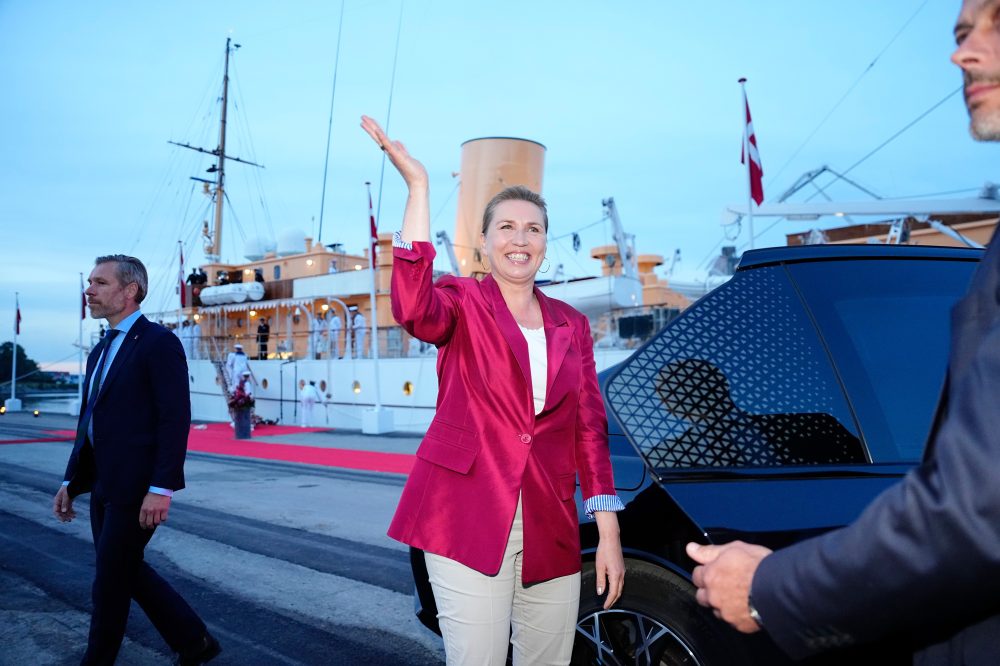

COPENHAGEN, Denmark (AP) — Denmark’s Social Democrat leader Mette Frederiksen will begin her third tenure as the nation’s prime minister, heading a center-left alliance of four political parties following two months of coalition talks.
The newly formed government consists of Frederiksen’s Social Democrats alongside three other parties: the centrist Moderates led by departing Foreign Minister Lars Løkke Rasmussen, the Green Left (SF), and the Danish Social Liberal Party, according to a Monday announcement from the Danish Royal House.
Speaking Monday evening, Frederiksen described the new administration as one that will serve “the people of Denmark, for the generations to come and for the animals.”
Frederiksen had triggered early elections in February, seemingly anticipating her party would gain support from her direct approach during tensions with U.S. President Donald Trump regarding Denmark’s semiautonomous Greenland territory.
The March parliamentary elections failed to deliver a clear majority for either progressive or conservative political blocs. Denmark’s proportional representation electoral system regularly results in multi-party coalition governments drawn from either the left or right side of the political spectrum.
This ruling coalition emerged after two unsuccessful government formation efforts — one led by Frederiksen herself and another by former Defense Minister Troels Lund Poulsen, who had attempted to establish a center-right administration.
The coalition’s policy agenda will be unveiled Tuesday, with cabinet appointments scheduled for announcement Wednesday.
The 48-year-old leader has governed the EU and NATO member nation since mid-2019. In the recent election, her party secured 38 seats in the 179-member unicameral legislature, representing a decline of 12 seats compared to the 2022 contest.
Frederiksen has gained recognition for her robust backing of Ukraine against Russia’s military aggression and for implementing strict immigration policies.
Responding to pressure from conservative opposition and citing concerns about potential migration increases due to the Iran conflict, Frederiksen proposed measures this year including a possible “emergency brake” on asylum applications and enhanced oversight of undocumented criminals. Her administration had previously announced plans allowing deportation of foreign nationals sentenced to one year or more for serious offenses.
During her second term, public approval declined amid rising living costs. However, she experienced renewed popularity while managing the diplomatic crisis over Trump’s interest in Greenland, which reached its peak in January with brief threats of European tariffs for nations opposing U.S. control of the Arctic territory.
The Greenland situation, which dominated government attention in recent months, played a minimal role in the campaign due to widespread consensus regarding its status within the kingdom.
In January, Frederiksen cautioned that American acquisition of Greenland would effectively destroy NATO. The crisis has since subsided.
Following Trump’s withdrawal of tariff threats against Denmark and other European nations opposing U.S. control of the Arctic island, the United States, Denmark, and Greenland initiated technical discussions for an Arctic security agreement.
Campaign discourse ultimately centered on living expenses, retirement benefits, and possible wealth taxation rather than foreign policy concerns.