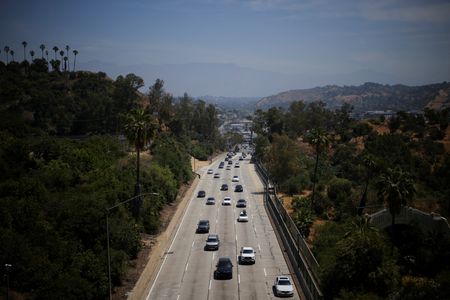

Despite gasoline costs climbing well above $6 per gallon in Los Angeles following recent military actions involving Iran, drivers in the traffic-heavy metropolitan area continue using the highways at typical levels, according to government transportation data.
The California Department of Transportation conducted an exclusive study for Reuters examining approximately eight weeks of traffic information through April 23, focusing on major roadways including Interstates 405, 10, and 5 following the February 28 U.S. and Israeli military strikes against Iran.
The analysis revealed no meaningful decrease in vehicle miles driven across Los Angeles-area highways, despite fuel costs that have created significant financial strain for motorists.
Traffic patterns on most major highway segments remained relatively stable, with some areas experiencing increases approaching 9% while others saw decreases reaching nearly 3% during the study timeframe.
“I think we’re immune,” commented 44-year-old Los Angeles resident Marco Falcon when informed about the research findings.
These results align with more than twenty years of studies demonstrating that American gasoline consumption remains largely inelastic, indicating drivers typically maintain their habits regardless of price fluctuations.
Research published by the National Bureau of Economic Research in 2006 revealed that motorists modified their driving patterns far less during fuel price increases in the 2000s compared to the oil crisis of the 1970s.
According to automobile club AAA, regular gasoline averaged $6.07 per gallon in Los Angeles on Monday, representing a nearly 28% increase from the previous year and standing 36% higher than the national average.
Falcon acknowledged that while increased fuel costs are unwelcome, Los Angeles motorists recognize that the country’s highest gasoline prices are simply part of life in car-dependent California.
“You just gotta figure out what your priorities are,” Falcon explained, noting he continues driving because alternative bus transportation would require three to four times longer travel periods. “Time is money for me.”
Public transportation usage showed modest gains, with combined weekday bus and train ridership increasing 1.6% year-over-year during March and April, while passenger miles grew 0.8%, according to the Los Angeles County Metropolitan Transportation Authority.
An agency spokesperson noted that while elevated fuel prices may have influenced these increases, the transit system has also added new stations and expanded service to additional areas.
“People don’t change their behavior much,” observed Brian Taylor, a research fellow at the Institute of Transportation Studies at the University of California, Los Angeles.
Taylor explained that when Los Angeles traffic appears lighter, it results from small vehicle reductions on nearly capacity-filled freeways creating disproportionately large improvements in traffic flow.
“A 10% drop in traffic can result in a 40% or 50% drop in delay,” Taylor stated.