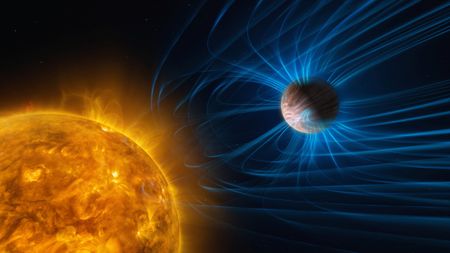

Scientists have uncovered the most compelling evidence to date that planets outside our solar system generate magnetic fields, a discovery that enhances our knowledge of distant worlds and their potential for supporting life.
The research, conducted using telescopes located in Chile and Hawaii, focused on seven massive, scorching gas planets and their atmospheric wind patterns. The findings reveal that these distant worlds share a crucial feature found in six of the eight planets within our own solar system.
Magnetic fields form when electrically charged materials move within a planet’s interior – typically molten metal in the core – combined with the planet’s spinning motion. This creates an invisible protective barrier around the world.
Although the gas giants examined in this research cannot support life as we know it, magnetic fields may play a vital role in making rocky worlds like Earth suitable for living organisms.
Each of the studied planets circles extremely close to large, hot stars, with one hemisphere constantly facing the star while the other remains in perpetual darkness, similar to how our moon always shows the same face to Earth.
Scientists classify these worlds as “hot Jupiters” due to their similar size and makeup to our solar system’s largest planet, though they experience much more extreme temperatures. The seven planets studied range from approximately Jupiter’s mass to more than three times heavier.
Powerful winds sweep from the blazing “dayside” to the frigid “nightside” of these worlds. Their close proximity to their host stars results in blistering atmospheric conditions on the sun-facing side. All orbit closer to their stars than Mercury does to our sun.
“What you would expect is that the planets with hotter temperatures would have stronger winds. The more energy you put into the system, the more violent the winds become. But we see the opposite,” explained astronomer Julia Seidel of the Observatoire de la Côte d’Azur’s Lagrange Laboratory in Nice, France, who led the study published Tuesday in Nature Astronomy.
“It’s the hottest planets that have the least strong winds mixing the atmosphere. And that’s really strange from what we know of how atmospheres behave,” Seidel noted. “That means all that energy that the star puts into the planet’s atmosphere has to be dissipated in a different way. And the only possibility to brake the atmosphere that much that fast is via the magnetic field and its interaction with the moving charged particles of the atmosphere.”
Wind velocities on these seven distant worlds reached speeds of up to 15,500 miles per hour (25,000 km per hour), exceeding those found on Jupiter.
Given that most planets in our solar system possess magnetic fields, researchers said the discovery that distant planets also have them makes sense. However, they noted that scientists had previously struggled to find convincing proof.
“We do not look at a singular exoplanet, but we look at a population of them and see a trend emerge,” Seidel stated.
Jupiter possesses the strongest and most extensive magnetic field in our solar system. The seven distant planets produced magnetic fields weaker than Jupiter’s but similar in strength to other solar system planets overall.
Mercury, Saturn, Uranus and Neptune join Earth and Jupiter as our solar system’s planets that create global magnetic fields. Venus and Mars lack magnetic fields, though Ganymede, one of Jupiter’s large moons, produces its own magnetic field. Earth’s moon also once generated its own magnetic field long ago.
Magnetic fields represent one factor that determines whether a planet can preserve its atmosphere over extended periods. Mars, for example, once possessed a magnetic field but lost it billions of years ago when its interior cooled, leaving it with only a thin atmosphere and harsh surface conditions.
“Although it’s a common misconception that magnetic fields directly determine whether a planet is habitable, they can play an important role in how a planet evolves over time,” said astronomer and study co-author Bibiana Prinoth of the European Southern Observatory in Germany. “Life as we know it relies on having an atmosphere. An atmosphere helps maintain surface pressure, regulate temperature and, on Earth, allows liquid water to exist at the surface.”