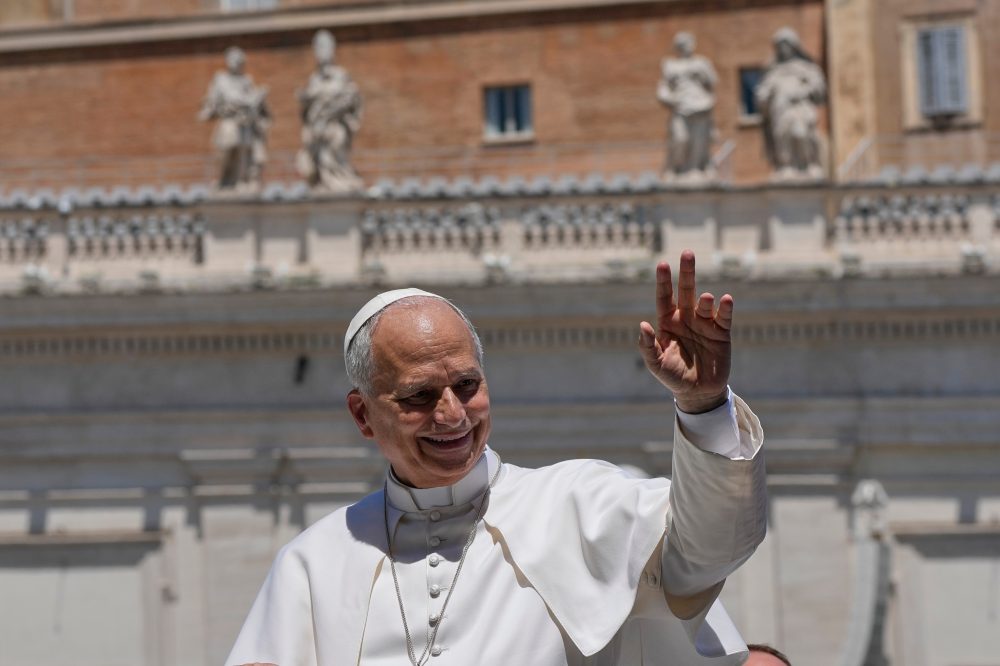

Following the release of his comprehensive statement demanding strong oversight of artificial intelligence, the pontiff found himself at the center of internet buzz when Saint Hoax, an Instagram account with over 3 million followers, shared content about his call to “disarm” AI technology. The post’s caption declared: “Love my woke pope (I’m not even Catholic).”
Another social media user on X referenced a popular internet joke in response to the religious document, posting: “The atheism leaving my body the moment the pope starts talking about how AI is an affront to God and the new Tower of Babel.”
Such responses to the papal leader’s inaugural encyclical, titled “Magnifica Humanitas” (Magnificent Humanity), have flooded social platforms since its publication last week. The widespread excitement stems partly from a belief, particularly among younger generations, that few political or international figures truly understand or seriously address the known and possible consequences of AI’s swift advancement. Many leaders have typically worked to support the technology sector, pointing to economic growth needs while critics argue they’ve grown too close to affluent executives.
“People have really been looking for a response to AI,” commented Isabel Thurston, a 27-year-old comedian from Boston. “This was the first — at least in my sphere of the world — world leader to make an announcement to this magnitude.”
The first pontiff born in the United States has shown readiness to adopt elements of modern culture. He was recently seen wearing Nike sneakers beneath his religious robes, and in his encyclical, the pope referenced the wise wizard Gandalf from the “Lord of the Rings,” a work by Catholic writer J.R.R. Tolkien.
“It’s clear that this is written by an American pope. There’s a spirit breathing through this document of an emphasis on individual freedom, on human happiness and human dignity,” stated Robert Orsi, a professor of religious studies and history at Northwestern University, regarding the papal document. “At times, I thought the language really resonates with the Declaration of Independence.”
This particular type of cultural understanding may help clarify some of his internet fame as head of the centuries-old faith.
Just weeks before, a group of young visitors to the Vatican persuaded the 70-year-old religious leader to perform a popular hand movement on camera called the 6-7 meme — a nonsensical “brain rot” joke among youth. While the video clearly shows the pontiff, like most older adults, doesn’t grasp what they’re requesting or its meaning, he complies anyway and receives excited applause. Seven days later, he repeated the gesture while smiling and greeting crowds from his vehicle.
The image emerging from these moments shows both playfulness and purpose. The religious leader emphasizes throughout “Magnifica Humanitas” that the church must address current questions and difficulties.
“Her mission has a historical scope and entails a responsibility for the way in which social relations are built,” the pope wrote about the Catholic Church. “She cannot consider herself a stranger to the forces shaping society. On the contrary, the Church actively participates in the processes by which society grows and is organized.”
Since his selection last year, the pontiff has made efforts to directly communicate with — and sometimes criticize — various elements of society, from politics to entertainment and athletics.
Orsi examines the connection between Catholicism and modernity, which he notes have frequently clashed throughout history. He explained that the pope’s encyclical and his overall leadership, similar to his predecessor’s, draws heavily from the still-controversial Second Vatican Council, which introduced modernizing changes to the church over 60 years ago.
“It’s speaking with a Vatican II voice to the modern world. So, it’s not a voice of condemnation, but it’s a voice of respect,” Orsi said about the papal document. “Pope Francis, in a sense, was the necessary prelude to this kind of encyclical. I think Francis gave a really strong encouragement to take a clear critical voice on these urgent questions.”
However, not everyone has supported the pope’s methods. Some criticized his choice to unveil his encyclical alongside Anthropic co-founder Christopher Olah. The Vatican chose to include the technology company as part of its ten-year initiative to engage Silicon Valley in discussions about AI’s human impact.
In the approximately 42,300-word document, the religious leader urges all “men and women of goodwill” to not fear getting their “hands dirty on the ‘construction site’ of our time.”
This readiness has occasionally resulted in careful but public criticism of policies, actions and leaders, including U.S. President Donald Trump and the continuing conflict in Iran. Some conservatives including Vice President JD Vance, who converted to Catholicism, have referenced “just war” theory in response to the pope’s criticisms.
Church doctrine has historically permitted “just wars” — using force to prevent unjust aggression — when specific requirements are satisfied. But the pontiff directly challenged this teaching in his encyclical, labeling it “outdated.” “Humanity possesses far more effective and capable tools for promoting human life and resolving conflicts, such as dialogue, diplomacy and forgiveness,” he wrote.
Last November, the religious leader held a “World of Cinema” event at the Vatican with performers and directors including Cate Blanchett, Viggo Mortensen, Gus Van Sant and Spike Lee, who presented him with a personalized New York Knicks jersey featuring the number 14 and the name Pope Leo on the back.
“Cultural facilities, such as cinemas and theaters, are the beating hearts of our communities because they contribute to making them more human,” the pope told his Hollywood guests. “The logic of algorithms tends to repeat what ‘works,’ but art opens up what is possible.”
He has also openly expressed his affection for the Chicago White Sox, occasionally wearing baseball caps or posing with bats — the latter inspiring a category of papal memes. “POV: you’re a priest who just asked ChatGPT to write your Sunday homily,” the Rev. Harrison Ayre shared on X with a photo of the pope holding a bat and smiling.
Soon after “Magnifica Humanitas” was published, Thurston, who is Catholic, uploaded a video of herself and a friend drinking margaritas while carefully examining and discussing printed copies of the encyclical. The content has accumulated over 3 million views on Instagram.
“An aspect that made the video going viral really joyful for me was to represent all of the Catholics or lapsed Catholics or adjacent interested parties as really celebrating what Pope Leo is saying in his encyclical,” she explained.
Orsi noted this approach arrives at a critical moment for the Catholic Church after years of confronting its history of clergy sexual abuse. “I think a lot of people who moved away from the church are now saying, ‘Wait, maybe the church does have something to say to the modern world,’” he said.