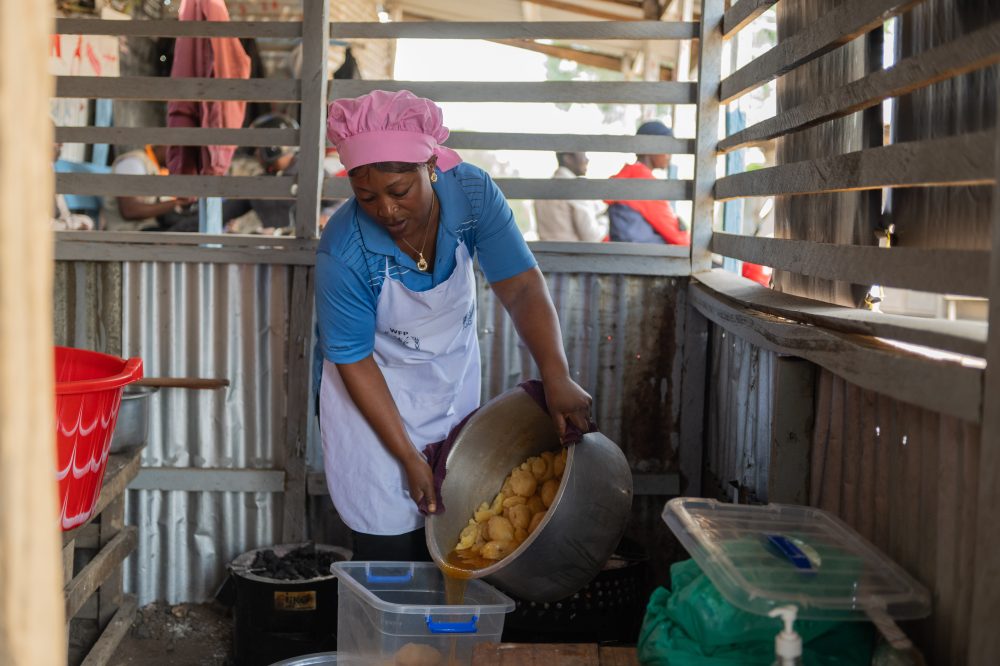

BUNIA, Congo (AP) — In the epicenter of Congo’s Ebola crisis, Arlette Basekawike dedicates her days to cooking meals for patients and medical staff from a modest shelter beside a healthcare center.
Wearing a pink head covering, Basekawike works as a volunteer with the United Nations food agency, creating breakfast dishes like porridge, eggs and bread for those receiving care at the Evangelical Medical Center. For other meals, she might serve fresh fish alongside fufu, a traditional dish made from mashed plantains, topped with fruit.
“Even though the patients have this disease, they still feel better when they eat, and the doctors have the energy to treat the sick and give them medication,” Basekawike explained to The Associated Press on Monday while cooking vegetables and potatoes with goat meat in a large pot. “I’m here for them like a parent, preparing food so they feel comfortable.”
While her work might seem straightforward, it has emerged as vital support for the area confronting the fast-moving rare Bundibugyo virus, the Ebola strain identified in eastern Congo during May.
By Tuesday, the World Health Organization reported 321 confirmed Ebola infections and 48 fatalities across the Central African country’s three eastern provinces: Ituri, North and South Kivu. Uganda has documented nine cases and one death according to WHO data, leading Uganda to seal its border with Congo.
Prior to this health emergency, the troubled region was already experiencing one of the planet’s worst food emergencies because of continuing warfare that has forced millions to flee as government troops battle insurgents. The viral outbreak has created additional complications that the United Nations cautions could hinder efforts to control transmission among a population already filled with distrust.
“We are in a region where we already have large segments of the population suffering from acute food insecurity linked to either war or displacement,” explained Olivier Nkakudulu, who leads the World Food Program in Ituri province. “So there are already needs and Ebola is an additional crisis on top of a crisis.”
The financially strained World Food Program confronts difficult decisions as funding reductions from the U.S. and other key donors have disrupted activities in this vulnerable area. Attempts to control the disease, which the World Health Organization has classified as a global health emergency, have been hindered by insufficient funding as international partners have either pulled out or decreased their commitments.
Additionally, assaults by distrustful community members on medical personnel and delayed aid delivery caused by the persistent conflict have made containing the disease’s spread challenging.
Nevertheless, the agency and healthcare workers report they have successfully maintained patients’ nutritional requirements thus far.
“Today we need to increase the amount because the number of patients has gone up,” stated Esther Bao, a nurse and volunteer. Some patients, due to their medical conditions, “don’t eat just any meal,” she noted.
No approved vaccine or cure exists for the Bundibugyo virus. Treatment focuses on managing symptoms, and five individuals have made recoveries.
The outbreak keeps expanding, growing from three affected health zones initially to 22 as of this past weekend, based on Congo’s Ministry of Health data.
On Sunday, 120 meals were distributed across four medical facilities, totaling 404 meals since food support started on May 28, Nkakudulu reported. However, the financial outlook remains challenging, he said.
“Without more funding, we might not be able to prioritize every suspected case,” Nkakudulu warned. “We might have to focus on some and not have food to give to others.”