A top Federal Reserve official warned Wednesday that the central bank may need to implement an interest rate increase this year as economic indicators suggest current monetary policy isn’t doing enough to control inflation.
Lorie Logan, who leads the Dallas Federal Reserve, expressed growing concern about strong economic performance and corporate profits that are “going gangbusters,” which could complicate efforts to bring inflation down to the Fed’s 2% objective.
Logan’s comments arrive just two weeks before Kevin Warsh leads his inaugural Fed policy meeting, as inflation pressures mount and his new colleagues increasingly believe more aggressive action may be required to address these challenges.
Current financial conditions remain supportive, Logan noted Wednesday, with artificial intelligence investments continuing to surge and drive economic demand without yet providing the productivity improvements that could help reduce inflation. Warsh has previously supported the view that AI technology could help lower inflation.
Despite rising energy costs that particularly impact lower-income families, consumer spending remains robust, Logan observed.
“These conditions indicate that monetary policy is not restraining the economy,” Logan stated in prepared remarks for a speech in El Paso, Texas.
Inflation continues to climb, driven not only by previous tariff implementations and this year’s oil price increases due to the Iran war, but also by additional underlying factors, she explained.
After examining various measures of core inflation, Logan said price increases appear to be moving toward the mid-2% range rather than reaching the Fed’s precise 2% target.
“I am increasingly concerned that higher interest rates could be necessary later this year to fully restore price stability and appropriately balance both sides of the Fed’s dual mandate,” Logan declared.
At the Fed’s most recent policy meeting, Logan joined two other officials in dissenting, advocating that the central bank should indicate a rate increase, not just a rate reduction, could be their next policy move.
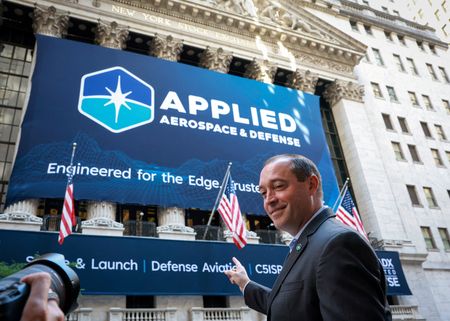
A space and defense hardware company saw its stock price climb during its first day of trading on Wednesday, giving the business a market value of $3.54 billion.
Applied Aerospace & Defense, headquartered in Huntsville, Alabama, watched its shares gain 3.8% during its initial trading session on the New York Stock Exchange. The company’s stock began trading at $20.75 per share, higher than its initial offering price of $20.
The company successfully sold 32.5 million shares priced between $18 and $21 each, generating $650 million in capital through the public offering.
Market activity for new stock offerings has picked up steam over the last two months following a slowdown in March. Several major companies are preparing to launch their own public offerings this week, including Quantinuum, a quantum computing business owned by Honeywell, and gas engine maker Innio.
Recent tensions involving the U.S.-Israeli conflict with Iran have contributed to increased interest in defense and aerospace company stock launches in recent weeks.
The food manufacturing giant Kraft Heinz is planning to intensify its product development efforts in the upcoming year, according to CEO Steve Cahillane in a recent interview with Reuters. This strategic move is part of the company’s broader initiative to recover from a decade of declining market position.
Since assuming leadership in January, Cahillane has allocated $600 million toward marketing and research and development initiatives this year. The investment targets rebuilding the company’s innovation capabilities and revitalizing its primary U.S. operations, which account for nearly 70% of total revenue.
“Next year is going to be better because we’ve put a lot of changes in place around the R&D, around process improvement, around resource allocation that will lead to a better innovation pipeline for 2027 than we had in 2026,” Cahillane stated, though he declined to elaborate on specific details.
The company’s strategy includes expanding into healthier product categories, including items with higher protein content and reduced sugar levels. Recent launches include a protein-enhanced version of its well-known Mac & Cheese in March, electrolyte-boosted Capri Sun beverages, and additional products in its sugar-free Heinz Zero line to appeal to health-conscious consumers.
“You’ve got to be willing to step out there and extend your brand a little bit and try things,” commented Ross Glotzbach, CEO and director of research at Southeastern Asset Management, a Kraft Heinz investor who endorses these strategic changes.
This renewed emphasis on innovation follows an extended period during which the company ranked among the food sector’s poorest performers. Over the past ten years, it has surrendered market share to both established competitors and emerging brands like Goodles, largely due to insufficient investment, budget reductions, and increased competition from healthier alternatives and store-brand products.
While the company’s stock has declined 3.8% this year, it has performed considerably better than competitors including Conagra Brands and Campbell’s, whose shares have dropped approximately 25%, indicating investor confidence in the current approach.
One of Cahillane’s most significant early decisions as CEO involved halting plans to divide the company into separate entities—one concentrating on grocery items and another on condiments and spreads—a move that preserved $300 million.
Industry analysts suggest that sustainable growth for the unified organization will require ongoing investment, given that Kraft Heinz operates in slow-growth market segments.
Recent performance data shows U.S. sales volumes decreased 4.1% in the four weeks ending May 16 compared to the previous year, while dollar sales dropped 1.9%, according to BNP Paribas analyst Max Gumport, referencing Nielsen statistics.
“That’s not going to be a sustainable outcome after $600 million of investment,” Gumport observed. “When you get to the end of this year, they will need to invest more, because what you need is volumes to be flat and dollar sales up for this business to work.”
The company is also committing to absorbing approximately 80% of inflation costs this year rather than transferring them to consumers, which constrains its ability to balance expenses and increases dependence on new product launches for revenue growth.
Cahillane indicated the company would increase spending further if initial results from new product introductions remain positive.
Company data from May revealed that 58% of its products were maintaining or gaining market share in March, up from 21% at the close of 2025.
“Some of the early returns we’re seeing gives us optimism that we might have the opportunity to invest even more,” he explained.
Google’s parent company Alphabet has boosted its equity fundraising goal to $84.75 billion on June 3, demonstrating robust investor enthusiasm for major technology firms as they build out artificial intelligence capabilities and computing infrastructure.
The company initially announced plans on Monday to secure $80 billion in funding, as major tech corporations work to surpass one another in constructing AI data centers amid what industry leaders view as a transformational artificial intelligence competition.
According to a June 2 regulatory filing, Alphabet now seeks to generate $18 billion by selling Class A and C shares alongside $16.75 billion from depositary shares. The company’s original strategy involved raising $30 billion through simultaneous public offerings supported by investment banks, with equal amounts allocated to both share types.
Alphabet’s strategy to secure $10 billion via private share placement to Berkshire Hathaway and an additional $40 billion through an at-the-market offering program during the third quarter continues as previously outlined.
The share offerings are scheduled to complete on June 4, with depositary shares wrapping up one day afterward, according to company statements.
In April, Alphabet increased its yearly capital expenditure projection by $5 billion, setting the range between $180 billion and $190 billion.
Major global technology corporations are accessing debt markets and pursuing equity funding to strengthen AI infrastructure, representing a departure for Silicon Valley companies that historically used cash reserves for investment purposes.
The collective spending by technology giants is now projected to surpass $700 billion this year, exceeding previous estimates of approximately $600 billion.
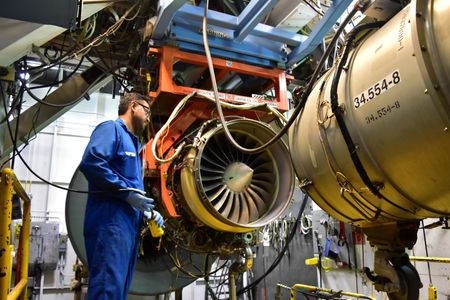
Honeywell Aerospace revealed to investors Wednesday its projection of reaching $6.5 billion in adjusted earnings by 2030, driven by robust demand from aircraft manufacturers and defense clients, combined with increased operational focus following its upcoming separation from Honeywell International.
The aircraft engine, components and defense systems company, which will begin trading under the ticker HONA following the June 29 split, plans to concentrate investment dollars on expanding production capacity and strengthening its supply chain instead of emphasizing dividend payments or stock repurchases, according to Honeywell Aerospace CEO Jim Currier in a Reuters interview.
“We have so much to make that just driving capital allocation into factories, suppliers, the business itself is going to provide a tremendous (return on investment capital) that’s going to drive the organic growth of the business,” he said.
The aerospace division’s separation mirrors GE Aerospace’s approach to conglomerate breakups, wagering that streamlined, specialized companies can achieve superior performance. During 2025, industrial giant Honeywell announced intentions to establish three standalone companies concentrating on automation, aerospace and advanced materials. The corporate divisions are scheduled for completion this year.
“All of the distractions that occur as part of a conglomerate are eliminated,” Currier said.
During its time within Honeywell International, there existed a “lack of synergies that exist between aerospace and the rest of the portfolio (and) you don’t see a lot of that efficiency gain by being a part of this industrial conglomerate,” he said.
A March partnership with the Pentagon, RTX and Lockheed Martin to boost precision-guided missiles and munitions manufacturing demonstrates how operating as a leaner organization enables Honeywell Aerospace to act more rapidly, Currier explained.
The partnership demands a $500 million company investment. Prior to the breakup, “that would have been a very difficult thing to do as part of an industrial conglomerate, (but) we were able to get that deal done in record time,” he said.
The organization anticipates 7% to 9% sales growth this year, earnings before interest and taxes of $4.6 billion to $4.7 billion and free cash flow in the second half of the year of $1 billion to $1.5 billion.
Throughout the remainder of the decade, the company projects annual sales increases of 6% to 8%, with more than $4 billion in free cash flow by 2030. This growth stems from increasing demand from commercial aircraft manufacturers, the aftermarket sector, defense and space industries. Honeywell Aerospace’s backlog has expanded to $19 billion, representing a 20% increase from the previous year.
Supply chain challenges impacted key products, including engines, during the first quarter of the year, but those represented temporary issues, Currier stated.
Investors and analysts remain interested in learning additional details about Honeywell Aerospace’s supply chain management approach. Jefferies investment analyst Sheila Kahyaoglu mentioned in a May 31 research note that concerns exist regarding the company potentially receiving less favorable treatment from essential suppliers, including castings and forgings providers.
The company’s investment amounts have also fallen behind those of its competitors, including RTX, she observed.
Honeywell Aerospace intends to invest in its suppliers, along with its own capacity, Currier stated.
“If I need to buy equipment for suppliers, smaller suppliers that are providing critical components for us, we will go ahead and do that as well, where necessary and where required,” he said. “So, when I think of capital deployment, it’s not just within our own four walls.”
Similar to other companies, the organization monitors potential supply chain constraints in castings, forgings, bearings, specialty materials, coatings and complex machining.
Last month, individuals from the company’s marketing team visited Currier’s office at its Phoenix, Arizona, headquarters, carrying a sample golf shirt featuring the Honeywell Aerospace logo and the phrase “established in 2026.”
Currier placed the shirt on his conference table.
“That’s when it really hit me … this is a brand-new aerospace and defense company, you know, out from underneath Honeywell, and so, it actually gave me some goosebumps,” Currier said.
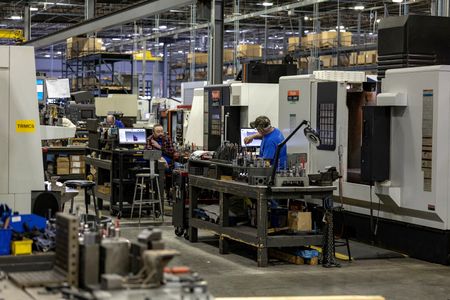
Manufacturing orders across the United States experienced their most significant monthly jump in nearly a year during April, driven by robust demand for commercial aircraft and numerous other manufactured goods.
The Commerce Department’s Census Bureau announced Wednesday that factory orders climbed 4.8%, representing the strongest monthly performance since May 2025. This followed an upwardly adjusted 1.8% growth in March. Economic analysts surveyed by Reuters had predicted a 4.6% increase, following what was initially reported as a 1.5% March gain.
Year-over-year comparisons showed orders climbing 6.0% in April. The manufacturing sector, representing 9.4% of the nation’s economy, continues benefiting from increased artificial intelligence-related spending, though the ongoing U.S.-Israeli conflict with Iran creates potential economic risks.
The three-month military conflict has significantly disrupted commodity shipping routes and inflated costs for energy, aluminum, and fertilizer products. A Monday survey from the Institute for Supply Management revealed that supplier delivery performance deteriorated for the sixth straight month in May, maintaining elevated input costs.
Commercial aircraft orders experienced a dramatic 165.9% surge following a 23.0% decline in March. Boeing’s website indicated the company secured 136 orders during April, predominantly for higher-priced aircraft models, compared to just 33 orders the previous month.
Primary metals orders grew 2.0%, while fabricated metal products bookings increased 3.5%. Machinery orders advanced 0.7%, and electrical equipment, appliances, and components saw 0.5% growth. Motor vehicle bodies, parts, and trailers also posted gains. However, computers and electronic products orders fell 0.7%, with computer orders specifically dropping 2.5%.
The Census Bureau additionally reported that non-defense capital goods orders excluding aircraft, considered an indicator of business equipment investment intentions, decreased 1.0% in April rather than the previously estimated 1.1% decline. Shipments of these core capital goods increased 0.4% as initially reported.
The president of the Federal Reserve Bank of New York emphasized Wednesday that the nation’s central banking system doesn’t need to adjust short-term interest rate policies, even as inflation concerns persist due to Middle East conflicts and other economic pressures.
During a Wednesday appearance on Yahoo Finance, John Williams expressed confidence in the current monetary approach. “Monetary policy, I think, is exactly in the right place,” Williams stated during the interview. “I don’t see any need to raise or lower interest rates right now” and “I don’t see an obvious argument to that we should change interest rates, but I also don’t see an obvious kind of direction where we would go in the future.”
Williams’ comments reinforce the Federal Reserve’s position on maintaining current interest rate levels despite ongoing economic uncertainties.
A reader recently reached out with a common household dilemma: their spouse shows minimal engagement with the family’s financial situation, which has become increasingly worrying as they get older.
The concerned partner explained that they attempt to share basic financial data monthly – covering earnings, expenses, account totals, and debt levels – but receive little response. They wondered if visual presentations like charts or graphs might capture their spouse’s attention better than raw numbers.
According to financial experts, this scenario plays out in many households. Most married couples naturally fall into a pattern where one partner handles the money management while the other remains less engaged. This division of responsibilities often functions well for years, but can create problems as couples age, especially if the financially-savvy partner becomes ill or passes away first.
The suggestion to use visual representations is excellent and could help draw in a reluctant spouse. Morningstar’s Portfolio X-Ray feature provides various graphics that help display financial status clearly. Major investment companies also offer visual resources – Schwab provides Portfolio Checkup services and bar charts showing monthly dividend and interest earnings, while Vanguard offers Portfolio Watch features along with performance displays and calculation tools.
Another approach involves creating a mind map, a technique used by financial advisory companies to present an entire financial picture on a single page. Various software options exist for creating these maps, though a simple sketch using paper and pencil works just as well. Place both spouses’ names at the center, then draw connecting lines to different categories including family members, investment portfolios, property holdings, insurance coverage, estate planning documents, important objectives, and contact details for professional advisors. Reviewing and updating this map annually as a team can be beneficial.
Beyond visual aids, several other strategies may prove helpful. Creating a comprehensive net worth document that lists cash holdings, taxable accounts, property values, retirement savings, and debts for each spouse plus joint assets provides clarity. Annual updates and discussions about this document are recommended. Setting it up as a spreadsheet allows for additional details like account numbers, account purposes, required distribution information, and tax considerations such as potential capital gains.
Many couples also assemble what’s sometimes jokingly called a ‘Doomsday Book’ – a comprehensive binder containing information about important document locations, insurance policies, bill payment procedures, account purposes, steps for the surviving spouse, final preferences, and other essential details.
Working with a qualified financial adviser represents another option. A good adviser can help involve both spouses in financial discussions during their lifetimes and provide full management if one partner dies first. Look for advisers with Certified Financial Planner credentials who charge reasonable fees. While 1% remains standard for accounts under $1 million, some advisers charge considerably less, including some who bill by hours worked rather than asset percentages.
WASHINGTON, June 3 – The nation’s services sector expanded at a faster pace during May as companies rushed to secure orders and increase stockpiles amid concerns about potential shortages and rising costs stemming from the war with Iran.
On Wednesday, the Institute for Supply Management announced that its nonmanufacturing purchasing managers index climbed to 54.5 in May, up from April’s reading of 53.6. This exceeded economists’ expectations, who had predicted the services PMI would reach 53.8 according to a Reuters survey.
Any measurement exceeding 50 signals expansion in the services sector, which represents over two-thirds of the nation’s economic output. The ongoing three-month U.S.-Israel conflict with Iran has significantly disrupted commodity shipping routes and driven up costs for various goods, including energy, aluminum and fertilizers.
This uptick in services activity aligns with increased manufacturing performance that the ISM reported earlier this week.
New orders for service companies surged to 57.3, compared to April’s 53.5. Meanwhile, services sector inventory levels skyrocketed to 62.5 from the previous month’s 53.1. Companies have been reducing their stockpiles for four consecutive quarters, marking the longest decline since the Great Recession. However, backlog orders and exports both experienced slower growth.
Input costs for businesses continued climbing, with the survey’s price measure reaching 71.3, up from 70.7 the month before. This suggests the oil price surge will continue affecting the services sector. Government data released last week showed inflation accelerated to its fastest rate in three years during April.
Financial markets anticipate the Federal Reserve will maintain its key overnight interest rate between 3.50%-3.75% through next year.
Supplier delivery times remained problematic, though the measure decreased slightly to 55.2 from April’s 56.8. Readings above 50 indicate delayed deliveries. While this elevated figure likely boosted the services PMI as economic demand grows stronger, supply chain disruptions are primarily responsible for the extended delivery periods.
Employment in the services sector stayed weak. The ISM has observed increased “attrition.” However, the ISM’s employment indicator hasn’t proven reliable for predicting private services job growth in the Labor Department’s monthly employment data.
National payroll numbers have shown consecutive months of gains exceeding 100,000 jobs. Economists surveyed by Reuters predict May payrolls likely grew by 85,000 positions following April’s increase of 115,000.
The unemployment rate is expected to remain steady at 4.3%.
Ford Motor Company is pulling nearly 420,000 SUVs from the road due to defective seat belt mechanisms that could cause injuries during accidents.
Federal safety officials announced Tuesday that the recall affects select Ford Expedition and Lincoln Navigator models manufactured between 2018 and 2022, according to the National Highway Traffic Safety Administration.
The problem centers on seat belt mechanisms that can jam unexpectedly, preventing the belts from properly extending or retracting. Federal safety officials warn that malfunctioning seat belts could lead to injuries during collisions. Additionally, passengers may be hurt if the belt mechanism snaps back too quickly.
This latest action replaces and broadens two earlier federal recalls. Ford Motor Co. has documented two warranty complaints and two field reports connected to this newest recall action. The automaker has confirmed one injury linked to the defect.
Affected vehicle owners will receive mail notifications about the recall. Drivers can bring their SUVs to Ford or Lincoln dealerships for free inspections of both front seat belt mechanisms and replacement of any defective parts covered under the recall.
Vehicle owners seeking additional details can reach Ford customer service at 1-866-436-7332 or contact the NHTSA at 1-888-327-4236.
When car buyers make the decision to purchase an electric vehicle, the challenging part becomes selecting the right model. Electric SUVs are becoming increasingly popular among consumers who need practical vehicles for daily use. Current models offer sufficient driving range for regular commutes and occasional long-distance trips while providing family-friendly space and cutting-edge technology. Two standout options are the Tesla Model Y and Toyota bZ.
Tesla’s top-selling electric vehicle receives significant updates for 2026, featuring refreshed appearance, enhanced ride quality, and an upgraded interior. Meanwhile, Toyota’s electric SUV has undergone complete redesign for 2026, transforming it into a much stronger competitor compared to the previous version. Automotive testing experts conducted a comprehensive comparison of these electric SUVs to determine which deserves consideration for purchase.
Toyota’s inaugural all-electric SUV, previously called the bZ4X, underwent such extensive changes that it received a new designation. Most notably, driving range has seen substantial improvement. The front-wheel-drive 2026 bZ achieves up to 314 miles per charge based on EPA ratings. Independent testing confirmed these figures, with one test vehicle achieving 331 miles, an outstanding performance for a compact electric SUV.
Similar to the bZ, various Model Y configurations offer different range capabilities. The Premium Rear-Wheel Drive version provides the longest range at an EPA-estimated 357 miles. While this specific Model Y variant hasn’t undergone independent range testing, other tested Model Y versions have met their EPA projections.
Testing also examined charging performance for both SUVs at public fast-charging locations. Both vehicles delivered comparable results, potentially adding approximately 100 miles of range within 15 minutes. However, the Model Y offers greater charging convenience through Tesla’s extensive Supercharger network.
Winner: Model Y
The Tesla Model Y continues to rank among the most enjoyable electric SUVs to operate. It provides rapid acceleration, smooth ride quality, and sporty handling characteristics around turns. The interior maintains excellent sound isolation from external noise, while front seats offer extensive adjustment options for extended driving comfort.
Although the previous bZ4X suffered from sluggish performance, the new bZ delivers impressive acceleration in both single and dual-motor options. The front-wheel-drive bZ actually exceeded the base Model Y Rear-Wheel Drive in acceleration testing from 0-to-60 mph, while the all-wheel-drive bZ finished slightly behind the Model Y All-Wheel Drive in identical testing. The bZ provides comfortable ride quality over rough surfaces, though it lacks the Model Y’s composure during cornering maneuvers.
The Model Y offers significantly superior interior room. It provides greater rear passenger legroom, accommodating adults more comfortably and offering additional space for large rear-facing car seats. The Model Y also delivers more cargo capacity and additional storage compartments for smaller items.
Winner: Model Y
Tesla’s entertainment system continues to excel with its intuitive interface and rapid responsiveness. Dual wireless charging pads enhance convenience, while Tesla’s sophisticated driver assistance technology provides competitive advantages. The Full Self-Driving (Supervised) capability stands out for enabling hands-free operation on highways and city roads. Nevertheless, the absence of Apple CarPlay and Android Auto connectivity might concern some purchasers.
Toyota responds with a new 14.1-inch touchscreen entertainment system that offers user-friendly operation and supports wireless Apple CarPlay and Android Auto connections. Dual wireless phone charging stations are located in front, with four fast-charging USB-C ports throughout the vehicle. Standard driver assistance capabilities are extensive. The bZ includes hands-free driving functionality, though it operates only at reduced speeds on highways.
Winner: Model Y
The entry-level Model Y Rear-Wheel Drive begins at $41,630 including destination charges. However, this base model lacks several desirable electric vehicle features. The Premium Model Y version represents the better choice due to increased power, slightly extended range, and enhanced interior appointments. A Model Y Premium All-Wheel Drive costs $51,630.
The Toyota bZ starts at $36,495 and includes substantial equipment for the price, particularly considering the enhanced performance and range now available. The highest-trim bZ Limited adds additional features and compares favorably to the Model Y Premium. It costs $46,895 in the available all-wheel-drive configuration.
Winner: bZ
The Toyota bZ’s enhancements transform it into a significantly more attractive electric SUV than its predecessor, with its affordable starting price appealing to budget-conscious buyers. Nevertheless, the Tesla Model Y maintains its leadership position in this market segment through superior technology, performance, and overall polish. While Toyota has achieved notable improvements, the Model Y remains the superior option.
This story was provided to The Associated Press by the automotive website Edmunds. Bradley Iger is a contributor at Edmunds.
The department store chain Macy’s announced Wednesday that it has achieved four quarters in a row of comparable sales growth, as the retailer credits changes to its product selection and improved customer service for connecting with shoppers.
The New York-based company updated its annual projections upward Wednesday, and stock prices climbed more than 3% before markets opened.
“We’re off to a strong start to the year,” said CEO Tony Spring, who is in the third year of an attempted turnaround of the storied retailer. “We’re operating with discipline and focusing on what matters most — our customers.”
Sales at existing online platforms and physical locations increased 3% in the first quarter. This exceeded the 1.8% growth seen in the fourth quarter of 2025 and marked the strongest first quarter performance for such sales in four years, according to the company. Main Macy’s locations saw comparable sales rise 1.6%, while Bloomingdale’s stores achieved a 10.2% increase, setting a record for first-quarter sales volume. Bluemercury, the beauty retailer also under Macy’s ownership, recorded a 6.4% comparable sales increase.
These results represent another positive development for Macy’s, which had experienced a prolonged period of declining sales. Since Spring assumed leadership in early 2024, the company has shuttered underperforming locations and invested millions to upgrade remaining stores. The retailer has enhanced customer service operations and worked to distinguish its luxury offerings from competitors through exclusive products.
Industry experts have partially attributed Bloomingdale’s strong performance to the Chapter 11 bankruptcy filing of Saks Global, which operates Saks Fifth Avenue and Neiman Marcus.
However, Macy’s continues to face the same obstacles confronting the broader retail industry.
American retailers have spent recent months dealing with economic uncertainty, including President Donald Trump’s tariffs and the effects of rising fuel costs due to the Iran war. Regular gasoline prices have remained above $4 per gallon since March, according to AAA data. A gallon now costs 40% more than before the conflict began. Recent earnings reports from major retailers highlight how consumers face mounting financial pressure as they cope with higher costs for fuel, food, utilities and nearly all other goods.
In a Wednesday phone interview with The Associated Press, Spring said the company is carefully watching developments given economic uncertainty, but has not observed any notable reduction in customer spending since fuel prices began climbing.
He believes Macy’s enhanced product mix and value proposition are resonating with shoppers. The company has seen robust sales in formal dresses, men’s footwear, women’s dresses and perfumes. Spring did note weak furniture sales, as consumers continue delaying major purchases.
“Despite the choiceful consumer, despite all the things that are going on that we read about every day in terms of the geopolitical, macroeconomic environment, fashion and newness and the consumer’s desire to indulge is still happening,” Spring told The AP. “And we’re very pleased that we are taking share.”
Spring observed that affluent customers maintain their spending habits, supported by stock market gains, while middle-income shoppers remain more cautious. He noted that lower-income customers continue facing challenges but are gravitating toward Macy’s sections featuring deeply discounted items.
The company posted net earnings of $63 million, or 23 cents per share, for the quarter ending May 2. Adjusted earnings per share reached 13 cents, exceeding Wall Street expectations by ten cents, according to FactSet data.
This compares to a $38 million profit, or 13 cents per share, in the same period last year.
Total sales increased to $4.68 billion from $4.6 billion in the prior year period. This quarter’s revenue also surpassed Wall Street forecasts.
The retailer now projects annual sales between $21.5 billion and $21.75 billion, raising its previous March guidance of $21.4 billion to $21.65 billion. Macy’s also revised its comparable sales outlook upward, now expecting growth between 0.5% and 1.2% on Wednesday. The company’s March prediction called for a decline of 0.5% to growth of 0.5%.
The company also raised its annual earnings per share forecast to a range of $2 to $2.20, up from previous guidance of $1.90 to $2.10 per share.
For the complete fiscal year, analysts had projected $2.09 per share on revenue of $21.6 billion, according to FactSet analysts.
A market intelligence company announced Wednesday it has secured $350 million in fresh funding, pushing its worth to $7.5 billion — nearly twice what it was valued at during its last investment round.
AlphaSense’s latest funding round was spearheaded by Vitruvian Partners, Accenture Ventures, and J.P. Morgan Asset Management. New backers in this round include D. E. Shaw Ventures and Pinegrove Opportunity Partners.
Established in 2011, the company operates an artificial intelligence-driven platform that assists businesses and financial professionals in examining companies, markets, and industries. The system draws from various sources including research reports, regulatory documents, earnings call transcripts, and news content.
This investment underscores the robust appetite among investors for AI-focused companies, as organizations continue embracing artificial intelligence technologies to boost efficiency, streamline operations, and process vast amounts of information.
The firm’s worth has climbed significantly from the $4 billion valuation it achieved in its 2024 funding round.
The New York-headquartered company exceeded $600 million in annual recurring revenue during the first quarter and has accumulated over $1 billion in total funding since inception.
According to the company, this latest capital injection will fuel its overseas growth plans and help expand its worldwide customer service capabilities.
Major clients using AlphaSense’s services include Adobe, Amazon.com, Microsoft, Nvidia, Pfizer and JPMorgan Chase.
Currency specialists anticipate the U.S. dollar will remain relatively stable in coming months before potentially declining later in 2024, according to a recent Reuters survey of financial experts who believe the Middle East conflict will conclude soon with only short-term effects on rising prices.
The three-month-old war has caused the dollar to fluctuate with market sentiment, gaining strength when fighting intensifies and dropping when hostilities appear to calm. Following an initial recovery period, traders now hold net positive positions, pushing the currency up approximately 2%.
However, Brent crude oil prices have surged more than 35%, a jump that threatens to drive up worldwide inflation rates. Warning signs are already emerging in America and the eurozone, where inflation has climbed to 3.8% and 3.2% respectively, significantly exceeding the desired 2% benchmark.
Government bond yields have increased substantially, and market predictions have eliminated earlier expectations of Federal Reserve interest rate reductions, instead suggesting rates may remain unchanged or even rise by year’s end. Multiple Fed officials have also adopted more aggressive policy stances.
Despite these concerns, average predictions from the May 29 to June 3 Reuters survey indicated the euro would climb roughly 2% to $1.18 within three months, $1.19 in six months, and $1.20 within a year, matching May’s projections.
“The driver of dollar weakness is a combination of ‘risk-on’ markets, optimism the conflict in the Middle East is going to end, and optimism that when it ends, we will not see significant or probably any tightening of U.S. monetary policy because the President doesn’t want that,” explained Kit Juckes, chief FX strategist at Societe Generale.
“That, and U.S. policymaking continuing to make global investors nervous about buying U.S. assets, is really what’s driving the status quo,” he continued, forecasting that any dollar decline would be short-lived.
Although the U.S. President has advocated for reduced interest rates, his selection for Fed chair may encounter pressure to maintain restrictive policies if warfare continues and inflation accelerates.
The European Central Bank is also anticipated to implement two rate increases this year, according to a separate survey.
While forecasters have traditionally expected dollar weakness, that confidence has diminished in recent months, with a substantial minority now projecting smaller decreases or even increases.
Experts noted that uncertainty is complicating longer-term predictions.
“The risks are much more for, at a minimum, a neutral bias, if not a hawkish bias from the Fed. There is a lot of uncertainty surrounding the war, and there are expectations some deal could be imminent, which could alleviate some of the pressure on oil markets,” stated Alex Cohen, FX strategist at Bank of America.
“But every day this goes on, the risks get greater and greater for higher oil prices and higher global inflation,” he continued, predicting some near-term dollar gains.
When asked about dollar positioning by late June, slightly more than half of strategists — 21 of 40 — anticipated minimal change. Only two predicted a return to net negative positions, while eight believed net positive positions would grow.
LONDON (AP) — British regulators announced Wednesday that Google must provide news websites with the ability to prevent their content from being harvested for AI-powered search summaries and other artificial intelligence features targeting users in Britain.
The Competition and Markets Authority announced it was mandating that Google offer this option to online publishers, describing the move as a “world first.”
The regulatory agency is working to break the American technology company’s dominant grip on Britain’s online search market by utilizing new digital enforcement powers to compel changes in the firm’s operational methods.
According to the ruling, Google must provide publishers with “effective tools” to block their material from being utilized in the company’s generative artificial intelligence offerings and AI search capabilities including AI Overviews and AI Mode.
Google must also provide proper attribution for publisher material in AI-created search results through clear linking, and allow publishers to prevent their content from being used in AI model training.
The regulatory body stated the ruling will strengthen publishers’ position during content licensing negotiations with Google. Publishers are characterized as any entity that makes content available online to British audiences.
The CMA’s decision was anticipated, as the agency had published preliminary recommendations earlier this year after using new digital enforcement capabilities to designate Google as a “strategic” participant in online search advertising.
The agency had previously determined that news publishers experienced decreased website traffic following Google’s introduction of AI Overviews — brief summaries displayed above certain search results — as fewer users navigate to source articles.
The regulatory body indicated its mandates will extend to significant modifications Google announced in May, which further integrate AI throughout the company’s search platforms.
Google is “engaging with regulators like the UK’s Competition and Markets Authority to ensure website owners have the right tools as user preferences evolve,” stated the company’s general manager of search ecosystem, Mrinalini Loew, in a blog post.
“Today, we’re beginning to test a new control that lets website owners manage how their links and content appear in generative AI Search features.”
CMA Chief Executive Sarah Cardell indicated the requirements will produce “fair treatment, greater transparency and meaningful choice for businesses and consumers” and will assist tens of millions of British users to “better understand and trust the information presented to them.”
Technology stocks have reached an unprecedented level of market dominance, creating new vulnerabilities for investors as artificial intelligence excitement drives stock prices to record heights.
The technology sector’s remarkable surge over the past two months has pushed its share of the S&P 500’s total market value above 39% for the first time in history, exceeding even the peak reached during the 2000 dot-com bubble.
“If the small number of tech stocks that have been leading this market higher roll over, by definition, the indexes are going to roll over,” said Matthew Maley, chief market strategist at Miller Tabak. “And when the indexes roll over in a meaningful way, the money flows inevitably reverse.”
The dramatic expansion in artificial intelligence infrastructure has boosted earnings projections for semiconductor manufacturers and other technology companies, sending their stock prices soaring.
“There is clearly an overarching AI theme to what is working,” said Liz Ann Sonders, chief investment strategist at the Schwab Center for Financial Research.
Technology stocks have dramatically outpaced the broader market since hitting their March yearly low, climbing nearly 47% compared to roughly half that gain for the overall S&P 500. Semiconductor companies led the charge, with Micron shares skyrocketing 230% during this period, while Intel and Advanced Micro Devices each posted gains exceeding 160%.
This technology-fueled market advance has persisted despite challenges from rising energy costs related to conflict in Iran, sparking inflation concerns and expectations that the Federal Reserve may maintain a tougher monetary policy stance.
Market participants remain cautious about potential developments that could undermine the artificial intelligence investment narrative.
“The way they’re performing … is like you’re driving a race car at 200 miles an hour,” said Walter Todd, chief investment officer at Greenwood Capital. “It doesn’t take much to cause an accident at that speed.”
While semiconductor stocks have delivered spectacular returns, other technology segments have also shown strong performance. The S&P 500 hardware category, encompassing companies like Dell, Cisco and Apple, has climbed more than 40% since the March bottom. Software stocks, which suffered earlier in 2026 due to concerns about AI disruption, have recovered 28% of their losses.
The artificial intelligence investment theme reaches beyond traditional technology classifications. When including Alphabet, Amazon and Meta Platforms — large companies not categorized as tech stocks but making substantial AI infrastructure investments — the combined share of S&P 500 market value in technology and AI-focused companies exceeds 50%. Industrial and utility companies are also benefiting from construction and energy demands related to AI development.
Technology stocks reached 39.4% of the S&P 500’s market capitalization on Monday, surpassing the approximately 35% level from March 2000, according to LSEG Datastream data.
However, one key difference exists between the current situation and the dot-com era: significantly stronger earnings performance, according to analysis from Bespoke Investment Group. The technology sector now generates more than 25% of trailing 12-month net income among S&P 500 companies, nearly double its share during the first quarter of 2000 when the dot-com bubble peaked.
“It’s not clear that earnings growth can keep up with what the market is pricing in, but in terms of profitability, this latest surge in market cap share looks much more sustainable and much less unreasonable than the one that peaked a quarter century ago,” Bespoke said in a note last week.
The technology-dominated market rally has raised concerns about limited participation across the broader stock universe.
Approximately 60% of S&P 500 companies are currently trading above their 200-day moving averages — a widely monitored technical indicator — falling short of the typical 73% historical average seen when the index reaches new peaks, according to Adam Turnquist, chief technical strategist at LPL Financial.
Nevertheless, throughout this bull market that commenced in October 2022, Turnquist observed that an average of 61% of index components have traded above their respective 200-day moving averages, closely matching current levels.
While market participation has been “underwhelming for a market making new highs … this is pretty characteristic of the bull market we’ve been in,” Turnquist said.
Additional evidence of concentrated gains appears in the performance gap between the standard S&P 500, which weights companies by market size, and an equal-weight version that treats all components equally. As of Friday, the traditional S&P 500 had outperformed its equal-weight counterpart by the widest margin in any nine-week span since data collection began in 1990, according to LSEG Datastream.
This performance differential “means the largest companies are producing much higher returns relative to the average company,” said David Lefkowitz, head of U.S. equities at UBS Global Wealth Management.
The firm is advising clients to ensure they haven’t become too heavily invested in recent winners, Lefkowitz explained.
“We do think the AI trade has further to go, but we also think this is an opportunity to rebalance and ensure that portfolios don’t have too much risk,” Lefkowitz said.
Major technology companies preparing for public stock offerings face a minefield of potential missteps that could derail their market debuts, as SpaceX and artificial intelligence firms gear up for what could become the largest initial public offerings in American history.
SpaceX and Anthropic are making preparations for their market launches, with OpenAI reportedly not far behind in the process. These companies will need to navigate the formal requirements of Wall Street while promoting revolutionary technologies like space rockets and AI software that sometimes generates incorrect information.
The period before an IPO involves high-pressure meetings and presentations where company leaders must convince potential investors of their growth prospects and profitability while demonstrating their credibility as executives. History shows that even the most successful entrepreneurs can make costly errors during this critical phase.
Past market debuts offer sobering lessons for today’s tech leaders. When the search engine company that became Alphabet prepared for its 2004 public offering, co-founders Sergey Brin and Larry Page violated Securities and Exchange Commission rules by participating in a Playboy magazine interview during the mandatory quiet period. The company had to include the complete article in its official IPO documentation, creating a lasting example of what not to do.
“IPOs are meant to be carefully choreographed and you want to get attention for your great business and story,” explained Scott Bisang, a founding partner of Collected Strategies who previously guided Lyft and other companies through their public offerings. “But sometimes executives go off script and that’s when things can get unpredictable.”
Salesforce’s leader Marc Benioff made a similar mistake when he allowed a New York Times journalist to follow him around while discussing his company’s prospects, even admitting he was breaking SEC regulations. The business software company had to postpone its 2004 IPO for a full month as a result.
The centerpiece of any IPO campaign is the roadshow, where company executives present their business case to prospective investors. This phase presents particular dangers because it may be the first time leaders face intense public scrutiny. SpaceX is anticipated to start investor meetings as early as Thursday, where executives will likely need to address ongoing losses from its artificial intelligence division xAI and questions about its outspoken chief executive’s leadership style.
“Investors want to be able to see these executives and get a feel for them; how they present themselves,” noted Elizabeth Blankespoor, a University of Washington business school professor who has researched roadshow presentations. “This is a chance for companies to package themselves, so image certainly matters.”
Sometimes companies project the wrong impression entirely. During the highly anticipated 2012 public offering of the social media platform then known as Facebook, CEO Mark Zuckerberg attended investor meetings wearing casual hooded sweatshirts and sneakers instead of business attire. This choice raised questions about the 27-year-old executive’s professionalism as he sought billions in investment.
“He’s actually showing investors that he doesn’t care that much,” one analyst commented at the time. “He’s got to show them the respect that they deserve because he’s asking them for their money.” The company’s stock price fell approximately 20% in its first few trading days, though investors eventually embraced the platform, transforming it into one of the world’s most valuable enterprises.
Most highly anticipated recent IPOs have failed to exceed market performance expectations.
For SpaceX, CEO Elon Musk’s unrestricted communication style, particularly on his X social media platform, creates potential complications during the formal IPO process, according to University of Notre Dame finance professor Timothy Loughran. “He’s well-known for expressing himself on his social media site and he’ll have to be very careful,” Loughran observed. “It’s an open question whether he can restrain himself.”
Whether Musk will participate in SpaceX’s roadshow remains unclear, though he did meet with investors during Tesla’s 2010 public offering, when he typically traveled without security details. Tesla’s successful market debut, with shares jumping roughly 40% on opening day, has SpaceX investors optimistic about similar returns.
SpaceX declined to comment on Musk’s potential roadshow participation.
The AI companies’ chatbot technology, known for producing inaccurate responses, may puzzle Wall Street investors who prefer concrete financial data and reliable revenue projections, Loughran suggested.
Additional risks exist within the official S-1 filing documents themselves. Daily deals company Groupon faced criticism during its 2011 public offering for creating an entirely new financial measurement that excluded marketing costs, a crucial expense for the e-commerce coupon business. The company was forced to revise its S-1 filing to properly explain this “adjusted consolidated segment operating income,” among several amendments that also addressed a quiet-period violation.
Shared workspace company WeWork revealed massive losses in its 2019 S-1 filing and disclosed that then-CEO Adam Neumann had purchased the trademark for “We” and was billing his own company for its use. Just before its planned roadshow, WeWork canceled its IPO as its valuation collapsed and investor enthusiasm disappeared.
Even company names can become sources of ridicule.
This happened with BATS, the online stock exchange operator that conducted its 2012 IPO on its own trading platform to demonstrate it could rival established exchanges like Nasdaq and the New York Stock Exchange. Instead, the company, officially called Better Alternative Trading System, experienced a computer malfunction that disrupted trading in numerous stocks, including its own. The newly issued shares crashed within seconds from $16 to as low as one cent, prompting the company to take the highly unusual step of canceling the entire IPO.
A federal jury’s securities fraud conviction of well-known investor Andrew Left this week may force a major shift in how activist short sellers conduct their business, sparking new debates about where legitimate market criticism ends and stock manipulation begins.
Activist short sellers place bets that company stock prices will decline while simultaneously running public campaigns that often involve releasing research studies, making social media posts, or giving television interviews.
These activists differ from conventional short sellers who operate behind the scenes by actively seeking media attention to expose what they believe are corporate performance issues or management failures, hoping to influence share prices.
The jury determined that Left participated in a securities fraud conspiracy. Federal prosecutors argued that he misused his media influence through social platforms and television appearances to promote what he claimed were his trading positions, then secretly and rapidly closed those positions to capitalize on brief price changes.
Though Left’s case involves his specific actions and he may file an appeal, industry observers believe the ruling could cause other activist short sellers to reconsider their operating methods.
“I don’t think this changes short selling in general, but I do think it fundamentally changes activist short selling,” said Scott Nations, president of Nations Indexes and the author of The Anxious Investor: Mastering the Mental Game of Investing.
“Plain-vanilla short selling is still about valuation, positioning, and risk; that part of the market will go on as before. But activist short selling depends on going public,” he said.
“Once a jury verdict like this lands, it raises the legal and reputational stakes for anyone whose strategy relies on broadcasting displeasure as part of the thesis,” Nations said.
Activist short sellers have traditionally maintained that First Amendment free speech protections cover their activities, while existing laws permit investors to modify their positions. Legal experts noted that the Justice Department successfully depicted Left as someone who sought to profit by frightening individual investors, allegations Left consistently rejected during proceedings, insisting he stood behind his recommendations.
“It’s tough to know how much of the verdict is due to the general dislike of short sellers versus these Left-specific factors, though, and the costs to short sellers of making the wrong guess are huge, and that’s where the chilling comes in,” Peter Molk, a law professor at the University of Florida who has studied the long-term effects of short activism, said in an email to Reuters.
Representatives for Left and the DOJ did not immediately respond to a request for comment. Shortly after the verdict, Left posted on X: “So now a truthful opinion that ends up making money is illegal. Is this America?”
Investors and researchers widely acknowledge that short selling — borrowing shares to sell them in hopes of benefiting from falling prices — generally helps markets by exposing fraud, operational problems, and overvalued companies.
However, activist short sellers have consistently faced criticism from targeted companies, which have attempted to limit their activities by claiming they conduct predatory operations and spread false or misleading information to artificially lower stock prices for quick gains.
Left’s trial concluded a multi-year criminal investigation by federal prosecutors in Washington and Los Angeles, who started examining short sellers in 2019, according to Reuters and other outlets.
That investigation, Reuters previously reported, was partly sparked by 2018 research by Columbia University professor Joshua Mitts whose analysis of 1,720 pseudonymous posts attacking publicly listed stocks on financial website Seeking Alpha between 2010 and 2017 found they were preceded by unusual and suspicious trading through stock options, in a process he called “short and distort”. Short sellers have disputed his methodology and findings. Mitts declined to comment.
Besides Left, the Justice Department investigated Muddy Waters’ Carson Block, Anson Funds and Marcus Aurelius Value, Reuters and others reported at the time. The Justice Department to date has only charged Left, and Reuters has reported that authorities dropped their probe into Block. Block did not immediately respond to a request for comment.
Canada’s Anson Advisors, meanwhile, settled with the Securities and Exchange Commission on charges it failed to disclose its relationship with Left.
Several prominent short sellers have recently exited the market. Jim Chanos closed his short-focused hedge funds in 2023, according to a source familiar with the matter, and Nathan Anderson’s Hindenburg closed in 2025, citing the toll of the “rather intense, and at times, all-encompassing” nature of the work.
Other funds still active in the space are Spruce Point Capital and Culper Research.
Spruce Point Capital, Culper Research, Hindenburg, Block, Chanos and Anson did not immediately respond to a request for comment on the verdict and its implications for activist short sellers.
“Short-selling is useful on both sides – the traders and the public – as long as it is properly done,” said Gontran de Quillacq, CEO of Navesink International, which provides expert witness and litigation support services for the financial markets.
“The comments point to the individual’s wrongdoing, not in general. This is only a matter of enforcement, not a systemic problem,” he said, referring to the Left verdict.
A major Spanish hospitality company announced Wednesday it will cease all management and branding operations for 15 hotels in Cuba, citing deteriorating political, legal and economic circumstances on the island.
The decision by Melia comes amid increased pressure from the current U.S. administration on Cuba, including oil restrictions and enhanced sanctions designed to limit resources and push for governmental changes.
The hotel operator, which ranks among Cuba’s biggest foreign hospitality companies, has maintained operations on the island for over three decades since 1990. Company officials revealed they notified property owners of this decision on May 26, with formal confirmation released Wednesday. Operations were conducted through their Portuguese division, Ilha Bela Gestao E Turismo.
According to company regulatory documents, the withdrawal resulted from “a combination of unforeseen circumstances” outside Ilha Bela’s control that severely impacted the feasibility, legality and security of continued operations.
While Cuba represents one of Melia’s biggest markets in terms of property count, its financial returns to the parent company have declined dramatically as the island’s hospitality industry struggles with electrical grid problems and decreased visitor numbers. Company officials noted that most affected properties were already shuttered or dormant.
Ilha Bela is currently coordinating a systematic exit from these properties while implementing protocols to maintain communication with vendors and guests, according to the announcement.
Stock market futures held steady near record territory Wednesday morning as crude oil costs surged amid renewed tensions in the Middle East, signaling limited advancement in diplomatic efforts to resolve the ongoing regional conflict.
Oil prices jumped significantly, with Brent crude climbing 1.6% to reach $97.56 per barrel following reports of an Iranian missile strike that caused damage to Kuwait’s airport and subsequent U.S. military operations conducted near the Strait of Hormuz. These developments have heightened concerns about potential supply chain interruptions that could fuel inflation pressures.
“It is not in the interest of either the U.S. or Iran to go back towards fighting and bombing. Our base case scenario remains that we would be moving towards a deal; even if it’s a fudge to get the Strait of Hormuz opened,” wrote Jefferies economist Mohit Kumar in a research note.
Market optimism about a potential resolution to the conflict, combined with positive corporate earnings reports, has supported Wall Street’s recent climb to new peaks.
Technology stocks have received additional momentum from developments reinforcing expectations for continued artificial intelligence investment spending.
Nvidia recently unveiled new processor chips designed for desktop and laptop computers, while Dell and Hewlett Packard Enterprise exceeded earnings projections and Alphabet announced plans to secure $80 billion in funding for AI expansion initiatives.
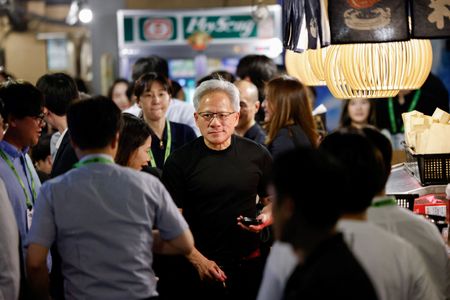
Marvell Technology shares jumped 15% in early trading, pushing its market capitalization above $290 billion and extending yesterday’s rally after Nvidia CEO Jensen Huang described the semiconductor company as the next “trillion-dollar company.”
Broadcom stock advanced 3% ahead of its quarterly earnings release scheduled after market close. The results will serve as another important indicator of AI-related market momentum, with the company’s shares gaining 14% over the past four trading sessions.
Elon Musk’s SpaceX is reportedly setting its initial public offering price at $135 per share as it prepares for investor presentations to raise a record $75 billion, according to a source with knowledge of the plans.
This potential listing is part of a broader trend of prominent private companies considering public market debuts, including Anthropic and OpenAI, following several years of limited large-scale IPO activity.
As of 4:23 a.m. Eastern Time, Dow futures declined 145 points or 0.28%, while S&P 500 futures dropped 7.25 points or 0.1%. Nasdaq 100 futures fell 3 points or 0.01%.
All three primary stock indices reached new record closing levels Tuesday, with the S&P 500 finishing above 7,600 for the first time in history.
Market participants are monitoring upcoming economic indicators, including S&P Global’s manufacturing and services reports and the ISM services index, ahead of Friday’s anticipated employment data that could influence monetary policy expectations.
Federal Reserve Chair Kevin Warsh committed to upholding “the best of the Fed’s traditions” in a message to staff as he begins his four-year leadership term.
Investment banking giant Goldman Sachs announced Tuesday that alternative funding sources will become increasingly crucial for supporting the artificial intelligence data center expansion, as technology companies seek financing options beyond conventional methods.
The financial services firm revised upward its capital expenditure projections for the four major hyperscale companies — Meta, Microsoft, Amazon, and Alphabet — reaching $5.3 trillion spanning fiscal years 2025 through 2030.
Goldman’s previous estimate before first-quarter earnings results had projected $4.5 trillion in capital spending for the identical timeframe.
According to Goldman’s analysis, corporations will access public, securitized and private funding sources to meet the massive scale of financial requirements.
“Private infrastructure and real estate will play an even larger role in the years ahead,” Goldman said.
The investment bank noted that distinctions between private infrastructure and real estate sectors are becoming less clear as data center developments span multiple asset classes including land acquisition, power systems, construction and technological equipment.
Goldman indicated that private infrastructure’s ability to generate structured returns and provide inflation hedging will likely stimulate additional expansion.
“Infrastructure sits at the epicenter of multiple structural tailwinds, which we expect will drive its growth and provide additional capacity for financing,” Goldman added.
Between 2021 and 2024, the private infrastructure sector expanded at approximately 11.5% annually, according to Goldman’s research.
The firm anticipates this expansion pace will accelerate, potentially approaching the 16% to 17% annual growth rates that characterized much of the 2012 to 2021 period.
Such growth trajectory would elevate infrastructure assets under management beyond $3 trillion by 2030, the brokerage concluded.
The online shopping behemoth Amazon.com announced Wednesday that it has rolled out its subscription Prime membership program in South Africa, providing customers with quicker shipping and entertainment offerings for 59 South African rand per month ($3.61) or 399 rand annually.
Key highlights of the launch include:
• The Prime membership program now operates in 27 countries total, and Amazon’s major shopping event Prime Day is set to run from June 23-29 in South Africa.
• The South African market has experienced significant growth in internet-based shopping in recent years, with domestic companies like Shoprite introducing rapid delivery options.
• Amazon entered the South African marketplace just two years ago.
• The retail giant announced that customers in South Africa can access a complimentary 30-day trial period for Prime membership.
The current exchange rate stands at $1 equals 16.3249 rand.
Ford Motor Company announced Wednesday it will recall 419,967 sport utility vehicles across the United States due to malfunctioning seat belt systems that could increase injury risks during accidents, according to federal safety regulators.
The National Highway Traffic Safety Administration reported that the recall covers select 2018-2022 Expedition and Lincoln Navigator models.
Federal officials explained that the seat belt pretensioner mechanism in either the driver’s seat, front passenger seat, or both positions may unexpectedly lock up, causing the belt to become stuck and unable to move freely. This malfunction prevents proper restraint of vehicle occupants and heightens the possibility of crash-related injuries.
To address the safety concern, authorized dealerships will examine the seat belt retractor systems and install replacement parts when needed, with all repairs provided free of charge to vehicle owners.
Two paint industry giants announced Wednesday they are walking away from their collaborative bid to purchase Dutch paint manufacturer AkzoNobel, sending the target company’s stock into a steep decline.
AkzoNobel shares, which include the well-known Dulux paint brand, dropped more than 20% in morning trading after an initial trading halt, positioning the company for potentially its most devastating trading session on record.
“A lot of people may have thought that another offer from Sherwin-Williams and Nippon Paint would be forthcoming,” Berenberg analyst Sebastian Bray said.
The withdrawal comes after AkzoNobel turned down the partnership’s €12.5 billion ($14.5 billion) cash acquisition proposal the previous week, news that had initially boosted the Dutch firm’s stock value by 20%.
In a Wednesday statement, AkzoNobel confirmed that both of its governing boards continue to unanimously support the company’s proposed combination with U.S. coatings manufacturer Axalta.
“Ultimately the Axalta merger now appears the most likely outcome,” Bray said.
Technology stocks in India were on track for their steepest single-day decline in more than four months Wednesday, as market participants weighed concerns about artificial intelligence’s potential impact on conventional software service demand.
The technology sector index fell 5.8% to reach 29,310.25 points. Should these declines persist, it would mark the sector’s most significant downturn since February 4.
Tata Consultancy Services, the nation’s top software services company, saw shares tumble 9% and drove the sector’s losses. Meanwhile, Bengaluru-headquartered companies Infosys and Wipro experienced declines of 4.3% and 3.7%, respectively.
Tata Motors has decided to partner with Chinese automaker Chery to obtain cutting-edge technology for its high-end electric vehicles, according to four sources with knowledge of the arrangement.
The Indian automotive company confirmed to Reuters that it will utilize the Freelander platform developed through a partnership between Chery and Jaguar Land Rover in China. Production will take place at Tata’s recently opened manufacturing facility in Tamil Nadu, located in southern India.
This development highlights how Chinese automotive technology is becoming increasingly essential in the global market, even as Chinese car manufacturers face barriers to entry in India, the world’s third-largest automotive market.
As India’s leading electric vehicle manufacturer, Tata will employ Chery’s platform to produce electric cars domestically under its upscale Avinya brand, with plans for a minimum of two vehicles. Sources indicate the initial model will debut in 2027.
This approach represents a significant change from Tata’s initial strategy, which involved using JLR’s electrified modular architecture for Avinya vehicles scheduled for 2025 release. That timeline fell apart last year when JLR abandoned its plans to manufacture EMA-based electric vehicles in India, forcing Tata to reconsider its approach.
The partnership with Chery is anticipated to help Tata recover from these delays, providing access to sophisticated features and technology that would otherwise require more time and investment to create independently, sources explained.
The debut Avinya vehicle using Chery’s platform is scheduled for 2027 and will initially arrive from China as a kit for assembly in India, with efforts already underway to source local components. A second electric vehicle is planned for 2029, with potential for two additional models thereafter.
“Avinya is being developed as a global premium brand. Our collaboration with JLR and its partners will be an important pillar of our global premium EV journey,” Tata stated, emphasizing that this agreement will help deliver the desired proposition for its luxury electric vehicle segment at scale.
Chery responded that its agreement with Tata builds upon the success of its existing collaboration with JLR.
“Chery will act as a supplier to Tata Motors Passenger Vehicles. Each project operates under its own separate agreement with standard commercial terms,” the Chinese manufacturer explained.
JLR has enlisted Chery, a long-standing partner, to develop and manufacture electrified vehicles, including electric and hybrid models, under its revived Freelander brand. These vehicles will utilize the Chinese company’s architecture and be produced at its Changshu facility.
One source characterized the Chery deal as a “stop-gap arrangement” because Tata risks losing its electric vehicle market position without new products, while noting the company still plans to develop its own dedicated platform eventually.
All sources requested anonymity as they lack authorization to speak with media.
Electric vehicles currently represent 14% of Tata’s total sales, with a goal to increase that figure to 30% by 2030. However, competitors Mahindra & Mahindra and JSW MG Motor are narrowing Tata’s lead, revealing weaknesses in its electric vehicle portfolio and increasing the possibility of additional market share decline.
These partnership discussions reflect a broader transformation occurring within India’s automotive sector. Indian automakers are increasingly importing Chinese electric vehicle technology while avoiding deeper equity partnerships due to political sensitivities.
Since 2020, New Delhi has implemented strict limitations on investment from neighboring countries, primarily targeting China, effectively halting large-scale participation in the automotive industry. While restrictions have relaxed somewhat in sectors like electronics, car manufacturers continue to face significant obstacles.
JSW Motor, the independent automotive venture of steel-to-cement billionaire Sajjan Jindal, also maintains a similar platform licensing arrangement with Chery.
Indian automotive companies have increased their research and development spending on new technologies and powertrains in recent years, but like many global competitors, they cannot match China’s speed, cost efficiency, and technical expertise in electric vehicles.
Chery, China’s largest automotive exporter, has rapidly expanded its international presence.
Taking inspiration from Toyota and Tesla, the Chinese automaker has pursued joint manufacturing agreements with foreign companies across key markets, including Europe, Southeast Asia, and Latin America.
Tata Motors is entering into an agreement to obtain automotive technology from Chinese manufacturer Chery, according to four sources with knowledge of the arrangement, as the Indian automaker works to revive its delayed premium electric vehicle initiative.
The Indian company, which leads the country’s electric vehicle market, will utilize Chery’s technological framework to manufacture electric cars domestically under its upscale Avinya label, with plans to produce a minimum of two vehicle models, according to three sources. The initial model is scheduled to debut in 2027, the sources indicated.
The collaboration represents Tata’s strategy to accelerate its premium electric vehicle offerings after encountering setbacks in its original timeline.
The parent company of popular fashion retailer Zara announced Wednesday that it exceeded expectations for summer sales performance, posting currency-adjusted revenue growth of 11.5% during May that surpassed what financial analysts had predicted.
Inditex also disclosed that its currency-adjusted sales increased 8.8% during the first quarter spanning February through April. The better-than-anticipated performance at the beginning of the company’s second quarter may ease concerns among investors about the fast fashion retailer’s ability to maintain customer interest amid rising living costs triggered by the Iran war-driven energy crisis. The company’s stock price has declined since the beginning of this year.
The fashion giant recorded quarterly revenue of €8.75 billion ($10.17 billion), while also showing enhanced profitability with gross margins reaching 61.2% compared to 60.6% during the same period last year. This improvement demonstrates the company’s success in maintaining profit levels despite increased expenses for raw materials and transportation.
Financial experts had projected May sales growth would reach 8%.
Britain’s competition watchdog announced Wednesday that it has established new operational requirements for Google’s search platform, including provisions that allow content creators to prevent their material from being used to train artificial intelligence systems operated by the technology company.
The Competition and Markets Authority has raised concerns regarding Google’s control over search platform services.
The technology company handles over 90% of search queries in the UK, prompting the regulatory body to examine the situation to maintain effective market competition.
On Wednesday, the CMA announced that the new requirements established for Google through the digital markets competition framework provide “publishers more control and stronger bargaining power over the use of their content,” while ensuring fair agreements.
The technology company did not provide an immediate response to requests for comment after regular business hours.
The regulatory authority stated that the company must now ensure that material from content creators, including news organizations, receives proper credit in AI-generated search results through clear linking.
Google’s search platform operations have come under regulatory examination worldwide, including in the United States and European Union, with the company stating in March that it was creating new search management features to address British competition issues.
“Google has recently announced changes to its search business and the requirements we’ve introduced today are designed to respond to what Google is doing now and in the future,” CMA Chief Executive Sarah Cardell said in a statement.
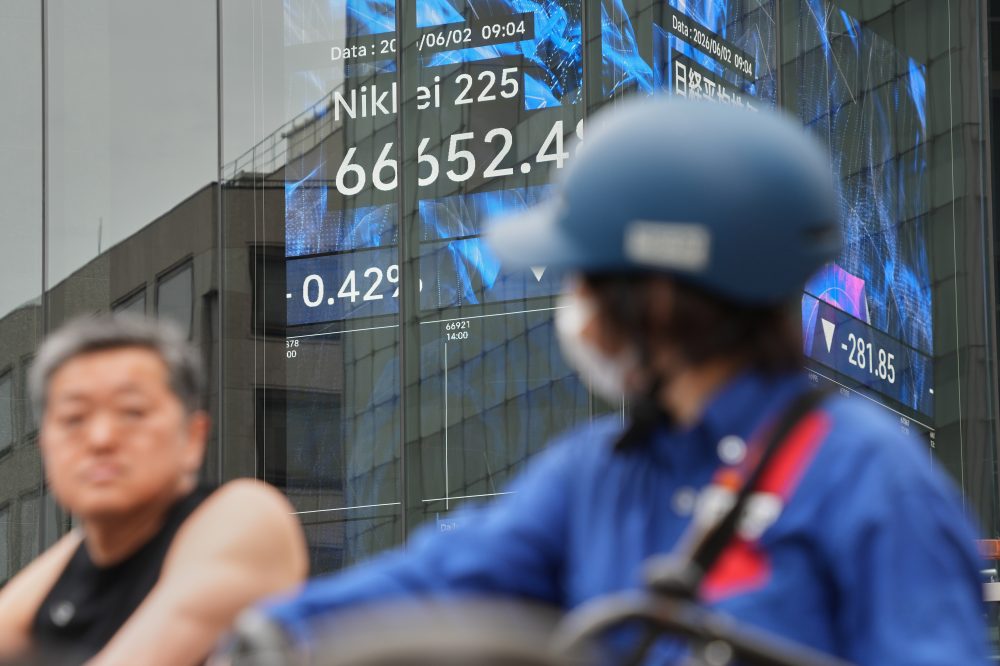
Despite continuing tensions in the Middle East, artificial intelligence stocks propelled Asian equity markets to record highs on Wednesday.
The CEO of Nvidia, Jensen Huang, sparked the latest surge by declaring that Marvell Technology could become the next company worth a trillion dollars. This endorsement caused Marvell’s shares to jump over 30% immediately.
While Marvell’s current market value of $254 billion remains far from the trillion-dollar mark, other companies in the sector have closed similar gaps rapidly. Memory chip companies Micron and SK Hynix were valued at just $100 billion a year ago but now exceed $1 trillion each.
In Japan, memory manufacturer Kioxia temporarily became the country’s second-largest company by market value on Wednesday, surpassing longtime leader Toyota and trailing only tech investor SoftBank.
In other market news, Elon Musk’s SpaceX surprised investors by announcing plans to price its upcoming public offering at $135 per share, aiming to raise a record $75 billion, according to a source with knowledge of the plans.
Currency markets saw the Japanese yen approach critical levels, touching 160 per dollar – a threshold that typically triggers government intervention.
Regional conflicts intensified as the U.S. military reported that Iranian missile strikes targeting Bahrain, Kuwait and other areas in the region were either intercepted or unsuccessful. Diplomatic efforts between Washington and Tehran have made little headway.
Oil prices climbed approximately $1 per barrel in response to the escalating tensions.
Economic data releases scheduled for later Wednesday include U.S. services sector indicators, private sector employment figures, and the Federal Reserve’s economic assessment report. These come ahead of Friday’s official labor market data.
Tuesday’s employment statistics showed job openings rose by the largest amount in five years during April.
The chief operating officer at KPMG Australia has stepped down from her leadership position as the accounting firm faces mounting pressure over allegations it improperly used confidential client information to secure profitable audit contracts.
Eileen Hoggett relinquished her executive duties on Wednesday but will continue working as an audit partner while investigations proceed, according to an internal company message from interim CEO Stan Stavros that the firm provided to Reuters.
Hoggett assumed the chief operating officer position in 2023, but her departure from the role follows closely behind the recent exits of the company’s chief executive and audit department head, both of whom resigned over how the firm handled an internal probe into whistleblower accusations.
The accounting firm stated its investigation did not support the whistleblower’s claims, which were also brought to the attention of a senator from Australia’s ruling Labor party. In March, Senator Deborah O’Neill informed parliament that the whistleblower’s accusations involved confidential board documents from real estate firm Lendlease being utilized to help secure major audit contracts with Westpac and Dexus.
“Documents were taken from Lendlease by the lead partners on the account, Eileen Hoggett and Paul Rogers, and were physically secured in Ms Hoggett’s locker,” O’Neill said.
Hoggett did not immediately respond to a request for comment via LinkedIn.
These accusations have intensified examination of Australia’s professional services industry, which faced significant turmoil in 2023 when reports emerged that PwC had shared sensitive Australian government information with potential clients.
That controversy led to parliamentary investigations and resulted in the separation of the firm’s government consulting division, numerous staff departures, and stricter regulations for the industry.
In his message to employees on Wednesday, Stavros acknowledged the firm should have managed the whistleblower’s accusations more appropriately.
“I am 100% committed and will ensure we approach the issues in the right way,” he said.
“I want to be open that we should all expect the heightened public scrutiny to continue for some time.”
The Australian Securities and Investments Commission has launched a preliminary examination into the behavior of three KPMG registered company auditors.
A parliamentary hearing regarding the whistleblower allegations is also set for June 19.
A major clean energy company has suspended $1 billion in planned renewable projects in Brazil after the country’s electrical grid operator began regularly turning away power from solar and wind facilities, according to the company’s chief executive.
Atlas Renewable Energy, which ranks among South America’s biggest clean power producers, made the decision to freeze the investments as grid curtailments reached 15%-25% for their current operations during the second quarter, CEO Carlos Barrera announced.
The company is controlled by Global Infrastructure Partners, a division of BlackRock. Barrera revealed the suspended projects totaled roughly 1.5 gigawatts of capacity that were scheduled to begin construction.
“There’s at least … 1.5 gigawatts that we put on hold in Brazil, where we had planned to already start construction,” Barrera explained during an interview at the SNEC photovoltaic conference in Shanghai.
Grid curtailment occurs when solar or wind facilities must shut down production because electrical networks have reached their capacity limits, even though weather conditions would allow for power generation.
The problem extends beyond Brazil, affecting renewable energy development in multiple nations including Australia, Japan, India and Chile, despite increased government support for clean energy following supply chain disruptions from international conflicts.
Brazil’s energy market structure creates additional financial strain for renewable companies. When grid operators reject their power output, these firms must purchase replacement electricity at premium prices to fulfill their contractual obligations.
“You’re being curtailed, but you’re buying energy at 2x the cost … that’s what’s been problematic,” Barrera said.
Credit rating agency Fitch Ratings issued negative outlooks for 11 Brazilian renewable project financings last month, warning that curtailments will persist through 2030 and harm cash flows, debt payments and liquidity. Fitch data shows average curtailments in their rated projects jumped to 7%-25% in 2025 from 6%-12% the previous year.
Barrera doesn’t anticipate reforms to the current market structure before 2028, citing upcoming elections this year. However, he predicts curtailments will gradually decrease as new solar installations slow down while electricity demand continues expanding.
The mismatch between rapid renewable capacity growth and insufficient transmission infrastructure development has forced clean energy companies to reduce operations and eliminate jobs.
“The real issue is overcapacity of solar. Even if you fix all the transmission issues in Brazil, you’re still going to have overcapacity, you’re still going to have curtailment,” Barrera stated.
Japan’s benchmark stock index achieved a historic milestone Wednesday, climbing above 68,000 points for the first time as American markets continued setting new records.
The U.S. dollar momentarily climbed past 160 Japanese yen before retreating slightly. Crude oil values increased by more than $1 per barrel.
Global stock market surges have been fueled by investor enthusiasm for technology companies benefiting from the artificial intelligence revolution.
By mid-morning trading, the Nikkei 225 had risen 2.2% to reach 68,172.89. Computer chip equipment manufacturer Tokyo Electron saw shares jump 10.1%, while chip testing equipment producer Advantest gained 4.6%.
Hong Kong’s Hang Seng declined 0.9% to 25,804.51, and the Shanghai Composite index dropped 0.2% to 4,068.77.
Australia’s S&P/ASX 200 increased 0.3% to 8,747.10, while Taiwan’s Taiex climbed 1.8%.
South Korean markets remained closed for a holiday.
Tuesday’s trading session saw artificial intelligence beneficiaries continue their upward momentum, propelling U.S. stock markets to fresh record highs.
The S&P 500 gained 0.1% to close at 7,609.78 following a day of mixed trading. The Dow Jones Industrial Average rose 0.4% to 51,307.79, while the Nasdaq composite increased marginally by less than 0.1% to 27,093.90. Each index established new all-time peaks.
Economic data revealed that U.S. companies posted significantly more job openings at April’s conclusion than forecasters had anticipated, suggesting ongoing strength in the nation’s employment sector.
Hewlett Packard Enterprise shares skyrocketed 19.5% following quarterly earnings that far exceeded analyst projections. The company attributed strong performance to customer demand for artificial intelligence infrastructure.
Marvell Technology experienced its strongest trading day since going public in 2000, jumping 32.5% after Nvidia’s CEO, Jensen Huang, indicated at a Taiwan conference that Marvell could become “the next trillion-dollar company.” Micron Technology was the most recent addition to the exclusive club of trillion-dollar corporations, also benefiting from AI momentum. Nvidia, which declined 0.7%, has reached a market value exceeding $5 trillion.
Generac shares advanced 5.7% after announcing an agreement to supply backup power systems to an unidentified “leading hyperscale data center operator.”
These “hyperscalers” are investing enormous sums to construct massive AI data facilities, driving what supporters view as the next major transformation of the worldwide economy.
Alphabet represents one such hyperscaler. Google’s parent company announced plans to raise $80 billion through stock sales to fund its investments, though shares fell 3.9% Tuesday.
The corporation expects to spend up to $190 billion on equipment and other investments this year. This amount exceeds The Walt Disney Co.’s entire market value, and Alphabet projects investment spending will “significantly increase” next year.
These massive expenditures raise questions about whether AI can generate sufficient profits and productivity improvements to justify the investment levels, or if an AI investment bubble is forming.
Market analysts have suggested the broader U.S. stock market might face a slowdown after the S&P 500’s unprecedented nine consecutive weekly gains, its longest winning streak since 2023.
The rally has been primarily driven by robust corporate earnings reports and optimism that the United States and Iran might negotiate an agreement to reopen the Strait of Hormuz. Such a deal would restore normal oil flows from the Persian Gulf and potentially reduce prices.
Oil markets resumed their upward trend. Brent crude oil, the global benchmark, rose $1.03 to $97.03 per barrel early Wednesday. Prices remain well above pre-war levels of approximately $70.
U.S. benchmark crude oil increased $1.10 to $94.86 per barrel.
Following a brief peak at 160.44 yen, the U.S. dollar retreated to 159.86 yen from Tuesday’s close of 159.92. The euro slipped to $1.1631 from $1.1632.
Network insiders confirmed Tuesday that CBS News has ended the employment of Scott Pelley, who worked as a correspondent for the long-running investigative program 60 Minutes, according to two sources within the organization.
In a termination letter, the program’s executive producer Nick Bilton addressed Pelley directly about his dismissal. “Your antipathy to the future of the show has come through loud and clear. And I have heard you.,” Bilton stated in the correspondence. “I therefore write on behalf of CBS News, Inc. (“CBS”) to inform you that your employment with CBS is terminated for cause effective immediately.”
A government defense contractor supported by private equity investors has successfully completed a $650 million initial public stock offering by setting share prices at $20 each, according to a Bloomberg News report from Tuesday that cited an unnamed source with knowledge of the transaction.
Reuters was unable to independently confirm the Bloomberg report. Applied Aerospace & Defense did not provide an immediate response when Reuters sought comment.
The Alabama-based company, headquartered in Huntsville, distributed 32.5 million shares according to the report. The firm had previously indicated it would market shares within a price bracket of $18 to $21 per share.
Multiple defense technology companies are entering the U.S. public stock market, seeking to take advantage of increased investor attention driven by the U.S.-Israeli conflict with Iran.
Companies are moving forward with public listing schedules to take advantage of the defense sector’s growing importance in geopolitical matters and higher market valuations.
Several companies including aerospace parts manufacturer Arxis, drone producer AEVEX, and radio signal analysis company Hawkeye 360 have recently completed public offerings in New York.
Investment firm Greenbriar Equity Group, which focuses on middle-market acquisitions, merged Applied Aerospace with PCX Aerosystems last year to create Applied Aerospace & Defense. PCX Aerosystems was established in 1900.
Applied Aerospace, which began operations in 1954, manufactures various products such as aircraft body components, flight control surfaces, solid rocket motor casings, and engine shafts for space and defense industry clients.
The company’s client base features Anduril Industries, Boeing, and GE Aerospace, as listed on the company’s website.
Investment banks Morgan Stanley and Jefferies are serving as underwriters for the stock offering. Applied Aerospace & Defense plans to begin trading on the New York Stock Exchange Wednesday using the ticker symbol “AADX.”
Federal Reserve Chairman Kevin Warsh has sent a message to the central bank’s more than 20,000 workers outlining his approach as he begins his four-year leadership role, promising to honor “the best of the Fed’s traditions” while examining opportunities for reform.
The internal communication offers insight into Warsh’s strategy as he works to implement what he has called a comprehensive reform plan for a central bank he believes has lost focus on its core mission, while simultaneously rebuilding relationships with staff and colleagues whose previous work he has questioned.
“Our highest priority will be to get policy right in service to our remit and the national interest. We will ensure an environment that supports our people in doing their life’s best work,” Warsh stated in the Tuesday memo that Reuters obtained.
“We won’t rely on past practices when we find better alternatives,” Warsh added. “In the coming quarters, I expect that together we will have open, clear-eyed discussions of Fed strategies, policies, and operations.”
Additionally, Warsh has brought on two conservative policy experts as advisers during his transition into the role, replacing former Fed Chair and current Governor Jerome Powell, according to someone with knowledge of the new chairman’s initial staffing choices. These appointments, initially reported by the Wall Street Journal, are described as temporary consulting roles to assist Warsh in developing his early initiatives as chair.
Daniel Heil serves as a policy fellow at Stanford University’s Hoover Institution, the same organization where Warsh was employed before assuming the Fed chairmanship. Paul Winfree previously worked at the Heritage Foundation and created the Federal Reserve reform section featured in the organization’s disputed Project 2025 conservative reform proposal.
According to the source, both advisers have collaborated with Warsh on various research and writing endeavors over recent years. Through his position at the Hoover Institution and involvement with the Group of Thirty think tank, Warsh has maintained regular publication of speeches and opinion pieces.
Warsh has outlined his vision for Fed changes, including reducing the Fed’s $6.7 trillion balance sheet, providing less specific guidance about future interest rate moves, and exploring whether alternative inflation measurements might better reflect economic price pressures.
During his consideration period for the chairmanship, Warsh frequently criticized the Powell Fed’s policy approach and expressed concerns that the Fed system, including its 12 regional reserve banks, had expanded beyond its monetary policy mandate.
Now at the helm of the institution he previously criticized, Warsh adopted a more encouraging tone in his employee memo.
“This new chapter at the Fed finds us in a time of great consequence for our nation. New technologies and new ways of doing business are arriving with unmatched speed,” Warsh stated. “I could not be more optimistic about all that we can achieve together.”
Warsh’s initial meeting as chair — and likely his first substantial remarks about economic conditions and monetary policy — is scheduled for June 16-17. While the Fed is anticipated to maintain current interest rates, new economic forecasts will indicate policy direction under Warsh’s leadership and reveal whether his colleagues worry that inflation, still above the Fed’s target, might worsen.
His leadership begins under unique circumstances.
The Fed awaits a Supreme Court decision regarding President Donald Trump’s attempt to remove Governor Lisa Cook, viewed as a direct challenge to the Fed’s independence in monetary policy decisions, potentially its most fundamental principle.
Furthermore, Warsh will lead an organization that includes its previous chief, Powell, who chose to retain his position on the Fed’s Board of Governors due to the administration’s attempts to influence the Fed.
An Australian investment firm announced Tuesday it has reached an agreement to divest its majority ownership in a Brazilian agricultural port terminal company to a United Arab Emirates-based operator for $835 million.
Macquarie Group revealed that its asset management division, along with Brazil’s IG4 Capital, will transfer controlling ownership of Corredor Logística e Infraestrutura S.A (CLI) to AD Ports Group in the massive deal.
Key aspects of the transaction include:
• CLI’s leadership structure will remain intact following the sale, with Gabriel Motta continuing in his role as CEO, according to Macquarie’s announcement.
• For AD Ports, this acquisition marks their biggest purchase to date and will allow the company to establish direct shipping connections between Brazil and both Khalifa Port and Abu Dhabi Food Hub, the UAE-based ports operator stated.
• CLI, headquartered in Sao Paulo, runs Brazil’s top sugar export facility along with a major terminal for corn and soybean exports, AD Ports noted.
• The agreement involves Macquarie Asset Management operating through Macquarie Infrastructure Partners V and IG4 Capital through its Private Equity Fund II, and requires approval from regulatory and antitrust authorities.
Fernando Lohmann, who leads Macquarie Asset Management’s Brazil operations, commented on the deal: “As a long-term investor in the country, Macquarie remains committed to acting as a responsible custodian of essential infrastructure assets that help drive economic development, improve connectivity and support Brazil’s role in global trade.”
When approached for additional information, Macquarie declined to provide complete details about the transaction terms.
Global financial markets climbed to new record levels Tuesday as investors maintained their buying momentum, buoyed by steady conditions in U.S.-Iran relations and calm currency and bond trading environments. Smaller companies and non-technology sectors led gains in American markets.
Market analyst Jamie McGeever highlighted an under-the-radar surge in small-cap stocks throughout this year. While media attention has focused on large-scale technology companies and major tech corporations, smaller technology firms have actually emerged as the primary beneficiaries of artificial intelligence investment enthusiasm.
Several major market indices achieved new peaks, including global stock measures and the S&P 500. European markets gained 0.8% driven by technology optimism, while cyclical stocks pushed British markets up 0.3%.
Individual stock performance varied significantly. Seven S&P 500 sectors advanced while four declined. Utility companies rose 2% while communication services dropped 2.6%. Notable gainers included Marvell Technologies jumping 32%, Hewlett Packard climbing 20%, and Super Micro Computer advancing 7%. Alphabet fell 4%, Microsoft declined 4%, Dell dropped 7%, and Boeing decreased 3%.
Currency markets saw the dollar-yen exchange rate approaching 160, putting traders on alert for potential Japanese intervention. Bitcoin fell 6% toward $66,000.
In major corporate news, Google’s parent company Alphabet surprised investors Monday evening by announcing an $80 billion equity financing plan, with $10 billion coming from Berkshire Hathaway. While the move addresses rising debt costs and massive AI infrastructure spending, concerns arise about the company’s financial direction. Despite having $126 billion cash at March’s end, Alphabet faces nearly $200 billion in AI capital expenditures this year and has already issued over $85 billion in debt over the past year.
U.S. job market data revealed mixed signals Tuesday. April job openings rose to two-year highs with the fastest increase in five years, showing continued worker demand and little evidence of AI-related job losses. However, 90% of openings concentrated in professional and business services, while hiring rates, layoffs, and resignations all declined, suggesting market stagnation rather than strength.
European inflation data virtually guaranteed central bank action, with euro zone inflation exceeding 3% for the first time since September 2023. This development makes a 25-basis-point rate increase from the European Central Bank next week nearly certain, with traders anticipating an additional 50 basis points of tightening by year-end.
Wednesday’s market-moving events include Middle East developments, manufacturing data from multiple countries, speeches from central bank officials including Bank of Japan Governor Kazuo Ueda and European Central Bank board members, plus U.S. employment and economic indicators.
GameStop announced Tuesday that its quarterly revenue increased by 14% while revealing that company directors have authorized a $2 billion share repurchase initiative.
The video game retailer’s stock price soared 9% during after-hours trading sessions following the financial disclosure.
Palo Alto Networks boosted its yearly revenue and earnings projections on Tuesday following robust demand for artificial intelligence and cloud-based cybersecurity services, causing the company’s stock to jump 7.4% in after-hours trading.
The cybersecurity firm, headquartered in Santa Clara, California, now anticipates fiscal 2026 revenue between $11.415 billion and $11.425 billion, marking an increase from its previous estimate of $11.28 billion to $11.31 billion.
Artificial intelligence has become a significant growth catalyst for the business, as increasing cyber threats powered by AI technology are driving companies to boost their cybersecurity investments and seek comprehensive platform solutions like those offered by Palo Alto Networks.
The firm specializes in delivering comprehensive network, cloud, identity and artificial intelligence security services.
For fiscal 2026, Palo Alto Networks projects adjusted earnings per share ranging from $3.77 to $3.79, representing an improvement from its earlier guidance of $3.65 to $3.70.
Third-quarter revenue climbed 31% to reach $3 billion, surpassing analyst expectations of $2.94 billion based on LSEG data.
A major cosmetics retailer announced an improved annual profit outlook this week, anticipating that reduced inventory losses and continued strong demand for premium products will offset increased expenses from store growth and advertising efforts.
The beauty chain bucked trends in the struggling luxury market, reporting robust sales performance across its locations as wealthy and younger customers continued purchasing trendy, high-margin fragrance and skincare products. Company stock prices surged 7% during after-hours trading following the announcement.
“From a market-share perspective, we gained share in prestige beauty, and we were roughly flat in mass beauty,” CEO Kecia Steelman said on the post-earnings call.
Sales at comparable locations increased 5.3% during the quarter that concluded May 2, surpassing the 2.9% growth recorded in the same period last year. Wall Street analysts had projected a 4.5% sales increase, according to LSEG data.
The retailer has expanded its appeal by adding celebrity-backed product lines including Rihanna’s Fenty Beauty, Selena Gomez’s Rare Beauty and Beyonce’s Cecred to better connect with shoppers.
“The company continues to outperform other beauty retailers, such as department stores,” said David Swartz, analyst at Morningstar.
The beauty chain now projects annual earnings per share between $28.36 and $28.80, up from its previous guidance of $28.05 to $28.55.
First-quarter earnings reached $7.74 per share, exceeding analyst expectations of $6.86.
New Federal Reserve Chair Kevin Warsh has brought on board two seasoned policy experts to help guide him as he begins his tenure at the nation’s central bank, according to a Wall Street Journal report published Tuesday.
The newspaper, citing unnamed sources, reported that Warsh has selected Paul Winfree and Daniel Heil, both described as conservative policy veterans, to serve in advisory roles during his early days on the job.
According to the Journal’s reporting, both Winfree and Heil will serve as temporary contractors, focusing on policy analysis and strategic planning as Warsh establishes his leadership approach. The report noted that the new chair has not yet made final determinations regarding permanent appointments within the Federal Reserve’s structure.
Reuters was unable to independently confirm the Wall Street Journal’s reporting at the time of publication.
Meta has reduced portions of its initiative to gather employee computer activity data for artificial intelligence training following significant worker opposition, according to a company internal communication released Tuesday.
The social media giant had planned to monitor staff mouse movements, keyboard activity, and other computer interactions to help develop AI systems. However, employees voiced strong objections to the data collection program over several weeks.
In the internal communication, the company acknowledged the workforce concerns while defending its original privacy safeguards. “While we remain confident in the privacy protections we put in place at launch, which went through several layers of risk review, we have heard your concerns about personal data on work devices, battery life, and wanting more control over when capturing happens,” the company stated in the memo.
The company emphasized that its initial privacy measures had undergone multiple security assessments before implementation, but ultimately decided to modify the program in response to employee feedback about data privacy, device battery performance, and user control over the monitoring system.
A groundbreaking digital trading connection between Jordan and the United Arab Emirates went live on June 1, 2026, creating direct investment pathways between the nations’ stock markets through an innovative electronic platform called Tabadul.
The historic launch ceremony took place in Amman, with Jordan’s capital market institutions and the Abu Dhabi Securities Exchange (ADX) making the joint announcement. The Amman Stock Exchange (ASE) released a statement explaining that this digital bridge represents a key component of an expanded strategic alliance between the two nations, designed to create new investment pathways and strengthen financial market connections.
Through this electronic connection, investors can now conduct international trades via authorized brokerage companies operating in either country. The trading mechanism functions within the Tabadul network, a specialized regional system created to enable shared access across Middle Eastern capital markets.
The ASE’s official statement outlined several key objectives for the program: expanding the pool of investors across both nations, boosting market performance, increasing available liquidity, and advancing the technological capabilities of regional financial market infrastructure.
Jordan Securities Commission Chairman Emad Abu Haltam characterized the platform’s debut as a major strategic milestone for Arab financial markets. He said the connection would strengthen integration among regional exchanges, increase liquidity, improve efficiency, and provide investors with wider opportunities.
ADX Group CEO Abdulla Alnuaimi said the Tabadul platform represents an advanced model for cooperation among regional financial markets. He said the system offers a secure trading environment designed to enhance the attractiveness of the region’s financial sector.
ASE CEO Mazen Wathaifi said the electronic link reflects broader economic cooperation between Jordan and the UAE. He said the initiative would help the Amman Stock Exchange expand its access to regional and international financial markets while supporting efforts to attract Arab and foreign investment.
This financial market collaboration builds upon a comprehensive partnership between the two countries that encompasses significant infrastructure development, including the $2.3 billion UAE-Jordan railway project that began earlier this year.
The Tabadul platform originally debuted in 2022 as an ADX initiative, specifically engineered to facilitate shared market access through a unified regulatory structure while promoting enhanced connectivity throughout regional capital markets.
Federal officials announced Tuesday they have chosen two mining initiatives to receive $134 million in government funding aimed at harvesting rare earth elements from industrial waste materials.
The federal government has been working to increase domestic production of these critical minerals while reducing America’s reliance on China, which controls most of the world’s rare earth supply network.
Approximately $67 million will go toward an initiative headed by the Colorado School of Mines and ElementUSA to construct a processing center in Louisiana. This facility will extract and process rare earth materials from bauxite waste products.
Officials expect the Louisiana plant to test commercial-scale operations and generate between 150 and 1,000 metric tons of rare earth materials each year from mining waste.
The Department of Energy also chose Phoenix Tailings for a second project to construct a testing facility in Oklahoma. Working alongside the Massachusetts Institute of Technology, this initiative will transform industrial waste materials into pure rare earth metals while creating a new domestic supply chain.
Last month, the federal agency had already chosen rare earth magnet manufacturer USA Rare Earth to receive as much as $19.3 million for a pilot processing operation designed to strengthen domestic supply networks.
The Minneapolis-based food giant General Mills has reached an agreement to transfer ownership of its Häagen-Dazs ice cream retail locations in mainland China to a group of investors that includes the Chinese tea company Ningji.
According to a company announcement released Monday evening, the transaction will grant the purchasing group exclusive rights to operate Häagen-Dazs branded ice cream shops and gift retail businesses throughout mainland China. General Mills will maintain its distribution agreements for Häagen-Dazs products with Chinese grocery stores and food service companies.
The companies did not reveal the purchase price for the transaction. Officials expect the sale to be finalized before the year ends.
When contacted Tuesday, General Mills did not provide immediate information about the total number of Häagen-Dazs locations it operates in China. The company’s most recent annual filing indicates it runs 332 ice cream shops globally.
Ningji currently manages approximately 3,000 tea retail locations throughout China. The company launched its store network in 2021 and has secured investment backing from ByteDance, the Beijing-based company behind TikTok, along with Shunwei Capital.
According to Yaling Jiang, an independent Chinese consumer analyst, Häagen-Dazs has been setting premium pricing in China “without delivering sufficient product value or cultural relevance.”
The brand’s offerings — conventional ice cream with elevated fat content — have “passed its peak” in China as consumers increasingly prefer low-fat, airy gelato alternatives, she noted.
International companies have increasingly been transferring ownership of their Chinese operations to local investors amid declining consumer confidence and slower economic expansion.
Starbucks announced in November its plans to establish a joint venture with Chinese private equity company Boyu Capital in an approximately $4 billion arrangement that gives Boyu up to 60% ownership of its Chinese operations.
In February, Toronto-headquartered Restaurant Brands International — which owns the U.S. fast food chain Burger King — announced the formation of a joint venture with Chinese investment company CPE to manage and grow the Burger King restaurant network in China.
Under that agreement, CPE contributed roughly $350 million to the joint venture and holds approximately 83% ownership of the operation.
WASHINGTON — Federal officials have unveiled plans to impose 25% import fees on goods coming from Brazil, accusing the South American nation of engaging in unfair trade practices that harm American business interests.
The proposal was announced Monday evening following a federal trade investigation that criticized Brazil for weak anti-corruption measures and imposing its own unfair import duties on American products.
U.S Trade Representative Jamieson Greer acknowledged having productive discussions with President Luiz Inácio Lula da Silva and other Brazilian leaders alongside President Donald Trump. However, Greer stated that “we continue to have substantial differences in resolving the issues identified in this investigation.”
Officials have set July 6 as the date for public input on the proposed import fees.
Trade attorney Ryan Majerus from King & Spalding pointed out that the administration’s proposal leaves out more than half of American imports from Brazil, excluding items like aircraft and essential minerals.
The current administration used Section 301 of the Trade Act of 1974 as the legal basis for examining Brazil’s trade policies.
Previously, the administration had imposed a 50% tariff on Brazilian goods last year, primarily in response to Brazil’s legal action against former president Jair Bolsonaro for attempting to challenge his 2022 election loss.
The U.S. Supreme Court determined in February that the administration exceeded its legal authority by using the International Emergency Economic Powers Act of 1977 to implement broad tariffs on trading partners, including the measure targeting Brazil.
Nevertheless, tariffs imposed under Section 301 have withstood court challenges, and officials are expected to rely on this legal framework for additional tariffs and to recover tax revenue lost due to the Supreme Court’s rejection of the previous tariff structure.
BRUSSELS, June 2 – Media company Paramount Skydance Corp has submitted a request to European Union regulators for permission to acquire Warner Bros Discovery, according to documents filed with the European Commission on Tuesday.
The European Commission, which serves as the competition watchdog for the EU, has established July 7 as the target date for rendering its verdict on the proposed deal.
Payment processing giant Mastercard announced Tuesday a significant executive shake-up that will see Ling Hai promoted to chief financial officer, taking over from Sachin Mehra, who will transition to a newly established chief business officer position.
The leadership restructuring takes effect August 3 and represents the company’s effort to consolidate customer-focused operations under unified leadership while enhancing coordination between different markets.
“The changes to the management team signal to us that Mastercard is moving to unify its customer focus across all markets,” RBC Capital Markets analyst Daniel R. Perlin stated.
Hai brings significant global operational expertise to the CFO role, having previously managed Mastercard’s operations throughout Asia Pacific, Europe, the Middle East and Africa regions.
Mehra, who served as CFO beginning in 2019, will transition to directing worldwide country operations along with sales enablement, partnerships and digital commercialization within a consolidated go-to-market leadership framework, according to the company.
The restructuring also includes Linda Kirkpatrick, currently president of the Americas, moving into the chief services officer position, replacing Craig Vosburg.
Perlin noted the organizational changes could prove beneficial if they lead to enhanced regional interoperability and stronger enterprise relationships with international customers.
This management overhaul occurs as Mastercard pursues investments in stablecoins and expands its commercial payments and services divisions while seeking growth opportunities beyond traditional card-network business.
Increased regulatory transparency and broader stablecoin adoption have opened new digital payment opportunities, spurring competition between Mastercard and competitor Visa for early market positioning.
The company reported first-quarter earnings in April that exceeded Wall Street projections, supported by steady consumer spending that maintained transaction volumes throughout its payment network.
Nevertheless, rising global energy costs are generating concerns about potential pressure on consumer spending strength, creating uncertainty in the economic forecast.
Contract discussions between Dauch Corp and the United Auto Workers union have remained at a standstill since workers began striking at the Michigan facility on Sunday, a union representative confirmed Tuesday.
Josh Jager, who serves as bargaining chairman for Local 2093 and has worked at the company for 24 years, told reporters that Dauch Corp has not reached out to restart contract talks. The UAW local represents approximately 1,000 employees at the facility and submitted their contract demands to management Sunday evening.
“They are on the clock, they are under the gun but their finger is not on the trigger yet,” Jager said.
The company, previously called American Axle, has not yet provided a response to requests for comment.
Workers have maintained picket lines outside the Three Rivers, Michigan axle manufacturing plant since Monday morning. The facility plays a crucial role in supporting General Motors’ lucrative pickup truck operations.
According to Jager, the majority of axles produced at the Three Rivers location are shipped to GM’s heavy-duty truck assembly plant in Flint, Michigan.
Multiple sources, including Jager, estimate that GM maintains roughly two weeks’ worth of axle inventory to sustain production during the strike. Union officials report observing approximately 250 management employees entering the facility to maintain axle manufacturing operations.
A General Motors representative confirmed that truck production remained operational Tuesday.
The striking workers are seeking pay raises, improvements to work-life balance policies, and preservation of their current healthcare coverage.
Employees accepted pay cuts in 2008, and since that time, the highest hourly wage has risen by $4 to reach $22 per hour, Jager explained. The union is pushing for maximum wages exceeding $30 per hour.
A California federal jury has found securities analyst Andrew Left guilty of operating a market manipulation scheme that defrauded everyday investors.
Left, who worked as a financial analyst, trader, and frequent guest on business television programs like CNBC and Fox Business, faced charges filed in July 2024 including one count of running a securities fraud scheme, 17 counts of securities fraud, and one count of lying to federal investigators. His business model involved short selling, where he profited by wagering that stock prices would decline.
Federal prosecutors announced Tuesday that Left was found guilty on one count of operating a securities fraud scheme and 12 counts of securities fraud. His sentencing is set for Aug. 31, and he could receive up to 25 years behind bars.
“Andrew Left used his expertise to profit at the expense of retail investors, ordinary people who owned the stocks he targeted. He callously boasted that it was like ‘taking candy from a baby,’” Assistant Attorney General A. Tysen Duva of the Justice Department’s Criminal Division, said in a statement. “Egregious schemes like this strike at the heart of free, fair and open markets, and warrant prosecution when they involve criminal manipulation. Investors should have confidence that U.S. markets are safe and free from the type of deliberate manipulation that Left engaged in to enrich himself at the expense of American investors.”
Federal prosecutors had previously revealed that Left operated through Citron Research, which maintained a website featuring investment analysis. His research covered major corporations including Tesla and GameStop as well as Grand Canyon Education and Peloton.
Court documents revealed that Left would analyze publicly traded corporations and issue stock recommendations. His analysis frequently featured dramatic headlines (“Investors Peddling Themselves into Frenzy”) and inflammatory language designed to trigger maximum market response. Prosecutors alleged Left deliberately leveraged his power to influence stock values by focusing on companies favored by individual investors and using social media posts to manipulate markets for quick profits.
The charges further claimed that prior to releasing Citron’s analysis, Left would establish trading positions in the companies he planned to discuss and prepare to rapidly exit those positions following publication to capitalize on price swings triggered by his reports.
Following the verdict, Left posted his disagreement on social media platform X through the Citron Research account.
“We disagree with the jury and this does not stop here,” the post said. “We will keep fighting for free, honest speech and opportunity, the backbone of this country. This is not over.”
President Donald Trump announced Tuesday his selection of federal housing finance Director Bill Pulte to serve as acting director of national intelligence, stepping in for Tulsi Gabbard.
The president revealed the unexpected choice on Truth Social, highlighting Pulte’s current role leading the Federal Housing Finance Agency and overseeing mortgage giants Fannie Mae and Freddie Mac. “has deep experience managing the most sensitive matters in America, the safety and soundness of the Markets, and over 10 Trillion Dollars at Fannie Mae/Freddie Mac,” Trump stated. Pulte will maintain his existing responsibilities while taking on the intelligence role, following Gabbard’s departure last month after she disclosed her husband’s cancer diagnosis.
Meanwhile, financial markets are sending warning signals about inflation that could complicate Trump’s political outlook ahead of the midterm elections. Rising energy costs from the Iran conflict have pushed up government bond prices, driving interest rates higher and making everyday purchases more expensive for Americans. While Trump believes a fraud task force could generate enough savings to balance the federal budget, economists view that goal as unlikely given the current deficit size. The higher borrowing costs are making it more difficult for people to purchase homes, buy vehicles, or manage credit card payments.
In the technology sector, artificial intelligence firm Anthropic is preparing for a public stock offering after filing confidentially with securities regulators. The company, which developed the Claude chatbot, recently secured $65 billion in private investment that values the five-year-old startup at $965 billion, establishing it among the world’s most valuable emerging companies.
Israeli defense exports hit unprecedented levels in 2025, reaching over $19 billion and representing a 30% jump from the previous year, according to the country’s Defense Ministry. More than half of last year’s transactions were large contracts worth $100 million or above. The sales figures have more than doubled over five years, even amid international criticism of Israel’s military actions against Gaza, Hezbollah, and Iran. Defense Minister Israel Katz noted the numbers strengthen Israel’s standing as a major defense technology leader, with officials planning to focus on drone defense innovation.
Wall Street’s remarkable winning streak showed signs of cooling Tuesday as Alphabet’s stock decline weighed on broader market performance. The S&P 500 dropped 0.1% following Monday’s record high, while the Dow Jones Industrial Average fell 121 points and the Nasdaq remained unchanged. Market watchers suggest the rally may be due for a pause after nine consecutive weeks of gains for the S&P 500. Alphabet shares declined after the company announced plans to raise $80 billion through stock sales to fund artificial intelligence projects, while AI chip manufacturers saw their shares rise.
American job opportunities surged in April despite economic disruption from the Iran conflict, with employers posting 7.6 million open positions compared to 6.9 million in March. The Labor Department figures exceeded economist predictions of 6.8 million openings, demonstrating labor market strength amid geopolitical uncertainty. Both layoffs and voluntary job departures decreased, indicating worker confidence in employment prospects. The job market is rebounding from a challenging 2025 when employers added fewer than 10,000 positions monthly, the weakest performance outside a recession since 2002.
The British government announced its commitment to reducing greenhouse gas emissions by 87% from 1990 levels by 2042, maintaining its net-zero objectives despite global energy supply disruptions. Energy Secretary Ed Miliband confirmed the administration will follow recommendations from the independent Climate Change Committee for upcoming emissions targets. While scientists support the goal’s alignment with 2050 carbon neutrality plans, they emphasize the need for specific implementation strategies. Opposition lawmakers advocate for increased domestic oil and gas production to reduce energy imports.
Scottish court proceedings revealed details of how former Scottish leader Nicola Sturgeon’s estranged husband embezzled over 400,000 pounds from the Scottish National Party through fraudulent invoices and falsified records. Peter Murrell faced charges Tuesday in Edinburgh’s High Court for purchasing hundreds of personal items with party money between 2010 and 2022, including a motorhome and Nintendo games. Murrell entered a guilty plea while Sturgeon, who led the SNP for ten years, denies involvement and was cleared after her 2023 arrest. Sentencing is scheduled for later this month.
Florida’s attorney general filed suit against OpenAI and CEO Sam Altman Monday, alleging the company deliberately hid ChatGPT’s dangers while promoting the product to consumers. Attorney General James Uthmeier accused the firm of suppressing internal safety concerns and misleading users about potential risks. The legal action references two recent criminal incidents where suspects reportedly used OpenAI technology for planning attacks. OpenAI responded that its systems consistently directed users toward professional help, including mental health resources, and confirmed cooperation with law enforcement in both cases.
Nvidia introduced advanced processors designed to bring sophisticated artificial intelligence capabilities to Windows computers, with CEO Jensen Huang announcing the chips will power new laptop and desktop models from Microsoft and Dell starting this fall. Speaking at the Nvidia GTC conference in Taipei Monday, Huang described efforts to transform personal computing through locally-running AI agents. Industry analysts believe Nvidia’s innovation could reshape the PC marketplace, expand home AI applications, and provide consumers with additional technology options.
The nation’s job market demonstrated remarkable strength in April, with employers advertising 7.6 million open positions despite ongoing economic challenges stemming from the Iran conflict, according to new federal data.
The Labor Department announced Tuesday that April’s job vacancy numbers represented a substantial increase from March’s 6.9 million openings and marked the highest level recorded since May 2024. The figure significantly exceeded economist predictions of 6.8 million available positions.
While companies reduced layoffs during the month, fewer Americans chose to leave their jobs voluntarily — an indicator that workers feel optimistic about their employment opportunities.
The nation’s employment sector has been bouncing back from a challenging 2025. During that period, employers across companies, nonprofits and government agencies created less than 10,000 positions monthly, representing the weakest job creation outside of a recession since 2002.
Employment trends have improved this year, with monthly job creation averaging 76,000 positions from January through April. Substantial tax refunds resulting from a comprehensive tax reduction measure passed during the previous year have provided economic momentum in 2026, helping to counterbalance the effects of dramatically increased energy costs following the February 28 military action by the United States and Israel against Iran. However, these refund payments are nearly complete and their economic stimulus effect is diminishing.
The country’s job creation needs have also decreased compared to previous years. Immigration enforcement measures and Baby Boomer workforce exits mean fewer individuals are seeking employment. Consequently, the break-even threshold — representing monthly job creation required to maintain steady unemployment rates — has declined to approximately zero from 155,000 monthly positions needed two or three years earlier, based on research from Federal Reserve economists Seth Murray and Ivan Vidangos published in April.
The Labor Department plans to release May employment statistics on Friday. Economic forecasters anticipate the data will reveal employers created 100,000 new positions during that month.
A spacecraft manufacturing company announced Tuesday it has secured $500 million in new investment funding, highlighting growing financial interest in the commercial space industry.
Impulse Space, which creates vehicles capable of transporting satellites and other cargo within orbit following launch, completed what the company calls a Series D funding round. According to someone with knowledge of the deal, this investment places the company’s worth at $4.26 billion.
The business was established by Tom Mueller, who served as the initial employee at SpaceX and worked as the propulsion engineer responsible for developing rocket engines that helped transform Elon Musk’s enterprise into the leading global launch service provider.
Venture capital firms 137 Ventures and Banner VC jointly led the investment round, pushing the total funding received by the Redondo Beach, California-based business beyond $1 billion, according to Impulse.
This fundraising demonstrates significant investor interest in companies developing infrastructure for the commercial space economy’s next stage, moving beyond traditional launch rockets.
With decreasing launch expenses and increasing satellite deployments, there’s growing demand for vehicles capable of moving spacecraft between different orbits, transporting payloads further into space, and maintaining satellites already positioned in orbit.
“Launch has pretty much been solved. The challenge now is getting everywhere else beyond low Earth orbit,” Mueller, who serves as CEO of Impulse Space, told Reuters.
The company creates orbital transfer vehicles and propulsion systems engineered to relocate satellites more rapidly once they’ve reached space.
According to Impulse, the company has completed three missions and obtained customer contracts worth hundreds of millions of dollars. Their product lineup includes Mira, a maneuvering spacecraft currently operating in orbit, and Helios, a larger transfer vehicle scheduled for its inaugural flight in 2027.
“For Helios, commercial customers can launch on a Falcon 9 and take six, eight or 10 months to reach their final orbit. Our pitch is: ‘launch with Helios and we’ll get you there the same day,’” said President and Chief Operating Officer Eric Romo.
Investment excitement surrounding the space sector has increased following SpaceX’s filing last month for what could become the largest IPO in history. The filing detailed ambitious expansion plans covering Starlink satellite internet services, artificial intelligence infrastructure and reusable Starship rockets.
The anticipated SpaceX IPO has heightened investor attention toward a new generation of startups created by former SpaceX executives and engineers who are developing satellite, spacecraft and orbital logistics businesses.
Other investors participating in the Impulse funding round included Founders Fund, Lux Capital and Linse Capital, the company reported.
Discount chain Dollar General boosted its yearly earnings outlook Tuesday as customers continue turning to affordable options during ongoing economic pressures.
The retailer’s stock climbed approximately 3% during premarket trading following the announcement.
Increasing fuel costs linked to the Iran conflict are adding strain to household budgets already facing challenges from U.S. import tariffs and AI-driven employment market volatility, creating advantages for discount chains such as Dollar General.
Competitor Dollar Tree similarly increased its earnings projection the previous week.
Dollar General projected fiscal 2026 earnings per share between $7.20 and $7.45, an increase from its previous estimate of $7.10 to $7.35, noting the forecast excludes potential effects from tariff refund payments.
The company maintains its expectation for yearly same-store sales growth of 2.2% to 2.7%.
Despite gasoline costs climbing well above $6 per gallon in Los Angeles following recent military actions involving Iran, drivers in the traffic-heavy metropolitan area continue using the highways at typical levels, according to government transportation data.
The California Department of Transportation conducted an exclusive study for Reuters examining approximately eight weeks of traffic information through April 23, focusing on major roadways including Interstates 405, 10, and 5 following the February 28 U.S. and Israeli military strikes against Iran.
The analysis revealed no meaningful decrease in vehicle miles driven across Los Angeles-area highways, despite fuel costs that have created significant financial strain for motorists.
Traffic patterns on most major highway segments remained relatively stable, with some areas experiencing increases approaching 9% while others saw decreases reaching nearly 3% during the study timeframe.
“I think we’re immune,” commented 44-year-old Los Angeles resident Marco Falcon when informed about the research findings.
These results align with more than twenty years of studies demonstrating that American gasoline consumption remains largely inelastic, indicating drivers typically maintain their habits regardless of price fluctuations.
Research published by the National Bureau of Economic Research in 2006 revealed that motorists modified their driving patterns far less during fuel price increases in the 2000s compared to the oil crisis of the 1970s.
According to automobile club AAA, regular gasoline averaged $6.07 per gallon in Los Angeles on Monday, representing a nearly 28% increase from the previous year and standing 36% higher than the national average.
Falcon acknowledged that while increased fuel costs are unwelcome, Los Angeles motorists recognize that the country’s highest gasoline prices are simply part of life in car-dependent California.
“You just gotta figure out what your priorities are,” Falcon explained, noting he continues driving because alternative bus transportation would require three to four times longer travel periods. “Time is money for me.”
Public transportation usage showed modest gains, with combined weekday bus and train ridership increasing 1.6% year-over-year during March and April, while passenger miles grew 0.8%, according to the Los Angeles County Metropolitan Transportation Authority.
An agency spokesperson noted that while elevated fuel prices may have influenced these increases, the transit system has also added new stations and expanded service to additional areas.
“People don’t change their behavior much,” observed Brian Taylor, a research fellow at the Institute of Transportation Studies at the University of California, Los Angeles.
Taylor explained that when Los Angeles traffic appears lighter, it results from small vehicle reductions on nearly capacity-filled freeways creating disproportionately large improvements in traffic flow.
“A 10% drop in traffic can result in a 40% or 50% drop in delay,” Taylor stated.
Financial markets appeared calm Tuesday morning despite significant developments in the artificial intelligence sector and ongoing uncertainty surrounding U.S.-Iran diplomatic efforts.
AI company Anthropic made headlines Monday by revealing it had quietly submitted paperwork for a public stock offering, potentially getting ahead of competitor OpenAI and riding the momentum of the massive SpaceX public offering planned for this month.
The move comes as tech giants are seeking enormous amounts of new funding for AI projects. Alphabet revealed plans to secure approximately $80 billion in stock financing, which includes a $10 billion private investment from Berkshire Hathaway. News of the fundraising caused Alphabet shares to drop roughly 2% in after-hours trading.
Technology companies have already borrowed tens of billions through debt offerings to finance their AI initiatives, but turning to stock sales represents a new approach. Market watchers are questioning whether investors have the appetite for all this new equity given the extremely high company valuations, or if the market will experience some difficulty digesting these offerings.
The financial figures are remarkable. Anthropic’s most recent funding round valued the company at approximately $965 billion, surpassing OpenAI’s valuation, while SpaceX’s proposed $75 billion offering puts its worth at $1.75 trillion.
This raises important questions about how these valuations will affect company rankings, index compositions, and the concentration of AI companies in major stock benchmarks. Historical precedent suggests that massive waves of initial public offerings have sometimes coincided with peak periods of market speculation.
Beyond Wall Street, actual AI demand continues showing strength. European semiconductor company STMicroelectronics surged 10% Tuesday to its highest level since 2000 after the company doubled its data-center revenue projection for this year to $1 billion.
The extent to which AI expansion and semiconductor shortages are influencing input costs and consumer prices is becoming an increasing worry, particularly as investors navigate unclear signals regarding energy markets amid stalled U.S.-Iran negotiations.
Oil prices pulled back slightly from Monday’s 5% jump after President Donald Trump suggested that discussions with Iran would proceed and possibly reach resolution this week. However, similar situations have occurred before, and Monday’s concern centered on continued military confrontations and Iran maintaining its firm positions.
Although oil prices declined somewhat today, year-end contracts have shown little movement over the past week and remain more than 30% above pre-war levels.
The intersection of energy concerns and AI developments was reflected in strong U.S. manufacturing data from the ISM survey for May. While the main factory activity measure reached its highest point in four years, questions arose about whether precautionary inventory building inflated the results. The input price component decreased slightly but stays at historically elevated levels.
In Europe, inflation in the euro zone climbed to an anticipated 3.2% in May, with a European Central Bank interest rate increase now broadly expected later this month.
STMicroelectronics helped drive gains in Europe’s primary stock indices early Tuesday, while Asian markets again benefited from Monday’s technology sector enthusiasm on Wall Street.
Before Tuesday’s market opening, Wall Street stock futures had retreated from Monday’s latest record closing high, long-term U.S. Treasury yields were slightly lower, and foreign exchange markets remained subdued.
The S&P 500 software sector index recorded its best monthly performance since October 2002 in May and finished last week at its highest point since late January following strong earnings from Dell and Snowflake.
Following a sharp decline earlier this year due to fears that AI technology could disrupt traditional business operations, the sector has nearly recovered all losses for the year. Companies including ServiceNow, IBM, Adobe, Salesforce and Workday all extended their rallies this week, with the index gaining another 4% on Monday.
Key events scheduled for Tuesday include U.S. April job openings data at 10 a.m. and remarks from Cleveland Fed’s Beth Hammack.
Stock prices for Fulcrum Therapeutics dropped by half during premarket trading Tuesday following the company’s announcement that it would halt development of an experimental medication for sickle cell disease due to cancer risks identified by federal regulators. The firm also stated it would explore strategic alternatives including a possible sale or merger.
The oral medication, pociredir, was undergoing testing as a treatment for sickle cell disease, a hereditary blood condition that causes pain, anemia, organ damage and shortened life spans.
This development represents another obstacle in the ongoing effort to develop sickle cell treatments. Last year, Pfizer pulled its approved medication Oxbryta from the market and halted associated research due to safety issues.
Pociredir was engineered to boost fetal hemoglobin levels by affecting a specific component of the PRC2 protein complex, which typically prevents its production.
Fulcrum’s choice came after receiving guidance from the U.S. Food and Drug Administration regarding safety issues connected to medications that target the protein complex, following the global withdrawal of Ipsen’s cancer treatment, Tazverik, earlier this year due to secondary blood cancer risks.
The company explained it had provided information contending that pociredir, which affects a different part of the PRC2 complex compared to Tazverik, presented a unique risk assessment. However, the FDA determined that all medications affecting the complex carry comparable cancer risks.
Truist analyst Gregory Renza noted that the regulatory agency did not distinguish between different components of the PRC2, instead considering the entire complex as presenting a comprehensive cancer threat.
The FDA also referenced previous preclinical cancer indicators associated with pociredir, according to Fulcrum.
The company’s stock has declined approximately 43% so far this year, based on LSEG information.
The firm additionally announced it would evaluate strategic options, including a possible sale or merger, and has started reducing expenses to maintain cash reserves. It held $333.3 million in cash and investments at the end of March.
Fulcrum stated that no additional safety issues had appeared in clinical studies and that the medication had demonstrated improvements in fetal hemoglobin, which could help lessen disease severity for sickle cell patients.
Investment management companies across the nation are supporting a federal initiative that would permit retirement accounts to include alternative investments such as private credit and digital currencies, potentially directing a portion of the $14.2 trillion currently held in 401(k) plans and similar retirement products toward these investment vehicles.
The Department of Labor’s proposed regulation drew more than 33,000 responses from both individuals and organizations, including financial industry groups and investor advocacy organizations, before the public comment deadline concluded on Monday.
While some respondents expressed concerns that the change could expose workers to heightened risks and costly fees on their retirement funds, others highlighted potential advantages for both investors and fund companies.
Jennifer Han, chief legal officer of the Managed Funds Association, a trade organization representing the alternative assets sector, stated: “Including those funds and assets should alleviate certain regulatory burdens and litigation risk that interfere with the ability of American workers to achieve, through their retirement accounts, the competitive returns and asset diversification necessary to secure a comfortable retirement.”
However, numerous commenters questioned whether the proposed changes would truly serve individual investors or primarily benefit asset managers seeking access to a substantial new funding source.
The suggested regulation would provide employers with legal protection from investor litigation, provided they “objectively, thoroughly, and analytically consider, and make determinations on factors including performance, fees, liquidity, valuation, performance benchmarks, and complexity” before making investment decisions, according to the Labor Department’s announcement in late March.
A Labor Department representative explained at that time that the rule wasn’t designed to encourage or discourage specific investments, but rather to provide providers with “the toolkit so that they can follow an analytical, thorough and objective process.”
The comment period has concluded, according to the Labor Department’s official website.
Federal officials will now examine the thousands of submissions received, potentially modify the regulation, and must obtain White House approval before any final version can be released. The process could move quickly, as it originated from an executive order issued by President Donald Trump in August.
The Investment Company Institute (ICI), representing asset managers who have been establishing new partnerships in preparation for such policy shifts, broadly endorsed the initiative. The organization recommended “modest private market allocations” within target-date funds, which serve as standard investment options for most employer-sponsored 401(k) programs.
Several financial advisers expressed support for the proposal’s potential benefits to savers.
Jarrod Winkcompleck, CEO of Gap Financial Services in Austin, Texas, wrote: “The American economy increasingly lives in private markets and most workers have no access to it,” as he encouraged policymakers to proceed with the proposal.
Approximately 57% of working Americans not covered by government retirement plans participate in some form of employer-sponsored retirement savings program, such as a 401(k) plan, based on Bureau of Labor Statistics data. The ICI estimated this capital pool reached $14.2 trillion as of last year.
The CFA Institute, an investment industry educational organization, noted that while institutional investors gain access to low-cost, high-quality investment options due to their market influence, retirement savers would lack “direct control over manager selection, deal access, valuation, liquidity terms or fee arrangements.”
Multiple comment letters examined by Reuters highlighted writers’ concerns regarding the structure of funds they would be able to access.
Michael McCormick, chief investment officer at Centric Wealth Management in Chicago, observed that alternative asset investment vehicles, including interval funds, “often promise more liquidity than their underlying assets can actually support, a mismatch that becomes dangerous in a market downturn.”
Stock prices for Marvell Technology jumped dramatically in early Tuesday trading, climbing more than 24% after Nvidia’s chief executive made a bold prediction about the company’s future.
During a technology conference presentation at Computex week in Taipei on Tuesday, Nvidia CEO Jensen Huang described the chipmaker as the next “trillion-dollar company.” Huang appeared alongside Marvell CEO Matt Murphy at the event.
The stock surge pushed Marvell shares up 24.4% to $272.9 in premarket trading. If those gains maintain throughout the trading day, the company stands to increase its market value by more than $47.2 billion. Nvidia’s own stock also climbed 1.4% following the comments.
Hewlett Packard Enterprise experienced a dramatic stock surge of nearly 29% during Tuesday’s premarket trading session, as Wall Street celebrated the technology company’s decision to accelerate its long-term financial projections by two years due to robust artificial intelligence infrastructure demand.
The enterprise server manufacturer, which faces competition from Dell Technologies and Super Micro Computer, is experiencing continuous demand as major corporations accelerate their equipment purchases to prevent supply chain disruptions while memory chip costs continue climbing.
Major cloud computing companies including Alphabet and Amazon are projected to invest over $700 billion in AI infrastructure throughout this year, which should increase demand for the company’s server and networking equipment.
The technology firm announced Monday that it elevated its fiscal 2026 revenue growth projection to 29%-33% from the previous 17%-22% range and boosted its networking division growth expectations to 72%-75% from 68%-73%.
“The biggest takeaway from the quarter was that HPE is benefiting from the same pricing dynamic that has recently driven upside at Dell – customers are absorbing materially higher server prices with little evidence of demand destruction,” Morgan Stanley analysts said in a note.
Dell and SMCI stock prices climbed 3% and 5% respectively during the same period.
Company CFO Marie Myers told Reuters the significant development this quarter involved increasing enterprise customer adoption of agentic AI as a primary workload. The organization stated its updated fiscal 2026 projections for adjusted earnings per share and free cash flow exceeded what it previously expected to reach by fiscal 2028.
The company maintains a 12-month forward price-to-earnings ratio of 15.93, while Dell shows 24.14 and Cisco displays 25.56.
The head of cosmetics giant Estee Lauder revealed Tuesday that a potential merger with Puig, the company behind Jean Paul Gaultier, fell apart over pricing concerns, though the beauty manufacturer remains interested in future acquisition opportunities.
Stephane de La Faverie, President and CEO of the U.S. cosmetics maker, explained that negotiations with Puig concluded last month without a deal that would have formed a major beauty conglomerate capable of challenging industry frontrunner L’Oreal.
According to five sources familiar with the negotiations who spoke to Reuters, the discussions broke down due to information leaks, disputes among influential family stakeholders, and various demands, including those from make-up magnate Charlotte Tilbury.
During his remarks at a Deutsche Bank consumer conference in Paris, de La Faverie attributed the failure to financial terms.
“If we cannot reach the growth and the profitability at the right price point, then that is not an option. And this is why, obviously, this deal didn’t go through, because it was not at the right price,” he explained, noting that his company would keep evaluating potential deals.
The parent company of Clinique and M.A.C announced in May plans to eliminate between 9,000 and 10,000 positions worldwide as part of its “Beauty Reimagined” restructuring initiative, targeting up to $1.2 billion in yearly cost reductions.
A French biotechnology company saw its stock price crash Tuesday after releasing clinical trial data for an experimental medication designed to treat inflammatory bowel disease, despite the drug demonstrating impressive effectiveness rates.
Abivax stock fell 30% during early trading in Paris, making it the biggest loser on Europe’s STOXX 600 benchmark index. The decline comes after the company’s shares had surged more than 16-fold during the previous year in a remarkable rally.
The experimental medication, called Obefazimod, is an oral treatment being tested for ulcerative colitis, a long-term condition that leads to inflammation and sores in the colon. During a 44-week maintenance trial, clinical remission was achieved by 50.8% of patients taking the 25 mg dosage and 51.3% of those on the 50 mg dosage, while only 10.4% of patients receiving placebo showed improvement.
Both dosage levels successfully reached the study’s primary endpoint, demonstrating placebo-adjusted remission rates of 39.3% and 40.3% respectively, ranking among the most robust results seen in major ulcerative colitis research programs.
Nevertheless, concerns arose when three participants taking the higher 50 mg dose developed cancer cases – one instance each of prostate cancer, breast cancer and colonic dysplasia. According to Abivax’s study report released Monday, researchers determined these cases were not connected to the treatment.
Jefferies analysts told investors in a research note that the cancer cases “broke” their investment recommendation, as these incidents may continue to affect investor sentiment regardless of the underlying cause.
“Even if proven to be not drug-related or very low incidence, we expect an overhang to investor interest, strategic optionality, and commercial uptake,” the analysts explained.
Truist Securities analysts similarly noted that safety questions, with the relationship to the drug still being debated, would likely cause continued stock price fluctuations, despite the medication’s remarkable effectiveness results.
The company did not respond immediately to requests for further comment regarding concerns about the cancer cases.
However, Yale Jen, senior managing director at brokerage Laidlaw & Company, suggested the stock selloff might represent an excessive reaction to safety worries, while describing the overall trial results as a “homerun” for the drug’s development prospects.
The leader of South Korea’s SK Group announced Tuesday that the company’s memory chip division, SK Hynix, intends to expand its wafer production capacity by 100% within the next five years.
Chey Tae-won made the announcement during the Computex conference in Taipei, where top technology executives from around the globe, including representatives from Nvidia, have assembled.
Chey, who previously cautioned in March that worldwide chip wafer shortages would likely continue through 2030, also indicated the company seeks additional collaborative relationships in Taiwan beyond its current partnership with TSMC, the globe’s biggest contract semiconductor manufacturer.
He expressed hope that his company could become a primary supplier of high-bandwidth memory (HBM) components for Nvidia’s Vera Rubin system.
Just last week, SK Hynix achieved a market valuation exceeding $1 trillion for the first time, joining competitors Samsung Electronics and Micron Technology in reaching this significant benchmark amid an artificial intelligence-fueled market surge.
As Nvidia’s primary HBM chip supplier, SK Hynix commanded a 58% portion of the worldwide HBM market during the first quarter, with Samsung and Micron each capturing 21% shares, based on data from Counterpoint Research.
Chey’s statements arrive as industry experts suggest the artificial intelligence surge is transforming the historically cyclical memory sector.
Goldman Sachs increased its 2028 operating profit projections for SK Hynix and Samsung Electronics by 24% and 23.3% respectively, reaching 454 trillion won ($299.62 billion) and 610 trillion won, attributing the growth to continued AI-powered demand.
A senior executive from Japan’s second-largest banking institution is urging the country’s central bank to provide transparent guidance on future monetary policy following an anticipated interest rate increase this month.
Arihiro Nagata, who serves as global markets chief at Sumitomo Mitsui Financial Group, shared his views with Reuters as Japan faces significant financial market pressures. The nation’s 10-year government bond yields have climbed to three-decade peaks, while the yen has declined back toward the critical 160-per-dollar threshold despite substantial government intervention efforts.
“The BOJ should raise interest rates in June, and I expect it will – surely this time,” Nagata stated during an interview. He emphasized that the crucial aspect of the central bank’s upcoming June 15-16 gathering will be the clarity of signals regarding the path toward policy normalization.
“The more clearly it lays out that path, the more the room for further increases in long-term interest rates will likely diminish,” he explained.
According to Nagata, it would be adequate for the central bank to simply indicate alignment with market expectations, which currently anticipate approximately two rate increases this year along with additional tightening measures beyond that timeframe.
Japan’s central bank maintained unchanged interest rates in April while strongly indicating the possibility of an imminent increase due to growing inflationary pressures.
The ongoing Middle East conflict has created additional complexity for monetary policy decisions, as elevated energy costs simultaneously drive up inflation while placing burden on Japan’s import-reliant economy.
During the upcoming June meeting, the central bank will examine its current bond reduction plan extending through March of next year and establish a new framework for fiscal 2027.
With no modifications expected to the existing reduction plan, financial markets are concentrating on whether the central bank will continue decreasing monthly bond purchases in fiscal 2027 or maintain current levels.
Nagata revealed that his institution has recommended the central bank cease further reductions and maintain monthly purchases at approximately 2.1 trillion yen ($13.15 billion) beginning next April.
Scaling back purchases to that amount “would be manageable without causing stress in the market, while allowing market functioning to recover,” he noted.
Concerning his company’s investment strategy, he mentioned the firm would consider purchasing long-term bonds if yields approach 3%, though investment choices will be made cautiously by evaluating overall market supply and demand dynamics.
TOKYO (AP) — Stock markets throughout Asia fell on Tuesday as fresh military confrontations between the United States and Iran raised concerns about the stability of their ceasefire agreement.
American market futures also dropped.
Japan’s primary Nikkei 225 index fell 1.6% to close at 65,833.49, while South Korea’s Kospi index declined 1.7% to finish at 8,642.82.
Hong Kong’s Hang Seng bucked the trend, rising 1.2% to 25,698.75, though China’s Shanghai Composite edged down less than 0.1% to 4,056.56.
The S&P/ASX 200 in Australia dropped 0.4% to 8,692.20.
Wall Street saw continued gains on Monday, with U.S. markets reaching new record highs.
The S&P 500 climbed 0.3% to finish at 7,599.96, while the Dow Jones Industrial Average increased 0.1% to 51,078.88. The technology-heavy Nasdaq composite advanced 0.4% to 27,086.81.
Treasury bond yields saw volatility, with the 10-year yield temporarily nearing 4.52% before pulling back to 4.46%, higher than Friday’s close of 4.45%.
Airlines faced pressure as oil prices surged, with United Airlines declining 2.6% and Alaska Air Group dropping 3.3% following overnight increases in Brent crude prices.
During Tuesday’s Asian session, U.S. crude oil fell 39 cents to $91.77 per barrel, while Brent crude decreased 28 cents to $94.70 per barrel. These prices remain significantly above pre-war levels of approximately $70.
Market stability largely depends on whether Washington and Tehran can negotiate an agreement to reopen the Strait of Hormuz, which would restore Persian Gulf oil shipments and reduce inflationary pressures.
Countries like Japan, which relies on imports for nearly all its petroleum needs, have managed to limit price impacts through strategic reserve releases, though this buffer may not last indefinitely.
“Crude shortages have already forced refiners across Asia and Europe to aggressively reduce runs,” said analyst Stephen Innes. “The result is that the squeeze is no longer confined to crude inventories. It is spreading into the fuels that actually power economies: gasoline, diesel, jet fuel, LPG, and naphtha.”
Military tensions escalated Monday when the United States conducted airstrikes on Iranian radar installations and drone facilities following Iran’s downing of an American unmanned aircraft. Iran responded by launching missiles at U.S. personnel in Kuwait, which American forces reportedly intercepted.
Despite these developments, U.S. President Donald Trump announced that Israel and Hezbollah had agreed to reduce hostilities after his discussions with Israeli Prime Minister Benjamin Netanyahu and indirect communications with the Lebanon-based militant organization.
Technology giant Nvidia provided the biggest boost to Wall Street, surging 6.2% after CEO Jensen Huang revealed multiple product announcements at an industry conference. Nvidia’s performance carries outsized influence on broader market movements due to its position as the largest company by market capitalization.
Currency markets saw the dollar strengthen to 159.70 Japanese yen from 159.66 yen, while the euro held steady at $1.1631.
Premium fashion companies across Europe have intensified their efforts to capture America’s affluent market, launching numerous boutique locations and high-profile runway presentations to attract wealthy consumers who have benefited from artificial intelligence and technology sector growth, while addressing declining consumer confidence worldwide.
Following a two-year downturn, the premium goods industry had begun showing recovery signals until conflict involving Iran started in late February, disrupting international travel and reducing luxury purchases well beyond Middle Eastern borders.
China, which had driven luxury market expansion for twenty years, continues grappling with deflationary pressures and ongoing real estate sector difficulties, making affluent American consumers more crucial than ever for the industry.
“The U.S. high-end consumer has been much more resilient than we are seeing elsewhere, especially in Europe,” stated Marcus Morris-Eyton, portfolio manager at AllianceBernstein in London, noting that the ongoing AI market surge and strong wage increases have strengthened this spending demographic.
Premium brands including LVMH, Moncler and Gucci have responded swiftly to this opportunity.
Dior and Gucci presented their cruise collections in America last month, while Italian label Zegna plans to unveil its Summer 2027 collection this Friday in Los Angeles.
North America claimed the leading position for new boutique launches for the first time last year, based on real estate company Savills’ international luxury retail analysis, which has monitored this data since 2016.
The analysis revealed North America represented approximately 27% of worldwide luxury boutique openings in 2025, versus 26% in Europe and 19% in China. Internationally, new luxury store launches dropped to their lowest point since 2020.
America maintains fewer luxury boutiques relative to its ultra-wealthy population compared to China, according to Savills analysis.
“Many brands still view the U.S. as unpenetrated relative to the scale of its wealth base,” explained Todd Siegel, Chicago-based president of U.S. retail at real estate company Savills.
Store investments target not only primary East and West Coast metropolitan areas, but extend to secondary states and cities where wealthy individuals have relocated, drawn by more favorable tax structures than California or New York, Siegel noted.
Italian premium outerwear company Moncler, for example, announced most of its new locations will be in America this year.
The company launched a boutique in luxury ski destination Aspen in January and intends to open its largest flagship location worldwide on New York’s Fifth Avenue during the year’s second half, plus new sites in California’s Valley Fair and Dallas, Texas, among other cities.
French luxury company Hermes established its inaugural stores in Nashville, Tennessee, and Scottsdale, Arizona, last year. The brand plans to open in Plaza del Lago shopping center in Wilmette, north of Chicago this summer, and in Williamsburg, Brooklyn, in September.
Consulting firm Bain described the luxury industry as reflecting a “two‑speed world” with the United States and certain Asian regions expanding, while Europe and the Middle East face reduced tourist spending amid the continuing Iran conflict.
Most luxury companies do not publish U.S. data separately, but their first-quarter earnings demonstrate growth in the broader Americas region significantly exceeded other areas.
Cartier parent company Richemont’s revenue increased 18% in the Americas from January through March, marking the company’s ninth straight quarter of double-digit sales expansion in the region.
The robust U.S. luxury market has also benefited American companies Ralph Lauren and Coach parent Tapestry, whose revenue has surpassed competitors.
“Our core customers are loyal and resilient,” Ralph Lauren Chief Product & Merchandising Officer Halide Alagoz told Reuters. “What we see so far is that their behaviours are not changing. On the contrary, consumers during these turbulent times want to come to brands that they can trust.”
Tapestry CEO Joanne Crevoiserat indicated growth opportunities exist in North America. “We’re building emotional connections and bringing new, younger consumers into the market in North America and beyond,” she stated.
Morgan Stanley analyst Edouard Aubin suggested forthcoming U.S. IPOs might stimulate spending on premium timepieces and jewelry, but warned that U.S. citizens represent approximately 20% to 22% of global luxury expenditure.
“It’s nice, it’s helpful, but you need China to get better as well for the sector to really recover,” he concluded.
A prominent Chinese artificial intelligence company announced Monday evening its intention to go public through Shanghai’s technology-focused stock exchange.
Knowledge Atlas Technology JSC, which operates under the name Zhipu AI, revealed plans to offer shares on the Shanghai Stock Exchange’s Sci-Tech Innovation Board. The AI firm stands among the top competitors in China’s competitive artificial intelligence marketplace.
According to the announcement, Zhipu AI would offer A shares valued at 0.10 yuan each, totaling anywhere from 9.1 million to 38.8 million shares. This offering would account for between 2% and 8% of the company’s complete share ownership.
The company did not reveal how much money it expects to generate through the stock offering.
Zhipu AI outlined plans to complete the share issuance within one year of receiving approval documentation from the China Securities Regulatory Commission. Following the completion of share distribution, the company will seek to have its stock listed and traded on the exchange.
The firm also announced it will rebrand its English corporate name from Knowledge Atlas Technology Joint Stock Co to Z.AI Co to better match its business operations.
Australia’s current account deficit exceeded expectations during the first quarter, as the nation experienced its first trade shortfall in seven years, creating substantial pressure on economic expansion.
The Australian Bureau of Statistics released figures on Tuesday revealing the current account posted a A$27.1 billion ($19.41 billion) deficit for the March quarter, an increase from the revised A$23.0 billion deficit recorded in the prior quarter. Economists had predicted a smaller A$23.2 billion deficit.
According to the ABS, net exports will reduce gross domestic product by 0.8 percentage points during the first quarter, exceeding analyst predictions of a 0.5 percentage point reduction.
The American dollar maintained stability on Tuesday as financial markets adopted a cautious stance regarding Middle East peace negotiations, following Lebanon’s declaration of a restricted ceasefire between Hezbollah and Israel, though continuing regional tensions kept investors wary.
Market participants have approached any advancement toward resolving the Iran conflict with careful consideration, considering the delicate nature of a U.S.-Iran ceasefire established in early April.
The dollar index, which tracks the currency’s performance against six major counterparts, retreated from previous increases following Monday’s Lebanon announcement. Though the agreement indicated some reduction in tensions, it remains constrained within the context of a broader regional war that has interfered with oil transportation through the Strait of Hormuz.
“We expect the U.S. and Iran to agree to gradually re-open the Strait of Hormuz and a 60-day extension of the ceasefire to negotiate Iran’s uranium enrichment sometime this week,” Kristina Clifton, a senior currency strategist at the Commonwealth Bank of Australia, wrote in a note.
“Good news about the war ending will weigh on the USD because it is a safe haven currency,” she added.
The dollar index remained unchanged at 99.17, with the euro climbing 0.03% to $1.1634 and sterling rising 0.07% to $1.346.
The American currency had strengthened when the conflict commenced on February 28, supported by safe-haven interest and the U.S. economy’s comparatively minimal vulnerability to energy-related price increases. Nevertheless, it has surrendered some of those advances due to questions about the conflict’s direction.
In Japan, Finance Minister Satsuki Katayama stated Tuesday that officials remained prepared to act in the foreign exchange market when necessary and avoided discussing recent currency fluctuations.
The Japanese yen declined 0.02% versus the dollar to 159.66 per dollar after Katayama’s comments, with the 160 threshold broadly viewed by markets as a point that could trigger intervention.
“If dollar/yen breaks above 160, the risk of surpassing the April 30 high would increase markedly, raising the likelihood of stronger verbal warnings and a renewed round of rate checks or actual intervention,” said Mizuho Securities chief currency strategist Masafumi Yamamoto.
Financial markets are also eagerly anticipating a presentation by Bank of Japan Governor Kazuo Ueda on Wednesday for potential indications about whether the central bank will move forward with a rate increase the following week.
Later Tuesday, the U.S. Labor Department will publish job openings information before Friday’s highly anticipated monthly employment data, while the euro zone’s May consumer price index will also be released.
Markets are predicting the U.S. central bank’s next action will be to increase its benchmark interest rate, contrasting with expectations for a reduction before the Iran war began, given escalating energy costs and their anticipated effect on inflation.
Friday’s release of the monthly U.S. employment data could influence the Fed’s policy direction in the immediate future. The figures are projected to reveal an increase of 85,000 jobs in May and no modification in the existing 4.3% unemployment rate, based on a Reuters survey of economists.
The Australian dollar increased 0.1% to $0.7162 against the dollar, while New Zealand’s currency advanced 0.07% to $0.5933.
In digital currencies, bitcoin dropped 0.13% to $71,277.59. Ethereum fell 0.04% to $2,001.94.
Asian financial markets displayed hesitant trading patterns Tuesday morning as geopolitical tensions in the Middle East region tempered investor enthusiasm sparked by artificial intelligence developments.
The MSCI Asia-Pacific stock index excluding Japan wavered between positive and negative territory during early trading hours, ultimately falling 0.5%. Korean equities led the decline with a 2% drop after opening higher, while S&P 500 electronic mini futures decreased 0.3% and Japan’s Nikkei 225 tumbled 0.7%.
Market analysts from Westpac explained the volatility in a research report: “Conflicting news coming out of the Middle East left markets whipsawing, with Iran stating that negotiations with the U.S. have been suspended, only for President Trump to follow up in recent hours with reassurances that talks are continuing ‘at a rapid pace’.”
Brent crude oil maintained stability near $95 per barrel following Lebanon’s announcement Monday of a partial ceasefire agreement between Hezbollah and Israel, potentially opening doors for renewed diplomatic efforts to conclude the three-month conflict between the United States and Iran.
Energy prices had surged more than 4% Monday after reports emerged that Tehran had paused indirect diplomatic discussions with the U.S.
During Monday’s session, the S&P 500 gained 0.3% after the ISM manufacturing PMI climbed to 54.0 in May from the prior month’s 52.7, surpassing forecasts to achieve a four-year high, apparently fueled by companies accelerating orders due to rising costs and supply shortages related to the Iranian conflict.
David Rosenberg, founder and president at Rosenberg Research in Toronto, noted in a client communication: “That the equity market is in boom mode is not up for debate,” despite elevated energy costs and climbing real interest rates. “The S&P 500 is now up nine weeks in a row, a streak we last witnessed in late 2023.”
Asian artificial intelligence suppliers posted gains following news that AI company Anthropic had privately submitted paperwork for a U.S. initial public offering, potentially achieving a trillion-dollar market value.
Alphabet stock declined 0.7% after the technology company announced plans to pursue $80 billion in equity fundraising, including investment from Berkshire Hathaway, as part of an ambitious strategy to finance AI infrastructure expansion.
The U.S. dollar index, tracking the currency’s performance against six major counterparts, remained stable at 99.18, staying within the narrow trading band established over the past three weeks.
The 10-year U.S. Treasury bond yield dropped 2.0 basis points to 4.455%. Gold prices fell 0.1% to $4,479.17.
In digital currency markets, bitcoin decreased 0.2% to $71,232.83, while ether held steady at $2,002.03.
The Securities and Exchange Commission is pushing back against judicial criticism of its settlement agreement with Elon Musk concerning his Twitter stock purchases, arguing the deal represents legitimate negotiations rather than improper coordination.
In court documents filed in Washington D.C. federal court, the SEC responded to concerns raised by the presiding judge about the settlement terms, which would require a trust bearing Musk’s name to pay $1.5 million.
The regulatory agency claims Musk violated disclosure rules by waiting 11 days beyond the required timeframe in March and April 2022 to report his Twitter stock acquisitions, allegedly allowing him to continue purchasing shares at lower prices before the market became aware of his activity.
Musk has maintained the late disclosure was unintentional. He eventually acquired Twitter for $44 billion in October 2022, subsequently rebranding the platform as X.
During a May 13 court session, U.S. District Judge Sparkle Sooknanan expressed skepticism about approving the agreement without thorough review.
The judge questioned the SEC’s decision to impose the fine on the trust rather than directly on Musk, and expressed concern that the penalty represented only 1% of his alleged $150 million in improper profits. She emphasized her responsibility to ensure the settlement serves public interests and is free from collusion or corruption.
In Monday’s court filing, the SEC characterized the settlement as “fair, reasonable, and appropriate,” stating it “was not the result of any improper collusion between the parties” but instead “arose from arm’s length negotiations among counsel of record, and reflects compromises from each side.”
The agency also argued that the $1.5 million penalty represents the largest fine of its kind, and that targeting the trust follows established SEC precedent in similar cases.
“The public benefits from an injunction that has the practical effect of binding Musk whenever he acts through the Revocable Trust, an investment vehicle that he appears to use to manage much of his wealth,” the SEC stated.
Musk’s legal representatives have not yet provided comment on the SEC’s latest filing.
The billionaire, who previously served as an adviser to Republican President Donald Trump, has accused the SEC of political motivation and violating his free speech rights by filing the lawsuit six days before Democratic President Joe Biden left office.
The current administration has scaled back certain corporate enforcement activities as SEC Chair Paul Atkins reshapes the agency’s regulatory focus.
Former SEC enforcement chief Margaret Ryan, who departed unexpectedly in March after only six months in the position, had disagreed with agency leadership regarding the enforcement program’s direction.
The beverage giant announced Monday that it’s weighing an initial public stock offering for Hindustan Coca-Cola Beverages, which operates as the company’s primary bottling facility in India.
Officials indicated they’re preparing to list shares on the BSE and the National Stock Exchange by 2027, while also considering selling part of their ownership stake in the operation.
The Indian conglomerate Jubilant Bhartia Group finalized its acquisition of a 40% ownership interest in Hindustan Coca-Cola Beverages during 2025.
“The Coca-Cola Company will stay invested in this important bottler and focus on growing our portfolio of global and local brands in India,” said Sanket Ray, Coca-Cola president for India and Southwest Asia and emerging large markets lead.
The soft drink manufacturer has encountered rivalry in India from Reliance’s consumer products brand Campa Cola. Bloomberg News previously reported that such a public offering could assign the bottling operation a value of $10 billion.
A major electric utility company announced Monday that it has entered discussions with large technology firms about potential partnerships for nuclear power plant construction, with the tech companies sharing financial responsibility for the projects.
The utility, headquartered in North Carolina and providing electricity across much of the southeastern United States, has experienced unprecedented demand from companies constructing data centers that require massive amounts of energy, pushing national electricity usage to historic levels.
During a recent interview, the company’s chief executive officer Harry Sideris explained that the utility has explored expanding its nuclear energy capacity to meet this surging demand. The company currently operates more nuclear facilities than any other regulated utility in the nation.
Nuclear plant construction projects have historically faced significant challenges, frequently exceeding initial budget projections and timeline estimates. This track record has made electric utilities reluctant to shoulder the complete financial burden of new reactor construction independently.
A private wealth manager who was identified in federal documents related to convicted sex offender Jeffrey Epstein has departed from Merrill Lynch, according to a company representative.
Paul V. Morris, whose name surfaced in Department of Justice files concerning Epstein, is no longer with the Bank of America subsidiary, a company representative confirmed. The departure was initially disclosed by Bloomberg News.
The representative would not reveal the timing of Morris’s exit or clarify whether his departure was connected to his documented connections with Epstein.
According to his LinkedIn profile, Morris began working at Merrill in August 2016. Federal documents revealed that while employed there, Morris communicated with both Epstein’s personal assistant and his accountant during 2017 and 2018.
Department of Justice records indicate Morris previously worked at JPMorgan Chase and Deutsche Bank. His name surfaces multiple times throughout the Epstein documentation. One document shows he was part of a JPMorgan team that gave approval for Epstein to become a client in 2011.
The nation’s largest bank, JPMorgan, currently faces legal action from women alleging Epstein sexually abused them, along with separate litigation from the U.S. Virgin Islands, where Epstein owned property.
A source with knowledge of the situation confirmed that Epstein was never a client of Merrill Lynch, Bank of America’s wealth management division.
Attempts to contact Morris by phone were unsuccessful, and he did not respond to messages sent through LinkedIn or his Merrill Lynch email address.
According to Bloomberg’s reporting, Morris maintained regular contact with Epstein following his employment at Bank of America.
Morris’s LinkedIn profile indicates he headed the Morris Group within Merrill Private Wealth Management.
Major financial institutions are facing increased examination regarding their connections to Epstein, who died in a New York City jail in 2019 while awaiting trial on federal sex trafficking charges. Officials ruled his death at the Metropolitan Correctional Center a suicide.
The Wall Street Journal had previously disclosed that JPMorgan Chase executives continued meeting with Epstein even after the institution chose to terminate his accounts in 2013.
In a similar pattern, Department of Justice documentation showed that Deutsche Bank kept managing Epstein’s accounts after notifying him in late 2018 that their business relationship would end, finally cutting all connections only after his arrest in July 2019.
An Israeli networking software company announced Monday it has completed a $410 million funding round, bringing its total fundraising to $1 billion since inception.
DriveNets said the investment was spearheaded by Bessemer Venture Partners and Atreides Management. AMD and Red Dot Capital came aboard as fresh investors, while current backers Pitango and D1 Capital Partners continued their support.
According to CEO Ido Susan, the funding will help the company address rapidly growing demand for large-scale artificial intelligence infrastructure solutions.
The company chose not to reveal its current valuation following this investment round and did not respond immediately to requests for additional details.
Venture capital has been flowing heavily into AI infrastructure companies in recent years, allowing these firms to grow while avoiding the ups and downs of public stock markets.
The company’s technology enables telecommunications companies and data centers to create and operate networks using standard, commercially available equipment instead of expensive specialized systems. This approach supports both high-speed connections and AI processing needs.
Since its establishment in 2015, DriveNets has formed partnerships with technology company Broadcom, Japan’s Fujitsu, and Indian IT services company Wipro.
Charlie Kawwas, president of Broadcom’s semiconductor solutions group, commented on the significance of network performance in AI development.
“As AI systems reach unprecedented scale, the performance of the underlying network fabric has become a primary driver of AI economics,” Kawwas said.
Wall Street’s major stock indexes climbed to record highs Monday, powered by artificial intelligence companies despite mixed signals about ongoing U.S.-Iran diplomatic discussions that created volatility throughout the trading session.
The market rally was driven primarily by technology stocks after President Donald Trump indicated that diplomatic conversations between the two nations were continuing. However, the gains showed unusual concentration, with only two sectors advancing while the majority of the market declined.
Market analyst Jamie McGeever examined what he calls the “K-shaped” U.S. economy in his Monday analysis, noting how personal savings have dropped to historic lows while corporations and wealthy asset owners benefit from AI-related investment spending. “Something has to give, right?” he wrote.
The technology sector jumped 2.5% and energy gained 1.9%, but the remaining nine sectors in the S&P 500 fell, with utilities dropping 3% and leading the decline. Individual tech stocks showed mixed results – Dell and Oracle each surged 10%, while Nvidia climbed 6% and Micron crossed the $1,000 mark. However, Qualcomm fell 9% and both Meta and Intel declined 5%.
The AI investment boom accelerated with several major developments. Nvidia introduced new processors designed to bring artificial intelligence capabilities directly to laptop and desktop computers. Anthropic announced it has privately submitted paperwork for a U.S. stock market debut, joining OpenAI in preparation for public trading. SpaceX is also expected to price its public offering later this month.
These potential listings could represent up to $4 trillion in combined market value, raising questions about whether the market can handle such large new offerings and whether current valuations indicate a market peak.
Manufacturing data released Monday showed U.S. factory activity expanding at its strongest pace in four years, driven by AI-related capital spending. This growth surprised many economists, particularly given concerns about tariffs, inflation, and low consumer confidence.
Currency markets saw the dollar strengthen broadly, with the USD/JPY pair approaching 160.00. New Zealand’s dollar and the Swedish krona each fell 1%, while Argentina’s peso dropped 1.5%. Bitcoin declined 3% to its lowest level since mid-April.
Oil prices spiked on Middle East tensions, with Brent crude rising 5% and West Texas Intermediate up 6%. Natural gas fell 3% while gold declined 1%. Treasury bond yields increased by as much as 3 basis points.
Global markets showed strength in Asia, with South Korea gaining 4% and major indexes including MSCI World, MSCI Asia ex-Japan, and Japan’s Nikkei all reaching new highs. European and UK markets declined.
Looking ahead, market watchers will monitor developments in the Middle East, along with economic data from Australia, South Korea, and the eurozone. U.S. job opening figures for April will be released, and Federal Reserve officials from Minneapolis and Cleveland are scheduled to speak.
Hewlett Packard Enterprise delivered exceptional quarterly performance on Monday, moving its long-term financial targets ahead by two years as artificial intelligence infrastructure demand drives unprecedented growth, causing stock prices to climb 36% in after-hours trading.
The technology company, which faces competition from Dell and Super Micro Computer, is experiencing increased sales of servers and networking equipment as customers build systems to support AI programs like ChatGPT.
Major U.S. technology companies including Alphabet and Amazon are planning to invest more than $700 billion in AI infrastructure this year, creating significant opportunities for equipment providers like HPE.
These market conditions allowed HPE to increase its fiscal 2026 revenue growth projections to 29% through 33%, a substantial jump from previous estimates of 17% to 22%. The company now anticipates annual networking division revenue growth of 72% to 75%, rising from earlier projections of 68% to 73%.
The company achieved record revenue growth of 40%, reaching $10.68 billion and exceeding analyst predictions of $9.79 billion. Adjusted earnings per share hit 79 cents, surpassing expectations of 53 cents.
“The strength of the quarter was largely driven by the performance of our traditional server business, which is really focused on enterprise customers,” CFO Marie Myers told Reuters.
Myers explained that this quarter marked a significant transition as businesses began implementing agentic AI as a primary operational component.
On Monday, the company announced the appointment of Elliott Investment Management partner Christopher Hsu to its board under their cooperation agreement established in July of last year.
HPE stated that its updated fiscal 2026 projections for adjusted earnings per share and free cash flow exceed what the company previously expected to accomplish by fiscal 2028.
The company increased its annual adjusted earnings per share forecast to a range of $3.35 to $3.45, compared to earlier estimates of $2.30 to $2.50. Previous fiscal 2028 projections had anticipated adjusted earnings per share of at least $3.00.
HPE reported an AI backlog exceeding $6.3 billion, including AI systems and networking equipment for AI applications, with 61% of orders coming from government agencies and major corporate clients.
“We do expect to ship and convert significantly more AI revenue in the back half of the year. We expect that actually to peak in Q4,” Myers said.
The company also unveiled a fiscal 2027 growth strategy, projecting revenue increases of 8% to 12%, which exceeds analyst estimates of 5.8%.
The rocket and satellite company SpaceX has allocated 5% of its upcoming initial public offering shares for specific employees and individuals chosen by executive leadership, allowing these recipients to avoid standard post-IPO selling restrictions, regulatory documents revealed Monday.
These reserved shares will be available at the IPO price through a special directed share program. Any shares not purchased through this arrangement will be made available to public investors, the company stated.
The regulatory documents did not reveal the total number of shares that would be distributed under this plan or name the individuals eligible to participate.
This announcement highlights SpaceX’s unconventional strategy for post-IPO stock transactions as the aerospace company seeks a market valuation of approximately $1.75 trillion.
Most companies that go public typically restrict insider stock sales for about six months after their debut on the stock market, but SpaceX has established special exemptions for certain participants and designed a gradual release system for restricted shares based partially on company performance metrics and stock price goals.
This framework would allow some shareholders to begin selling their stock soon after SpaceX releases its first quarterly financial report as a public company, assuming certain criteria are satisfied. Additional restricted shares would become available for sale in the following months, with all remaining shares becoming freely tradable after six months.
According to the filing, SpaceX CEO Elon Musk, who maintains 85.1% of the company’s voting control and owns 12.3% of Class A shares, has committed to avoiding stock sales for approximately one year following the public offering. Other major investors face similar one-year selling restrictions, though the documents do not specify the extent of their ownership stakes.
These tiered lock-up arrangements gained popularity during the IPO surge of 2020 and 2021, when companies such as Airbnb, DoorDash and Snowflake implemented similar gradual share-release systems. Recently, AI chip manufacturer Cerebras and cybersecurity firm Rubrik have employed comparable strategies.
The state of Florida has initiated legal proceedings against artificial intelligence company OpenAI and its chief executive in state court this Monday, according to court documents.
The legal action centers on claims that the company did not adequately inform users about potential risks associated with its ChatGPT technology, while simultaneously promoting the product as both safe and dependable for users, including children.
Court filings indicate the state alleges OpenAI presented its artificial intelligence chatbot as reliable and secure rather than providing appropriate warnings about possible hazards the technology might pose to users.
Fifteen defendants, including an attorney who was employed at multiple prominent law firms, entered not guilty pleas Monday in federal court to charges stemming from an alleged decade-long insider trading conspiracy involving confidential merger information.
Nicolo Nourafchan, whose employment history includes positions at Sidley Austin, Latham & Watkins and Goodwin Procter, was among those appearing in Boston federal court to formally deny securities fraud and related charges.
Federal prosecutors have brought charges against 30 individuals total in connection with the alleged conspiracy, which authorities claim generated tens of millions in illegal profits and was led by Nourafchan alongside personal injury lawyer Robert Yadgarov.
Yadgarov also denied the charges against him, as did Lorenzo Nourafchan, Nicolo’s brother who established a fractional CFO and accounting business. The judge noted a potential conflict of interest exists because Lorenzo is funding his brother’s legal representation.
“You may have different interests as this goes on,” U.S. Magistrate Judge Judith Dein cautioned.
Martin Weinberg, representing Nicolo Nourafchan, issued a statement saying his client “asserted his innocence to each allegation at his arraignment today and we intend a vigorous and compelling defense.”
Federal authorities allege the conspiracy commenced in 2014 shortly after Nicolo Nourafchan completed his studies at Yale Law School and began working at Sidley Austin.
According to prosecutors, Nourafchan used his positions at Sidley and subsequent firms to provide Yadgarov and others with advance notice of pending corporate deals in return for payments from trading profits.
The alleged scheme also involved recruiting additional attorneys to supply confidential information, including one lawyer from Wachtell, Lipton, Rosen & Katz and another who held positions at Weil, Gotshal & Manges and Willkie Farr & Gallagher.
Gabriel Gershowitz, the latter attorney, entered a guilty plea in secret last year and is now assisting prosecutors. Eight additional guilty pleas from 2024 were made public when authorities announced the case on May 6.
Court documents indicate many defendants are Jewish and allegedly used coded language related to their heritage when discussing merger information, with one transaction referred to as a “flight to Israel” and another called a “rabbi.”
Joseph Suskind, a Florida-based insurance adjuster, faces charges for allegedly trading in 2022 based on confidential information about SailPoint’s acquisition by Thoma Bravo and iRobot’s subsequently canceled deal with Amazon.com Inc. His attorney Michael Kendall maintains his client’s innocence.
“Evidence is more important than press releases,” Kendall stated to reporters following Suskind’s court appearance. “We look forward to the trial.”
New college graduates are facing unexpected challenges in today’s job market, and the culprit isn’t what many might expect, according to recent findings.
A study conducted by the New York Fed has determined that remote work policies, rather than artificial intelligence, are creating barriers for younger college graduates seeking employment in the post-pandemic era.
The research indicates that companies are showing reluctance to bring on board recent graduates who typically require more intensive training and mentorship – support that becomes more challenging to provide in remote work settings.
This trend has left many new degree holders on the sidelines of the job market, despite their educational qualifications and readiness to enter the workforce.
The findings suggest that the shift toward remote work, while beneficial for experienced professionals, has created an unexpected disadvantage for those just beginning their careers who depend on in-person guidance and professional development opportunities.
American crude oil exports reached an unprecedented level of 5.6 million barrels daily during May, as ongoing Middle East conflicts drove international refiners to seek alternative supply sources, according to shipping data released Monday.
The conflict between the U.S. and Israel against Iran has created the most significant disruption to global energy markets on record, forcing refiners worldwide to find replacements for Middle Eastern oil. The Strait of Hormuz, a crucial shipping channel that handles approximately 20% of global oil and gas transportation, was effectively shut down when hostilities began in late February.
May’s export figures exceeded the previous record of 5.2 million barrels per day established in April, data from analytics company Kpler revealed. The surge coincided with U.S. West Texas Intermediate crude trading at a significant discount compared to Brent, the international pricing standard.
The pricing gap between WTI and Brent reached as wide as $20.69 per barrel in March, marking the largest differential in 13 years. During April, when many May export contracts were negotiated, the spread averaged approximately minus $8.86, compared to the pre-war average of minus $4.85.
Both European and Asian markets achieved record import levels in May, with Asia purchasing 2.45 million barrels daily to maintain its position as the leading buyer for the second consecutive month. European imports closely followed at 2.4 million barrels daily.
Japan, which traditionally sources most of its crude from Middle Eastern suppliers, led Asian purchases of American oil at 808,000 barrels daily in May – representing a 32% monthly increase and establishing a new high.
“It’s not a surprise to see Asia pulling so much given the loss of barrels from the Mideast Gulf,” commented Matt Smith, Director of Commodity Research at Kpler.
Shipments destined for Mediterranean and Black Sea regions also achieved record levels during May, with Bulgaria, Croatia, Turkey and Greece becoming unusual transatlantic purchasers. Italy’s record imports of 335,000 barrels contributed significantly to increased European demand.
“We believe the Asian buying was mainly driven by necessity while European buying was mainly favorable shipping economics and lower transatlantic freight rates,” explained Rohit Rathod, a senior oil market analyst at Vortexa.
Approximately 283,000 barrels daily, representing about 5% of May’s total exports, originated from America’s strategic petroleum reserve. This oil, drawn from the ongoing release of 172 million barrels from emergency stockpiles to counter rising prices, was shipped to both European and Asian customers.
Following May’s exceptional performance, export volumes are projected to decline in June as potential peace negotiations have reduced supply concerns and narrowed the WTI-Brent price difference. While the discount remained substantial in early May, it diminished during the month’s second half and was trading around minus $6 on Monday.
Energy Aspects consultancy projects exports will average approximately 4.9 million barrels daily in June and about 4.60 million barrels daily in July.
“We would expect exports to fall by over 1 million bpd in June compared to May,” stated Georgios Sakellariou, chartering analyst at Signal Maritime, noting his company has observed at least 10 fewer Very Large Crude Carriers scheduled for June compared to May.
Reduced WTI crude inventories within the United States will also encourage more domestic storage rather than exports, according to industry sources and analysts.
Pricing for America’s primary export grades – WTI Midland crude at East Houston and Mars sour crude – both weakened for July trading as demand decreased. MEH traded at a $1.15 premium to WTI on Friday, down from a high of $7.75 in April for May delivery. Mars traded at a $1.50 premium Friday, compared to an April peak of $17.50.
The artificial intelligence firm Anthropic is taking steps to become a publicly traded company, marking another milestone in its rapid transformation from an obscure research lab into a major AI industry player with a $965 billion valuation.
On Monday, Anthropic announced it had filed confidential paperwork with the U.S. Securities and Exchange Commission seeking approval for an initial public stock offering.
“This gives us the option to go public after the SEC completes its review,” Anthropic said in a brief statement. “The proposed initial public offering will depend on market conditions and other factors.”
The firm has not yet determined how many shares will be offered or their pricing.
Just last week, Anthropic disclosed it had secured $65 billion in private investment funding, boosting its market worth to $965 billion. This massive figure positions the five-year-old creator of the Claude chatbot among the planet’s most valuable startup companies.
This development puts Anthropic in front of its primary competitor, OpenAI, which developed ChatGPT, in terms of both market worth and reported earnings. Anthropic reports it is currently generating $47 billion in annual revenue by licensing its technology to individuals and businesses that use Claude for coding and various professional and personal tasks.
Founded in 2021 by former OpenAI executives, Anthropic joins both AI companies, along with Elon Musk’s rocket and AI venture SpaceX, in preparing for public trading. However, all three enterprises continue to spend more than they earn, raising questions about a potential AI market bubble.
The recently appointed chief executive of Berkshire Hathaway, Greg Abel, has completed his inaugural major transaction since succeeding Warren Buffett, purchasing homebuilder Taylor Morrison for $6.8 billion in what may signal a shift away from the investment giant’s traditional hands-off approach.
In announcing the acquisition, Abel indicated plans to merge Taylor Morrison with Berkshire’s current site-built home construction operations under the Clayton Homes division. This represents a departure from Buffett’s six-decade practice of allowing acquired companies to operate independently under their existing management structures.
“We are excited to welcome Taylor Morrison into Berkshire’s portfolio, reflecting our long-standing commitment to housing, exemplified by Clayton Homes and our other building products businesses. Over time, we expect to unify our site-built homebuilding operations into a combined platform enabling us to deliver the dream of homeownership to more Americans,” Abel stated in the announcement.
Beyond Clayton, which focuses primarily on manufactured housing while maintaining a site-built division, Berkshire controls multiple housing-related enterprises including Benjamin Moore paint and Shaw Floors.
The extent of potential consolidation across Berkshire’s extensive portfolio remains uncertain. The conglomerate owns numerous companies spanning major insurance providers like Geico, manufacturing giants such as Precision Castparts, and various retail and service enterprises including NetJets, Dairy Queen and Helzberg Diamonds. However, Abel is recognized for being significantly more hands-on in his management style compared to Buffett.
“Given Greg’s strength as an operator it will be interesting to see if he does consolidate these units to get some greater scale and efficiencies,” said CFRA Research analyst Cathy Seifert.
Since 2018, Abel has supervised all of Berkshire’s non-insurance operations without implementing major operational changes, though he has promoted increased collaboration between subsidiaries when beneficial. Abel assumed the CEO position in January while Buffett continues as chairman and remains the company’s primary shareholder.
Investors are likely pleased to see Abel pursuing acquisitions given that the Omaha-headquartered corporation currently holds approximately $400 billion in cash reserves. While this particular transaction may not substantially impact Berkshire’s overall financial performance due to the company’s massive scale, dealmaking and investment activities were the aspects of Abel’s background that generated the most investor uncertainty.
During a Monday morning CNBC interview, Buffett offered praise for Abel’s performance.
“Greg did that faster than I could have done it, smoother than I could have done it, and I never talked to the CEO. He has launched,” Buffett told CNBC.
While Abel previously managed acquisitions during his tenure leading Berkshire’s substantial utility operations, those deals would have required Buffett’s approval. Abel now makes these decisions with guidance from Buffett and the board of directors.
“I think investors will cheer Greg’s foray into M&A as CEO. The purchase price seems rich given the current interest rate/macro environment,” Seifert said.
The agreement calls for Berkshire to pay Taylor Morrison shareholders $72.50 per share in an all-cash transaction. This represents a 24% markup over the company’s prior closing price of $58.50. Stock prices for the Scottsdale, Arizona-based homebuilder surged close to the purchase price Monday while Berkshire’s shares declined 1%.
Raymond James analyst Buck Horne noted in a research report that Berkshire might encounter competition from private equity companies or other potential purchasers willing to offer higher bids for Taylor Morrison before shareholders vote on accepting the current proposal.
“We would not be shocked if other players and/or private equity began to sharpen their pencils before the ink on this agreement is fully dry,” Horne said.
Soccer enthusiasts across multiple states will have more options for watching World Cup matches with a drink in hand as officials approve extended operating hours for bars and restaurants during the tournament.
Officials in six states have greenlit measures allowing establishments to serve alcohol later into the night throughout the global soccer championship. The initiatives aim to support struggling hospitality businesses while enhancing the viewing experience for fans who couldn’t afford tournament tickets. Some view these extensions as a final attempt to generate revenue as projected World Cup economic benefits have fallen short of expectations.
Kansas, Missouri, New Jersey, Pennsylvania, Rhode Island and Washington have all enacted different versions of extended service hours during the competition. Similar legislation is under review in New York and Massachusetts.
Under the new rules, Philadelphia venues can remain open until 4 a.m. during both the World Cup and America 250 festivities. Kansas City establishments may operate until 5 a.m. under certain conditions.
These modifications require local government approval, and no establishment faces mandatory participation. However, the hospitality sector, already facing declining revenue and rising costs, welcomes the opportunity for extended operations.
Mark Prinzinger, who operates Lion Sports Bar in Philadelphia, called watching matches with international fans a “magical experience.” With the chance to extend operations by two hours, he’s brought on additional employees, simplified food offerings and organized late-evening events.
“People want to have a beer with other soccer fans and the great thing about the World Cup is that it brings people together from all over the world into one place to watch a sport that everybody loves,” he said.
Pennsylvania establishments like Prinzinger’s can shift their 2 a.m. closing time to 4 a.m. from June 11 through July 20, covering both the World Cup and America 250 commemorations. Gov. Josh Shapiro endorsed the measure in a social media video where he opened a beer while signing, adding the playful warning: “Celebrate responsibly, Philly.”
The extended drinking hours have prompted public safety concerns and questions about law enforcement resources, despite receiving support from both political parties.
Kansas City Mayor Quinton Lucas initially opposed the idea, stating his city “doesn’t need bars operating 23 hours” during the tournament and quipping, “Worry not, if you want to drink a ton, bars can open quite early.”
Bar operators push back against such criticism, emphasizing that most establishments focus on training employees to prevent excessive alcohol consumption.
“Just because people are hanging out at the bar watching a soccer game doesn’t mean they’re getting blitzed,” Prinzinger said. “In fact, I would say it’s completely the opposite. I think people want to watch the game. People want to be engaged.”
Rhode Island Rep. Teresa Tanzi supported this perspective.
“Not everybody that’s going to walk into a place is going to be chugging drinks and getting loaded,” Tanzi, a Democrat, said earlier this month on the House floor. “There are going to be families who are going to want a cheeseburger, an American cheeseburger, and a Coca-Cola.”
Rhode Island, positioned closer to host venue Gillette Stadium than Boston, is considering extending alcohol service until 3 a.m. and closing times until 4 a.m. The state currently enforces a 1 a.m. last call, with limited exceptions in Providence.
Lucas eventually changed his position, proposing a plan that permits Kansas City bars and restaurants to operate until 3 a.m., with select venues staying open until 5 a.m. if they provide security plans to police. Standard alcohol sales currently run from 6 a.m. to 1:30 a.m.
The trend extends beyond American borders. Pubs in England and Wales may remain open until 2 a.m. when English or Scottish teams compete in elimination rounds, following relaxed government licensing regulations.
In Scotland, which maintains separate governance, local officials can permit pubs to operate until 30 minutes after matches conclude.
Most World Cup games are scheduled for early afternoon through early evening hours. However, some matches begin later, with four starting at midnight and eight beginning at 10 p.m. in the Eastern time zone.
The actual demand for late-night food and beverages remains uncertain. American consumer patterns have changed significantly since the COVID-19 pandemic, with people preferring earlier outings and reduced overall spending, according to David Henkes, senior principal at restaurant industry research firm Technomic.
“It’s so hard to stay open late night or overnight just because it’s hard to find labor,” Henkes said. “I applaud the effort to give restaurants an opportunity to earn more revenue, but I’m not sure that there’s going to be significant enough demand for it to make sense for a lot of operators to do so.”
The policy changes also mirror international approaches, with pubs in England and Wales receiving permission for extended hours during key matches involving their national teams.
Artificial intelligence company Anthropic announced Monday that it has privately submitted documentation for a United States stock market debut, potentially setting the stage for a pivotal moment in Wall Street’s artificial intelligence investment surge.
This development creates a crucial evaluation of whether financial market enthusiasm for the artificial intelligence transformation that has altered professional work globally can meet the elevated expectations surrounding this rapidly expanding industry.
The company chose not to reveal the magnitude or conditions of the stock offering. During late May, Anthropic secured $65 billion in funding at a post-investment valuation of $965 billion, positioning it ahead of competitor OpenAI.
The chief executive of Nvidia welcomed leading South Korean technology executives to an exclusive dinner gathering Monday evening in Taiwan’s capital, working to strengthen partnerships as the artificial intelligence sector prepares for what he described as an exceptionally demanding period ahead.
Among the attendees at the “Korean Partner Night” were SK Hynix CEO Kwak Noh-Jung and representatives from Samsung Electronics, LG Electronics and Naver. The event took place at a traditional Taiwanese restaurant in Taipei during the Computex trade show.
“I want to go congratulate them, thank them, and also prepare for the second half of this year. It’s going to be very busy and next year is going to be incredibly busy,” Huang told reporters.
“Korea is a critical part of our ecosystem.”
The Nvidia leader moved between tables, raising toasts with attendees while crowds of supporters and media personnel gathered outside, chanting “Jensen, Jensen!” His arrival temporarily disrupted local traffic flow.
While Huang regularly organizes similar gatherings for Taiwanese suppliers such as chipmaker TSMC during his visits, Monday’s dinner marked the first event specifically arranged for Korean business partners during his Taipei stay.
Stock prices for Samsung Electronics, LG Electronics and additional South Korean technology companies climbed Monday as market participants anticipated that expected discussions between the American semiconductor company and South Korean leadership at Computex could result in fresh collaborations in artificial intelligence and robotics sectors.
Following his nearly two-week visit to Taiwan, where he was born and enjoys celebrity-like popularity, Huang indicated he would travel to South Korea next, possibly on Friday.
“We always consider investments in Korea,” he said, speaking after a meal featuring fried oysters, radish omelette and clams, accompanied by Taiwan Beer and Korean soju.
“Really smart companies. Very technical.”
He expressed hopes to “contribute to robotics in Korea,” though he avoided confirming whether meetings with Samsung and SK Hynix would occur in Seoul.
South Korea has become one of Nvidia’s essential markets.
During the previous year, Nvidia announced plans to deliver more than 260,000 of its most sophisticated AI chips to South Korea’s government and several of the nation’s biggest corporations, including Samsung Electronics and Hyundai Motor Group, supporting the country’s efforts to enhance its artificial intelligence computing infrastructure.
Technology company Seagate has agreed to pay $175 million to resolve a lawsuit alleging the firm misled investors by hiding sales that violated U.S. trade restrictions with China’s Huawei Technologies.
The preliminary agreement in the proposed class action lawsuit against Seagate, along with Chief Executive Dave Mosley and Chief Financial Officer Gianluca Romano, was submitted on Friday evening to a federal court in San Francisco and awaits judicial approval.
Investment groups led by retirement funds from Arkansas, Mississippi, Germany and Luxembourg alleged that Seagate artificially boosted its earnings and stock value by hiding its sale of over 7.4 million hard disk drives to Huawei.
While agreeing to the settlement, Seagate has maintained it did nothing wrong. The company’s alleged infractions resulted in a $300 million fine from the U.S. Department of Commerce’s Bureau of Industry and Security in April 2023, marking the agency’s largest civil penalty not connected to a criminal matter.
Seagate has not yet responded to requests for comment made on Monday regarding the settlement.
The company has allocated $105 million toward the settlement costs and expects insurance companies to cover approximately $70 million of the total amount.
The lawsuit covers the time period from September 14, 2020 through April 19, 2023.
According to regulatory documents, Seagate maintains its headquarters in Singapore and is incorporated in Ireland, while operating U.S. facilities in Fremont, California.
Huawei, headquartered in Shenzhen, conducts business across more than 170 nations and employs approximately 213,000 workers.
The U.S. government added Huawei to a trade restriction list in 2019 citing national security concerns. Officials subsequently limited sales to Huawei of certain international products containing U.S. technology. Huawei has rejected claims that it poses a security risk.
Legal representatives for the Seagate shareholders intend to request up to 25% of the settlement amount to cover attorney fees.
Alternative asset management firms have extended nearly $560 billion in fresh financing to American companies during the past three years, resulting in the creation of over 6.5 million jobs, according to new research from the Managed Funds Association obtained by Reuters.
The findings highlight how essential alternative asset managers have become in supporting business operations and the overall economy, as this sector has experienced rapid growth during the last decade while investors have increased their commitments to private market opportunities.
When conventional banking institutions pulled back from higher-risk lending due to tightened regulatory requirements in recent years, private credit companies moved in to bridge the financing gap.
The MFA calculates that private credit financing activity since 2023 has produced approximately $897 billion in nationwide economic impact, with California, Illinois and Texas capturing the biggest portions.
“Alternative asset managers provide a meaningful contribution to the U.S. economy and everyday Americans. Regulators should continue fostering a regulatory framework that encourages these benefits nationwide,” MFA CEO Bryan Corbett said.
The Washington, D.C.-based MFA, which represents the global alternative asset management industry, analyzed private credit and hedge fund investment data from BlackRock’s Preqin and federal datasets for the report.
Commitments to hedge funds by pensions, university endowments and non-profit foundations across the U.S. have surged to approximately $1.6 trillion, as investors seek to finance long-term financial obligations.
Institutional investors utilize hedge funds to diversify their holdings and produce consistent long-term gains. Pensions dominated with $940 billion invested in hedge funds, while non-profit foundations have committed $510 billion.
New York, California and Texas lead as the primary states for institutional hedge fund commitments.
Private credit loans to U.S. businesses by year: 2023 – $163.6 billion; 2024 – $157.6 billion; 2025 – $238.7 billion
Pension, foundation, and endowment allocations to hedge funds (growth over time, not annual investment totals): 2023 – $1.43 trillion; 2024 – $1.44 trillion; 2025 – $1.56 trillion
A new Federal Reserve Bank of New York study released Monday reveals that the shift to remote work following the pandemic has created significant barriers for young job seekers, making employers less willing to hire recent college graduates.
Research conducted by the New York Fed examined the difference between jobs that can be performed remotely — like software development — versus positions requiring in-person presence, such as nursing roles. The analysis discovered that joblessness among young college graduates in remote-capable positions increased by approximately 1 percentage point when comparing 2017-2019 data to 2022-2024 figures.
Meanwhile, workers 29 and older in these same remote-capable fields experienced a slight decrease in unemployment rates, creating a significant disparity between younger and older college graduates in these occupations. However, positions that cannot be performed remotely showed minimal differences in unemployment between age groups, according to the research. This pattern was also observed among workers without college degrees.
Research economist Natalia Emanuel, who led the New York Fed study, determined that companies are hesitant to bring new graduates into remote work environments due to the challenges of providing proper training and guidance from a distance. The researchers calculated that remote work accounts for nearly two-thirds of the increased unemployment rate among young college graduates since the pandemic began.
“Remote work has weakened incentives to hire young workers by impeding on-the-job training,” the study said. “Employers may not want to hire fresh graduates onto distributed teams because it is more difficult to teach them the requisite skills from afar.”
The research emphasizes that rising unemployment among recent college graduates began before artificial intelligence tools like ChatGPT became widely available. When researchers analyzed how different occupations were affected by AI technology, they discovered minimal impact on youth unemployment rates.
College graduates under 29 saw their unemployment rate climb 20% from pre-pandemic levels to an average of 3.7% during 2022-2025, according to the New York Fed data. Graduates between ages 22 and 27 faced a 5.8% unemployment rate last year, marking the highest level outside the pandemic period since 2012.
These findings align with current job market conditions characterized by minimal layoffs and stable unemployment rates overall, while those seeking employment face significant challenges finding new positions.
The New York Fed research also examined internal data from an unnamed Fortune 500 technology company, which showed hiring patterns consistent with the broader trends identified in the study.
During office closures when employees worked entirely from home, “the firm hired fewer inexperienced workers and more experienced workers, who might need less mentorship to do their jobs well.”
“Once its offices reopened, the company shifted back to hiring younger workers,” the study said. However, even after returning to office operations, the company continued to prefer experienced candidates for teams that included remote work components.
WASHINGTON – April construction spending across the nation exceeded analyst predictions, driven primarily by single-family home construction, even as climbing mortgage rates connected to the war with Iran continue to create challenges for housing markets.
Data released Monday by the Commerce Department’s Census Bureau showed construction spending climbed 0.4% following a revised 0.2% gain in March. Financial analysts surveyed by Reuters had anticipated a 0.2% increase after March’s initially reported 0.6% growth.
Year-over-year construction spending grew 0.9% in April. Private construction project spending moved up 0.4% after the previous month’s 0.2% gain.
Residential construction investment jumped 0.8% following March’s 0.6% increase. New single-family housing project spending surged 1.4%.
Mortgage rates have climbed sharply as the U.S.-Israeli conflict with Iran has fueled inflation concerns. Last week, the widely-tracked 30-year fixed mortgage rate hit 6.53%, marking a nine-month peak according to mortgage finance agency Freddie Mac data. This compares to 5.98% at February’s end when the conflict began, as Freddie Mac and Fannie Mae increased their mortgage-backed securities purchases.
Climbing mortgage rates are dampening housing demand and limiting builders’ capacity to start new single-family construction projects. Construction companies also face elevated expenses from tariffs, land scarcity, and workforce shortages.
Multi-family housing unit spending, representing a smaller portion of the housing sector, dropped 0.3% in April.
Private nonresidential structure investment, including power plants and manufacturing facilities, declined 0.2% in April. Nonresidential structure spending has decreased for nine consecutive quarters, even with increased data center construction supporting artificial intelligence development.
Public construction project investment grew 0.4% after March’s 0.2% rise. State and local government construction spending increased slightly by 0.1% in April, while federal government project expenditures surged 4.8%, potentially tied to detention center construction amid immigration enforcement efforts.
A Canadian pharmaceutical company announced Monday its intention to pursue a major public stock offering that could breathe new life into Toronto’s struggling initial public offering landscape.
Apotex Health revealed plans to sell between 41.7 million and 50 million shares priced between C$20 and C$24 each, targeting gross proceeds of C$1 billion as part of its Toronto Stock Exchange debut.
The health company plans to generate approximately C$850 million through new share issuance, while current stakeholders will divest roughly C$150 million worth of existing stock during the offering process.
This represents among the most significant TSX listings attempted this year, following several years of minimal public offering activity as corporations steered clear of lackluster market conditions when seeking new funding.
Nevertheless, growing economic optimism combined with an improving TSX performance has sparked renewed enthusiasm, prompting companies across technology, natural resources and additional sectors to reconsider their public offering strategies.
Earlier this year, Toronto-based quantum computing company Xanadu Quantum Technologies completed its public debut through a special purpose acquisition company merger, securing dual listings on both Nasdaq and TSX while raising approximately $300 million.
The pharmaceutical firm, which serves customers across roughly 70 nations throughout North and South America, reported revenue increases of approximately 8% during the past four fiscal years, driven primarily by its generic drug operations through emphasis on first-to-market products and expansion into higher-value segments including specialty generics, branded medications, and biosimilars.
The offering’s underwriting team features RBC Capital Markets, TD Securities, and Scotiabank, while BMO Capital Markets and Jefferies serve as joint bookrunners, according to the company’s press release.
An African electric vehicle company announced Monday it has secured $215 million in equity funding to expand its battery-swapping infrastructure and electric transportation services throughout the continent.
Spiro received backing from institutional investors across Europe and Africa, including Denmark’s Impact Fund, highlighting increased investment interest in Africa’s sustainable transportation and energy industries.
“This past year marked a defining strategic milestone for Spiro,” said Gagan Gupta, founder of Spiro and chair of Equitane. “Across seven active markets, our deployment of 100,000 electric vehicles and 2,500 smart-swap stations has turned sustainable mobility into an affordable, everyday reality.”
According to Gupta, the company’s upcoming growth phase will concentrate on providing transportation options to millions of riders throughout Africa.
The company currently operates across Kenya, Rwanda, Uganda, Togo, Benin, Nigeria and Cameroon. Officials said the fresh capital will help expand the battery-swapping network, bolster local manufacturing and assembly facilities, and speed up market entry into the Democratic Republic of Congo and Ethiopia.
Company representatives did not reveal the valuation associated with this funding round.
The investment arrives as African nations work to decrease reliance on imported fossil fuels, enhance energy independence and upgrade urban transportation systems amid rising fuel costs and increasing demand for affordable mobility solutions.
Lars Bo Bertram, CEO of Impact Fund Denmark, stated the investment demonstrated confidence in Africa’s electric mobility sector.
Electric motorcycles are becoming a significant growth area across Africa, where two-wheeled vehicles serve as the primary form of urban transportation and delivery services in numerous cities.
The company runs manufacturing facilities in Kenya, Rwanda and Uganda, plus operates a battery recycling center in Nigeria.
According to Spiro, riders utilizing its electric motorcycles can reduce daily transportation expenses by up to 40%, potentially saving as much as $2 daily compared to traditional gasoline-powered motorcycles.
The company reported it is also creating solar-powered battery-swapping locations and second-life battery storage solutions.
While Africa’s electric mobility sector remains smaller than those in China and Europe, industry analysts indicate rapid growth as governments implement cleaner transportation policies and startups create business approaches designed for local markets, including battery-swapping networks that minimize charging delays and initial vehicle expenses.
The nation’s highest court requested input from President Donald Trump’s administration Monday regarding a legal battle involving the popular trading app Robinhood Markets.
The Supreme Court justices are weighing whether to review Robinhood’s effort to dismiss a class-action lawsuit filed by investors who claim the company provided misleading information before its stock market debut.
The legal challenge centers on allegations that Robinhood failed to properly inform potential investors about financial troubles stemming from a social media-driven trading boom that had already cooled off before the company went public in July 2021.
Investors who purchased Robinhood shares connected to the IPO filed the lawsuit under the Securities Act of 1933, a federal law designed to protect investors by requiring companies to provide accurate financial information.
According to the plaintiffs, post-IPO results showing declining revenue and performance metrics led to a steep drop in the Menlo Park, California-based company’s stock value.
The investors argued that Robinhood’s IPO paperwork contained false and misleading information by failing to reveal how heavily the company depended on trendy trading activity involving social media-hyped meme stocks like GameStop and the digital currency Dogecoin, both of which had lost momentum months before the public offering.
Robinhood has disputed these allegations, arguing that its IPO documentation included comprehensive risk warnings and extensive disclosures about potential downturns following the early 2021 surge in trading activity driven by meme stocks and Dogecoin.
The lawsuit’s primary plaintiffs are Vinod Sodha, a psychiatrist from Beverly Hills, California, and his daughter Amee Sodha, a physician from Millburn, New Jersey. They initially filed the case in 2021.
U.S. District Judge Edward Chen in San Francisco threw out the lawsuit in 2024, determining that the plaintiffs had not provided sufficient evidence of Robinhood’s alleged wrongdoing to move forward with the case.
However, the San Francisco-based 9th U.S. Circuit Court of Appeals brought the case back to life in 2025, ruling that Chen had used incorrect legal standards when evaluating the securities law claims.
Robinhood has petitioned the Supreme Court to take up the matter, arguing that the appeals court’s ruling creates unreasonable liability exposure for companies while establishing demanding disclosure requirements that could overwhelm investors with unnecessary details.
Manufacturing across the United States saw stronger-than-anticipated growth last month, climbing to its best performance in four years as companies scramble to secure orders amid supply disruptions and rising costs linked to the ongoing war with Iran.
Data released Monday by the Institute for Supply Management showed the manufacturing index climbed to 54.0 in May, up from April’s 52.7 reading. This marks the strongest showing since May 2022. Any figure above 50 signals growth in the manufacturing sector, which represents 9.4% of the nation’s economy. Market analysts had predicted a more modest increase to 53.
The sector has now posted expansion for five consecutive months, fueled primarily by heavy spending on artificial intelligence technology.
Ongoing conflict between the U.S.-Israeli alliance and Iran has resulted in the closure of the Strait of Hormuz, creating major disruptions to commodity shipping routes and driving up costs for energy, aluminum and fertilizer products.
New orders within the ISM report jumped to 56.8 last month, rising from April’s 54.1 figure. The data also showed increases in both order backlogs and export activity.
The supplier delivery index held steady at an elevated 60.6 reading. Numbers above 50 reflect slower delivery times. Supply networks were already under pressure from comprehensive import tariffs implemented last year, though the U.S. Supreme Court overturned these measures in February. President Donald Trump’s administration has introduced additional duties while arguing such measures are essential for rebuilding domestic manufacturing capacity.
With delivery performance remaining poor, factory-level prices kept climbing, though the rate of increase moderated somewhat in May. The survey’s input cost index dropped slightly to 82.1 from April’s 84.6, which had been the highest since April 2022. This came in below the predicted 85.0 level. The military conflict continues pushing prices upward, with inflationary pressures spreading beyond just energy products.
Government data released last week showed inflation accelerated at its fastest rate in three years during April. Rising prices that are cutting into household spending power have led financial markets to anticipate the Federal Reserve will maintain its key interest rate between 3.50% and 3.75% through next year.
Even with order increases, factory hiring remained weak last month. The ISM’s employment measure recorded its 32nd consecutive month of decline following brief growth in September 2023. The organization noted that workforce management rather than expansion continues as the standard approach in manufacturing, typically through job cuts, natural turnover and leaving positions unfilled.
Factory employment has dropped by approximately 77,000 positions since January 2025.
A quantum computing company spun off from Honeywell has expanded its plans for going public, now aiming for a market value that could reach $14.3 billion as investors show strong interest in the emerging technology sector.
Quantinuum, headquartered in Broomfield, Colorado, announced Monday it plans to raise as much as $1.46 billion through the sale of 26.5 million shares, with each share expected to sell for between $53 and $55.
The company had previously planned a smaller public debut, looking to generate up to $1.05 billion by selling approximately 21.1 million shares at a lower price range of $45 to $50 per share.
This month is shaping up to be particularly active for companies going public, as businesses attempt to take advantage of favorable market conditions before SpaceX’s highly anticipated stock market debut. Seven companies from various industries including defense and energy are planning to price their public offerings during this week.
The investment banks J.P. Morgan and Morgan Stanley are serving as the primary underwriters managing the Quantinuum stock offering.
Trading for Quantinuum shares is scheduled to begin Thursday on the Nasdaq stock exchange, where the company will trade under the ticker symbol “QNT.”
Delaware Transit Corporation has rolled out a comprehensive customer satisfaction survey, encouraging public transit users throughout the state to share their experiences and suggestions. The initiative represents an effort to collect meaningful rider input that will shape improvements to the public transportation system.
The survey focuses on gathering feedback about current DART operations while also helping transit officials pinpoint priorities for future system enhancements that align with passenger needs and expectations.
Transit users can weigh in on various aspects of their travel experience through the survey, including how dependable services are, how well vehicles and facilities are maintained, security measures, information sharing practices, and their general satisfaction with the system.
A major global investment company has brought aboard a seasoned technology expert as it positions itself for what executives anticipate will be a significant wave of artificial intelligence-driven business deals.
Permira announced it has recruited Mike Hoffmann from rival firm Thoma Bravo to serve as a partner on its technology investment team. Hoffmann began his new position Monday and will operate from the company’s Menlo Park, California office.
The new hire brings more than 15 years of expertise in software and technology investments to his role. During his tenure of over ten years at Thoma Bravo, Hoffmann served as a partner on the firm’s primary buyout fund, spearheading investments spanning software, infrastructure, cybersecurity, data management and information technology sectors. His portfolio included companies such as ConnectWise, which develops software for managed IT service providers; Verint, a customer engagement and analytics firm; and Talend, which specializes in data integration and management software. Prior to Thoma Bravo, he held positions at Providence Equity Partners and Citigroup Global Markets.
In his new position, Hoffmann will concentrate on transactions across various investment approaches, encompassing large-cap and upper middle-market buyout transactions as well as smaller growth-focused investments.
The investment firm is seeking to broaden its technology platform across software and AI-enabled enterprises, while intensifying its focus on investments in AI-enabled infrastructure, particularly data centers, as computing capacity demand continues to rise.
“The next investing cycle will produce one of the most exciting and challenging investment vintages for some time, particularly in the technology industry as AI continues to transform the economy,” Brian Ruder, Co-CEO of Permira, said. “What’s clear is that even deeper sector expertise than before is a must.”
During 2025, Permira’s technology team achieved its largest-ever annual distributions to investors, contributing to more than €12.6 billion ($14.7 billion) returned across the entire firm. A significant portion of these returns resulted from strategic exits, including the sale of Informatica to Salesforce and Genesys’ sale of equity stakes to Salesforce and ServiceNow.
Established in 1985, Permira provides advisory services for funds across two primary asset classes, private equity and credit, managing approximately $100 billion in total committed capital. The Permira funds have previously supported and helped scale numerous major technology companies worldwide, including Genesys, TeamViewer, Zendesk, McAfee, Mimecast, Octus, Informatica, Klarna, Magento and Teraco, among others.