Chinese technology giant Alibaba experienced significant expansion in its artificial intelligence and cloud computing sectors during the first quarter, though the company’s total revenue increased by only 3% to reach 243 billion yuan ($36 billion).
The company’s Cloud Intelligence Group saw revenues surge 38% during the January through March period compared to the same timeframe last year. This represents an acceleration from the 36% and 34% increases recorded in the two preceding quarters.
Despite these gains in AI and cloud services, Alibaba posted operational losses of 848 million yuan ($125 million) for the quarter, marking a dramatic shift from the 28.5 billion yuan profit recorded during the same period in 2023.
The decline in profitability stems largely from increased spending on technology infrastructure, as companies worldwide pour resources into building capabilities to meet surging artificial intelligence demand.
The Hangzhou-headquartered firm, which employs approximately 130,000 people, committed last year to investing a minimum of 380 billion yuan over three years to enhance its cloud computing and AI capabilities.
Recently, Alibaba announced the complete integration of its Qwen AI application with its Taobao e-commerce platform, enabling customers to “browse, compare, place orders, and manage deliveries through natural conversation” to boost user engagement. The company also introduced its commercial AI tool called Wukong in March and increased pricing for certain AI services.
“Alibaba’s AI has moved beyond the initial investment phase and progressed commercialization at scale,” CEO Eddie Wu stated during Wednesday’s earnings conference call.
Technology firms across the industry now face the challenge of demonstrating that massive AI investments can generate profitable returns. According to Jacob Cooke, who leads Beijing-based consultancy WPIC Marketing + Technologies, “we should expect AI-related growth to accelerate further” for Alibaba.
The company announced an ambitious target in March to exceed $100 billion in combined AI and cloud revenues within five years.
Competitor Tencent also released disappointing first-quarter results on Wednesday, with revenue falling short of projections despite a 21% increase in net profit, though some analysts suggest its AI investments are beginning to show returns.
According to Morningstar analyst Chelsey Tam, Chinese AI companies will likely maintain high spending levels as the “investment phase is far from over,” while these firms increasingly shift focus from gaining users to generating revenue.
SAO PAULO (AP) — While Brazil remains deeply divided politically, citizens across the nation have united around one innovation: PIX, an instant digital payment platform that enables purchases ranging from beachside treats to major vehicle transactions.
The government-operated system, managed by Brazil’s Central Bank rather than private financial institutions, generated an enormous $7 trillion in transaction volume during the previous year. However, the platform now confronts challenges from Washington, where officials allege it creates unfair competition by circumventing established credit card networks such as Visa and Mastercard.
“PIX is the superior payment option and the most widely adopted,” explained Luis Felipe de Almeida, a 21-year-old entrepreneur selling iced beverages and cassava treats along Rio de Janeiro’s Ipanema coastline. “Cash transactions have become obsolete since everyone carries smartphones and relies on PIX.”
Introduced in 2020, the platform enables any individual possessing Brazilian tax identification, registered businesses, or government agencies to execute immediate fund transfers. The sole prerequisite involves maintaining a Brazilian banking relationship.
The system incorporates QR code functionality for seamless transactions. Personal users enjoy zero-cost transfers, while businesses face minimal charges that remain substantially below traditional banking fees and processing times that previously required hours for completion.
During July, the Office of the U.S. Trade Representative under President Donald Trump initiated an investigation into PIX, contending the system creates unfair market conditions for American credit card operators by providing fee-free transaction alternatives.
India operates a comparable payment infrastructure that remains unchallenged by U.S. trade officials, despite handling $300 billion in transactions during March alone. That system similarly eliminates transaction charges.
Brazilian middle-class consumers have embraced PIX for both minor purchases and significant acquisitions.
Marcello Palladini, a 57-year-old Sao Paulo restaurateur, primarily employs PIX for supplier payments exceeding 1,000 Brazilian reais ($200), particularly since many vendors refuse credit cards for substantial amounts. Nevertheless, he noted that most dining customers continue favoring credit cards or meal vouchers for lunch payments.
“When I need immediate transactions, PIX delivers instant results. I also maintain running accounts with certain suppliers who provide monthly consolidated billing through PIX,” Palladini explained.
While criticizing unfair corporate transaction fees imposed by some banks, he remains enthusiastic about the platform.
“PIX functions excellently with immediate processing,” he stated.
Numerous major Brazilian corporations utilize PIX for employee compensation. Real estate, automobiles, and even aircraft purchases occur through the platform, though substantial amounts typically require prior banking authorization.
Despite widespread adoption, PIX faces significant challenges. Criminal organizations have discovered methods to exploit the system through phone theft, enabling instant transfers of tens of thousands of Brazilian reais while leaving law enforcement, financial institutions, and insurance providers struggling to prevent rapid movement of stolen assets.
Brazilian officials and companies now monitor and frequently suspend accounts involved in questionable activities while implementing transfer limitations between 8 p.m. and morning hours, preventing criminals from moving large amounts when most users aren’t monitoring transaction notifications.
The Brazilian Forum of Public Security estimates that between 24 million and 28 million individuals experienced PIX-related crimes from January through September of the previous year, though total financial losses remain undetermined.
“PIX maintains technical and legal security standards, but fraud vulnerability exists because risks stem from human deception rather than technological weaknesses,” noted Ana Paula Siqueira, a Brazilian digital law specialist. “Most common schemes involve psychological manipulation, identity falsification, and fabricated urgent payment requests.”
These security concerns haven’t deterred 178 million of Brazil’s 213 million citizens from PIX registration.
“Genuine affection develops gradually over time,” called out Claudia Quirino, a Brazilian dumpling vendor at a Sao Paulo Pinheiros neighborhood market. “However, PIX works immediately! Purchase today!”
A British robotics firm is setting its sights on a Wall Street debut as early as 2029, the company’s chief executive announced Wednesday.
Humanoid’s CEO Artem Sokolov revealed to Reuters that his company is eyeing a public stock offering in the United States as the business scales up manufacturing and fulfills a substantial backlog of industrial orders.
The executive disclosed that Humanoid has secured approximately 34,000 advance orders for its robotic systems, with shipments scheduled across the coming three-year period. These pre-orders translate to an estimated $2.4 billion in projected recurring annual revenue, Sokolov explained.
According to Sokolov, he established Humanoid in 2024 without any outside funding partners. The founder revealed he has personally committed roughly $100 million to finance the venture thus far.
While confirming the company’s preference for a U.S. stock exchange listing, Sokolov declined to specify what company valuation he’s targeting or outline specific circumstances that would prompt the public offering decision.
WASHINGTON — Wholesale inflation surged dramatically last month, with producer prices climbing 6% compared to the same period last year, marking the steepest annual increase since December 2022. The escalating 10-week conflict involving Iran has driven energy costs substantially higher, forcing businesses to consider passing these elevated expenses on to consumers.
Wednesday’s report from the Labor Department revealed that the producer price index, which measures inflation before it reaches retail customers, jumped 1.4% in April alone — the largest single-month increase since March 2022.
Energy costs experienced dramatic increases, rising 7.8% between March and April and climbing 22.7% year-over-year. Gasoline prices skyrocketed 15.6% from the previous month, while diesel fuel, crucial for transportation and shipping, surged 12.6%.
When removing unpredictable food and energy prices, core producer costs still increased 1% monthly and 5.2% compared to April 2025.
These figures significantly exceeded economic forecasts and could reshape the Federal Reserve’s approach to combating inflation.
The price increases come as Americans already struggle with elevated living costs. Economic affordability is expected to play a major role when voters head to polling stations on November 3 to decide whether President Donald Trump’s Republican Party will retain control of both congressional chambers.
“This report will set off alarm bells at the Fed and add fuel to the political conversation about affordability,” commented Carl Weinberg, chief economist at High Frequency Economics. “The results are so far above expectations that this update will set off alarm bells in the financial markets, too.”
The conflict escalated when the United States and Israel launched attacks on Iran on February 28, prompting Tehran to block access to the Gulf of Hormuz, a critical waterway handling one-fifth of global oil and liquefied natural gas shipments. This action sent energy prices soaring.
Producer price data provides early insight into potential consumer inflation trends. Economists closely monitor these figures because certain components, particularly healthcare and financial services measurements, influence the Fed’s preferred inflation metric — the Commerce Department’s personal consumption expenditures price index.
Earlier this week, the Labor Department reported that its closely monitored consumer price index increased 3.8% last month compared to April 2025, representing the largest annual jump in over three years as energy costs continued climbing.
Major retailers are feeling the pressure. Walmart, known for its commitment to low prices, implemented unusual price increases last year and may face intensifying pressure for additional hikes. The company is not facing this challenge alone.
Whirlpool, manufacturer of KitchenAid and Maytag appliances, announced this month that quarterly revenue fell nearly 10% and described the war’s impact as creating a “recession-level industry decline” that has damaged consumer confidence. The company implemented a 10% price increase in April, its steepest in ten years, and plans an additional 4% increase for July.
Previously, the company had absorbed higher costs rather than burden customers, but this strategy is changing.
Prior to the Iran conflict, the Federal Reserve was anticipated to reduce its benchmark interest rate in 2026. However, officials have adopted a more cautious stance, waiting to assess the conflict’s duration and whether elevated energy prices will spread to other sectors, potentially triggering broader inflation.
President Trump has criticized the Fed and outgoing chair Jerome Powell for declining to cut rates to stimulate economic growth. Kevin Warsh, Trump’s nominee to replace Powell, awaits Senate confirmation this week, though it remains uncertain whether Warsh would pursue rate reductions given war-related uncertainties or successfully convince fellow committee members to support such measures.
A leading executive at JPMorgan Chase has indicated the American banking giant would be willing to meet with France’s far-right National Rally party as the group prepares for the 2027 presidential race.
Matthieu Wiltz, who serves as co-chief executive for JPMorgan’s operations across Europe, the Middle East and Africa, made the comments during a conference in Paris on Tuesday when reporters asked about potential engagement with the National Rally.
“We try to have dialogue with all of (the political parties). I’m happy to talk to anyone,” Wiltz stated. “I really want to explain why it’s important to have strong banks and strong European corporates, and why that would benefit France in the long term — and the European Union as well.”
The statement represents a notable shift in corporate strategy toward the National Rally, which major French businesses have historically kept at arm’s length. However, with polling data indicating the party could potentially secure victory in 2027, companies are now attempting to better understand and potentially shape its economic policies.
This corporate outreach has already begun in earnest. National Rally president Jordan Bardella held discussions with France’s top employer organization last month. Additionally, sources report that Marine Le Pen, the party’s longtime figurehead and three-time presidential contender, attended a Paris dinner gathering in April that included executives from major French companies such as oil giant TotalEnergies and luxury conglomerate LVMH.
Nevertheless, the National Rally has not yet secured widespread support from France’s business community, where leaders remain wary of the party’s evolving economic positions.
Current polling shows the party as a serious competitor for power, though questions persist about Le Pen’s eligibility to run. She faces a 2025 embezzlement conviction that bars her from seeking office for five years, with an appeal decision expected in July.
Wiltz’s comments also addressed JPMorgan’s European strategy following Britain’s departure from the European Union. The bank has been working to maintain operations in both London and Paris since Brexit took effect.
“Brexit happened. We live in a world now where we have to be balanced between the UK and what we have here in France and the EU,” he explained.
“As it stands today, honestly, there is nothing that would push us to move outside of France. France is still very appealing.”
JPMorgan currently maintains a workforce of more than 1,000 employees in Paris and has been expanding its French operations in recent years, including developing plans for additional office space to accommodate growth.
A major American spirits company has announced its latest investment targeting younger drinkers, backing a canned cocktail brand that features a popular social media personality as an investor.
Sazerac, the company behind Buffalo Trace Bourbon, revealed Wednesday it has made a financial commitment to SIPMARGS, a sparkling margarita brand that counts TikTok influencer Alix Earle among its backers. The companies have also established an exclusive distribution partnership, though financial details of the investment remain undisclosed.
This move represents Sazerac’s continued effort to capture Generation Z consumers through strategic partnerships. The company recently announced backing for Kendall Jenner’s 818 Tequila brand and has acquired multiple ready-to-drink brands including BuzzBallz, recognized for its distinctive round containers, and Dirty Shirley.
Meanwhile, Sazerac has been pursuing larger acquisition targets. The privately-owned company submitted a roughly $15 billion offer last month to acquire Brown-Forman, the maker of Jack Daniel’s whiskey, but saw that proposal turned down this week. Brown-Forman had previously been in merger discussions with France-based Pernod-Ricard, though those talks have concluded.
SIPMARGS launched in 2020 and secured $3 million in funding this year from various investors, including Earle and Palm Tree Crew, a venture capital firm co-established by musician Kygo.
Earle, age 25, commands approximately 8.5 million followers on TikTok and has previously invested in beverage companies such as Poppi and GORGIE.
“We’ve built an incredibly engaged community around SIPMARGS, but partnering with Sazerac gives us the infrastructure and distribution power to reach consumers on a completely different level,” Earle stated. “It allows us to expand nationally, grow faster, and compete alongside some of the biggest names in the beverage industry while still staying true to what makes us special.”
The Goldring family owns Sazerac, which dates back to the 1850s and reports annual net sales exceeding $6 billion. The company’s portfolio includes more than 500 brands such as Svedka Vodka and Fireball Cinnamon Whiskey.
Sazerac has maintained an active acquisition strategy, purchasing approximately 60 brands over the past ten years.
Israeli chip manufacturer Tower Semiconductor exceeded Wall Street expectations Wednesday, projecting stronger-than-anticipated second-quarter earnings while announcing $1.3 billion in contracts to produce specialized chips for artificial intelligence data centers through 2027.
The contract chipmaker’s stock surged more than 17% in pre-market trading after reporting robust demand for its analog and mixed-signal processors, driven by increased investment in AI infrastructure and data center technology.
Tower Semiconductor manufactures integrated circuits for diverse sectors including automotive, industrial applications, consumer electronics, and communications technology.
The company projected second-quarter earnings of $455 million, surpassing Wall Street analysts’ consensus estimate of $436.4 million based on LSEG data.
Beyond the revenue forecast, Tower Semiconductor revealed it secured silicon photonics contracts valued at $1.3 billion for 2027 delivery and collected $290 million in upfront customer payments to guarantee manufacturing capacity. The company noted that clients have pledged additional orders for 2028, with further advance payments scheduled by January 2027.
“We are confident in our path toward achieving our financial model targets of $2.8 billion in annual revenue and $750 million in net profit in 2028,” CEO Russell Ellwanger said.
Tower Semiconductor’s first-quarter performance showed a 15% increase in revenue reaching $414 million, exceeding projections of $411 million. The company’s adjusted earnings per share hit 65 cents, outperforming analyst expectations of 56 cents.
However, Tower faces legal challenges as competitor GlobalFoundries filed a lawsuit in March, claiming the Israeli manufacturer violated 11 patents connected to smartphone and electronics chip production processes.
Rising fuel costs are pushing more drivers to consider hybrid vehicles for their next car purchase, and automotive experts say that’s a smart move for those who spend significant time on the road. While the hybrid market offers numerous options with many models priced competitively against traditional gas engines, choosing the right hybrid requires careful consideration to maximize savings potential.
Automotive specialists at Edmunds have developed four essential strategies to help buyers select hybrids that will deliver the greatest financial benefits.
Since hybrid vehicles generally carry higher sticker prices than conventional models, buyers should target options with minimal price premiums over their gas-only versions. This approach allows drivers to recover the additional investment more rapidly through fuel cost reductions. The 2026 Hyundai Santa Fe SE hybrid demonstrates this principle well, carrying only a $1,350 premium over the standard Santa Fe. EPA calculations show the hybrid variant can reduce annual fuel expenses by $850 for drivers covering 15,000 miles yearly, potentially offsetting the extra purchase cost within two years.
Other vehicles offering quick payback periods include Ford’s compact Maverick pickup and the Lexus NX luxury compact SUV when equipped with hybrid powertrains. However, some hybrid options require longer recovery periods. The Honda Civic hybrid, for instance, commands a $2,700 premium while delivering only $450 in annual fuel savings according to EPA estimates.
Buyers can calculate payback periods using the EPA’s fuel economy comparison website, which allows direct cost comparisons between hybrid and conventional versions of specific models.
For drivers prioritizing immediate fuel savings over purchase price considerations, focusing on vehicles with exceptional efficiency ratings proves most beneficial. The 2026 Toyota RAV4 stands out among compact SUVs, offering exclusively hybrid powertrains with EPA ratings reaching 43 mpg combined.
Smaller vehicle options include the Kia Niro, achieving up to 53 mpg, while the Toyota Prius remains the efficiency champion with EPA estimates reaching 57 mpg combined for 2026 models.
Pre-owned hybrid vehicles present opportunities to eliminate price premiums entirely. Higher-mileage or slightly older hybrid models often cost equivalent amounts to comparable conventional vehicles. Buyers considering used hybrids should seek certified pre-owned options that include extended warranty coverage to offset potential concerns about age or mileage.
Dealerships sometimes price slow-moving hybrid inventory at levels matching conventional vehicles regardless of age or condition, as dealers work to clear stagnant stock.
Large families seeking three-row SUVs can benefit significantly from hybrid powertrains in this vehicle segment. The new 2026 Hyundai Palisade Hybrid SEL can reduce annual fuel costs by $1,100 compared to its conventional counterpart for drivers covering 15,000 miles yearly, creating a two-year payback period. Toyota’s Grand Highlander Hybrid offers similar value propositions for families requiring spacious seating.
Beyond financial advantages, hybrid ownership provides additional benefits including increased power output compared to conventional engines, smoother operation, reduced emissions, and decreased brake maintenance due to regenerative braking technology.
Technology firm Nebius Group disclosed Wednesday that its first-quarter capital expenditures surged beyond expectations, fueled by major investments in graphics processing units and data center equipment to support its artificial intelligence cloud operations.
The tech company has carved out a profitable niche in the booming AI and cloud infrastructure sector by supplying Nvidia graphics cards and computing systems to software developers.
Financial analysts, however, have raised red flags about Nebius’s massive capital outlays as the firm rapidly builds out data centers worldwide, creating margin pressure despite robust revenue increases.
The company even halted its stock repurchase program in late 2024 to funnel more money into growing its primary AI infrastructure operations.
These worries echo similar concerns about larger competitor CoreWeave, which has forecast capital expenditures between $30 billion and $35 billion this year, cautioning that the investment surge could hurt short-term profitability.
Nebius Group has been growing its AI infrastructure division through strategic purchases and major computing agreements.
This month, the company announced plans to acquire AI firm Eigen AI for approximately $643 million to enhance its inference capabilities and expand its United States operations.
Nebius also secured a multi-year agreement with Meta to deliver up to $27 billion in computing services over a five-year period.
Capital spending soared to roughly $2.5 billion during the first quarter, a dramatic increase from $544 million in the same period last year. Wall Street analysts at Visible Alpha had projected $2.4 billion.
First-quarter revenue climbed to $399 million for the three-month period ending in March, surpassing analyst expectations of $371.4 million, according to LSEG data.
Regional aviation routes spanning less than 100 miles have become essential connectors in America’s transportation network, bridging the gap between smaller communities and major metropolitan hubs. However, these brief flights face an uncertain future as they were already experiencing reduced demand before recent spikes in jet fuel prices added new pressures.
These short-distance flights serve as the foundation of domestic air travel, ensuring that residents of smaller towns maintain access to larger cities and the broader aviation network. The routes have historically played a vital role in keeping rural and suburban areas connected to economic and cultural centers.
Industry observers note that the decline in these regional connections predates the current concerns about fuel costs, suggesting deeper structural challenges facing short-haul aviation services across the country.
NEW YORK – The explosive surge in semiconductor stock prices has powered the U.S. market’s impressive climb, but the dramatic increases are raising red flags about market overheating and causing some investors to brace for a potential downturn.
The current wave of artificial intelligence market excitement is lifting semiconductor stocks across the board, following Nvidia’s leadership role in the AI investment trend throughout the bull market that started in late 2022. This enthusiasm has swept through the entire chip industry this year, as enormous spending on data centers and AI infrastructure has driven up demand for semiconductors. However, the growing weight of these stocks in major indexes means any stumble could impact the broader market.
“It’s sort of a perfect mix – there is enough of a fundamental story, and then the technical story is also quite strong,” said Steve Edwards, senior investment strategist at Morgan Stanley Wealth Management. “Those two things are coming together into a confluence that has created a very enthusiastic and optimistic investor base, and that is driving that momentum.”
The Philadelphia SE Semiconductor index has jumped 64% since late March, dramatically outpacing the S&P 500’s nearly 17% increase during the same period. Micron Technology and Advanced Micro Devices shares more than doubled in that timeframe, while Intel stock nearly tripled.
Yet even bullish investors in the sector are preparing for the hot streak to fade. The semiconductor surge has prompted some observers to draw parallels to the 1999-2000 internet boom and bust.
“Anytime you see parabolic moves in anything, you have to ask yourself, are things getting too ebullient here?” said Peter Tuz, president of Chase Investment Counsel in Charlottesville, Virginia. The firm on Monday sold a position in Qualcomm shares from income-generating portfolios, but other portfolios still hold stocks including AMD and Nvidia, Tuz said.
Tuesday brought a pullback, with the SOX index closing down 3%. Some investors were turning pessimistic on the sector. Notable investor Michael Burry revealed Tuesday he was maintaining puts, which provide the option to sell an asset, in the iShares Semiconductor ETF.
The semiconductor sector’s outperformance has made the overall market increasingly dependent on these high-flying companies. The 19 semiconductor and chip equipment companies in the S&P 500 represented 18% of the index’s total weight as of Monday.
The AI infrastructure expansion has also boosted technology firms focused on memory and storage, including Sandisk and Western Digital. Semiconductor and memory stock gains represented 70% of the $5.1 trillion in market value added by the S&P 500 in 2026 through Monday, according to Michael O’Rourke, chief market strategist at JonesTrading.
Market analysts are pointing to concerning signs beneath the surface. Despite the S&P 500 reaching record highs entering this week, just over half of the index’s stocks were trading above their 50-day moving averages, data from Bespoke Investment Group shows.
The semiconductor group has “such a large weight in the S&P 500 now that any correction or any disappointment creates risk for the broader market,” O’Rourke said.
Semiconductors serve as essential parts in numerous electronic devices, and Wall Street has traditionally viewed the industry’s stock movement as a gauge of economic health and market direction. Recently, these companies have become central to the AI revolution.
“It’s really the AI infrastructure buildout. It’s the computing needs, it’s the networking needs,” said King Lip, chief strategist at BakerAvenue Wealth Management in San Francisco, which has overweighted semi stocks in its portfolios. “It’s really a multi-year capex cycle — very exciting in our view as it relates to semiconductors.”
Global semiconductor revenue is projected to climb 64% to $1.3 trillion this year, research firm Gartner reports. Semiconductor and chip equipment companies in the S&P 500 are anticipated to boost earnings by roughly 95% this year, up from an expected 62% increase as of January 1, according to Tajinder Dhillon, head of earnings and equity research at LSEG Data & Analytics.
“When you think about the fundamentals that are driving many of these companies, I think that there is still room to run,” said Ayako Yoshioka, senior investment strategist at Wealth Enhancement, whose firm’s holdings include AMD and Micron, although she said the group could be due for a pause.
Technical indicators suggest the semiconductor trade may be overextended. The relative strength index reached 85.5 on a weekly basis Friday for the Philadelphia SOX semiconductor index, marking its most “overbought” level since the technology bubble peak in March 2000.
“When something is overbought, it can stay overbought for some time,” Edwards said. However, he added, “technicals have a way of reversing themselves, and unfortunately, that can be a whipsaw.”
Any deterioration in AI momentum could impact semiconductor stocks. Jack Ablin, chief investment officer at Cresset Capital, said his firm has favored semiconductor shares in some tactical portfolios, but he’s monitoring for signs of weakness.
“We will hold them even if they get expensive,” he said, “as long as they have positive momentum.”
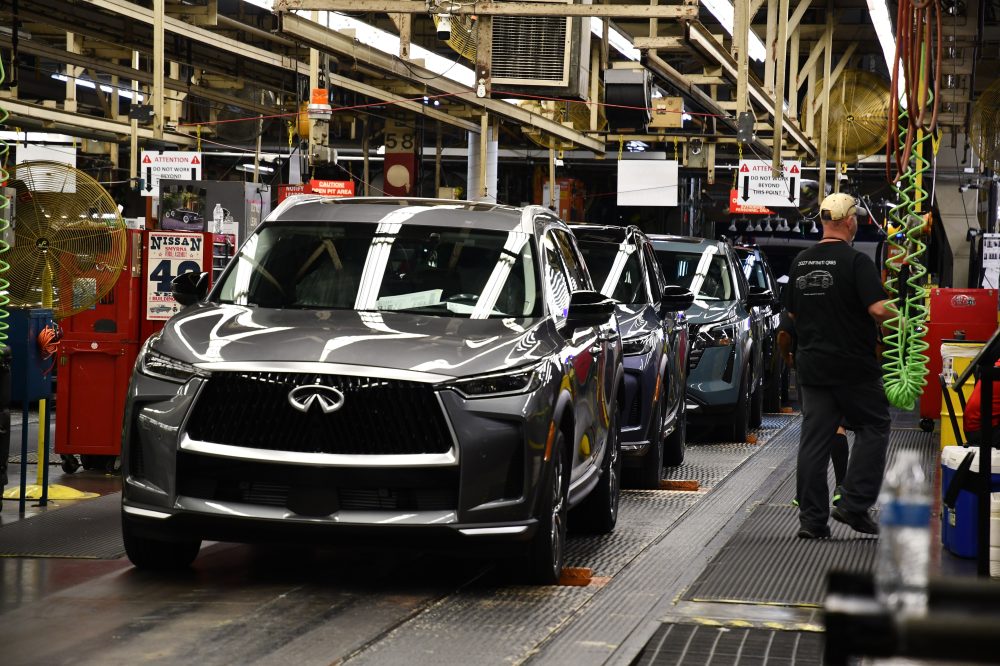
The Yokohama-based automaker Nissan Motor Corp. announced Wednesday that it narrowed its financial losses during the fiscal year ending in March, though the company continues to face headwinds from tariffs, rising costs, and fierce market competition.
The car manufacturer posted a 533 billion yen ($3.4 billion) deficit, an improvement from the previous year’s 670.9 billion yen loss.
Revenue dropped 5% to 12 trillion yen ($76 billion) for the annual period.
CEO Ivan Espinosa expressed optimism about the company’s trajectory, noting steady improvement and visible indicators of recovery.
“We have moved beyond recovery and are entering a phase of growth,” Espinosa stated. “We will build on this momentum through disciplined cost management and faster product execution, driving sales and profitability.”
Looking at the most recent quarter, Nissan recorded a 282.9 billion yen ($1.8 billion) deficit for the January through March period, a significant improvement from the 676 billion yen loss during the same timeframe last year.
Revenue for the quarter decreased nearly 2% to 3.43 trillion yen ($22 billion).
The automaker emphasized its focus on reducing expenses and implementing strategies to boost profitability. Company officials noted they achieved operating profits that exceeded projections and anticipate improved performance in the coming year with new vehicle releases.
During the fiscal year that concluded March 31, Nissan delivered 3.15 million vehicles worldwide across its lineup, which includes the Altima sedan, Pathfinder SUV, Leaf electric vehicle, and luxury Infiniti models.
However, beneath the optimistic messaging from leadership, the company faces its most challenging financial period in years. Nissan has eliminated thousands of positions and divested its headquarters property as part of restructuring efforts.
The automaker projects a return to positive earnings for the fiscal year ending March 2027, forecasting a modest 20 billion yen ($127 million) profit.
All Japanese car manufacturers are grappling with aggressive competition from emerging Chinese automakers that now control significant portions of Asian markets.
Previous discussions about combining certain operations with fellow Japanese automaker Honda Motor Co., which faces similar challenges, ultimately failed. While a full merger is off the table, the companies may pursue limited collaborative arrangements.
Nissan’s stock price, which has fluctuated throughout the past year, closed 4% higher following the earnings announcement.
WASHINGTON – Legal representatives for Elon Musk and federal securities regulators will stand before a Washington D.C. federal judge Wednesday to defend their proposed $1.5 million settlement agreement, which could provide new insights into the lengthy legal battle between the two parties.
The proposed agreement would end federal accusations that Musk delayed too long before revealing in April 2022 that he had acquired a 5% ownership position in Twitter, allegedly allowing him to avoid $150 million in costs. The world’s wealthiest individual completed his $44 billion acquisition of the social media platform six months after that disclosure.
Federal District Judge Sparkle Sooknanan stated last week that she must evaluate multiple considerations before giving her approval to the settlement, including whether it treats both parties fairly, serves the public good, and remains free from “tainted by improper collusion or corruption.”
The judge has instructed both legal teams to attend Wednesday’s hearing and come prepared to establish a schedule for submitting written arguments supporting their settlement proposal.
Federal regulators filed their lawsuit against Musk on January 14, 2025, just six days before former Democratic President Joe Biden concluded his presidency.
The billionaire entrepreneur, who previously served as an advisor to Republican President Donald Trump, has maintained the legal action was driven by political motivations. Musk has also stated his delayed stock disclosure was an unintentional mistake.
The current Trump administration has reduced certain types of business enforcement actions as SEC Chairman Paul Atkins reshapes the agency’s focus areas.
Margaret Ryan, the previous enforcement division leader who departed unexpectedly in March after only six months in her role, had disagreed with agency leadership regarding enforcement strategy direction, according to Reuters reporting.
Under the settlement terms, Musk would not need to acknowledge any legal violations or return the money he allegedly saved through the delayed disclosure. While the financial penalty represents significantly less than regulators initially pursued, it still constitutes the largest SEC fine in history for this category of violation, according to a source with knowledge of the agreement.
The iconic German footwear manufacturer Birkenstock fell short of Wall Street’s second-quarter sales projections on Wednesday, citing inconsistent consumer demand for its high-end sandals and clogs, along with shipping disruptions caused by ongoing Middle East tensions.
The company’s stock price tumbled 8% during pre-market trading in New York after executives revealed that conflict in the Middle East resulted in a 6 million euro ($7.02 million) negative impact on their Europe, Middle East and Africa business segment.
According to company officials, approximately half of these losses stemmed from their inability to fulfill certain product deliveries to affected regions. The remaining impact resulted from weakened European consumer confidence, primarily driven by elevated energy prices and ongoing inflation connected to the regional conflict.
These financial results emerge during a period of increased uncertainty surrounding consumer discretionary purchases, as geopolitical instability and rising inflation continue to dampen spending sentiment. Despite these challenges, luxury brands like Birkenstock have demonstrated relative stability in recent reporting periods.
The sandal manufacturer maintained its annual revenue and earnings projections unchanged, despite the Middle East-related setbacks, relying on its strategy of controlled product distribution and maintaining full retail pricing.
Regional performance varied significantly, with the Asia-Pacific market leading growth at 22% during the quarter on a reported basis. The Americas segment expanded by 4%, while the EMEA region posted 10% growth.
The company’s gross profit margin declined to 53.9% from the previous year’s 57.7%, affected by currency exchange fluctuations and U.S. import duties, though these impacts were partially balanced by increased product pricing.
Quarterly revenue reached 618.3 million euros, falling below the analyst consensus estimate of 620.07 million euros compiled by LSEG data.
Adjusted earnings per share came in at 0.50 euros, representing a 9% decrease from the prior year’s 0.55 euros per share.
WASHINGTON – Kevin Warsh is poised to assume leadership of the Federal Reserve this month, bringing with him an extensive reform agenda that economists warn could prove difficult to implement swiftly.
The 56-year-old attorney and finance expert departed the central bank 15 years ago in disagreement with an aggressive bond-purchasing strategy that ultimately left the Fed holding a massive $6.7 trillion investment portfolio.
Warsh’s vision for change encompasses multiple areas, from revamping inflation tracking methods to reconsidering market intervention policies and overhauling how the Fed communicates with the public. His proposals would require both technical modifications to the bank’s economic assessments and delicate adjustments to its public messaging approach – areas that have proven resistant to rapid transformation in the past.
The incoming chair could quickly alter the Fed’s communication style and potentially reduce activities like media briefings, marking a shift back toward the more secretive central banking practices that existed before the 2007-2009 financial crisis prompted greater transparency and market guidance.
While Warsh opposes the current communication approach, he remains cautious about market disruption. “There are so many things that he wants to do and it is just going to take time to work through that,” explained Randall Kroszner, a University of Chicago economics professor who worked with Warsh as a Fed governor from 2006 to 2009. “It’s not just ‘off with their heads’ or suddenly tomorrow we’re going to have the balance sheet be $4 trillion.”
The Senate is expected to confirm President Donald Trump’s selection of Warsh to replace Jerome Powell this week. Trump frequently criticized Powell, initially pushing for rate reductions before escalating tensions through attempts to remove Fed Governor Lisa Cook and launching a Justice Department investigation into Powell that many viewed as an attack on the Fed’s independence. The Cook matter awaits Supreme Court review, while the Justice Department has concluded its Powell inquiry.
Powell’s eight-year leadership term concludes Friday, though he plans to retain his position on the Board of Governors as the investigation fully concludes, partly to shield the Fed from additional legal challenges from the administration.
Warsh’s first major hurdle involves balancing Trump’s pressure for rate cuts against economic indicators that provide little justification for such action. Unemployment sits at a relatively modest 4.3%, while inflation continues running significantly above the Fed’s 2% goal and appears to be climbing.
At Warsh’s inaugural policy meeting in June, success might simply mean preventing colleagues on the Federal Open Market Committee from advocating for rate increases. Three Fed officials voted against the majority at the April 28-29 meeting, favoring language that suggested rate hikes might be necessary, and this position could gain support as inflation spreads beyond factors related to tariffs or elevated energy costs.
Powell enjoyed roughly six months after Trump elevated him to Fed leadership in 2018 before facing presidential criticism, and investors currently don’t anticipate rate reductions until 2028.
Throughout the past year, Warsh has presented various arguments in speeches, interviews and public testimony for why rates might still decline despite current economic data. He suggests productivity improvements from artificial intelligence could reduce costs across the economy, that reducing the Fed’s long-term bond holdings might justify lower short-term rates, and that alternative inflation measurements show prices rising more gradually than current Fed indicators suggest.
While these arguments may have merit, supporting them with convincing research and persuading fellow policymakers will require significant time and effort, if achievable at all.
Former Fed personnel and officials indicate Warsh would likely begin by ordering comprehensive internal evaluations, followed by FOMC discussions and eventually potential modifications to policies like bank reserve requirements – one possible route to reducing the balance sheet – or incorporating different inflation data into policy deliberations.
Warsh has also expressed interest in modifying established communication mechanisms like the quarterly Summary of Economic Projections, which features the “dot plot” chart showing rate forecasts. Widespread dissatisfaction with certain SEP elements exists, making this area potentially suitable for quicker reform.
However, both the central bank’s SEPs and the Fed chair’s media briefings have become influential tools for managing public expectations. A recent Brookings Institution poll of 29 academic and private-sector Fed specialists found nearly all respondents considered post-meeting press conferences “useful or extremely useful,” while just over half expressed similar views about the SEP and dot plot.
Media briefings specifically represent “an international standard” for explaining policy decisions and economic forecasts, noted former St. Louis Fed President James Bullard, now dean of Purdue University’s Mitch Daniels School of Business. “I think it would be hard to change that.”
Regarding other matters, former Fed officials and staff indicate Warsh’s suggestions would undergo the same scrutiny as any proposal.
Concepts for balance sheet reduction are already being discussed, but skepticism exists about Warsh’s theory that shrinking bond holdings would enable rate cuts.
Warsh’s observations about productivity improvements affecting inflation are generally accepted in principle, but questions remain about timing and rate implications. Chicago Fed President Austan Goolsbee recently outlined an alternative situation where widespread AI expectations could prompt people to spend anticipated stock and wealth gains immediately, increasing inflation and forcing Fed rate hikes.
The disagreement centers less on AI’s economic impact and more on timing and risk – how quickly productivity gains reduce inflation versus encouraging additional current spending, and whether the Fed can safely rely on future disinflation to justify immediate rate cuts.
“He might be right in the impact on demand versus the impact on supply,” Goolsbee told reporters following a Los Angeles conference. “I think it is worth thinking about… I don’t know what the debate ground rules are going to be… I hope, for my purposes… it will be rooted in serious economic research.”
China’s dominant social media and gaming corporation, Tencent Holdings, announced Wednesday that its first-quarter earnings climbed 9% as the company capitalized on strong gaming performance and growing artificial intelligence business segments.
The technology giant, headquartered in Shenzhen, recorded earnings of 196.5 billion yuan (equivalent to $28.94 billion) during the January through March period, falling short of the 198.96 billion yuan projection from financial analysts surveyed by LSEG.
The company’s net earnings reached 58.1 billion yuan, which also came in below analyst predictions of 61.42 billion yuan.
YOKOHAMA, Japan – Japanese automaker Nissan delivered unexpected results Wednesday, announcing an operating profit of 58.0 billion yen (equivalent to $367.60 million) for its fiscal year concluding in March, defying Wall Street predictions of significant losses.
Financial experts surveyed by LSEG had anticipated the car manufacturer would report annual losses totaling 60 billion yen. The company’s previous year performance showed profits of 69.8 billion yen, making this year’s results a decline but still positive territory.
The automaker managed to achieve profitability despite facing multiple headwinds including enhanced cost management strategies and receiving a special benefit related to U.S. emissions compliance requirements, which helped counterbalance negative impacts from Washington’s trade tariffs.
Similar to other global automotive companies, Nissan continues navigating challenges from American trade policies, fierce rivalry from Chinese electric vehicle manufacturers across European and international markets, along with increased raw material expenses and supply chain vulnerabilities stemming from the U.S.-Israeli conflict with Iran.
Under the leadership of CEO Ivan Espinosa, the company is working to restore growth momentum following several years of internal upheaval. His strategy involves workforce reductions, closing manufacturing facilities, and streamlining the company’s worldwide vehicle portfolio.
The financial performance exceeded Nissan’s own projections of 50 billion yen in profits that were announced approximately two weeks prior to this report.
Company officials revealed that American tariff policies reduced full-year earnings by 286 billion yen, representing a substantial drag on overall performance.
Looking ahead to the current fiscal year, Nissan forecasts operating profits will reach 200 billion yen, showing optimism for continued recovery.
The powerful families behind Volkswagen are pressing the German automaker to make major changes to how it operates after their investment firm took a significant financial hit during the first quarter.
Porsche SE, the investment company controlled by the Porsche-Piech families and Volkswagen’s biggest shareholder, reported that its adjusted profits dropped 21% to 382 million euros ($469 million) between January and March.
The investment firm’s overall financial picture looked even worse, with an unadjusted loss of 923 million euros after taking a massive 1.3 billion euro writedown on the value of its Volkswagen holdings. This follows a similar 1.1 billion euro loss the company recorded last year.
As traditional car business profits continue declining, Porsche SE is exploring new investment opportunities in defense technology and artificial intelligence sectors. The global automotive industry faces mounting pressure from trade tariffs, increased competition from Chinese manufacturers, and difficulties transitioning to electric vehicle production.
These alternative investments remain a minor portion of Porsche SE’s overall portfolio. The company did generate 60 million euros during the quarter by selling its ownership stake in semiconductor startup Celestial AI.
Hans Dieter Poetsch, who chairs Porsche SE’s board, acknowledged that the quarterly results matched what analysts expected.
“At the same time, the business models that have served our core investments well for a long time now need to be realigned,” Poetsch stated, referring specifically to Volkswagen and its Porsche AG division.
The holding company maintains significant control over Volkswagen, owning nearly 32% of all shares and commanding 53.3% of voting power. It also holds a 12.5% stake in luxury sports car manufacturer Porsche AG.
Poetsch has consistently expressed Porsche SE’s long-term support for Volkswagen while simultaneously urging the automaker to identify areas where it can reduce expenses.
Volkswagen’s chief executive Oliver Blume has promised to accelerate cost-reduction efforts beyond the 50,000 job eliminations already underway. Several underutilized manufacturing facilities in Germany are being examined for potential changes, despite a 2024 labor agreement that prevents any plant closures through the end of this decade.
The chief executive of artificial intelligence company OpenAI appeared in court to testify in defense of his organization against legal action initiated by tech mogul Elon Musk.
NPR correspondent Leila Fadel conducted an interview with New York Times technology reporter Mike Isaac regarding Sam Altman’s courtroom appearance and his statements during the legal proceedings launched by the billionaire business leader.
The lawsuit represents a notable clash between two influential figures in the technology industry, with Altman taking the witness stand to address the allegations brought forward by Musk against the AI development company.
Drivers across California are grappling with increasingly expensive fuel costs as gas prices continue their upward climb amid ongoing conflict involving Iran. The Golden State, which has historically maintained some of the nation’s steepest gasoline prices, is witnessing residents express growing concern over the mounting economic pressure.
The escalating prices at fuel stations throughout California are directly tied to the current Iran conflict, adding another layer of financial stress for motorists who were already paying premium rates compared to other states. Residents report that the rising costs are creating a noticeable impact on their household budgets and daily expenses.
For the first time in four months, Japanese investors pulled money out of foreign stock markets during April, withdrawing funds as worries about rising energy prices from Middle East conflicts and broader inflation risks made them more cautious about overseas investments.
According to data released Wednesday by Japan’s Ministry of Finance, investors withdrew a net 636.4 billion yen ($4.04 billion) from foreign stocks last month. This marked the biggest monthly withdrawal since October of last year.
While Japanese investors continued selling foreign bonds, that selloff slowed to its lowest level in three months at 219.2 billion yen during April.
The moves came as U.S. inflation data showed consumer prices climbing at their fastest rate in three years during April, with increases spanning food, services, housing costs and airline tickets, according to Tuesday’s report from the U.S. Labor Department.
Japanese trust accounts led the foreign stock exodus, pulling out 1.85 trillion yen in their largest monthly withdrawal since June of last year. However, these same accounts put 897.3 billion yen into foreign long-term bonds.
Not all Japanese investors retreated from foreign markets. Investment trust management firms bought 1.25 trillion yen worth of foreign stocks, while life insurance companies purchased 333.1 billion yen worth.
A separate Bank of Japan report revealed that during the first quarter, Japanese investors sold 4.95 trillion yen in U.S. bonds and 1.02 trillion yen in European bonds.
The European bond sales included 797.66 billion yen worth of French bonds and 307.65 billion yen in German bonds.
TOKYO — Technology investment giant SoftBank Group Corp. announced Wednesday that its annual earnings surged almost five times higher compared to the previous year, driven by profitable artificial intelligence ventures.
The Tokyo-headquartered firm posted yearly earnings of 5 trillion yen ($32 billion), a dramatic increase from the prior year’s 1.15 trillion yen in profits.
Revenue grew approximately 8% year-over-year, reaching nearly 7.8 trillion yen ($50 billion) compared to 7.2 trillion yen previously, according to the company’s official statement.
The firm’s most profitable venture proved to be its stake in OpenAI, where SoftBank invested $34.6 billion and saw returns of $45 billion.
The investment company also holds positions in American AI corporation Nvidia, Germany’s Deutsche Telekom mobile and internet provider, and Britain’s Arm semiconductor company. SoftBank is additionally known for creating the Pepper humanoid robot.
The company received an extra boost from PayPay’s initial public stock offering, a widely-used mobile payment app in Japan that enables users to conduct fast, cashless transactions through QR code scanning.
Positive returns from Intel Corp. holdings helped balance out losses from investments in China’s Alibaba e-commerce platform.
These varied outcomes are characteristic of SoftBank’s performance, as the company was an early technology investor among Japanese firms and now manages an extensive portfolio through its Vision Funds program.
Masayoshi Son established SoftBank over 40 years ago and continues serving as CEO and chairman. The University of California alumnus has become a billionaire and is recognized as a trailblazer in Japan’s tech industry.
SoftBank has recently launched a battery venture in Japan focused on constructing advanced electric power systems to meet anticipated electricity demands from AI expansion.
The corporation is also collaborating with Toppan, a Japanese company specializing in printing, communications, security and packaging, to create lightweight, resilient aircraft wing materials expected to enter commercial use within three years.
SoftBank Group does not release earnings projections.
A California-based defense technology company announced Wednesday that it has successfully secured $5 billion in new investment funding, bringing its total valuation to $61 billion — exactly double its previous worth.
Anduril Industries completed this massive funding round with leadership from two major venture capital firms: Thrive Capital and Andreessen Horowitz.
The startup has experienced remarkable growth over the past 12 months, with company officials reporting that annual revenue has more than doubled to reach $2.2 billion in 2025. During this same period, Anduril has nearly doubled the size of its workforce.
This funding announcement follows earlier reports from March indicating that Anduril was pursuing approximately $4 billion in investment from the same venture capital partners. The company’s valuation has seen dramatic growth since June 2025, when it was valued at $30.5 billion.
The defense technology sector has become increasingly attractive to investors, particularly as private funding opportunities expand during the ongoing U.S.-Iran conflict. This environment has allowed companies to secure larger investment rounds while maintaining their private status for extended periods.
Anduril specializes in creating defense solutions that include various sensor technologies and drone systems. The company has gained significant attention as military and government agencies increasingly seek affordable autonomous defense technologies.
A major Indian pharmaceutical company announced disappointing financial results on Wednesday, with earnings falling well below expectations due to challenging conditions in the United States market and rising operational costs.
Cipla, which ranks as India’s third-largest drug manufacturer by sales volume, saw its consolidated net earnings plummet 54.6% compared to the same period last year, reaching 5.55 billion rupees (equivalent to $58 million) for the quarter that concluded on March 31. This performance fell significantly short of the 7.05 billion rupee average projection from financial analysts, based on data from LSEG.
The company’s overall operational revenue decreased by 2.8% to 65.41 billion rupees, which was below the anticipated 67.49 billion rupees that market experts had forecast. This shortfall was primarily attributed to declining sales performance in the crucial North American marketplace.
While the company’s domestic Indian market showed robust growth with revenue climbing 15% to reach 30.07 billion rupees, this positive performance was overshadowed by a substantial 26% drop in North American revenue, which fell to 14.14 billion rupees.
These two primary markets represent approximately three-quarters of the pharmaceutical company’s total sales volume.
Operating costs increased by nearly 8.5% to 18.82 billion rupees, driven by various expense increases throughout the organization.
Additionally, the company recorded an impairment charge of approximately 420.2 million rupees related to its associate investments, further contributing to financial pressure.
Financial analysts from Jefferies had previously indicated in their pre-earnings analysis that they anticipated continued decline in U.S. sales in the coming months due to deterioration in key product lines, with profit margins expected to remain constrained until new product launches gain momentum.
The company announced it will distribute a dividend payment of 13 rupees per share to shareholders.
A competing pharmaceutical company, Dr Reddy’s, also reported a significant quarterly profit decline on Tuesday, impacted by impairment charges related to its discontinued cancer treatment development program.
Despite the disappointing earnings report, Cipla’s stock price rose 4.23% during afternoon trading. However, the company’s shares have declined approximately 14.3% since the beginning of this year.
Japanese technology investment giant SoftBank Group announced Wednesday it generated net earnings of 1.9 trillion yen, equivalent to $12.05 billion, during the January through March period.
This represents a significant jump from the company’s net earnings of 517 billion yen during the corresponding quarter in 2023.
The Tokyo-based firm has now achieved positive earnings for five straight quarters, with much of its success stemming from its substantial investment in artificial intelligence company OpenAI.
SoftBank’s Vision Fund division, which manages the company’s OpenAI holdings, reported investment gains totaling 3.1 trillion yen during the three-month period.
The increasing valuation of the company behind ChatGPT through several funding rounds in recent months has served as the main catalyst for SoftBank’s strong financial performance.
Looking ahead, SoftBank has committed an additional $30 billion to OpenAI through 2026, which would increase its total investment commitment to $64.4 billion in exchange for approximately 13% ownership of the AI company.
To fund these investments, the Japanese conglomerate has divested portions of its holdings in companies including T-Mobile and Nvidia, while also issuing bonds and securing loans using its semiconductor designer Arm and domestic telecom subsidiary SoftBank Corp as collateral.
A Chinese toy manufacturing company nearly went out of business last year, saved only by a trade agreement that came just one day before the firm would have collapsed, according to company executives.
David Cheung, who operates Huntar Company alongside his brother Jason, revealed that their family business was on the verge of bankruptcy when the United States and China reached a trade agreement in Geneva on May 12 last year. The deal reduced the most severe tariffs that had been crippling their operations.
At the exact moment the trade truce was announced, Huntar’s manufacturing equipment was preparing to leave Chinese customs as part of a desperate attempt to relocate production to Vietnam and keep the company afloat.
The Cheung brothers immediately recalled their shipment upon learning of the trade deal, later realizing this split-second choice had rescued their enterprise.
“That one day would have changed everything,” Cheung explained. “We were very, very lucky.”
If the manufacturing molds had crossed into Vietnam, the company would have faced two costly scenarios: either setting up operations in the new country or navigating lengthy customs processes to bring the equipment back to China. Both options would have delayed production for two complete cycles, draining essential cash reserves.
The near-collapse of Huntar demonstrates the severe impact the trade dispute had on international businesses and highlights potential risks if economic relations between the superpowers deteriorate further.
Huntar operates in Shaoguan, a southern Chinese city, where it employs between 400 and 500 workers producing educational toys sold at major American retailers like Walmart and Target. Company leadership hopes recent diplomatic meetings between U.S. and Chinese officials could establish more predictable trade relationships.
Economic experts believe an extension of the current tariff pause is probable, pointing to China’s control over rare earth mineral production as a key negotiating advantage. These materials are essential for American industries, including defense contractors, and China effectively leveraged this dependency during previous trade discussions.
“China’s export curbs were an important reminder that economic interdependence cuts both ways,” noted Neil Shearing, chief economist at Capital Economics.
“President Trump discovered that the U.S. did not, in fact, ‘hold all the cards’.”
However, Shearing cautioned that efforts to improve relations haven’t addressed fundamental issues driving the conflict, including China’s massive $1.2 trillion trade surplus and America’s reliance on Chinese manufacturing.
The United States has criticized China for mercantilism – policies that promote exports while limiting imports to increase national wealth and influence. China counters that America is attempting to suppress its economic growth.
“It is a negative feedback loop: geopolitics worsen imbalances, and imbalances worsen geopolitical tensions,” Shearing observed.
Paradoxically, Huntar’s existence stems from the very differences between the two nations that now create tension. David Cheung’s father fled Communist China by swimming across a river into British-controlled Hong Kong, then immigrated to California in 1978, attracted by American freedoms.
Working as a janitor in San Francisco and selling merchandise at flea markets for additional income, he eventually saved enough money to establish the business his sons now operate. The family pursued the American dream until, like many U.S. manufacturers, they shifted production to China.
In the toy industry specifically, China produces 80% of products purchased by American consumers, according to The Toy Association trade group.
Given these interconnected supply chains, Cheung anticipates that U.S.-China tensions will continue affecting manufacturing networks regardless of diplomatic outcomes.
American wholesale buyers still request alternative production locations, though most recognize the need “to keep as much in China as possible because that’s where we have the infrastructure. That’s where everything is, frankly, better manufactured,” Cheung stated.
“There’s always this political cloud hanging over their heads where they don’t want to be in the same position that they were in a year ago.”
While Huntar maintains a partnership with a Vietnamese manufacturer for certain products, any major relocation efforts face new challenges. Plastic sourcing costs have increased more than 40% since U.S.-Israeli military actions against Iran disrupted oil and petroleum product supplies.
Delaware families are spending more at the grocery store as food costs climbed nationwide last month, driven by multiple economic pressures beyond just rising fuel prices.
Government data released Tuesday shows grocery store food prices jumped 2.9% in April compared to the same period last year, marking the steepest annual increase since August 2023. Restaurant and fast-food prices also climbed, pushing overall food inflation to 3.2% over the past 12 months, according to the Labor Department’s consumer price index.
While fuel costs have surged due to the Iran conflict disrupting shipping through the Strait of Hormuz – a crucial oil transport route – this represents just one piece of the pricing puzzle. Diesel fuel, which powers fishing vessels, farm equipment, and trucks carrying 83% of America’s agricultural products, has jumped 61% from last year, AAA reported Tuesday.
Raymond Campise, who owns Sparrow Market, an independent grocery store in Ann Arbor, Michigan, said his suppliers for meat, produce and dry goods have all implemented fuel surcharges on deliveries in recent weeks. Wholesale costs for many products have also increased, he noted.
“For independent markets operating on narrow margins, even small increases can have a major impact,” Campise said.
Purdue University economists Ken Foster and Bernhard Dalheimer warn that energy cost impacts on food pricing may not have fully materialized yet in American supermarkets. They explain that increased expenses for producing, processing, storing and shipping food typically take three to six months before appearing on store shelves, and once prices rise, they tend to decrease slowly.
“Most of what we’re seeing now in the food price chain probably predates the conflict,” Foster, a professor of agricultural economics, said. “We’re cautiously waiting to see what the June numbers and the May numbers might show as they come out in terms of … the extent to which energy shocks in the Strait of Hormuz and shipping blockades and so forth are going to impact food prices.”
The consumer price index tracks retail price changes for meat, bread, milk, produce and other grocery essentials in American cities. Historical data from the U.S. Department of Agriculture shows grocery prices have risen an average of 2.6% annually over the past two decades.
Fresh and refrigerated items typically see faster price increases when energy costs spike. Urban consumers paid 6.5% more for fresh fruits and vegetables last month compared to April 2023, while meat prices surged 8.8%, Labor Department figures show.
However, U.S. trade decisions and severe weather conditions have also contributed to rising food costs over the past year. The Trump administration’s 17% tariff on Mexican fresh tomatoes, implemented in July 2023, preceded a 40% consumer price increase for tomatoes in the 12 months leading to April.
Western U.S. drought conditions have helped drive beef prices 15% higher year-over-year in April. Coffee costs jumped 18.5%, partially due to drought and weather issues affecting global coffee production in recent years.
“Today’s CPI showed that food prices have been rising 3.2 percent in the past year, but the story behind that number is more complicated than just an energy shock,” said Dalheimer, an assistant professor of macroeconomics and trade in Purdue’s Department of Agricultural Economics.
Some food categories saw stable or declining prices over the 12-month period. Milk and chicken prices dropped slightly, while butter costs fell 5.8% in April compared to the previous year. Egg prices plummeted 39% as farmers rebuilt poultry operations devastated by the ongoing bird flu outbreak.
Food pricing and broader inflation issues are expected to play major roles in November’s midterm elections. During his 2024 campaign, President Donald Trump frequently highlighted the costs of bacon, cereal, crackers and other grocery items as justification for voters to elect him to the White House.
Some food industry sectors report current struggles due to elevated fuel expenses. The Southern Shrimp Alliance, representing shrimpers across eight states, said some vessels have remained docked this spring because crews cannot catch sufficient shrimp to offset diesel costs.
While fuel typically accounts for 30% to 50% of U.S. shrimping expenses, these operators supply only 6% of American shrimp consumption, limiting their ability to increase prices or implement fuel surcharges, the organization explained.
Rising fuel costs may affect food pricing through additional channels. Foster suggested that April’s 5% annual increase in non-alcoholic beverage prices might partially stem from petroleum derivatives used in plastic bottle manufacturing.
“It’s possible some of that’s starting to seep down the supply chain and get into those prices,” he said.
Looking ahead, Americans may face higher food costs due to escalating fertilizer expenses, since approximately 30% of global fertilizer passes through the Strait of Hormuz.
Fertilizer costs pose less immediate concern for U.S. farmers this year, as many secured supplies before the conflict began, Foster noted. However, impacts could become more apparent next year if the war continues.
“I expect the Iran conflict to impact the coming years’ food prices through a couple of channels. One, the energy costs and transportation handling. The other would be through packaging costs,” Foster said. “If the conflict were to last longer, then we might see more coming online as fertilizer prices start to impact longer-term planting decisions and cropping decisions.”
A major telecommunications company based in Dubai announced Wednesday that it has upgraded its financial outlook for 2026 after posting strong first-quarter performance driven by significant digital growth.
Veon has increased its projected revenue growth for 2026 to a range of 11% to 14% in U.S. dollar terms, marking an improvement from its earlier projection of 9% to 12%. This revision follows the company’s announcement of a 17% increase in first-quarter revenue, which reached $1.2 billion.
The company’s earnings before interest, taxes, depreciation and amortization climbed 17.7% compared to the same period last year, totaling $517 million. The corresponding margin expanded to 43.0%.
Particularly noteworthy was the performance of digital revenues, which represent a central component of Veon’s expansion strategy. These revenues surged 57.7% to reach $303 million, now accounting for more than 25% of the company’s total revenue stream. Digital EBITDA hit $105 million with a margin of 34.6%.
Veon operates telecommunications brands across emerging markets including Ukraine through its separately listed subsidiary Kyivstar, as well as in Pakistan and Bangladesh.
The company also adjusted its annual capital expenditure target upward to 15-17% of revenue, excluding Ukraine operations, from its previous range of 14-16%. This modification stems from spectrum deployment plans following a scheduled March 2026 auction in Pakistan.
A major Japanese snack manufacturer is stripping the color from its product packaging due to supply chain disruptions stemming from the ongoing conflict in Iran.
Calbee Inc., a Tokyo-based company that produces potato chips and cereals, announced this week that it will transition 14 of its snack products to monochrome packaging starting May 25. The company emphasized that the actual food products inside remain unchanged.
“This measure is intended to help maintain a stable supply of products,” the company stated, explaining that the decision represents a flexible response to shifting global political conditions.
The dramatic shift affects popular items sold throughout Japan’s widespread convenience store network, with products also distributed to markets in the United States, China and Australia. Calbee, established in 1949 and currently employing over 5,000 workers, has not indicated how long these packaging changes will remain in effect.
The supply shortage stems from the virtual shutdown of the Strait of Hormuz due to the Iranian war, which has driven up petroleum prices and created shortages of various materials. Among these is naphtha, an oil-derived component essential for manufacturing plastics and printing inks.
Japan’s heavy dependence on imported oil makes the country particularly vulnerable to such disruptions, though government officials have sought to calm public concerns by highlighting the nation’s strategic oil stockpiles.
The packaging transformation is particularly striking on Calbee’s lightly salted potato chips, called “usu shio,” which previously featured vibrant orange bags displaying yellow chip images and a cartoon potato mascot in a hat. The redesigned version contains only black text on a white background.
This development comes just two months after Calbee, which also produces popular shrimp-flavored snacks known as “kappa ebisen,” unveiled an aggressive expansion plan in March.
“Calbee will continue to respond flexibly and promptly to changes in its operating environment, including geopolitical risks, and remains committed to maintaining a stable supply of safe, high‑quality products,” the company said. “We ask for your understanding.”
A government advisory panel in Singapore has urged the island nation to pursue major artificial intelligence companies and strengthen its position as an energy trading center, according to recommendations delivered to officials this week.
The strategic growth committee presented its findings Wednesday as Singapore looks to artificial intelligence to reshape both its economy and workforce amid rising global tensions, including conflicts in Iran that could impact economic growth and drive up prices.
The panel outlined several key strategic directions for the Southeast Asian financial hub:
Committee members emphasized that Singapore must sharpen its competitive advantages and develop greater flexibility to navigate challenging international conditions.
The recommendations call for Singapore to convince major industries to establish permanent operations there, leveraging the nation’s existing position as a critical link in semiconductor and other supply chains.
The committee identified quantum computing and space technology as particularly promising areas, noting these fields can build upon Singapore’s established strengths in chip manufacturing, advanced production methods, aviation, and satellite operations.
Panel members specifically recommended that Singapore position itself as a reliable center where artificial intelligence systems can be created, tested, and implemented by drawing top AI corporations and skilled professionals to the country.
The group also suggested Singapore capitalize on its energy trading role by developing expertise in new areas such as liquefied natural gas markets, along with hydrogen, ammonia, and clean aviation fuel sectors.
Deputy Prime Minister Gan Kim Yong addressed the committee’s findings during a business conference Wednesday, warning against complacency about the nation’s future competitiveness.
“In a changed world, Singapore cannot assume that yesterday’s strengths will automatically become tomorrow’s place,” Gan Kim Yong said during his remarks.
JPMorgan Chase is reportedly planning significant leadership changes within its investment banking operations as part of a broader company restructuring, according to a Financial Times report published Tuesday.
The banking giant is expected to name three senior executives as co-heads of its global investment banking division, sources familiar with the situation told the Financial Times. The trio includes Dorothee Blessing, who currently serves as coverage chief, Kevin Foley, the global head of capital markets, and Jared Kaye, who holds the position of global co-head of the financial institutions group.
The leadership shake-up represents part of a larger organizational restructuring effort at the major financial institution. Reuters has not been able to independently confirm the details of the reported changes.
Australia’s Commonwealth Bank experienced a dramatic stock decline Wednesday, with shares falling 9% as the nation’s biggest home loan provider responded to new government tax policies and set aside additional funds to address global economic risks.
The banking giant reported quarterly cash profits of approximately A$2.7 billion ($1.95 billion) for the period ending March 31, representing an increase from A$2.6 billion during the same timeframe last year. However, these earnings fell roughly 2% short of what some financial analysts had predicted.
Banking stocks across Australia faced selling pressure Wednesday as investors expressed concern about potential slowdowns in mortgage lending following significant tax policy announcements made Tuesday by the federal government.
The country’s Labor government revealed in its yearly budget proposal plans to restrict negative gearing benefits for investment properties to newly constructed buildings only, aiming to increase housing availability. This tax strategy currently permits investors to deduct property-related losses from their overall taxable earnings.
Additionally, officials announced the elimination of the existing 50% capital gains tax reduction for assets owned longer than one year. Under the proposed system, taxes would apply to inflation-adjusted profits, with investors facing at least 30% tax rates on net capital gains.
Financial experts believe these policy shifts may reduce investor appetite for mortgages from Australian banks, as existing home sales activity could weaken significantly.
“Changes to negative gearing and CGT, which will dampen investor activity, come as rates are rising, consumer sentiment has troughed and construction costs are rising,” said Citigroup analyst Thomas Strong.
The 9% stock drop represents Commonwealth Bank’s steepest single-day decline since March 2020, marking a significant milestone for the financial institution.
Other major Australian banks also experienced losses, with Westpac shares declining 3%, National Australia Bank dropping 2.6%, and ANZ Group falling 1.65%. The broader S&P/ASX200 market index decreased by 0.7%.
According to the bank’s financial update, home loans, commercial lending, and consumer deposits all expanded during the three-month period ending March 31, contributing to a 1% increase in net interest earnings despite intense competition in lending markets.
Commonwealth Bank announced it would boost collective financial reserves by A$200 million after updating economic projections and increasing the probability of unfavorable economic conditions developing.
The financial institution reported that its net interest margin remained relatively steady for the quarter when excluding one-time benefits, though specific margin figures were not provided in the preliminary trading report.
The bank’s common equity tier 1 ratio, which measures available capital reserves, reached 11.6% at the end of March.
Loan loss provisions increased to A$316 million from A$223 million in the previous year, with the bank citing higher collective reserves due to growing geopolitical tensions and economic uncertainty.
“Conflict in the Middle East is disrupting critical supply chains and contributing to global uncertainty,” Chief Executive Officer Matt Comyn said.
TOKYO (AP) — Stock markets across Asia displayed varied performance early Wednesday, with diminishing investor excitement about artificial intelligence and technology sectors beginning to slow Wall Street’s streak of record-breaking gains.
Japan’s primary Nikkei 225 index climbed modestly by less than 0.1% to reach 62,774.94. South Korea’s Kospi index recovered with a 0.9% increase to 7,708.05, making up for some recent declines. The Kospi had dropped 2.3% earlier this week from its record peak after a government official hinted at possible plans to redistribute excess AI company profits to the public.
Australia’s S&P/ASX 200 declined 0.3% to 8,645.80. Hong Kong’s Hang Seng fell 0.4% to 26,246.29, while Shanghai’s Composite index remained nearly flat, dropping less than 0.1% to 4,213.86.
“Corporate earnings and AI momentum are acting as the market’s primary shock absorbers, but the road is getting significantly rougher,” said Tim Waterer, chief market analyst at KCM Trade.
“With oil prices becoming entrenched at elevated levels and a diplomatic breakthrough between the U.S. and Iran remaining elusive, the easy bullish narrative is becoming much harder to maintain.”
Energy markets saw benchmark U.S. crude decrease 58 cents to $101.60 per barrel. Brent crude dropped 66 cents to $107.11 per barrel.
These prices remain substantially higher than pre-war levels with Iran, as the conflict threatens to continue and ceasefire prospects appear fragile. Brent has jumped from approximately $70 per barrel before the conflict began. The war has effectively blocked oil tanker passage through the Strait of Hormuz.
On Wall Street, the S&P 500 dropped 0.2% from its record high established the previous day. The Dow Jones Industrial Average rose 56 points, or 0.1%, while the Nasdaq composite fell 0.7% from its own record.
Semiconductor companies and stocks that have experienced dramatic gains due to the artificial intelligence surge saw some of the steepest declines. Intel tumbled 6.8% after its stock had more than tripled year-to-date. Micron Technology fell 3.6%.
Bond market Treasury yields increased following initial fluctuation, indicating traders believe the Federal Reserve will maintain elevated interest rates to fight inflation. The 10-year Treasury yield climbed to 4.45% Tuesday from 4.42% late Monday and stays well above its 3.97% pre-war level. Traders anticipate the Fed will hold its primary interest rate unchanged.
Overall, the S&P 500 declined 11.88 points to 7,400.96. The Dow Jones Industrial Average gained 56.09 to 49,760.56, and the Nasdaq composite lost 185.92 to 26,088.20.
In foreign exchange markets, the U.S. dollar strengthened to 157.70 Japanese yen from 157.59 yen. The euro traded at $1.1741, slightly down from $1.1744.
The chief executive of semiconductor giant Nvidia will reportedly accompany President Donald Trump during his scheduled trip to China this week, according to two sources with knowledge of the plans who spoke to Reuters Wednesday.
Jensen Huang’s name was not included on the original roster of business executives that the White House released earlier this week for the presidential delegation. The group is expected to include more than a dozen American CEOs making the journey alongside Trump.
Nvidia has encountered obstacles in the Chinese marketplace, particularly with its advanced H200 semiconductor products, which have yet to reach Chinese customers. A U.S. government official indicated last month that the company has struggled to obtain necessary approvals from Chinese authorities for these sales.
White House officials did not provide a response when contacted for comment about Huang’s participation in the delegation.
The future chief executive of BHP, the globe’s largest publicly traded mining corporation, has outlined his strategy for long-term expansion through strategic acquisitions and increased exploration efforts.
Brandon Craig, set to assume leadership of the mining giant on July 1, addressed investors at a Bank of America conference in Miami on Tuesday. His remarks were made public through the Australian stock exchange on Wednesday.
“One of my priorities will be ensuring we have options to grow well beyond 2035. That means increasing exploration, seeking opportunities to partner with peers to unlock value in adjacent operations and by executing smaller ‘bolt on’ acquisitions when the value case supports them,” Craig stated during his presentation.
The incoming executive emphasized the company’s financial flexibility while maintaining a cautious approach to deals. “And while we will remain extremely disciplined, our diversified model and strong balance sheet gives us the ability to move at pace if the right opportunity presents itself,” he explained.
Craig’s predecessor, Mike Henry, pursued multiple acquisition attempts of smaller competitor Anglo American, including a recent effort in November as the company worked to strengthen its copper market position. Anglo American rejected BHP’s $49 billion takeover bid in May 2024.
The mining company’s stock performance has been strong, climbing 31% year-to-date and reaching a record peak of A$61.61 on Wednesday’s trading session.
The American dollar maintained its position near a weekly peak on Wednesday as investor confidence declined following an unexpectedly high inflation report that drove Treasury bond yields upward, while crude oil prices climbed amid fresh Middle Eastern tensions.
European currencies weakened against the dollar during early Asian trading sessions, with the euro dropping to $1.1735 and the British pound falling to $1.3532, each declining approximately 0.05% versus the American currency.
The dollar index, which measures the greenback’s performance against six major international currencies, remained stable at 98.335, hovering near its strongest position in seven days.
“I think it’s a less positive risk tone, effectively. The U.S. dollar has been tracking risk sentiment very closely throughout the war,” said Ray Attrill, head of FX strategy at National Australia Bank.
Attrill noted that sluggish momentum in stock markets also contributed to the currency movement.
April’s consumer price index climbed 3.8% compared to the same month last year, marking the largest annual increase since May 2023, as energy costs surged due to the ongoing conflict with Iran.
Prospects for Middle Eastern peace negotiations deteriorated after President Donald Trump described the potential ceasefire with Iran as being “on life support” following Tehran’s rejection of an American proposal to end hostilities. Trump dismissed Iran’s counter-demands as “garbage.”
Crude oil markets responded with higher prices, pushing Brent futures to approximately $108 per barrel.
Bond markets reflected changing Federal Reserve expectations, with two-year Treasury note yields climbing to 3.9956% and the benchmark 10-year note reaching 4.4688%.
Financial markets have essentially eliminated expectations for Fed rate reductions this year, while the probability of at least a 25 basis point increase at December’s central bank meeting jumped to 35%, based on CME’s FedWatch Tool data.
Pacific currencies showed minimal movement, with the Australian dollar trading at $0.72365 and New Zealand’s currency holding at $0.5954.
Japan’s yen remained relatively stable at 157.715 after Tuesday’s sudden strengthening sparked speculation about potential government intervention in currency markets.
Treasury Secretary Scott Bessent stated that both the United States and Japan view excessive currency market volatility as problematic, remarks interpreted as backing Tokyo’s recent efforts to support the yen through market intervention.
China’s yuan traded near 6.79 against the dollar, approaching its strongest level since February 2023, as markets anticipated this week’s scheduled meeting between Trump and Chinese President Xi Jinping in Beijing.
Stock markets throughout Asia opened lower Wednesday morning as investors grappled with unexpectedly high U.S. inflation numbers and continued instability from Middle Eastern conflicts.
The MSCI Asia-Pacific index excluding Japan dropped 0.6%, marking its second consecutive day of declines. South Korean markets experienced the sharpest volatility, initially plummeting 3.2% before staging a partial recovery. Industry observers noted that Korean stocks had been on an impressive run recently, hitting multiple records during an artificial intelligence-driven surge that many believed was overdue for a correction.
Japan’s Nikkei 225 index fell 0.2%, while futures for the S&P 500 edged down 0.1%.
“A hotter-than-expected inflation report and persistent geopolitical tensions reminded investors that sticky prices and elevated energy costs are not going away anytime soon,” said Tony Sycamore, market analyst at IG in Sydney.
The Middle Eastern situation remains deadlocked as President Donald Trump indicated Tuesday that he doesn’t anticipate needing China’s assistance to resolve the conflict with Iran, speaking ahead of his scheduled meeting with Chinese President Xi Jinping this week.
“We’ve seen this movie before, and we know it doesn’t end with a breakthrough agreement that resets the U.S.-China relationship,” said Phillip Wool, chief research officer and head of portfolio management at Rayliant Investment Research.
“That creates a pretty low bar for success: As long as Trump and Xi can get along and the trade détente continues, that should be enough to count this meeting as a win for both sides,” Wool added.
Brent crude oil prices declined 0.6% to $107.13 per barrel. Energy prices have remained at or above $100 since late February, when American and Israeli military actions against Iran and Tehran’s subsequent effective blockade of the Strait of Hormuz disrupted global supply chains.
In South Korea, Samsung Electronics stock tumbled 5.7% after the technology giant was unable to reach a wage agreement with its domestic labor union Wednesday. This development sets up a potential strike by more than 50,000 workers that could severely impact production of artificial intelligence processors and other semiconductor components.
U.S. markets closed lower Tuesday night, with the S&P 500 down 0.2% and the Nasdaq Composite falling 0.7% following news that American consumer inflation rose at its fastest pace in three years during April. This development increases the likelihood that the Federal Reserve may need to implement interest rate increases sooner than previously anticipated.
Financial markets have essentially eliminated expectations for any Fed rate reductions this year, while the probability of at least a 25 basis point increase at December’s meeting has climbed to over 35% from under 22% earlier this week, based on CME’s FedWatch Tool data.
The 10-year U.S. Treasury bond yield remained steady at 4.469%, representing its highest point since July.
The U.S. dollar index, which tracks the currency’s performance against six major international counterparts, held firm at 98.322, continuing its third straight day of increases.
Compared to the Japanese yen, the dollar strengthened 0.1% to 157.77 after the yen briefly surged Tuesday amid speculation about “rate checks,” which market watchers often interpret as a signal of potential government intervention.
Investors remain alert for any moves by Tokyo officials after sources indicated that authorities had already stepped in during the past two weeks to halt the yen’s slide.
In commodity markets, gold increased 0.1% to $4,718.48 per ounce, while bitcoin dropped 0.2% to $80,508.37 and ethereum declined 0.4% to $2,275.36.
Technology shares led a market downturn that brought Wall Street’s historic winning streak to an end Tuesday, as artificial intelligence companies faced selling pressure and energy costs climbed.
The S&P 500 retreated 0.2% from Monday’s record close, while the Dow Jones Industrial Average managed a slight 0.1% gain. The tech-heavy Nasdaq fell 0.7% after reaching its own peak just one day earlier. Companies that had surged during the artificial intelligence rally became the session’s biggest drags on market performance.
The selloff started in Asian markets, where South Korea’s main index plummeted 2.3% amid speculation that officials might redistribute unexpected AI-related profits to the public. Meanwhile, crude oil jumped more than 3% as ongoing conflict with Iran raised supply concerns.
President Donald Trump is scheduled to arrive in Beijing Wednesday for high-level talks with Chinese President Xi Jinping. Trump told the press that trade negotiations will dominate their agenda, with his administration hoping to create a “Board of Trade” mechanism to resolve disputes and avoid future commercial tensions. The diplomatic mission occurs as Trump faces domestic challenges from the Iran conflict and climbing inflation rates. Discussions will also cover Taiwan policy and an $11 billion arms deal, with Trump expressing confidence about improving U.S.-China relations.
Several major American business leaders have received invitations to accompany Trump on his China visit. The delegation includes technology, farming, and defense industry executives such as Apple’s Tim Cook, Goldman Sachs chief David Solomon, and Tesla and SpaceX leader Elon Musk. Beyond Iran-related discussions, Trump and Xi plan to address trade policies and artificial intelligence cooperation.
Hotel industry representatives report that anticipated economic benefits from World Cup hosting have yet to materialize. The American Hotel & Lodging Association’s latest analysis shows reservation levels falling short of projections in most of the 11 American host cities, with approximately one month remaining before the global tournament begins. Survey data indicates that nearly 80% of hotels in Boston, Philadelphia, San Francisco, and Seattle are experiencing slower booking patterns compared to typical summer periods. Industry analysts suggest operators should have anticipated the lukewarm demand.
Trump has proposed suspending federal gasoline taxes to help consumers cope with elevated fuel costs during the Iran crisis. While the president lacks unilateral authority for such action, legislators from both parties are already advocating for the temporary measure. Proponents argue the suspension would benefit struggling households and businesses, though critics note the tax represents only a small fraction of pump prices and question its effectiveness. The federal fuel tax supports highway and transit infrastructure, raising concerns about long-term funding implications if suspended.
OpenAI leader Sam Altman appeared in court Tuesday to defend his business practices in a legal battle with Elon Musk, countering testimony that criticized his management during a crucial period for the ChatGPT developer. Musk, currently the world’s wealthiest individual, seeks Altman’s removal from company leadership through a civil case alleging betrayal of their original OpenAI mission. Altman’s testimony outlined various worries about Musk’s efforts to increase his influence over OpenAI, which aims to develop artificial general intelligence that surpasses human capabilities.
Global shipping companies warn of potential fuel shortages as the Iran war disrupts a critical supply route through the Strait of Hormuz. Maritime transport handles roughly 80% of international trade, relying on a thick, oil-based substance called bunker fuel for propulsion. Southeast Asia serves as the world’s primary ship refueling center, placing the region at the heart of mounting supply concerns as costs soar. Industry experts advise businesses and consumers to prepare for shipping cost increases and profit margin impacts, while interest in environmentally friendly fuel alternatives may accelerate.
Marty Makary has stepped down from his role leading Trump’s Food and Drug Administration following criticism from pharmaceutical companies, anti-abortion groups, and other administration supporters. The surgeon and researcher faced difficulties during his tenure, with Trump acknowledging Tuesday that Makary “was having some difficulty” but would “go on and do well.” Makary gained recognition as a vocal opponent of COVID-19 public health policies through Fox News appearances, but struggled to earn staff trust at the FDA amid workforce reductions, management changes, and disputes over vaccines, medications, and e-cigarettes.
Kuwait has accused Iran of attempting an unsuccessful assault on an island where China is constructing port facilities. The allegation emerged Tuesday as Trump prepared to depart for Beijing to meet with Xi Jinping for critical discussions about the war and other matters. Kuwaiti officials said six armed Revolutionary Guard members tried to infiltrate Bubiyan Island for “hostile acts,” with four detained and two escaping. Iran has not responded to Kuwait’s claims. With ceasefire negotiations between Iran and the United States stalled, continued attacks risk renewed full-scale conflict.
American consumer prices accelerated again last month as the 10-week Iran conflict drove energy costs higher. The Labor Department announced Tuesday that its consumer price index increased 3.8% compared to April 2025, with monthly prices rising 0.6% from March as gasoline jumped 5.4%. Core prices excluding food and energy climbed 0.4% monthly and 2.8% annually, suggesting the energy price surge hasn’t significantly spread to other categories.
Energy markets saw a decline Wednesday following three consecutive days of gains, as traders monitored the unstable truce with Iran while President Donald Trump prepared for crucial discussions with Chinese President Xi Jinping.
Brent crude dropped 82 cents to $106.95 per barrel, while West Texas Intermediate fell 66 cents to $101.52 during early trading. Both oil benchmarks have stayed near or above $100 per barrel since late February when the U.S. and Israel launched military action against Iran, prompting Tehran to effectively block the Strait of Hormuz.
Tuesday saw oil prices jump more than 3% as optimism about a durable U.S.-Iran truce diminished, reducing chances of reopening the strategic waterway that typically handles about 20% of worldwide oil and natural gas shipments.
Speaking Tuesday, Trump indicated he doesn’t anticipate needing Chinese assistance to resolve the Iranian conflict, despite growing doubts about achieving a permanent peace agreement and Iran’s continued control over the strait.
China remains Iran’s largest oil customer even amid pressure from the Trump administration. The American president is scheduled to meet with Xi in Beijing Thursday and Friday.
“The length of the disruption and the scale of the supply loss – already more than 1 billion barrels – means oil prices are likely to remain above $80 per barrel for the rest of the year,” Eurasia Group said in a client note.
The Iranian conflict has begun impacting America’s economy as elevated oil costs translate to higher fuel prices, with economists predicting additional effects in coming months.
Consumer prices in the United States increased substantially in April for the second month running, creating the biggest yearly inflation spike in almost three years and reinforcing expectations that the Federal Reserve will maintain current interest rates.
“The marked increase in inflation across advanced economies has yet to cause real spending to contract, but the widespread decline in consumer sentiment and hiring intentions points to worse to come,” the Capital Economics said in a client note.
Higher interest rates increase borrowing costs, which could reduce oil demand. Meanwhile, American crude stockpiles dropped for the fourth week straight, with distillate supplies also falling, according to industry sources citing American Petroleum Institute figures.
The Energy Information Administration will release official inventory numbers at 10:30 a.m. Wednesday, with analysts predicting continued stockpile decreases.
The Trump Organization has withdrawn from its first planned development in Australia, ending a deal for a massive skyscraper project worth $1.09 billion just three months after the agreement was reached.
The company announced Wednesday it was backing out of the Gold Coast development, which would have been a 91-story tower in the popular Queensland tourist area. The February agreement with Australian firm Altus Property Group has now been terminated due to what Trump Organization officials call unmet financial requirements.
According to a Trump Organization representative, the partnership was dependent on Altus fulfilling certain financial commitments that were never satisfied. The company indicated it remains interested in pursuing other development opportunities in Australia.
“After months of negotiations and empty promise, after empty promise, on a supposed A$1.5 billion project, Altus Property Group was unable to meet the most basic financial obligation due upon the execution of the agreement,” the Trump Organization spokesperson stated in an email.
The representative also criticized Altus CEO David Young, saying he attributed the deal’s collapse to “some world events,” which the Trump Organization called “merely a ploy to distract from his own defaults and failures.”
Neither Altus Property Group nor Young provided immediate responses when contacted for comment by Reuters.
The Australian Financial Review reported that the development will move forward without Trump branding, and quoted Young as disputing claims that obligations went unmet.
The proposed luxury development was designed to include a “six-star resort-hotel,” 270 residential units, retail spaces, a beach club, and swimming pool facilities. Apartment prices were expected to begin around $3.62 million.
The project faced significant local opposition, with an online petition against the tower collecting more than 140,000 signatures. Opponents stated they were “deeply uncomfortable with the Trump brand and what it represents.”
A major emergency medical services company completed its debut on the stock market Tuesday, bringing in $478.7 million through its initial public offering on the New York Stock Exchange.
Global Medical Response, headquartered in Lewisville, Texas, sold nearly 32 million shares priced at $15 each, giving the company an overall market value of approximately $3.35 billion.
The fundraising total fell short of the company’s original goals, which had aimed to collect as much as $797.9 million by pricing shares between $22 and $25 each.
The stock offering comes as more companies are moving forward with public listings while market conditions remain favorable, despite ongoing economic uncertainties and global tensions that continue to make investors cautious.
Global Medical Response provides comprehensive emergency medical services including helicopter and ground ambulance transportation, mobile medical care, and disaster relief operations throughout both city and rural areas across the United States.
The company serves more than 1,400 counties nationwide and recently completed a major $5.4 billion financial restructuring in 2025.
Investment giant KKR has been building this emergency services empire since 2015, when it purchased Air Medical from Bain Capital for approximately $2 billion.
Three years later, the New York-based investment firm expanded its medical transport holdings by acquiring American Medical Response from Envision Healthcare for $2.4 billion, then merging it with Air Medical to create Global Medical Response.
Trading for the newly public company begins Wednesday on the New York Stock Exchange under the ticker symbol “GMRS.” Major financial institutions including J.P. Morgan, KKR, and Bank of America Securities served as the primary underwriters for the stock offering.
Samsung Electronics voiced disappointment Wednesday following the breakdown of wage negotiations with its South Korean labor union, expressing worry that the failed talks could create unease among workers, investors, and the general public.
The tech giant indicated it would maintain efforts to avoid a worst-case outcome through what the company characterized as “sincere dialogue” with union representatives.
Earlier Wednesday, union leadership announced they had been unable to secure a wage agreement with Samsung management, cautioning that over 50,000 employees might proceed with an 18-day work stoppage beginning May 21. Such a strike could interfere with the manufacturing of artificial intelligence processors and other semiconductor products.
Delaware small businesses celebrated major victories Tuesday evening as Governor Matt Meyer and the Delaware Division of Small Business revealed the recipients of the Spring 2026 EDGE 2.0 Grant Competition.
The competitive funding program, which represents the Division’s premier pitch competition designed to foster business development and expansion opportunities, distributed nine awards worth a combined $1.15 million to local entrepreneurs.
Delaware Technical Community College’s Owen Campus in Georgetown served as the venue for Tuesday night’s awards ceremony, where business owners learned their fate in the state’s flagship funding initiative known as EDGE – an acronym representing Encouraging Development, Growth and Expansion.
The announcement generated considerable enthusiasm among attendees as the state continues its commitment to supporting small business growth throughout Delaware.
A Houston-based geothermal energy company has successfully completed one of the week’s largest stock market debuts, securing $1.89 billion through its initial public offering on Tuesday.
Fervo Energy distributed 70 million shares priced at $27 each, achieving a company valuation of approximately $7.66 billion. The share price exceeded the company’s revised target range of $25 to $26, which had already been increased from an earlier projection of $21 to $24 per share.
Growing electricity demands from artificial intelligence data centers, combined with increasing electrification across transportation and residential sectors, are creating strain on America’s power grid. This pressure is driving up energy costs and creating greater need for consistent power sources.
The company specializes in creating advanced geothermal systems that provide continuous, emissions-free electricity generation. This technology offers a stable energy source compared to solar and wind power, which depend on weather conditions.
Fervo represents one of three companies launching billion-dollar public offerings this week, alongside artificial intelligence chip manufacturer Cerebras Systems and Blackstone Digital Infrastructure Trust.
Major financial institutions including J.P. Morgan, BofA Securities, RBC Capital Markets and Barclays served as primary underwriters for the stock offering. Trading is scheduled to begin Wednesday on the Nasdaq exchange under the ticker symbol “FRVO.”
The company utilizes enhanced geothermal systems technology to overcome limitations of conventional geothermal energy, which typically requires specific geological conditions like volcanic regions. Their approach incorporates underground monitoring equipment, including artificial intelligence-powered fiber optic sensors.
Construction is underway on Fervo’s major Cape Station facility in Utah, designed to become the world’s largest next-generation geothermal installation. Power generation from this project is anticipated to commence before the end of this year.
The stock market launch occurs as Middle Eastern conflicts have pushed oil prices beyond $100 per barrel, increasing investor interest in domestic energy alternatives.
Under President Donald Trump’s administration, geothermal energy has received more supportive regulatory treatment compared to other renewable sources, even as previous Biden administration policies promoting transition away from fossil fuels have been reversed.
OpenAI Chief Executive Sam Altman appeared in federal court to defend his company against serious allegations from Tesla CEO Elon Musk, who claims Altman essentially hijacked what was supposed to be a charitable organization.
The courtroom showdown in Oakland, California features two of the technology industry’s most recognizable figures in a legal dispute that observers say could fundamentally reshape the artificial intelligence company responsible for creating ChatGPT.
During a break in Monday’s proceedings, Altman was photographed walking through the federal courthouse as the high-stakes trial continues to unfold.
Legal experts suggest the outcome of this case could trigger sweeping transformations at OpenAI, depending on how the court rules on Musk’s accusations regarding the company’s charitable status and operations.
Major corporations are beginning to see the first payments in what could become a massive $166 billion refund program following a Supreme Court decision that invalidated Trump-era import tariffs.
On Tuesday, heavy truck manufacturer Oshkosh Corp and toy company Basic Fun both announced they had received initial portions of the tariff refunds they requested after the nation’s highest court struck down the trade taxes earlier this year.
The payments represent a significant development in an ongoing legal and financial dispute. Following the Supreme Court’s ruling that deemed the tariffs illegal, the federal government faces the task of returning up to $166 billion to businesses that paid the import taxes.
Jay Foreman, who leads Basic Fun – the company behind popular brands like Tonka trucks, Care Bears and K’Nex building sets – described the situation in practical terms. “The issue is will the funds flow like a river or fire hose or like a stream or garden hose,” Foreman wrote in an email message. “So far, the funds are trickling out but they have started.”
Foreman’s company received $400,000 as part of their total $7.4 million claim. While Oshkosh confirmed receiving partial payments, the Wisconsin-based company has not revealed the total amount they are seeking in refunds.
According to a Tuesday court document filed by U.S. Customs and Border Protection, the agency expects to distribute refunds totaling $35.46 billion covering 8.3 million individual shipments that were processed by 7 a.m. Eastern time on May 11.
However, this represents only a fraction of the total money scheduled to be returned to businesses nationwide.
CBP data from early April shows that importers had completed required paperwork for refunds worth $127 billion – representing more than three-quarters of all eligible refund money. The agency processed tariff payments from over 330,000 importing companies across 53 million separate shipments.
The refund process is creating a secondary wave of financial negotiations, as customers who absorbed higher prices due to the tariffs are now requesting their own refunds from the importing companies.
Jim Estill, who runs appliance importing business Danby, has not yet received government refunds but has already heard from two customers seeking their share of any future payments.
“When we get a refund, we’ll look at giving a refund to some of those customers,” Estill explained. “But we haven’t committed to anything because we haven’t received any refund yet.”
Estill pointed out that his company absorbed some of the original tariff costs rather than passing all expenses to customers, and that pursuing refunds involved additional expenses.
“We used a consultant to help us file this and they get a percentage of the refund,” he noted.
Workers at Meta’s United States facilities circulated protest materials on Tuesday opposing the company’s decision to install computer mouse monitoring software, according to photographs obtained by Reuters.
The distributed materials urged employees to join an online petition opposing the surveillance technology. The flyers stated that “workers are legally protected when they choose to organize for the improvement of working conditions.”
The workplace demonstration occurred across several Meta office locations as staff members voiced concerns about the newly implemented tracking technology on their work computers.
The company behind Jack Daniel’s whiskey has turned down a massive buyout proposal valued at around $15 billion, according to a Tuesday report from the Wall Street Journal.
Brown-Forman Corporation declined the acquisition bid from competing spirits company Sazerac, sources with knowledge of the discussions told the publication.
The proposed deal would have represented one of the largest transactions in the distilled spirits industry, combining two major players in the American whiskey market.
Investment management company Blue Owl has experienced a dramatic decline in new money flowing into its largest retail credit fund, with contributions plummeting by 95% compared to the same period last year, according to recent regulatory documents.
The Blue Owl Credit Income fund, known as OCIC, received only $26.4 million in new subscription payments on May 1, a stark contrast to the $480 million it collected during the same timeframe in the previous year. The fund’s total portfolio is currently valued at approximately $34 billion.
This significant downturn reflects growing unease among affluent investors, who have been withdrawing funds from private credit investments in recent months. Their concerns center on deteriorating lending standards and fears that artificial intelligence technology could severely impact the software industry, where many of these funds have substantial investments.
The OCIC operates as a business development company, which functions by raising equity capital and combining it with borrowed funds to provide financing primarily to medium-sized businesses.
Federal communications regulators have given their approval for EchoStar to move forward with selling portions of its wireless spectrum to two major companies, according to an announcement made Tuesday.
The Federal Communications Commission’s wireless and space divisions have cleared the satellite company to transfer roughly 65 megahertz of spectrum to SpaceX, while also approving the sale of 50 megahertz to telecommunications giant AT&T.
The regulatory approval represents a significant step forward for both transactions, which will redistribute valuable wireless spectrum resources among the companies involved.
European satellite company Eutelsat announced Tuesday that its third-quarter financial results aligned with market predictions, as expanding low Earth orbit internet operations helped balance declining video service revenues.
Market analysts are closely monitoring when the company’s LEO internet growth will fully compensate for losses in its traditional broadcasting division, following Eutelsat’s massive $3.4 billion purchase of OneWeb last year that transformed it into a major connectivity provider.
For the quarter ending March 31, comparable revenues from video services, government contracts, and mobile and fixed connectivity increased 0.9% compared to the previous year, reaching 284 million euros ($334 million). This figure came close to analyst projections of 286 million euros, with estimates ranging from 276 million to 296 million euros.
The company’s low Earth orbit services experienced dramatic expansion with revenues surging 65%. Meanwhile, video service income dropped 13.3% due to canceled contracts and restrictions affecting Russian broadcasting channels. Connectivity revenues climbed 15.3%.
Following the OneWeb purchase, Eutelsat has broadened its satellite internet offerings to capitalize on increasing demand for space-based connectivity services, partly fueled by the rising success of Elon Musk’s Starlink network.
The Paris-headquartered corporation operates OneWeb, which consists of over 600 LEO satellites delivering internet services to government agencies, military organizations, aviation companies, and maritime clients. Both France and Britain, among its primary financial backers, support Eutelsat as Europe’s leading domestic competitor to Starlink.
Company officials indicated that income from a decade-long agreement with French military forces should begin appearing in financial records during the fourth quarter ending in June.
Eutelsat recently obtained approximately 5 billion euros through government-supported refinancing efforts. Initial shipments of 440 additional OneWeb satellites are scheduled for completion by year’s end, with launch operations planned to commence in 2027.
NEW YORK, May 12 — American corporate bond markets are experiencing remarkable strength, with investment-grade credit spreads narrowing, bond issuance climbing, and robust economic fundamentals motivating investors to deploy their available capital.
Despite ongoing Middle East conflicts that have driven oil prices beyond $100 per barrel, the appetite for risk that has propelled U.S. stock markets to record highs and pushed credit spreads near historical lows continues to build.
“The market very quickly gets over the bad news,” said Johnathan Owen, portfolio manager at TwentyFour Asset Management in New York. The key factor, he explained, is that “people have cash.”
“We’re not seeing earnings deteriorate and we’re not seeing downgrades tick up. And when fundamentals are strong, people are going to own risk assets,” Owen stated.
Data from ICE BofA U.S. Corporate Index reveals investment-grade spreads are hovering near record lows at 78 basis points above Treasuries, close to January’s 73 basis point mark. Market analysts note this is tighter than 2007 levels, just prior to the global financial crisis. High-yield credit spreads narrowed to 275 basis points last week, marking the lowest point since September.
Market participants point to enhanced credit quality across both investment grade and high yield securities. SIFMA data indicates U.S. corporate bond issuance reached over $1 trillion during the first four months of 2026, representing a 28.2% increase compared to the previous year’s same period.
Rising Treasury yields have also provided positive momentum, according to market observers.
“While spreads are tight, the higher yield is still attractive for fixed-rate bonds,” explained Ken Shinoda, portfolio manager at DoubleLine Capital in Los Angeles.
ABUNDANT LIQUIDITY FUELS DEMAND
Corporate bond appetite has been supported by substantial liquidity, with investors pointing to robust money supply expansion and accommodative fiscal policies.
The broad U.S. money supply, designated as M2, increased 6% from April 2025 to April 2026, based on recent St. Louis Federal Reserve statistics.
This liquidity boost stems partly from Federal Reserve policy changes, including Treasury bill purchases through a program that has stabilized bank reserves at the central bank around $3 trillion.
M2 had declined during portions of 2023 and 2024 following pandemic-era expansion, partially due to the Fed reducing its balance sheet through quantitative tightening measures.
The recent recovery indicates liquidity conditions have eased somewhat, despite the central bank maintaining relatively tight policy rates.
“We have the big, beautiful bill from the Trump administration, which is fiscally expansive. That means there’s plenty of cash on the sidelines and it’s self-fulfilling,” Owen from TwentyFour noted. “You’ve got a government that’s spending money and that feeds into risk assets.”
Substantial cash reserves have established favorable technical conditions, where investors anticipate modest spread increases—projected at 15 to 30 basis points for investment grade—will be rapidly absorbed through new investments.
Additionally, investors had positioned defensively during recent market volatility and are now gradually returning to neutral allocations, supporting rallies in both primary and secondary markets.
Insurance companies have emerged as significant players in U.S. credit markets, according to DoubleLine’s Shinoda, driven by strong appetite for fixed-rate annuities. Fixed annuity providers profit from the difference between investment returns and policyholder credits.
Treasury securities alone typically don’t generate sufficient yields to make annuities economically viable, particularly after factoring in distribution expenses, reserves, hedging costs and regulatory capital requirements. Consequently, insurers seek additional yield through corporate credit investments.
Shinoda estimates insurers now represent nearly half the demand in certain corporate bond market segments, up from approximately 20% ten years ago.
On the supply side, primary issuance remains strong, led by AI technology companies. New offerings are completing with minimal or no pricing concessions, and investor interest exceeds available bonds by multiple times, analysts report.
BNP Paribas projects record investment grade bond supply of roughly $2 trillion for 2026.
SOLID FUNDAMENTALS WITH UNDERLYING RISKS
However, potential weaknesses remain below the surface. Investors have identified lower-quality high yield segments and private credit as concerning areas, especially if economic growth decelerates. Increasing defaults in these sectors could serve as pathways for broader credit market stress, analysts warn.
Currently, the combination of strong fundamentals, ample liquidity and consistent investment flows continues supporting credit markets.
Corporate financial health remains solid, with no significant increase in downgrades or earnings decline, reinforcing investor confidence despite ongoing macroeconomic uncertainties.
“Tight spreads limit the excess return potential of the sector, but the risk of significant spread widening is lessened by the excellent health of corporate balance sheets,” stated Ryan Swift, chief U.S. bond strategist at BCA Research.
Student loan difficulties that have plagued borrowers nationwide appear unlikely to trigger widespread problems in the broader consumer credit market, according to a Federal Reserve Bank of New York analysis released Tuesday.
The regional Fed bank reached this conclusion in its comprehensive review of consumer debt patterns during the first three months of the year, which revealed moderate increases in major borrowing categories and minimal changes in overall delinquency rates during a period characterized by steady employment and continued economic expansion.
Student debt has followed a concerning trajectory in recent quarters following the government’s decision to restart mandatory loan repayments after an extended suspension. However, the New York Fed observed that the rate of student loans entering serious financial distress slowed during the quarter, with the overall default level in this borrowing category remaining “relatively low.”
Nevertheless, student loan borrowers continue to show “very high delinquency rates across all credit products,” and “these high rates suggest that their payment struggles extend beyond student loans – and are likely to worsen when collection efforts resume,” researchers noted in a blog post that accompanied the debt analysis.
Despite these challenges, student borrowers represent a relatively small portion of total credit usage in the American economy, meaning “spillover from the recent wave of defaults and delinquencies to broader credit markets is likely to be limited,” the New York Fed economists concluded.
Outside of student loan borrowing, Americans’ debt management remains “on pretty stable footing overall” despite some indicators of “weakness,” New York Fed researchers explained during a media conference call.
The analysis revealed that the rate of student loans transitioning into serious delinquency reached 10.9% during the first quarter, a decrease from the 16.2% rate recorded in the fourth quarter of 2025.
Student loan delinquency rates overall climbed to 10.3% for loans at least three months overdue in the first quarter, rising from 9.6% at the close of the fourth quarter of 2025. Approximately 2.6 million student loan borrowers who fell 120 days or more behind on payments had their loans transferred to the U.S. Department of Education’s Default Resolution Group.
Total delinquency rates across all debt types remained largely unchanged during the first quarter at 4.8%.
Household borrowing patterns showed stability throughout the first quarter period. However, uncertainty remains about whether this relative calm will continue as consumers confront rising energy costs linked to Middle Eastern conflicts that have disrupted global supply networks. Recent New York Fed research indicated that lower-income families are experiencing increased financial pressure from higher energy expenses.
The Fed’s analysis showed total household debt reached $18.8 trillion in the first quarter, representing an $18 billion increase from the final three months of 2025. Mortgage balances totaled $13.2 trillion, climbing $21 billion from the previous quarter, while credit card debt decreased by $25 billion to $1.3 trillion.
WASHINGTON – The financial services company PayPal has reached a $30 million settlement agreement with federal authorities following a government investigation into a business investment initiative, the Department of Justice announced Tuesday.
The investigation centered on PayPal’s investment program that was designed to support Black and minority-owned businesses. According to the Justice Department’s Tuesday statement, officials determined the program violated federal law and constituted discrimination.
The settlement resolves the federal probe into what the Department of Justice characterized as an “unlawful” and “discriminatory” investment initiative.
Boeing experienced a significant boost in aircraft orders during April, with the aerospace manufacturer announcing 135 new net bookings on Tuesday.
The April surge nearly equaled Boeing’s entire order total from the first quarter of the year. When combined with earlier months, the company has accumulated 284 new orders through April after accounting for cancellations and aircraft type changes – marking their strongest four-month performance since 2014.
Despite this positive momentum, Boeing remains behind European competitor Airbus, which has secured 405 orders through the end of April when factoring in cancellations and conversions. Airbus also outpaced Boeing in deliveries, handing over 67 aircraft to customers last month.
Boeing’s April deliveries totaled 47 jetliners, representing a slight increase from March’s 46 deliveries. These handovers are crucial financial milestones since airlines typically pay the majority of an aircraft’s cost upon delivery, making them a key metric for investors.
The delivered aircraft breakdown included 34 of Boeing’s 737 MAX models and six 787 Dreamliners.
Boeing’s 787 delivery schedule continues facing obstacles due to ongoing certification issues with premium cabin seating. However, Chief Financial Officer Jay Malave indicated during last month’s earnings discussion that the company maintains its goal of delivering between 90 and 100 of these popular wide-body jets in 2024.
April’s order breakdown featured 57 requests for 737 MAX aircraft and 51 for 787 models, with most customers choosing to remain anonymous. Additionally, Boeing received 28 orders for its 777X aircraft from undisclosed buyers. The company continues working through the certification process for this long-delayed model.
A milestone occurred on May 7 when the first passenger-configured 777-9 completed its inaugural flight. This particular aircraft, destined for Lufthansa, had initially been scheduled to fly in April, though such timeline adjustments are common in aircraft testing programs.
WASHINGTON — The ongoing conflict with Iran has driven American inflation higher once again, with consumer costs rising 3.8% compared to April of last year, according to Tuesday’s release from the Labor Department.
Monthly price increases reached 0.6% from March to April, primarily fueled by a 5.4% spike in gasoline costs during April alone. This represents a slowdown from the 0.9% monthly jump recorded between February and March.
Gas station prices have surged dramatically, with Labor Department data showing fuel costs up more than 28% from the same period last year. According to AAA, drivers now pay over $4.50 per gallon on average — a 44% increase from last year’s prices.
When removing unpredictable food and energy costs from the equation, core consumer prices showed more moderate increases of 0.4% monthly and 2.8% annually, indicating the energy crisis hasn’t yet spread significantly to other sectors.
Food costs at grocery stores climbed 0.7% between March and April, driven by rising meat prices, reversing the previous month’s slight decline.
Prior to the current crisis, inflation had been steadily declining since reaching a peak of 9.1% in June 2022. That earlier surge resulted from pandemic-related supply chain disruptions and energy market chaos following Russia’s Ukraine invasion, though prices remained above the Federal Reserve’s 2% goal.
The current inflationary pressure began when the United States and Israel launched attacks against Iran on February 28. Iran retaliated by blocking the Gulf of Hormuz, a critical waterway handling one-fifth of global oil and natural gas shipments, causing energy markets to skyrocket.
Federal Reserve officials, who previously anticipated rate cuts in 2026, have adopted a wait-and-see approach as they assess the conflict’s duration and potential for broader price increases across the economy.
President Donald Trump has criticized the Federal Reserve and outgoing Chair Jerome Powell for maintaining current rates instead of stimulating economic growth. Kevin Warsh, Trump’s nominee to replace Powell, faces Senate confirmation this week, though his stance on rate cuts amid wartime uncertainty remains unclear.
The energy price surge is impacting both consumers and businesses nationwide. Appliance manufacturer Whirlpool, maker of KitchenAid and Maytag products, reported nearly 10% revenue decline in its latest quarter, describing the conflict’s impact as a “recession-level industry decline” that has damaged consumer confidence.
Stock market futures remained in negative territory Tuesday morning as Wall Street digested new inflation figures from April and considered what they might mean for Federal Reserve policy decisions moving forward.
The latest Consumer Price Index report from the Labor Department revealed prices climbed 3.8% compared to the same month last year, exceeding economist predictions of a 3.7% rise based on a Reuters survey. Month-to-month, prices increased 0.6%, which matched analyst expectations.
When removing the more unpredictable food and energy sectors, the core inflation measure reached 2.8% annually, surpassing the anticipated 2.7%. The monthly core reading came in at 0.4%, higher than the projected 0.3% gain.
As of 8:37 a.m. Eastern Time, futures contracts showed the Dow down 15 points or 0.03%, while Nasdaq 100 futures fell 224 points or 0.76%. S&P 500 futures dropped 24.5 points, representing a 0.33% decline.
Delaware-based Rigel Pharmaceuticals announced Tuesday it has secured worldwide licensing rights to a recently approved breast cancer treatment developed by pharmaceutical giants Pfizer and Arvinas, adding a fourth commercial product to the company’s portfolio.
The announcement sent Rigel’s stock price climbing more than 5% during pre-market trading sessions.
Under the agreement, Rigel gains complete exclusive authority to develop, produce and market the breast cancer medication Veppanu globally. The pharmaceutical company will pay Arvinas and Pfizer $70 million immediately, with an additional $15 million due once transition procedures are finalized.
Federal regulators granted approval for Veppanu earlier this month specifically for patients battling advanced breast cancer with tumors containing particular genetic mutations. The drug’s approval followed extensive late-stage clinical testing involving 624 participants, which demonstrated that patients taking Veppanu experienced extended periods without cancer progression compared to those receiving fulvestrant, an established hormone treatment.
The licensing arrangement includes potential future payments reaching $320 million tied to regulatory approvals and sales achievements, plus ongoing royalty payments based on product sales. Rigel has committed to contributing up to $40 million toward continued development efforts over the coming four years, while Pfizer and Arvinas will maintain their current research activities.
The transaction requires standard regulatory approvals, including clearance from U.S. antitrust authorities, with completion anticipated by mid-June.
The digital marketplace eBay has turned down a massive $56 billion acquisition attempt from video game retailer GameStop, dismissing the unsolicited proposal as lacking both credibility and appeal.
GameStop, under the leadership of Ryan Cohen, revealed earlier this month its pursuit of acquiring eBay as part of a strategy to challenge online retail powerhouse Amazon in the marketplace arena.
The gaming chain, which operates roughly 1,600 retail locations across the United States, outlined plans to transform its stores into pickup and delivery hubs. Among the proposals was a concept for live streaming sales events from GameStop stores showcasing eBay merchandise.
The acquisition proposal valued eBay at $125 per share through a combination of cash and stock, creating a deal worth approximately $55 billion in total equity value. GameStop previously announced it began purchasing eBay shares in February and now holds a 5% ownership position in the company.
eBay Chairman Paul Pressler responded to Cohen in a formal letter, stating the board had thoroughly evaluated GameStop’s proposal and determined that eBay remains a robust and enduring enterprise.
“With its differentiated global marketplace and a clear strategy, eBay’s board is confident that the company, under its current management team, is well-positioned to continue to drive sustainable growth, execute with discipline, and deliver long-term value for our shareholders,” the letter said.
GameStop has not yet provided a response to requests for comment regarding the rejection. The company’s shares dropped 4% in pre-market trading on Tuesday following the announcement.
Online trading platform eToro exceeded Wall Street’s profit projections for the first quarter on Tuesday, powered by an impressive boost in commodities trading volume.
The retail trading company’s stock jumped 6.5% in premarket activity, adding to a 10% gain for the year through Monday’s close.
Financial markets experienced significant turbulence during the opening three months of 2026, as rising Middle East conflicts fueled inflation worries and spooked investors, creating volatility throughout various investment categories.
Uncertain market conditions typically generate increased revenue for trading platforms as investors actively adjust their holdings to protect against potential losses.
The platform’s net trading revenue from stocks, commodities and foreign exchange jumped 71% to reach $166 million during the first quarter compared to the same period last year.
Commodities trading represented approximately 60% of the company’s trading fees during the three-month period ending March 31, with trading volumes increasing nearly four times compared to the previous year.
The company also expanded its services by launching around-the-clock trading for commodities, stocks and market indices during the quarter.
CEO Yoni Assia stated: “Looking ahead, we continue to enhance our global product offering, deepen our investment in on-chain technologies, and grow our suite of AI-driven tools, which we believe will fundamentally reshape how retail investors engage with the markets and unlock new opportunities for growth.”
eToro reported adjusted quarterly earnings of $86 million, equivalent to 91 cents per share, compared to $67 million or 77 cents per share during the same quarter last year. Financial analysts had projected earnings of 73 cents per share, based on data from LSEG.
In the previous month, eToro acquired cryptocurrency wallet company Zengo, expanding its digital currency services.
The head of automotive giant Stellantis announced Tuesday that collaborative alliances will serve as a cornerstone of the company’s upcoming strategic direction, speaking ahead of next week’s unveiling of a new long-term business plan.
During remarks at the Financial Times’ Future of the Car Summit, Chief Executive Antonio Filosa explained that the automaker has discovered the strength of working with partners and noted that “they will be embedded in our strategy going forward.”
The announcement comes after Stellantis revealed plans last week to begin collaborative vehicle manufacturing in Europe alongside Chinese company Leapmotor, expanding their existing relationship from distribution activities into actual production operations.
When discussing potential future opportunities, Filosa indicated there could be additional ventures, stating “There are many things that can be done (beyond Leapmotor).”
Online auction platform eBay turned down a massive $56 billion acquisition proposal from GameStop on Tuesday, expressing skepticism about the video game retailer’s ability to finance such an enormous transaction while highlighting its own successful business transformation initiatives.
The dismissal may pave the way for an aggressive takeover attempt, as GameStop’s chief executive Ryan Cohen indicated last week his willingness to bypass eBay’s board and present the proposal straight to company shareholders.
Market experts and investors have questioned the feasibility of the mixed cash-and-stock proposal from the $12 billion gaming company seeking to acquire a business worth nearly four times its own market capitalization. eBay’s share price has remained $20 under the proposed $125 per share offer price.
The takeover attempt has also frustrated certain GameStop stakeholders. Michael Burry, the investor made famous by “The Big Short,” divested his entire position in GameStop following the bid announcement.
Describing the acquisition strategy as “pedestrian,” Burry, who previously compared GameStop CEO Ryan Cohen to investment legend Warren Buffett, expressed concerns about increased debt obligations and the dilution of shareholder value.
Cohen aims to implement his successful expense-reduction strategies from GameStop to enhance eBay’s profit margins, while leveraging GameStop’s approximately 1,600 retail locations across the United States to create a brick-and-mortar presence that could help eBay compete more effectively against Amazon.
The GameStop leader has highlighted potential debt funding of $20 billion through TD Securities and GameStop’s capacity to issue additional shares to support the transaction financing.
The head of artificial intelligence company OpenAI will face questioning in a California courtroom Tuesday and Wednesday as part of a high-profile legal dispute with tech billionaire Elon Musk, court officials announced.
Sam Altman’s testimony comes during the third week of proceedings that could reshape the future of OpenAI and its executive team. The company has secured hundreds of billions in funding from major technology firms and investors as it builds infrastructure for what could become a trillion-dollar public stock offering.
At the heart of the dispute is Musk’s claim that Altman and the artificial intelligence company misled him into contributing $38 million to what he understood would remain a nonprofit organization dedicated to helping humanity. Instead, Musk argues, the company shifted to a profit-driven business model. OpenAI counters that Musk was aware of plans to become profitable but demanded control over the organization.
The high-profile confrontation has captured attention across the technology industry and beyond, with courtroom testimony often examining the character and management approaches of both men. On Monday, former OpenAI chief scientist Ilya Sutskever told the court he spent approximately one year collecting information for the company’s board showing Altman had demonstrated a “consistent pattern of lying.”
Multiple important witnesses have already appeared before the court, including current and former company leaders. These include President Greg Brockman, former technology executive Mira Murati, and Shivon Zilis, a previous board member who has four children with Musk.
Musk, who wants both Altman and Brockman removed from their positions, has testified that OpenAI originated as his concept before leadership took control of it. He stated his financial contributions were “specifically meant to be for a charity.”
The Tesla founder also acknowledged being aware of early conversations about transforming OpenAI into a profit-making entity, but said Altman assured him the organization would maintain its nonprofit status.
Two decades after transforming online shopping with rapid delivery, Amazon is setting a new standard by launching 30-minute delivery service for customers willing to pay extra fees for immediate needs.
The retail giant, which changed consumer expectations in 2005 by introducing two-day shipping for Prime subscribers, is establishing compact fulfillment centers across numerous American and international cities. These facilities target shoppers who need immediate access to items like cold medicine for illness or fresh ingredients for evening meals.
This ultra-rapid service, branded as Amazon Now, debuted in India last June. The company reports that half-hour delivery options have expanded to metropolitan regions across Brazil, Mexico, Japan, the United Arab Emirates, Britain and America.
These compact distribution centers measure roughly equivalent to a CVS pharmacy location. Each facility maintains approximately 3,500 items available for express delivery, featuring alcoholic beverages, baby supplies, pet products, fresh meat, over-the-counter drugs, games and electronic accessories.
“We know that customers love speed and always have,” Beryl Tomay, Amazon’s head of transportation, told The Associated Press on Monday. “What we see customers doing, when we offer faster speeds, are they purchase more from Amazon. And Amazon becomes more top of mind for that or other types of items as well.”
Within America, the corporation initially piloted Amazon Now in Seattle, where company headquarters operates, along with Philadelphia. Atlanta residents and Dallas-Fort Worth metropolitan area shoppers currently enjoy access to the program. The platform has launched or expects deployment before year’s end in Houston, Denver, Minneapolis, New York, Phoenix, Oklahoma City, Orlando, Florida, plus numerous additional metropolitan areas, according to Amazon.
Pricing for Amazon Now begins at $3.99 for Prime subscribers, who pay yearly fees of $139, while non-members face charges of $13.99. Orders totaling less than $15 incur an additional $1.99 handling charge, the company stated.
Amazon’s emphasis on delivery velocity emerges as certain consumers question rushed shipping practices, considering potential environmental consequences and worker welfare concerns related to high-speed order fulfillment.
Relentless speed focus enabled Amazon to construct its logistics and e-commerce dominance. Following its establishment of two-day delivery as standard practice, Amazon introduced one-day and same-day options for Prime customers. This spring, the corporation launched 90,000 products available within one to three hours for additional costs.
These streamlined micro-facilities designed for 30-minute order processing represent another advancement in Amazon’s delivery evolution.
Just a few employees handle orders from product aisles within these 5,000- to 10,000-square-foot locations, contrasting with massive fulfillment warehouses storing millions of products where Amazon utilizes combined human staff and robotic systems for order selection and packaging.
Amazon customizes product selections for individual locations while employing artificial intelligence and advanced technology to examine customer purchasing patterns, timing and frequency. Top American purchases include cleaning products, dental care items, mouthwash, plumbing tools, tropical fruits and wireless audio devices, Amazon reported.
Amazon’s push for instant satisfaction directly challenges on-demand food delivery services including Instacart, Uber Eats, DoorDash and Grubhub, which lack the e-commerce giant’s operational scale, according to independent retail analyst Bruce Winder.
“What Amazon brings is their prowess in supply chain,” Winder said.
These competitor companies dismiss Amazon as a competitive threat, highlighting their ability to deliver hundreds of thousands of products through partnerships with diverse merchants and restaurants.
“DoorDash has a mission to empower grocers and retailers and augment their existing footprint, not to replace them,” DoorDash spokesperson Ali Musa said in an emailed statement. “We win only when they win, which is how we can offer over half a million grocery and retail items in under an hour across the country.”
Amazon engages in competition with Walmart to become the leading retailer providing sub-hour delivery to online customers.
Walmart Express Delivery charges an extra $10 beyond standard shipping fees, offering shoppers access to over 100,000 products guaranteed within one hour. Many customers receive items under 30 minutes, Walmart CEO John Furner informed analysts in February.
Previous companies have attempted 30-minute delivery promises, but the industry shows numerous failed efforts to achieve such speed targets.
The COVID-19 pandemic spawned multiple companies promising 10- to 15-minute grocery delivery from neighborhood micro-warehouses, according to Sucharita Kodali, an analyst at market research firm Forrester Research.
However, escalating operational expenses, minimal customer retention and depleted investment funding caused most ventures to collapse before pandemic conclusion, analysts noted.
Domino’s introduced a 1984 guarantee offering free pizzas for deliveries exceeding 30 minutes. The company modified this “30 minutes or it’s free” policy after two years, providing only $3 discounts for delayed orders.
While the promotion increased Domino’s market position, it ultimately damaged company reputation. The guarantee ended in December 1993 following multiple accidents and legal cases involving drivers speeding to meet deadlines.
Brad Jashinsky, a retail analyst at information technology research and consulting firm Gartner, believes Amazon should learn from the pizza company’s experience.
“You get in trouble when you start overpromising something like that,” he said.
Amazon will avoid time guarantees, instead providing customers selecting 30-minute delivery with order progress updates, Tomay explained.
“There’s no rushing either in our building workers or the gig workers,” she said.
Kodali believes Amazon requires multiple simultaneous orders from identical or neighboring apartment complexes for cost-effective 30-minute service operation.
While consumers value rapid delivery of essential products like bathroom tissue and batteries, retailers and logistics professionals observe some online shoppers, particularly Generation Z members, selecting slower shipping for non-urgent purchases.
Amazon has offered customers options to decline one- or two-day delivery, receiving consolidated orders on single days with minimal packaging. Combining deliveries reduces boxes, shipping materials and fuel consumption, analysts reported.
“The millennials who came to age in an era that was on fast delivery came to expect it de facto, whereas … Gen Z is more accepting of a slower speed than previous generations before them,” said Darby Meegan, a general manager at Flexport, a supply chain and logistics company that fulfills orders for thousands of online merchants.
Amazon leadership reports encouraging initial Amazon Now results in India, where Prime members tripled 30-minute delivery requests after service adoption.
Amazon Now attracts increasing repeat American customers, Tomay noted.
“It’s in early days and time will tell,” she said. “I think that it will be interesting to see how it evolves.”
The streaming entertainment powerhouse Netflix revealed Tuesday that it has pumped more than $135 billion into film and television content creation during the past ten years, highlighting the company’s massive influence on the entertainment industry and the explosive growth of streaming services.
According to the company’s announcement, this enormous investment generated economic ripple effects worth more than $325 billion globally while supporting over 425,000 production jobs during the same timeframe.
The California-based streaming service, headquartered in Los Gatos, has grown into one of the planet’s biggest video platforms, boasting more than 325 million paying subscribers by the close of 2025. The company revolutionized home entertainment viewing and has produced original content that has significantly shaped modern pop culture.
Netflix co-CEO Ted Sarandos explained the announcement’s significance: “Today we’re launching the Netflix Effect — a comprehensive look at the economic, cultural and social impact of our films and series, and how it ripples out across economies, industries and everyday life, day after day, week after week.”
The streaming service has secured licensing agreements for content from over 3,000 different companies, including government-funded broadcasters, according to the company’s statement.
International programming has seen remarkable growth on the platform, with non-English content now accounting for more than one-third of total viewing time, a dramatic increase from less than ten percent a decade earlier. Global hits including “Money Heist,” “Squid Game,” and “KPop Demon Hunters” have attracted massive international viewership despite originating outside the United States.
This announcement comes shortly after Netflix chairman and co-founder Reed Hastings announced his departure from the company last month. The timing coincides with Netflix’s search for fresh growth opportunities in areas like gaming and live entertainment, while the company faces challenges from declining sales growth.
Tesla’s ambitious robotaxi expansion into Dallas and Houston has hit significant roadblocks, according to recent testing by Reuters journalists who experienced extensive delays and service limitations in both Texas cities.
While some investors viewed last month’s announcement of the service expansion as progress toward CEO Elon Musk’s goal of transforming Tesla into an artificial intelligence and autonomous driving leader, real-world testing revealed the technology still faces major challenges.
During a recent Monday afternoon test in Dallas, a Reuters journalist spent almost two hours completing what should have been a 20-minute journey from Southern Methodist University to Dallas City Hall – a distance of roughly 5 miles via major highway.
The testing began at 4:55 p.m. when the reporter attempted to book a ride through Tesla’s robotaxi application, which functions similarly to Uber. Instead of finding available vehicles, the app displayed a “high service demand” notification. Meanwhile, Uber showed an 8-minute wait for a 22-minute trip to the same destination.
For the following 30 minutes, repeated booking attempts resulted in either the high-demand warning or “no rides available nearby” messages. After 36 minutes of searching, a vehicle finally appeared with a 19-minute estimated wait time.
Tesla’s massive $1.6 trillion market valuation – exceeding five times that of any competing automaker – largely depends on investor confidence that the company will soon deploy widespread robotaxi fleets. Musk has claimed Tesla’s autonomous driving capabilities “work anywhere” and has criticized the more methodical strategy used by Alphabet’s Waymo, which conducts detailed mapping and comprehensive testing before launching in new markets.
In July, Musk projected that Tesla robotaxis would reach half of America’s population by late 2025. However, the service currently operates only in Dallas, Houston, and Austin, where Tesla began its initial robotaxi pilot program in June of last year.
Several analysts noted following Tesla’s April 22 first-quarter earnings announcement that robotaxi expansion was proceeding more slowly than anticipated. During that earnings call, Musk stated the company was adopting a “cautious approach” to prevent injuries or deaths.
Once the Dallas reporter was finally picked up, the vehicle avoided North Central Expressway – the primary route to downtown – instead taking nearly 35 minutes traveling on local streets. The car ultimately dropped the passenger at a parking area requiring a 15-minute walk to City Hall.
When the rider contacted support through the vehicle’s system, an agent explained the area was “restricted,” despite being within the Dallas service zone Tesla had promoted on social media the previous month. “We’re still in the beta version,” the agent acknowledged.
Additional downtown trips revealed similar problems. The app consistently showed drop-off locations requiring approximately 15-minute walks to reach actual destinations. During one trip to a downtown farmers’ market, the robotaxi deposited the reporter across a freeway, suggesting he walk beneath overpasses littered with debris and reeking of urine.
On another journey, the robotaxi repeatedly failed to execute a left turn, missing the maneuver four times. The intersection, located near a freeway exit ramp with “do not enter” signage, appeared to confuse the vehicle’s systems. Instead of turning left, the car continued straight and made right turns to circle the block, but kept missing the required left turn.
After the reporter contacted a remote operator about the situation, the vehicle eventually completed the turn successfully.
In Houston, Tesla operates robotaxis within a limited suburban zone on the city’s northwest side. Another Reuters reporter testing the service on a weeknight managed to secure one ride. When attempting a second trip, the same vehicle appeared 13 minutes away, but the app subsequently canceled the ride.
Despite trying for an additional 30 minutes, no vehicles became available, forcing the reporter to use Uber instead.
Even in Austin, where Tesla’s service has operated for nearly a year, customers frequently encounter wait times exceeding 30 minutes.
According to a recent presentation by Austin city officials, Tesla operates approximately 50 vehicles in the city, compared to Waymo’s fleet of more than 250 vehicles in Austin.
Some Austin Tesla robotaxis still include human safety monitors seated in the front passenger area. While Tesla reports increasing the number of fully autonomous vehicles in Austin, the company hasn’t provided specific numbers.
A Reuters reporter in Austin conducted three weeks of monitoring in April, checking Tesla robotaxi wait times eight times daily from morning through evening. Wait times exceeded 15 minutes approximately half the time and reached at least 25 minutes in more than 25% of checks. No vehicles were available at all in 27% of instances.
Austin Police Lieutenant William White, who supervises autonomous vehicle safety for the city, reports that Tesla has experienced no major crashes and received no traffic citations in Austin.
Since August, Tesla has filed 15 crash reports in Austin with the U.S. National Highway Traffic Safety Administration, as required for autonomous vehicle operators even for minor incidents. Most involved no injuries, though one resulted in a hospital visit.
Unlike other autonomous vehicle companies, Tesla has requested that regulators redact all crash details.
White describes Tesla as generally cooperative with city inquiries but notes one concern: Tesla robotaxis consistently ignore posted speed limits. During test rides last year, he observed vehicles regularly traveling 5 mph above speed limits.
White said company representatives told him it was safer for vehicles to match traffic flow. White responded to Tesla: “At no time would we ever advocate that you program your vehicles to speed.”
Tesla did not respond to requests for comment regarding this story.
A powerful group of American business leaders will join President Donald Trump during his diplomatic meetings with Chinese President Xi Jinping on May 14-15, as major corporations look to break through business barriers in the world’s second-largest economy.
The delegation features over a dozen chief executives and senior leaders from prominent companies including Tesla, BlackRock, Illumina, Mastercard, and Visa, according to a White House official who spoke Monday.
This business contingent differs significantly from Trump’s 2017 China visit, which emphasized ceremony and trade agreements. Sources familiar with the planning process, who requested anonymity, indicate this smaller group focuses on companies with specific business challenges requiring resolution in China.
“Besides Boeing and Cargill being linked to purchase agreements, the others are mainly there to deliver demands on critical input supply,” explained Reva Goujon, a geopolitical strategist at Rhodium Group.
“This could help the US administration’s messaging that to even be able to discuss a board of investment, China needs to be a reliable investment partner and not weaponise supply,” Goujon added.
The corporate executives anticipate the high-level diplomatic discussions will create sufficient political momentum to overcome regulatory obstacles, secure market entry permissions, and open investment pathways, sources revealed. These companies confront broader regulatory and political challenges in China that extend beyond typical commercial negotiations.
When contacted for comment about their summit objectives, none of the participating companies provided responses.
According to one source, companies needed to demonstrate a “tangible ask” with potential for concrete results or agreement during the summit period to qualify for the trip.
However, another source emphasized that American businesses view this summit more as a political catalyst that could accelerate ongoing regulatory conversations in China rather than a platform for major formal announcements.
Meta faces immediate pressure regarding China’s state planning agency’s directive last month to reverse its acquisition of artificial intelligence company Manus, valued at over $2 billion. This order reflects Beijing’s increased examination of American investments in Chinese startups developing advanced technologies.
Tesla confronts potential restrictions on Chinese exports of solar manufacturing equipment to America, which could impact the company’s factory construction and expansion plans for increased domestic production.
Reuters previously reported in March that Tesla sought to purchase $2.9 billion worth of solar panel manufacturing equipment from Chinese suppliers, including Suzhou Maxwell Technologies, which required export permission from China’s commerce ministry.
Additionally, Tesla is pursuing Chinese regulatory permission to expand its Full Self-Driving assistance technology throughout China’s automotive market, the world’s largest.
Tesla CEO Elon Musk has previously recognized challenges created by technology restrictions from both American and Chinese governments, while expressing confidence about obtaining Chinese approval this year.
BlackRock CEO Larry Fink arrives in Beijing as his company leads a consortium facing examination over a proposed $23-billion purchase of port facilities, including two near the Panama Canal, from Hong Kong-based CK Hutchison.
Beijing has criticized this transaction amid Washington’s efforts to limit Chinese control over the strategically important waterway.
Technology company Coherent, which manufactures optical components, must navigate Beijing’s export restrictions on indium and related materials essential for advanced optical chip production.
Illumina joins the delegation as the American gene-sequencing company works to restore its operations after Beijing removed an export prohibition imposed on the firm last year.
Despite this progress, Illumina remains listed on China’s “unreliable entity” roster amid escalating American-Chinese tensions regarding biotechnology security and supply chain dependencies.
Payment processing leaders Mastercard and Visa hope to leverage the summit to strengthen their positions within China’s strictly controlled payments industry, according to the two sources.
One source indicated Mastercard desires American government support for increased ownership in its Chinese joint venture.
Mastercard achieved a milestone in 2023 as the first foreign payment network approved to process domestic yuan bank card transactions in China through its partnership with local company NetsUnion.
Another source revealed that Visa, which has not yet secured China’s domestic bank card processing authorization like competitors Mastercard and American Express, seeks to enter this valuable market with complete 100% ownership of a future joint venture license.
Citigroup CEO Jane Fraser and Goldman Sachs CEO David Solomon are also participating as Wall Street institutions continue pursuing deeper access to China’s capital markets.
Citigroup awaits approval for a fully owned securities brokerage license in China following its exit from a previous joint venture arrangement.
The bank also faces legal challenges with Zhejiang-based fuel company Haiyue Energy Group, which filed suit against Citibank over freezing a $27-million payment connected to American sanctions.
Agricultural agreements may emerge from the summit, potentially expanding Beijing’s grain and meat purchases from America, though market analysts don’t anticipate significant new soybean orders beyond last October’s agreement.
ByteDance’s popular social media app TikTok appeared before the European Union’s highest court Tuesday in a final effort to overturn its classification as a “gatekeeper” under new digital regulations that impose stricter requirements on major tech companies.
The hearing at the EU Court of Justice in Luxembourg marks the first legal challenge to the Digital Markets Act’s gatekeeper designations, with potential implications for Europe’s broader efforts to regulate Big Tech companies and promote competition.
European regulators classified TikTok as a gatekeeper in September 2023, placing it alongside tech giants including Google (Alphabet), Meta Platforms, Apple, Amazon, Microsoft and Booking.com – all companies with more than 45 million monthly users in Europe.
A lower court had previously rejected TikTok’s initial challenge in 2024, determining the platform satisfied the requirements for gatekeeper status under the new law.
The Digital Markets Act establishes demanding obligations designed to limit Big Tech’s influence, with potential penalties reaching 10% of a company’s yearly revenue for violations.
During Tuesday’s proceedings, TikTok’s legal team contended the lower court incorrectly determined the company met all three gatekeeper criteria: substantial market influence, serving as an essential gateway between businesses and users, and maintaining a dominant market position.
“ByteDance showed not only that its market cap is overwhelmingly derived from its Asian businesses but also they had no connection to Europe, face different competitive dynamics and operate in a distinct regulatory, linguistic and cultural environment,” stated TikTok attorney Bill Batchelor before the 15-judge panel.
Batchelor emphasized that approximately 70% to 80% of TikTok users simultaneously engage with other social media platforms, including Meta’s Facebook and Instagram, Snapchat, and X, indicating users aren’t confined to TikTok’s ecosystem.
“We refer to this as ‘multihoming.’ That means businesses can reach the same end users via multiple other platforms,” Batchelor explained.
However, a European Commission attorney rejected TikTok’s reasoning.
“Lock-in can occur even when some degree of multihoming exists. For example, there may be specific user groups that depend on TikTok,” Commission lawyer Mislav Mataija told the court.
The court’s decision is expected within the coming months. Meta Platforms has also filed a separate challenge regarding its gatekeeper designation for Messenger and Marketplace services.
Residents in isolated communities across the United States may soon lose their only connection to commercial air travel as a crucial federal subsidy program faces severe budget reductions.
The Essential Air Service program, which provides financial support to airlines serving small and rural markets, could see its funding slashed by half. This dramatic reduction would eliminate flight options for communities that already struggle with limited transportation access.
The situation is exemplified by places like Provincetown, Massachusetts, where resident Joe Castellana faces a stark choice. While his Cape Cod home sits just 120 miles from Boston, the journey can take several hours by car, particularly during busy summer months. Commercial flights offer a 20-minute alternative, but these services often disappear during off-season periods.
Provincetown’s battle to maintain consistent air service throughout the year illustrates the broader challenges facing remote locations nationwide. Without federal assistance, many airlines find these routes financially unsustainable.
The potential funding cuts would force residents in affected areas to rely entirely on ground transportation, adding hours to trips that could otherwise be completed in minutes. This transportation gap could impact everything from business travel to medical appointments and family visits.
Rural aviation advocates warn that losing these connections could further isolate communities already facing economic and demographic challenges.
FRANKFURT, May 12 – German financial regulator BaFin issued a warning Tuesday about escalating cybersecurity threats linked to artificial intelligence developments, announcing plans for a specialized inspection unit to monitor financial institutions.
The rollout of Anthropic’s Mythos technology has sparked intense interest across the global banking sector, with institutions rushing to access and evaluate the system while regulators work to assess the cybersecurity implications and institutional preparedness.
BaFin President Mark Branson highlighted the speed at which modern AI systems can detect system weaknesses, stating: “These new AI models can identify many vulnerabilities in both new and existing IT systems with remarkable speed.”
Branson added that these advanced systems “will be able to exploit the vulnerabilities they find ever more rapidly.”
The regulator’s chief emphasized that financial institutions must prioritize cybersecurity improvements, describing such measures as “an urgent and essential investment.”
Cybersecurity professionals consider Mythos a major concern for banking operations and older technology infrastructure, leading to multiple regulatory alerts and policy recommendations. Several American financial institutions have already received access to test the Mythos platform.
The newly established inspection team will focus on streamlined technology assessments rather than comprehensive reviews, according to Branson.
“Such ‘IT spotlight’ inspections take far less time than fully-fledged reviews. We can therefore complete more of them and thus respond more effectively to current developments and incidents,” Branson explained.
LUXEMBOURG – Meta Platforms suffered a significant legal setback on Tuesday when Europe’s highest court upheld an Italian regulatory directive requiring the social media giant to pay news publishers for utilizing excerpts from their articles.
The Court of Justice of the European Union, based in Luxembourg, ruled in favor of Italy’s telecommunications regulatory authority, AGCOM, in a decision that highlights the growing legal tensions between news organizations and technology companies over content usage and artificial intelligence training data.
The European court stated that “The Court finds that a right to fair compensation for publishers is consistent with EU law, provided that remuneration constitutes consideration for authorising their publications to be used online.”
This legal dispute emerged when Meta contested AGCOM’s authority to establish payment requirements for online platforms that utilize press content. The tech company maintained that such national regulations conflict with publisher rights already established under European Union copyright laws.
The conflict represents part of a broader intellectual property struggle between content creators and technology firms, with similar lawsuits targeting companies like OpenAI and Anthropic over alleged copyright violations in their use of published materials for artificial intelligence development.
An Italian court had previously referred the matter to the CJEU for clarification on the regulatory framework. The case is officially designated as C-797/23 Meta Platforms Ireland (Fair compensation).
BANGKOK (AP) — The maritime industry depends on a thick, tar-like substance called bunker fuel to power cargo vessels worldwide. The ongoing Iran conflict has blocked the Strait of Hormuz, severely limiting access to this essential fuel that keeps global shipping operations running, particularly affecting Asia’s largest maritime refueling center.
This heavy, crude fuel represents the lowest grade of petroleum products — thicker and more contaminated than refined oils used in cars and aircraft — and settles at the bottom of storage tanks due to its density.
However, this fuel is crucial for transporting approximately 80% of internationally traded merchandise that travels by ocean, and industry analysts warn that bunker fuel shortages will drive up shipping expenses, elevate retail prices, and damage business profits across the globe.
Asia will experience these problems initially, given its heavy dependence on Middle Eastern petroleum. Singapore, which serves as the world’s primary bunker fuel supply center, is experiencing declining stockpiles and rapidly increasing costs.
Maritime companies are attempting to adjust to this energy crisis by reducing ship speeds and modifying routes to minimize expenses temporarily while developing strategies to obtain vessels capable of using alternative energy sources.
However, some businesses may not endure this emergency response much longer, according to Henning Gloystein from Eurasia Group consulting, who cautioned that the economic damage will extend beyond Asia through international supply networks.
Asia, experiencing the earliest and most severe effects of the energy crisis, has implemented different types of “energy triage” to manage the situation, expanding coal usage, purchasing additional Russian crude oil, and reconsidering nuclear energy development plans.
Nevertheless, Asia is preparing for additional consequences as energy stockpiles decrease and government financial support disappears.
According to United Nations statistics, over half of worldwide ocean-based commerce passed through Asian ports during 2024, meaning developments there will affect the entire planet.
However, the extended disruption from major heavy crude oil suppliers needed for bunker fuel production, including Iraq and Kuwait, will create supply shortages, according to Natalia Katona from commodity website OilPrice.
“We just see the price in Singapore going up, up, up,” Katona said.
Prior to the conflict, Singapore’s bunker fuel prices averaged approximately $500 per metric ton ($450 per U.S. ton). By early May, costs had risen to over $800 ($725 per U.S. ton).
Maritime companies are currently bearing most of these increased expenses, according to June Goh, a petroleum analyst with Sparta Commodities market intelligence firm, though this situation may soon “pass on to the customers.”
The European Federation for Transport and Environment estimates the Iran war costs the global shipping sector 340 million euros (approximately $400 million) daily.
“Bunker fuel shortages tend to feed through to shipping costs more quickly than many other cost pressures,” said Oliver Miloschewsky of risk consultancy firm Aon.
While individual product impacts might seem small, the combined effect of elevated shipping expenses “can ripple across supply chains and ultimately influence consumer prices across a broad range of sectors,” he said.
Singapore residents are experiencing these effects in additional ways as local ferry services raise ticket prices and luxury cruise operators add fuel surcharges.
According to Miloschewsky, shipping companies have few options to address this situation. They can either pay increased fuel costs or adopt fuel conservation strategies like reducing speed or canceling trips.
Clarksons Research industry group reported that average speeds for bulk carriers and container vessels have decreased globally by approximately 2% since the conflict started on February 28.
Elevated prices are also generating increased interest in environmentally friendly fuels, according to Håkan Agnevall from marine and energy technology company Wartsila.
The positive aspect is that technology for producing lower-emission fuels already exists, he explained. The negative aspect is that production hasn’t reached commercial scale and cleaner fuels typically cost more.
Although U.S. President Donald Trump disrupted initiatives to move global shipping away from fossil fuels in 2025, Agnevall suggested the current crisis might encourage forward-thinking companies and nations to restart their transition toward cleaner alternatives.
Increasing fossil fuel costs are reducing the price difference. “That improves the business case for green fuels,” he said.
The Caravel Group operates Fleet Management Limited, one of the world’s largest ship management companies, supervising over 120 shipbuilding projects.
Approximately one-third of vessels under the company’s construction management will be “dual fuel capable,” allowing them to operate on both traditional bunker fuel and alternatives like liquified natural gas, CEO Angad Banga explained to The Associated Press.
Ship owners are prepared to pay extra for vessels that can alternate between fuel types because “in a volatile environment optionality has a measurable economic value,” he said.
Alternative fuels currently lack the flexibility of conventional fuel systems, Banga noted. While over 890 LNG-powered vessels operate worldwide, insufficient supporting infrastructure has created operational bottlenecks.
However, the industry is advancing and bunker fuel restrictions are generating even greater interest in LNG-capable ships, he said, “that progress is real.”
A German hydrogen technology company has put a halt to new hiring in costly markets as part of sweeping cost-reduction efforts following a significant increase in quarterly losses, the firm announced Tuesday.
Thyssenkrupp Nucera’s financial struggles deepened during the second quarter due to escalating expenses related to hydrogen projects and the cancellation of a pilot program in the United States.
During a company earnings call, Chief Financial Officer Stefan Hahn explained that the cost-cutting initiatives are projected to generate approximately 25 million euros ($29 million) in yearly savings by fiscal year 2026/27. These measures include the employment freeze and cutting work hours in Germany, which equals roughly 40 full-time positions.
The company is also pursuing an additional 15 million euros in annual cost reductions by relocating certain operations to regions with lower expenses and consolidating research, development, and hydrogen product operations.
“Overall, the programme is well underway and will not only mitigate the current market softness, but also enhance our structural efficiency and competitiveness going forward,” Hahn said.
Financial results showed the company posted a net loss of 64 million euros ($75 million) during the second quarter, falling short of analyst projections that had estimated a 32 million euro loss.
Despite the disappointing earnings, which the company had previewed the previous week, Thyssenkrupp Nucera reported improved cash flow performance with 9 million euros in positive free cash flow, a turnaround from the 5 million euro outflow recorded in the same period last year.
Japanese electronics manufacturer Panasonic Holdings announced Tuesday that its battery manufacturing division is projected to see dramatic profit growth over the next three years, rebounding from recent financial setbacks.
The company’s energy division, which produces batteries for electric vehicle maker Tesla, is forecasted to generate operating profits of 171 billion yen (equivalent to $1.09 billion) by March 2027. This represents a significant jump from the 69.8 billion yen recorded in the fiscal year that recently concluded.
The battery unit faced challenges during the January through March period, recording losses of 3.8 billion yen. These financial difficulties stemmed from several factors including U.S. trade tariffs, expenses related to launching operations at the company’s Kansas manufacturing facility, and reduced sales volume at a production plant in Japan.
Investment powerhouse Carlyle Group and Yum China Holdings are leading a competitive bidding process to purchase Jardine Matheson’s restaurant operations that manage KFC and Pizza Hut franchises throughout Hong Kong, Taiwan and several other Asian territories, according to sources familiar with the transaction.
The acquisition, potentially valued at approximately $400 million, has drawn additional interest from Taiwan-based food corporation Uni-President along with several other private equity companies, sources revealed while requesting anonymity due to the confidential nature of the negotiations.
Initial non-binding proposals for Jardine Restaurant Group are expected to be submitted this week, according to three individuals with knowledge of the process.
Based in Hong Kong, the restaurant division manages approximately 1,000 KFC and Pizza Hut locations while providing employment for roughly 25,000 workers across Hong Kong, Macau, Myanmar, Taiwan and Vietnam.
The company’s portfolio also includes PHD, a pizza delivery brand operating in Hong Kong. The combined restaurant operations generate between $35 million and $40 million in earnings before interest, taxes, depreciation and amortization, sources indicated.
A representative for Jardines refused to provide comment on the matter.
Carlyle similarly declined to offer remarks, while Yum China and Uni-President did not respond immediately to requests for statements.
International quick-service restaurant brands with Asian operations have experienced significant growth driven by urban development, younger demographics, and increased consumer preference for affordable, convenient meal options. This growth has attracted substantial investment from regional strategic buyers and private equity investors throughout the last ten years.
The Asia-Pacific fast food industry reached a market value of roughly $270 billion in 2024 and is projected to grow to $465 billion by 2033, according to a ResearchandMarkets.com analysis published last year.
However, consumer expenditure in Hong Kong has remained weak, as noted in Jardines’ 2025 annual report, citing deflationary economic pressures that have negatively impacted the restaurant division’s performance.
Both Carlyle and Yum bring extensive experience in the fast-food sector. Carlyle completed a transaction in December to purchase 100% ownership of KFC Korea. The firm was also involved in a consortium that acquired majority control of McDonald’s China operations in 2017, later selling its position back to the American fast-food company in 2023 for substantial profits.
Yum China, which separated from Yum Brands Inc in 2016, manages KFC and Pizza Hut restaurants throughout mainland China and receives backing from private equity firm Primavera Capital and Jack Ma’s Ant Group.
Should a transaction be completed, industry sources expect the business to be valued at a high single-digit to low-teen multiple of core earnings. Jardines remains flexible regarding whether to sell individual markets or the entire operation, depending on proposal terms, one source noted.
The divestiture aligns with Jardines’ strategy to redirect capital toward its primary business segments.
The company finalized a $4.2 billion privatization transaction for luxury hotel operator Mandarin Oriental in January.
Reuters previously reported in April that Jardines’ DFI Retail division was engaged in discussions with CK Hutchison regarding a potential merger of their Hong Kong supermarket operations.
Those negotiations have since reached an impasse, according to two sources.
A DFI representative declined to comment, while CK Hutchison did not respond immediately to requests for statements.
FRANKFURT – German pharmaceutical and agricultural company Bayer announced Tuesday that its first-quarter operating profits climbed 9%, significantly exceeding Wall Street forecasts thanks to strong performance from its soybean seed operations.
The company’s adjusted earnings before interest, taxes, depreciation and amortization reached 4.45 billion euros, equivalent to $5.23 billion. This figure substantially beat the average analyst projection of 3.93 billion euros that had been compiled on Bayer’s corporate website.
The agricultural division, known as Crop Science, saw particularly impressive growth with profits surging 17.9% to reach 3.0 billion euros. Much of this increase stemmed from settling a soybean licensing conflict with industry competitor Corteva earlier this year.
Additionally, Bayer reaffirmed its currency-adjusted financial projections for 2026 results, indicating confidence in continued growth.
India’s technology sector took a significant hit on Tuesday, May 12, as the Nifty IT index plummeted 3.6% to reach its lowest point in three years, marking the weakest performance since May 2023. The decline was driven by disappointing earnings forecasts and growing concerns about reduced demand for conventional IT services.
Financial analysts from HSBC released a report Tuesday indicating that fourth-quarter financial results and fiscal 2027 projections from India’s leading technology companies fell short of market expectations. The analysts suggested that increased global investment in artificial intelligence technology could be “crowding out” spending on traditional IT services.
The HSBC assessment followed OpenAI’s announcement just one day earlier about launching a new venture supported by more than $4 billion in funding, designed to assist organizations in building and implementing AI solutions.
This market turbulence echoes similar disruptions from February, when global technology stocks experienced significant losses after Anthropic introduced new AI tools that intensified worries about artificial intelligence-related disruption in the data and professional services sectors.
Tuesday’s market session saw major Indian technology companies suffer substantial losses, with shares of Tata Consultancy Services, Infosys, HCL Technologies, and Wipro declining between 2.5% and 4%.
FRANKFURT, Germany – German energy giant Siemens Energy announced Tuesday it will speed up its existing stock repurchase program following strong financial performance in the second quarter.
The company reported a substantial 42% surge in pre-tax free cash flow, driven largely by growing demand for data center infrastructure needed to support artificial intelligence technology.
As a result of this improved financial position, Siemens Energy revealed plans to repurchase up to 3 billion euros worth of its own stock during 2026. This represents a significant increase from the 2 billion euros the company had previously scheduled to buy back in the current fiscal year.
The announcement comes after the company shared preliminary quarterly results last month, which included an upgraded forecast for the remainder of its fiscal year.
While the timeline for stock purchases has been accelerated, company officials noted that the total value of the buyback program remains at 6 billion euros, the same amount announced when the initiative was first revealed in November.
TOKYO (AP) — Markets across Asia showed varied performance in early Tuesday trading as investors balanced enthusiasm from Wall Street’s record-breaking session against concerns over climbing oil costs and potential artificial intelligence market instability.
Tokyo’s main Nikkei 225 index climbed 0.7% to reach 62,881.03, while South Korea’s Kospi fell 1.2% to 7,726.30. Market experts attribute South Korea’s decline to excessive dependence on weakening artificial intelligence expectations.
“Global equities remain dangerously dependent on a tiny cluster of AI leaders, creating a rally structure that looks powerful on the surface but increasingly fragile underneath,” said Stephen Innes, analyst with SPI Asset Management.
Innes suggested South Korea could be among the initial major economies to experience what he termed “the political redistribution phase of the AI boom.”
Other regional markets showed modest movements, with Australia’s S&P/ASX 200 declining 0.3% to 8,676.60. Hong Kong’s Hang Seng index rose 0.2% to 26,467.50, while Shanghai’s Composite index dropped 0.4% to 4,208.00.
Crude oil costs continued their upward trajectory as the Iranian conflict shows no signs of resolution. U.S. benchmark crude increased 91 cents to $98.98 per barrel, while Brent crude, the global standard, rose 90 cents to $105.11 per barrel.
Market anxiety intensified following President Donald Trump’s remarks that the U.S.-Iran ceasefire remained on “life support” after dismissing Iran’s most recent proposal to conclude their conflict. These developments increase pressure surrounding Trump’s scheduled visit to China this week, given China’s position as Iran’s largest purchaser of sanctioned crude oil.
The conflict has already pushed Brent crude prices up from pre-war levels around $70 per barrel and spread inflation throughout the global economy. Military action has blocked the Strait of Hormuz and stranded oil tankers in the Persian Gulf rather than allowing deliveries to worldwide customers.
Despite these challenges, several companies have reported earnings exceeding analyst predictions, indicating the U.S. economy maintains stability even as consumers face pressure from expensive fuel and tariffs.
Wall Street concluded Monday with gains, as the S&P 500 increased 0.2% beyond its previous record high established Friday. The Dow Jones Industrial Average advanced 95 points, or 0.2%, while the Nasdaq composite gained 0.1% to establish its own record high.
Final numbers showed the S&P 500 rising 13.91 points to 7,412.84. The Dow Jones Industrial Average added 95.31 points to reach 49,704.47, and the Nasdaq composite increased 27.05 points to 26,274.13.
Bond market activity showed Treasury yields moving higher, with the 10-year yield climbing to 4.40% from Friday’s close of 4.38%.
Currency markets saw the U.S. dollar strengthen to 157.57 Japanese yen from 157.12 yen. The euro weakened to $1.1761, down from $1.1787.
OAKLAND, Calif. — A high-stakes courtroom battle between tech billionaire Elon Musk and ChatGPT creator Sam Altman is putting the OpenAI chief executive’s career on the line, with Altman scheduled to testify in his own defense this week.
The federal trial has already produced embarrassing moments for Altman that have gone viral online. Among the most shared pieces of evidence is a 2023 text message exchange during Altman’s brief removal as CEO, where he asked company executive Mira Murati whether things were trending in a positive or negative direction. Her response has become internet gold: “Sam this is very bad.”
The world’s wealthiest individual is pursuing legal action aimed at removing Altman from OpenAI’s leadership for the second time, claiming he abandoned their original vision for the artificial intelligence company. What began as a nonprofit organization primarily backed by Musk’s funding has transformed into a profit-driven enterprise now worth $852 billion.
Regardless of whether Musk prevails in court, the proceedings have intensified examination of Altman’s management during a crucial period for OpenAI as it competes with Musk’s AI company and Anthropic, which was established by seven former OpenAI executives. All three organizations are preparing for public stock offerings expected to rank among the largest in history.
The case’s outcome will be determined by jurors who have listened to testimony about Altman’s character from both former supporters and critics, with potential consequences extending far beyond the courtroom.
“This is not looking good for any of them and I think that that’s a little bit unfortunate for the AI industry at a time when the public perception of AI is quite negative and seems to be getting worse,” said Sarah Kreps, director of Cornell University’s Tech Policy Institute.
Musk’s legal action claims Altman and his key associate Greg Brockman violated their agreement by abandoning the San Francisco-based company’s original charitable mission in favor of profit-seeking activities conducted without Musk’s knowledge.
Just before proceedings began, Musk dropped his request for personal financial compensation and now seeks unspecified monetary damages to support OpenAI’s philanthropic division. In text messages with Brockman discussing a potential settlement, Musk predicted that both executives “will be the most hated men in America” following the trial.
While Musk’s reputation as head of SpaceX, Tesla and other ventures made him recognizable to Bay Area jurors, fewer were familiar with Altman despite knowing about ChatGPT.
During two weeks of testimony in the Oakland federal courthouse, jurors have heard from former OpenAI board members Helen Toner and Tasha McCauley, who explained their 2023 decision to dismiss Altman before being removed themselves when he regained his position.
In recorded testimony last week, Toner described how the dismissal process began when OpenAI co-founder Ilya Sutskever, a prominent AI researcher, approached board members with his concerns about Altman.
“A phrase we used was ‘a pattern of behavior,’ so no one single cause,” Toner said. “The pattern of behavior related to his honesty and candor, his resistance of board oversight.”
Sutskever played a key role in the failed effort to remove Altman but subsequently expressed regret about his involvement. During Monday’s testimony, Sutskever confirmed he authored a 2023 board memo describing Altman as creating division among executives and displaying a “consistent pattern of lying” that undermined trust and workplace effectiveness.
According to Sutskever, Altman’s conduct created conditions that were “not conducive” to achieving the company’s objectives, including its goal of developing artificial general intelligence safely. He explained that he later reversed course and backed Altman’s return because he feared for the future of the organization he helped build and “cared very much about.”
“I felt that, had I not done this, the company would have been destroyed, and I felt that this was a Hail Mary,” he testified.
The legal proceedings also pose risks for Musk, who plans a summer initial public offering for SpaceX that could make him the world’s first trillionaire. Witnesses have included Shivon Zilis, a former OpenAI board member who served as a liaison between Musk and company leadership while failing to reveal that Musk fathered her twin children, according to courtroom testimony.
OpenAI finally began presenting its defense Monday afternoon in the trial’s third week, starting with current board chairman Bret Taylor, who offered a more favorable assessment of Altman’s leadership abilities.
“I think Sam has done a great job as CEO,” Taylor said. “He’s been forthright with me and the other board members.”
Syracuse University professor Shubha Ghosh, who specializes in business and technology law, expressed skepticism about Altman’s long-term prospects as OpenAI’s chief executive, regardless of the trial’s conclusion.
“A lot this of might depend upon a testimony,” he said. “And I don’t know what he’s going to say or how he’s gonna say it. But even like the best case, movie theater type performance, with all the music playing and the angels descending or whatnot, I don’t see him coming off as a fairly strong leader, especially (since) this case has gone this far.”
Federal economists are bracing for Tuesday’s release of April inflation data that could show consumer prices climbing for the second month in a row, potentially marking the steepest annual price increase in more than two and a half years.
The Labor Department’s Consumer Price Index report is anticipated to reveal not only sustained price growth but also an uptick in core inflation rates, though analysts note this acceleration stems partly from technical adjustments to housing cost measurements following last year’s government shutdown disruption.
This inflation report comes on the heels of last week’s stronger-than-expected jobs data for April. The ongoing conflict involving the U.S., Israel and Iran has pushed crude oil prices upward, immediately impacting costs for gasoline, diesel and aviation fuel. Economic experts predict these energy price shocks will ripple through other sectors in coming months. Market analysts now expect the Federal Reserve to maintain current interest rates through 2027.
Consecutive months of robust inflation figures could create political headaches for President Donald Trump and Republicans as November’s midterm elections approach. Trump secured his 2024 re-election victory largely by pledging to bring down inflation, but public opinion polls show Americans have grown increasingly critical of his economic stewardship, particularly regarding fuel costs.
“People are now realizing that the pitch they got about lowering the cost of goods and services is a fairy tale,” said Brian Bethune, an economics professor at Boston College. “They were basically treading water with their nose just above the surface, now they are being pulled down below the surface. There is no air to breathe.”
Economic forecasters surveyed by Reuters predict the CPI rose 0.6% in April, following March’s sharp 0.9% spike. Projections vary widely, with estimates spanning from 0.4% to 0.9% growth.
The anticipated slowdown from March’s largest monthly increase since June 2022 reflects mostly technical factors, economists explained. Crude oil prices surged past $100 per barrel in March following military strikes against Iran, before retreating to still-elevated levels after an early April ceasefire agreement.
Fuel costs likely drove most of April’s CPI increase, following March’s record-breaking surge in gasoline prices.
Food costs were also expected to accelerate after an unusually flat March reading. Economists project continued food price increases in upcoming months, partly reflecting higher energy expenses and fertilizer supply shortages amid shipping disruptions through the Strait of Hormuz.
Looking at the full 12-month period ending in April, the CPI is forecast to have climbed 3.7%. This would represent the largest year-over-year gain since September 2023, up from March’s 3.3% annual increase.
The Federal Reserve, which uses different inflation measures for its 2% target, maintained its key overnight lending rate between 3.50%-3.75% at last month’s meeting.
Stripping out volatile food and energy costs, core CPI is projected to have increased 0.3% in April, with potential for rounding up to 0.4%. The core index advanced 0.2% in March. The Bureau of Labor Statistics, which produces the CPI report, is expected to implement a one-time correction to rental cost calculations.
The BLS divides its rental survey into six rotating panels, each sampled biannually. However, last year’s 43-day government shutdown prevented October data collection. The agency used a statistical method called carry-forward imputation for rent calculations to fill the data gap, artificially suppressing those indexes.
“The April report will include hard data for that part of the shelter panel, which should lead to a significant catch-up effect,” said Lou Crandall, chief economist at Wrightson ICAP. “We expect that special factor to add roughly a tenth of a percent to the increase in the core this month.”
Core inflation was also expected to receive a boost from healthcare expenses after an unexpected March decline. Core goods prices are anticipated to remain subdued, with most economists saying tariff impacts have likely run their course. The Supreme Court invalidated Trump’s comprehensive tariff program in February.
“It’s unlikely that retailers will pass on savings they are now seeing following the decline in the effective tariff rate in February, after the Supreme Court’s ruling, but the pressure to raise prices further has eased,” said Samuel Tombs, chief U.S. economist at Pantheon Macroeconomics.
Annual core CPI inflation is expected to have reached 2.7% in April, up from March’s 2.6% rate. Some economists questioned the relevance of core inflation measures.
“The problem is that the average person, the working people, they don’t live in core CPI,” said Sung Won Sohn, a finance and economics professor at Loyola Marymount University. “They live in higher gasoline prices, they live in higher grocery prices, and they are getting hurt.”
Global markets experienced mixed trading Tuesday as diplomatic tensions in the Middle East overshadowed recent gains in technology stocks, while traders anticipated key U.S. inflation data.
President Donald Trump described the ceasefire negotiations with Iran as being “on life support” following Tehran’s response to an American proposal aimed at ending the conflict, highlighting the significant divide between both nations.
The geopolitical uncertainty pushed Brent crude oil futures up 0.7% to reach $105 per barrel. Meanwhile, S&P 500 futures declined 0.2%, and South Korea’s KOSPI index dropped 3%, dragging down other markets across the region.
Asian markets broadly declined, with MSCI’s index of Asian shares outside Japan falling 1%. Tokyo’s Nikkei remained unchanged, while European market futures dropped 1%.
Investors are closely monitoring Trump’s scheduled Wednesday trip to China, though expectations remain modest for meaningful breakthroughs on either Iranian relations or trade matters.
“Investors should not expect sweeping agreements. A ‘win’ would mean no new tariffs or export controls, and perhaps small symbolic deals, such as agricultural purchases, aircraft orders, or signals on rare earths,” explained Daniel Casali, chief investment strategist at Evelyn Partners.
“These may seem minor, but stability at the margin matters,” Casali added.
Despite rising energy costs, Wall Street showed resilience Monday evening, with both the S&P 500 and Nasdaq achieving fresh record closing levels.
The consumer price index data scheduled for release later Tuesday is expected to show headline inflation accelerating to 3.7% annually, which could influence Federal Reserve policy decisions.
Market concerns center on whether the central bank might raise interest rates this year instead of cutting them as investors had anticipated before the current conflict began.
Bond markets saw yields climb overnight, particularly British government bonds following a speech by Prime Minister Keir Starmer that failed to reassure investors about his political stability after Labour’s poor performance in recent local elections.
Japanese 10-year government bond yields reached a 29-year peak of 2.54% ahead of Tuesday’s bond auction. Recent Bank of Japan meeting minutes suggested a more aggressive monetary stance, keeping open the possibility of a June rate increase.
U.S. Treasury 10-year yields held steady at 4.42%.
Currency markets saw the dollar strengthen, rising to 157.53 against the Japanese yen. Treasury Secretary Scott Bessent met with Japanese officials in Tokyo, though his Japanese counterpart avoided directly addressing potential currency intervention measures.
“We agreed that we are coordinating extremely well on recent market moves, including exchange rates,” stated Japanese Finance Minister Satsuki Katayama.
The euro weakened 0.2% to $1.1762, while the Australian dollar fell 0.25% to $0.7232 ahead of Australia’s budget announcement expected to show a smaller deficit than previously projected.
The American dollar maintained stability on Tuesday as diplomatic efforts to resolve ongoing Middle Eastern conflicts showed minimal progress, leading to increased oil prices and investor concerns about prolonged elevated interest rates to combat inflation.
Market participants are growing concerned that the ceasefire established on April 7 may be at risk, with potential for renewed hostilities in the conflict that started in late February, resulting in thousands of casualties and disrupting critical energy supply chains.
Due to the continued closure of the vital Strait of Hormuz, Brent crude futures climbed 0.3% to reach $104.55 per barrel. Meanwhile, U.S. West Texas Intermediate rose 0.13% to $98.17 per barrel.
President Donald Trump characterized the ceasefire agreement with Iran as being “on life support” following recent negotiations on a proposed resolution that highlighted significant remaining disagreements between the parties.
Currency trading remained subdued at the start of the Asian session, with attention turning to Trump’s upcoming visit to China this week. Treasury Secretary Scott Bessent is also conducting meetings in Japan and South Korea during his Asian tour.
The euro traded at $1.1775, while the British pound held steady at $1.3602. The dollar index, tracking the U.S. currency against six major counterparts, stood at 97.98.
Initially, the dollar gained from safe-haven investment flows when hostilities began, but has since lost much of those increases and continues to fluctuate amid uncertain peace negotiations and a fragile ceasefire agreement.
OCBC currency strategist Christopher Wong noted that Trump’s dismissal of Iran’s response to the American peace proposal has maintained market caution and supported the dollar’s value.
“Still, USD gains were contained, suggesting markets are not yet treating the latest headlines as a full risk-off shock,” Wong explained, adding that a complete breakdown in diplomatic talks or new military escalation could trigger a stronger market response.
Market focus will shift to U.S. inflation data later today, with economists predicting consumer prices increased 0.6% last month following March’s 0.9% surge, according to a Reuters poll. Projections range from 0.4% to 0.9% growth.
This information will strengthen expectations that the Federal Reserve will maintain current interest rates. Traders have eliminated predictions of rate reductions this year, compared to two anticipated cuts before the Iranian conflict began.
Commonwealth Bank of Australia currency strategist Sarah Hammoud warned that core inflation could exceed expectations due to energy price impacts on sectors like airfare and food costs.
“An upside surprise to U.S. core inflation will push up U.S. interest rates and the dollar,” Hammoud stated.
The benchmark U.S. 10-year Treasury note yield remained stable at 4.418% during Asian trading hours after Monday’s 4.8 basis point increase.
The Japanese yen held steady at 157.30 against the dollar as traders monitored potential comments from Bessent regarding Japan’s currency and monetary policies.
Japanese Finance Minister Satsuki Katayama confirmed continued close cooperation with the U.S. on currency matters following Tuesday’s meeting with Bessent.
After reportedly investing approximately $63.7 billion in recent intervention efforts, analysts suggest Tokyo may be relying on Bessent’s Japan visit to provide additional market influence through either direct support or strategic statements indicating U.S. acceptance of Japan’s currency actions.
The Australian dollar declined 0.14% to $0.724 ahead of the federal budget announcement, while New Zealand’s currency dropped 0.07% to $0.5959. Bitcoin decreased 0.3% to $81,551 in early trading.
Business leaders across Australia are grappling with persistent pessimism as escalating energy expenses tied to Middle Eastern conflicts continue eating into company profits and forcing cutbacks in future spending, according to fresh survey data released Tuesday.
The National Australia Bank’s latest business survey revealed confidence among companies showed only slight improvement, rising to negative 24 in April from the previous month’s reading of negative 29. March had witnessed a dramatic 29-point plunge, marking the second-steepest monthly decline on record.
Meanwhile, the bank’s gauge measuring actual business conditions dropped three points to positive 3, representing the second-weakest performance since 2020 and extending a four-month streak of deterioration.
NAB economist Michael Hayes explained the troubling trend: “The survey suggests that rising prices and pressure on margins are beginning to affect activity and investment measures, as forward orders, capex, cash flow and employment have all fallen noticeably in recent months and are sitting well below their respective long-run averages.”
The data showed companies received four fewer forward orders in April compared to March, bringing the total decline to 11 points since February and pushing levels significantly below historical norms. Capital spending plans took an even bigger hit, tumbling eight points in what represented the sharpest reduction since the pandemic recovery began.
Cost pressures intensified across multiple categories during the month, with purchasing expenses climbing 4.5 percent on a quarterly basis while companies could only raise their selling prices by 1.8 percent. Retail price increases accelerated dramatically to 3.2 percent from just 0.6 percent previously.
Australia’s central bank has implemented three consecutive interest rate hikes, pushing the benchmark rate to 4.35 percent in its ongoing effort to tame persistent inflation. Policymakers worry that businesses may ultimately transfer their rising energy expenses to consumers, potentially fueling expectations for continued price increases.
The artificial intelligence company OpenAI has established a $38 billion ceiling on revenue-sharing payments to Microsoft, according to a Monday report from The Information.
The technology publication cited an individual familiar with the financial arrangement between the two companies when reporting the revenue cap details.
Reuters was unable to independently confirm the reported information about the payment limit.
SINGAPORE, May 12 – Ultra-wealthy families across the Asia-Pacific region are seeking professional guidance for inheritance planning at significantly higher rates than wealthy families in Western countries, according to new research from Swiss banking giant UBS.
The study reveals that approximately 72% of Asia-Pacific heirs planning to receive family wealth are consulting with professional wealth managers and family officers for guidance. This stands in sharp contrast to just 42% in North America and only 19% in Europe who seek similar professional advice.
More than 40% of Asia-Pacific families are currently either in the midst of wealth transfers or actively developing plans to pass assets to younger generations, the bank’s research shows.
Young Jin Yee, who serves as co-head of UBS Global Wealth Management APAC, explained the trend: “We see APAC families adopting a more structured, deliberate approach to intergenerational transition.”
Yee also noted what the younger generation values most in these relationships: “The next generation is also telling us that access to a strong global network is what truly differentiates a wealth manager.”
The findings come as part of a massive global wealth transition expected to unfold over the coming 20 to 30 years, with an estimated $83 trillion in private assets set to move between generations worldwide, UBS reported.
The bank’s first-ever Global Next Generation Report drew from two separate surveys conducted between May 2025 and January 2026, gathering 175 responses from around the world. Asia-Pacific participants made up roughly 11% of the total responses.
Across all regions surveyed, nearly one-third of respondents indicated their families have already begun the wealth transfer process. In most cases, parents and senior family members are taking the initiative to begin discussions about succession planning, the study found.
Maryland Governor Wes Moore called for sweeping changes to the country’s biggest electricity marketplace on Monday, targeting reforms that could impact power costs across Delaware and 12 other states served by the regional grid.
Speaking at the annual gathering of PJM Interconnection members, Moore advocated for extended power contracts and mandating that data centers fund the expensive infrastructure required to support their operations. The PJM network spans the Midwest and Mid-Atlantic areas and houses the globe’s highest concentration of data centers.
“For too long, affordability and reliability have been framed as somehow competing goals… that somehow keeping the lights on tomorrow requires working families to pay crushing prices today,” Moore told the audience. “That is a false choice.”
The regional electricity market has experienced severe supply shortages, driving residential power costs significantly higher and attracting increased political attention. PJM officials are considering substantial modifications to control data center energy demands and restore balance to regional power supplies following approximately two years where Big Tech companies’ server facility requirements have exceeded new grid capacity additions.
Capacity charges within PJM’s system, which function as insurance to maintain power during peak demand periods, have soared roughly 1,000% during the past two years. Moore joined other state leaders last year in successfully advocating for temporary limits on these costs.
A key component of PJM’s suggested changes involves establishing long-term, fixed-rate agreements between power suppliers and data centers.
Although Moore and PJM members reached consensus on the general framework of these reforms, they disagreed about what triggered the market instability.
During a panel conversation, PJM representatives cited inconsistent state policies, including clean energy initiatives favoring wind and solar over traditional gas and coal facilities, plus government market interference as factors deterring investors from making the long-term commitments necessary for constructing new regional power plants.
Moore and fellow governors within the PJM territory have contended that the grid operator has moved too slowly in adding new generation capacity while approving expensive transmission infrastructure projects they claim haven’t benefited their states.
PJM acknowledged the strain from rising electricity costs throughout the region and stated it was working to accelerate the introduction of additional power supplies to the grid.
“This is a generational challenge that no one organization, state or industry can solve alone. It will take coordination across policymakers, grid operators, utilities, generators, and large energy users to help evolve the grid at the speed and scale this moment demands,” PJM spokesman Jeff Shields said.
Moore plans to sign Maryland’s Utility RELIEF Act on Tuesday, legislation designed to deliver financial assistance to utility customers through dedicated funds and other provisions, including limits on utility executive compensation.
Energy markets experienced significant volatility Monday as crude oil costs surged amid continued uncertainty surrounding the US-Iran conflict, though American stock exchanges managed to reach fresh record highs despite the ongoing tensions.
NEW YORK (AP) — Brent crude oil prices jumped 2.9% to exceed $104 per barrel following President Donald Trump’s announcement that the ceasefire between the United States and Iran remains precarious after he dismissed Iran’s most recent peace proposal. This development leaves both nations in an uncertain position, contributing to Brent crude’s rise from approximately $70 before hostilities began. Despite energy sector concerns, the S&P 500 managed a 0.2% gain beyond Friday’s record closing. The Dow Jones also advanced 0.2%, while the Nasdaq composite climbed 0.1% to establish its own new high.
BANGKOK (AP) — Asian nations are preparing for additional energy disruptions as their initial protective measures against the Iran conflict’s impact begin to weaken. Regional governments that anticipated a swift resolution to the war have relied on temporary solutions, including depleting strategic energy stockpiles, purchasing oil and gas on spot markets, and implementing power conservation measures. However, with peace negotiations remaining deadlocked, these interim approaches are rapidly becoming ineffective. The crisis has evolved beyond fuel shortages to affect broader economic sectors, inflating fertilizer prices and shipping costs while threatening national economic expansion. Millions of citizens with lower incomes face increasing financial pressure from escalating expenses and diminishing profit margins.
Recent polling data reveals that younger Americans express greater pessimism about employment opportunities compared to older generations, marking a dramatic shift from conditions just three years earlier when older workers held more negative views. Historically, both in the United States through 2023 and internationally, younger demographics have maintained more positive outlooks regarding job market conditions. Gallup research typically shows younger individuals worldwide are approximately 10 percentage points more likely than older counterparts to view their local employment situation favorably. Currently in America, younger people are 21 percentage points less inclined to express optimism about job prospects than older workers.
WASHINGTON (AP) — President Donald Trump announced plans to eliminate the federal gasoline tax as a response to escalating fuel costs resulting from the Iran conflict. However, the president lacks unilateral authority to suspend this tax, requiring Congressional approval for implementation. Bipartisan lawmakers have advocated for gasoline tax suspension, arguing it would deliver essential financial relief to families and businesses dependent on vehicles for work, education, and daily activities. Current federal taxation stands at 18.4 cents per gallon for gasoline and 24.4 cents for diesel fuel, excluding state taxes which frequently exceed federal rates. AAA motor club data shows Monday’s national average gas price reached $4.52 per gallon, representing a 50% increase from pre-war levels.
NEW YORK (AP) — American businesses are experiencing mounting expenses during the US-Israel war against Iran, with economists forecasting additional economic pressures and potential reductions in employment and investment over the coming months. A National Association for Business Economics survey released Monday indicates nearly half of responding business economists report negative operational impacts from the conflict, with 54% citing effects from rising energy costs. More than two-thirds documented increased material expenses during the past three months. The war, which commenced February 28, has created global energy and supply chain disruptions.
WASHINGTON (AP) — The Treasury Department has instructed American financial institutions to identify suspected Iranian money laundering operations that allegedly utilize funds for smuggling sanctioned oil through shell companies and cryptocurrency networks. This initiative seeks to undermine Iran’s sanctions-evasion infrastructure as the US and Iran reached a stalemate Monday regarding war termination, with ceasefire stability deteriorating. President Donald Trump characterized the ceasefire as being on “life support” following his rejection of Tehran’s latest proposal. The Trump administration is requesting banks to identify customers potentially laundering funds for Iran’s Revolutionary Guard, particularly those conducting unusually large transactions or maintaining connections to Iranian cryptocurrency firms.
Google announced Monday it successfully prevented a criminal organization’s attempt to weaponize artificial intelligence for exploiting a previously unknown digital security weakness at another company, intensifying concerns across government and private sectors about AI’s cybersecurity risks. While Google provided limited details about the attackers or their target, John Hultquist, chief analyst at the technology company’s threat intelligence division, described this as the realization of cybersecurity experts’ long-standing warnings about malicious hackers utilizing AI to enhance their computer infiltration capabilities.
April sales of existing American homes remained virtually unchanged, continuing the housing market’s sluggish performance during its typically most active period. The National Association of Realtors reported Monday that previously owned home sales increased marginally by 0.2% from March to a seasonally adjusted annual rate of 4.02 million units, with sales figures unchanged compared to the previous April. The latest sales data fell below economists’ expectations of approximately 4.12 million units, according to FactSet. The national median sales price rose 0.9% in April compared to the same month last year, reaching $417,700.
BILLINGS, Mont. (AP) — The Interior Department has eliminated a regulation that established conservation as equal priority with development on public lands, supporting President Donald Trump’s initiative to increase drilling, logging, mining, and grazing activities on taxpayer-owned property. The land management rule represented a cornerstone of former President Joe Biden’s efforts to redirect the Interior Department’s Bureau of Land Management focus. This agency manages approximately 10% of all American land and has traditionally emphasized development activities. The cancelled regulation permitted public land leasing for restoration purposes using the same framework that allows oil companies to lease land for drilling operations.
The federal government is making a substantial financial commitment to a mining operation in Montana as part of a broader strategy to reduce America’s reliance on China for essential minerals needed for national security and economic interests.
The significant investment comes at a time when President Trump’s diplomatic visit to China has brought renewed attention to Beijing’s dominant position in the global market for critical and strategic mineral resources.
Officials view the Montana mining initiative as a key component in efforts to shift the balance of power in the strategic minerals sector, which has become increasingly important for national security considerations and technological advancement.
A Polish airline has become the first carrier to bring Boeing before a jury, alleging the aircraft manufacturer deliberately concealed dangerous flaws in its 737 MAX aircraft to secure lucrative contracts.
LOT Polish Airlines filed the lawsuit in Seattle federal court, claiming Boeing withheld crucial safety information when the airline selected the MAX jets in 2016 as part of a financial recovery strategy. The carrier’s expansion plans collapsed when aviation authorities worldwide banned the aircraft in 2019 following two fatal accidents.
“This case is about Boeing’s lies and deception and the devastating financial harm it caused,” stated Anthony Battista, representing the Polish national airline, during Monday’s opening arguments.
The legal battle centers on Boeing’s Maneuvering Characteristics Augmentation System, known as MCAS. While marketing the 737 MAX to LOT, Boeing engineers were secretly addressing the aircraft’s tendency to nose upward in certain flight conditions. They developed MCAS software to automatically correct this issue by pushing the plane’s nose downward.
Court documents reveal Boeing provided misleading information to the Federal Aviation Administration regarding MCAS capabilities and testing challenges. This deception allowed Boeing to avoid requiring extensive pilot retraining, which would have significantly increased costs for airlines and hurt competitiveness against Airbus’s A320 aircraft family.
Former LOT executive Maciej Wilk testified that switching to Airbus would have demanded costly and time-consuming simulator training. “And the key promise in all this was about pilot training” for the 737 MAX, Wilk explained to jurors.
Unaware of the hidden safety issues, LOT agreed to lease 15 aircraft over several years. The MCAS system later contributed to two catastrophic accidents: Lion Air Flight 610 in October 2018 and Ethiopian Airlines Flight 302 in March 2019, resulting in 346 deaths combined.
Following the initial crash, Boeing officials publicly maintained the MAX’s safety record. Company sales representatives gave similar assurances to LOT, denying any safety concerns with the aircraft.
LOT continued operating the jets until global regulators grounded the entire MAX fleet after the second tragedy revealed MCAS’s role in both disasters. Aviation authorities permitted flights to resume 20 months later following comprehensive design modifications and enhanced pilot training requirements.
Airlines worldwide, including LOT, have since returned the updated aircraft to service. Boeing’s legal team questioned LOT’s credibility Monday, arguing the airline continues daily MAX operations while claiming fraud damages.
“Is that how the victim of a multimillion-dollar fraud scheme behaves?” Boeing’s attorney asked, noting LOT is “crying foul and fraud out of one side of their mouth in the courtroom” while operating the aircraft.
Boeing has previously paid billions in compensation to crash victims’ families and reached undisclosed settlements with numerous airlines affected by the grounding. LOT’s case marks the first time an airline has pursued Boeing through trial rather than private settlement negotiations.
A medical equipment manufacturer announced Monday its fiscal 2027 earnings projections will surpass Wall Street analyst predictions, driven by robust demand for sterilization services, even though the company fell slightly short of fourth-quarter profit expectations.
The infection-prevention product maker, Steris, projects adjusted earnings per share between $11.10 and $11.30 for fiscal 2027, meeting or exceeding the average analyst estimate of $11.10 compiled by LSEG data. The company also anticipates yearly revenue growth ranging from 7% to 8%.
The Ohio-based company, which provides sterilization equipment and services to hospitals and laboratories, reported fourth-quarter revenue climbed 7% to reach $1.6 billion, surpassing analyst projections of $1.59 billion for the period ending March 31. The revenue increase stemmed from higher medical procedure volumes and an expanded customer portfolio.
Company leadership also announced approval for a new $1 billion stock buyback program.
However, Steris’ fourth-quarter adjusted earnings of $2.83 per share fell just short of Wall Street’s $2.85 per share prediction.
Breaking down quarterly performance by division, the Healthcare segment, which represents the company’s largest revenue source, generated $1.14 billion in sales, marking a 7% increase. The Applied Sterilization Technologies division saw revenue grow 6% to $289.2 million, while Life Sciences revenue jumped 9% to $162.9 million.
Cargo aircraft of the same model involved in a fatal Kentucky accident last autumn have been cleared to fly again after federal regulators approved safety modifications over the weekend.
Federal Aviation Administration officials announced they had given the green light to Boeing’s proposed repairs for the MD-11 aircraft “after extensive review.” FedEx immediately began operating the planes for package delivery services on Sunday.
The November 2025 UPS accident occurred when the aircraft’s left engine separated from the wing during takeoff at Louisville’s Muhammad Ali International Airport. The incident claimed the lives of three crew members aboard the Hawaii-bound cargo flight, along with 12 individuals on the ground.
Boeing’s solution involved replacing a critical spherical bearing component and increasing inspection frequency for engine mounting hardware. The National Transportation Safety Board revealed that Boeing had recorded four similar bearing failures on three different MD-11 aircraft in 2011, though the manufacturer concluded at that time it would not create “a safety of flight condition.” McDonnell Douglas originally manufactured these planes before Boeing acquired the company.
Following the crash, aviation authorities grounded the entire MD-11 fleet due to safety concerns. UPS responded by retiring all of its MD-11 aircraft earlier this year, representing roughly 9% of the company’s total fleet. FedEx, however, maintained its commitment to returning the planes to operation despite them comprising only about 4% of its aircraft. Western Global Airlines, the third carrier operating MD-11s, has remained silent since the incident and did not respond to requests for comment regarding the FAA’s decision.
In a company statement, FedEx detailed its collaboration with Boeing, federal regulators, and internal specialists to examine and modify its aircraft, with government certification confirming compliance with Boeing’s guidelines. The company operates 46 of these planes, though more than two dozen were already in storage before the accident occurred.
“Safety is our highest priority at FedEx,” the company said.
Despite the return to service, FedEx intends to phase out its MD-11 fleet in favor of more fuel-efficient aircraft, a strategy announced prior to the Louisville crash.
Legal representatives for families pursuing lawsuits related to the Louisville accident expressed cautious optimism about the safety measures.
“We hope the FAA does a thorough job of investigating the fixes before the MD-11 fleet is allowed to return to flight,” lawyer Bradley Cosgrove said.
Aviation safety specialist Jeff Guzzetti expressed surprise at the lengthy grounding period, considering the NTSB’s rapid identification of probable causes for the engine separation. The NTSB has scheduled two days of investigative hearings next week to examine the crash in greater detail.
“I’m confident that the solution will work, and I would like to see the MD-11s back up in the air. It will be a safe airplane with regards to its engines after these corrective actions are made,” said Guzzetti, who used to investigate crashes for both the NTSB and FAA.
Industry analysts had questioned whether MD-11s would ever return to service if repair costs exceeded the economic value of the aging aircraft. However, Boeing successfully addressed safety issues through bearing replacement and enhanced inspection protocols.
A federal judge in Washington D.C. has thrown out criminal charges against British American Tobacco following the company’s completion of a three-year compliance agreement related to alleged North Korea sanctions violations.
The Justice Department confirmed in court documents filed Monday that BAT had “fully complied” with terms established in their April 2023 deferred prosecution deal. As part of the resolution, the tobacco manufacturer paid roughly $630 million in penalties and forfeiture fees while strengthening its internal compliance systems.
This settlement marked the Justice Department’s most significant financial penalty ever imposed for breaking U.S. sanctions targeting North Korea’s government. BAT’s subsidiary operation, BAT Marketing Singapore, entered a guilty plea to conspiracy charges as part of the arrangement.
The company, whose cigarette portfolio features well-known brands like Dunhill, Lucky Strike and Pall Mall, has not yet issued a public response to the case dismissal.
Federal prosecutors alleged that BAT continued selling tobacco products to North Korea from 2007 through 2017, even after publicly claiming it had ended all business operations there. According to the Justice Department, BAT had transferred its North Korean operations to a Singapore-based third-party company but maintained tobacco sales through this intermediary.
U.S. District Judge Beryl Howell approved the government’s motion to dismiss the charges.
The United States maintains extensive economic sanctions against North Korea as part of efforts to limit funding sources for the country’s nuclear weapons and missile development programs.
Wall Street and international stock markets climbed to fresh record highs Monday, with investor enthusiasm for artificial intelligence technology continuing to overshadow the ongoing standoff between the United States and Iran.
Despite a fragile ceasefire and diminishing prospects for a long-term agreement in the Middle East, technology-driven earnings optimism maintained its grip on financial markets.
The market rally comes as stock concentration reaches near-record levels both in the U.S. and emerging markets worldwide. While this concentration may not immediately concern investors, analysts warn it could create volatility when markets eventually decline.
Multiple major indices posted record performances, including the S&P 500, Nasdaq, Japan’s Nikkei, South Korea’s KOSPI, and several global market measures. Chinese markets reached their highest levels in eleven years.
Within the S&P 500, six sectors advanced while five declined. Technology stocks gained 1% and energy climbed 2.6%, while communications services fell 2.3%. The Philadelphia semiconductor index jumped 2.6% to a new peak. Individual stock movements included Caterpillar rising 3%, Nvidia advancing 2%, and Nike dropping 4%.
Currency markets saw the dollar edge higher while the Japanese yen posted the largest decline among major developed-nation currencies. India’s rupee and South Korea’s won also fell sharply.
Bond markets experienced rising yields, with U.S. Treasury rates climbing 6 basis points at shorter maturities. A three-year Treasury auction attracted weak investor demand.
Commodity prices surged, with oil advancing 3% and silver jumping 7%.
Market analysts note that stocks continue reaching new heights even as oil prices and bond yields climb. While supply chain disruptions and rising energy costs typically dampen equity enthusiasm, the AI boom appears to be offsetting these concerns.
BlackRock analysts remain optimistic about market conditions. “We see no disconnect between record U.S. equities prices and elevated oil, commodities and yields. Markets are pricing both AI-driven growth and the impact of the Middle East supply shock. We stay pro-risk as a result,” they stated.
Attention now shifts to this week’s U.S.-China summit between Presidents Donald Trump and Xi Jinping. Trump’s delegation includes executives from Tesla, Apple, BlackRock and other major American corporations.
Recent Chinese economic data revealed surging export growth, an expanding trade surplus and increasing price pressures in April, suggesting the economy is emerging from a period of declining prices. However, unemployment rose and retail sales disappointed expectations.
Major technology companies are expanding their borrowing efforts to fund AI development projects. Alphabet announced plans for its first bond sale in Japanese yen, while Amazon prepares its inaugural Swiss franc bond offering. These currencies traditionally offer lower borrowing costs, though the increased debt levels put growing pressure on AI investments to generate returns.
Looking ahead, markets will monitor Middle East developments, energy price movements, and various economic data releases including U.S. inflation figures and Federal Reserve officials’ comments.
Victoria’s Secret has publicly outlined the reasons behind its decision to reject Australian billionaire Brett Blundy’s bid for a board position, while announcing that one current director will step down amid the ongoing corporate dispute.
In a regulatory filing released Monday, the lingerie company revealed it had informed Blundy in November that his board candidacy posed “potential for significant reputational and legal risk” along with “conflict of interest and competition concerns.”
Blundy, through his investment company BBRC International, has been mounting a campaign to oust two current board members – Donna James and Mariam Naficy – by encouraging shareholders to withhold their votes at the upcoming annual meeting in June.
The pressure campaign has already claimed one casualty. Naficy announced she will not seek re-election next month, citing her professional obligations and the demands of responding to BBRC’s proxy fight.
Victoria’s Secret’s November letter to Blundy detailed several concerning issues that influenced their rejection. The company cited Blundy’s “pattern of hiring executives with a history of serious allegations of sexual harassment” and reported incidents of “harassment and highly inappropriate employee policies” at businesses under his control.
The retailer also raised competitive concerns, noting that Leays, a Blundy-controlled enterprise, markets itself as an international lingerie, sleepwear and beauty company, creating direct competition with Victoria’s Secret.
Additionally, the filing alleged that a BBRC representative visited Victoria’s Secret retail locations and “according to store personnel with whom he interacted, falsely presented himself as being affiliated with Victoria’s Secret to gain access to and misappropriate confidential sales information from the stores.”
BBRC currently holds a 13% ownership stake in Victoria’s Secret and has been working to implement changes since 2024. Blundy has argued that his retail industry experience makes him qualified for a board position.
A defensive mechanism known as a shareholder-rights plan, implemented after BBRC accumulated its significant stake, is set to expire this month.
Blundy was not available for immediate comment regarding the company’s allegations.
Investment powerhouse KKR announced Monday it will pump $300 million into its struggling private credit fund FS KKR Capital as the fund grapples with mounting losses and a steep decline in asset values.
The fund, known as FSK, has been hit hard along with similar investment vehicles as concerns grow about lending practices and the potential impact of artificial intelligence disruption on software companies that borrowed heavily. Investors have been pulling money from these funds while their stock market performance has deteriorated.
Over the past 12 months, FSK has seen its value plummet by 46%, and last month Fitch ratings agency downgraded the fund to junk status.
According to a company statement, KKR plans to purchase $150 million worth of convertible perpetual preferred stock and will launch a tender offer to buy up to $150 million in common stock at $11 per share. The company noted it “believes the intrinsic value of FSK’s common stock is in excess” of that offering price.
Additionally, the fund has approved a $300 million stock buyback program.
The fund’s financial troubles are evident in its rising non-accrual rate, which measures loans that have stopped generating interest or are unlikely to be repaid. This rate climbed to 4.2% of the portfolio’s fair value from 3.4% at the end of December. Raymond James analysts described this worsening trend as “exacerbating FSK’s concerning credit trends versus peers.”
FSK attributed the drop in asset values to investments that had already hurt performance in previous quarters, newly non-performing assets, and spread widening, where investors demand higher returns for taking on riskier debt investments.
The fund’s net asset value per share dropped to $18.83 from $20.89 at year-end, while losses per share expanded significantly to $1.57 from 41 cents.
Among the fund’s troubled investments are holdings in companies like software company Medallia, which sources say is expected to be handed back to creditors in a move that could eliminate $5.1 billion in equity value for owner Thoma Bravo and other investors.
Looking ahead, Raymond James analysts warned: “We believe the remaining portfolio quality … is likely to deteriorate through the remainder of 2026.”
A former top scientist at artificial intelligence company OpenAI revealed Monday that his ownership share in the tech startup is valued at approximately $7 billion, during court testimony in an ongoing legal battle involving Elon Musk.
Ilya Sutskever, who previously served as OpenAI’s Chief Scientist, made the disclosure while testifying in a California courtroom as part of Musk’s lawsuit against the company behind the popular ChatGPT chatbot.
The legal proceedings could significantly impact OpenAI’s future, as the company has been securing massive funding from investors while preparing for what could become a trillion-dollar public stock offering. OpenAI revolutionized public access to artificial intelligence through its ChatGPT technology.
Musk’s lawsuit demands major changes to how OpenAI operates and seeks $150 billion in damages from both the AI company and Microsoft, which has invested heavily in the firm.
During his court appearance, Sutskever testified that he had been contemplating efforts to oust co-founder Sam Altman from his CEO position for at least twelve months before casting his board vote in November 2023.
According to Sutskever’s testimony, Altman’s leadership style involved “undermining and pitting executives against one another,” which he described as “not conducive to any grand goal,” including developing safe artificial general intelligence.
Sutskever was instrumental in the shocking removal and subsequent reinstatement of Altman in November 2023. As a board member at the time, he helped coordinate Altman’s initial dismissal.
After departing OpenAI in 2024, Sutskever established his own artificial intelligence company named Safe Superintelligence.
Microsoft CEO Satya Nadella also appeared in court Monday, describing his company’s financial backing of OpenAI as a “calculated risk.” Nadella testified that Microsoft viewed its early investments as valuable primarily for promotional advantages.
The trial has featured testimony from multiple current and former OpenAI leadership figures, including President Greg Brockman, Mira Murati, and Shivon Zilis.
Musk has stated under oath that while he was aware of early conversations about converting OpenAI into a profit-driven enterprise, Altman assured him the organization would maintain its nonprofit status.
NEW YORK — American companies are grappling with mounting expenses as the ongoing conflict involving the U.S. and Israel against Iran continues, with economic experts warning of potential challenges ahead including reduced hiring and business investment.
A survey conducted by the National Association for Business Economics reveals that approximately half of business economists report the conflict has harmed their company operations, according to findings released Monday. Additionally, 54% cite energy price increases as a major concern, while over two-thirds have experienced higher material costs during the past three months — marking the steepest increase NABE has recorded since July 2022.
The conflict, which started with U.S. and Israeli military actions on February 28, has triggered a global energy emergency. Oil prices continue climbing as Washington and Tehran remain locked in a standoff over the Strait of Hormuz, creating price pressures for companies and families worldwide. As fuel expenses mount, transportation costs are cutting deeper into business operations. Supply chain interruptions affecting essential items like fertilizer are adding additional pressure.
Companies are transferring these increased expenses to consumers through higher prices, extending beyond the immediate impact seen at gas stations.
According to NABE’s survey of economists from corporations, trade groups and universities, 48% indicated their companies are shifting at least some cost increases to customers — a decrease from 60% recorded in January. However, NABE discovered that more respondents (16%) anticipate raising prices within six months, while no companies plan price reductions.
Most survey participants report strong current sales and stable profit projections. This aligns with broader Wall Street sentiment, where impressive earnings across sectors from technology to oil have pushed markets near record levels recently.
However, only 13% of NABE survey participants anticipate profit growth in the near term — the smallest percentage since 2023, according to the organization.
Employment and spending may face additional impacts soon, with nearly 25% of survey respondents planning to reduce investment and hiring over the next six months.
“Sales over the past three months were steady, but materials costs increased and profit margins declined,” stated Martha Moore, chair of NABE’s survey, in a prepared statement. She noted that expectations had “softened” across multiple indicators while price outlook continues rising.
Moore, who serves as chief economist and managing director at the American Chemistry Council, highlighted growing recession worries. Half of survey participants see greater than a 25% probability that the U.S. enters recession within the coming year, up from 44% who projected such likelihood in January, NABE reported.
The nation’s housing market showed minimal improvement in April, delivering another disappointing performance during the season that typically sees the year’s strongest activity.
According to Monday’s report from the National Association of Realtors, sales of existing homes climbed just 0.2% from March, reaching a seasonally adjusted annual rate of 4.02 million units. This figure matched last April’s sales volume exactly.
The April results disappointed analysts who had projected sales would reach approximately 4.12 million units, based on FactSet data.
For more than a year now, sales activity has remained stuck near the 4-million mark annually, well below the typical historical average of around 5.2 million.
Meanwhile, housing costs continued their upward trajectory last month, though the pace of increases has moderated. The national median home price climbed 0.9% year-over-year to reach $417,700, setting a new record for any April since data collection began in 1999. This marks the 34th consecutive month of annual price growth.
America’s housing sector has struggled since 2022, coinciding with rising mortgage rates from their pandemic lows. Last year saw existing home sales remain essentially stagnant at three-decade lows, and this year’s first quarter continued showing year-over-year declines.
“This spring homebuying season, so far all the way through April, we can say we are not predicting any increase compared to one year ago,” said Lawrence Yun, NAR’s chief economist.
April purchases likely originated from contracts signed during February and March, when 30-year mortgage rates fluctuated between 5.98% — the lowest point in three and a half years — and 6.38%, according to Freddie Mac data. Last week’s average rate stood at 6.37%.
Though current rates remain lower than last year’s levels, they’ve been volatile since conflicts with Iran escalated, as rising energy costs spark inflation concerns.
Buyers who can afford current prices are finding more options available, though inventory remains significantly below normal levels.
Unsold properties totaled 1.47 million at April’s end, representing a 5.8% increase from March and 1.4% growth from the previous April. This inventory level marks the highest April total since 2019, when 1.83 million homes were available.
However, this still falls short of the roughly 2 million homes typically available before the COVID-19 pandemic began.
April’s inventory represents a 4.4-month supply based on current sales activity. Market balance traditionally requires a 5- to 6-month supply.
“We really need to see 30% growth in inventory, but we’re not really seeing that,” Yun said.
Recent rainfall across Germany has brought relief to shipping companies operating on the Rhine River, allowing cargo vessels to increase their loads significantly after drought conditions severely limited operations last week, according to industry traders who spoke Monday.
Throughout April, lack of precipitation caused the vital waterway to drop to dangerously shallow depths, forcing commercial ships to operate at just half their normal capacity. When water levels drop too low, shipping companies must add extra fees to freight costs to make up for the reduced cargo space, driving up expenses for businesses that rely on river transport. Companies also face additional costs when they must divide shipments across multiple partially-loaded vessels.
The recent precipitation has allowed water levels to recover substantially, with traders reporting that ships can now operate at between 70% and 90% capacity, a significant improvement from the 50% capacity limit imposed during the worst of the shallow water conditions.
Shipping has returned to nearly standard operations along northern stretches of the river, particularly near the major ports of Duisburg and Cologne. However, the critical bottleneck area at Kaub continues to restrict vessels to approximately 70% of their full cargo capacity.
Industry experts expect water levels at Kaub to improve enough to allow completely full loads by the end of this week as rainwater continues to flow into the river system.
The Rhine serves as a crucial transportation corridor for essential commodities including agricultural products, minerals, raw materials, industrial chemicals, coal, and petroleum products such as heating fuel.
German businesses experienced significant supply chain disruptions and manufacturing difficulties during the summer of 2022 when severe drought conditions caused the river to reach historically low levels.