
Federal economists are bracing for Tuesday’s release of April inflation data that could show consumer prices climbing for the second month in a row, potentially marking the steepest annual price increase in more than two and a half years.
The Labor Department’s Consumer Price Index report is anticipated to reveal not only sustained price growth but also an uptick in core inflation rates, though analysts note this acceleration stems partly from technical adjustments to housing cost measurements following last year’s government shutdown disruption.
This inflation report comes on the heels of last week’s stronger-than-expected jobs data for April. The ongoing conflict involving the U.S., Israel and Iran has pushed crude oil prices upward, immediately impacting costs for gasoline, diesel and aviation fuel. Economic experts predict these energy price shocks will ripple through other sectors in coming months. Market analysts now expect the Federal Reserve to maintain current interest rates through 2027.
Consecutive months of robust inflation figures could create political headaches for President Donald Trump and Republicans as November’s midterm elections approach. Trump secured his 2024 re-election victory largely by pledging to bring down inflation, but public opinion polls show Americans have grown increasingly critical of his economic stewardship, particularly regarding fuel costs.
“People are now realizing that the pitch they got about lowering the cost of goods and services is a fairy tale,” said Brian Bethune, an economics professor at Boston College. “They were basically treading water with their nose just above the surface, now they are being pulled down below the surface. There is no air to breathe.”
Economic forecasters surveyed by Reuters predict the CPI rose 0.6% in April, following March’s sharp 0.9% spike. Projections vary widely, with estimates spanning from 0.4% to 0.9% growth.
The anticipated slowdown from March’s largest monthly increase since June 2022 reflects mostly technical factors, economists explained. Crude oil prices surged past $100 per barrel in March following military strikes against Iran, before retreating to still-elevated levels after an early April ceasefire agreement.
Fuel costs likely drove most of April’s CPI increase, following March’s record-breaking surge in gasoline prices.
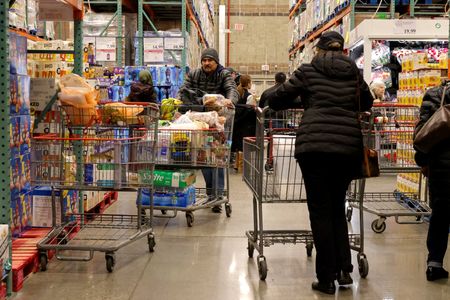
Food costs were also expected to accelerate after an unusually flat March reading. Economists project continued food price increases in upcoming months, partly reflecting higher energy expenses and fertilizer supply shortages amid shipping disruptions through the Strait of Hormuz.
Looking at the full 12-month period ending in April, the CPI is forecast to have climbed 3.7%. This would represent the largest year-over-year gain since September 2023, up from March’s 3.3% annual increase.
The Federal Reserve, which uses different inflation measures for its 2% target, maintained its key overnight lending rate between 3.50%-3.75% at last month’s meeting.
Stripping out volatile food and energy costs, core CPI is projected to have increased 0.3% in April, with potential for rounding up to 0.4%. The core index advanced 0.2% in March. The Bureau of Labor Statistics, which produces the CPI report, is expected to implement a one-time correction to rental cost calculations.
The BLS divides its rental survey into six rotating panels, each sampled biannually. However, last year’s 43-day government shutdown prevented October data collection. The agency used a statistical method called carry-forward imputation for rent calculations to fill the data gap, artificially suppressing those indexes.
“The April report will include hard data for that part of the shelter panel, which should lead to a significant catch-up effect,” said Lou Crandall, chief economist at Wrightson ICAP. “We expect that special factor to add roughly a tenth of a percent to the increase in the core this month.”
Core inflation was also expected to receive a boost from healthcare expenses after an unexpected March decline. Core goods prices are anticipated to remain subdued, with most economists saying tariff impacts have likely run their course. The Supreme Court invalidated Trump’s comprehensive tariff program in February.
“It’s unlikely that retailers will pass on savings they are now seeing following the decline in the effective tariff rate in February, after the Supreme Court’s ruling, but the pressure to raise prices further has eased,” said Samuel Tombs, chief U.S. economist at Pantheon Macroeconomics.
Annual core CPI inflation is expected to have reached 2.7% in April, up from March’s 2.6% rate. Some economists questioned the relevance of core inflation measures.
“The problem is that the average person, the working people, they don’t live in core CPI,” said Sung Won Sohn, a finance and economics professor at Loyola Marymount University. “They live in higher gasoline prices, they live in higher grocery prices, and they are getting hurt.”