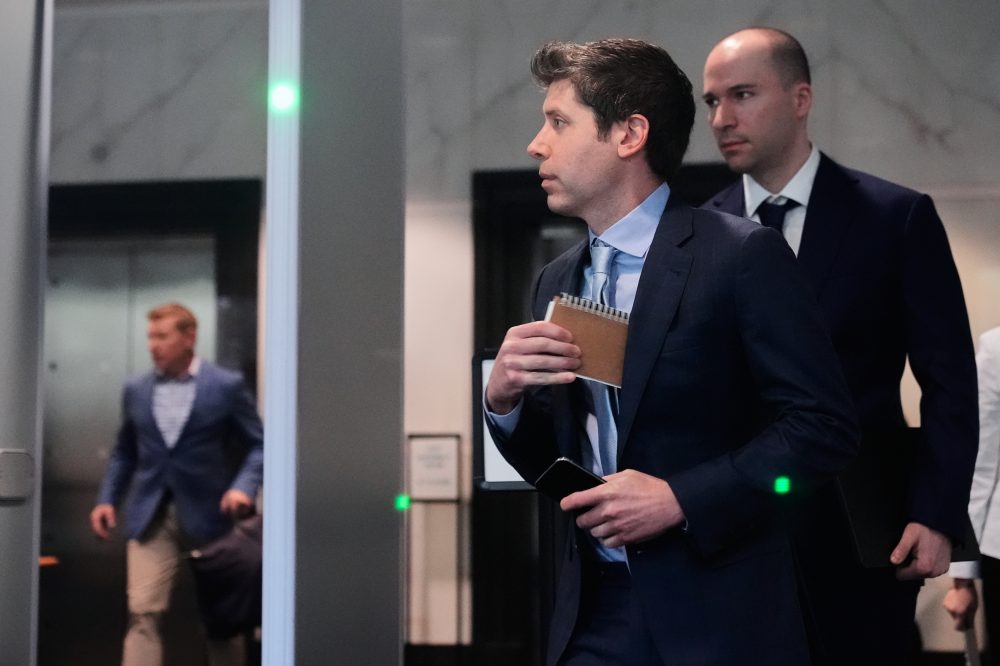

OAKLAND, Calif. — A high-stakes courtroom battle between tech billionaire Elon Musk and ChatGPT creator Sam Altman is putting the OpenAI chief executive’s career on the line, with Altman scheduled to testify in his own defense this week.
The federal trial has already produced embarrassing moments for Altman that have gone viral online. Among the most shared pieces of evidence is a 2023 text message exchange during Altman’s brief removal as CEO, where he asked company executive Mira Murati whether things were trending in a positive or negative direction. Her response has become internet gold: “Sam this is very bad.”
The world’s wealthiest individual is pursuing legal action aimed at removing Altman from OpenAI’s leadership for the second time, claiming he abandoned their original vision for the artificial intelligence company. What began as a nonprofit organization primarily backed by Musk’s funding has transformed into a profit-driven enterprise now worth $852 billion.
Regardless of whether Musk prevails in court, the proceedings have intensified examination of Altman’s management during a crucial period for OpenAI as it competes with Musk’s AI company and Anthropic, which was established by seven former OpenAI executives. All three organizations are preparing for public stock offerings expected to rank among the largest in history.
The case’s outcome will be determined by jurors who have listened to testimony about Altman’s character from both former supporters and critics, with potential consequences extending far beyond the courtroom.
“This is not looking good for any of them and I think that that’s a little bit unfortunate for the AI industry at a time when the public perception of AI is quite negative and seems to be getting worse,” said Sarah Kreps, director of Cornell University’s Tech Policy Institute.
Musk’s legal action claims Altman and his key associate Greg Brockman violated their agreement by abandoning the San Francisco-based company’s original charitable mission in favor of profit-seeking activities conducted without Musk’s knowledge.
Just before proceedings began, Musk dropped his request for personal financial compensation and now seeks unspecified monetary damages to support OpenAI’s philanthropic division. In text messages with Brockman discussing a potential settlement, Musk predicted that both executives “will be the most hated men in America” following the trial.
While Musk’s reputation as head of SpaceX, Tesla and other ventures made him recognizable to Bay Area jurors, fewer were familiar with Altman despite knowing about ChatGPT.
During two weeks of testimony in the Oakland federal courthouse, jurors have heard from former OpenAI board members Helen Toner and Tasha McCauley, who explained their 2023 decision to dismiss Altman before being removed themselves when he regained his position.
In recorded testimony last week, Toner described how the dismissal process began when OpenAI co-founder Ilya Sutskever, a prominent AI researcher, approached board members with his concerns about Altman.
“A phrase we used was ‘a pattern of behavior,’ so no one single cause,” Toner said. “The pattern of behavior related to his honesty and candor, his resistance of board oversight.”
Sutskever played a key role in the failed effort to remove Altman but subsequently expressed regret about his involvement. During Monday’s testimony, Sutskever confirmed he authored a 2023 board memo describing Altman as creating division among executives and displaying a “consistent pattern of lying” that undermined trust and workplace effectiveness.
According to Sutskever, Altman’s conduct created conditions that were “not conducive” to achieving the company’s objectives, including its goal of developing artificial general intelligence safely. He explained that he later reversed course and backed Altman’s return because he feared for the future of the organization he helped build and “cared very much about.”
“I felt that, had I not done this, the company would have been destroyed, and I felt that this was a Hail Mary,” he testified.
The legal proceedings also pose risks for Musk, who plans a summer initial public offering for SpaceX that could make him the world’s first trillionaire. Witnesses have included Shivon Zilis, a former OpenAI board member who served as a liaison between Musk and company leadership while failing to reveal that Musk fathered her twin children, according to courtroom testimony.
OpenAI finally began presenting its defense Monday afternoon in the trial’s third week, starting with current board chairman Bret Taylor, who offered a more favorable assessment of Altman’s leadership abilities.
“I think Sam has done a great job as CEO,” Taylor said. “He’s been forthright with me and the other board members.”
Syracuse University professor Shubha Ghosh, who specializes in business and technology law, expressed skepticism about Altman’s long-term prospects as OpenAI’s chief executive, regardless of the trial’s conclusion.
“A lot this of might depend upon a testimony,” he said. “And I don’t know what he’s going to say or how he’s gonna say it. But even like the best case, movie theater type performance, with all the music playing and the angels descending or whatnot, I don’t see him coming off as a fairly strong leader, especially (since) this case has gone this far.”