SRN News brings listeners a daily feature called “Global Landscape” — a compact, two-minute audio segment designed to keep audiences informed on the most important religion-focused news stories happening around the world.
The feature covers a wide range of topics, from significant faith-based developments to cultural shifts and key events where religion and global affairs come together. Each edition is crafted to give listeners a timely and informative snapshot of what’s happening in the world of faith.
For the full audio segment, visit SRN News online.
A federal judge has thrown out a lawsuit claiming the Equal Employment Opportunity Commission is illegally failing to protect transgender workers on the job. Chief Maryland District Judge George Russell ruled that the court does not have the authority to hear the case and that the plaintiff — a Maryland LGBT advocacy organization — does not have legal standing to bring the suit. Under Chair Andrea Lucas, the EEOC has moved quickly to align with President Trump’s 2025 executive order recognizing only two biological sexes that cannot be changed. The agency has significantly reduced legal actions taken against employers on behalf of individuals living as the opposite sex.
In Idaho, a judge has decided that men will not face criminal prosecution for entering women’s restrooms, at least for now. U.S. District Judge Amanda Brailsford issued a ruling that temporarily blocks enforcement of major parts of a law that was scheduled to go into effect July 1st. The Idaho law goes beyond similar measures in other states by prohibiting men from using women’s restrooms in both publicly and privately owned facilities. Idaho Attorney General Raul Labrador announced plans to appeal, saying the ruling “misapplied the law, confused the issues, and misrepresented the position of the State. Biological sex is not vague, and neither is this law.”
A new study from the Barna Group, conducted alongside Gloo, shows that the overwhelming majority of pastors are already incorporating artificial intelligence into their work — only 13 percent report never using it. However, the same survey found that 71 percent of pastors describe themselves as cautious about AI, while 40 percent say they feel torn about the technology. Barna spokesman Daniel Copeland explained that “Pastors are predominantly using AI for behind-the-scenes work. They’re using it to prepare for ministry, not to replace what happens when they’re actually with people.” The study also found that a large share of pastors are concerned that AI could begin to substitute for a personal relationship with God.
As the United States approaches its 250th anniversary, a new AP-NORC poll is taking stock of how Americans feel about their constitutional rights. Roughly 90 percent of adults say freedom of speech is central to the nation’s identity, and about 80 percent feel the same way about religious freedom. Despite that, nearly half of those surveyed believe free speech is currently facing a major threat, and around three in ten say the same about religious liberty. An overwhelming majority of respondents view voting rights as critically important, and two-thirds believe those rights are also under threat.
Conservative political parties in New Zealand have put forward a new bill that would establish firm legal definitions for the words ‘man’ and ‘woman.’ The legislation successfully passed its first parliamentary vote in May and is now in a public comment period that runs through the end of this month.
The push comes as nations around the world are stepping back from earlier transgender policies. Public concern has been mounting over issues such as biological males using women’s restrooms and locker rooms, as well as boys competing on girls’ sports teams.
New Zealand’s move is part of a wider global conversation as governments reconsider how gender identity intersects with existing laws and public accommodations.
A legal showdown may be on the horizon in Texas after Rockwall County officials erected a monument displaying the Ten Commandments outside their courthouse last month.
The Freedom From Religion Foundation is demanding the monument be removed, warning that it will pursue a lawsuit if county officials refuse to comply. Despite the pressure, Rockwall County is holding its ground and has no plans to take the display down.
The county is being represented by First Liberty Institute, which points out that the monument is nearly identical to a Ten Commandments display at the state capital in Austin — one that was previously upheld by the U.S. Supreme Court.
A European court has delivered a significant victory for religious freedom after striking down a Bulgarian law that banned door-to-door evangelism. The law had prohibited people of faith from going door to door to share their beliefs, even as political canvassers were permitted to do exactly that.
The European Court of Human Rights ruled that the Bulgarian ban violates the European Convention on Human Rights, determining that believers must be afforded the same rights of expression as any other group.
Nicholas Bauer of the European Center for Law and Justice spoke with EWTN about the ruling, stating: “The court ruling reaffirms a basic requirement of religious freedom for believers: the right to the same freedom of expression as everyone else.”
Two major United Nations food agencies are urgently requesting $202 million to help shield 8.8 million people across 22 high-risk nations from the growing threat of an El Niño weather event. The appeal was made Thursday by the UN’s Food and Agriculture Organization and the World Food Programme.
The two agencies warn that strong El Niño conditions expected during the second half of 2026 could significantly increase the chances of drought, flooding, and powerful storms across regions of Africa, Asia, the Pacific, and Latin America and the Caribbean.
The 22 countries identified as most vulnerable include Cameroon, Ethiopia, Kenya, Madagascar, Malawi, Mozambique, Nigeria, Somalia, South Sudan, Sudan, Uganda, and Zimbabwe on the African continent. In the Asia-Pacific region, Afghanistan, Pakistan, the Philippines, and East Timor are listed among those at greatest risk. Rounding out the list are Colombia, El Salvador, Guatemala, Haiti, Honduras, and Venezuela in Latin America and the Caribbean.
The agencies noted that securing the requested funding would allow them to expand their reach beyond the 1.2 million people already being targeted for assistance. Planned aid measures include cash transfers, seeds designed to withstand climate stress, protection for livestock, and flood control efforts.
El Niño is a naturally occurring weather phenomenon caused by a warming of sea surface temperatures in the eastern Pacific Ocean, triggered by a weakening of trade winds. It typically occurs every two to seven years and generally lasts between nine and twelve months.
The U.S. National Oceanic and Atmospheric Administration officially declared El Niño’s arrival last week, adding that conditions are likely to grow stronger. The agency placed the probability of a very strong or so-called ‘super El Niño’ developing heading into 2027 at 63%.
A newly released survey from the Cultural Research Center at Arizona Christian University is shedding light on how Americans think about the value of human life — and the results may surprise you.
According to the poll, 57% of the general population believes that human beings are created in God’s image and likeness, are morally fallen, and are in need of redemption. However, when it comes to the sanctity of life, the numbers tell a different story.
Just 27% of those surveyed believe that human life is sacred — the same percentage as those who say human life holds no intrinsic value at all. That means an equal share of Americans see life as sacred as those who believe it has no inherent worth.
Perhaps most striking is the finding among people who identify as born-again Christians. Despite their faith background, only 44% of that group said they believe human life is sacred.
BRATISLAVA, Slovakia — The government of Slovakia is scheduled to undergo a parliamentary confidence vote on Thursday, prompted by the country’s national debt climbing beyond limits established in its Constitution.
The vote was set in motion after the nation’s Constitutional Court — its highest legal authority — ruled on Wednesday that the government must seek a confidence vote without delay.
Prime Minister Robert Fico, a populist leader, said he would respect the court’s decision and proceeded to call for the vote.
Fico’s coalition government controls 78 of the 150 seats in the Slovak parliament, known as the National Council, giving it a majority and making it the strong favorite to survive the vote. Coalition members moved to cap the debate at 12 and a half hours.
Fico noted that his government had originally intended to tie the confidence vote to a separate vote on next year’s state budget, which was expected to take place later this year.
The opposition brought the matter before the court in November, following a determination by Eurostat — the European Union’s official statistics body — that Slovak debt had reached 59.7% of gross national product the prior month. That figure has since climbed to 61.4%, according to the Slovak Statistics Office. Despite the increase, Slovakia’s debt level remains below the average across EU member nations.
The constitutional threshold that triggers a mandatory confidence vote in Slovakia is set at 50% of gross national product.
Like many European nations, Slovakia ramped up government spending in response to the economic disruptions caused by the COVID-19 pandemic and Russia’s ongoing war against Ukraine, which sent energy costs surging.
Slovakia’s Supreme Audit Office reported Tuesday that the country’s economy expanded by just 0.8% in 2025 — the weakest growth rate in three years — while government expenditures continued to rise at a faster pace, adding pressure to the country’s debt levels.
Fico has remained a controversial figure since reclaiming power in 2023. His pro-Russian positions and various policy decisions have sparked repeated protests across the country.
NEW YORK (AP) — Jaelyn Chester is willing to do just about anything — wait tables, stock shelves, wash dishes, even scrub toilets. All she wants is for someone to give her a shot.
“I’ve been looking everywhere,” says the 17-year-old, who maintains straight A’s, plays varsity basketball and dreams of becoming an engineer. She has submitted dozens of applications throughout her community. “I’m not unemployed because I’m incompetent. I’m unemployed because nobody’s hiring.”
For generations of American young people, landing a summer job was practically a given. These days, it’s anything but.
Federal data shows that only about one in three teenagers between the ages of 16 and 19 held a job last summer — a steep decline from a peak of roughly 60% back in the late 1970s. Gloomy forecasts from labor experts, combined with frustration pouring in from young people across the country, paint a bleak picture for this summer’s job market.
“The opportunities for workers at the start of the career ladder started to dry up,” says Nicole Bachaud, an economist with ZipRecruiter, noting that teens rank among the labor market’s “most marginalized groups.”
For Chester, being jobless isn’t just inconvenient — it threatens her entire summer. She’s worried about affording gas, missing out on concerts and potentially having to cancel a college-visit road trip to North Carolina with friends. So she keeps pushing.
She stashes copies of her resume in her car and has a tight 30-second pitch ready whenever she walks into a restaurant or store hoping to speak with a manager. She and her friends coach each other before heading out on job hunts, swapping advice and borrowing professional-looking outfits. Jobs that once seemed unappealing, like dishwashing, now look attractive.
“At this point,” says the teen from Lake Mary, Florida, “it would be hard to say no to anything.”
An analysis of U.S. Bureau of Labor Statistics data by the outplacement firm Challenger, Gray and Christmas found that the number of jobs teens landed fell 25% last summer compared to the year before. The firm predicts that inflation, rising oil prices and cautious hiring practices will push that number even lower this year — potentially to the lowest teen summer employment total since the federal government started keeping track in 1948.
Teens most often find work in food service and retail, according to federal labor data. But Jaune Little, director of recruiting services at the human resources firm Insperity, says many entry-level positions have simply disappeared, and those that remain attract more experienced candidates.
“A lot of the entry-level roles that once existed simply do not any longer,” Little says. “Those that do exist are on leaner teams that have less ability and desire to develop and train someone. In many instances, they are prioritizing more skilled workers even if they are overqualified.”
Max Stephenson began her job search after graduating high school last year. The entire summer passed without a single offer. Once she enrolled at the University of Arkansas-Pulaski Technical College, she landed a work-study position in the school cafeteria while continuing to search for something more stable.
Now that school is out again, the 19-year-old from Little Rock, Arkansas, finds herself back at square one.
She has lost count of how many applications she has sent out — somewhere between 50 and 100 — and can’t shake the feeling that her generation has it harder than those who came before.
“I thought it would be much easier than it’s been,” Stephenson says. “Old people say, ‘Just walk in there and give them a firm handshake.’ That doesn’t work so well now.”
A 2022 report from the Pew Research Center found that teen summer employment began falling during the early 2000s dot-com bubble and dropped further during and after the Great Recession of 2007 to 2009. The report also found that white teens are more likely to be employed than teens of any other racial group.
Across all backgrounds, teens are voicing their frustrations on platforms like Reddit and TikTok, complaining about job listings that lead nowhere, managers who never respond and applications that disappear into a void.
Connor Vukelich knows that experience well. After turning 16, he applied to every employer he could find within 30 miles of his home near Vancouver, Washington. No one called back, and his friends were striking out too.
“There’s all these ‘We’re Hiring’ signs but no one’s actually hiring,” Vukelich says. “What’s going on? Why can’t any of us find jobs?”
With no offers coming in, Vukelich ended up helping out on his family’s lavender farm. That frustrating experience eventually inspired him — now 20 and studying at Embry-Riddle Aeronautical University — to create Poppin’ Jobs, a job search website launched this year and designed specifically for teens and young adults in their 20s.
Vukelich believes artificial intelligence is taking away some jobs that teens might otherwise have filled, and that minimum wage increases in certain states have put first-time job seekers in direct competition with more seasoned workers.
“They don’t see the value in hiring someone without any experience,” he says of employers. “They’re not as willing to give someone that shot.”
Some teens do eventually break through after a long and discouraging search. Demie Njea, a 16-year-old from Lexington, Kentucky, began applying for jobs as soon as she turned 14 — the legal working age in her state. She started with fast food and retail applications, then expanded her search to include janitorial work, daycare positions and more.
Her first summer turned up nothing. Neither did her second. She estimates she submitted more than 100 applications in total and began to wonder if a first job would ever come.
Then, finally, an offer arrived. Njea landed a position at Sonic and couldn’t be happier. But when a friend who had just turned 15 started her own job search, Njea felt she had to be straight with her.
“I had to calmly put her down and say, ‘You’re not going to get it,’” Njea says. “It’s just not going to happen.”
Millions of Americans say they want to volunteer, and countless nonprofits are desperately searching for help. The challenge, according to the nonprofit organization Points of Light, is getting those two groups together effectively.
Points of Light — the organization established by former President George H.W. Bush to promote community service — is preparing to announce a sweeping new plan at its annual conference in Washington on June 22.
Jennifer Sirangelo, president and CEO of Points of Light, told The Associated Press that the group’s National Volunteer Strategy initiative marks the first phase of a $100 million effort to double the total number of volunteers in the United States to 150 million people by the year 2035.
“We believe that volunteering changes everything,” Sirangelo said. “It changes the people who serve. It uplifts the community. And we know that collectively it can change our society.”
She described the National Volunteer Strategy as Points of Light’s way of “building bridges, deepening empathy, and putting us on a path for having a more civil society where we can get along in a pluralistic environment.”
The rollout comes at a challenging moment for the volunteer sector. President Donald Trump’s administration eliminated much of AmeriCorps, the federal agency dedicated to national service and volunteerism, in 2025, wiping out thousands of jobs and forcing nonprofits to scramble for replacement workers and funding.
Those federal cuts compounded a drop in volunteerism that began during the COVID-19 pandemic, leaving many charities short-staffed even as demand for their services grew. While volunteers started returning in 2023 — the most recent year with available U.S. Census Bureau data — the 28% of the population that gave their time is still below pre-pandemic levels.
Sirangelo said the ongoing recovery in volunteerism signals that now is the right moment to launch a bold new initiative. “So many people in the industry have applauded the effort and said, ‘I’ve been waiting for this for years,’” she said. “There has been enthusiastic engagement.”
Cathy Scott, vice president for social impact at The UPS Foundation, expressed enthusiasm for the initiative, pointing to her own organization’s track record. In 2011, The UPS Foundation set a goal for company employees to collectively volunteer 30 million hours by 2030 — a target they hit in April, a full four years early.
Through its partnership with Points of Light, UPS was able to measure how volunteering boosted employee retention and workplace pride. “We know that volunteerism increases well-being,” Scott said. “And we know that doing good is good for business.”
Scott added that volunteering is proving to be a powerful antidote to isolation among workers. “We’re finding that (volunteerism) is bringing employees out of loneliness,” she said. “It’s creating additional professional networks. It is increasing skill development and talent development. It’s giving them a purpose… And people want to be part of a purpose and also find their own purpose.”
Points of Light developed its National Volunteer Strategy after a year-long listening process that included two national surveys, 23 roundtables with leaders from corporate, cultural, faith, and government sectors, and guidance from a 40-member advisory council.
What emerged from that process, Sirangelo said, was a clear picture: interest in volunteering is strong, but the infrastructure connecting willing volunteers to the organizations that need them is weak. To address that gap, Points of Light plans to invest in the millions of volunteer managers working at nonprofits across the country.
“We will invest in them and their continued growth with tools and resources that help them be effective at building those transformative volunteer experiences,” she said, noting that these managers are critical to addressing needs in areas like hunger relief, youth development, and environmental work.
Part of the strategy also involves establishing a shared set of expectations — a kind of common framework — so that both volunteers and nonprofits have a clearer understanding of what they can expect from one another.
Sirangelo was careful to note that the National Volunteer Strategy is a starting point, not an endpoint. One area still under development is how to better reach and engage Gen Z and younger generations, who have not embraced traditional volunteering at the same rates as older generations.
Alex Edgar, youth engagement manager at the history education nonprofit Made by Us and a member of the Points of Light board of directors, said young people often don’t receive credit for the volunteer work they do. Edgar, 22, is also co-founder of Youth250 at Made By Us, an initiative connecting young Americans to the country’s upcoming 250th anniversary.
“There is a hunger for (nonprofits) to have more youth-focused things, but oftentimes these local volunteer action centers don’t have the staff or resources or best practices honestly to do that well,” Edgar said. “There is interest, there is energy around bringing young people in, in part, because people see how disconnected they are, how much they distrust our institutions.”
Edgar said he hopes Points of Light can help build a framework that shows young people the career opportunities available in the nonprofit world. “It is going to be incredibly beneficial for young people who are interested in service, but may not really see much of an ecosystem out there right now, especially given the changes in funding,” he said.
While experts acknowledge that economic and cultural hurdles still stand in the way of greater youth participation, Edgar remains optimistic. “For so many young people, we’re not 100% there yet in terms of showing them, ‘This is for you. This is something that we can do with you,’” he said. “But we have to start somewhere.”
Major U.S. banks are making one final formal appeal to the Federal Reserve on Thursday, urging the central bank to make additional adjustments to proposed rules that determine how much money financial institutions must hold in reserve to cover potential losses.
According to five industry insiders who spoke on the condition of anonymity, the banks’ top priorities include reducing capital requirements tied to Wall Street trading operations, eliminating a proposed requirement to hold funds against unused credit card lines, and adjusting a financial penalty applied to the world’s most interconnected banks.
Back in March, federal regulators — led by the Federal Reserve — released a revised and more lenient version of sweeping capital rules. Officials estimated the updated proposal would cut the amount of loss-absorbing capital large banks must hold by roughly 4.8%, arguing that the existing requirements have been dragging on the broader economy. These regulations, commonly referred to as the “Basel” rules, reshape how banks calculate risk and, by extension, how much capital they are required to maintain.
The banking industry has largely welcomed the revised proposal as a significant improvement over the Fed’s original 2023 plan, which was crafted under Democratic leadership and would have required banks to increase their capital buffers by around 20% — a response to a wave of regional bank failures at the time.
Still, after combing through hundreds of pages of technical proposals, lenders have pinpointed a number of remaining concerns they want addressed before the rules are finalized.
Thursday marks the deadline for banks to submit their official written comments. A spokesperson for the Federal Reserve did not respond to a request for comment.
Matthew Bisanz, a partner at Mayer Brown who focuses on financial regulation, noted the urgency surrounding the process. “There’s a really big push to get it wrapped up in the next six months because there are other items on the regulatory agenda,” he said.
Not everyone supports loosening the rules. Critics warn that reducing capital requirements leaves banks more exposed to financial shocks and could ultimately harm the broader economy if lenders struggle and pull back on loans.
Last month, Phillip Basil, director of Economic Growth and Financial Stability for Better Markets, argued in a public statement that “strong capital standards are the foundation” of a stable banking system, because “they ensure that banks — not taxpayers, workers, or small businesses — absorb losses when risks materialize.”
On the trading side, banks plan to argue that regulators have been overly cautious in assigning capital to trading activities — particularly given that the Fed already evaluates individual banks’ risk exposure each year through its “stress test” process. Industry groups may propose changes significant enough to dramatically reduce or even eliminate the additional trading capital the Fed has outlined.
Banks are also expected to challenge a provision that would require them to hold capital equal to 10% of unused credit lines — known as “unconditionally cancelable commitments” — the most common example being unused credit card balances. Currently, these lines carry no capital requirement because banks can cancel them at any time. However, regulators contend that in practice, banks are unlikely to cancel these lines during economic downturns due to customer relationships and risk management considerations.
A group of the nation’s largest banks will also renew their push to soften a financial “surcharge” the Fed applies to globally significant U.S. banks — known as GSIBs — a measure that has been in place since the 2008 financial crisis. The Fed has proposed a one-time adjustment to reflect economic growth going back to around 2019, along with automatic future updates. But banks are pressing for the adjustment to stretch back further, to 2015, when the surcharge was first introduced.
Despite their concerns, banks are not expected to mount the kind of aggressive opposition they launched in 2023. Multiple executives said the industry has narrowed its focus to the most pressing issues. One industry group reportedly identified close to 100 problems with the proposal but plans to formally argue only a few dozen of them.
Fed Vice Chair for Supervision Michelle Bowman, who is overseeing the rule-writing process, has reportedly signaled to banks that they should keep their feedback measured. Industry executives say they are eager to move past a regulatory battle that has consumed years of time and resources.
A flesh-eating parasite known as the screwworm has made its way back into the U.S. Southwest for the first time in roughly five decades, raising serious concerns for the livestock industry, wildlife, and household pets alike.
What exactly is a screwworm?
The screwworm is a parasitic fly that targets warm-blooded animals. Female flies deposit their eggs inside open wounds, and once those eggs hatch, hundreds of larvae use sharp mouthparts to burrow through living tissue. Without treatment, the infestation can be fatal to the host animal. The parasite primarily spreads when infested animals are moved from one location to another. Experts note it poses no risk to food safety and rarely affects humans. Animals that receive prompt care — including maggot removal, wound cleaning, and antibiotics — typically survive.
In June, a dog in New Mexico was confirmed to have a screwworm infestation, highlighting the real danger to pets as the pest has spread northward from endemic areas in Central America and into Mexico.
What warning signs should pet owners watch for?
Veterinarians say owners should be on alert for wounds that swell, ooze pus, or refuse to heal. Other red flags include signs of pain such as excessive licking or chewing at a wound, unusual tiredness, and loss of appetite. One of the most distinctive indicators is the odor of rotting flesh coming from a wound.
Experts advise taking a pet to the veterinarian at the first sign of any of these symptoms — even if maggots or eggs are not visibly present.
Stray cats and dogs may be especially vulnerable to screwworm and could potentially pass the parasite on to household pets. Residents are encouraged to monitor strays closely and notify local animal control if they observe any suspicious wounds.
Dr. Pancho Hubert, a veterinarian in Corpus Christi, Texas, and president of the Texas Veterinary Medical Association, emphasized the importance of acting quickly. “The consequences of missing one or two cases is so great that if the public sees anything suspicious, take it into your vet,” he said. “It might not be anything, but these wounds carry so much significance.”
Can pet owners prevent an infestation?
Monthly parasite prevention medications already used for ticks and fleas may also offer protection against screwworm. Chewable treatments like Credelio and Simparica work by entering the animal’s bloodstream and killing parasites that feed on it, and experts say they may work similarly against screwworm.
How is screwworm treated?
A veterinarian will examine the wound, remove larvae and eggs, and send samples to animal health authorities for identification. The vet will then clean and disinfect the wound, administer an oral insecticide, and likely prescribe pain medication and antibiotics. The U.S. Department of Agriculture has approved approximately a dozen drugs for treating screwworm infestations.
Experts strongly caution against pet owners attempting to treat screwworm on their own. DIY treatment risks missing larvae that will continue burrowing deeper, and accidentally dropping maggots on the ground could allow them to mature into flies and spread the infestation further.
Can pets recover?
With early detection and proper veterinary treatment, animals typically make a full recovery. However, screwworm infestations are deadly if left untreated.
What are authorities doing to combat the outbreak?
The U.S. Department of Agriculture has ramped up surveillance, put movement restrictions in place, and invested in the production of sterile flies, which are used to interrupt screwworm reproduction. Two new sterile fly production facilities are currently under construction, but experts say current output falls well short of what is needed to get the outbreak under control.
Reuters previously reported that hundreds of veterinarians, support staff, and lab workers at the USDA’s animal health division departed after the Trump administration sought resignations, leaving fewer disease response specialists on hand. Agriculture Secretary Brooke Rollins stated that screwworm had been projected to enter the U.S. last year, and credited the Trump administration’s actions with delaying that entry and giving the USDA time to mount a rapid response.
A key advisory panel to the U.S. Food and Drug Administration is preparing to cast a vote on whether the benefits of Moderna’s new flu vaccine outweigh its potential risks in older adults — a review that follows a notable reversal by regulators who had initially moved to reject the drugmaker’s application.
Moderna is pursuing two different types of approval for the vaccine, known as mFlusiva. The company is seeking standard approval for adults between 50 and 64 years old, and a conditional, accelerated approval for adults 65 and older — a pathway that would require Moderna to carry out additional studies confirming the vaccine actually works. The company has agreed to conduct that follow-up research and provide more data for the older age group if it receives approval.
The advisory committee review is taking place against a backdrop of recent turmoil at the FDA. Both the agency’s commissioner, Marty Makary, and its vaccine chief, Vinay Prasad, recently left the agency following a string of controversies surrounding vaccine and rare-disease drug reviews — including the handling of Moderna’s flu shot application. Senior FDA officials had previously stated that Moderna put patients at risk by not using the preferred higher-dose flu vaccine as the comparison treatment in its clinical trial for adults 65 and older.
Acting Commissioner Kyle Diamantas has been working to steady the agency and rebuild its relationship with the biotechnology industry following months of disruption.
In briefing materials released ahead of the advisory meeting, FDA staff reviewers indicated that immune response data from Moderna’s flu shot could support a finding of effectiveness in adults 65 and older. However, those same documents raised concerns about the vaccine’s performance in people with weakened immune systems and very frail elderly individuals, both of whom were left out of the clinical trials.
Moderna’s own submission stated that its vaccine performed better than standard-dose flu shots among adults aged 50 to 64. A separate, smaller study also showed the vaccine produced a strong immune response when compared with a high-dose flu vaccine in adults 65 and older.
Paul Offit, director of the Vaccine Education Center at the Children’s Hospital of Philadelphia, offered perspective on the review process. “Every year when we approve flu vaccines, we don’t have efficacy data. So I think the question will be whether or not they thought that the immunogenicity study was big enough,” he said.
If the FDA grants approval, mFlusiva would become the first seasonal flu vaccine in the United States developed using mRNA technology — the same faster-production platform behind some COVID-19 vaccines. It would enter a competitive market alongside flu vaccines from Sanofi, GSK, CSL Seqirus, and AstraZeneca.
One key difference from conventional flu vaccines is that mFlusiva does not use chicken eggs in its production process. Moderna says this allows manufacturers to more closely match the vaccine to flu strains currently circulating and reduces the time between selecting the strain and making the vaccine available.
The FDA is expected to issue its final decision on the vaccine by August 5. One analyst at Jefferies, Andrew Tsai, does not anticipate Moderna generating flu vaccine revenue until 2027, but projects $750 million in combined U.S. flu and COVID-flu combo vaccine sales by 2030.
Governments around the world are taking aim at social media companies in an effort to protect children from potential harms online, with a growing list of nations either passing new laws or actively working toward restrictions.
Australia led the way, becoming the first country on Earth to ban social media for children under 16. The landmark legislation took effect December 10, 2025, blocking minors from platforms such as TikTok, YouTube and Instagram and Facebook. Companies that fail to comply could face fines as steep as A$49.5 million — roughly $34.9 million U.S. dollars.
In Britain, Prime Minister Keir Starmer announced on June 15 that a ban on social media for children under 16 is expected to be approved by Christmas, with the measure taking effect around Spring 2027. Starmer also said on June 8 that major tech companies must take action to stop children from sharing nude images on their devices, or face legislation requiring them to do so. Under those plans, companies like Apple and Google would need to build or activate tools on smartphones and tablets to detect and block such images for minors, while adults could still access that type of content through an age verification process.
China has already implemented what it calls a “minor mode” program, which places device-level restrictions and app-specific rules on screen time based on a child’s age.
Denmark announced in November it would ban social media for children under 15, though parents could grant access to certain platforms for children as young as 13.
France’s National Assembly approved legislation in January to ban children under 15 from social media, citing concerns about online bullying and mental health. The bill still needs to clear the Senate before a final vote in the lower house.
In Germany, children between 13 and 16 may use social media only with parental approval, though child protection advocates argue those controls do not go far enough.
Greece is reportedly very close to announcing a social media ban for children under 15, according to a senior government source who spoke to Reuters on February 3.
India’s chief economic adviser called for age restrictions on social media platforms in January, referring to them as “predatory” in how they keep young users hooked. That came just two days after the tourist state of Goa said it was considering restrictions similar to Australia’s.
In Italy, children under 14 must have parental consent to create a social media account, while no such consent is needed for those 14 and older.
Malaysia began blocking those under 16 from registering on social media platforms, its communications regulator announced on June 1.
Norway proposed in 2024 raising the age at which children can consent to social media terms of service from 13 to 15, while still allowing parents to give permission for younger children. The government has also started work on legislation to set a firm minimum age of 15.
Poland’s ruling party announced on February 27 that it is preparing legislation to ban social media for children under 15 and to make platforms responsible for verifying users’ ages.
Slovenia is drafting a law that would bar children under 15 from accessing social media, Deputy Prime Minister Matej Arcon announced on February 6.
Spain plans to move forward with rules making social networks and artificial intelligence safer despite pushback from the tech industry, according to Digital Transformation Minister Oscar Lopez, who spoke to Reuters in May. Prime Minister Pedro Sanchez had previously stated in February that Spain would ban social media access for minors under 16, with age verification required of platforms.
A government-appointed commission in Sweden recommended on June 2 that the country set a minimum age of 15 for social media use. Investigator Lisa Englund Krafft, speaking at a news conference alongside Social Affairs and Public Health Minister Jakob Forssmed, said a ban could be structured so that platforms themselves bear responsibility for verifying ages.
Turkey’s parliament passed legislation on April 24 banning social media use for children under 15 and introducing new rules for digital platforms, including companies that make game software.
The United Arab Emirates approved a resolution on June 18 setting the minimum age for social media use at 15, according to the government’s media office. The UAE became the first Arab nation to introduce such a measure. The resolution bars children under 15 from creating or using personal social media accounts and limits their access to platform features.
In the United States, legislation aimed at pushing social media companies to better protect young users cleared a significant hurdle after Republican Senator Ted Cruz announced on May 12 that he would support the bill. Cruz said he would back the Kids Online Safety Act, which would require social media companies to “exercise reasonable care” when designing features that could cause harm to minors. That bill is separate from the long-standing Children’s Online Privacy Protection Act, which prohibits companies from collecting personal data from children under 13 without parental consent. Several states have already passed laws requiring parental consent for minors to use social media, though those laws have faced legal challenges on free speech grounds.
At the European Union level, Commission President Ursula von der Leyen said on May 12 that the EU would pursue stronger protections for children from harmful social media features. She said the Commission would target what she called “addictive and harmful design practices” through its planned Digital Fairness Act, expected to be proposed later this year. The European Parliament also agreed in November on a resolution calling for an EU-wide ban on social media access for children under 16 without parental consent, and an outright ban for those younger than 13.
Meanwhile, major social media platforms including TikTok, Facebook and Snapchat say users must be at least 13 years old to sign up. Child protection advocates say those self-imposed rules are not enough, and official data from several European countries shows that large numbers of children under 13 already have social media accounts.
Israeli Foreign Minister Gideon Saar declared Thursday that he is ending all communication with the European Union’s top foreign policy official, Kaja Kallas, citing statements she reportedly made likening Israel to the racist apartheid system that once governed South Africa.
Saar took to social media to announce the move, stating that Kallas had allegedly “compared Israel to the racist apartheid regime” during a trip to Mexico. He said contact would remain severed unless she walked back her remarks.
No statement from Kallas’ office was released in the immediate aftermath of the announcement.
In follow-up posts on X, Saar referenced a June 12 report published by the European news outlet Euractiv, which cited unnamed officials and diplomats. According to that report, Kallas made the comparison during a visit to Mexico the previous month, suggesting that Israel’s treatment of Palestinians in the West Bank and Gaza resembled the policies of apartheid South Africa — a system of legally enforced racial segregation.
The European Union has long criticized Israel’s expansion of Jewish settlements in the West Bank, a practice widely considered illegal under international law and seen as a barrier to peace between Israelis and Palestinians and the creation of a Palestinian state.
Earlier this year in May, the EU imposed sanctions on three individuals and four organizations it held responsible for what it described as “serious and systematic human rights abuses against Palestinians in the West Bank.” At the time, Saar responded by firmly rejecting the EU’s decision on behalf of Israel.
While the EU has also spoken out against Israel’s military conduct in the Gaza conflict, it has simultaneously affirmed Israel’s right to defend itself. The bloc’s 27 member nations remain divided on the issue, with some taking a strongly critical stance toward Israel while others maintain close diplomatic relationships with the country.
On Thursday, Saar went further in his criticism, accusing Kallas of “acting obsessively and with blatant unfairness toward the State of Israel.”
President Trump has put his signature on a framework agreement intended to bring an end to the conflict with Iran, marking a significant diplomatic development on the international stage.
At the same time, the president is reportedly trying to use the Senate confirmation process for his Director of National Intelligence nominee as a bargaining chip to advance legislation that has no direct connection to that nomination — a move that is drawing attention in Washington.
Adding to the political pressure, a newly released NPR poll shows that public approval of Trump’s handling of the economy has fallen to its lowest point on record, signaling growing concern among Americans about the direction of the nation’s finances.
A recently disclosed internal document from the Department of Homeland Security lays out a plan to equip local police departments with facial recognition technology.
The document, which has just come to light, details how the technology would be distributed to law enforcement agencies at the local level — a step that would considerably expand the surveillance reach of Immigration and Customs Enforcement, commonly known as ICE.
The plan represents a significant shift in how federal immigration authorities could work alongside local police, using advanced identification tools to broaden their monitoring capabilities.
Good morning, Delmarva! It’s going to be a hot and breezy one out there today. Expect partly sunny skies this morning with temperatures climbing to a steamy high near 94°F. Southwest winds will be gusty, reaching up to 35 mph, so secure any loose outdoor furniture. By mid-afternoon, we’re watching a chance of showers and thunderstorms developing — roughly between 2 and 5 p.m. — so if you have outdoor plans, try to wrap them up before then. Storm chances linger into the evening, though rainfall totals should remain light. Overnight, expect mostly cloudy skies with a low near 69°F.
Tomorrow is Juneteenth, and we’re tracking another round of possible showers and thunderstorms in the morning. The good news? Skies should clear out by afternoon with a more comfortable high near 84°F. Friday night looks beautiful — clear skies and a pleasant low of 65°F.
Stay cool, stay safe, and keep that umbrella handy today! I’ll have updates throughout the day right here on TV Delmarva.
When visitors walk through the new Obama Presidential Center Museum, one of the highlights drawing eyes is a collection of dresses worn by former First Lady Michelle Obama during her time in the White House.
The exhibit puts a spotlight on some of her most recognized fashion moments from her years as first lady. However, not every iconic outfit made the cut — at least one notable presidential gown is absent from the display.
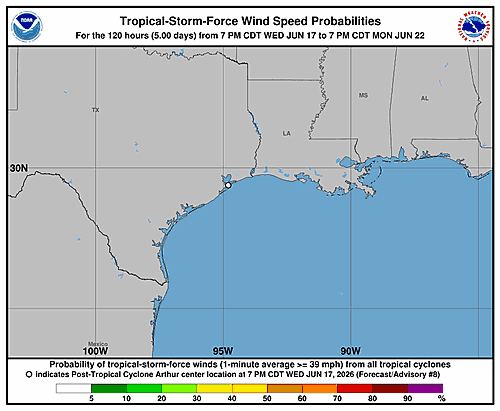
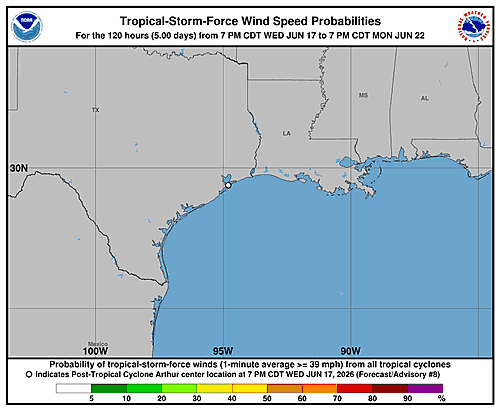
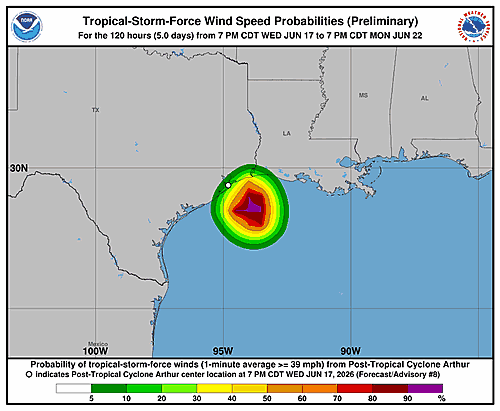
The National Hurricane Center has issued updated wind speed probability graphics for Post-Tropical Cyclone Arthur, providing forecasters and the public with the latest information on potential wind impacts.
The graphics display the probability of 34-knot wind speeds affecting different regions over a 120-hour period. According to the National Hurricane Center, the wind speed probabilities were last updated on Thursday, June 18, 2026, at 3:20 a.m. GMT.
Residents are encouraged to monitor the latest updates from the National Hurricane Center as conditions continue to be assessed.
As the United States prepares to mark 250 years since its founding, a Philadelphia museum is finding new ways to bring history within reach — literally — for visitors who are blind or have low vision.
The National Constitution Center in Philadelphia has introduced guided tactile tours that allow visitors to experience history through touch. The tours take place in a gallery called Signers’ Hall, where museum educators lead participants through the space, guiding their hands over statues and exhibits.
Federal law requires most museums and public buildings to be physically accessible to people with disabilities. However, access to the actual contents inside those buildings — the exhibits, artifacts, and displays — often remains limited for those with visual impairments.
The tactile tours aim to bridge that gap, offering a more inclusive experience for visitors who may not be able to see the exhibits in the traditional way. Museum educator Sydney Wharton has been leading visitors through the gallery, helping them connect with history in a hands-on way.
During one such tour, Wharton guided visitor Tim Kelly Jr., tracing his hands over a statue of Benjamin Franklin, while his father, Tim Kelly Sr., accompanied them through the experience.
Cities may not be living things, but they behave a lot like them — growing, changing, and sometimes declining in ways that mirror biological processes. Now, a team of researchers has used satellite imagery to monitor the vital signs of six major cities across the globe, identifying what they call a distinctive “urban pulse” unique to each one.
The six cities studied were Dubai, Lagos, Mexico City, Mumbai, Seattle, and Shenzhen. Scientists developed a new approach to document changes happening in each city in near real-time, offering a far more detailed picture than traditional methods have allowed.
For years, experts have tracked urban growth using data collected infrequently — things like annual census figures, yearly economic reports, or decade-long maps showing how a city’s boundaries have shifted. But the researchers behind this new study argue that approach leaves out crucial details about how cities actually develop.
“We got the inspiration from the human pulse, which tells us different information about our health than weight or height,” said study lead author Zhe Zhu, a professor of remote sensing and director of the Global Environmental Remote Sensing Laboratory at the University of Connecticut’s Department of Natural Resources and the Environment.
Zhu explained that the urban pulse concept goes beyond simply recording end results. “The urban pulse measures the high-frequency process of development, and therefore we can spot early warning signs of economic stress or stagnation before they become full-blown crises,” he said. “We compare traditional metrics to looking at a heart attack — the outcome — whereas the ‘urban pulse’ is like monitoring the daily lifestyle and vital signs leading up to that heart attack — the process.”
The study’s central finding, published in the journal Proceedings of the National Academy of Sciences, is that urban growth is far from smooth or predictable. Study senior author Karen Seto, a professor of geography and urbanization science at Yale University, described what the data revealed.
“Urbanization is actually ‘spiky,’ meaning that it happens in abrupt, intense bursts, or ‘cyclical,’ moving through boom-and-rest phases that don’t match annual seasons, or ‘asynchronous,’ as different neighborhoods in the exact same city develop at completely different, uncoordinated times,” Seto said. “This is important because, for decades, researchers have characterized cities through static maps.”
To gather their data, the team relied on dense, high-frequency satellite imagery from NASA’s Landsat program and the European Space Agency’s Sentinel-2 satellites. They focused on physical changes such as new construction, demolition, major infrastructure upgrades, and development spreading into green spaces.
“We selected cities with a wide range of political-economic conditions including the state-led development of Shenzhen, the market-driven growth of Seattle, the informal expansion of Lagos and the megaprojects of Dubai,” Zhu said.
Each city displayed its own distinct pattern. Shenzhen — once a small fishing village near Hong Kong that has grown into a massive metropolis — showed the highest levels of growth intensity, with large, clustered spikes reflecting rapid, government-directed development. Dubai also recorded enormous growth, but its pulse was more speculative in nature, driven by isolated, high-cost coastal megaprojects that surged and then stalled. Lagos, Nigeria’s largest city, had a highly fragmented pulse, with long quiet stretches broken up by short, intense bursts of activity. Seattle’s pattern reflected a market-driven cycle of redevelopment and increasing density.
Mumbai, India’s financial and commercial hub, and Mexico City, the most populous city in North America, stood out for their resilience — both showed far less disruption during global shocks like the COVID-19 pandemic compared to the other cities studied.
“Just as a human pulse reacts to illness, our data captured the exact moment COVID-19 triggered a synchronized ‘cardiac arrest’ in development worldwide. But the recovery was entirely unequal,” Zhu said.
He added: “Shenzhen saw a sharp, coordinated dip followed by a rapid rebound. Lagos experienced a muted pulse that transitioned into smaller, incremental changes. Meanwhile, cities like Mumbai and Mexico City showed much less of an impact. It showed us that global shocks don’t manifest the exact same way in every city’s ‘body.’”
The researchers believe their method has real-world applications for those managing urban areas. “For urban planners and policymakers, it functions as a diagnostic tool. Instead of reacting to a crisis after the fact, they can see exactly when and where a neighborhood’s ‘pulse’ is slowing down and intervene early to prevent infrastructure collapse or economic decay. It also prevents cities from overheating their labor and material markets,” Seto said.
Authorities have canceled a Gold Alert that had been issued for Shayone Teachy after the individual was successfully located.
Officials confirmed that Teachy has been found, bringing the alert to a close. No additional information was released regarding the circumstances of the case.
A large-scale fair billed as the Great American State Fair has kicked off on the National Mall in Washington, D.C., and it is expected to run for 16 days.
Despite the festive setup, not every state government has chosen to get on board. Several have opted out of official participation in the event. However, organizers say that should not stop visitors from seeing representation from across the country — they maintain that all U.S. states and territories will have booths set up along the National Mall.
Preparations for the event were visible on the Mall in the days leading up to the opening, with crews working to get displays and exhibits ready for the public.
Travelers looking for relief at the ticket counter may have to keep waiting. While the average price of jet fuel has fallen to its lowest level since the conflict with Iran began, aviation experts warn that airfare prices are not expected to follow suit anytime soon.
Despite the decline in fuel costs, industry analysts say passengers should not count on seeing those savings reflected in the price of their plane tickets, at least for the foreseeable future.
A newly released national poll is painting a grim picture for President Trump as the country moves into summer, with approval ratings for both his overall job performance and his management of the economy falling to record lows.
The survey, conducted by NPR, PBS News, and Marist, found that fewer Americans than ever recorded in the poll approve of how Trump is doing his job. His handling of economic issues drew equally poor marks from respondents.
The findings arrive at a politically significant moment — the period leading up to a midterm election that could reshape the balance of power in Washington.
Wall Street got its first taste of the Kevin Warsh era at the Federal Reserve on Wednesday, and it was anything but calm. Investors are now bracing for bigger market swings as the central bank steps back from its long-standing practice of hinting at future interest rate decisions.
The Fed kept rates unchanged at Wednesday’s meeting, which was widely expected. But new economic projections and remarks from Warsh — presiding over his very first meeting as chair — caught traders off guard, sending markets to price in the possibility of a rate increase within just a few months.
Investors are now grappling with a more secretive Fed under Warsh’s leadership, one that is abandoning forward guidance and overhauling the way it talks to the public — a change that analysts warn could bring fresh turbulence to financial markets.
Warsh’s opening policy statement removed any language about where rates might be headed, and he hinted at broader changes to how the Fed communicates, reads economic data, and thinks about inflation.
“He’s hot out of the gate, and he’s putting his thumbprint on everything Fed-related,” said Michael Reynolds, vice president of investment strategy at Glenmede.
Investors had been watching Warsh’s debut closely, looking for signals about how the Fed might operate differently under new leadership. One of the most notable early changes was a pared-down policy statement that left out any mention of possible near-term actions — a format reminiscent of former Fed Chairman Alan Greenspan, who led the central bank from 1987 to 2006.
“You are transitioning from what I believe was the most transparent Fed, who didn’t like to deliver surprises or disappointments, to a less transparent Fed, who doesn’t want to be boxed in or handcuffed to forward guidance that was given previously,” said Michael Arone, chief investment strategist at State Street Investment Management.
Warsh indicated that financial markets should price securities based on their own interpretation of the economy rather than trying to guess what policymakers are thinking.
David Seif, chief economist for developed markets at Nomura, noted that markets have predicted Fed moves with remarkable accuracy over the past two decades. “The simplification of communication could ultimately mean that this idea that has persisted for quite some time, that the Fed almost never surprises markets, could go away,” Seif said.
Warsh also announced a broad review of Fed operations, covering its balance sheet, communications strategy, data sources, productivity, jobs, and its inflation framework.
“Both in what he said and really chose not to say showed to the market and to the Fed watching community that the way the Fed is going to communicate moving forward is going to change appreciably,” said Joseph Purtell, a portfolio manager at Neuberger Berman.
A more aggressive stance on rates could put the brakes on a long-running stock market rally by raising borrowing costs for businesses and consumers, while also pushing up the dollar and bond yields.
Markets had entered 2026 expecting rate cuts, but that outlook reversed after a late-February conflict between the U.S. and Israel involving Iran sent energy prices and inflation higher, shifting expectations toward a possible rate hike by year’s end. Recent data have shown inflation running well above the Fed’s 2% annual target — a target Warsh reaffirmed on Wednesday.
Wednesday’s meeting strengthened those hawkish expectations. The Fed’s quarterly projections showed nine officials now anticipate a rate increase by the end of 2026. Warsh’s strong emphasis on price stability during a press conference was read as a hawkish signal by markets, according to Josh Jamner, senior investment strategy analyst at ClearBridge Investments.
By late Wednesday, Fed funds futures pointed to better-than-even odds of a rate hike at the Fed’s September meeting, according to CME FedWatch data.
“September now is very ‘live’ in terms of the possibility of seeing a rate hike, but if the June data is hot, I think they could hike as early as July,” said Dustin Reid, chief strategist of fixed income at Mackenzie Investments in Toronto.
Stocks retreated from near-record levels on Wednesday, with the benchmark S&P 500 closing down 1.2%. The two-year U.S. Treasury yield climbed to its highest point since February 2025, and the dollar gained ground across the board.
Still, some investors cautioned that Wednesday’s market reaction may have been an overreaction, expressing doubt that rate hikes are truly around the corner. Notably, Warsh himself did not take part in the rate projections that drove much of the hawkish response.
A key consideration for investors is falling oil prices, with U.S. crude dropping to around $75 per barrel by Wednesday following a U.S.-Iran deal reached over the weekend.
“I don’t think that this is necessarily as hawkish as people make it out to be because (Warsh) understands that gas prices will probably pull down overall inflation over time,” said Drew Matus, chief market strategist at MetLife Investment Management in New Jersey.
MELBOURNE, Australia — Australian carrier Qantas Airways is gearing up to introduce what will be the longest nonstop commercial flight on the planet, linking London and Sydney in a journey that could stretch up to 22 hours.
The Sydney-based airline revealed the first of its specially modified Airbus A350-1000 jets on Thursday. These aircraft are designed to regularly cover the 17,015-kilometer (10,573-mile) route beginning in October of next year. Depending on conditions, the trip between these two cities on opposite ends of the globe is expected to last anywhere from 19 to 22 hours.
Currently, the title of world’s longest regular nonstop route belongs to Singapore Airlines, which operates a flight between its home city-state and New York City — a distance of 15,349 kilometers (9,537 miles) completed in just under 19 hours. One major distinction, however, is that Singapore Airlines does not carry economy passengers on that particular route.
While a standard Airbus A350-1000 is capable of seating up to 480 travelers, Qantas has configured its customized A350-1000ULR to carry only 238 passengers. Of those, 140 seats will be in economy class for the London-Sydney service.
For now, the longest nonstop journey available to economy passengers worldwide is also operated by Qantas — between London and Perth on Australia’s western coast. That route covers 14,499 kilometers (9,009 miles) and takes between 16 and 18 hours. Sydney, by contrast, sits on Australia’s eastern coast.
Sharon Petersen, chief executive officer of AirlineRatings — an Australia-based website that evaluates airlines on their products and safety records — noted that economy seats on the London-Sydney route will offer more legroom than what most long-haul carriers provide. Economy travelers will also have access to a dedicated “Wellbeing Zone” positioned between the economy and premium economy sections, where passengers can stand, stretch, and grab drinks and snacks.
Qantas has acknowledged that tickets for the nonstop service, which go on sale in February, will cost more than fares for flights that stop in Singapore. The airline says the direct route will cut as much as four hours from total travel time.
Petersen said flying business class on the nonstop service is an appealing choice for travelers who might be able to sleep for eight hours straight without the disruption of stopping in Singapore. However, she personally would rather break up the trip than endure a 22-hour economy flight.
“The reason for that is 22 hours is really daunting. If you get sat next to someone who’s smelly, is perhaps really unwell and coughing, perhaps there’s a baby sitting next to you that’s having an uncomfortable flight or an oversized passenger who really needs two seats,” Petersen said.
She considers two shorter flights a safer bet for economy travelers. “If you’ve got it wrong on one flight, you might be okay on the next. You get a break,” she added.
Petersen explained that the aircraft’s reduced passenger count serves two purposes: improving overall comfort and making room for an extra fuel tank holding 20,000 liters (5,283 gallons). She also pointed out that ultra-long flights depend heavily on premium cabin bookings to turn a profit, since the weight constraints of such a journey leave little room for cargo revenue.
“Because the flight is so long, they can’t rely on cargo because of the weight. So it really is a passenger-heavy aircraft and a premium passenger-heavy aircraft at that to get the profit margin,” Petersen said.
After the Sydney-London route is up and running, Qantas says its next ultra-long-haul nonstop service will connect Sydney with New York City — a somewhat shorter distance of 16,013 kilometers (9,950 miles).
One of the most anticipated cultural openings in recent memory is set to take place Thursday, when the Obama Presidential Center holds its grand dedication ceremony.
The event is expected to draw a star-studded crowd for the official opening of the center, which is located in Chicago. Former President Barack Obama and former first lady Michelle Obama were spotted at the site on June 16, ahead of the formal dedication.
While the center includes a museum dedicated to the legacy of the 44th president, it is not structured as a traditional presidential library — setting it apart from similar institutions honoring past commanders-in-chief.
The dedication marks a major milestone for the project, which has been years in the making and is expected to become a significant landmark in Chicago.
The governor of the Moscow region, Andrei Vorobyov, announced Thursday that 16 people sustained injuries during a significant Ukrainian drone offensive targeting the Russian capital and its surrounding area.
A large number of Ukrainian drones descended on Moscow and the greater Moscow region during the attack, striking the city’s oil refinery for the second time within the same week.
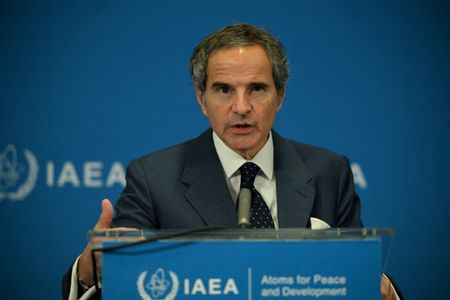
GENEVA — The United Nations nuclear watchdog is expressing support for the interim peace agreement reached between Washington and Tehran, announcing Thursday that it will now take part in technical talks to carry out the deal’s provisions.
“It is good that the memorandum is there. Now the technical work starts,” said Rafael Grossi, the director of the International Atomic Energy Agency, speaking to reporters in Geneva.
“Now it is for us to sit down with our American and Iranian colleagues and start formulating concrete steps that will have to be taken,” Grossi added.
The agreement, which consists of 14 points and was signed Wednesday evening, extends by 60 days a ceasefire that was first announced in April — including in Lebanon — giving both parties additional time to negotiate a permanent truce.
Both Trump and Iranian President Masoud Pezeshkian have digitally signed the memorandum in both English and Farsi, according to officials from the United States and Iran. Iran’s foreign ministry stated the agreement took effect as of Wednesday.
Grossi emphasized the significance of the IAEA’s oversight role under the deal. “The fact that they are mentioning that this will be under the supervision and control of the IAEA is very important, because in our conversation, what we are going to be doing is defining what we need to see, what we need to access,” he said.
He noted that the full scope of the agency’s involvement will depend on the final terms of the agreement, and that upcoming technical discussions will work to translate broad principles into concrete actions.
The path to this agreement has not been smooth. Back in February, talks held in Geneva between Iran and the U.S. aimed at resolving their long-running nuclear standoff ended without a breakthrough. While an Omani mediator indicated that progress had been made and further technical talks with the IAEA in Vienna were planned for the following week, those efforts were derailed when the U.S. and Israel launched military strikes against Iran just 48 hours later, triggering a wider regional conflict.
Despite that troubled history, Grossi urged against letting past setbacks breed pessimism. “We have a chance and we need to seize it,” he said.
BRUSSELS — NATO’s senior nuclear deterrence body announced Thursday that member nations have reached an agreement to upgrade the alliance’s nuclear capabilities while also strengthening how it plans and manages its nuclear deterrence mission.
The announcement came from the Nuclear Planning Group, which serves as the alliance’s primary forum for consultation and decision-making on nuclear deterrence matters. All NATO member nations participate in the group with the exception of France.
Defense ministers who took part in the meeting emphasized the foundational importance of the alliance’s nuclear forces. According to the group’s statement, the ministers “recalled that the strategic nuclear forces of the Alliance remain the supreme guarantee of Allied security and underpin NATO’s extended deterrence architecture.”
The group outlined a clear path forward in its official statement: “NPG Ministers agreed to continue enhancing NATO’s nuclear deterrence mission by modernising NATO’s nuclear capabilities, strengthening its nuclear planning capacity, and adapting to achieve its security interests.”
BEIJING — China’s commerce ministry has unveiled a set of measures designed to bring artificial intelligence deeper into the everyday lives of consumers and businesses throughout the country, according to state broadcaster CCTV, which reported the announcement on Thursday.
The package consists of 17 specific measures focused on expanding the role of AI across both the goods and services sectors nationwide.
On the product side, the plan calls for shifting consumer electronics away from simply being functional devices toward becoming truly intelligent ones. Officials also identified the development of a new market for humanoid robots as a key goal under the initiative.
When it comes to services, the measures are designed to keep pace with AI’s rapid spread — moving beyond consumer retail into areas like public services and everyday lifestyle services.
Lin Jian, the deputy director of the international trade cooperation institute under the ministry, explained the broader significance of the effort. “The introduction of AI is expected to break through the bottleneck in service consumption constrained by high labour costs and low standardization,” he said.
A group of emergency room doctors based in Eugene, Oregon, has successfully pushed back against a national staffing company that sought control over their practice.
The local physicians waged a determined fight against the corporate giant and ultimately prevailed, marking a notable win for doctors looking to maintain independence from large staffing firms.
A pair of researchers at the Massachusetts Institute of Technology believe they have cracked the mystery of how Russia’s Burevestnik missile actually works — and what they found is deeply concerning.
The two scientists conducted an analysis of the nuclear-powered weapon, which has been dubbed “Skyfall” by Western military observers. Their conclusion: the missile is both radioactively contaminating and poses serious dangers.
The Burevestnik is a nuclear-powered cruise missile that Russia has been developing as part of its advanced weapons program. Unlike conventional missiles, it relies on a nuclear reactor for propulsion, which raises significant questions about the radiation it leaves behind during flight.
The MIT researchers’ findings shed new light on the risks associated with the weapon, suggesting that its operation could spread radioactive contamination along its flight path — making it a hazard not just as a weapon, but as a source of nuclear pollution.
Federal student loan borrowers are being put on notice: major changes to how those loans can be repaid and potentially forgiven are set to take effect on July 1.
The federal government is moving forward with significant updates to its student loan programs, which could affect the repayment plans and forgiveness options available to millions of borrowers across the country.
With the deadline just weeks away, borrowers are encouraged to review their current loan status and repayment arrangements to understand how the upcoming changes may affect them.
Travelers hoping for a break on airfare may be waiting a while longer, even as jet fuel prices have dropped significantly. According to aviation experts, the average price of jet fuel has fallen to its lowest level since the war with Iran began — but that relief at the pump isn’t expected to translate into cheaper plane tickets, at least not in the near term.
Industry experts say that while lower fuel costs are a welcome development for airlines, passengers should not count on seeing those savings reflected in the price of their tickets anytime soon. Airfares are expected to remain high for the time being, despite the decline in one of the airline industry’s biggest operating expenses.
Chicago is gearing up for a historic moment as the Obama Presidential Center prepares to open its doors to the public this Friday.
Before the public opening, a high-profile dedication ceremony is planned for Thursday, bringing together musical guests and all of the living former presidents — with one notable exception.
Listen to the Morning Delmarva Farm Report Update — June 18, 2026
DELMARVA — A grain-loaded tractor-trailer overturned Wednesday evening on the northbound side of Route 13 in Wicomico County. Details on the cause remain limited. Farmers hauling grain or routing deliveries along Route 13 Thursday morning are advised to check road conditions before departing.
Markets
July corn closed at $4.21/bu, up 7¼ cents. July soybeans settled at $11.32/bu, up 2 cents. July Chicago wheat posted a strong session, closing at $6.12¾/bu, up 16¾ cents.
In livestock, August live cattle finished at $248.85, August feeder cattle at $367.42, and July lean hogs at $94.65.
Locally, Laurel Grain Company in Laurel, Delaware is bidding $4.63 on December corn and $11.00 on November soybeans.
Policy
Federal agencies released new H-2A guidance Wednesday for dairy operations. The Departments of Homeland Security and Labor outlined how dairy farms can access the agricultural guest worker program, provided they can demonstrate their labor needs are temporary or seasonal. Dairy producers are encouraged to review the full guidance.
Forecast
Thursday’s high will reach 94°F with southwest winds at 10-20 mph. Afternoon showers and thunderstorms are likely. Overnight lows will drop to 69°F with a slight chance of storms continuing.
Friday’s high is forecast at 84°F, with storm chances expected early in the day before clearing through the afternoon.
This article is based on the Delmarva Farm Report Update Morning Edition, June 18, 2026. Hosted by Tom Bradley.
Drivers heading northbound on Interstate 495 should be aware of a lane restriction currently in effect due to construction activity.
The right lane between exits 2 and 3 is closed as part of an ongoing construction project. The closure is scheduled to remain in place until 5:00 a.m.
Motorists traveling through the affected stretch are advised to allow extra travel time and remain alert for construction crews and equipment in the area.
Every person being held at the Florida Everglades immigration detention center — widely known as “Alligator Alcatraz” — has now been relocated to other facilities, according to the Department of Homeland Security.
Officials cited concerns related to the hurricane season as the reason behind the decision to transfer all detainees out of the remote facility.
MILAN — Maserati pulled back the curtain Thursday on updated versions of its GranTurismo, GranCabrio, and Grecale models, setting the stage for a pivotal December capital markets day that is expected to chart a new direction for the financially troubled Stellantis luxury brand.
When Stellantis CEO Antonio Filosa laid out the company’s business plan last month, he expressed the automaker’s intention “to strengthen Maserati’s future as a pure luxury brand,” a strategy that includes adding two new large-sized vehicles to the lineup.
Looking further ahead, Maserati also confirmed plans for a brand-new generation of the Grecale SUV, set to arrive in 2027.
The current Maserati lineup includes the Grecale — offered in petrol, hybrid, and fully electric configurations — along with the GranTurismo coupe and its open-top counterpart the GranCabrio, both available in petrol and all-electric versions. The low-volume MCPura sports car and its limited-edition variants round out the portfolio.
Among the updates to the refreshed models are increased electric vehicle range capabilities and a more powerful 590 horsepower six-cylinder engine for both the GranTurismo and GranCabrio. That six-cylinder engine will also now be offered across all petrol variants of the Grecale.
Maserati vehicles are priced starting at approximately €80,000, or about $92,700, in Europe, while U.S. pricing begins around $80,000.
On Wednesday, Filosa revealed that Stellantis is currently in discussions with “two important partners, which can bring us technology, development and excellent ideas,” noting the company is in the process of deciding between the two for Maserati’s long-term future.
During an online presentation of the refreshed lineup, Maserati Chief Santo Ficili addressed the question of partnerships directly. “We clearly seek, want, and must find excellence on the market in electronic architecture, in the supply of specific parts…. we’re moving in that direction,” he said.
Ficili did, however, draw a clear line, ruling out any partnership with Jaguar Land Rover or Tata Motors — both of which signed separate cooperation agreements with Stellantis last month for the U.S. market and for India, respectively.
Filosa also dismissed speculation that Maserati could be sold, including recent reports of interest from China’s BYD. “Maserati is not for sale, for sure,” he stated plainly.
The brand’s challenges are significant — Maserati shipped fewer than 8,000 vehicles last year and posted an adjusted operating loss of €198 million.
NEW DELHI — India quietly confronted Telegram over its failure to crack down on accounts allegedly distributing leaked exam questions, while Telegram fired back by accusing Indian officials of misrepresenting what was said in their meetings. The standoff ultimately resulted in an extraordinary government-ordered ban of the app, according to documents reviewed by Reuters.
Prime Minister Narendra Modi’s government invoked emergency authority to shut down Telegram within India through June 22, citing concerns that the platform was being exploited to cheat candidates sitting for NEET — a high-stakes national entrance examination for medical school admission.
Telegram has taken the matter to the Delhi High Court, arguing the ban violates constitutional protections and freedom of expression. The conflict represents the latest confrontation between a major technology company and the Modi government, following a legal battle last year with Elon Musk’s X platform over content removal demands.
The app counts 150 million users in India — its largest market in the world. NEET exam results were thrown out in May after suspicions arose that test questions had been leaked in advance, and the exam was rescheduled for June 21. The controversy triggered a political uproar, including calls for the education minister to step down. More than 2 million students take the undergraduate medical entrance exam each year.
Documents obtained by Reuters show the June 16 ban order came after roughly two weeks of back-and-forth communication between India’s IT ministry and Telegram representatives. The government accused Telegram of “inaction” regarding channels with names like “NEET PAPER LEAKED” and “Paper Leaked NEET,” saying the names alone made their purpose obvious. Some of those channels were allegedly soliciting money in exchange for a “full (exam) paper.”
Telegram pushed back in follow-up emails, stating it was “surprised at the suggestion that it has been inactive in addressing unlawful content” and insisting it does not allow its platform to be used for such activities.
India’s IT ministry and Telegram both declined to respond to questions from Reuters.
While WhatsApp dominates India’s messaging market with more than 500 million users, Telegram offers features that set it apart. Its group chats can accommodate up to 200,000 members — a far cry from WhatsApp’s 1,024-person limit — and users can communicate without revealing their phone numbers. Critics argue those same features have made it a haven for fraud and illegal activity, though Telegram rejects that characterization and says it moves quickly to address bad actors.
The Indian government has stated that fraudulent activity tied to the NEET exam is “most pronounced on Telegram.”
Telegram founder Pavel Durov publicly called the ban “a mistake,” arguing that it punishes ordinary users while those spreading leaked content can simply migrate to other platforms. The company also posted a pointed — if indirect — jab at the situation on its X account: “Over 300,000 people die of drowning each year. In order to protect society, it is now illegal to consume or possess water.”
The dispute between the two sides grew more contentious following a June 3 meeting, when Telegram emailed Indian officials to say the government’s written record of the meeting did not accurately reflect what was discussed. According to government notes, Telegram acknowledged having limitations in proactively detecting “more subjective” content related to exams, as opposed to clearer violations such as child sexual material and pornography.
Telegram disputed that account in a June 5 email, clarifying that it does have proactive measures for such content — but that exam-related material simply requires more intensive moderation than other categories.
In its formal court challenge, Telegram went further, describing the government’s meeting minutes as a “one-sided and inaccurate account of the discussions” that “deliberately” left out details of the company’s proactive efforts. The government has not yet filed a response to those claims in court.
Federal highway safety officials announced Thursday that Waymo is pulling back 3,871 of its self-driving robotaxis across the United States after discovering a software problem that could send the vehicles into closed freeway construction zones while continuing to travel at full speed.
The recall involves specific Fifth Generation Automated Driving Systems used in the company’s robotaxi fleet.
According to the National Highway Traffic Safety Administration, Waymo has already taken steps to limit where its vehicles can operate, specifically restricting them from driving on freeways while the issue is being addressed.
As a permanent fix, Waymo plans to roll out an updated software version for the Automated Driving System that will allow the vehicles to better identify their location and steer clear of construction zones. The update will be provided free of charge, the agency confirmed.
A Rip Current Statement has been issued by the National Weather Service out of Mount Holly, New Jersey, taking effect at 4:22 AM on Wednesday, June 18, and remaining in place through 8:00 PM that same evening.
Rip currents are powerful, fast-moving channels of water that can pull swimmers away from shore quickly. They are one of the leading causes of drowning deaths at beaches each year.
Residents and visitors planning to spend time at local beaches on Wednesday should be aware of the elevated risk. Swimmers caught in a rip current are advised not to fight the current by swimming directly back to shore, but instead to swim parallel to the shoreline until free of the current, then make their way back to the beach.
The National Weather Service recommends only swimming at beaches with a lifeguard on duty during periods when rip current alerts are active.
TOKYO — The head of Japan’s leading banking industry group is warning that financial institutions across the country could be forced to take drastic steps — including shutting down ATMs and suspending online banking — if powerful artificial intelligence systems begin posing a serious threat to the banking sector.
Advanced AI systems, like Anthropic’s Mythos, have the ability to rapidly detect weaknesses within software platforms, raising widespread alarm about the possibility of a wave of highly sophisticated cyberattacks.
“There are concerns about an increase in sophisticated cyberattacks that go beyond what has been anticipated,” said Masahiko Kato, chair of the Japan Bankers Association and president of Mizuho Bank, speaking at a press briefing.
Kato added that banks may have to act decisively to shield customers from harm. “Certain services such as ATMs could be proactively suspended in order to protect customers’ assets,” he said.
When Anthropic introduced Mythos back in April, the company itself cautioned that the AI had already identified thousands of software vulnerabilities — including flaws found in every major operating system and web browser — and warned that the consequences of its widespread use could be significant.
In response to growing concerns, banks have been stepping up their scrutiny of such AI tools. Additionally, the U.S. government recently directed Anthropic to cut off access to its advanced AI models for foreign nationals, citing national security concerns.
Despite the alarm, not everyone in the cybersecurity field is convinced the threat is as dire as portrayed. Some experts argue that the reaction has been overblown, suggesting that access to a model like Mythos would not instantly give cybercriminals the ability to carry out attacks that were previously beyond their capabilities.
Ryan O’Hearn put together the best run-producing game of his career Wednesday, belting a home run and collecting six RBIs to carry the Pittsburgh Pirates to a convincing 12-4 win over the Athletics in West Sacramento, California.
O’Hearn got things started with a two-run double in the first inning, then added a two-run home run in the fourth, and capped his big day with a two-run single in the seventh.
Marcell Ozuna also went deep and finished with two hits, while Bryan Reynolds chipped in two RBIs. Spencer Horwitz crossed the plate three times, and Nick Gonzales, Jared Triolo (two runs), and Brandon Lowe (two RBIs) each had two-hit outings. Pittsburgh took two of three in the series.
Pirates starter Braxton Ashcraft improved to 6-3 after allowing just two runs — only one earned — on four hits across six innings. Athletics starter Aaron Civale dropped to 5-3 after surrendering six runs and nine hits in just over three innings of work. In the ninth, Zack Gelof hit a home run for Oakland, extending his hitting streak to 21 games — the longest active streak in the majors and a new career best.
Dodgers 5, Rays 4
Freddie Freeman delivered a go-ahead two-run homer in the sixth inning, and Shohei Ohtani gutted through a bloody blister to earn the win as Los Angeles completed a home series sweep of Tampa Bay.
Alex Call, Alex Freeland, and Kyle Tucker each drove in runs for the Dodgers. Ohtani improved to 7-2 after giving up four runs on seven hits over six innings. Alex Vesia escaped a bases-loaded situation in the ninth to earn his third save.
Yandy Diaz had two hits and an RBI for Tampa Bay, which finished a six-game road trip to the Los Angeles area with a disappointing 1-5 record. Kevin Kelly fell to 4-3 after allowing two runs in 1 2/3 innings.
Marlins 12, Phillies 4
Kyle Stowers went 4-for-5 with a pair of home runs and five RBIs to carry visiting Miami past Philadelphia.
Stowers’ two long balls, combined with home runs from Owen Caissie, Jakob Marsee, and Joe Mack, provided plenty of support for Sandy Alcantara, who improved to 7-4 after tossing six strong innings. The right-hander is now 4-0 in June, having given up four runs — two earned — on eight hits.
Philadelphia starter Andrew Painter dropped to 1-8 after lasting just two innings, surrendering six runs on six hits. Alec Bohm went 2-for-4 with an RBI for the Phillies, while Trea Turner collected three hits and scored a run.
Mets 9, Reds 1
Nolan McLean was nearly untouchable over seven innings, allowing just one unearned run, and Juan Soto had three hits and two RBIs as New York salvaged the final game of a three-game series in Cincinnati.
Bo Bichette and Francisco Alvarez each had three-hit games for the Mets. Bichette went 8-for-14 across the series. McLean improved to 4-4, giving up just three hits while striking out nine and walking one.
Nick Lodolo fell to 2-2 after being tagged for seven runs on 11 hits in 4 2/3 innings. The loss denied Cincinnati its first home sweep of the season.
Yankees 10, White Sox 5
Paul Goldschmidt capped a five-run fifth inning with a three-run homer as New York stretched its home winning streak against Chicago to nine games.
Cody Bellinger and Jazz Chisholm Jr. also went deep for the Yankees, who have now won four games in a row overall. Carlos Rodon improved to 3-2 after giving up three runs on seven hits in five innings.
Colson Montgomery had the first multi-homer game of his career for Chicago, and Sam Antoncacci added another home run. Anthony Kay dropped to 6-2 after allowing four runs on six hits across four innings.
Royals 6, Nationals 2
Carter Jensen, John Rave, Lane Thomas, and Michael Massey each hit solo home runs to power visiting Kansas City past Washington.
Jensen went 4-for-4 with a double and a walk, while Rave added a triple and scored twice. Luinder Avila improved to 2-3 after allowing just one run on three hits over 5 2/3 innings as the Royals won the series finale.
Nasim Nunez had two hits for Washington, which was outhit 12-6. CJ Abrams and Dylan Crews each drove in a run for the Nationals. Zack Littell fell to 6-6 after giving up four runs on seven hits in five innings.
Astros 4, Tigers 2
Peter Lambert was dominant over seven innings, allowing just one run on two hits, and Jeremy Pena drove in two runs as host Houston won the rubber game against Detroit.
Lambert improved to 6-4 after surrendering a solo homer to Kerry Carpenter in the seventh. He struck out five and walked no one, improving to 4-0 over his last five starts. Pena hit a solo homer in the third and added an RBI single in the sixth. Yordan Alvarez and Isaac Paredes each contributed an RBI double in the fifth.
Closer Josh Hader gave up a leadoff homer to rookie Kevin McGonigle in the ninth but responded by striking out the next three batters to lock down his fourth save. Casey Mize, activated from the 15-day injured list before the game, allowed three runs on six hits in 4 2/3 innings for Detroit, which has dropped four of its last five.
Giants 7, Braves 2 (completion of suspended game)
Robbie Ray threw 6 1/3 scoreless innings and Jung Ho Lee hit a homer and drove in two runs as visiting San Francisco defeated Atlanta in a game that had been halted Tuesday due to rain.
Ray improved to 5-6, allowing just two hits while striking out eight and walking two. Rafael Devers and Willy Adames each added solo home runs for the Giants.
Grant Holmes fell to 4-3 after giving up three runs on four hits in two innings before Tuesday’s suspension. Drake Baldwin opened the bottom of the first with the longest home run in the majors this season, a 473-foot blast.
Giants 7, Braves 5 (regularly scheduled game)
Luis Arraez homered and drove in four runs, and Carson Whisenhunt delivered five solid innings in his season debut as San Francisco posted another win over Atlanta.
Whisenhunt improved to 1-0 after allowing two runs on six hits following a morning call-up from Triple-A Sacramento. Willy Adames and Bryce Eldridge each hit solo home runs for the Giants, who have won three straight overall.
J.R. Ritchie dropped to 1-2 after allowing five runs on five hits across five innings for the struggling Braves, who have now lost six of their last seven games.
Padres 6, Cardinals 1
Fernando Tatis Jr. and Jackson Merrill each went 3-for-5 with two RBIs as visiting San Diego beat St. Louis to avoid being swept in the series.
Xander Bogaerts went 2-for-3 with an RBI for the Padres. Merrill, who tied his season high in hits, put the game away with a two-run homer in a three-run ninth inning off Cardinals reliever Chris Roycroft.
Griffin Canning earned his first win as a Padre, improving to 1-5 by scattering four hits over 4 1/3 innings while allowing just one run. St. Louis starter Kyle Leahy dropped to 5-4 after giving up three runs on seven hits in six innings.
Diamondbacks 8, Angels 1
Corbin Carroll launched a grand slam to top off a five-run second inning as Arizona rolled to a series-clinching win over visiting Los Angeles in Phoenix.
Tommy Troy and Ketel Marte each had two hits, two RBIs, and a run scored, while Gabriel Moreno collected three hits for the Diamondbacks, who have won three of four. Starter Eduardo Rodriguez improved to 6-2 after allowing one run on six hits across seven innings.
Zach Neto homered and singled for the Angels, who had won five of their previous seven games. Sam Aldegheri dropped to 2-2 after struggling through three innings, giving up six runs on six hits.
Blue Jays 3, Red Sox 0
Toronto’s bullpen-by-committee approach worked to perfection, with seven pitchers combining for nine scoreless innings in a win at Boston in the second game of a three-game series.
Max Scherzer was originally set to start but was placed on the 15-day injured list with back spasms before first pitch. Braydon Fisher opened the game and recorded the first four outs before giving way to Simeon Woods Richardson, who tossed three scoreless innings and was credited with the win, improving to 1-7.
Andres Gimenez went 2-for-4 with an RBI and scored twice for Toronto, while Vladimir Guerrero Jr. had two hits and two RBIs. Boston rookie Jake Bennett fell to 1-3 after allowing two runs on three hits in 5 1/3 innings. The Red Sox left 13 runners on base and went 0-for-12 with runners in scoring position.
Brewers 9, Guardians 4
Jackson Chourio and Christian Yelich hit home runs as Milwaukee took down visiting Cleveland.
Shortstop prospect Cooper Pratt, one of Milwaukee’s top-rated minor leaguers, recorded his first career hit in the second inning and added an RBI single in the eighth. Reliever Chad Patrick improved to 4-3 by throwing 3 1/3 scoreless innings, striking out seven of the 12 batters he faced.
Cleveland, playing without regulars Chase DeLauter, Jose Ramirez, and Angel Martinez — all on the injured list — managed just three hits and lost for the sixth time in eight games. Gavin Williams dropped to 9-4 after allowing seven runs on seven hits in five innings. Daniel Espino tossed a perfect sixth inning in his major league debut.
Cubs 8, Rockies 6
Dansby Swanson hit a two-run homer and Matt Shaw delivered a two-run triple as host Chicago erupted for seven runs in the second inning to beat Colorado in the rubber game of the series.
Cubs starter Javier Assad improved to 5-1 after allowing five hits and two runs in 5 2/3 innings. Jacob Webb closed things out in the ninth for his second save, despite giving up a solo homer to Kyle Karros.
Sterlin Thompson put Colorado on the board in the third with the first of two solo shots — both the first home runs of his career. Hunter Goodman capped a three-run eighth inning with his 21st homer of the season, a two-run blast. Sean Sullivan dropped to 0-1 in his second career start after surrendering eight runs on nine hits in four innings.
Orioles 5, Mariners 3
Gunnar Henderson and Jackson Holliday each homered, and Kyle Bradish struck out a career-high 12 batters across 7 2/3 strong innings as Baltimore beat host Seattle.
Dominic Canzone and Cole Young hit back-to-back home runs to open the bottom of the ninth against Orioles closer Ryan Helsley, who was making his first appearance after missing seven weeks with right elbow inflammation. Helsley steadied himself by getting Victor Robles to ground out, then struck out Colt Emerson and Connor Joe to seal the win.
Bradish improved to 4-7 after holding the Mariners to one run on five hits. He had allowed five runs in each of his previous two starts, both of which lasted just four innings. Seattle starter George Kirby dropped to 5-7 after giving up three runs on eight hits over six innings.
Three allied nations are joining forces to deliver a new round of military support to Ukraine, according to Sweden’s Defence Minister Pal Jonson, who made the announcement in Brussels on Thursday.
Sweden, Norway, and Canada plan to formally unveil what is known as a Prioritised Ukraine Requirements List — or PURL — package, which is designed to channel U.S. weapons to Ukraine.
Sweden’s defence ministry confirmed in an official statement that the Nordic nation’s share of the package will total $108 million. The contribution amounts from Norway and Canada had not been disclosed at the time of the announcement.
Witnesses in Niamey, the capital of Niger, reported hearing explosions and continuous gunfire early Thursday morning near the city’s airport and adjacent military airbase. A security source described the situation as what appeared to be a deliberate attack on the facility.
No group had immediately stepped forward to take responsibility for the incident, and a spokesperson for the Niger government had not responded to requests for comment as of early Thursday.
The airport has been targeted before. An affiliate of the Islamic State operating in the region claimed responsibility for a similar strike on the airport back in January. At that time, the group stated it had targeted air command headquarters and drone equipment, boasting that it had “delivered a direct blow” to the country’s efforts to fight insurgency.
Thursday’s incident began with the first explosions reported at approximately 6 a.m. local time, which is 5 a.m. GMT. A Reuters witness on the ground reported that sporadic gunfire could still be heard nearly two hours after the initial blasts. Security forces moved quickly to seal off the surrounding area.
Niger is no stranger to this kind of violence. Like its neighboring Sahel nations Mali and Burkina Faso, the country has been battling relentless attacks from jihadist organizations with ties to both al Qaeda and Islamic State. Those conflicts have claimed thousands of lives and forced millions of people from their homes across all three countries.
Looking back at the January attack, Niger’s Defence Ministry reported that militants had approached on motorcycles before being driven back by security forces. Four soldiers were wounded in that assault. The ministry also noted that a stockpile of ammunition caught fire during the attack and that several civilian aircraft sustained damage.
Niger’s military ruler, Abdourahamane Tiani, previously blamed the presidents of France, Benin, and Ivory Coast for sponsoring the January attack, though he provided no evidence to support the accusation. He also issued a warning of retaliation at that time.
Dutch semiconductor equipment manufacturer BE Semiconductor Industries, known as BESI, announced Thursday that it is raising both its long-term revenue projections and operating margin goals, driven by stronger order activity and rising demand tied to data center and photonics applications.
BESI shares have more than doubled since January, a reflection of investor confidence in the company’s advanced packaging technology as chipmakers look for new methods to boost computing power for artificial intelligence. The stock held relatively steady in early trading following the announcement.
The company now projects long-term revenue in the range of 1.7 billion euros to 2.2 billion euros — equivalent to roughly $1.96 billion to $2.54 billion — an increase from its previous target of 1.5 billion euros to 1.9 billion euros. The updated figures were shared ahead of the company’s investor day scheduled for 2026 in Amsterdam.
BESI also adjusted its operating margin target, lifting the lower bound from 40% to 45%, while leaving the upper ceiling at 55% unchanged.
No specific timeline was provided by the company for when it expects to reach these financial milestones.
ING analyst Marc Hesselink offered a measured take on the news in a research note, saying: “While the long-term structural drivers remain intact, (…) the guidance increase appears largely anticipated and reflected in consensus positioning.”
Hesselink added that he would not rule out some investors choosing to take profits following the announcement, given the stock’s elevated valuation.
The Swiss government announced Thursday that the United States and Iran are expected to hold initial talks at the Buergenstock mountaintop resort in Switzerland on Friday, coming on the heels of a ceasefire agreement reached between the two nations.
According to a statement from the Swiss foreign ministry, “As things stand, the plan is still for the U.S. and Iran, along with mediators Pakistan and Qatar and other involved countries, to meet tomorrow at Buergenstock for initial negotiations about implementing the agreement.”
Swiss officials offered little additional detail about the gathering, with the foreign ministry adding, “No further information is currently available regarding the schedule and details of this meeting.”
BOGOTÁ, Colombia — The scars of six decades of armed conflict in Colombia are still very much alive for those who lived through it — etched into their bodies and minds in ways that never fully heal.
For 67-year-old Blanca Nubia Monroy, that scar takes the form of a black-and-white scale of justice tattooed on her forearm — a replica of the tattoo that was used to identify the body of her 19-year-old son after he was kidnapped and killed by Colombian soldiers in 2008.
For Sigifredo López, 62, it comes in the form of haunting flashbacks from the seven years he spent as a guerrilla captive deep in the South American country’s jungle, and the lasting trauma of having survived while his fellow captives were massacred in 2007.
The two hold sharply opposing views on who should lead Colombia after Sunday’s election. Monroy is throwing her support behind peace advocate Iván Cepeda, while López is backing Trump-endorsed Abelardo de la Espriella, a lawyer who has pledged a sweeping offensive against crime. Yet despite their political differences, both share the same core fear: a return to the brutal violence of the past.
BRUSSELS — U.S. Defense Secretary Pete Hegseth stood before NATO defense ministers Thursday and delivered a clear message: European nations need to take responsibility for defending their own continent and help reshape the alliance into what he called a “real hard-line military alliance.”
Speaking at the ministerial gathering, Hegseth pushed for a fundamental transformation of the 32-member organization, framing it as a “NATO 3.0” upgrade designed to give the alliance stronger deterrence capabilities against any potential threat.
His remarks arrived just weeks after Washington informed its allies that the United States would no longer commit certain warships, aircraft, and other military assets to a crisis situation involving an attacked ally. European nations and Canada are now working to determine how to fill those gaps.
“NATO 3.0 is post-Cold War recognition that (NATO) needs to go back to a real hard-line military alliance that has real military capabilities capable of deterring right here on the continent and taking the lead for the conventional defense of Europe,” Hegseth said.
He also told reporters that the United States plans to invest $1.5 trillion in its own defense by 2027, describing it as a signal to the rest of the world that America is building what he called an “arsenal of freedom.”
Hegseth said that arsenal “first and foremost protects America and American interests but also backstops the strength of NATO and our allies.”
He made clear that he intends to tell U.S. allies they “have to be willing to stand up and do something in a strong way about” securing their own continent.
NATO’s supreme allied commander, who is American, has been developing contingency plans following the U.S. announcement on June 3 that it would pull back commitments including an aircraft carrier, support ships, aerial refueling planes, and dozens of fighter jets in the event of a crisis.
The Trump administration has stated it must be prepared to handle two simultaneous conflicts and wants to keep more military resources available in case a confrontation with China erupts in the Indo-Pacific region.
Under Article 5 of NATO’s founding treaty — the alliance’s collective defense guarantee — all 32 member nations agree that an attack on one is considered an attack on all. However, the treaty does not legally require military assistance, though many allies would likely provide it.
In practical terms, the United States is reducing the level of military support it would provide if Article 5 were triggered. The U.S. holds by far the largest military force within NATO. Washington has indicated it does not plan to remove its nuclear weapons from Europe, which remain a cornerstone of NATO’s deterrence strategy.
Private equity fund EQT has announced it is acquiring Exolaunch, a Berlin-based space company that works with satellite operators to get their payloads into orbit, including through a partnership with Elon Musk’s SpaceX.
The deal, announced Thursday, reflects growing investor enthusiasm for the space industry and represents the Stockholm-listed fund’s debut private equity investment in the sector. EQT says it intends to expand the company’s global footprint and pour resources into developing new satellite launch and deployment technologies.
Exolaunch traces its roots to the department of space technology at the Technical University of Berlin, where it was founded in 2013 by associate professor Dmitriy Sternharz before being spun off as its own company.
“There has never been a better time to be in the space economy,” said Robert Sproles, Chief Executive Officer of Exolaunch. “There is such tremendous growth, it really is a confluence of technology, demand, end-product use and funding that is coming together to enable these opportunities.”
The acquisition is being funded through EQT’s flagship private equity fund, which typically writes equity checks ranging from €300 million to €1.5 billion — roughly $348 million to $1.74 billion. A source familiar with the deal, who asked not to be identified because the financial terms have not been made public, indicated the Exolaunch purchase came in toward the lower end of that range.
Nils Ketter, a partner and head of industrial technology on the EQT Private Equity advisory team, expressed enthusiasm about the timing of the investment. “It’s a fantastic moment to invest in that company both from a market perspective but also where the company is in terms of its development,” he said, noting that EQT had been watching Exolaunch since last year. “It is a bit of a hidden gem of German industry.”
To date, Exolaunch has successfully deployed more than 790 satellites over 47 missions, serving a client base of more than 200 commercial and government customers spanning North America, Europe, Asia, and the Middle East.
The company has held a strategic working relationship with SpaceX since 2020 and has taken part in every Falcon 9 Transporter and Bandwagon rideshare mission since those programs launched.
Exolaunch has also recently begun securing its own dedicated launches. Two SpaceX Falcon 9 missions — designated Exo-1 and Exo-2 — are currently scheduled for 2027 and 2028 respectively.
China’s second-largest annual shopping festival is coming to a quiet close, shining a light on sluggish consumer spending and a broader move by the country’s government to rein in extreme discount competition among online retailers.
The 618 festival takes its name from the founding date of e-commerce giant JD.com — June 18. What once served as a showcase for explosive online retail growth has gradually expanded from a single-day event into a weeks-long sales period spanning all major Chinese shopping platforms.
That extended format has made it difficult to keep shoppers excited, especially as China continues to grapple with a prolonged crisis in its real estate sector and ongoing trade friction with the United States — both of which have shaken job security for many workers.
Yu Yang, an engineer at an internet company in Beijing, said she barely made any purchases during this year’s festival. “I bought some laundry detergent, but not because it was discounted, it’s just I ran out of it,” she said.
This year’s event on platforms including JD.com and Alibaba’s Tmall kicked off in mid-May and runs through June 20 or 21 — roughly 40 days in total, which is three to four shopping days longer than last year depending on the platform.
Last year’s 618 festival, itself about a week longer than the 2024 edition, saw combined gross merchandise value — a standard e-commerce performance metric — jump 15% to 855.6 billion yuan, equivalent to about $127 billion, according to retail data firm Syntun. However, daily spending figures actually declined during that period.
For this year, analysts are projecting overall revenue to grow by a single-digit percentage, largely due to the longer event window. Final data from this year’s festival is expected to be released next week.
With Chinese regulators pushing back against cutthroat pricing tactics, Alibaba described this year’s festival as a “decisive shift,” saying “brands prioritizing healthy margins over headline sales figures” defined the event.
JD.com, PDD, and ByteDance-owned Douyin — the Chinese counterpart to TikTok — did not respond to requests for comment on this year’s 618 performance.
Derek Deng, who leads consumer products for Bain and Co. in Greater China, offered a positive take on the subdued atmosphere. “This time around, we feel that it is quite quiet. I believe this is a good thing for the market. This shows that people’s consumption patterns are normalised, people don’t just stock up during shopping carnivals,” he said.
The muted festival comes as China’s retail sales dropped 0.6% compared to the same period a year ago in May — the first year-over-year decline since December 2022, when the country was still operating under strict COVID-19 restrictions. Government data released Tuesday showed notable declines in spending on vehicles, home appliances, furniture, jewelry, and building materials, even as state subsidies were in place to encourage large purchases.
Meanwhile, the use of artificial intelligence by e-commerce companies expanded significantly in the first half of 2026, and industry watchers are paying close attention to how widely consumers are actually engaging with these new tools.
Alibaba, for instance, has woven its AI model Qwen throughout its Taobao platform, enabling shoppers to browse, compare, and buy products simply by having a conversation with the AI rather than manually scrolling through listings.
Jason Yu, general manager at CTR Market Research, noted that all the major e-commerce players are using 618 as a testing ground for their AI capabilities. “So it’s not just a battleground for e-commerce, but also more of a technology battleground for all these big platforms,” he said.
HELSINKI — Finland’s defense ministry announced Thursday that the country intends to purchase GBU-53 SDB II glide bombs from the United States to arm its fleet of F-35 fighter jets.
The acquisition expands Finland’s air-to-ground combat capabilities and builds on the NATO member country’s existing $9.4 billion deal to purchase 64 F-35 aircraft from Lockheed Martin.
According to the defense ministry, the GBU-53 SDB II is a precision-guided weapon capable of hitting moving targets at medium range, even in poor weather. The bomb’s compact design allows an F-35 to carry several of them at once on a single aircraft.
Raytheon, which operates as a division of U.S. defense company RTX, will manufacture the munitions. The overall package also includes spare parts, technical documentation, transportation, training, and ongoing repair and support services.
Defense Minister Antti Hakkanen said the purchase gives Finland a new capability that strengthens the country’s defenses “in demanding conditions.”
Kyle Bradish reached a personal milestone Wednesday night, striking out a career-high 12 batters across 7 2/3 impressive innings as the Baltimore Orioles beat the host Seattle Mariners 5-3.
Gunnar Henderson and Jackson Holliday each connected on home runs to fuel Baltimore’s offense, while Bradish kept Seattle’s lineup largely in check throughout his outing.
The final moments of the game brought some tension when Orioles closer Ryan Helsley — returning from a seven-week layoff due to right elbow inflammation — gave up back-to-back home runs to Dominic Canzone and Cole Young to open the bottom of the ninth inning. However, Helsley steadied himself, getting Victor Robles to ground out before striking out rookie Colt Emerson and Connor Joe to close out the victory.
Bradish improved to 4-7 on the season. After allowing five runs in each of his previous two starts — both of which lasted just four innings — he bounced back in a big way, surrendering only one run on five hits and two walks against Seattle.
With two outs and a runner on base in the eighth, the Orioles turned to Yennier Cano to face Cal Raleigh. Raleigh drew a walk, but Cano got Rob Refsnyder — who represented the potential tying run — to pop out to shortstop to end the threat.
Seattle starter George Kirby turned in a quality outing but still suffered his fifth consecutive loss, falling to 5-7. The right-hander went six innings, giving up three runs on eight hits with five strikeouts and no walks.
Baltimore got on the board in the third inning when Blaze Alexander singled to right field with one out. Two batters later, Henderson lifted a deep fly ball to right that barely cleared the fence for a two-run homer.
The Mariners cut the lead in half in the fourth when Julio Rodriguez doubled to right with one out and Canzone followed with a run-scoring single to center, making it 2-1.
The score held until the sixth inning, when Pete Alonso reached on an infield single with one out for Baltimore. Former Mariner Leody Taveras then laced a low liner to right-center that rolled all the way to the wall, scoring Alonso with a run-scoring triple and pushing the lead to 3-1.
Baltimore’s Tyler O’Neill made a highlight-reel play in the bottom of that same inning, leaping at the right field wall to rob Raleigh of what would have been a home run.
The Orioles added another run in the seventh against reliever Alex Hoppe. Holliday walked to lead off the inning and moved to third on Alexander’s single up the middle. Holliday scored to make it 4-1 as Taylor Ward grounded into a double play.
Seattle played the game without first baseman Josh Naylor, who was sidelined with right wrist discomfort, and outfielder Luke Raley, dealing with lower back tightness — both missing their second straight game.
SEOUL — South Korea’s parliament voted Thursday to open a 45-day formal investigation into the National Election Commission following a ballot paper shortage that threw the country’s June 3 local elections into chaos.
The probe was approved at a full plenary session of the National Assembly. The ballot shortage fiasco has sparked public protests, led to the resignation of the election commission’s top official, and prompted President Lee Jae Myung to demand a thorough review of what happened.
A special parliamentary committee has been formed to scrutinize both the National Election Commission and regional election bodies. Lawmakers described the situation as a violation of citizens’ voting rights and said reforms to election management are urgently needed.
The investigation panel includes members from the ruling Democratic Party, the main opposition People Power Party, and several smaller parties. People Power Party lawmaker Yoon Sang-hyun is set to serve as the committee’s chair.
National Assembly Speaker Cho Jeong-sik addressed the significance of the inquiry, saying: “The fact-finding investigation is not the end, but the beginning.” He added, “The parliamentary investigation should identify the causes and lead to election management reform measures that the public can trust.”
On Wednesday, NEC acting secretary-general Kang Dong-wan met with university student representatives who had been staging protests. He told them the commission felt “devastated” over its failure to adequately prepare and pledged cooperation with the parliamentary inquiry, a joint police-prosecution investigation, and an internal audit.
An NEC official confirmed Wednesday that ballot shortages affected 91 polling stations across the country, with voting temporarily suspended at 26 of those locations during the local elections.
In Seoul’s Songpa district, one polling station was forced to halt voting at 4:46 p.m. It did not resume until 5:39 p.m. and ultimately stayed open until 10 p.m. to accommodate roughly 175 voters holding waiting tickets. However, 12 people who had received waiting tickets never came back to cast their ballots, according to the NEC official.
Residents of Makerfield, a former coal mining district near Manchester in northern England, cast their votes Thursday in a by-election that carries far-reaching consequences for British national politics.
At the center of the race is Greater Manchester Mayor Andy Burnham, 56, who is seeking to return to parliament. Should he win, political observers say he would be positioned to mount a challenge to deeply unpopular Prime Minister Keir Starmer for the leadership of the Labour Party — potentially making Burnham Britain’s seventh prime minister in just over ten years.
The by-election was triggered when a fellow Labour Party member resigned his parliamentary seat. The vacancy drew an unusual level of national attention to the area, given what the outcome could mean for the future of the country’s governing party.
Burnham has attempted to frame the race around local concerns, pointing to his personal ties to the region — he lives nearby and his three children attended school there. But rival candidates have accused him of treating the election as little more than a launchpad for national ambitions, particularly after he began offering hints about how he might lead the country.
Speaking to party supporters in remarks also broadcast on the social media platform X on Wednesday evening, Burnham declared: “Change is coming, but the question tonight is ‘what kind of change?’” He added, “A vote for me is a vote to end 40 years of trickle-down economics that didn’t trickle down much at all to people here.”
Labour flooded Makerfield with senior ministers and dozens of lawmakers in the run-up to the vote and is cautiously optimistic that Burnham can defeat Reform UK’s candidate, Robert Kenyon, a self-employed plumber who also hails from the area. Reform UK is the populist party led by Brexit advocate Nigel Farage. Polling shows Burnham ahead, though Reform’s support has been somewhat reduced by competition from a newer right-wing party called Restore Britain.
If Burnham secures a win, he has made clear he intends to enter any leadership race against Starmer, though he may not move immediately. Another potential challenger, former health minister Wes Streeting, has said he is ready to force a leadership contest if Starmer does not voluntarily step aside — something Streeting has publicly called for.
Starmer, 63, has repeatedly pushed back against calls to resign, noting that he has “always battled against the odds” — pointing to how he guided Labour from its worst election defeat in 84 years in 2019 to a landslide victory in 2024. He has pledged to fight any leadership challenge.
Nevertheless, multiple senior Labour lawmakers suggest Starmer might be persuaded to hand power to Burnham voluntarily, given that Burnham appears to have strong support among Labour’s members of parliament. The thinking is that a negotiated transition could spare the party a drawn-out leadership contest that might further damage its standing with voters ahead of a general election scheduled for 2029.
One scenario floated by Labour lawmakers would have Burnham offering Streeting a prominent cabinet position in exchange for Streeting declining to formally trigger a leadership race. One senior lawmaker noted that a likely three-month summer leadership campaign would only hurt the party, and that members of parliament would probably favor a swift and orderly resolution.
MEXICO CITY — Long before the opening whistle, Colombia’s World Cup fans had already claimed Mexico City as their own. Thousands of yellow-clad supporters packed the streets and restaurants of the capital on June 17, transforming the Mexican metropolis into a lively extension of South America.
Colombian fans dressed in their national team colors filled dining spots throughout the city, enjoying traditional dishes like Bandeja Paisa, sausages, eggs, beans, and empanadas while singing and building excitement for what turned out to be a commanding 3-1 win over Uzbekistan in Group K at the Estadio Azteca.
At a Latin American food hall in the Roma neighborhood called Comedor de los Milagros — which translates to “Dining Room of Miracles” — the energy surged even higher when Colombian music star Carlos Vives made an unexpected appearance. Fans erupted in applause, treating his arrival as a sign of good things to come.
The venue, which describes itself as a “House of Latinos” and features bold colors, murals, and Catholic-inspired artwork, felt more like a Colombian fan club headquarters than a restaurant on match day.
For Pablo Calderon, who made the trip from Medellin with his brother, the experience blended passion with financial reality. “Mexico is more of a football country, but we are going to the United States too,” he said. “We wanted to follow Colombia through the group stage, but everything is too expensive. Our ticket alone cost around $1,000.”
His brother Ricardo Calderon pointed to a deeper cultural bond between the two nations. “There is common ground between Mexicans and Colombians,” he said. “We like football, music, food and noise. That is why we feel good here.”
Inside the Azteca, Colombia’s yellow-shirted supporters dominated the seating areas, giving the stadium an atmosphere that felt far more like a home venue than a neutral one.
On the field, Daniel Munoz put Colombia ahead in the 40th minute, finishing off a pass from Luis Diaz. Uzbekistan briefly tied things up when Abbosbek Fayzullaev scored his first-ever World Cup goal, but Diaz and Jaminton Campaz both found the net to close out the 3-1 victory.
Colombian restaurants in the city also felt the surge of excitement. Andrea, manager of SalchiParce — a spot with a strong social media following — called her establishment “the most Colombian house in Mexico.”
“Yesterday and today we have seen a lot of Colombians here, although not only Colombians, Mexicans too,” she said. “We are interested in making them feel at home, with a big enough plate of food and some authentic Colombian beer.”
When the final whistle blew, there was little doubt: for one night, Mexico City belonged to Colombia.
KYIV — Four years after Ukraine’s Azov Regiment was forced to surrender the last remnants of the battered city of Mariupol to Russian forces, the reconstituted unit has turned its attention back to making Russia answer for that occupation.
That crushing defeat in May 2022 — during which hundreds of Azov fighters were either killed or taken prisoner — transformed the regiment into a symbol of resilience across Ukraine and set the stage for its return as a larger, more formidable force. The unit is now once again directing its efforts toward its home city on the Azov Sea.
Drones operated by First Corps Azov flew over the city’s strategically important seaport last week in a mission that struck electrical substations, repair facilities, and a sanctioned vessel, knocking out power to the port entirely, according to Ukraine’s military. Reuters was able to verify the location of portions of attack footage the corps posted publicly.
The strike was part of Ukraine’s growing campaign to hit Russian military supply lines far behind the front lines, with the goal of wearing down Moscow’s ability to wage war and shifting momentum in Kyiv’s favor.
Col. Arsen Dmytryk, First Corps Azov’s chief of staff, told Reuters that many more such operations are planned to demonstrate the unit’s capabilities, technology, and strategic thinking.
He acknowledged that pushing Russia out of Mariupol — which sits roughly 120 kilometers, or about 75 miles, behind front lines that have barely shifted — is a slow process he described as a “long game.”
“If it takes 20 years, we will spend 20 years planning, waiting, preparing,” said Dmytryk, 32, who was among those captured by Russia and later released. “But when the time comes, we must be ready. I believe we will return it (Mariupol). It’s just a matter of time.”
Russia’s defense ministry did not respond to a request for comment.
The port strike, conducted alongside Ukraine’s drone forces and the SBU security service, hit just a few miles from the steel mill where Azov fighters and other Ukrainian troops surrendered following a three-month Russian siege of the city.
It came after months of strikes on major roadways throughout Russian-occupied areas of the eastern Donetsk region, including in Mariupol itself, as part of a coordinated effort to disrupt Russian supply lines heading to the front.
Video footage released by the corps documents these operations: an April 16 clip shows drones flying over wide open fields and long stretches of highway around Donetsk before slamming into heavy military vehicles. A May 8 post features aerial footage sweeping over central Mariupol and the heavily damaged Azovstal Iron and Steel Works — the site of the Ukrainian garrison’s final stand in 2022. “Azov is already patrolling its home city of Mariupol. From the skies — for now,” the post stated.
Mariupol’s population has dropped significantly from its prewar total of more than 400,000. Today the city is the site of new infrastructure projects that are part of Russia’s effort to solidify its hold on occupied southern Ukraine, according to a Reuters investigation conducted earlier this year. In January, Kyiv’s foreign intelligence service reported that Russia is expanding Mariupol’s seaport as a major economic hub while pursuing high-profile construction projects at the expense of ordinary residents.
Within Ukraine’s broader “middle strike” campaign, Azov’s main objective is to cut off enemy cargo — particularly fuel — moving from Russia through key transit points like Mariupol and Donetsk city, according to a corps drone officer. He noted that the constant movement of supply trucks along wide, exposed roads makes them hard to protect. “There’s no way to hide a tanker carrying fuel … It’s just impossible,” he said.
The targeted routes include the M14 highway connecting Mariupol with the Russian city of Rostov to the east, the H20 running north from Mariupol to Donetsk, and a ring road around Donetsk city.
Ukraine’s military is also intensifying strikes on logistics across the Russian-occupied “land bridge” through southern Ukraine that links Russia with Crimea — attacks that have already caused fuel shortages on the peninsula. Ukraine’s top drone commander Robert Brovdi pledged last week to “isolate Crimea in the near future” through continued strikes on the key P-280 highway.
Azov’s strikes are “cumulative rather than decisive,” according to Franz-Stefan Gady, a Vienna-based expert with the Center for a New American Security. He explained that the strikes force Russian forces to spread their vehicles across longer alternate routes and rely more heavily on nighttime driving — which over time “degrades the offensive tempo Russia can generate” on the battlefield.
Russian forces are currently on the verge of capturing the city of Kostiantynivka, the southern anchor of what is known as the “fortress belt” in the Donetsk region that Moscow has demanded Kyiv hand over. Russian drone teams are also targeting Ukrainian battlefield supply lines. However, Russia’s overall rate of advance has slowed considerably in recent months, and Ukrainian forces have reclaimed ground in some areas along the front.
Rob Lee, a senior fellow at the U.S.-based Foreign Policy Research Institute, said Kyiv’s mid-range strikes could “test the conditions” for Ukraine — and possibly Azov — to eventually launch offensive operations. “This is one of the big stories of this year: how does Russia deal with Ukraine’s middle strike campaign?” he said.
Among Azov’s primary weapons is an AI-assisted drone called the Hornet, produced by a U.S. defense-technology firm run by former Google CEO Eric Schmidt called Perennial Autonomy. Corps operators enhanced the drone by fitting it with Starlink internet terminals to extend its original 100-kilometer range — an innovation that highlighted the unit’s technical expertise. “Azov was responsible for a lot of the improvements to the Hornet,” Lee said.
By targeting roads into and out of Mariupol with drone strikes, the corps is working toward another critical goal, said chief of staff Dmytryk: speeding up an end to the war that he hopes would result in the release of more than 700 Azov fighters currently held in Russian prisons. Kyiv has made a full prisoner exchange a central demand in any peace negotiations. Frequent “Free Azov” rallies are held in Kyiv and other major Ukrainian cities, reflecting the unit’s revered status in Ukrainian society.
Corps commander Denys Prokopenko wrote on X last month that freeing his fellow fighters was “my personal priority and a matter of honour.”
Despised in Russia due to its origins as a nationalist militia, today’s Azov is a far different organization from the small volunteer battalion that liberated Mariupol from pro-Russian separatists in 2014, or the fragmented regiment that fought in 2022. Now formally part of the National Guard, it is considered one of Ukraine’s top fighting units and among its “most advanced formations” in drone warfare, according to defense analyst Olena Kryzhanivska of the Canadian Global Affairs Institute.
Last year, the unit expanded into a full corps made up of six brigades, a drone regiment, and a special-purposes unit, and now numbers in the tens of thousands of troops, the unit says.
“When we were in captivity, the Muscovites told us that they wanted to destroy, destroy, destroy us,” said Dmytryk, whose call sign is “Lemko.” “But somehow their ‘destruction’ keeps scaling up Azov instead.”
ZURICH — Switzerland’s lower house of parliament has turned down a trade agreement with the South American trading bloc Mercosur, following pushback from lawmakers on both the political right and left.
The vote, which took place late Wednesday, resulted in the accord being rejected by a margin of 96 to 86, with nine abstentions. The agreement had been reached last year.
Opposition to the deal came from two very different directions. Conservative lawmakers, many representing agricultural interests, stood against it, as did left-leaning parties who raised concerns about labor standards and the ongoing destruction of the Amazon rainforest.
Despite the lower house rejection, the process is not necessarily over. The agreement will now be considered by the upper chamber of parliament, and if approved there, it could be sent back to the lower house for another vote.
Mercosur is a South American trade bloc made up of four nations: Argentina, Brazil, Paraguay, and Uruguay.
Hong Kong’s weather observatory issued its most severe rain warning — known as the black rain signal — on Thursday at 12:55 p.m. local time, ordering schools to close and pushing some businesses to suspend operations as officials warned residents to find shelter and prepare for serious flooding.
The observatory reported on its website that heavy rainfall exceeding 70 millimeters per hour was expected to persist. This marks the second time this year the black rain signal has been activated, with the first occurrence happening just over a week earlier on June 8.
The major financial city, along with much of southern China, has endured several consecutive days of soaking rain driven by an active southwest monsoon and a persistent low-pressure trough in the region.
Strong wind gusts have also been battering the city, with speeds of approximately 80 kilometers — about 50 miles — per hour recorded in Hong Kong’s southwestern district of Tai O, according to the observatory.
The severe weather arrives at an especially inconvenient time, falling just before the Dragon Boat Festival on Friday, which kicks off a three-day weekend during which large numbers of residents are expected to be traveling.
Just across the border in Shenzhen, mainland China, local authorities issued a red rain signal and called on residents to avoid low-lying areas, waterlogged zones, and what officials described as “other dangerous areas.” Officials there also warned of a heightened risk of mountain floods, landslides, and other related disasters.
Global investment firm KKR is in advanced negotiations to acquire a controlling interest in the Indian hospital division of Sweden’s Medicover, with the deal valued at a minimum of $1 billion, according to a source with direct knowledge of the situation.
Stockholm-listed Medicover moved quickly to confirm the discussions, issuing a press release shortly after being contacted for comment Wednesday evening. The company stated that Medicover Hospitals India is currently in talks with KKR “regarding a potential sale of its Indian operations.”
While Medicover’s statement offered no financial specifics, sources indicate KKR is looking to acquire the Swedish parent company’s full 66.9% ownership stake for at least $1.05 billion. Talks with minority shareholders are also reportedly underway.
According to the source, who asked not to be identified given the private nature of the negotiations, “discussions are ongoing and a non-binding agreement has been reached.”
Medicover first entered the Indian market in 2016 and has since built a network of 26 hospitals with roughly 6,000 beds. The company also noted in its statement that it has been preparing for an initial public offering on Indian markets, and that there is no guarantee the KKR discussions will result in a completed transaction.
This potential deal would represent another significant step in KKR’s growing commitment to healthcare in India. In 2024, the firm purchased a controlling stake in a hospital group based in the southern Indian state of Kerala and has continued supporting that group’s expansion through additional acquisitions.
India’s hospital industry has become a magnet for investors, driven by rising household incomes, broader health insurance access, and increasing demand for higher-quality medical care — all of which are fueling consolidation across the sector.
Medicover competes in India against Apollo Hospitals, Aster Hospitals, and Fortis Healthcare.
Financial advisory firm Rothschild is handling the sale process on Medicover’s behalf, while Kotak is advising KKR, the source said. Neither firm responded to requests for comment.
Medicover’s India operations posted annual revenue of $234.6 million in 2025, a gain of nearly 1% compared to the prior year. The Indian division represents more than half of the company’s total hospital network worldwide.
Medicover did not respond to additional questions, and KKR declined to comment.
Many of the countries sending teams to this year’s World Cup are struggling with serious social divisions back home. Yet on the soccer field, those same nations are presenting a very different story — one where players of varying backgrounds and religious beliefs are working side by side in pursuit of a shared goal.
This dynamic stands out most clearly among Western European national teams, which for the vast majority of soccer’s history were made up almost entirely of white Christian players. As those countries have become more culturally and religiously diverse, so have their rosters — now featuring both Christian and Muslim players who are open and public about their beliefs.
England’s national team has, for the first time, a Muslim player on its squad. France’s roster includes players from Protestant, Catholic, and Muslim backgrounds. Spain’s breakout star, 18-year-old Lamine Yamal, is a practicing Muslim. Sweden’s Yasin Ayari is as well — and after scoring the first of his two goals in Sunday’s win over Tunisia, the country where his father is from, Ayari dropped to the ground in prostration to give thanks to God.
All four of those countries — along with several other European nations — have faced political tension tied to the arrival of large numbers of Muslim immigrants. So does the religious diversity seen on these World Cup rosters carry a meaningful message?
Eboo Patel, president of Interfaith America, an organization that promotes religious pluralism and cooperation, says it absolutely does. “It is symbolic yet also substantive,” he said.
Patel described the image of Christian players making the sign of the cross and Muslim players raising their hands in prayer. “My identity really matters to me and it makes me a better soccer player,” he said those gestures communicate.
“They score, they each say their respective prayers, and then they’re hugging each other,” Patel added. “You’re cooperating to build a community and a team. … It’s not a contrived television ad or a condescending afterschool special. It’s the way you build an excellent soccer team.”
Several players at this World Cup have drawn attention for how openly they express their faith:
Egypt’s Mohamed Salah is by far the most recognized player on his country’s squad. A Sunni Muslim, Salah is consistently open about his faith both on and off the field — frequently prostrating himself after scoring to give thanks to God. His presence has had measurable effects beyond the sport: after he joined Liverpool in England’s Premier League, researchers found that anti-Muslim posts on social media by the club’s fans dropped by half.
Croatia’s Luka Modrić, 40, is competing in his fifth World Cup and is on pace to surpass 200 international appearances during the tournament. A devout Catholic, Modrić has frequently worn shin guards bearing images of Jesus and the Virgin Mary. Just days before the team departed for the United States, Modrić and his Croatian teammates gathered to celebrate Mass together at a chapel in the town of Icici.
England’s Djed Spence has been identified by the BBC and other media outlets as the first Muslim player to appear for the senior England national team, though the Football Association has not officially tracked players’ religious affiliations. Spence, a fullback who plays for Tottenham, previously represented England six times at the under-21 level. “It’s good to make history and hopefully inspire young kids around the world that they can make it as well,” Spence told the BBC. “They can do what I am doing.”
Spain’s Lamine Yamal, an 18-year-old Muslim whose father is Moroccan, made international headlines in May when he was seen waving the Palestinian flag during Barcelona’s celebration after winning the Spanish league title. Barcelona’s coach Hansi Flick publicly questioned that decision, and Israel’s defense minister, Israel Katz, later accused Yamal of spreading “hate.”
England defender Marc Guéhi, 25, is the son of a Christian minister based in London and is playing his first season with Manchester City. He was chosen as one of England’s defenders for the World Cup. While serving as captain at his previous club, Crystal Palace, Guéhi wrote religious messages on his uniform during a Premier League campaign supporting LGBTQ+ inclusion — a move that violated Football Association rules, which bar players from displaying religious messages. He was not punished for the act.
Iraq’s World Cup squad reflects the country’s complex religious and ethnic landscape. Religious minorities have faced persecution in Iraq for decades, yet this year’s team includes Kurds, Sunni Muslims, Shiite Muslims, and several Christians — a notable fact given that Iraq’s Christian population is estimated to have dropped from 1.5 million in 2003 to roughly 150,000 today. One of those Christian players, midfielder Aimar Sher, has been eager to share his faith publicly, posting photos on social media of himself wearing a shirt that reads “I Belong to Jesus.”
U.S. forward Christian Pulisic has spoken candidly about his Christian faith and is frequently seen wearing a cross necklace given to him by his mother. He has led Bible study sessions with teammates, and his Instagram account has included photos of scripture passages he has personally underlined. Several of his U.S. teammates are also publicly open about their Christian faith, including Weston McKennie and goalkeeper Matt Freese. McKennie’s Instagram biography consists of just four words: “All glory to God.”
KINSHASA, Congo (AP) — When Prosper Mbumba got married, he had planned on having just two children — but at least one of them needed to be a boy. After four daughters, he and his wife were still trying to conceive a son.
Mbumba felt the weight of tradition from his Luba community in Congo, where producing a male heir is a deeply held expectation.
“In my tribe, in my culture, that was like an insult, having only daughters,” said Mbumba, who works as a human rights activist. “I should do my best to get more children, expecting to have a boy.”
He and his wife, Régine Ntumba, said a sense of relief washed over them when their first son arrived — one of two boys they would eventually have. Sitting together at an open-air bar in the Congolese capital of Kinshasa, Mbumba described finally feeling a “little satisfied.”
Ntumba, a housewife, said she was “very happy to learn that finally I have a boy.”
—
This report is part of an ongoing series examining maternal mortality in sub-Saharan Africa — a region with the world’s fastest-growing population that accounts for 70% of all pregnancy-related deaths globally. Approximately 180,000 women die from pregnancy-related causes across the continent every year.
—
Africa’s population is expanding faster than anywhere else on earth, but countless births take place under extremely difficult circumstances — from shortages of trained medical staff to a lack of resources for handling complicated deliveries, particularly in rural communities. The World Health Organization reports that Africa is responsible for 70% of maternal deaths worldwide, even as those numbers have been slowly declining.
The Associated Press has been investigating why so many African women continue to lose their lives during childbirth. Contributing factors emerge even before pregnancy begins, including barriers to obtaining contraception. The situation is being further strained as major international donors — particularly the United States under the Trump administration — have significantly scaled back the aid that helps protect mothers and newborns.
Adding to these dangers in many parts of sub-Saharan Africa is a cultural pressure placed largely on women to give birth to sons who will carry on family bloodlines.
Because daughters typically marry into different clans or tribes, sons are considered essential for preserving ancestral legacies. This belief runs so deep that many women have come to accept it as valid — even when repeated pregnancies put their own health at serious risk.
Congo’s fertility rate stands at 5.9 children per woman, placing it among the highest in the world, according to United Nations data. That figure is driven largely by cultural norms favoring early marriage and large families, compounded by limited access to contraception.
Patrick Djemo, a physician who leads MSI Reproductive Choices in Congo, said the pursuit of male heirs is deeply embedded in society and exposes many women to pregnancies they do not want.
His organization offers counseling, contraceptive services, and safe, legally permitted abortions to women across seven of the country’s 26 provinces. Clients include both married women and younger women who wish to delay having children.
“A lot of pressure is exerted on couples, and, as you know, mostly it is the woman who is blamed for giving birth to a girl,” Djemo said. He added that men frequently try to prevent their partners from using family planning by claiming the authority to make those decisions.
According to the U.N. Population Fund, around 29% of Congolese women of reproductive age report an “unmet need” for family planning — whether they want to space out pregnancies or stop having children altogether.
Congolese officials have tried to address this through a five-year strategic plan designed to give all women of childbearing age access to “affordable, quality family planning services” by 2026. However, carrying that out remains a massive challenge in a nation the size of Western Europe, where infrastructure is poor and armed conflict continues in the eastern regions.
Annie Tshiamala, who heads an association of Congolese midwives, said she has seen far too many women consumed by the desire to have a son.
She recalls a moment more than 30 years ago when a woman in her 40s — bloodied and exhausted from a difficult labor delivering her ninth child — immediately asked whether the baby was a boy or a girl. The woman already had eight daughters and was desperate for a son.
Not wanting to deliver more bad news, Tshiamala stayed silent, but a colleague spoke up and told the mother it was another girl.
“And she was disappointed. She said, ‘Oh, my Lord. Why?’”
The woman later told Tshiamala that her marriage was on the verge of falling apart because she had never given birth to a son.
Tshiamala herself was not immune to such pressure — her mother-in-law pushed her to have more children beyond the four sons she already had. With her husband’s support, she refused.
Even in Congo’s capital city today, women with education and professional careers are not spared from this kind of scrutiny.
“When you don’t have boys, you are not worth respect,” said Gloria Masanka, a radio presenter with Congo’s national broadcaster, describing the attitude within her in-laws’ family. She said daughters are seen as a threat to the continuation of the family name.
Masanka, who has been married for ten years and is the mother of two young daughters, said the couple would feel more fulfilled if they had a son — even though she has suffered two miscarriages and her blood pressure climbs to dangerous levels during pregnancy.
The issue has caused tension and family conflict. She said her husband has even gone so far as to suggest he might seek a girlfriend in order to father a male heir.
PHOENIX (AP) — A pair of Republican congressmen vying for the Arizona governorship faced off in a debate Wednesday, each making the case that they alone have what it takes to defeat Democratic Gov. Katie Hobbs as Arizona residents continue to feel the pinch of rising costs.
U.S. Rep. Andy Biggs, the frontrunner in the GOP primary and a candidate backed by President Donald Trump, argued he has the ability to attract voters across party lines and the experience needed to lead the state.
“There’s not a doubt in my mind, if you look at the polling data that you’re going to find, I am the most competitive with Katie Hobbs of anybody on this stage in any Republican in the state,” Biggs said.
U.S. Rep. David Schweikert, who has successfully fended off three strong Democratic challengers in recent election cycles, contended that his deep knowledge of government finances and his commitment to attracting new businesses to Arizona set him apart from the rest of the field.
“These are wonderful people, but they’ve never actually been in the great battle,” Schweikert said, referring to Biggs and two other Republican contenders.
Businessman Scott Neely, who mounted an unsuccessful run for governor in 2022, told reporters after the debate that a Biggs primary victory would ultimately cost Republicans the general election.
Whoever emerges from the July 21 Republican primary will go on to challenge Gov. Hobbs, who faces no opposition in her own party’s primary.
Biggs has spent five terms in the U.S. House representing a strongly Republican district in the eastern suburbs of Phoenix. He previously chaired the ultra-conservative U.S. House Freedom Caucus. Before his time in Congress, Biggs served in the Arizona Legislature from 2003 to 2016, including four years as president of the state Senate. During that time, he clashed with then-Republican Gov. Jan Brewer over a Medicaid expansion in 2013 and championed school choice legislation and bills aimed at abortion providers.
Biggs has been one of Trump’s most vocal defenders in Congress and backed Trump’s unfounded claims that the 2020 presidential election was stolen.
Schweikert, widely recognized as a fiscal hawk who frequently speaks out against government debt, has represented a wealthy district covering portions of northeast Phoenix and Scottsdale for eight terms. He previously served in the Arizona House during the 1990s and as Maricopa County’s treasurer in the 2000s.
Throughout his congressional career, Schweikert has repeatedly warned about the growing federal deficit, often delivering late-night floor speeches to a nearly deserted House chamber. He has praised the 2017 Trump tax cuts while also calling for deeper spending reductions to curb federal borrowing.
Schweikert’s record has not been without controversy. In 2022, the Federal Election Commission fined him $125,000 for misappropriating campaign funds. Two years earlier, he agreed to pay a $50,000 fine and acknowledged 11 campaign finance violations following a U.S. House Committee on Ethics investigation. Despite those issues, he successfully defended his congressional seat in his last three general elections.
On the topic of data centers, Biggs expressed support for Arizona’s recently enacted three-year pause on tax incentives for new data center construction — a position also championed by Gov. Hobbs. “They shouldn’t be given a break,” Biggs said, pointing to the significant demands data centers place on power and water supplies.
Schweikert described Arizona’s affordability situation as “pretty miserable” but cautioned that consumer prices don’t drop on their own. He pledged to actively recruit businesses to the state and push for higher wages.
Both candidates were questioned about the lapse of healthcare subsidies for people enrolled in coverage through the Affordable Care Act.
“We’re going to have to deal with the reality of subsidization of everything in the economy is not going to work,” Schweikert said.
Biggs said he has introduced legislation in Congress aimed at reducing healthcare costs. He also expressed support for Trump’s idea of sending money directly to Americans for health savings accounts, allowing individuals to manage their own insurance and medical expenses.
The business jet skidded sideways down a dark Texas highway, clipping one light pole after the next, a trail of orange sparks in its wake.
Tow truck driver Ivan Franco initially thought he was looking at a car accident from a distance. When he got closer, the reality was far more alarming — a plane, snapped in two, lying on its side with flames beginning to climb. Franco dug into his truck’s rescue kit and grabbed a sledgehammer along with three fire extinguishers, which he passed off to officers already arriving at the scene.
“At that moment, you don’t think much about what to do, because I knew the plane could explode since it was on fire,” Franco told The Associated Press in Spanish. “My idea was to try to break the windows because the pilots hadn’t come out yet.”
Franco was among a handful of motorists who came across the wreckage in Laredo, Texas, late Tuesday night and immediately jumped into action — putting themselves at serious risk to help those trapped inside escape while smoke filled the cabin.
Police also arrived rapidly, and officials said the combined effort between officers and civilian bystanders almost certainly prevented more deaths.
“The officers and the good Samaritans that went to the scene, our firefighters that responded — I do also want to commend each and every one of them,” Laredo Police Chief Mike Rodriguez said at a news conference Wednesday. He added that he directed staff to identify every civilian who helped at the scene.
According to the FAA, the Cessna Citation Latitude twin jet had taken off Tuesday evening from the Mexican resort city of San José del Cabo and was headed to Austin, Texas. The aircraft was operated by NetJets, a company owned by Warren Buffett’s Berkshire Hathaway that sells fractional ownership in private jets. NetJets issued a statement saying it was working with authorities.
The crash happened after the pilots declared a mechanical emergency and requested permission to land at a nearby airport. The main fuselage ended up draped across a concrete barrier, while the tail section broke away and landed on a lower stretch of road.
One passenger lost his life: Joshua Baer, a prominent figure in Texas’ technology and startup communities. Three teenage passengers and both pilots made it out alive, as did the driver of a truck that was struck by the plane during the crash. Authorities have not provided further details about the relationships among the passengers.
Crash investigators spent Wednesday sifting through the debris for answers about what went wrong.
The Laredo crash was the third notable aviation accident in the United States within just three days. On Monday, a B-52 went down during a test flight at Edwards Air Force Base in California, killing all eight people on board. The day before that, 12 people died when a plane carrying skydivers crashed in Missouri.
Zayra Garza, an esthetician who was giving co-workers a ride home, was among the motorists who pulled over in Laredo after spotting the wreckage. She filmed the scene on her phone while her husband ran toward the plane to help.
“It looked like part of a movie. I was in shock,” Garza said. The fire was her biggest concern: “I was concerned that it could have just exploded at any time.”
Garza watched as people abandoned their vehicles to try to shatter the cockpit glass. Her video captures the aircraft’s door cracking open slightly from the inside as a voice screams “Help! Help! Help!” Rescuers can be seen straining to force the door open wider as three teenagers scramble out, followed closely by one pilot and then the other.
Franco, a 23-year-old Laredo resident, swung his sledgehammer furiously through thick, black smoke. Other bystanders attacked the windows with a shovel and tools pulled from their own vehicles.
Despite their efforts, the most they managed was to leave a web of small cracks in the cockpit window. Aircraft windshields are engineered with multiple layers of glass specifically designed to stay structurally intact even when the outer surface breaks — built to withstand bird strikes at cruising speed and extreme pressure at high altitude.
“They are basically bulletproof,” said retired airline pilot John Cox, who serves as CEO of Safety Operating Systems.
As smoke continued to thicken, police officers worked to reach the last person still inside — Baer — but were forced back, doubled over coughing from the fumes.
Firefighters equipped with oxygen masks were ultimately able to enter the aircraft.
Responders also pulled a dog from the wreckage. The animal was suffering from smoke inhalation and was handed over to animal control, with investigators expecting it to survive, according to Jose Baeza, an investigator with the Laredo Police Department.
Five officers were treated for smoke inhalation. All five survivors of the crash were later discharged from the hospital.
As the jet came down on the northbound side of the highway, one of its wings struck a truck traveling in the opposite direction. That driver also survived, Baeza confirmed.
Social media has been flooded with praise for the bystanders who stopped to help, with many calling out their courage and selflessness.
Laredo Mayor Victor Treviño described the outcome as “nothing short of a miracle that this tragedy did not become a mass fatality event,” crediting both the late hour of the crash and the swift response of first responders.
Franco said that in those frantic moments, his only focus was getting people out. But he had to push through one powerful emotion to do it.
“You’re in constant fear,” he said. “You don’t know what situation you’re in.”
A federal agency that oversees animal and plant health is taking steps to update and extend an existing information collection tied to the importation of live dogs intended for resale.
The Animal and Plant Health Inspection Service announced its intention to seek a revision to — and an extension of — the approved information collection associated with bringing live dogs into the United States from regions where African swine fever either exists or is reasonably believed to be present.
The move is being made in accordance with the Paperwork Reduction Act of 1995, which requires federal agencies to publicly announce changes to the way they gather information from the public or regulated industries.
Federal agriculture officials have announced plans to conduct a comprehensive environmental review of a program aimed at controlling grasshopper and Mormon cricket populations on rangeland across the western United States.
The Animal and Plant Health Inspection Service (APHIS), an agency within the U.S. Department of Agriculture, issued a Notice of Intent stating it will prepare a Programmatic Environmental Impact Statement — a broad analysis of how the suppression program affects the surrounding environment.
The review will cover the program’s operations across 17 states: Arizona, California, Colorado, Idaho, Kansas, Montana, Nebraska, Nevada, New Mexico, North Dakota, Oklahoma, Oregon, South Dakota, Texas, Utah, Washington, and Wyoming.
As part of the process, APHIS is asking for public input to help shape the scope of the review. Officials want feedback on possible alternatives to the current approach, potential effects on people and the environment, and any relevant research or data the public believes should be considered.
The new environmental impact statement will replace a previous version that was published in 2019. APHIS expects to have the final document completed and published by August 2027.
Skyrocketing fuel costs linked to the ongoing Iran war are giving electric vehicle sales across Europe a significant boost, according to industry data obtained by Reuters — though some auto industry leaders caution that the momentum may not hold if gas prices retreat.
Experts in the field point to improvements in charging networks and a new wave of more budget-friendly EV models — including vehicles from Chinese manufacturers — as factors helping electric cars become more accessible to everyday consumers.
Although the United States and Iran have agreed to an extended ceasefire, disruptions to shipping mean oil moving through the Strait of Hormuz could take weeks to return to normal levels, keeping fuel prices elevated for the foreseeable future.
Research group New Automotive and industry organization E-Mobility Europe shared data with Reuters showing new electric vehicle registrations climbed 34% compared to the same period last year in May, covering 17 markets that represent more than 90% of car sales across the European Union and European Free Trade Association.
Fully electric models made up nearly one out of every four new vehicle registrations in those markets.
Renault CEO Francois Provost told Reuters last week that the automaker’s EV order book has grown by 50% in certain countries since the Iran conflict began in late February. However, he predicted that growth “will decrease” should fuel prices come back down.
Ford’s Europe chief Jim Baumbick acknowledged that the war has “increased customers’ interest” in EVs, but urged caution about viewing the trend as a permanent change in consumer behavior.
The conflict has coincided with a broader push by automakers to introduce less expensive electric vehicles in Europe, tackling one of the biggest obstacles to wider adoption — the higher purchase price compared to traditional gas-powered cars.
Chinese automakers are moving beyond larger vehicle segments and into smaller hatchbacks aimed at European buyers. BYD launched its Dolphin G model in Berlin last week as part of that expansion.
Andy Palmer, a former Nissan executive who helped bring the mass-market Leaf EV to consumers, commented: “Consumer interest in EVs is clearly stimulated by low-cost, very good Chinese cars arriving on the market.”
The used EV market is also heating up. Online marketplace OLX reported that sales leads for Chinese-brand vehicles in France surged more than fourfold in May compared to a year earlier.
German online marketplace Carwow, which tracks both new and used vehicles, said consumer interest in EVs — measured through vehicle configurations and purchase inquiries — has leveled off at between 70% and 75%, a notable jump from roughly 40% earlier this year.
Philipp Sayler von Amende, managing director of Carwow Germany, said: “This development has long since evolved from a short-term effect to a sustainable trend.”
Used electric vehicles are also attracting buyers with their relatively low price tags. Tesla’s aggressive price cuts in 2023 significantly dragged down resale values across the used EV market, though those prices are now beginning to inch back up as demand grows stronger.
Danish used-car platform Bilbasen anticipates used EV prices will rise by about 10% this year.
At present, used electric vehicles remain less expensive than comparable gas-powered models. In Britain, two- to four-year-old EVs are selling for roughly 33% of their original purchase price, compared to 52% for fossil-fuel vehicles, according to dealer services firm Cox Automotive.
Cox’s insight director Philip Nothard said the growing availability of affordable new and pre-owned EVs should help keep demand strong even if fuel prices ease. “The market should stabilise,” he said. “I very much doubt that we’ll see a downturn.”
TAIPEI — Taiwan’s president addressed foreign journalists Thursday, expressing his desire for a new U.S. arms sale package to be approved without delay, while also defending his government’s right to protect itself from Chinese pressure.
President Lai Ching-te made the remarks at a gathering of the Taiwan Foreign Correspondents’ Club in Taipei, saying the United States’ commitment to Taiwan’s security remains intact — but that Taiwan itself must not waver in building up its own defenses.
“The key is that Taiwan must not change course in strengthening its own defence capabilities, nor can it slow its pace,” Lai said.
He added: “We will continue to maintain close communication with the U.S. government, and we also hope the arms purchases can be approved as soon as possible.”
The comments follow unease in Taiwan sparked by remarks from U.S. President Donald Trump last month. After meeting with China’s Xi Jinping in Beijing, Trump indicated he was still weighing whether to approve new arms sales to Taiwan, describing them as a “very good negotiating chip” with China.
Taiwan is a democratically governed island that China considers part of its own territory. Beijing has intensified both military and diplomatic pressure on Taiwan in recent years.
China has labeled Lai a “separatist” and has rejected his repeated overtures for dialogue. Despite that, Lai said Thursday he still wants to engage in talks with China based on what he called “parity and respect.”
He also made clear that Taiwan’s people alone have the right to determine their own future, and he pushed back on the notion that Taiwan’s self-defense efforts are antagonistic toward Beijing.
“Taiwan’s safeguarding of its own national security and maintaining its democratic and free way of life, its refusal to accept unification, and its refusal to accept rule by the Chinese Communist Party should not be seen as a provocation against China,” Lai said.
A Thai fisherman named Chaiyaporn Arunrasamee was bent over his fishing nets along the Andaman Sea last month — waters that sit at the center of an enormous government infrastructure proposal that could reshape global shipping routes in Southeast Asia.
“Personally, I don’t want it to happen at all,” said Chaiyaporn, who has spent his entire 50 years fishing in the waters near Ranong, a coastal town on Thailand’s western shore.
Thailand’s Prime Minister Anutin Charnvirakul has breathed new life into a long-discussed plan known as the “Land Bridge” — a massive logistics corridor valued at 1 trillion baht, or roughly $30.45 billion. The project gained renewed urgency following the conflict in Iran and the closure of the Hormuz Strait, events that underscored how dependent global trade is on a handful of critical sea passages.
The proposal calls for connecting two newly built deep-sea ports — one at Chumphon on the Gulf of Thailand to the east, and another at Ranong along the western Andaman coast — through a 90-kilometer (56-mile) standard-gauge railway capable of handling up to 20 million shipping containers per year. Additional infrastructure would include a meter-gauge rail link to Thailand’s existing national rail network, multi-lane highways, and local roads.
The goal is to give cargo ships an alternative to the Strait of Malacca, a 900-kilometer (550-mile) waterway bordered by Indonesia, Thailand, Malaysia, and Singapore that serves as the primary sea route between East Asia and the Middle East and Europe. About 80% of container traffic at major ports along the Malacca Strait involves goods being transferred between ships rather than cargo headed to local destinations.
“We want to capture some of this 80% market, particularly the feeder segment,” said Jiraroth Sukolrat, Director-General of Thailand’s Office of Transport and Traffic Policy and Planning, referring to smaller freight vessels with a capacity of 12,000 containers or fewer. “We are not targeting giant mainline vessels.”
According to an internal government presentation reviewed by Reuters, the corridor could slash logistics costs by nearly 30% and trim transit times by up to 14 days for cargo traveling between southern China and Indian Ocean ports serving South Asia and the Middle East. Feeder-to-feeder shipments crossing the corridor could be around 10% cheaper and six days faster than comparable routes through Singapore, largely due to lower congestion.
Despite the ambitious projections, analysts are skeptical that the Land Bridge can truly rival the Malacca Strait as a global trade route.
“The land bridge may ultimately emerge as a modular national security asset aimed at securing local energy routes and boosting Thailand’s own western export capabilities,” said Eugene Mark of Singapore’s ISEAS-Yusof Ishak Institute.
Mark also noted that convincing shipping companies to unload cargo, haul it overland, and reload it onto another vessel remains a steep challenge. “Proving that this double-handling model can genuinely compete with the seamless transit through the Strait of Malacca remains a major hurdle,” he said.
The Land Bridge concept was first introduced around 2020 and is the latest in a string of similar infrastructure proposals that Thai governments have pursued over two decades, none of which came to fruition. Unlike earlier versions, the current plan does not include oil refineries or petrochemical facilities, focusing instead on ports, railways, and light industry.
“The concept hasn’t really changed. What has changed is the packaging,” said Wipawadee Panyangnoi, an independent researcher who wrote her doctoral dissertation on the Land Bridge proposal. “In the past they openly talked about industrial estates and petrochemicals, which people opposed. Today the project is framed as transport infrastructure and logistics because that language is easier for the public to accept.”
The Thai government says it has drawn lessons from past failures, with the state taking a regulatory and supporting role while private investors provide the bulk of financing. “It has to be a consortium involving shipping lines, port operators, financiers and land developers,” said Jiraroth.
So far, investor interest has been cautious. Mark noted that shifting policy frameworks and enormous capital requirements have kept major backers from making firm commitments. The project also carries geopolitical complexity, with neighboring countries watching warily. “Chinese state enterprises are unlikely to commit significant capital unless they secure strong operational leverage, which would trigger intense domestic political pushback in Thailand over foreign control,” Mark said. “Thailand must navigate a delicate diplomatic balancing act to prevent the corridor from becoming a geopolitical flashpoint.”
The Singapore foreign ministry did not respond to requests for comment from Reuters.
Meanwhile, communities along the proposed corridor are pushing back. In the fertile Phato district, where durian plantations and coffee farms generate significant income, residents are questioning the need for large-scale industrialization.
“My hometown’s durian industry alone generates around 10 billion baht a year without needing to build anything new,” said coffee entrepreneur Chalermchart Seekhiao, 30. “People need to understand: this isn’t an empty wasteland.”
Chaiyaporn, speaking from the small fishing village of Baan Hat Sai Dam on an island surrounded by mangrove forests, put the stakes simply: “This thing will be located in the area where we make our living. Where will we go?”
The project suffered a recent setback when regulators ordered a completely new Environmental and Health Impact Assessment after a significant gap was found between government and private research estimates on the density of marine life near the proposed port sites.
A government-appointed review panel is expected to submit its findings before the end of July.
“Local opposition alone rarely cancels a top-down mega-project in Thailand, but it acts as a powerful regulatory drag that compounds investor risk,” Mark said.
NEW YORK (AP) — New York City is rolling out the ultimate welcome for its NBA champions Thursday, treating the Knicks to a classic ticker-tape parade after the team finally delivered a title that fans had been waiting more than half a century to celebrate.
The Knicks’ triumph — ending a 53-year championship drought — has sent the city into a frenzy. Mayor Zohran Mamdani has suggested Thursday’s festivities could go down as one of the grandest parades in the city’s storied history.
The occasion carries extra significance beyond just the championship itself. Despite winning back-to-back titles in the 1970s, the Knicks never received a ticker-tape parade either time. Then-Mayor John Lindsay had scaled back such elaborate celebrations for financial and other reasons, opting instead for a reception at the mayoral residence in 1970 and a packed ceremony outside City Hall in 1973.
This time around, the city is holding nothing back.
ZAWAIDA, Gaza Strip (AP) — Both children and adults in Zawaida, located in the central Gaza Strip, took part in virtual reality sessions Wednesday designed to offer psychological support. The sessions were made available through a tent set up and operated by a medical technology team working in the area.
LOS ANGELES — For the first time ever in World Cup competition, FIFA has made it mandatory for all soccer players to take hydration breaks during matches, citing concerns about dangerous heat conditions. The new rule, however, has drawn pushback from two very different camps.
Experts have warned that this summer’s World Cup — co-hosted by the U.S., Mexico, and Canada — could go down as the hottest in the tournament’s history. FIFA responded to those concerns by requiring three-minute hydration breaks at the midpoint of each half, regardless of what the temperature happens to be. Critics from the soccer world argue the stoppages interrupt the rhythm of the game and give coaches an opportunity to tactically shift momentum, while some in the scientific community contend three minutes simply isn’t enough time to meaningfully cool down or rehydrate players when conditions are dangerously hot.
“When we look at the three minute hydration breaks, we’re really looking at this as a way to mitigate anything that could potentially lead to an incident or an emergency,” said Joshua L. DeVincenzo, assistant director of applied research services at Columbia University’s National Center for Disaster Preparedness.
These are the first mandatory three-minute cooling breaks in World Cup history, applied to every match regardless of temperature or whether a stadium has air conditioning or an enclosed structure. FIFA stated the policy was designed to “ensure equal conditions for all teams, in all matches,” drawing on lessons learned from past events — including the FIFA Club World Cup held in the U.S. last summer, where temperatures in many locations climbed into the 90s F (mid-30s C) and beyond.
Some coaches acknowledged the breaks make sense when heat is extreme but questioned whether they were truly needed at every single game.
Athletes who push themselves hard in hot and humid environments face a condition known as exertional heat illness, which occurs when the body overheats and places serious stress on the heart, nerves, muscles, and central nervous system. Warning signs include muscle cramps, extreme tiredness, poor performance, headaches, irritability, nausea, dizziness, and dehydration.
When an athlete’s internal body temperature climbs above 105 F (40.5 C), they may become confused, aggressive, or even lose consciousness, according to Yuri Hosokawa, an associate professor at the Faculty of Sport Sciences at Japan’s Waseda University. Writing in an email, she described these as “characteristic signs of exertional heat stroke” that “require immediate medical attention.” Hosokawa was among those who co-signed a letter sent to FIFA in May calling for stricter heat safety guidelines, including cooling breaks of at least six minutes in length.
Exertional heat stroke during athletic competition ranks among the leading causes of death in athletes.
Dehydration makes the danger worse. In hot conditions, athletes can lose between 1 and 2 liters — roughly 50 to 67 ounces — of fluid per hour through sweat, and most players don’t drink enough to replace what they lose. Research shows that losing just 2% of body weight to dehydration can noticeably hurt physical performance.
Ryan Calsbeek, a professor of biological sciences at Dartmouth College, explained that the human body actually performs better as it warms up — but only to a point. Beyond a certain threshold, performance doesn’t just plateau, it drops sharply.
“Your body starts to really fall apart, you lose the ability to cool off fast enough,” he said. “And the physiological mechanisms just break down.” That tipping point comes when the wet bulb globe temperature — a measurement that factors in heat, humidity, cloud cover, and wind — exceeds roughly 95 F (35 C), though individual heat tolerance varies from person to person.
Calsbeek also noted that the mental fog brought on by extreme heat can affect a player’s ability to make smart decisions on the field. “It’s these marginal differences in performance that I think can determine the outcome of a match,” he said. “If you have individuals that do better in extreme conditions, whether it’s extreme heat or high altitude or whatever the case may be, those small differences could play a critical, pivotal role in determining the outcome.”
The mandatory three-minute breaks are intended to shield both players and referees from serious heat illness while helping them maintain peak physical performance. During that window, athletes can cool down and replace some of the water and salt lost through sweating — but how effective the break is depends heavily on how aggressively cooling methods are applied.
One approach involves placing cold, wet towels on exposed areas of the body such as the neck, head, back, and arms. When done properly, that technique can lower body temperature by roughly 0.22 F (0.12 C) per minute, according to Douglas Casa, CEO of the Korey Stringer Institute at the University of Connecticut, who also co-signed the letter to FIFA.
“Some people can tolerate a little more fluids comfortably and then do intense exercise. Some people can’t because it sloshes around in their stomach and they don’t feel super comfortable, so they might not drink as much in such a short period of time,” Casa said. He added that the length of the break directly determines how much benefit players get — whether from fluids or cooling — and “that’s why we’re suggesting doing something like five or six minutes, because it just makes such a big impact when you’re dealing with a change of that magnitude.”
How much recovery time any individual player needs also varies. “Depending on your body, you might need more or less time. But those kinds of breaks are crucial so that your body isn’t just being forced to keep trying to play catch up… to keep trying to cool you down without any kind of rest or a break,” said Bharat Venkat, director of the Heat Lab at the University of California, Los Angeles.
As global temperatures continue to rise, experts say requiring hydration breaks and rethinking where, when, and how sports are played will become increasingly necessary. “No matter what sport you play, there’s going to be adjustments that have to be made in the face of climate change,” Venkat said.
If you’re hunting for a World Cup ticket, be careful — scammers are out in full force targeting fans eager to catch a match in person.
Security experts and law enforcement agencies are sounding the alarm about criminals using a variety of tricks to take advantage of soccer fans desperate to attend games at the tournament, which got underway June 11. The event runs through July 19, and the biggest matches are still ahead.
With FIFA setting record-high ticket prices and some games already sold out, the demand is creating a perfect storm for fraud.
Here’s what fans need to watch out for:
If you spot a Facebook post advertising last-minute seats to a hot game at what seems like a great price, slow down before pulling out your wallet. Ask yourself whether the deal seems too good to be true.
Just like other types of fraud, World Cup scammers exploit high demand to pressure buyers into paying for tickets that don’t exist. Britain’s Home Office flagged this tactic last month as part of an ongoing fraud awareness effort, warning fans to watch for classic pressure lines like “lots of interest” or “I need to sell right now.”
“Scammers often use urgency to push you into making hasty decisions,” the agency cautioned.
Social media platforms have become breeding grounds for ticket fraud.
The U.S. Federal Trade Commission put out a consumer alert back in March warning that scammers use social media posts to steer people toward fraudulent websites, where they either advertise phony tickets or sell the same seat to multiple buyers.
The British government also warned that criminals may advertise a spare ticket on social media, then shift the conversation to an encrypted messaging app like WhatsApp, pressure the buyer to wire money to a bank account, and then block the victim and vanish.
Two weeks before the tournament began, Meta Platforms announced that Facebook users searching for World Cup tickets would start seeing pop-up alerts reminding them to purchase only from verified sellers and explaining how to flag suspicious listings.
Cybersecurity experts say criminals are now using artificial intelligence to craft convincing messages, slick-looking fake storefronts, and fraudulent endorsements.
“My advice: assume any World Cup deal that reached you through a social media ad or search result is suspect until proven otherwise,” said Chris Olson, CEO of digital safety company The Media Trust.
Olson said the World Cup is driving a spike in “phishing attacks and cloaking schemes,” adding that “AI-powered phishing campaigns are becoming more sophisticated, more targeted, and more difficult to detect. We’ve seen it all, from data harvesting to fake ticket sales.”
For legitimate tickets, fans should start at the official FIFA website, which handles both direct sales and authorized resale. Established third-party resale platforms like StubHub and SeatGeek are also options, though FIFA cautions that purchasing outside official channels increases the risk of receiving counterfeit or invalid tickets — or paying inflated prices.
Another threat comes from websites designed to look like the official FIFA site. The FBI issued a public service announcement warning that scammers are building copycat FIFA websites to steal personal information or peddle fake tickets and hospitality packages.
The agency identified more than three dozen fraudulent sites with web addresses that can easily be mistaken for the real thing, including examples like fifa-online.com and fifa-ticket.live. Most of those sites have gone dark, and some have been flagged as malware, but the FBI cautioned that new ones will keep popping up.
The FBI recommends typing fifa.com directly into your browser’s address bar rather than using a search engine. If you do use Google, steer clear of sponsored results at the top of the page — the agency warned those could be “paid imitators” trying to divert traffic to scam sites.
Fans who can’t make it to a game in person and plan to stream matches online face their own set of risks.
Not all games will air on free channels, and experts warn that scammers are setting up shady streaming sites to cash in on that demand. According to a report by Assaf Morag, a researcher at cybersecurity firm Flare, cybercriminals typically build copycat streaming sites and promote them through platforms like Telegram, Facebook, Discord, and Reddit.
Drawing on patterns from past major sporting events, illegal streams tend to appear right before a match kicks off. Once viewers click in, criminals can bombard them with scam ads, fake software update prompts, and data harvesting tools — or earn commissions by redirecting them to gambling or adult content sites.
“Nearly 40% of users who access illegal streams experience direct financial losses due to scams, fraud, or compromised payment information,” Morag said. “The trap is incredibly easy to fall into. You click a ‘Play’ button, and the site immediately forces your browser through multiple hidden layers of tracking, pop-ups, and advertising infrastructure explicitly designed to hide malicious software — all while the match never actually loads.”
BANGKOK (AP) — Asian stock markets surged Thursday, with major indexes in Japan and South Korea reaching new record highs, following the signing of an initial agreement between the United States and Iran to end the war.
The strong performance across Asia came despite a pullback on Wall Street the day before, which was triggered by concerns that the Federal Reserve might hike interest rates this year to fight inflation. U.S. futures pointed higher early Thursday, while oil prices declined.
Leaders from both the U.S. and Iran put their signatures on a deal formally ending hostilities between the two nations. The agreement sets a 60-day countdown to negotiate a final resolution regarding Iran’s nuclear program. In the meantime, Tehran is required to dilute its stockpile of highly enriched uranium. The deal also immediately removes U.S.-backed sanctions on Iran, allowing the country to sell its oil freely on the global market — a significant concession from Washington, according to details released by both governments.
The news broke after U.S. markets had already closed for the day. In Tokyo, the Nikkei 225 climbed 1.9% to finish at 71,233.35. The index had crossed the 70,000 mark for the first time earlier this week and continues to rise on optimism surrounding the war’s end and strong demand for technology stocks tied to the artificial intelligence boom.
Neil Newman, head of strategy at Astris Advisory Japan, described the movement as widespread. “This is very broad-based rally, I believe it’s actually showing some confidence that the Japanese economy is going to recover further from the … the end of the war, and presumably the oil prices in the near future,” he said.
South Korea’s market also hit a fresh record, rising 0.6% to 8,917.31. Taiwan’s Taiex advanced 1%. Hong Kong’s Hang Seng moved in the opposite direction, falling 1.4% to 23,968.66, while China’s Shanghai Composite index edged up just 0.1%. Australia’s S&P/ASX 200 dipped 0.4% to 8,930.50.
Back on Wednesday, the S&P 500 dropped 1.2% to 7,420.10 after the Federal Reserve released projections indicating that nearly half of its policymakers expect at least one interest rate increase before the end of 2026. The Dow Jones Industrial Average fell 1% to 51,492.55, and the Nasdaq composite declined 1.3% to 26,021.66.
While higher interest rates can help bring inflation under control, they also slow economic growth and weigh on investment values. For much of the past year, markets had anticipated that the Fed would be cutting rates rather than raising them.
Kevin Warsh, in his first press conference as the new head of the U.S. central bank, declined to project where the federal funds rate might stand by the end of 2026. He indicated he is exploring changes to how the Fed communicates with financial markets, households, and businesses. Among his early decisions was removing forward-looking hints about interest rate direction from official Fed statements.
Wall Street responded with uncertainty to the Fed’s latest projections. Stocks swung back and forth multiple times after the central bank announced it would hold the federal funds rate steady for now.
Among individual stocks, SpaceX gave back an early gain and closed down 4.9%, marking its first losing session since its much-anticipated debut on U.S. markets last week. Microsoft fell 3.8%, Amazon dropped 3.5%, and Nvidia declined 1.3%, all weighing heavily on the S&P 500.
A report released Wednesday showed that retail sales nationwide grew faster in May than economists had predicted, providing some encouragement that consumer spending could help keep the economy afloat. However, persistent inflation has left many American shoppers feeling financially strained.
Oil prices had stabilized somewhat on Wednesday after sliding earlier in the week as traders reacted to optimism surrounding the tentative U.S.-Iran agreement. With the deal now signed, Iran is expected to take steps to reopen the Strait of Hormuz, which would allow oil tankers to resume deliveries of crude oil from the Persian Gulf — a development that could help ease pressure on inflation.
Early Thursday, Brent crude oil fell 1.6% to $78.31 per barrel. While that remains above the roughly $70 price seen before the war began, it is well below the $100-plus levels recorded just a few weeks ago. U.S. benchmark crude slipped 1.7% to $74.75 per barrel.
In currency markets, the U.S. dollar rose to 160.62 Japanese yen from 159.75 yen. The euro was trading at $1.1515, up slightly from $1.1503.
LONDON (AP) — One of England’s most iconic trees, long connected to the legend of Robin Hood, appears to have been killed by the very people who came to admire it.
The Major Oak, a 1,200-year-old giant in Sherwood Forest, is believed to have died after it failed to grow leaves this spring, according to the Royal Society for the Protection of Birds, which announced the news Thursday.
The conservation organization explained that centuries of visitors coming to gaze at the tree’s twisted branches and wide-spreading canopy in Nottingham gradually packed down the soil around its base, preventing rainwater from reaching its roots.
The forest has faced threats for years, and rumors of the tree’s death had circulated before — only for the group to confirm each time that it had survived. This time, there is no such reassurance.
“The tree’s failure to produce leaves this year is heart-breaking for everyone,” said Hollie Drake of the RSPB in a statement confirming the tree’s death.
According to legend, Robin Hood — the fictional 13th-century outlaw known for stealing from the wealthy to give to the poor — used the forest as a hideout while evading the sheriff of Nottingham, and the Major Oak is said to have provided him shelter.
The tree earned its name after being featured in a book about oaks written by Major Hayman Rooke in 1790, which sparked the first surge of visitors flocking to the forest to see it.
Pinpointing a single cause of death is not possible, experts say, but the cumulative impact of millions of footsteps played a role, as did efforts to physically support the tree’s enormous limbs using cables and poles. Climate change, which has brought increasingly severe heat waves and drought conditions, was also cited as a contributing factor.
Specialists who examined the tree found its root system had been choked and deprived of nutrients.
“Ancient trees like the Major Oak are the ‘conservation white rhinos of the U.K.’ but their decline is far less visible,” said Ed Pyne of the Woodland Trust. “Saving them is vital to the health of the world we live in and yet most disappear quietly, without the recognition or care given to the Major Oak.”
Beyond its place in folklore, Sherwood Forest holds historical significance for another reason — its oaks were used to build the ships of Vice Admiral Horatio Nelson’s Royal Navy during the late 18th and early 19th centuries, and timber from the forest was used in the roof of St. Paul’s Cathedral in London.
The Major Oak was spared from being cut down and has been protected behind a fence since the 1970s.
“The Major Oak will continue to stand at the heart of Sherwood as a natural monument for visitors to come and see, living on in the legend of Robin Hood and continuing to provide as much support to the forest’s ecosystem in death as in life,” Drake said.
LONDON (AP) — UK Prime Minister Keir Starmer isn’t running in Thursday’s special election, but his political survival very much depends on its outcome.
Residents of the Makerfield district in northwest England are heading to the polls to choose a new member of Parliament, and the heavy favorite is Andy Burnham — the current mayor of Greater Manchester and the man betting markets consider most likely to become the country’s next prime minister.
Should Burnham beat out a challenger from the anti-immigration party Reform UK and secure the seat for the governing Labour Party, he is widely expected to mount a leadership challenge against the increasingly unpopular Starmer.
On the campaign trail, Burnham made a bold pledge: “If people put their trust in me, I will change politics” — a sweeping promise from someone who, if elected, would be just one of 650 members of the House of Commons.
Yet the extraordinary level of global media attention — with scores of journalists from around the world descending on Makerfield — signals this is anything but a routine by-election. Results are anticipated in the early hours of Friday morning.
Roughly 75,000 people are eligible to cast ballots in Makerfield, a constituency made up of several towns and villages on the outskirts of Greater Manchester, about 200 miles (320 kilometers) northwest of London.
Those voters effectively hold the fate of Starmer in their hands. His public approval has collapsed since he guided the center-left Labour Party to a sweeping election victory in July 2024.
Starmer’s government has stumbled in its efforts to deliver economic growth, fix deteriorating public services, and bring down the cost of living. A series of missteps has compounded his troubles, including his choice to name Peter Mandelson — a figure with a scandal-clouded past and ties to Jeffrey Epstein — as the UK’s ambassador to the United States.
A poor showing in May’s local elections prompted dozens of Labour lawmakers to call for Starmer’s resignation. He has refused to step aside, but senior party figures are pushing for a change at the top. Former Health Secretary Wes Streeting quit his Cabinet role in May, declaring that “where we need vision, we have a vacuum.”
Shortly after, Labour lawmaker Josh Simons resigned his Makerfield seat, deliberately triggering the special election to create a path for Burnham to return to Parliament.
Britain’s system of government allows a ruling party to swap out its leader mid-term, with the new leader automatically becoming prime minister — no national election required. Under Labour Party rules, a leadership challenge can be launched if one-fifth of the party’s House of Commons members back it, which currently means 81 lawmakers.
Streeting said Tuesday that he hopes Starmer will voluntarily step down, but warned that if he refuses, “there will need to be a contest, and I would be prepared to do that.”
While Streeting is seen as a capable communicator with allies in Parliament, Burnham is viewed as the more probable successor to Starmer.
The 56-year-old politician — often called the “King of the North” — has served as Manchester’s mayor since 2017, overseeing a significant revitalization of the city where the Industrial Revolution took root. He is now promising to bring his distinctive “Manchesterism” approach to the national stage.
“It’s not right, the way the country has been run,” Burnham said during a campaign appearance last week, arguing that “London-centric politics” has left other parts of the UK behind.
Starmer, for his part, has projected an image of calm resolve. At a G7 summit in France this week, he insisted he has no plans to resign.
“I will fight if there’s a challenge,” Starmer said. “We won a significant general election result in 2024, with a mandate to bring about change. I’m not going to walk away from that.”
Starmer has also floated the idea of bringing Burnham into his Cabinet if Burnham wins the seat, telling Sky News on Wednesday that “I want him to have a big role in government.” However, sources close to Burnham signaled he has no interest in that offer.
Rob Ford, a professor of political science at the University of Manchester, said a convincing Burnham win would make “the pressure on Starmer very hard to resist.”
“Starmer can say all that he likes that he wants to carry on,” Ford said. “But if the entire Cabinet turns around and says, ‘We’re not going to serve under you and we think you should go,’ then either he’ll go with dignity or go without dignity, but he’ll end up having to go quite quickly.”
Still, Burnham’s path to victory is not guaranteed. Makerfield has returned Labour lawmakers to Parliament for over a century, but Reform UK has made rapid inroads across post-industrial northern England, scoring significant gains in last month’s local elections.
Reform’s candidate, Rob Kenyon — a local plumber — is aiming to capitalize on voter anxiety about immigration, a concern frequently voiced by residents despite the area having relatively few immigrants. Reform also faces pressure from its right flank, from Restore, an even more hardline anti-immigration and ethnonationalist party.
A Burnham win would be damaging enough for Starmer. But Ford warned that a Reform victory in Makerfield would mean “Gotterdammerung, apocalypse, disaster, chaos” for Labour.
“Andy Burnham is miles more popular than every other (leadership) candidate available. Miles better known, miles better liked,” Ford said.
“If Reform take him out, then simultaneously you have a situation where the Reform threat looks much graver, and the best person available to combat the Reform threat has failed.”
SHANDUR, Pakistan — The mountains of northern Pakistan’s Shandur Pass came alive with cheers and celebration as horses raced across the world’s highest polo ground this past weekend. The Shandur Polo Field, sitting at roughly 3,700 meters — about 12,000 feet — above sea level, hosted thousands of fans who watched wooden mallets swing through the thin mountain air.
Set against a backdrop of snow-covered peaks and bright blue skies, the Shandur Polo Festival returned once again to what many call the “roof of the world,” bringing together sport, culture and tradition in one of the most remote venues on earth.
Along the sidelines, spectators took in freestyle mountain polo — a form of the game that dates back centuries and remains a living tradition in Pakistan’s northern communities. Makeshift stands along the rugged mountainside were packed with families, tourists and local residents sitting side by side. Children waved flags, elderly spectators bundled in warm shawls, and groups of friends erupted in cheers as the high-energy matches unfolded.
The festival’s climax came when Gilgit-Baltistan’s polo team captured the Shandur Polo Festival trophy for the first time in more than ten years, edging out longtime rivals Chitral in a nail-biting final that ended 6-5. The match stretched nearly an hour before players and supporters poured onto the field, waving flags and embracing in celebration.
While polo is often referred to as the “game of kings” and carries associations with royalty and elite society around the world, the version played at Shandur carries a different meaning — one rooted in mountain community pride and cultural identity. The freestyle format on display here is considered among the oldest surviving forms of the sport.
The three-day event was organized with support from the Pakistan Army, the Khyber Pakhtunkhwa provincial government and the Gilgit-Baltistan regional government. Peshawar Corps Commander Lt. Gen. Omar Ahmed Bokhari attended the closing ceremony, underscoring official support for preserving cultural heritage while promoting sports and tourism in the region.
Beyond the polo matches, the high-altitude plateau transformed into a full cultural celebration, with music performances, traditional folk dances and local food drawing crowds throughout the festival.
Former President Barack Obama is marking a major milestone with some high-profile help as his presidential museum in Chicago prepares to open its doors.
Thursday’s invitation-only dedication ceremony will feature performances from Bruce Springsteen, Stevie Wonder, Christina Aguilera and Bono. Former Presidents George W. Bush and Bill Clinton are also on the guest list.
Both Barack Obama and former first lady Michelle Obama are expected to deliver remarks at the event. The celebration will be livestreamed for those unable to attend in person, and it launches a full weekend of activities surrounding the Obama Presidential Center, which will open to the general public on Juneteenth.
President Donald Trump is not listed among the announced attendees. He referred to the $850 million center as a “total disaster” in a February social media post.
Additional celebrities set to appear Thursday include Common, Jennifer Hudson, Eddie Vedder, John Legend, Marc Anthony and The Roots.
Valerie Jarrett, the Obama Foundation’s chief executive and a former top adviser to Obama, described the vision behind the event: “We hope to inspire people everywhere to believe in their power to bring change home.” She added that the ceremony “will reflect a spirit of inspiration and joy, with a big boost from the performers who are sharing their talent with us.”
Tens of thousands of people have already gotten an early look at the nearly 20-acre campus situated in Jackson Park on Chicago’s South Side, though general admission tickets are sold out through the end of October.
The center sits near the neighborhood where Obama once lived and launched his political career. It is expected to draw more than 1 million visitors each year. The campus is located adjacent to the Griffin Museum of Science and Industry in the lakefront park, not far from the University of Chicago.
The sprawling complex features a towering museum dedicated to both the political legacy and personal life of the nation’s first Black president. Public amenities on the grounds include a branch of the Chicago Public Library, a playground, an athletic center, basketball courts and a picnic area with grills.
For months — and in some cases even longer — parents of children with disabilities have been waiting on the Education Department to act on their complaints involving bullying and discrimination at school.
Now, with the department handing off civil rights enforcement and special education oversight to other federal agencies, many of those parents and advocates are bracing for an already gridlocked process to get even worse.
“It’s to the point I don’t even check in anymore with the attorney,” said Nicole May, an Ohio mother who filed a complaint in spring 2024 with the department’s Office for Civil Rights. May alleged her teenage daughter was being bullied because of her hearing aids and was struggling in class because she couldn’t hear her teachers. More than two years after filing, her case still hasn’t been resolved.
Under changes announced Tuesday, the Department of Justice will assume responsibility for civil rights enforcement in schools, while the Department of Health and Human Services will take over special education. The moves are part of President Donald Trump’s campaign pledge to dismantle the Education Department. Education Secretary Linda McMahon described the changes as a way to better serve families of children with disabilities.
Disability advocates pushed back, arguing that special education has no business being housed in a health department — an agency that tends to view disabilities as medical conditions to be managed rather than as differences in how children learn. The top Republican on the Senate education committee echoed those concerns, saying he would seek legislation to keep special education away from Health and Human Services.
For many families and advocates, though, the announcement was met more with exhausted resignation than outrage.
The Education Department’s civil rights office had long served as the final option for parents who believed their child was being discriminated against at school, with a requirement to review every complaint it received. Under the Trump administration, the backlog of unresolved cases has grown significantly while completed resolutions have declined. Attorneys say they are increasingly looking to other avenues to seek justice for their clients.
That response is a notable shift from a year ago, when parents and attorneys were alarmed by deep cuts to Education Department staff.
The Office of Special Education and Rehabilitative Services has shrunk by roughly one-third since 2024, and the Office for Civil Rights is now approximately 40% smaller. At the same time, the Department of Justice’s Education Opportunities Section has been cut in half, according to estimates from Justice Connection, a network of former department employees.
“I think a lot of people are mad, but they are like, ‘What are we going to do?’” said Emily Harvey, co-legal director at Disability Justice, formerly known as Disability Law Colorado, who has watched her cases sit idle.
When Trump took office, Harvey had a federal complaint pending alleging that some Colorado schools were unlawfully turning away students with disabilities who lived outside their attendance boundaries. She also has a case at the Department of Justice alleging that a school district south of Denver restrained and isolated disabled students hundreds of times, despite the fact that such measures are supposed to be used only in emergencies.
“I feel like they’re probably collecting dust on a virtual shelf somewhere,” Harvey said.
In response to the federal backlog, Harvey helped push for a new state law in Colorado that broadens the types of civil rights cases state education officials are permitted to pursue. That legislation, signed into law in May, allows the state to take on cases that would typically be handled at the federal level — including those involving allegations of discrimination and harassment.
Harvey said the federal civil rights office was never without flaws. “But I think it’s become even less help for people who are trying to resolve issues,” she said. Harvey previously worked as an Education Department civil rights attorney in 2020 and 2021.
Craig Haller, a special education advocate in the Boston area, said he has received no word on a complaint he submitted early last year to the Education Department’s Office for Civil Rights. Since the Trump administration began dismantling the department, he has relied more heavily on Massachusetts’s state system for handling special education disputes.
He recently used that system to assist a student whose high school failed to consider his special education plan before suspending him.
“I got it fixed for my client,” Haller said. But without the federal Office for Civil Rights, he added, “I can’t get it fixed systematically.”
While only Congress has the authority to formally close the Education Department, Secretary McMahon — a billionaire and former CEO of World Wrestling Entertainment — has signed 10 agreements transferring department functions to other federal agencies.
Those agreements have not yet resulted in fewer employees working on specific programs. However, the union representing department workers says staff have encountered problems with equipment and access at their new locations.
“It’s hard to describe how inefficient the implementation of the (agreements) has been,” said Rachel Gittleman, the union’s president.
Taken together, advocates for students with disabilities say the splintering of programs, enforcement, and oversight across multiple agencies raises serious questions about what will be overlooked or lost entirely.
Robyn Linscott, who directs education and family policy at The Arc of the United States, a prominent disability rights organization, recalled a three-hour listening session the Education Department held in January. Families, educators, and advocates described the obstacles they face in getting proper support and services. While they acknowledged the system has problems, not one parent called for moving special education oversight to Health and Human Services.
Even so, Linscott said she isn’t surprised the administration made the move.
“It has only been 24 hours, but I think we anticipated this move for over a year,” she said Wednesday.
In Congress, senators from both parties said they would work to block special education from being placed under Health and Human Services. Republican Sen. Bill Cassidy of Louisiana said he would “publicly commit” to joining forces with Democratic Sen. Tim Kaine of Virginia on legislation to pressure the administration to reverse course. Cassidy, who lost a primary election this spring and has fewer than six months remaining in his Senate term, has a personal connection to the issue — his wife co-founded a network of charter schools serving students with dyslexia.
If special education must be moved, Cassidy said Wednesday, it should go to the Labor Department, which he argued is better equipped to support people with disabilities as they learn and enter the workforce.
Ultimately, what parents care about most is whether their children are receiving the services they need, said Rob Harris, an IEP advocate in Colorado. Families already spend enormous amounts of time trying to navigate systems that should be working in coordination but often aren’t. Harris has personal experience with those challenges — his 19-year-old daughter is blind.
“Families don’t experience the government through organizational charts,” Harris said. “We experience it through the services our children receive.”
Trae Young appears to be heading toward free agency, though his time with the Washington Wizards may not necessarily be coming to an end.
According to a Wednesday report from Andscape, Young intends to turn down his $48.97 million player option for the 2026-27 season, making him an unrestricted free agent as of Monday. While Washington is considered the leading candidate to bring him back, the report indicates that several other franchises are likely to pursue the four-time All-Star once he officially enters the market.
This decision had been widely anticipated as one of the first significant moves of Washington’s offseason. The Wizards brought Young over from the Atlanta Hawks back in January, sending CJ McCollum and Corey Kispert to Atlanta in a trade designed to give their rebuilding franchise a proven offensive playmaker.
Unfortunately, Young’s debut season in Washington was plagued by injuries. He originally suffered a sprained right medial collateral ligament while still with Atlanta in late October, eventually returned in December, but then appeared in just five games for the Wizards before back and quad problems ended his season early.
In total, Young played 15 games split between Atlanta and Washington, putting up averages of 17.9 points and 8.0 assists. During his five outings in a Wizards uniform specifically, he averaged 15.2 points and 6.2 assists per game.
Washington’s desire to keep Young is tied to a larger push to climb out of the league’s basement. The Wizards went 17-65 last season — their third straight year losing at least 64 games — but the organization now has Young, Anthony Davis, and a promising group of younger players to build around.
Adding to the franchise’s optimism, Washington also holds the No. 1 overall pick heading into next week’s draft, giving them yet another key piece to develop alongside their veteran duo.
Young, 27, has put up career averages of 25.1 points and 9.8 assists across 498 games, cementing his reputation as one of the NBA’s elite playmakers. The central question now is whether Washington can leverage its early positioning to lock him into a long-term deal.
American Olympic medalist and former world champion Jenny Simpson is currently hospitalized after she collapsed during a community track event in Raleigh, North Carolina on Tuesday, according to a statement released Wednesday by the Sir Walter Running team.
Simpson, 39, was serving as a pacer for a mile group at the community event hosted by Sir Walter Running when she suddenly collapsed. Bystanders performed CPR, and an automated external defibrillator was used on her before emergency medical services transported her to a nearby hospital, according to local media reports.
The Sir Walter Running team expressed deep gratitude for those who stepped in to help. “We are incredibly grateful to the individuals who responded immediately, as well as (the emergency medical services) and the medical professionals who handled the situation with such care, urgency and professionalism,” the team said in a written statement.
The team went on to say, “Jenny is receiving excellent medical care, and our thoughts are with her and her family during this time.”
“We also thank everyone who has reached out with concern and support. We ask that you continue to keep Jenny and her family in your thoughts,” the statement continued.
Simpson had a decorated career in competitive distance running. She claimed gold in the 1,500 meters at the 2011 world championships and earned bronze at the 2016 Rio Olympics. She also took home silver medals in the 1,500 meters at both the 2013 and 2017 world championships before retiring from competition in 2024.
North Korea has pulled its ambassador out of Britain just weeks after he arrived, scaling back diplomatic relations in retaliation for sanctions placed on a North Korean children’s camp, according to a report from NK News, a website that focuses on North Korean affairs.
The North Korean embassy in London issued a statement to NK News announcing the withdrawal of Ambassador Mun Myong Sin and said diplomatic ties would be reduced to the charge d’affaires level until Britain removes its sanctions against the Songdowon International Children’s Camp.
Britain imposed those sanctions in May, designating the camp as part of Kremlin-run youth programs connected to the deportation and indoctrination of Ukrainian children.
The North Korean embassy described Britain’s action as a “heinous, unethical, politically-motivated provocation,” accusing London of trying to damage North Korea’s reputation and weaken its relationship with Russia, NK News reported.
North Korea’s foreign ministry had already responded in May through state media, calling the sanctions a malicious act and warning that Britain would face consequences. The ministry dismissed the sanctions as baseless and argued they violated the rights of North Korean children, whom it described as receiving the “most precious” treatment.
Britain’s Foreign, Commonwealth and Development Office declined to comment to NK News about Ambassador Mun’s status or the circumstances of his departure.
Britain had appointed a new ambassador to North Korea last year, though its embassy in Pyongyang has remained shuttered since the COVID-19 pandemic. North Korea’s embassy in Britain did not respond to a request for comment from Reuters.
GUADALAJARA, Mexico — Mexico’s head coach Javier Aguirre delivered a firm message to his squad Wednesday, saying the grace period for opening-match nerves is officially over as the co-host nation gears up to face South Korea in a Group A World Cup showdown at Guadalajara Stadium on Thursday.
Both squads arrive at the matchup with three points in hand after winning their respective openers. South Korea claimed a 2-1 victory over the Czech Republic, while Mexico knocked off South Africa by a 2-0 score. Despite that winning start, Aguirre acknowledged that 10 of his players were making their World Cup debuts in that opener and showed signs of being physically and mentally tight under the weight of playing in front of a home crowd.
“I granted them the benefit of the doubt for the nervousness of a debut,” Aguirre said. “But I told them I can no longer allow a player, because of the stage, to be unable to make a three- or four-metre pass or a movement they have trained for.”
When it comes to Thursday’s opponent, Aguirre pointed to South Korea’s speed on the counter-attack as the biggest danger. He referenced a friendly between the two teams last September, when Mexico had difficulty keeping up with the Koreans’ rapid transitions going forward.
“The speed of the Koreans going forward — we have trained on how to nullify it,” Aguirre said. “We have to be attentive to the ‘vigilance’ when we are attacking. If there are two Koreans, there must be at least three Mexicans.”
The 67-year-old coach also spoke about the ongoing conversation around FIFA’s mandatory hydration breaks, which were put in place to shield players from the intense North American summer heat. The three-minute stoppages have stirred debate, with some critics claiming they disrupt the flow and momentum of teams that are in control of a match.
Aguirre, however, sees them as an opportunity. “We take advantage of the rules,” he said. “It allows you to give instructions while the players drink water. I use those breaks to correct things I see; it’s actually helpful for us coaches because we don’t have to shout across the field anymore.”
The veteran coach also reflected on how the game has transformed over the years, noting the influence of technology and new regulations on modern football.
“It is another type of football than the one I played,” Aguirre said. “Between the VAR and the technological evolution where they send you images at halftime, I think it all adds up to better football.”
Even with five decades in the sport, Aguirre admitted he still feels the pull of pre-match anxiety — and considers that a good sign. “I have 50 years in this blessed football and I still feel a strange nervousness before every game … The day I don’t feel that, I’ll go home.”
Canada’s soccer team is heading into Thursday’s World Cup Group B showdown against Qatar in Vancouver with a clear message: take charge from the very first minute.
The match comes after Canada’s opening 1-1 draw with Bosnia & Herzegovina, a result that left all four teams in Group B — Canada, Qatar, Switzerland, and Bosnia & Herzegovina — level on one point, one goal scored, and one goal allowed heading into Thursday’s matches. Switzerland faces Bosnia & Herzegovina earlier in the day before Canada takes on Qatar.
“We know that, given our group being so tight right now, that every moment and every point matters, and we’re focused on that,” Canada coach Jesse Marsch told reporters at a pre-match press conference on Wednesday.
Marsch made clear the team has no interest in being passive going forward. “We’re not trying to be overly magnanimous, we’re just focused on the match and about Qatar and what they’re good at, and what we want to try to limit from them, and how we want the game to look,” he said.
The coach pointed specifically to the first half against Bosnia & Herzegovina as a stretch where Canada failed to impose its preferred style of play. “I think we felt like, specifically in the first half against Bosnia, that the game looked more like what they wanted it to look like than what we wanted it to look like, and so we have to make sure that from the beginning we set the tone and we play the kind of match that favours us from the start, so we will, we will be looking to establish that early in the match,” Marsch said.
One positive development for Canada is the availability of Alphonso Davies, whose health had been a subject of speculation for several days. Marsch confirmed the left-side player is fit and ready. “He’s been in training this week, and he’ll be available tomorrow, and we’ll see how the match goes, and then make a decision on how we would choose to use him,” the coach said.
After opening their campaign in Toronto, the Canadian squad has traveled to the west coast to prepare at the National Soccer Development Centre ahead of the Vancouver match. Marsch expressed enthusiasm about playing at BC Place in front of what he expects to be an electric crowd.
“I know this is a football town, Vancouver. We’ve seen it many times before, and we expect this place to be rocking, man. I mean, red everywhere, rocking, supporting these guys, supporting their players, their team, their country,” he said.
Marsch also called on fans to make their presence felt inside the stadium. “Like, these guys will be ready to perform, and we want to make sure that Qatar feels not just the team, but the crowd. So show up, be loud, use the echo in the stadium, and make sure that we have a 12th man in the stadium,” he added.
The National Hurricane Center has released updated wind speed probability graphics for Post-Tropical Cyclone Arthur, providing forecasters and the public with the latest outlook on potential wind impacts.
The imagery depicts the probability of 34-knot wind speeds affecting different regions as the storm system continues to be monitored. These graphics are a standard tool used by meteorologists to communicate the range of possible storm impacts.
According to the National Hurricane Center, the wind speed probability graphics were last updated on Thursday, June 18, 2026, at 3:20 a.m. GMT. Residents in potentially affected areas are encouraged to monitor official forecasts for the latest information as conditions may change.
NICOSIA, Cyprus — The war involving Iran has rattled global fuel prices and strengthened Europe’s resolve to develop alternative trade and energy routes that don’t rely on the Strait of Hormuz.
Here’s a closer look at what the European Union is considering to strengthen its energy security and reduce vulnerability to future conflicts, as it deepens ties with Gulf nations and India.
European Commission President Ursula von der Leyen has expressed fresh enthusiasm for a project known as the India-Middle-East-Europe Economic Corridor, or IMEC. Speaking to G7 leaders at this week’s summit, she noted that “alternative export routes have been created that are more resilient and offer choices” and added that “other routes will be built — for example, a typical one is IMEC.”
The corridor is viewed as a way to give the EU greater economic resilience, diversified supply chains, and stronger energy security — particularly at a time when Russia continues its aggressive posture and U.S. strategic commitments appear to be shifting.
While the EU has backed IMEC through a memorandum of understanding, only a small number of its 27 member states have formally signed on. Still, a senior EU diplomat — speaking anonymously because they were not authorized to discuss confidential talks — said political support behind closed doors is strong.
“The focus now is on translating that vision into practical implementation across its three pillars: transport and trade connectivity, energy connectivity and digital connectivity,” the diplomat said, noting the initiative could include new pipelines and transmission cables.
The EU’s press office would not offer a timeline for when the project might move forward.
IMEC would run through Israel, which has voiced its support. Israeli Prime Minister Benjamin Netanyahu said last year that he had spoken with Indian Prime Minister Narendra Modi about the corridor, describing it as “a very revolutionary and transformative development that we want to bring into place.”
Lianne Pollak-David, co-founder of the Israel-based Coalition for Regional Security, told a recent online briefing that U.S. leadership would be critical to advancing IMEC — particularly in helping normalize relations between Israel and Saudi Arabia, a key player in the project.
“Without normalization between Israel and Saudi Arabia, IMEC cannot be truly realized,” she said.
Saudi Arabia has stated it will only normalize ties with Israel if there is a clear path toward Palestinian statehood — a position that Netanyahu has rejected.
It is still uncertain how the Iran war, which was launched by the U.S. and Israel and caused damage to Gulf Arab nations, may affect Saudi Arabia’s calculations going forward. Saudi officials declined to comment when asked about their stance on IMEC.
Von der Leyen has said the EU spent an additional 25 billion euros — roughly $29 billion — on oil and gas imports during just the first 54 days of the Iran war, while also facing the prospect of a prolonged jet fuel shortage.
She and European Council President Antonio Costa said during an EU leaders’ meeting in April that the bloc is “ready to team up with Gulf countries” to develop new energy infrastructure that avoids conflict zones like the Strait of Hormuz.
The importance of such alternatives is already on display. Saudi Arabia’s East-West Pipeline, which runs from its eastern oil fields to the Red Sea, saw Aramco ramp up transport to its maximum capacity of 7 million barrels per day after the Iran war began.
French Foreign Ministry spokesperson Pascal Confavreux told the Associated Press that G7 leaders are discussing ways to finance and build infrastructure — “sometimes on the terrestrial part” — that can route energy “outside of the track of the Strait of Hormuz.”
Von der Leyen and Costa have not spelled out specifics on EU-backed projects. However, an EU official who spoke anonymously said the bloc would encourage European companies to invest in Gulf renewable energy projects to meet EU energy demand.
Gabriel Mitchell, an analyst with the German Marshall Fund think tank, said getting European collaborative projects off the ground in Gulf nations will take time. He noted that oil and gas pipelines are the most likely near-term projects given their shorter construction timelines, along with subsidizing repairs at Gulf facilities that were targeted by Tehran during the war. Mitchell added that any new infrastructure would need to align with the EU’s green policies — meaning pipelines, for instance, would likely be designed with future “dual-use” capability to carry both gas and potentially hydrogen.
Another significant initiative is the Great Seas Interconnector — an EU-backed undersea electricity cable planned to stretch 1,208 kilometers, or about 750 miles, connecting continental Europe’s power grid with EU member Cyprus and eventually Israel. Known as GSI, the project is currently held up by financing red tape, but its potential goes beyond ending the energy isolation of Cyprus and Israel — it could also serve as an energy link to India and become part of IMEC.
Gallia Lindenstrauss, a senior fellow with the Israel-based Institute for National Security Studies, praised the GSI as a “very pragmatic solution for the modern energy needs” that helps pave the way toward green energy transition. “As energy security and grid backup move to the forefront of the global agenda, this project provides a flexible platform,” she said.
The United States is also working to strengthen energy ties among Greece, Cyprus, and Israel. U.S. Secretary of Energy Chris Wright said last week that Washington views the Eastern Mediterranean as “an increasingly important region for global energy development.” Wright was in Houston to open the Eastern Mediterranean Energy Center at Rice University, which is designed to boost cooperation on natural gas development, U.S. liquefied natural gas infrastructure, and energy transportation networks across the European region.
The National Hurricane Center has issued updated wind speed probability graphics for Post-Tropical Cyclone Arthur, providing forecasters and the public with the latest outlook on the storm system.
The graphics display the probability of 34-knot wind speeds occurring across the storm’s projected path over a 120-hour period. These probability maps are a standard tool used by meteorologists to communicate the likelihood of hazardous winds reaching specific areas.
The wind speed probability information was last updated Thursday, June 18, 2026, at 2:51 a.m. GMT, according to the National Hurricane Center.
SEOUL — South Korean President Lee Jae Myung departed the G7 summit in Evian-les-Bains, France, carrying more than just diplomatic goodwill — he left with a pen from U.S. President Donald Trump and what appears to be a standing golf invitation.
Lee attended the summit as an invited partner and said Thursday that he and Trump sat down for an extended conversation during the leaders’ dinner.
“We had an in-depth conversation for about 90 minutes about peace on the Korean peninsula and South Korea-U.S. relations, and made significant progress,” Lee wrote on X.
The following day, Trump handed Lee the pen he had been using to sign documents at the summit. Lee noted the gesture mirrored their first summit, when Trump had received a pen from Lee.
The golf topic also came up during the dinner, with Trump reportedly raising it not once but twice. Lee said he initially brushed it off.
“I thought it was just a passing remark, but it seems I should prepare,” Lee said.
Lee recounted that Trump expressed interest in playing golf with both him and first lady Kim Hea Kyung, and that the promise became something of a formal commitment.
“He said he would play golf with my wife and me, and my wife even sealed the promise by hooking fingers,” Lee said. “Then, after today’s luncheon, he again said we should definitely play golf together.”
During a group photo session earlier at the summit, Lee asked Trump to take the initiative in working toward a peaceful resolution to ongoing tensions with North Korea, according to Lee’s office.
The presidential Blue House also said the two leaders talked about areas of mutual economic benefit, including shipbuilding, and agreed on the value of continued cooperation among South Korea, the United States, and Japan.
Relations between Seoul and Washington have generally been strong, though they have faced occasional friction in recent years over issues including U.S. tariffs and how to divide the costs of maintaining a shared defense.
Trump referred to Lee as a “strong leader,” according to Lee’s office.
HSBC’s Australian banking arm has acknowledged major failures in keeping its customers safe from scams and now faces a potential penalty of A$35 million — roughly $24.59 million in U.S. dollars — pending a federal court’s approval, according to Australia’s corporate regulator.
The Australian Securities and Investments Commission, known as ASIC, announced Thursday that it and HSBC will jointly ask the Federal Court to sign off on the proposed punishment.
According to ASIC’s investigation, HSBC failed to keep proper controls over its internal transfer systems during a 12-month window stretching from May 2023 through May 2024. That gap in oversight left customers more vulnerable to unauthorized transactions.
The investigation also revealed that the bank had been aware of a growing impersonation scam threat as far back as May 2021 — cases in which criminals posed as HSBC representatives to deceive customers.
ASIC Chair Sarah Court called the case a landmark moment: “This is one of the first cases of its kind globally and sends a clear message that protecting customers from scams is a core responsibility of banks.”
Beyond the lapse in controls, the regulator found that HSBC violated its financial services license obligations by failing to adequately stop scams from occurring and by taking an average of 144 days to follow up on customer-reported incidents.
The bank also lacked sufficient systems to help customers who were locked out of their accounts following scam-related incidents, ASIC noted.
An HSBC spokesperson responded to the findings via email, stating: “(We) have reached an agreement to resolve the proceedings with ASIC, which recognises our customer redress program and the significant enhancements made to our fraud and scam prevention, detection and response.”
The settlement is not yet final. The Federal Court must still review and determine whether the proposed penalty and any additional orders are appropriate before anything is officially decided.
Singapore-based online car marketplace Carro has completed the purchase of Australian used-car platform CarPlace, making Australia the company’s eighth market, the firm announced Thursday.
Carro had previously signaled its intentions to Reuters back in September, when the company said it was exploring acquisitions as a way to break into Australia ahead of a possible dual stock listing.
Through the acquisition, Carro now has operations in Western Australia, Queensland, and Victoria — three of the four biggest car markets in the country. The financial details of the deal were not made public.
CarPlace is run by Autoleague, described as one of Australia’s largest automotive groups. As part of the agreement, Autoleague will remain a strategic shareholder in CarPlace and will also become a strategic investor in Carro.
Carro says it intends to apply its technology platform to improve how vehicles are inspected, how inventory is tracked, and how dealers connect with customers in the Australian market.
“Australia is one of the largest used-car markets in Asia Pacific,” said Carro co-founder and CEO Aaron Tan, pointing to annual sales of 2.3 million used vehicles and growing demand for electric cars.
The company also has plans to expand wholesale vehicle operations in Australia, which includes importing cars from Japan. Wholesale operations involve selling vehicles in bulk or to dealers rather than directly to individual consumers.
Carro was founded in 2015 and has raised more than S$700 million — equivalent to approximately $545.6 million U.S. — from investors that include SoftBank Vision Fund and several sovereign wealth funds. The company employs more than 4,500 people worldwide.
In addition to Australia, Carro operates in Singapore, Malaysia, Indonesia, Thailand, Japan, Taiwan, and Hong Kong.
What was once Tropical Storm Arthur has weakened significantly, now classified as a low pressure area hugging the upper Texas coast.
According to the National Hurricane Center, as of 10:00 PM CDT on Wednesday, June 17, the center of the system was positioned near coordinates 29.7 degrees north, 94.5 degrees west, moving to the northeast at approximately 9 miles per hour.
The storm’s minimum central pressure was recorded at 1000 millibars, with maximum sustained winds of around 35 miles per hour — down from its peak tropical storm intensity.
Even though Arthur has lost its tropical storm classification, forecasters are warning that life-threatening flooding remains a serious concern for portions of the southeastern United States. Residents in affected areas are urged to remain cautious and stay informed through local emergency management officials.
The National Hurricane Center in Miami issued its final forecast advisory for Post-Tropical Cyclone Arthur at 3:00 a.m. UTC on Thursday, June 18, 2026, signaling the end of active storm tracking for this system.
At the time of the final advisory, the storm’s center was pinpointed near 29.7 degrees North latitude and 94.5 degrees West longitude, with that position considered accurate within 30 nautical miles. The system was moving toward the northeast at approximately 8 knots, or roughly 9 miles per hour.
Arthur’s estimated minimum central pressure stood at 1,000 millibars, with maximum sustained winds of 30 knots and gusts reaching up to 40 knots at the time of the report.
Forecasters indicated the storm was expected to fully dissipate by 12:00 p.m. UTC on Thursday. However, the National Hurricane Center noted that the remnants of Arthur could re-emerge over the Atlantic Ocean by Friday. If that occurs, additional information will be available through High Seas Forecasts issued by the National Weather Service.
The advisory was the eighth and final one issued for this storm, designated AL012026. Forecaster Beven authored the final report. Ships within 300 nautical miles of the storm’s last known position were asked to submit reports every three hours.
The National Hurricane Center announced Wednesday night that Arthur has officially been downgraded from a tropical cyclone to a post-tropical low, after the storm’s structure broke down along the Upper Texas coastline.
According to forecasters, surface observations showed that Arthur’s center briefly re-formed near Galveston between approximately 9 and 10 p.m. Eastern time Wednesday following an offshore burst of thunderstorm activity. However, organized storm activity near the center soon disappeared, and the circulation stretched out along the Upper Texas coast — prompting the downgrade. The system is now carrying maximum sustained winds of 30 knots.
The storm’s path remains somewhat uncertain due to the center reformation, but forecasters estimate it is beginning to pick up speed, moving toward the northeast at around 8 knots. The surface center is expected to fall apart later Wednesday night over southeastern Texas or southwestern Louisiana. After that, the remnants of Arthur are forecast to track east-northeastward across the southeastern United States before emerging into the Atlantic Ocean on Friday, continuing out to sea from there.
Although the surface center is expected to dissipate, global weather models indicate it could potentially re-form near the Atlantic coast on Friday, with some strengthening possible as it moves offshore. Forecasters say it remains unclear whether any redevelopment would result from tropical or non-tropical weather processes. As a precaution, marine gale warnings have been issued for portions of the western Atlantic.
Despite losing its tropical cyclone designation, Arthur continues to pose significant dangers. Forecasters warn that heavy rainfall and life-threatening flash flooding will remain a major concern across the southeastern United States for the next several days. An elevated tornado risk is also in place for parts of the Southeast through Thursday.
Key hazards outlined by forecasters include: potentially life-threatening flash flooding and urban flooding likely through Friday across southern Louisiana, southern Mississippi, southern Alabama, southwestern Georgia, and the Florida Panhandle; the possibility of scattered minor river flooding, with isolated moderate to major river flooding; wind gusts reaching tropical-storm force along portions of the Louisiana coast Wednesday night; and coastal flooding along the Texas and Louisiana coasts expected to gradually ease later tonight and into Thursday.
Wednesday night’s update marks the final advisory the National Hurricane Center will issue on Arthur. Rainfall forecasts and flash flood risk outlooks for the storm’s remnants will continue to be available through the Weather Prediction Center.
The National Hurricane Center in Miami issued Wind Speed Probability Update Number 8 for Post-Tropical Cyclone Arthur at 3:00 a.m. Coordinated Universal Time on Thursday, June 18, 2026.
At the time of the bulletin, the center of the post-tropical system was located near latitude 29.7 degrees north and longitude 94.5 degrees west. The storm was carrying maximum sustained winds of approximately 30 knots, which equals about 35 miles per hour or 55 kilometers per hour.
The bulletin was designed to provide the probability of sustained wind speeds reaching at least 34 knots (39 mph), 50 knots (58 mph), and 64 knots (74 mph) at specific locations over the following five days. However, forecasters noted that no official forecast existed for the applicable date and time window, meaning no wind speed probability calculations could be generated for any of the listed locations.
The National Hurricane Center has issued updated wind speed probability graphics for Post-Tropical Cyclone Arthur, providing forecasters and the public with the latest outlook on potential wind impacts.
The graphics, which display the probability of 34-knot wind speeds over a 120-hour period, were last updated on Thursday, June 18, 2026, at approximately 2:51 a.m. GMT.
Residents in areas that could be affected by the storm’s remnants are encouraged to monitor the latest updates from the National Hurricane Center as conditions continue to evolve.