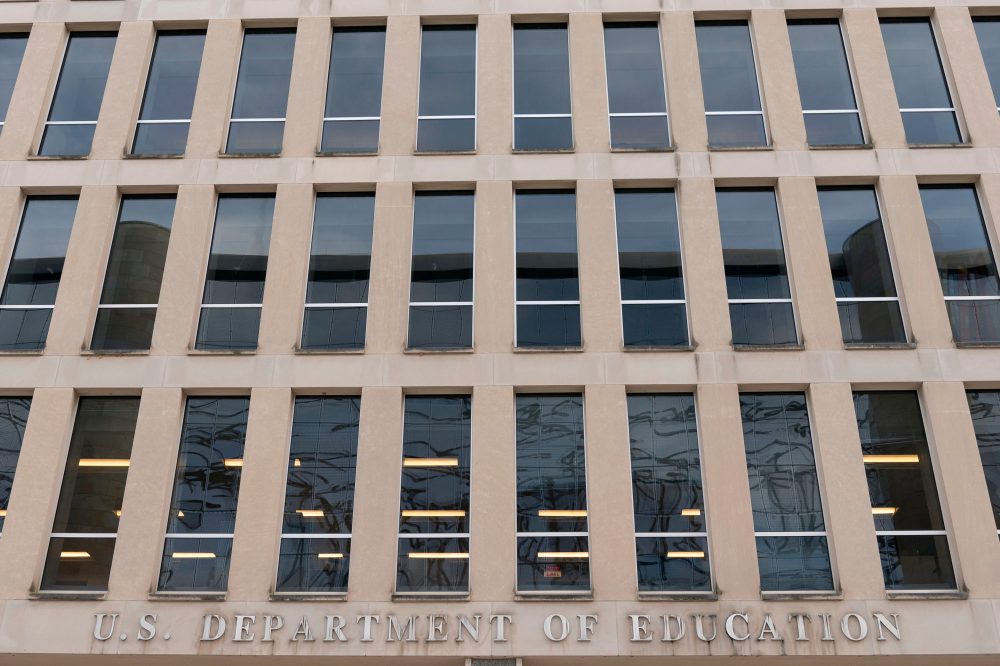

For months — and in some cases even longer — parents of children with disabilities have been waiting on the Education Department to act on their complaints involving bullying and discrimination at school.
Now, with the department handing off civil rights enforcement and special education oversight to other federal agencies, many of those parents and advocates are bracing for an already gridlocked process to get even worse.
“It’s to the point I don’t even check in anymore with the attorney,” said Nicole May, an Ohio mother who filed a complaint in spring 2024 with the department’s Office for Civil Rights. May alleged her teenage daughter was being bullied because of her hearing aids and was struggling in class because she couldn’t hear her teachers. More than two years after filing, her case still hasn’t been resolved.
Under changes announced Tuesday, the Department of Justice will assume responsibility for civil rights enforcement in schools, while the Department of Health and Human Services will take over special education. The moves are part of President Donald Trump’s campaign pledge to dismantle the Education Department. Education Secretary Linda McMahon described the changes as a way to better serve families of children with disabilities.
Disability advocates pushed back, arguing that special education has no business being housed in a health department — an agency that tends to view disabilities as medical conditions to be managed rather than as differences in how children learn. The top Republican on the Senate education committee echoed those concerns, saying he would seek legislation to keep special education away from Health and Human Services.
For many families and advocates, though, the announcement was met more with exhausted resignation than outrage.
The Education Department’s civil rights office had long served as the final option for parents who believed their child was being discriminated against at school, with a requirement to review every complaint it received. Under the Trump administration, the backlog of unresolved cases has grown significantly while completed resolutions have declined. Attorneys say they are increasingly looking to other avenues to seek justice for their clients.
That response is a notable shift from a year ago, when parents and attorneys were alarmed by deep cuts to Education Department staff.
The Office of Special Education and Rehabilitative Services has shrunk by roughly one-third since 2024, and the Office for Civil Rights is now approximately 40% smaller. At the same time, the Department of Justice’s Education Opportunities Section has been cut in half, according to estimates from Justice Connection, a network of former department employees.
“I think a lot of people are mad, but they are like, ‘What are we going to do?’” said Emily Harvey, co-legal director at Disability Justice, formerly known as Disability Law Colorado, who has watched her cases sit idle.
When Trump took office, Harvey had a federal complaint pending alleging that some Colorado schools were unlawfully turning away students with disabilities who lived outside their attendance boundaries. She also has a case at the Department of Justice alleging that a school district south of Denver restrained and isolated disabled students hundreds of times, despite the fact that such measures are supposed to be used only in emergencies.
“I feel like they’re probably collecting dust on a virtual shelf somewhere,” Harvey said.
In response to the federal backlog, Harvey helped push for a new state law in Colorado that broadens the types of civil rights cases state education officials are permitted to pursue. That legislation, signed into law in May, allows the state to take on cases that would typically be handled at the federal level — including those involving allegations of discrimination and harassment.
Harvey said the federal civil rights office was never without flaws. “But I think it’s become even less help for people who are trying to resolve issues,” she said. Harvey previously worked as an Education Department civil rights attorney in 2020 and 2021.
Craig Haller, a special education advocate in the Boston area, said he has received no word on a complaint he submitted early last year to the Education Department’s Office for Civil Rights. Since the Trump administration began dismantling the department, he has relied more heavily on Massachusetts’s state system for handling special education disputes.
He recently used that system to assist a student whose high school failed to consider his special education plan before suspending him.
“I got it fixed for my client,” Haller said. But without the federal Office for Civil Rights, he added, “I can’t get it fixed systematically.”
While only Congress has the authority to formally close the Education Department, Secretary McMahon — a billionaire and former CEO of World Wrestling Entertainment — has signed 10 agreements transferring department functions to other federal agencies.
Those agreements have not yet resulted in fewer employees working on specific programs. However, the union representing department workers says staff have encountered problems with equipment and access at their new locations.
“It’s hard to describe how inefficient the implementation of the (agreements) has been,” said Rachel Gittleman, the union’s president.
Taken together, advocates for students with disabilities say the splintering of programs, enforcement, and oversight across multiple agencies raises serious questions about what will be overlooked or lost entirely.
Robyn Linscott, who directs education and family policy at The Arc of the United States, a prominent disability rights organization, recalled a three-hour listening session the Education Department held in January. Families, educators, and advocates described the obstacles they face in getting proper support and services. While they acknowledged the system has problems, not one parent called for moving special education oversight to Health and Human Services.
Even so, Linscott said she isn’t surprised the administration made the move.
“It has only been 24 hours, but I think we anticipated this move for over a year,” she said Wednesday.
In Congress, senators from both parties said they would work to block special education from being placed under Health and Human Services. Republican Sen. Bill Cassidy of Louisiana said he would “publicly commit” to joining forces with Democratic Sen. Tim Kaine of Virginia on legislation to pressure the administration to reverse course. Cassidy, who lost a primary election this spring and has fewer than six months remaining in his Senate term, has a personal connection to the issue — his wife co-founded a network of charter schools serving students with dyslexia.
If special education must be moved, Cassidy said Wednesday, it should go to the Labor Department, which he argued is better equipped to support people with disabilities as they learn and enter the workforce.
Ultimately, what parents care about most is whether their children are receiving the services they need, said Rob Harris, an IEP advocate in Colorado. Families already spend enormous amounts of time trying to navigate systems that should be working in coordination but often aren’t. Harris has personal experience with those challenges — his 19-year-old daughter is blind.
“Families don’t experience the government through organizational charts,” Harris said. “We experience it through the services our children receive.”