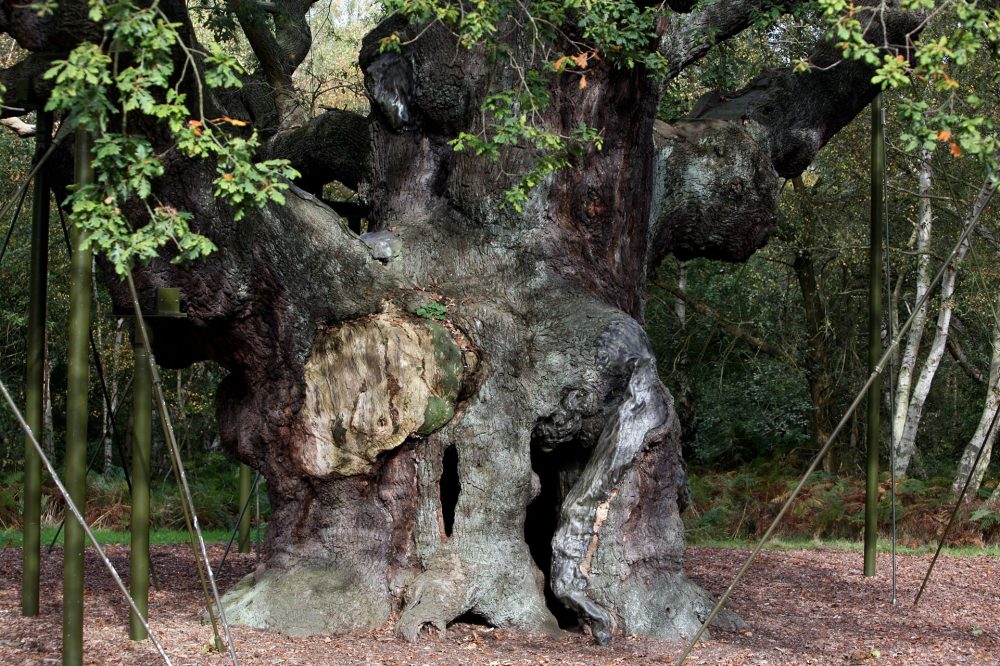

LONDON (AP) — One of England’s most iconic trees, long connected to the legend of Robin Hood, appears to have been killed by the very people who came to admire it.
The Major Oak, a 1,200-year-old giant in Sherwood Forest, is believed to have died after it failed to grow leaves this spring, according to the Royal Society for the Protection of Birds, which announced the news Thursday.
The conservation organization explained that centuries of visitors coming to gaze at the tree’s twisted branches and wide-spreading canopy in Nottingham gradually packed down the soil around its base, preventing rainwater from reaching its roots.
The forest has faced threats for years, and rumors of the tree’s death had circulated before — only for the group to confirm each time that it had survived. This time, there is no such reassurance.
“The tree’s failure to produce leaves this year is heart-breaking for everyone,” said Hollie Drake of the RSPB in a statement confirming the tree’s death.
According to legend, Robin Hood — the fictional 13th-century outlaw known for stealing from the wealthy to give to the poor — used the forest as a hideout while evading the sheriff of Nottingham, and the Major Oak is said to have provided him shelter.
The tree earned its name after being featured in a book about oaks written by Major Hayman Rooke in 1790, which sparked the first surge of visitors flocking to the forest to see it.
Pinpointing a single cause of death is not possible, experts say, but the cumulative impact of millions of footsteps played a role, as did efforts to physically support the tree’s enormous limbs using cables and poles. Climate change, which has brought increasingly severe heat waves and drought conditions, was also cited as a contributing factor.
Specialists who examined the tree found its root system had been choked and deprived of nutrients.
“Ancient trees like the Major Oak are the ‘conservation white rhinos of the U.K.’ but their decline is far less visible,” said Ed Pyne of the Woodland Trust. “Saving them is vital to the health of the world we live in and yet most disappear quietly, without the recognition or care given to the Major Oak.”
Beyond its place in folklore, Sherwood Forest holds historical significance for another reason — its oaks were used to build the ships of Vice Admiral Horatio Nelson’s Royal Navy during the late 18th and early 19th centuries, and timber from the forest was used in the roof of St. Paul’s Cathedral in London.
The Major Oak was spared from being cut down and has been protected behind a fence since the 1970s.
“The Major Oak will continue to stand at the heart of Sherwood as a natural monument for visitors to come and see, living on in the legend of Robin Hood and continuing to provide as much support to the forest’s ecosystem in death as in life,” Drake said.