
Many of the countries sending teams to this year’s World Cup are struggling with serious social divisions back home. Yet on the soccer field, those same nations are presenting a very different story — one where players of varying backgrounds and religious beliefs are working side by side in pursuit of a shared goal.
This dynamic stands out most clearly among Western European national teams, which for the vast majority of soccer’s history were made up almost entirely of white Christian players. As those countries have become more culturally and religiously diverse, so have their rosters — now featuring both Christian and Muslim players who are open and public about their beliefs.
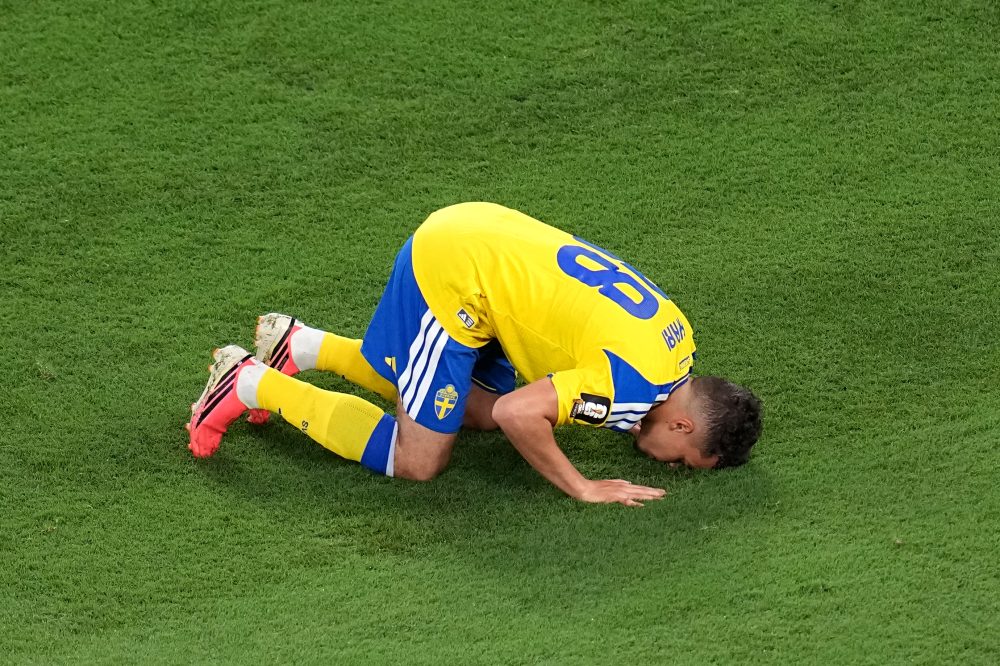
England’s national team has, for the first time, a Muslim player on its squad. France’s roster includes players from Protestant, Catholic, and Muslim backgrounds. Spain’s breakout star, 18-year-old Lamine Yamal, is a practicing Muslim. Sweden’s Yasin Ayari is as well — and after scoring the first of his two goals in Sunday’s win over Tunisia, the country where his father is from, Ayari dropped to the ground in prostration to give thanks to God.
All four of those countries — along with several other European nations — have faced political tension tied to the arrival of large numbers of Muslim immigrants. So does the religious diversity seen on these World Cup rosters carry a meaningful message?
Eboo Patel, president of Interfaith America, an organization that promotes religious pluralism and cooperation, says it absolutely does. “It is symbolic yet also substantive,” he said.
Patel described the image of Christian players making the sign of the cross and Muslim players raising their hands in prayer. “My identity really matters to me and it makes me a better soccer player,” he said those gestures communicate.
“They score, they each say their respective prayers, and then they’re hugging each other,” Patel added. “You’re cooperating to build a community and a team. … It’s not a contrived television ad or a condescending afterschool special. It’s the way you build an excellent soccer team.”
Several players at this World Cup have drawn attention for how openly they express their faith:
Egypt’s Mohamed Salah is by far the most recognized player on his country’s squad. A Sunni Muslim, Salah is consistently open about his faith both on and off the field — frequently prostrating himself after scoring to give thanks to God. His presence has had measurable effects beyond the sport: after he joined Liverpool in England’s Premier League, researchers found that anti-Muslim posts on social media by the club’s fans dropped by half.
Croatia’s Luka Modrić, 40, is competing in his fifth World Cup and is on pace to surpass 200 international appearances during the tournament. A devout Catholic, Modrić has frequently worn shin guards bearing images of Jesus and the Virgin Mary. Just days before the team departed for the United States, Modrić and his Croatian teammates gathered to celebrate Mass together at a chapel in the town of Icici.
England’s Djed Spence has been identified by the BBC and other media outlets as the first Muslim player to appear for the senior England national team, though the Football Association has not officially tracked players’ religious affiliations. Spence, a fullback who plays for Tottenham, previously represented England six times at the under-21 level. “It’s good to make history and hopefully inspire young kids around the world that they can make it as well,” Spence told the BBC. “They can do what I am doing.”
Spain’s Lamine Yamal, an 18-year-old Muslim whose father is Moroccan, made international headlines in May when he was seen waving the Palestinian flag during Barcelona’s celebration after winning the Spanish league title. Barcelona’s coach Hansi Flick publicly questioned that decision, and Israel’s defense minister, Israel Katz, later accused Yamal of spreading “hate.”
England defender Marc Guéhi, 25, is the son of a Christian minister based in London and is playing his first season with Manchester City. He was chosen as one of England’s defenders for the World Cup. While serving as captain at his previous club, Crystal Palace, Guéhi wrote religious messages on his uniform during a Premier League campaign supporting LGBTQ+ inclusion — a move that violated Football Association rules, which bar players from displaying religious messages. He was not punished for the act.
Iraq’s World Cup squad reflects the country’s complex religious and ethnic landscape. Religious minorities have faced persecution in Iraq for decades, yet this year’s team includes Kurds, Sunni Muslims, Shiite Muslims, and several Christians — a notable fact given that Iraq’s Christian population is estimated to have dropped from 1.5 million in 2003 to roughly 150,000 today. One of those Christian players, midfielder Aimar Sher, has been eager to share his faith publicly, posting photos on social media of himself wearing a shirt that reads “I Belong to Jesus.”
U.S. forward Christian Pulisic has spoken candidly about his Christian faith and is frequently seen wearing a cross necklace given to him by his mother. He has led Bible study sessions with teammates, and his Instagram account has included photos of scripture passages he has personally underlined. Several of his U.S. teammates are also publicly open about their Christian faith, including Weston McKennie and goalkeeper Matt Freese. McKennie’s Instagram biography consists of just four words: “All glory to God.”