
PHOENIX (AP) — A pair of Republican congressmen vying for the Arizona governorship faced off in a debate Wednesday, each making the case that they alone have what it takes to defeat Democratic Gov. Katie Hobbs as Arizona residents continue to feel the pinch of rising costs.
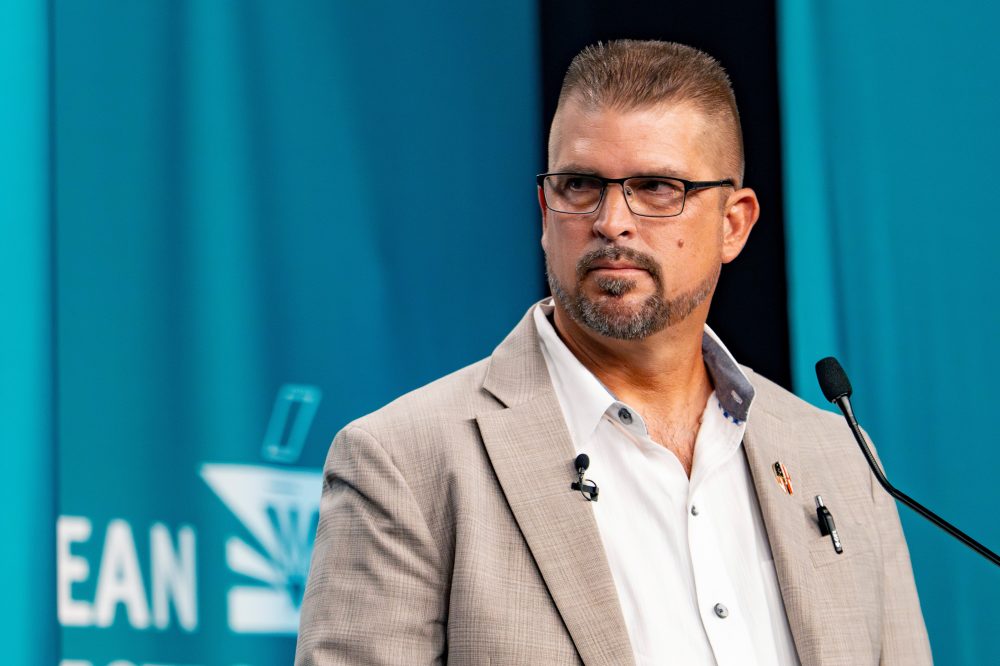
U.S. Rep. Andy Biggs, the frontrunner in the GOP primary and a candidate backed by President Donald Trump, argued he has the ability to attract voters across party lines and the experience needed to lead the state.
“There’s not a doubt in my mind, if you look at the polling data that you’re going to find, I am the most competitive with Katie Hobbs of anybody on this stage in any Republican in the state,” Biggs said.
U.S. Rep. David Schweikert, who has successfully fended off three strong Democratic challengers in recent election cycles, contended that his deep knowledge of government finances and his commitment to attracting new businesses to Arizona set him apart from the rest of the field.
“These are wonderful people, but they’ve never actually been in the great battle,” Schweikert said, referring to Biggs and two other Republican contenders.
Businessman Scott Neely, who mounted an unsuccessful run for governor in 2022, told reporters after the debate that a Biggs primary victory would ultimately cost Republicans the general election.
Whoever emerges from the July 21 Republican primary will go on to challenge Gov. Hobbs, who faces no opposition in her own party’s primary.
Biggs has spent five terms in the U.S. House representing a strongly Republican district in the eastern suburbs of Phoenix. He previously chaired the ultra-conservative U.S. House Freedom Caucus. Before his time in Congress, Biggs served in the Arizona Legislature from 2003 to 2016, including four years as president of the state Senate. During that time, he clashed with then-Republican Gov. Jan Brewer over a Medicaid expansion in 2013 and championed school choice legislation and bills aimed at abortion providers.
Biggs has been one of Trump’s most vocal defenders in Congress and backed Trump’s unfounded claims that the 2020 presidential election was stolen.
Schweikert, widely recognized as a fiscal hawk who frequently speaks out against government debt, has represented a wealthy district covering portions of northeast Phoenix and Scottsdale for eight terms. He previously served in the Arizona House during the 1990s and as Maricopa County’s treasurer in the 2000s.
Throughout his congressional career, Schweikert has repeatedly warned about the growing federal deficit, often delivering late-night floor speeches to a nearly deserted House chamber. He has praised the 2017 Trump tax cuts while also calling for deeper spending reductions to curb federal borrowing.
Schweikert’s record has not been without controversy. In 2022, the Federal Election Commission fined him $125,000 for misappropriating campaign funds. Two years earlier, he agreed to pay a $50,000 fine and acknowledged 11 campaign finance violations following a U.S. House Committee on Ethics investigation. Despite those issues, he successfully defended his congressional seat in his last three general elections.
On the topic of data centers, Biggs expressed support for Arizona’s recently enacted three-year pause on tax incentives for new data center construction — a position also championed by Gov. Hobbs. “They shouldn’t be given a break,” Biggs said, pointing to the significant demands data centers place on power and water supplies.
Schweikert described Arizona’s affordability situation as “pretty miserable” but cautioned that consumer prices don’t drop on their own. He pledged to actively recruit businesses to the state and push for higher wages.
Both candidates were questioned about the lapse of healthcare subsidies for people enrolled in coverage through the Affordable Care Act.
“We’re going to have to deal with the reality of subsidization of everything in the economy is not going to work,” Schweikert said.
Biggs said he has introduced legislation in Congress aimed at reducing healthcare costs. He also expressed support for Trump’s idea of sending money directly to Americans for health savings accounts, allowing individuals to manage their own insurance and medical expenses.