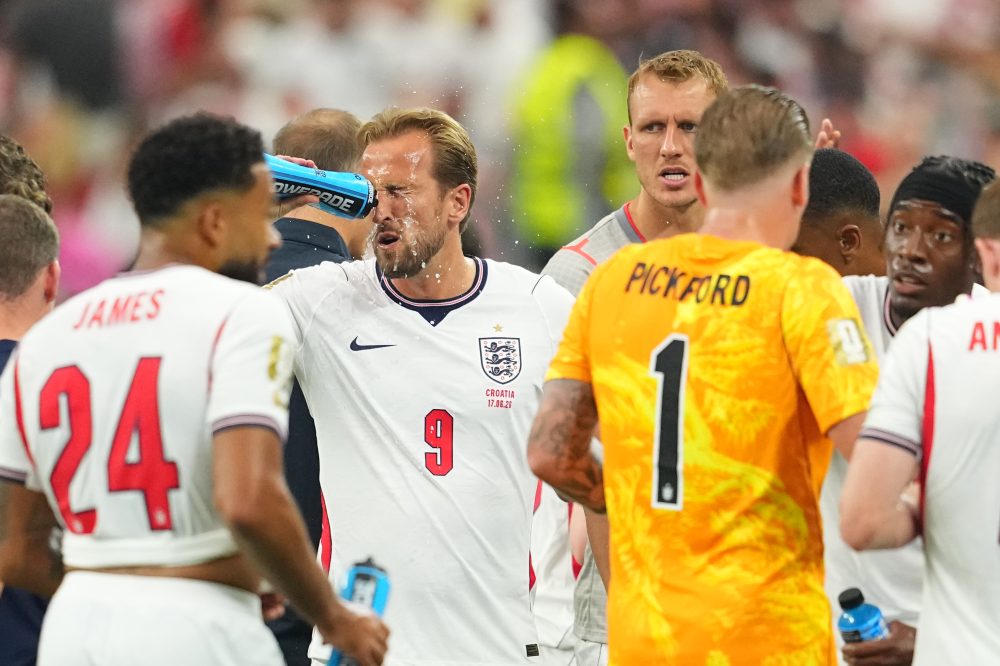

LOS ANGELES — For the first time ever in World Cup competition, FIFA has made it mandatory for all soccer players to take hydration breaks during matches, citing concerns about dangerous heat conditions. The new rule, however, has drawn pushback from two very different camps.
Experts have warned that this summer’s World Cup — co-hosted by the U.S., Mexico, and Canada — could go down as the hottest in the tournament’s history. FIFA responded to those concerns by requiring three-minute hydration breaks at the midpoint of each half, regardless of what the temperature happens to be. Critics from the soccer world argue the stoppages interrupt the rhythm of the game and give coaches an opportunity to tactically shift momentum, while some in the scientific community contend three minutes simply isn’t enough time to meaningfully cool down or rehydrate players when conditions are dangerously hot.
“When we look at the three minute hydration breaks, we’re really looking at this as a way to mitigate anything that could potentially lead to an incident or an emergency,” said Joshua L. DeVincenzo, assistant director of applied research services at Columbia University’s National Center for Disaster Preparedness.
These are the first mandatory three-minute cooling breaks in World Cup history, applied to every match regardless of temperature or whether a stadium has air conditioning or an enclosed structure. FIFA stated the policy was designed to “ensure equal conditions for all teams, in all matches,” drawing on lessons learned from past events — including the FIFA Club World Cup held in the U.S. last summer, where temperatures in many locations climbed into the 90s F (mid-30s C) and beyond.
Some coaches acknowledged the breaks make sense when heat is extreme but questioned whether they were truly needed at every single game.
Athletes who push themselves hard in hot and humid environments face a condition known as exertional heat illness, which occurs when the body overheats and places serious stress on the heart, nerves, muscles, and central nervous system. Warning signs include muscle cramps, extreme tiredness, poor performance, headaches, irritability, nausea, dizziness, and dehydration.
When an athlete’s internal body temperature climbs above 105 F (40.5 C), they may become confused, aggressive, or even lose consciousness, according to Yuri Hosokawa, an associate professor at the Faculty of Sport Sciences at Japan’s Waseda University. Writing in an email, she described these as “characteristic signs of exertional heat stroke” that “require immediate medical attention.” Hosokawa was among those who co-signed a letter sent to FIFA in May calling for stricter heat safety guidelines, including cooling breaks of at least six minutes in length.
Exertional heat stroke during athletic competition ranks among the leading causes of death in athletes.
Dehydration makes the danger worse. In hot conditions, athletes can lose between 1 and 2 liters — roughly 50 to 67 ounces — of fluid per hour through sweat, and most players don’t drink enough to replace what they lose. Research shows that losing just 2% of body weight to dehydration can noticeably hurt physical performance.
Ryan Calsbeek, a professor of biological sciences at Dartmouth College, explained that the human body actually performs better as it warms up — but only to a point. Beyond a certain threshold, performance doesn’t just plateau, it drops sharply.
“Your body starts to really fall apart, you lose the ability to cool off fast enough,” he said. “And the physiological mechanisms just break down.” That tipping point comes when the wet bulb globe temperature — a measurement that factors in heat, humidity, cloud cover, and wind — exceeds roughly 95 F (35 C), though individual heat tolerance varies from person to person.
Calsbeek also noted that the mental fog brought on by extreme heat can affect a player’s ability to make smart decisions on the field. “It’s these marginal differences in performance that I think can determine the outcome of a match,” he said. “If you have individuals that do better in extreme conditions, whether it’s extreme heat or high altitude or whatever the case may be, those small differences could play a critical, pivotal role in determining the outcome.”
The mandatory three-minute breaks are intended to shield both players and referees from serious heat illness while helping them maintain peak physical performance. During that window, athletes can cool down and replace some of the water and salt lost through sweating — but how effective the break is depends heavily on how aggressively cooling methods are applied.
One approach involves placing cold, wet towels on exposed areas of the body such as the neck, head, back, and arms. When done properly, that technique can lower body temperature by roughly 0.22 F (0.12 C) per minute, according to Douglas Casa, CEO of the Korey Stringer Institute at the University of Connecticut, who also co-signed the letter to FIFA.
“Some people can tolerate a little more fluids comfortably and then do intense exercise. Some people can’t because it sloshes around in their stomach and they don’t feel super comfortable, so they might not drink as much in such a short period of time,” Casa said. He added that the length of the break directly determines how much benefit players get — whether from fluids or cooling — and “that’s why we’re suggesting doing something like five or six minutes, because it just makes such a big impact when you’re dealing with a change of that magnitude.”
How much recovery time any individual player needs also varies. “Depending on your body, you might need more or less time. But those kinds of breaks are crucial so that your body isn’t just being forced to keep trying to play catch up… to keep trying to cool you down without any kind of rest or a break,” said Bharat Venkat, director of the Heat Lab at the University of California, Los Angeles.
As global temperatures continue to rise, experts say requiring hydration breaks and rethinking where, when, and how sports are played will become increasingly necessary. “No matter what sport you play, there’s going to be adjustments that have to be made in the face of climate change,” Venkat said.