
LONDON (AP) — UK Prime Minister Keir Starmer isn’t running in Thursday’s special election, but his political survival very much depends on its outcome.
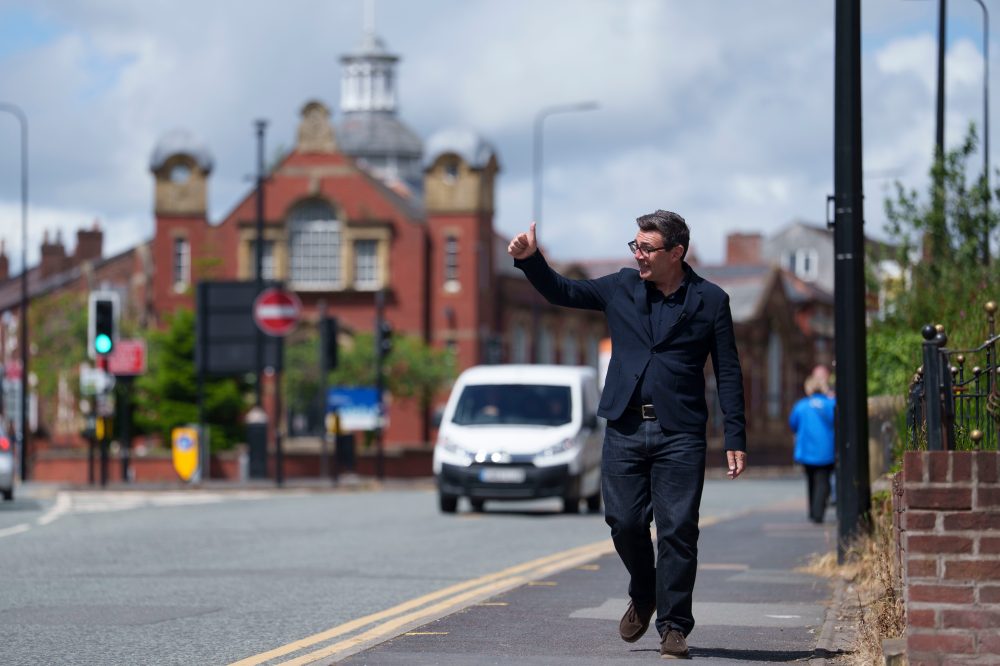
Residents of the Makerfield district in northwest England are heading to the polls to choose a new member of Parliament, and the heavy favorite is Andy Burnham — the current mayor of Greater Manchester and the man betting markets consider most likely to become the country’s next prime minister.
Should Burnham beat out a challenger from the anti-immigration party Reform UK and secure the seat for the governing Labour Party, he is widely expected to mount a leadership challenge against the increasingly unpopular Starmer.
On the campaign trail, Burnham made a bold pledge: “If people put their trust in me, I will change politics” — a sweeping promise from someone who, if elected, would be just one of 650 members of the House of Commons.
Yet the extraordinary level of global media attention — with scores of journalists from around the world descending on Makerfield — signals this is anything but a routine by-election. Results are anticipated in the early hours of Friday morning.
Roughly 75,000 people are eligible to cast ballots in Makerfield, a constituency made up of several towns and villages on the outskirts of Greater Manchester, about 200 miles (320 kilometers) northwest of London.
Those voters effectively hold the fate of Starmer in their hands. His public approval has collapsed since he guided the center-left Labour Party to a sweeping election victory in July 2024.
Starmer’s government has stumbled in its efforts to deliver economic growth, fix deteriorating public services, and bring down the cost of living. A series of missteps has compounded his troubles, including his choice to name Peter Mandelson — a figure with a scandal-clouded past and ties to Jeffrey Epstein — as the UK’s ambassador to the United States.
A poor showing in May’s local elections prompted dozens of Labour lawmakers to call for Starmer’s resignation. He has refused to step aside, but senior party figures are pushing for a change at the top. Former Health Secretary Wes Streeting quit his Cabinet role in May, declaring that “where we need vision, we have a vacuum.”
Shortly after, Labour lawmaker Josh Simons resigned his Makerfield seat, deliberately triggering the special election to create a path for Burnham to return to Parliament.
Britain’s system of government allows a ruling party to swap out its leader mid-term, with the new leader automatically becoming prime minister — no national election required. Under Labour Party rules, a leadership challenge can be launched if one-fifth of the party’s House of Commons members back it, which currently means 81 lawmakers.
Streeting said Tuesday that he hopes Starmer will voluntarily step down, but warned that if he refuses, “there will need to be a contest, and I would be prepared to do that.”
While Streeting is seen as a capable communicator with allies in Parliament, Burnham is viewed as the more probable successor to Starmer.
The 56-year-old politician — often called the “King of the North” — has served as Manchester’s mayor since 2017, overseeing a significant revitalization of the city where the Industrial Revolution took root. He is now promising to bring his distinctive “Manchesterism” approach to the national stage.
“It’s not right, the way the country has been run,” Burnham said during a campaign appearance last week, arguing that “London-centric politics” has left other parts of the UK behind.
Starmer, for his part, has projected an image of calm resolve. At a G7 summit in France this week, he insisted he has no plans to resign.
“I will fight if there’s a challenge,” Starmer said. “We won a significant general election result in 2024, with a mandate to bring about change. I’m not going to walk away from that.”
Starmer has also floated the idea of bringing Burnham into his Cabinet if Burnham wins the seat, telling Sky News on Wednesday that “I want him to have a big role in government.” However, sources close to Burnham signaled he has no interest in that offer.
Rob Ford, a professor of political science at the University of Manchester, said a convincing Burnham win would make “the pressure on Starmer very hard to resist.”
“Starmer can say all that he likes that he wants to carry on,” Ford said. “But if the entire Cabinet turns around and says, ‘We’re not going to serve under you and we think you should go,’ then either he’ll go with dignity or go without dignity, but he’ll end up having to go quite quickly.”
Still, Burnham’s path to victory is not guaranteed. Makerfield has returned Labour lawmakers to Parliament for over a century, but Reform UK has made rapid inroads across post-industrial northern England, scoring significant gains in last month’s local elections.
Reform’s candidate, Rob Kenyon — a local plumber — is aiming to capitalize on voter anxiety about immigration, a concern frequently voiced by residents despite the area having relatively few immigrants. Reform also faces pressure from its right flank, from Restore, an even more hardline anti-immigration and ethnonationalist party.
A Burnham win would be damaging enough for Starmer. But Ford warned that a Reform victory in Makerfield would mean “Gotterdammerung, apocalypse, disaster, chaos” for Labour.
“Andy Burnham is miles more popular than every other (leadership) candidate available. Miles better known, miles better liked,” Ford said.
“If Reform take him out, then simultaneously you have a situation where the Reform threat looks much graver, and the best person available to combat the Reform threat has failed.”