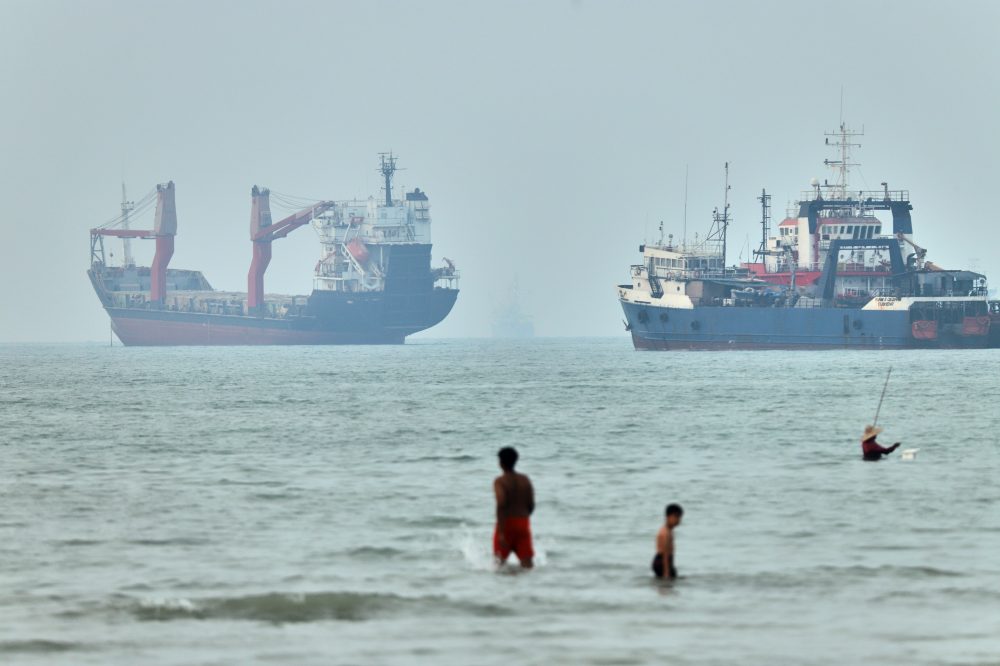

A Thai fisherman named Chaiyaporn Arunrasamee was bent over his fishing nets along the Andaman Sea last month — waters that sit at the center of an enormous government infrastructure proposal that could reshape global shipping routes in Southeast Asia.
“Personally, I don’t want it to happen at all,” said Chaiyaporn, who has spent his entire 50 years fishing in the waters near Ranong, a coastal town on Thailand’s western shore.
Thailand’s Prime Minister Anutin Charnvirakul has breathed new life into a long-discussed plan known as the “Land Bridge” — a massive logistics corridor valued at 1 trillion baht, or roughly $30.45 billion. The project gained renewed urgency following the conflict in Iran and the closure of the Hormuz Strait, events that underscored how dependent global trade is on a handful of critical sea passages.
The proposal calls for connecting two newly built deep-sea ports — one at Chumphon on the Gulf of Thailand to the east, and another at Ranong along the western Andaman coast — through a 90-kilometer (56-mile) standard-gauge railway capable of handling up to 20 million shipping containers per year. Additional infrastructure would include a meter-gauge rail link to Thailand’s existing national rail network, multi-lane highways, and local roads.
The goal is to give cargo ships an alternative to the Strait of Malacca, a 900-kilometer (550-mile) waterway bordered by Indonesia, Thailand, Malaysia, and Singapore that serves as the primary sea route between East Asia and the Middle East and Europe. About 80% of container traffic at major ports along the Malacca Strait involves goods being transferred between ships rather than cargo headed to local destinations.
“We want to capture some of this 80% market, particularly the feeder segment,” said Jiraroth Sukolrat, Director-General of Thailand’s Office of Transport and Traffic Policy and Planning, referring to smaller freight vessels with a capacity of 12,000 containers or fewer. “We are not targeting giant mainline vessels.”
According to an internal government presentation reviewed by Reuters, the corridor could slash logistics costs by nearly 30% and trim transit times by up to 14 days for cargo traveling between southern China and Indian Ocean ports serving South Asia and the Middle East. Feeder-to-feeder shipments crossing the corridor could be around 10% cheaper and six days faster than comparable routes through Singapore, largely due to lower congestion.
Despite the ambitious projections, analysts are skeptical that the Land Bridge can truly rival the Malacca Strait as a global trade route.
“The land bridge may ultimately emerge as a modular national security asset aimed at securing local energy routes and boosting Thailand’s own western export capabilities,” said Eugene Mark of Singapore’s ISEAS-Yusof Ishak Institute.
Mark also noted that convincing shipping companies to unload cargo, haul it overland, and reload it onto another vessel remains a steep challenge. “Proving that this double-handling model can genuinely compete with the seamless transit through the Strait of Malacca remains a major hurdle,” he said.
The Land Bridge concept was first introduced around 2020 and is the latest in a string of similar infrastructure proposals that Thai governments have pursued over two decades, none of which came to fruition. Unlike earlier versions, the current plan does not include oil refineries or petrochemical facilities, focusing instead on ports, railways, and light industry.
“The concept hasn’t really changed. What has changed is the packaging,” said Wipawadee Panyangnoi, an independent researcher who wrote her doctoral dissertation on the Land Bridge proposal. “In the past they openly talked about industrial estates and petrochemicals, which people opposed. Today the project is framed as transport infrastructure and logistics because that language is easier for the public to accept.”
The Thai government says it has drawn lessons from past failures, with the state taking a regulatory and supporting role while private investors provide the bulk of financing. “It has to be a consortium involving shipping lines, port operators, financiers and land developers,” said Jiraroth.
So far, investor interest has been cautious. Mark noted that shifting policy frameworks and enormous capital requirements have kept major backers from making firm commitments. The project also carries geopolitical complexity, with neighboring countries watching warily. “Chinese state enterprises are unlikely to commit significant capital unless they secure strong operational leverage, which would trigger intense domestic political pushback in Thailand over foreign control,” Mark said. “Thailand must navigate a delicate diplomatic balancing act to prevent the corridor from becoming a geopolitical flashpoint.”
The Singapore foreign ministry did not respond to requests for comment from Reuters.
Meanwhile, communities along the proposed corridor are pushing back. In the fertile Phato district, where durian plantations and coffee farms generate significant income, residents are questioning the need for large-scale industrialization.
“My hometown’s durian industry alone generates around 10 billion baht a year without needing to build anything new,” said coffee entrepreneur Chalermchart Seekhiao, 30. “People need to understand: this isn’t an empty wasteland.”
Chaiyaporn, speaking from the small fishing village of Baan Hat Sai Dam on an island surrounded by mangrove forests, put the stakes simply: “This thing will be located in the area where we make our living. Where will we go?”
The project suffered a recent setback when regulators ordered a completely new Environmental and Health Impact Assessment after a significant gap was found between government and private research estimates on the density of marine life near the proposed port sites.
A government-appointed review panel is expected to submit its findings before the end of July.
“Local opposition alone rarely cancels a top-down mega-project in Thailand, but it acts as a powerful regulatory drag that compounds investor risk,” Mark said.