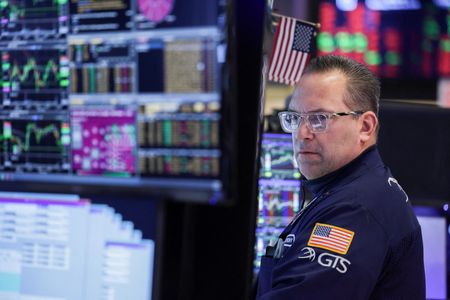
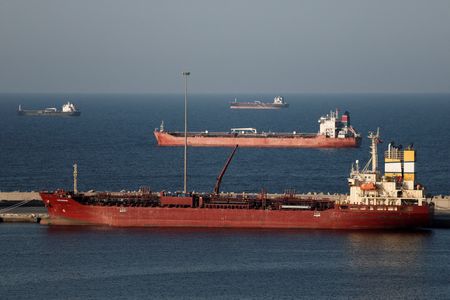
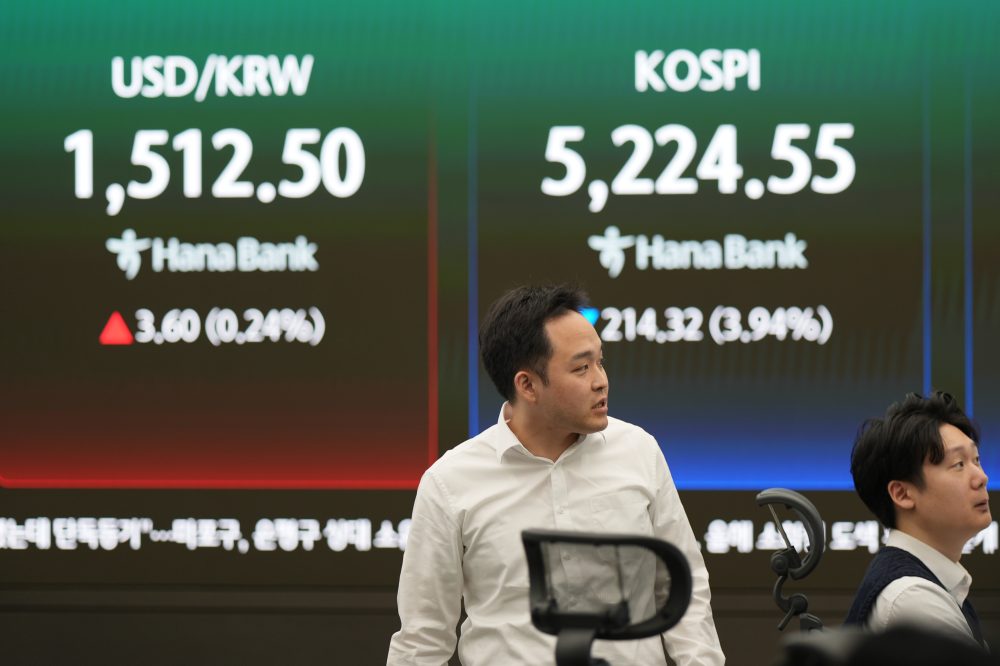
Wall Street futures began the shortened trading week with modest gains Monday morning, recovering from steep losses in the previous session as investors continue evaluating the growing Middle East crisis.
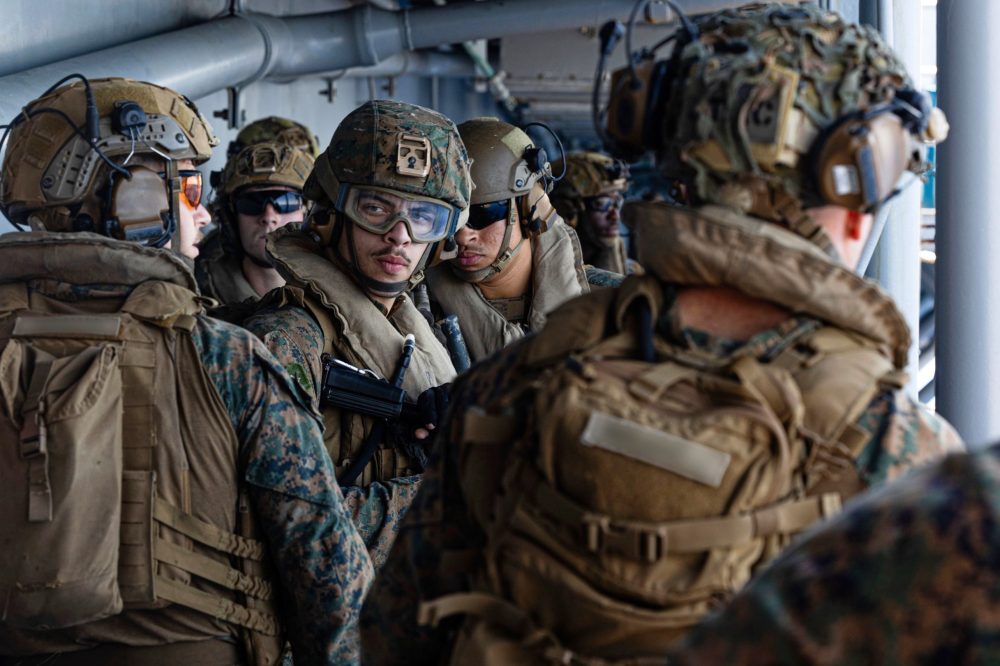
Over the weekend, Yemen’s Iran-backed Houthi forces joined the conflict while additional U.S. military personnel deployed to the region. President Donald Trump stated in a Financial Times interview that he wanted to “take the oil in Iran.”
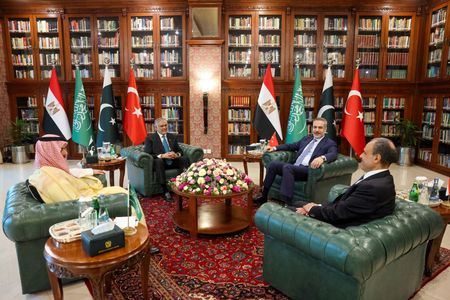
However, markets found some reassurance in Trump’s remarks that the U.S. and Iran have been conducting meetings “directly and indirectly,” with Pakistan serving as a go-between and indicating that “meaningful talks” could occur in the coming days.
“The market is grappling with two major unknowns that feed directly into each other: when oil flows will resume in meaningful volumes, and at what price level oil switches from an inflation story to a recession story,” explained Stefan Koopman, senior macro strategist at Rabobank.
Koopman added that capturing Iran’s Kharg Island would restrict export capabilities and drive global oil costs even higher.
Energy markets continued their upward trend Monday, with oil company stocks posting gains. Exxon Mobil and Chevron each rose approximately 1.4% in early trading.
Major market indices concluded their fifth straight week of losses Friday, with the Dow Jones officially entering correction territory after dropping more than 10% from its peak. Both the Nasdaq and Russell 2000 small-cap index have also confirmed corrections since hostilities began, while the S&P 500 sits just over 1% away from that threshold.
Investment firm Morgan Stanley reduced its global equity rating to “equal weight” from “overweight,” though analysts noted that money flowing into U.S. stocks and bonds has surpassed other regions since the conflict started, suggesting America may again serve as an investor safe haven.
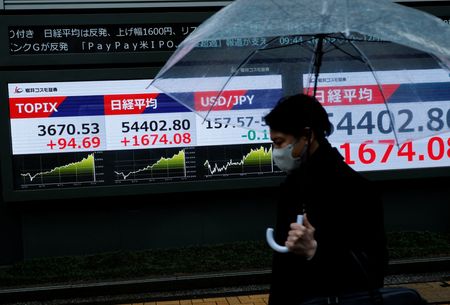
As of 5:25 a.m. Eastern Time, Dow futures climbed 156 points or 0.34%, S&P 500 futures gained 26 points or 0.41%, and Nasdaq 100 futures advanced 87.75 points or 0.38%.
Trading floors will remain closed Friday for the Good Friday holiday.
Rising oil costs from the Iran situation have renewed concerns about inflation, creating challenges for central banks regarding interest rate decisions.
Market watchers no longer expect Federal Reserve rate cuts this year, a shift from predictions of two reductions before the war started, according to CME Group’s FedWatch Tool.
Several employment reports including March nonfarm payroll numbers are due this week, potentially offering fresh economic health indicators.
Investors will also closely examine remarks from Fed Chair Jerome Powell and New York Fed President John Williams scheduled for later Monday.
Aluminum producer shares climbed in pre-market activity as metal prices reached four-year highs. Alcoa jumped 8.4% while Century Aluminum gained 7.2%.
Armed assailants stormed a university community in Nigeria’s Plateau state Sunday evening, opening fire and killing at least 13 people, according to local residents and government officials. The deadly assault marks another tragic incident in a region that has experienced ongoing violence between different groups.
The attackers targeted the Gari Ya Waye community within the Angwan Rukuba district, where they fired weapons at civilians without discrimination, witnesses reported. State authorities have identified the perpetrators as unknown gunmen and responded by establishing a 48-hour curfew across the affected district.
The violence has disrupted academic activities, with the University of Jos announcing the postponement of examinations that were scheduled to begin Monday morning. The institution cited security concerns following the overnight attack.
“People were here in the evening and unfortunately, wicked terrorists came and attacked our people. We have counted scores of people who are now dead and then so many others are also in the hospital receiving treatment,” said Paul Mancha, a local resident who serves as chairperson of the youth council in Plateau.
The central Nigerian region, commonly referred to as the Middle Belt, has been experiencing persistent deadly confrontations. While these conflicts are sometimes characterized as religious tensions between Muslim Fulani herders and Christian farming communities, analysts and political leaders point to environmental factors as underlying causes. Climate change and agricultural expansion have intensified competition for land resources, creating disputes that transcend religious and ethnic boundaries.
The violence in Nigeria has drawn international attention, with former U.S. President Donald Trump designating the country “a country of particular concern” last November. Trump cited targeting of Christians and alleged government failures to provide adequate protection, claims that Nigerian officials have disputed.
Kosovo’s leadership announced Monday their commitment to deploy military personnel to Gaza as part of an international peacekeeping operation supported by the United States, following last year’s ceasefire agreement between Israel and Hamas.
The Balkan nation joins several other countries, including Indonesia, Morocco, Kazakhstan, and Albania, in contributing forces to what’s being called the International Stabilization Force. This peacekeeping mission aims to maintain stability and support a transitional government in Gaza under President Donald Trump’s “Board of Peace” initiative.
During a televised government meeting on Monday, Kosovo’s defense ministry confirmed the deployment decision after receiving an invitation from Washington in December.
“We are ready to participate and help the people of Gaza, because we ourselves have been and are beneficiaries of international forces since 1999,” Prime Minister Albin Kurti stated during the session.
Officials did not disclose the specific number of troops Kosovo plans to send to the region.
Despite the ceasefire that took effect in November, tensions remain high in Gaza. Local health authorities report that Israeli forces have killed more than 680 Palestinians since the truce began. The broader conflict, which started in October 2023, has resulted in over 72,000 deaths according to local officials.
Kosovo, home to 1.6 million people in the Balkans, maintains strong ties with the United States, which supported the country’s declaration of independence from Serbia in 2008.
The world’s most valuable company, Nvidia, is experiencing a dramatic shift in investor sentiment as its stock trades at the lowest price-to-earnings ratio in seven years.
The artificial intelligence chip giant’s valuation has dropped to levels not seen since early 2019, well before the pandemic and four years prior to ChatGPT sparking the AI investment frenzy that sent tech stocks soaring.
Market turbulence stemming from escalating Middle East conflicts and growing skepticism about AI investments has pushed Nvidia shares down nearly 20% from their October peak. The company’s stock declined another 2.2% on Friday and appears headed for approximately a 10% loss in the first quarter.
Currently trading at roughly 19.6 times projected 12-month earnings, Nvidia’s valuation has fallen below the broader S&P 500’s ratio of about 20 – an unusual situation given that rapidly growing companies typically command higher premiums than slower-growth competitors.
The selloff has erased more than $800 billion from Nvidia’s market capitalization, which now stands at approximately $4 trillion, despite the company posting consecutive quarters of rising gross margins that have reached 75%.
Investor anxiety has centered on two main concerns: potential economic disruption from Middle East warfare that could drive up oil prices and inflation, and questions about whether massive AI infrastructure investments by tech giants like Microsoft, Alphabet, and Amazon are generating expected returns quickly enough.
“All technology, no matter what, including Nvidia, could potentially be disrupted, and that’s the risk factor right now,” explained Dennis Dick, a proprietary trader at Triple D Trading. “Everything’s running on Nvidia chips, but that doesn’t mean it’s going to be that way in two or three years. Everything is changing so rapidly, and I think that’s the overall market concern.”
The company has undergone a remarkable transformation from its origins as a graphics chip designer for video games to becoming the dominant supplier of processors powering AI applications. Since ChatGPT’s debut triggered the AI race, Nvidia shares have climbed over 1,000%.
Other AI-focused companies have similarly seen their valuations compress during the recent market downturn. Microsoft’s price-to-earnings ratio has dropped to about 20 from 35 last August, while Alphabet’s has declined to 24 from nearly 30 in January.
Despite the market pessimism, some analysts remain optimistic about Nvidia’s prospects. Wall Street forecasts show analysts expecting the company’s earnings to grow more than 70% in its current fiscal year, far outpacing the 19% growth projected for S&P 500 companies in 2026.
Art Hogan, chief market strategist at B. Riley Wealth, continues recommending the stock to clients. “Trading at a multiple that is lower than the S&P 500, I think it’s an easy decision to make,” Hogan stated.
The dramatic valuation shift reflects broader market uncertainty about whether the AI boom can sustain its momentum amid geopolitical tensions and questions about the timeline for returns on massive technology investments.
Good morning, Delmarva! We’re starting this Monday with partly sunny skies, but don’t put that umbrella away just yet. Scattered rain showers are expected to develop after 10 AM, though with only a 30% chance of precipitation, many of you may stay completely dry today. High temperatures will reach a pleasant 67°F, but it’ll be breezy out there with southwest winds gusting up to 30 mph at times.
Tonight, those scattered showers may linger as we drop to a mild 58°F – perfect sleeping weather with the windows cracked open.
Looking ahead to Tuesday, we’ll see a nice improvement! While we may start with a few morning showers, expect mostly sunny skies to take over with temperatures climbing to a beautiful 77°F. Tuesday night looks great with partly cloudy skies and lows around 64°F.
Overall, it’s a typical spring pattern with mild temperatures and just enough moisture to keep things interesting. Have a wonderful start to your week, Delmarva!
A potential Supreme Court ruling affecting birthright citizenship could create new obstacles for students trying to access educational opportunities across the United States.
Currently, federal law guarantees that every child has access to free public education from kindergarten through 12th grade, no matter their immigration status or that of their parents. However, education experts warn that any changes to birthright citizenship policies could make it more difficult for students to enroll in schools and pursue higher education.
The complications could extend beyond elementary and secondary education, potentially affecting college admissions and access to financial aid programs that require proof of citizenship or legal residency status.
Education advocates are closely monitoring the situation, concerned that administrative hurdles could prevent eligible students from receiving the education they are entitled to under current law.
Restaurant and bar owners nationwide are being forced to overhaul their wine selections as tariffs on European imports drive up costs beyond what customers will pay.
Kristen Goceljak, who oversees wine purchasing for Kent Hospitality Group’s upscale New York establishments, says certain champagne and cremant varieties that were previously menu fixtures are being eliminated because tariffs have pushed prices too high.
Five restaurant operators, retailers, and wine distributors told Reuters they’re revamping their offerings with more affordable options following tariffs on alcohol imports from European regions implemented over the past year.
European goods faced a 15% tariff rate starting last August under a US-EU trade agreement. After the Supreme Court struck down several of President Trump’s tariff policies in February, new levies were quickly implemented, imposing at least a 10% additional cost on many European imports.
Goceljak experienced the impact firsthand in February when she discovered a champagne she regularly purchased for private events had jumped approximately $5 per bottle from its previous $48 price at her distributor.
A cremant variety from the same supplier increased by roughly $3 per bottle, she noted, while numerous other vendors have informed her of price hikes reaching 20% this year.
Goceljak plans to replace champagne and cremant brands – which must originate from France – along with other established labels, opting for less expensive substitutes.
“It’s just too expensive,” she stated.
President Trump’s comprehensive tariff program announced in April 2025 immediately affected massive alcohol shipments entering the United States. European alcohol exports including wines, spirits and aperitifs to America totaled approximately 9 billion euros ($10.4 billion) in 2024, based on Eurostat figures.
However, many producers initially avoided raising prices while US alcohol sales already faced challenges from affordability concerns, competition from cannabis beverages, and changing consumption patterns.
Companies shipped large quantities in advance to avoid the tariffs or absorbed the additional costs themselves to maintain stable pricing, particularly during the crucial October-December holiday period when alcohol sales typically surge. These approaches are now becoming unsustainable.
“The pressure to pass through costs is mounting,” explained Lance Emerson, Senior Vice President of Commercial Finance at Republic National Distributing Company, a major US wholesaler. He noted the impact is more severe for wine, while spirits producers have better capacity to absorb tariff costs within their profit margins.
Retail prices for some imported wine brands have already increased 5-12% in 2025, with more significant rises from additional suppliers anticipated in 2026, Emerson said.
Both Emerson and Zach Poelma, Senior Vice President of Commercial Intelligence at Southern Glazer’s Wine and Spirits wholesaler, report that retailers and restaurants are either currently modifying their menus and inventory or are expected to make such adjustments increasingly throughout this year.
Emerson said dining establishments are shifting cocktail and wine offerings toward lower-priced alternatives, while retailers are reducing their product variety and balancing imported selections with domestic options. Poelma indicated restaurants, bars and other venues may also progressively replace imported wines with American varieties.
The pricing pressures have benefited some domestic brands. Imported wine sales volumes dropped approximately 8% from October through January, while domestic wine sales declined only 3% during the same timeframe, according to SGWS’s Poelma, with similar patterns continuing through February.
Francis Creighton, CEO of the Wine & Spirits Wholesalers of America trade organization, said member companies are assisting customers in updating their wine selections and cocktail offerings, including by providing domestic alternatives.
California’s Josh Cellars brand experienced 8.3% sales growth in the 13 weeks ending mid-March, while the overall wine category fell 3.6% – results that Dan Kleinman, chief marketing officer at parent company Deutsch Family Wine & Spirits, attributes partly to tariffs affecting imported competitors.
Deutsch Family Wines has maintained steady pricing on both Josh Cellars and imported brands in its collection.
“The sweet spot in America is a $10-$12 glass of wine,” Kleinman said, explaining that exceeding that range gets products removed from menus because many consumers refuse to pay higher amounts. “They want you at those certain prices.”
Josh Cellars Cabernet retails for approximately $10 per glass.
Wife and the Somm, a Los Angeles restaurant, has replaced several Old World European wines on its by-the-glass menu with domestic brands, according to owners Chris and Christy Lucchese.
This year, costs for European artisanal cheeses and meats they carried also increased dramatically.
“We have had to segue our entire cheese and charcuterie program to all domestic,” they explained. In some instances, they now pay more for American versions than they previously spent on European imports.
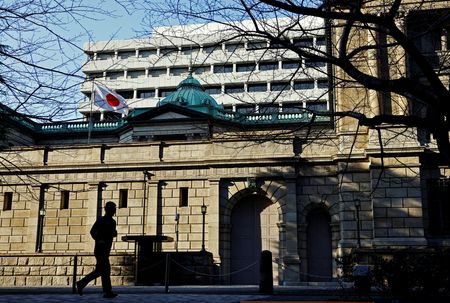
Japan’s central bank issued a warning Monday that the country’s core inflation rate could experience heightened upward momentum from climbing oil costs and the weakening yen, as companies demonstrate increased willingness to implement price increases.
The Bank of Japan released this assessment as part of a research document examining elements that influence core inflation—price increases stemming from domestic consumer demand rather than external cost pressures—a fundamental metric the bank uses to guide decisions about interest rate adjustments.
According to the central bank, while recent crude oil price surges might negatively impact economic growth, they could simultaneously elevate public expectations about inflation and drive up core price levels.
“Attention is warranted to the possibility that upward pressure on prices through this channel may have strengthened compared with the past,” the bank stated, noting that businesses have adopted more aggressive approaches to increasing both prices and wages.
The research also indicated that evolving corporate pricing strategies could make inflation more vulnerable to yen depreciation, as the central bank cautioned about inflationary forces created when a weakened currency drives up costs for imported goods.
“Even temporary supply-side factors may affect inflation expectations,” the document warned, suggesting that ongoing increases in food costs could create sustained upward momentum in overall consumer price inflation if they continue.
Japan’s central bank concluded its decade-long massive economic stimulus program in 2024 and implemented short-term rate increases, believing the nation was approaching sustainable achievement of its 2% inflation goal.
Bank officials have indicated they will pursue additional rate increases if they gain greater confidence that core inflation will remain steady at the 2% level.
Addressing criticism from financial analysts who argued that the bank’s underlying inflation concept lacked clarity, the research paper detailed the institution’s measurement methodology.
Beyond examining the output gap, the central bank analyzes multiple price indicators, including a newly revealed index that excludes temporary elements such as government subsidies, while employing economic models to assess pricing trends, according to the document.
The bank also reviews various surveys to understand public sentiment regarding future price movements and develops proprietary composite indices, which currently show inflation expectations ranging between 1.5% and 2.0%, the paper revealed.
“Looking at factors underlying price developments, the output gap has been on an improving trend, albeit with some fluctuations. Labor market conditions remain extremely tight, and wages are rising moderately,” the document stated.
“Taking these points into account, it could be judged that the underlying inflation rate is rising moderately toward 2%,” it continued. “Going forward, from the perspective of sustainable and stable achievement of the price stability target, it will also be necessary to monitor whether underlying inflation becomes firmly anchored at around the 2% level.”
HALABJA, Iraq (AP) — Yaser Fattahi depends on elaborate phone relays to hear his mother’s voice across the Iran-Iraq border, waiting anxiously for his cousin to make dangerous trips near the frontier where cell signals can briefly connect the separated family.
The trained nurse escaped to Iraq last December after Iranian authorities began targeting him for treating wounded anti-government demonstrators in private homes, helping them avoid surveillance at government-controlled medical facilities.
With regional warfare escalating, Fattahi now lives in constant anxiety about his mother’s wellbeing as U.S. and Israeli strikes continue.
The ongoing conflict has severed telecommunications networks and prompted Iran to mass troops along the border, effectively cutting off both communication channels and commercial activity across the region.
Fattahi’s cousin orchestrates their calls by carrying two devices to the border area – one connected to Iraq’s cellular network to reach Fattahi, while using the second phone to contact his mother through Iran’s system via WhatsApp.
“The calls last a minute or two,” Fattahi explained from his location in Sulaymaniyah, situated in Iraq’s Kurdish territory near the Iranian frontier. “She tells me to take care of myself, and that they are okay.”
Four days have elapsed since their most recent conversation. Fattahi continuously checks his device. “I thought he would call today but he hasn’t,” he noted.
The frontier separating Iran from northern Iraq’s Kurdish areas has historically remained fluid, sustained by family connections, commercial exchange, and illicit trafficking. Currently, households find themselves isolated from relatives, while merchants and even contraband runners avoid crossing. Iranian military units have expanded their deployment to block infiltration attempts by Iranian Kurdish resistance organizations.
Individuals who venture toward the boundary seeking Iraqi cellular coverage face potential shooting, according to advocacy groups. Alternative communication methods include illegally obtained Starlink access, though at considerable expense.
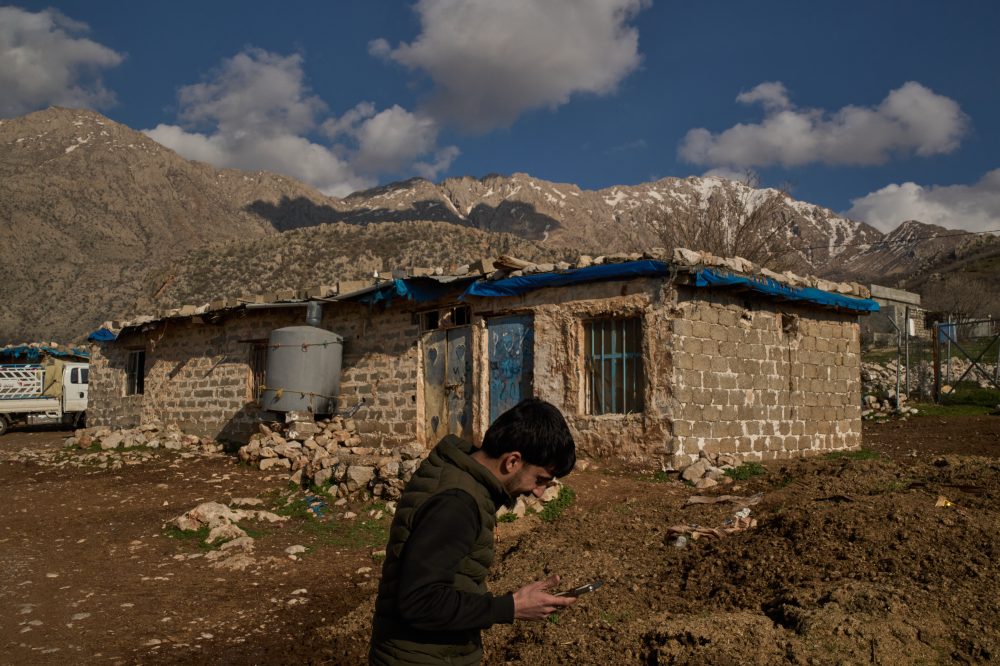
Within the mountainous Iraqi region of Byara, family members previously made routine border crossings for celebrations and religious observances.
The warfare has disrupted these established customs.
Nyan Fayaq, a 25-year-old legal studies student, supervised large cooking vessels while helping prepare an iftar meal during Ramadan’s concluding week as numerous family members assembled in traditional Kurdish attire among verdant hills populated with livestock.
Her concerns centered on relatives in Iran’s Saqqez city, whom she hasn’t contacted for over thirty days.
Born in Iran, Fayaq relocated to Iraq with her mother following her parents’ separation when she was two years old, returning to her mother’s native country. She reconnected with her Iranian uncles eighteen years later and maintained regular contact.
“They have electricity, gas and water, but everything has become very expensive because of America,” she stated.
An Iranian Kurdish worker employed in Iraq returned to his native Merivan two weeks prior to retrieve his spouse, bringing her to Iraq due to safety concerns. He requested anonymity, worried that identification might prevent future returns.
Since that time, his family communications have been extremely limited. He reported that relatives informed him Iranian law enforcement and security personnel operate outside their usual facilities because airstrikes have destroyed many installations. The Associated Press cannot verify these claims independently.
According to his sources, security forces have occupied educational institutions and recreational facilities despite local opposition.
The conflict has completely halted cross-border smuggling activities.
These carriers, called kolbars, transport merchandise including tobacco products, electronic devices, and apparel throughout Iran’s western regions. They function within legal ambiguity while risking death from border security, severe climate conditions, and dangerous mountain passages.
Occasionally, kolbars also facilitate human smuggling across the frontier. Many clients are Iranian Kurds lacking travel documents due to incomplete military obligations, while others seek asylum hoping to reach Europe. Kurdish militant organizations utilize identical mountain paths for moving personnel and supplies into Iran for operations.
Twenty-five-year-old Bilal Osman has known only kolbar work, inheriting the profession from previous generations.
He remembers Iranian forces firing on a twelve-mule convoy transporting merchandise through mountain terrain last year. “One bullet even hit a man’s leg,” he recalled.
“Sometimes a lot of soldiers are stationed along the border. If they see us, they shoot, beat us, or throw stones. Our life is hard, but this is how we make money to feed our families,” he explained.
At the base of mountains bordering Iran near Halabja, he cares for his animals while awaiting communication from Iranian kolbars across the boundary. Since warfare commenced, no contact has occurred.
“The kolbars simply can’t cross. We are always ready, but the borders are tightly controlled,” Osman stated.
Iranian authorities have “brought cameras for each spot, increased soldiers from five to at eac30 h location, and now even place soldiers between checkpoints,” he reported. “We speak to people on the Iranian side every day, and they tell us they can’t come because the border is too heavily guarded.”
An Iranian kolbar, speaking anonymously for security reasons, confirmed to The Associated Press that operations have virtually ceased since hostilities began due to enhanced security measures.
Shiwa Hassanpour, representing the Hengaw Organization human rights monitoring group based in Iraqi Kurdistan, reported that individuals approaching the border face shooting because Iranian forces suspect espionage activities.
Gathering intelligence from within Iran has become progressively challenging, she noted. Residents depend on expensive virtual private networks to report incidents and transmit footage, causing delayed news emergence. Hassanpour herself hasn’t reached her family for over twenty days.
She indicated that Iran’s Islamic Revolutionary Guard has positioned substantial troop numbers throughout Kurdish regional cities. These actions intensified following Iranian Kurdish opposition groups’ coalition announcement.
Subsequently, Hengaw has recorded significant increases in temporary checkpoints, vehicle inspections, and civilian violence.
VPN services to circumvent internet limitations cost approximately $25. Family communication with overseas relatives requires up to $50, beyond most households’ financial capacity, she explained. Residents also pay premium rates for smuggled Starlink connectivity.
To block Iranians from accessing Iraqi networks for calls, Iran attacked cellular infrastructure operated by Iraqi companies Asiacell and Korek near the frontier, then instructed security forces to shoot anyone approaching those areas, according to Hassanpour.
Officials have also detained anyone discovered with VPN applications, accusing them of espionage for Israel or the United States, she added.
Fattahi continues awaiting word from his mother. Their conversations often suffer from interference and ambient noise because his cousin employs two devices – one contacting Fattahi while the other reaches his mother.
“It’s hard to hear her,” he said. “But it’s enough.”
Medical officials reported Monday that Israeli military actions resulted in four Palestinian deaths across Gaza and the West Bank, marking continued violence despite a ceasefire agreement brokered by the United States over five months ago.
According to local healthcare authorities, three Palestinians died and two sustained injuries when Israeli aircraft launched a missile strike targeting a group near Gaza City’s Zeitoun neighborhood. Israeli officials have not yet provided a response to the incident.
The conflict, which began in October 2023, has resulted in more than 72,000 fatalities. Israel is currently engaged in military operations against Iran with U.S. support, while also conducting a fresh offensive against Hezbollah that includes Israeli ground forces operating in southern Lebanon.
Despite the ceasefire agreement, hostilities in Gaza have continued alongside Israel’s conflict with Iran. Medical authorities in the territory report that Israeli forces have killed at least 50 Palestinians since the Iran confrontation started one month ago.
In the Israeli-controlled West Bank, healthcare officials confirmed that Israeli troops fatally shot a 22-year-old man in the vicinity of Hebron, with soldiers subsequently removing the victim’s body.
Palestinian security officials named the deceased as Ramzi Awawada and alleged that Israeli forces allowed him to die from blood loss while blocking emergency responders from providing aid.
Israeli military representatives stated that their personnel shot and killed a Palestinian individual who approached them while carrying a knife.
Human rights organizations and medical personnel report that Israeli settlers are exploiting movement restrictions implemented during the Iran conflict to launch attacks against Palestinians in the West Bank, with military checkpoints hindering ambulances from quickly reaching those injured.
According to the Palestinian Health Ministry, settlers have been responsible for at least five Palestinian deaths in the West Bank since the current conflict commenced on February 28.
MADRID, March 30 – Spanish authorities have prohibited United States military aircraft participating in operations against Iran from entering the country’s airspace, according to a report published Monday by the Spanish daily El Pais, which cited defense sources.
The airspace restriction requires American military aircraft to find alternative flight paths around the NATO ally as they travel toward Middle Eastern targets, though emergency situations would be exempt from the ban, El Pais reported.
Spanish defense officials have not yet responded to requests for comment regarding the reported policy change.
When asked whether the airspace closure might damage diplomatic ties with Washington, Economy Minister Carlos Cuerpo explained the rationale during a radio interview with Cadena Ser. “This decision is part of the decision already made by the Spanish government not to participate in or contribute to a war which was initiated unilaterally and against international law,” Cuerpo stated.
Spanish Prime Minister Pedro Sanchez has emerged as one of the strongest critics of American and Israeli military actions against Iran, characterizing the operations as both reckless and illegal.
In response to Spain’s refusal to provide access to its military facilities for the conflict, President Donald Trump has warned of potential trade restrictions against Madrid.
Taiwanese officials announced Monday they are conducting investigations into 11 Chinese companies suspected of unlawfully recruiting semiconductor engineers and other technology professionals from Taiwan, as the island nation intensifies efforts to prevent technology transfers amid escalating tensions with China.
The Investigation Bureau of Taiwan reported that over 185 agents conducted searches at 49 different sites and interviewed 90 individuals during this month’s coordinated operation targeting Chinese businesses allegedly hiring Taiwanese engineers without proper authorization.
According to the bureau, the Chinese corporations being investigated concealed their true ownership by creating Taiwanese operations using foreign-funded shell companies as fronts, or by establishing unauthorized offices to illegally recruit workers and conduct business activities on the island.
China maintains claims over Taiwan, which governs itself democratically, asserting it as Chinese territory while refusing to rule out military action to gain control of the island. Taiwan rejects these territorial claims and maintains that only its citizens have the right to determine the island’s future.
Taiwan’s legal framework bans Chinese investment in certain semiconductor industry sectors, particularly chip design, while requiring government approval for other areas like chip packaging. These restrictions make it challenging for Chinese semiconductor companies to establish legitimate operations in Taiwan.
The investigation targets several major companies, including electronics manufacturer Huaqin Technology, mobile power device producer Anker Innovations, semiconductor and circuit board equipment maker Circuit Fabology Microelectronics Equipment, power semiconductor company Yangzhou Yangjie Electronic Technology Co Ltd, and chip design firm SG Micro.
None of these companies provided immediate responses when contacted for comment by Reuters.
Beijing’s pursuit of semiconductor expertise and skilled workers has grown more aggressive as Chinese leadership prioritizes achieving independence in advanced chip technology, driven by intensifying technological competition with the United States.
A specialized task force established in late 2020 has processed over 100 comparable cases involving suspected unauthorized recruitment efforts and illegal business operations conducted by Chinese companies, according to bureau officials.
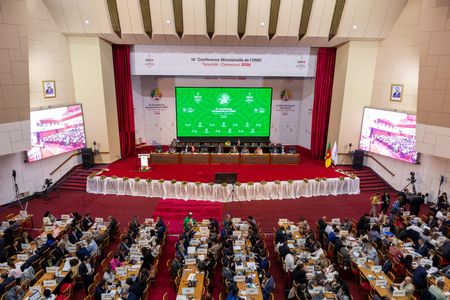
International trade discussions concluded without success early Monday morning following four days of negotiations in Yaounde, Cameroon, as countries failed to reach consensus on key digital commerce policies and broader trade reforms.
The ministerial conference ended with Brazil preventing the United States and other nations from securing an extension of current policies that prevent tariffs on digital transactions such as online downloads and streaming services.
While expectations were modest going into the talks, many hoped the existing digital commerce agreement would at least be renewed. However, disagreements between Brazil and other member countries made even this limited goal unattainable, according to diplomatic sources.
Brazil was only willing to support a two-year extension, far short of what the United States wanted, and trade representatives couldn’t find middle ground that satisfied both sides.
American officials and business organizations voiced disappointment with the stalemate. Britain’s Business and Trade Secretary Peter Kyle characterized the inability to reach consensus as a “major setback for global trade.”
These discussions were viewed as a crucial test for the World Trade Organization’s continued importance following a turbulent year of trade disputes and recent disruptions from the U.S.-Israeli conflict with Iran.
Securing agreement on digital commerce policies was considered essential for maintaining U.S. support of the WTO, particularly as President Donald Trump has moved away from international multilateral organizations while implementing his “America First” strategy.
WTO Director-General Ngozi Okonjo-Iweala expressed hope that the digital commerce agreement could still be restored, noting that Brazil and the United States continue working toward a compromise.
The organization reported some advancement on reform plans before time expired, with further discussions on making subsidy regulations more transparent and streamlining decision-making processes scheduled for Geneva in May.
Both the United States and European Union contend that China has particularly benefited from existing regulations to their disadvantage.
Negotiators spent Sunday attempting to bridge the divide between Brazil’s initial two-year proposal and America’s preference for permanent extension by creating a four-year plan with additional provisions extending through 2031.
Brazil subsequently offered a four-year extension including a midpoint review, but this compromise failed to gain sufficient backing.
Nations in the developing world have resisted lengthy extensions, claiming the current moratorium costs them valuable tax income.
A U.S. representative stated Brazil had rejected a “near-consensus document,” explaining “it’s not U.S. vs Brazil. It’s Brazil and Turkey v 164 members.” A Brazilian negotiator responded that “the U.S. wanted the sky,” arguing that pursuing longer extensions wasn’t wise given rapid changes occurring in digital commerce.
Another diplomat who attended the meetings said U.S. Trade Representative Jamieson Greer made participants “uncomfortable” when he implied there “would be consequences” if America didn’t obtain a long-term moratorium extension.
Keith Rockwell, a trade expert with the Hinrich Foundation and former WTO director, explained that Brazil’s attempt to use digital commerce negotiations to gain agricultural concessions failed because America is less committed to the WTO than previously.
“In the old days because they felt responsibility for the system the Americans would have swallowed hard and taken a hit,” he stated. “But now they won’t do that anymore.”
Rockwell predicted the deadlock would strengthen alternative trade frameworks like the Comprehensive and Progressive Agreement for Trans-Pacific Partnership, which includes 12 nations such as Japan, Britain, Canada, Mexico, Australia and Malaysia, but excludes the United States.
“Now what you’re going to see is a lot more energy and momentum into things like the CPTPP. They could immediately just agree on the framework (on e-commerce),” Rockwell explained.
Investment giant Morgan Stanley has shifted its investment strategy recommendations, pulling back on global stock markets while favoring safer assets as Middle East tensions continue to shake financial markets.
The major Wall Street firm announced Friday it was reducing its global stock rating from “overweight” to “equal weight” while simultaneously boosting its recommendations for U.S. Treasury bonds and cash holdings from “equal weight” to “overweight.”
Morgan Stanley analysts explained their reasoning in a research note, stating that “uncertainty around magnitude and duration of oil supply disruption means outcomes for risk assets have become increasingly asymmetrical.”
Oil prices have experienced dramatic increases this month, with Brent crude jumping 59% – marking the sharpest monthly increase on record and surpassing gains witnessed during the 1990 Gulf War. Trading pushed above $116 per barrel on Monday.
The investment firm issued a stark warning about potential market impacts, suggesting that if crude oil reaches $150-$180 per barrel and remains at those levels, global stock market values could decline by nearly 25%.
As part of its strategy adjustment, Morgan Stanley reduced its recommendations for both U.S. and Japanese equities from “overweight” to “equal weight.”
Regarding Japanese markets specifically, the strategists noted: “We turn equal weight on Japanese stocks given negative tail risks as we expect it to come under pressure from supply chains and global recessionary impacts in a scenario where the Strait (of Hormuz) remains closed for longer.”
Despite the overall pullback, Morgan Stanley continues to favor American stocks over other international markets, citing stronger earnings-per-share growth expectations.
This strategic pivot represents a dramatic reversal from investment patterns seen throughout most of the previous year, when investors avoided U.S. markets due to trade policy uncertainties and instead moved money into European, Japanese, and emerging market investments.
Since Middle East conflicts intensified last month, investment flows into American stocks and bonds have surpassed other global markets, with investors “looking to U.S. assets as a more defensive market again,” according to Morgan Stanley’s analysis.
The firm’s strategists explained that U.S. Treasury bonds provide superior portfolio protection during oil supply disruptions because America relies less heavily on energy imports compared to European nations.
The United States Conference of Catholic Bishops has submitted a legal document to the Supreme Court defending the constitutional principle of birthright citizenship as the nation’s highest court prepares to hear a related case.
In their filing, the bishops warn that eliminating birthright citizenship would “increase the susceptibility of children to statelessness,” creating a situation where minors could find themselves without legal citizenship in any nation.
The religious leaders’ intervention comes as the Supreme Court considers a case that could impact the 14th Amendment’s guarantee that individuals born on American soil automatically receive citizenship rights.
Air travel disruptions are ongoing at airports nationwide as the Transportation Security Administration operates without congressional funding approval.
The budget standoff has left the TSA in financial uncertainty, though President Trump has issued directives ensuring agency employees receive their wages during the funding gap.
Major aviation hubs across the country are experiencing continued operational delays as the situation remains unresolved on Capitol Hill.
As experts document what they describe as a ‘friendship recession’ across the country, one Washington cafe has launched an innovative solution to help people connect.
The southeastern Washington establishment now organizes ‘speed friending’ gatherings – events modeled after speed dating but designed specifically for those seeking non-romantic companionship.
These structured social events provide participants with quick opportunities to meet potential friends in a relaxed cafe setting, offering an alternative approach to building meaningful platonic relationships in an increasingly disconnected world.
TEL AVIV, Israel — During a lengthy overnight legislative session on Monday, Israel’s parliament approved the nation’s annual budget, enabling Prime Minister Benjamin Netanyahu’s administration to serve out its complete term through the autumn months.
The country faced a critical April 1 deadline to approve budget legislation or automatically trigger snap elections. While Netanyahu retains the option to call for earlier voting if he chooses, the budget approval removes that immediate threat.
Critics from opposition parties harshly condemned the spending plan, arguing it inappropriately increases allocations to ultra-Orthodox religious communities while Israel grapples with enormous expenses from its ongoing conflicts with Iran and the extended Gaza war.
“The greatest theft in the state’s history,” declared opposition leader Yair Lapid regarding the budget.
Former Prime Minister Naftali Bennett, anticipated to run against Netanyahu in future elections, posted on X: “The government of gluttony and evasion carried out a nocturnal heist.”
Opposition lawmakers expressed particular outrage over a final-hour amendment allocating an extra $250 million to ultra-Orthodox educational institutions. Public frustration has grown toward the ultra-Orthodox population due to their resistance to military conscription while Israel’s armed forces face severe manpower shortages and desperately need additional troops. Most Jewish citizens must complete mandatory military service.
Finance Minister Bezalel Smotrich, representing the far-right, defended the budget as “taking care of all Israeli citizens, without exception.”
Netanyahu’s administration enters its final months of a four-year mandate, with elections required no later than October’s end. Israeli governments typically don’t complete full terms, but the budget’s approval suggests Netanyahu, whose approval ratings have plummeted since Hamas’s October 7, 2023 assault, will likely finish his current term.
The legislation passed by a 62-55 margin. Parliamentary proceedings were interrupted three times by air raid sirens alerting of Iranian missile attacks targeting Jerusalem, according to the legislature’s spokesperson. Lawmakers met in the building’s auditorium instead of the main chamber due to its proximity to protective shelters.
The $270 billion spending plan represents Israel’s largest budget ever, featuring a 20% boost for the Defense Ministry due to the continuing Iranian conflict. Defense spending has expanded to $45 billion, necessitating reductions across other government departments.
Current polling data shows that while Israelis broadly support the military campaign, Netanyahu and his governing coalition aren’t gaining political advantage.
Iran maintains daily missile attacks against Israel, disrupting daily life for millions of stressed and weary citizens. Israel’s conflict with Hezbollah forces in Lebanon is also escalating, while Persian Gulf oil supply disruptions have destabilized the worldwide economy.
Delaying elections until autumn might help Netanyahu capitalize on wartime momentum once nightly air raid warnings become distant memories for Israelis. However, the voting would occur near the anniversary of the October 7 attack, Israel’s most devastating in history.
Israeli military officials recently extended civilian wartime restrictions for another week, maintaining prohibitions on large gatherings and requirements to remain near bomb shelters. These measures will now cover at least the initial portion of the week-long Passover celebration beginning Wednesday.
JERUSALEM (AP) — Israel’s legislative body is preparing to cast ballots on proposed legislation that would establish capital punishment as the standard sentence for West Bank Palestinians found guilty of killing Israelis.
Parliamentary discussions commenced Monday, just prior to the spring legislative break. If approved, the measure would represent the successful conclusion of a multi-year campaign by Israel’s extreme right wing to intensify penalties for Palestinians found guilty of nationalist crimes against Israelis — delivering a political win for Israel’s controversial national security minister, Itamar Ben-Gvir, whose religious political party sponsored the proposed law.
Those opposing the proposed legislation describe it as discriminatory, harsh, and ineffective at preventing attacks by Palestinian militants. The proposed law stipulates that capital punishment would take effect within a month, although advocacy organizations are anticipated to challenge it before Israel’s highest court.
Leading up to the legislative vote, Ben-Gvir has promoted the proposal by wearing a miniature noose on his jacket lapel — a clear symbol referencing the bill’s preferred method of execution.
“With God’s help, we will fully implement this law and kill our enemies,” he stated following the bill’s advancement to a final vote, describing it as “the most important law” approved by parliament in recent years.
Ben-Gvir’s political party plays a vital role in the governing coalition led by Prime Minister Benjamin Netanyahu.
Opposition comes from both Israelis and Palestinians, along with international human rights organizations and the United Nations. They argue the legislation creates different standards within Israel’s judicial system that would limit death sentences to Palestinians convicted of murdering Jewish Israeli citizens.
The proposed law directs military tribunals to impose death sentences on those found guilty of killing an Israeli “as an act of terror.” These military courts handle cases only for West Bank Palestinians, who lack Israeli citizenship. The legislation allows military courts to substitute life imprisonment under “special circumstances.”
Israeli civilian courts, which handle cases for Israeli citizens including Palestinian citizens of Israel, may select between life imprisonment or capital punishment for murders intended to harm Israeli citizens and residents or “with the intent of rejecting the existence of the state of Israel.”
Amichai Cohen, a senior researcher at the Israel Democracy Institute’s Center for Democratic Values and Institutions, described this difference as discriminatory.
“It will apply in territories with military courts, which are Palestinian courts. It will apply in Israeli courts, but only to terrorist activities that are motivated by the wish to undermine the existence of Israel. That means Jews will not be indicted under this law,” he explained.
Cohen noted that according to international law, Israel’s parliament lacks authority to create legislation for the West Bank, which remains outside Israeli sovereignty. Many members of Netanyahu’s far-right coalition support annexing the West Bank to Israel.
The legal counsel for parliament’s National Security Committee identified multiple issues during previous discussions, pointing out the law’s lack of clemency provisions, which conflicts with international agreements. The proposed legislation mandates executions occur within three months of sentencing.
While Israel maintains capital punishment as a potential sentence for genocide, wartime espionage, and specific terrorist crimes, the nation has not executed anyone since Nazi war criminal Adolf Eichmann in 1962.
The proposed law would not apply retroactively to militants Israel currently detains who participated in the October 7, 2023 attack. A separate piece of legislation under review addresses punishment for those attackers.
Some opposition legislators express concern the bill might damage future prisoner exchange negotiations. Israel traded approximately 250 hostages captured during the October 2023 assault for thousands of Palestinian detainees.
The Public Committee against Torture in Israel, a domestic advocacy organization, notes the state has repeatedly supported abolishing capital punishment at the United Nations. Israel’s Shin Bet security service had — until recently — opposed the practice, fearing it might trigger additional revenge attacks by Palestinian militants.
Listen to the Morning Delmarva Farm Report Update — March 30, 2026
DELMARVA — Spring fieldwork continues across Delmarva as growers monitor soil conditions following recent rain events. With warmer temperatures building through midweek, many Delaware and Eastern Shore producers are finalizing equipment maintenance and preparing seed orders ahead of the April planting window.
Agronomists say soil temps are climbing into the upper 40s in most areas, still below the 50-degree threshold needed for corn germination, but approaching optimal conditions.
Markets
May corn futures are trading at $4.82/bu this morning, up 3 cents from Friday’s close. July soybeans stand at $11.14, down 2 cents. May wheat is at $5.29, up 1 cent.
Locally, number 2 yellow corn is bid at $4.70 in Dover. Soybeans are running $11.00 on the Eastern Shore.
Forecast
Partly sunny skies are expected today with highs reaching 63 degrees. Isolated rain showers are possible late this afternoon with southwest winds 10-15 mph. Tonight brings scattered rain showers with lows around 54.
Tuesday looks warmer, reaching 72 degrees, with scattered morning showers clearing to mostly sunny skies by afternoon. Fieldwork conditions should improve Tuesday afternoon through Wednesday morning before the next system moves in Wednesday night.
This article is based on the Delmarva Farm Report Update Morning Edition, March 30, 2026. Hosted by Tom Bradley.
FRANKFURT – A new analysis from the European Central Bank reveals that American consumers and importing businesses bear most of the financial burden from trade tariffs, while overseas exporters absorb only minimal costs.
The research, published Monday in the ECB’s Economic Bulletin, examined the impact of widespread tariffs implemented by the United States on numerous trading partners during the previous year. The findings contradict earlier predictions from the Trump administration that foreign exporters would shoulder the expense.
“Exporters to the United States are absorbing only a small fraction of higher tariff-related costs,” the ECB’s study said. “Their costs are falling mostly on domestic importers and consumers.”
According to the bank’s findings, American consumers currently bear approximately one-third of tariff-related expenses. However, this proportion could climb beyond 50% over time as U.S. companies reach their limit for absorbing additional costs internally.
The research indicates that American businesses would ultimately handle roughly 40% of increased tariff expenses in the long run.
European exporters face challenges as well, since the study projects substantial decreases in import volumes due to tariff implementation. The analysis determined that for products still being traded despite tariffs, each 10% tariff increase leads to a 4.3% drop in import quantities.
Officials in South Korea are evaluating whether to implement widespread driving limitations for all citizens as global crude oil costs continue climbing due to Middle East conflicts involving the U.S., Israel, and Iran.
Finance Minister Koo Yun-cheol announced Sunday that the government might broaden current vehicle usage restrictions beyond government agencies if oil prices reach approximately $120-130 per barrel, compared to today’s $100-110 range.
Such widespread restrictions would represent the nation’s first comprehensive driving limitations since 1991’s Gulf War, when officials implemented a 10-day vehicle rotation program to preserve energy resources.
“If the Middle East situation worsens, the crisis alert would have to move up to the ‘warning’ stage, and around that point we would need to curb consumption,” Koo stated during a local television appearance, describing a potential escalation to the third level of the nation’s four-tier resource security warning system.
The finance minister also indicated officials might pursue additional fuel tax reductions to help households manage rising costs.
Monday’s statement from the finance ministry clarified that mandatory vehicle restrictions for private citizens haven’t been finalized, noting that officials will evaluate energy supply situations and economic conditions before making decisions.
The nation relies on Middle East imports for approximately 70% of its crude oil supply, creating significant vulnerability to regional supply interruptions and price fluctuations from area conflicts.
Last week, officials implemented mandatory five-day vehicle rotation requirements for government agencies, limiting vehicle usage according to license plate numbers.
Energy Minister Kim Sung-whan stated Thursday that officials are examining stricter demand control policies if warning levels increase further, potentially expanding driving restriction enforcement while encouraging voluntary corporate and financial sector participation.
Large corporations including Samsung Electronics and SK Group have supported these initiatives, encouraging workers to reduce personal vehicle usage and implement fuel conservation practices.
Political leaders and legislators have utilized social media platforms to demonstrate public transportation and bicycle usage, encouraging citizens to participate in energy conservation initiatives.
JAKARTA – Indonesia has announced plans to send a pair of endangered Komodo dragons to Japan’s Shizuoka prefecture as part of an international wildlife conservation exchange program, according to officials who spoke Monday.
The Indonesian Forestry Ministry explained that this animal exchange will enhance “contributions from both parties toward wildlife protection and conservation, as well as raising public awareness of biodiversity.” Ministry officials emphasized the program’s goal of breeding these critically threatened reptiles, which are listed as endangered by the IUCN Red List.
Conservation official Ahmad Munawir from the ministry confirmed to Reuters that both a male and female Komodo dragon will be transported to a Shizuoka zoo. As part of the reciprocal arrangement, Japan’s Shizuoka prefecture will provide Indonesia with multiple animals, including red pandas and giraffes, Ahmad explained.
Officials finalized the exchange agreement last week, timing it before President Prabowo Subianto’s upcoming diplomatic visit to Japan, where he is scheduled to meet with Japanese Prime Minister Sanae Takaichi.
Government statistics show Indonesia houses more than 3,000 Komodo dragons within its borders. These massive reptiles hold the distinction of being Earth’s largest lizard species, capable of reaching lengths of approximately 3 meters or 10 feet. The creatures are distinguished by their distinctive yellow forked tongues and deadly venomous bites.
According to reports from Japan’s TV Shizuoka, the two dragons could arrive as soon as June to begin the breeding program. Ahmad noted that the actual transfer will occur following the completion of a business agreement between the participating zoos in both countries.
Iranian authorities acknowledged Monday that Revolutionary Guards Navy Commander Alireza Tangsiri has died from critical injuries, according to reports from Iranian media citing an official statement from the guards.
Several days earlier on March 26, Israeli Defense Minister Israel Katz had announced the military action, stating: “In a precise and lethal operation, the IDF eliminated the commander of the IRGC Navy, Tangsiri, along with senior naval command officials.”
The confirmation from Tehran comes after the Israeli official’s public declaration of the targeted strike that killed the high-ranking Iranian military leader and other naval commanders.
The chief executive of a major British veterinary services company announced Monday he will retire from his leadership position after nearly seven years at the top.
Richard Fairman revealed his plans to step down from CVS Group, citing personal circumstances for his departure. The executive will continue in his current capacity until the company finds his replacement.
Fairman began his tenure with CVS Group in 2018 serving as chief financial officer before ascending to the CEO position in 2019. During his leadership, he guided the organization through substantial strategic advancement and oversaw its expansion into Australian markets last year.
Financial analysts from Peel Hunt believe CVS Group is well-positioned to secure a qualified successor, pointing to the company’s solid market presence in both the United Kingdom and Australia, as well as recent clarity regarding regulatory oversight of the veterinary industry.
The announcement follows last week’s completion of a major investigation by Britain’s competition authority into the country’s pet services sector, valued at 6.7 billion pounds ($8.89 billion). The probe resulted in new requirements for companies like CVS Group, including mandates for transparent pricing practices and limits on prescription charges, among other comprehensive industry changes.
Economic analysts anticipate that Chinese manufacturing activity rebounded in March, ending a two-month period of decline, as the country’s export sector continues to show strength despite growing international concerns.
According to a survey of 28 economic experts conducted by Reuters, China’s official manufacturing purchasing managers’ index is expected to climb to 50.1 from February’s reading of 49.0. This would mark the first time since January that the index has crossed above the critical 50-point threshold that indicates growth rather than contraction.
The official statistics, compiled through the National Bureau of Statistics’ survey of businesses nationwide, are scheduled for release on Tuesday.
Manufacturing activity had remained below the expansion level throughout most of 2025 and the opening months of 2026, as domestic consumer weakness led to destructive price competition that eroded company profits. Additionally, strained relationships with international trade partners undermined business confidence.
Despite challenges from American tariff policies, China’s export sector demonstrated remarkable strength in 2025 and surged during the first two months of 2026, providing crucial support for economic growth.
Even a modest improvement in manufacturing indicators would provide encouragement to government officials working to maintain stable economic progress while navigating increasing global uncertainties.
The Middle Eastern conflict that began in late February, featuring U.S.-Israeli military action against Iran, has disrupted worldwide supply networks and created an energy shortage as Iran has limited shipping through the strategically important Strait of Hormuz. These complications may pressure Chinese manufacturers’ profit margins as transportation and raw material expenses increase.
Economic researchers surveyed by Reuters predict the private RatingDog Manufacturing PMI, scheduled for Wednesday release, will register 51.6, representing a decrease from February’s 52.1 reading.
Senior economist Xu Tianchen from the Economist Intelligence Unit noted that the manufacturing index faces pressure from oil market disruptions, particularly affecting refinery and petrochemical sectors. “The PMI will be constrained by the oil shock, which has hit industries such as refineries and petrochemicals,” Xu said.
Xu suggested that government intervention could help businesses weather these challenges. “To cushion the impact on businesses, the government can help small and medium-sized companies reduce operating costs through cheaper credit and lighter social security inspection,” he explained.
Chinese leadership established a more modest economic growth goal of 4.5%-5% for the current year in early March, following 2025’s 5% expansion rate. This adjustment provides additional flexibility to tackle persistent imbalances between domestic production capacity and consumer demand.
Officials have committed to expanding investment in essential infrastructure and public services, while allocating additional government resources to stimulate consumer spending and private sector investment through a dedicated 100 billion yuan ($14.47 billion) fiscal coordination program.
BEIJING, March 30 – DeepSeek, the widely-used Chinese artificial intelligence chatbot, experienced its most significant service disruption Monday since achieving widespread popularity with its R1 and V3 models in early 2025.
According to the company’s status page, users were unable to access the chatbot for 7 hours and 13 minutes, beginning in the early morning hours and continuing until service was restored at 10:33 a.m. Beijing time (0233 GMT). The incident was classified as a “major outage” on the platform.
Following standard company practice, DeepSeek did not provide an explanation for what caused the extended downtime. Technical disruptions like this can result from various problems, including server failures or software glitches following system updates.
Company records indicate that DeepSeek’s developer-focused API service experienced similar day-long interruptions in late January 2025 during the peak of its viral popularity surge. However, the main website used by regular consumers to interact with the chatbot had not previously experienced such an extended disruption lasting more than two hours, according to the startup’s tracking data.
The artificial intelligence sector worldwide continues to anticipate DeepSeek’s upcoming advanced model release, though the company has not announced any specific launch dates.
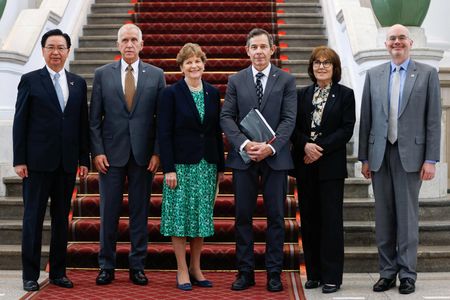
A delegation of American senators traveled to Taiwan’s capital this week, pressing the island nation’s leaders to move forward with a massive $40 billion defense spending package that has been stuck in legislative gridlock.
The lawmakers cautioned that continued delays in approving President Lai Ching-te’s military budget proposal could weaken Taiwan’s capacity to defend itself against mounting Chinese military threats, even as the United States speeds up weapons deliveries and security assistance to the region.
Taiwan relies heavily on American military support and diplomatic backing, making the U.S. its primary international ally despite the absence of official diplomatic relations. Beijing maintains its claim over Taiwan, which the island continues to reject.
The proposed defense spending increase remains blocked in Taiwan’s legislature, where opposition parties hold majority control.
Republican Senator John Curtis led the four-member congressional delegation that arrived Monday, continuing his longstanding support for Taiwan. The visit occurs amid escalating Chinese military and political campaigns aimed at forcing the democratic island to submit to Beijing’s control.
Speaking to media at Taiwan’s presidential office following his meeting with President Lai, Curtis emphasized American solidarity with the island nation.
“We’re here to enforce that message and demonstrate to the people here in Taiwan that we are together a very important part of the safety and the unity around this world,” Curtis stated.
The senator directly advocated for the defense budget’s passage, telling reporters: “I’d like to personally endorse the special defence budget and tell you back in Washington, D.C., that my colleagues are watching, that this is important. We want to make sure that as we invest in this part of the world, that you are also investing and that we’re in this together.”
While Taiwan’s opposition-led parliament continues debating the spending proposal, lawmakers have already given approval for the government to finalize American weapons deals totaling approximately $9 billion across four separate arms packages, even before the broader budget receives final approval.
The meeting included Raymond Greene, America’s top diplomatic representative in Taiwan, and Joseph Wu, Taiwan’s National Security Council Secretary-General. Washington has thrown its weight behind Lai’s military modernization efforts as part of broader American policy encouraging allies to increase their defense investments.
Democratic Senator Jeanne Shaheen, who serves as the ranking member on the Senate Foreign Relations Committee, expressed alarm over Beijing’s increasingly aggressive posture toward Taiwan.
“We are concerned by the increased pressure from Beijing, including military activity around Taiwan that raises the risk of miscalculation,” Shaheen said.
Chinese military and political pressure campaigns against Taiwan have intensified significantly, including conducting military exercises near the island. The most recent war games occurred in December, shortly after Washington greenlit an $11 billion weapons sale to Taiwan.
According to previous Reuters reporting, American officials are currently preparing another substantial arms package for Taiwan valued at approximately $14 billion.
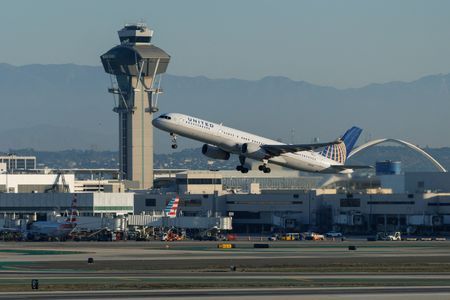
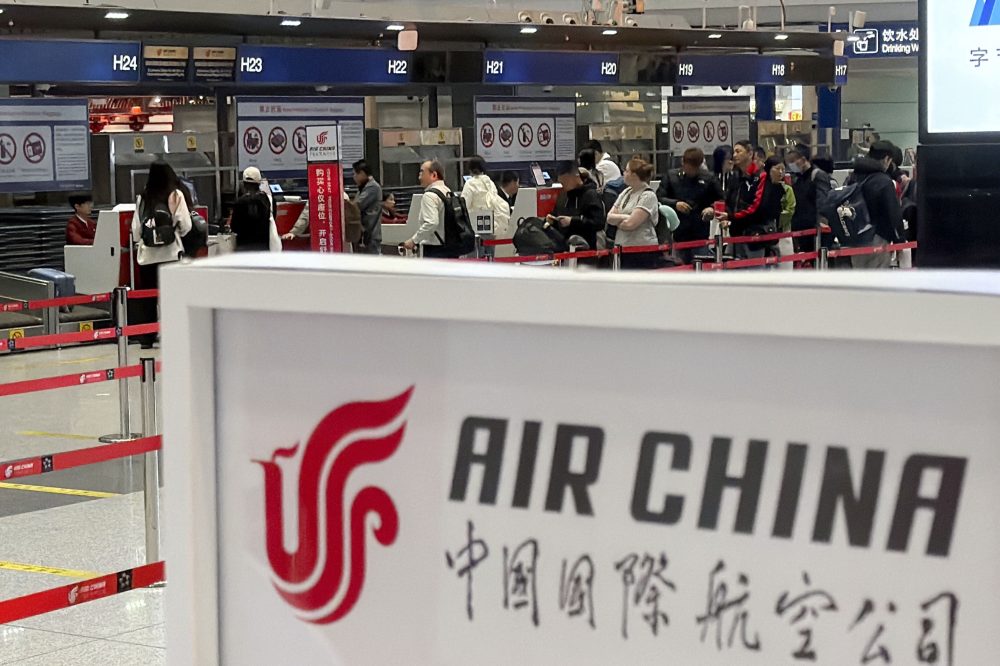
Airlines across the globe are implementing significant ticket price increases and route reductions as they struggle to manage skyrocketing jet fuel expenses, raising concerns about whether travelers will continue flying as transportation costs surge.
The aviation industry had projected unprecedented earnings of $41 billion by 2026 before the U.S.-Israeli tensions with Iran escalated last month. However, jet fuel prices have now doubled, forcing airlines to completely reassess their route networks and business approaches.
Major carriers including United Airlines, Air New Zealand, and Scandinavian airline SAS have all announced service cuts and price hikes, with several implementing additional fuel surcharges for passengers.
Rigas Doganis, former head of Greece’s Olympic Airways and ex-director of Britain’s easyJet, described the situation as dire. “Airlines face an existential challenge,” Doganis explained. “They will need to cut fares to stimulate weakening demand while higher fuel costs will be pushing them to increase fares. A perfect storm,” added Doganis, who currently leads the London-based Airline Management Group consultancy.
The aviation sector experienced unprecedented passenger volumes last year, with global travel rebounding to approximately 9% beyond pre-pandemic numbers despite ongoing supply chain disruptions affecting aircraft deliveries.
Strong post-pandemic travel appetite combined with supply chain constraints had limited capacity expansion, allowing airlines substantial control over pricing as they achieved higher seat occupancy rates.
However, the magnitude of fare increases required to offset current fuel price spikes presents enormous challenges, particularly as consumers face mounting pressure from elevated gasoline costs that may reduce discretionary spending.
Andrew Lobbenberg, Barclays’ European transport equity research director, emphasized capacity reduction as the key strategy. “The only way to get prices up is to reduce capacity,” Lobbenberg stated. “That is what I would expect to see happen this time, and it’s what we saw in the previous occasions when we had other crises; people just have to start trimming capacity.”
United Airlines CEO Scott Kirby informed ABC News recently that ticket prices would require a 20% increase for the carrier to manage elevated fuel expenses.
Hong Kong’s Cathay Pacific Airways has implemented fuel surcharge increases twice within the past month. Starting Wednesday, passengers traveling round-trip from Sydney to London will pay an additional $800 fuel surcharge. Prior to the Iranian conflict, standard economy round-trip tickets for this route typically cost around A$2,000 ($1,369.60).
Budget airlines may face the greatest challenges since their customer base tends to be more cost-conscious compared to business travelers and affluent passengers increasingly targeted by premium carriers like Delta Air Lines and United Airlines, according to industry analysts.
Nathan Gee, Bank of America’s Asia-Pacific transport research head, noted potential travel pattern shifts. “I think for the more price-sensitive travellers, even the short-haul flying trip gets downgraded, potentially to rail or to bus or other alternatives,” Gee observed.
This Middle Eastern conflict represents the fourth oil crisis impacting airlines since 2000, though it marks the first instance where carriers such as Vietnam Airlines have voiced concerns about physically obtaining fuel supplies due to Strait of Hormuz restrictions.
Previous oil shocks occurred during 2007-2008 before the global financial downturn reduced demand, following the Arab Spring around 2011, and after Russia’s invasion of Ukraine in 2022.
Airline consolidation between 2008 and 2014, including mergers like Delta-Northwest and American Airlines-US Airways, reduced eight major U.S. carriers to four and introduced stricter capacity management practices. Meanwhile, budget airlines such as Ryanair and India’s IndiGo maintained low operational costs through single-aircraft fleets and rapid turnaround times.
While upgrading to newer, more fuel-efficient aircraft represents an obvious cost-reduction strategy, severe post-pandemic supply chain shortages and new-generation engine problems have caused delivery delays.
Although U.S. ultra-low-cost carriers operate some of the industry’s newest and most efficient aircraft, declining travel demand could make financing these planes a profitability obstacle.
Dan Taylor, consulting director at aviation advisory firm IBA, predicted the current oil crisis would increase disparities between financially stable and struggling airlines.
Taylor noted on his firm’s website that “Carriers with robust balance sheets, strong pricing power, and reliable access to capital are better positioned to absorb ongoing pressures.” He added, “In contrast, airlines with low profitability and limited funding options may face increasing financial stress.”
Mining giant Rio Tinto announced Monday that three of its four iron ore shipping facilities in Australia’s Pilbara region have returned to normal operations following disruptions caused by Tropical Cyclone Narelle in Western Australia.
The powerful storm brought torrential rains and widespread power failures to Australia’s northeastern coastline earlier this month, forcing the mining company to temporarily close two bauxite operations. The cyclone also led South32 to halt activities at its Gemco manganese facility, which is jointly operated with Anglo American.
When Narelle struck Australia’s northwestern shores last week, it forced the closure of shipping ports throughout the mineral-rich Pilbara area.
The world’s top iron ore producer confirmed that cargo loading operations restarted at three facilities on March 28, after ports were forced to close on March 24.
The company expects its fourth terminal, Cape Lambert A, which is currently being repaired, to return to shipping operations “in the coming days,” according to Rio Tinto officials.
Rio Tinto estimates that two tropical storms in February and March have impacted approximately eight million metric tons of iron ore shipments. However, the company stated it has “identified a pathway to recover around half of these losses.”
Despite the weather-related setbacks, Rio Tinto maintained its 2026 shipping projections for Pilbara iron ore at between 323 million and 338 million tons.
The ongoing conflict between Iran and Israel is threatening one of the most profitable markets for luxury automakers, putting a damper on sales of high-end vehicles that can cost millions of dollars.
Just weeks before the war erupted on February 28, Rolls-Royce had unveiled its custom Phantom Arabesque model in Dubai, featuring intricate laser engravings inspired by Arabian design and matching wooden interior details. The luxury vehicle was created specifically for a Dubai client and showcased at the brand’s newly opened second showroom in the city.
The Middle East represents less than one-tenth of total sales volume for most premium car manufacturers, but the region delivers profits that far exceed its size due to wealthy customers who pay premium prices for customized features.
While a basic Rolls-Royce Phantom carries a price tag of approximately $572,416, Gulf buyers often request personalized modifications that can double or even triple that amount.
“It’s the best market in the world,” Bentley’s CEO Frank-Steffen Walliser commented about the Middle East earlier this month.
However, the outbreak of hostilities forced many luxury car dealerships across the Gulf to temporarily shut down. Both Ferrari and Maserati suspended vehicle deliveries during the initial weeks of conflict, though both companies report their showrooms have since resumed operations.
Rolls-Royce, which is owned by BMW, stated in an email that the company is “closely monitoring” developments in the Middle East region.
“Given the fluidity of the situation, it would be premature to speculate on longer-term impacts,” the automaker responded.
F1rst Motors in Dubai, which carries all major luxury automotive brands, closed temporarily when the conflict began but has since reopened its doors. The dealership specializes in Ferraris and Bugattis, with inventory ranging from $250,000 vehicles up to $14 million supercars.
Director Chris Bull reports that business has declined roughly 30% since reopening, though sales of vehicles exceeding $1.4 million have stabilized and international sales outside the UAE remain strong.
“Obviously, there are fewer people walking in the front door … But we’re still managing to maintain a good level of business,” Bull explained, noting that some customers will spend up to $34,512 just to have a $7 million vehicle transported out of the country.
Multiple luxury brands including Lamborghini, Ferrari, Jaguar Land Rover, and Porsche are monitoring the situation closely, hoping for a quick resolution to the conflict.
“It’s very high margin,” Volkswagen CEO Oliver Blume said regarding Middle Eastern sales during a recent media briefing, adding about the Iran conflict: “We will see an impact there for sure.”
While most luxury manufacturers don’t publish regional profit breakdowns, Ferrari disclosed that Middle East sales comprised 4.6% of its total volume last year, surpassing its China sales and up from 3.5% in 2024. A Ferrari representative said regional sales remain stable currently.
The Middle East market is characterized by exclusive limited editions that command substantial premiums for special features like exotic wood trim, mother-of-pearl accents, or gold leaf finishing.
Last year, Jaguar Land Rover sold 20 special “Sadaf” edition Range Rover Sport SV models for about $440,000 each – roughly triple the standard UK price.
Andy Palmer, former CEO of Aston Martin, recalled that during his leadership, the company would immediately contact Middle Eastern collectors when offering high-profit special editions.
“You almost didn’t need to ask,” Palmer told reporters.
Industry executives say this lucrative custom vehicle business in the region has essentially stopped.
“People in the Middle East have other thoughts than looking for a new Bentley at the moment,” CEO Walliser observed.
The Middle East disruption comes as luxury automakers face challenges across multiple markets. US sales have been affected by tariff uncertainties, while demand has dropped significantly in China and Europe, leaving few growth opportunities and forcing some manufacturers to consider production cuts.
Bentley’s sales dropped 5% last year even before the Iran conflict began, though CFO Axel Dewitz told media this month that production cuts aren’t currently necessary.
“However, if the current crisis endures for a couple of weeks, I think we would need to revisit the situation,” he stated.
Lamborghini CEO Stephan Winkelmann said this month his company has encountered numerous obstacles since the COVID-19 pandemic, noting that “there is no new American market out there that we can tap into to boost our sales volumes.”
Russian sales ended after Moscow’s 2022 invasion of Ukraine, the Chinese luxury market has “collapsed,” tariffs have affected the crucial US market, and now Middle Eastern business has stalled, he explained.
For former Aston Martin chief Palmer, the current situation is unprecedented.
“For a manufacturer of premium and luxury cars in particular, it’s an utter disaster.”
A major European artificial intelligence company has secured $830 million in financing to build critical infrastructure as the continent works to compete with American and Chinese technology leaders.
Mistral, a Paris-based AI firm, announced the debt financing deal that will fund the purchase of 13,800 specialized computer chips from Nvidia for a large-scale data center facility located near the French capital, according to company statements to Reuters.
The financing arrangement represents Mistral’s inaugural debt funding round and demonstrates increasing investor faith in European AI companies as they work to challenge established American technology corporations including Microsoft, Google, and Amazon in cloud computing and artificial intelligence services.
A group of seven financial institutions provided the funding, including major banks BNP Paribas, Crédit Agricole CIB, HSBC, and MUFG. The data processing facility in Bruyeres-le-Chatel is scheduled to begin operations during the second quarter of 2026.
The company chose this location for its inaugural data center in February 2025. Additionally, Mistral recently announced intentions for a second facility in Sweden and outlined goals to obtain 200 megawatts of processing capacity throughout Europe by late 2027.
“Scaling our infrastructure in Europe is critical to empower our customers and to ensure AI innovation and autonomy remain at the heart of Europe,” stated Chief Executive Arthur Mensch in comments provided to Reuters.
The French startup, which supplies AI technology to the nation’s military forces, has established itself as a European competitor to American AI industry leaders by providing both technological models and infrastructure services to government agencies and businesses seeking increased technological independence.
JUBA, South Sudan (AP) — According to legend, a South Sudanese spiritual leader brandished a mystical wooden staff during tribal warfare in 1878, calling forth lightning that killed enemy warriors.
This ceremonial object, called Ngundeng Bong’s dang, continues to hold legendary status as a supernatural weapon and now influences the ongoing bloodshed in the world’s newest country.
The wooden staff has become a disputed artifact in the conflict between South Sudan’s President Salva Kiir and opposition figure Riek Machar, who has possessed the relic for years. Machar’s supporters view him as the gap-toothed, left-handed leader prophesied by Ngundeng to eventually rule the nation.
This belief fuels Machar’s political campaign while simultaneously making him a target for adversaries. The two leaders represent different tribal communities — Kiir belongs to the Dinka, the nation’s dominant ethnic group, while Machar shares the Nuer heritage of the prophet Ngundeng.
Ethnic warfare erupted when the two politicians clashed in 2013. Kiir accused Machar of orchestrating a government overthrow attempt. Machar subsequently started an armed uprising that developed into a devastating civil conflict claiming approximately 400,000 lives. Following a 2018 ceasefire agreement that has since failed, Machar briefly returned as Kiir’s second-in-command.
Current hostilities have intensified to the point where officials are commanding citizens to flee rebel-controlled areas. This occurs despite Machar being confined to his residence and facing treason charges. Military footage recently showed a South Sudanese commander instructing government forces to “spare no lives.”
Various rebel groups, including the militia called the White Army, believe their fight serves to realize Ngundeng’s predictions and place Machar in the presidency.
Douglas H. Johnson, the British-American scholar who returned the staff to South Sudan, likens the relic’s significance to a parliamentary mace required for conducting official proceedings.
According to Johnson and other sources who discussed the matter with The Associated Press, Machar treats the staff as a spiritual artifact while using it to build political alliances.
“Much of this conflict connects to spiritual beliefs,” explained Mawal Marko, an independent researcher in Juba. “Many fighters, particularly eastern Nuer people, are battling in Ngundeng’s name.”
South Sudanese folklore contains numerous tales of brutality, and the Kiir-Machar rivalry represents the latest chapter in the tribal animosity that Ngundeng witnessed and attempted to end: Dinka fighting Nuer, Nuer fighting Dinka.
Ngundeng communicated his predictions through songs that people still listen to online today, seeking insights about their nation’s destiny. Interpretations of Ngundeng’s messages often vary.
“When examining prophecies over time, uncertainty always exists,” noted Christopher Tounsel, a historian specializing in greater Sudan at the University of Washington, discussing Ngundeng’s predictions.
“The most influential factor is people’s beliefs and emotions. That creates the greatest impact — not objective reality, but public perception.”
Ngundeng, who passed away in 1906, allegedly foretold his nation’s eventual independence. He envisioned future violence. Legend claims he prophesied about a messianic Nuer ruler for South Sudan who would lack traditional tribal facial scarification, be left-handed and gap-toothed, and have relationships with white women. Machar reportedly fits this description.
“We understand it possesses influence,” said Alex Miskin from the Rift Valley Institute research organization, referring to Ngundeng’s staff. “Whether Machar can channel authority through that object remains unknown to me.”
“Machar’s possession of the staff and its associated legend might intimidate some people,” Miskin observed.
The staff was carved from tamarind tree roots and adorned with copper wire. It measures approximately 110 centimeters (three and a half feet) in length. One section broke during the 1878 battle that the Nuer won. Subsequently, Ngundeng declared the staff damaged; no records exist of him wielding it successfully again.
Ngundeng’s son inherited the staff but was killed attempting to use it against colonial forces. Reports describe him weeping when he lifted the object and nothing occurred.
Taken as war spoils, the staff was thought permanently lost until Johnson, a respected South Sudan expert, found it in Bournemouth, England. He purchased the artifact and worked to return it to South Sudan, which lacked a proper museum.
In 2009, Machar received the staff in Juba, South Sudan’s capital, as the senior Nuer official in a government approaching independence from Sudan. A ceremonial white ox sacrifice accompanied the handover, with Machar photographed raising the staff overhead.
The staff’s homecoming was treated as a significant national occasion. Kiir acknowledged its arrival in an official statement cautioning against using the staff for warfare.
While serving as vice president, Machar stored the staff at his residence and displayed it to visiting Nuer dignitaries, Johnson reported. “He essentially used this as a cultural symbol, something meaningful to the Nuer rather than all of South Sudan, to recruit others into his political alliance,” he explained.
Johnson remembered the staff appearing unremarkable in an umbrella holder when he first encountered it. However, if Machar controls the staff, Kiir’s concern about it being “outside government oversight” would be understandable, he noted.
The Associated Press could not contact Machar for his perspective. His representative, Puok Both Baluang, stated that releasing Machar would be “equivalent to bringing peace.”
Despite his confinement, the 73-year-old Machar remains a powerful rival to Kiir, who has ruled without voter approval for 15 years. Officials promise elections in December. However, a vote excluding Machar that reinstalls Kiir would be viewed as denying Nuer people representation.
Their military competition started in the wilderness during the 1990s, when Machar commanded a splinter group that faced betrayal accusations during the extended independence war. During this division, Machar’s forces conducted a massacre targeting Dinka people, enraging Kiir and others.
Internal southern fighting temporarily weakened their independence movement and created permanent mistrust between Machar and Kiir. Machar maintained influence through Nuer fighter loyalty.
Kiir removed Machar from his deputy position in September after accusations that Machar remotely participated in an assault on government troops. Machar regularly appears in a courtroom cage during what he calls a politically motivated trial. Whether Ngundeng’s staff remains at his home is uncertain.
The staff “represents South Sudan’s heritage,” despite not being housed at Juba’s national archives building, said archivist Peter Tako.
“We understand it’s with Riek Machar,” Tako said about the staff. “I avoid discussing it.”
He described the staff as a sacred object “infused” with political power that made him feel unqualified to comment on it.
PRISTINA, Kosovo — Manager Kushtrim Ajvazi takes pride in working for a thriving enterprise in a nation ranked among Europe’s most economically disadvantaged. His company manufactures potato chips and snack foods distributed throughout Kosovo’s retail outlets and shipped internationally.
However, Ajvazi’s firm now confronts unexpected obstacles due to soaring fuel costs triggered by Iran’s ongoing conflict, with economic shockwaves reaching this small southeastern European nation.
The Pestova corporation operates nearly 100 acres of potato cultivation in Kosovo’s eastern region, supplying raw materials for their Vipa-branded chips. According to Ajvazi, both the company and its distribution channels suffered when fuel wholesale rates climbed from 1.10 euros ($1.27) to as much as 1.7 euros ($1.96) per liter.
Since Kosovo lacks domestic fuel production capabilities, diesel and gasoline pricing depends on importers operating under a 12% profit margin ceiling.
With spring potato planting season approaching, Ajvazi appealed to government officials for relief assistance.
The company requires substantial fuel quantities, making expenses “extremely high,” he explained. Fertilizer costs have also increased, though the company maintained stockpiles.
“We are analyzing and calculating every additional cost, and if we see that this process of rising costs continues, we will be forced to adjust our prices,” Ajvazi stated.
Unlike neighboring Balkan nations that have implemented farmer relief measures, Kosovo’s administration has yet to respond. Government officials did not answer inquiries.
Romania, Hungary and Serbia have established special agricultural diesel pricing or reduced state tax burdens.
Kosovo’s economic analysts cautioned that officials must urgently address potential further price increases to prevent broader economic harm.
“There is not one sector that is not affected by the price increase,” economist Safet Gerxhaliu observed.
Ajvazi noted his company encounters additional difficulties since approximately 40% of production goes to export markets under predetermined, fixed contracts requiring 90-day advance notice for price modifications. He emphasized the challenge of planning without price stability.
“We call on the government to ease this phase for us,” he said. “We are a company that exports to more than 23 different countries, including those in Europe.”
Rising costs have also impacted regular citizens. IT worker Bardh Mehmeti from Pristina now spends 100 euros ($115) to fill his vehicle’s tank, compared to 80 euros ($92) before the crisis began. Mehmeti is now “seriously considering” purchasing an electric vehicle.
Kosovo’s economy has faced ongoing challenges since declaring independence from Serbia in 2008 after armed conflict. Serbia refuses to acknowledge the separation, and this unresolved dispute has hindered both nations’ European Union membership aspirations.
A lengthy political crisis that left Kosovo without full government functionality for most of last year has further complicated the economic landscape. Prime Minister Albin Kurti’s current administration remains deadlocked over presidential election failures.
The primary opposition Democratic Party has denounced perceived government inactivity and advocated for temporary tax reductions to support citizens and businesses.
MELBOURNE, Australia — A seven-month manhunt in Australia has ended with police fatally shooting a man they believe killed two officers and critically injured another in a remote forest area.
The suspect, identified as 56-year-old Dezi Freeman, had evaded capture since allegedly firing on law enforcement officers who arrived to execute a warrant at his residence near Porepunkah in Victoria state on August 26 of last year, according to Victoria’s Chief Commissioner of Police Mike Bush.
Authorities located and killed a man they believe to be Freeman on Monday in an isolated area close to Thologolong, approximately two hours by car north of where the original shooting occurred.
“We believe it is Freeman, but we have to go through a formal identification process,” Bush explained to media representatives in Melbourne. He noted that confirming the identity could require up to 48 hours using methods such as fingerprint analysis.
Elite tactical officers from the Special Operations Group engaged in a three-hour confrontation before the fatal shooting occurred. The individual had taken refuge in a structure resembling a shipping container and declined police attempts to negotiate his surrender, Bush reported.
“This was all about bringing this to a conclusion as safely as possible. Our ultimate goal was to arrest the person there … as peacefully as possible,” Bush stated.
The police commissioner expressed his strong conviction that the suspect possessed weapons, though he could not confirm whether the man fired upon officers during the final encounter.
Media reports indicated that Freeman held sovereign citizen ideologies and harbored animosity toward law enforcement. His wilderness survival expertise raised concerns among police that he could remain at large indefinitely in the outdoors.
The attack on three officers triggered an extensive search operation throughout Victoria’s densely wooded mountain territory. Recent months saw police considering the possibility that Freeman had committed suicide.
“We have to follow every avenue of inquiry and there was a lot to suggest that Freedman had taken his own life,” Bush noted.
The commissioner declined to reveal whether a tip from the public led to Monday’s discovery. Law enforcement had posted a reward of 1 million Australian dollars ($678,000) for information leading to Freeman’s capture.
Investigators continue examining whether additional individuals assisted the fugitive in avoiding apprehension.
President Donald Trump floated the possibility of U.S. military forces capturing Iran’s Kharg Island, the nation’s primary oil export facility located in the Persian Gulf.
During a Monday interview with the Financial Times, Trump stated, “Maybe we take Kharg Island, maybe we don’t. We have a lot of options.” He acknowledged that such an operation “would also mean we had to be there (on Kharg Island) for a while.”
The comments come as tensions escalate in the region, with Iran warning it would plant mines throughout the Persian Gulf if its territory faces invasion. Despite ongoing ceasefire discussions showing some promise, both American and Israeli forces continued their military operations against the Islamic Republic on Monday. Meanwhile, Iran launched an attack on a critical utilities facility in Kuwait as part of its broader offensive against Gulf Arab nations.
Trump also revealed that Iran had committed to permitting 20 oil tankers to pass through the Strait of Hormuz beginning Monday morning and continuing for several days “out of a sign of respect.”
“I would only say that we’re doing extremely well in that negotiation but you never know with Iran because we negotiate with them and then we always have to blow them up,” Trump remarked.
The ongoing conflict has created significant disruptions to worldwide energy markets, caused shortages in fertilizer supplies, and interfered with international aviation. Iran’s control over the crucial Strait of Hormuz shipping lane has created volatility in both commodity markets and pricing.
Additional developments include:
Iranian official Alaeddin Boroujerdi’s comments to state media followed longstanding calls from hardliners in Tehran for such action.
“Why should we accept the restrictions?” Boroujerdi questioned. “We are not seeking a nuclear weapon anyway. But it’s not like that we are supposed to observe the rules of the game and they bomb us.”
The Nuclear Nonproliferation Treaty represents a crucial international agreement designed to prevent nuclear weapons proliferation. Signatory nations commit to avoiding nuclear weapons development or acquisition while permitting International Atomic Energy Agency inspections to verify program compliance. Iran has limited IAEA access for years and blocked inspectors from visiting three uranium enrichment facilities targeted by U.S. strikes in June.
— Israeli forces announced Monday morning strikes against ‘military infrastructure’ throughout Tehran.
— Bahrain activated its missile warning systems twice during Monday.
— Early Monday, Israel’s military reported Iranian missile launches targeting the country, marking the day’s first such attack from Iran. Warning sirens activated near Israel’s primary nuclear research facility, an area repeatedly targeted in recent days.
DUBAI, United Arab Emirates (AP) — While diplomatic negotiations show potential progress, President Donald Trump has publicly considered capturing Iran’s Kharg Island oil facility in the Persian Gulf, even as military confrontations between the United States, Israel, and Iran continued Monday across the region. Iran responded by striking a critical utilities facility in Kuwait, continuing its campaign against Gulf Arab nations.
Despite Pakistan facilitating diplomatic efforts to end the conflict, Trump indicated Iran had agreed to permit 20 oil tankers passage through the Strait of Hormuz beginning Monday as “a sign of respect.” However, with 2,500 U.S. Marines currently deployed to the area and additional forces en route, the president floated the possibility of seizing Iran’s Kharg Island facility.
“Maybe we take Kharg Island, maybe we don’t,” Trump stated in a Financial Times interview released Monday morning. “We have a lot of options.”
Dawn brought air raid warnings near Israel’s primary nuclear research facility, an area facing repeated targeting in recent days. Israeli defense forces reported destroying two drones launched from Yemen, where Iranian-supported Houthi rebels joined the conflict Saturday with their initial missile strike.
Iran maintained its assault on neighboring Gulf Arab states, with Saudi Arabia intercepting five missiles aimed at its oil-producing Eastern Province, Bahrain activating missile warnings, and Dubai’s defense systems creating a fireball while destroying an incoming projectile.
Kuwait suffered casualties when an Iranian strike damaged a power and water treatment facility, resulting in one civilian death and 10 military personnel injuries, according to the state-run KUNA news agency.
Water treatment facilities remain vital for Gulf Arab nations’ water security, with Iran having previously damaged a similar facility in Bahrain during the ongoing conflict. These plants typically operate alongside power generation facilities due to the substantial energy requirements for converting seawater into drinking water.
Israeli forces conducted fresh strikes against Iran, targeting what they described as “military infrastructure” throughout Tehran. Iranian outlets reported damage to a Tabriz Petrochemical facility in the country’s northern region, though officials stated no dangerous materials were released.
In Lebanon, where Israeli ground operations are underway, an Indonesian peacekeeper died and three others sustained injuries when a projectile detonated near a southern village.
During the weekend, Israeli Prime Minister Benjamin Netanyahu announced plans to expand military operations, extending the “existing security strip” in southern Lebanon while pursuing the Iran-affiliated Hezbollah organization.
Iran’s assault on regional energy facilities and its control over the Strait of Hormuz, which handles one-fifth of global oil shipments during peacetime, has caused oil prices to surge and sparked fears of a worldwide energy shortage.
During early Monday trading, Brent crude oil prices reached approximately $115, representing nearly a 60% increase since U.S. and Israeli forces initiated the conflict with February 28 attacks on Iran.
With mounting pressure on Trump to resolve the crisis, American officials have presented Iran with a 15-point proposal requiring Iran to reopen the Strait of Hormuz for commercial shipping. Iran has countered with its own five-point framework, insisting on maintaining control over the strategic waterway.
Pakistan announced Sunday its intention to facilitate upcoming U.S.-Iran discussions, though neither Washington nor Tehran immediately confirmed the arrangement, and the format of potential talks regarding the month-long war remained unclear.
Pakistan’s Foreign Minister Ishaq Dar stated the negotiations would occur “in the coming days.”
Speaking to reporters on Air Force One Sunday evening, Trump confirmed the U.S. was engaging “directly and indirectly” with Iran, despite Iranian denials of any Washington communications.
“We’re doing extremely well in that negotiation but you never know with Iran because we negotiate with them and then we always have to blow them up,” Trump commented.
Iran’s parliament speaker, Mohammad Bagher Qalibaf, rejected the Pakistani talks as a diversion while additional U.S. forces deploy to the region. He declared Iranian forces were “waiting for the arrival of American troops on the ground to set them on fire and punish their regional partners forever,” state media reported.
In his Financial Times discussion, Trump acknowledged that capturing Kharg Island could require an extended American presence, noting “it would mean we had to be there for a while.”
“I don’t think they have any defense,” he continued. “We could take it very easily.”
U.S. forces have already conducted airstrikes targeting military positions on the island. Iran has warned it would launch ground invasions of Gulf Arab countries and deploy mines throughout the Persian Gulf if American troops land on Iranian soil.
Any amphibious assault on Kharg would require passage through the Strait of Hormuz and most of the Persian Gulf. Military analysts note that maintaining control of the island would present significant challenges, as Iran’s missiles, drones, and artillery from the mainland could easily reach the facility.
Lebanese officials report over 1,200 deaths and more than 1 million displaced residents. Five Israeli soldiers have also perished.
Iranian authorities report more than 1,900 casualties, while Israel has confirmed 19 deaths.
In Iraq, where Iranian-supported militias have joined the fighting, 80 security force members have died.
Gulf states have reported 20 fatalities. Four deaths have occurred in the occupied West Bank.
Thirteen U.S. service members have lost their lives in the conflict.
Border warfare has resumed between Afghanistan and Pakistan, with both nations confirming intense military exchanges occurred over the weekend, just days following their agreement to temporarily halt combat operations.
The renewed hostilities took place on Sunday as Pakistan was simultaneously hosting regional leaders to discuss reducing tensions in Middle Eastern conflicts, with announcements that the country may facilitate upcoming diplomatic meetings between American and Iranian officials.
Military officials reported that both countries deployed artillery and heavy armaments, striking targets across Afghanistan’s Kunar province and Pakistan’s adjacent Bajur district.
According to Hamdullah Fitrat, deputy spokesperson for the Taliban government in Kabul, Pakistani bombardment resulted in one fatality and wounded 16 additional people, with women and children comprising the majority of casualties.
Pakistani security sources, speaking anonymously due to lack of authorization for media statements, maintained their forces only retaliated against intense Afghan shelling and avoided targeting civilian areas. Pakistan’s military command did not provide official comment when contacted.
The neighboring countries experienced their most severe military confrontation in years during the previous month, resulting in substantial casualties for both sides.
Taliban officials claimed Pakistani airstrikes against a drug treatment facility in Afghanistan’s capital killed over 400 individuals earlier this month, prior to the suspension of fighting.
Pakistani authorities disputed the Taliban’s account of the airstrike, stating they had “precisely targeted military installations and terrorist support infrastructure.”
A temporary halt to combat operations had been declared during the Islamic celebration of Eid al-Fitr, following requests from Turkey, Qatar, and Saudi Arabia, which Pakistan concluded the previous week.
Kabul has not yet provided official confirmation regarding whether they continue to observe the ceasefire arrangement.
Pakistan maintains that Afghanistan’s Taliban government provides sanctuary and assistance to Islamic extremist groups conducting attacks within Pakistani territory. The Taliban administration rejects these allegations, asserting that militant activity represents Pakistan’s internal security challenge.
SYDNEY – Australian Prime Minister Anthony Albanese expressed concerns Monday about the lack of clear direction from President Donald Trump regarding the current military conflict with Iran.
“I want to see more certainty in what the objectives of the war are and I want to see a de-escalation,” Albanese stated when asked about his assessment of Trump’s approach to the conflict.
The conflict began after an Israeli military operation on February 28 resulted in the death of Iran’s Supreme Leader Ayatollah Ali Khamenei, leading to his son Mojtaba taking over the leadership role.
The military action has expanded throughout the Middle East region, resulting in thousands of casualties and creating unprecedented disruptions to global energy markets, significantly impacting the worldwide economy.
Australia has contributed military aircraft to support defensive operations in the United Arab Emirates following a formal request from that nation, though Australian officials have declined to deploy naval vessels to help restore access through the Strait of Hormuz.
A Finnish quantum computing company has landed a major investment from BlackRock as it prepares for its debut on American stock exchanges.
IQM Quantum Computers announced it has received 50 million euros, equivalent to $57.64 million, in venture capital funding from accounts managed by the investment management giant. The Helsinki-based firm told Reuters the capital will fuel its worldwide expansion efforts.
The quantum computing company previously announced in February its intention to go public through a merger with Real Asset Acquisition Corp, a special purpose acquisition company. The deal would create a dual listing on both U.S. and Helsinki exchanges, with an estimated initial value of approximately $1.8 billion.
BlackRock highlighted the significance of the investment sector in a Thursday social media statement, describing quantum computing as representing the “next era of computing.”
Company CEO Jan Goetz explained that the fresh capital, officially announced Monday, will support scaling operations, speeding up chip development and technology advancement, and reinforcing the company’s competitive position.
“It’s basically a question of ramping up the commercial traction to bring us to profitability,” Goetz told Reuters.
The quantum computer manufacturer and cloud computing service provider nearly doubled its revenue to approximately $35 million in the previous year. The company reported having secured bookings valued at over $100 million by year-end.
Goetz noted untapped potential in hardware sales, stating: “What we also yet haven’t fully tapped into is the whole field of private data centres.”
He emphasized the strategic importance of the technology, adding: “Quantum is at the core of the tech strategies of nations around the world.”
Tony Kim, who leads BlackRock’s global technology team within the Fundamental Equities division of the Portfolio Management Group, explained the distinction between quantum computing and artificial intelligence in a video statement.
“AI reasons from data. Quantum reasons from physics. Together though, they could reshape what is computationally possible,” Kim said.
Iranian judicial authorities have carried out the executions of two individuals who were found guilty of maintaining ties to the People’s Mojahedin Organisation of Iran opposition movement, according to reports from the country’s judiciary news service on Monday.
The two men were also convicted of planning armed assaults in Tehran utilizing makeshift launching equipment, the judicial outlet reported.
Officials did not release information regarding the timing of the men’s arrests or other details surrounding their cases.
Beijing announced sanctions Monday against Keiji Furuya, a Japanese legislator who serves as a key advisor to Prime Minister Sanae Takaichi, citing his connections to Taiwan independence movements.
The Chinese foreign ministry declared that Furuya will be prohibited from entering China and any property or financial holdings he maintains in the country will be frozen with immediate effect.
As chairman of a bipartisan Japanese-Taiwanese legislative alliance, Furuya has made numerous trips to Taiwan while accompanying Japanese government officials. His most recent visit occurred earlier in March when he met with Taiwan’s President Lai Ching-te in the capital city of Taipei.
Beijing’s foreign ministry criticized Furuya for working with what they termed “separatist forces” in Taiwan, claiming he continued making these visits “in defiance of China’s strong opposition.”
China considers Taiwan, which operates as a democratic government, to be part of Chinese territory and opposes diplomatic visits by international officials to the island, viewing such actions as violations of the “One China” policy and challenges to Beijing’s territorial claims.
Taiwan’s leadership disputes Beijing’s assertions of sovereignty over the island.
The ministry declared that Furuya’s activities “constitute gross interference in China’s internal affairs, and seriously undermine China’s sovereignty and territorial integrity.”
When questioned by journalists at Japan’s legislative building, Furuya defended his Taiwan visits as routine responsibilities of the parliamentary organization he chairs. He noted that he has not traveled to mainland China in many years and maintains no financial interests there, according to Kyodo news service.
Furuya played a significant role as a trusted advisor to Prime Minister Takaichi, backing her campaign for leadership of the governing Liberal Democratic Party in the previous year.
Relations between Tokyo and Beijing have grown increasingly strained since Takaichi stated in November that Japan might respond militarily if China were to attack Taiwan.
Beijing previously imposed sanctions on another Japanese legislator, Seki Hei, who was born in China, for his public statements regarding Taiwan and related matters.
The athletic footwear and apparel giant Nike is facing significant challenges in the Chinese market, where operational mistakes and intensifying competition from domestic brands are exposing fundamental weaknesses in the company’s business strategy.
China represents approximately 15% of Nike’s worldwide sales and serves as the company’s second-most important market after North America. However, an economic downturn and ongoing real estate difficulties are constraining Chinese consumers’ purchasing ability, making a recovery increasingly challenging.
Meanwhile, Nike is being outpaced by rapidly expanding Chinese competitors Anta and Li Ning, which have leveraged flexible supply chains and extensive retail networks to distribute affordable products throughout China’s interior regions.
The financial impact is becoming evident: Nike has recorded declining sales in China for six consecutive quarters. Following a 17% decrease in the most recent quarter announced in December, CEO Elliott Hill characterized China as the “longest road” in the company’s worldwide recovery efforts, acknowledging the necessity to “reset” their strategy.
Earlier this year, the athletic brand named 25-year company veteran Cathy Sparks as Vice President and General Manager of Greater China, replacing longtime executive Angela Dong. Sparks has been tasked with strengthening retail partnerships, eliminating outdated inventory, and accelerating digital initiatives.
Industry experts suggest the challenges extend beyond simple resistance to international brands. They identify declining premium status, slow inventory control, and operational shortcomings that have allowed Nike to fall behind more agile domestic competitors.
“The global brands that are struggling in China – Nike, Starbucks, Häagen-Dazs – are not losing ground just because Chinese consumers don’t want to buy foreign brands,” explained Yaling Jiang, founder of research and strategy consultancy ApertureChina. “They are struggling because they are selling at a premium without giving people a good reason why they should pay a premium for their products.”
Nike chose not to provide comments as it prepares for Tuesday’s third-quarter financial results. Market analysts anticipate the company’s profit margins will shrink for the sixth straight quarter, while overall sales are projected to drop 0.3%, based on LSEG data.
Additional uncertainty stems from Middle Eastern conflicts, as companies prepare for increased material expenses due to rising oil prices.
Nike’s struggles contrast sharply with several international competitors that have maintained growth in China. Brands like On and Hoka have achieved strong double-digit increases by taking advantage of growing sports participation, especially running.
Even longtime competitor Adidas has mounted a successful recovery. After experiencing five consecutive quarters of decline in China during 2023, Adidas returned to positive growth and by 2025 had achieved ten straight quarters of expansion.
This turnaround resulted from increased local emphasis, featuring accelerated product development cycles and designs created specifically for Chinese consumers’ preference for innovation. Products designed locally now comprise approximately 60% of Adidas’ China offerings, compared to only 10% before this strategic change.
“Adidas is really trying to change the fit of the apparel, change the model of the sneaker, trying to respect our culture. But Nike is just changing the pattern, colour palette, or graphic – it’s not deep enough,” commented one concept store owner and Nike wholesale partner, who requested anonymity to speak candidly about the brand.
“As a big Nike fan, I don’t want to say Adidas is doing a better job than Nike, but I think sometimes you have to learn from your competitor.”
Structural problems have worsened Nike’s brand difficulties, according to two former and one current Nike China employees who spoke anonymously. A hierarchical decision-making approach reduced responsiveness to local market needs, while repeated attempts to promote unsuccessful products to retail partners increased inventory problems during a period of declining consumer spending.
Regular price reductions to eliminate surplus inventory damaged Nike’s brand reputation and wholesale relationships, they noted.
Morningstar analyst David Swartz believes Adidas’ recovery demonstrates that Nike can also rebound in China. “It doesn’t have to be a death spiral,” he stated.
Wei Kan, founder of consultancy Conduit Asia and former brand director at Nike Greater China, indicated that recent marketing efforts suggest the company is starting to adapt. He referenced a Chinese New Year advertising campaign that resonated with consumers by incorporating local humor.
“When everything is booming, the ‘Just Do It’ message fits with the mood, but the past few years, it hasn’t been a good fit for how people in China are feeling.”
Scottie Barnes delivered 23 points and a career-best 15 assists for his second straight double-double performance as the Toronto Raptors demolished the Orlando Magic 139-87 on Sunday in a historic blowout.
The crushing 52-point defeat marked the worst loss in Magic franchise history, surpassing their previous low of a 47-point defeat to Chicago in 2017. Toronto seized control early with an incredible 31-0 scoring streak during the first half, then added insult to injury with a 17-0 run spanning the end of the third quarter into the fourth period.
The devastating three-minute burst expanded Toronto’s commanding 38-point advantage to an insurmountable 55-point margin. Orlando briefly showed signs of life in the final quarter with a 15-4 surge that cut the deficit to 45 points with 4:26 left on the clock. However, a Moritz Wagner three-pointer capped that run and represented the Magic’s final points of the game.
RJ Barrett topped all scorers with 24 points while leading eight Toronto players who reached double digits. Jamal Shead contributed 12 points and 10 assists, with Ja’Kobe Walter and Jakob Poetlt each adding 11 points. For Orlando, Desmond Bane paced the scoring with 17 points, Jalen Suggs managed 13 points and five assists, and Tristan da Silva chipped in 12 points. Star player Paolo Banchero, the team’s leading scorer, was held to just nine points.
In other NBA action, Shai Gilgeous-Alexander’s 30 points powered Oklahoma City past New York 110-100 at home. The Thunder extended their hot streak to 14 wins in 15 games, building a 2.5-game cushion over San Antonio atop the Western Conference standings. Jalen Williams contributed 22 points on efficient 7-of-11 shooting in his most extensive action since returning from a hamstring injury. Jalen Brunson led the Knicks with 32 points, while Josh Hart, Karl-Anthony Towns and Mikal Bridges each scored 15. Towns also grabbed 18 rebounds in the loss that snapped New York’s seven-game winning streak.
The Los Angeles Clippers defeated Milwaukee 127-113 behind Bennedict Mathurin’s 28 points and John Collins’ 22-point effort. Kawhi Leonard added 20 points and eight rebounds while Darius Garland posted a double-double with 15 points and 11 assists as Los Angeles won its fifth consecutive game. The struggling Bucks dropped their fourth straight contest and 14th in 17 games despite Gary Trent Jr.’s game-high 36 points and Taurean Prince’s 18 points, eight assists and six rebounds. Milwaukee played without key players Giannis Antetokounmpo, Kyle Kuzma, Kevin Porter Jr. and Gary Harris.
Jayson Tatum’s 32 points, five rebounds and eight assists led short-handed Boston to a 114-99 road victory over Charlotte, extending the Celtics’ winning streak to three games. Payton Pritchard added 28 points, six rebounds and six assists with Jaylen Brown and Derrick White sidelined. Neemias Queta contributed 17 points and eight rebounds. The Hornets struggled from long range, connecting on just 12 of 43 three-point attempts (27.9%), with Kon Knueppel particularly cold at 1-for-6 from beyond the arc. LaMelo Ball led Charlotte with 19 points and Miles Bridges scored 14.
Pascal Siakam dominated with 30 points, 11 rebounds and six assists as Indiana topped visiting Miami 135-118. Micah Potter knocked down five three-pointers for 21 points, Kobe Brown added 18 and Andrew Nembhard tallied 15 points and 10 assists for the Pacers, who earned their first home victory since January 31. T.J. McConnell contributed 15 points and nine assists while Obi Toppin finished with 12. Tyler Herro paced Miami with 31 points, followed by Jaime Jaquez Jr.’s 17. Bam Adebayo recorded 15 points and 12 rebounds for the Heat, who lost their seventh game in eight attempts.
Portland crushed visiting Washington 123-88 as Toumani Camara scored 23 points with seven rebounds and Scoot Henderson added 21 points and seven assists. Former Wizards player Deni Avdija contributed 20 points, seven rebounds and five assists as the Trail Blazers never trailed while winning their sixth game in eight contests. Portland now sits just 1.5 games behind the eighth-place Los Angeles Clippers in Western Conference play-in positioning. Will Riley led Washington with 14 points off the bench as the Wizards suffered their 18th loss in 19 games. Bub Carrington scored 11 points before exiting in the final quarter with muscle cramps.
Alperen Sengun posted 36 points and 13 rebounds while adding seven assists, three steals, three blocks and five three-pointers in Houston’s 134-102 victory over host New Orleans. Jabari Smith Jr. and Kevin Durant each scored 20 points as the Rockets extended their lead over Phoenix to four games for the No. 6 Western Conference seed. Clint Capela grabbed 14 rebounds in just 16 minutes off the bench. Dejounte Murray led New Orleans with 19 points as the Pelicans (25-51) dropped their fifth straight game. Saddiq Bey and Zion Williamson each contributed 18 points.
Brooklyn snapped a 10-game losing streak with a 116-99 victory over Sacramento in New York, getting 17 fourth-quarter points from Ochai Agbaji and rookie Drake Powell. The Nets took control early and never relinquished their lead, building a 27-point advantage midway through the second quarter for their first win since March 9. Agbaji finished with 18 points and Powell scored 16, while rookie Nolan Traore added 17 points and six assists. The victory marked just Brooklyn’s third win in 23 games. Sacramento extended their road struggles against Eastern Conference teams to 11 straight losses while playing without DeMar DeRozan (hamstring) and Malik Monk (bruised shoulder). Devin Carter paced the Kings with 20 points, rookie Nique Clifford contributed 17 points and seven rebounds, and Precious Achiuwa chipped in 16 points and eight boards.
Economic forecasters predict South Korea will experience its most robust export growth in nearly half a decade during March, with shipments overseas expected to climb 44.9% compared to the same period last year, according to a new Reuters survey of economists.
The projected increase would surpass February’s already strong 28.7% growth rate and represent the most significant export expansion since May 2021. If realized, this would extend South Korea’s streak of year-over-year export gains to ten consecutive months.
The driving force behind this economic surge appears to be unprecedented demand for semiconductor technology, particularly memory chips used in artificial intelligence applications. Hana Securities economist Chun Kyu-yeon noted the trend, stating: “Semiconductor prices are continuing to rise sharply on robust demand for memory chips.” Chun anticipates this year’s trade surpluses could reach unprecedented levels.
Data from the first three weeks of March supports these optimistic projections, showing exports jumped 50.4% during that period. Semiconductor sales alone skyrocketed 163.9%, while shipments to major trading partners showed remarkable growth: the United States saw increases of 57.8%, China experienced 69.0% growth, and European Union exports rose 6.6%.
However, geopolitical tensions in the Middle East are creating economic headwinds through elevated energy costs. iM Securities economist Park Sang-hyun warned of these challenges, explaining: “However, due to the impact of high oil prices, import growth will also be higher than previously projected. It is expected that there will be some disruption to shipments to the Middle East.”
The survey indicates imports are forecast to increase 18.0% in March compared to the previous year, a significant acceleration from February’s 7.5% growth. This would represent the largest import surge since September 2022.
Economists project South Korea’s monthly trade surplus will reach $21.2 billion, expanding from the previous month’s $15.4 billion figure and potentially setting a new record high.
The economic momentum is also affecting domestic prices, with consumer inflation expected to accelerate to 2.4% in March, up from February’s 2.0% rate and marking the fastest pace in four months.
South Korea’s government plans to release official March trade statistics on Wednesday, April 1, at 9 a.m. local time.
BUDAPEST, Hungary (AP) — Young volunteers in their mid-twenties knocked on doors throughout a Hungarian town last week, backing a political movement that could potentially topple Prime Minister Viktor Orbán’s decade-and-a-half hold on leadership.
These volunteers from Hungary’s Lake Balaton area were working for the center-right Tisza party and its candidate, Péter Magyar, as they sought to advance beyond what they called Orbán’s failing governance.
“Our entire lives have been spent under this administration, and we’re curious to experience what lies beyond it,” explained Florián Végh, a 25-year-old university student. “Speaking for my classmates and peers, I can confidently say this administration is completely broken.”
An expanding age-based political divide shows Hungary’s younger generation strongly demanding an end to Orbán’s authoritarian leadership, while elderly voters continue supporting the prime minister — a division that may prove crucial in the April 12 elections.
The 62-year-old Orbán currently lags in polling behind Magyar, a 45-year-old attorney who departed from Orbán’s nationalist-populist Fidesz party following a political controversy in 2024. Magyar has guided Tisza through remarkable political growth, energizing voters who had stayed away from politics for roughly twenty years.
Fidesz’s weakening support amid economic slowdown and various political and corruption controversies has expanded the age-related political gap. Recent polling from 21 Research Center revealed that 65% of voters under 30 favor Tisza, compared to just 14% supporting Orbán.
Levente Koltai, a 24-year-old student volunteering for Tisza, noted that Fidesz originally stood for “Alliance of Young Democrats” in Hungarian. However, he argues the party has abandoned those founding principles.
“Fidesz has abandoned its claims to being young, democratic and unified,” he explained to The Associated Press. “It has transformed from youthful to aged, from democratic to authoritarian-leaning, and from a coalition to an inner circle of loyalists.”
Andrea Szabó, a senior researcher at Eötvös Loránd University’s Institute for Political Science in Budapest, described an emerging leadership transition in Hungary, where “a fresh, engaged political generation is starting to emerge.”
While Orbán’s political cohort was shaped by opposition to Hungary’s Soviet-era communist government during the 1980s and 1990s, “we’ve now arrived at a moment where, after 25 years, there exists a new political generation opposed to the Orbán administration,” Szabó explained.
Orbán’s administration characterizes itself as both Christian-national and “illiberal,” and has moved away from European Union partnerships while strengthening ties with Russia and China.
Critics have long alleged that Orbán has captured Hungary’s institutions, restricted media independence and overseen widespread political corruption — allegations he rejects — and he has emerged as a prominent figure in the international far-right movement.
Supporters praise his stance against immigration and restrictions on LGBTQ+ rights, and celebrate benefits for young families including tax exemptions for mothers with multiple children and government-supported loans for first-time home purchasers.
These policies, along with additional pension benefits for seniors, attract many older voters. Fidesz maintains a 50% to 19% advantage over Tisza among retirement-age Hungarians, according to 21 Research Center polling.
Zsuzsanna Prépos, a retiree attending one of Orbán’s recent campaign events, expressed satisfaction with the government’s pension programs, stating she supports Fidesz because it “assists young people.”
“During my youth… I received nothing. Today’s young people receive substantial assistance,” she stated.
However, these programs haven’t generated youth support for Orbán. In multiple recent addresses, he has both criticized young people for their anti-government positions and appealed for their reconsideration.
“Young people, wake up!” he declared at a rally last week. “These are not times for taking risks, experimenting or trying new things… Believe me, today only Fidesz and my humble self can provide this country with security.”
Szabó, the researcher, noted that while many young people appreciate Orbán’s family assistance programs, their “very strong sense of justice” conflicts with “the authoritarian exercise of power, the corruption, the fact that they feel vulnerable and that there is insecurity in the country.”
“Their lives essentially took place entirely within the Orbán regime, so they know nothing other than this kind of functioning of power,” she explained.
Recent developments in Hungary have turned significant numbers of young people against the governing party.
Hungary experienced major controversy in February 2024 when reports emerged that the president, a close Orbán supporter, had pardoned someone involved in a child sexual abuse case. This revelation stunned the nation, leading to resignations by both the president and justice minister.
Shortly afterward, several prominent social media influencers organized a protest calling for political change. Drawing tens of thousands of participants, it represented a pivotal moment that “opened the door to politicization for a lot of young people,” Szabó stated.
Following the pardon controversy, Magyar left Fidesz and established Tisza. Three months later, the party captured 30% of votes in European Parliament elections.
Magyar has centered his campaign on pledges to reverse Orbán’s alignment with Russia and restore Hungary’s Western partnerships, and to revitalize the struggling economy by recovering billions in EU funding currently withheld due to rule-of-law and corruption issues.
This economic platform has connected with young voters. Végh, the Tisza volunteer, explained that his internet-connected generation can easily access diverse information sources and travel to neighboring countries where governments effectively utilize public resources.
“In Austria, you observe a much more tranquil, peaceful, educated society with superior infrastructure and healthcare,” he noted. “You cross the border and realize you’ve entered a developed European nation.”
Despite Tisza’s polling advantage, victory remains uncertain. Orbán maintains support among older voters and throughout much of rural Hungary.
At a recent Budapest rally attracting over 100,000 attendees, Tisza supporter Dorina Csobán described how the electoral contest had become “pretty divisive in my family for the older people, because we younger people are saying clearly that there must be change.”
RIO DE JANEIRO (AP) — A 33-year-old Brazilian woman named Emily de Souza jumped at the chance to participate in an unusual program that would cut four days from her prison term simply by reading a book, allowing her to revive a beloved pastime.
Alongside thousands of other prisoners nationwide — including former President Jair Bolsonaro — she enrolled in a sentence reduction initiative that motivates incarcerated individuals to dive into literature in return for trimming up to 48 days annually from their prison terms.
The prospect of reuniting sooner with her 9-year-old autistic child, currently cared for by her mother and aunt, intensified her desire to join the program.
“One day is an eternity because it feels like it’s never going to end,” de Souza explained from the Djanira Dolores de Oliveira Women’s Prison in Rio de Janeiro, which holds roughly 820 female prisoners.
She described reading as “a kind of escape, to get out of this environment for a bit, to think about other things: other stories, other people, not just me.”
De Souza, like many of her fellow prisoners, was convicted on drug trafficking charges. She received a five-year sentence for distributing cannabis-infused Brazilian chocolate confections called “brigadeiro.” After arriving last November, she anticipates advancing to Brazil’s semi-open prison system by August, which would permit daytime release for employment.
Brazil, home to one of Latin America’s highest incarceration rates per capita, distinguishes itself by operating one of the world’s most structured and widespread sentence reduction programs through reading. This expanding initiative, initially regulated in 2012 and standardized nationally in 2021, gained fresh attention this year when the Supreme Court permitted Bolsonaro — currently serving 27 years for coup attempt charges — to participate.
Andréia Oliveira, who oversees female prisons and LGBTIQ+ programs in Rio state facilities, emphasized that providing reading opportunities and education benefits both former inmates and the broader community. “When we encourage education, ludic activities, knowledge, we return to society someone who can reconnect, respect rules,” she explained.
Literature professor Paulo Roberto Tonani has facilitated prison workshops since 2022, enabling Rio detainees to access this program.
The process begins with participants selecting or receiving a book during an introductory session. During subsequent meetings, they discuss their reading material and ultimately create either a written review or artwork demonstrating their understanding.
Prisoners have engaged with works including “Captain of the Sands” by celebrated Brazilian novelist Jorge Amado, “Crime and Punishment” by Fyodor Dostoevsky, and “The Color Purple” by Alice Walker.
According to Tonani, participants particularly embrace the illustrated story “Father Francisco” by Marina Miyazaki Araujo, which portrays an imprisoned father through his child’s viewpoint. Many Brazilian inmates come from impoverished backgrounds and lack completed elementary education.
During a late March workshop at the Djanira Dolores de Oliveira facility, several participants were studying “Unsubmissive Tears of Women” by Brazilian author Conceição Evaristo — including Celina Maria de Conceição, a 50-year-old woman from Pernambuco state.
De Conceição, who participated in previous workshops and re-enrolled, credited the program with fostering her appreciation for reading.
“It helps us a lot because we’re locked up and it gets very stressful, very noisy,” she noted. “We get to go to somewhere else, interact with other people and talk about good things, like the book we’re studying.”
However, she abandoned Evaristo’s book, which examines violence’s effects on Black women’s experiences, after finding it emotionally disturbing.
“It wasn’t good for me, because it stirs up our emotions, and we’re in a place where the environment is already truly heavy,” she said.
Brazilian correctional facilities are notorious for overcrowding and brutal conditions. In 2023, the Supreme Court acknowledged widespread human rights violations within the prison system and mandated federal action to address these issues. The resulting “Just Punishment” plan, launched in 2025, aims to broaden educational and employment opportunities among other objectives.
Despite improvements, access to sentence reduction through reading varies significantly across Brazil, according to Rodrigo Dias, who leads education, culture and sports initiatives for the National Secretariat of Penal Policies.
While northeastern Alagoas state provided some inmates with Kindles containing 300 literary works, other more traditional states maintain heavy administrative barriers that restrict access, Dias observed.
A 2023 government assessment revealed that approximately 30% of Brazilian prison facilities lack libraries or suitable reading areas. Nevertheless, Dias highlighted secretariat data showing a sevenfold increase in reading-based remission applications since 2021.
Similar to de Conceição, many participants seek to continue once they begin. “The book gives them the possibility to dream, and often to ‘talk’ with other people — not those who are imprisoned or working in the facility, but with the characters in the stories,” Dias said.
While Elionaldo Fernandes Julião, co-author of “Sentence Remission Through Reading in Brazil: The Right to Education in Contest” and professor at Fluminense Federal University, recognizes the value of prison book access, he contends that reading-based sentence reduction often substitutes for developing educational access, which requires significantly more resources.
Julião also noted that program and book availability frequently relies on local initiatives. “Unfortunately, these are very easy to eliminate or shut down as quickly as possible,” he warned.
During the recent workshop, de Souza read aloud poetry by formerly incarcerated Argentine writer Liliana Cabrera. One verse declares the narrator is “Also something more / than the letters in black / of a court case.”
De Souza found deep meaning in these words.
“Someone knew how to explain with beautiful terms (…) that I’m a lot more than a court case, a lot more than the mistake I made, that I’m a human with my story,” she reflected.
BEIJING — For the first time in six years, China’s national airline has reestablished direct air service to North Korea, with flights now operating between Beijing and Pyongyang as of Monday.
Chinese Ambassador Wang Yajun and other diplomatic officials were on hand to mark the return of Air China service to the North Korean capital, state media reported.
The airline resumption comes shortly after rail connections between the two nations returned to operation on March 12.
Both air and rail passenger services had been halted since 2020 when the COVID-19 outbreak began, cutting off most international travel to the isolated nation.
North Korea’s own airline, Air Koryo, had already restarted flights between the two capitals in 2023.
During the health crisis, North Korea implemented a complete prohibition on foreign tourism, though recent months have seen a gradual relaxation of these policies. A Russian tourist delegation was permitted entry in 2024.
Before the travel restrictions took effect, visitors from China represented approximately 90 percent of all tourism to North Korea, making the extended delay in Chinese tour resumption unexpected to many analysts.
Beijing serves as Pyongyang’s most significant economic partner and political supporter, though Chinese officials have periodically criticized North Korea’s missile testing programs that could potentially threaten South Korea and the United States.
In a notable diplomatic gesture last September, North Korean leader Kim Jong Un made the trip to Beijing to observe a large-scale military parade, representing the first attendance by a North Korean leader at such a Chinese event in many years.
The professional surfing world championship tour launches its historic 50th season this week, beginning at the legendary Bells Beach in Australia before embarking on a globe-spanning journey that will end at Hawaii’s famous Banzai Pipeline in December.
The World Surf League’s championship circuit will visit 12 locations across nine nations, starting with the opening rounds that will include complete fields of 36 male competitors and 24 female surfers. Competition will intensify as the season progresses, with the field condensing to 24 men and 16 women for the final two regular season events that will decide who advances to compete for world titles.
The 2026 WSL Championship Tour schedule includes:
April 1-11: Bells Beach, Victoria, Australia April 16-26: Margaret River, Western Australia, Australia May 1-11: Gold Coast, Queensland, Australia May 15-25: Raglan, New Zealand June 5-15: Punta Roca, El Salvador June 19-27: Saquarema, Brazil August 8-18: Teahupo’o, Tahiti August 25-September 4: Cloudbreak, Fiji September 11-20: Lower Trestles, California, USA October 14-18: Surf Abu Dhabi, United Arab Emirates (marking the end of regular season and beginning of post-season) October 22-November 1: Peniche, Portugal December 8-20: Pipe Masters, Hawaii, USA
The season finale at the Pipe Masters will reunite the complete championship tour fields with post-season qualifiers, with points awarded at 1.5 times their normal value for the climactic event.
Three surfing legends are making their highly anticipated return to professional competition this week as the elite world tour launches its 50th season at Australia’s renowned Bells Beach. Veterans Stephanie Gilmore, Carissa Moore, and Gabriel Medina are stepping back into the spotlight to compete against an emerging generation of athletes who have transformed the sport’s competitive landscape.
The returning champions, who each took time away from competition for personal reasons, will encounter heightened competition levels on the 12-event tour, especially during contests featuring massive, challenging waves.
“I am so stoked to be back,” said Moore, a five-time world champion who welcomed her first child last year. “Being away for two years really gave me a renewed sense of appreciation for the sport – getting to do something that pushes me out of my comfort zone every day and challenges me and takes me around the world and meet great people.”
The Hawaiian champion previously captured Olympic gold in Tokyo and sat out the 2024 season to prepare for defending her title at Tahiti’s dangerous Teahupo’o reef break. While competing pregnant with daughter Olena, Moore failed to medal and subsequently dedicated time to motherhood while watching the sport from afar.
“Yeah, it’s been fun to be a fan the last two years, I’ll tell you that,” the 33-year-old athlete commented. “I’ve been super impressed with how everybody’s been competing and raising the level of the sport, especially in waves of consequence.”
Moore and Australia’s Gilmore, age 38, controlled women’s professional surfing for over ten years, accumulating 13 world championships combined. During their hiatus, a group of twenty-something competitors spearheaded by 2025 champion Molly Picklum, Olympic gold winner Caroline Marks, and 2024 top-ranked Caitlin Simmers have delivered exceptional performances in powerful surf conditions at Teahupo’o and Hawaii’s Pipeline.
However, even these accomplished athletes may need to watch for an emerging talent in French teenager Tya Zebrowski, who becomes the youngest competitor ever to join the elite tour at just 15 years old.
In men’s competition, Brazil’s Medina is returning from injury but won’t be able to continue his famous rivalry with Hawaii’s John John Florence, who chose to spend another year sailing globally with his family. This leaves the 32-year-old Brazilian and his compatriots Yago Dora, the current champion, and two-time titleholder Filipe Toledo to compete against California’s Griffin Colapinto and Australians Jack Robinson and Ethan Ewing for the championship.
Competition begins Wednesday at Bells Beach, with the tour traveling through nine nations before concluding at Pipeline in surfing’s traditional home in December. The schedule includes New Zealand’s Raglan as a new venue, offering the high-performance left-hand waves many competitors have desired, while Australia’s Gold Coast and California’s Lower Trestles return to the lineup.
Uncertainty surrounds the wave pool competition planned for Abu Dhabi in October due to ongoing Middle East conflicts. In a significant format change announced previously, the World Surf League eliminated its controversial winner-takes-all finale, returning to a cumulative scoring system for determining champions. The final Pipeline event will carry 1.5 times the points of regular tour stops to acknowledge its special significance.
A recent addition is the maternity wild card program starting in 2027, an initiative that particularly pleased Moore. “I hope that I can inspire other moms to keep doing what they love too,” Moore stated. “I am excited about and motivated to push myself in ways that I haven’t before, and see who I can become and how I can become a better person, a better mom, a better wife, a better sister, friend, daughter, all those things.”
The Boston Bruins pulled off a remarkable comeback Sunday night, erasing a three-goal third-period deficit to defeat the Columbus Blue Jackets 4-3 in a shootout, with Viktor Arvidsson delivering the clinching goal after recording three assists during regulation play.
Pavel Zacha completed the dramatic rally by evening the score at 3-3 with just 11 seconds left on the clock, converting a power-play opportunity during a 6-on-4 advantage following a chaotic scramble in front of the net.
Zacha finished with two goals and one assist, while Charlie McAvoy contributed a goal and an assist for Boston (42-24-8, 92 points). The Bruins have now won five of their last six contests and hold a four-point advantage over Columbus in the race for the Eastern Conference’s first wild card playoff spot. Goaltender Jeremy Swayman turned away 21 shots in the victory.
For the Blue Jackets (38-23-12, 88 points), Mason Marchment recorded a goal and an assist, while Kirill Marchenko added two assists. Goalie Jet Greaves made 35 saves in the losing effort. Columbus has now dropped four of their past five games (1-3-1). Boston’s David Pastrnak saw his 12-game point streak come to an end.
Flyers 2, Stars 1 (OT)
Trevor Zegras found the back of the net with 1:33 remaining in overtime, leading Philadelphia past Dallas at home while matching his career-best mark of 23 goals this season.
Philadelphia goaltender Samuel Ersson stopped 17 shots and also recorded an assist on the game-winning goal for the Flyers, who have compiled an impressive 8-1-1 record over their last 10 outings. Following a scoreless opening frame, Travis Konecny put Philadelphia on the board with a power-play tally midway through the second period. The forward received a pass from Matvei Michkov near the goal line, moved to the front of the crease, and slid the puck past Casey DeSmith for his 26th goal of the campaign.
Dallas has already secured a playoff berth but has managed just one victory in their last six games. DeSmith made 28 saves for the Stars, while Arttu Hyry notched his first NHL goal.
Rangers 3, Panthers 1
Rookie Adam Sykora found the net for the second consecutive game, Igor Shesterkin stopped 26 shots, and New York defeated Florida at home for their second straight victory following a season-worst six-game losing streak.
Conor Sheary scored on a short-handed breakaway with 8:46 remaining in the final period. Adam Fox sealed the Rangers’ victory with a short-handed empty-net goal with 3:54 left in the third.
Mackie Samoskevich scored in the closing minute as Florida dropped to 2-6-0 in their last eight contests. Sergei Bobrovsky made 18 saves in defeat.
Canadiens 3, Hurricanes 1
Nick Suzuki netted two goals and added an assist to power Montreal’s comeback victory in Raleigh, N.C., extending their winning streak to five games against Carolina.
Cole Caufield contributed a goal and an assist while Lane Hutson recorded two assists for the Canadiens. Goaltender Jakub Dobes made 34 saves as Montreal maintained third place in the Atlantic Division standings.
Andrei Svechnikov scored for Carolina and Frederik Andersen stopped 15 shots for the Hurricanes, who have suffered just two defeats in their past six games — both against Montreal. Carolina continues to lead the Metropolitan Division by nine points.
Devils 5, Blackhawks 3
Dougie Hamilton and Jack Hughes scored within 19 seconds of each other late in the third period, sparking New Jersey’s comeback victory over Chicago at home.
Hamilton knotted the score at 3-3 with a wrist shot from the right faceoff circle that found the far corner at 14:32, and Hughes converted a breakaway down the right wing at 14:51 to give New Jersey a 4-3 advantage. Hughes added an empty-net goal with 31 seconds remaining to finish with two goals and two assists.
Connor Brown and Simon Nemec also scored for the Devils, while Jake Allen made 28 saves. New Jersey has won six of eight games. Frank Nazar scored twice for Chicago, Ilya Mikheyev added a goal, and Spencer Knight stopped 35 shots for the Blackhawks, who have lost five of six.
Lightning 3, Predators 2
Corey Perry scored the go-ahead goal off a rebound in the third period as Tampa Bay held on to reclaim the top spot in the Atlantic Division with a victory over Nashville at home.
Perry’s 15th goal of the season and fourth in 13 games since returning to Tampa Bay came at 6:52 of the final period, allowing the Lightning (46-21-6, 98 points) to match Buffalo in points while holding one game in hand over the surging Sabres. Jake Guentzel recorded a goal and two assists, while Brandon Hagel scored once to tie his career-high mark of 35 goals, which he set last season with Tampa Bay.
Filip Forsberg tallied a goal and an assist, Joakim Kemell scored his first NHL goal in his 10th career appearance, and defenseman Justin Barron earned an assist in his 200th game as Nashville (34-31-9, 77 points) suffered their third consecutive loss (0-3-0).
Pharmaceutical company Eli Lilly is demanding that Britain’s National Health Service pay higher prices for medications and eliminate a billion-pound rebate program before the company will restart its investment in the country, according to a Financial Times report published March 30.
Patrik Jonsson, who leads Eli Lilly’s international operations, revealed in the Monday interview that he’s currently negotiating with British government officials and feels “optimistic” about securing a deal before summer that would increase what the nation pays for pharmaceutical products.
The negotiations include exploring “innovative” payment structures that would tie the cost of weight-loss medications to patients’ ability to recover sufficiently to rejoin the workforce, according to Jonsson.
Jonsson criticized the current pricing system, stating that drug costs in Britain have been “far too low for far too long, and even with the current threshold, we are not back to where we started more than 20 years ago.”
The British Department of Health and Social Care responded by saying “Everyone deserves access to the best and most innovative treatments, and our changes to medicine pricing will make sure thousands of NHS patients gain faster access to new treatments.”
The department added: “We remain fully committed to delivering the UK-US Pharmaceutical Agreement, including the changes to the NICE cost-effectiveness threshold.”
Last August, Lilly dramatically increased the British list price for its weight-loss drug Mounjaro by as much as 170%, explaining that it had originally priced the medication “significantly below” rates in three other major European markets to avoid NHS access delays.
Global oil markets experienced dramatic upheaval as Brent crude oil prices climbed above $115 per barrel, driven by escalating tensions across the Middle East that threaten vital shipping lanes.
Asian stock markets tumbled as crude oil posted what analysts say could become the largest monthly gain in history – approximately 59% for March alone. This surge exceeds even the dramatic price spikes witnessed when Iraq invaded Kuwait in 1990.
Recent developments have intensified market concerns, with Pakistan attempting to facilitate peace negotiations between reluctant American and Iranian representatives. Violence has spread throughout the Persian Gulf region and extended southward as Yemen’s Houthi forces launched attacks against Israel.
The expansion of hostilities raises serious concerns about potential shipping disruptions through the Bab el-Mandeb strait in the Red Sea, which serves as another crucial bottleneck for Middle Eastern oil exports alongside the Strait of Hormuz.
Regarding the Strait of Hormuz, President Trump revealed to the Financial Times that Iran had consented to allow passage for an additional 20 “big boats,” likely referring to oil tankers, as part of a diplomatic concession. This arrangement appears to acknowledge Iran’s effective control over the strategic waterway.
However, Trump also indicated more aggressive intentions, stating he wants to “take the oil in Iran” and suggesting possible deployment of U.S. military forces to capture Kharg Island, Iran’s primary oil export facility in the Persian Gulf.
The president described ongoing diplomatic communications with Iran as proceeding “extremely well” through both direct and indirect channels, though he acknowledged that while a deal could materialize quickly, success remains uncertain.
Military buildup continues in the region, with multiple reports indicating over 50,000 American troops are now stationed there, including additional special operations forces.
These factors suggest the conflict may persist for an extended period, with risks tilting toward further escalation that could inflict additional damage throughout the supply chain and delay any return to normal operations even after the Strait potentially reopens. This uncertainty has pushed Brent crude futures above $100 through July, with December contracts trading at $85 per barrel.
The oil price surge spells trouble for inflation rates and will likely appear prominently in Germany’s preliminary March consumer price index data released Monday, followed by European Union inflation figures on Tuesday. European Central Bank officials advocating for tighter monetary policy are already pushing for interest rate increases, with financial markets pricing in a 58% probability of an April rate hike.
Financial markets have abandoned expectations for Federal Reserve interest rate cuts this year, a topic Fed Chair Powell may address during a Harvard University event scheduled for today. This issue will also be significant for Kevin Warsh, the proposed successor to Powell, as the Senate Banking Committee plans to conduct confirmation hearings for Warsh’s nomination beginning the week of April 13.
Monday’s key economic events include Germany’s preliminary March consumer price index, European Union economic confidence data for March, the Dallas Federal Reserve’s monthly survey, remarks from Federal Reserve Chair Jerome Powell and New York Fed President John Williams, and a virtual meeting of G7 finance ministers, energy officials, and central bank leaders.
SEATTLE — What a difference a year makes for Seattle Mariners pitcher Emerson Hancock. After managing just two outs in his season opener last year, the right-hander delivered a masterful performance Sunday at T-Mobile Park.
Hancock dominated the Cleveland Guardians for six hitless innings, striking out nine batters while leading Seattle to an 8-0 victory. The stellar outing marked a dramatic turnaround from his struggles in 2025.
“A year ago, right now, we’re having a completely different conversation. Things went completely different,” Hancock said with a laugh. “But, I think that’s just part of this game. And you’re going to struggle, there’s going to be ups, there’s going to be downs.”
The 30,800 fans in attendance certainly weren’t seeing any downs on this afternoon. They gave Hancock a rousing standing ovation after he completed a perfect sixth inning, capping off his dominant performance.
Hancock’s achievement placed him in elite company, becoming only the second Mariners pitcher alongside Félix Hernández to record nine or more strikeouts in a hitless outing lasting at least six innings. Hernández accomplished the feat during his perfect game in 2012.
The nine strikeouts represented a personal best for Hancock, powered largely by his four-seam fastball that fooled Cleveland hitters into nine swing-and-miss attempts. Combined with an improved sweeper he worked on extensively during the winter, his fastball kept the Guardians off balance throughout the evening.
“You’re playing the speed game and the break game,” Hancock explained. “It’s something slower, it’s something that is breaking a lot through the zone. And if you can throw it in the zone, it can help a ton. And then the heater for me, I’m just trying to see it as the mask and just kind of rip it.”
The 26-year-old navigated Cleveland’s batting order with ease. His only baserunners came via a first-inning walk to José Ramírez and when he plunked CJ Kayfus with a fastball in the sixth.
Manager Dan Wilson made the decision to remove Hancock after six innings and 97 pitches, ending any possibility of the seventh no-hitter in franchise history.
“What he did today was really good execution,” Wilson explained. “Really hard to take a guy out after no hits, six innings. But, pitch count was where it was.”
Cleveland rookie Chase DeLauter ended Seattle’s combined no-hit hopes by lining a clean single off reliever Cooper Criswell to start the seventh inning.
Despite cooler temperatures in the low 40s throughout the chilly Pacific Northwest afternoon, Hancock’s velocity was slightly reduced compared to last season. Both he and Wilson attributed this to the early stage of the campaign and the cold conditions.
Third baseman Brendan Donovan was struck by Hancock’s aggressive approach from the beginning, noting how the pitcher attacked the strike zone early and often. Hancock threw first-pitch strikes to 12 of his 19 batters faced and didn’t allow a single ball to leave the infield.
“I feel like he had confidence in everything that was coming out of his hand,” Donovan observed. “Mixing speeds, locations, high levels. Kind of in and out, down, everything seemed to be working for him.”
This performance stood in stark contrast to Hancock’s disastrous 2025 season opener, after which he eventually moved to the bullpen as Seattle’s rotation regained health. Hancock earned his current rotation spot partly due to an injury to Bryce Miller during spring training.
If Hancock can replicate Sunday’s brilliance consistently, Wilson may face more difficult decisions beyond simply managing pitch counts.
“What an incredible performance by Emerson Hancock,” Wilson said. “It was impressive.”
A new academic study has revealed that major German corporations find themselves in an economic bind, unable to break ties with either the United States or China without facing catastrophic financial consequences.
Researchers from the University of Sussex and King’s College London examined the business relationships of companies listed on Germany’s major stock indices, discovering extensive dependencies spanning multiple industries and individual corporations.
The analysis shows automotive and machinery companies rely most heavily on Chinese markets for sales, while chemical and pharmaceutical businesses depend primarily on American operations for research and development activities. Technology, telecommunications, and semiconductor firms face particular challenges with critical suppliers located in both nations.
“Leading industrial players like Siemens and BMW were built in a fundamentally globalised system and can’t decouple from either China or the US without devastating losses,” explained Steven Rolf, a political economist at the University of Sussex who helped conduct the research.
The study highlights specific examples of these complex relationships. BMW earns more money from Chinese operations than from American business while simultaneously relying on Chinese battery manufacturer CATL for components worth more than 1.4 billion euros ($1.5 billion).
Meanwhile, Siemens derives 24% of its total revenue from United States operations and 12% from China, with supply chain networks deeply connected to both countries.
According to Rolf, these findings demonstrate the challenge facing German policymakers as they attempt to navigate increasingly strained relationships between Washington and Beijing.
A parliamentary member has put forward Myanmar’s military chief Min Aung Hlaing as a candidate for the nation’s presidency on Monday, setting up a legislative vote to choose the next leader of the conflict-stricken Southeast Asian country.
The nomination comes as Myanmar continues to face ongoing internal strife following the military takeover of the government.
President Trump expressed optimism about potential negotiations with Iran’s new leadership Sunday, describing the country’s replacement officials as ‘very reasonable’ while Pakistan announced its willingness to facilitate peace discussions between the two nations.
Speaking to reporters aboard Air Force One Sunday evening, Trump revealed that Washington and Tehran have been engaging through both direct and indirect channels since the conflict began last month.
‘I think we’ll make a deal with them, I’m pretty sure, but it’s possible we won’t,’ Trump stated during his flight back to the capital.
The President indicated that Washington had achieved its goal of changing Iran’s government structure through military action that eliminated the nation’s supreme leader and other senior officials, though he emphasized twice that their successors appeared ‘reasonable.’
Iran’s Supreme Leader Ayatollah Ali Khamenei was killed in an Israeli attack on February 28, with his son Mojtaba taking over leadership responsibilities.
The ongoing conflict has expanded throughout the Middle East, resulting in thousands of casualties, unprecedented disruption to global energy markets, and significant economic consequences worldwide.
Pakistani Foreign Minister Ishaq Dar announced following Sunday discussions among regional diplomats that his country stands ready to facilitate negotiations aimed at resolving the crisis.
‘Pakistan will be honoured to host and facilitate meaningful talks between the two sides in coming days, for a comprehensive and lasting settlement of the ongoing conflict,’ Dar declared. Officials have not confirmed whether both Washington and Tehran have committed to participating in the proposed discussions.
Iran’s parliament speaker Mohammad Baqer Qalibaf responded skeptically to potential negotiations, claiming the United States was simultaneously preparing for a ground invasion while discussing diplomacy. He warned that Iran would respond if American forces were deployed.
‘As long as the Americans seek Iran’s surrender, our response is that we will never accept humiliation,’ Qalibaf said in his message to the Iranian people.
The Pentagon has deployed thousands of additional troops to the Middle East, providing Trump with options for potential ground operations if diplomatic efforts fail.
Israeli officials indicated they have no plans to reduce their military operations against Iran ahead of any possible Washington-Tehran negotiations, stating they would continue targeting what they characterize as military installations.
Israel’s military reported conducting more than 140 airstrikes across central and western Iran, including the capital Tehran, during the 24-hour period ending Sunday evening. The strikes targeted ballistic missile facilities and storage sites among other objectives.
Iranian state media confirmed attacks hit Mehrabad airport and a petrochemical facility in Tabriz in the country’s north.
A chemical facility near Beersheba in southern Israel was struck by Iranian missiles or debris, prompting authorities to warn residents to avoid the area due to dangerous materials.
Iran’s blockade of the Strait of Hormuz, through which 20% of global oil and gas shipments pass, has driven energy prices higher and created economic difficulties worldwide.
Asian markets declined Monday as investors prepared for an extended Gulf region conflict, with oil prices approaching record monthly increases that threaten to trigger inflation and potential recession globally. Japan’s Nikkei index dropped 4.7%.
Oil markets continued their upward trajectory, with Brent crude futures rising $3.09 or 2.74% to $115.66 per barrel by late Sunday, following Friday’s 4.2% gain.
The New York Times reported Sunday that several hundred special operations personnel have arrived in the region, adding to thousands of Marines who deployed Friday aboard an amphibious assault vessel as part of the first of two planned contingents.
Reuters has reported that Pentagon officials are evaluating military options including ground forces, though Trump has not approved any such plans according to multiple media outlets.
In a Financial Times interview published Sunday, Trump expressed interest in ‘taking the oil in Iran’ and potentially seizing Kharg Island, the country’s primary export facility. Controlling Kharg, which handles 90% of Iran’s oil exports, would require ground troops but could severely damage Tehran’s energy trade and economic stability.
Most Americans oppose the war and further military escalation, which could hurt Trump’s approval ratings ahead of November’s congressional midterm elections.
Yemen’s Iran-supported Houthis entered the conflict Saturday with their first attacks on Israel, raising concerns they could block the Bab el-Mandeb Strait, another crucial shipping route. Israeli authorities reported intercepting two drones launched from Yemen on Sunday.
Seattle pitcher Emerson Hancock nearly achieved baseball perfection Sunday, tossing six no-hit innings before being removed from the game as the Mariners crushed the Cleveland Guardians 8-0 to split their four-game series.
Hancock (1-0), filling in for injured starter Bryce Miller who’s sidelined with an oblique injury, dominated Cleveland hitters by striking out nine batters while walking just one and hitting another. Remarkably, no Cleveland batter managed to hit a ball beyond the infield during Hancock’s dominant outing.
The Guardians came closest to breaking through against Hancock during the third frame when bottom-of-the-order hitter Brayan Rocchio grounded a ball that caromed off first base and popped high into the air. Josh Naylor corralled the unusual bounce and easily tagged the base ahead of Rocchio.
Cleveland finally broke up the no-hit attempt when Chase DeLauter lined a single to right field off reliever Cooper Criswell to open the seventh inning. The Guardians managed only one additional hit – a single by Daniel Schneemann with one out in the eighth. Cleveland starter Slade Cecconi (0-1) struggled through 4 1/3 innings, surrendering six runs on six hits while walking three and striking out five.
In other Sunday action, Toronto powered past Oakland 5-2 behind home runs from Jesus Sanchez, George Springer and Kazuma Okamoto. The Blue Jays received strong pitching from Eric Lauer (1-0), who allowed just two runs while fanning nine over 5 1/3 innings.
Kansas City salvaged the finale of their Atlanta series with a 4-1 victory, getting 6 1/3 scoreless innings from Seth Lugo (1-0). Bobby Witt Jr. extended his hitting streak to three games and delivered his first RBI of the season for the Royals.
Cincinnati erased a two-run deficit when Eugenio Suarez launched a three-run homer to lift the Reds over Boston 3-2 in their series rubber match. Rookie Sal Stewart continued his torrid start, collecting two more hits and raising his average to .700 through three games.
Texas claimed their series finale against Philadelphia 8-3, powered by home runs from Andrew McCutchen and Brandon Nimmo. MacKenzie Gore (1-0) impressed in his Rangers debut, allowing two runs over 5 1/3 innings after joining Texas in an offseason trade.
Baltimore rallied with three runs in the seventh inning to defeat Minnesota 8-6, taking two of three games in their season-opening series. Tyler O’Neill’s three-run blast and clutch hits from Pete Alonso, Adley Rutschman and Coby Mayo fueled the comeback.
Miami completed a stunning sweep of Colorado with rookie Owen Caissie’s walk-off two-run homer in the ninth, giving the Marlins a 4-3 victory. The win improved Miami to 3-0 for the first time since 2009.
Houston split their four-game set with Los Angeles after Isaac Paredes delivered a clutch two-out, two-strike double in the eighth inning to break a 6-6 tie and lead the Astros to a 9-7 triumph.
Pittsburgh avoided a season-opening sweep by edging New York 4-3 in 10 innings, with Ryan O’Hearn driving in the winning run with his second RBI single of the contest.
Tampa Bay exploded for 17 hits in an 11-7 victory over St. Louis, led by Yandy Diaz’s outstanding 5-for-6 performance with four RBIs. The Rays avoided being swept in the three-game series.
Washington took their series against Chicago behind home runs from Joey Wiemer and Keibert Ruiz in a 6-3 win. Wiemer’s hot start continued as he reached base safely in his first eight plate appearances as a National.
Milwaukee completed a three-game sweep of Chicago with a dramatic 9-7 comeback victory, overcoming a 7-2 deficit thanks to Christian Yelich’s three-run pinch-hit homer that capped a six-run eighth-inning rally.
President Donald Trump revealed divisions within his administration’s approach to Iran’s nuclear program during comments made aboard Air Force One on Sunday, describing Intelligence Director Tulsi Gabbard as taking a more lenient stance than his own.
When questioned by reporters about his confidence in Gabbard during his return flight from Mar-a-Lago in Florida, Trump responded with “yeah, sure,” before elaborating on their philosophical differences.
“She’s a little bit different in her thought process than me,” Trump explained while traveling back to Washington. “But that doesn’t make somebody not available to serve. I would say that I’m very strong on the fact that I don’t want Iran to have a nuclear weapon because if they had a nuclear weapon, they’d use it immediately. I think she’s probably a little bit softer on that issue, but that’s okay.”
The president’s remarks represent a rare public acknowledgment of disagreements among senior officials regarding the ongoing U.S.-Israeli operations against Iran, now in their second month.
Vice President JD Vance has advocated for a more restrained position on the conflict, while other prominent Republicans have privately expressed concerns about potential domestic economic and political ramifications.
The administration has delivered mixed signals concerning Iran’s nuclear capabilities and timeline. Prior to the current conflict, certain high-ranking officials warned that Iran was mere weeks from nuclear weapon development, while others, including Trump himself, claimed that previous U.S.-Israeli operations last summer had eliminated Iran’s weapons capabilities.
Iran continues to assert that its nuclear activities serve exclusively peaceful purposes.
Earlier this month, Gabbard, who previously served as a Democratic representative, informed Congress that U.S. intelligence agencies possessed “high confidence” in their knowledge of Iran’s highly enriched uranium storage locations. However, she refused to publicly discuss whether the United States possesses the capability to eliminate those stockpiles.
Joe Kent, who directed the National Counterterrorism Center and maintains close connections to Gabbard, stepped down from his position earlier this month in protest of the conflict, stating that Iran does not present an immediate danger to American interests.
Stock markets throughout Asia experienced significant losses during Monday morning trading sessions, driven by mounting concerns over escalating oil costs and the ongoing military conflict between the United States and Iran.
These market declines mirror the substantial losses experienced on Wall Street last Friday, which capped off a fifth consecutive week of declining values – the longest losing streak witnessed in nearly four years.
Japan’s primary stock index, the Nikkei 225, dropped 4.5% during morning hours to reach 50,979.54. Meanwhile, Australia’s S&P/ASX 200 decreased 1.2% to 8,417.00. South Korea’s Kospi experienced a steep 3.2% decline to 5,264.32. Hong Kong’s Hang Seng fell 1.7% to 24,519.63, and the Shanghai Composite decreased 0.7% to 3,884.57.
Particularly concerning for Japan and other Asian nations is the restricted access to the Strait of Hormuz due to the Iranian conflict, as these countries depend heavily on this shipping route for petroleum imports.
Energy markets saw dramatic price increases, with benchmark U.S. crude oil rising $2.28 to reach $101.92 per barrel. International Brent crude surged $2.88 to $115.45 per barrel. Prior to the conflict’s onset, Brent crude had been trading around $70 per barrel.
Market participants are preparing for an extended conflict duration, which analysts believe could trigger widespread inflation across global markets and potentially hamper Asia’s economic expansion.
“Although we do not expect the conflict to be protracted, we anticipate heightened volatility in the near term,” said Xavier Lee, senior equity analyst at Morningstar Research.
Petroleum prices resumed their upward trajectory after briefly stabilizing when President Donald Trump postponed his self-imposed deadline to “obliterate” Iran’s power facilities until April 6.
Wall Street experienced significant losses, with the S&P 500 declining 1.7% during its worst week since the Iranian conflict commenced. The Dow Jones Industrial Average plummeted 793 points, or 1.7%, falling more than 10% below its recent record high, while the Nasdaq composite dropped 2.1%.
The S&P 500 currently sits 8.7% beneath its January all-time peak. Major technology companies, including Amazon and Nvidia, contributed heavily to market losses.
Final Friday trading numbers showed the S&P 500 falling 108.31 points to 6,368.85. The Dow Jones Industrial Average decreased 793.47 points to 45,166.64, and the Nasdaq composite lost 459.72 points to close at 20,948.36.
Bond market activity saw the 10-year Treasury yield climb as high as 4.48% before settling at 4.43% by week’s end. This represents an increase from Thursday’s 4.42% and a significant jump from the pre-war level of 3.97%.
Currency markets showed the U.S. dollar slightly weakening to 159.97 Japanese yen from 160.32 yen. The euro traded at $1.1505, down from $1.1510.
South Korean golfer Hyo Joo Kim captured her second consecutive LPGA Tour victory Sunday, successfully defending her Ford Championship title in Chandler, Arizona, while once again defeating world No. 2 Nelly Korda.
Kim carded a final-round 69, three strokes under par, to finish the tournament at 28-under 260 at Whirlwind Golf Club’s Cattail Course. The 30-year-old golfer displayed remarkable consistency throughout the four-day event, recording scores of 61 and 69 in alternating fashion.
Despite stumbling with a double-bogey six on the eighth hole and dropping another shot at the par-4 16th, Kim recovered with six birdies distributed evenly across both halves of her scorecard.
Speaking through an interpreter after her victory, Kim reflected on the challenge of defending a title. “It’s super hard as a player to become a defending champion,” Kim said. “But I took the great energy from last week and the course and all of that into this place here and I want to carry that on to next week.”
Kim’s performance included setting the LPGA’s 54-hole scoring record on Saturday, though she fell three shots short of matching the tour’s 72-hole record of 257, established by Sei Young Kim in 2017.
Korda, who entered the final round trailing, mounted a strong challenge with two eagles during her 67 on Sunday. The American star found the bottom of the cup twice on par-5 holes, at the second and 17th, before adding a birdie at the 18th hole in a late surge.
However, Kim maintained her composure, making par on the final hole to secure a two-shot victory at 26-under par. This marked the second straight week that Kim edged Korda, having defeated her by a single stroke at the previous week’s Fortinet Founders Cup.
The mutual respect between the competitors was evident in their post-round comments. Kim, who has previously stated that Korda is her favorite player, praised her playing partner’s performance.
“Just loved and felt great playing with Nelly,” Kim said. “She has such a beautiful swing and this whole time it was just wire to wire, just so tight. Just watching her getting that eagle and finishing, the birdie at the end, I think she is just a fantastic player.”
Korda returned the compliment, calling Kim’s recent play “inspiring” while reflecting on her consecutive runner-up finishes.
“There’s times when I’m going to get frustrated. I’m a human being, so I’m going to get down and I’m going to get a little frustrated,” said Korda, who won the season-opening Hilton Grand Vacations Tournament of Champions. “But I’m trying to get over that as fast as possible.”
The world No. 2 expressed gratitude for her current form, contrasting it with her struggles from the previous year. “I’m just very grateful. If you’d have told me this time last year the finishes that I would have right now, I would be super happy with the game that is trending. Last year I just felt so weird with my game. Nothing was kind of going my way.”
Korda emphasized the positive aspects of competition and improvement. “I’m really happy. I’ve put in a lot of work, and that’s the best thing about golf is that you can always improve and you can have someone like Hyo Joo that’s going to test you and push your buttons but in a really good way to improve.”
Japan’s Minami Katsu claimed third place at 23-under par after shooting a final-round 65. New Zealand’s Lydia Ko, who opened the tournament with a remarkable 60, finished fourth at 20-under following a Sunday 68.
South Korea’s In Gee Chun rounded out the top five at 19-under par after carding a 68 in the final round.
President Donald Trump announced Sunday that construction of a new White House ballroom is moving faster than anticipated and remaining within financial projections, even as legal opposition continues to challenge the project.
Speaking to reporters aboard Air Force One during his return flight to Washington from his Florida Mar-a-Lago estate Sunday evening, Trump displayed updated architectural drawings of the ballroom while defending the controversial construction. “We’re doing very well, so we’re ahead of schedule,” the president stated.
The construction project has encountered both legal and political opposition, including litigation filed by the National Trust for Historic Preservation. The organization claims the administration failed to follow proper review procedures and public consultation requirements. A federal judge is expected to rule by March’s end on whether to grant an injunction that would temporarily stop construction during the legal proceedings.
While no definitive completion timeline has been announced, White House officials have indicated the project will finish “long before the end” of Trump’s presidential term.
During Sunday’s discussion, Trump characterized the ballroom as a “shed” that will sit above an extensive underground military facility. He explained that the structure will feature “high-grade, bullet-proof” windows and a roof designed to withstand drone attacks.
“Unfortunately we’re living in an age where that is a good thing,” Trump remarked.
The president has previously stated that the entire $400 million ballroom construction will be financed through private contributions, positioning it as part of his broader initiative to transform Washington.
The head of Taiwan’s primary opposition party will make a diplomatic journey to China next month following a personal invitation from Chinese President Xi Jinping, according to announcements from both sides.
Cheng Li-wun, who chairs the Kuomintang (KMT) party after winning election to the position in October, will travel to the mainland from April 7 through April 12. Her itinerary includes stops in Beijing, Shanghai, and Jiangsu province in eastern China.
The KMT released a statement Monday indicating that Cheng welcomed the invitation and accepted it with enthusiasm. According to the party, Cheng “expressed hope that the two parties (the KMT and China’s Communist Party) would work together to promote the peaceful development of cross-strait relations, strengthen cross-strait exchanges and cooperation, secure peace in the Taiwan Strait, and enhance the well-being of the people.”
This diplomatic outreach represents a shift toward warmer relations with Beijing compared to Cheng’s predecessor Eric Chu, who led the party starting in 2021 but never made the trip across the Taiwan Strait during his tenure.
Beijing considers democratic Taiwan part of its territory and maintains a policy of not engaging with President Lai Ching-te’s administration, labeling him a “separatist.” However, Chinese officials regularly host senior KMT representatives, and Cheng had previously indicated her intention to visit.
The timing of this visit coincides with ongoing political battles in Taiwan’s legislature, where President Lai’s administration is seeking approval for an additional $40 billion in military spending from the opposition-controlled Parliament. While the KMT has expressed support for bolstering Taiwan’s defense capabilities, party leaders have stated they won’t approve “blank cheques” without receiving more detailed information from the government.
This diplomatic activity occurs ahead of a planned meeting between former U.S. President Donald Trump and Chinese leadership scheduled for mid-May, though Beijing has not yet officially confirmed those arrangements. The Trump meeting was originally planned for early April but was delayed due to the U.S. and Israeli conflict with Iran.
The historical context of cross-strait relations dates back to 1949, when the Republic of China government, then controlled by the KMT, retreated to Taiwan following their defeat in a civil war against Mao Zedong’s communist forces. No formal peace agreement or armistice was ever established, and neither government officially recognizes the other’s legitimacy.
A significant precedent for such high-level meetings was set in late 2015, when then-Taiwanese President Ma Ying-jeou, also a KMT member, conducted a historic summit with Xi in Singapore.
Both Chinese state media and the KMT referred to Xi using his Communist Party title of general secretary rather than his role as China’s head of state in their announcements about the upcoming visit.
A top Egyptian soccer official is advising Liverpool superstar Mohamed Salah to steer clear of Major League Soccer when his time with the English club concludes this season, arguing such a move would damage his international profile.
Ibrahim Hassan, who serves as Egypt’s national team director, expressed concerns that the 33-year-old forward would lose global recognition if he chooses MLS over European competition. Salah is weighing his options after a remarkable nine-season run at Liverpool that included two Premier League championships and a Champions League victory.
While MLS Commissioner Don Garber has publicly expressed interest in bringing Salah to American soccer, Hassan believes Europe remains the better choice for maintaining the player’s worldwide status.
“Personally, I would prefer him to stay in Europe,” Hassan shared during an interview with On Sports. “I have heard about offers from Paris Saint‑Germain, Bayern Munich and clubs in the Italian league.”
Hassan drew a pointed comparison to Lionel Messi’s recent career path to emphasize his concerns about MLS visibility.
“A move to the Major League? He would be far too out of the spotlight. You won’t remember Salah any more than I remember (Lionel) Messi now, I don’t even try to watch him,” Hassan explained.
The Argentina captain Messi transitioned to Inter Miami in 2023 following championship runs with Barcelona and Paris Saint‑Germain, shortly after capturing the World Cup. Despite becoming Miami’s leading scorer in franchise history, Hassan suggests the move has reduced Messi’s global presence.
Should European opportunities fail to materialize, Hassan indicated that Saudi Arabia’s professional league would serve as a viable alternative for Salah.
“If he does not receive offers from Europe, then a move to the Saudi league would be a good option, especially with big names such as Cristiano (Ronaldo),” noted Hassan, whose twin brother Hossam Hassan coaches Egypt’s national squad.
Currently dealing with an injury, Salah will be absent from Egypt’s preparation sessions as the team gears up for World Cup competition in North America. The squad recently defeated Saudi Arabia 4-0 in Jeddah and has a scheduled friendly against Spain in Barcelona this Tuesday.
Egypt, which has claimed seven African championships, will compete in World Cup Group G alongside Belgium, New Zealand and Iran when the tournament kicks off June 11 through July 19.
Professional golfer Gary Woodland achieved much more than just another tournament victory on Sunday – he triumphed over personal struggles that have defined his recent years.
The veteran player carded a final-round 67, three strokes under par, to claim the Texas Children’s Houston Open title at Memorial Park Golf Course. This marks Woodland’s first PGA Tour championship in almost seven years, a drought that included brain surgery in 2023 to remove a tumor.
Woodland has publicly discussed his ongoing battle with post-traumatic stress disorder, making Sunday’s victory particularly meaningful and emotional.
“We play an individual sport out here, but I wasn’t alone today,” Woodland said. “I got a lot of people behind me, my team, my family and this golf world. Anybody that’s struggling with something, I hope they see me and don’t give up, just keep fighting.”
The champion completed four rounds at 21-under-par 259, securing a commanding five-shot victory over Denmark’s Nicolai Hojgaard, who finished with a final-round 71. Woodland had tied for runner-up at the same venue the previous year.
This represents Woodland’s fifth career PGA Tour championship, but his first since capturing the 2019 U.S. Open title.
“I’ve got a big fight ahead of me and I’m going to keep going, but I’m proud of myself right now,” Woodland said.
Fellow professionals have expressed admiration for Woodland’s courage in sharing his personal struggles publicly.
“Just really look up to him as a mate who put it out there just a couple weeks ago on television, what he’s dealing with,” Australia’s Adam Scott said. “It is inspirational.”
Woodland established control early, posting four birdies on the front nine, including back-to-back birdies on holes seven through nine, creating a six-shot cushion. His lead expanded to seven strokes when Hojgaard stumbled with a bogey on the 10th hole.
“Nice to stay in the fight on the back nine and thought if I made the eagle on 16, something interesting could happen the last two,” Hojgaard said. “And then when I didn’t make the eagle, I felt like I couldn’t reach him.”
Johnny Keefer fired a impressive 64 in the final round to secure a share of third place at 15-under alongside defending champion Min Woo Lee of Australia, who shot 67. Sam Stevens claimed fifth position at 14-under with a 67. The third-place showing represents rookie Keefer’s first top-10 result on tour at age 25.
Jake Knapp delivered the round of the day with a flawless 62, matching the course record while playing well ahead of the final groups. His spectacular 43-foot eagle putt on the par-5 16th hole highlighted an outstanding performance.
“I still didn’t drive it necessarily amazing, but was able to control distances and hit it pretty well into the greens to give myself a bunch of looks,” Knapp said.
Knapp joined Chris Gotterup (65), Australia’s Jason Day (68), and Canada’s Sudarshan Yellamaraju (67) in a four-way tie for sixth place at 13-under-par.
Michael Thorbjornsen experienced disappointment after entering the final round with hopes of cracking the world’s top 50 to earn Masters Tournament qualification. Currently ranked 56th globally, Thorbjornsen needed a top-five finish but struggled with a double-bogey on the eighth hole and three bogeys over four holes on the back nine, settling for 72 and a tie for 14th at 10-under.
Scott provided one of the tournament’s memorable moments with a hole-in-one on the 11th hole using an 8-iron. The ace marked his third on the PGA Tour but first in 14 years.
“It was actually hard to see the flag mixed in with the people and the crowd, but we heard it go in,” said Scott, who finished the tournament at 8-under with a final-round 71.
ABBOTSTOWN, Pa. – Salisbury University’s women’s golf squad achieved their second consecutive top-five placement following an impressive final round performance at the McDaniel Spring Invitational on Sunday.
The Sea Gulls completed the tournament at The Bridges Golf Course with a strong showing in their second and concluding round of competition.
This latest result continues the team’s recent success, marking back-to-back tournaments where they’ve finished among the top five competitors.
Delaware Department of Transportation crews are conducting bridge inspections tonight that will impact traffic on Interstate 95 northbound in the Wilmington area.
The inspections are taking place under the Route 202 Concorde Avenue overpass, causing alternating lane restrictions on I-95 north. The work is scheduled to continue until 2 a.m.
DelDOT is advising drivers to follow directions from traffic control personnel on scene and to expect potential delays in the area. Motorists may want to consider alternate routes or adjust their travel times accordingly.
WASHINGTON (TV Delmarva) — While traveling aboard Air Force One Sunday evening, President Donald Trump told reporters he sees no issue with allowing a Russian oil tanker to deliver fuel to Cuba, despite the United States maintaining strict economic sanctions against the Caribbean nation.
Speaking to the press during his return flight to Washington, Trump stated: “We have a tanker out there. We don’t mind having somebody get a boatload because they need… they have to survive.”
The president confirmed reports from The New York Times regarding the oil delivery, telling journalists: “I told them, if a country wants to send some oil into Cuba right now, I have no problem whether it’s Russia or not.”
Maritime tracking information indicates the tanker, named Anatoly Kolodkin, was positioned near Cuba’s eastern coastline Sunday night with approximately 730,000 barrels of crude oil aboard. The vessel is scheduled to dock in Matanzas by Tuesday, according to reports from Cuban government media outlets.
The Anatoly Kolodkin faces sanctions from the United States, European Union, and United Kingdom due to Russia’s conflict in Ukraine.
Under Trump’s administration, Cuba has faced the most severe economic pressure from Washington in decades, with policies designed to isolate the communist government and force political change. These measures have severely impacted ordinary Cubans, creating widespread hardship among the population Trump and Secretary of State Marco Rubio claim they aim to assist.
The oil embargo has triggered widespread power outages across Cuba, compounding existing economic difficulties. Fuel shortages have disrupted hospital operations and eliminated much of the public transportation system, while citizens struggle to access essential supplies.
Energy specialists estimate the incoming oil shipment could yield roughly 180,000 barrels of diesel fuel, providing Cuba with enough supply to meet daily energy needs for approximately nine to ten days.
The situation reflects the ongoing geopolitical rivalry between Washington and Moscow over influence in Cuba, a dynamic that has persisted for generations. Trump rejected suggestions that permitting the oil delivery would benefit Russian President Vladimir Putin.
“It doesn’t help him. He loses one boatload of oil, that’s all it is. If he wants to do that, and if other countries want to do it, it doesn’t bother me much,” Trump explained. “It’s not going to have an impact. Cuba’s finished. They have a bad regime. They have very bad and corrupt leadership and whether or not they get a boat of oil, it’s not going to matter.”
The president added: “I’d prefer letting it in, whether it’s Russia or anybody else because the people need heat and cooling and all of the other things.”
St. John’s University announced Sunday that head basketball coach Rick Pitino has received a contract extension and salary boost following the team’s impressive recent performance. The university confirmed the veteran coach’s deal has been extended through the 2029-30 season.
According to ESPN’s reporting, Pitino’s original six-year agreement from 2023 now includes an extra year along with increased compensation that positions him as the Big East’s second-highest paid coach, trailing only Dan Hurley at UConn.
The 73-year-old coach has compiled an 81-25 record during his tenure with the Red Storm, leading the program to two NCAA Tournament berths. This includes their current March Madness run that ended Friday with a narrow 80-75 loss to Duke in the Sweet 16. The appearance marked just their second time reaching the tournament’s regional semifinals since 1999.
Athletic director Ed Kull expressed enthusiasm about securing Pitino’s future with the program. “We’re thrilled that Coach Pitino has signed a new agreement to remain at St. John’s, a deal that will keep him in Queens through the end of the decade,” Kull stated. “This extension reflects our strong confidence in his leadership, vision and commitment to our student-athletes.”
Kull continued his praise, adding: “Coach Pitino has changed the culture of our community, and we want his presence to be felt on this campus for years to come. We look forward to more Big East championships and NCAA tournament runs with Coach Pitino at the helm.”
Under Pitino’s guidance, St. John’s completed the season with a 30-7 record and earned rankings as high as fifth nationally. The Red Storm achieved a historic milestone by becoming the first Big East school to capture both regular-season and conference tournament championships in back-to-back years. Their NCAA Tournament victories came against Northern Iowa and Kansas before falling to Duke.
When asked about his future plans during Thursday’s pre-game media session, Pitino expressed his desire to continue coaching. “I’d like to stay in as long as I can,” he said. “As long as God willing is giving me good health, I’d like to stay in it as long as I can.”
Pitino brings extensive experience to St. John’s, with a career coaching record of 915-318 (.742 winning percentage). His coaching journey has included positions at Hawaii (1975-76), Boston University (1978-83), Providence (1985-87), Kentucky (1989-97), Louisville (2001-17), Iona (2020-22), and now St. John’s.
Throughout his career, Pitino has secured 12 regular-season conference championships and 16 conference tournament titles. His most notable achievements include leading Kentucky to the 1996 NCAA championship and Louisville to the 2013 national title.
Pitino also spent time in professional basketball, coaching the New York Knicks (1987-89) and Boston Celtics (1997-2001), where he posted a combined 192-220 record (.466 winning percentage).
A Russian oil tanker loaded with hundreds of thousands of barrels of crude has reached Cuban territorial waters, delivering critical fuel supplies as President Donald Trump signals a shift away from his previous oil embargo against the island nation.
The vessel Anatoly Kolodkin, flying under Russian colors, was positioned near Cuba’s eastern coastline on Sunday and scheduled to dock at Matanzas port on Monday, according to Cuban state media outlet Cubadebate.
Speaking with reporters while traveling on Air Force One, President Trump demonstrated newfound flexibility regarding oil deliveries to Cuba, stating: “If a country wants to send some oil into Cuba, right now, I have no problem whether it’s Russia or not.”
This represents a significant departure from Trump’s previous policy, which had successfully blocked virtually all petroleum shipments to Cuba in an effort to apply economic pressure on the Havana government, accompanied by harsh rhetoric directed at Cuban leadership.
According to The New York Times, citing an informed U.S. official, the Coast Guard permitted the sanctioned tanker to proceed toward Cuba, though the reasoning behind this decision remains unclear. However, attempting to forcibly stop the vessel could have heightened tensions with Russia during an already volatile period in international relations.
Cuban media characterized the Russian delivery as a direct confrontation to America’s oil embargo, noting that Russian naval forces provided escort protection for the sanctioned ship as it traveled through the English Channel en route to the Caribbean.
The fuel delivery comes at a crucial time for Cuba, which has implemented severe gasoline rationing measures due to the U.S. oil restrictions and has endured widespread electrical blackouts throughout the Communist nation.
Ship monitoring information from LSEG indicates the Anatoly Kolodkin departed from Russia’s Primorsk terminal with approximately 650,000 barrels of crude oil, though alternative sources suggest the cargo may contain as much as 730,000 barrels.
In earlier March developments, the United States temporarily relaxed certain Russian sanctions to facilitate improved global oil distribution, which had been constrained by the ongoing U.S.-Israeli conflict with Iran.
The US dollar maintained its strength Monday as escalating Middle East tensions continued to drive investors toward safe-haven currencies, putting the greenback on track for its best monthly performance since July.
Global markets have experienced significant volatility this month following the effective closure of the Strait of Hormuz, a critical passage that handles approximately 20% of worldwide oil and natural gas shipments. This disruption has pushed Brent crude prices toward their largest monthly increase while creating uncertainty around global interest rate policies.
The current conflict began after US and Israeli military actions against Iran on February 28 and has since expanded throughout the region. Weekend developments, including potential ground operations and Yemen’s Iran-backed Houthis joining the conflict Saturday, have further dampened market confidence.
Despite Pakistan announcing preparations for “meaningful talks” to resolve the crisis in the coming days, Tehran has indicated readiness to retaliate should the United States initiate ground operations.
These developments have strengthened the dollar’s position as investors seek stability. The euro traded at $1.1512, tracking toward a 2.5% monthly decline – its worst performance since July. The British pound held at $1.32585, showing little daily movement but facing a 1.7% drop for March. The dollar index, measuring the US currency against six major counterparts, reached 100.14 during early trading.
“What stands out is how quickly probabilities have shifted. Only two weeks ago, U.S. boots on the ground in Iran was seen as a low-probability outcome,” explained Chris Weston, Pepperstone’s head of research.
“That has clearly changed, reinforcing the need for markets to remain open-minded. In this environment, traders remain defensive. The playbook is to sell rallies in risk and maintain volatility hedges,” Weston added.
The Japanese yen showed particular weakness, recovering slightly to 159.97 per dollar after touching 160.47 earlier in the session – its lowest point since July 2024 when Tokyo last stepped into currency markets.
Senior Japanese currency official Atsushi Mimura warned Monday that authorities are prepared to take “decisive” action if speculative currency movements persist.
Bank of Japan Governor Kazuo Ueda also provided some support for the yen, stating that the central bank is closely monitoring exchange rate fluctuations due to their significant effects on economic growth and inflation.
“We judge the recent weakening of the JPY as driven by fundamentals rather than speculation,” noted Commonwealth Bank of Australia strategists. “A direct market intervention will rapidly pull USD/JPY down by a few yen.”
Other currencies also faced pressure, with the Australian dollar declining 0.3% to $0.6851, heading for a 3.8% monthly drop – its steepest fall since December 2024. The New Zealand dollar weakened 0.4% to $0.57275, down 4.4% for March.
Each year on Palm Sunday, Mexican bird sellers known as pajareros travel from all corners of the country to Mexico City for a remarkable religious tradition. These vendors construct towering cage displays reaching 10 feet high, decorating them with vibrant flowers, shimmering tinsel, and sacred images of the Virgin of Guadalupe, who serves as Mexico’s patron saint.
The pajareros undertake lengthy walks through Mexico City’s streets alongside their families, carrying their feathered companions and ornate cage towers to reach the famous basilica. This annual journey represents both a business venture and a spiritual pilgrimage for these dedicated vendors who honor their faith through this colorful procession.
ULAANBAATAR, Mongolia (AP) — The Mongolian People’s Party has chosen a replacement candidate for prime minister following the departure of Zandanshatar Gombojav, who stepped down after serving less than a year in the position.
Party officials nominated Uchral Nyam-Osor during a Sunday gathering, as reported by the state-run Montsame news agency. Currently serving as both party chairman and parliamentary speaker, Uchral became a party member in 2009 and represents a middle-ground choice between competing party wings.
Gombojav’s departure followed corruption accusations against one of his top cabinet officials. The former prime minister also dealt with opposition from the Democratic Party, whose members have staged a parliamentary walkout since early this month over concerns that too much authority has been consolidated within the governing party.
This political upheaval threatens to further undermine public confidence in Mongolia’s government institutions. The nation made its democratic transition from single-party Communist rule in 1990, but despite regular elections, citizens continue to voice frustrations about widespread corruption and a political structure that appears to serve wealthy elites.
International business interests have grown increasingly concerned about Mongolia’s unstable political climate and the brief terms served by consecutive administrations.
With a population of 3.4 million, Mongolia relies heavily on mineral exports to China and continues to grapple with inconsistent regulatory policies and ongoing corruption issues.
An international agreement that prevented countries from imposing taxes on digital downloads and streaming services has come to an end, according to a high-ranking World Trade Organization official who spoke Monday.
Trade negotiations held in Cameroon aimed at extending this tax-free arrangement for digital commerce failed to reach a conclusion before the deadline, with discussions now moving to Geneva, Switzerland, as announced by the WTO conference leader to participating delegates.
A senior WTO representative, speaking on condition of anonymity, confirmed that fresh negotiations will commence to establish a new agreement preventing duties on digital transactions.
The discussions hit an impasse due to disagreements between the United States and Brazil regarding how long any new moratorium should remain in effect, with disputes centering on proposals to extend the arrangement beyond a two-year period.
The U.S. Treasury Department plans to launch a series of discussions with insurance regulators in the coming weeks regarding recent turbulence in private credit lending markets, according to two sources with knowledge of the initiative.
The $2 trillion non-bank lending industry has faced growing unease among investors recently due to worries about transparency, liquidity issues, and questionable lending practices.
Sources indicate that Treasury Secretary Scott Bessent has been developing plans since January to establish ongoing dialogue with insurance regulators during the second quarter of 2024.
An announcement regarding the initial meeting could come as early as Wednesday, the sources revealed.
Following the first session, participants will decide how to proceed with additional discussions, working toward enhanced fact-based and transparent regulatory oversight of private credit companies as their connections with traditional financial institutions expand.
While the Treasury lacks direct oversight power over insurance companies, Bessent aims to position the department as a central gathering place and resource hub for insurance regulators across all 50 states.
Treasury officials want input from regulators on several key issues: increased use of fund-level borrowing, reliability of private credit ratings, offshore reinsurance practices, and liquidity concerns in private credit investments. The sources emphasized that any policy recommendations would only emerge after multiple consultation rounds.
Treasury representatives did not respond immediately to requests for comment.
Speaking to the Economic Club of Dallas in February, Bessent, who previously managed hedge funds, explained that Treasury becomes involved when assets transfer from private credit companies into regulated institutions like pension funds, banks, or captive insurance firms.
“I am concerned with watching, how does this get to the regulated financial system,” Bessent stated.
He noted that private credit lending filled important financing gaps when bank regulations tightened following the 2008-2009 financial crisis and when bank lending halted during the COVID-19 pandemic. However, he emphasized wanting assurance that private credit companies “been prudent in their loan portfolios.”
“We want to gauge, could it have any effects on the overall economy? Thus far, it’s been very additive, but again, how does it affect the regulated system? And we want to prevent contagion,” Bessent explained.
While supporting individual investor access to private credit assets through pension and 401(k) retirement plans, Bessent warned that Treasury plays a role in regulating how private assets move into individual investment accounts.
He stated that the Trump administration would not permit working Americans’ retirement savings to become “a dumping ground” for “rotten” assets.
Officials at Japan’s central bank engaged in discussions about implementing additional interest rate increases during their March policy meeting, according to a summary of their deliberations released Monday from Tokyo. The conversations centered on rising oil prices stemming from Middle East tensions that could fuel inflation concerns.
One policymaker expressed concern about the timing of future rate adjustments, stating: “There is a risk the BOJ may unintentionally fall behind the curve, since second-round effects and rise in underlying inflation stemming from overseas developments are more likely to emerge.”
During their March gathering, Japan’s central bank officials chose to leave interest rates unchanged while continuing to signal their readiness to tighten monetary policy. They emphasized concerns that escalating oil prices linked to ongoing Middle East conflicts could intensify inflationary pressures across the economy.
Iran’s parliament speaker Mohammad Bagher Qalibaf delivered a stark warning to the United States Monday, declaring that Iranian forces “are waiting for the arrival of American troops on the ground to set them on fire and punish their regional partners forever.”
Qalibaf continued with defiant remarks: “Our firing continues. Our missiles are in place. Our determination and faith have increased.”
These threatening statements emerged as regional leaders convened in Pakistan seeking solutions to end the Middle Eastern conflicts, coinciding with approximately 2,500 U.S. Marines deploying to the area and Iranian-supported Houthi rebels joining the monthlong conflict.
The ongoing warfare has created widespread economic disruption, threatening worldwide oil and natural gas supplies while causing fertilizer shortages and interrupting air transportation. Iran’s control over the crucial Strait of Hormuz has created market instability and price fluctuations.
The Houthis’ involvement raises concerns about additional damage to international shipping, particularly if they resume attacking vessels in the Bab el-Mandeb Strait near the Red Sea, a waterway that handles approximately 12% of global trade.
UN Peacekeeper Fatality in Southern Lebanon
Early Monday, UNIFIL reported that one United Nations peacekeeper died and another sustained critical injuries when an explosive projectile hit their position close to a southern Lebanese village.
Officials stated that the “origin of the projectile” remained undetermined.
The mountainous border region where UNIFIL forces conduct patrols has experienced decades of cross-border conflicts.
Israel and Lebanon’s Hezbollah militants engaged in comprehensive warfare in 2024 and are currently fighting again after Hezbollah aligned with Iran in launching attacks against Israel in the present conflict. Israel has deployed thousands of soldiers across the Lebanese border.
Israel Reports Preventing West Bank Attacks
Israeli military forces shot two individuals they determined posed threats during separate overnight incidents in the occupied West Bank, resulting in one death and “neutralizing” the other, according to early Monday military statements.
Military reports indicate one knife-wielding man charged toward soldiers near Dura in the southern West Bank and was fatally shot. Another individual accelerated his vehicle toward troops near a village north of Jerusalem, prompting soldiers to open fire.
Israeli police announced approval of a “limited prayer framework” allowing worship at Jerusalem’s Church of the Holy Sepulchre as the sacred Holy Week period begins.
Jerusalem’s Old City religious sites important to Christians, Jews and Muslims have remained shuttered throughout the Iran conflict due to security concerns. Earlier this month, debris from intercepting an Iranian missile landed on a rooftop near the church, which Christians consider the crucifixion site of Jesus.
Police officials said they collaborated with a representative of Cardinal Pierbattista Pizzaballa, the Latin Patriarch who had been previously denied entry, and promised additional details about permitted activities would follow.
Israeli Forces Intercept Yemeni Drones
Israel’s military confirmed its air force successfully intercepted two unmanned aircraft launched from Yemen during early Monday morning hours.
The Iranian-supported Houthi rebels took credit for their initial attack in the current conflict — a missile launched at Israel that was also intercepted — early Saturday morning.
Northern Iran Petrochemical Plant Hit
Iranian news outlets reported early Monday that a Tabriz Petrochemical facility in the country’s northern region was struck. Officials confirmed no dangerous materials were released.
The company processes oil and natural gas into chemical products used for manufacturing everyday items including plastics and various chemicals.
ABBOTSTOWN, Pa. – Salisbury University’s men’s golf team made history this weekend by capturing their first tournament championship in the program’s modern era, taking the title at the McDaniel Spring Invitational.
The Sea Gulls completed their championship run on Sunday during the tournament’s final round at The Bridges Golf Course, marking a significant milestone for the university’s golf program.
This victory represents a breakthrough moment for Salisbury University athletics, as the men’s golf team reached the top of the leaderboard for the first time in a weekend tournament format during the current era of the program.
Drivers using Interstate 495 southbound are encountering significant lane restrictions near Exit 2 as construction crews continue their work through the overnight hours.
Delaware Department of Transportation officials report that the two leftmost lanes of southbound I-495 remain blocked at Exit 2, with the closure expected to last until 3 a.m.
Motorists are advised to plan for potential delays and consider alternate routes if possible during the affected timeframe.
Drivers traveling on Route 40 will need to plan for delays as construction work has shut down the right turn lane in both directions.
The Delaware Department of Transportation reports that the right turn lane closure is in effect between Brookmont Drive and Wellington Drive while crews complete construction activities.
The lane restriction will remain in place until 5 a.m., according to DelDOT’s traffic incident report.
Motorists are advised to use alternate routes or allow extra travel time when passing through the construction zone.
Delaware Department of Transportation officials are reporting that northbound traffic on US Route 13 has been shut down at West Glenwood Avenue following a vehicle accident.
The crash has resulted in the complete closure of the northbound lanes at that intersection, forcing drivers to seek alternate routes.
DelDOT has not yet provided details about the severity of the crash, the number of vehicles involved, or an estimated time for reopening the roadway.
Motorists traveling north on Route 13 should expect delays and plan alternative routes until the scene is cleared and normal traffic flow resumes.
March Madness delivered another unforgettable moment as the University of Connecticut punched their ticket to the Final Four with a heart-stopping victory over Duke in the Elite Eight round.
The Huskies’ dramatic win came courtesy of guard Braylon Mullins, who nailed a three-point shot from the logo with just 0.4 seconds remaining on the clock Sunday evening in Washington. The Indianapolis-area native’s clutch performance sent UConn to college basketball’s biggest stage.
Connecticut now joins Illinois, Arizona, and Michigan in the Final Four, setting up what promises to be an exciting conclusion to the 2026 NCAA tournament. The Huskies’ stunning upset of the highly-favored Blue Devils caps off another thrilling weekend of March Madness basketball.
SAN BARTOLO MORELOS, Mexico (AP) — Cruz Monroy has spent over three decades navigating the streets of a small community near Mexico’s capital city, balancing towering structures of tiny cages containing colorful birds.
The songs of crimson cardinals, emerald and sapphire parakeets, and vibrant finches provide the soundtrack for “pajareros” — street vendors who sell birds like Monroy.
The practice of marketing birds in towering cage formations, often reaching heights that dwarf the vendors themselves, spans multiple generations. These sellers have remained a constant presence in Mexican marketplaces and represent part of the 1.5 million street vendors operating throughout Mexico.
“Hearing their songs, it brings people joy,” Monroy said, the sounds of dozens of birdsongs echoing over him from his home in his small town outside Mexico’s capital, where he cares for and raises the birds. “This is our tradition, my father was also a bird-seller.”
Each Palm Sunday during the Catholic celebration, hundreds of bird vendors from throughout the nation gather in Mexico City, creating elaborate 10-foot cage displays decorated with vibrant flowers, shimmering tinsel, and pictures of the Virgin of Guadalupe, the country’s beloved patron saint.
These vendors journey for miles on foot through the capital’s streets alongside their families and feathered companions, making their way to the city’s famous basilica.
However, the number of pajareros working the streets has steadily declined in recent times due to increasing government regulations and harsh opposition from animal welfare organizations, who label the practice as cruelty and illegal wildlife trade.
Monroy and fellow vendors maintain they avoid capturing prohibited species like parrots and other birds banned by Mexican officials — who classify tropical varieties as “wild birds, not pets” — and instead often raise their own birds while providing proper care. Nevertheless, Monroy acknowledges that within his own family, this time-honored practice is fading away.
Facing pressure from officials and growing opposition, he hopes his children will pursue more reliable employment opportunities.
“Because of the restrictions, harassment by certain authorities, many friends have left selling birds behind,” Monroy said. “For my children, it’s not stable work anymore. We have to look for other alternatives.”
Pharmaceutical company Eli Lilly announced Sunday it has broadened its artificial intelligence collaboration with Insilico Medicine through an agreement that could reach $2.75 billion in total value.
The expanded partnership grants Lilly exclusive global rights to develop, manufacture, and market specific oral medications that are currently undergoing preclinical testing, utilizing Insilico’s artificial intelligence platform.
According to the agreement’s structure, Insilico Medicine will collect an initial $115 million payment, with additional compensation tied to development progress, regulatory approvals, and commercial success that could push the total contract value to roughly $2.75 billion. The company will also earn percentage-based royalties from future product sales.
“By deploying AI technologies that scale from biomarkers to life models, world models of human and animal life, we can identify multi-purpose targets driving multiple diseases at the same time,” said Alex Zhavoronkov, founder and CEO of Insilico Medicine.
The pharmaceutical giant and Insilico Medicine previously established a research partnership last November, building upon their initial AI software licensing arrangement that started in 2023.
Italian tennis sensation Jannik Sinner claimed the Miami Open championship on Sunday, defeating Czech opponent Jiri Lehecka 6-4, 6-4 in a weather-disrupted final that made tennis history.
The world’s second-ranked player achieved something no man had accomplished before – completing the prestigious ‘Sunshine Double’ while remaining undefeated in sets throughout both tournaments. His dominant serving performance saw him win 92% of first-serve points while successfully defending against all three break point attempts.
“We did a lot of work to be in this position, so I’m really, really happy, and I’m also happy to go back home now,” Sinner expressed following his championship victory.
“Making here the Sunshine Double here for the first time, it’s incredible. It’s something I would have never thought, because it’s also difficult to achieve, and yeah, we made it somehow, so I’m very happy.”
Weather proved challenging throughout the day, with approximately 90 minutes of rain delays before the match began. Sinner stayed relaxed during the interruption by juggling a soccer ball with his coaching staff.
The Italian established early control by securing a break for a 3-1 advantage, then relied on strong serving to claim the opening set without losing a point in his final service game.
More precipitation arrived during the second set’s first game, sending both players to the locker room for another 90-minute delay. Once again, Sinner maintained his composure by playing with a soccer ball alongside his team members.
Lehecka, ranked 22nd globally and competing in his inaugural Masters 1000 championship match, showed resilience by surviving five break opportunities across two service games in the second set. He even took a 4-3 lead with a love hold before Sinner seized control.
The Italian converted his sixth break chance of the set to move ahead 5-4, then sealed the title with a forehand volley to an open court on his first championship opportunity.
This accomplishment makes Sinner the first male player since Roger Federer in 2017 to capture both Indian Wells and Miami titles consecutively – an achievement dubbed the ‘Sunshine Double’ due to the tournaments’ California and Florida locations.
Sinner now joins an exclusive group of champions that includes Federer, Novak Djokovic, Andre Agassi, Marcelo Rios, Pete Sampras, Michael Chang, and Jim Courier. His victory also extended his remarkable Masters 1000 streak to 17 consecutive matches without dropping a set.
SYDNEY – A seven-month manhunt in Australia came to an end Monday when authorities fatally shot a fugitive accused of murdering two police officers, according to Australian media reports.
Dezi Freeman, formerly known as Desmond Filby, had evaded capture since August following a deadly confrontation that claimed the lives of two officers and wounded another in Victoria state. Law enforcement had placed a substantial A$1 million ($684,700) bounty on information that would lead to his arrest.
The deadly incident occurred when Freeman allegedly attacked a 10-member police squad, which included officers from the sexual offences and child investigation unit, as they attempted to serve a search warrant at a residence in Porepunkah. The location sits approximately 300 kilometers (186 miles) northeast of Melbourne.
After the attack, Freeman escaped into the wilderness of Mount Buffalo National Park. Authorities described him as having extensive survival expertise and access to high-powered weapons. Local news outlets characterized the 56-year-old as a “sovereign citizen” who rejected government authority.
The fatal shooting occurred around 8:30 a.m. Monday (2130 GMT Sunday), according to the Australian Broadcasting Corp.
Victoria Police confirmed in an official statement that officers killed a man during an operation targeting Freeman at a property in northeastern Victoria, though they did not confirm the individual’s identity.
“No police officers were injured during the incident,” the statement said, adding that further details would be released later on Monday.
The Senate Banking Committee may schedule a confirmation hearing for Federal Reserve chair nominee Kevin Warsh during the week of April 13th, according to a Sunday report from Punchbowl News that cited two sources with knowledge of the scheduling discussions.
Warsh’s nomination has faced political opposition in the Senate, causing delays in the confirmation process. Meanwhile, current Federal Reserve Chair Jerome Powell continues to serve in his position as President Donald Trump seeks a replacement who would be more willing to reduce interest rates at a faster pace.
The leadership uncertainty at the Federal Reserve comes at a challenging time, as inflation concerns have intensified due to rising oil prices following U.S.-supported military strikes against Iran and ongoing Middle East conflicts that have disrupted important shipping lanes.
Financial markets now show minimal expectations for interest rate reductions this year, as increased energy costs contribute to broader inflationary pressures and reduce opportunities for loosening monetary policy.
Asian financial markets experienced significant declines Monday as investors prepared for what analysts expect to be a prolonged Middle East crisis that has already driven oil prices to their highest monthly gains ever recorded.
Pakistan announced Sunday it was making preparations to facilitate “meaningful talks” aimed at resolving the Iranian conflict in the coming days, despite Tehran’s earlier accusations that Washington was planning a ground invasion as additional U.S. military personnel deploy to the region.
The Iran-backed Houthis in Yemen conducted their initial strikes against Israel since the conflict began.
“Iran’s control of the Strait of Hormuz, capacity to disrupt global energy and food markets, and sustained missile and drone capabilities give it little incentive to concede, pressuring the U.S. to escalate,” said Madison Cartwright, senior geo-economics analyst at CBA.
“We expect the war to run at least into June, with the risk tilted to a longer conflict.”
The restrictions on the Strait have caused dramatic price increases for oil, natural gas, fertilizer, plastic and aluminum, along with aviation and shipping fuel. Costs for food products, pharmaceuticals and petrochemical goods are all expected to climb.
This development poses particular challenges for Asia, given the region’s heavy reliance on Middle Eastern energy supplies. Japanese Nikkei futures dropped to 50,870, signaling a sharp decline from Friday’s closing price of 53,373.
S&P 500 futures decreased an additional 0.6%, while Nasdaq futures dropped 0.7%.
Brent crude increased 2.4% to $115.33 per barrel, pushing monthly gains to 59% and exceeding the surge that occurred after Iraq’s 1990 invasion of Kuwait. U.S. crude advanced 3.0% to $102.52, achieving a monthly increase of 53%.
“The longer the Strait remains closed, the sharper the drawdown in buffer supplies that could spark dramatic increases in the price of crude oil, natural gas and other commodities,” warned Bruce Kasman, global head of economics at JPMorgan.
“A scenario in which the Strait remains closed for an additional month would be consistent with oil prices rising towards $150/bbl and constraints on industrial consumers of energy supply.”
The inflation concerns have prompted investors to adjust their interest rate expectations upward across most markets. Current market conditions suggest 12 basis points of Federal Reserve tightening this year, a shift from the 50 basis points of cuts anticipated just one month ago.
Federal Reserve Chairman Jerome Powell will have an opportunity to share his perspective at a scheduled event Monday, while influential New York Fed President John Williams is also set to speak.
This week’s economic data on U.S. retail sales, manufacturing and employment will offer insights into the economy’s current trajectory. Employment is projected to increase by 55,000 in March, following February’s unexpected decline of 92,000, with unemployment expected to remain at 4.4%.
European Union data scheduled for Tuesday is anticipated to reveal annual inflation jumped to 2.7% in March from 1.9% the previous month, though core prices should remain more stable.
The anticipated energy crisis, coupled with fiscal pressure from higher borrowing costs and increased defense spending requirements, has negatively impacted government bond markets.
Ten-year U.S. Treasury yields have risen approximately 47 basis points this month to 4.428%, while two-year yields have increased 54 basis points.
Increased market volatility has generally favored the U.S. dollar as the world’s most liquid currency. The United States also benefits from being a net energy exporter, providing advantages over Europe and much of Asia.
The dollar traded slightly higher Monday at 160.42 yen, after crossing the 160 threshold last week for the first time since July 2024, when Japan last intervened to support its currency.
The euro remained near $1.1492, close to March’s low of $1.1409.
In commodities trading, gold showed little movement at $4,487 per ounce, receiving minimal support despite its traditional roles as a safe haven and inflation hedge.
Federal immigration officers may continue operating at airports nationwide even after Transportation Security Administration personnel receive their wages, according to recent developments.
The presence of Immigration and Customs Enforcement agents at air travel facilities could persist beyond the resolution of TSA payment issues, indicating continued coordination between federal security agencies.
Long security lines have been observed at major airports, including George Bush Intercontinental Airport in Houston, as travelers navigate checkpoint procedures amid ongoing staffing considerations.
The situation reflects the complex interplay between different federal agencies responsible for airport security and immigration enforcement at transportation hubs across the country.
In a stunning upset that will be remembered for years, Braylon Mullins nailed a clutch three-pointer with just 0.4 seconds remaining to propel UConn past top-seeded Duke 73-72, securing the Huskies a place in the Final Four after overcoming a massive 19-point first-half deficit.
Duke appeared to have control of the game, holding a three-point advantage before UConn’s Silas Demary Jr. converted one of two free throws with 10 seconds on the clock. As the Blue Devils attempted to run out the clock and avoid fouling situations, Cayden Boozer’s pass near center court was knocked away. UConn recovered the loose ball, setting up Demary’s long-range shot from well beyond the arc. This marks consecutive seasons ending in devastating fashion for Duke, who entered as the tournament’s overall top seed.
The championship semifinals are now confirmed with UConn’s dramatic victory over Duke completing the Final Four bracket alongside Illinois, Arizona and Michigan. Illinois will meet UConn while Michigan squares off against Arizona this Saturday, with victors advancing to Monday’s championship game. The Arizona-Michigan contest features two top seeds, while UConn enters as a second seed facing third-seeded Illinois. According to BetMGM Sportsbook, Arizona leads as the early championship favorite followed by Michigan. The game-winning shot came from Mullins, who was raised near Indianapolis where the title game will be played.
Gary Woodland captured his first PGA Tour victory since undergoing brain surgery, claiming the Houston Open title just 30 months after his medical procedure. Woodland dominated the field, building leads as large as seven strokes and closing with a 67 to win by four shots. The golfer underwent surgery in September 2023 to remove a brain lesion that had caused irrational fears about dying. Two weeks prior to his Houston triumph, Woodland publicly shared his battle with post-traumatic stress disorder during an emotional Golf Channel interview. The victory earns him entry into the Masters tournament.
The Vegas Golden Knights dismissed head coach Bruce Cassidy on Sunday, immediately naming John Tortorella as his replacement. General Manager Kelly McCrimmon made the announcement following the team’s struggles, having dropped three consecutive games and six of their last seven contests. Tortorella brings 24 seasons of NHL head coaching experience to Vegas, though he was not coaching this season and served as a U.S. assistant coach at the Milan Cortina Olympics where the team captured gold. He previously guided Tampa Bay to the Stanley Cup championship in 2004. Cassidy had led the Golden Knights to their 2023 Stanley Cup title but was terminated less than three years into his tenure.
Yaxel Lendeborg powered Michigan’s dominant 95-62 victory over Tennessee with 27 points, propelling the Wolverines into the Final Four alongside Elliot Cadeau’s 10 assists in the NCAA Tournament rout. Morez Johnson Jr. contributed 12 points as top-seeded Michigan recorded their 11th win this season by 30 or more points. Aday Mara added 11 points and two blocked shots in the Midwest Region championship game. Utilizing their size and athletic advantages on both ends of the floor, Michigan earned their first Final Four berth since 2018 and ninth in program history. The Wolverines will face Arizona in Saturday’s national semifinal.
Defending champion UConn and coach Geno Auriemma advanced to their 25th women’s Final Four with a 70-52 victory over Notre Dame in the Fort Worth Regional final. All-America forward Sarah Strong led the undefeated Huskies with 21 points while Blanca Quiñonez contributed 20 in the win. UConn improved to 38-0 and extended their winning streak to 54 games as they pursue their 13th national championship. Fellow first-team AP All-America selection Azzi Fudd scored 13 points for the Huskies. Notre Dame’s Hannah Hidalgo recorded 22 points and 11 rebounds in the Fighting Irish’s season-ending loss.
Lauren Betts dominated with 23 points, 10 rebounds and five blocks as UCLA overcame a halftime deficit to defeat Duke 70-58, earning the Bruins their second consecutive women’s Final Four appearance. Top-seeded UCLA will face either Texas or Michigan in Phoenix on Friday’s national semifinal round. The Bruins now sit just two victories away from capturing the program’s first NCAA championship. Third-seeded Duke challenged UCLA more than most opponents this season, with Taina Mair leading the Blue Devils with 21 points in their second straight regional final defeat.
Chase Elliott outmaneuvered Denny Hamlin at Martinsville Speedway to capture his first NASCAR Cup Series victory of the season. Elliott benefited from a strategic decision by crew chief Alan Gustafson to pit the No. 9 Chevrolet ahead of other contenders on Sunday. When a caution flag waved on lap 312, Elliott held the lead and joined other lead-lap drivers in pitting, except for Ross Chastain. Elliott passed Chastain following the restart and controlled the final 69 laps, winning by 0.565 seconds over Hamlin’s No. 11 Toyota. Joey Logano claimed third place, with Ty Gibbs and William Byron rounding out the top five.
Irish rugby player Neff Giwa has committed to South Carolina’s football program despite never playing American football. The 6-foot-7½, 295-pound athlete from Tipperary chose the Gamecocks over scholarship offers from Miami, North Carolina, SMU, Tennessee and Texas to play offensive line. The 20-year-old, who also holds Nigerian citizenship, only became interested in football several months ago and connected with American recruiter Brandon Collier in Germany. Collier arranged a recent tour of U.S. colleges for Giwa, whose workout video attracted attention from multiple universities.
Chicago White Sox rookie Munetaka Murakami and Cleveland Guardians’ Chase DeLauter have joined an exclusive group by homering in each of their first three major league games, an achievement accomplished by only two previous players. According to Sportradar, Trevor Story of the Colorado Rockies in 2016 and Kyle Lewis of the Seattle Mariners in 2019 were the only other players to homer in at least their first three MLB contests. Story holds the major league record with home runs in his first four career games.
NEWARK, Del. – The Blue Hens men’s tennis squad concluded their home schedule on a high note, blanking Hofstra University in a commanding 4-0 victory.
The University of Delaware tennis program wrapped up the home portion of their 2025-26 campaign with the decisive win over the visiting Pride at their Newark courts.
The shutout performance marked a strong finish to the Blue Hens’ home slate, as they now prepare for upcoming road matches to complete their season.
Star Entertainment, a major Australian casino company, announced Monday that it has obtained a firm commitment for $390 million in new financing through WhiteHawk Capital Partners, a private credit investment firm, as part of efforts to restructure its current debt obligations.
The gaming company stated that this three-year financing arrangement will completely replace its current group debt while providing additional cash resources for day-to-day business activities.
Several standard conditions must still be met before the refinancing becomes final, including completing detailed financial documents, obtaining necessary regulatory clearances, and fulfilling other typical requirements for this type of financing arrangement.
Star Entertainment indicated it is working toward finalizing the refinancing no later than May 15, which would meet the requirements of a temporary agreement granted by its current primary lenders on February 27.
This development follows Star’s announcement in late February that it had reached a preliminary understanding with WhiteHawk regarding possible refinancing options.
When Star released its first-half financial results on February 27, the company also revealed it had obtained a temporary exemption from certain financial requirements under its existing loan agreement that were due December 31, 2025.
The temporary exemption required Star to provide a refinancing commitment letter by March 31 and complete the new financing arrangement by May 15 to prevent being in breach of its loan terms.
Israel’s Knesset voted to approve the nation’s 2026 budget early Monday morning, according to a parliamentary spokesperson, preventing Prime Minister Benjamin Netanyahu’s administration from facing potential snap elections while the country remains engaged in military conflicts with Iran and operations in Lebanon.
The defense-focused spending plan totals 699 billion shekels and was passed one month into Israel’s ongoing military operations, which include fighting against Hezbollah forces in Lebanon. The economic impact of these conflicts has reached approximately $1.6 billion per week.
Had lawmakers rejected the budget proposal, Israel would have faced mandatory early elections within 90 days – a scenario that polling data suggests Netanyahu would likely lose.
While regular elections are scheduled for late October, no specific date has been confirmed. Netanyahu has indicated the vote could potentially occur in September.
The budget’s approval at the final hour eliminates significant uncertainty for Israel’s financial markets and economic outlook, which had been functioning on an extended 2025 budget since January.
Defense spending received an additional 32 billion shekels under the new budget, pushing the deficit target to approximately 5% of the nation’s gross domestic product.
Economic analysts warn this increased spending could trigger inflationary pressures, potentially delaying the return to sound fiscal management and limiting opportunities for future interest rate cuts.
A United Nations peacekeeper died and another sustained critical injuries when an explosive projectile struck their position close to the southern Lebanese village of Adchit al-Qusayr on Sunday, according to the UN peacekeeping mission in Lebanon.
The UN mission, known as UNIFIL, announced the casualties in a statement released early Monday morning.
“We do not know the origin of the projectile. We have launched an investigation to determine all of the circumstances,” UNIFIL stated.
The peacekeeping force operates in southern Lebanon to oversee tensions along the border with Israel, a region that has become a flashpoint for fighting between Israeli forces and Hezbollah militants backed by Iran.
The peacekeeping operation, scheduled to conclude at the end of 2026, has repeatedly found itself caught between Israeli and Hezbollah forces during recent conflicts.
Earlier this month on March 6, Ghana’s military reported that missile strikes targeted the headquarters of its UN peacekeeping unit in Lebanon, critically wounding two soldiers.
Israeli military officials later confirmed their tank artillery had struck a UN facility in southern Lebanon on that date, injuring the Ghanaian peacekeepers.
The Israeli military stated its forces had retaliated against anti-tank missile attacks from Hezbollah that moderately injured two Israeli soldiers.
“Once again, we call on all actors to uphold their obligations under international law and to ensure the safety and security of UN personnel and property at all times, including by refraining from actions that may put peacekeepers in danger,” UNIFIL said.
Lebanon became involved in the broader Middle Eastern conflict when Hezbollah launched rocket attacks against Israel on March 2 in support of Tehran, following Israeli and U.S. strikes on Iran two days earlier. This Hezbollah assault triggered a fresh Israeli military campaign against the organization.
A vessel flying the Russian flag and loaded with crude oil moved into Cuban territorial waters on Sunday, marking what appears to be the Caribbean island’s first petroleum shipment in over two months, according to maritime tracking information.
The vessel Anatoly Kolodkin, which set sail from the Russian port of Primorsk with approximately 650,000 barrels of Urals crude oil aboard, appears destined for Cuba’s Matanzas port based on its current trajectory, maritime tracking services Marine Traffic and LSEG report.
The shipment represents a significant development for Cuba, which has experienced an extended period without oil imports stretching back more than eight weeks.
Crude oil markets experienced significant gains Monday following weekend strikes by Yemen’s Houthi militants against Israel, representing the group’s initial assault on Israeli territory since the broader U.S.-Israel confrontation with Iran commenced, according to March 30 reports.
The escalation has intensified concerns about expanding regional instability throughout the Middle East, driving energy prices sharply upward.
Brent crude futures climbed $3.16 per barrel, representing a 2.81% increase to reach $115.73 by 2205 GMT on Monday. This followed Friday’s session where prices had already settled 4.2% higher.
Meanwhile, U.S. West Texas Intermediate crude reached $102.77 per barrel, gaining $3.13 or 3.14% for the day. This came after the previous trading session had already seen a substantial 5.5% increase.
The Iran-backed Houthis’ decision to target Israel directly represents a significant expansion of the regional conflict, contributing to market volatility as traders assess potential disruptions to Middle Eastern oil supplies.
One person died and eight others sustained injuries when Ukrainian drones struck the Russian port city of Taganrog on Sunday, according to local authorities.
The attack sparked multiple fires and caused extensive damage to residential neighborhoods and industrial facilities, forcing officials to evacuate affected areas where drone wreckage had fallen.
Rostov region Governor Yuri Slyusar reported on Telegram that rescue teams were deployed to locations where debris had crashed. “Emergency crews are working at the site of the incident, where the debris fell,” Slyusar stated. “Fires and damage have occurred. People have been evacuated.”
Mayor Svetlana Kambulova detailed the scope of destruction across the city in her own Telegram message, revealing that emergency responders handled 49 separate incidents related to the drone assault.
“Due to falling drone debris, several residential houses, social sites, and industrial enterprises were damaged,” Kambulova reported.
Defense systems continued operating in the area following the attack. Taganrog sits along the Sea of Azov’s eastern shore, positioned as a strategic port city near Ukraine’s border.
Drivers traveling on southbound Route 13 should expect delays as the Delaware Department of Transportation continues construction work that has closed the right lane between Discount Land Road and Delaware Avenue.
The lane restriction is scheduled to remain in place until 5 a.m., according to DelDOT’s traffic incident reporting system.
Motorists are advised to use caution when traveling through the work zone and allow extra time for their commute during the overnight construction period.
A traffic collision has resulted in the complete closure of northbound lanes on Newport Gap Pike at the intersection with Graves Road, according to Delaware Department of Transportation officials.
The crash has blocked all northbound traffic flow in the area, prompting authorities to redirect vehicles around the incident scene. DelDOT is advising drivers to seek alternative routes while emergency responders and cleanup crews work to clear the roadway.
No additional details about the nature of the accident, number of vehicles involved, or potential injuries have been released at this time. The duration of the road closure remains unknown as crews continue their response efforts.
Drivers traveling in the area should expect significant delays and plan accordingly by using alternate routes to reach their destinations.
The Goldey-Beacom Lightning softball squad traveled to take on Post University in Conference action, resulting in a split doubleheader on Saturday.
The Lightning dominated the opening contest, securing a commanding 12-1 triumph that concluded after five innings due to the mercy rule. The team’s offensive explosion provided an impressive start to the day’s competition.
However, momentum shifted in the nightcap as Goldey-Beacom struggled to replicate their earlier success. Post University managed to even the series with a 5-3 victory in the second game, sending both teams home with one win apiece.
The split keeps the Lightning competitive in CACC standings as conference play continues throughout the season.