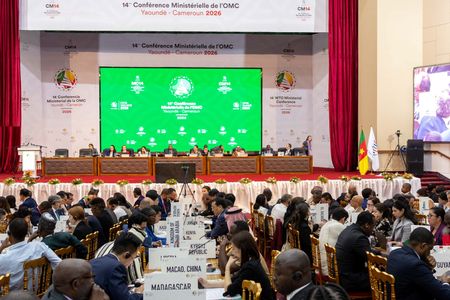

International trade discussions concluded without success early Monday morning following four days of negotiations in Yaounde, Cameroon, as countries failed to reach consensus on key digital commerce policies and broader trade reforms.
The ministerial conference ended with Brazil preventing the United States and other nations from securing an extension of current policies that prevent tariffs on digital transactions such as online downloads and streaming services.
While expectations were modest going into the talks, many hoped the existing digital commerce agreement would at least be renewed. However, disagreements between Brazil and other member countries made even this limited goal unattainable, according to diplomatic sources.
Brazil was only willing to support a two-year extension, far short of what the United States wanted, and trade representatives couldn’t find middle ground that satisfied both sides.
American officials and business organizations voiced disappointment with the stalemate. Britain’s Business and Trade Secretary Peter Kyle characterized the inability to reach consensus as a “major setback for global trade.”
These discussions were viewed as a crucial test for the World Trade Organization’s continued importance following a turbulent year of trade disputes and recent disruptions from the U.S.-Israeli conflict with Iran.
Securing agreement on digital commerce policies was considered essential for maintaining U.S. support of the WTO, particularly as President Donald Trump has moved away from international multilateral organizations while implementing his “America First” strategy.
WTO Director-General Ngozi Okonjo-Iweala expressed hope that the digital commerce agreement could still be restored, noting that Brazil and the United States continue working toward a compromise.
The organization reported some advancement on reform plans before time expired, with further discussions on making subsidy regulations more transparent and streamlining decision-making processes scheduled for Geneva in May.
Both the United States and European Union contend that China has particularly benefited from existing regulations to their disadvantage.
Negotiators spent Sunday attempting to bridge the divide between Brazil’s initial two-year proposal and America’s preference for permanent extension by creating a four-year plan with additional provisions extending through 2031.
Brazil subsequently offered a four-year extension including a midpoint review, but this compromise failed to gain sufficient backing.
Nations in the developing world have resisted lengthy extensions, claiming the current moratorium costs them valuable tax income.
A U.S. representative stated Brazil had rejected a “near-consensus document,” explaining “it’s not U.S. vs Brazil. It’s Brazil and Turkey v 164 members.” A Brazilian negotiator responded that “the U.S. wanted the sky,” arguing that pursuing longer extensions wasn’t wise given rapid changes occurring in digital commerce.
Another diplomat who attended the meetings said U.S. Trade Representative Jamieson Greer made participants “uncomfortable” when he implied there “would be consequences” if America didn’t obtain a long-term moratorium extension.
Keith Rockwell, a trade expert with the Hinrich Foundation and former WTO director, explained that Brazil’s attempt to use digital commerce negotiations to gain agricultural concessions failed because America is less committed to the WTO than previously.
“In the old days because they felt responsibility for the system the Americans would have swallowed hard and taken a hit,” he stated. “But now they won’t do that anymore.”
Rockwell predicted the deadlock would strengthen alternative trade frameworks like the Comprehensive and Progressive Agreement for Trans-Pacific Partnership, which includes 12 nations such as Japan, Britain, Canada, Mexico, Australia and Malaysia, but excludes the United States.
“Now what you’re going to see is a lot more energy and momentum into things like the CPTPP. They could immediately just agree on the framework (on e-commerce),” Rockwell explained.