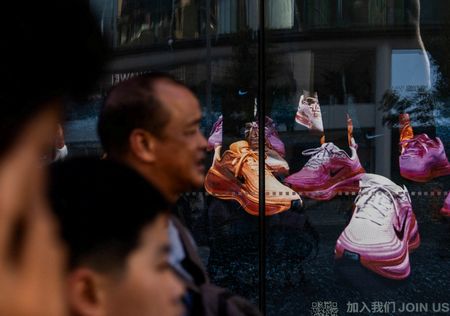

The athletic footwear and apparel giant Nike is facing significant challenges in the Chinese market, where operational mistakes and intensifying competition from domestic brands are exposing fundamental weaknesses in the company’s business strategy.
China represents approximately 15% of Nike’s worldwide sales and serves as the company’s second-most important market after North America. However, an economic downturn and ongoing real estate difficulties are constraining Chinese consumers’ purchasing ability, making a recovery increasingly challenging.
Meanwhile, Nike is being outpaced by rapidly expanding Chinese competitors Anta and Li Ning, which have leveraged flexible supply chains and extensive retail networks to distribute affordable products throughout China’s interior regions.
The financial impact is becoming evident: Nike has recorded declining sales in China for six consecutive quarters. Following a 17% decrease in the most recent quarter announced in December, CEO Elliott Hill characterized China as the “longest road” in the company’s worldwide recovery efforts, acknowledging the necessity to “reset” their strategy.
Earlier this year, the athletic brand named 25-year company veteran Cathy Sparks as Vice President and General Manager of Greater China, replacing longtime executive Angela Dong. Sparks has been tasked with strengthening retail partnerships, eliminating outdated inventory, and accelerating digital initiatives.
Industry experts suggest the challenges extend beyond simple resistance to international brands. They identify declining premium status, slow inventory control, and operational shortcomings that have allowed Nike to fall behind more agile domestic competitors.
“The global brands that are struggling in China – Nike, Starbucks, Häagen-Dazs – are not losing ground just because Chinese consumers don’t want to buy foreign brands,” explained Yaling Jiang, founder of research and strategy consultancy ApertureChina. “They are struggling because they are selling at a premium without giving people a good reason why they should pay a premium for their products.”
Nike chose not to provide comments as it prepares for Tuesday’s third-quarter financial results. Market analysts anticipate the company’s profit margins will shrink for the sixth straight quarter, while overall sales are projected to drop 0.3%, based on LSEG data.
Additional uncertainty stems from Middle Eastern conflicts, as companies prepare for increased material expenses due to rising oil prices.
Nike’s struggles contrast sharply with several international competitors that have maintained growth in China. Brands like On and Hoka have achieved strong double-digit increases by taking advantage of growing sports participation, especially running.
Even longtime competitor Adidas has mounted a successful recovery. After experiencing five consecutive quarters of decline in China during 2023, Adidas returned to positive growth and by 2025 had achieved ten straight quarters of expansion.
This turnaround resulted from increased local emphasis, featuring accelerated product development cycles and designs created specifically for Chinese consumers’ preference for innovation. Products designed locally now comprise approximately 60% of Adidas’ China offerings, compared to only 10% before this strategic change.
“Adidas is really trying to change the fit of the apparel, change the model of the sneaker, trying to respect our culture. But Nike is just changing the pattern, colour palette, or graphic – it’s not deep enough,” commented one concept store owner and Nike wholesale partner, who requested anonymity to speak candidly about the brand.
“As a big Nike fan, I don’t want to say Adidas is doing a better job than Nike, but I think sometimes you have to learn from your competitor.”
Structural problems have worsened Nike’s brand difficulties, according to two former and one current Nike China employees who spoke anonymously. A hierarchical decision-making approach reduced responsiveness to local market needs, while repeated attempts to promote unsuccessful products to retail partners increased inventory problems during a period of declining consumer spending.
Regular price reductions to eliminate surplus inventory damaged Nike’s brand reputation and wholesale relationships, they noted.
Morningstar analyst David Swartz believes Adidas’ recovery demonstrates that Nike can also rebound in China. “It doesn’t have to be a death spiral,” he stated.
Wei Kan, founder of consultancy Conduit Asia and former brand director at Nike Greater China, indicated that recent marketing efforts suggest the company is starting to adapt. He referenced a Chinese New Year advertising campaign that resonated with consumers by incorporating local humor.
“When everything is booming, the ‘Just Do It’ message fits with the mood, but the past few years, it hasn’t been a good fit for how people in China are feeling.”