
President Trump expressed optimism about potential negotiations with Iran’s new leadership Sunday, describing the country’s replacement officials as ‘very reasonable’ while Pakistan announced its willingness to facilitate peace discussions between the two nations.
Speaking to reporters aboard Air Force One Sunday evening, Trump revealed that Washington and Tehran have been engaging through both direct and indirect channels since the conflict began last month.
‘I think we’ll make a deal with them, I’m pretty sure, but it’s possible we won’t,’ Trump stated during his flight back to the capital.
The President indicated that Washington had achieved its goal of changing Iran’s government structure through military action that eliminated the nation’s supreme leader and other senior officials, though he emphasized twice that their successors appeared ‘reasonable.’
Iran’s Supreme Leader Ayatollah Ali Khamenei was killed in an Israeli attack on February 28, with his son Mojtaba taking over leadership responsibilities.
The ongoing conflict has expanded throughout the Middle East, resulting in thousands of casualties, unprecedented disruption to global energy markets, and significant economic consequences worldwide.
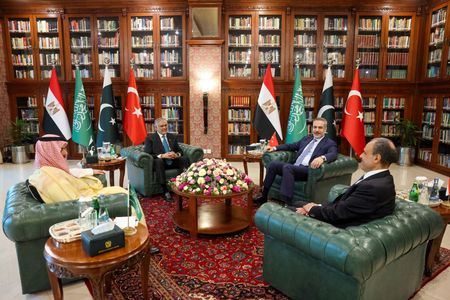
Pakistani Foreign Minister Ishaq Dar announced following Sunday discussions among regional diplomats that his country stands ready to facilitate negotiations aimed at resolving the crisis.
‘Pakistan will be honoured to host and facilitate meaningful talks between the two sides in coming days, for a comprehensive and lasting settlement of the ongoing conflict,’ Dar declared. Officials have not confirmed whether both Washington and Tehran have committed to participating in the proposed discussions.
Iran’s parliament speaker Mohammad Baqer Qalibaf responded skeptically to potential negotiations, claiming the United States was simultaneously preparing for a ground invasion while discussing diplomacy. He warned that Iran would respond if American forces were deployed.
‘As long as the Americans seek Iran’s surrender, our response is that we will never accept humiliation,’ Qalibaf said in his message to the Iranian people.
The Pentagon has deployed thousands of additional troops to the Middle East, providing Trump with options for potential ground operations if diplomatic efforts fail.
Israeli officials indicated they have no plans to reduce their military operations against Iran ahead of any possible Washington-Tehran negotiations, stating they would continue targeting what they characterize as military installations.
Israel’s military reported conducting more than 140 airstrikes across central and western Iran, including the capital Tehran, during the 24-hour period ending Sunday evening. The strikes targeted ballistic missile facilities and storage sites among other objectives.
Iranian state media confirmed attacks hit Mehrabad airport and a petrochemical facility in Tabriz in the country’s north.
A chemical facility near Beersheba in southern Israel was struck by Iranian missiles or debris, prompting authorities to warn residents to avoid the area due to dangerous materials.
Iran’s blockade of the Strait of Hormuz, through which 20% of global oil and gas shipments pass, has driven energy prices higher and created economic difficulties worldwide.
Asian markets declined Monday as investors prepared for an extended Gulf region conflict, with oil prices approaching record monthly increases that threaten to trigger inflation and potential recession globally. Japan’s Nikkei index dropped 4.7%.
Oil markets continued their upward trajectory, with Brent crude futures rising $3.09 or 2.74% to $115.66 per barrel by late Sunday, following Friday’s 4.2% gain.
The New York Times reported Sunday that several hundred special operations personnel have arrived in the region, adding to thousands of Marines who deployed Friday aboard an amphibious assault vessel as part of the first of two planned contingents.
Reuters has reported that Pentagon officials are evaluating military options including ground forces, though Trump has not approved any such plans according to multiple media outlets.
In a Financial Times interview published Sunday, Trump expressed interest in ‘taking the oil in Iran’ and potentially seizing Kharg Island, the country’s primary export facility. Controlling Kharg, which handles 90% of Iran’s oil exports, would require ground troops but could severely damage Tehran’s energy trade and economic stability.
Most Americans oppose the war and further military escalation, which could hurt Trump’s approval ratings ahead of November’s congressional midterm elections.
Yemen’s Iran-supported Houthis entered the conflict Saturday with their first attacks on Israel, raising concerns they could block the Bab el-Mandeb Strait, another crucial shipping route. Israeli authorities reported intercepting two drones launched from Yemen on Sunday.