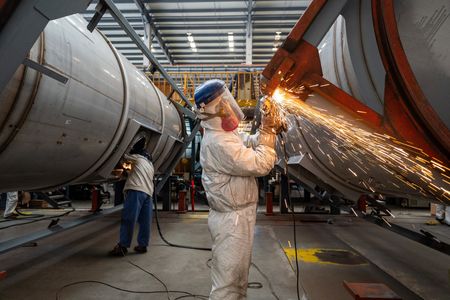

Economic analysts anticipate that Chinese manufacturing activity rebounded in March, ending a two-month period of decline, as the country’s export sector continues to show strength despite growing international concerns.
According to a survey of 28 economic experts conducted by Reuters, China’s official manufacturing purchasing managers’ index is expected to climb to 50.1 from February’s reading of 49.0. This would mark the first time since January that the index has crossed above the critical 50-point threshold that indicates growth rather than contraction.
The official statistics, compiled through the National Bureau of Statistics’ survey of businesses nationwide, are scheduled for release on Tuesday.
Manufacturing activity had remained below the expansion level throughout most of 2025 and the opening months of 2026, as domestic consumer weakness led to destructive price competition that eroded company profits. Additionally, strained relationships with international trade partners undermined business confidence.
Despite challenges from American tariff policies, China’s export sector demonstrated remarkable strength in 2025 and surged during the first two months of 2026, providing crucial support for economic growth.
Even a modest improvement in manufacturing indicators would provide encouragement to government officials working to maintain stable economic progress while navigating increasing global uncertainties.
The Middle Eastern conflict that began in late February, featuring U.S.-Israeli military action against Iran, has disrupted worldwide supply networks and created an energy shortage as Iran has limited shipping through the strategically important Strait of Hormuz. These complications may pressure Chinese manufacturers’ profit margins as transportation and raw material expenses increase.
Economic researchers surveyed by Reuters predict the private RatingDog Manufacturing PMI, scheduled for Wednesday release, will register 51.6, representing a decrease from February’s 52.1 reading.
Senior economist Xu Tianchen from the Economist Intelligence Unit noted that the manufacturing index faces pressure from oil market disruptions, particularly affecting refinery and petrochemical sectors. “The PMI will be constrained by the oil shock, which has hit industries such as refineries and petrochemicals,” Xu said.
Xu suggested that government intervention could help businesses weather these challenges. “To cushion the impact on businesses, the government can help small and medium-sized companies reduce operating costs through cheaper credit and lighter social security inspection,” he explained.
Chinese leadership established a more modest economic growth goal of 4.5%-5% for the current year in early March, following 2025’s 5% expansion rate. This adjustment provides additional flexibility to tackle persistent imbalances between domestic production capacity and consumer demand.
Officials have committed to expanding investment in essential infrastructure and public services, while allocating additional government resources to stimulate consumer spending and private sector investment through a dedicated 100 billion yuan ($14.47 billion) fiscal coordination program.