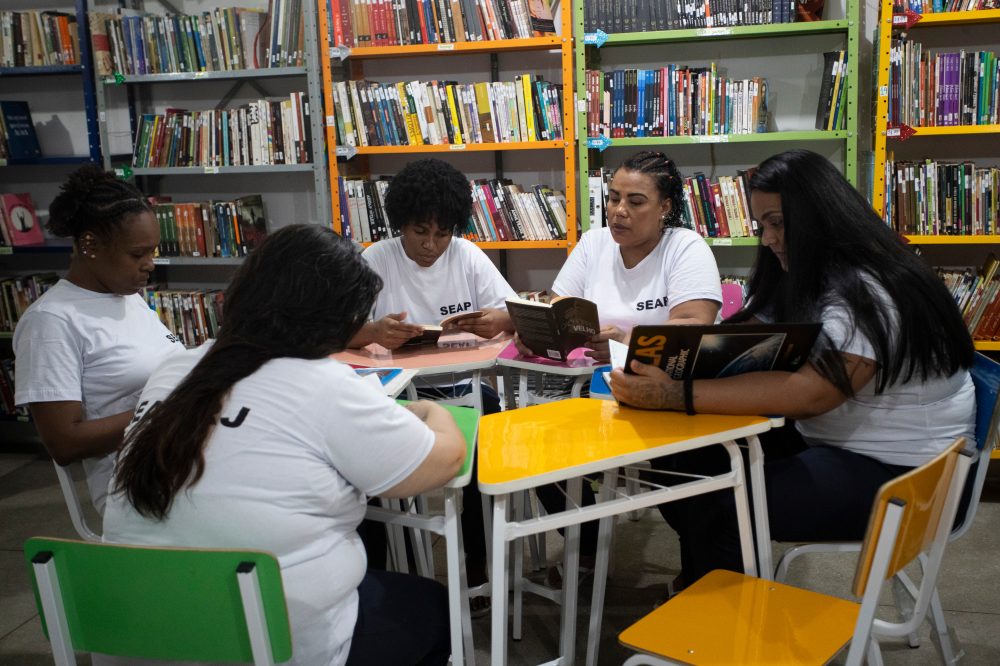

RIO DE JANEIRO (AP) — A 33-year-old Brazilian woman named Emily de Souza jumped at the chance to participate in an unusual program that would cut four days from her prison term simply by reading a book, allowing her to revive a beloved pastime.
Alongside thousands of other prisoners nationwide — including former President Jair Bolsonaro — she enrolled in a sentence reduction initiative that motivates incarcerated individuals to dive into literature in return for trimming up to 48 days annually from their prison terms.
The prospect of reuniting sooner with her 9-year-old autistic child, currently cared for by her mother and aunt, intensified her desire to join the program.
“One day is an eternity because it feels like it’s never going to end,” de Souza explained from the Djanira Dolores de Oliveira Women’s Prison in Rio de Janeiro, which holds roughly 820 female prisoners.
She described reading as “a kind of escape, to get out of this environment for a bit, to think about other things: other stories, other people, not just me.”
De Souza, like many of her fellow prisoners, was convicted on drug trafficking charges. She received a five-year sentence for distributing cannabis-infused Brazilian chocolate confections called “brigadeiro.” After arriving last November, she anticipates advancing to Brazil’s semi-open prison system by August, which would permit daytime release for employment.
Brazil, home to one of Latin America’s highest incarceration rates per capita, distinguishes itself by operating one of the world’s most structured and widespread sentence reduction programs through reading. This expanding initiative, initially regulated in 2012 and standardized nationally in 2021, gained fresh attention this year when the Supreme Court permitted Bolsonaro — currently serving 27 years for coup attempt charges — to participate.
Andréia Oliveira, who oversees female prisons and LGBTIQ+ programs in Rio state facilities, emphasized that providing reading opportunities and education benefits both former inmates and the broader community. “When we encourage education, ludic activities, knowledge, we return to society someone who can reconnect, respect rules,” she explained.
Literature professor Paulo Roberto Tonani has facilitated prison workshops since 2022, enabling Rio detainees to access this program.
The process begins with participants selecting or receiving a book during an introductory session. During subsequent meetings, they discuss their reading material and ultimately create either a written review or artwork demonstrating their understanding.
Prisoners have engaged with works including “Captain of the Sands” by celebrated Brazilian novelist Jorge Amado, “Crime and Punishment” by Fyodor Dostoevsky, and “The Color Purple” by Alice Walker.
According to Tonani, participants particularly embrace the illustrated story “Father Francisco” by Marina Miyazaki Araujo, which portrays an imprisoned father through his child’s viewpoint. Many Brazilian inmates come from impoverished backgrounds and lack completed elementary education.
During a late March workshop at the Djanira Dolores de Oliveira facility, several participants were studying “Unsubmissive Tears of Women” by Brazilian author Conceição Evaristo — including Celina Maria de Conceição, a 50-year-old woman from Pernambuco state.
De Conceição, who participated in previous workshops and re-enrolled, credited the program with fostering her appreciation for reading.
“It helps us a lot because we’re locked up and it gets very stressful, very noisy,” she noted. “We get to go to somewhere else, interact with other people and talk about good things, like the book we’re studying.”
However, she abandoned Evaristo’s book, which examines violence’s effects on Black women’s experiences, after finding it emotionally disturbing.
“It wasn’t good for me, because it stirs up our emotions, and we’re in a place where the environment is already truly heavy,” she said.
Brazilian correctional facilities are notorious for overcrowding and brutal conditions. In 2023, the Supreme Court acknowledged widespread human rights violations within the prison system and mandated federal action to address these issues. The resulting “Just Punishment” plan, launched in 2025, aims to broaden educational and employment opportunities among other objectives.
Despite improvements, access to sentence reduction through reading varies significantly across Brazil, according to Rodrigo Dias, who leads education, culture and sports initiatives for the National Secretariat of Penal Policies.
While northeastern Alagoas state provided some inmates with Kindles containing 300 literary works, other more traditional states maintain heavy administrative barriers that restrict access, Dias observed.
A 2023 government assessment revealed that approximately 30% of Brazilian prison facilities lack libraries or suitable reading areas. Nevertheless, Dias highlighted secretariat data showing a sevenfold increase in reading-based remission applications since 2021.
Similar to de Conceição, many participants seek to continue once they begin. “The book gives them the possibility to dream, and often to ‘talk’ with other people — not those who are imprisoned or working in the facility, but with the characters in the stories,” Dias said.
While Elionaldo Fernandes Julião, co-author of “Sentence Remission Through Reading in Brazil: The Right to Education in Contest” and professor at Fluminense Federal University, recognizes the value of prison book access, he contends that reading-based sentence reduction often substitutes for developing educational access, which requires significantly more resources.
Julião also noted that program and book availability frequently relies on local initiatives. “Unfortunately, these are very easy to eliminate or shut down as quickly as possible,” he warned.
During the recent workshop, de Souza read aloud poetry by formerly incarcerated Argentine writer Liliana Cabrera. One verse declares the narrator is “Also something more / than the letters in black / of a court case.”
De Souza found deep meaning in these words.
“Someone knew how to explain with beautiful terms (…) that I’m a lot more than a court case, a lot more than the mistake I made, that I’m a human with my story,” she reflected.