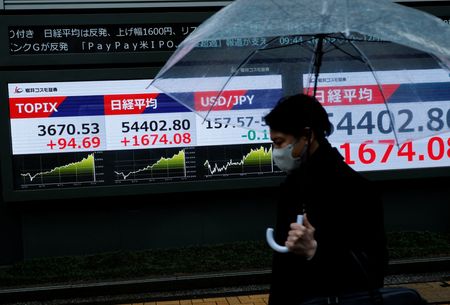

Asian financial markets experienced significant declines Monday as investors prepared for what analysts expect to be a prolonged Middle East crisis that has already driven oil prices to their highest monthly gains ever recorded.
Pakistan announced Sunday it was making preparations to facilitate “meaningful talks” aimed at resolving the Iranian conflict in the coming days, despite Tehran’s earlier accusations that Washington was planning a ground invasion as additional U.S. military personnel deploy to the region.
The Iran-backed Houthis in Yemen conducted their initial strikes against Israel since the conflict began.
“Iran’s control of the Strait of Hormuz, capacity to disrupt global energy and food markets, and sustained missile and drone capabilities give it little incentive to concede, pressuring the U.S. to escalate,” said Madison Cartwright, senior geo-economics analyst at CBA.
“We expect the war to run at least into June, with the risk tilted to a longer conflict.”
The restrictions on the Strait have caused dramatic price increases for oil, natural gas, fertilizer, plastic and aluminum, along with aviation and shipping fuel. Costs for food products, pharmaceuticals and petrochemical goods are all expected to climb.
This development poses particular challenges for Asia, given the region’s heavy reliance on Middle Eastern energy supplies. Japanese Nikkei futures dropped to 50,870, signaling a sharp decline from Friday’s closing price of 53,373.
S&P 500 futures decreased an additional 0.6%, while Nasdaq futures dropped 0.7%.
Brent crude increased 2.4% to $115.33 per barrel, pushing monthly gains to 59% and exceeding the surge that occurred after Iraq’s 1990 invasion of Kuwait. U.S. crude advanced 3.0% to $102.52, achieving a monthly increase of 53%.
“The longer the Strait remains closed, the sharper the drawdown in buffer supplies that could spark dramatic increases in the price of crude oil, natural gas and other commodities,” warned Bruce Kasman, global head of economics at JPMorgan.
“A scenario in which the Strait remains closed for an additional month would be consistent with oil prices rising towards $150/bbl and constraints on industrial consumers of energy supply.”
The inflation concerns have prompted investors to adjust their interest rate expectations upward across most markets. Current market conditions suggest 12 basis points of Federal Reserve tightening this year, a shift from the 50 basis points of cuts anticipated just one month ago.
Federal Reserve Chairman Jerome Powell will have an opportunity to share his perspective at a scheduled event Monday, while influential New York Fed President John Williams is also set to speak.
This week’s economic data on U.S. retail sales, manufacturing and employment will offer insights into the economy’s current trajectory. Employment is projected to increase by 55,000 in March, following February’s unexpected decline of 92,000, with unemployment expected to remain at 4.4%.
European Union data scheduled for Tuesday is anticipated to reveal annual inflation jumped to 2.7% in March from 1.9% the previous month, though core prices should remain more stable.
The anticipated energy crisis, coupled with fiscal pressure from higher borrowing costs and increased defense spending requirements, has negatively impacted government bond markets.
Ten-year U.S. Treasury yields have risen approximately 47 basis points this month to 4.428%, while two-year yields have increased 54 basis points.
Increased market volatility has generally favored the U.S. dollar as the world’s most liquid currency. The United States also benefits from being a net energy exporter, providing advantages over Europe and much of Asia.
The dollar traded slightly higher Monday at 160.42 yen, after crossing the 160 threshold last week for the first time since July 2024, when Japan last intervened to support its currency.
The euro remained near $1.1492, close to March’s low of $1.1409.
In commodities trading, gold showed little movement at $4,487 per ounce, receiving minimal support despite its traditional roles as a safe haven and inflation hedge.