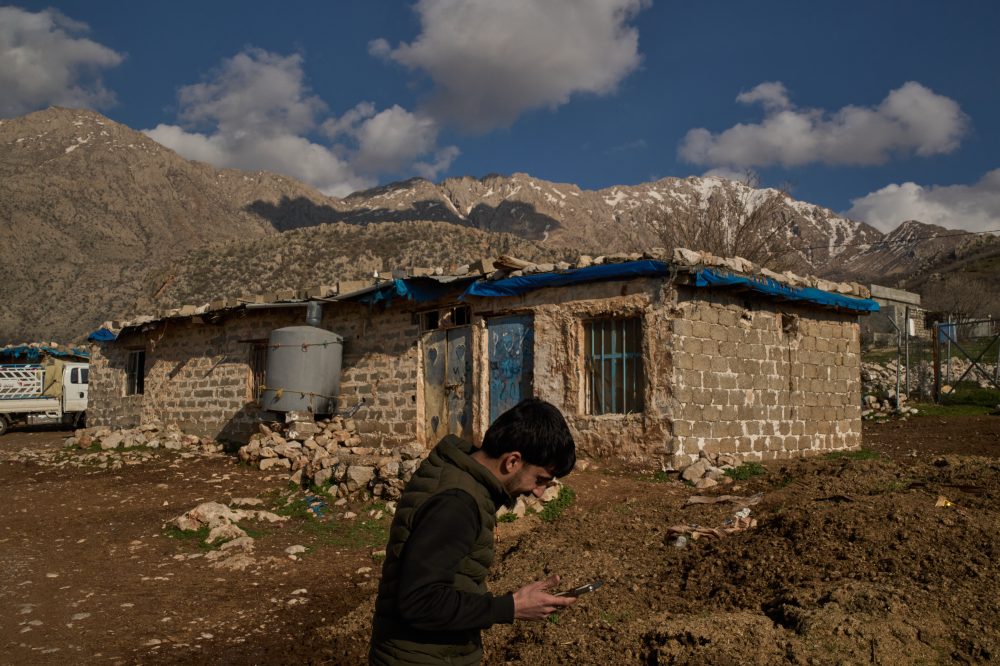

HALABJA, Iraq (AP) — Yaser Fattahi depends on elaborate phone relays to hear his mother’s voice across the Iran-Iraq border, waiting anxiously for his cousin to make dangerous trips near the frontier where cell signals can briefly connect the separated family.
The trained nurse escaped to Iraq last December after Iranian authorities began targeting him for treating wounded anti-government demonstrators in private homes, helping them avoid surveillance at government-controlled medical facilities.
With regional warfare escalating, Fattahi now lives in constant anxiety about his mother’s wellbeing as U.S. and Israeli strikes continue.
The ongoing conflict has severed telecommunications networks and prompted Iran to mass troops along the border, effectively cutting off both communication channels and commercial activity across the region.
Fattahi’s cousin orchestrates their calls by carrying two devices to the border area – one connected to Iraq’s cellular network to reach Fattahi, while using the second phone to contact his mother through Iran’s system via WhatsApp.
“The calls last a minute or two,” Fattahi explained from his location in Sulaymaniyah, situated in Iraq’s Kurdish territory near the Iranian frontier. “She tells me to take care of myself, and that they are okay.”
Four days have elapsed since their most recent conversation. Fattahi continuously checks his device. “I thought he would call today but he hasn’t,” he noted.
The frontier separating Iran from northern Iraq’s Kurdish areas has historically remained fluid, sustained by family connections, commercial exchange, and illicit trafficking. Currently, households find themselves isolated from relatives, while merchants and even contraband runners avoid crossing. Iranian military units have expanded their deployment to block infiltration attempts by Iranian Kurdish resistance organizations.
Individuals who venture toward the boundary seeking Iraqi cellular coverage face potential shooting, according to advocacy groups. Alternative communication methods include illegally obtained Starlink access, though at considerable expense.
Within the mountainous Iraqi region of Byara, family members previously made routine border crossings for celebrations and religious observances.
The warfare has disrupted these established customs.
Nyan Fayaq, a 25-year-old legal studies student, supervised large cooking vessels while helping prepare an iftar meal during Ramadan’s concluding week as numerous family members assembled in traditional Kurdish attire among verdant hills populated with livestock.
Her concerns centered on relatives in Iran’s Saqqez city, whom she hasn’t contacted for over thirty days.
Born in Iran, Fayaq relocated to Iraq with her mother following her parents’ separation when she was two years old, returning to her mother’s native country. She reconnected with her Iranian uncles eighteen years later and maintained regular contact.
“They have electricity, gas and water, but everything has become very expensive because of America,” she stated.
An Iranian Kurdish worker employed in Iraq returned to his native Merivan two weeks prior to retrieve his spouse, bringing her to Iraq due to safety concerns. He requested anonymity, worried that identification might prevent future returns.
Since that time, his family communications have been extremely limited. He reported that relatives informed him Iranian law enforcement and security personnel operate outside their usual facilities because airstrikes have destroyed many installations. The Associated Press cannot verify these claims independently.
According to his sources, security forces have occupied educational institutions and recreational facilities despite local opposition.
The conflict has completely halted cross-border smuggling activities.
These carriers, called kolbars, transport merchandise including tobacco products, electronic devices, and apparel throughout Iran’s western regions. They function within legal ambiguity while risking death from border security, severe climate conditions, and dangerous mountain passages.
Occasionally, kolbars also facilitate human smuggling across the frontier. Many clients are Iranian Kurds lacking travel documents due to incomplete military obligations, while others seek asylum hoping to reach Europe. Kurdish militant organizations utilize identical mountain paths for moving personnel and supplies into Iran for operations.
Twenty-five-year-old Bilal Osman has known only kolbar work, inheriting the profession from previous generations.
He remembers Iranian forces firing on a twelve-mule convoy transporting merchandise through mountain terrain last year. “One bullet even hit a man’s leg,” he recalled.
“Sometimes a lot of soldiers are stationed along the border. If they see us, they shoot, beat us, or throw stones. Our life is hard, but this is how we make money to feed our families,” he explained.
At the base of mountains bordering Iran near Halabja, he cares for his animals while awaiting communication from Iranian kolbars across the boundary. Since warfare commenced, no contact has occurred.
“The kolbars simply can’t cross. We are always ready, but the borders are tightly controlled,” Osman stated.
Iranian authorities have “brought cameras for each spot, increased soldiers from five to at eac30 h location, and now even place soldiers between checkpoints,” he reported. “We speak to people on the Iranian side every day, and they tell us they can’t come because the border is too heavily guarded.”
An Iranian kolbar, speaking anonymously for security reasons, confirmed to The Associated Press that operations have virtually ceased since hostilities began due to enhanced security measures.
Shiwa Hassanpour, representing the Hengaw Organization human rights monitoring group based in Iraqi Kurdistan, reported that individuals approaching the border face shooting because Iranian forces suspect espionage activities.
Gathering intelligence from within Iran has become progressively challenging, she noted. Residents depend on expensive virtual private networks to report incidents and transmit footage, causing delayed news emergence. Hassanpour herself hasn’t reached her family for over twenty days.
She indicated that Iran’s Islamic Revolutionary Guard has positioned substantial troop numbers throughout Kurdish regional cities. These actions intensified following Iranian Kurdish opposition groups’ coalition announcement.
Subsequently, Hengaw has recorded significant increases in temporary checkpoints, vehicle inspections, and civilian violence.
VPN services to circumvent internet limitations cost approximately $25. Family communication with overseas relatives requires up to $50, beyond most households’ financial capacity, she explained. Residents also pay premium rates for smuggled Starlink connectivity.
To block Iranians from accessing Iraqi networks for calls, Iran attacked cellular infrastructure operated by Iraqi companies Asiacell and Korek near the frontier, then instructed security forces to shoot anyone approaching those areas, according to Hassanpour.
Officials have also detained anyone discovered with VPN applications, accusing them of espionage for Israel or the United States, she added.
Fattahi continues awaiting word from his mother. Their conversations often suffer from interference and ambient noise because his cousin employs two devices – one contacting Fattahi while the other reaches his mother.
“It’s hard to hear her,” he said. “But it’s enough.”