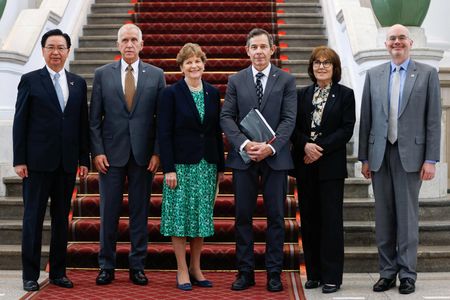

A delegation of American senators traveled to Taiwan’s capital this week, pressing the island nation’s leaders to move forward with a massive $40 billion defense spending package that has been stuck in legislative gridlock.
The lawmakers cautioned that continued delays in approving President Lai Ching-te’s military budget proposal could weaken Taiwan’s capacity to defend itself against mounting Chinese military threats, even as the United States speeds up weapons deliveries and security assistance to the region.
Taiwan relies heavily on American military support and diplomatic backing, making the U.S. its primary international ally despite the absence of official diplomatic relations. Beijing maintains its claim over Taiwan, which the island continues to reject.
The proposed defense spending increase remains blocked in Taiwan’s legislature, where opposition parties hold majority control.
Republican Senator John Curtis led the four-member congressional delegation that arrived Monday, continuing his longstanding support for Taiwan. The visit occurs amid escalating Chinese military and political campaigns aimed at forcing the democratic island to submit to Beijing’s control.
Speaking to media at Taiwan’s presidential office following his meeting with President Lai, Curtis emphasized American solidarity with the island nation.
“We’re here to enforce that message and demonstrate to the people here in Taiwan that we are together a very important part of the safety and the unity around this world,” Curtis stated.
The senator directly advocated for the defense budget’s passage, telling reporters: “I’d like to personally endorse the special defence budget and tell you back in Washington, D.C., that my colleagues are watching, that this is important. We want to make sure that as we invest in this part of the world, that you are also investing and that we’re in this together.”
While Taiwan’s opposition-led parliament continues debating the spending proposal, lawmakers have already given approval for the government to finalize American weapons deals totaling approximately $9 billion across four separate arms packages, even before the broader budget receives final approval.
The meeting included Raymond Greene, America’s top diplomatic representative in Taiwan, and Joseph Wu, Taiwan’s National Security Council Secretary-General. Washington has thrown its weight behind Lai’s military modernization efforts as part of broader American policy encouraging allies to increase their defense investments.
Democratic Senator Jeanne Shaheen, who serves as the ranking member on the Senate Foreign Relations Committee, expressed alarm over Beijing’s increasingly aggressive posture toward Taiwan.
“We are concerned by the increased pressure from Beijing, including military activity around Taiwan that raises the risk of miscalculation,” Shaheen said.
Chinese military and political pressure campaigns against Taiwan have intensified significantly, including conducting military exercises near the island. The most recent war games occurred in December, shortly after Washington greenlit an $11 billion weapons sale to Taiwan.
According to previous Reuters reporting, American officials are currently preparing another substantial arms package for Taiwan valued at approximately $14 billion.