
DUBAI, United Arab Emirates (AP) — While diplomatic negotiations show potential progress, President Donald Trump has publicly considered capturing Iran’s Kharg Island oil facility in the Persian Gulf, even as military confrontations between the United States, Israel, and Iran continued Monday across the region. Iran responded by striking a critical utilities facility in Kuwait, continuing its campaign against Gulf Arab nations.
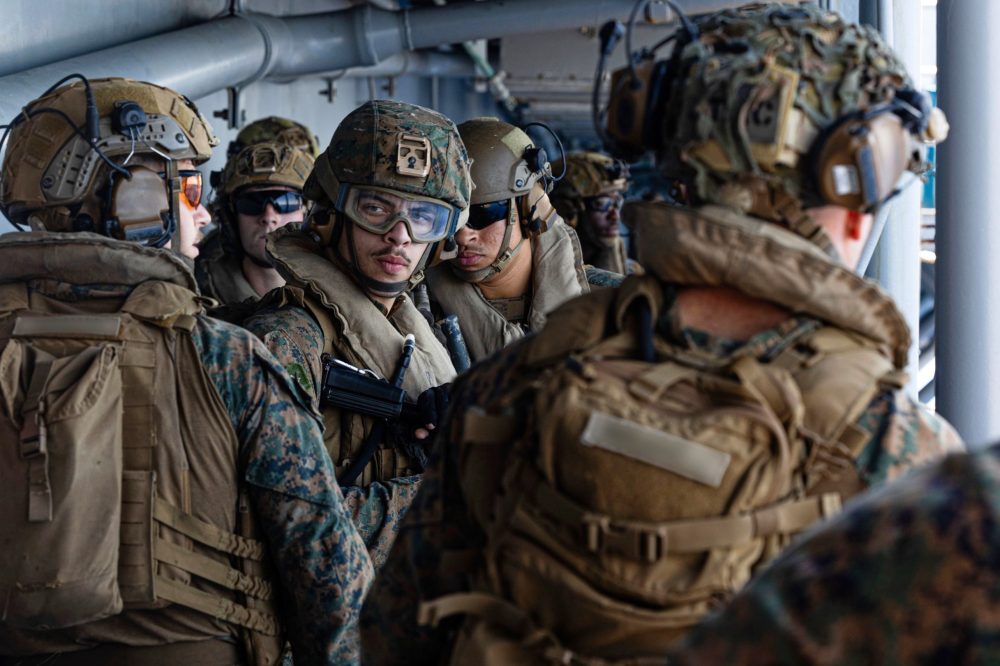
Despite Pakistan facilitating diplomatic efforts to end the conflict, Trump indicated Iran had agreed to permit 20 oil tankers passage through the Strait of Hormuz beginning Monday as “a sign of respect.” However, with 2,500 U.S. Marines currently deployed to the area and additional forces en route, the president floated the possibility of seizing Iran’s Kharg Island facility.
“Maybe we take Kharg Island, maybe we don’t,” Trump stated in a Financial Times interview released Monday morning. “We have a lot of options.”
Dawn brought air raid warnings near Israel’s primary nuclear research facility, an area facing repeated targeting in recent days. Israeli defense forces reported destroying two drones launched from Yemen, where Iranian-supported Houthi rebels joined the conflict Saturday with their initial missile strike.
Iran maintained its assault on neighboring Gulf Arab states, with Saudi Arabia intercepting five missiles aimed at its oil-producing Eastern Province, Bahrain activating missile warnings, and Dubai’s defense systems creating a fireball while destroying an incoming projectile.
Kuwait suffered casualties when an Iranian strike damaged a power and water treatment facility, resulting in one civilian death and 10 military personnel injuries, according to the state-run KUNA news agency.
Water treatment facilities remain vital for Gulf Arab nations’ water security, with Iran having previously damaged a similar facility in Bahrain during the ongoing conflict. These plants typically operate alongside power generation facilities due to the substantial energy requirements for converting seawater into drinking water.
Israeli forces conducted fresh strikes against Iran, targeting what they described as “military infrastructure” throughout Tehran. Iranian outlets reported damage to a Tabriz Petrochemical facility in the country’s northern region, though officials stated no dangerous materials were released.
In Lebanon, where Israeli ground operations are underway, an Indonesian peacekeeper died and three others sustained injuries when a projectile detonated near a southern village.
During the weekend, Israeli Prime Minister Benjamin Netanyahu announced plans to expand military operations, extending the “existing security strip” in southern Lebanon while pursuing the Iran-affiliated Hezbollah organization.
Iran’s assault on regional energy facilities and its control over the Strait of Hormuz, which handles one-fifth of global oil shipments during peacetime, has caused oil prices to surge and sparked fears of a worldwide energy shortage.
During early Monday trading, Brent crude oil prices reached approximately $115, representing nearly a 60% increase since U.S. and Israeli forces initiated the conflict with February 28 attacks on Iran.
With mounting pressure on Trump to resolve the crisis, American officials have presented Iran with a 15-point proposal requiring Iran to reopen the Strait of Hormuz for commercial shipping. Iran has countered with its own five-point framework, insisting on maintaining control over the strategic waterway.
Pakistan announced Sunday its intention to facilitate upcoming U.S.-Iran discussions, though neither Washington nor Tehran immediately confirmed the arrangement, and the format of potential talks regarding the month-long war remained unclear.
Pakistan’s Foreign Minister Ishaq Dar stated the negotiations would occur “in the coming days.”
Speaking to reporters on Air Force One Sunday evening, Trump confirmed the U.S. was engaging “directly and indirectly” with Iran, despite Iranian denials of any Washington communications.
“We’re doing extremely well in that negotiation but you never know with Iran because we negotiate with them and then we always have to blow them up,” Trump commented.
Iran’s parliament speaker, Mohammad Bagher Qalibaf, rejected the Pakistani talks as a diversion while additional U.S. forces deploy to the region. He declared Iranian forces were “waiting for the arrival of American troops on the ground to set them on fire and punish their regional partners forever,” state media reported.
In his Financial Times discussion, Trump acknowledged that capturing Kharg Island could require an extended American presence, noting “it would mean we had to be there for a while.”
“I don’t think they have any defense,” he continued. “We could take it very easily.”
U.S. forces have already conducted airstrikes targeting military positions on the island. Iran has warned it would launch ground invasions of Gulf Arab countries and deploy mines throughout the Persian Gulf if American troops land on Iranian soil.
Any amphibious assault on Kharg would require passage through the Strait of Hormuz and most of the Persian Gulf. Military analysts note that maintaining control of the island would present significant challenges, as Iran’s missiles, drones, and artillery from the mainland could easily reach the facility.
Lebanese officials report over 1,200 deaths and more than 1 million displaced residents. Five Israeli soldiers have also perished.
Iranian authorities report more than 1,900 casualties, while Israel has confirmed 19 deaths.
In Iraq, where Iranian-supported militias have joined the fighting, 80 security force members have died.
Gulf states have reported 20 fatalities. Four deaths have occurred in the occupied West Bank.
Thirteen U.S. service members have lost their lives in the conflict.