BRUSSELS (AP) — European Union leadership announced Wednesday plans to urge member countries to prohibit so-called ‘conversion therapy’ targeting LGBTQ+ individuals, responding to widespread public pressure and timing the announcement ahead of this weekend’s Brussels Pride celebration.
Commission President Ursula von der Leyen declared Wednesday that such “conversion practices” have “no place in our Union.” Enhanced protections for LGBTQ+ residents have remained a key pledge of EU leadership since von der Leyen assumed her role in 2019.
Research from the EU’s Agency for Fundamental Rights revealed in 2024 that 25% of surveyed LGBTQ+ individuals had experienced the scientifically debunked practice designed to alter their sexual orientation or gender identity. The highest rates were documented in Greece, Cyprus, the Czech Republic, Estonia, and Slovakia.
The commission’s action followed a petition drive that gathered signatures from more than one million EU residents calling for “a binding legal ban on conversion practices targeting LGBTQ+ citizens in the European Union.”
Currently, only 10 of the 27 EU member states have implemented complete or partial bans on conversion therapy, data from the International Lesbian, Gay, Bisexual, Trans and Intersex Association – Europe shows.
Malta became the first EU country to prohibit attempts to alter gay individuals’ sexual orientation in 2016. France has since followed suit, establishing criminal penalties including imprisonment and monetary fines for those who employ such practices against LGBTQ+ individuals.
“Conversion practices are built on a lie, the lie that LGBTQ+ people need to be fixed, that there is something wrong with who they are. And there is, of course, nothing to fix, there is nothing to cure, and there is no one to change,” stated Hadja Lahbib, the European commissioner for equality. “You cannot torture away a person’s identity, and you cannot legislate it away. And yet these practices continue, unfortunately.”
Brussels, serving as the EU’s institutional center, expects tens of thousands of participants for Saturday’s march as the city commemorates three decades of its annual LGBTQ+ rights and cultural parade.
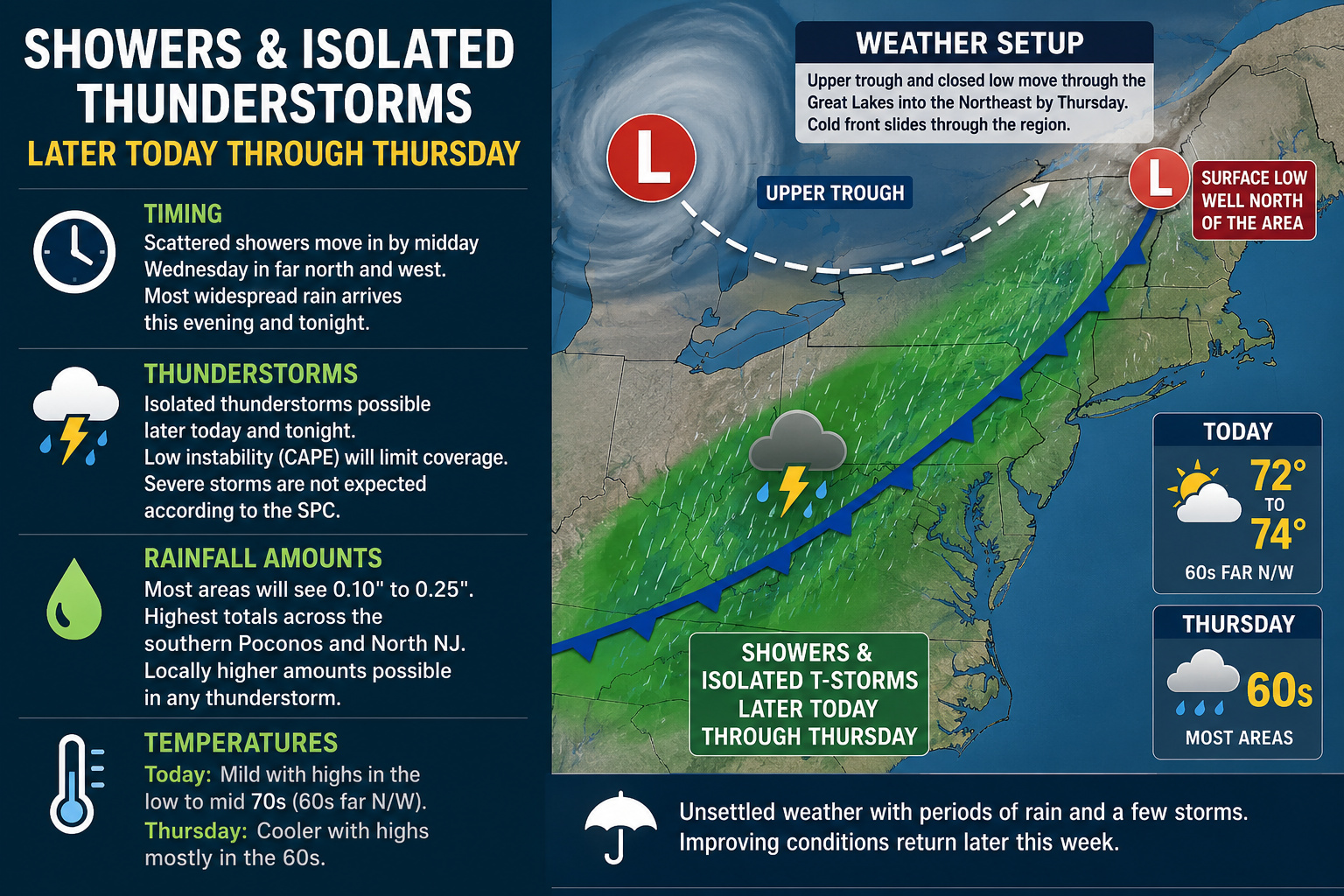
A stretch of unsettled weather is expected across the Delmarva region beginning later today and continuing through Thursday as an area of low pressure and an approaching cold front move through the eastern United States.
According to the latest details, an upper-level trough connected to a closed low over central Canada will swing through the Great Lakes and Ohio Valley tonight before settling into the Northeast by Thursday. While the main surface low will remain well north of Delmarva, its associated cold front will cross the region and bring periods of showers along with the chance for a few isolated thunderstorms.
The timing of rainfall has slowed somewhat compared to earlier expectations. Only scattered showers are expected to begin developing across northern and western portions of the region around midday Wednesday, while the steadier and more widespread rainfall is now expected to hold off until later this evening and overnight.
Although thunderstorms remain possible later today and tonight, the overall severe weather threat remains very low. Limited atmospheric instability, also known as CAPE, is expected to keep thunderstorm coverage isolated at best. The Storm Prediction Center is not expecting severe thunderstorms across the region during this event.
Rainfall totals also continue trending lower with most locations expected to receive between one tenth and one quarter of an inch of rain. Locally higher amounts could occur underneath any thunderstorm, but widespread heavy rainfall is not anticipated. The highest rainfall totals are expected farther north across portions of the southern Poconos and northern New Jersey.
Temperatures ahead of the system will remain seasonably mild today with highs reaching the lower to middle 70s across much of Delmarva, though some far northwestern areas may stay in the 60s. Cooler air arrives behind the cold front on Thursday with daytime highs generally falling back into the 60s region-wide.
While this system is not expected to produce severe weather, residents should still prepare for periods of wet weather, occasional downpours, and a few rumbles of thunder through Thursday before improving conditions gradually return later in the week.
SAO PAULO (AP) — While Brazil remains deeply divided politically, citizens across the nation have united around one innovation: PIX, an instant digital payment platform that enables purchases ranging from beachside treats to major vehicle transactions.
The government-operated system, managed by Brazil’s Central Bank rather than private financial institutions, generated an enormous $7 trillion in transaction volume during the previous year. However, the platform now confronts challenges from Washington, where officials allege it creates unfair competition by circumventing established credit card networks such as Visa and Mastercard.
“PIX is the superior payment option and the most widely adopted,” explained Luis Felipe de Almeida, a 21-year-old entrepreneur selling iced beverages and cassava treats along Rio de Janeiro’s Ipanema coastline. “Cash transactions have become obsolete since everyone carries smartphones and relies on PIX.”
Introduced in 2020, the platform enables any individual possessing Brazilian tax identification, registered businesses, or government agencies to execute immediate fund transfers. The sole prerequisite involves maintaining a Brazilian banking relationship.
The system incorporates QR code functionality for seamless transactions. Personal users enjoy zero-cost transfers, while businesses face minimal charges that remain substantially below traditional banking fees and processing times that previously required hours for completion.
During July, the Office of the U.S. Trade Representative under President Donald Trump initiated an investigation into PIX, contending the system creates unfair market conditions for American credit card operators by providing fee-free transaction alternatives.
India operates a comparable payment infrastructure that remains unchallenged by U.S. trade officials, despite handling $300 billion in transactions during March alone. That system similarly eliminates transaction charges.
Brazilian middle-class consumers have embraced PIX for both minor purchases and significant acquisitions.
Marcello Palladini, a 57-year-old Sao Paulo restaurateur, primarily employs PIX for supplier payments exceeding 1,000 Brazilian reais ($200), particularly since many vendors refuse credit cards for substantial amounts. Nevertheless, he noted that most dining customers continue favoring credit cards or meal vouchers for lunch payments.
“When I need immediate transactions, PIX delivers instant results. I also maintain running accounts with certain suppliers who provide monthly consolidated billing through PIX,” Palladini explained.
While criticizing unfair corporate transaction fees imposed by some banks, he remains enthusiastic about the platform.
“PIX functions excellently with immediate processing,” he stated.
Numerous major Brazilian corporations utilize PIX for employee compensation. Real estate, automobiles, and even aircraft purchases occur through the platform, though substantial amounts typically require prior banking authorization.
Despite widespread adoption, PIX faces significant challenges. Criminal organizations have discovered methods to exploit the system through phone theft, enabling instant transfers of tens of thousands of Brazilian reais while leaving law enforcement, financial institutions, and insurance providers struggling to prevent rapid movement of stolen assets.
Brazilian officials and companies now monitor and frequently suspend accounts involved in questionable activities while implementing transfer limitations between 8 p.m. and morning hours, preventing criminals from moving large amounts when most users aren’t monitoring transaction notifications.
The Brazilian Forum of Public Security estimates that between 24 million and 28 million individuals experienced PIX-related crimes from January through September of the previous year, though total financial losses remain undetermined.
“PIX maintains technical and legal security standards, but fraud vulnerability exists because risks stem from human deception rather than technological weaknesses,” noted Ana Paula Siqueira, a Brazilian digital law specialist. “Most common schemes involve psychological manipulation, identity falsification, and fabricated urgent payment requests.”
These security concerns haven’t deterred 178 million of Brazil’s 213 million citizens from PIX registration.
“Genuine affection develops gradually over time,” called out Claudia Quirino, a Brazilian dumpling vendor at a Sao Paulo Pinheiros neighborhood market. “However, PIX works immediately! Purchase today!”
Federal health officials report that roughly 70,000 Americans lost their lives to drug overdoses in 2025, representing a 14% reduction compared to the year before, according to newly released preliminary data.
Wednesday’s federal report reveals this marks the third consecutive year of declining overdose fatalities, creating the most extended period of improvement seen in recent decades. The 2025 numbers mirror overdose deaths recorded in 2019, before the coronavirus pandemic began.
Multiple drug categories showed reductions in fatal overdoses, including fentanyl, cocaine, and methamphetamine. Most states experienced decreases in overdose deaths, though Arizona, Colorado, and New Mexico saw significant increases, the Centers for Disease Control and Prevention announced.
Brandon Marshall, a Brown University researcher specializing in overdose patterns, expressed measured hope about the trend. “I’m cautiously optimistic that this represents really a fundamental change in the arc of the overdose crisis,” Marshall stated.
Despite the encouraging statistics, Marshall and fellow researchers emphasize that overdose deaths remain at concerning levels, and several factors could trigger another surge, including shifts in government policy or changes in available street drugs.
“If deaths are going down rapidly, that means they can increase just as rapidly if we take our foot off the gas,” Marshall warned.
While overdose fatalities had been climbing for decades, they surged dramatically during the pandemic years, reaching nearly 110,000 deaths in 2022. The pandemic increase coincided with widespread social isolation and reduced access to addiction treatment services.
As pandemic restrictions lifted, death rates began falling. Experts point to several contributing factors: greater access to naloxone, the overdose-reversing medication; expanded treatment programs; changes in drug use patterns; and the impact of billions in settlement funds from opioid litigation.
Research also indicates the population at highest overdose risk may be shrinking, as fewer young people begin using drugs and many long-term users have died. Additionally, regulatory changes implemented by China several years ago appear to have reduced access to chemicals needed for fentanyl production.
However, health and law enforcement agencies have recently raised concerns about new substances detected with increasing frequency throughout 2025.
Alex Krotulski leads the Center for Forensic Science Research and Education, a federally supported toxicology laboratory in Horsham, Pennsylvania, that serves as a key component of the national drug monitoring network.
Throughout 2025, the facility discovered 27 previously unknown drugs. In less than five months of 2026, researchers have already identified 23 new substances, Krotulski reported.
One particularly concerning drug under surveillance is cychlorphine, a powerful synthetic opioid reportedly up to 10 times more potent than fentanyl. Experts believe it’s being mixed into other illegal drugs without users’ awareness.
“The drug supply continues to change and evolve,” Krotulski explained.
Simultaneously, the Trump administration has been eliminating programs aimed at reducing overdose deaths and drug-related infections. Last month, the federal Substance Abuse and Mental Health Services Administration informed grant recipients that funding would cease for test strips and kits that help users detect dangerous additives in their drugs.
Administration officials state they’re moving away from services that enable illegal drug use, including needle exchange programs and phone support lines for active users.
A group of mothers who lost children to overdoses recently met with media representatives to oppose government policies emphasizing punishment and imprisonment.
Kimberly Douglas established Black Moms Against Overdose following her 17-year-old son’s death.
“We are starting to see overdoses go down in some places and that’s because of harm reduction” services like those being targeted by the Trump administration, she said.
BATON ROUGE, La. (AP) — Louisiana’s Republican senators pushed through a proposal Wednesday to dismantle one of the state’s two congressional districts where Black voters hold a majority, acting on a recent U.S. Supreme Court decision that invalidated the current House map for illegal racial gerrymandering.
The Senate committee’s decision came in the early morning hours following extensive emotional testimony from Black community members and Democratic lawmakers who opposed the redistricting plan. While Republicans could have pursued an even more drastic strategy targeting both Democratic-held seats, they chose a more restrained approach.
The Supreme Court’s latest decision has weakened federal voting rights protections for minority communities, encouraging GOP lawmakers across the South to target House districts where large minority populations have consistently elected Democratic representatives. Both Tennessee and Alabama have already moved forward with revised congressional maps that could boost Republican chances of gaining additional seats. However, a comparable initiative in South Carolina’s Senate failed to advance on Tuesday.
These efforts to dismantle minority-majority districts represent the newest chapter in a nationwide redistricting fight that has been ongoing for 10 months and has affected roughly one-third of all states. The movement intensified when former President Donald Trump encouraged Texas Republicans to redraw their House boundaries last year in hopes of capturing more seats during midterm elections. California Democrats responded with their own redistricting efforts, followed by numerous other Republican-controlled states.
GOP strategists believe their party could pick up as many as 15 House seats through new district maps across Texas, Missouri, North Carolina, Ohio, Florida, Tennessee and Alabama. Democratic analysts estimate their party could gain six seats from revised maps in California and Utah. Last week, Virginia’s Supreme Court rejected a redistricting plan that might have created four additional competitive seats for Democrats.
WASHINGTON — The Trump administration has announced that David Venturella, who previously held executive positions at a private prison company, will take over as interim director of U.S. Immigration and Customs Enforcement when the current leadership transitions out later this month.
According to a Department of Homeland Security representative speaking Tuesday evening, Venturella will replace Todd Lyons, who has guided the immigration enforcement agency during the administration’s aggressive immigration policies. ICE officials had not responded to requests for comment by Wednesday.
Congressional members noted in a public correspondence earlier this year that Venturella departed from the Geo Group in early 2023 and has since been employed at ICE, where he manages the department responsible for detention facility contracts.
During his tenure at Geo Group, Venturella held various leadership roles, including executive vice president in charge of corporate development, as documented in Securities and Exchange Commission records.
The leadership change occurs as public opinion has shifted regarding President Trump’s immigration enforcement strategies, which deployed large numbers of federal agents to cities nationwide for immigrant apprehensions. These operations heightened community tensions and sparked confrontations between demonstrators and police, culminating in the deaths of two American citizens in Minneapolis this year.
Trump campaigned on promises of widespread deportations upon returning to office, with ICE serving as a key agency in implementing this agenda. During Lyons’ tenure, the organization received substantial funding increases to expand personnel and detention facilities while increasing arrests to satisfy administration demands.
Officials confirmed Lyons’ resignation last month after he oversaw ICE during Trump’s immigration policy overhaul.
The appointment occurs as DHS Secretary Markwayne Mullin establishes himself in his Cabinet position overseeing ICE operations. Mullin has pledged to maintain a lower profile for his department and suggested a more moderate approach to immigration matters, though he remains committed to supporting the president’s deportation objectives.
Most anglers picture Virginia’s James River as a rocky, mountain-fed waterway flowing from the Blue Ridge to the Chesapeake Bay. While the upper reaches offer spectacular scenery and fishing for smallmouth bass and muskellunge, that river transforms completely at Richmond’s fall line – where colonial boats once stopped and a dramatically different waterway begins.
At Richmond, the James shifts from the Piedmont region to the Coastal Plains. Rocky rapids give way to tidal flows and calm waters. This tidal section has its own distinct character and beauty, though its massive size can overwhelm anglers accustomed to smaller waters. Understanding the river by sections makes tackling these expansive waters much more manageable. Numerous public access points stretch from Richmond to the Chesapeake Bay confluence.
Ancarrows Landing
Richmond anglers know Ancarrows Landing well, particularly during the famous shad run from late March through mid-April when this city-owned facility sees its heaviest use of the year. The two-lane ramp accommodates everything from kayaks to 20-foot center console boats bound for the Chesapeake. Spring brings hickory shad, American shad, striped bass, and white perch as these species make their spawning runs. Year-round residents include smallmouth bass, largemouth bass, blue catfish, and flathead catfish. Shore fishing is especially popular during shad season.
Osborne Landing
Downstream from Richmond, Osborne Landing features three double boat ramps plus a separate kayak and canoe launch. This extremely popular facility has hosted numerous national bass fishing tournaments, as largemouth bass remain the top target species. The James River’s reputation as a world-class tidal largemouth fishery draws anglers from across the region. Many also launch here targeting blue catfish. A fishing pier accommodates those without boats. Spring fishing includes hickory shad, white perch, striped bass, blue catfish, flathead catfish, largemouth bass, yellow perch, and bowfin.
Deep Bottom Boat Landing
Deep Bottom provides excellent access for exploring nearby Presquile National Wildlife Refuge. Here the James develops its winding character with long bends and oxbows toward Hopewell. Extended curves, shallow areas, and freshwater marshes define this section’s features. Blue catfish and largemouth bass dominate angling efforts. Trophy blue catfish over 50 pounds are regularly landed in these waters. Wildlife watchers frequently spot bald eagles, ospreys, and blue herons.
Appomattox Delta & Confluence
Hopewell City Marina offers Appomattox River access above its James River confluence, while Jordan Point Marina provides main river access below the merger. The James undergoes dramatic changes here as the Appomattox adds substantial freshwater flow. The river expands significantly and water movement slows compared to narrower upstream channels. Extensive flats hold water throughout tidal cycles. Blue catfish are everywhere, with specimens exceeding 100 pounds caught nearly annually. Largemouth bass fishing thrives with diverse habitat including riprap points, docks, duck blinds, wooded shores, drop-offs, humps, and bends. Spring striped bass fishing involves trolling artificial lures or fishing live and cut bait.
Lawrence Lewis Jr. Park & Chickahominy Riverfront Park
Lawrence Lewis Jr. Park in Charles City County provides a single-lane boat ramp and fishing pier. The pier particularly attracts blue catfish anglers. This section features abundant flats, points, and river bends, plus multiple large creek confluences that create prime habitat for catfish and largemouth bass.
Chickahominy Riverfront Park in James City County sits roughly 17 miles downstream. Its wide two-lane ramp launches boats at Gordon Creek near the Chickahominy River confluence. Bald cypress trees and vast freshwater marshes create particularly scenic surroundings. This location is extremely popular with largemouth bass enthusiasts and hosts multiple tournaments annually. Both the Chickahominy and James offer outstanding largemouth fishing near the park. The facility includes a large fishing pier and riverside camping for multi-day fishing trips.
Hog Island Wildlife Management Area
Hog Island marks the freshwater-saltwater fishing license boundary on the James. A line connecting Hog Point on Hog Island in Surry County with the downstream point of College Creek’s mouth in James City County defines this division. Upstream fishing requires freshwater licenses while downstream requires saltwater licenses. Salinity levels increase dramatically here but vary with seasonal flow and rainfall patterns.
Lawnes Creek Boat Ramp provides access to Lawnes Creek just above its James River confluence. Striped bass, red drum, and speckled trout become primary targets in this reach. Blue catfish fishing remains excellent, especially during wet winters and springs when the salt wedge moves further downstream. Black drum and flounder are also caught regularly.
Ragged Island Wildlife Management Area and the Mouth of the James
Ragged Island Wildlife Management Area offers spectacular scenery directly across from Newport News. Oyster beds and tidal salt marshes dominate the landscape, with creeks winding through the WMA carrying strong tidal currents. Low and high tides create dramatically different conditions. Kayakers and canoeists can explore the WMA directly. Boat anglers face 15-20 minute runs from either Jones Creek Boat Ramp or Huntington Park Boat Ramp near the James River Fishing Pier in Newport News. The river’s massive size here demands careful attention to tides and wind forecasts. Dolphins commonly appear during summer months.
Summer fishing produces red drum, speckled trout, striped bass, bluefish, flounder, and sheepshead. During wet periods, blue catfish reach this area and even the James River Fishing Pier. Pier anglers also battle impressive black drum. Downstream from Ragged Island, the James maintains its industrial character through its final turn into the Chesapeake Bay. The Nansemond and Elizabeth rivers join from the Norfolk side, both offering excellent fishing opportunities. The Monitor Merrimac Bridge Tunnel and Hampton Roads Bridge Tunnel provide popular fishing structure as the river passes through Hampton before reaching the Bay, concluding 348 miles from its mountain origins.
Alex McCrickard serves as DWR’s Angling Education Coordinator.
A British robotics firm is setting its sights on a Wall Street debut as early as 2029, the company’s chief executive announced Wednesday.
Humanoid’s CEO Artem Sokolov revealed to Reuters that his company is eyeing a public stock offering in the United States as the business scales up manufacturing and fulfills a substantial backlog of industrial orders.
The executive disclosed that Humanoid has secured approximately 34,000 advance orders for its robotic systems, with shipments scheduled across the coming three-year period. These pre-orders translate to an estimated $2.4 billion in projected recurring annual revenue, Sokolov explained.
According to Sokolov, he established Humanoid in 2024 without any outside funding partners. The founder revealed he has personally committed roughly $100 million to finance the venture thus far.
While confirming the company’s preference for a U.S. stock exchange listing, Sokolov declined to specify what company valuation he’s targeting or outline specific circumstances that would prompt the public offering decision.
Delaware motorists should expect delays on northbound Interstate 95 this morning due to ongoing road maintenance operations.
Delaware Department of Transportation crews are performing a sweeping operation that is moving slowly through the left lane of I-95 North. The maintenance work spans from the point where I-95 and I-495 split through the U.S. Route 202 interchange.
Officials report the lane restrictions are scheduled to remain in effect until 11 AM today. Drivers traveling through this corridor should allow extra time for their commute and consider using alternate routes if possible.
The sweeping operation is part of routine highway maintenance to keep roadways clear of debris and safe for travelers.
Federal health officials announced Wednesday that fatal drug overdoses across the United States continued their downward trend in 2025, dropping by almost 14% compared to the previous year.
The Centers for Disease Control and Prevention’s preliminary data reveals that approximately 69,973 Americans lost their lives to drug overdoses in 2025, a significant decrease from the estimated 81,313 deaths recorded in 2024.
Health experts point to the expanded access to naloxone, a life-saving overdose reversal drug, as a major factor behind the encouraging statistics. The medication has become increasingly available to first responders, community organizations, and the general public.
Opioid-related fatalities specifically showed substantial improvement, falling from an estimated 55,296 deaths in 2024 to 44,564 in 2025, according to the CDC’s provisional figures.
Despite these positive trends, synthetic opioids like fentanyl continue to be the primary driver of overdose deaths nationwide, the data indicates.
While the majority of states experienced reductions in overdose fatalities, the report noted that New Mexico, Arizona, and Colorado bucked the national trend with increases of 10% or higher when compared to the same timeframe in 2024.
The Defense Department announced Wednesday it has secured framework deals with four companies that could lead to purchasing more than 10,000 affordable, containerized missiles beginning in 2027.
According to a Pentagon statement, the agreements involve Anduril, CoAspire, Leidos and Zone 5 as part of the newly launched “Low‑Cost Containerized Munitions (LCCM) program.”
The program’s assessment phase will begin in June 2026 with the Pentagon purchasing test missiles from all four contractors. While the statement did not reveal costs or specify particular weapon systems, it established terms for future fixed-price production contracts.
Military officials have long promoted containerized weapon systems as an affordable, portable method for deploying missiles using standard shipping containers.
In a separate deal, defense startup Castelion has outlined plans for a two-year contract requiring a minimum annual purchase of 500 Blackbeard missiles – the company’s inaugural hypersonic strike weapon – once testing and validation requirements are met.
The Pentagon is seeking authorization and funding to acquire more than 12,000 Blackbeard missiles across five years.
Michael Duffey, the Pentagon’s chief weapons buyer serving as under secretary of defense for acquisition and sustainment, stated the agreements demonstrate how the U.S. is expanding beyond traditional “prime” contractors to broaden the industrial base.
The deals send “a clear, long-term demand signal to innovative new entrants,” Duffey added.
Emil Michael, under secretary of defense for research and engineering, emphasized the agreements require companies to meet delivery deadlines and cost targets.
“We will deliver affordable mass for our warfighters at unprecedented speed,” Michael said in the statement.
The Pentagon has increased its congressional funding requests for munitions amid high demand due to the ongoing conflict in Iran.
General Dan Caine, chairman of the Joint Chiefs of Staff, testified this week that the Pentagon’s fiscal year 2027 budget would allocate more than $26 billion for multi-year procurement contracts for essential munitions.
WhatsApp users will soon have access to a new privacy-focused feature for artificial intelligence conversations, as Meta announced Wednesday the rollout of “Incognito Chat” functionality.
The social media giant revealed that this new capability will utilize specialized private processing technology to keep AI conversations completely confidential, preventing even Meta from accessing the discussions.
“Your conversations are not saved and by default, your messages disappear — giving you a space to think and explore ideas without anyone watching,” the company explained in their announcement.
This development addresses mounting privacy worries as individuals increasingly turn to AI assistants for guidance on personal matters including finances, health issues, and workplace situations.
WhatsApp’s leader Will Cathcart explained the reasoning behind the feature during a media presentation: “We’re starting to ask a lot of meaningful questions about our lives with AI systems. It doesn’t always feel like you should have to share the information behind those questions with the companies that run those AI systems.”
While Meta typically uses interactions with its AI assistant to enhance its artificial intelligence capabilities, the company clarifies that standard WhatsApp personal messages already receive end-to-end encryption protection and aren’t accessed for training purposes.
Currently, the incognito feature will only support text-based conversations, with image sharing capabilities not available, according to Cathcart.
He also noted that safety measures will be integrated into the AI system, allowing it to decline inappropriate requests and redirect problematic conversations.
Looking ahead, Meta plans to introduce an additional feature called “Side Chat” in upcoming months, which will provide users with private AI assistance during any WhatsApp conversation.
ABUJA, Nigeria (AP) — Nigerian military forces have once again caused massive civilian casualties in an airstrike intended to target militant fighters, marking another deadly error in a troubling pattern that has emerged over recent years and calls into question the effectiveness of a key U.S. security ally.
Sunday’s devastating attack claimed the lives of at least 100 innocent people, including young children, according to Amnesty International’s Nigerian branch. The strike hit a marketplace in Tumfa, located in the northwestern region of Zamfara state. A local Red Cross representative verified the aerial bombardment to The Associated Press, confirming that “multiple civilians” lost their lives.
Nigerian military leadership, however, disputes claims of civilian deaths. Major General Michael Onoja acknowledged that forces did conduct an airstrike on the market area but insisted there was “no verifiable evidence of civilian casualties.” He stated that military operations in the region are ongoing.
These types of deadly incidents have become routine across Nigeria’s violence-plagued northern territories, where armed forces depend extensively on air attacks to strike at bases used by numerous militant organizations. Armed fighters typically travel in large motorcycle convoys through isolated forest areas and remote settlements that ground forces cannot easily access.
Research conducted by SBM Intelligence, a Lagos-based analytical organization that compiled reports and information from impacted communities, shows that military airstrikes have resulted in more than 500 civilian deaths since 2017.
The Trump administration has recently deployed military personnel and drone aircraft to provide intelligence gathering and logistical assistance to Nigerian forces. Whether American-supplied intelligence played a role in Sunday’s strike remains unclear.
On several previous occasions, Nigerian officials have acknowledged responsibility for civilian deaths from airstrikes, characterizing these incidents as unintentional. However, residents and security experts report that such occurrences are happening with increasing frequency.
Defense Minister Christopher Musa has stated that the military is working to enhance its human rights practices and ensure accountability among its personnel.
Numerous armed organizations operate throughout Nigeria beyond Boko Haram, the most notorious extremist faction that began its violent campaign in 2009 seeking to impose its radical Islamic ideology across the northeastern region.
Many of today’s fighters were previously cattle herders who became involved in disputes with agricultural communities over land and water resources. These groups have evolved from carrying traditional weapons to conducting assaults with firearms smuggled across borders, leading to thousands of annual fatalities.
Certain militant factions conduct large-scale killings and abduct victims for ransom money in northwestern and central areas. According to analysts, they also demand “tax” payments from local populations to fund their activities, supplementing income from kidnapping operations.
Assaults can continue for multiple days in villages that lack sufficient security protection. Fighters typically avoid staying in any single area for extended periods, constantly moving locations and mixing with civilian populations to avoid capture.
Nigerian government officials explain that preventing civilian casualties during airstrikes proves difficult because armed groups frequently use innocent people as protective shields.
“Bandits and terrorists, unlike professional soldiers, don’t respect the rules of engagement. They don’t care about killing their hostages if they come under attack,” former President Muhammadu Buhari previously stated.
According to Senator Iroegbu, a security expert based in Abuja, the repeated military errors that result in civilian fatalities can also be traced to gaps in intelligence collection and inadequate communication between ground units, aircraft crews, and other key participants.
Nigerian government and military leaders routinely pledge to examine airstrikes to prevent future mistakes. Security analysts note, however, that such reviews typically fail to produce meaningful changes.
In 2024, military authorities took the unusual step of pursuing legal action against two service members following an airstrike that killed more than 80 civilians in Kaduna state. Officials also committed to publishing their investigation findings but have yet to do so.
Oluwole Ojewale from the Institute for Security Studies, which focuses on African issues, emphasized that Nigeria requires better investment in pilot education and training programs, along with modernized aircraft and targeting technology.
He added that military forces must also work to establish trust and gain cooperation from local communities, whose knowledge of militant group movements is essential for accurate targeting and successful operations against these organizations.
ANKARA, Turkey (AP) — In a symbolic move toward better diplomatic relations, Turkey has lifted trade restrictions with Armenia on Wednesday, marking progress between the two nations that have been at odds for decades.
The neighboring countries have maintained no official diplomatic ties, with their shared border remaining sealed since the 1990s. Tensions have persisted due to historical disputes and Turkey’s close partnership with Azerbaijan.
Both nations committed in late 2021 to working toward better relations, naming special representatives to explore reconciliation options and border reopening possibilities. These diplomatic efforts have already led to restored direct air travel and relaxed visa requirements.
Turkish Foreign Ministry Spokesman Oncu Keceli announced on social media platform X Wednesday that technical and administrative efforts to reopen the shared border continue moving forward.
The new policy allows goods shipped between Turkey and Armenia through third-party countries to properly identify their actual origin or destination, removing previous labeling restrictions, according to Keceli.
“In the light of the historic opportunity seized to strengthen lasting peace and prosperity in the South Caucasus, Türkiye will continue to contribute to the development of economic relations in the region and to further advancing cooperation for the benefit of all countries and peoples of the region,” Keceli stated, using Turkey’s official spelling.
Armenian officials praised the development.
“We would like to emphasize that this is an important step toward the establishment of full and normalized relations between the two countries, which could logically continue through the opening of the Armenia-Turkey border and the establishment of diplomatic relations,” Armenian Foreign Ministry Spokesperson Ani Badalyan responded on X.
Turkey closed its Armenian border in 1993 to support Azerbaijan during its territorial dispute with Armenia over the Karabakh region, also called Nagorno-Karabakh internationally.
During 2020, Turkey provided substantial military support to Azerbaijan in a six-week war against ethnic Armenian forces supported by Armenia over Karabakh territory. Azerbaijan reclaimed significant portions of the region and surrounding areas, utilizing Turkish military equipment including combat drones.
The two countries also share a painful historical legacy concerning the estimated 1.5 million Armenian deaths during massacres, deportations and forced relocations beginning in 1915 under Ottoman rule.
Most historians classify these events as genocide. Turkey strongly disputes this characterization, acknowledging casualties occurred during that period while arguing death counts are exaggerated and resulted from civil conflict.
SALISBURY, Md. — Salisbury officials will hold a special ceremony on Friday, May 15, 2026, at 11 a.m. to dedicate Henry T. Stephens Way and commemorate National Police Week.
The event is scheduled to occur at 110 W. Church Street, which previously served as the Salisbury Police Department’s main headquarters, and will pay tribute to Henry T. Stephens’ service and sacrifice during the national observance of Police Week.
The public, elected officials, law enforcement officers, and other invited guests are welcome to participate in this dedication event.
Attendees are advised to use the downtown parking structure at 111 Circle Ave. or find spaces in nearby downtown locations. Officials will suspend parking enforcement throughout downtown from 11 a.m. until 4 p.m. on Friday, May 15, 2026, to help accommodate those attending the ceremony.
Street closures will begin Thursday, May 14, 2026, at 4 p.m. and remain in place until Friday, May 15, 2026, at 4 p.m. to allow for event preparation and ceremony activities.
The affected area will be W. Church Street from St. Peter’s Street to N. Division Street exclusively.
Mayor Randy Taylor commented, “We want to take this opportunity during National Police Week to honor the officers who gave their lives in service and thank those who continue to stand watch over our community every day.”
Police Chief David Meienschein remarked, “During Police Week and Police Memorial Day, we forever honor those who made the ultimate sacrifice in service to others, especially Salisbury Police Officer Henry Stephens, who gave his life in the line of duty on September 6, 1958. The honorary renaming of the 100 block of West Church Street ensures his sacrifice will never be forgotten.”
Drivers and area residents should make alternative travel arrangements and expect longer commute times while the road restrictions are active.
Salisbury officials express gratitude for community understanding and support as residents come together for this meaningful tribute.
Delaware Department of Transportation crews are performing painting work that requires a temporary lane shift on the southbound Route 202 ramp leading to Route 141.
The lane adjustment will remain in effect until 4:00 PM today while maintenance crews complete their painting operations in the area.
Motorists traveling through this corridor should allow extra time and exercise caution while navigating through the work zone.
A months-long investigation into a suspected fatal drug overdose has led to the arrest of a Wilmington man on serious drug and weapons charges, according to New Castle County Police.
Kane Stanford, 32, of Wilmington, was taken into custody by detectives from the department’s Drug and Human Trafficking Investigations Team on multiple felony drug-related charges. The investigation began in March 2026 following a suspected overdose death.
During the course of their investigation, detectives secured search warrants for a residence as they worked to build their case against Stanford. The specific details of what was recovered during the searches have not yet been released by authorities.
The arrest represents the culmination of a two-month investigation by specialized detectives who focus on drug trafficking and related crimes in New Castle County.
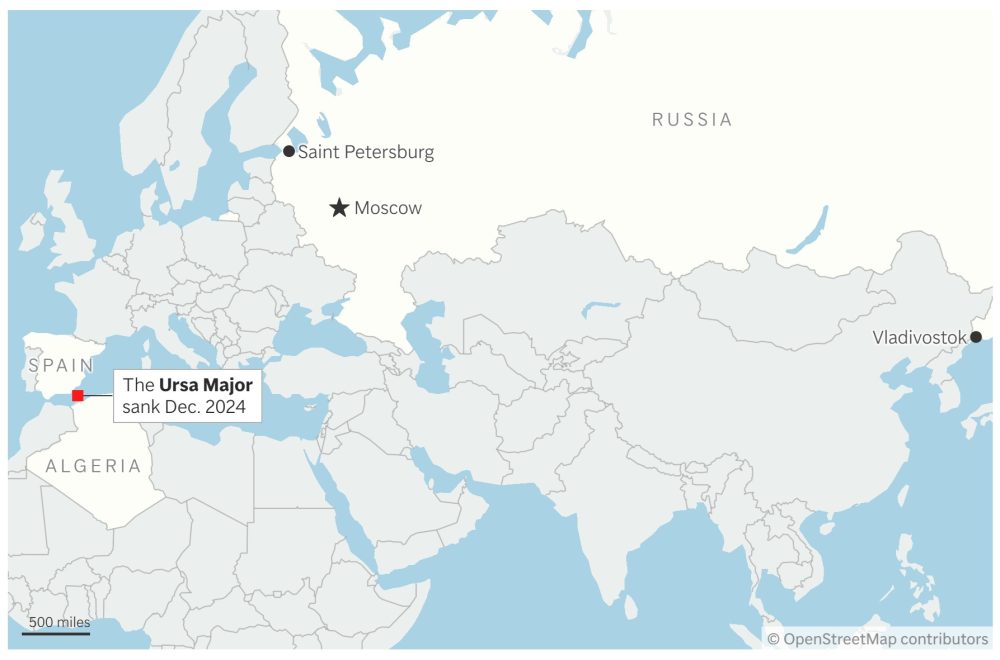
BARCELONA, Spain — Spanish government records reveal that a Russian cargo vessel which went down in Mediterranean waters more than a year ago following engine room explosions was potentially transporting nuclear submarine reactor components.
The vessel Ursa Major went down on December 23, 2024, in waters between Spain and Algeria during what was reported as a voyage from St. Petersburg to Russia’s Pacific port of Vladivostok. Fourteen crew members were rescued by Spanish maritime teams, though two sailors were lost.
According to a written government response to parliamentary opposition members, the vessel’s commanding officer “confessed” the ship was transporting “components for two nuclear reactors similar to those used in submarines.”
The parliamentary document, dated February 23 and first disclosed by CNN on Tuesday, has been reviewed by The Associated Press.
When the vessel sank, Russian state shipping company Oboronlogistika claimed the Ursa Major was the victim of sabotage. The company reported three major explosions struck the vessel near the waterline in what they characterized as a “terrorist attack.”
Oboronlogistika operates under Russia’s defense ministry and faces sanctions from both the United States and European Union due to military connections.
Ship records indicated the vessel was transporting 129 containers, two large cranes, and “two well covers,” according to the government document.
When questioned by Harbor Master officials in Cartagena, Spain, following the rescue, the ship’s captain disclosed that the well covers were actually nuclear components. The captain clarified that no nuclear fuel was aboard the vessel.
Spanish officials explained they could not inspect the ship to verify this information during rescue operations, which prioritized crew safety and searching for missing personnel. The wreckage lies approximately 2,500 meters below the surface.
Kremlin spokesperson Dmitry Peskov stated during a Wednesday press briefing that he had not reviewed reports about the ship’s cargo, adding “there is nothing for us to comment on here.”
KUALA LUMPUR, Malaysia (AP) — Malaysian maritime authorities acknowledge they possess limited authority to prevent vessels linked to Iran from conducting oil transfers in waters off their coastline, a practice that enables Iran to circumvent international sanctions and has sparked increasing international condemnation.
According to United Against Nuclear Iran, a U.S.-based advocacy organization, satellite surveillance has documented 42 ship-to-ship oil transfers involving Iranian vessels in waters approximately 70 kilometers (45 miles) from Malaysia’s southern Johor state since February 28, following U.S. and Israeli military actions against Iran that initiated Middle East hostilities.
Shipping industry groups and UANI have condemned these transfer operations, with the advocacy group claiming Malaysia demonstrates insufficient enforcement measures.
Mohamad Rosli Abdullah, Director-General of Malaysia’s Maritime Enforcement Agency, explains that these transfers frequently occur in international waters beyond Malaysian authority, and these vessels, referred to as a “shadow fleet,” successfully avoid detection through various tactics including disabling tracking equipment, using fraudulent identities, conducting nighttime operations, and utilizing complicated ownership arrangements.
“The issues raised do not align with the actual situation on the ground and do not reflect the operational realities of maritime enforcement conducted by the MMEA,” Mohamad Rosli told The Associated Press.
American officials have previously indicated that Iranian petroleum exports depend significantly on service providers and ship-to-ship transfer operations conducted near Malaysian territorial waters.
This region, designated as the Eastern Outer Port Limits, or EOPL, within the South China Sea, sits along one of the planet’s most heavily trafficked maritime commercial routes and provides a midpoint between Iran and China, which purchases approximately 90% of Iranian petroleum.
Secret open-ocean transfers involving Iranian-connected tankers have continued for years, enabling Tehran to market its crude oil while providing purchasers with reasonable deniability regarding the petroleum’s origin.
Although not prohibited by law, Malaysia discourages unauthorized transfers conducted outside designated zones, where such activities can receive proper oversight since they significantly heighten spill risks, involve deteriorating vessels, and occur far from ports where accidents could receive better containment.
Representatives from both the Iranian Embassy in Kuala Lumpur and the U.S. State Department did not provide immediate responses to requests for comment.
Even with a U.S. naval blockade of Iranian ports beginning in mid-April, UANI continues tracking Iranian-connected tankers still in operation, although the number successfully passing through remains unclear.
As of Tuesday, two dozen Iranian-linked vessels monitored by UANI were positioned or waiting near the EOPL transfer area off Johor, though determining how many departed before the blockade implementation remains uncertain.
“It’s business as usual,” senior UANI adviser Charlie Brown told the AP.
“Because of Malaysia’s inaction, it is facilitating this business model by Iran and China and dark fleet actors,” he said, warning Malaysia is becoming “a facilitator rather than merely a transit point” for illicit activity.
UANI argues that Malaysia could implement environmental regulations requiring advance notification for ship-to-ship transfers, prohibit Malaysian companies from supporting involved vessels, and mandate adequate insurance coverage for accidents and oil spills, among other measures.
However, Mohamad Rosli stated Malaysia has limited options since the “activities are typically conducted outside Malaysian territorial waters, particularly in areas located near maritime boundaries or international shipping routes.”
He emphasized that enforcement follows Malaysian law and applicable international agreements strictly, and authorities have “never compromised nor provided any special treatment or privileges to any country.”
While the transfer location is generally considered part of Malaysia’s broader economic zone, it borders the Riau Archipelago, which belongs to Indonesian territory.
Indonesia’s Foreign Ministry indicated authorities are examining the situation to assess the activity’s legality.
“Indonesia does not permit its territory or maritime zones to be used for unlawful activities,” said Foreign Ministry spokesperson Yvonne Mewengkang.
“At the same time, Indonesia continues to uphold legitimate navigational rights under UNCLOS (the United Nations Convention on the Law of the Sea), including the right of innocent passage, transit passage, and the right of passage through Indonesian maritime zones.”
Mohamad Rosli mentioned that Malaysia had previously seized two vessels this year, one without national registration and another flying a Cameroon flag, participating in transferring 2 million barrels of crude oil within Malaysian territorial waters.
Both vessels received later release on bond for conducting unauthorized oil transfers. Brown noted one vessel was observed earlier this month performing a ship-to-ship transfer of suspected Iranian petroleum in Johor waters.
Malaysian authorities “will continue to strengthen monitoring and enhance strategic cooperation with relevant agencies to ensure that the nation’s maritime domain’s safety and sovereignty are consistently safeguarded,” Mohamad Rosli said.
MANILA, Philippines — Shots were fired Wednesday evening at the Philippine Senate building where Senator Ronald dela Rosa has been taking refuge from law enforcement officials seeking his arrest on International Criminal Court charges, according to an Associated Press reporter and other witnesses present.
The cause of the shooting and whether anyone was wounded remained unclear. Dela Rosa has been under the protection of fellow senators inside the legislative building while Philippine officials attempt to apprehend him for potential transfer to the ICC.
Senate President Alan Cayetano made a brief statement to reporters, confirming that building security informed him of the gunfire before quickly departing without offering additional information.
“The emotions are high here,” Cayetano said. “This is the Senate of the Philippines and we are allegedly under attack.”
The ICC made public its arrest warrant for dela Rosa on Monday. The 64-year-old former national police commander oversaw President Rodrigo Duterte’s drug enforcement campaigns that resulted in the deaths of thousands of suspected low-level offenders.
The warrant, initially issued in November, accuses dela Rosa of murder as a crime against humanity involving “no less than 32 persons” during his tenure leading the national police from July 2016 through April 2018 under Duterte’s administration.
Dela Rosa has pledged to challenge the ICC warrant through all available legal channels. On Wednesday evening, he urged his supporters to come to the Senate complex to help block what he described as his imminent detention.
When National Bureau of Investigation officers attempted to take dela Rosa into custody Monday, he escaped to the Senate chamber and requested assistance from colleague senators. Cayetano announced at that time he would hold the government agents in contempt.
WASHINGTON — Wholesale inflation surged dramatically last month, with producer prices climbing 6% compared to the same period last year, marking the steepest annual increase since December 2022. The escalating 10-week conflict involving Iran has driven energy costs substantially higher, forcing businesses to consider passing these elevated expenses on to consumers.
Wednesday’s report from the Labor Department revealed that the producer price index, which measures inflation before it reaches retail customers, jumped 1.4% in April alone — the largest single-month increase since March 2022.
Energy costs experienced dramatic increases, rising 7.8% between March and April and climbing 22.7% year-over-year. Gasoline prices skyrocketed 15.6% from the previous month, while diesel fuel, crucial for transportation and shipping, surged 12.6%.
When removing unpredictable food and energy prices, core producer costs still increased 1% monthly and 5.2% compared to April 2025.
These figures significantly exceeded economic forecasts and could reshape the Federal Reserve’s approach to combating inflation.
The price increases come as Americans already struggle with elevated living costs. Economic affordability is expected to play a major role when voters head to polling stations on November 3 to decide whether President Donald Trump’s Republican Party will retain control of both congressional chambers.
“This report will set off alarm bells at the Fed and add fuel to the political conversation about affordability,” commented Carl Weinberg, chief economist at High Frequency Economics. “The results are so far above expectations that this update will set off alarm bells in the financial markets, too.”
The conflict escalated when the United States and Israel launched attacks on Iran on February 28, prompting Tehran to block access to the Gulf of Hormuz, a critical waterway handling one-fifth of global oil and liquefied natural gas shipments. This action sent energy prices soaring.
Producer price data provides early insight into potential consumer inflation trends. Economists closely monitor these figures because certain components, particularly healthcare and financial services measurements, influence the Fed’s preferred inflation metric — the Commerce Department’s personal consumption expenditures price index.
Earlier this week, the Labor Department reported that its closely monitored consumer price index increased 3.8% last month compared to April 2025, representing the largest annual jump in over three years as energy costs continued climbing.
Major retailers are feeling the pressure. Walmart, known for its commitment to low prices, implemented unusual price increases last year and may face intensifying pressure for additional hikes. The company is not facing this challenge alone.
Whirlpool, manufacturer of KitchenAid and Maytag appliances, announced this month that quarterly revenue fell nearly 10% and described the war’s impact as creating a “recession-level industry decline” that has damaged consumer confidence. The company implemented a 10% price increase in April, its steepest in ten years, and plans an additional 4% increase for July.
Previously, the company had absorbed higher costs rather than burden customers, but this strategy is changing.
Prior to the Iran conflict, the Federal Reserve was anticipated to reduce its benchmark interest rate in 2026. However, officials have adopted a more cautious stance, waiting to assess the conflict’s duration and whether elevated energy prices will spread to other sectors, potentially triggering broader inflation.
President Trump has criticized the Fed and outgoing chair Jerome Powell for declining to cut rates to stimulate economic growth. Kevin Warsh, Trump’s nominee to replace Powell, awaits Senate confirmation this week, though it remains uncertain whether Warsh would pursue rate reductions given war-related uncertainties or successfully convince fellow committee members to support such measures.
NEW YORK — The Open Society Foundations, established by billionaire philanthropist George Soros, announced Wednesday a $30 million initiative to combat religious hatred targeting Jewish and Muslim communities over the next three years.
The human rights organization made the commitment to build stronger interfaith alliances and safeguard vulnerable communities as religious violence escalates globally, particularly amid tensions surrounding the Israel-Hamas conflict and recent ceasefire developments.
Data from Tel Aviv University’s latest annual report shows that violence against Jewish people reached unprecedented levels last year — the worst in more than 30 years — including incidents like the December shooting during Hanukkah festivities in Australia. Simultaneously, anti-Muslim sentiment has surged, with some congressional Republicans making inflammatory statements suggesting Muslims “don’t belong in American society.”
Open Society Foundations President Binaifer Nowrojee addressed the crisis in a statement, saying: “The deep injustices occurring in the Middle East are fueling indiscriminate prejudice, dehumanization, and violence directed against both Muslims and Jews. Entire communities cannot be targeted simply because of their religion. Bigotry and intolerance in any form must be called out and confronted.”
This represents the organization’s most prominent public initiative since reports emerged last fall that federal prosecutors were exploring potential charges against the foundations. Former President Donald Trump specifically mentioned Soros while directing law enforcement to investigate what he termed “left-wing terrorism” — allegations the organization has consistently refuted while emphasizing their democratic mission.
Alex Soros, who assumed control of the family foundations in late 2022, brings personal perspective to the cause as both the child of a Holocaust survivor and spouse of a Muslim American. The organization noted that George Soros, despite his prominent role as a progressive political donor, frequently becomes the target of conspiracy theories that transform his influence into antisemitic narratives about shadowy control.
“At a moment like this we need to stand together and act,” Alex Soros stated in a social media video. “This investment is about keeping people safe and pushing back against hate.”
The funding will support educational programs addressing discrimination, empower community leaders who foster trust between groups, and defend free speech protections. Several organizations have already received grants, while others can apply for support. Beneficiaries include the Jewish Social Justice Roundtable, the Jewish Council for Public Affairs, and the Nexus Project. Shoulder to Shoulder, an interfaith coalition training religious leaders to combat Islamophobia, leads anti-Muslim discrimination efforts.
Amy Spitalnick, who heads the Jewish Council for Public Affairs, praised the comprehensive approach addressing both issues simultaneously. The funding will expand JCPA’s collaborative work with Muslim and Arab American organizations, relationships that have grown stronger since the Israel-Hamas war began. She highlighted joint programs including a fellowship and Capitol Hill event on Jewish-Muslim cooperation developed with the Muslim Public Affairs Council.
Spitalnick stressed the interconnected nature of hatred, explaining that normalizing Islamophobia, racism, and broader extremism creates conditions where antisemitism thrives.
“We need funders and others to recognize that treating any of these issues in silos doesn’t get at the root cause, doesn’t get at the broader resiliency we need right now,” Spitalnick explained. “The fact that Jewish safety requires Muslim safety, that Muslim safety requires Jewish safety.”
The foundations did not specify their definition of antisemitism — a contentious topic on college campuses and in state governments where debates continue over whether Israeli criticism constitutes anti-Jewish hatred. The selected grant recipients suggest a more flexible interpretation than organizations like the Anti-Defamation League, which publishes yearly antisemitic incident reports and considers anti-Zionist views as antisemitic.
The Nexus Project, by contrast, advocates for antisemitism definitions that exclude criticism of Israeli government policies. When the National Education Association considered restricting ADL educational materials, Spitalnick emphasized that “one does not need to align with the ADL on every issue.”
Andrés Spokoiny, who leads the Jewish Funders Network, estimates philanthropic organizations have invested hundreds of thousands of dollars in antisemitism prevention efforts, regardless of definitional differences. Other major initiatives include New England Patriots owner Robert Kraft’s $25 million “Stand Up to Jewish Hate” advertising campaign launched in March 2023 through his Foundation to Combat Antisemitism.
However, continued antisemitism has prompted some funders in Spokoiny’s network to question their strategies.
“There’s a lot of perplexity around what actually works,” he observed. “So many funders are very frustrated.”
A leading executive at JPMorgan Chase has indicated the American banking giant would be willing to meet with France’s far-right National Rally party as the group prepares for the 2027 presidential race.
Matthieu Wiltz, who serves as co-chief executive for JPMorgan’s operations across Europe, the Middle East and Africa, made the comments during a conference in Paris on Tuesday when reporters asked about potential engagement with the National Rally.
“We try to have dialogue with all of (the political parties). I’m happy to talk to anyone,” Wiltz stated. “I really want to explain why it’s important to have strong banks and strong European corporates, and why that would benefit France in the long term — and the European Union as well.”
The statement represents a notable shift in corporate strategy toward the National Rally, which major French businesses have historically kept at arm’s length. However, with polling data indicating the party could potentially secure victory in 2027, companies are now attempting to better understand and potentially shape its economic policies.
This corporate outreach has already begun in earnest. National Rally president Jordan Bardella held discussions with France’s top employer organization last month. Additionally, sources report that Marine Le Pen, the party’s longtime figurehead and three-time presidential contender, attended a Paris dinner gathering in April that included executives from major French companies such as oil giant TotalEnergies and luxury conglomerate LVMH.
Nevertheless, the National Rally has not yet secured widespread support from France’s business community, where leaders remain wary of the party’s evolving economic positions.
Current polling shows the party as a serious competitor for power, though questions persist about Le Pen’s eligibility to run. She faces a 2025 embezzlement conviction that bars her from seeking office for five years, with an appeal decision expected in July.
Wiltz’s comments also addressed JPMorgan’s European strategy following Britain’s departure from the European Union. The bank has been working to maintain operations in both London and Paris since Brexit took effect.
“Brexit happened. We live in a world now where we have to be balanced between the UK and what we have here in France and the EU,” he explained.
“As it stands today, honestly, there is nothing that would push us to move outside of France. France is still very appealing.”
JPMorgan currently maintains a workforce of more than 1,000 employees in Paris and has been expanding its French operations in recent years, including developing plans for additional office space to accommodate growth.
Health officials in southwestern France have temporarily barred passengers and crew members from leaving a cruise vessel docked in Bordeaux following reports of numerous gastroenteritis cases aboard the ship.
The Ambassador Cruise Line ship Ambition, carrying approximately 1,700 people, arrived from Belfast and Liverpool before being held at port as a safety precaution. French television reports indicate one passenger has died during the voyage.
Regional health authorities emphasized that this apparent stomach illness outbreak bears no connection to a separate hantavirus incident that occurred on the luxury vessel Hondius during its journey from Argentina to the Canary Islands.
Ambassador Cruise Line announced through social media that they have put stronger cleaning and safety measures in place on the Ambition. “Once clearance is granted, guests will be permitted to disembark,” the company stated.
Officials described the passenger restriction as temporary while they await results from medical examinations.
Stomach-related illnesses frequently occur on cruise vessels. The Centers for Disease Control and Prevention has already documented four separate outbreaks this year on cruise ships, including two cases of E.coli and two instances of norovirus.
Gastroenteritis, commonly known as stomach flu, primarily causes nausea and loose bowel movements. While highly transmissible, the condition typically resolves without serious complications, though severe cases may result in fluid loss requiring medical attention.
This illness differs significantly from hantavirus, which carries a much higher death rate but rarely spreads between people except through prolonged direct contact.
A major American spirits company has announced its latest investment targeting younger drinkers, backing a canned cocktail brand that features a popular social media personality as an investor.
Sazerac, the company behind Buffalo Trace Bourbon, revealed Wednesday it has made a financial commitment to SIPMARGS, a sparkling margarita brand that counts TikTok influencer Alix Earle among its backers. The companies have also established an exclusive distribution partnership, though financial details of the investment remain undisclosed.
This move represents Sazerac’s continued effort to capture Generation Z consumers through strategic partnerships. The company recently announced backing for Kendall Jenner’s 818 Tequila brand and has acquired multiple ready-to-drink brands including BuzzBallz, recognized for its distinctive round containers, and Dirty Shirley.
Meanwhile, Sazerac has been pursuing larger acquisition targets. The privately-owned company submitted a roughly $15 billion offer last month to acquire Brown-Forman, the maker of Jack Daniel’s whiskey, but saw that proposal turned down this week. Brown-Forman had previously been in merger discussions with France-based Pernod-Ricard, though those talks have concluded.
SIPMARGS launched in 2020 and secured $3 million in funding this year from various investors, including Earle and Palm Tree Crew, a venture capital firm co-established by musician Kygo.
Earle, age 25, commands approximately 8.5 million followers on TikTok and has previously invested in beverage companies such as Poppi and GORGIE.
“We’ve built an incredibly engaged community around SIPMARGS, but partnering with Sazerac gives us the infrastructure and distribution power to reach consumers on a completely different level,” Earle stated. “It allows us to expand nationally, grow faster, and compete alongside some of the biggest names in the beverage industry while still staying true to what makes us special.”
The Goldring family owns Sazerac, which dates back to the 1850s and reports annual net sales exceeding $6 billion. The company’s portfolio includes more than 500 brands such as Svedka Vodka and Fireball Cinnamon Whiskey.
Sazerac has maintained an active acquisition strategy, purchasing approximately 60 brands over the past ten years.
Delaware anglers planning weekend surf fishing trips will need to book ahead starting May 23, as the state’s five busiest drive-on fishing beaches implement mandatory reservation systems for weekends and holidays.
The reservation requirement affects only the most heavily used coastal fishing spots, while seven additional drive-on locations will continue operating without advance booking needs thanks to policy adjustments made in 2025.
The new system aims to manage crowding at Delaware’s premier surf fishing destinations during peak times when angler traffic is heaviest.
Worcester County officials have issued an advisory regarding a scheduled water service interruption that will affect residents living on East Hopetown Lane in West Ocean City on May 15th.
The planned outage notice was posted by county administrators on May 13th to provide advance warning to customers who will experience temporary loss of water service during the maintenance period.
County officials have not yet released specific details about the duration of the service interruption or the exact nature of the work being performed that necessitates shutting off water to the area.
Residents on East Hopetown Lane are advised to prepare for the temporary water outage by storing water for essential needs during the scheduled maintenance window.
Motorists traveling on Cave Neck Road should plan for potential delays as construction crews continue work that requires intermittent lane closures.
The affected stretch runs between Front Street and Hudson Road, where drivers may encounter temporary lane restrictions throughout the day.
According to DelDOT officials, the construction-related lane closures will continue until 6 PM today. Drivers are advised to allow extra travel time and exercise caution when passing through the work zone.
The department recommends seeking alternate routes when possible to avoid potential traffic backups in the area.
ANNAPOLIS, MD – A longtime Baltimore Orioles executive has taken on a new role overseeing plant health and pest control for the state of Maryland.
Agriculture Secretary Kevin Atticks revealed Monday that Nicole Sherry has been named assistant secretary for Plant Industries and Pest Management at the Maryland Department of Agriculture. The appointment, announced on May 13, 2026, brings Sherry’s decades of field management expertise from professional baseball into state government.
Sherry’s career with the Orioles organization spanned 23 years, where she most recently held the position of senior director of field operations. Her extensive background in turf management and field maintenance will now be applied to broader agricultural challenges across Maryland.
The Maryland Department of Agriculture oversees plant health regulations, pest control programs, and agricultural inspection services throughout the state.
The basketball world is mourning the loss of Memphis Grizzlies forward Brandon Clarke, who passed away at the age of 29. The team, his representation agency, and the NBA have all confirmed his death.
According to sources close to the investigation, medical examiners will conduct an autopsy to establish the precise cause of Clarke’s passing. His representatives at Priority Sports expressed their grief on social media, stating they were “beyond devastated” by the tragic news. Clarke had faced legal troubles recently, having been taken into custody on April 1st in Arkansas on charges of speeding and controlled substance possession before posting bond the following day. The Gonzaga product was selected 21st overall by Oklahoma City in the 2019 draft and earned All-Rookie honors in 2020, though injuries restricted him to just 72 appearances over his final three seasons out of a possible 246 games.
In playoff action, Victor Wembanyama delivered a dominant performance to help the San Antonio Spurs defeat the Minnesota Timberwolves 126-97, putting San Antonio one win away from the Western Conference finals with a 3-2 series advantage. The young star recorded 27 points, 17 rebounds, and three blocks in what served as redemption following his first career ejection. Keldon Johnson contributed 21 points, while De’Aaron Fox added 18 and Stephon Castle chipped in 17 for the Spurs. San Antonio can secure their spot against Oklahoma City with a Game 6 victory this Friday in Minneapolis. Minnesota’s Anthony Edwards managed 20 points despite being held to just eight in the opening half.
Los Angeles Dodgers superstar Shohei Ohtani will sit out the next two games as the designated hitter while dealing with an offensive struggle. Despite breaking an 11-game home run drought with his second long ball in 24 contests during a 6-2 victory over San Francisco, manager Dave Roberts announced Ohtani won’t appear in Wednesday’s lineup when he takes the mound, nor Thursday’s game. Ohtani finished 2-for-4 with two runs, one RBI, and a walk, while his teammates managed just two hits in 25 at-bats. This marks Ohtani’s inaugural complete season as a dual-threat player with the Dodgers.
The Philadelphia 76ers have dismissed president Daryl Morey while retaining head coach Nick Nurse following their Eastern Conference semifinal sweep at the hands of the New York Knicks. Morey’s six-year tenure ended after another disappointing postseason, prompting the organization to seek new leadership for their basketball operations. Former Golden State Warriors executive Bob Myers will spearhead the search for Morey’s successor and oversee operations temporarily. Under Morey’s leadership, Philadelphia posted a 270-212 regular season record but struggled in playoff situations with a 28-26 mark, never advancing beyond the conference semifinals.
A Florida judge has ordered that Tiger Woods’ prescription medication records be released to prosecutors in connection with his March DUI arrest. The ruling came after a brief four-minute court session in Martin County, where an agreement was reached between Woods’ legal team and prosecutors. The subpoena requests all prescription drug documentation for the golf legend from January through March. Woods’ lawyer conceded that privacy rights have limitations and acknowledged prosecutors presented a strong case for accessing the records. In exchange, the defense secured a protective order restricting who may view the sensitive medical information.
World number one golfer Scottie Scheffler aims to break a pattern of second-place finishes as he defends his PGA Championship title. Despite his dominance on tour, Scheffler has recorded three straight runner-up results since the Masters. “It’s a little bittersweet but at least he knows he’s playing well,” Scheffler commented on his recent performances. Victory would place him alongside Brooks Koepka and Tiger Woods as the only players to capture consecutive PGA Championships in the stroke play era. Standing in his path are golf’s strongest major championship field and Aronimink’s challenging layout, which Xander Schauffele characterized as having “diabolical greens.”
Pavel Dorofeyev netted his second goal of the contest 4:10 into overtime, lifting the Vegas Golden Knights to a 3-2 triumph over the Anaheim Ducks and a 3-2 series lead. The Golden Knights need just one more victory to reach the Western Conference final, with Game 6 scheduled for Thursday in Anaheim. Vegas hasn’t appeared in a conference final since capturing the Stanley Cup in 2023. The Ducks, making their first postseason appearance in eight years, will attempt to force a decisive Game 7 back in Las Vegas this Saturday. Tomas Hertl ended a 29-game goalless streak dating to the regular season and now has two goals in two playoff games. Vegas goaltender Carter Hart made 34 saves in the victory.
Zach Benson celebrated his 21st birthday in style, scoring the game-winning goal on a third-period power play as the Buffalo Sabres defeated the Montreal Canadiens 3-2 in Game 4, evening their Eastern Conference semifinal series. Benson received a pass from Josh Doan in the slot, controlled the puck with his skate, and fired a backhand past goalie Jakub Dobes at the 4:41 mark of the final period. Game 5 returns to Buffalo on Thursday, with the series victor advancing to face Carolina in the conference final. Tage Thompson equalized for Buffalo in the second period with an unusual goal and also recorded an assist. Defenseman Mattias Samuelsson opened the scoring while Doan contributed two assists. Ukko-Pekka Luukkonen replaced Alex Lyon in net and stopped 28 shots.
Major League Baseball players and team owners have commenced collective bargaining discussions more than six months before their current agreement expires on December 1st. The negotiations, expected to be lengthy and contentious, will likely feature management’s push for a salary cap system that the players’ union has consistently rejected. The initial two-hour meeting took place at the MLB Players Association offices, located just a short walk from league headquarters in Manhattan’s Rockefeller Center. Both sides used the session to present their perspectives on the sport’s current state and financial landscape, though no formal proposals were exchanged.
Drivers traveling through a local intersection should plan for delays this morning due to ongoing construction activity.
Work crews are operating at the intersection where Lochmeath Way meets Brookfield Drive, creating slower traffic conditions for commuters and other motorists passing through the area.
According to DelDOT traffic reports, the construction-related delays are expected to continue until 11:00 AM today.
Drivers are advised to allow extra travel time or consider alternate routes if possible to avoid the affected intersection during the morning hours.
Delaware Department of Transportation crews are conducting construction work that has resulted in a temporary lane closure on a busy stretch of U.S. Route 13.
The right lane of northbound Route 13 is currently blocked to traffic from Midstate Road to Canterbury Road while the work is being performed.
DelDOT officials indicate the lane restriction will remain in place until 1 PM today, after which normal traffic patterns are expected to resume.
Motorists traveling through the area should expect potential delays and are advised to use caution when passing through the construction zone.
Motorists traveling through Sussex County should plan for potential delays on Walt Messick Road today due to ongoing construction work.
The Delaware Department of Transportation reports that the right lane of eastbound Walt Messick Road at Vernon Road is currently closed to traffic. The closure affects the stretch of roadway between Farmington Road and Whitelysburg Road.
According to DelDOT, the lane restriction is scheduled to remain in place until 4 PM today. Drivers are advised to use caution when traveling through the work zone and allow extra time for their commute.
The construction activity is causing traffic to merge into the left lane in the affected area. Officials recommend considering alternate routes if possible to avoid potential backups during peak travel times.
Albrecht Weinberg, a centenarian who lived through the horrors of Nazi concentration camps and dedicated his later years to sharing his testimony, passed away Tuesday in Leer, Germany, at the age of 101, according to local officials.
The survivor had experienced unimaginable suffering during World War II, imprisoned in multiple concentration camps including Auschwitz, Mittelbau-Dora, and Bergen-Belsen, and forced to endure three death marches. Weinberg’s passing occurred just weeks following his 101st birthday celebration and the debut of a film documenting his experiences, titled “Es ist immer in meinem Kopf” (“It Is Always in My Head”), which attracted hundreds of viewers.
Weinberg entered the world on March 7, 1925, in Rhauderfehn, a community close to Leer. As a young man, he was taken into custody for forced labor and managed to survive some of the most infamous facilities in the Nazi camp system. The Holocaust claimed the lives of most of his relatives, including siblings Dieter and Friedel, based on records from the Claims Conference’s survivor testimony project.
According to Leer Mayor Claus-Peter Horst’s public statement, Weinberg devoted his remaining years to continuously sharing his survival story. “Since returning from New York to his East Frisian home 14 years ago, Albrecht recounted tirelessly and with incredible energy his terrible experiences during the Nazi era and warned again and again against forgetting,” Horst said.
During Germany’s struggle with both the declining population of living Holocaust witnesses and rising concerns about far-right political movements, Weinberg established himself as a regular presence in educational institutions and community events. Though he was honored with Germany’s Order of Merit in 2017, he made the decision in 2025 to return the award following a parliamentary migration vote that received backing from the far-right Alternative for Germany party (AfD). This legislative action shattered a decades-long postwar tradition of avoiding dependence on far-right support for parliamentary majorities.
Israel’s ambassador to Germany, Ron Prosor, honored Weinberg’s memory, describing him as “a bridge—between past and present, between pain and hope, between the dead he could never forget and the young people whom he encouraged to seek the truth,” according to The Associated Press.
According to a Reuters investigation, Saudi Arabia conducted secret airstrikes on Iranian territory in late March, marking a retaliatory response to attacks the kingdom endured during recent regional hostilities, four sources told the news agency.
The military operations represent the first documented instance of Saudi forces striking targets within Iran’s borders.
A source familiar with the situation described the military action as “tit-for-tat strikes in response to attacks Saudi Arabia had suffered.”
The Reuters investigation revealed that these strikes exposed vulnerabilities in Saudi Arabia’s defensive capabilities, despite the nation’s strong military partnership with the United States and its longstanding dependence on American security guarantees. According to the report, hostile attacks during the conflict managed to breach the U.S. protective security framework safeguarding the Gulf nation.
Sources indicated that Saudi officials notified Iran following the completion of their military operations. Reuters documented that extensive diplomatic communications ensued, accompanied by Saudi threats of potential further military action. These diplomatic exchanges ultimately resulted in mutual agreements designed to lower tensions between the rival nations. This informal de-escalation pact reportedly became effective approximately one week prior to the April 7 ceasefire agreement reached between Washington and Tehran.
The revelation of Saudi military action emerged one day following The Wall Street Journal’s disclosure that the United Arab Emirates had similarly conducted strikes within Iranian territory during the same conflict period. The publication reported that the UAE operation took place in early April, coinciding with President Trump’s ceasefire declaration, though the exact timing relative to the announcement remained unclear.
During the conflict, Saudi Arabia and the United Arab Emirates employed contrasting approaches, Reuters found. While Riyadh worked to prevent further escalation and kept diplomatic channels open with Iranian representatives, including Iran’s ambassador stationed in Riyadh, the UAE pursued a more aggressive stance focused on punishing Tehran.
Israeli Eurovision contestant Noam Bettan secured his place in Saturday’s grand final following Tuesday’s semifinal performance in Vienna, though his appearance sparked both enthusiastic support and vocal opposition from audience members.
Bettan performed his entry “Michelle” as the tenth act of the evening, ultimately earning enough votes to advance alongside nine other nations: Greece, Finland, Belgium, Sweden, Moldova, Serbia, Croatia, Lithuania, and Poland.
The performance was marked by disruptions, with venue security removing multiple spectators who engaged in anti-Israel demonstrations. Local authorities escorted out one protester who yelled “genocide” during Bettan’s time on stage.
Speaking to Israeli media afterward, Bettan acknowledged the hostile reception but remained focused. “The calls were really, really loud. But I focused on the performance,” Bettan explained following his stage exit. He continued, “I searched with my eyes for the Israeli flags in the crowd. That strengthened me.”
Upon learning of his advancement to the final round, Bettan expressed gratitude to his supporters, stating he was thankful “to all the people of Israel, to all the Jews in the world, and to everyone who voted for us.”
“Wow, I had an amazing performance, I enjoyed every moment, see you in the final. I truly felt like I was singing for the State of Israel. I was simply channeling the people and felt like I was a conduit,” he added.
Meanwhile, Eurovision organizers issued a warning to Israel’s Kan public broadcaster regarding an online promotional campaign supporting Bettan, citing updated competition regulations designed to restrict external promotional efforts.
Eurovision director Martin Green revealed that officials quickly contacted the Israeli delegation after discovering online videos featuring Bettan. “Within 20 minutes, we had contacted the KAN delegation to ask them to immediately stop any distribution of the videos and remove them from any platforms where they had been published. They immediately acted to do this,” Green stated.
When questioned by The Times of Israel, Kan responded that it “is following all of the rules of the competition.” A delegation insider noted that contestants from Malta and Romania had conducted similar promotional campaigns this year.
BRUSSELS (AP) — Palestinian musician Bashar Murad took the stage at an elegant Brussels venue Tuesday night, delivering an emotional rendition of Nina Simone’s “I Wish I Knew How It Would Feel to Be Free” in both English and Arabic. The crowd responded with thunderous applause as the last notes echoed through the hall.
Murad’s performance was part of a growing movement of alternative concerts protesting Israel’s inclusion in this week’s Eurovision Song Contest in Vienna. Critics are voicing opposition to Israel’s participation amid its ongoing military operations in Gaza and surrounding regions.
This year’s Eurovision, celebrating its 70th anniversary with the theme “United by Music,” has seen five nations — Spain, Ireland, the Netherlands, Slovenia and Iceland — refuse to participate. Despite the boycotts, 35 countries are still competing, with ten nations including Israel and frontrunner Finland securing spots in Tuesday’s semifinals.
The “United for Palestine” concert in Brussels brought together European performers with Palestinian musicians like Murad, who nearly represented Iceland in the 2024 competition.
“It’s always amazing to be in the same room with people who believe in the same things as you and people who believe that we can’t just let the show go on,” Murad explained.
Murad’s parents, including his father who helped found the prominent Palestinian band Sabreen, had previously tried without success to get Palestine admitted to Eurovision in 2007 through the European Broadcasting Union in Geneva.
Israel has been a Eurovision participant since 1973, claiming victory four times and maintaining strong cultural ties to the annual competition.
However, Israel’s continued involvement has generated increasing controversy as international anger mounts over casualties in Gaza, the West Bank, Lebanon and Iran. Mass demonstrations have swept from Rome to Madrid, with European Union officials considering additional sanctions.
“We have to create an alternative because the participation of Israel is problematic,” stated Katrien De Ruysscher, who leads activist organization SOS Gaza. Her group partnered with rights organization 11.11.11 to coordinate the Brussels gathering.
Previous Eurovision events in Malmo, Sweden in 2024 and Basel, Switzerland the year before witnessed significant pro-Palestinian demonstrations demanding Israel’s removal. Allegations also surfaced that Israel’s government violated competition guidelines to assist their representative.
Contest organizers have strengthened voting procedures this year following claims of ballot manipulation, though participants continue to be evaluated by national panels and global audiences.
The European Broadcasting Union rejected calls to exclude Israel, prompting the five-nation boycott.
Amnesty International’s secretary general Agnès Callamard argued Eurovision should remove Israel just as it did with Russia in 2022 following Moscow’s invasion of Ukraine.
“Songs and sequins must not be allowed to drown out or distract from Israel’s atrocities or Palestinian suffering,” Callamard declared.
Similar protest concerts are occurring across Austria, Germany, Slovenia, Italy and Spain, according to Brussels event organizers.
Spanish public television, which traditionally broadcasts Eurovision, will instead air an alternative program Saturday evening called “La Casa de la Música.” The special will honor the network’s 70-year history with performances by 20 established and emerging artists, including Benidorm Fest winners who would typically advance to Eurovision.
Despite these alternative events, none will match Eurovision’s massive reach — the contest attracted 166 million viewers in 2025 and maintains its devoted fanbase.
Murad expressed hope that counter-programming might encourage reflection on Eurovision’s founding principles of musical unity.
“The purpose of these alternative programs that are happening is to remind Eurovision what it’s actually about and to try to hopefully bring it back, to correct its course, and make it actually live up to the things that it claims to be about,” he said. “A lot of people in the world feel that the competition has lost its meaning.”
President Donald Trump touched down in Beijing Wednesday evening for critical discussions with Chinese President Xi Jinping during a turbulent period marked by global concerns over warfare, trade disputes, and artificial intelligence developments.
Trump’s visit comes during a challenging period for his administration, with domestic approval ratings suffering due to the ongoing U.S.-Israel conflict with Iran and subsequent inflationary pressures from that war. The president aims to secure victory through new agreements for China to purchase additional American agricultural products and aircraft, stating he plans to discuss trade matters with Xi “more than anything else.”
Upon Air Force One’s landing, Chinese officials rolled out a red carpet welcome for the American president.
Chinese Vice President Han Zheng, Washington ambassador Xie Feng, executive foreign affairs vice minister Ma Zhaoxu, and U.S. Beijing envoy David Perdue were scheduled to receive Trump, the White House confirmed.
The elaborate welcome featured approximately 300 Chinese young people, along with a military honor guard and band performance.
The leaders will conduct bilateral discussions and attend a formal state dinner during the visit.
Trump’s team hopes to launch discussions for creating a bilateral Board of Trade with China to resolve ongoing disputes between the nations. This proposed board could help avoid future trade conflicts like the one sparked last year following Trump’s tariff increases, which China responded to by restricting rare earth mineral exports. Those tensions led to a temporary ceasefire agreement last October.
While Trump has no scheduled public appearances Wednesday following his arrival, he’s planned for multiple meetings with Xi Thursday and Friday.
Chinese Vice Premier He Lifeng and U.S. Treasury Secretary Scott Bessent conducted what Chinese state television CCTV described as “candid, in-depth and constructive” discussions Wednesday regarding economic and trade concerns while exploring expanded cooperation opportunities.
The trade negotiations between the world’s largest economies took place in South Korea just hours before Trump’s Beijing arrival.
According to CCTV, the talks followed important agreements previously reached by both nations’ leaders and emphasized mutual respect, peaceful coexistence, and mutually beneficial cooperation principles.
The White House initially indicated Huang’s schedule prevented his participation, but later changes allowed him to join the delegation.
His last-minute inclusion sparked widespread online discussion and humorous content across Chinese social media platforms.
Users on Xiaohongshu and Weibo created and shared doctored photos showing Huang gripping Air Force One’s exterior with his hands.
A White House official confirmed these prominent American business leaders from technology and agriculture sectors received invitations to accompany Trump’s China trip:
1. Elon Musk – Tesla and SpaceX CEO 2. Tim Cook – Apple CEO 3. Kelly Ortberg – Former Rockwell Collins CEO 4. Jensen Huang – Nvidia President and CEO 5. Larry Fink – BlackRock Chairman and CEO 6. Stephen Schwarzman – Blackstone Chairman, CEO and co-founder 7. Brian Sikes – Cargill Chairman and CEO 8. Jane Fraser – Citi Chairman and CEO 9. Jim Anderson – Coherent CEO 10. H. Lawrence Culp – GE Aerospace Chairman and CEO 11. David Solomon – Goldman Sachs Chairman and CEO 12. Jacob Thaysen – Illumina CEO 13. Michael Miebach – Mastercard CEO 14. Dina Powell McCormick – Meta President and Vice Chairman 15. Sanjay Mehrotra – Micron Chairman, President and CEO 16. Cristiano Amon – Qualcomm President and CEO 17. Ryan McInerney – Visa CEO
Iran’s control over the Strait of Hormuz continues strangling global energy distribution while causing worldwide economic hardship, though the Islamic Republic’s domestic economic struggles are challenging its capacity to sustain the conflict and resist Washington’s pressure.
Iranian citizens face skyrocketing costs for food, medical supplies, and other necessities. The nation has simultaneously experienced massive unemployment and business failures due to strike-related damage to critical industries and the government’s extended internet shutdown.
“The economic cost of the war and the U.S. naval blockade has been very substantial and unprecedented for Iran,” explained Hadi Kahalzadeh, an Iranian economist and Brandeis University research fellow.
However, Kahalzadeh noted that Iran has survived decades of economic pressure and sanctions, and its adaptive capabilities remain intact.
The International Monetary Fund projects Iran’s economy will contract by approximately 6 percentage points over the coming year.
SALISBURY, Md. – Salisbury University’s baseball program has earned a coveted NCAA Tournament selection according to the latest Roadie Joes Rankings released this Wednesday.
The rankings, published for the second Wednesday of May, highlight the Sea Gulls’ successful season that has culminated in tournament qualification. The achievement marks a significant milestone for the university’s baseball program as they prepare for postseason competition.
The Roadie Joes Rankings serve as a key indicator for NCAA Tournament selections and provide insight into team standings across collegiate baseball programs nationwide.
Delaware Department of Transportation officials are alerting drivers about ongoing construction work affecting traffic flow on Cave Neck Road.
The roadwork is causing periodic lane restrictions along the stretch of Cave Neck Road running from Front Street to Hudson Road. These lane closures will remain in effect until 6 PM today.
Motorists traveling through the area should expect potential delays and plan alternate routes if possible during the construction period.
Israeli chip manufacturer Tower Semiconductor exceeded Wall Street expectations Wednesday, projecting stronger-than-anticipated second-quarter earnings while announcing $1.3 billion in contracts to produce specialized chips for artificial intelligence data centers through 2027.
The contract chipmaker’s stock surged more than 17% in pre-market trading after reporting robust demand for its analog and mixed-signal processors, driven by increased investment in AI infrastructure and data center technology.
Tower Semiconductor manufactures integrated circuits for diverse sectors including automotive, industrial applications, consumer electronics, and communications technology.
The company projected second-quarter earnings of $455 million, surpassing Wall Street analysts’ consensus estimate of $436.4 million based on LSEG data.
Beyond the revenue forecast, Tower Semiconductor revealed it secured silicon photonics contracts valued at $1.3 billion for 2027 delivery and collected $290 million in upfront customer payments to guarantee manufacturing capacity. The company noted that clients have pledged additional orders for 2028, with further advance payments scheduled by January 2027.
“We are confident in our path toward achieving our financial model targets of $2.8 billion in annual revenue and $750 million in net profit in 2028,” CEO Russell Ellwanger said.
Tower Semiconductor’s first-quarter performance showed a 15% increase in revenue reaching $414 million, exceeding projections of $411 million. The company’s adjusted earnings per share hit 65 cents, outperforming analyst expectations of 56 cents.
However, Tower faces legal challenges as competitor GlobalFoundries filed a lawsuit in March, claiming the Israeli manufacturer violated 11 patents connected to smartphone and electronics chip production processes.
Ukrainian armed forces announced Wednesday they had successfully targeted multiple Russian energy facilities, including an oil terminal, refinery, and gas processing facility, as the country resumes its campaign against Russian energy infrastructure following a brief pause in operations.
According to Ukraine’s General Staff and drone forces commander Robert Brovdi, who posted updates on Telegram, the attacks targeted the Tamanneftegas terminal in Russia’s Krasnodar region and a gas processing facility in Astrakhan, both located in southern Russia.
The operations resulted in fires breaking out at fuel storage reservoirs, military officials reported.
Ukrainian forces also targeted a refinery facility in Yaroslavl, situated northeast of Moscow, with strikes hitting primary oil processing units, according to military statements.
These attacks are part of Ukraine’s ongoing strategy to target Russian petroleum facilities, as Moscow relies on income from its substantial oil and gas resources to fund its military operations in the conflict that has now entered its fifth year.
President Donald Trump and Chinese President Xi Jinping are preparing to explore a new trade framework this week that could lead to reduced tariffs on approximately $30 billion worth of goods from each nation, according to sources familiar with the negotiations.
The proposed mechanism, dubbed the “Board of Trade,” was initially suggested by U.S. Trade Representative Jamieson Greer in March as a major outcome for the upcoming high-level meeting between the two world leaders in Beijing.
While details of the proposal remain limited, this approach represents a significant departure from previous trade discussions. Rather than pressuring China to overhaul its state-controlled economic structure to mirror America’s market-based system, the new strategy focuses on establishing numerical trade goals for non-strategic industries.
“It’s not really a situation where we go and get China to change the way they govern, the way they manage their economy,” Greer explained during a Fox Business Network interview last week. “That’s all baked into their system, but I think there is a world where we find out where can we optimize trade between China and the United States to achieve more balance.”
Greer compared the proposed system to an electrical “adapter” that could help bridge the gap between two fundamentally different economic models.
On Wednesday, U.S. Treasury Secretary Scott Bessent and Chinese Vice Premier He Lifeng held a three-hour preparatory meeting in Incheon, South Korea, to finalize economic proposals for the Trump-Xi discussions. However, neither official released public statements following their preliminary talks.
According to four individuals with knowledge of the administration’s goals, the framework would involve a reciprocal $30 billion trade barrier reduction arrangement to launch the new system. It remains uncertain whether specific products will be identified during the Trump-Xi summit or in follow-up negotiations.
Former USTR negotiator Wendy Cutler, who currently leads the Asia Society Policy Center in Washington, indicated that both nations “are coalescing around” a $30 to $50 billion collection of goods for reduced tariffs or other trade barriers.
“The non-sensitive basket is just such a small part now of our overall trade with China. So maybe this Board of Trade, maybe it starts with that” and expands in the future, Cutler said during a virtual Asia Society forum on Tuesday.
Trade volume between the two nations decreased by 29% in 2024, falling from $582 billion to $415 billion, while the U.S. trade deficit dropped nearly 32% to $202 billion in 2025 – its smallest level in twenty years, based on U.S. Census Bureau statistics.
Both the U.S. Trade Representative’s office and Treasury Department declined to provide additional comments about the proposed system before the Beijing summit.
China has avoided using the “Board of Trade” terminology, stating in March that both sides had “agreed to explore the establishment of working mechanisms to expand economic and trade cooperation” without providing further specifics.
The United States is particularly interested in boosting energy and agricultural exports to China, making Beijing’s retaliatory tariffs on these commodities a potential target for reduction.
Currently, China maintains a blanket 10% additional tariff on all American imports, which corresponds to the existing 10% temporary U.S. tariff on Chinese products. Beyond these measures and standard “most favored nation” rates, Beijing has imposed retaliatory duties including 10% on crude oil, 15% on liquefied natural gas, 15% on coal, and up to 55% on beef.
The United States continues to impose 7.5% tariffs on various Chinese consumer goods that were implemented in 2019 during the height of Trump’s initial trade conflict with China. These affected products include flat-screen televisions, flash memory devices, smart speakers, Bluetooth headphones, bedding, multifunction printers, and numerous types of shoes. The temporary 10% global U.S. tariff, scheduled to expire in July, is applied in addition to these existing duties.
America could also revive some of the more than 2,200 product-specific exemptions from China tariffs that were granted during Trump’s first presidency but have mostly lapsed since then.
In November 2025, Trump extended temporary tariff exemptions for one year on solar manufacturing equipment and 164 categories of industrial and medical products, ranging from printed circuit boards to electric motors and blood pressure monitoring devices. Some of these exemptions could become permanent.
The two countries are also expected to address the less-developed idea of a “Board of Investment” for handling investment matters, though Greer told the Hudson Institute last month: “I don’t think we’re at the point in our relationship with the Chinese where we want to talk about big investment programs either way.”
Congressional lawmakers and representatives from automotive, steel, and technology industries have cautioned Trump against any agreement that would permit Chinese investment in the U.S. automotive sector, contending that such arrangements would undermine American manufacturing capabilities.
Federal officials announced Wednesday they will implement a nationwide freeze on Medicare enrollments for new home healthcare and hospice providers, citing widespread fraudulent activity in these sectors.
The temporary suspension comes as part of Vice President JD Vance’s anti-fraud task force efforts to combat healthcare scams targeting Medicare, the federal health insurance program serving elderly and disabled Americans.
According to a senior administration official, the Trump administration has criticized several Democratic-led states, particularly California and Minnesota, for insufficient fraud prevention measures. However, federal oversight has also increased in Republican-led states like Georgia and Ohio over the past year.
“Widespread fraud has gone on for far too long. But under the Vice President’s task force we are finally putting a stop to the massive scale fraudsters ripping off the American people once and for all,” a spokesperson for Vance stated.
The task force plans to reveal this policy change alongside additional measures Wednesday afternoon, marking the first public disclosure of this moratorium.
Officials say the enrollment pause will allow the Centers for Medicare & Medicaid Services to conduct a comprehensive review of hospice and home health spending within Medicare and develop enhanced oversight guidelines.
A key concern driving the suspension involves how quickly fraudulent home health and hospice operations can establish themselves, according to the administration official.
Medicare data shows significant spending in these areas during 2024. The Medicare Payment Advisory Commission reports that 1.8 million Medicare recipients utilized hospice services at a total cost of $28.3 billion. Additionally, 2.7 million Medicare patients received home healthcare services costing $16 billion, according to the congressional advisory agency.
California has become a particular focus for Vance’s task force, especially after the state auditor determined in 2022 that inadequate oversight had allowed extensive fraudulent activity in hospice services.
Healthcare industry organizations have expressed mixed reactions to potential federal action. The National Partnership for Healthcare and Hospice Innovation voiced support in March for a temporary hospice enrollment freeze. Conversely, the National Alliance for Care at Home cautioned against sweeping measures that might discourage physicians and patients from pursuing necessary care.
Leading companies in these sectors include BrightSpring Health Services, Matrix Medical Network (backed by private equity), and UnitedHealth in home healthcare. VITAS Healthcare, a Chemed Corporation subsidiary, ranks among the largest hospice care providers.
Healthcare fraud costs the United States tens of billions of dollars annually, resulting in increased expenses for patients and employers, according to the National Health Care Anti-Fraud Association.
This Medicare enrollment freeze represents part of a broader Trump administration initiative targeting healthcare fraud. In February, officials suspended Medicare enrollments for durable medical equipment suppliers, including prosthetics providers.
The administration’s anti-fraud campaign began in Minnesota, where federal officials announced in February they would withhold $259 million in Medicaid funding.
Trump has frequently referenced a Minnesota scandal from 2020, where 47 individuals faced charges for allegedly stealing $250 million from a federally funded child nutrition program operated by the state. Local media reported that many defendants were Somali Americans.
This controversy led Trump to deploy thousands of federal immigration officers to Minnesota as part of a migrant enforcement operation. However, he modified this approach to be less confrontational after federal officers fatally shot two individuals protesting his policies.
When announcing the fraud task force in March, Trump claimed, without supporting evidence, that Democratic-led states experience higher rates of fraud allegations compared to Republican-led states.
Motorists should plan for delays on Janice Road today as construction crews have closed one southbound lane between Nassau Commons Boulevard and Siham Road.
According to DelDOT, the lane restriction will remain active until 5:00 PM this afternoon while work continues in the area.
Drivers are advised to use alternate routes or allow extra travel time when navigating through the construction zone.
Drivers using Route 13 southbound should plan for potential delays today as construction crews have blocked the right lane near Hessler Boulevard.
According to DelDOT traffic reports, the lane restriction on North DuPont Highway is expected to remain in effect until 3 PM this afternoon.
Motorists are advised to use caution when traveling through the work zone and allow extra time for their commute. Traffic may be slower than usual as vehicles merge into the remaining open lanes.
Motorists using Blackbird Station Road are encountering periodic lane restrictions today as construction crews work along the roadway.
The Delaware Department of Transportation reports that drivers should expect intermittent lane closures on Blackbird Station Road in the area between Cart Road and Mill Lane.
The temporary traffic restrictions are scheduled to remain in effect until 3 PM today while construction activities continue in the area.
Drivers are advised to allow extra travel time and use caution when traveling through the work zone.
Motorists traveling eastbound on Route 40 in New Castle County are dealing with lane restrictions today due to ongoing construction work.
The Delaware Department of Transportation reports that the right shoulder is currently blocked between School Bell Road and Appleby Road on the Pulaski Highway portion of the route.
Officials say the construction-related closure will remain in place until 4 PM today. Drivers are advised to allow extra travel time and exercise caution when passing through the work zone.
The affected stretch of highway serves as a major commuter route connecting communities in northern New Castle County.
Drivers traveling on southbound Dundee Road are facing lane restrictions today as construction work forces the closure of the right lane between Willow Grove Road and Bison Road.
According to DelDOT traffic officials, the lane closure is expected to remain in place until 4 PM this afternoon. Motorists are advised to plan for possible delays and consider alternate routes if traveling through the area.
The construction activity is impacting traffic flow along this stretch of Dundee Road, and drivers should exercise caution when passing through the work zone.
Rising fuel costs are pushing more drivers to consider hybrid vehicles for their next car purchase, and automotive experts say that’s a smart move for those who spend significant time on the road. While the hybrid market offers numerous options with many models priced competitively against traditional gas engines, choosing the right hybrid requires careful consideration to maximize savings potential.
Automotive specialists at Edmunds have developed four essential strategies to help buyers select hybrids that will deliver the greatest financial benefits.
Since hybrid vehicles generally carry higher sticker prices than conventional models, buyers should target options with minimal price premiums over their gas-only versions. This approach allows drivers to recover the additional investment more rapidly through fuel cost reductions. The 2026 Hyundai Santa Fe SE hybrid demonstrates this principle well, carrying only a $1,350 premium over the standard Santa Fe. EPA calculations show the hybrid variant can reduce annual fuel expenses by $850 for drivers covering 15,000 miles yearly, potentially offsetting the extra purchase cost within two years.
Other vehicles offering quick payback periods include Ford’s compact Maverick pickup and the Lexus NX luxury compact SUV when equipped with hybrid powertrains. However, some hybrid options require longer recovery periods. The Honda Civic hybrid, for instance, commands a $2,700 premium while delivering only $450 in annual fuel savings according to EPA estimates.
Buyers can calculate payback periods using the EPA’s fuel economy comparison website, which allows direct cost comparisons between hybrid and conventional versions of specific models.
For drivers prioritizing immediate fuel savings over purchase price considerations, focusing on vehicles with exceptional efficiency ratings proves most beneficial. The 2026 Toyota RAV4 stands out among compact SUVs, offering exclusively hybrid powertrains with EPA ratings reaching 43 mpg combined.
Smaller vehicle options include the Kia Niro, achieving up to 53 mpg, while the Toyota Prius remains the efficiency champion with EPA estimates reaching 57 mpg combined for 2026 models.
Pre-owned hybrid vehicles present opportunities to eliminate price premiums entirely. Higher-mileage or slightly older hybrid models often cost equivalent amounts to comparable conventional vehicles. Buyers considering used hybrids should seek certified pre-owned options that include extended warranty coverage to offset potential concerns about age or mileage.
Dealerships sometimes price slow-moving hybrid inventory at levels matching conventional vehicles regardless of age or condition, as dealers work to clear stagnant stock.
Large families seeking three-row SUVs can benefit significantly from hybrid powertrains in this vehicle segment. The new 2026 Hyundai Palisade Hybrid SEL can reduce annual fuel costs by $1,100 compared to its conventional counterpart for drivers covering 15,000 miles yearly, creating a two-year payback period. Toyota’s Grand Highlander Hybrid offers similar value propositions for families requiring spacious seating.
Beyond financial advantages, hybrid ownership provides additional benefits including increased power output compared to conventional engines, smoother operation, reduced emissions, and decreased brake maintenance due to regenerative braking technology.
ROME (AP) — Catholic Church leaders delivered an ultimatum Wednesday to a traditionalist organization, cautioning that their upcoming bishop consecrations without Vatican approval would constitute a schismatic action resulting in immediate excommunication.
Cardinal Víctor Manuel Fernández, the Vatican’s chief doctrine official, released a statement saying Pope Leo XIV is seeking divine guidance in hopes that Society of St. Pius X leadership “may reconsider the extremely grave decision they have made.”
The warning represents what appears to be a final attempt to prevent the organization’s scheduled July 1 consecration of four new bishops. Should they proceed, it would mark the most serious challenge to Leo’s papal authority as he works to mend relationships with traditionalist Catholics that deteriorated during Pope Francis’s tenure.
Known as SSPX, the organization was established in Écône, Switzerland in 1970 as a response against the progressive changes of the 1960s Second Vatican Council, which permitted Mass to be conducted in local languages instead of exclusively in Latin.
The organization, which maintains the pre-Vatican II Latin Mass tradition, initially separated from Rome in 1988 when founder Archbishop Marcel Lefebvre consecrated four bishops without Vatican permission. Church officials immediately excommunicated Lefebvre and the four bishops, leaving the group without official recognition within the Catholic Church.
Despite this break, the organization has expanded significantly over the following decades, establishing educational institutions, seminaries and parishes worldwide, along with communities of priests, nuns and laypeople devoted to traditional Latin Mass practices.
This expansion presents a genuine concern for Vatican officials as it essentially creates a competing Catholic church structure. Current SSPX data shows the group includes two bishops, 733 priests, 264 seminarians, 145 religious brothers, 88 oblates and 250 religious sisters from 50 different countries.
Rev. Davide Pagliarani, the present SSPX leader, revealed plans earlier this year for the July 1 bishop consecrations to serve their growing membership, explaining that the organization’s two elderly bishops can no longer adequately serve their worldwide community.
Vatican officials extended an invitation to Pagliarini for discussions, but the same doctrinal and logistical issues that have blocked reconciliation for five decades appear to have left both parties at a standstill.
In recent statements on the SSPX website, Pagliarani reinforced the necessity for additional bishops. He expressed approval that his announcement sparked discussions about what the SSPX views as a crisis within the church, including religious pluralism and doctrinal uncertainty.
“Now, what is at stake today is not an opinion, nor a sensibility, nor a preferential option, nor a particular nuance in the interpretation of a text, but the faith and morals that a Catholic must know, profess, and practise in order to save his soul and reach paradise,” he said.
The approaching consecrations, which would trigger automatic excommunications, represent the first concrete crisis for Leo, who has worked to improve relationships with Catholic traditionalists that deteriorated under Pope Francis after the Argentine pontiff restricted the use of the traditional Latin Mass.
Although the SSPX remains separated from the Holy See, many Catholic traditionalists who maintain loyalty to Rome while preferring the old Mass sympathize with the SSPX situation and are observing Leo’s response to this challenge.
BEIRUT (AP) — Eight people died Wednesday when Israeli drones targeted three vehicles traveling on a major highway south of Beirut, according to Lebanon’s Health Ministry. Among the victims were a mother and her two young children.
Israel’s military confirmed it had targeted Hezbollah facilities across multiple locations in southern Lebanon, coming just hours after ordering residents in six southern villages to leave their homes.
The deadly strikes come as Lebanon and Israel prepare for another session of direct negotiations in Washington on Thursday, with the Trump administration working to achieve a diplomatic breakthrough between the two nations that have remained in a state of conflict since Israel’s establishment in 1948.
Health Ministry officials verified the three separate attacks in an official statement but did not specify how many people were in each targeted vehicle.
Two of the Wednesday drone attacks occurred on the highway connecting Beirut to the southern port city of Sidon, while Lebanon’s state-run National news agency reported a third strike in the town of Saadiyat, located near the busy roadway. State media also reported a fourth attack during the early afternoon at Sidon’s northern entrance, where a car was hit.
An Associated Press photographer witnessed the remains of three victims from two of the strikes that occurred near the coastal communities of Barja and Jiyeh.
Throughout southern Lebanon, Israeli airstrikes continued to be reported across various towns and villages, while Hezbollah claimed responsibility for additional attacks against Israel. Both sides have maintained their exchange of fire despite a U.S.-brokered ceasefire agreement that took effect on April 17.
The current Israel-Hezbollah conflict began on March 2, when the Lebanese militant organization launched rockets into northern Israel, occurring two days following joint U.S.-Israeli strikes against Iran.
Lebanese Health Minister Rakan Nassereddine informed reporters on Tuesday that 380 people have lost their lives and 1,122 have been injured since the ceasefire began. These figures bring the total casualties since the war’s start to 2,882 deaths and 8,786 wounded.
Senate Democrats are preparing to challenge the Trump administration’s dismantling of consumer financial protections through a series of strategic votes designed to put Republican lawmakers in difficult positions during this election cycle.
The voting strategy, scheduled for Wednesday, targets regulatory changes and policy reversals implemented by the Consumer Financial Protection Bureau since Republicans regained control of the agency in February 2025. Acting director Russell Vought, who simultaneously serves as President Trump’s budget chief, has eliminated 67 policies and has openly stated his intention to effectively eliminate the agency entirely.
Democratic lawmakers plan to utilize the Congressional Review Act to file Joint Resolutions of Disapproval, which would reverse recently implemented federal regulations. Although these measures are unlikely to succeed, Democrats view them as an opportunity to emphasize their economic messaging ahead of elections.
The proposed resolutions, numbering approximately 20, will address policy modifications affecting debt collection practices, buy-now-pay-later services, overdraft charges, and additional consumer finance matters.
Massachusetts Senator Elizabeth Warren, the ranking Democrat on the Senate Banking Committee, is spearheading this effort. Warren originally conceived the CFPB in 2007 during her tenure as a Harvard Law School professor and remains its strongest congressional supporter.
“Today, we are going to hear from 20 senators about how the Trump administration has hurt American families by rolling back commonsense CFPB rules — and how Congress can make them right,” Warren plans to declare during Wednesday’s Senate floor proceedings.
The 1996 Congressional Review Act enables lawmakers to reverse agency regulations after their finalization. While rarely employed in its initial decades, the legislation gained prominence during Trump’s first presidency when Republican majorities overturned numerous Obama-era policies. Democrats similarly used this tool in 2021 to reverse several Trump administration rules.
These election-year votes may serve as political weapons against vulnerable Republican senators facing reelection battles, including Maine’s Susan Collins, Alaska’s Dan Sullivan, and Texas’s John Cornyn.
“I urge my Republican colleagues to listen with open ears and cast their votes on behalf of the consumers they were elected to represent,” Warren stated.
The CFPB has experienced significant operational disruption during Trump’s second term. Most bureau personnel remain under work suspension orders, and current activities primarily focus on reversing initiatives from the Biden administration and Trump’s first term. The agency’s funding is also expected to decrease following Trump’s tax and spending reduction legislation, which cut Federal Reserve transfers to the bureau.
Lawmakers established the CFPB following the 2008 financial crisis and recession, creating an independent regulatory body with extensive enforcement powers over consumer financial products and services. The bureau reported returning $17.5 billion to American consumers in 2024 while imposing $4 billion in fines and penalties on financial institutions.
Consistent polling data reveals bipartisan voter support for the CFPB and its mission. A March survey by Lake Research Partners and Chesapeake Beach Consulting showed more than 80 percent of Americans, including Republican majorities, endorsed the agency’s regulatory role over banks and financial service companies.
NEW YORK (AP) — Despite a string of electoral victories, Democratic National Committee Chairman Ken Martin finds himself under mounting pressure from within his own party, with officials expressing growing doubts about his leadership less than a year into his tenure.
The party organization is struggling with reluctant major contributors, public criticism from progressive voices over Martin’s failure to publish a promised internal analysis of past election setbacks, and behind-the-scenes conversations among Democratic strategists about potential replacement candidates. However, most insiders believe Martin’s position remains secure heading into the upcoming midterm contests.
Amanda Litman, head of the Democratic-supporting group Run For Something, revealed that senior party strategists have recently contacted her about potentially stepping into Martin’s role. While she turned down the overture, Litman expressed skepticism about the current chairman’s performance.
“I think it’s a really hard job, and also Ken is not doing it very well,” Litman shared with The Associated Press. “I honestly think he’s going to have a hard time rebuilding trust.”
She noted that frustrated Democrats face a significant obstacle: “there’s not really an alternative.”
According to two sources speaking confidentially about internal discussions, the mounting criticism has affected Martin personally, leading to increased suspicion and wariness, even within the party’s Washington headquarters where he chose not to bring in his own staff after assuming leadership.
This internal discord occurs against the backdrop of remarkable Democratic success in elections during Martin’s tenure, which has coincided with Republican Donald Trump’s return to presidential power. Over the past year, Democrats have secured victories in gubernatorial races, special legislative and congressional contests, state supreme court battles, county executive positions, and even sheriff elections.
With less than six months remaining before the 2026 midterm elections, the leadership controversy represents either an unwelcome diversion for a party seeking to challenge Republican control in Washington, or potentially a more serious obstacle that could hamper Democratic chances in November while weakening confidence in the DNC’s role in organizing the next presidential nomination contest.
Martin chose not to provide comments for this report. He has avoided media appearances recently, instead concentrating on strengthening the committee’s financial position and evaluating possible locations for the 2028 presidential convention.
During a recent Denver visit, Martin participated in a well-attended fundraising gathering followed by three private donor meetings while conducting additional fundraising calls with contributors in other cities.
Jaime Harrison, Martin’s predecessor as DNC chair, expressed frustration with party members who are publicly questioning Martin’s leadership. Harrison particularly criticized Democratic operatives from the “Pod Save America” podcast, who challenged Martin in a recent episode about his broken commitment to publish a post-2024 election review.
Even Martin’s supporters acknowledged that the podcast appearance was an uncomfortable moment for the first-term chairman.
“Am I happy with everything that goes on in the party? No. Am I happy with leadership that sometimes you get? No. But do you see me going out at this juncture trying to make that case? This is not the moment for that,” Harrison stated. “We have to be as strong as we possibly can going into November, because we have to win. Once we win, we can fight like hell.”
When asked about Martin’s job security, Harrison responded, “I don’t think so.”
Martin has committed to a comprehensive 50-state funding approach that even his backers privately admit carries significant risks.
Monthly, the DNC distributes $1 million across party organizations in all states and major U.S. territories, while providing an additional $5,000 monthly to nearly two dozen Republican-led states to strengthen party infrastructure.
These investments enjoy widespread support from local party leaders, even as the DNC faces financial difficulties.
According to the most recent federal disclosure, the national party held $22.1 million in cash with $18.4 million in outstanding debt at the end of March. In comparison, the Republican National Committee reported $116.8 million available with no debt obligations.
Despite the criticism, DNC national finance co-chair Chris Lowe explained that the financial gap reflects Martin’s deliberate strategy, outlined during his campaign for chairman and implemented since taking control.
“We made a conscious decision to spend money,” Lowe explained. “His view, and I would agree with this view, is the best way to position ourselves for the presidential (election) in ’28 is not just to amass a bunch of money, it’s to have a history of winning elections all across the country up and down the ballot. And that’s what we’ve done.”
Lowe emphasized that Martin generated more funds during his initial year than any previous chairman in comparable non-presidential years when Democrats lacked White House control. For 2026, he noted, the committee has surpassed its major donor fundraising goals each month.
California DNC member Michael Kapp, a strong Martin supporter, acknowledged he would “love to have big donors come on board” but argued that the committee’s financial balance isn’t the primary concern.
“Republicans can brag about having more money but they’re not spending it, and they’re not winning,” Kapp observed. “At the end of the day the scoreboard matters more than the spreadsheet.”
Beyond fundraising concerns, the controversy surrounding Martin’s leadership stems from his decision not to release the DNC’s internal examination of the 2024 election — referred to within the organization as the “after-action report” — despite previous commitments to publish it immediately upon becoming chairman.
Kapp, like many Martin allies, believes “it’s certainly something that should be made public,” but accepts Martin’s reasoning that releasing the analysis too close to November’s midterm elections would be inappropriate timing.
“I know there are lessons to be learned from that,” he said regarding the report. “I trust Ken. I’ve known the man for 10 years. But at this point, when we’re six, seven months away from the midterms, we need to be focused on the midterms.”
Martin has intensified his outreach to major contributors, despite their apparent hesitation to support the committee. He has acknowledged pressure regarding the analysis in some conversations and suggested modifications might be forthcoming, according to two individuals with direct knowledge of these discussions who were not authorized to discuss them publicly.
As Martin prepares for 2028, when the DNC will be responsible for establishing political infrastructure for the party’s next presidential candidate, some potential presidential contenders are approaching the internal party conflict cautiously.
Kentucky Governor Andy Beshear, anticipated to announce a presidential campaign, avoided directly addressing whether Martin should remain as DNC leader.
“Ken and I work well together. And I say that being somebody who wasn’t originally on board,” Beshear commented. “But he made an effort to reach out to me. And, listen, I want to work with whoever’s there. We need a healthy DNC. We need it to work.”
Federal prosecutors have brought criminal charges against companies connected to the cargo vessel that struck Baltimore’s Francis Scott Key Bridge in 2024, resulting in a fatal collapse.
The charges represent a major development in the investigation into the maritime disaster that brought down the iconic span crossing Baltimore’s harbor.
The 2024 incident involved a cargo ship collision that led to the bridge’s catastrophic failure, marking one of the most significant infrastructure disasters in recent Maryland history.
Two leading dairy industry organizations have expressed strong support following House approval of legislation designed to address organized retail crime that has been disrupting dairy shipments nationwide.
The National Milk Producers Federation and U.S. Dairy Export Council released statements praising lawmakers for advancing the Combatting Organized Retail Crime Act, known as CORCA, which targets criminal operations that break into cargo shipments.
According to NMPF President and CEO Gregg Doud, the legislation represents a valuable resource for dairy farmers working to deliver products to consumers without disruption. “CORCA is an important tool for our dairy producers to ensure that their products reach end customers safely and on time,” Doud stated. He thanked Representatives Joyce, Lee, Valadao and Titus for spearheading what he called practical legislation aimed at reducing cargo theft incidents that continue to impact dairy transportation companies.
USDEC President and CEO Krysta Harden emphasized how criminal activity has interfered with international dairy trade. “U.S. dairy exporters rely upon a supply chain that is safe and reliable in order to reach customers around the world,” Harden explained. “Unfortunately, our dairy exports have been collateral damage as criminals break into shipping containers in search of high-value retail goods.” She described the House-approved measure as essential for giving dairy shippers and law enforcement better tools to address these challenges.
Both organizations indicated they plan to advocate for Senate passage of the bipartisan measure to make it law.
SRN News has launched a new daily audio program that focuses on religious developments worldwide. The two-minute broadcast, called “Global Landscape,” offers listeners a quick overview of the most important faith-related stories happening across the globe each day.
The program aims to keep audiences informed about major religious events, cultural changes, and significant developments where faith intersects with world events. The brief format allows busy listeners to stay updated on these important stories in just a few minutes.
SRN News designed this feature to fill a gap in daily news coverage by specifically highlighting religious and faith-based stories that shape communities and cultures around the world.
Technology firm Nebius Group disclosed Wednesday that its first-quarter capital expenditures surged beyond expectations, fueled by major investments in graphics processing units and data center equipment to support its artificial intelligence cloud operations.
The tech company has carved out a profitable niche in the booming AI and cloud infrastructure sector by supplying Nvidia graphics cards and computing systems to software developers.
Financial analysts, however, have raised red flags about Nebius’s massive capital outlays as the firm rapidly builds out data centers worldwide, creating margin pressure despite robust revenue increases.
The company even halted its stock repurchase program in late 2024 to funnel more money into growing its primary AI infrastructure operations.
These worries echo similar concerns about larger competitor CoreWeave, which has forecast capital expenditures between $30 billion and $35 billion this year, cautioning that the investment surge could hurt short-term profitability.
Nebius Group has been growing its AI infrastructure division through strategic purchases and major computing agreements.
This month, the company announced plans to acquire AI firm Eigen AI for approximately $643 million to enhance its inference capabilities and expand its United States operations.
Nebius also secured a multi-year agreement with Meta to deliver up to $27 billion in computing services over a five-year period.
Capital spending soared to roughly $2.5 billion during the first quarter, a dramatic increase from $544 million in the same period last year. Wall Street analysts at Visible Alpha had projected $2.4 billion.
First-quarter revenue climbed to $399 million for the three-month period ending in March, surpassing analyst expectations of $371.4 million, according to LSEG data.
Two members of Israel’s military will serve time behind bars following their involvement in vandalizing a Christian religious statue in southern Lebanon. The incident gained international attention when images of the desecration circulated widely online, generating significant public backlash.
Military officials announced that the service member who participated in the act will receive a 21-day prison sentence, while the individual who captured the photographs will serve 14 days. Israeli Defense Forces leadership issued a public statement emphasizing that it “views the incident with great severity and respects freedom of religion and worship, as well as holy sites and religious symbols of all religions and communities.” The vandalism occurred after Israeli military units gained control of southern Lebanese territory during the current conflict with Hezbollah that started in March.
Meanwhile, discussions about religious freedom are intensifying in the United States, particularly around the concept of church-state separation. While the actual phrase “separation of church and state” cannot be found within the Constitution itself, it originates from correspondence by Thomas Jefferson, who characterized the First Amendment as establishing “a wall of separation between church and state.” Legal systems continue to navigate the delicate balance between protecting religious expression and preventing government endorsement of faith. Dan Patrick, who leads President Trump’s Religious Liberty Commission, has publicly stated his belief that true separation between religious institutions and government does not exist.
Additional religious debates are emerging as federal authorities work to expand access to in vitro fertilization treatments. Many individuals who oppose abortion find IVF problematic due to potential harm to developing embryos during the process. Certain Christian denominations maintain that procreation should remain within traditional marriage relationships, making artificial reproductive technologies unacceptable. The Catholic Church has maintained its opposition to these procedures for decades, while evangelical Protestant groups are increasingly examining their positions. During 2024, the Southern Baptist Convention adopted measures calling for IVF limitations when the process results in embryo destruction.
In Supreme Court developments, Justice Clarence Thomas has achieved the milestone of becoming the second-longest serving justice in the court’s history, completing 34 years of service. Only Justice William O. Douglas served longer, and Thomas could surpass that record by 2028 if he continues in his role. Throughout his tenure, Justice Thomas has consistently supported religious freedom cases and opposed abortion rights. While he initially represented a small conservative faction, the court’s ideological balance has shifted significantly following President Trump’s appointment of three additional justices. At 77 years old, Thomas has not indicated any plans for retirement in the near future.
A European monitoring group has documented a troubling pattern of incidents targeting Christian communities across the continent during the month of April. The Observatory on Intolerance and Discrimination against Christians in Europe recorded 38 separate cases involving violence against religious leaders and congregation members, property fires, vandalism, and the desecration of sacred sites.
The organization published these findings to highlight the growing severity of anti-Christian sentiment throughout European nations. France led with the most documented cases at 10 incidents, while both Germany and Italy each reported seven separate occurrences during the same timeframe.
The United Nations has initiated the process to select its next secretary general, with the appointment scheduled to be finalized before year’s end. Among the top contenders for the position is Michele Bachelet, who previously served as Chile’s president and currently holds the role of UN High Commissioner for Human Rights.
Bachelet has drawn attention for her controversial stance on reproductive rights, advocating for unrestricted abortion access through all stages of pregnancy and supporting government-funded abortion services worldwide. Additionally, she has endorsed transgender rights initiatives, including medical transition procedures for minors.
The selection process for the UN’s top leadership position will continue throughout the coming months as member nations evaluate potential candidates.
A new federal website designed to support mothers and families across the country has been launched by the Trump administration. The platform, accessible at moms.gov, provides comprehensive resources covering multiple aspects of family life and maternal support.
The online portal features an array of services and information, including directories for pregnancy resource centers, nutritional and dietary guidance, details about adoption services, and mental health resources for families. Health and Human Services Secretary Robert Kennedy Jr. emphasized the administration’s dedication to family support in announcing the initiative.
“The Trump Administration is strengthening its commitment to America’s families by equipping mothers and fathers with the resources and information they need to build healthy, prosperous lives,” Kennedy stated.
Churches across the nation are grappling with a growing shortage of pastors as fewer men choose to pursue careers in ministry. Recent data reveals that enrollment in Master of Divinity programs has dropped by 14 percent over the last five years, with Black Protestant denominations experiencing an even steeper decline of 31 percent.
While surveys suggest that religious leaders have mostly bounced back from the challenges brought on by the coronavirus pandemic, a significant portion of current pastors continue to contemplate leaving their calling altogether. The shortage has become so pronounced that some congregations have been forced to shut their doors or merge with other churches due to the inability to find pastoral leadership.
President Donald Trump has issued pardons to no fewer than 15 former government officials and their accomplices who were convicted on corruption charges during the past year, according to recent reports.
The wave of presidential clemency has raised concerns among legal experts who warn that such actions could weaken ongoing efforts to prosecute public corruption cases across the country.
Among those who received pardons was former Illinois Governor Rod Blagojevich, whose clemency was announced after Trump signed a series of executive orders in the Oval Office this past February.
The pardons have sparked debate about the impact of presidential clemency on the justice system’s ability to hold corrupt public officials accountable for their actions.
Regional aviation routes spanning less than 100 miles have become essential connectors in America’s transportation network, bridging the gap between smaller communities and major metropolitan hubs. However, these brief flights face an uncertain future as they were already experiencing reduced demand before recent spikes in jet fuel prices added new pressures.
These short-distance flights serve as the foundation of domestic air travel, ensuring that residents of smaller towns maintain access to larger cities and the broader aviation network. The routes have historically played a vital role in keeping rural and suburban areas connected to economic and cultural centers.
Industry observers note that the decline in these regional connections predates the current concerns about fuel costs, suggesting deeper structural challenges facing short-haul aviation services across the country.
Marty Makary has stepped down from his position as commissioner of the U.S. Food and Drug Administration following what sources describe as a challenging 13-month period leading the federal agency.
Makary’s departure marks the end of his tenure overseeing the nation’s primary food and drug safety regulatory body during a period marked by significant challenges and controversy.
Charitable support that flowed generously into Minneapolis communities during Operation Metro Surge has significantly declined, leaving immigrant families still struggling while donor interest fades.
Mutual aid organizations in Minneapolis successfully collected millions in donations when federal immigration enforcement was at its peak. However, as most federal agents have departed the area and community attention has shifted elsewhere, financial contributions have dropped dramatically.
Volunteers with Juntos Podemos, a local mutual aid organization, continue their efforts to support affected families. Tania Fischer and Carissa Coudray were recently seen delivering food supplies to A & A Barber Studio, maintaining their commitment to distribute essential items to families still recovering from the federal operation’s impact.
The contrast is stark: while donors and community supporters have largely moved their attention to other causes, immigrant families remain in need of ongoing assistance. The end of intensive federal enforcement operations has not translated to an end of the challenges these families face in rebuilding their lives and communities.
Travelers who experienced a fatal hantavirus outbreak during an Antarctic cruise expedition face significant barriers if they want to pursue legal action against the ship’s operator, according to maritime law experts.
The situation unfolded aboard the MV Hondius, a polar expedition vessel flying under the Dutch flag and operated by Oceanwide Expeditions. The ship was carrying nearly 150 passengers and crew members near Antarctica when officials reported a cluster of serious respiratory illnesses to international health authorities on May 3.
Medical officials confirmed the outbreak as hantavirus after detecting the virus in a passenger who had left the ship in late April and received medical treatment in South Africa. While hantavirus typically spreads through contact with rodents, the particular strain discovered on the vessel can transmit between humans.
Health investigators are still working to determine how the virus made its way onto the ship. As of Tuesday, three deaths have been linked to the outbreak, and the World Health Organization reported nine confirmed cases on Monday. The final passengers left the vessel on Monday, ending their extended ordeal at sea.
Legal experts say passengers face an uphill battle in court due to extensive liability protections built into Oceanwide’s passenger agreements. The company’s general terms and conditions, posted on their website, state that Oceanwide cannot be held responsible for various incidents ranging from passenger illness and death to stolen belongings and criminal acts.
However, Dutch legal specialists note that these broad liability shields might not withstand court scrutiny if passengers can demonstrate the company acted with extreme negligence. Any legal challenges would need to be filed in the Netherlands, as specified in the company’s terms and conditions.
So far, no passengers have announced plans to file lawsuits or indicated they intend to pursue legal action.
Proving extreme negligence or reckless behavior under Dutch legal standards presents a substantial challenge and would require evidence showing Oceanwide knowingly engaged in dangerous practices, legal experts explained.
Such evidence might include disregarding health authority warnings or instructions, or failing to implement standard infection prevention measures while understanding these failures could endanger passengers, according to legal professionals.
No reports have emerged suggesting the MV Hondius crew engaged in improper conduct, and some passengers have publicly commended the crew’s response to the crisis. Oceanwide Expeditions did not respond to requests for comment.
The company’s terms and conditions designate the District Court of Middelburg in the Netherlands as the only venue for filing lawsuits. Legal experts say courts in the United States and other countries typically respect these jurisdictional requirements and would likely reject cases filed elsewhere.
Passengers might challenge Oceanwide’s comprehensive liability waivers as unreasonable and legally unenforceable under European Union consumer protection regulations, Dutch legal experts suggested.
Travelers could also argue that the company’s extensive liability protections violate EU contract fairness laws for consumers, which invalidate terms that create an unreasonable advantage for businesses.
Family members of passengers who died could potentially file wrongful death lawsuits, though Oceanwide would likely maintain that the ticket terms still govern claims related to the voyage and insist on Dutch court jurisdiction.
In Dutch courts, families could contend they never surrendered their wrongful death legal rights and attempt to persuade judges that Oceanwide’s terms were unjust and unreasonable. Nevertheless, they would still face the challenging task of proving extreme negligence or reckless conduct.
Dutch legal experts say there is minimal precedent for passengers suing cruise operators in Dutch courts.
Cruise companies faced passenger litigation in the United States regarding COVID-19 exposure, but courts dismissed many cases because plaintiffs couldn’t demonstrate how cruise operators directly caused their illnesses.
Unlike major cruise corporations such as Carnival, Oceanwide appears to lack U.S. business connections that could establish American court jurisdiction.
The Republican Party has achieved significant victories in the 2026 congressional redistricting battle, yet political experts warn these gains might not guarantee the GOP will retain control of the U.S. House of Representatives come November’s midterm contests.
Through the process of redrawing congressional district boundaries, Republicans stand to capture as many as twelve House seats currently occupied by Democrats. However, political analysts suggest these advantages could be neutralized by President Trump’s struggling approval numbers and the traditional pattern of midterm losses for the sitting president’s party.
The bottom line: Most political observers continue to view Democrats as having better prospects for reclaiming House control, despite Republicans holding a narrow current majority.
Jacob Rubashkin, who tracks House competitions for Inside Elections, an electoral analysis firm, explained the situation. “It is incontrovertable that Republican chances in the House have increased,” Rubashkin noted. “But none of the underlying politics has changed.”
The GOP’s map-drawing initiatives, launched by Trump in the previous year, received significant momentum recently following favorable court rulings from both the U.S. Supreme Court and Virginia’s highest court, opening new pathways for creating Republican-friendly districts.
The Republican Party secured their House majority in 2024’s elections by a mere three-seat margin in the 435-member chamber. Since then, they have successfully redrawn 14 districts across six states to benefit their candidates, while GOP state lawmakers pursue additional changes in Louisiana, Alabama, and South Carolina. Meanwhile, Democrats have secured five seats in California and gained one new Democratic district in Utah through court intervention.
While each House race represents its own battle, the various redrawn electoral maps mean Democrats would likely need to win the nationwide House popular vote by 3 to 4 percentage points to secure a chamber majority, according to Kyle Kondik from the University of Virginia’s Center for Politics. The exact margin depends on how redistricting concludes in the three Southern states.
Current polling data suggests Democrats are meeting that threshold. A recent Reuters/Ipsos survey concluded Monday revealed 41% of registered voters would support the Democratic House candidate in their district if elections occurred today, compared to 35% backing the Republican option.
This 6-point advantage on the “generic ballot” appears sufficient to overcome Republican redistricting benefits come November.
Historical precedent shows mixed results for midterm elections. During the 2018 midterms, occurring two years into Trump’s initial presidency, Democrats capitalized on widespread dissatisfaction with his performance to gain 41 House seats and secure a comfortable majority. However, in 2022’s midterms under Democratic President Joe Biden, Republicans managed only a nine-seat House pickup following the conservative Supreme Court’s decision to overturn abortion rights.
“The current Democratic lead in the generic ballot, that would probably do it — but if they have a situation like 2022, it’s more of a tossup,” Kondik observed.
Currently, Republicans face several challenges, including the controversial Iran conflict initiated by Trump and resulting increases in inflation and energy prices. Trump’s job approval stands at just 36% among Americans, while 63% disapprove, according to the latest Reuters/Ipsos polling.
Republican officials reject suggestions that Democrats hold the advantage for House control. Mike Marinella, representing the Republican national House campaign organization, stated: “House Republicans are on offense because we have the strong candidates, an historic fundraising advantage, a winning message and favorable map to defy history and grow the majority.”
Just two weeks prior, Democrats appeared confident they had successfully countered Trump’s push for Republican-controlled states to create more favorable congressional maps. Voters in California and Virginia had endorsed new Democratic-supported maps, responding to Republican-led redistricting efforts in Texas, North Carolina, and Missouri.
The situation shifted when Florida entered the redistricting battle. On April 29, Florida’s Republican-controlled legislature approved a map designed to flip four Democratic seats. That same day, a U.S. Supreme Court voting rights ruling created opportunities for states to eliminate majority-Black districts that traditionally support Democratic candidates, prompting Southern Republican lawmakers to act quickly.
Virginia’s Supreme Court delivered another blow to Democrats on May 8, rejecting a new map created by Democrats and approved by voters that would have targeted four Republican-held House seats statewide.
Virginia Democrats have submitted an emergency appeal to the U.S. Supreme Court seeking to overturn the Virginia court’s ruling. Legal challenges remain active in Florida, Tennessee, Louisiana, and other states attempting to halt Republican redistricting efforts.
House Democratic leader Hakeem Jeffries promised colleagues in a Monday letter that his party would prevail in November before launching a “massive redistricting counteroffensive” prior to the 2028 elections.
Some Democratic leaders believe the unfavorable court decisions could energize their voter base for November turnout.
Rodney Willett, a Virginia Democratic state delegate who helped secure passage of the now-invalidated electoral map through a voter referendum last month, described receiving numerous messages from upset constituents following the state Supreme Court’s decision.
“There has been huge disappointment and palpable frustration,” Willett explained before attending a Democratic county meeting. “My message this evening will be to tell people to channel that energy and elect folks we know can do a better job.”
U.S. Representative Sharice Davids, a Kansas Democrat who retained her seat despite 2022 Republican redistricting making her district more GOP-friendly, suggested that politically motivated redistricting actually helps mobilize supporters.
Davids advised fellow Democrats to tell voters that Trump and Republican allies are attempting to “rig the system to maintain political power.”
NEW YORK – The explosive surge in semiconductor stock prices has powered the U.S. market’s impressive climb, but the dramatic increases are raising red flags about market overheating and causing some investors to brace for a potential downturn.
The current wave of artificial intelligence market excitement is lifting semiconductor stocks across the board, following Nvidia’s leadership role in the AI investment trend throughout the bull market that started in late 2022. This enthusiasm has swept through the entire chip industry this year, as enormous spending on data centers and AI infrastructure has driven up demand for semiconductors. However, the growing weight of these stocks in major indexes means any stumble could impact the broader market.
“It’s sort of a perfect mix – there is enough of a fundamental story, and then the technical story is also quite strong,” said Steve Edwards, senior investment strategist at Morgan Stanley Wealth Management. “Those two things are coming together into a confluence that has created a very enthusiastic and optimistic investor base, and that is driving that momentum.”
The Philadelphia SE Semiconductor index has jumped 64% since late March, dramatically outpacing the S&P 500’s nearly 17% increase during the same period. Micron Technology and Advanced Micro Devices shares more than doubled in that timeframe, while Intel stock nearly tripled.
Yet even bullish investors in the sector are preparing for the hot streak to fade. The semiconductor surge has prompted some observers to draw parallels to the 1999-2000 internet boom and bust.
“Anytime you see parabolic moves in anything, you have to ask yourself, are things getting too ebullient here?” said Peter Tuz, president of Chase Investment Counsel in Charlottesville, Virginia. The firm on Monday sold a position in Qualcomm shares from income-generating portfolios, but other portfolios still hold stocks including AMD and Nvidia, Tuz said.
Tuesday brought a pullback, with the SOX index closing down 3%. Some investors were turning pessimistic on the sector. Notable investor Michael Burry revealed Tuesday he was maintaining puts, which provide the option to sell an asset, in the iShares Semiconductor ETF.
The semiconductor sector’s outperformance has made the overall market increasingly dependent on these high-flying companies. The 19 semiconductor and chip equipment companies in the S&P 500 represented 18% of the index’s total weight as of Monday.
The AI infrastructure expansion has also boosted technology firms focused on memory and storage, including Sandisk and Western Digital. Semiconductor and memory stock gains represented 70% of the $5.1 trillion in market value added by the S&P 500 in 2026 through Monday, according to Michael O’Rourke, chief market strategist at JonesTrading.
Market analysts are pointing to concerning signs beneath the surface. Despite the S&P 500 reaching record highs entering this week, just over half of the index’s stocks were trading above their 50-day moving averages, data from Bespoke Investment Group shows.
The semiconductor group has “such a large weight in the S&P 500 now that any correction or any disappointment creates risk for the broader market,” O’Rourke said.
Semiconductors serve as essential parts in numerous electronic devices, and Wall Street has traditionally viewed the industry’s stock movement as a gauge of economic health and market direction. Recently, these companies have become central to the AI revolution.
“It’s really the AI infrastructure buildout. It’s the computing needs, it’s the networking needs,” said King Lip, chief strategist at BakerAvenue Wealth Management in San Francisco, which has overweighted semi stocks in its portfolios. “It’s really a multi-year capex cycle — very exciting in our view as it relates to semiconductors.”
Global semiconductor revenue is projected to climb 64% to $1.3 trillion this year, research firm Gartner reports. Semiconductor and chip equipment companies in the S&P 500 are anticipated to boost earnings by roughly 95% this year, up from an expected 62% increase as of January 1, according to Tajinder Dhillon, head of earnings and equity research at LSEG Data & Analytics.
“When you think about the fundamentals that are driving many of these companies, I think that there is still room to run,” said Ayako Yoshioka, senior investment strategist at Wealth Enhancement, whose firm’s holdings include AMD and Micron, although she said the group could be due for a pause.
Technical indicators suggest the semiconductor trade may be overextended. The relative strength index reached 85.5 on a weekly basis Friday for the Philadelphia SOX semiconductor index, marking its most “overbought” level since the technology bubble peak in March 2000.
“When something is overbought, it can stay overbought for some time,” Edwards said. However, he added, “technicals have a way of reversing themselves, and unfortunately, that can be a whipsaw.”
Any deterioration in AI momentum could impact semiconductor stocks. Jack Ablin, chief investment officer at Cresset Capital, said his firm has favored semiconductor shares in some tactical portfolios, but he’s monitoring for signs of weakness.
“We will hold them even if they get expensive,” he said, “as long as they have positive momentum.”
Oceanwide Expeditions announced Wednesday they will determine by Friday whether their cruise vessel will proceed with planned summer Arctic voyages following a fatal hantavirus outbreak that claimed three lives.
The MV Hondius, flying under a Dutch flag, had been scheduled to embark on Arctic expeditions starting with a May 29 departure, according to the cruise line’s website.
The deadly outbreak has resulted in three fatalities, including a married couple from the Netherlands who health authorities believe contracted the virus first during their South American travels. Medical officials have documented 11 total cases linked to the outbreak, with nine receiving laboratory confirmation.
Following the vessel’s arrival at Spain’s Canary Islands earlier this week, where all remaining passengers were evacuated, Oceanwide Expeditions initially stated Monday they did not “foresee changes to our operations.”
However, the company revised their position Wednesday, explaining they anticipate “clarity on whether the vessel will sail and the sailing schedule by the end of this week.”
More than 120 individuals who were aboard during the health crisis – encompassing all passengers plus select crew members – departed the ship Sunday and Monday. These individuals are currently under quarantine protocols in various nations. The vessel has since departed for Rotterdam in the Netherlands, with an anticipated arrival between May 17 and 18.
Currently remaining aboard are 25 crew members, two medical personnel, and the remains of one deceased passenger. The cruise operator reports none of those still on the ship are displaying symptoms.
Medical experts note that hantavirus typically transmits through contact with rodent waste and rarely passes between humans, although the specific Andes strain identified aboard the Hondius can occasionally spread person-to-person. The virus typically manifests symptoms one to eight weeks following initial exposure.
KYIV, Ukraine — Ukrainian President Volodymyr Zelenskyy announced that more than 100 Russian drones struck Ukrainian territory on Wednesday, following earlier attacks that claimed at least eight civilian lives.
“Russia continues its strikes and is doing so brazenly — deliberately targeting our railway infrastructure and civilian sites in our cities,” Zelenskyy wrote on X.
The nighttime assault hit residential areas and rail systems in the Dnipro and Kharkiv regions, port facilities in Odesa, and power plants in Poltava, according to the Ukrainian president. He noted that 14 regions faced bombardment throughout Tuesday alone.
“It is important to support Ukraine and not remain silent about Russia’s war. Every time the war disappears from the top of the news, it encourages Russia to become even more savage,” Zelenskyy stated, seemingly referencing global attention shifting to conflicts in Iran.
Russia’s relentless assault continues despite Ukraine’s growing confidence from recent battlefield successes and claims from both President Donald Trump and Vladimir Putin that the conflict might be ending soon, though neither has offered supporting evidence.
Speaking to reporters before departing for a Beijing summit, Trump expressed optimism about negotiations between the warring nations.
“The end of the war in Ukraine I really think is getting very close,” Trump declared Tuesday. “Believe it or not, it’s getting closer.”
During a weekend address, Putin suggested his invasion of Ukraine might be “coming to an end.”
Both leaders failed to explain their reasoning behind potential peace prospects in Europe’s most prolonged military conflict since World War II. Previous U.S.-led diplomatic initiatives have stalled over fundamental disagreements about territorial concessions to Russia and future security guarantees for Ukraine.
European nations are now weighing whether to engage Putin directly in negotiations. For years, Europe has sought to diplomatically isolate the Russian president while imposing economic sanctions on his country.
The battlefield dynamics have evolved significantly in recent months. Ukraine has transformed from desperately seeking international military aid to sharing its advanced drone expertise with other nations facing similar threats.
Ukrainian forces have successfully struck energy infrastructure and manufacturing facilities deep within Russian territory using long-range drones and missiles, with three Russian regions reporting attacks Wednesday. Russia’s Defense Ministry claimed its air defense systems destroyed 286 Ukrainian drones across Russian territories, occupied Crimea, and the Azov and Black Sea regions.
Along the 780-mile battle line, Russia’s larger and better-equipped military has seen its advance slow consistently since October, according to the Institute for the Study of War.
Russia’s spring military campaign has struggled, with Russian forces experiencing their first net territorial loss since 2024 began, the Washington-based research organization reported.
“Not only are Ukrainian defensive lines holding, but Ukrainian forces have managed to contest the tactical initiative in several areas of the front line even as Russia continues to lose disproportionate amounts of manpower to achieve minimal gains,” the ISW stated Tuesday.
The Yokohama-based automaker Nissan Motor Corp. announced Wednesday that it narrowed its financial losses during the fiscal year ending in March, though the company continues to face headwinds from tariffs, rising costs, and fierce market competition.
The car manufacturer posted a 533 billion yen ($3.4 billion) deficit, an improvement from the previous year’s 670.9 billion yen loss.
Revenue dropped 5% to 12 trillion yen ($76 billion) for the annual period.
CEO Ivan Espinosa expressed optimism about the company’s trajectory, noting steady improvement and visible indicators of recovery.
“We have moved beyond recovery and are entering a phase of growth,” Espinosa stated. “We will build on this momentum through disciplined cost management and faster product execution, driving sales and profitability.”
Looking at the most recent quarter, Nissan recorded a 282.9 billion yen ($1.8 billion) deficit for the January through March period, a significant improvement from the 676 billion yen loss during the same timeframe last year.
Revenue for the quarter decreased nearly 2% to 3.43 trillion yen ($22 billion).
The automaker emphasized its focus on reducing expenses and implementing strategies to boost profitability. Company officials noted they achieved operating profits that exceeded projections and anticipate improved performance in the coming year with new vehicle releases.
During the fiscal year that concluded March 31, Nissan delivered 3.15 million vehicles worldwide across its lineup, which includes the Altima sedan, Pathfinder SUV, Leaf electric vehicle, and luxury Infiniti models.
However, beneath the optimistic messaging from leadership, the company faces its most challenging financial period in years. Nissan has eliminated thousands of positions and divested its headquarters property as part of restructuring efforts.
The automaker projects a return to positive earnings for the fiscal year ending March 2027, forecasting a modest 20 billion yen ($127 million) profit.
All Japanese car manufacturers are grappling with aggressive competition from emerging Chinese automakers that now control significant portions of Asian markets.
Previous discussions about combining certain operations with fellow Japanese automaker Honda Motor Co., which faces similar challenges, ultimately failed. While a full merger is off the table, the companies may pursue limited collaborative arrangements.
Nissan’s stock price, which has fluctuated throughout the past year, closed 4% higher following the earnings announcement.
WASHINGTON – Legal representatives for Elon Musk and federal securities regulators will stand before a Washington D.C. federal judge Wednesday to defend their proposed $1.5 million settlement agreement, which could provide new insights into the lengthy legal battle between the two parties.
The proposed agreement would end federal accusations that Musk delayed too long before revealing in April 2022 that he had acquired a 5% ownership position in Twitter, allegedly allowing him to avoid $150 million in costs. The world’s wealthiest individual completed his $44 billion acquisition of the social media platform six months after that disclosure.
Federal District Judge Sparkle Sooknanan stated last week that she must evaluate multiple considerations before giving her approval to the settlement, including whether it treats both parties fairly, serves the public good, and remains free from “tainted by improper collusion or corruption.”
The judge has instructed both legal teams to attend Wednesday’s hearing and come prepared to establish a schedule for submitting written arguments supporting their settlement proposal.
Federal regulators filed their lawsuit against Musk on January 14, 2025, just six days before former Democratic President Joe Biden concluded his presidency.
The billionaire entrepreneur, who previously served as an advisor to Republican President Donald Trump, has maintained the legal action was driven by political motivations. Musk has also stated his delayed stock disclosure was an unintentional mistake.
The current Trump administration has reduced certain types of business enforcement actions as SEC Chairman Paul Atkins reshapes the agency’s focus areas.
Margaret Ryan, the previous enforcement division leader who departed unexpectedly in March after only six months in her role, had disagreed with agency leadership regarding enforcement strategy direction, according to Reuters reporting.
Under the settlement terms, Musk would not need to acknowledge any legal violations or return the money he allegedly saved through the delayed disclosure. While the financial penalty represents significantly less than regulators initially pursued, it still constitutes the largest SEC fine in history for this category of violation, according to a source with knowledge of the agreement.
The iconic German footwear manufacturer Birkenstock fell short of Wall Street’s second-quarter sales projections on Wednesday, citing inconsistent consumer demand for its high-end sandals and clogs, along with shipping disruptions caused by ongoing Middle East tensions.
The company’s stock price tumbled 8% during pre-market trading in New York after executives revealed that conflict in the Middle East resulted in a 6 million euro ($7.02 million) negative impact on their Europe, Middle East and Africa business segment.
According to company officials, approximately half of these losses stemmed from their inability to fulfill certain product deliveries to affected regions. The remaining impact resulted from weakened European consumer confidence, primarily driven by elevated energy prices and ongoing inflation connected to the regional conflict.
These financial results emerge during a period of increased uncertainty surrounding consumer discretionary purchases, as geopolitical instability and rising inflation continue to dampen spending sentiment. Despite these challenges, luxury brands like Birkenstock have demonstrated relative stability in recent reporting periods.
The sandal manufacturer maintained its annual revenue and earnings projections unchanged, despite the Middle East-related setbacks, relying on its strategy of controlled product distribution and maintaining full retail pricing.
Regional performance varied significantly, with the Asia-Pacific market leading growth at 22% during the quarter on a reported basis. The Americas segment expanded by 4%, while the EMEA region posted 10% growth.
The company’s gross profit margin declined to 53.9% from the previous year’s 57.7%, affected by currency exchange fluctuations and U.S. import duties, though these impacts were partially balanced by increased product pricing.
Quarterly revenue reached 618.3 million euros, falling below the analyst consensus estimate of 620.07 million euros compiled by LSEG data.
Adjusted earnings per share came in at 0.50 euros, representing a 9% decrease from the prior year’s 0.55 euros per share.
Chinese leadership is mounting fierce opposition to pending American legislation designed to limit Beijing’s access to advanced semiconductor manufacturing equipment, escalating tensions just days before crucial diplomatic meetings between the world’s two largest economies.
The controversial legislation, dubbed the MATCH Act, is anticipated to feature prominently in this week’s high-profile discussions in Beijing, where President Trump and Chinese President Xi Jinping will meet for the first time since their nations established a delicate trade agreement in South Korea last year.
While the Trump administration has refrained from implementing fresh technology export restrictions on China despite ongoing national security worries, lawmakers on Capitol Hill have taken initiative to address this void. Both chambers of Congress introduced bills last month designed to hamper Chinese semiconductor manufacturers’ ability to create AI chips, partly through mechanisms that would pressure allied nations to restrict equipment sales to China.
Beijing’s response has been swift and pointed. Chinese authorities have openly condemned the proposed law, developed retaliatory strategies should it pass, and according to sources familiar with the situation, called in American embassy personnel in China to voice their objections to the potential legislation.
Additionally, China’s Ministry of Commerce arranged a meeting in April at its Washington embassy with US semiconductor industry leaders to discuss chip-related matters, including the MATCH Act, though the specific companies involved were not disclosed.
“Congress understands how important it is for the United States to win the AI race with China — and Beijing understands its chipmaking industry is extremely vulnerable to American export control,” explained Ryan Fedasiuk, a former State Department adviser on US-China relations who anticipates the bill will surface during this week’s Beijing discussions.
Sources indicate that while other issues will dominate the summit agenda, Chinese representatives have already brought up the legislation during preliminary meetings leading up to the main talks.
The White House has remained neutral on the proposed law. When asked Friday about the bill and whether it might be discussed in Beijing, a White House representative declined to comment, stating: “We don’t get ahead of the President on pending legislation.”
Chinese embassy representatives in Washington also refused to comment on whether the bill has been raised in diplomatic conversations or discuss the embassy industry meeting or the summoning of US diplomatic staff in China.
However, Chinese officials have been vocal in their criticism since the bill’s introduction last month, and the government has announced potential countermeasures it could deploy if the legislation becomes law.
“The U.S. is using all sorts of pretexts to coerce other countries into joining its technological blockade against China,” stated Liu Pengyu, the Chinese embassy spokesperson, when asked about the MATCH Act by Reuters last month.
Following a House Foreign Affairs committee vote on April 22 that advanced the proposed legislation alongside other AI and semiconductor-related bills, China’s Ministry of Commerce issued its own statement.
“Should the relevant bills be enacted into law, they would severely undermine the international economic and trade order,” a MOFCOM spokesperson declared. China will “decisively take necessary measures to resolutely safeguard the lawful and legitimate rights and interests of Chinese enterprises.”
On April 13, China announced a new decree it could deploy against US regulations like the MATCH Act, including placing those who support or enforce inappropriate foreign extraterritorial actions on a “Malicious Entity List.” The measure also creates opportunities for legal challenges.
The MATCH Act seeks to eliminate loopholes in chipmaking equipment sales to China by focusing on essential technology from the United States, Japan, and the Netherlands — the three nations that control the market. Should foreign countries fail to restrict these exports within months of the law taking effect, the proposed legislation establishes a framework for the US to impose its own controls. The bill also mandates licensing for equipment maintenance services.
Netherlands-based ASML, the global leader in deep ultraviolet immersion lithography equipment, is considered a primary target of the legislation and could face new limitations in the Chinese market. Japanese equipment manufacturer Tokyo Electron is also seen as potentially affected. ASML declined to provide comment, while Tokyo Electron did not respond to requests for comment.
The MATCH Act passed the House Foreign Affairs committee with a 36-8 vote last month, after the draft legislation underwent multiple revisions following lobbying efforts. Micron, America’s largest memory chip manufacturer, was a key supporter behind the bill, as Reuters previously reported.
WASHINGTON – Kevin Warsh is poised to assume leadership of the Federal Reserve this month, bringing with him an extensive reform agenda that economists warn could prove difficult to implement swiftly.
The 56-year-old attorney and finance expert departed the central bank 15 years ago in disagreement with an aggressive bond-purchasing strategy that ultimately left the Fed holding a massive $6.7 trillion investment portfolio.
Warsh’s vision for change encompasses multiple areas, from revamping inflation tracking methods to reconsidering market intervention policies and overhauling how the Fed communicates with the public. His proposals would require both technical modifications to the bank’s economic assessments and delicate adjustments to its public messaging approach – areas that have proven resistant to rapid transformation in the past.
The incoming chair could quickly alter the Fed’s communication style and potentially reduce activities like media briefings, marking a shift back toward the more secretive central banking practices that existed before the 2007-2009 financial crisis prompted greater transparency and market guidance.
While Warsh opposes the current communication approach, he remains cautious about market disruption. “There are so many things that he wants to do and it is just going to take time to work through that,” explained Randall Kroszner, a University of Chicago economics professor who worked with Warsh as a Fed governor from 2006 to 2009. “It’s not just ‘off with their heads’ or suddenly tomorrow we’re going to have the balance sheet be $4 trillion.”
The Senate is expected to confirm President Donald Trump’s selection of Warsh to replace Jerome Powell this week. Trump frequently criticized Powell, initially pushing for rate reductions before escalating tensions through attempts to remove Fed Governor Lisa Cook and launching a Justice Department investigation into Powell that many viewed as an attack on the Fed’s independence. The Cook matter awaits Supreme Court review, while the Justice Department has concluded its Powell inquiry.
Powell’s eight-year leadership term concludes Friday, though he plans to retain his position on the Board of Governors as the investigation fully concludes, partly to shield the Fed from additional legal challenges from the administration.
Warsh’s first major hurdle involves balancing Trump’s pressure for rate cuts against economic indicators that provide little justification for such action. Unemployment sits at a relatively modest 4.3%, while inflation continues running significantly above the Fed’s 2% goal and appears to be climbing.
At Warsh’s inaugural policy meeting in June, success might simply mean preventing colleagues on the Federal Open Market Committee from advocating for rate increases. Three Fed officials voted against the majority at the April 28-29 meeting, favoring language that suggested rate hikes might be necessary, and this position could gain support as inflation spreads beyond factors related to tariffs or elevated energy costs.
Powell enjoyed roughly six months after Trump elevated him to Fed leadership in 2018 before facing presidential criticism, and investors currently don’t anticipate rate reductions until 2028.
Throughout the past year, Warsh has presented various arguments in speeches, interviews and public testimony for why rates might still decline despite current economic data. He suggests productivity improvements from artificial intelligence could reduce costs across the economy, that reducing the Fed’s long-term bond holdings might justify lower short-term rates, and that alternative inflation measurements show prices rising more gradually than current Fed indicators suggest.
While these arguments may have merit, supporting them with convincing research and persuading fellow policymakers will require significant time and effort, if achievable at all.
Former Fed personnel and officials indicate Warsh would likely begin by ordering comprehensive internal evaluations, followed by FOMC discussions and eventually potential modifications to policies like bank reserve requirements – one possible route to reducing the balance sheet – or incorporating different inflation data into policy deliberations.
Warsh has also expressed interest in modifying established communication mechanisms like the quarterly Summary of Economic Projections, which features the “dot plot” chart showing rate forecasts. Widespread dissatisfaction with certain SEP elements exists, making this area potentially suitable for quicker reform.
However, both the central bank’s SEPs and the Fed chair’s media briefings have become influential tools for managing public expectations. A recent Brookings Institution poll of 29 academic and private-sector Fed specialists found nearly all respondents considered post-meeting press conferences “useful or extremely useful,” while just over half expressed similar views about the SEP and dot plot.
Media briefings specifically represent “an international standard” for explaining policy decisions and economic forecasts, noted former St. Louis Fed President James Bullard, now dean of Purdue University’s Mitch Daniels School of Business. “I think it would be hard to change that.”
Regarding other matters, former Fed officials and staff indicate Warsh’s suggestions would undergo the same scrutiny as any proposal.
Concepts for balance sheet reduction are already being discussed, but skepticism exists about Warsh’s theory that shrinking bond holdings would enable rate cuts.
Warsh’s observations about productivity improvements affecting inflation are generally accepted in principle, but questions remain about timing and rate implications. Chicago Fed President Austan Goolsbee recently outlined an alternative situation where widespread AI expectations could prompt people to spend anticipated stock and wealth gains immediately, increasing inflation and forcing Fed rate hikes.
The disagreement centers less on AI’s economic impact and more on timing and risk – how quickly productivity gains reduce inflation versus encouraging additional current spending, and whether the Fed can safely rely on future disinflation to justify immediate rate cuts.
“He might be right in the impact on demand versus the impact on supply,” Goolsbee told reporters following a Los Angeles conference. “I think it is worth thinking about… I don’t know what the debate ground rules are going to be… I hope, for my purposes… it will be rooted in serious economic research.”
Britain’s communications watchdog has imposed a record-breaking penalty of 950,000 pounds ($1.28 million) against an online platform that hosts suicide-related discussions, marking the most substantial financial punishment issued under the nation’s digital safety legislation.
Ofcom announced Wednesday that it would not disclose the identity of either the forum or its operator due to the sensitive nature of the material involved. The regulatory agency revealed that the platform has been connected to more than 130 fatalities across Britain and has been referenced in multiple coroner investigations.
According to the oversight body, the website contained material that promotes or facilitates suicide—which constitutes a criminal violation in Britain—including step-by-step guidance on harmful methods and conversations that might influence at-risk individuals.
“This is a significant fine on a suicide forum known for exploiting the most vulnerable in society,” stated Suzanne Cater, Ofcom’s director of enforcement.
Cater indicated that modifications implemented by the operator to limit British access proved inadequate. The regulator noted that the website remained accessible without virtual private network technology and that access limitations were not uniformly enforced.
The Online Safety Act, considered among the globe’s most comprehensive digital safety frameworks, requires platforms featuring user-created material to evaluate and reduce risks of users encountering prohibited content while ensuring swift removal.
The regulator’s probe, conducted from March 2025 through April 2026, discovered that harmful suicide-related material remained consistently available, including posts highlighted or reshared by the platform’s own administrators.
Officials determined that the operator had neglected to conduct proper risk evaluations, establish adequate systems to prevent exposure to prohibited material, or ensure rapid content removal.
The foreign-based operator has been given 10 business days to meet Ofcom’s demands. The agency stated it is working toward obtaining a judicial directive that would compel internet providers to restrict British access to the forum should violations persist.
Wednesday brought significant developments across multiple fronts as President Trump landed in China for diplomatic meetings. The president’s arrival marks another key stop in his international outreach efforts.
Back in Washington, Defense Secretary nominee Pete Hegseth encountered intense scrutiny from lawmakers on Capitol Hill regarding the mounting financial burden of military operations related to Iran. Congressional members pressed Hegseth for answers about the escalating expenses tied to the ongoing conflict.
In separate news, FDA Commissioner Marty Makary announced his resignation from the federal health agency, adding to the list of recent high-profile departures from government positions.
Motorists traveling on Route 1 northbound should expect delays this morning as construction crews have shut down one lane on the ramp connecting to Northeast Front Street.
The Delaware Department of Transportation reports that the lane closure is part of ongoing construction work in the area. Traffic restrictions are expected to be lifted by 5:30 AM.
Drivers are advised to allow extra travel time and consider alternate routes if possible during the closure period.
For military families, uncertainty has always been part of daily life. However, the ongoing conflict with Iran is creating unprecedented levels of anxiety and fear that many families have never experienced before.
Military spouses like Jessica Serrato are managing the challenges of single parenting while their partners serve in the Middle East. The image shows Serrato speaking by phone with her deployed partner while preparing her children for school in Southern California.
The current conflict presents unique obstacles that distinguish it from previous deployments. Families are navigating uncharted emotional territory as they cope with the specific risks and unknowns associated with the Iran war.
These military families must balance maintaining strength and normalcy at home while dealing with the constant worry about their loved ones serving in an active conflict zone thousands of miles away.
Good morning, Delmarva! We’re looking at a beautiful Wednesday across the peninsula with plenty of sunshine and comfortable temperatures reaching 76 degrees. You’ll notice a steady south wind picking up throughout the day at 15 to 20 mph, so it might be a bit breezy for any outdoor activities.
However, don’t let today’s pleasant weather fool you – changes are coming tonight! We’re tracking showers and thunderstorms moving into the area after sunset, with temperatures dropping to a cool 55 degrees. Make sure to grab the umbrella if you have evening plans.
Looking ahead to Thursday, we’ll see those morning showers gradually clearing out, giving way to partly sunny skies by afternoon. It’ll be a bit cooler with highs around 69 degrees – perfect weather for getting back outside. Thursday night stays mostly cloudy with lows dipping to around 50 degrees.
Overall, it’s a typical spring pattern with some nice weather bookended by a quick-moving storm system. Stay weather-aware tonight, and I’ll see you back here tomorrow with your updated forecast!
Drivers traveling eastbound on South Little Creek Road should expect lane restrictions today as construction crews have closed the shoulder between South Bay Road and Fox Road.
According to DelDOT, the shoulder closure will remain in place until 4:00 PM this afternoon while work continues in the area.
Motorists are advised to use caution when driving through the construction zone and allow extra time for their commute.
RALEIGH, N.C. — Working at a downtown tavern, Evan Duke brightens at the prospect of keeping more of the cash gratuities he collects during busy evenings serving beverages and cocktails without federal income tax obligations.
However, the 30-year-old bartender lacks health coverage and remains concerned about escalating expenses for housing, groceries, and gasoline that impact both him and customers who contribute to the tip container at Pearl & Peril.
“It’s kind of messy right now,” Duke said.
Duke’s situation exemplifies the economic challenges facing Donald Trump’s second presidential term. While the Republican leader has attempted to increase middle-class income through tax reductions, these advantages are diminishing as costs continue climbing, particularly amid the Iranian conflict. Tuesday’s latest data revealed inflation rates maintained their upward trajectory.
This economic tension influences daily life as citizens evaluate approaching midterm contests that will decide congressional leadership for Trump’s remaining two years in office.
These financial concerns have dominated North Carolina’s political landscape and its Senate campaign. Republican candidate Michael Whatley, a former national party leader, promotes Trump’s tax reform measures. Democratic contender Roy Cooper, an ex-governor, criticizes Trump’s economic stewardship.
Duke, who registers as an independent voter, remains undecided about his choice. Similar to many Americans who base voting decisions on financial considerations, he plans to choose based on “how things are going at the time.”
“I’ve got to do more research,” he said.
The central issue revolves around what Trump termed “the one big beautiful bill,” his landmark tax legislation that reduces levies while cutting funding for social programs including Medicaid.
During Whatley’s recent appearance with Vice President JD Vance in Rocky Mount, he declared the midterm elections concerned “protecting no tax on tips, no tax on overtime, no tax on Social Security.”
Several statements contained inaccuracies. The legislation doesn’t completely eliminate federal taxes on overtime wages. However, his comments demonstrated Republican efforts to present the law as a “working families tax cut,” their preferred terminology.
“I don’t know about you, but I sure trust you to spend your money better than a federal government in D.C.,” Whatley said.
Tracy Brill, 62, a Trump supporter attending the event, expressed willingness to endure increased costs during wartime.
“The course he’s taken is spot on,” she said, adding that “I believe the other presidents didn’t do what they should have done.”
Cooper and fellow Democrats center their message on what they term the “affordability crisis.” They stress healthcare expenses and Republican opposition to extending enhanced Affordable Care Act premium assistance. They also emphasize housing and utility costs, price increases on goods affected by Trump’s tariffs, and consequences from the president’s Iran conflict on fuel, agricultural fertilizer, and food prices.
“It seems like everything that Washington is doing is driving up costs across the board,” Cooper said in Greensboro.
This represents a strategic reversal for Democrats. President Joe Biden and his party previously faced inflation criticism, which Trump exploited during his comeback effort, but now Republicans bear primary responsibility for voter frustration.
Republicans maintain stronger Senate margins compared to House representation, yet Democrats believe economic dissatisfaction provides opportunities for complete congressional control. North Carolina ranks among primary targets alongside Maine, Ohio, and Alaska. Democrats harbor hopes that Iowa and Texas might become competitive.
Democrats have historically struggled winning North Carolina Senate positions, but they see improved chances this cycle because Republican incumbent Thom Tillis is stepping down.
Cooper benefits from a moderate image and six successful statewide campaigns, including two gubernatorial victories during cycles when Trump won North Carolina. Whatley possesses extensive Republican connections as a former lobbyist and longtime party official, though voters don’t yet recognize him widely.
Phyllis Aycock, a 79-year-old antiques shop owner in Nash County, leans toward Cooper despite voting for Trump three times. She regrets her most recent presidential vote.
“It’s the whole trickle-down effect,” Aycock explained, describing economic uncertainty and inflation, including health insurance premium increases that supplement Medicare and offset Social Security adjustments and tax benefits received during Trump’s presidency.
She questioned whether Trump “even thinks about the cause-and-effect of what he does or what he doesn’t do, how it directly affects us, and when I say ‘us,’ I definitely mean the middle-class, lower-class working people, the blue collar, the ones that pay the taxes.”
“It just seems like there’s no relief for us, like it’s all for the guy who has everything already,” she said.
Aycock and her son Michael report decreased customer traffic and sales at their store, located near the law office where Cooper and his father previously worked. The elder Aycock doesn’t know Cooper personally but has supported him before and would consider doing so again.
Regarding Whatley, she perceives only Trump loyalty. She pursed her lips, then stated, “I’m worried he’s just a yes man. We’ve got enough of those.”
During Cooper’s gubernatorial tenure, he persuaded the Republican-controlled Legislature to expand Medicaid — government insurance for low-income or disabled individuals and children from poor or working families — under Barack Obama’s Affordable Care Act. Cooper discusses this program while criticizing Republican refusal to extend pandemic-era private insurance subsidies.
This position attracts supporters like Emily Miller, a 43-year-old Greensboro resident who volunteers for Democratic voter mobilization efforts.
“Medicaid and the Affordable Care Act absolutely have saved my life,” said Miller, who faces physical health challenges. As a Kentucky and later North Carolina resident, she relied on the 2010 law’s provisions between her public school teaching career and return as an education consultant.
Without full-time employment, Miller required costly medical treatment, including inpatient mental health services. She explained her part-time positions couldn’t cover private insurance expenses, let alone direct market treatment costs.
“I’m very grateful I’ve gotten back to a place where I’ve got a career again,” Miller said, with employer-provided coverage. “I’m an example of exactly what this system is supposed to do. It was a bridge. And so many people, people who are working, are struggling like that.”
Miller questions whether people will benefit from Trump’s overtime tax reduction legislation.
“I had an overtime-eligible job,” she said, “and I had bosses who would send us home before we got those extra hours.”
For Cooper to succeed, he must also motivate disengaged voters, including some Democrats.
James Outlaw, a 60-year-old rural Bertie County resident, plans to vote in November but expects no improvement regardless of results.
“It won’t get no better,” he said while completing lottery numbers at a local store. “Never does.”
Back at the downtown Raleigh bar, Duke anticipated the approaching weekend, which promises larger crowds and potentially higher tips.
He values receiving “a few thousand dollars” from tax reductions and would “at least look at” Whatley, the Republican nominee. However, he considers kitchen staff who don’t earn gratuities and won’t benefit from tip tax elimination.
Concerning his insurance absence, Duke said this won’t guarantee his Cooper vote, even while remembering the Democratic candidate as “a pretty good governor.”
“I’m healthy, and I can pay rent,” he said.
This perspective may benefit Republicans encouraging voter patience. Speaking in Rocky Mount, Vance assured attendees that Trump won’t allow economic stagnation.
“He constantly is pressing on the gas,” Vance said. “He wants us to do more.”
International human rights organizations are calling on Poland to end its cooperation with United States deportation operations that send Ukrainian nationals back to their war-torn homeland through Polish airports.
Amnesty International and Human Rights First issued a joint appeal Wednesday, claiming these deportation practices could violate international legal standards by forcing people into dangerous conditions.
The organizations report that US Immigration and Customs Enforcement conducted at least two deportation operations through Poland in November 2025 and March 2026, sending more than 50 individuals back to Ukraine.
“Forcibly transferring Ukrainians into an active war zone, where missiles strike nationwide, shocks the conscience and violates international law,” stated Uzra Zeya, CEO and president of Human Rights First.
Zeya continued, “Poland, which has offered generous safe haven to so many Ukrainian refugees, should refuse to facilitate the Trump administration’s forced transfers that send Ukrainians back to life-threatening circumstances.”
The advocacy groups revealed they contacted Polish officials on April 17 expressing their concerns about flights departing Phoenix, Arizona and landing at Rzeszów-Jasionka Airport in southeastern Poland. After receiving no reply, they chose to make their correspondence public.
Polish Interior Ministry Spokesperson Karolina Galecka responded that her country has no formal deportation agreement with the United States, calling it “an internal matter between two countries — Ukraine and the United States.”
Galecka explained Poland serves merely as a transit location without direct involvement, with Border Guard personnel only conducting standard clearance procedures.
“Perhaps a Ukrainian citizen who is to be deported from the United States to Ukraine has no right to enter Poland. And here, a simple check is being carried out within the framework of statutory authority,” Galecka explained.
Bartosz Gorski, vice president of Rzeszow-Jasionka airport, refused to discuss the deportation flights and avoided questions about Polish government participation.
The US Department of Homeland Security has not yet responded to requests for comment.
Records show another flight carrying Ukrainian deportees arrived at Rzeszów-Jasionka Airport on April 30, though passenger numbers remain unknown.
President Donald Trump has intensified immigration enforcement since returning to office, with ICE expanding detention and removal operations. The administration defends these policies as necessary for border security and reducing illegal immigration, while critics argue they violate constitutional protections and civil liberties.
The human rights groups maintain that current conditions in Ukraine make deportations unsafe, noting that international law prohibits Poland from sending individuals to locations where they face threats to life or freedom.
“Polish authorities must investigate these incidents, establish the whereabouts of those affected and ensure they are protected from refoulement, treated with dignity, and provided with an effective remedy,” said Anna Błaszczak-Banasiak, director of Amnesty International Poland.
In a significant diplomatic development, Turkey has eliminated several customs barriers with Armenia, creating opportunities for indirect commercial exchange between the two nations after more than three decades of tense relations.
While Turkey was among the initial nations to acknowledge Armenia’s independence when it broke away from the Soviet Union in 1991, relations soured quickly. Turkey sealed its border with Armenia and suspended all direct commerce in 1993 to support Azerbaijan, its close ally, during the Nagorno-Karabakh dispute.
The countries have maintained no official diplomatic ties since that time, with their relationship complicated by deep historical animosity rooted in the mass killings of Armenians by Ottoman military forces during World War One – events Armenia and numerous other nations classify as genocide.
According to Wednesday’s announcement from Turkey’s Foreign Ministry, the updated trade rules now permit merchandise traveling from Turkey through a third nation to Armenia, or in the opposite direction, to be officially labeled with either “Armenia” or “Turkey” as the final destination or origin point.
Armenia’s economy, which represents only a small portion of Turkey’s economic size and relies heavily on energy imports from Russia and Iran, responded positively to the development.
“This decision is significant for expanding trade and business ties between the two countries, promoting economic connectivity in the region, and ensuring peace and prosperity,” stated Armenian Foreign Ministry spokesperson Ani Badalyan, as reported by the Armenpress state news agency.
Currently, both Yerevan and Ankara are engaged in discussions about reopening their 311-kilometer (193-mile) shared border.
Turkey has expressed willingness to reopen this eastern boundary, but only under the condition that Armenia finalizes a peace agreement with Azerbaijan, a nation sharing cultural and linguistic connections with Turkey. Armenia has also shown interest in border reopening.
Last August, Armenia and Azerbaijan reached a peace framework brokered by the United States to end nearly four decades of hostilities, though they have not yet formalized a comprehensive peace treaty.
A complete peace agreement could dramatically reshape the South Caucasus region, an energy-rich area bordering Russia, Europe, and Iran that serves as a corridor for oil and gas pipelines but remains divided by closed borders and persistent ethnic disputes.
Turkish Foreign Ministry spokesperson Oncu Keceli confirmed Wednesday that efforts to reopen border crossings between the two countries remain ongoing.
Earlier this month, both nations signed an agreement to restore the historic Ani Bridge, a 10th-century structure that crosses a river along their mutual frontier.
ROME – Italian health officials announced Wednesday that four individuals who were being monitored for potential hantavirus exposure have all received negative test results, according to the country’s health ministry.
The individuals included an Argentine woman who was hospitalized with pneumonia, an Italian man from Calabria who placed himself in voluntary isolation, and a British traveler in Milan along with his travel companion.
Medical facilities in Rome and Milan conducted the testing, with all results coming back negative, health ministry officials confirmed.
“The risk connected with the virus remains very low in Europe and therefore also in Italy,” the ministry stated.
The Argentine woman had departed from an area in her homeland where the virus is known to occur on April 30, flying from Buenos Aires to Rome before traveling to Sicily, where medical staff treated her for pneumonia.
The Italian man from Calabria had a brief encounter on April 25 aboard an aircraft with a Dutch passenger who subsequently died from the infection.
The British traveler had also encountered the same Dutch woman during a separate flight and was placed under quarantine protocols, while medical personnel hospitalized his companion as a safety measure.
According to the World Health Organization, rodents primarily transmit hantavirus, though human-to-human spread can occur in uncommon instances. Initial symptoms typically resemble flu, including exhaustion and elevated temperature, appearing one to eight weeks following exposure.
Recent cases have been connected to passengers aboard the MV Hondius cruise vessel, which arrived at Spain’s Canary Islands after completing a polar voyage that originated in Argentina.
The outbreak has claimed three lives so far – a Dutch couple and a German citizen.
The WHO has updated its count of verified cases in this outbreak to nine individuals. Officials noted that additional cases might emerge due to the extended incubation timeline, but emphasized this situation does not constitute a pandemic and differs significantly from COVID-19.
LONDON – British Prime Minister Keir Starmer is battling to save his political career as King Charles III prepares to deliver the government’s legislative agenda to Parliament on Wednesday. The embattled Labour leader is facing mounting pressure to resign following devastating electoral defeats last week that have thrown his leadership into question.
On Tuesday, Starmer held a crucial meeting at Downing Street with Health Secretary Wes Streeting, who many view as a potential successor. The meeting comes as speculation grows about a possible leadership challenge within the Labour Party.
The King’s Speech ceremony follows centuries-old traditions, with the monarch traveling by horse-drawn carriage from Buckingham Palace to Parliament. After donning the Imperial State Crown, King Charles will lead a formal procession to the House of Lords chamber.
In a symbolic display of parliamentary independence, an official known as Black Rod will summon members of the House of Commons, but the chamber doors will be slammed shut and only opened after three ceremonial strikes. The king will then read the government’s legislative program before lawmakers begin days of debate.
During Tuesday’s Cabinet meeting, Starmer acknowledged responsibility for the electoral failures but vowed to continue leading. “I took responsibility for the losses in last week’s elections but would fight on,” he stated.
Several Cabinet members publicly backed the prime minister as they departed Downing Street. Works and Pensions Secretary Pat McFadden noted that no one directly confronted Starmer during the meeting, while Business Secretary Peter Kyle praised the prime minister’s “really steadfast leadership.”
Deputy leader David Lammy cautioned Labour members that internal divisions only benefit populist right-wing forces, particularly Reform UK’s Nigel Farage. “He has my full support, and what I say to colleagues is, look, let’s just step back,” Lammy said. “Take a breath.”
However, multiple junior ministers resigned Tuesday, including several first-time lawmakers elected during Labour’s overwhelming victory in July 2024. Housing Minister Miatta Fahnbulleh became the first to quit, calling on Starmer “to do the right thing for the country.”
Safeguarding Minister Jess Phillips, a prominent Labour figure, also stepped down. In her resignation letter, she called Starmer “a good man fundamentally” but criticized his inability to implement significant reforms.
Labour’s popularity has collapsed despite removing the Conservative Party from power after 14 years of rule. Critics point to policy failures, economic struggles, and questions about Starmer’s judgment, including his controversial selection of Peter Mandelson as ambassador to the United States despite Mandelson’s connections to convicted sex offender Jeffrey Epstein.
Political observers are closely watching Health Secretary Streeting, who enjoys strong support among Labour lawmakers. Some speculate he may pressure Starmer to step aside, potentially triggering a cascade of resignations similar to the 2022 downfall of Boris Johnson.
The King’s Speech will outline several key initiatives, including measures to combat the cost of living crisis, establish a national wealth fund for infrastructure investment, and strengthen asylum regulations. Controversial proposals may include eliminating jury trials for certain cases, lowering the voting age to 16, and requiring public officials to cooperate fully with investigations.
With the next general election required by 2029, Labour faces the possibility of losing power if current polling trends continue following last week’s historic local election defeats.
China’s dominant social media and gaming corporation, Tencent Holdings, announced Wednesday that its first-quarter earnings climbed 9% as the company capitalized on strong gaming performance and growing artificial intelligence business segments.
The technology giant, headquartered in Shenzhen, recorded earnings of 196.5 billion yuan (equivalent to $28.94 billion) during the January through March period, falling short of the 198.96 billion yuan projection from financial analysts surveyed by LSEG.
The company’s net earnings reached 58.1 billion yuan, which also came in below analyst predictions of 61.42 billion yuan.
Nigerian military officials are pushing back against reports of massive civilian casualties following an airstrike earlier this month in the country’s northwest region.
Defense officials stated Wednesday they have found no confirmed evidence that non-combatants were killed during the May 10 aerial operation in Zamfara state, dismissing casualty reports as unconfirmed and inaccurate.
The human rights organization Amnesty International claimed earlier this week that the airstrike killed at least 100 civilians when it hit a busy marketplace in Tumfa village. The group called for authorities to launch an immediate inquiry into the incident.
According to Amnesty International, eyewitnesses reported that many victims were women and children. Similar casualty figures have appeared in local news reports.
“No credible, substantiated evidence of civilian casualties has been established through any official assessment or independent verification,” stated Major-General Michael Onoja, the spokesperson for Defense Headquarters.
Onoja explained that the military operation followed international humanitarian guidelines and was aimed at a “confirmed high-level gathering” of militant commanders in the village, based on intelligence from multiple sources.
The defense spokesperson acknowledged that verifying casualties immediately after such operations is challenging, but said follow-up assessments confirmed that “several terrorists were neutralised.”
Nigerian forces have been engaged in ongoing conflicts with criminal groups in the northwest region, typically referring to these armed groups as terrorists. The military is simultaneously fighting a 17-year-old Islamist insurgency in the country’s northeastern areas.
YOKOHAMA, Japan – Japanese automaker Nissan delivered unexpected results Wednesday, announcing an operating profit of 58.0 billion yen (equivalent to $367.60 million) for its fiscal year concluding in March, defying Wall Street predictions of significant losses.
Financial experts surveyed by LSEG had anticipated the car manufacturer would report annual losses totaling 60 billion yen. The company’s previous year performance showed profits of 69.8 billion yen, making this year’s results a decline but still positive territory.
The automaker managed to achieve profitability despite facing multiple headwinds including enhanced cost management strategies and receiving a special benefit related to U.S. emissions compliance requirements, which helped counterbalance negative impacts from Washington’s trade tariffs.
Similar to other global automotive companies, Nissan continues navigating challenges from American trade policies, fierce rivalry from Chinese electric vehicle manufacturers across European and international markets, along with increased raw material expenses and supply chain vulnerabilities stemming from the U.S.-Israeli conflict with Iran.
Under the leadership of CEO Ivan Espinosa, the company is working to restore growth momentum following several years of internal upheaval. His strategy involves workforce reductions, closing manufacturing facilities, and streamlining the company’s worldwide vehicle portfolio.
The financial performance exceeded Nissan’s own projections of 50 billion yen in profits that were announced approximately two weeks prior to this report.
Company officials revealed that American tariff policies reduced full-year earnings by 286 billion yen, representing a substantial drag on overall performance.
Looking ahead to the current fiscal year, Nissan forecasts operating profits will reach 200 billion yen, showing optimism for continued recovery.
The powerful families behind Volkswagen are pressing the German automaker to make major changes to how it operates after their investment firm took a significant financial hit during the first quarter.
Porsche SE, the investment company controlled by the Porsche-Piech families and Volkswagen’s biggest shareholder, reported that its adjusted profits dropped 21% to 382 million euros ($469 million) between January and March.
The investment firm’s overall financial picture looked even worse, with an unadjusted loss of 923 million euros after taking a massive 1.3 billion euro writedown on the value of its Volkswagen holdings. This follows a similar 1.1 billion euro loss the company recorded last year.
As traditional car business profits continue declining, Porsche SE is exploring new investment opportunities in defense technology and artificial intelligence sectors. The global automotive industry faces mounting pressure from trade tariffs, increased competition from Chinese manufacturers, and difficulties transitioning to electric vehicle production.
These alternative investments remain a minor portion of Porsche SE’s overall portfolio. The company did generate 60 million euros during the quarter by selling its ownership stake in semiconductor startup Celestial AI.
Hans Dieter Poetsch, who chairs Porsche SE’s board, acknowledged that the quarterly results matched what analysts expected.
“At the same time, the business models that have served our core investments well for a long time now need to be realigned,” Poetsch stated, referring specifically to Volkswagen and its Porsche AG division.
The holding company maintains significant control over Volkswagen, owning nearly 32% of all shares and commanding 53.3% of voting power. It also holds a 12.5% stake in luxury sports car manufacturer Porsche AG.
Poetsch has consistently expressed Porsche SE’s long-term support for Volkswagen while simultaneously urging the automaker to identify areas where it can reduce expenses.
Volkswagen’s chief executive Oliver Blume has promised to accelerate cost-reduction efforts beyond the 50,000 job eliminations already underway. Several underutilized manufacturing facilities in Germany are being examined for potential changes, despite a 2024 labor agreement that prevents any plant closures through the end of this decade.
NEW DELHI, May 13 – Indian Prime Minister Narendra Modi has substantially downsized his official motorcade in an effort to conserve fuel, according to a government source who spoke Wednesday. The decision comes just days after Modi called on Indian citizens to implement cost-cutting measures as energy prices climb due to the ongoing Iran conflict.
On Sunday, Modi made a public appeal encouraging people to embrace frugal spending habits, which included limiting non-essential international trips, utilizing public transportation, decreasing gold buying, and reducing cooking oil consumption. The prime minister cited mounting global energy costs that are straining India’s foreign currency reserves.
After Modi’s public statement, social media users began criticizing the extensive motorcades used by top Indian officials, along with Modi’s domestic air travel and his planned European trip aboard the official government plane.
The government source explained that Modi’s motorcade vehicle count was decreased while maintaining necessary security elements, following guidelines from the Special Protection Group responsible for protecting the prime minister. The source did not reveal specific numbers regarding the motorcade’s current size.
Modi receives the nation’s top level of personal protection, and his motorcade previously included approximately twelve vehicles before the recent reduction.
The prime minister implemented smaller motorcades during this week’s trips to Gujarat, his home state, and Assam in northeastern India, according to the source. Modi has also requested the addition of electric vehicles to his motorcade when practical, but without purchasing new ones.
The source requested anonymity since they lacked authorization to discuss the matter with reporters.
The Prime Minister’s Office has not yet provided a response to requests for comment.
India ranks as the globe’s third-largest oil importer and consumer, depending significantly on supplies from the Strait of Hormuz for crude oil, liquefied natural gas, and cooking gas. The waterway has been affected by the U.S.-Israeli conflict with Iran.
Rising oil costs pose risks of expanding India’s current account deficit, damaging economic growth, and increasing inflation as Washington and Tehran work toward ending hostilities, over a month after a fragile ceasefire temporarily halted fighting.
While India has not yet increased petrol and diesel prices, an uptick is expected soon due to Middle Eastern developments.
The chief executive of artificial intelligence company OpenAI appeared in court to testify in defense of his organization against legal action initiated by tech mogul Elon Musk.
NPR correspondent Leila Fadel conducted an interview with New York Times technology reporter Mike Isaac regarding Sam Altman’s courtroom appearance and his statements during the legal proceedings launched by the billionaire business leader.
The lawsuit represents a notable clash between two influential figures in the technology industry, with Altman taking the witness stand to address the allegations brought forward by Musk against the AI development company.
Drivers across California are grappling with increasingly expensive fuel costs as gas prices continue their upward climb amid ongoing conflict involving Iran. The Golden State, which has historically maintained some of the nation’s steepest gasoline prices, is witnessing residents express growing concern over the mounting economic pressure.
The escalating prices at fuel stations throughout California are directly tied to the current Iran conflict, adding another layer of financial stress for motorists who were already paying premium rates compared to other states. Residents report that the rising costs are creating a noticeable impact on their household budgets and daily expenses.
The departure of FDA Commissioner Marty Makary from his position has prompted commentary from his predecessor, former FDA Commissioner Scott Gottlieb, who shared his analysis of what this change could mean for the Trump administration’s healthcare policies.
Gottlieb offered his insights into how Makary’s exit from the Food and Drug Administration might influence the direction of health-related initiatives under the current administration.
The resignation represents a significant shift in leadership at the federal agency responsible for regulating food, drugs, and medical devices across the United States.
While most regions experience a gradual transition into spring, the far northern city of Fairbanks, Alaska witnesses an extraordinary natural phenomenon where trees burst into full foliage within just one to two days.
This remarkable transformation, locally referred to as ‘greenup,’ demonstrates how dramatically different seasonal changes can be in Alaska’s interior compared to more temperate climates where leaf emergence typically takes weeks.
Communities nationwide are grappling with questions about youth gatherings that have disrupted public spaces and raised safety concerns. The phenomenon has prompted discussions among law enforcement, community leaders, and legal experts about appropriate responses.
NPR host Michel Martin recently explored this issue with Kristin Henning, who leads the Juvenile Justice Clinic and Initiative at Georgetown Law. The conversation focused on understanding the nature of these youth gatherings and evaluating their actual impact on community safety.
The incidents have occurred in multiple locations across the United States, leading to varying responses from local authorities and raising questions about how communities should address such situations involving young people.
Listen to the Morning Delmarva Farm Report Update — May 13, 2026
DELMARVA — Federal agriculture officials released projections Tuesday showing the nation’s wheat harvest could be one of the smallest in decades. The USDA’s first outlook for the 2026-2027 marketing year also forecasts reduced corn production and increased soybean cultivation.
Agricultural economists predict both corn and soybean prices will climb higher as growing demand for biofuel production continues to influence market conditions.
Markets
Grain futures posted solid gains in Monday’s trading. July corn closed at $4.80 per bushel, up nearly 5 cents. July soybeans jumped 13.75 cents to $12.26.75. July Chicago wheat added 45 cents to $6.79.
Locally, Laurel Grain Company in Laurel, Delaware is bidding $5.24 a bushel for July corn and $11.67 for July soybeans.
Forecast
Sunny skies are expected today with a high near 67°F and south winds 15 to 20 miles per hour. Rain showers move in tonight with a low around 56°F. Thursday brings a chance of morning showers then partly sunny skies with temperatures reaching 65°F.
This article is based on the Delmarva Farm Report Update Morning Edition, May 13, 2026. Hosted by Tom Bradley.