
President Donald Trump touched down in Beijing Wednesday evening for critical discussions with Chinese President Xi Jinping during a turbulent period marked by global concerns over warfare, trade disputes, and artificial intelligence developments.
Trump’s visit comes during a challenging period for his administration, with domestic approval ratings suffering due to the ongoing U.S.-Israel conflict with Iran and subsequent inflationary pressures from that war. The president aims to secure victory through new agreements for China to purchase additional American agricultural products and aircraft, stating he plans to discuss trade matters with Xi “more than anything else.”
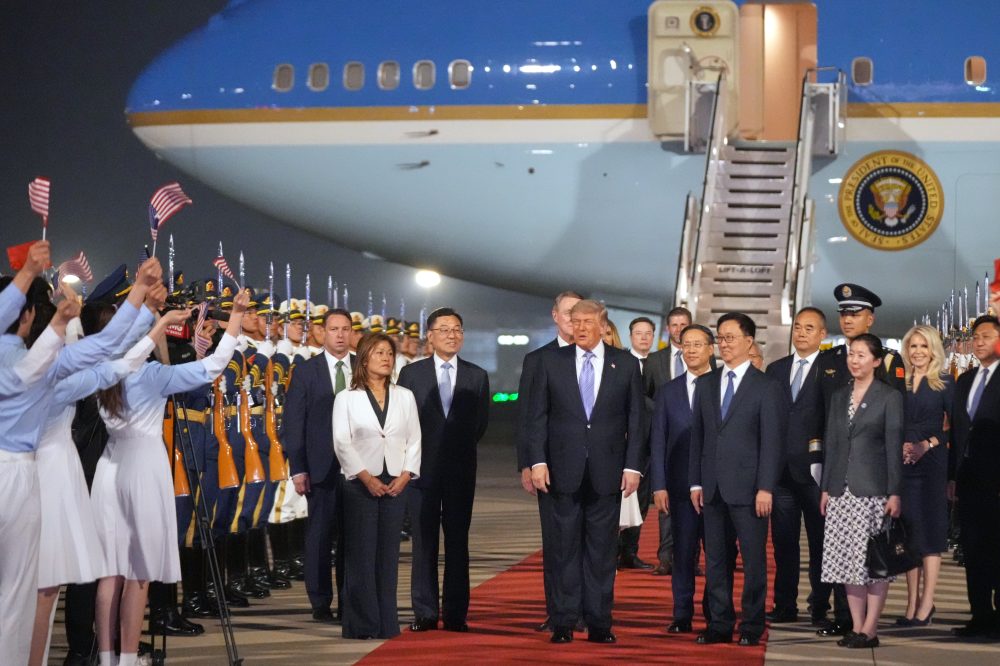
Upon Air Force One’s landing, Chinese officials rolled out a red carpet welcome for the American president.
Chinese Vice President Han Zheng, Washington ambassador Xie Feng, executive foreign affairs vice minister Ma Zhaoxu, and U.S. Beijing envoy David Perdue were scheduled to receive Trump, the White House confirmed.
The elaborate welcome featured approximately 300 Chinese young people, along with a military honor guard and band performance.
The leaders will conduct bilateral discussions and attend a formal state dinner during the visit.
Trump’s team hopes to launch discussions for creating a bilateral Board of Trade with China to resolve ongoing disputes between the nations. This proposed board could help avoid future trade conflicts like the one sparked last year following Trump’s tariff increases, which China responded to by restricting rare earth mineral exports. Those tensions led to a temporary ceasefire agreement last October.
While Trump has no scheduled public appearances Wednesday following his arrival, he’s planned for multiple meetings with Xi Thursday and Friday.
Chinese Vice Premier He Lifeng and U.S. Treasury Secretary Scott Bessent conducted what Chinese state television CCTV described as “candid, in-depth and constructive” discussions Wednesday regarding economic and trade concerns while exploring expanded cooperation opportunities.
The trade negotiations between the world’s largest economies took place in South Korea just hours before Trump’s Beijing arrival.
According to CCTV, the talks followed important agreements previously reached by both nations’ leaders and emphasized mutual respect, peaceful coexistence, and mutually beneficial cooperation principles.
The White House initially indicated Huang’s schedule prevented his participation, but later changes allowed him to join the delegation.
His last-minute inclusion sparked widespread online discussion and humorous content across Chinese social media platforms.
Users on Xiaohongshu and Weibo created and shared doctored photos showing Huang gripping Air Force One’s exterior with his hands.
A White House official confirmed these prominent American business leaders from technology and agriculture sectors received invitations to accompany Trump’s China trip:
1. Elon Musk – Tesla and SpaceX CEO
2. Tim Cook – Apple CEO
3. Kelly Ortberg – Former Rockwell Collins CEO
4. Jensen Huang – Nvidia President and CEO
5. Larry Fink – BlackRock Chairman and CEO
6. Stephen Schwarzman – Blackstone Chairman, CEO and co-founder
7. Brian Sikes – Cargill Chairman and CEO
8. Jane Fraser – Citi Chairman and CEO
9. Jim Anderson – Coherent CEO
10. H. Lawrence Culp – GE Aerospace Chairman and CEO
11. David Solomon – Goldman Sachs Chairman and CEO
12. Jacob Thaysen – Illumina CEO
13. Michael Miebach – Mastercard CEO
14. Dina Powell McCormick – Meta President and Vice Chairman
15. Sanjay Mehrotra – Micron Chairman, President and CEO
16. Cristiano Amon – Qualcomm President and CEO
17. Ryan McInerney – Visa CEO
Iran’s control over the Strait of Hormuz continues strangling global energy distribution while causing worldwide economic hardship, though the Islamic Republic’s domestic economic struggles are challenging its capacity to sustain the conflict and resist Washington’s pressure.
Iranian citizens face skyrocketing costs for food, medical supplies, and other necessities. The nation has simultaneously experienced massive unemployment and business failures due to strike-related damage to critical industries and the government’s extended internet shutdown.
“The economic cost of the war and the U.S. naval blockade has been very substantial and unprecedented for Iran,” explained Hadi Kahalzadeh, an Iranian economist and Brandeis University research fellow.
However, Kahalzadeh noted that Iran has survived decades of economic pressure and sanctions, and its adaptive capabilities remain intact.
The International Monetary Fund projects Iran’s economy will contract by approximately 6 percentage points over the coming year.