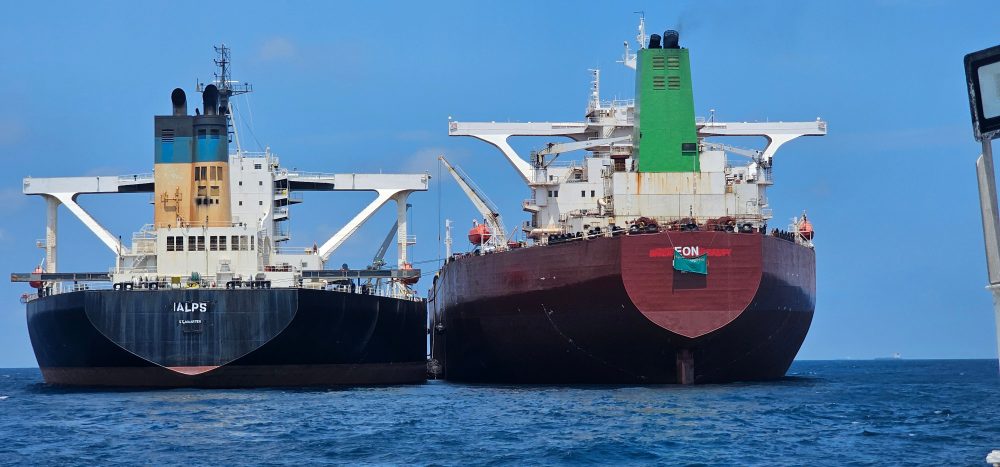

KUALA LUMPUR, Malaysia (AP) — Malaysian maritime authorities acknowledge they possess limited authority to prevent vessels linked to Iran from conducting oil transfers in waters off their coastline, a practice that enables Iran to circumvent international sanctions and has sparked increasing international condemnation.
According to United Against Nuclear Iran, a U.S.-based advocacy organization, satellite surveillance has documented 42 ship-to-ship oil transfers involving Iranian vessels in waters approximately 70 kilometers (45 miles) from Malaysia’s southern Johor state since February 28, following U.S. and Israeli military actions against Iran that initiated Middle East hostilities.
Shipping industry groups and UANI have condemned these transfer operations, with the advocacy group claiming Malaysia demonstrates insufficient enforcement measures.
Mohamad Rosli Abdullah, Director-General of Malaysia’s Maritime Enforcement Agency, explains that these transfers frequently occur in international waters beyond Malaysian authority, and these vessels, referred to as a “shadow fleet,” successfully avoid detection through various tactics including disabling tracking equipment, using fraudulent identities, conducting nighttime operations, and utilizing complicated ownership arrangements.
“The issues raised do not align with the actual situation on the ground and do not reflect the operational realities of maritime enforcement conducted by the MMEA,” Mohamad Rosli told The Associated Press.
American officials have previously indicated that Iranian petroleum exports depend significantly on service providers and ship-to-ship transfer operations conducted near Malaysian territorial waters.
This region, designated as the Eastern Outer Port Limits, or EOPL, within the South China Sea, sits along one of the planet’s most heavily trafficked maritime commercial routes and provides a midpoint between Iran and China, which purchases approximately 90% of Iranian petroleum.
Secret open-ocean transfers involving Iranian-connected tankers have continued for years, enabling Tehran to market its crude oil while providing purchasers with reasonable deniability regarding the petroleum’s origin.
Although not prohibited by law, Malaysia discourages unauthorized transfers conducted outside designated zones, where such activities can receive proper oversight since they significantly heighten spill risks, involve deteriorating vessels, and occur far from ports where accidents could receive better containment.
Representatives from both the Iranian Embassy in Kuala Lumpur and the U.S. State Department did not provide immediate responses to requests for comment.
Even with a U.S. naval blockade of Iranian ports beginning in mid-April, UANI continues tracking Iranian-connected tankers still in operation, although the number successfully passing through remains unclear.
As of Tuesday, two dozen Iranian-linked vessels monitored by UANI were positioned or waiting near the EOPL transfer area off Johor, though determining how many departed before the blockade implementation remains uncertain.
“It’s business as usual,” senior UANI adviser Charlie Brown told the AP.
“Because of Malaysia’s inaction, it is facilitating this business model by Iran and China and dark fleet actors,” he said, warning Malaysia is becoming “a facilitator rather than merely a transit point” for illicit activity.
UANI argues that Malaysia could implement environmental regulations requiring advance notification for ship-to-ship transfers, prohibit Malaysian companies from supporting involved vessels, and mandate adequate insurance coverage for accidents and oil spills, among other measures.
However, Mohamad Rosli stated Malaysia has limited options since the “activities are typically conducted outside Malaysian territorial waters, particularly in areas located near maritime boundaries or international shipping routes.”
He emphasized that enforcement follows Malaysian law and applicable international agreements strictly, and authorities have “never compromised nor provided any special treatment or privileges to any country.”
While the transfer location is generally considered part of Malaysia’s broader economic zone, it borders the Riau Archipelago, which belongs to Indonesian territory.
Indonesia’s Foreign Ministry indicated authorities are examining the situation to assess the activity’s legality.
“Indonesia does not permit its territory or maritime zones to be used for unlawful activities,” said Foreign Ministry spokesperson Yvonne Mewengkang.
“At the same time, Indonesia continues to uphold legitimate navigational rights under UNCLOS (the United Nations Convention on the Law of the Sea), including the right of innocent passage, transit passage, and the right of passage through Indonesian maritime zones.”
Mohamad Rosli mentioned that Malaysia had previously seized two vessels this year, one without national registration and another flying a Cameroon flag, participating in transferring 2 million barrels of crude oil within Malaysian territorial waters.
Both vessels received later release on bond for conducting unauthorized oil transfers. Brown noted one vessel was observed earlier this month performing a ship-to-ship transfer of suspected Iranian petroleum in Johor waters.
Malaysian authorities “will continue to strengthen monitoring and enhance strategic cooperation with relevant agencies to ensure that the nation’s maritime domain’s safety and sovereignty are consistently safeguarded,” Mohamad Rosli said.