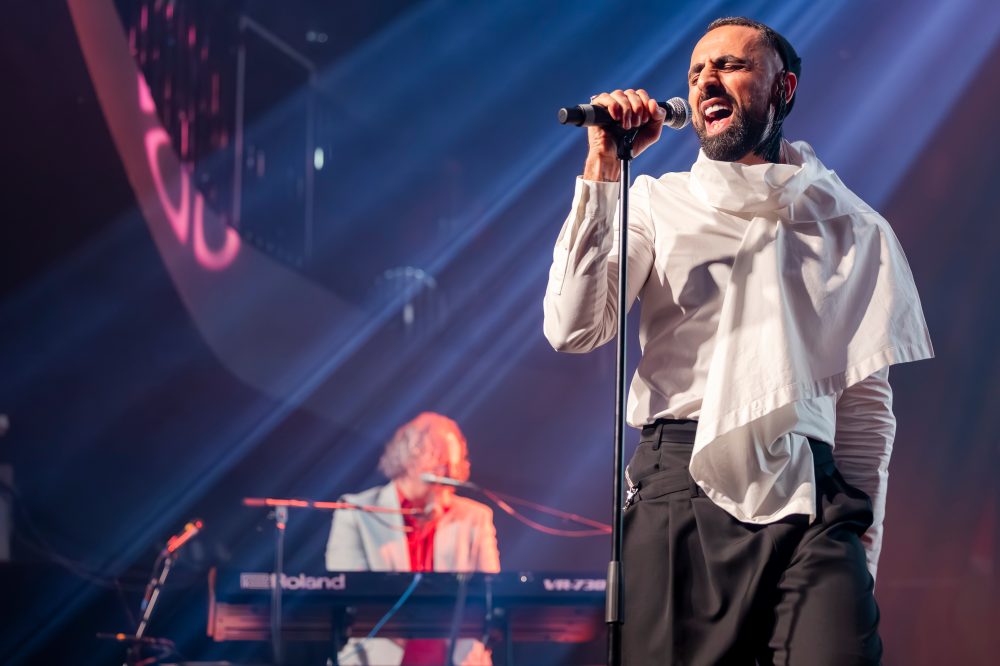

BRUSSELS (AP) — Palestinian musician Bashar Murad took the stage at an elegant Brussels venue Tuesday night, delivering an emotional rendition of Nina Simone’s “I Wish I Knew How It Would Feel to Be Free” in both English and Arabic. The crowd responded with thunderous applause as the last notes echoed through the hall.
Murad’s performance was part of a growing movement of alternative concerts protesting Israel’s inclusion in this week’s Eurovision Song Contest in Vienna. Critics are voicing opposition to Israel’s participation amid its ongoing military operations in Gaza and surrounding regions.
This year’s Eurovision, celebrating its 70th anniversary with the theme “United by Music,” has seen five nations — Spain, Ireland, the Netherlands, Slovenia and Iceland — refuse to participate. Despite the boycotts, 35 countries are still competing, with ten nations including Israel and frontrunner Finland securing spots in Tuesday’s semifinals.
The “United for Palestine” concert in Brussels brought together European performers with Palestinian musicians like Murad, who nearly represented Iceland in the 2024 competition.
“It’s always amazing to be in the same room with people who believe in the same things as you and people who believe that we can’t just let the show go on,” Murad explained.
Murad’s parents, including his father who helped found the prominent Palestinian band Sabreen, had previously tried without success to get Palestine admitted to Eurovision in 2007 through the European Broadcasting Union in Geneva.
Israel has been a Eurovision participant since 1973, claiming victory four times and maintaining strong cultural ties to the annual competition.
However, Israel’s continued involvement has generated increasing controversy as international anger mounts over casualties in Gaza, the West Bank, Lebanon and Iran. Mass demonstrations have swept from Rome to Madrid, with European Union officials considering additional sanctions.
“We have to create an alternative because the participation of Israel is problematic,” stated Katrien De Ruysscher, who leads activist organization SOS Gaza. Her group partnered with rights organization 11.11.11 to coordinate the Brussels gathering.
Previous Eurovision events in Malmo, Sweden in 2024 and Basel, Switzerland the year before witnessed significant pro-Palestinian demonstrations demanding Israel’s removal. Allegations also surfaced that Israel’s government violated competition guidelines to assist their representative.
Contest organizers have strengthened voting procedures this year following claims of ballot manipulation, though participants continue to be evaluated by national panels and global audiences.
The European Broadcasting Union rejected calls to exclude Israel, prompting the five-nation boycott.
Amnesty International’s secretary general Agnès Callamard argued Eurovision should remove Israel just as it did with Russia in 2022 following Moscow’s invasion of Ukraine.
“Songs and sequins must not be allowed to drown out or distract from Israel’s atrocities or Palestinian suffering,” Callamard declared.
Similar protest concerts are occurring across Austria, Germany, Slovenia, Italy and Spain, according to Brussels event organizers.
Spanish public television, which traditionally broadcasts Eurovision, will instead air an alternative program Saturday evening called “La Casa de la Música.” The special will honor the network’s 70-year history with performances by 20 established and emerging artists, including Benidorm Fest winners who would typically advance to Eurovision.
Despite these alternative events, none will match Eurovision’s massive reach — the contest attracted 166 million viewers in 2025 and maintains its devoted fanbase.
Murad expressed hope that counter-programming might encourage reflection on Eurovision’s founding principles of musical unity.
“The purpose of these alternative programs that are happening is to remind Eurovision what it’s actually about and to try to hopefully bring it back, to correct its course, and make it actually live up to the things that it claims to be about,” he said. “A lot of people in the world feel that the competition has lost its meaning.”