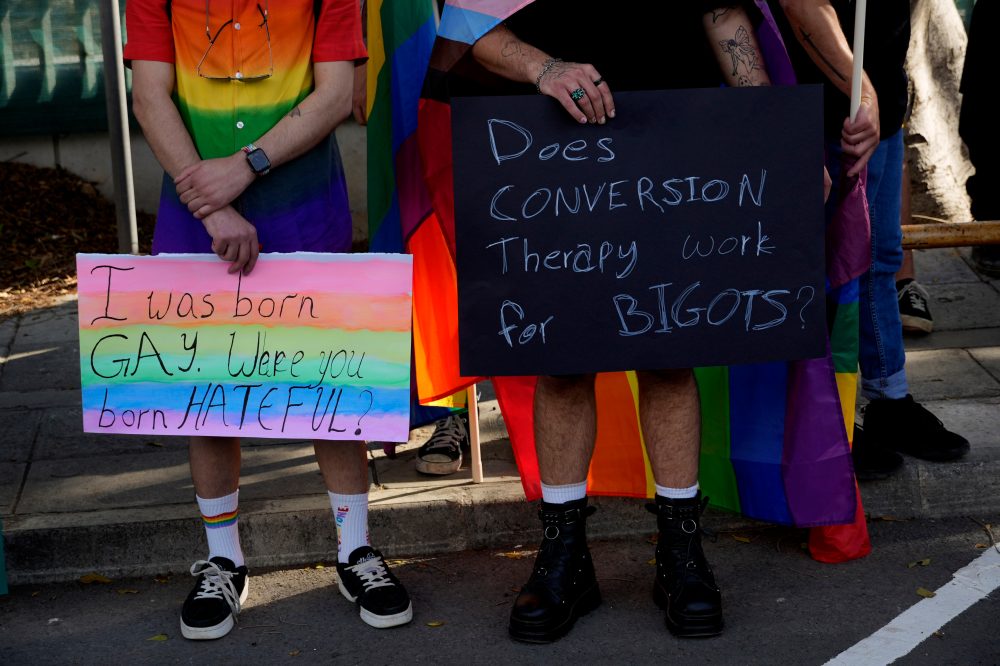

BRUSSELS (AP) — European Union leadership announced Wednesday plans to urge member countries to prohibit so-called ‘conversion therapy’ targeting LGBTQ+ individuals, responding to widespread public pressure and timing the announcement ahead of this weekend’s Brussels Pride celebration.
Commission President Ursula von der Leyen declared Wednesday that such “conversion practices” have “no place in our Union.” Enhanced protections for LGBTQ+ residents have remained a key pledge of EU leadership since von der Leyen assumed her role in 2019.
Research from the EU’s Agency for Fundamental Rights revealed in 2024 that 25% of surveyed LGBTQ+ individuals had experienced the scientifically debunked practice designed to alter their sexual orientation or gender identity. The highest rates were documented in Greece, Cyprus, the Czech Republic, Estonia, and Slovakia.
The commission’s action followed a petition drive that gathered signatures from more than one million EU residents calling for “a binding legal ban on conversion practices targeting LGBTQ+ citizens in the European Union.”
Currently, only 10 of the 27 EU member states have implemented complete or partial bans on conversion therapy, data from the International Lesbian, Gay, Bisexual, Trans and Intersex Association – Europe shows.
Malta became the first EU country to prohibit attempts to alter gay individuals’ sexual orientation in 2016. France has since followed suit, establishing criminal penalties including imprisonment and monetary fines for those who employ such practices against LGBTQ+ individuals.
“Conversion practices are built on a lie, the lie that LGBTQ+ people need to be fixed, that there is something wrong with who they are. And there is, of course, nothing to fix, there is nothing to cure, and there is no one to change,” stated Hadja Lahbib, the European commissioner for equality. “You cannot torture away a person’s identity, and you cannot legislate it away. And yet these practices continue, unfortunately.”
Brussels, serving as the EU’s institutional center, expects tens of thousands of participants for Saturday’s march as the city commemorates three decades of its annual LGBTQ+ rights and cultural parade.