Sergio Garcia, one of the biggest names to leave the PGA Tour for LIV Golf back in 2022, says he is almost certain the breakaway league will survive into 2027 — even as its primary source of money dries up.
Saudi Arabia’s Public Investment Fund has announced it will stop bankrolling LIV Golf after the current season wraps up. Reports have indicated the tour could face serious trouble even before this year’s schedule is completed.
To keep going, LIV Golf is looking to raise roughly $300 million from outside investors, which would fund a 10-tournament slate in 2027.
Garcia expressed confidence that a deal will get done. “Obviously, I think they’ve had a lot of meetings with different possible investors,” he said, according to bunkered.co.uk. “I’m 99% sure that LIV is going to continue. It’s just going to look different than it has the last four years. But I’m very, very confident that it’s going to keep going. We’ll see how it develops.”
While the tour’s future remains uncertain, Garcia has been keeping busy on the course. The Spanish golfer competed in the DP World Tour’s BMW International Open last week in Germany and is expected to tee it up in at least three more DP World Tour events before the season is out. He is also planning to renew his DP World Tour membership for the 2027 season.
“Obviously, at 46, I can’t play 30 events a year, but I’m going to make an effort to see if I can at least play a handful and try to do my best there,” Garcia said.
The 2017 Masters champion has had top-three finishes across all four major tournaments throughout his career and has accumulated 38 professional victories — 11 on the PGA Tour, 16 in Europe, and two in LIV Golf.
This year, Garcia finished 52nd at the Masters and sat out both the PGA Championship and the U.S. Open. He also failed to qualify for this month’s Open Championship, being held at Royal Birkdale Golf Club in Southport, England.
Kerr Kriisa, a college basketball player who suited up for four programs — Arizona, West Virginia, Kentucky, and Cincinnati — was indicted Monday by the Northern District of West Virginia on charges alleging he ran a $2.2 million fraud scheme.
Court documents outline five counts against the 25-year-old, and federal prosecutors are seeking a financial judgment equal to the alleged proceeds of the scheme, as well as any property purchased with those funds.
According to the United States Department of Justice, Kriisa is accused of using false representations, fabricated identities, and deceptive communications to obtain money from at least two victims.
Kentucky Sports Radio reported that the FBI arrested Kriisa last week.
The indictment alleges Kriisa “falsely representing that he and his family faced imminent danger if a victim of his fraudulent scheme did not send him money to pay a debt.” Prosecutors also allege he directed one victim to send a payment to another victim while posing under the fake name “Irene.”
Originally from Estonia, Kriisa played professionally in Lithuania and Germany before coming to the United States for college basketball. He spent three seasons at Arizona, where he began his college career as a guard.
The DOJ alleges the fraudulent operation began while Kriisa was living in Tucson in 2022 and that he was still engaged in the scheme as recently as last month.
During the 2023-24 season at West Virginia, Kriisa averaged a career-best 11 points per game, though he also served a nine-game suspension that year stemming from impermissible benefits he received while at Arizona. He then transferred to Kentucky for the 2024-25 season and Cincinnati for the 2025-26 season. Over his college career, Kriisa appeared in 127 games — starting 106 of them — averaging 8.8 points, 2.2 rebounds, 4.4 assists, and 28.1 minutes per contest.
The National Weather Service office in Mount Holly, New Jersey issued a Severe Thunderstorm Warning on July 6, taking effect at 4:06PM EDT and set to expire at 4:30PM EDT.
Residents in the warned area are urged to seek shelter immediately and stay away from windows. Severe thunderstorms can bring dangerous lightning, damaging winds, and heavy rainfall in a short period of time.
Officials recommend staying indoors until the warning has expired and monitoring local weather updates for any changes to the storm’s path or intensity.
Two Italian tennis stars made their mark at Wimbledon on Monday, with Flavio Cobolli and Jasmine Paolini both punching their tickets to the quarterfinals, while British wildcard Arthur Fery thrilled home fans by surviving a grueling match against fellow wildcard Grigor Dimitrov.
Cobolli, seeded ninth, dispatched Australian fifth seed Alex de Minaur 7-5, 7-6(4), 6-3 on a sweltering afternoon on Court One — a match that was interrupted twice after spectators in the stands fell ill from the heat. The victory came on the heels of Cobolli’s runner-up finish at Roland Garros, where he lost to Alexander Zverev, and he continued to show his best tennis on the Grand Slam stage. A standout moment came deep in the second set when he unleashed a spinning forehand winner that showcased his shot-making ability. After the match, Cobolli was spotted cooling off with some ice cream.
“I feel great. It was an incredible match for me. I think I played one of the best matches, especially on this surface that is always tough to play on,” Cobolli told reporters. “Today I found a way to have a high level for, I don’t know how much I played, but for all the match … I’m proud and happy to reach a second quarter-final in a row here at Wimbledon. That means a lot for me. I played for my first time here on Court One. The feeling on the court was incredible. I love to play there. The sound was amazing and amazing feeling with the ball.”
For De Minaur, the defeat stung deeply. The 27-year-old had been chasing his eighth Grand Slam quarterfinal appearance and hoping to finally break through that barrier. “I think breaking it down into possibly simpler terms, I think one of us went out to win the match, and the other went out not to lose the match,” De Minaur said. “I think it’s pretty self-explanatory who was who. It breaks me inside. That’s the reality of it. Many, many hours gets put into my craft and countless years to have moments like these. To not step up to the plate, it’s gut wrenching.”
On Centre Court, Paolini — seeded 13th — knocked out crowd favorite Alexandra Eala of the Philippines 6-4, 4-6, 6-3 to keep her deep Wimbledon run going. Paolini was the runner-up at the event in 2024 and has been dealing with a foot injury that has troubled her throughout the season, but she says she’s finding her love for the game again at a venue where she feels strong fan support.
“I’m enjoying playing tennis. Of course, it’s easier when you play well. But I think it’s important to try to keep this mindset, even when things are tougher,” Paolini said.
Paolini’s next opponent will be Ukrainian 12th seed Marta Kostyuk, who opened the eighth day of competition with a 6-4, 6-4 win over American qualifier Ashlyn Krueger on Court Two. Kostyuk acknowledged the pressure she felt heading into the match. “It was a pretty stressful match for me because I was the one coming into this match with being a favourite with such a good opportunity, playing for the first quarter-final here in Wimbledon,” she said. “Of course, there was more pressure. I think just all these things kind of connected. For sure the heat didn’t help.”
The heat has been a major storyline throughout the tournament. Last week saw temperatures reach around 37 degrees Celsius (98 degrees Fahrenheit), breaking British records for June. Forecasters expect the second week to bring temperatures climbing back above 30 degrees Celsius.
In other women’s action, former Australian Open champion Madison Keys was eliminated with a 6-4, 7-6(2) loss to 21-year-old Czech Linda Noskova, who reached the Wimbledon quarterfinals for the first time in her career. Noskova, who looks to follow in the footsteps of Czech champions Petra Kvitova, Marketa Vondrousova, and Barbora Krejcikova, will next face Belgian Elise Mertens, who beat fellow Czech Marie Bouzkova 6-4, 6-4.
The evening’s biggest moment for the home crowd came when Fery, the last remaining British player in the singles draw, battled past Dimitrov 7-5, 3-6, 4-6, 6-4, 7-6(10-7) in a match that stretched nearly four hours.
On the men’s side, Taylor Fritz cruised past Kazakh 10th seed Alexander Bublik 7-6(1), 6-4, 6-4 to reach the quarterfinals for the fourth time in five years at the All England Club. Zverev, who won the French Open title, will look to stay in contention for a second Grand Slam crown when he takes on Jiri Lehecka later in the day.
The U.S. Supreme Court has temporarily allowed Texas to enforce a new law that limits children’s ability to download apps without parental approval, even as legal challenges to the measure continue in lower courts.
Under Texas’ App Store Accountability Act, minors must obtain permission from a parent or guardian before they can download the majority of apps onto their mobile devices.
The high court’s decision means the law can be put into practice while lawsuits challenging it are still being heard and decided at the lower court level.
The National Weather Service out of Mount Holly, New Jersey has issued a Flash Flood Warning that went into effect at 4:17 PM EDT on Sunday, July 6, and is set to expire at 8:15 PM EDT the same evening.
Residents in areas covered by the warning are urged to stay off roadways that may be prone to flooding and to avoid any low-lying or flood-prone areas until the warning has been lifted.
Flash floods can develop rapidly and without much notice. Even shallow moving water can be dangerous, and officials always caution that drivers should never attempt to cross flooded roads.
TV Delmarva will continue to monitor this weather situation and provide updates as conditions change. Residents are encouraged to have a way to receive weather alerts and to follow guidance from local emergency management officials.
The National Weather Service office out of Mount Holly, New Jersey has issued a Flash Flood Warning that went into effect at 4:37 PM EDT on July 6 and remains active until 8:15 PM EDT that same evening.
Residents are urged to take this warning seriously and stay alert for rapidly rising water. Flash floods can develop quickly and pose a serious danger to life and property.
Authorities remind the public never to attempt to drive through flooded roads. Even shallow water moving across a roadway can sweep a vehicle off course. The phrase “turn around, don’t drown” remains the standard safety guidance during any flash flood event.
Stay tuned to TV Delmarva and monitor official National Weather Service updates for the latest information as this warning remains in effect through the early evening hours.
The Canadian provinces of Alberta and Ontario announced Monday a joint proposal to build a major pipeline carrying western Canadian crude oil eastward, with the possibility of eventually reaching Atlantic export terminals — a move driven by Canada’s desire to find new buyers beyond the United States.
Alberta Premier Danielle Smith outlined the plan, describing a proposed 3,300-kilometer (roughly 2,050-mile) pipeline running from Hardisty, Alberta, to Sarnia, Ontario. The line would be capable of moving up to 500,000 barrels of oil per day, with the potential to scale up to 800,000 barrels. Smith said the corridor could one day be extended to Canada’s Atlantic coastline, creating a pathway for oil exports to European markets.
Canada’s crude oil flows primarily to the United States, its largest buyer by a wide margin, while Alberta holds one of the biggest proven oil reserves on the planet.
Ontario Premier Doug Ford expressed support for the plan, saying it would be a worthwhile investment whether funded through public or private money. Officials said a feasibility study is in the works.
“There is still a lot of work ahead of us to deliver,” Ford said.
The proposal comes with significant obstacles, including securing financing, navigating regulatory approvals, and holding required consultations with Indigenous communities. A comparable project known as Energy East was scrapped in 2017 after facing years of political, regulatory, and environmental opposition, including strong resistance from Quebec.
Daniel Béland, a political science professor at McGill University in Montreal, offered a cautious assessment. “It’s technically feasible but it would be a massive undertaking. We are only at a very early stage of the project and we don’t have the final route or cost estimates yet,” he said. “It’s not even sure the Hardisty-Sarnia pipeline will ever be built so the idea it could at some point reach the Atlantic sounds quite speculative at this stage to say the least.”
Just last week, Smith and Prime Minister Mark Carney moved forward on a separate pipeline proposal — a taxpayer-subsidized project targeting the Pacific coast to boost exports to Asian markets. That effort involves a partnership with the federally owned Trans Mountain Corp. and Calgary-based Pembina Pipeline. Smith noted that the extent of any private-sector involvement in that project has not yet been finalized.
Smith has publicly stated her goal of doubling Alberta’s oil output to 8 million barrels per day over the next decade to 15 years. She has also argued that the previous federal government under former Prime Minister Justin Trudeau harmed Alberta’s energy sector and stoked sentiment in favor of provincial independence.
Alberta is set to hold a vote this fall on whether to pursue a referendum on breaking away from the rest of Canada.
Andrew Leach, an energy economist and professor at the University of Alberta, described Smith’s production targets as “incredibly ambitious,” pointing out that Alberta dealt with serious inflation the last time it tried to ramp up output at a similar pace. He also raised questions about whether oil producers would have any incentive to route their crude to Sarnia if there was no infrastructure in place to move it further from there.
Prime Minister Carney acknowledged last week that Canada’s greenhouse gas emissions would likely climb in the short term as his government pushes forward with pipeline expansion. He has made broadening Canada’s export reach a central priority in response to the trade conflict with U.S. President Donald Trump, pledging to pursue greater access to markets across Europe and Asia.
ATLANTA — A dispute over a reversed player suspension has thrust the personal bond between Donald Trump and FIFA President Gianni Infantino into the global spotlight, igniting outrage and raising serious concerns about whether outside influence is compromising the integrity of the World Cup.
Trump confirmed this week that he personally phoned Infantino last week to request a review of the one-match suspension handed to U.S. forward Folarin Balogun. That suspension was subsequently lifted, allowing Balogun to take the field Monday when the United States faced Belgium in the round of 16. The move drew sharp condemnation from Belgium and from UEFA, European soccer’s governing body, which charged that FIFA had crossed a “red line.”
The episode has cast new attention on the years-long relationship between Trump and Infantino, which has grown steadily more visible and intertwined with the staging of the largest World Cup in history.
Trump’s interest in the sport increased after the United States secured co-hosting rights for the tournament back in 2018, during his first term in office. He welcomed Infantino to the White House during that period, and the FIFA president made a memorable impression by presenting Trump with red and yellow cards, joking they could come in handy when dealing with reporters.
The two grew closer over the following years. At the global economic summit in Davos in 2020, they shared a dinner where Infantino referred to Trump as “my great friend.” That same year, Trump extended an invitation to Infantino for the White House signing ceremony of the Abraham Accords — a diplomatic effort to normalize ties between Israel and several Arab nations — at a time when Infantino was working to deepen FIFA’s own relationship with Saudi Arabia.
By contrast, Infantino’s interactions with Joe Biden, who defeated Trump in the 2020 election, were considerably more subdued. The two met briefly at a Group of 20 summit in 2022, and Infantino made at least one visit to the White House in 2024.
When Trump won the 2024 presidential election, Infantino publicly congratulated him the very next day and later visited Trump’s South Florida club, Mar-a-Lago, during the presidential transition period. He attended Trump’s inauguration and described the two as sharing “a great friendship.”
Earlier this year, Infantino appeared at Trump’s Board of Peace gathering in Washington, where nine governments committed $7 billion to a Gaza relief effort. Infantino pledged to contribute a new stadium, a FIFA academy, and multiple soccer fields to the conflict-affected region.
In December of last year, human rights organization Fair Square filed a complaint with FIFA’s ethics committee, alleging that Infantino had repeatedly violated the governing body’s rules on political neutrality. The complaint cited multiple instances of what it described as Infantino’s public backing of “the actions and policies of the US President, Donald Trump.”
Perhaps the most striking symbol of the two men’s alliance came when FIFA created an inaugural peace prize in November — a development that followed Trump’s public complaints about being passed over for the Nobel Peace Prize. The FIFA prize was awarded to Trump, with Infantino praising him for his “unwavering commitment to advancing peace and unity throughout the world.” At the 2026 World Cup draw held in December, Infantino presented Trump with a golden trophy engraved with his name and placed a medal around his neck.
“This is truly one of the great honors of my life,” Trump said at the ceremony, adding, “most important, I just want to thank everybody. The world is a safer place now.”
Trump has received other sports-related gifts as well. The oversized trophy crafted by Tiffany for the newly expanded Club World Cup — featuring a 24-karat gold-plated finish — spent time in the Oval Office ahead of the tournament being held in the U.S. last year. In an interview with broadcaster DAZN, Trump recalled asking FIFA when it planned to retrieve the trophy, saying he was told: “You can have it forever in the Oval Office. We’re making a new one.” Infantino also gave Trump a gold replica of the World Cup trophy, describing it as being “for winners only.”
Trump has called Infantino “probably the most respected man in sports.” The two watched the Club World Cup final together from a luxury box at MetLife Stadium in July of last year, and it was during that gathering that they began discussions about holding the World Cup draw in Washington — a location that had not been widely anticipated, as Las Vegas had been considered the likely venue.
Infantino has a history of cultivating relationships with host nations. He accepted the Russian Order of Friendship from Vladimir Putin following the 2018 World Cup and temporarily relocated to Qatar ahead of the 2022 tournament. While Mexican President Claudia Sheinbaum and Canadian Prime Minister Mark Carney were both present at December’s draw, Trump alone received the FIFA peace prize.
“You can always count on my support,” Infantino told Trump at the event, which ended with the Village People performing “Y.M.C.A.”
On Monday, Trump addressed the Balogun controversy directly. “I didn’t tell him what to do. I can’t tell him what to do,” he said. Infantino, for his part, maintained that FIFA’s judicial bodies operate independently and said that autonomy was “essential to the credibility and integrity of football.”
Trump has not yet attended a World Cup match, though Infantino has watched games alongside several members of the Trump administration, including the Commerce Secretary, the Secretary of State, and the FBI Director. Infantino said in a recent television interview that Trump plans to join him for the World Cup final and present the trophy to the winning team.
A woman who once had a romantic relationship with Maine Democratic Senate candidate Graham Platner is accusing him of sexually assaulting her while he was intoxicated, despite her telling him to stop, according to a report published Monday by Politico.
Platner pushed back against the allegation and indicated he is evaluating what comes next for his campaign. In a video posted to social media, he said, “Regardless of the inaccuracy of the reporting but mindful of the political reality it will inflict, we’re taking the time to reflect on the best path forward.”
The woman making the accusation, Jenny Racicot of Maine, told Politico that Platner came into her home drunk in 2021 and assaulted her. Racicot said the two had been in an on-and-off relationship at the time, but she ended all contact with him after that night and made clear to him that what happened was not consensual.
The Associated Press attempted to reach Platner’s campaign for comment via email and phone on Monday. In his social media video, Platner stated, “Any accusation of non-consensual behavior is categorically false.”
By Monday, Platner had called off several campaign town hall events that had been scheduled across Maine.
Platner won the Democratic nomination for Maine’s U.S. Senate seat last month. However, state law does allow the party to swap in a different candidate before the general election. Under that provision, party officials could choose a replacement if Platner withdraws by 5 p.m. on July 13, with any replacement candidate needing to be named no later than July 27.
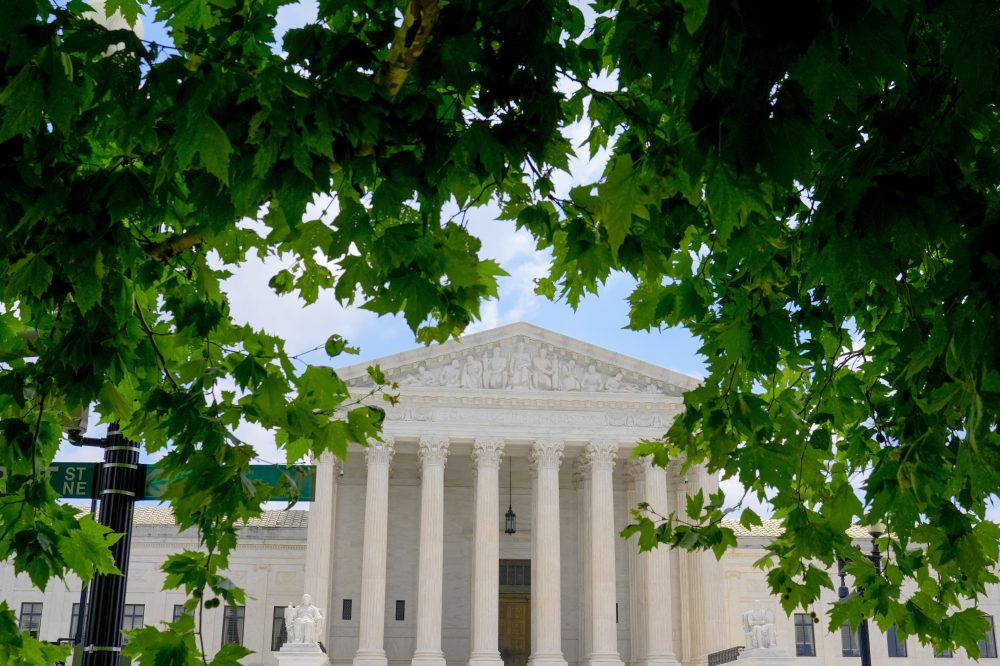
WASHINGTON — The U.S. Supreme Court on Monday allowed Texas to move forward with enforcing a state law that requires app stores to confirm users’ ages and secure parental consent before children can download apps or make in-app purchases on smartphones and other mobile devices.
Justice Samuel Alito issued two one-sentence orders rejecting emergency requests from groups challenging the Texas App Store Accountability Act. Those groups argue the law violates constitutional free speech protections.
The decision follows a ruling last month by a three-judge panel from the 5th U.S. Circuit Court of Appeals, which said the law could take effect. That panel had put on hold a lower court’s December ruling that had found the law unconstitutional.
Among those suing to stop the law are the Computer & Communications Industry Association and Students Engaged in Advancing Texas. Texas Attorney General Ken Paxton is named as a defendant in both lawsuits.
Lawyers for the plaintiffs contend the law improperly restricts access to content that is protected under the First Amendment, including news articles and educational material.
Attorneys for Students Engaged in Advancing Texas wrote: “Equity and the public interest support relief because protecting First Amendment rights — and parents’ rights to supervise their children as they see fit, not as the government tells them they should — is always in the public interest.”
On the other side, attorneys from Attorney General Paxton’s office defended the law as a way to shield children from what they called “dangerous modern products.”
“A child with access to an app store and a mobile device (such as a tablet or smartphone) can potentially download any number of software applications, potentially agreeing to invasions of the child’s privacy and sale of the child’s data and be exposed to any conceivable content without parental consent or even parental knowledge,” those attorneys wrote.
Millions of Americans lost their Affordable Care Act health insurance coverage over the past year, according to newly released federal data that offers the first complete state-by-state look at how dramatically enrollment has fallen since enhanced subsidies expired at the start of this year.
The data, which the Trump administration posted in late June and was first reported on by The Associated Press, shows that approximately 2.6 million fewer people held ACA marketplace plans in February compared with the same month a year earlier.
The figures capture not just how many people signed up for or were automatically re-enrolled in plans for 2026, but also how many actually paid their first month’s premium to keep that coverage active. According to Cynthia Cox, a vice president and director of the ACA program at the healthcare research nonprofit KFF — who reviewed the dataset — the numbers also account for people who were removed from coverage after failing to pay during a grace period.
“This is the first time we’ve seen state-level data that shows how much ACA marketplace enrollment truly fell,” Cox said. “It’s in line with our expectations, but it does show a very steep drop in the number of people with ACA coverage.”
Health policy analysts have been closely watching ACA enrollment figures since the so-called enhanced premium tax credits expired, causing monthly health insurance costs for many Americans to double or even triple. That pricing shock pushed some people to drop coverage altogether. The subsidies had been the focus of an intense battle in Congress last fall, with Democrats and a number of Republicans urging renewal.
The rising cost of health insurance — across ACA plans and other programs — has become a significant issue as voters head toward November elections, with affordability ranking among their top concerns.
Last week, the U.S. Department of Health and Human Services released a report suggesting the enrollment decline could largely be explained by a federal crackdown on fraudulent or so-called “phantom” enrollments. However, health analysts have pushed back on that explanation, saying the drop is more likely tied to the January 1st expiration of federal subsidies and other policy changes, including stricter rules about which immigrants can access subsidized coverage.
An AP analysis of the data found that Ohio and Oklahoma each experienced enrollment declines of more than 32% — the largest proportional losses of any state in the country.
Several other states were close behind, each losing more than a quarter of their ACA-enrolled populations: Arizona, South Carolina, Minnesota, Indiana, Michigan, Mississippi, Louisiana, and Missouri.
Florida, which relies heavily on ACA coverage partly because it did not expand Medicaid and has a large population of gig workers and self-employed residents, still leads all states with nearly 4 million marketplace enrollees. However, it also recorded the highest raw number of people losing coverage — around 443,000 — of any state this year.
The data does not reveal whether those who dropped ACA coverage found insurance elsewhere. While some may have obtained coverage through an employer or other source, Cox said most people who leave the ACA marketplace likely go without any insurance at all, since the marketplace tends to be a “place of last resort” for those who have no other options.
Several of the states hit hardest by this year’s enrollment drops were the same ones that saw the biggest gains when enhanced subsidies were first introduced during the COVID-19 pandemic. Cox said that pattern makes sense, since those states likely had large numbers of people who only enrolled because the enhanced subsidies made coverage affordable enough to consider.
Just one state bucked the national trend: New Mexico saw its ACA enrollment grow by roughly 14% compared with last year. It is the only state in the country that fully replaced the expired federal subsidies using its own state money.
Nationwide, about three out of five states use the federal marketplace HealthCare.gov, while the remaining states run their own ACA marketplaces. The new data shows that states relying on the federal marketplace lost larger shares of enrollees than those operating their own exchanges.
One likely reason is that many states with their own marketplaces took steps to cushion the blow for residents when the enhanced subsidies expired in January. New Mexico is the most dramatic example: during a special legislative session last fall, state lawmakers approved a plan to use state funds to replace the missing federal subsidies through mid-2026. In March, the state’s governor signed legislation extending that financial backstop through mid-2027.
The U.S. Department of Agriculture’s National Agricultural Statistics Service, known as NASS, has released its latest Crop Progress and Condition estimates.
The report offers a snapshot of how crops are faring across the nation, providing data that farmers, analysts, and agricultural businesses use to monitor the status of the current growing season.
NASS publishes these crop progress updates on a regular basis during the growing season, giving a week-by-week look at planting, emergence, and overall crop conditions throughout the country.
CARACAS — Venezuelan authorities announced Monday that the death toll from the country’s twin earthquakes has climbed to 3,535, with nearly 18,000 people still left without homes more than a week after the disaster hit the capital and surrounding coastal regions.
Top lawmaker Jorge Rodriguez released the latest official figures, which show 16,740 people were injured and 17,854 left without housing following the June 24 quakes. The two tremors, measuring magnitudes 7.2 and 7.5, struck within seconds of one another.
The updated numbers highlight the enormous scope of destruction in and around Caracas and La Guaira, the coastal area that suffered the worst damage, as public frustration over the government’s handling of the crisis continues to grow.
Venezuela’s social vice presidency reported that at least 12,800 displaced people are currently sheltering in 80 facilities spread across Caracas and La Guaira.
Acting President Delcy Rodriguez has pushed back against criticism of the government’s disaster response, which many Venezuelans have described as slow and insufficient. She said security forces were deployed immediately following the earthquakes and announced the establishment of a new military unit dedicated to handling future emergencies and disasters.
Reuters reporters on the ground in La Guaira Monday observed trucks and forensic workers carrying coffins, while heavy equipment dug trenches in an open field marked with white crosses — the site where authorities were burying unidentified victims.
The United Nations confirmed it is continuing to expand aid operations in coordination with the Venezuelan government in Caracas.
“Some search and rescue teams remain deployed in the affected areas, while other specialized engineering teams and medical support continue to arrive,” U.N. spokesperson Stephane Dujarric told reporters Monday.
Dujarric added that a full assessment of humanitarian needs — which will guide an updated relief plan — is nearly finished, though he did not provide a timeline for its release. U.N. agencies are already delivering services at three camps and evaluating additional sites where support could be expanded.
A large mural of Giannis Antetokounmpo may still stand in downtown Milwaukee, but the man himself has now officially said goodbye — sharing an emotional farewell video on social media after being traded to the Miami Heat.
The professionally produced video features career highlights and memorable moments while Antetokounmpo himself provides the narration throughout.
The trade sent Antetokounmpo to Miami in exchange for four players, three first-round draft picks, and additional compensation.
In the video, Antetokounmpo spoke directly to the people of Milwaukee and Wisconsin. “The city of Milwaukee and the state of Wisconsin, I want them to remember this from me,” he said. “Don’t worry about the basket. Don’t worry about the championship. Don’t worry about the wins. Don’t worry about the losses.”
He went on to describe his deep connection to the city’s working-class spirit. “I tried to be like them. I believe the city of Milwaukee is blue-collar. It’s people that work extremely hard every single day. They give all their hard-earned money, just to come watch the Milwaukee Bucks. To come and feel something. To come to be a part of us.”
“I hope that I was able to represent them, the best that I could. And I was like them. I showed up to work, did everything. I was willing to do all the dirty work, just like them.”
During his 13 years with Milwaukee, the player known as “The Greek Freak” earned two MVP awards, a most-improved-player award, and a defensive-player-of-the-year honor. Most notably, he led the Bucks to the NBA championship in 2021 — the franchise’s first title since 1971.
Across 895 regular-season games with 830 starts, the 31-year-old averaged 24.1 points, 9.9 rebounds, and 5.0 assists per game. He was selected 15th overall in the 2013 draft. In 84 playoff appearances, he averaged 33.0 points, 15.4 rebounds, and 6.6 assists. He was named to the All-Star team ten times throughout his career.
His farewell message continued: “I hope that bringing a trophy to the city meant something to them, because it meant so much to me.”
“I want you to hear it from my mouth. The city of Milwaukee will always be in my heart. This is my home. And this is a place that I had my kids. My mom is here. My father is here. My brothers played here. It made me the man that I am today. That will never, ever change.”
He closed with a powerful declaration: “No matter where I am, Milwaukee will always be my city, my team, my family.”
The video wraps up with a clip of a young Antetokounmpo expressing his dream of playing in the NBA, followed by NBA commissioner David Stern calling his name at the 2013 draft.
As the video spread across social media, Bucks general manager Jon Horst released a letter to fans addressing the trade. “This decision is in the best interest of both the Bucks and Giannis,” Horst wrote. “I understand the emotions this news brings, and I share them. I’m confident our path forward provides a strong foundation for sustained success. As we begin the next chapter of Bucks basketball, we do so with optimism, purpose and a clear vision to build on our standard of excellence while strengthening our competitive identity and winning culture under the leadership of our new head coach, Taylor Jenkins.”
A longer version of the interview from which Antetokounmpo’s narration was drawn is available on his YouTube channel.
France captain Kylian Mbappe publicly condemned a Paraguayan senator on Monday, calling her a “despicable woman” after she unleashed a racist attack against him on social media following Paraguay’s exit from the World Cup.
Mbappe’s penalty kick was the deciding goal as France defeated Paraguay 1-0 in Philadelphia on Saturday, sending France into the quarterfinals of the tournament.
Senator Celeste Amarilla responded to the loss with a lengthy, slur-filled post on X, referring to Mbappe as a “colonised Cameroonian, desperately trying to pass himself off as French” and calling him a “brute” who had not learned to write. She also suggested Paraguay’s players should have struck him after the game.
Mbappe responded directly and forcefully, standing up for himself while also defending the honor of the Paraguayan players.
“Madame Celeste Amarilla, you are a despicable woman and unworthy of your position. You do not represent Paraguay, that country which has sweated passion and honour throughout the competition,” he wrote.
“Through your recklessness and your brazen racism, the entire world has already forgotten the journey and the historic effort that your players accomplished during this World Cup, making way for an incompetent woman who gives the worst possible image of her country.”
He added: “I will never allow people like her the freedom to spread their hatred and racism across the world.”
The French Football Federation escalated the situation further, announcing it intends to pursue criminal charges against the senator. The organization described her comments as “utterly abhorrent and unacceptable.”
“These remarks are criminal and reprehensible. They must be prosecuted here as elsewhere. The FFF is reporting the matter to the public prosecutor’s office with a view to legal proceedings,” the federation stated.
“These remarks bring shame upon those who make them and those who disseminate them. The players of the French national team represent France; it is our country that is being insulted,” it added.
LONDON — American tennis star Taylor Fritz punched his ticket to the Wimbledon quarter-finals for the fourth time in five years on Monday, defeating unpredictable Kazakh opponent Alexander Bublik in straight sets on Court One.
Fritz, the sixth seed, took control of the match during a first-set tiebreak following a high-level serving battle between the two players. He stayed sharp at the critical moments throughout the match, eventually closing out a 7-6(1) 6-4 6-4 victory.
With the win, Fritz joins a prestigious group as the 10th American player to reach the Wimbledon quarter-finals on four or more occasions — a list that includes legends Pete Sampras, Jimmy Connors, and John McEnroe.
However, unlike those celebrated American players, Fritz has not yet captured a Grand Slam title. His only Grand Slam final appearance came at the 2024 U.S. Open, where he fell to Jannik Sinner.
Next up for Fritz in the quarter-finals will be either second seed Alexander Zverev or Jiri Lehecka.
The National Weather Service out of Mount Holly, New Jersey issued a Severe Thunderstorm Warning on July 6, taking effect at 3:55 PM EDT and remaining in place until 4:30 PM EDT.
Residents in the warned area are urged to seek shelter indoors, stay away from windows, and avoid any unnecessary travel until the warning has expired.
Severe thunderstorm warnings are issued when weather conditions pose an immediate threat, typically involving winds of 58 miles per hour or greater, hail at least one inch in diameter, or the possibility of a tornado. Residents should monitor local alerts and be prepared for rapidly changing conditions.
The National Weather Service office in Mount Holly, New Jersey issued a Severe Thunderstorm Warning on the afternoon of July 6, effective from 3:41 PM Eastern Time through 4:30 PM Eastern Time.
Residents in the warning area were advised to take precautions as dangerous thunderstorm conditions were expected. Severe thunderstorms can bring damaging winds, large hail, and heavy rainfall in a short period of time.
Officials recommend that people move indoors, stay away from windows, and avoid travel during severe thunderstorm warnings. The warning was set to expire at 4:30 PM Eastern Time on July 6.
Delaware State Police have released the name of the man who lost his life in a deadly single-vehicle crash that occurred Sunday morning on Peterkins Road in Georgetown. The victim has been identified as 32-year-old Breiner Perez-Perez, a resident of Millsboro, Delaware.
The Delaware State Police Collision Reconstruction Unit is actively investigating the circumstances surrounding the crash. Troopers are urging anyone who may have seen the accident or who has video footage of the incident to reach out to Master Corporal J. Smith at (302) 703-3267. Tips can also be submitted through a private Facebook message to the Delaware State Police or by calling Delaware Crime Stoppers at 1-800-847-3333.
Anyone who has been impacted by a crime or has experienced the sudden loss of a loved one can reach the Delaware State Police Victim Services Unit and the Delaware Victim Center around the clock. Their toll-free hotline is available 24 hours a day at 1-800-VICTIM-1 (1-800-842-8461). You may also contact the Victim Services Unit directly by emailing [email protected].
HAVANA, Cuba (AP) — A total blackout plunged all of Cuba into darkness Monday as the nation’s dwindling fuel supply and deteriorating power grid pushed the island to a breaking point.
Cuba’s state-run Electric Union announced the outage on X, noting that the cause is still being investigated. The country’s Ministry of Energy and Mines also posted on X, stating that emergency protocols to restore power have been set in motion.
The island’s fuel shortage has been mounting since January, when U.S. President Donald Trump threatened tariffs against any nation that sells or provides oil to Cuba. The threat deepened an already severe economic and financial crisis on the island, bringing public transportation to a near standstill and forcing officials to cancel tens of thousands of scheduled surgeries.
In Havana, the sudden darkness left residents anxious and scrambling. Lina May, 36, said she was left wondering when the lights would return so she could simply prepare a meal.
“I just told my dad that we have to buy charcoal because otherwise we won’t eat and we’ll starve,” she said.
Richard Valdés, 40, described the blackout as just the most recent in a long string of hardships.
“We’re without power again,” he said. “Now we have no water, no gas, nothing until they restore it.”
Cuba currently produces only 40% of the fuel it requires. A Russian tanker delivered 730,000 barrels of oil to the island in late March, but that supply was fully depleted by the end of April.
To cope with the shortage, the Cuban government has been implementing intentional power cuts that can last more than 24 consecutive hours at a time.
Previous major outages include a mid-May blackout that darkened the island’s eastern provinces and a mid-March event that knocked out power across the entire island.
Mario Pedroso, a 33-year-old Havana resident, reflected the weary acceptance shared by many Cubans when asked about Monday’s total blackout.
“Oil hasn’t come in here for a while, and we have no way to solve the problem,” he said. “We have to resist, as we Cubans say. That’s all.”
A former college basketball standout is facing serious federal charges after a grand jury accused him of swindling nearly $2.2 million from two people through an elaborate web of lies and impersonations.
Kerr Kriisa, a 25-year-old, 6-foot-3 guard originally from Estonia, was indicted by a federal grand jury in West Virginia last month. The case became public Monday after federal agents arrested him in Kentucky on Saturday. He is expected to appear in federal court in West Virginia this week to face five counts of wire fraud.
U.S. Attorney Matthew Harvey announced the charges, stating: “Financial fraud schemes erode trust and cause real harm to victims who believed they were helping someone in need.”
Kriisa built a notable college basketball career, beginning at Arizona in 2020 where he became a crowd favorite known for his aggressive play and shooting from beyond the arc. He led the Pac-12 in assists over his two full seasons there before transferring to West Virginia, where he was suspended for the first nine games of his only season after admitting to receiving improper benefits while at Arizona.
He later transferred to Kentucky in 2024, but a foot injury limited him to just nine games. His final year of eligibility took him to Cincinnati, where he started 12 games before a separated shoulder ended his season in February.
According to the indictment, the fraudulent activity stretched from 2022 through June 2 of this year. During that time, Kriisa allegedly pretended to be other people — including his own mother — and falsely claimed that he and his family were in desperate need of money to handle urgent emergencies.
In one instance from August 2022, Kriisa allegedly told a victim he had secured a loan to pay her back, and then months later claimed he was planning to sell his organs to raise repayment funds. Between 2022 and 2024, he allegedly contacted that same victim while posing as his mother, requesting money for cancer treatments and to rescue the family’s farm.
In April 2025, Kriisa reportedly signed a written agreement falsely promising to repay that victim $100,000 by February 2026.
A second victim was targeted from November 2025 through early February of this year, with Kriisa allegedly reaching out repeatedly for money while sometimes pretending to be a fictional individual named “Irene.”
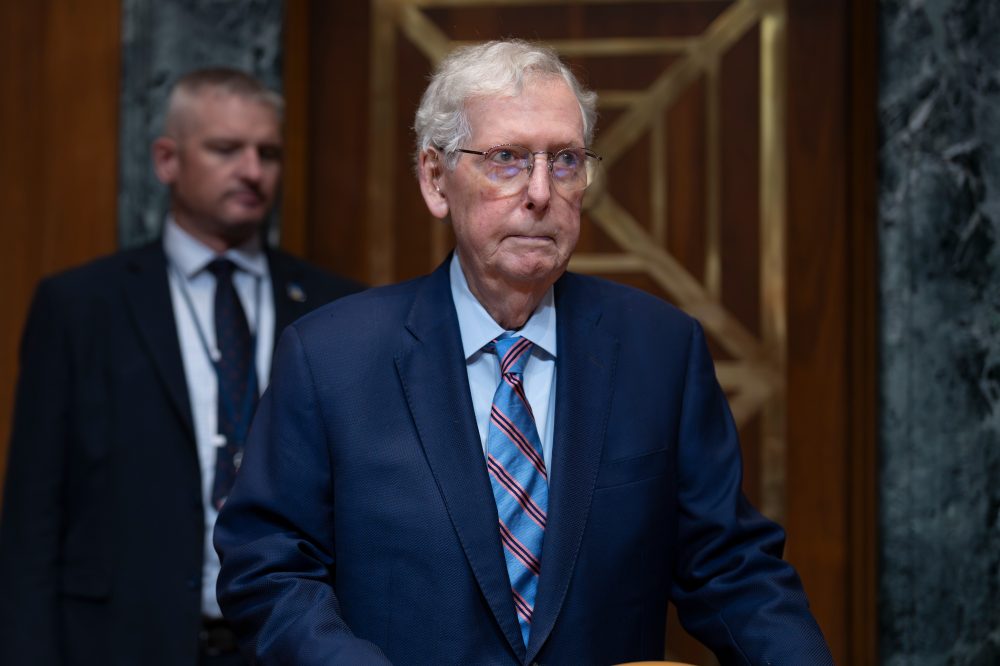
WASHINGTON (AP) — Aides for Kentucky Sen. Mitch McConnell confirmed last week that the senator remains hospitalized and is “continuing his recovery,” but they have offered virtually no details about what is keeping him there. With the Senate currently on a break, questions are mounting about whether McConnell will be back at the Capitol when lawmakers return next week.
McConnell was first admitted to the hospital on June 14. His office issued a brief statement at that time saying only that he was “receiving excellent care.” About a week later, a follow-up statement noted he would not be casting any votes that week. Then, on Thursday, his office released another update saying he “continues to improve” and “appreciates the outpouring of support he’s receiving while he continues his recovery in the hospital.”
No further updates have been issued since that Thursday statement. A spokeswoman for the senator did not respond to a request for comment made on Monday.
This latest hospitalization is not McConnell’s first. The 84-year-old senator has dealt with several health-related setbacks in recent years. He was hospitalized with a concussion in March 2023 after taking a fall at a Washington hotel, causing him to miss multiple weeks of work. When he returned to the Senate that summer, he twice appeared to freeze during news conferences, staring blankly ahead before colleagues and staff stepped in to help him. The following year, he fell and sprained his wrist while leaving a Republican luncheon.
McConnell’s health challenges go back even further. He contracted polio as a young child and has long acknowledged that walking and climbing stairs can be difficult for him as an adult. In 2019, he fell at his home in Kentucky and required surgery to repair a fractured shoulder.
The senator’s current health situation is unfolding at a sensitive time for Senate Republicans, who are managing a narrow majority in the chamber during the final stretch before the midterm elections. McConnell, who is serving out his final Senate term set to expire in January, was the longest-serving Senate leader in American history before stepping down from that role last year. He was first elected to the Senate in 1984 and led Senate Republicans from 2007 until last year, holding both the majority and minority leader positions during that span. Even after leaving leadership, he has continued showing up for Senate sessions, frequently relying on a wheelchair to get around the Capitol.
Delaware State Police are looking into a carjacking that took place Saturday evening in Frederica, and investigators are asking the public for help identifying the suspects involved.
At around 6:45 p.m. on July 4, 2026, troopers were called to the first block of East Oak Street in Frederica after a carjacking was reported. According to the preliminary investigation, the victim — a Lyft driver — had picked up three unknown individuals in Dover and transported them to the first block of East Pine Street in Frederica. Once there, one of the suspects pulled out a handgun from the back seat and demanded the driver exit the vehicle. A second suspect then got behind the wheel, and all three fled the scene in the victim’s car, also taking his cell phone. The driver was not physically harmed during the ordeal.
All three suspects had their hoods pulled up and were wearing black masks that covered their faces at the time of the incident.
The Delaware State Police Criminal Investigations Unit is continuing to work the case. Detectives are urging anyone who saw what happened or has any relevant information to reach out to Det. S. Heitzman at (302) 698-8555. Tips can also be submitted by sending a private message to the Delaware State Police Facebook page or by contacting Delaware Crime Stoppers at 1-800-847-3333.
Anyone who has been a victim or witness of a crime, or who has lost a loved one to a sudden death and needs support, can contact the Delaware State Police Victim Services Unit and Delaware Victim Center around the clock through their toll-free hotline at 1-800-VICTIM-1 (1-800-842-8461). The Victim Services Unit can also be reached by email at [email protected].
Folarin Balogun steps onto the field Monday for the biggest match of his career, carrying with him a story that has become far more than just soccer — it touches on questions of identity, immigration, and American politics at the highest level.
Balogun was not supposed to be on the field at all for the United States’ round of 16 showdown against Belgium. He had been handed a red card during the Americans’ previous match against Bosnia and Herzegovina, which would have automatically kept him out. But FIFA stunned the soccer world on Sunday by announcing it would lift that suspension.
The circumstances surrounding that decision are hard to miss. President Donald Trump — who has repeatedly pushed to end birthright citizenship — publicly called on FIFA President Gianni Infantino to take another look at Balogun’s case. Infantino confirmed the conversation took place, though he denied that Trump’s involvement had any bearing on the final outcome.
The irony runs deep. Balogun holds U.S. citizenship because his Nigerian mother was visiting New York when her pregnancy advanced too far for her to fly home. She gave birth in the United States, then brought her newborn son back to England when he was just one month old. Balogun grew up in Britain and came through the Arsenal youth academy before eventually deciding to represent the United States on the international stage.
He had previously played for England at the youth level before formally joining the U.S. Soccer program in 2023. England, Nigeria, and the United States had all been possibilities for the talented forward.
“It feels like I’m at home here,” Balogun said when U.S. Soccer announced he would wear the Stars and Stripes.
He noted that the decision was made alongside his family, and that a vacation to Orlando played a role in winning him over. “I think that’s when I really saw the full force of the U.S. fans,” he said. “It’s just something I’m really happy that I’ve decided to do.”
At the World Cup, Balogun has emerged as the tournament’s breakout American star, scoring three goals and sparking dreams of a deep run. While Christian Pulisic — long the face of U.S. men’s soccer — remains the team’s most recognized name among sponsors, it is Balogun who has captured the imagination of fans. He even drew a shoutout from LeBron James after mimicking the NBA star’s “Silencer” celebration on the pitch.
The red card that threatened to sideline him came Wednesday, when a Video Assistant Referee review caught him planting his boot on the ankle of Bosnia defender Tarik Muharemovic — a contact that appeared unintentional. Pulisic put his arm around Balogun as the 25-year-old took the moment in stride, later vowing to support his teammates from the sidelines if the ban held.
It did not hold. And the timing of the reversal — coming less than a week after the Supreme Court handed Trump a significant defeat in his effort to end birthright citizenship — made the story impossible to ignore.
“The timing and the development of the story has been extraordinary to witness,” said Jorge Loweree, the managing director of programs at the American Immigration Council.
Loweree also weighed in on what Balogun’s story represents in the broader debate. “Mr. Balogun’s case is an extraordinary example of the good that is made available to us by things like birthright citizenship, giving people an opportunity that they would not have otherwise, to be their best and to contribute to the United States in ways that benefit all of us,” he said.
A Miami Herald editorial declared that Balogun “prove(s) birthright citizenship isn’t a loophole — it’s America.”
The United States is among 33 countries — the majority located in the Western Hemisphere — that grant unconditional birthright citizenship, a right rooted in an 1898 Supreme Court ruling affirming the 14th Amendment. A Reuters/Ipsos poll conducted this year found that most Americans oppose eliminating that right.
Balogun’s rise has also taken on added significance for U.S. Soccer itself, as the program works to move beyond its long-standing reputation for drawing overwhelmingly from white, suburban talent pools. His success on sport’s grandest stage has become a symbol of a changing American soccer identity.
SEATTLE — With just hours to go before the United States and Belgium squared off in a World Cup round of 16 contest at Seattle Stadium, ticket prices were still trending downward.
According to ticket-tracking service TicketData.com, the lowest available ticket — known as the get-in price — had fallen to $1,508 as of 1 p.m. ET on Monday, July 6. That figure represents a 27% decline over just three days. Prices had peaked at $3,115 shortly after the matchup was set on July 1, then slid as low as $1,283 on Sunday morning before bouncing back to $1,788 later that day, only to fall again Monday morning.
The pattern is consistent with what has been seen at other round of 16 matches. England’s victory over Mexico in Mexico City on Sunday night carried a get-in price of $3,820 when tracking ended four hours before kickoff. However, most other remaining knockout games have experienced notable price drops.
Argentina’s Tuesday matchup against Egypt in Atlanta started at $1,599 on July 4 and has since slipped to $1,378. The most affordable ticket among all round of 16 games now belongs to Switzerland’s match against Colombia in Vancouver, where the get-in price has fallen from $972 to $719 over the past two days.
In Dallas, Monday’s other knockout contest between Portugal and Spain has seen a more modest decline, dropping from $1,367 to $1,311.
Here is a full breakdown of round of 16 get-in prices as of 1 p.m. ET on July 6, per TicketData.com:
Mexico vs. England, July 5 (Mexico City): $3,820 Brazil vs. Norway, July 5 (New York): $1,812 USA vs. Belgium, July 6 (Seattle): $1,508 Argentina vs. Egypt, July 7 (Atlanta): $1,378 Portugal vs. Spain, July 6 (Dallas): $1,311 Paraguay vs. France, July 4 (Philadelphia): $914 Canada vs. Morocco, July 4 (Houston): $721 Switzerland vs. Colombia (Vancouver): $719
Across all round of 16 matches, the average get-in price has dropped 3% over the past three days and 8% over the past week.
The steep drop in prices for the U.S.-Belgium game is considered somewhat unexpected, given that Belgium’s base camp sits just 10 miles south of Seattle Stadium at the Sounders FC Performance Center. Monday marks the third time Belgium has played in Seattle during this tournament, having previously tied Egypt 1-1 in group play and then rallying for a dramatic 3-2 victory over Senegal in the round of 32.
Whoever wins Monday’s match in Seattle will advance to face the winner of the Portugal-Spain game, with that quarterfinal set for Los Angeles on Friday.
Westbound travelers on DE-54 between Route 1 and DE-20 should expect significant delays due to heavy congestion along that corridor.
According to Delaware Department of Transportation, the slowdown is causing travel times to stretch anywhere from 20 to 55 minutes beyond normal conditions.
Drivers in the area are encouraged to allow extra time or consider using an alternate route until traffic conditions improve.
Two decades ago, the federal government established the NOAA Marine Debris Program, designating it as the lead U.S. agency responsible for reducing and preventing the damaging effects of marine debris on the nation’s ocean and Great Lakes.
The program has spent twenty years working to address the widespread problem of debris that threatens aquatic ecosystems across the country.
The National Weather Service office in Mount Holly, New Jersey has issued a Flood Watch for portions of the local area, effective Sunday, July 6.
The watch went into effect at 2:11 PM EDT and is set to expire at 8:00 PM EDT the same day.
A Flood Watch means that conditions are favorable for flooding to develop. Residents are urged to stay alert, avoid low-lying areas, and never attempt to drive through flooded roadways. Even shallow water on roads can be dangerous.
TV Delmarva will continue to monitor this weather alert and provide updates as conditions develop.
WASHINGTON — The U.S. Supreme Court on Monday declined to put a stop to a Texas law that forces app stores and developers to verify the ages of mobile device users, requiring parental approval before anyone under 18 can download apps or make in-app purchases.
The justices turned down requests from those challenging the law to reverse a lower court ruling that had allowed the measure to go into effect while the legal fight over its constitutionality plays out. The challengers argued the law runs afoul of the First Amendment’s free speech protections.
The lawsuit was brought by the Computer & Communications Industry Association — a group whose membership includes major app store operators such as Apple and Google — along with a student coalition called Students Engaged in Advancing Texas and two individual students. They went to court seeking to prevent the Texas law from being enforced.
This case marks yet another free speech showdown at the nation’s highest court involving Texas efforts to shield children from online content. Last year, the Supreme Court upheld a separate Texas law requiring age verification on adult websites. That decision came down 6-3, with the court’s six conservative justices forming the majority and the three liberal justices dissenting.
Texas enacted its App Store Accountability Act in 2025. Under the law, accounts for users younger than 18 must be connected to a parent or guardian’s account. Before a minor can download any app, the parent or guardian must be notified of the app’s age rating and must give their approval. Republican Governor Greg Abbott signed the measure into law.
The legislation is part of a growing movement among U.S. states and other nations to place limits on children’s smartphone use and reduce the potential harms of social media. Australia made history in 2025 by becoming the first country to outright ban social media access for children under the age of 16.
U.S. Judge Robert Pitman in Austin, Texas had previously blocked the law last December, concluding it likely violates the First Amendment. In his ruling, Pitman compared the law’s requirements to an extreme bookstore policy.
“The act is akin to a law that would require every bookstore to verify the age of every customer at the door and, for minors, require parental consent before the child or teen could enter and again when they try to purchase a book,” Pitman wrote.
However, on June 4, the New Orleans-based 5th U.S. Circuit Court of Appeals placed Pitman’s ruling on hold, allowing the law to take effect. The appeals court stated that “Texas has a substantial, if not compelling, interest in protecting children, and parents need to have the necessary information to make informed choices affecting their children’s upbringing.”
In urging the Supreme Court to step in and block the 5th Circuit’s decision, the Computer & Communications Industry Association argued the Texas law unlawfully requires app stores to act as gatekeepers over a massive amount of online speech.
“No state has ever required its citizens to prove their age before reading a newspaper, entering a bookstore, or even accessing the internet,” the group stated in its court filing, adding that the Texas law “does exactly that — for every mobile app on every mobile phone.”
Paris-based fashion house Christian Dior has landed one of the most talked-about bridal commissions in recent memory, dressing both Taylor Swift and Travis Kelce in Haute Couture designs for their wedding held at Madison Square Garden in New York.
The designs were crafted by Dior creative director Jonathan Anderson, a Northern Irish designer who took the reins at the French luxury house just one year ago after spending 11 years leading Loewe. The wedding outfits were made at Dior’s ateliers located at 30 Avenue Montaigne in Paris and were developed through close collaboration between Anderson and the couple.
No photographs from the tightly controlled ceremony have yet been released to the public, but the fashion world is already buzzing. The win gives Dior a clear advantage over rival Chanel in the competition for fashion’s most sought-after celebrity partnerships.
Chanel’s own creative director, Matthieu Blazy — also new to his position — made waves earlier this year when he designed an intricately beaded bridal gown for pop star Dua Lipa’s wedding in Sicily in June. However, the massive media attention surrounding Swift’s nuptials is expected to generate far greater visibility for Dior, one of the flagship brands under the LVMH luxury group, as it works to reignite consumer interest in a slowing luxury market.
Swift’s 273 million Instagram followers and devoted global fanbase represent a level of exposure that few traditional marketing campaigns could achieve.
Thomai Serdari, a luxury brand strategist and marketing professor at New York University’s Stern School of Business, explained the significance of the moment. “The commission ensures that Dior, and by extension Jonathan Anderson, are commemorated for years to come in the history of pop culture,” she said.
At Dior’s Haute Couture show held Monday in Paris, guests in the front row were eagerly discussing Swift’s wedding gown. Sheila Hicks, a 91-year-old American textile artist who previously collaborated with Anderson on a Dior bag design, shared her reaction with reporters. “When she picked Jonathan I thought, someone was advising her correctly,” Hicks said. “It projects that she’s on the ball — that she’s working with the right people.” Hicks also offered her vision for the gown, saying it “shouldn’t be overwhelming, but it should definitely have a very strong personality.”
In the weeks before the ceremony, speculation ran high about who would design Swift’s dress. Stella McCartney, one of the singer’s frequently favored designers, and Givenchy’s Sarah Burton were among the names most often mentioned as possible choices.
While Swift regularly wears a variety of high-end labels, she is rarely seen at fashion industry events and has frequently spotlighted smaller or lesser-known brands. Her engagement ring, for instance, came from independent jeweler Artifex Fine Jewelry. She wore Ralph Lauren for her engagement photo shoot, but ultimately chose French couture for her wedding day.
Anderson has had a particularly active bridal season. Within just the past month, Dior revealed two additional Haute Couture wedding gowns he designed — one worn by Chinese model Ming Xi and another by Brazilian influencer Elisa Zarzur.
Still, dressing celebrities for their weddings does not always translate into broader business success for luxury fashion labels. Lauren Sanchez wore a custom Dolce & Gabbana gown for her Venice wedding to Amazon founder Jeff Bezos during a lavish three-day event last year, yet the Italian brand has since been seeking financing and is currently in debt renegotiations with banks. Similarly, Valentino — which designed a gown for Nicola Peltz’s 2022 wedding to Brooklyn Beckham — reported a financial loss last year and is also working through negotiations with creditors.
A human rights organization focused on sports is calling for a formal investigation into U.S. President Donald Trump’s involvement in reversing a red card suspension for American soccer player Folarin Balogun, warning it could spell the beginning of the end for FIFA president Gianni Infantino.
Trump confirmed this past Monday that he had personally reached out to Infantino regarding the red card ban, which had threatened to sideline Balogun from the U.S. team’s World Cup round-of-16 clash with Belgium. FIFA’s disciplinary committee suspended the punishment on Sunday, allowing Balogun to take the field in Monday’s match.
Infantino, who has led FIFA since 2016, released a statement insisting that the disciplinary committee operates independently and that he played no role in the decision to lift Balogun’s ban.
FairSquare, a nonprofit organization dedicated to sports and human rights issues, argues that FIFA’s growing entanglement with political figures has been a concern dating back to the 2018 World Cup held in Russia.
“I don’t think there’s any question they’ve become far too politically aligned,” said Nicholas McGeehan, director and co-founder of FairSquare, in comments to Reuters.
“I think that the politicisation, probably on account of how Trump carries on, has become most obviously blatantly problematic (in the U.S.). But I think this is a trend that that has come into force … since Infantino came to power, for sure,” McGeehan added.
Earlier this month, 50 members of the European Parliament sent a letter to FIFA’s ethics committee supporting FairSquare’s existing complaint against Infantino. That complaint centers on Infantino’s backing of Trump’s political positions, including the decision to award Trump the first-ever FIFA Peace Prize.
McGeehan warned that continued political interference would place enormous strain on Infantino’s leadership. “I think if we continue to see those types of political interventions, that’s going to put real pressure on Infantino,” he said.
He went on to describe Infantino as a symptom of deeper organizational problems. “I think Infantino is a symptom of the problem. He’s a symptom of an organisation that has a rotten governance structure. (There’s a general understanding that) it’s dysfunctional to the point where it can never be reformed. And I think the relationship with Trump is probably what sort of catalysed that understanding.”
McGeehan suggested the red card controversy may ultimately prove to be a turning point for Infantino, who has already announced plans to seek another four-year term as FIFA president in March. “People are outraged when the sort of the reputation of FIFA is smeared,” he said.
“What I think you’ll find is that football administrators get seriously exercised when you start to jeopardize the integrity of the game. We are definitely going to ask for an investigation into the circumstances of this. If there is a quid pro quo at work here, then that is a very clear violation of (FIFA’s) code of ethics,” McGeehan stated.
FairSquare previously called for the resignation of Infantino’s predecessor, Sepp Blatter, back in 2015 — before Blatter stepped down amid a sweeping FIFA corruption scandal. McGeehan suggested that sentiment within the sport may now be shifting in a similar direction against Infantino.
“I think the sharks are probably circling,” McGeehan said. “He’s made far too many very serious missteps. And when you have a situation when you’ve got European lawmakers wading into debate about presidential misconduct, you have a problem.”
MIAMI — Before Giannis Antetokounmpo could look ahead to his future in Miami, he felt the need to look back and say goodbye to Milwaukee.
The NBA officially approved the blockbuster trade Monday that sends Antetokounmpo and Bobby Portis to the Miami Heat in exchange for Tyler Herro, Jaime Jaquez Jr., Kel’el Ware, Kasparas Jakucionis, and draft picks. Antetokounmpo is expected to arrive in South Florida within a few days to formally begin his tenure with the Heat.
Before making that move, the two-time NBA Most Valuable Player and 10-time All-Star shared a deeply personal video message on social media, reflecting on what Milwaukee has meant to him over 13 seasons.
“I want you to hear from my mouth, the city of Milwaukee will always be in my heart,” Antetokounmpo said in the video. “This is my home, and this is a place that I had my kids. … It made me the man that I am today. That will never ever change. No matter where I am, Milwaukee will always be my city, my team, my family.”
Antetokounmpo leaves Milwaukee as the franchise’s all-time leading scorer with 21,531 points — a total that surpasses the previous record by more than 7,000 points over Kareem Abdul-Jabbar’s time with the team. He also holds the franchise records for rebounds and assists, and ranks second all-time in steals.
Miami Heat President Pat Riley celebrated the deal enthusiastically, calling it a landmark moment in the organization’s history.
“The announcement of today’s trade for Giannis Antetokounmpo and Bobby Portis Jr. is one of the great trades in Heat history,” Riley said. “In my opinion, Giannis is one of the top five players in the league and Bobby is one of the best power forwards. The difficult part is trading Tyler, Kasparas, Jaime and Kel’el, who have given so much to this organization. We wish them nothing but the best.”
Bucks General Manager Jon Horst also issued a statement, describing the trade as the right move for all parties and praising Antetokounmpo’s lasting impact on the franchise.
“Since we drafted him in 2013, Giannis has transformed the Milwaukee Bucks in every way — on the court, in our locker room and throughout the community,” Horst said. “Over 13 seasons, he became an extraordinary leader, teammate and representative of this city, and one of the defining players of his generation. The standard he set will continue here.”
The crown jewel of Antetokounmpo’s time in Milwaukee was undoubtedly the 2021 NBA championship. He poured in 50 points during the title-clinching Game 6 win over Phoenix, earning NBA Finals MVP honors by a wide margin.
In his farewell message, Antetokounmpo said the championship was as meaningful to him as he hoped it was to the fans who supported him throughout his career.
“I believe the city of Milwaukee is blue collar,” he said. “It’s people that work extremely hard every single day. They give all their hard-earned money just to come watch the Milwaukee Bucks, to come and feel something, to come, to be a part of us.
“I hope that I was able to represent them the best that I could. And I was like them. I showed up to work, did everything. I was willing to do all the dirty work, just like them. I hope that bringing a trophy to this city meant something to them, because it meant so much to me.”
If you are traveling northbound on Route 1 between Dover and Smyrna, be prepared for a significant slowdown.
Congestion along that corridor is causing delays of approximately 15 to 20 minutes for drivers making the trip.
Authorities have not yet indicated when the backup is expected to clear. Drivers are encouraged to allow extra time or seek an alternate route to avoid the tie-up.
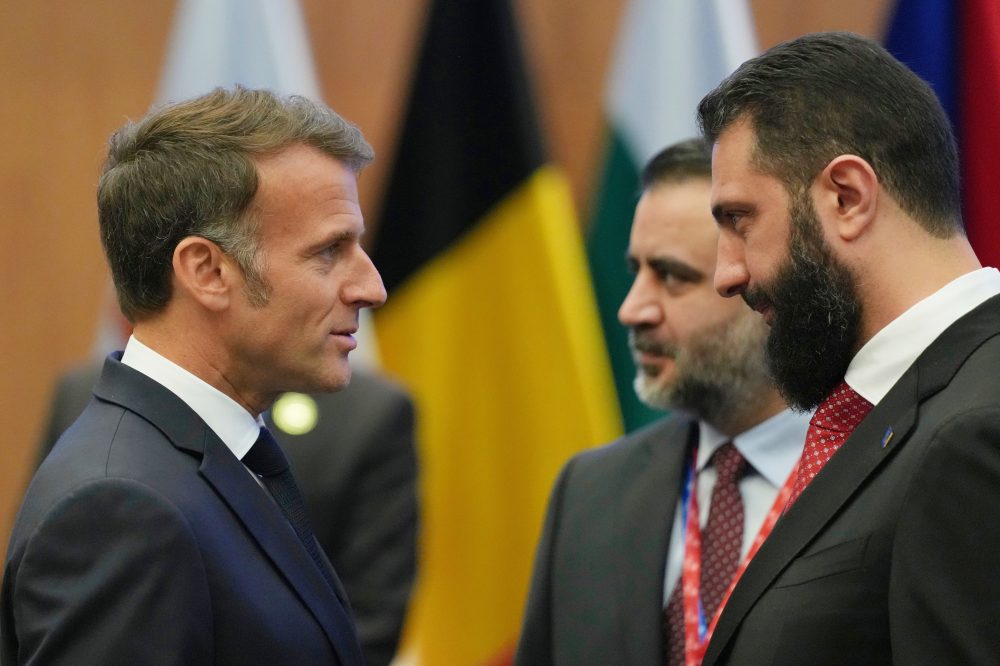
DAMASCUS, Syria — French President Emmanuel Macron touched down in the Syrian capital on Monday, becoming the first major leader from western Europe or North America to set foot in the country since Bashar al-Assad was driven from power in 2024.
While Ukrainian President Volodymyr Zelenskyy had made a visit in April, Macron’s arrival marks a significant milestone as the first visit by a Western leader of his standing.
The trip comes at a time of relative calm across the Middle East following a month of conflict involving Iran and Lebanon. After leaving Syria, Macron is scheduled to travel to Ankara, Turkey, for the NATO summit. Syrian President Ahmad al-Sharaa is also expected to attend that gathering and is anticipated to hold a high-profile meeting with U.S. President Donald Trump.
Syria’s state-run SANA news agency reported that Macron arrived alongside a business delegation, with talks planned around regional security as well as economic and investment opportunities.
Upon landing, Macron was welcomed at the Damascus airport by Syrian Foreign Minister Asaad al-Shibani.
In a post on X, Macron stated: “I have come to express France’s commitment to the Syrian people. For a sovereign Syria, united in its diversity and at peace with its neighbors. Together, let us open a new chapter of stability and peace.”
Macron’s office indicated that France stands behind all those who can “contribute to build a new Syria,” in keeping with the aspirations that emerged during the 2011 Arab Spring — a wave of uprisings across the Middle East that demanded political reform and change.
The French president was set to meet with al-Sharaa at the presidential palace and to connect directly with a range of Syrian citizens, his office noted. Specific details of the visit were withheld for security purposes.
Macron had previously hosted al-Sharaa in Paris in May 2025, during which he pushed European and U.S. leaders to remove long-standing economic sanctions on Damascus. The majority of those sanctions have since been lifted.
France stood by Syria’s new leadership even when other nations remained skeptical, given al-Sharaa’s background as the former head of the Hayat Tahrir al-Sham militant group, which had previously been tied to al-Qaida and operates under Islamist leadership.
Western governments had raised particular concerns about the rights of women and minority groups under the new administration, and whether Syria’s leadership would move toward a more democratic system of governance.
Syria has largely avoided being drawn into the region’s recent armed conflicts, but the nation continues to bear the scars of 13 years of internal war. That prolonged conflict left vast portions of the country in ruins, pushed millions of people into poverty, and is estimated to require hundreds of billions of dollars in reconstruction funding. While Syria has signed memorandums of understanding with various countries and major corporations for large-scale investment projects, those agreements have not yet translated into concrete results.
LA GUAIRA, Venezuela — Noel Márquez was at his girlfriend’s apartment when twin earthquakes brought down the high-rise building where he lived with his family, setting it ablaze. He rushed back and called out desperately. The only response came from his 17-year-old brother Leonel, whose legs were trapped beneath concrete columns that would have required heavy machinery to move.
Márquez and his father, both of whom survived, could hear Leonel through the layers of debris — crying out in pain, begging for help, choking on smoke — as they waited for a crane that never arrived. After several agonizing hours, Leonel went silent.
As devastating as that was, Márquez said the worst part came next: attempting to retrieve his family members’ remains with little more than his bare hands and a saw. He was forced to cut off limbs to free the bodies of Leonel and his mother. He could not reach his eight-months-pregnant sister, his grandmother, or other relatives still buried in the wreckage — and with them, any chance of giving them a proper burial.
“It’s unfair. It’s inhumane, everything that is happening,” said Márquez, 26, speaking from an overcrowded temporary morgue set up at the La Guaira port. “We couldn’t get my brother out because we didn’t get a response from the state … and after 11 days, we are still requesting a crane.”
Márquez represents a vast number of Venezuelans who, after days of torment, have been left largely on their own — searching not for survivors, but for the remains of the people they loved, and for some measure of peace.
International rescue teams, quietly accepting that the odds of finding anyone alive after 12 days under the debris are essentially zero, are preparing to leave the country. Local officials have shifted their attention toward finding shelter for the thousands of people displaced by the disaster. But the task of recovering the dead has fallen heavily on the families themselves.
“I found her hand, but her torso is crushed,” said Norely Rodríguez, working to free her 5-year-old daughter from the ruins in La Guaira, the hardest-hit area. “I want to see if I can get her out whole.”
Survivors say that just as the government failed to respond quickly enough to rescue the living in the immediate aftermath of the quakes, families are now similarly under-resourced as they try to recover the dead nearly two weeks later.
The passage of time has made the process increasingly grim. “It has been difficult because the bodies are already in an advanced state of decomposition, decomposed to such an extent that many times when we try to remove them, they fall apart,” said William Gomez, a firefighter working in La Guaira.
Authorities announced Sunday that the confirmed death toll had climbed to 3,342, with an additional 16,740 people reported injured. Beyond those numbers lies an unknown count of victims still buried beneath the rubble. While no official tally exists, more than 30,000 missing persons reports have been submitted to a website created by the Venezuelan opposition.
Over the weekend in La Guaira, no government civil defense workers or security personnel were observed helping families dig through the wreckage. The overwhelming majority of those searching were ordinary civilians using their hands or basic tools like pickaxes and shovels, with occasional assistance from firefighters and Mexican rescue workers still in the country.
“We are the ones helping ourselves: our family. Nobody else helps us except for a few volunteers,” said Yeikhary Urbina, who on Saturday discovered the bodies of her mother and brother suspended under mounds of concrete, appearing to be locked in an embrace.
Rescue teams from Italy, Argentina, Spain, and other nations have already gone home. The Venezuelan government has not officially called off the search for survivors, but officials have shifted their public messaging — moving away from highlighting dramatic rescues on social media and toward announcing rebuilding plans under a program called Venezuela Reborn.
“Venezuela is entering a process of infrastructure recovery, of housing recovery,” acting President Delcy Rodríguez said on state television Saturday.
Families still searching face new horrors with each passing day. Some have spent days digging only to find remains so badly decomposed that identification is nearly impossible. Others have found nothing at all. “She kept asking, ‘Why did God play this trick on me?’” said Geraldine Perdomo, describing her sister’s desperate search through the rubble of her home for any confirmation that her two daughters had died.
And some, like Márquez, endured days of grueling effort to recover their loved ones’ bodies, only to lose track of them again in the disorder of the makeshift morgue beneath grain silos at La Guaira port, where bodies have been arriving in a near-constant stream since the June 24 earthquakes. Márquez said that on Sunday — a week after he brought in the bodies — he learned authorities had located his mother and grandfather. But his brother Leonel, he said, “is still missing because of the negligence here.”
Márquez and many other residents of the country’s public housing towers — built years ago for low-income families under former socialist leader Hugo Chávez — say their concerns about government neglect go back long before this disaster. Several of those high-rise buildings, each housing hundreds of families, collapsed entirely during the earthquakes, renewing questions about the quality of their construction.
Alexander, a 42-year-old police officer who lived in one of the towers, was shaking with anger on Sunday. He blamed the government for ignoring residents’ longstanding concerns about the structural integrity of the building, for failing to send rescue crews in time to save his wife and three daughters, and now for not providing the heavy equipment needed to help him recover their bodies.
“Not a single person from the government was here,” he said. He asked to be identified only by his first name, fearing that as a government employee, speaking out against authorities could put him at risk of retaliation.
After 11 days of searching, he finally reached the last member of his family still unaccounted for — his 12-year-old daughter. Her body was decomposed but intact.
“She was waiting for me to pull her out,” he said, holding the black plastic body bag in his arms.
WASHINGTON — President Trump announced Monday that a granite helipad is being constructed on the White House South Lawn, saying the new landing surface is necessary to support a modern and more powerful fleet of presidential helicopters.
Construction crews were already on the job when Trump confirmed the project, working on the same South Lawn where UFC had recently set up a temporary arena for a cage fight marking the president’s 80th birthday. Trump said the project would be privately funded, putting its price tag at as much as $6 million.
“It’s got the seal of the White House on it in granite, in carved granite,” Trump told reporters during an Oval Office appearance. “It’s really a beautiful thing.”
The president offered no specifics on how long construction would take. The helipad is the latest in a series of major renovation efforts Trump has undertaken to put his personal stamp on the White House.
While some of Trump’s previous White House construction projects have drawn on public funds despite early suggestions they would not, Trump said Sikorsky Aircraft — a subsidiary of defense contracting giant Lockheed Martin — would be covering the cost of the helipad.
When asked about the cost and timeline, Lockheed Martin issued a statement saying in part: “This specific contribution was made to the Trust for the National Mall, the National Park Service’s non-profit organization” and was “conducted in full accordance with all applicable laws and regulations.”
In 2024, Sikorsky finished delivering a new fleet of helicopters for presidential transport. President Joe Biden became the first to fly aboard one of the modern VH-92A helicopters, using it to travel to the Democratic National Convention in Chicago — the same day the military announced Sikorsky had delivered the final aircraft in the 23-helicopter order.
However, Trump explained that the new choppers are far more powerful than the Vietnam War-era helicopters that have long served as Marine One, and that their power makes them too intense to land on the White House lawn without causing damage.
“It’s not that the grass gets discolored — it gets ripped out,” the president said.
The new aircraft have indeed seen limited use at the White House because their exhaust vents direct heat downward, scorching the South Lawn. The Marines and Sikorsky have spent years searching for a fix, meaning the new helicopters have largely sat unused at the executive mansion. A 2026 Marine Corps aviation plan noted that the older VH-3D helicopters will remain in service through the end of this year.
Trump recalled telling a group of military generals that building a helipad would resolve the problem. He said Sikorsky agreed to build and fully fund the pad because the company “felt a little bit guilty” that its new helicopter fleet was too powerful to land at the White House.
Trump also said he directed builders to “do a beauty” and pushed for granite rather than plain painted concrete. “You’re landing on granite, which is the strongest stone,” he said, adding that the finished pad could double as a venue for outdoor White House events such as news conferences. He also said the helipad would allow officials to “finally retire 45-year-old helicopters” that had been pressed into service as Marine One.
The helipad is just one of several changes Trump has made to the White House. Other projects include tearing up part of the Rose Garden to create a patio reminiscent of his Mar-a-Lago estate in Florida, adding partisan plaques along the colonnade wall for a Presidential Walk of Fame, renovating the bathroom off the Lincoln Bedroom, redoing the Palm Room, installing new flagpoles on both the north and south lawns, and demolishing the entire East Wing to make room for a large ballroom.
While “Marine One” is a designation applied to any helicopter carrying the president, the most iconic version has been the specially modified VH-3D Sea King, which entered service in 1978. Efforts to replace it date back to the early 2000s, when President George W. Bush launched a modernization program that was eventually scrapped due to cost overruns during President Barack Obama’s administration. Obama restarted the effort, but technical problems delayed progress until May 2014, when the military finally awarded Sikorsky a contract to build the VH-92A Patriot — the helicopters that were ultimately delivered in 2024.
Later Monday, Trump spoke at a lunch held in the Rose Garden patio and revealed yet another renovation project: a restoration of the columns on the building’s north side. Scaffolding has already gone up, and Trump noted, “We’ve taken about 150 years of paint off of the columns,” adding that “if you don’t strip the paint off, it gets worse and worse and worse.”
“A lot of love is being put into the White House,” Trump said. “Because, frankly, it was treated very badly by a lot of presidents.”
The president did not say who would be paying for the column restoration work.
The punishing heat wave that locked down New York City and much of the Northeast last week has finally given way — but the relief came with a new set of dangers, as heavy rain and flooding swept through the region.
Flash flood warnings were put in place Monday for portions of New York, Philadelphia, and New Jersey as multiple rounds of storms pushed through the area.
New York City Mayor Zohran Mamdani had spent Sunday warning residents about the dangers of heatstroke and pointing people toward pools and cooling centers. By Monday morning, his message had shifted dramatically — urging anyone living in a basement apartment to get out immediately if they noticed water beginning to rise inside their home.
Across northern New Jersey, floodwaters left cars stranded on highways. In Ocean Township, heavy rainfall caused part of the roof at a BJ’s Wholesale Club to give way. Two people were briefly trapped inside but were able to free themselves. The Monmouth County Sheriff’s Office confirmed no injuries were reported.
“Nothing too serious. They have us running from call to call,” said Capt. Leroy Marshall of the Lakewood Police Department, located nearby.
The storms effectively dismantled the heat dome that had been sitting over the Northeast for days. At its peak, LaGuardia Airport in New York recorded a historic high of 104 degrees Fahrenheit (40 degrees Celsius) on Thursday. Overnight temperatures in many locations barely dipped below 80 degrees F (26.7 C), offering little relief even after dark.
New Jersey health officials are now looking into approximately 25 deaths that may have been caused by the extreme heat. The victims — ranging in age from their 30s to their 80s — were found dead either on the street or inside homes without air conditioning, according to New Jersey Department of Health Commissioner Raynard Washington.
Washington noted that autopsies and further investigations will be required before the heat can officially be listed as the cause of death. No other states have announced potential heat-related fatalities at this time.
As the heat wave broke over the weekend, a line of severe storms tracked from Michigan toward the East Coast. According to poweroutage.com, around 450,000 customers were still without electricity in the aftermath of the storm damage.
DETROIT (AP) — Long before it was ever called the United States, this nation was built not on centuries of shared tradition, but on something harder to pin down: a collection of stories it repeated to itself again and again — a mix of truths, myths, and outright fabrications — until it willed itself into being.
“A city upon a hill.” “All men are created equal.” “Life, liberty and the pursuit of happiness.” Tales of presidents splitting logs and owning up to chopping down cherry trees. A founding father flying a kite in a thunderstorm. And towering above them all, the “American Dream” — a story that traveled across states and entire oceans.
The United States grew into the nation that built the most powerful storytelling machines the world had ever seen — the American frontier, Hollywood, and Madison Avenue. It also sat at the heart of the internet and social media revolution — technologies that muddled and scrambled information even as they gave a voice to groups that had long been silenced, allowing them to offer their own perspectives on the American experience.
This past Saturday marked 250 years of what many call the Great Experiment. And even in this era of deep division, the American story still carries enormous weight. It shapes hearts and minds in a country where the national narrative — and the question of who controls it — has always been a source of power. And as is evident today, it is those who win who get to write and control the history.
Frontier historian Richard Slotkin once put it plainly. “There’s nothing organic about the United States. It’s an invented country,” he told The Associated Press. “And if we stop telling the American story, we’re just a bunch of folks. … You have to keep adding new chapters to the story and making the story make sense.”
In politics and entertainment, in classrooms and at tourist destinations, Americans do exactly that — at a relentless pace, and sometimes, perhaps, to a degree that isn’t healthy.
The country today holds countless versions of its own story, each reflecting what America has been, is, and might one day become. But in the 2020s, telling that story is a crowded and contentious endeavor, riddled with misinformation and deliberate falsehoods. The battle plays out in schools, political arenas, newsrooms, entertainment, and history books alike.
Is your anthem “This Land Is Your Land,” “God Bless America,” or “Courtesy of the Red, White and Blue”? Do you side with Sean Penn or James Woods? Tucker Carlson or Jimmy Kimmel? Do you wear a bald eagle on your shirt or a pride flag? Do you drive a pickup truck or an electric vehicle? These choices signal what kind of American you see yourself as.
Do you grab flag-themed souvenirs at Walmart, or do you express your love of country differently? Do you belt out the National Anthem at sporting events? Do you share memes celebrating America’s greatness — or lamenting its failures? Do you watch old World War II films with a sense of reverence? Every one of those choices is a small act of storytelling, a contribution to the ongoing national narrative.
Consider singer-songwriter Jesse Welles — progressive and openly patriotic, carrying on the tradition of Woody Guthrie and Bruce Springsteen — who uses flag imagery and pointed lyrics at his concerts to assert that he and those who share his beliefs will not be written out of the American story. “Good morning, America. Good evening, America. I love ya,” he likes to sing.
Or consider Donald Trump, a master of brand-driven storytelling, who is actively reshaping the story America tells about itself. Regardless of how one feels about him, it’s difficult to argue that the American narrative — both at home and abroad — doesn’t bear his unmistakable mark. He is well aware of his influence over the tale.
“The left has warped, distorted, and defiled the American story with deceptions, falsehoods, and lies,” Trump said shortly before losing the 2020 election.
Yet the president’s version of the story frequently centers less on the nation itself and more on Donald Trump personally.
Through a torrent of superlatives and self-promotion, he has placed his own story front and center — both in a figurative and a literal sense. He has expressed interest in being added to Mount Rushmore. His face may appear on currency during his own lifetime. It will appear on this year’s anniversary edition of the U.S. passport. His image is displayed throughout Washington, D.C., alongside other visible marks of his presence — from a triumph arch to the disputed redesign of the reflecting pool to the equally controversial $400 million ballroom being added to the White House. Whatever else these projects represent, they are attempts to claim pieces of the American story as his own.
It is a pattern that has defined much of his life — presenting himself as the living symbol of American success. Even this month’s anniversary celebration became a contest over which story to tell, with Trump’s influence clearly in play.
There was America250, a bipartisan effort created by Congress. And there was Freedom 250, a version backed by the Trump administration that hewed much more closely to the MAGA interpretation of American history. The two events effectively represent a tug-of-war over which version of America gets the spotlight — a tension made more visible when several musical acts pulled out of Freedom 250 concerts, saying the events had become too politically charged.
The story shifted.
The American flag sits at the heart of the national narrative — a piece of cloth that contains contradictions and complexities (“gave proof through the night, that our flag was still there”). It always has, going back to the legend of Betsy Ross.
Its display — in ballparks, at solemn military ceremonies, in the aisles of big-box stores — invites people to think about their country and its purpose. Its deliberate destruction, protected under the principle of free speech and itself a significant chapter in the American story, is used by some as a form of passionate protest, and condemned by others as shameful and even treasonous.
That tension is no surprise, given that the flag is a physical representation of the American story — something Jesse Welles makes plain at his performances.
“It’s an extraordinarily potent symbol for anybody — left, right or center,” said Ken Burns, the celebrated documentary filmmaker. “It’s interesting when we have this assault on traditional democratic institutions that the people who are out in the streets protesting have sort of reclaimed — and they never should have relinquished — the American flag.”
But how the flag is used — and by whom — varies considerably. Republicans and older white Americans are more likely to fly it, wear it as clothing, or, as in the case of Pete Hegseth, use it as a pocket square. Democrats and Black Americans are less likely to do so. That was the finding of an AP-NORC poll conducted last month.
John Baick, a historian at Western New England University, has noticed less flag imagery during Trump’s second term than during his first, suggesting that the intense focus on Trump himself may have crowded it out. Baick argues that the use of storytelling in today’s political environment shapes the broader sense of what the United States is — and he sees that sense fragmenting, as reflected in how the flag is being used.
“I think it’s just become a muddled mess,” Baick said. “I think it’s just going to be almost the breakdown of a national system and states will figure it out, cities will figure it out, individuals will figure it out. They’ll put out their flags, but … they’ll tell their own stories.”
The national story is far from finished. Fox News business journalist Maria Bartiromo, when recently recounting her family’s history, referred to the United States as “this young nation” — a reminder of just how new this country really is. Nations like China and Russia have thousands of years of stories to draw upon. The United States has fewer than 400, even counting back to its earliest origins.
And so the American story presses on. Where it goes next — and whose voice will carry the farthest — remains to be seen.
Ukrainian President Volodymyr Zelenskiy spoke out Monday about what he described as a critical shortage of weapons needed to shield Ukraine from Russian ballistic missile attacks.
In his nightly video address, Zelenskiy called the situation deeply troubling, saying: “It is simply absurd that, in the modern world, production has still not been scaled up to the level actually required to protect people from ballistic terror.”
The Ukrainian leader went on to say that Ukraine already possesses the technical knowledge to manufacture the necessary defense systems. He added that if Ukraine were granted U.S. licenses to produce U.S. Patriot missile systems, “our production would be sufficient not only to defend Ukraine but also to assist partners who need them.”
Russian heavyweight champion Murat Gassiev is set to defend his WBA world heavyweight boxing title against Germany’s Peter Kadiru in Moscow on July 11, according to event organizers who announced the matchup on Monday.
The fight came together after French heavyweight Tony Yoka was forced to withdraw from the scheduled bout at the VTB Arena, citing a back injury that left him unable to compete.
Gassiev captured the secondary WBA ‘regular’ heavyweight title this past December by defeating Bulgaria’s Kubrat Pulev. He now sits atop the WBA’s heavyweight rankings after ‘super champion’ Oleksandr Usyk gave up his belts, leaving the division without a clear top titleholder.
The 32-year-old Russian enters the fight with an impressive professional record of 33 victories and just two defeats, including a loss to Usyk in the cruiserweight division back in 2018, along with one no contest.
His opponent, Kadiru, was born in Hamburg and is 29 years old. The German fighter has competed 24 times as a professional, with only a single defeat on his record.
Federal authorities have confiscated more than 600 drones that were flying near FIFA World Cup stadiums since the tournament began on June 11, the Transportation Security Administration announced Monday.
During match days, all aircraft — including drones — are banned from flying within a three-nautical-mile radius and up to 3,000 feet above ground level around the host stadiums, unless air traffic controllers have specifically granted permission. The FBI confirmed that the seized drones were recovered from restricted airspace spanning all 11 U.S. cities serving as World Cup host sites.
ANKARA, Turkey — The Netherlands is set to unveil a package of defence agreements and plans valued at more than €3 billion — roughly $3.43 billion — at a NATO forum taking place Tuesday in Ankara, according to Dutch Defence Minister Dilan Yesilgoz.
Speaking with Reuters during an interview in the Turkish capital on Monday, Yesilgoz outlined some of what is expected to be announced, including a partnership with Belgium focused on air defence and a collaboration with Britain involving naval vessels. She also indicated the Netherlands is seeking to expand joint defence projects with Germany.
“We have several levels of plans with countries around us, within NATO,” Yesilgoz said. “For the Netherlands, it will be … well over 3 billion euros that we will have new — not only pledges, but concrete plans.”
The minister held back additional specifics ahead of the formal announcements, which are part of a broader wave of declarations expected from NATO member nations at the forum. The flurry of pledges is designed to demonstrate that alliance members are ramping up their defence budgets — a priority pushed by U.S. President Donald Trump.
Trump is scheduled to join the leaders of NATO’s 31 other member nations for the summit, which kicks off Tuesday evening with a dinner. The gathering continues Wednesday with a session of the alliance’s top decision-making body, the North Atlantic Council.
When asked whether she felt confident the United States would stay committed to NATO despite Trump’s past remarks questioning his dedication to the alliance, Yesilgoz was measured but firm. “I have to be confident, because I know that we need each other,” she said.
She went on to say that “we need each other … for our own safety and security,” and described it as “healthy for Europe to invest more in its own defence and defence industries regardless of who is at the White House at the moment.”
A young Czech tennis star continued her country’s strong tradition at Wimbledon on Monday, as 21-year-old Linda Noskova eliminated American Madison Keys 6-4, 7-6(2) to make the quarterfinals at the All England Club for the very first time.
Noskova, seeded ninth, is looking to follow a proud line of Czech champions at the grasscourt major, including Petra Kvitova, Marketa Vondrousova, and Barbora Krejcikova. Her performance Monday showed a level of maturity on grass that signals she could be next in line to make a deep run at the prestigious tournament.
The young Czech had trained under Melanie Molitor — the mother of tennis legend Martina Hingis — from the time she was 3 years old until age 19, and those lessons were on full display. Noskova successfully defended both break points she faced early in the match before seizing her lone opportunity in the 10th game to claim the first set.
The match was played on a lightly attended Court One, as many spectators sought shade from the intense summer sun. Keys, the 26th seed, was unable to replicate the dominant form she had shown in the previous round, when she had 2025 runner-up Amanda Anisimova struggling to keep up.
Noskova appeared poised to run away with the second set after jumping out to a 3-0 lead, but her serve suddenly became unreliable. Four double faults led to a break in the fifth game, allowing the 2025 Australian Open champion Keys to claw back to 3-3 and force a tiebreak.
When it mattered most, however, Noskova held her nerve. She converted her first match point with a perfectly placed dropshot winner, closing out the victory and booking her spot in the quarterfinals against Belgian 25th seed Elise Mertens.
Noskova now joins fellow Czech Karolina Muchova in the last eight, giving the Czech Republic a chance to capture the Venus Rosewater Dish for the third time in four years. For Keys, the loss brought an end to an impressive eight-match winning streak on grass that had begun with her title run in Eastbourne last month.
A stunning and controversial ruling by FIFA has cleared U.S. men’s national team forward Folarin Balogun to play in the round of 16 despite being shown a red card just one week earlier.
Balogun was ejected during the United States’ round of 32 match against Bosnia-Herzegovina, a foul that would normally trigger an automatic one-game suspension. Yet FIFA made the unusual decision to wipe away that ban, allowing him to suit up Monday against Belgium in Seattle.
The ruling sent shockwaves through the soccer world, particularly after it came to light that President Donald Trump had spoken directly with FIFA President Gianni Infantino prior to the decision. That revelation has sparked a heated debate about whether political pressure played a role in overturning the standard disciplinary process.
Belgium’s football federation was not going down without a fight, filing a last-minute appeal in an attempt to block Balogun from taking the field. The rare nature of FIFA’s decision and the circumstances surrounding it have placed the governing body squarely at the center of a growing controversy.
An Afghan man who spent a decade fighting alongside U.S. Special Forces died from a severe allergic reaction while being held by Immigration and Customs Enforcement — just one day after agents arrested him for deportation proceedings, according to his death certificate.
Mohammad Nazeer Paktiawal, 41, experienced what the document describes as “an adverse drug reaction” to an unknown substance, which set off anaphylaxis and worsened his existing asthma condition. His death on March 14 at a Dallas hospital was officially classified as an accident.
The circumstances surrounding Paktiawal’s death have sparked widespread anger, given that he had put his life on the line as a U.S. ally in Afghanistan for ten years. Advocacy organization AfghanEvac and several members of Congress have been pushing for a full accounting of what took place.
Among more than 50 deaths that have occurred in ICE detention during President Donald Trump’s second term, Paktiawal’s is the only one so far to be ruled an accident, based on tracking by The Associated Press. The majority of the other deaths have been attributed to natural causes or suicide.
On Monday, AfghanEvac called on Texas officials to make public the complete autopsy report. Authorities have been fighting to keep it sealed, arguing that releasing it could compromise an active criminal investigation into the death.
“This family has a right to know what happened. Why won’t they release the report?” said Shawn VanDiver, president of AfghanEvac. He pressed authorities to explain what triggered the allergic reaction, how that substance entered Paktiawal’s body, and why the death certificate lists the date of injury as the day before he was actually taken into custody.
Paktiawal was among the thousands of Afghans evacuated to the United States when American forces withdrew from Afghanistan in 2021. He came through a legal immigration process and applied for asylum. That application was still pending when ICE agents showed up at his home in Richardson, Texas, on March 13 and arrested him as he was in the process of taking some of his six children to school.
ICE has defended its decision to pursue deportation against Paktiawal, pointing to prior arrests on food stamp fraud and theft charges. He had not been convicted in either case.
According to a one-page ICE summary of the incident, Paktiawal was screened at the agency’s Dallas field office and told staff he had no known medical conditions or allergies. A few hours later, he began having trouble breathing and complained of chest pain while in a holding room, and was transported to Parkland Memorial Hospital.
The following morning, hospital workers noticed his tongue had swollen while he was eating breakfast and administered epinephrine, a medication used to treat severe allergic reactions. Despite life-saving efforts, he was pronounced dead roughly 40 minutes later.
The death certificate lists the official cause of death as “anaphylaxis complicating acute asthma exacerbation.” Anaphylaxis is an extreme allergic response that can be triggered by food, medication, or insect venom. The document also notes that methamphetamine toxicity, heart disease, and cigarette smoking were contributing factors.
People who knew Paktiawal — including family members and coworkers — said they had never seen him use methamphetamine. A second autopsy conducted privately on behalf of the family was unable to confirm whether meth was present in his system because no blood was available for testing, according to VanDiver. Paktiawal’s wife has stated that he used an inhaler to manage his asthma, but ICE agents turned her away when she tried to hand over the device at the time of his arrest.
The Dallas County Medical Examiner’s Office conducted the official autopsy and established both the cause and manner of death.
County officials have declined to release the full autopsy report, citing guidance from ICE that doing so could hinder a federal investigation. They have asked Texas Attorney General Ken Paxton’s office for authorization to withhold the record under a “law enforcement exception” in the state’s open records law.
In a written response to an AP request for the report, Dallas County official Jennifer Rose stated that releasing it “would interfere with the detection, investigation, and prosecution of a crime,” without providing further detail. The medical examiner’s office declined to comment on the matter.
Paxton’s office has not yet issued a ruling, but it previously approved a comparable request from another Texas county to block release of an autopsy report for a Vietnamese man who died in ICE custody in July 2025, according to documents the AP obtained.
French President Emmanuel Macron touched down in Syria on Monday, according to Syria’s state news agency, becoming the first leader of a European Union nation to visit Damascus since rebel forces ousted longtime ruler Bashar al-Assad in 2024.
The historic trip signals a major shift in how the international community views Syria under its new leadership. The country is now led by President Ahmed al-Sharaa, a former al Qaeda commander who has managed to forge strong relationships with Western and Middle Eastern nations — governments that had previously refused to engage with the Assad regime.
Sharaa is working to rebuild a nation left in ruins after 13 years of devastating civil war, and Macron’s visit underscores Syria’s rapidly changing role in the geopolitical landscape of the region.
LIMA — Peruvian leftist presidential candidate Roberto Sanchez formally stepped aside Monday, acknowledging conservative Keiko Fujimori as the winner of Peru’s presidential election — several days after the country’s electoral authorities made their official declaration.
Sanchez and his political party released a joint statement Monday saying they “recognized that the National Elections Board had officially proclaimed the electoral results.” According to the final vote count, Fujimori received 50.135% of the vote in the June 7 runoff election.
KANSAS CITY, Missouri — Two decades before Lionel Messi lifted the World Cup trophy as a champion, his former Argentina coach Jose Pekerman made a calculated decision to bring a nervous 18-year-old off the bench during a match that was already well in hand — and he did it with a clear purpose in mind.
With Argentina cruising to what would become a 6-0 victory over Serbia and Montenegro in Gelsenkirchen, Pekerman introduced Messi in the 75th minute. He wasn’t simply giving a talented youngster some field time. In his mind, he was setting the foundation for what he believed would be one of soccer’s all-time great careers.
The teenager wasted no time justifying that belief. Within minutes of entering the match, Messi assisted Hernan Crespo on a goal and then scored himself, becoming the youngest Argentine ever to find the net at a World Cup.
Despite criticism for limiting Messi’s playing time throughout the tournament, Pekerman insists the approach was never about padding a scoreline. Each appearance, no matter how short, was part of a broader strategy to prepare the young player for the unique pressures of the world’s biggest soccer stage.
Cuba’s national power grid went dark Monday afternoon, with the country’s grid operator confirming a total collapse that left approximately 10 million people on the Caribbean island without electricity.
Grid operator UNE announced the complete nationwide outage and said crews are actively investigating what triggered the failure.
The island has been dealing with a worsening energy situation for months, enduring blackouts that have stretched from several hours to multiple days at a time. Officials have pointed to a badly deteriorated power infrastructure and a U.S.-imposed oil blockade that has severely restricted the island’s fuel supply as contributing factors.
For everyday Cubans, Monday’s total grid failure is another blow in an already exhausting situation. Rolling blackouts have already made it difficult for many residents to work or get a good night’s sleep during the sweltering Caribbean summer.
Cuba’s Communist-run government has faced a prolonged economic crisis for years, but the situation has reached new levels of severity under mounting pressure from U.S. President Donald Trump.
Adding to the severity of Monday’s collapse — nearly two-thirds of the island was already experiencing power outages before the grid failed entirely.
Brazil’s World Cup heartbreak is fresh once more, and legendary right back Cafu says the solution goes deeper than tactics or finding someone to blame. Speaking in New York on Monday, the captain of Brazil’s 2002 World Cup championship team said the real fix might start with something much more fundamental — letting kids play freely without carrying the burden of a nation’s expectations.
Just one day after Brazil suffered a gut-wrenching 2-1 defeat to Norway in the Round of 16 at the New York/New Jersey stadium — with Erling Haaland netting both goals to send the record five-time champions packing — Cafu called on Brazil to give coach Carlo Ancelotti the time and space for a full four-year rebuild.
Brazil’s quest for a sixth World Cup title will now stretch to at least 28 years without a championship, the longest drought in the nation’s storied football history. Cafu, who was part of the 1994 squad that snapped a 24-year title drought, understands exactly what that number means to those who wear the famous yellow jersey.
When asked about the pressure the next generation of Brazilian players will face, Cafu didn’t sugarcoat it. “Even greater,” he told Reuters. “If there was pressure in ’94 after 24 years, just imagine now in 2030, after 28 years.”
Cafu was in New York to help unveil a massive LEGO sculpture of the World Cup trophy at Rockefeller Plaza — an 8.47-metre-long creation made from more than 1.36 million LEGO bricks. Despite the occasion, he kept his remarks grounded and measured.
Brazil, he insisted, are still Brazil — a country measured by “the potential and the calibre of Brazilian football.” That standard, he noted, is exactly why patience will be both painful and essential in the years ahead.
“It’s not the end of the world,” he said. “It’s the start of a new cycle and a new generation, so we have to trust Carlo (Ancelotti) is the man to help Brazil win that title again.”
ANCELOTTI STEPPED INTO CHAOS
Ancelotti, who was once managed by Cafu at AC Milan, took over a Brazilian program in disarray. After three interim coaches and significant administrative turmoil, Cafu said the Italian manager wasn’t handed a team so much as a crisis.
“Ancelotti came into this World Cup to put out a fire, really,” Cafu said. “He took the reins of a ship that was already underway. He tried to right that ship mid-journey… but unfortunately he didn’t succeed.
“Now he’ll take the ship while it’s docked and will be able to set it on its exact course.”
Beyond the national team, Cafu’s concern runs deeper — into the academies and youth leagues where he believes Brazil’s trademark creativity and flair are being choked out by an adult-driven obsession with results. The country that once produced attacking full backs who could cover entire flanks with joy and freedom is, in his view, losing sight of what made those players great.
“Youth teams aren’t developing full-backs the way they should be,” he said. “A full-back has to be a full-back; he has to work on the flank.”
On a broader level, Cafu believes Brazil has confused nurturing talent with manufacturing winners.
“Today we’re not developing players, we’re developing competitors,” he said. “When you set up a youth programme where you’re obliged to win, you’ll develop competitors; you won’t develop proper athletes with creative freedom.”
The romance of street football — the barefoot games on asphalt that shaped his own generation — cannot be brought back simply by wishing for it, Cafu acknowledged. His memories belong to a different era of Brazilian life.
“That’s changed. It won’t come back,” he said. “Lucky were us who lived through that time, who lived through that era.”
The challenge now isn’t to recreate the past, but to preserve some of its spirit within the modern game’s structure.
“Let children be children,” Cafu said. “At eight, a child should be playing with a ball, laughing and having fun.”
And then he offered perhaps the simplest coaching philosophy imaginable — fitting, given the setting.
“It’s like building with Lego,” he said. “You put the pieces together one by one and enjoy yourself without even noticing you are developing a skill.”
Delaware State Police are actively investigating a murder-suicide that unfolded Sunday afternoon in a Milford neighborhood.
At around 4:15 p.m. on July 5, 2026, troopers were dispatched to the 7000 block of Sugar Maple Drive in the Sugar Maple Farms community after a man dialed 911 and told dispatchers he had killed his wife before abruptly ending the call. Both 911 dispatchers and troopers on the scene made repeated attempts to make contact with the man, but those efforts were unsuccessful.
Members of the Delaware State Police Special Operations Response Team eventually entered the home, where they discovered a 38-year-old woman who had suffered gunshot wounds and a 43-year-old man with what appeared to be a self-inflicted gunshot wound. Both individuals were pronounced dead at the scene. Their names are being withheld at this time pending notification of their families.
The Delaware State Police Homicide Unit has taken over the investigation. Detectives are urging anyone who may have information about this case to reach out to Detective Z. Spudis at (302) 752-3795. Tips can also be submitted through a private message on the Delaware State Police Facebook page or by contacting Delaware Crime Stoppers at 1-800-847-3333.
Anyone who has been affected by a violent crime or the sudden loss of a loved one can reach the Delaware State Police Victim Services Unit and the Delaware Victim Center around the clock through their toll-free hotline at 1-800-VICTIM-1 (1-800-842-8461). You may also contact the Victim Services Unit by email at [email protected].
The Newark Police Department has unveiled a new partnership aimed at boosting the mental health and overall well-being of its officers and staff members.
The department announced it has teamed up with The GUIDE App, a platform designed to provide confidential wellness and resilience resources. The collaboration is intended to give the men and women who serve the Newark community every day greater access to support tools they can use on their own terms.
According to the department, the partnership is part of a broader, ongoing commitment to mental health and wellness within the agency. By expanding access to these kinds of resources, the department says it hopes to better support the people who work to keep Newark safe.
WARSAW — Four European nations say they are well on their way to establishing a new joint defence financing plan. Britain, the Netherlands, Finland, and Poland issued a joint statement Monday declaring they have made “significant progress” on what is being called the Multilateral Defence Mechanism, with a goal of having it fully in place by 2027.
The announcement arrives just ahead of a NATO summit taking place this week in Ankara, Turkey, where the question of how to fund military buildup across allied nations is expected to dominate discussions. The MDM is one of several competing efforts designed to draw more private investment into defence spending among allied countries.
In their joint statement, the four nations noted, “We have benefited from the support of a broader group of allies in developing the technical details of this model.”
The countries also outlined plans to grow the coalition behind the initiative, stating they intend to move into the next phase of development alongside nations that formally declare their participation this autumn.
The MDM is not the only initiative vying for attention in the increasingly busy world of defence financing. Another major effort, known as the Defence, Security and Resilience Bank, is also gaining momentum. Canada is working to announce approximately 10 founding member nations for the DSRB at the upcoming NATO summit.
Poland’s finance ministry did not respond to questions about whether it is in talks to join the DSRB. Britain, for its part, has already ruled out joining that initiative, choosing instead to focus its efforts on the MDM project.
Extreme weather conditions left more than 485,000 homes and businesses across the United States without electricity as of late Sunday, according to figures from PowerOutage.us.
Michigan took the biggest hit of any state, with approximately 100,378 customers losing power — about 2% of the state’s 5.1 million total customers. One utility unit under DTE Energy in Michigan accounted for roughly 82,472 of those outages on its own.
DTE Energy posted an update on its website saying, “Our Storm Response Team is working as quickly and safely as possible to restore service and is on track to restore 95% of impacted customers by the end of day today, Monday, July 6.”
Pennsylvania ranked second among all states for outages, with around 95,732 customers left in the dark. A unit of PPL Electric Utilities was responsible for roughly 65,401 of those customers — approximately 3.3% of its Pennsylvania customer base.
PPL Electric Utilities noted on its website that “Crews restored power to more than 196,000 customers since Friday.”
New York-based energy provider Con Edison reported Sunday that it had brought power back to more than 166,800 of the roughly 173,700 customers affected by the severe weather. The company said the Westchester County communities of Yonkers, Mount Vernon, Rye, and New Rochelle — located north of New York City — experienced the highest concentration of storm-related outages. Con Edison expects 95% of its affected Westchester customers to be back online by Monday at 7 p.m. EDT, following storms that struck on July 4.
Maryland also appeared among the eight states with the highest outage counts, with nearly 29,854 customers without power. Here is a breakdown of the eight states with the most outages:
WASHINGTON — President Donald Trump on Monday took credit for prompting FIFA to take another look at a red card handed to U.S. star forward Folarin Balogun at the World Cup, while making clear he did not pressure the organization to reach a particular decision.
“All I did was ask for a review,” Trump said during an unrelated Oval Office event when reporters brought up the matter. “I didn’t say, ‘You have to do this.’”
Trump confirmed he personally reached out to FIFA President Gianni Infantino and requested that the punishment against Balogun be reconsidered. The red card was issued during the United States’ 2-0 victory over Bosnia-Herzegovina the previous week in Santa Clara, California, near San Francisco. FIFA ultimately chose to lift the mandatory one-game ban Balogun faced for a foul tackle, clearing him to take the field in Monday’s round of 16 showdown with Belgium in Seattle.
FIFA’s move to suspend the ban drew widespread celebration among American fans but sparked sharp criticism from the broader international sports community, with some calling it an inappropriate outside interference.
Speaking Monday, Trump described the original referee’s call as “horrible” and suggested it would have cast a shadow over the entire tournament if Balogun — the leading U.S. scorer at this year’s World Cup with three goals — had been forced to sit out against Belgium and the Americans had gone on to lose. Trump praised FIFA’s reversal as a brilliant decision.
“I didn’t think it was a foul,” Trump said. “I thought it was two great athletes that crashed into each other and got entangled.”
Trump, who described himself as someone who understands sports “really well,” admitted he was not initially familiar with what a red card means or what consequences it carries. Once he learned that Balogun would face a one-game suspension as a result, he said he decided to get involved. He also criticized the use of video review technology to issue the red card, arguing that slow-motion replays can make routine athletic contact appear more aggressive than it actually was.
Republican Sen. Ted Cruz of Texas was among those present at the Oval Office event and expressed his appreciation for Trump’s involvement.
“On behalf of all Americans, thank you for getting rid of that ridiculous red card,” Cruz said. “It was spectacular. There was a reason the FIFA trophy sat here for as long as it did.”
Cruz appeared to be referencing a White House gathering held the previous year, during which Infantino visited and brought along the World Cup trophy.
A man from upstate New York has taken ICE to court, claiming the federal immigration agency trampled on his free speech rights after it dispatched officers to his home in response to a strongly worded email he had sent to the agency’s former leader.
David Streever, a U.S. citizen from Rochester, was traveling abroad in Finland when two federal officers arrived at his home in June and handed his wife a warning notice. The notice stated that an email Streever had written several months earlier was being treated as a threat, according to his legal team. Streever had composed the email in January, addressing it to Todd Lyons, who was at the time serving as ICE’s acting director. The email was written following the fatal shooting of Minneapolis resident Renee Good by an immigration officer during a demonstration against ICE.
In the message, Streever referred to Lyons as “a monstrous human being” who “will never know peace.” On Monday, Streever filed a lawsuit in Washington D.C. arguing that ICE’s response to that email was a violation of his First Amendment protections.
The full three-paragraph email, with the subject line “What’s next,” also drew a comparison to a Nazi Germany leader: “You are a monstrous human being and will go down in history as America’s Reinhard Heydrich, the butcher.
“The way you are protecting the obvious execution in Minnesota, even as we see the videos, will lead to your downfall. Even Trump will turn on you before the end, and you will be a sad, despised man who eats himself alive with shame at your own pathetic weakness.
“You will never know peace. You will seek to lose yourself, to escape the burden of knowing the truth about yourself. But wherever you go, you will find yourself. You will torment yourself until your last day on Earth.”
Streever is among at least two upstate New York residents who received federal warning visits in June following online criticism of ICE. The Philadelphia-based Foundation for Individual Rights and Expression is handling Streever’s legal representation and says the lawsuit was filed because his right to free expression was infringed upon.
“This is very clearly within the protection of the First Amendment,” said Adam Steinbaugh, an attorney with the foundation. “It was in the context of political speech.”
When Streever returned from Finland and was staying at a hotel in New York City, federal agents also attempted to confront him there, but hotel staff turned them away, according to Steinbaugh.
The lawsuit also names Homeland Security Secretary Markwayne Mullin as a defendant. Neither ICE nor Mullin’s office offered an immediate response to the filing on Monday. ICE had previously declined to comment on the warning issued to Streever, saying an investigation was ongoing.
In a statement released last week, ICE said: “ICE investigates all credible threats towards its employees and officers, including threats to the ICE Director.”
Federal officials paid a visit to Streever’s home during the same week they approached Paigelynne Gonyea, a poll worker, at a voting location during New York’s primary elections — confronting her about a social media post she had made.
Gonyea believes the federal visit was connected to a post she made in January in which she wrote “I think today is a great day for Jonathan to be indicted,” alongside a photo of Jonathan Ross, the ICE officer who fatally shot Renee Good. Ross had already been publicly identified by news outlets at that point.
Lauren Bis, a spokesperson for the U.S. Department of Homeland Security, presented a different social media post from Gonyea — one in which Bis alleged Gonyea had shared the home address of an ICE officer. Part of that post was blacked out. Bis stated in June that Gonyea “committed a federal crime by posting the address of an ICE law enforcement officer online” and warned that “if you doxx our officers, we will investigate you, and you will be brought to justice.”
A representative from the New York Attorney General’s Office has confirmed the office is aware of both residents’ encounters with federal agents and has said it has been reviewing the interaction between Gonyea and federal officers that occurred at the polling location.
ANKARA — NATO Secretary General Mark Rutte emphasized that the freedom to protest and a free press are fundamental pillars of democracy, speaking out after Turkey carried out a sweeping crackdown on dissidents in the days leading up to this week’s major alliance summit.
Turkey is hosting leaders from all 32 NATO member nations, along with officials from partner countries, at a summit in Ankara scheduled for Tuesday and Wednesday. In preparation, Turkish authorities have significantly tightened security throughout the capital, prohibiting public demonstrations, putting up barricades, and shutting down roadways.
On Sunday alone, more than 100 people were taken into custody during protest marches organized by leftist parties and groups. Separately, 103 additional individuals were arrested during anti-terror raids conducted across Ankara.
When reporters asked Rutte at a press conference about those detentions and arrests — which included journalists and a well-known comedian — he made clear that democratic governance involves far more than holding elections.
“And of course democracy is for people to organise demonstrations if they so choose. So it’s much more than only free elections, and when it comes to media,” Rutte said, adding that it was important for NATO that journalists be able to attend major events in person. A number of independent Turkish journalists were reportedly denied press credentials for the summit.
Turkish officials maintain that the detentions and security operations were aimed at rooting out militant activity and have no connection to the NATO gathering.
In recent years, Western nations — including Turkey’s fellow NATO allies — have largely gone quiet on concerns about human rights and civil liberties in Turkey. Critics of President Tayyip Erdogan’s government argue that this silence has allowed an authoritarian drift to take hold, weakened the country’s political opposition, and sidelined NATO’s core founding principles of democracy and the rule of law.
DAKAR — Senegal’s President Bassirou Diomaye Faye is moving forward with plans to establish his own political party, according to a statement from a coalition that supports him — the clearest sign yet of a lasting break between Faye and the prime minister he recently removed from office.
The pro-Faye coalition announced late Friday that the president has directed senior adviser Aminata Toure to put together a task force responsible for building the new party.
Up until now, Faye had been a member of the ruling Pastef party, which is led by Ousmane Sonko. Faye removed Sonko from the prime minister’s post in May, bringing to a head months of growing friction between the two men.
Sonko has since taken on the role of speaker of the National Assembly, where he has been pushing for changes to the constitution. Among those proposed changes is a provision that would prohibit a sitting president from also leading a political party.
Lawmakers approved those constitutional changes last week, but Faye has decided the matter should go to a public referendum. No date for that vote has been announced.
All of this political turmoil is playing out while Senegal faces a significant financial crisis tied to the discovery that the previous government had misreported the country’s debt levels.
Both Faye and Sonko are now looking ahead to local elections set for 2027, which are expected to reveal how much grassroots support each leader commands throughout the country.
Italy’s Jasmine Paolini brought an end to Alexandra Eala’s historic Wimbledon journey Monday, defeating the young Filipino star 6-4, 4-6, 6-3 in a thrilling fourth-round clash on a sweltering Centre Court.
At just 21 years old, the left-handed Eala had already made history as the first player from the Philippines to advance this far in a Grand Slam tournament. She gave Paolini, the 2024 Wimbledon runner-up, a genuine battle throughout the match before ultimately falling short.
Eala, seeded 29th, had won over Wimbledon fans with her outgoing personality and dynamic playing style, which had been enough to knock out defending champion Iga Swiatek just two days earlier on Saturday.
It was Paolini, however, equally beloved by the crowd, who stepped up when it mattered most to book her spot in the quarterfinals for the second time in her career.
The 13th-seeded Italian had entered the tournament under a cloud of uncertainty due to a foot injury that plagued much of her season, leaving her with just one grass-court tune-up match before Wimbledon began. Things looked even shakier when she dropped the opening set of her first-round match against Robin Montgomery by a 6-0 scoreline.
But the 30-year-old found her footing — and her confidence — as the tournament progressed. Speaking on court after the win, Paolini reflected on her rocky start: “I came here without many matches in the last month and after the first set in the first round, it was like ‘okay I can only get better, it can’t go worse.’”
She added: “I’m feeling better point by point and game by game. Grass is a weird surface, sometimes you love it, sometimes you hate, but when you play well and feel good, it’s the best surface.”
Paolini had notable support in the stands, with fellow Italian and Formula 1 championship leader Kimi Antonelli watching from the Royal Box alongside tennis legend Roger Federer.
Meanwhile, Eala had her own cheering section — some 8,000 fans gathered at a PhilSports Arena watch party in Manila, where her remarkable rise through the rankings has made her a national hero.
On the court, Eala started nervously as Paolini charged out to a 4-1 lead in the opening set. The Filipino teenager settled and managed to break back while Paolini was serving for the set, but then dropped her own serve with a baseline error to hand Paolini the first set.
With temperatures climbing and some spectators retreating from the sun to find shade, Eala responded in the second set with deeper groundstrokes and better consistency. After trading service breaks, she secured a crucial break and held on to level the match and force a deciding third set.
The final set was tightly contested, but Paolini’s experience ultimately made the difference. She applied relentless pressure, breaking Eala’s serve to go up 5-3 before closing out the match in the next game when Eala’s return sailed wide.
Goldman Sachs announced Monday that Evan Kotsovinos has come aboard as a new partner and head of asset and wealth management engineering, making the move from tech giant Google to the prominent banking firm.
According to the bank, Kotsovinos will collaborate with teams throughout the asset and wealth management division, as well as GS Engineering, focusing on investment performance, the client experience, risk management, and everyday operations.
Prior to joining Goldman Sachs, Kotsovinos held the role of head of privacy, safety and security at Google, where his responsibilities included overseeing artificial intelligence safety and data protection efforts.
His professional background also includes leading technology infrastructure at American Express, and he previously held engineering leadership positions at Morgan Stanley across both Europe and Asia.
AIX-EN-PROVENCE, FRANCE — With France’s 2027 presidential election drawing closer, centrist political hopefuls are making their case to the country’s business community, promising they can bring government spending under control without putting the brakes on economic growth.
The push comes as French corporate leaders grow increasingly anxious about whether centrist politicians — scrambling to reclaim voters lost to the far right and the hard left — will stay committed to fiscal responsibility.
Current polling shows that the far-right National Rally’s eventual presidential nominee will likely be a strong contender to reach the election’s second-round runoff. At least one survey has also suggested that hard-left leader Jean-Luc Melenchon could make the runoff if the political center stays divided.
The question of who will represent the far right may be answered soon. Marine Le Pen and her protege Jordan Bardella are waiting on a Paris court ruling set for July 7, when judges will decide on Le Pen’s appeal of an embezzlement conviction and a five-year ban from seeking elected office.
Two former prime ministers who served under President Emmanuel Macron — Edouard Philippe and Gabriel Attal — were among the declared and potential candidates who appeared at an annual business conference in Aix-en-Provence last week, each making the argument that he is best suited to repair the country’s finances.
Attal, 37, drew enthusiastic applause from the audience when he promised to run the government with the efficiency of a private company and remove ministers who fail to deliver results.
“In your company, when a finance director fails to meet their targets or overspends, there’s usually a consequence. It must be the same for those who run the government,” he said.
Tackling the Deficit
France has repeatedly broken European Union rules that limit budget deficits to 3% of gross domestic product. Attal, who held the prime minister’s post in 2024, told the newspaper Le Parisien that he would reduce the deficit from its current 5.1% down to 3% before 2032. He said the bulk of those savings would have to come from welfare spending, which makes up two-thirds of the budget, along with further changes to the pension system and unemployment benefits.
Philippe, who served as prime minister from 2017 to 2020 and currently serves as mayor of Le Havre, told the business publication Les Echos that he would also cut the deficit — from 5% of GDP this year down to 2% by the end of the next presidential term in 2032. He has proposed holding a national referendum to enshrine budget discipline rules in the French constitution and said he would push to raise the retirement age further. The government had paused a gradual increase in the retirement age from 62 to 64, putting that change on hold until after the upcoming election.
Opinion polls suggest Philippe may have the strongest chance among centrists of preventing a far-right candidate from reaching the presidency. At the Aix-en-Provence gathering, he pledged to help dismantle trade barriers within the European Union and work toward consolidating the bloc’s fragmented capital markets.
Xavier Girre, the CEO of French utility group Suez, said his message to any presidential contender is simple: regulatory and tax stability are essential for any future government to give businesses the clear outlook they need to make investment decisions.
A Crowded Field
For years, France’s top business figures kept their distance from Le Pen and her party, which has had little success breaking into corporate boardrooms. But with polls now pointing toward a possible far-right victory next year, some business leaders are beginning to show interest in understanding the movement’s economic positions.
“Business leaders believe that far-right politicians have made progress in their economic analysis and in their understanding of the French economy,” said Alexandre Medvedowsky, who leads the lobbying firm NSI.
Despite that shift in attitude, neither the National Rally nor Jean-Luc Melenchon’s France Unbowed party received invitations to the three-day business conference — consistent with prior years. The event’s organizers said in an emailed statement that the decision to exclude both parties was reached through a group vote.
Benoit Derigny, who oversees the French operations of staffing company ManpowerGroup, noted that center-left and center-right politicians largely agree on what is wrong with France, including its heavy debt burden. He told Reuters that with so many candidates crowding the political center, they will need to differentiate themselves by explaining how they would prioritize limited government resources.
A New York man is taking the Department of Homeland Security to court after federal agents showed up at his home and tracked his movements — all because he sent an email criticizing the former director of Immigration and Customs Enforcement.
David Streever, who lives in Rochester, N.Y., says agents attempted to locate him at both his residence and a hotel, and left behind a written notice warning him that the email he sent to the former ICE chief could potentially be considered illegal.
Doorbell camera footage captured two federal agents wearing blue jackets standing on Streever’s porch on June 23, 2026, documenting the visit to his home.
Streever has now filed a lawsuit in response to what he describes as government overreach and an attempt to intimidate him for exercising his right to free speech.
The case has drawn attention from civil liberties advocates who say it raises troubling questions about whether the federal government is using its surveillance and law enforcement resources to silence critics.
Two University of Delaware swimmers have been honored for combining excellence in the pool with strong academic performance, earning national recognition from the College Swimming & Diving Coaches Association of America, known as the CSCAA.
Matvei Namakonov, a member of the Blue Hens men’s swimming and diving program, was named to the CSCAA First Team Scholar All-American squad for the 2026 spring season. On the women’s side, Alex Pastris earned a spot on the Second Team Scholar All-American roster.
The CSCAA announced both honors this week, recognizing the Delaware student-athletes among the top academic performers in college swimming and diving across the country.
Technology is reshaping the way cattle farmers do their jobs, with virtual fencing emerging as one of the most talked-about innovations in modern livestock management.
Rather than relying on traditional wire and post fencing, this new approach allows farmers to set boundaries and guide cattle movement directly from a phone or other digital device. The system represents a significant shift in how ranchers think about controlling and monitoring their herds.
Virtual fencing technology gives producers the ability to manage grazing patterns, move animals between areas, and monitor herd behavior — all without ever setting foot in the field to string a wire or pound a post.
Proponents of the technology say it can save time, reduce labor costs, and offer greater flexibility in rotational grazing practices, which can benefit both the land and the animals.
As farming operations look for ways to become more efficient and sustainable, tools like virtual fencing are drawing growing interest from producers looking to modernize their cattle management practices.
The Anaheim Ducks announced on Sunday that they have reached a five-year contract extension agreement with defenseman Pavel Mintyukov.
The organization did not release the financial terms of the deal, but several media outlets reported the total value at $36 million — breaking down to $7.2 million per season.
The 22-year-old blueliner put together a solid 2025-26 campaign, tallying 22 points on eight goals and 14 assists across 73 games with Anaheim.
Since the Ducks selected him with the 10th overall pick in the 2022 NHL Draft, Mintyukov has accumulated 69 points — including 17 goals and 52 assists — over 204 career games.
NEW CASTLE — Two major Delaware health agencies have joined forces to roll out a new initiative designed to modernize how healthcare providers handle insurance-related processes across the First State.
The Delaware Department of Health and Social Services and the Delaware Health Care Commission announced the launch of a new effort under the Rural Health Transformation Program, known as RHTP. The initiative is focused on enabling real-time insurance verification and prior authorization services statewide.
To accomplish this, the program will make use of the Delaware Health Information Network, commonly referred to as DHIN, which serves as Delaware’s statewide health information exchange platform. The network is expected to play a central role in connecting providers with the tools needed to streamline these processes.
Officials say the initiative is part of a broader push to strengthen Delaware’s health information technology infrastructure and improve access to timely, efficient care for residents across the state.
MADRID (AP) — A massive wildfire raging in southern France forced Tour de France officials to keep spectators away from the final stretch of the cycling event’s third stage on Monday.
After spending two days racing through Spain, the competition crossed into France for a stage ending in the Pyrenees town of Les Angles — located roughly 60 kilometers (37 miles) from a fire that has already consumed nearly 1,821 hectares (4,500 acres) of land.
Race officials cited the enormous wildfire burning in the Pyrénées-Orientales region as requiring a massive deployment of firefighting crews, security personnel, and various government agencies.
“The top priority remains the protection of people, property, and natural areas, as well as bringing the fire under control,” authorities stated.
Because of the emergency, organizers announced that for the final 40 kilometers (25 miles) of the stage inside France, the traditional publicity caravan — a 10-kilometer (6-mile) convoy of sponsor vehicles that typically rolls ahead of the race — would be suspended. Only cyclists and vehicles directly necessary to the race were permitted on the course, and fans were urged to stay off roadsides and away from the finish area.
The third stage got underway from the Spanish town of Granollers, where the Spanish Meteorological Agency recorded temperatures of around 35 degrees Celsius (95 Fahrenheit), according to race organizers.
Close to 700 firefighters were working to battle the blaze, which prompted authorities on Sunday night to order evacuations from more than two dozen villages in the area.
Europe continues to be the fastest-warming continent on Earth, with temperatures rising at twice the global average rate since the 1980s, according to the European Union’s Copernicus Climate Change Service. Globally, 2025 ranked as the third-hottest year ever recorded, bringing intense heatwaves across the continent.
In Greece, government spokesman Pavlos Marinakis announced Monday that 96 wildfires had ignited across the country within the previous 48 hours. He noted that the overwhelming majority were contained before they could grow larger.
Climate scientists continue to warn that rising global temperatures are making heat and dry conditions more frequent and more severe — particularly in southeastern Europe — increasing the region’s exposure to health risks and wildfire dangers.
The most serious Greek fire broke out Sunday afternoon near the town of Mandra, west of the capital Athens. Authorities rushed 29 aircraft and more than 200 firefighters to the scene to get the fire under control before nightfall, when aerial firefighting operations must cease. By Monday, the fire had largely died down, though it had not been completely put out.
Several areas of Greece remained under high or very high wildfire risk Monday because of strong winds. On the southern island of Crete, a wildfire near the town of Ierapetra triggered evacuation orders for a nearby village. Fanned by strong winds, that blaze was moving primarily through agricultural land, fire officials said.
Across the Iberian Peninsula, Spain and Portugal were also enduring another surge of dangerous heat, with hundreds of firefighters working to hold back wildfires in both countries.
Spain’s weather agency AEMET cautioned that a heatwave which began Sunday would continue at least through Thursday, pushing daytime and nighttime temperatures well above normal. Much of Spain, including the capital Madrid, was expected to see afternoon highs ranging from 37 C to 42 C (99 F to 108 F) on Monday and Tuesday.
Overnight temperatures were also forecast to stay oppressively warm, with readings expected to remain above 20 C (68 F) — a threshold scientists describe as “tropical nights.” Such conditions prevent people from adequately cooling down and recovering from the heat of the day.
In Portugal, temperatures soared at inland locations Monday, while even the coastal capital Lisbon sweltered under readings reaching 33 C (91 F). Forecasters said temperatures should ease later in the week.
Microsoft has announced plans to cut 4,800 jobs — approximately 2.1% of its worldwide workforce — with a substantial number of those positions coming from its Xbox video game division, the company revealed Monday.
Among those losing their jobs are 1,600 Xbox employees, and the company has signaled that additional cuts are on the way as part of a wider reorganization aimed at giving the gaming brand a fresh start. The Redmond, Washington-based tech giant described the move as a necessary “reset” for Xbox as it navigates an increasingly competitive marketplace.
Xbox CEO Asha Sharma, who stepped into her role leading the gaming division earlier this year, addressed the situation directly in an internal memo. “Our business today is not healthy,” Sharma wrote, adding that the division is “operating at margins that are 3-10x lower than comparable platform and publishing businesses.”
Sharma also pointed to a broader challenge affecting the entire gaming hardware industry, describing it as a severe “hardware crisis” driven by skyrocketing costs for console components. Xbox competes directly with Sony’s PlayStation and Nintendo’s Switch in the gaming console market.
A police officer lost his life Sunday night after responding to a 911 call reporting gunshots at a home in Rittman, Ohio, according to the Wayne County Sheriff. The suspect and two other people also died, and two more officers along with a police dog were injured in the incident.
Wayne County Sheriff Tom Ballinger spoke to reporters about the shooting, which took place in Rittman — a community located roughly 40 miles south of Cleveland. The initial 911 call came in around 9:30 p.m., reporting what Ballinger described as “some type of disturbance and shots fired.”
When officers arrived on scene, the situation turned deadly almost immediately. “Officers responded to the area and immediately started taking fire,” Ballinger said. “At this point, we have lost an officer in the line of duty.”
The conditions of the two injured officers and the police dog were not immediately available. Sheriff Ballinger did not offer additional details regarding the deaths of the suspect and the other two individuals, and he declined to take questions from reporters.
No names of those involved have been released at this time.
President Donald Trump disclosed Monday that he reached out directly to FIFA chief Gianni Infantino, asking him to take another look at the red card handed to U.S. striker Folarin Balogun — and made clear he believed the referee who issued it made the wrong call.
Speaking to reporters from the Oval Office, Trump was straightforward about his involvement. “All I did, I asked for a review, because I didn’t think it was a foul,” he said.
The move is without precedent and has drawn international attention to FIFA’s disciplinary process. Belgium, who face the United States on Monday in a match with a quarter-final berth on the line, responded with anger to Trump’s intervention.
In Trump’s view, the play that resulted in Balogun’s red card was nothing more than an accidental collision between two players running at full speed. He also raised doubts about the impartiality of the referee involved.
“I saw the play,” Trump said. “That wasn’t a foul. That wasn’t even an infraction. That was two guys running whole speed that happened to crash into each other.”
FIFA ultimately chose to suspend the red card, a decision Trump applauded. “I think the referee’s call was horrible,” he said, describing FIFA’s response as a “really brilliant decision.”
Trump was careful to note the limits of his role in the matter. “I didn’t tell them what to do. I can’t tell them what to do,” he said, adding that having the team’s top players available on the field was what mattered most.
The Toronto Raptors are preparing to kick off contract extension negotiations this week with forward Kawhi Leonard and his newly appointed agent, according to an ESPN report released Monday.
Leonard, who is 35 years old, currently has one year and $50.3 million left on the three-year extension he originally signed with the Los Angeles Clippers back in 2024.
His previous contract was handled by agent Mitch Frankel, but the seven-time All-Star and two-time NBA Finals MVP has since brought on Harrison Gaines of SLASH Sports to represent him in talks with Toronto, the report noted.
Under league rules, Leonard is eligible to sign a new extension of up to two years and $123.7 million as he makes his return to the Raptors, per ESPN.
The Clippers reached an agreement on June 30 to send Leonard to Toronto in exchange for veteran forward Brandon Ingram, third-year guard Gradey Dick, and a collection of draft picks. The trade was set to become official on Monday.
During his only previous season with the Raptors in 2018-19, Leonard put up 26.6 points and 7.3 rebounds per game across 60 starts before departing for the Clippers. He earned Finals MVP honors that year after guiding Toronto to a six-game championship series win over the Golden State Warriors.
Following several seasons hampered by injuries, Leonard bounced back in a big way last season, posting a career-best 27.9 points per game along with 6.4 rebounds across 65 starts. That performance landed him seventh in MVP voting and earned him his seventh All-Star selection.
A two-time Defensive Player of the Year, Leonard carries career averages of 20.7 points, 6.4 rebounds, 3.1 assists, and 1.7 steals across 798 games — including stints with the San Antonio Spurs from 2011 to 2018, the Raptors, and the Clippers from 2019 to 2021 and again from 2022 to 2026.
President Donald Trump announced Monday that the federal government has deposited an initial $1,000 into more than 500,000 so-called “Trump Accounts,” a new program intended to give newborn Americans an early entry point into the stock market and help build long-term wealth.
To mark the occasion, Trump rang the opening bell from the White House Oval Office alongside top executives from the New York Stock Exchange and Nasdaq — two rival exchanges whose cooperation, Trump noted, was something neither Democrats nor Republicans had previously managed to achieve.
Among those present for the bell-ringing were Nasdaq CEO Adena Friedman, Nasdaq President Nelson Griggs, Intercontinental Exchange CEO Jeffrey Sprecher, and NYSE Group President Lynn Martin.
The program is open to U.S. citizens born between 2025 and 2028. Funds deposited into the accounts are automatically placed into a low-cost index fund geared toward long-term growth. Account holders gain full control of their accounts when they turn 18, at which point they may withdraw the money or continue investing. Any gains will be subject to taxes upon withdrawal.
Backers of the program say it promotes long-term investing habits and financial literacy from an early age. Critics, however, raise concerns that families with tight budgets may struggle to make additional contributions, potentially limiting the full benefit of the accounts. The program operates alongside existing tax-advantaged savings tools such as college savings plans and retirement accounts.
Trump said the initiative gives children who are not born into wealth a meaningful financial foundation, and he cautioned account holders against pulling money out early, particularly given the current strength of the market.
The rising cost of living has emerged as a significant concern for voters ahead of the November midterm elections.
A number of major American companies have announced their support for the program through employer matches or additional seed funding. Participating businesses include payment giant Visa, technology firm Dell, and media and telecommunications company Comcast. Chipmaker Micron has committed $250 million specifically to support the Trump Accounts initiative.
Republican Senator Ted Cruz of Texas, who attended the program’s launch, offered his take on the broader goal: “Trump Accounts are about making every child and every American a capitalist. Every one of our kids is now going to be an owner of the biggest producers in our country.”
On the beachfront of the coastal city of Tyre, the sounds of war have faded just enough for children to splash in the waves and families to relax under umbrellas — a fragile glimpse of normalcy slowly returning to southern Lebanon.
But just steps away from that shoreline calm, a far grimmer reality awaits the hundreds of thousands of people trickling back to their hometowns after months of displacement. They face the twin burdens of rebuilding lives shattered by Israeli airstrikes and living under the constant shadow of renewed fighting between Israel and Iran-backed Hezbollah.
“People are coming back to Tyre to rebuild, to work — all the restaurants are open again,” said local resident Ali Skaiky, still dripping from a swim and clutching a rubber float. “We still hear strikes and fighting at night, but it’s far away. There’s destruction beyond imagination, but we hope everything will stay calm.”
Skaiky is one of roughly 400,000 people who have returned to southern Lebanon since a ceasefire between Israel and Hezbollah took effect. The truce has not ended the fighting entirely, but it has significantly reduced its intensity.
Those coming home are clearing debris, reopening shops, and trying to piece back together the routines the war tore apart. For many, however, the new normal means keeping a bag packed, staying glued to the news, and never venturing too far from home.
For Fadlallah Qassim, 42, coming home meant facing devastating destruction head-on — including a direct hit on his own house.
“We returned to find the whole house caved in with rubble, and all the furniture ruined,” he said. “I cleaned up, fixed it, and brought some basic things for the house, now my wife, children and I all live in one room.”
In the nearby village of Srifa, where entire neighborhoods were left in ruins, 55-year-old Suzan Fakih described the emotional blow of returning to a place that no longer felt familiar.
“The moment you arrive, it doesn’t feel like your village anymore,” she said. “Everything is black and grey. It hurts your soul. You look around and think, ‘This can’t be the village I’ve lived in all my life.’”
Srifa sits deep in southern Lebanon, near where Israeli forces continue to occupy a stretch of territory and carry out regular strikes on what the Israeli military describes as Hezbollah targets. In surrounding areas, Israel has demolished nearly entire villages.
Fakih said the fear of being forced to flee again never fully leaves residents’ minds.
“I can’t remember a time in my life when I wasn’t living with a bag packed, ready to leave. A few quiet years pass, then you pack your bags and run again,” she said.
Lebanon’s social affairs ministry reports that 600,000 additional people remain internally displaced due to the ongoing violence and widespread destruction. Many families whose homes were completely destroyed are still sheltering in schools or the rented accommodations they escaped to during the fighting.
Lebanon has endured the deadliest regional fallout since U.S. and Israeli strikes on Iran in February set off a broader conflict. Fighting spread to Lebanese soil on March 2, when Hezbollah launched attacks on Israel in solidarity with Tehran, prompting an Israeli air and ground campaign in response. Lebanon’s health ministry reports that more than 4,300 people have been killed in the country since the conflict began.
About 20 miles farther north, in the Bekaa Valley town of Sohmor, residents who recently returned home describe living with the same persistent uncertainty. Mohammad Sweid, 31, a manual laborer, continues to pay rent on the house his family fled to during the war — keeping it as a safety net should they need to leave again.
“If something happens again, we may not find another place,” he said.
In the Lebanese capital Beirut, residents of Dahiyeh — a suburb controlled by Hezbollah that has been repeatedly struck by Israel over the past two years due to its role as a hub for Hezbollah’s leadership — are also cautiously working to rebuild.
Moussa Ghamloush, 68, has been repairing his bomb-damaged home and working to reopen his restaurant, which was completely leveled in a separate strike. Despite everything, he says he has no intention of leaving permanently.
“We’re not the kind of people who leave. Our roots are here. We stayed, and if there’s a third war, we’ll stay again.”
Italian tennis star Flavio Cobolli is riding the wave of the best Grand Slam stretch of his career after knocking out Australian fifth seed Alex de Minaur at Wimbledon on Monday, winning 7-5, 7-6(4), and 6-3 to advance to the quarter-finals.
The 24-year-old, seeded ninth in the tournament, secured his spot in the Wimbledon quarter-finals for the second consecutive year — a remarkable achievement coming just weeks after finishing as runner-up at the French Open.
Monday’s victory was notable as the first time two top-10 men’s players faced each other in the draw this year. Cobolli seized control early, forcing a backhand error to break De Minaur’s serve in the 11th game of the opening set, closing out the set in just 50 minutes.
The second set brought a dramatic twist when play was briefly interrupted after a spectator fell ill in the stands. Rather than letting the stoppage break his focus, Cobolli used the downtime to chat casually with fans courtside. He then stormed back from a 2-5 deficit, winning three straight games before ultimately claiming the set in a tiebreak.
Cobolli carried that same aggressive energy into the third set, recovering from an 0-2 hole and breaking De Minaur’s serve again in the sixth game to put the match away and seal the victory.
Looking ahead, Cobolli will face either British hopeful Arthur Fery or Bulgarian veteran Grigor Dimitrov in the quarter-finals — both players having performed strongly at the All England Club over the past week.
Goldey-Beacom College has announced the five individuals who will be honored as part of its ninth Athletics Hall of Fame class, with NovaCare signing on as the title sponsor for the upcoming brunch and induction ceremony.
The newest class of honorees includes Lori Knabb (Dreger), who made her mark in women’s soccer, and Kim Rowley (Matthews), a standout from the women’s basketball program. Representing men’s soccer are brothers Daimen and Jeremy Michaels. Rounding out the class is former Dean of Students Bernadette Wimberley, recognizing her contributions to the college community beyond the playing field.
The announcement marks another milestone for the college’s athletics program as it continues to recognize those who have left a lasting impact on Goldey-Beacom sports.
The University of Delaware men’s soccer team is set to look a little different heading into the 2026 season, with 11 new players joining the program.
Head coach Tommy McMenemy made the announcement Monday, revealing that the incoming group consists of seven freshmen along with four players arriving via transfer.
Motorists traveling along South DuPont Boulevard, also known as US Route 113, are being advised of a lane restriction near the Route 1 off-ramp at Warner Road.
According to Delaware Department of Transportation, the left lane at that intersection is currently closed to accommodate construction work in the area.
The closure is expected to remain in place until noon. Drivers in the area are encouraged to allow extra travel time or consider alternate routes if possible.
Bitcoin mining company TeraWulf announced Monday it has entered into a 20-year lease agreement with artificial intelligence company Anthropic, a deal the company says is expected to generate approximately $19 billion in contracted revenue. The announcement pushed TeraWulf’s stock up more than 10% during early morning trading.
The agreement represents a major step in TeraWulf’s ongoing effort to reduce its dependence on bitcoin mining and build a more stable revenue base through AI customers — a strategic shift the company first signaled in May.
Here are the key details of the deal:
The Anthropic lease is tied to a purpose-built AI infrastructure campus located at TeraWulf’s Justified Data site in Hawesville, Kentucky. The facility is designed to support approximately 401 megawatts of critical IT load. Initial capacity is expected to come online during the second half of 2027, with the campus reaching full capacity by early 2028.
In a separate but related move, TeraWulf also announced it has agreed to sell its 50.1% ownership stake in the Abernathy joint venture to an investor group led by partner Fluidstack. The company said the sale will recoup its roughly $450 million investment at a premium over what was originally put in, while also freeing up capital to invest in AI infrastructure projects it fully owns.
Prior to Monday’s surge, TeraWulf shares had already climbed about 85% so far this year.
Morocco’s counterterrorism agency announced Monday that it had successfully broken up a plot to carry out attacks on sensitive sites and public security targets — a scheme tied to an Islamic State affiliate operating in the Sahel region of Africa.
The Central Bureau for Judicial Investigations, known by its French acronym BCIJ, said ten individuals were taken into custody during coordinated operations carried out across the cities of Agadir, Taroudant, Casablanca, Hajeb, Tetouan, Fqih Ben Salah, and Safi.
According to the agency, early investigative findings revealed that the suspects had sworn loyalty to Islamic State and were receiving direct orders from the group’s Sahel-based branch to execute attacks on Moroccan soil.
The case highlights the growing threat from extremist organizations operating in the Sahel, where both Islamic State and al Qaeda-linked groups have significantly expanded their foothold in Burkina Faso, Mali, and Niger.
When authorities conducted searches, they uncovered bladed weapons, military-style clothing, documents with instructions for constructing explosive devices, digital materials, and chemical substances, the BCIJ stated.
Investigators also discovered a modified vehicle suspected of being prepared for use in either a suicide bombing or a vehicle-ramming attack.
At a warehouse connected to the group, security forces additionally found butane gas cylinders and pressure cookers — some packed with nails and others wired to electrical components.
BCIJ data indicates that Islamic State branches operating across Africa have recruited more than 130 Moroccan fighters in recent years.
Since the agency was founded in 2015, it has broken up dozens of militant cells and detained more than 1,000 individuals suspected of jihadist activity.
The most recent jihadist attack to occur on Moroccan territory took place in 2023, when three IS loyalists fatally shot a Moroccan police officer in Casablanca.
A suspect is in custody following a Fourth of July incident in which a person was seen displaying and pointing a handgun at others in a Wilmington apartment complex parking lot.
New Castle County Division of Police officers were called to the 600 block of Robinson Lane in the Maryland Park Apartment community on Saturday, July 4, 2026, at approximately 2:35 p.m. Callers reported that a suspect was showing and directing a handgun toward people in the parking lot area.
When officers arrived on scene, they confirmed the details of the report and located the suspect. An arrest was made following the aggravated menacing investigation.
Even as the federal government has taken aggressive steps to slow the growth of renewable energy, one Native American tribe in Colorado has managed to push a major solar project across the finish line.
The Ute Mountain Ute tribe successfully brought a utility-scale solar energy project online, a significant accomplishment given the current political environment surrounding clean energy development in the United States.
President Trump has made reducing renewable energy development a notable part of his administration’s energy agenda, creating obstacles for projects like this one across the country. Despite those headwinds, the tribe moved forward and completed the large-scale project.
DEIR AL-BALAH, Gaza Strip — Hamas announced Monday that it has disbanded its governing body in the Gaza Strip and is getting ready to hand over authority to a technical committee that has United Nations backing, as part of a ceasefire arrangement facilitated by the United States.
The militant group stopped short of addressing whether it would take the critical step of laying down its weapons or turning over security responsibilities to an international force. However, Hamas framed the decision as a demonstration of its dedication to rebuilding Gaza following years of devastating conflict.
It remained uncertain whether the announcement — which came from a lower-ranking official — would result in any real, tangible changes on the ground.
The Board of Peace, the newly formed entity led by President Donald Trump and tasked with governing and rebuilding Gaza, acknowledged the Hamas announcement but made clear it would evaluate the situation based on “actions, not promises.” In a statement posted to X, the board emphasized that the technocratic committee must take control of all weapons in Gaza, as outlined in the ceasefire agreement.
At a press conference held Monday in the courtyard of Al-Aqsa Hospital in Deir al-Balah, Ismail al-Thawabta, general director of the Hamas-run Government Media Office, stated that “only technical and professional staff” would remain in place to handle the day-to-day operations of the Palestinian territory.
“All employees working in service provision are ‘state employees’ and are fully prepared to work under the National Committee for the Administration of Gaza,” al-Thawabta said. Hamas spokesperson Hazem Qassem described the development as “a positive step forward on the path to implement the ceasefire deal.”
Israel, however, rejected the announcement outright. “The alleged resignation of the Hamas government, where all of the Hamas members stay in their positions, is a spin that has no significance,” said an Israeli official who spoke anonymously because they lacked authorization to address the media.
The committee of technocrats is headquartered in Cairo and is led by Ali Shaath, an engineer born in Gaza who previously served as an official with the Palestinian Authority. The committee’s role is to restore basic services and oversee civilian affairs under the watch of both the United Nations and the Board of Peace.
Even nine months after the ceasefire was signed, talks between Israel and Hamas remain largely at a standstill over how to carry out the agreement’s second phase, which includes Hamas disarming and the rebuilding of Gaza. Hamas has maintained that the terms of the first phase must be fully implemented before any discussion of its weapons can take place.
The war was ignited by the October 7, 2023 attack carried out by Hamas-led militants, which resulted in the deaths of approximately 1,200 people in Israel and the taking of 251 hostages. Since then, Israel’s military campaign in Gaza has killed 73,098 Palestinians, according to figures from Gaza’s Health Ministry.
The Health Ministry, which operates under the Hamas-led government, is run by medical professionals and keeps detailed records that United Nations agencies and independent experts generally consider reliable. The ministry does not separate civilian deaths from militant deaths, though it reports that women and children account for roughly half of all fatalities.
Israeli military strikes have dropped off significantly since the ceasefire took hold on October 10, but they have continued on a near-daily basis. Israel’s military maintains that it is targeting Hamas operatives and other militants, frequently stating those individuals were in the process of planning attacks.
On Monday alone, Israeli strikes claimed the lives of at least five people across Gaza — three in Khan Younis in the southern part of the territory and two others in an apartment building in Gaza City, according to health officials. The Israeli military stated it struck a Hamas operative in the Gaza City attack and a Palestinian Islamic Jihad militant in the Khan Younis strikes.
Militants have also continued launching shooting attacks against Israeli troops inside Gaza, and five Israeli soldiers have been killed since the ceasefire went into effect.
ANKARA, Turkey — NATO Secretary-General Mark Rutte stood firm Monday in calling on the alliance’s member nations to bring “clear, concrete and credible plans” to the table for meeting defense spending targets, ahead of the annual NATO summit in Ankara, Turkey.
All 32 member nations agreed last year to direct 5% of their gross domestic product toward defense-related expenditures — specifically, 3.5% toward actual defense budgets and another 1.5% toward infrastructure improvements such as roads, bridges, and ports that would allow troops and military equipment to move more efficiently during conflicts.
Not all members are fully on board. Spain accepted the overall goal but argued it could meet NATO’s security needs without committing that level of spending. Meanwhile, some nations are still falling short of the alliance’s previous, lower benchmark of 2% of GDP.
Rutte struck a more optimistic tone when discussing European allies and Canada, saying “the evidence we see so far is impressive.” He noted NATO projections show those nations will collectively spend $258 billion more on defense in 2025 and this year combined compared to prior years.
Even so, those figures may not be enough to satisfy the Trump administration. President Donald Trump has repeatedly criticized U.S. allies for not spending enough on their own defense, and has previously threatened to withhold American military protection from nations he deemed to be falling short.
Rutte delivered his remarks in the Turkish capital just ahead of a two-day summit set to begin Tuesday — a gathering that carries added weight as the United States continues to scale back its security commitments in Europe.
LEH, India — The Dalai Lama took part in ceremonies Monday honoring his 91st birthday in Leh, India, while devotees across India and Nepal came together for prayers and festivities in his honor.
Regarded by millions of Tibetan Buddhists as a sacred and divine figure, the Dalai Lama has dedicated much of his life to advocating for peace, nonviolence, and compassion. He has also been a consistent voice calling for greater autonomy for the Tibetan people.
After escaping Tibet in 1959, he set up the Tibetan government-in-exile in the northern Indian town of Dharamshala, which remains his home today. China views him as a separatist.
A pivotal weeklong preliminary hearing got underway Monday for the man accused of gunning down conservative activist Charlie Kirk, as prosecutors work to convince a judge they have sufficient evidence to take the case to trial.
Tyler Robinson, 23, faces an aggravated murder charge in connection with the September 10 shooting death of Kirk on the campus of Utah Valley University, where Kirk had been speaking to a crowd of thousands. Robinson has not yet entered a plea, and his attorneys have made no public statements about his guilt or innocence.
The hearing marks the most significant public presentation of evidence in the case to date. Once it wraps up, state District Judge Tony Graf will decide whether the case moves forward to trial.
Kirk’s widow, Erika Kirk, along with his parents Robert and Kathryn, and his sister Mary released a statement ahead of Monday’s proceedings, expressing gratitude to supporters who have reached out with kindness and prayers.
“Every court proceeding serves as a painful reminder of his death,” Erika Kirk wrote in a statement posted on X, “and the loss that has irrevocably impacted our lives and the lives of his children.”
She also noted that the public support “has sustained us during the darkest days of our lives.” The statement concluded: “Out of respect for the judicial process, we will not be commenting further at this time.”
This week marks the first time Kirk’s family will be in the same courtroom as the man accused of taking his life, according to a source familiar with the situation who spoke anonymously because they were not authorized to comment publicly.
During her husband’s memorial service last September, Erika Kirk made a striking declaration when she announced she had forgiven Robinson.
“My husband, Charlie, he wanted to save young men, just like the one who took his life,” she said, visibly fighting back tears.
“I forgive him because it was what Christ did. It is what Charlie would do,” she added.
Her words stood in sharp contrast to the reaction from many prominent conservatives, including President Donald Trump, who stated on Fox News in September that he hopes Robinson receives the death penalty.
Following her husband’s death, Erika Kirk assumed leadership of Turning Point USA, the conservative youth organization that her husband co-founded.
The case has not been without controversy. Judge Graf recently found that prosecutors had violated his restrictions on public statements when Deputy Utah County Attorney Christopher Ballard told a media outlet that his office had more than enough evidence to convict Robinson. Defense attorneys argued the comments were designed to sway potential jurors and pushed for the death penalty option to be removed as punishment. Graf rejected that request, calling it too extreme and noting that Ballard’s remarks were not made with malicious intent. The judge said any concerns about juror bias could be handled by broadening the jury pool or more thoroughly screening prospective jurors.
Paul Cassell, a University of Utah law professor and former federal judge, said the hearing shifts the focus to whether the evidence supports going to trial and whether the death penalty is appropriate. He noted that evidence already made public in court filings points to what he called “an overwhelming case.”
“This seems like the proverbial slam dunk at this stage of the case, where the only issue is whether there is a sound basis for moving forward with a trial on the merits,” Cassell said.
In Utah, the death penalty is only available when aggravating circumstances are present. Prosecutors contend that Kirk’s shooting put others in the crowd at risk, which they argue qualifies as an aggravating factor.
Investigators say DNA consistent with Robinson’s profile was discovered on the rifle’s trigger, a fired cartridge casing, two unfired rounds, and a towel used to wrap the weapon.
Authorities also say that after officials released a surveillance photo of the suspect along with details about the rifle, Robinson’s parents confronted him. They reportedly persuaded him to meet with a family friend — a retired sheriff’s deputy — who helped arrange for Robinson to turn himself in.
Prosecutors allege Robinson left a handwritten note for his roommate, who was also his romantic partner, reading: “I had the opportunity to take out Charlie Kirk and I’m going to take it.” He also reportedly sent a text message about Kirk saying, “I had enough of his hatred. Some hate can’t be negotiated out.”
Defense attorneys tried and failed to prevent prosecutors from using recorded statements from Robinson’s roommate during the hearing. They had argued the roommate should testify in person so Robinson could exercise his right to challenge witness credibility. Judge Graf ruled that opportunity would come at a later stage.
The hearing is expected to resemble a condensed version of a trial, with prosecutors planning to present DNA evidence, investigator testimony, autopsy findings, witness accounts, and video footage of the shooting. Prosecutors are not required to lay out their entire case and may rely on secondhand accounts or hearsay at this stage. The legal standard here is lower than at trial — they need only show reasonable grounds to believe Robinson committed the crime, rather than proving guilt beyond a reasonable doubt.
BEIRUT — The massive crowds that gathered in Tehran to mourn the passing of Iranian Supreme Leader Ayatollah Ali Khamenei carried a message that extended far beyond grief. For Iran’s leadership, the outpouring was a statement directed squarely at the United States and Israel: their campaign to cripple the Islamic Republic had not succeeded.
Rather than appearing battered by a war that was triggered by U.S. and Israeli strikes on February 28, Iran chose to project an image of unity, resilience, and determination to influence what happens next in the region.
According to regional officials, diplomats, and analysts, that posture of survival is now the foundation of Iran’s negotiating strategy — with the funeral serving as the moment Tehran attempted to turn endurance into political leverage.
A 60-day ceasefire, which Washington had hoped would restart diplomacy around Iran’s nuclear ambitions, has instead opened a different kind of competition. In this new contest, Iran’s geographic position — not its uranium stockpiles — has emerged as its most powerful card.
Tehran is working to convert gains made during the conflict into lasting strategic influence, particularly by pushing for formal recognition of its dominant role around the Strait of Hormuz, the narrow waterway through which roughly a fifth of the world’s oil and liquefied natural gas flows.
The 60-day countdown toward a final agreement, tied to the ceasefire and an accompanying memorandum of understanding, has not yet officially begun. In that gap, Iran is calling the shots.
Alex Vatanka of the U.S.-based Middle East Institute said Tehran views Hormuz less as a money-making opportunity and more as a source of political standing. “The symbolic part is more important for the Iranians than revenues,” Vatanka said. “They want some kind of symbolic acceptance that the Strait is Iran’s. It’s about accepting Iran as the sovereign power over the Strait.”
Drawing on a Persian proverb, Vatanka put it bluntly: “Why give away a diamond for a lollipop?” In Tehran’s view, control of Hormuz is the diamond. Sanctions relief and access to frozen assets are the lollipop.
Iran’s parliamentary leadership has reinforced this stance. Parliament Speaker Mohammad Bagher Qalibaf declared that “the Strait of Hormuz is our greatest power tool; we must properly protect this divine blessing,” and vowed that Iran would “under no circumstances relinquish its rights” there.
Regional sources and diplomats say Iran is intentionally dragging its feet in negotiations to cement what it sees as the rewards of the war before pivoting back to the nuclear issue. Alan Eyre, a former U.S. diplomat with deep expertise on Iran, said Tehran sees no urgency on uranium while its position on Hormuz remains unsettled. “Iran is perfectly happy to play for time and just drag negotiations out,” Eyre said. “It wants control of Hormuz and is holding talks to institutionalise that control.”
That control could take shape through transit arrangements, coordination agreements, or fees for services along the strategic corridor, while Gulf nations watch to see whether Washington can reverse the new reality on the ground.
Eyre also noted that Iran believes U.S. President Donald Trump — facing domestic political pressures and reluctant to spark another confrontation ahead of November’s midterm congressional elections — is under greater pressure to reach a deal than Iran is to offer concessions. “The Iranians know that President Trump wants to get out; he wants to move on,” Eyre said. “They know they can squeeze him because time is on their side.”
Aaron David Miller, a former U.S. Middle East negotiator, said Washington’s military campaign failed to dislodge Iran’s leverage, leaving American diplomacy with a flawed ceasefire that has itself become a point of contention. He said Tehran has little incentive to engage seriously on its nuclear program until it is satisfied that the new reality around Hormuz is accepted and that meaningful headway has been made on freeing billions of dollars in frozen assets held abroad.
“The 60-day clock was always a fantasy,” Miller said. “The Iranians are not going to move to the nuclear file until they’re relatively confident they’ve achieved this new status quo. They want to make sure that Trump understands, and that the world understands, that there’s no going back to February 27.”
Miller pointed to what he called the defining reality of the post-war landscape: neither U.S. military force nor the threat of a naval blockade fundamentally changed Iran’s position on the strait. “They’re not going to give it up,” he said.
Ebtesam Al-Ketbi, president of the Emirates Policy Center, argued that by ending the war without resolving its root causes, Washington may have inadvertently elevated Hormuz from a pressure point into a permanent source of leverage for Tehran. Gulf officials fear that Iran’s demonstrated ability to shape events around the strait has given it an advantage it will be unwilling to trade away, even for sanctions relief or nuclear concessions.
“They are twisting the arms of the Americans and everybody,” Al-Ketbi said. “Now that they have found this Hormuz treasure, they will not leave it.”
Analysts say Washington will likely have to accept a reopening of the strait largely on terms set by Tehran. As Eyre summarized: “No one’s going to win, but Iran will lose less than the United States will.”
BAKU — Azerbaijan’s Foreign Ministry took formal diplomatic action Monday, calling in Russia’s ambassador to lodge a protest over what it characterized as a Russian drone attack on a fuel station owned by the state oil and gas company SOCAR, located in Ukraine’s Mykolaiv region. The strike occurred on Sunday.
Russia has been targeting fuel stations across Ukraine as a countermeasure against Kyiv’s growing campaign striking energy infrastructure inside Russia — attacks that have led to fuel shortages across numerous Russian regions.
Azerbaijan’s Foreign Ministry noted that this was not an isolated incident, pointing out that other SOCAR-operated facilities in Ukraine — including an oil storage depot in Odesa — had already suffered damage in earlier military strikes.
“The continuation of such incidents, despite repeated warnings, indicates the deliberate nature of these attacks,” the ministry stated in an official release.
As of Monday, Russia had not issued any public response to Azerbaijan’s diplomatic complaint or the allegations made against it.
Since Russia launched its large-scale military invasion of Ukraine in February 2022, Azerbaijan has worked to preserve its relationships with both Moscow and Kyiv. The country has provided humanitarian assistance to Ukraine while stopping short of joining the Western-led sanctions imposed on Russia.
Pakistan has been quietly working to bring together Libya’s rival factions in an effort that, if successful, would significantly boost Islamabad’s standing on the world diplomatic stage, two Pakistani sources have revealed.
The mediation push comes as observers have watched for months as the United States has worked to find a diplomatic resolution in Libya — a country that has been divided between competing eastern and western governments ever since a civil war erupted following the 2011 NATO-backed uprising that brought down Muammar Gaddafi.
Pakistan has already played a notable role this year as a go-between in separate talks involving the U.S. and Iran, a contribution that has been repeatedly acknowledged by the Trump administration. One of the Pakistani sources said the U.S. is “fully aware and involved” in Pakistan’s efforts in Libya as well.
Saudi Arabia is also supporting the initiative, both sources confirmed. Pakistan and Saudi Arabia signed a mutual defence agreement last year, and Riyadh has long sought to extend its influence in Libya.
According to both sources, the mediation effort got underway late last year, with both Libyan sides requesting Pakistan’s participation. How closely Pakistan has been coordinating with other regional players remains unclear.
Pakistan’s foreign ministry, its military media wing, officials from both Libyan factions, and the foreign ministries of Qatar, Turkey, Saudi Arabia, and the United States did not respond to requests for comment.
What a Unity Plan Could Look Like
Analysts say any workable plan to reunite Libya would need to satisfy the competing interests of outside powers while resolving long-standing disputes over government posts, election rules, and oil revenues — issues that have derailed previous attempts at reconciliation.
“The United States has been pushing hard in Libya,” said Jalel Harchaoui, a contributor to Britain’s Royal United Services Institute think tank, “but the format it is trying to impose is still loose and ill-defined.”
A summary of a proposed “Libya Reunification Plan” obtained by Reuters would create a 36-month transitional power-sharing arrangement under a body called the Government of National Consensus and Presidential Council.
Under the proposal — which one Pakistani source noted is still being refined — Abdulhamid Dbeibah of the U.N.-recognized, western-based Libyan Government of National Unity would serve as prime minister, while Saddam Haftar, deputy commander of the eastern-based Libyan National Army, would chair the Presidential Council.
The faction loyal to Saddam Haftar’s father, Khalifa Haftar — the Libyan National Army’s commander-in-chief — controls a large portion of Libya’s oil infrastructure. The plan would give him authority over the national budget.
One Pakistani source said Pakistan intends to play “an active role in making sure this whole arrangement stays in play,” though details are still being worked out.
Pakistan’s Diplomatic Moves
Last month, Pakistan’s army chief Asim Munir held a meeting with Saddam Haftar in Rawalpindi. Just days afterward, Haftar traveled to Washington, where he sat down with Secretary of State Marco Rubio.
The State Department said at the time that Rubio welcomed the efforts of Libyan leaders to overcome their divisions and reaffirmed Washington’s support for a unified Libya.
While analysts consider Pakistan a secondary player in Libya — where the U.S., the UAE, Turkey, and Egypt have competed for influence for years — Islamabad has maintained ties with both Libyan sides, something other regional actors may not be able to claim.
As Reuters reported in December, Pakistani officials have pursued defence ties with the eastern-based Libyan National Army, including discussions about the possible sale of JF-17 fighter jets and Super Mushshak trainer aircraft, despite an active U.N. arms embargo.
Meanwhile, the rival western government recently sought direct talks with Pakistan as well, according to an unreported document reviewed by Reuters.
Qatar and Turkey — one of the western government’s most significant backers — were among those who encouraged Pakistan to take on a mediation role, two Pakistani sources familiar with the situation said.
Tarek Megerisi, director of geopolitical advisory firm Informmi, offered a note of caution, warning that there is no guarantee any agreement reached would hold. He pointed to a deal struck last year between the leaders of Rwanda and the Democratic Republic of the Congo that fell apart within months.
The Royal Belgian Football Association is accusing FIFA of turning its request for information into an inadmissible appeal, effectively blocking Belgium from challenging U.S. striker Folarin Balogun’s eligibility ahead of their World Cup round-of-16 matchup on Monday.
FIFA had lifted Balogun’s automatic suspension — stemming from a red card — and cleared him to play after U.S. President Donald Trump personally reached out to FIFA President Gianni Infantino requesting a review of the case.
The Belgian association said it was given only a matter of hours to respond and received no information from FIFA to work with. The organization had been pushing back after FIFA quietly removed the automatic player suspension section from a pre-match coordination meeting presentation, without offering any explanation despite repeated requests — both verbal and in writing.
“For an appeal to be admissible, FIFA’s own regulations state that the reasoned decision must first have been communicated to the appellant,” the Royal Belgian Football Association said in a statement.
The association went on to say: “While the RBFA was merely seeking legitimate explanations, FIFA itself created an appeal and immediately ensured that it would be declared inadmissible. All of this occurred while FIFA simultaneously refused to respond to the RBFA’s legitimate requests.”
Reuters reached out to FIFA seeking comment on the matter.
WASHINGTON — President Donald Trump announced Monday that more than 500,000 children across the United States have had $1,000 deposited into their Trump Accounts, representing the opening wave of a new federally backed savings program.
Trump said the government has completed the first round of seed funding, with each eligible child receiving the initial one-thousand-dollar investment into their designated account.
Abu Dhabi Commercial Bank, ranked as the United Arab Emirates’ third-largest financial institution by assets, announced Monday that it has successfully resolved a technology-related disruption that had been impacting select banking services over the previous week.
The bank did not disclose the root cause of the problem, but described it as something that “affected the ability of certain customers to access services through our mobile banking app, most notably payments and transfers.”
According to the bank, the disruption was not constant — it occurred intermittently, lasting only a few hours on the days when customers were affected. Officials emphasized that at no point during the outage were customer data or account balances placed at risk.
The bank clarified that only a portion of its retail “Aspire” customer base experienced the issue. Services for corporate clients and other banking systems had remained fully functional and stable for the four days leading up to the announcement.
Abu Dhabi Commercial Bank is primarily owned by the Abu Dhabi government, through its sovereign wealth fund, Mubadala Investment Company.
Community Supported Agriculture — commonly known as CSA — is creating stronger bonds between Virginia farms and the families who depend on locally grown food, according to the Virginia Farm Bureau.
Through CSA programs, consumers can purchase a share of a farm’s seasonal harvest in advance, providing farmers with upfront financial support while giving families regular access to fresh produce and other farm goods throughout the growing season.
The Virginia Farm Bureau recently highlighted how these programs work and the benefits they offer to both farmers and consumers. The arrangement is seen as a way to strengthen local food systems and build lasting relationships between the people who grow food and the communities that eat it.
CSA programs have grown in popularity as more families seek out fresh, locally sourced food and as farmers look for more direct ways to connect with their customers.
Motorists traveling through Dover should be aware of a significant road closure currently in effect on Water Street.
According to Delaware’s Department of Transportation, Water Street is shut down in both directions between South State Street and South Governors Avenue. The closure is related to ongoing construction in the area.
The road is expected to remain closed until August 20th, 2026, meaning drivers will need to find alternate routes for an extended period of time.
Travelers in the area are encouraged to plan ahead and allow extra time when navigating through that part of Dover.
BUNIA, Congo — More than 500 people have lost their lives in Congo’s ongoing Ebola outbreak, with the total death count reaching 506 out of 1,561 confirmed cases, according to the country’s Ministry of Health. The grim figures were released Sunday night as the outbreak continues to spread faster than response teams can contain it.
Adding to the crisis, frontline health workers deployed in Ituri province — the heart of the outbreak — issued a 24-hour strike warning on Sunday. They say they will walk off the job unless authorities address unpaid benefits and unacceptable working conditions.
The workers, most of them health professionals, have been pushing through exhausting shifts while also facing physical attacks from residents and widespread public doubt about the existence of the virus.
In a formal notice sent to the government — a copy of which was obtained by The Associated Press — workers both inside and outside hospitals stated they have received no benefits since the outbreak began in May and lack the basic supplies needed to do their jobs.
Their complaints also include low pay, what they described as the “arrogance” of teams dispatched from the capital city of Kinshasa, and the “excessive” reliance on workers brought in from other provinces rather than hiring locally in Ituri. Inadequate equipment was also cited as a major concern.
The strike threat arrives just days after clinical trials got underway in the region, raising fears about what a work stoppage could mean for that progress. A strike could also seriously set back efforts to slow the disease’s spread, which has now reached three eastern provinces, including North Kivu and South Kivu.
Response efforts have been further complicated by the fact that the current outbreak is caused by the Bundibugyo strain of Ebola, for which there is no approved vaccine or treatment. This stands in contrast to the more common Zaire strain, which does have a vaccine and was responsible for most of Congo’s previous 16 Ebola outbreaks.
Health officials have not yet identified the outbreak’s original patient and still face the enormous task of tracking down potentially tens of thousands of people who may have had contact with infected individuals.
The World Health Organization has stated that the first month of this outbreak was already the deadliest opening stretch ever recorded for an Ebola crisis.
Spring has arrived on Virginia farms, bringing with it colorful tulip festivals and cherished seasonal traditions that draw visitors from across the region.
Farms throughout Virginia are opening their fields to the public, showcasing vibrant tulip displays as part of springtime celebrations that have become a beloved annual tradition in the agricultural community.
These festivals highlight the intersection of farming and community, giving visitors a firsthand look at the beauty that comes with the spring growing season while supporting local agricultural operations.
LONDON (AP) — The United Kingdom moved Monday to impose sanctions on nine Russian individuals and organizations accused of developing chemical weapons used in two high-profile poisoning cases — one targeting opposition leader Alexei Navalny and another aimed at a former Russian intelligence officer living in England.
Britain’s Foreign Office announced the measures against seven individuals and two scientific research institutes, saying they played roles in producing the epibatidine toxin used to poison Navalny at an Arctic prison facility in 2024, as well as the Novichok nerve agent deployed in a 2018 attack in the English city of Salisbury. That attack targeted former Russian spy Sergei Skripal and left him and his daughter seriously injured. A local woman named Dawn Sturgess also died as a result of the attack.
Among those sanctioned were the Russian state scientific research institute SC Signal and GNIII VM, also known as the State Scientific Research and Testing Institute for Military Medicine, along with multiple senior officials and scientists.
Foreign Secretary Yvette Cooper condemned the actions, stating that “Russia’s repeated use of chemical weapons is a sickening violation of international law and a direct threat to global security.”
Separately on Monday, Britain’s defense ministry released photographs showing U.K. F-35 fighter jets intercepting a Russian Bear-F maritime patrol aircraft that had approached a British carrier strike group in the Norwegian Sea. The HMS Prince of Wales and other British ships are currently operating in the Arctic as part of NATO missions.
According to the ministry, the incident occurred on Thursday when the Russian aircraft “passed at low altitude and unnecessarily close to HMS Prince of Wales and dropped a large number of sonobuoys in close proximity to the carrier.” Sonobuoys are floating monitoring devices that use sonar technology to detect submarines and other vessels.
“This activity was unsafe and unprofessional. The Russian aircraft was intercepted and escorted by two UK F-35 jets from HMS Prince of Wales until it left the area,” the defense ministry said in an official statement.
President Donald Trump is set to hold meetings with Ukrainian President Volodymyr Zelenskyy and Syrian President Ahmad al-Sharaa on Wednesday during the NATO summit taking place in Turkey, according to the White House. Ukraine is working to draw Trump’s focus back to its ongoing conflict with Russia, while Trump has openly speculated about Syria’s place in the broader Middle East landscape.
White House spokesperson Anna Kelly confirmed the planned meetings during a call with reporters ahead of the summit in Ankara. Trump is also expected to sit down with Turkey’s President Recep Tayyip Erdogan on Tuesday. Before heading back to the United States on Wednesday, the president is scheduled to hold a press conference, Kelly said.
The meeting with Zelenskyy comes as Russia’s war against Ukraine stretches into its fifth year. Both Zelenskyy and Russian President Vladimir Putin spoke with Trump by phone on Saturday, offering congratulations on the July Fourth celebration marking 250 years of American independence.
Trump departs Monday evening for the summit. In the days leading up to the trip, he has repeatedly voiced frustration over the gap between what the U.S. spends on defense versus other alliance members. NATO Secretary-General Mark Rutte attempted to smooth things over with Trump during an Oval Office visit last month. The rapid push by most NATO countries to commit to spending 5% of their annual gross domestic product on defense over the next decade reflects just how much Trump has reshaped the alliance’s priorities.
On a separate front, Interior Secretary Doug Burgum said Sunday that the Trump administration has no plans to seek new contractor bids for repairs to the Lincoln Memorial Reflecting Pool. Burgum, like Trump, stated he is completely certain that vandals were responsible for the damage to the historic pool on the National Mall. Trump has described a 350-foot gash cut into the pool’s liner during recent renovation work, while Burgum characterized it as several cuts totaling that length. Burgum added that the pool will need to be at least partially drained in the coming week to complete the work.
“We’ll use the same company, because they did a fantastic job,” Burgum told CNN’s “State of the Union.” “Thankfully, the vandalism was small. It was bad. I mean, it could cost tens of thousands of dollars to repair, so then it could fall into a felony … just like damaging any other government property could. But the job that was done to fix the Reflecting Pool was done extremely well.”
Meanwhile, controversy erupted after Trump stepped in on behalf of U.S. men’s national team forward Folarin Balogun, who had been handed an automatic one-game suspension following a red card in a World Cup round of 32 victory over Bosnia-Herzegovina. Balogun, who leads the American squad with three goals in the tournament, received the card after stepping awkwardly on the right ankle of Tarik Muharemović during the 2-0 win on Wednesday.
FIFA announced Sunday that the suspension was lifted, clearing Balogun to play in Monday’s round of 16 match against Belgium. The decision appeared to be the first time since 1962 that a red card issued during a World Cup did not lead to a suspension. Trump praised the outcome, while Belgium’s team expressed outrage. According to a person familiar with the matter who spoke anonymously because they were not authorized to discuss it publicly, Trump called FIFA president Gianni Infantino after the game to request a review of the red card. Norway’s coach summed up the reaction from many in Europe, calling the decision “bad, bad, bad, bad, bad.”
Also drawing attention, Trump on Sunday shared a doctored image on social media depicting former President Barack Obama and former first lady Michelle Obama waving as they boarded an Air Force One plane covered in spray-painted graffiti. The image included the phrase “Yes We Can,” the word “Obama,” “BLM” standing for Black Lives Matter, and Arabic text reading “alhamdulillah,” meaning “praise be to God.” The post follows a previous racist image Trump shared showing the couple as primates, which was removed after significant bipartisan backlash. Trump has a long history of personal attacks against the Obamas, including promoting the false claim that Barack Obama was not born in the United States.
Separately, Trump may be moving to install new leadership at the Smithsonian Institution after a White House report labeled current leadership — particularly at the National Museum of American History — as radical activists who could not be trusted. Trump had already signed an executive order targeting Smithsonian funding for programs he described as promoting “divisive narratives” and “improper ideology.” Current Smithsonian Secretary Lonnie Bunch, the first African American to lead the institution, addressed the broader topic of history in an unrelated interview that aired Sunday on NBC’s “Meet the Press,” saying, “America’s greatest strength, it’s not running away from its history, but it’s understanding how that history shaped us and continues to shape us.”