At least three Palestinians lost their lives Tuesday as Israeli airstrikes struck multiple locations across the Gaza Strip, according to the territory’s health officials.
In the first incident, a man was killed and two children were injured when an Israeli airstrike hit the Mawasi area of Khan Younis in southern Gaza, according to medics on the ground. The Israeli military confirmed to Reuters that the strike had targeted a Hamas militant.
Later that same day, a second Israeli airstrike landed near a tent encampment sheltering displaced families in western Gaza City, claiming one life and leaving five others wounded. A third strike in Khan Younis also killed one person and injured three more, medics reported. The Israeli military offered no immediate response regarding either of those two incidents.
Israel has conducted repeated strikes throughout Gaza since a ceasefire brokered by the United States with Hamas was reached last October. Israeli officials have stated the strikes are aimed at militants who pose a threat to Israeli forces or who participated in the October 2023 attack on Israel.
Hamas has charged Israel with breaking the terms of the ceasefire agreement. Nikolay Mladenov, appointed by U.S. President Donald Trump as the Board of Peace envoy to Gaza, has stated that both parties have committed violations of the agreement.
In the eight months since the ceasefire took effect, more than 1,070 Palestinians — a significant number of them civilians — and four Israeli soldiers have been killed in Gaza, based on figures provided by both sides. Hamas has not disclosed how many of its own fighters have died.
Israeli forces currently control more than 60% of Gaza, patrolling what Prime Minister Benjamin Netanyahu refers to as a buffer zone designed to prevent Hamas attacks. Netanyahu has made clear that Israel has no plans to withdraw from the territory.
Israel’s extensive aerial and ground campaign in Gaza has displaced nearly the entire population of roughly 2 million people. Most residents are now living in tents or partially destroyed buildings within a narrow coastal strip of land under Hamas governance.
JUBA, South Sudan — The government of South Sudan confirmed late Monday that a government-appointed county commissioner serving in an opposition stronghold within the oil-rich Jonglei State was “assassinated” by opposition forces, marking a dangerous escalation in renewed fighting across the region.
The violence in Jonglei has been intensifying over recent days, with the full number of casualties still unknown. The strategically important county of Akobo has become a flashpoint, with both the government and the opposition having appointed their own rival county commissioners to the area.
James Kueth Makuach, who held the government-appointed commissioner role, was killed on Sunday when opposition fighters launched an attack on Walgak, a remote location in Akobo West. Officials from both sides confirmed the details of the assault.
Makuach had switched allegiance to President Salva Kiir’s ruling party in April, following his removal by the opposition’s acting leadership earlier in the year. The government subsequently named him county commissioner, a move that bypassed the terms of a 2018 peace agreement, which designated that position in Akobo County to the opposition party led by Riek Machar. Machar is currently imprisoned and faces treason charges.
In a formal statement, the ruling party said it “strongly condemns the brutal killing” of the commissioner and announced it would convene an emergency session to address the matter.
The opposition-appointed governor, John Wiyual Lul, stated that opposition fighters briefly took control of the area before pulling back when government reinforcements arrived. He noted that senior military officers were among the fatalities.
Jonglei State government spokesperson Nyamar Lony Thichiot told The Associated Press late Monday that the exact number of casualties had not yet been determined.
The Reconstituted Joint Monitoring and Evaluation Commission, which was established to oversee South Sudan’s peace process, issued a statement Monday warning that the renewed fighting is undermining the implementation of the 2018 peace deal that ended the country’s civil war and is putting civilian lives at risk.
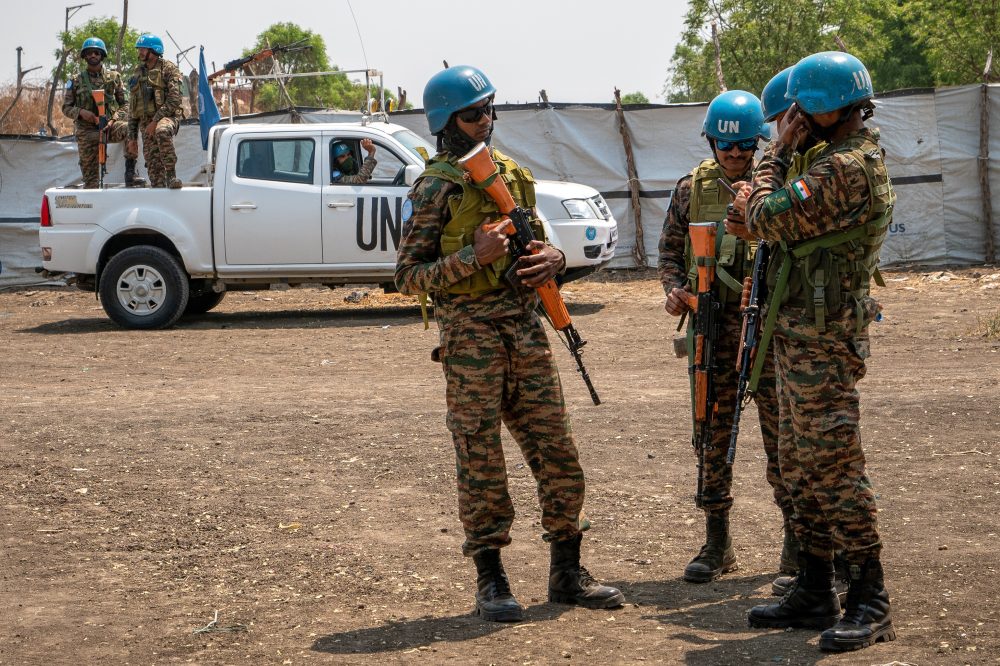
Clashes in Akobo County first broke out in March when opposition forces targeted a government installation. In June, the United Nations pulled its peacekeepers from a base that had been set up to help shield civilians from harm.
Leaders from civil society groups cautioned that political tensions are increasingly translating into armed conflict once again.
Juba-based civil society activist Bol Deng Bol described the situation as “an unfortunate relapse into violence and a clear threat to civilians, their property and humanitarian operations.” Fellow activist Edmond Yakani called on both the opposition and the government to fully honor the permanent ceasefire agreement.
South Sudan is set to hold long-delayed elections on December 22 — its first since gaining independence from Sudan in 2011.
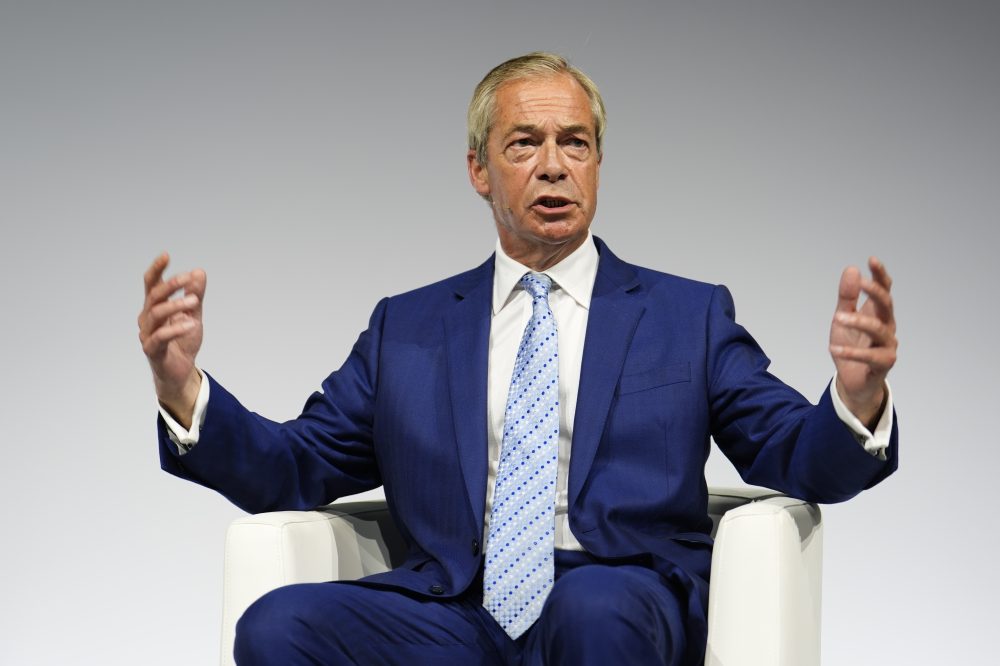
LONDON (AP) — Reform UK leader Nigel Farage has announced he will deliver a public statement Tuesday about his political future, as scrutiny intensifies over financial donations connected to a cryptocurrency billionaire and a man convicted of fraud.
Farage, who is known as a close British ally of U.S. President Donald Trump, posted on X that he would address his future in public life at 2 p.m., though he offered no additional details ahead of the announcement.
The Reform UK leader is currently the subject of a parliamentary standards investigation involving a 5 million pound — roughly $6.7 million — gift from a cryptocurrency billionaire based in Thailand. Separately, opposition lawmakers are pushing for a second inquiry into donations received from George Cottrell, a crypto-gambling entrepreneur with an aristocratic background who previously served time in a U.S. prison for fraud.
Farage has denied any wrongdoing, but the financial scrutiny has fueled widespread speculation about his political future. He had been viewed by some as a front-runner to become prime minister following the next national election.
His anti-immigration party holds only eight of the 650 seats in the House of Commons, yet Reform UK consistently outperforms both the ruling Labour Party and the main opposition Conservatives in opinion polls.
The party scored a major victory in local and regional elections in May, a result that contributed to the removal of Prime Minister Keir Starmer by members of his own Labour Party.
However, Reform UK has now lost three back-to-back special elections it had hoped to win, which may signal a softening in the party’s support. The most recent defeat came at the hands of Labour’s Andy Burnham, who is expected to succeed Starmer as prime minister within the coming weeks.
Parliamentary standards commissioner Daniel Greenberg is leading the investigation into the donation Farage received from Christopher Harborne, a British businessman who lives in Thailand. Farage has said the money was a personal gift used to cover security costs and that it was given before he was elected to the House of Commons.
Should investigators find that Farage violated parliamentary rules, he could face suspension. A suspension lasting 10 or more days would give voters in his Clacton constituency in eastern England the ability to call for a special election to fill his seat.
Such an outcome would deal a significant blow to a party whose rapid rise mirrors the nationalist and anti-immigration political style associated with Trump. Farage has made the issue of migrants crossing the English Channel in small boats a centerpiece of his message — describing the situation as an invasion — though critics accuse him of inflaming public fears rather than addressing the issue constructively.
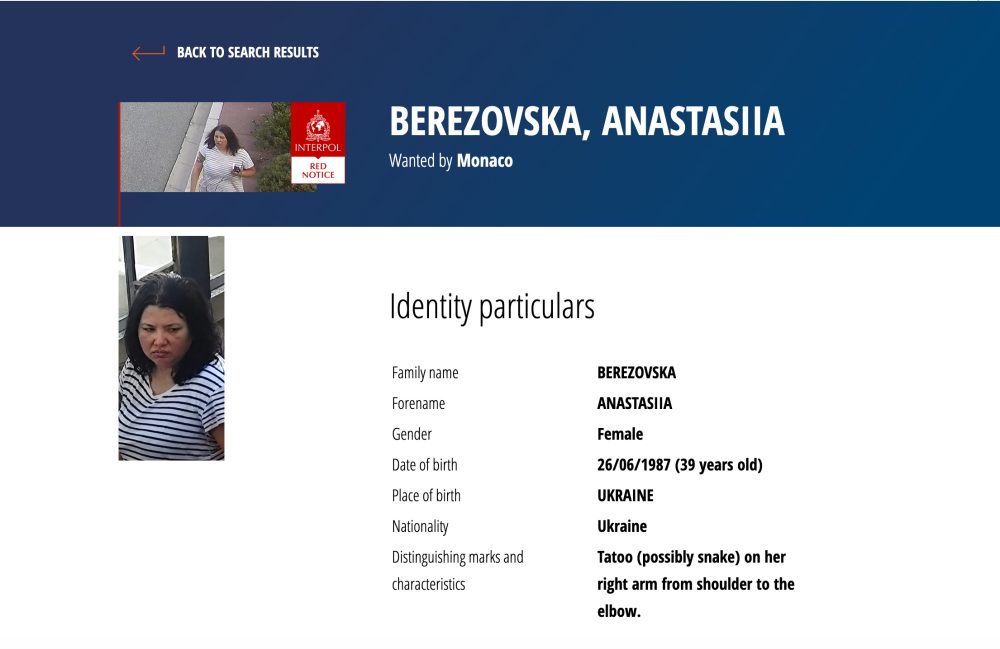
KYIV, Ukraine — Ukraine’s Security Service announced Tuesday that the body of Ukrainian citizen Anastasiia Berezovska has been found. Berezovska had been sought by authorities in Monaco in connection with a bombing that targeted Ukrainian business tycoon Vadym Yermolaiev.
The Security Service, known by its Ukrainian abbreviation SBU, revealed that an officer from Ukraine’s military intelligence agency admitted to killing Berezovska with the assistance of a former law enforcement officer. The suspect claimed he acted on his own, without the knowledge or approval of his superiors.
The original bombing occurred on June 29 and reportedly targeted Yermolaiev, who has ties to Russia, along with members of his family. Three people were hurt in the blast, among them a child. The explosion sent shockwaves through Monaco — the glamorous coastal enclave known for its wealthy residents, tax advantages, royal family, and Formula 1 Grand Prix race. Monaco’s head of state, Prince Albert II, called the explosion “an odious act” and confirmed that all public services had been deployed to maintain security.
Interpol had previously identified 39-year-old Berezovska as the primary suspect in the bombing, issuing a Red Notice requesting her arrest on charges of attempted murder, placing an explosive device in a public area with criminal intent, and criminal conspiracy. On Tuesday, Interpol said it had no immediate statement to offer and noted that the Red Notice would remain active on its website until Monaco formally requested its removal.
SBU investigators zeroed in on the two suspects after uncovering evidence that they had repeatedly sent cryptocurrency and bank transfers to Berezovska. During searches of the former law enforcement officer’s home, authorities also discovered what the SBU described as a basement that resembled a torture chamber.
Berezovska’s body was located during a crime scene reconstruction based on one of the suspect’s accounts. She had suffered gunshot wounds to the head, and investigators recovered spent pistol casings at the location, according to the SBU.
Both men are now in custody, facing suspicion of premeditated murder.
The SBU said it has provided all relevant information to investigators in Monaco and is continuing efforts to identify who ordered and organized the original assassination attempt.
MADISON, Wis. — Wisconsin’s highest court has shut down a conservative activist’s effort to gain access to guardianship records that he claimed could reveal ineligible voters on the state’s registration rolls.
The case has been moving through the court system for several years and traces its origins to efforts by conservatives to challenge President Joe Biden’s 2020 victory over President Donald Trump in Wisconsin.
The dispute centered on a fundamental tension between protecting individuals’ privacy rights and ensuring that people who are legally ineligible to vote are not casting ballots.
Former travel executive Ron Heuer and his organization, the Wisconsin Voter Alliance, filed the lawsuit in 2022. They alleged that the number of voters who should be disqualified does not line up with Wisconsin’s official voter registration list. The lawsuit does not identify how many voters could potentially be affected.
Heuer asked the state’s Supreme Court to require counties to hand over records created when a judge rules that a person lacks the mental capacity to vote. He wanted those records compared against the voter registration list.
His attorney, Erick Kaardal, argued that privacy concerns and public records access could both be honored by blacking out sensitive personal details on the documents before releasing them.
However, the attorney representing Walworth County — which was fighting to keep the records sealed — pushed back on that argument. Attorney Sam Hall said at oral arguments that the whole point of obtaining the records was to match names against the voter rolls, which would require releasing the individuals’ names and addresses. Neither Hall nor Kaardal responded to requests for comment following the ruling.
Under Wisconsin law, a guardianship order is a court-issued arrangement that grants one person legal authority over another who has been found incapable of making decisions for themselves. A judge can strip someone under such an order of their right to vote if they are deemed unable to understand what an election is meant to accomplish.
In a 5-2 decision handed down Tuesday, the court’s liberal majority — joined by conservative Justice Brian Hagedorn — determined that the records in question are not available to the public, rejecting Heuer’s argument.
The case reached the Supreme Court after two lower appeals courts reached opposite conclusions. An appeals court in Madison had denied access to the records, while a separate appeals court in Waukesha ruled in 2023 that the records should be released — with birth dates and case numbers removed. The Supreme Court reversed that Waukesha ruling.
The legal battle was part of a broader campaign by those who disputed the 2020 presidential race results to raise questions about election integrity in the swing state. Heuer and the Wisconsin Voter Alliance filed similar lawsuits in 13 Wisconsin counties in 2022 seeking the same type of records.
Heuer and the organization have promoted conspiracy theories about the 2020 election in unsuccessful attempts to undo Biden’s Wisconsin win. Heuer was also hired as an investigator in a since-discredited election review led by former Wisconsin Supreme Court Justice Michael Gableman. That investigation found no evidence of fraud or misconduct that would have changed the election outcome.
The Wisconsin Voter Alliance also filed two separate lawsuits attempting to overturn Biden’s Wisconsin victory, both of which failed.
Biden beat Trump by nearly 21,000 votes in Wisconsin in 2020 — a margin that survived independent and partisan audits, multiple reviews, legal challenges, and recounts requested by Trump. In the 2024 election, Trump carried Wisconsin by roughly 29,000 votes.
No lawsuits are currently pending to challenge the 2024 Wisconsin election results, and no calls for an investigation into that outcome have been made.
The state of Utah has pulled the operating license from a boarding school where media personality and hotel heiress Paris Hilton says she suffered abuse as a teenager, with officials determining the facility “failed to provide applicable health and safety services for clients.”
The license revocation took effect Monday and targets the Provo Canyon School campus located in Springville. Under the action, the school has a 15-day window to request a formal hearing before the Department of Health & Human Services.
A broad list of violations dating back to 2025 prompted the state’s decision. Among the cited issues: insufficient staff-to-client ratios, unnecessary physical restraint and aggressive contact with a student, neglect of care, and failure to verify employee credentials or submit background checks on time. State health officials had already stepped in with temporary restrictions back in May after staff failed to get immediate medical attention for a student who had sustained serious injuries.
Hilton, 45, issued a statement Tuesday responding to the news. “For more than fifty years, children came forward with stories of abuse, neglect, and trauma,” she said. “Today, the state confirmed what survivors have known all along: Provo Canyon School failed the children in its care.”
She continued: “I was one of those children. I know what it feels like to cry for help and believe no one is coming. Today, children still inside that facility know someone is finally coming to protect them.”
Hilton spent nearly a year at the school during the late 1990s. She has alleged that staff members physically beat her, watched her shower, gave her unidentified pills, and confined her alone in a room without clothing.
Hilton had been publicly calling on Utah officials to shut the school down. She has taken her story to Capitol Hill and state legislatures across the country, and her advocacy has contributed to the passage of laws protecting teenagers in Utah and 15 other states. Utah has historically been a major hub of the so-called troubled teen industry — a network of private, for-profit residential facilities serving youth with behavioral challenges.
As of Tuesday, Provo Canyon School had not responded to a request for comment. The state’s letter indicated that all operations at the campus must cease by August 6.
This past June, Hilton visited the school to show support for two families who have filed lawsuits claiming their children were mistreated there.
The school is currently under different ownership than when Hilton attended, and the current administration has stated it is unable to address anything that occurred prior to the ownership change, including the period when Hilton was a student.
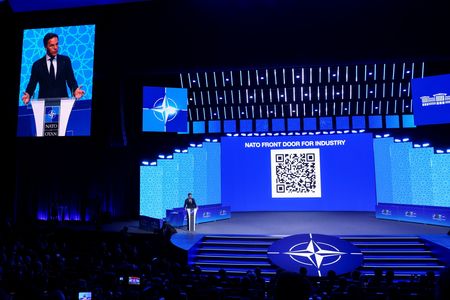
ANKARA — NATO will establish a shared fleet of Airbus A400M military transport planes and expand its existing tanker aircraft program, Secretary General Mark Rutte announced Tuesday on the sidelines of a NATO summit in Ankara.
Rutte made the announcement at a defense industry event where allied nations unveiled arms agreements worth billions of dollars — a show of force meant to demonstrate that European members are taking seriously U.S. calls to increase defense spending ahead of the summit, which began Tuesday evening with President Donald Trump in attendance.
“It is about air power, which is essential to strengthen our deterrence and defence,” Rutte said.
The existing tanker program, known as the MRTT project, currently operates nine A330 aircraft — planes that can also serve as troop or passenger transports — based out of Eindhoven in the Netherlands. Adding a tenth aircraft moves the alliance closer to filling gaps created after the United States reduced its contributions to NATO. The alliance is working toward eventually growing that fleet to 12 aircraft. Belgium, Czechia, Denmark, Finland, Germany, Luxembourg, the Netherlands, Norway, and Sweden all take part in the program.
While the U.S. has not publicly detailed the extent of its cutbacks, a military source indicated the reductions span refueling planes, fighter jets, drones, and naval vessels. Trump has repeatedly criticized European nations for depending too heavily on American military support through NATO.
Airbus, the manufacturer behind both the A400M airlifter and the A330 jet that serves as the basis for the tanker, said the new shared A400M fleet would include Belgium, Britain, France, Spain, Turkey, Croatia, and Poland.
The news is a welcome development for the A400M program, which was originally designed to address Europe’s shortfall in military cargo and troop transport capabilities to difficult terrain. The aircraft has struggled to attract export customers, raising questions about its long-term viability. Airbus had previously issued warnings to investors about the program’s future, though the company softened that language earlier this year.
According to a spokesperson, the new shared pool would initially draw from aircraft already in service, followed by planes currently in production. The spokesperson added that the arrangement could eventually lead to new aircraft orders, though it was too early to predict how many planes might be ordered or when.
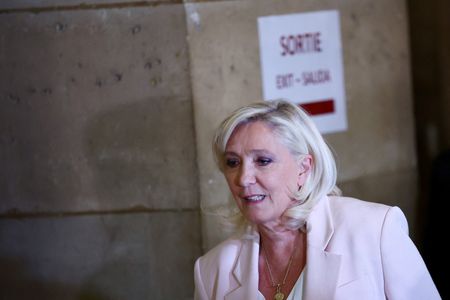
A Paris appeals court issued its ruling on Tuesday, upholding the embezzlement conviction of National Rally leader Marine Le Pen while reducing her ban on seeking elected office — a decision that could allow her to compete in France’s 2027 presidential race.
Under the court’s ruling, Le Pen will serve a three-year prison sentence, with two of those years suspended. She will also be required to wear an electronic ankle monitoring device for one year.
The decision also opens the door for her political protégé, 30-year-old Jordan Bardella, who would likely become the anti-immigrant National Rally’s top presidential contender if Le Pen ultimately chooses not to run.
Le Pen’s path to the presidency had been blocked since March 2025, when she was handed a five-year ban from public office along with a four-year prison sentence. That original verdict came after she was found guilty of embezzling more than 4 million euros — roughly $4.6 million — from the European Parliament.
The court determined she had participated in a scheme that diverted EU funds intended to pay parliamentary staff, channeling that money instead to employees of the National Rally party. Le Pen denied any wrongdoing and pursued an appeal.
Her attorney, Rodolphe Bosselut, responded cautiously to Tuesday’s ruling. “We are considering the decision as a whole, we will issue a further statement. We are partially satisfied,” he said.
Critics on the political left were quick to condemn the situation. Left-wing Ensemble deputy Clementine Autain pointed to what she called hypocrisy within the National Rally. “Whilst the RN blames immigrants for all society’s ills and dreams of imposing ever-harsher penalties for petty crime, it is fleecing taxpayers… The RN leader has vowed that she will not be able to campaign under these conditions. Will she keep her word?” she said.
Benjamin Lucas-Lundy, coordinator of the left-wing political group Generation.s, went further, arguing Le Pen should no longer hold her current legislative seat. “She has been found guilty by the courts of theft… I don’t think she should even be sitting as a Member of Parliament here in the National Assembly any longer,” he stated.
A biotechnology company targeting obesity and related metabolic conditions has made a move toward listing on U.S. public markets. Kalohexis, which focuses on clinical-stage drug development, submitted a confidential filing on Tuesday for an initial public offering, contributing to a growing surge of activity in the IPO space.
The company has not yet disclosed the financial terms of its planned offering.
Here is what is known about Kalohexis and its work:
The company was spun out of Endevica Bio in March and is led by the same leadership team that ran Endevica Bio. Its mission is to push forward the clinical development of its portfolio of drug candidates.
Kalohexis is working to treat metabolic disorders by focusing on the body’s melanocortin system — a natural mechanism that helps regulate metabolic balance. The company is building a pipeline of specialized peptides designed to safely interact with these key regulatory receptors in the body.
Its primary drug candidate, known as 710GO, is taken orally and is designed to activate both MC3 and MC4 receptors. The goal is to produce lasting weight loss in people living with general obesity.
The company is also developing a drug called mifomelatide, which works differently by blocking MC3R and MC4R receptors. This treatment is aimed at combating cachexia — a dangerous and potentially life-threatening wasting condition that can affect patients battling advanced cancers.
Canada is holding off on naming the founding members of its proposed global defence bank until more countries agree to come on board, the country’s foreign minister said Tuesday.
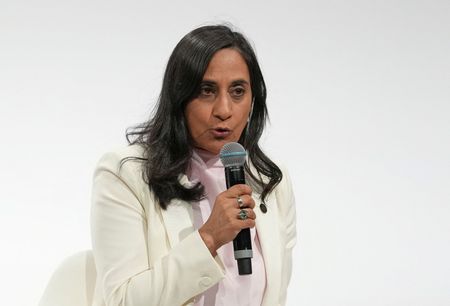
Foreign minister Anita Anand spoke with reporters on the sidelines of the NATO leaders’ summit in Ankara, Turkey, where she said negotiations are continuing with multiple nations over the Defence, Security and Resilience Bank, known as the DSRB.
The initiative, backed by Mark Carney’s government, had originally been targeting roughly 10 founding national supporters to be revealed at the NATO gathering. However, Anand signaled that Canada wants a broader coalition before making any official announcement.
“We want more and more countries to come on board before we put something out,” Anand said, adding that the project still enjoys a “critical mass” of support — a phrase that echoes earlier statements made by Carney himself.
The DSRB is designed to raise as much as £100 billion — approximately $134 billion U.S. — in affordable financing to strengthen the defence capabilities of allied nations. The bank is pursuing a triple-A credit rating, which would allow it to offer low-interest loans for defence projects, especially for countries and companies that currently have difficulty accessing cheaper funding.
The bank also intends to provide loan guarantees to private financial institutions to help scale up the defence industry.
The future of the project remains uncertain without wider national participation, as countries are being asked to contribute startup capital. Anand declined to identify which nations are currently in talks, but she did highlight Luxembourg as having made considerable effort — noting it is currently the only other publicly confirmed supporter of the initiative.
“We’re still in discussions with many of these countries. Of course, we have a critical mass of countries now, but the more the merrier as it is in terms of ensuring that SMEs (small and medium-sized enterprises) have the capabilities to ramp up,” Anand said.
The NATO summit, which Carney is attending, runs through Wednesday.
Amazon is looking to pull in at least $25 billion through a bond sale in U.S. dollars, Bloomberg News reported Tuesday, as the company continues pouring money into artificial intelligence development.
Across the tech industry, major companies have been turning to debt markets and stock sales to pay for the enormous cost of building out AI infrastructure. Amazon, along with Alphabet, Microsoft, and Meta, are among the Big Tech firms collectively expected to pour more than $700 billion into AI spending this year.
Bloomberg, citing sources with knowledge of the situation, noted that the final size of Amazon’s bond offering could climb higher based on investor interest. Amazon had not responded to a request for comment at the time of the report.
An earlier regulatory filing from the company revealed that Amazon has submitted paperwork for an eight-part offering consisting of both floating-rate and fixed-rate notes.
This turn toward bond and equity markets represents a notable change for Silicon Valley’s biggest players, who have historically relied on their own cash reserves to bankroll major investments. Recent debt offerings from tech companies have attracted strong demand from investors.
Last month, Alphabet — the parent company of Google — announced it would raise approximately $85 billion through an expanded equity sale. Earlier this year, Meta, which owns Facebook, sold $25 billion in investment-grade bonds. That followed a $30 billion bond sale Meta completed in October, which stood as the company’s largest ever.
According to Amazon’s exchange filing, Barclays, Goldman Sachs, J.P. Morgan, and Morgan Stanley are serving as the joint book-running managers for the new offering.
Back in March, Amazon completed an 11-part bond sale targeting $37 billion that was heavily oversubscribed by investors.
Drivers traveling through Sussex County this Friday may encounter a sobriety checkpoint as part of a statewide effort to crack down on impaired driving.
The Delaware Office of Highway Safety, working alongside Delaware State Police and local law enforcement agencies from across the state, announced plans to conduct a Driving Under the Influence checkpoint on Friday, July 10, 2026, in Sussex County.
The checkpoint is part of Delaware’s ongoing efforts to reduce impaired driving and improve road safety throughout the state.
Delaware Governor Matt Meyer has put his signature on a trio of banking bills that represent the most sweeping update to the state’s financial regulations in more than 40 years.
The legislation, made up of Senate Bills 16, 18, and 19, is designed to modernize Delaware’s banking laws and strengthen the state’s position as a leader in financial services going forward.
The bills were sponsored by Senator Spiros Mantzavinos and Representative Bill Bush.
State officials say the package is intended to set Delaware up to lead the next generation of financial innovation, building on the state’s long-standing reputation as a hub for the banking and financial services industry.
Motorists traveling on Route 1 between Middletown and Dover should be aware of an ongoing trash operation affecting ramps in both the northbound and southbound directions.
The work is taking place on the ramps along that corridor and is expected to continue until 3 p.m. Drivers are encouraged to plan accordingly and allow extra time if traveling through that area.
Westbound travelers on Churchill Drive are facing a left lane closure between Marsh Road (Route 3) and North Hillside Boulevard as a result of ongoing construction activity.
The lane restriction is expected to remain in effect until 5 PM. Drivers in the area should anticipate potential slowdowns and allow extra travel time.
Authorities recommend that motorists consider alternate routes if possible to avoid delays in the affected stretch of roadway.
PARIS — A French appeals court issued a mixed ruling Tuesday in the case of Marine Le Pen, upholding her conviction on charges of misusing European Union funds while at the same time reducing the duration of her ban from holding elected office.
The decision could potentially reopen the door for the far-right political figure to pursue the French presidency in 2027 — but significant hurdles remain.
While the court shortened the office ban, it also handed down a three-year jail sentence. Two of those years were suspended, but Le Pen was ordered to wear an electronic ankle monitoring device for one full year — a condition that would make running a presidential campaign both politically and logistically challenging.
The ruling leaves considerable uncertainty about whether Le Pen will ultimately seek France’s top political office in the upcoming election cycle.
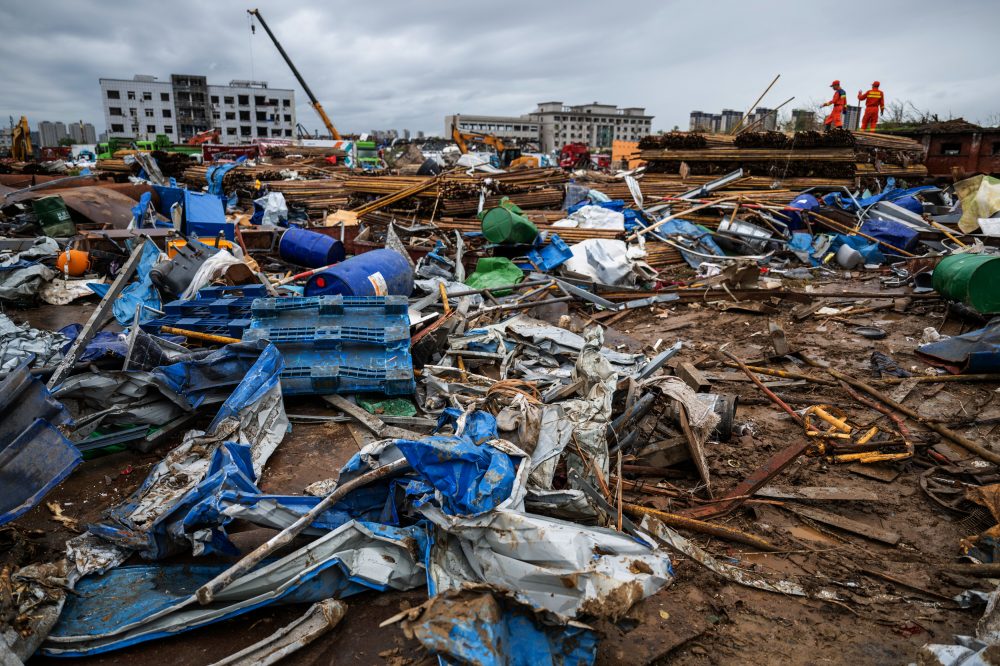
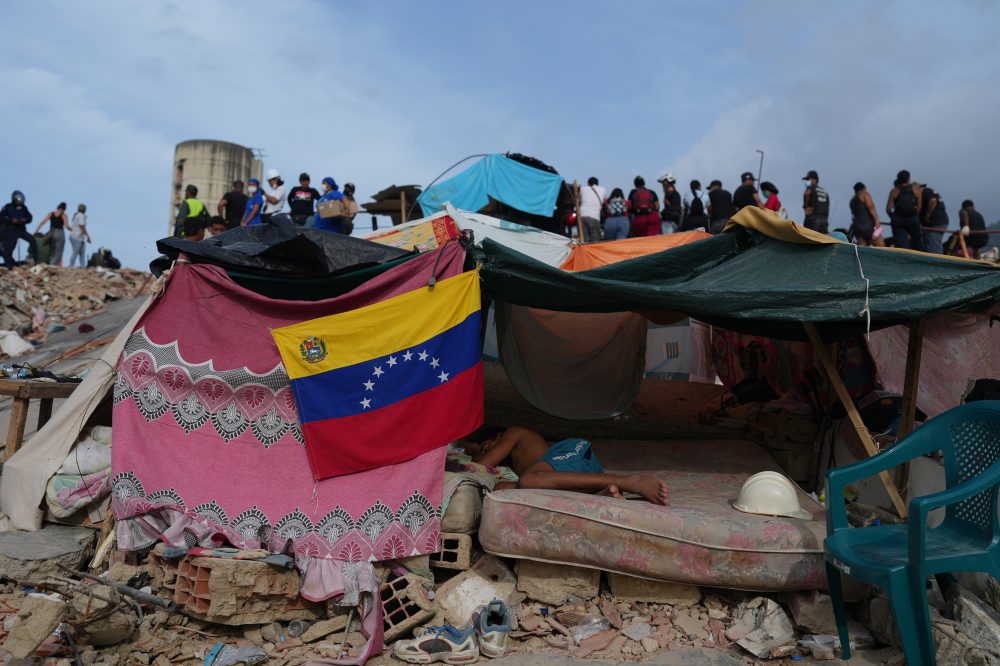
Chinese state media reported Tuesday that at least 11 people lost their lives and hundreds more were hurt after tornadoes tore through a central province in China.
The eastern Hubei province bore the brunt of powerful thunderstorms Monday night, with the severe weather impacting an estimated 14,600 people, according to the official state news agency Xinhua. More than 330 individuals were injured and one person remained unaccounted for. The destruction was extensive — over 20 homes completely collapsed and more than 4,800 additional structures sustained damage.
An EF2 tornado, considered rare for the region, cut through Huanggang city, causing significant damage to buildings. Among the hardest-hit locations were a logistics company and a warehouse construction site, where powerful winds hurled multiple trucks as far as 30 meters — roughly 98 feet — from their original positions, Xinhua reported.
Video shared by Shanghai Daily on the social media platform X appeared to capture the terrifying moment when strong winds forced open glass doors on the ground floor of a building, shattering one of them as people inside screamed.
According to China Weather News, which is operated by the China Meteorological Administration, tornadoes in China are typically documented in southern and coastal provinces such as Guangdong and Jiangsu — making Monday night’s event in Hubei highly unusual.
Meteorological expert Wang Xiaoling explained to the Hubei Daily newspaper that several contributing factors led to the tornadoes, including the remnants of Tropical Storm Maysak, which played a role in the unusual weather that swept through the area.
The destruction did not stop there. In southern China, officials confirmed that four people died in Hengzhou city, with eight others still missing, after Maysak brought record-setting rainfall that caused widespread flooding across the Guangxi region, Xinhua reported.
Authorities evacuated more than 53,000 residents from Hengzhou, while an additional 8,000 people were moved out of Binyang county as floodwaters surged. On Tuesday, Guangxi issued a red alert — the highest level of flood warning available — as river levels climbed up to 7.5 meters, or approximately 24 feet, above established warning thresholds, according to Xinhua.
Virginia’s wildlife management agency has put forward a draft plan aimed at guiding how stocked trout are managed throughout the state.
The draft document outlines the agency’s proposed approach to trout stocking programs, which are popular among anglers who fish Virginia’s rivers, streams, and lakes each year.
Officials are expected to seek feedback from the public as part of the review process before the plan is finalized.
Stocked trout programs are a significant part of recreational fishing in Virginia, drawing anglers of all experience levels to waterways across the commonwealth.
Further details about how to review the draft plan and submit comments were made available through the agency’s official channels.
MANILA — Philippine Vice President Sara Duterte showed no signs of backing down Tuesday as she briefly appeared at the Senate ahead of the second day of her impeachment trial, telling reporters she would emerge from the proceedings beaten but unbroken.
“In this bloodbath and bludgeoning, I will be bloodied but unbowed,” Duterte said to reporters before meeting with her legal team. She wore a green polo shirt, a color widely associated with her political identity.
The high-profile trial carries enormous stakes — its outcome could determine whether Duterte is eligible to seek the presidency in 2028. Rather than attend the proceedings herself, she allowed her attorneys to represent her inside the Senate chamber.
Duterte is the daughter of former President Rodrigo Duterte, who is currently being held in The Hague where he faces a separate trial related to his administration’s deadly anti-drug campaign.
On Tuesday, prosecutors shifted their focus to allegations that the vice president made violent threats against President Ferdinand Marcos Jr., the first lady, and a former House Speaker. Prosecutor Lorenz Defensor argued that these statements went far beyond ordinary criminal behavior and rose to the level of a constitutional violation.
To support their case, prosecutors called a National Bureau of Investigation official as their first witness to verify the authenticity of video recordings capturing Duterte making the alleged remarks.
One video from October 2024 showed Duterte expressing a desire to behead Marcos. A second clip, recorded at a November 2024 press conference, showed her claiming she had arranged for an assassin to kill Marcos, the first lady, and a former House Speaker if anything were to happen to her.
In the video, Duterte is heard saying: “I have talked to a person. I said, ‘if I get killed, go kill BBM (Marcos), (First Lady) Liza Araneta and (House Speaker) Martin Romualdez.’ No joke, no joke. I said, ‘do not stop until you kill them.’”
Defensor stressed to the senator-judges that the alleged threats carried special significance given who made them. “What makes these threats especially sinister is that they do not come from an ordinary citizen, but from the vice president herself,” he said. “Her words were neither accidental nor taken out of context. They were uttered publicly with the intention to be taken seriously.”
The charges related to the alleged threats are just one part of a broader impeachment complaint against Duterte. She also faces accusations of misusing public funds, accumulating unexplained wealth, bribery, and corruption. Duterte has denied all wrongdoing and characterized the impeachment proceedings as politically driven.
Marcos and Duterte — both members of two of the Philippines’ most prominent political families — ran together and won the 2022 election, but their once-united alliance eventually fractured into a deep and public rivalry.
Duterte’s defense team has argued that the impeachment effort is an attempt to undo the will of more than 32 million Filipino voters who elected her to the vice presidency.
Nuclear fuel manufacturer Standard Nuclear has announced plans for a U.S. initial public offering, with the company seeking a valuation of as much as $3.55 billion.
The company announced Tuesday that it hopes to generate up to $383.25 million through the offering, which involves 18.25 million shares priced in the range of $18 to $21 per share.
The move comes as the broader IPO market finds its footing again, driven by easing geopolitical tensions, steady equity markets, and growing appetite from investors — all of which are encouraging more companies to move forward with their listing plans.
Standard Nuclear specializes in producing advanced nuclear fuel and radioisotope power systems. The company has placed particular emphasis on expanding domestic manufacturing to strengthen U.S. energy security.
Standard Nuclear plans to trade on the New York Stock Exchange under the ticker symbol “STDN”. BofA Securities, Goldman Sachs, Barclays, and UBS Investment Bank are listed among the underwriters for the offering.
NATO has unveiled a roughly $4.5 billion plan to acquire up to 10 Saab GlobalEye surveillance aircraft, choosing the Swedish option over a competing offering from American aviation giant Boeing to replace its fleet of aging early warning planes.
The announcement came Tuesday during a NATO summit in Ankara, where Secretary-General Mark Rutte explained that swapping out the alliance’s Cold War-era Airborne Warning and Control System — commonly known as AWACS — for a newer platform built on smaller business jets would better address modern threats, including drone swarms.
“This will ensure we keep NATO’s… surveillance and early warning capability strong and credible for decades to come,” Rutte said at the summit event.
With U.S. President Donald Trump having repeatedly pushed NATO allies to increase defense spending and purchase more American-made equipment, Rutte was careful to highlight the program’s international roots. The GlobalEye system is installed aboard Bombardier Global 6500 business jets.
“Like its predecessor, GlobalEye is a transatlantic programme, delivered by European and Canadian industries with essential contributions from US industries. It is a real success story, again, made in NATO,” Rutte told those gathered.
Trump has frequently criticized European allies for depending too heavily on the United States for their defense needs while pushing them to buy more U.S. military hardware. He has also, at various points, threatened to withdraw from the alliance altogether.
The GlobalEye goes up against Boeing’s E-7 Wedgetail, an aircraft built on the 737 platform that is designed for early warning and battlefield command-and-control functions.
NATO described the GlobalEye as a mission-proven system, though it offered no further details on that characterization.
Reuters had reported last Thursday that NATO was set to replace its Boeing E-3 Sentry AWACS jets with Saab’s GlobalEye. The alliance is now entering formal contract negotiations with Saab following the public announcement of its preliminary selection.
Saab’s chief executive, Micael Johansson, put the total value of the deal at up to $4.5 billion and said the company could begin delivering aircraft in 2030, provided an agreement is reached in the near term. He noted that a final price has not yet been set, but estimated each aircraft would cost somewhere between approximately $400 million and $450 million.
The total number of planes to be ordered had been a point of debate, with planners weighing whether to pursue a more costly version of the aircraft capable of being refueled while airborne. A source with knowledge of the situation said the GlobalEyes would not initially include that feature, though it is expected to be incorporated through a future upgrade.
NATO’s current AWACS fleet does have in-flight refueling capability — a feature that has proven particularly useful during operations near Ukraine.
Amazon’s speedy delivery service is gaining traction in Brazil, and fresh food is largely driving that momentum, according to a company executive.
The service, called Amazon Now, originally launched in the United States with a promise of delivering orders within 30 minutes in select major cities. Amazon has since taken the concept international, rolling it out in markets including Mexico, India, Japan, and Britain, focusing on everyday essentials and groceries.
In Brazil, the service operates with an even faster 15-minute delivery window, and the reception has exceeded expectations — particularly when it comes to fresh and frozen food, which Amazon had never offered Brazilian customers before.
“We are very positively surprised by fresh food acceptance, which we hadn’t sold before,” said Fernanda Grumach, the shopping experience director at Amazon’s Brazilian operations, in an interview with Reuters.
Amazon initially rolled out Amazon Now with grocery deliveries in portions of eight Brazilian cities and has continued expanding its reach, including into Osasco, located in the greater Sao Paulo metropolitan area, Grumach noted. Since the Brazilian launch, the product selection available through the service has grown by 15%, with a notable increase in fruits and vegetables. Amazon declined to share specific sales figures.
The company faces stiff competition in Brazil from Uruguay-based e-commerce platform MercadoLibre and Shopee, which is owned by Singapore’s Sea. Amazon may also find itself going head-to-head with iFood — a meal delivery app owned by Dutch investment group Prosus that holds a dominant position in Brazil’s food delivery market.
For its Amazon Now operations in both Brazil and Mexico, Amazon has teamed up with Colombian delivery app Rappi, sharing logistics hubs as part of the partnership. The service launched in Mexico late last year.
Grumach also noted that the ongoing World Cup has given demand a boost in Brazil, with customers ordering items like soccer stickers, snacks, and beverages. That observation came before Brazil’s five-time soccer champions suffered a shocking loss to Norway on Sunday.
According to Grumach, there is no universal strategy for Amazon Now since what drives demand can differ significantly by market. However, some markets can serve as useful previews for others.
“For example, Mexico debuted in the World Cup earlier than Brazil, so we closely monitored demand for Amazon Now there and thought, ‘Well, we better be prepared for that here,’” she said.
BlackRock announced Tuesday that it plans to introduce a new exchange-traded fund tied to the technology-heavy Nasdaq-100 index, aiming to capture growing investor interest fueled by the artificial intelligence-driven surge in stock markets.
The new fund, called the iShares Nasdaq 100 ETF, comes from the world’s largest asset manager and will begin trading under its ticker symbol on Thursday. The launch comes just months after the Nasdaq updated its eligibility rules to speed up the addition of newly listed companies, including SpaceX.
The new offering puts BlackRock in direct competition with Invesco, whose Nasdaq-100 products — the QQQ Trust Series 1 and Nasdaq 100 ETFs — have long been the go-to options for investors looking for exposure to large-cap, technology-focused stocks. Last month, State Street also entered the space with its own Nasdaq 100 ETF.
Elise Terry, U.S. head of iShares at BlackRock, explained the rationale behind the launch: “IQQ enhances our ability to offer investors access to the Nasdaq-100 with iShares ETFs — providing complementary strategies that allow them to align their portfolios with their objectives.”
Investor appetite for large-cap and tech-focused stocks has been strong, helping the Nasdaq 100 post its best quarterly performance since April 2020 during the three months ending in June. The index follows the top 100 non-financial companies listed on the Nasdaq stock exchange.
BlackRock’s new fund will open with an initial net asset value of $24 per share — a significant contrast to Invesco’s competing funds, which carry net asset values of $722.45 and $297.45, respectively.
BlackRock already manages more than $41 billion in assets through its existing Nasdaq 100-related strategies, which include the iShares Nasdaq Top 30 Stocks ETF and the iShares Nasdaq Premium Income Active ETF.
CHISINAU — Moldovan President Maia Sandu has tapped Deputy Prime Minister Eugeniu Osmochescu, a former international financial official, to serve as the country’s acting prime minister. The appointment, formalized through a presidential decree, takes effect Wednesday.
Osmochescu steps into the role following the sudden departure of Alexandru Munteanu, who resigned last Friday. Munteanu stated that he was no longer able to perform his duties in a manner consistent with his personal convictions.
In addition to serving as deputy prime minister, Osmochescu currently holds the position of minister of economic development and digitalization. Before entering government service, he worked at the International Finance Corporation, the private sector division of the World Bank.
Munteanu offered his support for his successor in a Facebook post, writing: “I would like to thank him for taking on this responsibility and wish him every success in this mission.”
President Sandu had told reporters on Friday that she planned to consult with parliamentary factions during the week to identify a replacement for Munteanu. Her pro-European Party of Action and Solidarity holds a majority in the country’s 101-seat parliament.
Munteanu had originally been appointed following September’s parliamentary election, in which the party decisively defeated a Russia-leaning rival to secure a new governing mandate.
On Wednesday, Osmochescu will preside over a government meeting. The current cabinet is continuing to function in a caretaker capacity until parliament formally appoints a new government.
Motorists heading along North Star Road are being advised to plan for delays this afternoon as construction work is causing intermittent lane closures in the area.
The lane restrictions are in place along the section of North Star Road between Alton Wood Drive and Neptune Drive. Drivers should expect periodic interruptions to traffic flow as crews work in the area.
The closures are scheduled to remain in effect until 6:00 PM. Travelers are encouraged to allow extra time or consider alternate routes to avoid potential delays.
A traffic stop involving an electric scooter turned into a significant arrest Monday evening in Wilmington, according to New Castle County Division of Police.
At around 5:50 p.m. on Monday, July 6, 2026, officers on patrol in the area of Governor Printz Boulevard and East Lea Boulevard spotted a person riding an electric scooter and committing a traffic violation.
Police pulled the rider over and, during the course of the stop, the situation led to charges related to both a firearm and illegal drugs. Additional details about the suspect and the specific charges were not included in the initial report.
A public comment period is currently underway for a set of proposed regulations, giving members of the public an opportunity to weigh in before any final decisions are made.
Residents interested in reviewing the proposed changes and submitting their comments are encouraged to do so before the comment period closes. Public input plays an important role in the regulatory process, and officials are inviting feedback from those who may be affected by the proposed rules.
Further details regarding the specific regulations under consideration, as well as instructions on how to submit comments, can be found through the agency overseeing the proposal.
Motorists heading along Willow Grove Road, also known as Route 10, should plan for possible slowdowns as construction crews work in the area.
An intermittent lane closure is currently in place along the stretch of roadway between Cow Marsh Creek and Ironmine Road. The closure is expected to continue until 6 PM.
Drivers are encouraged to allow extra travel time or consider alternate routes until construction activity wraps up for the day.
Ukrainian drone forces carried out overnight strikes against eight tankers belonging to Russia’s so-called “shadow fleet,” hitting the vessels as they transported fuel to Crimea, Kyiv’s military announced on Tuesday.
In a statement posted to Telegram, Ukraine’s drone forces said each of the targeted ships was operating under international sanctions and had a deadweight capacity of approximately 7,000 tons. The strikes took place in the Sea of Azov.
The attack followed a similar operation just one day earlier, when the same Ukrainian forces reported striking two additional shadow-fleet vessels in the same general area.
Ukraine has intensified its campaign against Crimea’s logistics and energy infrastructure over recent weeks, contributing to fuel shortages and a declared state of emergency in the territory. Crimea is considered vital to Russia’s ongoing war effort against its smaller neighbor — a conflict now entering its fifth year.
Russia seized Crimea in 2014 and later launched a full-scale invasion of Ukraine in 2022.
“Striking the enemy’s naval logistics complicates the supply of fuel and ammunition necessary to support the activities of Russian troops, primarily in the temporarily occupied territory of Crimea,” the drone forces said in their statement.
The unit also released black-and-white drone footage appearing to show ships being struck and catching fire. Reuters was unable to independently confirm the claims.
Ukraine has long pressed its international allies to take stronger action against vessels that circumvent sanctions by carrying Russian oil to global markets.
Ukrainian forces have previously used sea drones to disable tankers hauling Russian oil through the Black Sea, as part of a broader strategy to cut into Moscow’s revenue. A separate series of unexplained explosions has also occurred aboard tankers that docked at Russian ports. Ukraine has neither confirmed nor denied involvement in those incidents, though maritime security sources believe Ukraine is responsible.
Northbound travelers on Interstate 95 should be aware of an ongoing lane restriction near the Salem Church overpass.
According to Delaware Department of Transportation, the right shoulder on northbound I-95 beneath the Salem Church overpass is currently closed. The closure is expected to remain in effect until 3:00 PM.
Drivers are encouraged to stay alert and allow extra time when passing through the area.
The Dover Police Department is working to identify those responsible for a shooting that struck homes and vehicles in the Village of Westover community on Monday afternoon.
Officers were called to the East Broadstairs Place area at around 5:11 p.m. on July 6th, 2026 after residents reported hearing multiple gunshots. When officers arrived on scene, they discovered approximately 40 spent shell casings scattered across the roadway.
The gunfire struck 10 unoccupied vehicles and five residences in the area. Despite the widespread damage, no one was reported injured.
Early investigation results and video surveillance footage revealed that a maroon SUV was driving through East Broadstairs Place when several suspects stepped out of a dark-colored sedan and began shooting at the SUV. After the gunfire, both vehicles left the scene before police arrived. Neither vehicle has been found as of this report.
The investigation remains active and ongoing. Anyone with information about this incident is encouraged to contact the Dover Police Department at (302) 736-7145. Callers can remain anonymous. Tips can also be submitted through Delaware Crime Stoppers by calling 800-TIP-3333 or visiting www.delaware.crimestoppersweb.com. A cash reward may be offered for information that leads to an arrest.
Drivers heading northbound on Newcastle Avenue should be aware of an active lane restriction currently in effect between D Street and C Street.
A left lane closure is in place due to ongoing construction work in the area. The closure is expected to remain until 4 PM.
Motorists traveling through that stretch are encouraged to use caution and allow extra travel time, or consider an alternate route to avoid potential delays.
Drivers heading northbound on Edgemoor Street should be aware of a lane restriction currently in effect due to construction activity in the area.
The right lane is closed along the stretch of Edgemoor Street between Philadelphia Pike Road and Governors Printz Boulevard, also known as Route 13. The closure is expected to remain in place until 5 PM.
Motorists traveling through this corridor are encouraged to allow extra travel time or consider an alternate route to avoid potential delays.
BOSTON (AP) — The popular idea that weight loss simply comes down to burning more calories than you consume turns out to be a significant oversimplification.
Trendy diets rise and fall, but nearly all of them share the same basic premise: eat less, burn more, lose weight. In theory, that logic holds. Tracking calories can even be a helpful strategy. The trouble is, the numbers themselves are far less reliable than most people realize — and the math gets complicated fast.
A tangle of biological and dietary factors determines how — and whether — our bodies actually process the calories we take in. Experts say the type of food you eat is every bit as important as how much of it you consume.
“Different foods have very different effects on the brain, liver, fat cells, muscle function, pancreas and all organs related to metabolism and body weight,” said Dr. Dariush Mozaffarian, a cardiologist and director of the Food is Medicine Institute at Tufts University.
A calorie is defined as the unit of energy the body can extract from carbohydrates, proteins, and fats. That definition sounds clean and simple, but the issue of calorie accuracy recently made headlines when a lawsuit alleged that the maker of David protein bars had placed misleading labels on its products, overstating calorie and fat content. That lawsuit has since been withdrawn.
The claims were grounded in a method called bomb calorimetry, which determines calorie content by literally burning food and measuring the heat produced. This approach counts every possible calorie. But the human body is not a furnace — it doesn’t extract energy the same way. Most food labels, including those on the David bars, report only the calories the body can realistically absorb. Technically, neither figure is wrong, but for the purpose of dieting, only the latter is relevant.
“You could put sawdust into a bomb calorimeter and you would get basically 4 calories per gram,” said Dr. David Ludwig, an endocrinologist and researcher at Boston Children’s Hospital. “If you’re a termite, yes, you’ll get calories from it. But humans won’t.”
Even the calorie counts printed on standard nutrition labels — which reflect what the body is likely to metabolize — can be off by as much as 20% due to rounding rules. Beyond that, how digestible an ingredient is, whether it has been cooked, how heavily it was processed, variations in manufacturing, and even a person’s individual genetic makeup all play a role in how many calories the body actually takes in. And that’s just the beginning.
The body decides whether to burn or store calories based partly on energy demands — but food quality plays a major role too. High-glycemic foods like white bread, pasta, and sugar are quickly converted into usable energy and signal the body to store calories, according to Ludwig.
Foods containing resistant starches — found in some beans, whole grains, and seeds — are harder for the body to convert and don’t trigger that same fat-storage response. They’re also more difficult to digest, meaning fewer of their total calories are absorbed.
“Having a snack of 8 ounces of sugary beverage, 100 calories, should be better for your weight than 1 ounce of nuts at 200 calories, right?” Ludwig said. “That’s the opposite of what actually happens because those 100 calories, even if they’re fewer at that moment, they shift your body toward storing fat and leave you hungrier sooner.”
That hunger, of course, leads to eating more — and more calories.
Even ripeness and cooking methods factor into the equation. Calories from cooked foods are absorbed more readily than from raw versions of the same food, while unripe produce — like a green banana — yields fewer absorbed calories than a ripe one. A medium banana is listed at 105 calories, but how many of those your body actually uses depends on how ripe it is when you eat it.
Processing foods, even in simple ways, also changes caloric impact. “One classic example is that the calories in whole almonds are absorbed substantially less well than the calories in almond butter,” Ludwig said. “Just processing the almonds into almond butter causes a change in how much they will be absorbed.”
Ultra-processed foods bring yet another wrinkle. Diets heavy in these products have been shown to reduce the number of calories the body burns while at rest, Mozaffarian said — meaning a greater share of what you eat ends up being stored rather than burned.
Individual differences add another layer of complexity. Genetics influence how our bodies handle calories, said Dr. Fatima Cody Stanford, an obesity specialist at Harvard Medical School. Even something as routine as a poor night’s sleep can alter how the body processes food, meaning you might absorb more or fewer calories from the exact same meal on different days.
So what should people actually do? Ludwig said calorie counts can serve as a rough reference point, and many people benefit from having some structure to guide portion sizes and food choices. But the research points clearly toward prioritizing the quality of what you eat, not just the quantity. Experts recommend steering clear of ultra-processed foods — especially refined starches — and centering your diet on whole, minimally processed foods, with a strong emphasis on fiber-rich, plant-based options.
“We need to think about calories in a much more sophisticated fashion than the number on the package,” Ludwig said. “The number on the package can do more harm than good by misleading people into thinking that it’s simply an accounting problem.”
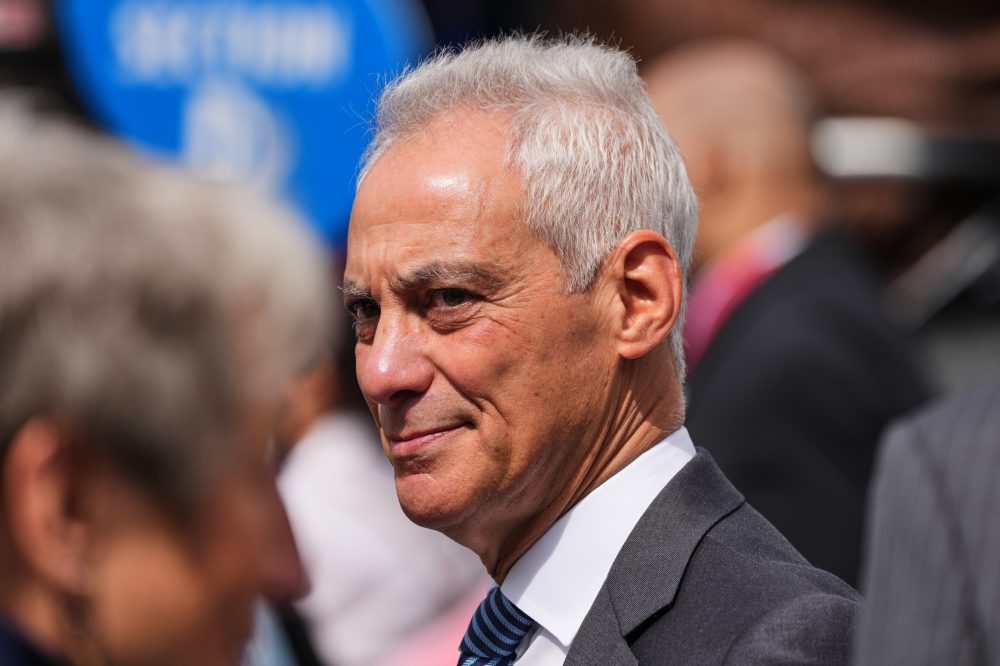
WASHINGTON (AP) — Rahm Emanuel, a longtime Israel supporter who is weighing a run for the Democratic presidential nomination, is preparing to deliver a pointed condemnation of Israeli Prime Minister Benjamin Netanyahu during a speech in Tel Aviv this week — warning that the bond between the United States and Israel stands at a critical turning point.
“It cannot stand or survive as it has been,” Emanuel is set to say at Tel Aviv University on Wednesday, according to remarks obtained by The Associated Press. “To maintain the strength of our ties, we need significant changes and a new direction.”
The address, coming from a prominent figure in the centrist wing of the Democratic Party, underscores just how dramatically the party has moved away from its historically strong backing of Israel.
A new survey from The Associated Press-NORC Center for Public Affairs Research found that roughly 58% of Democrats now believe the United States is “too supportive” of Israel — a notable jump from 45% in January 2024. About half of Democrats also believe Israel has committed genocide against Palestinians during the Gaza conflict, a charge that some human rights groups have made but that Israel and the U.S. government have firmly rejected.
Among Emanuel’s planned proposals: imposing sanctions on Israelis who target Palestinian civilians and property, as well as on companies and financial institutions that support settlements that most of the international community considers illegal. He also intends to push for ending U.S. subsidies to Israel’s defense budget, arguing that Israel “should be able to buy American arms under the same financial terms, the same restrictions, and the same requirements as every other trusted ally that abides by our laws.”
Emanuel will also lay blame squarely on Netanyahu for steering Israel toward what he calls a “dead end,” a situation he says was made worse by poor choices from American leaders over the years.
“For too long, American policy toward Israel operated under the assumption that the best thing Washington could do for Jerusalem was to blindly and silently stand behind your government, without conditions, without demands, and without consequences when we disagreed,” he plans to say. “That has been our mistake. Unconditional support has produced a prime minister who has presumed that his strategic interests would incur no cost if he ignored America’s concerns.”
It is highly unusual for an American with presidential aspirations to travel abroad — especially to a country as politically charged as Israel — to deliver such a direct attack on its leadership. Centrist Democrats like Emanuel have historically been more cautious than the party’s progressive wing when it comes to questioning U.S. support for Israel.
Netanyahu, who once referred to Emanuel — who had aspirations to become the first Jewish speaker of the U.S. House — as a “self-hating Jew,” could respond forcefully to the remarks. With Netanyahu facing his own reelection battle in October, he may attempt to use the confrontation to his political advantage by casting himself as standing firm against outside pressure.
For Democrats who may enter the 2028 presidential race, the speech signals an aggressive approach to addressing the fallout from Israel’s war in Gaza and Netanyahu’s perceived alignment with the Republican Party under President Donald Trump. The conflict has reshaped political alliances within both major U.S. parties, with younger voters in particular pushing American leaders to take a harder line. The issue has already stirred tension in some Democratic congressional primaries this year and could remain a flashpoint heading into the 2028 nomination fight.
Taking Netanyahu to task for doing little to advance diplomatic efforts to end the war, Emanuel will observe that “support for Israel is plummeting around the world.”
“You’ve lost Europe,” he plans to say. “Your scientists face exclusion from international research networks. Your artists and academics are shut out of exhibits and conferences.”
While Netanyahu has cultivated close ties with Trump and the Republican Party, Israel’s standing among Democrats has steadily eroded. Interestingly, Emanuel’s portrayal of Israel as increasingly isolated echoes recent comments from Vice President JD Vance, illustrating how criticism of Israel is gaining traction across party lines. Speaking from the White House briefing room as the U.S. worked toward a deal to end the conflict with Iran, Vance said Trump was “the only head of state in the entire world who is sympathetic to the nation of Israel at this moment in time.”
Despite his harsh words, Emanuel — who is Jewish and whose father was born in Jerusalem — will also express empathy. He acknowledged the devastating impact of the October 7, 2023 attacks, in which Hamas-led militants carried out air and ground assaults on Israel, killing nearly 1,200 people and taking more than 250 hostages. He also noted the frustrations stemming from past rounds of failed peace negotiations with Palestinian leaders.
“But even while acknowledging that history, the path forward cannot be held hostage to a past defined exclusively by recriminations,” he will say.
Rather than endorsing the traditional two-state solution, which he will call “discredited,” Emanuel plans to advocate for what he terms a “23-state solution” — one that brings together Israel, the Palestinians, and the 21 other members of the Arab League in a comprehensive peace agreement.
“The 21 Arab nations that have exploited Palestinian rights as a slogan for decades now need to roll up their sleeves and stand up a governing authority capable of accepting the historic Jewish connection to this land,” he will say.
While no major Democrat has officially launched a 2028 presidential campaign, that could change following the November midterm elections, with a potentially large field expected to form. Emanuel, a former White House chief of staff, U.S. congressman, Chicago mayor, and U.S. ambassador, has been among the most transparent about his ambitions. Without a current public office, he has kept his name in the conversation by releasing a series of policy proposals, cycling through the early-voting state of New Hampshire, appearing on podcasts, and building his social media presence.
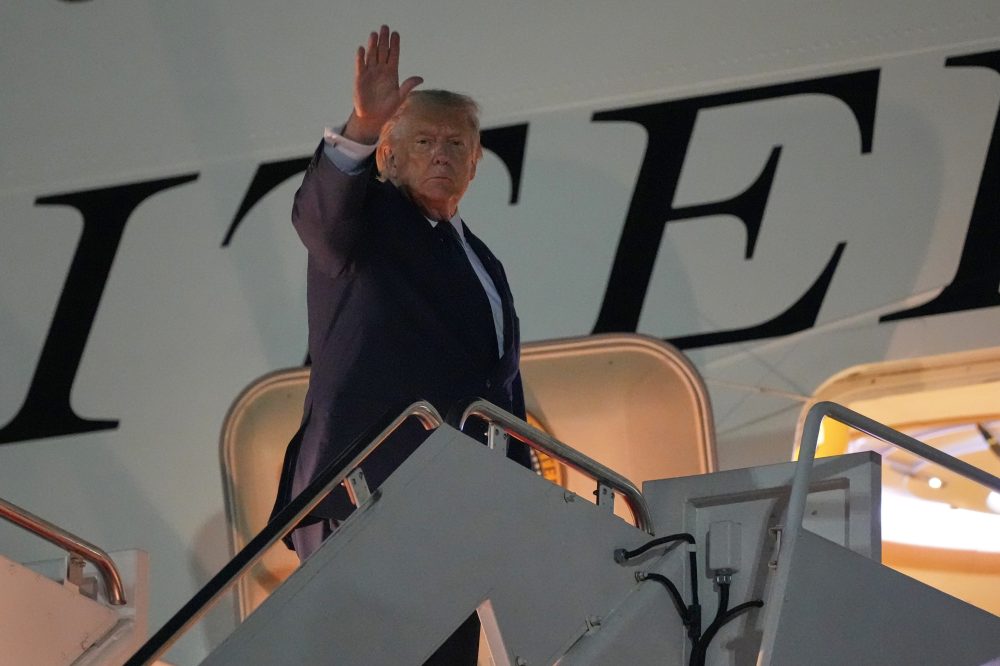
President Donald Trump arrived in Ankara, Turkey on Tuesday to join fellow NATO leaders at a high-stakes summit, where the alliance is working to convince him that member countries are genuinely stepping up their military capabilities — even as American attention increasingly shifts away from Europe and toward Asia.
Trump has been openly critical of NATO’s ability to operate without American leadership, has moved to pull U.S. troops out of Europe, and has raised questions about whether the United States would actually defend an ally if attacked. He has also expressed frustration that some NATO members refused to participate in the Iran war, which he launched alongside Israel without consulting the alliance, and have not helped to reopen the Strait of Hormuz.
The two-day gathering in Ankara is being built around the theme of a stronger Europe within a stronger NATO, featuring a showcase of military projects valued at billions of dollars designed to demonstrate that allies are turning their increased defense budgets into real military capability.
NATO Secretary-General Mark Rutte spoke with energy at a defense industry forum on the sidelines of the summit, calling the spending “money well spent.” The event, billed as NATO’s “big reveal,” featured a slick video presentation and techno music as officials made the case to government ministers and defense industry representatives.
Trump, who has called NATO a “paper tiger” that would fall apart without American arms and leadership, was scheduled to first meet with Turkish leader Recep Tayyip Erdoğan at the presidential compound. Erdoğan, a close ally of Trump, is hosting this year’s summit.
One major announcement came from Sweden, where Prime Minister Ulf Kristersson revealed that Swedish manufacturer Saab will supply up to 10 new GlobalEye surveillance aircraft to a ten-nation consortium. The deal replaces NATO’s fleet of 14 AWACS radar planes, which are roughly 50 years old. NATO itself does not own weapons — those belong to the 32 member nations — but it does operate that aging surveillance fleet along with some newer drones.
The Netherlands also announced new defense investments on the summit’s opening day. The Dutch defense ministry said it is partnering with the United Kingdom to purchase new amphibious transport vessels and working with other NATO allies to replace the old AWACS planes. The Netherlands is also taking a leading role in a European effort to jointly produce and maintain American-made weapons, including Stinger, Amraam, and PAC-3 missiles.
Dutch Defense Minister Dilan Yesilgöz-Zegerius said the Netherlands and its European partners “are investing much more in strengthening European defense” with additional funding “but also by working together smarter.”
German Chancellor Friedrich Merz emphasized before departing Berlin that his country has doubled its defense spending since 2022. He said the effort is not being made “to do anyone a favor” but because it is “necessary for our defense, for our security.” Merz described Russia as “a serious threat” that is “testing our determination every day,” and said the Ankara summit “should send the message that we are building a more European NATO so that NATO can remain trans-Atlantic.”
When asked last month what allies could do to get back in his good graces, Trump gave a simple answer: “Just be loyal.”
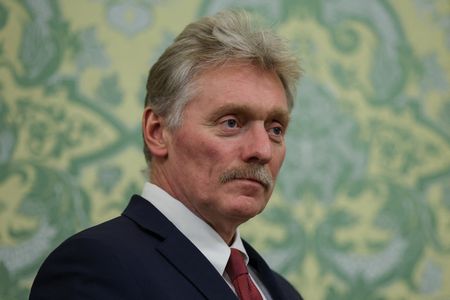
From Moscow, Kremlin spokesman Dmitry Peskov said Russia would be watching the NATO summit closely. He dismissed Ukraine’s calls for more air defense weapons, saying additional arms deliveries would not stop Russia from achieving what the Kremlin calls the goals of its “special military operation.” On the subject of a peace settlement, Peskov said Russia “maintains contact with the Americans via working-level channels” and expressed hope that American efforts to move toward peace “will ultimately succeed.” He added that hostilities could end once Kyiv “demonstrates goodwill and shows a readiness to make those important decisions that need to be made.”
In a sign of political tensions within some alliance members, the leaders of the Czech Republic traveled to Turkey separately. Prime Minister Andrej Babiš flew with his foreign and defense ministers, while President Petr Pavel departed on his own later. Babiš, whose ANO movement won big in an October election, leads a governing coalition that has moved away from strong support for Ukraine. The Czech defense budget currently falls below NATO’s target, coming in at under 1.8% of GDP. Babiš said Tuesday that the government plans to meet the minimum 2% target next year but does not plan to go beyond that.
President Pavel, a retired army general, is a strong supporter of Ukraine’s fight against the Russian invasion — a position at odds with his government. The government initially refused to include Pavel in the summit delegation, only relenting after the country’s Constitutional Court stepped in.
Turkish police detained more than 20 protesters near a demonstration in central Ankara against the NATO summit. Officers used riot shields to block journalists from filming and photographing the protest, which was organized by supporters of left-wing political parties. A legal association reported that 22 students affiliated with the Turkish Workers’ Party and three lawyers were taken into custody.
Turkish Foreign Minister Hakan Fidan used the summit’s opening day to warn against restrictions on defense industry cooperation among NATO members. In a social media post, he said trade barriers “undermine efficiency and slow response” and have become “strategic liabilities.” The United States and several European nations have imposed limits in recent years on selling military and dual-use goods to Turkey. “European defense initiatives must remain fully inclusive of all NATO Allies,” Fidan stated.
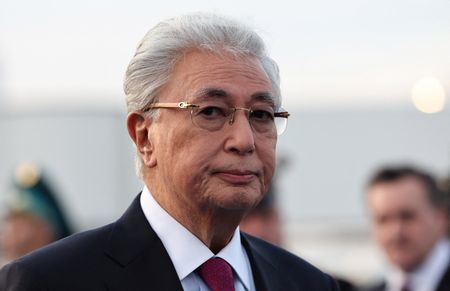
Kazakhstan’s constitutional court announced Tuesday that President Kassym-Jomart Tokayev is free to pursue another term leading the Central Asian nation, which is a major producer of energy and minerals, under a new constitution that officially took effect last week.
The decision essentially gives Tokayev a fresh start on term limits. He had previously been restricted to one seven-year term beginning in 2022, when he oversaw an earlier overhaul of the country’s constitution.
Notably, Tokayev himself asked the court to weigh in on the matter. He first came to power in 2019 as the chosen successor of Kazakhstan’s founding president, Nursultan Nazarbayev.
The new constitution was drafted and ratified within just a few weeks earlier this year, immediately fueling widespread speculation about what it could mean for Tokayev’s political future.
While the updated constitution still caps the presidency at a single seven-year term, the court determined that terms served under the previous constitution would not count toward that limit.
What remains unclear is whether Tokayev will be required to stand for election in a snap vote, or whether he will continue serving under the terms of the old constitution through 2029.
Among other changes, the new constitution establishes a vice-presidency and consolidates parliament into a smaller, single-chamber body. Snap parliamentary elections are already set for August 23.
Before becoming president, Tokayev had a long career as a Soviet diplomat and senior United Nations official, and also served as Kazakhstan’s prime minister and foreign minister prior to succeeding Nazarbayev in 2019.
Tokayev distanced himself from his former mentor in January 2022, following a wave of nationwide unrest that left hundreds of people dead. Tokayev characterized the violence as a coup attempt orchestrated by loyalists of Nazarbayev.
MOSCOW — The Kremlin announced Tuesday that Russia intends to keep a close watch on what comes out of the NATO summit taking place in Turkey, while noting that a string of hostile remarks about Russia had set the tone leading up to the event.
NATO leaders have convened in Ankara for a two-day gathering on Tuesday and Wednesday. The meetings come as U.S. President Donald Trump has pushed European allies to increase their defense spending, and following months of tension across the Atlantic stemming from disputes over the Iran war and Greenland.
“This is an event that is of great interest, including to us. Of course, we will be monitoring all the news and information coming out of Ankara,” Kremlin spokesman Dmitry Peskov told reporters.
Peskov noted that numerous statements about Russia had surfaced in the days before the summit. “To our regret, these were not statements about constructive engagement and dialogue, but rather statements of a confrontational nature,” he said, declining to offer specifics.
On Monday, President Trump said he planned to address the ongoing war in Ukraine during the summit, describing a resolution to the more than four-year conflict as “getting closer than people realise.”
Peskov expressed hope that U.S. “efforts to steer the entire situation onto a peaceful track (would) ultimately succeed,” adding, “At the very least, we, as the Russian President has repeatedly said, remain open to this.”
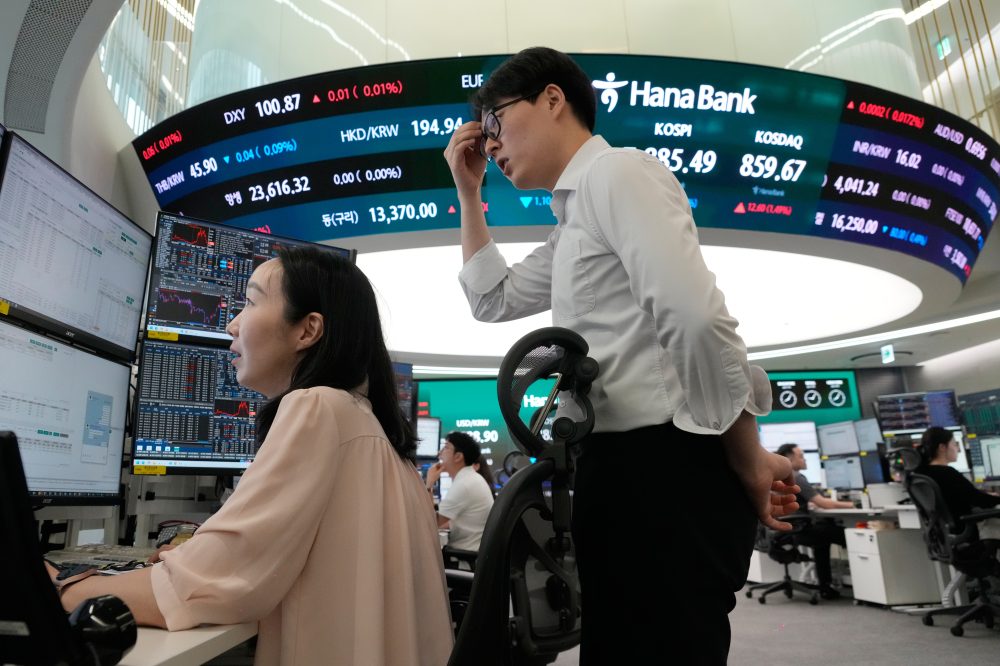
A rebound in U.S. semiconductor stocks on Monday quickly ran out of steam as Asian markets took a sharp turn lower on Tuesday, raising fresh doubts about whether the artificial intelligence chip boom can keep delivering gains for investors.
Samsung Electronics saw its shares plunge nearly 7% on Tuesday, a surprising reaction given the South Korean tech giant had just reported a staggering 19-fold increase in second-quarter operating profit. Rival chipmaker SK Hynix also fell sharply, pulling South Korea’s chip-heavy KOSPI stock index down roughly 5%.
The Monday rally in U.S. chip stocks appeared to be fueled by news that Broadcom had extended a deal with Apple to supply the iPhone maker with custom-built chips through 2031. That positive sentiment lifted both the S&P 500 and the Nasdaq to higher closes. By Tuesday morning, however, Nasdaq futures were down more than 1% ahead of the opening bell, reflecting the turbulence overseas.
Analysts note that the Tuesday selloff in Asian tech stocks could be a signal that investors already have the benefits of surging chip demand baked into current prices. It’s also worth noting the dramatic run-up these stocks have already seen — Samsung’s share price had more than doubled so far this year, while SK Hynix had more than tripled.
In other technology news, Microsoft shares slipped nearly 1% on Monday after the company announced it would be cutting approximately 4,800 jobs as part of a restructuring of its gaming division. The announcement came after the company’s stock had already fallen roughly 20% during the first six months of 2026.
On the currency front, Japan’s yen edged slightly stronger on Tuesday but remained near 40-year lows, hovering around 162 yen per dollar. Traders continued to watch closely for any sign that Japanese authorities might step in to support the currency.
Oil markets moved higher following reports that Iran launched missiles at commercial vessels in the Strait of Hormuz on Monday. Brent crude was trading at close to $73 per barrel in the wake of those reports.
On the diplomatic stage, the NATO summit opened Tuesday in Ankara, Turkey, with European defense spending expected to dominate discussions. Leaders are under pressure to show how they plan to meet higher NATO spending targets that President Donald Trump has been pushing for. Several NATO member nations began announcing multi-billion dollar arms agreements at the summit’s opening.
NATO Secretary General Mark Rutte said Monday that European nations had made what he called “staggering” increases in defense spending, driven both by fears of Russia following Moscow’s 2022 invasion of Ukraine and by what he described as President Trump’s “forceful” push for greater contributions.
Also drawing attention is a planned meeting on the sidelines of the summit Wednesday between President Trump and Ukrainian President Volodymyr Zelenskiy. Trump on Monday again suggested that a resolution to the war in Ukraine could be within reach.
Key events to watch Tuesday include the release of the U.S. May trade balance at 8:30 a.m. EDT, a 3-year Treasury note auction at 1 p.m. EDT, and SpaceX’s addition to the Nasdaq 100 index.
Chinese AI startup DeepSeek is working to design its own artificial intelligence chip, according to three individuals with knowledge of the project — a development that could reduce the company’s reliance on processors from Nvidia and Huawei, which it has used to build and operate its widely used AI models.
The chip being developed is intended for inference — the phase of AI computing where a trained model produces responses for users — rather than for the training of new models, the sources indicated.
Should the effort prove successful, DeepSeek’s move into chip design would represent a significant strategic change for a company celebrated in China as a national AI leader, and could add competitive pressure on tech giant Huawei.
DeepSeek gained worldwide attention more than a year ago after releasing two highly efficient AI models that spread rapidly across the globe, catching many in Silicon Valley and Washington off guard.
The company has historically focused on advancing AI model development rather than commercializing its technology.
While Huawei’s chips still fall considerably short of Nvidia’s most advanced offerings, U.S. restrictions on exporting those Nvidia chips to China have allowed Huawei to capture roughly half of China’s $50 billion domestic AI chip market, with DeepSeek and several other major players among its customers.
That dominance is already being tested, however, as tech rivals Alibaba and Baidu develop their own chips and claim a growing share of the market.
DeepSeek’s push into chip development is still in its early stages. The company has been reaching out to outside partners and holding talks with chip-design, foundry, and memory companies, the three sources said. One of the individuals noted the effort started roughly a year ago.
The Hangzhou-based firm has also been quietly bringing on chip-design engineers in recent months, though the hiring has been conducted without any public job postings, two of the sources said.
All three sources asked not to be named because the matter has not been made public. DeepSeek, which has maintained a low profile despite its prominence in China’s AI sector, did not respond to a request for comment.
By pursuing an in-house chip, DeepSeek would be following a broader trend among global AI companies seeking greater control over the hardware powering their systems and less dependency on Nvidia.
OpenAI last month unveiled its first custom inference chip, called Jalapeno, developed in partnership with Broadcom. Separately, Anthropic has been exploring the possibility of building its own AI chips, according to a Reuters report from April.
For DeepSeek, the move carries additional strategic weight. U.S. export controls prevent Chinese companies from purchasing Nvidia’s most advanced chips, and Beijing has been pushing its technology companies to develop homegrown alternatives.
DeepSeek founder Liang Wenfeng acknowledged in a rare 2024 interview with a Chinese media outlet that chip export restrictions posed a challenge for the company.
DeepSeek has relied on both Nvidia and Huawei chips over time. The company has stated that the underlying model powering R1 — its reasoning model whose low-cost performance rattled U.S. tech stocks in January 2025 — was trained using Nvidia’s H800, a chip made for the Chinese market that Washington banned in late 2023.
More recently, DeepSeek has leaned more heavily on Huawei. In April, it released its V4 model adapted to run on Huawei’s Ascend chips, and Huawei confirmed its processors played a role in training V4-Flash, a lighter version of the model. Orders for Huawei’s Ascend 950 chips from major Chinese tech companies surged following that launch, Reuters has reported.
A DeepSeek inference chip would enter the fastest-growing area of AI computing. As AI applications become more widespread, the industry is shifting more of its computing workload from training models to running them — a task that relies on specialized chips that can be less expensive and more energy-efficient than general-purpose processors.
Still, success is far from certain. Designing a competitive AI chip typically takes years and requires substantial investment. Manufacturing presents additional obstacles, as U.S. restrictions block Chinese chip designers from using the most advanced overseas production facilities, while separate controls have limited China’s access to high-bandwidth memory — a key component for AI inference chips.
DeepSeek’s chip ambitions come alongside the company’s first move toward accepting outside investment. The company was set to raise $7 billion in an initial funding round that would value it at between $52 billion and $59 billion, Reuters reported in June — a reversal of its longstanding policy of turning down external capital.
NEW DELHI — A court in India has ordered the country’s federal government to restore the X social media account belonging to the youth Cockroach Janta Party (CJP), more than a month after it was taken offline. The account had attracted approximately 200,000 followers in just a matter of days after its creation, according to the party’s founder and a lawyer connected to the case.
The government had defended its decision to block the account in court, arguing that content posted there could have sparked disorder during a national medical college entrance examination. That exam had to be held again after its question papers were leaked to the public.
The CJP has been staging sit-in demonstrations for the past two weeks, calling on the education minister to step down in response to the exam scandal. While its main account remained blocked, the party continued reaching its X audience through a secondary account.
The Delhi High Court issued its order after Prime Minister Narendra Modi’s government indicated it had no opposition to restoring the account, according to the lawyer who spoke with Reuters.
CJP founder Abhijeet Dipke celebrated the development on X, calling it a “big win” for the party, the movement, and for “free speech and digital rights.”
However, as of Tuesday evening, the account was still showing as restricted within India, with its page displaying a message stating it had been withheld “in response to a legal demand.”
The CJP, which describes its membership as representing “the lazy, the unemployed, and the chronically correct,” boasts close to 22 million followers on Instagram. By comparison, Modi’s Bharatiya Janata Party — which has labeled the CJP part of “an anti-India gang” — has just over 9 million followers on the platform.
Livestock owners are being advised to familiarize themselves with a serious animal health threat known as the New World Screwworm, a parasitic fly whose larvae can burrow into the living tissue of warm-blooded animals and cause severe, potentially fatal wounds.
The New World Screwworm, caused by the fly species Cochliomyia hominivorax, gets its name from the way its larvae screw themselves into open wounds on livestock and other animals. Unlike ordinary flies, these larvae do not feed on dead tissue — they feed on living flesh, which makes infestations especially dangerous and fast-moving.
Animals most at risk include cattle, sheep, goats, deer, and other warm-blooded creatures. Even small cuts, insect bites, or birthing wounds can serve as entry points for the fly to lay eggs. Once hatched, the larvae can rapidly enlarge a wound and cause serious damage within days if left untreated.
Livestock owners are encouraged to regularly inspect their animals for any signs of unusual wounds, foul odors coming from an animal, or behavioral changes that might indicate pain or distress. Early detection is considered critical to preventing the spread of an infestation and saving an affected animal.
The New World Screwworm was previously eradicated from the United States through a decades-long sterile insect program, but concerns have grown in recent years due to outbreaks in parts of Central America and the Caribbean. Animal health officials have warned that any reintroduction into the U.S. could pose a significant threat to the livestock industry.
Farmers who suspect they may have found a case are urged to contact their local veterinarian or state animal health officials immediately. Prompt reporting is considered essential to containing any potential spread.
Producers are also reminded to maintain good wound management practices, keep animals clean and monitored, and work closely with their veterinarians on prevention strategies during high-risk periods.
Westbound travelers on W. Newport Pike should be aware of a right lane closure currently in effect between W. Redmont Road and Petro Drive.
The lane restriction is the result of ongoing construction in the area. According to traffic officials, the closure is scheduled to remain in place until 4 p.m.
Drivers are encouraged to allow extra travel time or consider using an alternate route to avoid delays in the area.
Motorists traveling westbound on Harrington Highway, also known as Route 14, in the Milford area should plan for slowdowns today due to an active construction zone.
According to DelDOT, the westbound shoulder is closed and lane shifts are in place along that stretch of roadway between Canterbury Road (Route 15) and Church Hill Road.
The lane restrictions are expected to remain in effect until 5 p.m. Drivers are encouraged to allow extra travel time or consider an alternate route if possible.
For many years, electricity costs at the Belden Brick Company in Sugarcreek, Ohio, remained fairly predictable. Then last year, those bills shot up by 90% — a surge driven largely by the growing appetite for power from data centers moving into the region.
The brick manufacturer, which has been in business for 141 years and whose products appear in landmark structures including the Texas Alamo and Notre Dame University, has seen its monthly capacity charge balloon from $1,600 to $12,000.
Belden Brick is far from alone. Factories throughout America’s industrial heartland are grappling with climbing electricity costs as data centers built to support the artificial intelligence industry spread across the same regions where manufacturing has long been rooted.
A Reuters review of federal energy data and conversations with nearly a dozen manufacturers and industry advocates found that factory electricity bills — a fundamental operating expense — are climbing faster than those for most homes and other types of businesses.
Governments at the federal, state, and local levels, responding to both public frustration and concerns about grid stability, are pushing technology companies to shoulder more of the financial burden tied to their expected electricity demand. However, some of the proposals being considered would group smaller factories together with tech giants like Meta and Amazon, even though those companies’ power consumption can exceed that of even large manufacturers by a factor of 50. Meta declined to offer a comment, and Amazon did not respond to a request for one.
Capacity charges are fees designed to compensate power generators for maintaining enough electricity on the grid during periods of peak demand and to encourage the development of new energy supply. These charges typically make up about 10% of a residential electricity bill, but for manufacturers they can account for as much as three times that share, according to manufacturers, attorneys, and energy experts.
Those fees have climbed steeply in the 13-state territory managed by grid operator PJM Interconnection, where supply has stagnated while data centers — each of which can consume as much electricity as a mid-sized town — have multiplied.
MANILA, Philippines — Philippine Vice President Sara Duterte declared Tuesday that she will emerge battered but defiant as her high-profile impeachment trial gets underway before the country’s Senate.
Duterte, who has publicly stated her intention to run for president in mid-2028, was impeached by the House of Representatives in May. That legislative body is largely controlled by allies of President Ferdinand Marcos Jr. The 48-year-old lawyer and politician has called the charges against her politically motivated.
The trial, broadcast on television and conducted before the 24-member Senate serving as an impeachment court, began Monday.
On Tuesday, senators took up the first of four major charges against her. That charge accuses Duterte of threatening during an online news conference in November 2024 to arrange the killings of Marcos, his wife, and then-House Speaker Martin Romualdez through an unidentified individual — a threat she allegedly made as tensions between her and the president’s camp were intensifying.
Video evidence presented at the trial showed Duterte making the threat and emphasizing that she was serious. She also stated in the footage that the person she asked to carry out the killings had agreed to her plan.
A separate video shown during the proceedings captured the vice president saying she wanted to cut off the president’s head.
Duterte briefly appeared at the Senate building Tuesday in casual clothing and rubber shoes to meet with her legal team, but left before the trial resumed. Speaking to reporters outside, she declined to answer questions.
“In this bloodbath and bludgeoning, I will be bloodied but unbowed,” she told the gathered media.
In prior statements, Duterte has denied all allegations against her. The charges extend beyond the threat and include accumulating unexplained wealth, misappropriating confidential funds, corruption, bribery, and inciting sedition, though no specific details have been provided on those counts.
Duterte and Marcos ran together as a ticket in the 2022 elections, combining the political strength of two of the Philippines’ most powerful dynasties. That alliance, however, quickly unraveled after they took office.
Supporters of the vice president have accused Marcos and his inner circle of using the justice system to sideline her and her political allies in order to block her presidential ambitions.
Adding to the turmoil surrounding the trial, three senators who back Duterte have been removed from the political picture by separate legal troubles. Two were recently arrested and detained on alleged large-scale corruption charges, while a third went into hiding after the International Criminal Court issued a warrant for his arrest. That senator is accused of being a co-conspirator of former President Rodrigo Duterte — the vice president’s father — in alleged crimes against humanity.
Those charges relate to the killings of thousands of mostly low-income drug suspects during anti-narcotics crackdowns ordered by the former president between 2011 and 2019. Rodrigo Duterte, currently held by the ICC in The Hague, is scheduled to face trial on November 30.
Justice officials and state prosecutors have insisted the legal troubles facing the three senators are based on solid evidence and are entirely separate from the vice president’s impeachment proceedings.
Sara Duterte holds Marcos responsible for her father’s arrest last year and his subsequent transfer to ICC custody.
To secure a conviction, prosecutors must obtain at least 16 votes — two-thirds of the 24-member Senate. A guilty verdict would effectively end her presidential ambitions.
Even an acquittal would not guarantee her freedom from legal jeopardy. Anti-graft prosecutors are separately investigating criminal charges against her, including large-scale corruption, that mirror some of the impeachment allegations.
HONG KONG (AP) — A court ruling requiring a Chinese tea company to pay French luxury brand Louis Vuitton $1.5 million has set off a broader conversation about who truly owns traditional Chinese symbols and designs.
The controversy centers on a four-petal flower shape that appears in Louis Vuitton’s 130-year-old signature monogram. Chinese state media outlets and online commentators are now raising questions about whether that design was originally drawn from patterns that trace back to ancient China — and whether the company is effectively “monopolizing” those traditional motifs.
A court in Suzhou, a city in eastern China, recently sided with Louis Vuitton, finding that the logo used by Molly Tea — a chain known for jasmine and other floral-based drinks — was too similar to the French brand’s trademarked monogram. The court directed Molly Tea to pay 10.3 million yuan, equivalent to roughly $1.5 million, to Louis Vuitton. Local media reports carried copies or details of what they described as the official ruling.
Legal battles between international and Chinese brands over intellectual property are not unusual. Western companies, including American sneaker maker New Balance, have previously taken Chinese businesses to court over trademark and intellectual property disputes — and have sometimes won.
The Suzhou ruling quickly became a trending topic across Chinese social media platforms.
On Tuesday, the state-owned Beijing Daily posted a commentary on Weibo, a widely used Chinese social platform, suggesting the decision highlighted a failure to protect ancient Chinese heritage. “Why did a Chinese enterprise end up paying more than 10 million yuan in damages to a French company for using a design that resonated with the spirit of China’s centuries-old patterns?” the post read.
The Global Times, a state-run English-language publication, ran a headline stating: “Chinese netizens accuse LV of attempting to monopolize ancient motifs after lawsuit against tea brand.” The article described what it called “widespread frustration” among Chinese internet users who believe a foreign company now holds trademark rights over a design rooted in Chinese cultural history.
To illustrate the argument, the article included a photo comparing patterns found on a Tang Dynasty rosewood “pipa” — a type of traditional Chinese lute — placed side by side with Louis Vuitton’s monogram design.
Louis Vuitton is currently marking the 130th anniversary of its monogram, which was originally created in 1896. The brand has described it as a “universal symbol of creativity.” According to the website of its parent company LVMH, the monogram drew inspiration from neo-gothic ornamentation and the artistic movement known as Japonism.
Neither LVMH nor Molly Tea responded to requests for comment. As of Tuesday, Molly Tea — which was founded in 2021 — was still displaying the four-petal flower logo on its official website. The company has told local media that it intends to appeal the ruling.
BEIJING (AP) — A deadly landslide in northwestern China has killed five people and left 12 others still unaccounted for beneath the rubble, state media reported Tuesday.
The disaster struck just before 7 a.m., burying 33 people in Nanhe township, located in Longnan city within Gansu province, according to the official Xinhua News Agency.
The exact cause of the landslide has not been determined. Images and footage shared online by state broadcaster CCTV showed three excavators alongside rescue workers digging through large mounds of dirt in an area surrounded by dense green vegetation. Weather conditions at the scene appeared calm, with clear skies visible in the footage.
As rescue efforts continued, local authorities moved residents out of the area as a precaution.
A wave of trading activity, fueled in part by the massive SpaceX initial public offering, is expected to deliver impressive second-quarter results for the biggest names on Wall Street, according to analysts and data from LSEG.
Five of the six largest U.S. banks — JPMorgan Chase, Bank of America, Citigroup, Wells Fargo, and Goldman Sachs — are scheduled to release their quarterly earnings on July 14, with Morgan Stanley following a day later on July 15.
Trading has remained a reliable source of income throughout 2026, as ongoing geopolitical tensions and uncertainty tied to artificial intelligence disruption have kept market volatility elevated.
Angad Chhatwal, head of fixed income, currencies, and commodities at Coalition Greenwich, a global analytics and data provider for the financial services industry, said market revenue for the world’s largest banks is expected to climb at least 15% compared to the same period last year.
Jamie Vickers, head of equities at Coalition Greenwich, pointed to stocks as the key growth driver. “Equities is set to be the primary engine of growth across global markets. The SpaceX IPO will have generated significant revenues in banking but also for certain cash-equities desks during the quarter,” Vickers said.
Goldman Sachs and Morgan Stanley, both of which played major roles in the nearly $86 billion SpaceX IPO, are expected to lead the pack in equities performance, according to Morningstar analyst Sean Dunlop. Banks involved in the SpaceX deal reportedly collected around $500 million in fees combined.
Dunlop did offer a note of caution, however, saying that while second-quarter trading revenue remains solid, it may not match the exceptional pace of the first quarter. That earlier period was driven by unusually intense volatility stemming from the initial Iran war shock and related inflation and interest rate shifts.
Investment banking has also been a standout performer, with large-scale equity offerings and multibillion-dollar transactions pointing to the most active deal-making climate in years. Global investment banking revenue reached $61.4 billion in the first half of 2026, a 24% increase over the same stretch a year ago, according to Dealogic data. JPMorgan held the top spot globally for investment banking revenue, while Goldman Sachs led in merger and acquisition advisory work.
Among the quarter’s notable transactions were chip designer Cerebras’ $6.4 billion IPO and a massive $85 billion share sale by Alphabet, the parent company of Google.
LOAN GROWTH ADDS TO THE PICTURE
Banks are also expected to benefit from stronger loan activity and wider net interest margins — a measure of the difference between what banks earn on loans and what they pay out on deposits.
Federal Reserve data indicates that loan growth picked up speed in the second quarter, particularly in commercial and industrial lending, analysts noted.
Jefferies analyst David Chiaverini highlighted a shift in business sentiment: “While some uncertainty persists from geopolitical factors and market volatility, many banks are reporting that clients are increasingly viewing the current environment as the ‘new normal’ and continuing to move forward with investment plans.”
Investors are expected to closely watch executive commentary on the economic outlook for the remainder of 2026, especially as inflation continues to weigh on consumers. Morningstar analyst Austin Taggart noted that credit quality and overall loan demand will be critical factors in sustaining the recent rally in bank stocks through the second half of the year.
WHAT THE BANKS ARE SAYING
JPMorgan Chase CEO Jamie Dimon told investors at a conference in May that the bank’s investment banking fees could grow by 10% or more in the second quarter.
Bank of America Co-President Jim DeMare said in June that the bank may surpass an earlier projection of 15% growth in second-quarter markets revenue, driven by its equities business.
Citigroup Chief Financial Officer Gonzalo Luchetti said at an investor conference in June that trading revenue is expected to rise in the high-single to low-double digit range for the quarter, with investment banking revenue projected to climb by a mid-teen percentage.
Wells Fargo CFO Mike Santomassimo said in June that the bank’s net interest income is expected to “step up” in the second quarter.
Goldman Sachs announced in a LinkedIn post on June 16 that it has advised on more than $1 trillion in announced mergers and acquisitions so far in 2026, citing Dealogic data — a record pace for any investment bank within a half-year period.
Morgan Stanley CEO Ted Pick said last month that it was “a pretty good time to be in the capital markets business,” adding that there is a lot of core investment banking activity underway.
Below are second-quarter 2026 earnings-per-share estimates compared to the same quarter last year, based on LSEG data as of June 30:
JPMorgan Chase: estimated $5.70 vs. $5.24 in Q2 2025
Bank of America: estimated $1.11 vs. $0.89 in Q2 2025
Citigroup: estimated $2.68 vs. $1.96 in Q2 2025
Wells Fargo: estimated $1.71 vs. $1.60 in Q2 2025
Goldman Sachs: estimated $13.91 vs. $10.91 in Q2 2025
Morgan Stanley: estimated $2.84 vs. $2.13 in Q2 2025
Defence contractors from across NATO member countries convened in Ankara on Tuesday for an industry forum held in conjunction with the alliance’s yearly summit, where a series of major defence deals were unveiled.
Here is a breakdown of the agreements announced:
SAAB
Swedish defence manufacturer Saab announced that NATO has entered into formal negotiations to acquire as many as 10 GlobalEye airborne early warning and control aircraft. The company’s CEO, Micael Johansson, told reporters that deliveries could begin as early as 2030, with each aircraft expected to carry a price tag of roughly $400 million to $450 million.
LOCKHEED MARTIN AND RHEINMETALL
Lockheed Martin and Rheinmetall signed a memorandum of understanding to jointly manufacture ATACMS short-range ballistic missiles on German soil — a historic move that would mark the first time this type of missile has ever been produced outside the United States.
NORTHROP GRUMMAN
NATO Secretary General Mark Rutte announced that alliance members have agreed to purchase up to five MQ-4C Triton high-altitude surveillance drones from Northrop Grumman. Norway, Finland, Germany, and Denmark each signed a letter of intent for the acquisition.
AIRBUS
Secretary General Rutte also announced that NATO will establish a new strategic airlift fleet using Airbus A400M transport aircraft, while also adding one more plane to its current fleet of A330 MRTT tanker and transport aircraft.
ISAR AEROSPACE
German aerospace firm Isar Aerospace inked a deal with Canada’s Maritime Launch Services to secure access to launch facilities and services at Spaceport Nova Scotia, a move NATO says is aimed at strengthening the company’s readiness for orbital launches.
South African police are firmly denying any connection between the recent death of a Nigerian man in police custody and the ongoing surge of anti-migrant violence that has swept the country.
Authorities announced Tuesday that the man died late last month after collapsing while being taken into custody at a Pretoria police station — not as a result of any protest-related violence. He had been arrested on drug possession charges following an intelligence-led operation at his apartment, where drugs were reportedly found at the scene.
Nigeria’s foreign ministry raised alarms on Sunday, alleging the man had died during a police interrogation just two days before nationwide demonstrations against undocumented migrants took place. The ministry warned of unspecified consequences if attacks on Nigerian citizens were to continue.
South African police rejected those characterizations in a formal statement. “The South African Police Service strongly rejects attempts to link this incident to anti-illegal immigrant protests,” a police spokesperson said.
The spokesperson confirmed that paramedics were called to the scene but were unable to save the man. A police oversight watchdog has since been notified and is expected to launch a formal investigation into the circumstances of his death.
South Africa’s foreign ministry has called on Nigeria to submit any evidence it has regarding the man’s death, though officials have not directly addressed the specific allegations made by their Nigerian counterparts.
The anti-migrant protests, which have been ongoing for several months, have been largely peaceful but have at times turned violent, resulting in attacks on foreign nationals and the looting of shops owned by immigrants.
Human rights organizations argue that foreigners are being unfairly blamed for long-standing domestic issues such as high crime rates and widespread unemployment.
Luxshare Precision Industry, a China-headquartered manufacturer and major supplier to Apple, announced Tuesday that it has priced its Hong Kong stock listing at the highest point of its advertised range, bringing in roughly HK$24.27 billion — or about $3.09 billion in U.S. currency.
The company, which is already listed on the Shenzhen stock exchange, set its offer price at HK$63.28 per H-share and plans to sell 383.5 million shares in total.
According to its prospectus, Luxshare intends to put the funds raised toward several goals: growing its manufacturing operations in automotive and consumer electronics, upgrading its factories with artificial intelligence technology, making acquisitions, paying down debt, and covering general business expenses.
A notable share of the proceeds will go toward expanding the company’s automotive electronics division — a sign that Luxshare is pushing beyond its traditional consumer electronics roots and positioning itself more firmly within the rapidly expanding intelligent vehicle supply chain.
The company said it anticipates releasing information about investor demand for its international offering, along with allocation results, on July 8. Shares are then expected to begin trading on the Hong Kong Stock Exchange at 9:00 a.m. local time on July 9.
Luxshare was founded by Chinese billionaire Wang Laichun and has grown into one of Apple’s largest manufacturing partners. The company produces a range of electronic products, including routers, wireless charging modules, and video conferencing equipment.
(Exchange rate reference: $1 = 7.8425 Hong Kong dollars)
The World Health Organization issued a stark warning Tuesday that Europe may be heading into even more dangerous conditions, with a fresh and intense heatwave developing over the Atlantic Ocean.
Temperatures across Portugal and southern Spain are forecast to soar to 43 degrees Celsius — roughly 109 degrees Fahrenheit — within the next several days.
On Monday, WHO Regional Director for Europe Hans Kluge convened an emergency conference call with officials from 41 European nations, along with representatives from the European Commission and various civil society organizations. The purpose was to evaluate what was learned from the recent heatwave and how to prepare for the next one.
Kluge noted in an official statement that nations which already had heat-health action plans in place were able to respond more swiftly and protect their residents more effectively during the June heatwave. Despite this, he pointed out that fewer than half of WHO’s European member states currently have such a plan.
Climate scientists have described the June 20–28 heatwave as the worst on record for Europe. The extreme temperatures disrupted power generation, caused widespread infrastructure damage, and placed enormous strain on healthcare systems. Scientists added that climate change almost certainly played a role in driving that extreme heat.
Preliminary data from France, the Netherlands, and Belgium show a combined 3,700 deaths beyond normal levels during that period, though authorities cautioned those figures could climb higher as more data becomes available. Temperatures reached 40 degrees Celsius in some parts of Europe during the event.
Kluge also raised concerns that vulnerable populations — including nursing home residents, homeless individuals, and elderly people living in social isolation — were still not being consistently reached with assistance across the continent.
“The work now is on two fronts: fixing what failed in recent weeks before the next heatwave hits and building the kind of health systems that don’t just respond to extreme heat but are ready for it,” Kluge said.
Good morning, Delmarva! Start your Tuesday with some caution — patchy fog is lingering across the peninsula early this morning, so give yourself extra time on those morning commutes. Visibility should improve as we head toward mid-morning, but don’t put the umbrella away just yet. A 30% chance of showers and thunderstorms develops through the afternoon, with highs climbing to a warm 83°F under mostly cloudy skies. A light northeast breeze around 5 mph will offer a little relief. Any rainfall should stay minimal — less than a tenth of an inch expected.
Tonight, we’re holding onto that storm chance, so keep an eye on the sky if you have evening plans outdoors. Lows will settle comfortably around 68°F.
Looking ahead to Wednesday, we catch a nice break! Partly sunny skies return with a high near 82°F and partly cloudy conditions overnight. A much more pleasant midweek day is on the way!
Stay weather-aware today, Delmarva, and have a great Tuesday! 🌦️
Descendants of Dred Scott and the chief justice who authored the notorious Dred Scott opinion gathered at a church near the Supreme Court last week, speaking publicly about reconciliation at a moment when the nation’s highest court is once again confronting issues of race and who qualifies as an American.
The meeting brought together the great-great-granddaughter of Dred Scott and the great-great-grandnephew of the man who wrote the Dred Scott decision, according to reporting from the event held at St. Mark’s Church on Capitol Hill on June 30, 2026.
Their conversation unfolded against the backdrop of the Supreme Court wrestling with questions that many observers say carry echoes of one of the most condemned rulings in American legal history — a decision widely regarded as a moral and constitutional low point for the country.
The gathering underscores how the legacy of that 167-year-old ruling continues to resonate in modern legal and political debates surrounding race, identity, and the meaning of American citizenship.
FRANKFURT — Europe’s central banking authority has given financial institutions across the euro zone until October 31 to develop concrete plans for defending against cyber threats powered by artificial intelligence, warning that such attacks could seriously damage confidence in the financial system and disrupt payment operations.
The move comes as regulators grow increasingly concerned about highly advanced AI models — including Anthropic’s Mythos — whose cyber capabilities have grown so sophisticated that access to some of them has already been restricted. Euro zone banks are currently among those excluded from accessing these tools.
In a letter sent directly to bank chief executives, the European Central Bank warned that recent developments carry serious consequences for the security and stability of banking technology infrastructure. “These developments have potentially profound implications for the confidentiality, integrity and resilience of banks’ information and communication technology (ICT) systems,” the ECB wrote.
Banks were instructed to make protecting internet-connected systems a top priority, including third-party software and open-source components. The ECB also called on institutions to speed up fixes for known vulnerabilities and strengthen their monitoring capabilities.
Beyond immediate cyber defenses, the ECB urged banks to update outdated technology systems, improve basic cyber hygiene practices, and strengthen their ability to manage crises, recover from incidents, and share information with other institutions.
To help banks focus on meeting the October 31 deadline, the ECB said it would postpone a separate information technology survey and may also scale back certain inspections and other oversight activities.
Alongside the ECB’s letter, the European Systemic Risk Board — an EU body responsible for issuing recommendations to other authorities — released its own warning, cautioning that large-scale cyber disruptions could erode public trust in financial institutions and potentially trigger bank runs against companies or even countries seen as vulnerable.
“The ESRB considers these developments to be a source of systemic risks to the financial system,” the board stated.
To put the threat in concrete terms, the ESRB outlined a range of possible scenarios, from a slow erosion of confidence in smaller banks to state-sponsored espionage and coordinated attacks targeting payment, clearing, and settlement systems. Officials also warned that misinformation campaigns could amplify the damage caused by such incidents.
The board noted that disruptions could spread rapidly through the financial sector due to the widespread use of shared technology providers and common software platforms across institutions.
Across the country, roads and highways are showing the strain of increasingly severe weather driven by climate change — and the financial cost of addressing that damage could be enormous.
Heat waves are growing more frequent and more intense, and pavement is among the casualties. When temperatures soar, road surfaces can buckle, crack, and deteriorate far faster than they were designed to handle.
The question now facing transportation planners and policymakers is whether America’s existing road infrastructure is built to withstand the demands of a warming climate — one that brings not only more extreme heat, but also heavier rainfall and more unpredictable weather patterns.
Engineers and infrastructure experts warn that the challenge is not just about fixing roads after they are damaged, but about rethinking how roads are built in the first place. Materials and construction methods developed decades ago may no longer be adequate for the conditions roads face today.
As communities across the nation grapple with the growing cost of climate-related infrastructure damage, the road ahead — both literally and financially — appears to be a challenging one.
At least 18 people were hurt Tuesday when two explosions tore through central Damascus, even as France’s president was inside the Syrian presidential palace for a high-profile meeting with his Syrian counterpart, according to Syria’s Interior Ministry.
French President Emmanuel Macron had just begun his meeting with Syrian President Ahmad al-Sharaa when the blasts went off near the Four Seasons Hotel — the same hotel where Syrian media reported Macron was staying. The French president’s office quickly confirmed that Macron was not harmed and that his talks with al-Sharaa were ongoing.
Syria’s Interior Ministry, citing state media, said investigators determined that both explosions were caused by improvised explosive devices — one concealed inside a garbage bin and a second hidden in a parked vehicle. Among the 18 wounded, four were police officers. No fatalities were immediately reported, and an investigation was underway at the scene.
Witnesses described a large column of smoke rising from the area, which sits along a busy Damascus thoroughfare near the Tourism Ministry headquarters and the Damascus National Museum. Video spreading across social media showed a van and a motorcycle engulfed in flames, with bloodstains visible on the pavement. No group immediately stepped forward to claim responsibility.
The bombings come just days after a separate explosive device went off inside a café near the Justice Palace in Damascus, leaving at least 10 people dead and more than 20 others injured.
Macron’s trip marks a significant moment in international diplomacy — he is the first prominent Western leader to travel to Syria since al-Sharaa took power. The visit comes ahead of a NATO summit in Ankara, Turkey. Macron arrived in Syria Monday evening accompanied by an economic delegation, and the two leaders were expected to sign memorandums of understanding aimed at drawing foreign investment into a country still devastated by 14 years of war.
The French president has been a key figure in persuading Europe and the United States to lift most of their sanctions against Syria. Before heading to the presidential palace, Macron also met with members of Syrian civil society, though his office did not disclose the identities of those involved.
Tuesday’s violence represents a setback for al-Sharaa, who rose to power after leading an insurgency that forced former leader Bashar Assad from office in 2024. Since taking control, al-Sharaa has worked to consolidate authority, reassure religious and ethnic minorities wary of his Islamist-rooted background, and gain the confidence of Western governments that had long viewed his leadership of the former al-Qaeda-linked Hayat Tahrir al-Sham group with suspicion. His administration has pledged sweeping political and economic reforms following decades of authoritarian governance.
Although Syria’s new leadership has faced ongoing challenges from various armed factions as it works to stabilize the country, Damascus itself had largely remained calm throughout this turbulent transition period.
The Syrian conflict claimed the lives of nearly half a million people and uprooted millions more. The country’s infrastructure was left in ruins, and despite large investment pledges from other nations and businesses, Syria still requires hundreds of billions of dollars to rebuild and pull its population out of poverty.
China’s navy carried out a test launch of a long-range ballistic missile from one of its nuclear-powered submarines on Monday, firing it into the Pacific Ocean. Defense experts say the move demonstrates Beijing’s growing ability to project nuclear deterrence power on a global scale.
The launch quickly drew protests from the United States and several nations across Asia and the Pacific. It marks only the second time in recent years that China has fired a ballistic missile into international waters. Although some neighboring countries received advance notice, several said it was insufficient — and analysts warn the test is adding fuel to already rising tensions over military expansion in the region.
China’s official Xinhua News Agency released a brief statement after the launch, saying it was part of routine annual training, was conducted in accordance with international law, and was not aimed at any specific country or target. No details were given about the type of missile used.
The missile carried a dummy warhead rather than a live nuclear one. While launching in international waters is uncommon, the United States has also conducted its own missile tests in international waters in the past.
Xinhua released a photograph of the missile on Tuesday but offered no further specifics. Experts believe it could be either a JL-2 or a JL-3 — both submarine-launched ballistic missiles — though most analysts said the image was not clear enough to make a definitive identification. The state-owned Global Times reported it was “most likely” a JL-3, with a range exceeding 10,000 kilometers, or roughly 6,200 miles. The JL-2 has a shorter range by comparison.
New Zealand’s government stated that the missile landed in treaty waters within the South Pacific Nuclear Free Zone, which it said violated the spirit of the agreement. That zone was created under the 1986 Treaty of Rarotonga, which bans nuclear weapons throughout the region. China ratified the treaty’s protocols in 1987, committing not to test nuclear weapons within the zone or threaten to use them against countries with territory there.
China has urged other nations to “avoid overinterpretation” of the test, but experts say the international concerns are grounded in real issues. Drew Thompson, a senior fellow at the S. Rajaratnam School of International Studies in Singapore, pointed to a lack of transparency as a central problem. “China’s military modernization and buildup have occurred without concurrent increases in openness and transparency, resulting in uncertainty about China’s intentions,” he said.
Australian Prime Minister Anthony Albanese said his government did not receive adequate warning before the launch. Speaking to reporters Tuesday while visiting Honiara in the Solomon Islands, he was direct in his assessment: “There is no doubt that this is a provocative act by China which does destabilize the region.”
He went further, adding: “This was a test of a nuclear-capable intercontinental ballistic missile fired from a nuclear-powered submarine. That is of real concern because what we need is less nuclear weapons, certainly not more. And the fact that this test took place yesterday with very little notice is of real concern.”
New Zealand echoed those concerns the previous day, with Foreign Minister Winston Peters describing the launch as “unwelcome and concerning.”
Solomon Islands Prime Minister Matthew Wale, also speaking to reporters in Honiara on Tuesday, expressed disappointment while acknowledging China’s relationship with his country. “China is a good friend of Solomon Islands, but this is not something a friend does. This is not … good in our region,” he said. He added: “We don’t want to see any more countries — China, America, anybody — we don’t want anybody testing their ICBMs in the Pacific Islands region. Be our friend, but don’t threaten us.”
China’s leader Xi Jinping has placed military modernization at the top of his agenda. China already maintains the world’s largest standing army and the world’s largest navy. Although its nuclear stockpile remains smaller than those of the United States and Russia, China has been steadily growing its arsenal of nuclear warheads while also developing longer-range missiles and advanced drone technology.
China’s defense budget is projected to reach $270 billion in 2026, having grown at approximately 7% per year over the past four years, representing just under 2% of its gross domestic product. However, independent researchers suggest actual spending could be significantly higher. The Stockholm International Peace Research Institute, for instance, estimates China’s total military spending for 2024 at $313.7 billion.
Much of the regional anxiety centers on Taiwan — the self-governing island that China claims as its own and has refused to rule out taking by force. China routinely dispatches warplanes and naval vessels into waters surrounding the island as part of what it calls military exercises.
In response to China’s military expansion, neighboring countries have been increasing their own defense budgets. Japan is abandoning its long-standing cap of 1% of GDP on defense spending, doubling that figure to 2%. The Philippines has also agreed to grant the U.S. access to four additional military bases within its borders.
Emma Chanlett-Avery, director of Political-Security Affairs at the Asia Society Policy Institute, noted the broader regional impact: “The Chinese launch exacerbates already deeply strained relations between Beijing and Tokyo. Since (Prime Minister Sanae) Takaichi’s comments last year suggesting that Japan would engage in a conflict over Taiwan, China has tightened export controls on Japan and accused it of embracing a ‘new time of militarism.’”
COLOMBO, Sri Lanka — The number of people killed in a violent clash at a Sri Lankan prison has climbed to 26, with seven prison officials and 19 inmates among the dead. The government confirmed Tuesday that three separate investigations into the incident are now underway.
The trouble began Sunday at the prison in Negombo, located roughly 35 kilometers — about 22 miles — north of the capital city of Colombo. What started as a dispute between inmates escalated dramatically on Monday when prisoners turned on the guards who stepped in to restore order. Officials say the inmates even attempted to force their way through the main gate before being stopped.
Justice Minister Harshana Nanayakkara addressed the situation Tuesday, describing it as a “tragic incident.” He confirmed that 77 additional people — 23 prison officials and 54 inmates — are still receiving medical care in hospitals. The minister did not provide details on the specific causes of the deaths or the nature of the injuries sustained.
Speaking before parliament, Nanayakkara outlined the three ongoing probes into the clash. In addition to a police investigation and an internal review by the prison department, a committee headed by a retired judge is being formed. He said the inquiries will examine what triggered the violence, “whether there were any security lapses or the congestion in the prisons caused this,” and stressed that “our responsibility is to prevent such incidents happening again.”
The initial confrontation broke out between two rival gangs with ties to the illegal drug trade, according to Nanayakkara. By Monday evening, order had been restored, and the inmates identified as ringleaders of the violence were moved to other prison facilities.
On Tuesday, local television footage showed hundreds of family members gathered outside the prison and nearby hospitals, desperately seeking word on their loved ones. Many were seen crying and begging for information.
Security at the prison has been significantly reinforced, with additional army troops and armed tanks now deployed to the area.
Sri Lanka’s prison system is severely overcrowded. More than 39,000 inmates are currently held in facilities designed to hold only 10,000 people.
NEW YORK (AP) — For decades, backing Israel was something both major political parties could agree on. But a new poll from the AP-NORC Center for Public Affairs Research shows that consensus is crumbling, with opposition rising sharply among Democrats and cracks appearing even within the Republican Party.
The survey comes as Israel’s conduct in its ongoing war with Hamas in Gaza — now approaching its third year — has turned what was once a broadly shared foreign policy position into a deeply divisive issue, splitting Americans along both party and generational lines.
Roughly one-third of American adults — including about half of all Democrats — now believe Israel has committed genocide against Palestinians during the Gaza conflict. That accusation has been made by certain human rights organizations but is firmly rejected by both Israel and the U.S. government. About 2 in 10 Americans say genocide has not occurred, while the remaining half say they don’t have enough information to form an opinion.
Among Jewish adults specifically, about 30% believe Israel has committed genocide, while nearly half — 49% — say it has not.
Harold Kalmus, a 69-year-old Democrat from Arden, Delaware, who identifies as Jewish by birth, said his feelings toward Israel have changed dramatically over the years. He remembers feeling pride in the country when he was young — but that’s no longer the case.
“I realize that there is a threat from Hamas. And I realize they’re in a very difficult situation, but what they have done is just an unspeakable horror,” he said, referring to Israel’s military campaign against Palestinians. “They’re trying to wipe out a civilization as far as I’m concerned.”
The poll reflects a steep decline in how Americans view Israel in the nearly three years since Hamas launched its attack on October 7, 2023 — an assault that killed approximately 1,200 people in Israel, mostly civilians, and resulted in 251 people being taken as hostages to Gaza. According to the Hamas-run Gaza Health Ministry, more than 73,000 Palestinians have died in Gaza since then, a figure that does not separate civilian from militant casualties. That total includes more than 1,000 deaths since the most recent ceasefire began. Polling data suggests American sympathies had been gradually shifting toward Palestinians since around 2020, but that trend accelerated dramatically after the latest war began.
Around 4 in 10 Americans say they don’t feel informed enough to judge whether Israel’s military response — either its initial retaliation or its continued operations — was justified. Among those who did weigh in, most said the early military response was appropriate. However, a majority of that same group believes Israel’s current ongoing military actions are not justified.
Among Jewish adults, about three-quarters said Israel’s initial response was justified, but that support dropped to roughly 4 in 10 when asked about its continuing operations.
Only about one-third of Americans consider Israel to be an “extremely” or “very” important personal issue. Still, the U.S.-Israel relationship has become a flashpoint in American politics, with high-stakes midterm elections just four months away — elections that will determine which party controls Congress during the final two years of President Donald Trump’s time in office. Vice President JD Vance recently took aim at Israeli leaders who have voiced frustration with Trump, while candidates who have been vocal critics of Israel recently beat establishment-backed Democrats in primary races in New York and Colorado.
The poll shows a clear and decisive shift happening within the Democratic Party. About 58% of Democrats now say the U.S. is “too supportive” of Israel — up from 45% in a January 2024 AP-NORC poll conducted while former President Joe Biden was still in office. That includes 51% of Jewish Democrats in the current survey.
Around 62% of Democrats say the U.S. is “not supportive enough” of Palestinians, compared to 49% two years ago. While younger Democrats — those 45 and under — remain more likely than their older counterparts to hold that view, the gap is narrowing. About 57% of older Democrats now say the U.S. should do more to support Palestinians, up from just 39% two years ago.
Joy Jennik, a 73-year-old Democrat from Brookfield, Wisconsin, said she didn’t have particularly strong feelings about the U.S.-Israel relationship before Hamas’ October 7 attack. Now, she believes Israel is guilty of genocide.
“The Gaza Strip, there’s not a lot left of it. Those poor people are barely living,” said Jennik, a retired home economics teacher.
On the Republican side, only 13% describe Israel’s actions as genocide, though a generational divide is visible there too. About 2 in 10 Republicans under 45 use that term, compared to roughly 1 in 10 Republicans aged 45 and older.
Overall, 60% of Republicans say U.S. support for Israel is “about right,” and only about 2 in 10 say the country is “too supportive” — though younger Republicans are more likely to hold that view. While the share of Republicans saying the U.S. is “too supportive” hasn’t changed significantly since 2024, the share saying it’s “not supportive enough” has fallen from 39% to just 15%.
Mike Cardona, a 70-year-old Republican from suburban Phoenix, said he supports the current level of U.S. backing for Israel and rejects the genocide characterization.
“I wish they’d gone in harder and better,” said Cardona, a retired industrial supply salesperson, referring to Israel’s military campaign in Gaza. “Unfortunately, some innocents will be hurt, but Hamas and Hezbollah never took that into consideration when they were killing children and women in Israel.”
Several people interviewed for the poll said their criticism was aimed specifically at Israel’s leadership — particularly Prime Minister Benjamin Netanyahu, who is widely seen as closely aligned with Trump following repeated conflicts with Democratic presidents.
Nationally, only 20% of American adults have a favorable view of the Israeli prime minister, while about twice that number — 38% — view him unfavorably. About 41% say they don’t know enough to form an opinion.
Netanyahu’s approval is especially low among Jewish adults: roughly 6 in 10 view him unfavorably, while about one-third see him in a positive light.
Younger Americans across both parties are more likely to say they don’t have an opinion about Netanyahu. Among older Republicans, views of Netanyahu lean positive, but younger Republicans’ opinions tilt in the opposite direction.
New York City Mayor Zohran Mamdani, a 34-year-old democratic socialist who has been an outspoken critic of Israel, is viewed favorably by 27% of U.S. adults. Another 28% view him unfavorably, and 44% say they don’t know enough to have an opinion.
Jewish adults — who identify as Democrats at high rates — actually view Mamdani more positively than Netanyahu, with 44% holding a favorable opinion of the New York City mayor, 39% viewing him negatively, and 17% saying they’re unsure.
About half of Democrats overall view Mamdani favorably, with only about 1 in 10 holding an unfavorable view and roughly 39% saying they don’t have an opinion.
Despite all of this, the U.S.-Israel issue is far from the top concern for many Americans heading into the midterm elections.
Michael Ripka, a 34-year-old stage hand from Casper, Wyoming who typically votes Republican, said the economy is what matters most to him right now.
“Everything is mad expensive,” he said, adding that Middle East conflicts are “100% a very big distraction.”
The AP-NORC poll surveyed 3,040 adults between June 11 and June 17, using a sample drawn from NORC’s probability-based AmeriSpeak Panel, which is designed to reflect the broader U.S. population. The poll also included interviews with 1,022 Jewish adults. The margin of sampling error is plus or minus 2.8 percentage points for the general adult sample, and plus or minus 5.0 percentage points for the Jewish adult sample.
The body of a Ukrainian woman identified as the chief suspect in a bombing attack targeting a wealthy Ukrainian-born businessman in Monaco has been discovered near the Ukrainian capital of Kyiv, according to a report published Tuesday by Ukrainska Pravda.
Citing law enforcement sources, the Ukrainian news outlet reported that the woman had been shot, with her body discovered shortly before 11 p.m. local time on Monday.
The woman, identified as Anastasiia Berezovska, 39, was named as the primary suspect in an Interpol Red Notice. The notice described her as a Ukrainian national who speaks German, and stated she was wanted by Monaco authorities on charges of attempted murder, placing an explosive device in a public location with criminal intent, and criminal conspiracy.
Monaco’s deputy prosecutor stated last week that following the attack, the suspect left the principality on foot into neighboring France before traveling by car through multiple European countries, including Italy, ultimately reaching Germany.
Sources indicated that Ukrainian-born Vadym Yermolaiev, along with his partner and son, suffered injuries in the bombing, which occurred last Monday.
Ukrainska Pravda, drawing on a separate law enforcement source, also reported that two individuals have already been taken into custody in connection with the attack. One of those detained is reportedly an officer with Ukraine’s Main Directorate of Intelligence, known as HUR, while the second is a former law enforcement officer.
Ukrainian police and HUR did not provide comment when contacted.
Yermolaiev received Cypriot citizenship in 2019 and was placed under Ukrainian sanctions in 2023. Ukrainian media reported that the sanctions were tied to his business activities in Russian-occupied Crimea.
NATO foreign ministers gathered Tuesday with their counterparts from Gulf Arab nations to confront the ongoing crisis surrounding the Strait of Hormuz, including a proposal from France and the United Kingdom to launch a multinational maritime security mission — one that Iran has already rejected.
The meeting, held alongside a NATO summit in Ankara, brought together ministers from Bahrain, Kuwait, Qatar, and the United Arab Emirates. It comes after weeks of heightened tensions in the strategically vital waterway, even though a temporary peace agreement between the United States and Iran was reached in mid-June.
Early Tuesday, the United Kingdom Maritime Trade Operations agency reported that a tanker had been struck east of Oman’s Limah. Axios also reported that Iran’s Revolutionary Guards fired at least two missiles at commercial vessels passing through the Strait of Hormuz.
Belgian Foreign Minister Maxime Prevot spoke ahead of the meeting, emphasizing the stakes for European nations. “In the Gulf region, Bahrain, Kuwait, Qatar, and the United Arab Emirates were directly targeted by Iranian attacks this spring,” he said. “Their stability and ours are inextricably linked. This goes far beyond the Strait of Hormuz alone, however crucial it may be for Europe’s energy security.”
The crisis began when Iran started blockading the waterway after the United States and Israel launched military action against it in February. Despite the interim accord reached last month, ships are still struggling to pass through the strait, which normally carries roughly one-fifth of the world’s oil supply. The disruption has pushed oil prices higher, increased shipping costs, and strained global supply chains.
NATO member nations have largely tried to stay out of direct involvement in the conflict, preferring to work through non-alliance frameworks to reopen the strait. U.S. President Donald Trump, who was scheduled to arrive in Ankara later Tuesday, has publicly criticized NATO allies for being slow to contribute to efforts to restore passage through the waterway.
European countries have stated they did not want to be pulled into a war that began without their consultation, but they have expressed willingness to help secure the strait once the fighting ends. France and Britain have been working to assemble a coalition of roughly a dozen nations to guarantee safe navigation through the strait after tensions subside — though any lasting arrangement would require Iran’s cooperation.
Iran has consistently opposed any foreign military presence in the region and last week pushed back against comments by French President Emmanuel Macron, who suggested the mission would move forward regardless.
Several NATO members already have warships, minehunters, and support vessels operating in the area. Diplomats say France and Britain are hoping to announce in the coming days the launch of an initial mission in the Gulf of Oman — a neighboring waterway that connects the Arabian Sea to the Strait of Hormuz and borders Iran, Oman, and the UAE.
A joint statement issued by France and the United Kingdom on July 3 noted that “the Sultanate of Oman has agreed to work with the United Kingdom and France to ensure that its sovereign territorial waters are safe for navigation.”
TAIPEI — A senior Taiwanese national security official pushed back Tuesday against the idea that Taiwan’s military readiness efforts amount to provocation, saying the island’s people must take the threat from China seriously and begin preparing without delay.
China considers Taiwan to be part of its own territory, despite the island being democratically governed, and has never ruled out using military force to bring it under Beijing’s authority. Chinese military aircraft and naval vessels operate in the skies and waters surrounding Taiwan on a daily basis.
Taiwan’s government rejects China’s claim of sovereignty over the island and has been steadily increasing its defense budget. Regular civil defense exercises are also being conducted as part of what President Lai Ching-te describes as a whole-of-society resilience strategy.
Lin Fei-fan, deputy secretary-general of Taiwan’s National Security Council and the official overseeing the resilience program, addressed a forum in Taipei and pointed to China’s enormous defense spending and persistent military pressure in the region as genuine dangers that cannot be ignored.
“People often portray Taiwan’s preparations as provocation toward the other side,” Lin said. “I want to take this opportunity to tell everyone: all of China’s preparations have one clear goal — military aggression and external expansion.”
China’s Taiwan Affairs Office had not responded to requests for comment at the time of publication. Beijing regularly accuses President Lai of being a “separatist” and blames him for rising tensions. Chinese officials maintain that their military activities are intended to defend Chinese sovereignty and security.
Lin drew a sharp contrast between the actions of Beijing and those of Taipei, pointing out that Taiwan does not send its own aircraft or warships into Chinese airspace or territorial waters.
“A country that advocates ‘the two sides of the strait are one family’ does not need to test-fire missiles and rockets in the Taiwan Strait,” he said. “Taiwan today does not fly a single aircraft or send a single warship to intrude into the other side’s airspace or waters. The one provoking the regional order is not anyone else — it is China.”
Lin also cautioned against complacency, warning that observers should not look at the ongoing war in Ukraine and assume a similar conflict could never unfold in Taiwan. He stressed that government-led efforts to prepare citizens for a potential crisis are essential.
“If we do not act today, strength will not suddenly appear tomorrow,” he said. “If we do not conduct drills today, when a crisis arrives, we may not even know the most basic standard operating procedure.”
Lin concluded by saying that peace would come immediately if China abandoned its military ambitions toward Taiwan — but warned that the alternative is far more dire.
“But if Taiwan now gives up its ability to defend itself, there will no longer be a Taiwan in the world,” he said.
Nigerian President Bola Tinubu has instructed the country’s competition watchdog to launch a formal inquiry into major technology companies, targeting alleged anti-competitive behavior and the unauthorized use of news content. The Federal Competition and Consumer Protection Commission announced the directive late Monday.
The FCCPC said the investigation would look into complaints brought by Nigerian media organizations against companies including Meta, Alphabet, X, and generative artificial intelligence platforms operating within Nigeria.
The complaints were filed by the Nigerian Press Organisation, a body that represents newspaper owners, journalists’ unions, broadcasters, and online publishers throughout the country.
Meta, Alphabet, and X did not provide comment when contacted for a response.
The inquiry could serve as a significant test of Nigeria’s capacity to hold global digital platforms accountable — companies whose search engines, social media networks, and AI tools have fundamentally reshaped how news is shared and how money is made from it.
According to the FCCPC, investigators will look at allegations of market dominance, anti-competitive conduct, the unauthorized extraction or commercial use of copyrighted news and broadcast material, and the use of journalistic content to train AI systems.
The commission was clear that the investigation does not assume any wrongdoing has occurred, and that all parties involved will have a chance to present their side before any findings are made.
Nigeria is not alone in taking this approach. Regulators in multiple countries have been examining whether large tech companies should be required to pay publishers for content that drives user traffic, powers AI tools, or generates advertising revenue.
In Africa, South Africa’s competition authority secured concessions from Google and YouTube last year, including a media support package worth 688 million rand — roughly $42 million — following its own inquiry into digital platforms and the news industry.
France levied a €500 million fine against Google in 2021 over its handling of negotiations with news publishers and violations tied in part to the use of publisher content in AI systems. Australia and Canada have each put in place bargaining frameworks that led to payment deals between tech giants and media outlets.
ROME — Italy’s Foreign Minister Antonio Tajani announced Tuesday that the country intends to stop reacting to provocative statements made by U.S. President Donald Trump, as NATO leaders gathered for a summit in Turkey.
The tension between the two governments flared last month when Prime Minister Giorgia Meloni publicly disputed a claim Trump made to an Italian television channel. Trump had said Meloni had “begged” him for a photo together at a G7 summit held in France — a claim Meloni flatly denied, calling it fabricated.
As both leaders prepared to attend the NATO summit in Ankara on Tuesday and Wednesday, Trump appeared to stoke the feud again by posting a photo on Truth Social showing Meloni looking up at him, captioned with the words “RESTRAINING ORDER NEEDED.”
In an interview with the Italian newspaper La Stampa, Tajani addressed the ongoing friction directly. Trump “speaks for himself. We have a U.S. President who loves to provoke, especially on social media. We have decided to stop responding to these remarks so as not to fuel disputes among our allies,” he said.
Tajani also reaffirmed the countries’ relationship, adding, “We are and will remain friends of the United States as our strategic partner and that of Europe.”
Meloni had previously been one of Trump’s strongest European supporters and was the only European leader present at his 2025 inauguration. But the relationship has grown strained this year after she criticized Trump for attacking Pope Leo over the pope’s condemnation of the Iran conflict. Trump responded sharply, accusing Meloni of lacking courage.
Italian newspaper Il Foglio joined in the back-and-forth on Tuesday, publishing a front-page image of Trump alongside Russia’s Vladimir Putin under the same “RESTRAINING ORDER NEEDED” caption — a pointed response to Trump’s jab at Meloni.
One of the most significant chapters in American history began with something almost impossibly small — a single flake of gold.
The discovery set off the California Gold Rush, a phenomenon that drew hundreds of thousands of people to the West Coast and fundamentally altered the direction of the United States.
A preliminary hearing is now underway for the individual accused of killing conservative influencer Charlie Kirk.
Prosecutors are presenting their case before the court, seeking to establish that there is enough evidence to move forward with charges serious enough to potentially result in the death penalty.
A limited-edition U.S. passport bearing the likeness of President Trump is causing a stir nationwide, with enthusiastic supporters forming long lines to obtain one and vocal opponents expressing sharp disapproval.
The commemorative passport has become the latest flashpoint in the ongoing cultural debate surrounding the president, drawing passionate responses from both sides of the political divide.
The Trump administration has issued a report taking aim at a Smithsonian museum, alleging that the institution has crossed into what officials are calling “extreme political activism.”
The accusation has drawn attention from historians and cultural observers across the country. Sarah Weicksel of the American Historical Association spoke about the administration’s report and what it could mean for the museum and the broader historical community.
The controversy raises questions about where the line falls between educational programming and political advocacy within publicly funded cultural institutions.
SpaceX is set to become part of the Nasdaq 100 index on Tuesday, a milestone that analysts expect will generate billions of dollars in new demand for the company’s shares as investment funds scramble to realign their portfolios.
The rocket and satellite company made its stock market debut on June 12, and its entry into the Nasdaq 100 just 15 days later ranks among the quickest index inclusions on record. The fast-track addition was made possible by updated Nasdaq rules that allow newly listed companies to qualify for widely followed benchmarks more quickly than before.
When a company enters an index like the Nasdaq 100, funds designed to mirror that index must purchase its shares to stay in sync. With more than $587 billion currently invested in funds that track the Nasdaq 100 — including Invesco’s QQQ and QQQM — the demand for SpaceX shares is expected to be substantial. J.P. Morgan estimated last month that the index inclusion could bring in approximately $4.3 billion in passive investment flows.
Tuesday also marks the end of the mandatory quiet period for analysts at the banks that led SpaceX’s blockbuster initial public offering — Goldman Sachs, Morgan Stanley, BofA Securities, Citigroup, and J.P. Morgan. That means Wall Street is now free to publish its first formal valuations of the company.
Both Goldman Sachs and Morgan Stanley launched coverage of SpaceX on Tuesday with their highest ratings. Morgan Stanley gave the company the notable label of “AI’s final frontier.”
Goldman Sachs analysts expressed confidence in the company’s direction, saying, “We see the company as well-positioned to scale its differentiated advantages across space, connectivity, and AI,” and projected that each of those markets could grow into multi-trillion-dollar opportunities over a five-year-plus timeframe.
Brokerages RBC, Bernstein, and Stifel also initiated coverage with top ratings, focusing heavily on Starship — SpaceX’s next-generation rocket engineered to be fully reusable. RBC analysts described the vehicle as the engine behind the company’s broader ambitions, saying, “The Starship is the flywheel that powers SpaceX’s ambitions.”
Earlier this month, Oppenheimer became the first brokerage to start coverage of SpaceX, assigning it an “outperform” rating.
Much of the investor enthusiasm is tied to SpaceX’s potential as an artificial intelligence infrastructure company. Analysts believe the firm could use revenue generated from its existing operations to fund the development of Grok, an AI product competing against OpenAI’s GPT models and Anthropic’s Claude. Investors also see room for Starlink, SpaceX’s satellite internet service, to further cement its position in the global communications market.
Not all analysts share the optimism, however. Morningstar placed SpaceX’s value at roughly $780 billion — far below its current market capitalization of $2.1 trillion — citing uncertainty surrounding its AI ventures, including xAI and social media platform X.
At $2.1 trillion, SpaceX currently ranks as the sixth-largest company in the United States, and its CEO is recognized as the world’s first trillionaire.
SpaceX’s stock has climbed more than 6% since its debut, though the ride has included typical post-IPO swings in share price.
FTSE Russell added SpaceX to its U.S. indexes last month, with funds such as the iShares Russell 1000 ETF already offering investors exposure to what has been called the largest IPO in U.S. history. However, S&P Global chose not to create a similar fast-track process for the S&P 500 in June, meaning it could be at least a year before SpaceX appears in the world’s most closely watched stock index.
Ford is recalling a combined total of 110,626 Mustang vehicles across the United States due to two distinct safety concerns, according to an announcement Tuesday from the U.S. National Highway Traffic Safety Administration.
The first recall covers 67,842 Mustang and Mustang GTD vehicles. According to NHTSA, these cars may experience windshield wiper problems in cold weather conditions — specifically, the wipers could become stuck operating only at their highest speed setting, and the vehicle’s windshield washing system may stop working altogether.
The second recall involves 42,784 Mustang Mach-E vehicles. NHTSA says the rear differential pinion shaft in these electric vehicles may crack and break, which could cause the car to lose its driving power. There is also a risk of unintended movement if the vehicle is parked without the parking brake engaged.
In both cases, Ford dealerships will fix or replace the faulty components at no expense to vehicle owners, NHTSA confirmed.
Beijing and Tokyo are offering sharply different versions of events following a confrontation Tuesday near a group of contested islands in the East China Sea.
The islands, which Japan calls the Senkaku Islands and China refers to as the Diaoyu Islands, are claimed by both nations. Over the years, the two countries have repeatedly faced off in the surrounding waters, sending patrol vessels and demanding the other side withdraw.
According to China’s Coast Guard, one of its vessels drove away a Japanese fishing boat that had allegedly entered the territorial waters of one of the disputed islands without permission.
Japan’s Coast Guard told a completely different story. In an official statement, Japanese authorities said they were the ones doing the expelling — intercepting and turning away two Chinese Coast Guard ships that had moved toward a Japanese fishing vessel carrying two crew members, and doing so before Tuesday morning.
Japan’s government maintained that Chinese vessels operating in the waters around the Senkaku Islands and claiming Chinese jurisdiction there are acting in violation of international law. Officials added that Japan would continue to handle such situations, in their words, “calmly and resolutely,” in accordance with both international and Japanese domestic law.
NATO Secretary General Mark Rutte announced Tuesday that member nations are moving forward with a plan to acquire as many as five Northrop Grumman MQ-4C Triton high-altitude surveillance drones. Norway, Finland, Germany, and Denmark have formalized their interest by signing a letter of intent for the purchase.
The acquisition represents a first for the alliance and will add to NATO’s existing fleet of RQ-4D Phoenix intelligence, surveillance, and reconnaissance drones, which are currently stationed at Sigonella Air Base in Sicily, Italy.
Both the Triton and Phoenix drones are designed to support NATO’s ground surveillance operations. Each aircraft is built on Northrop’s Global Hawk platform, which features a wingspan of 35.4 meters — roughly 116 feet — and is capable of remaining airborne for more than 30 hours at a stretch.
Rutte made the announcement while speaking at a defense industry forum held ahead of the NATO summit in Ankara, where he emphasized that intelligence gathering, surveillance, and reconnaissance capabilities are critically important to the alliance’s mission.
LONDON — The United Kingdom announced Monday that it has imposed sanctions on two Russian research institutes along with senior staff members it says are connected to Moscow’s chemical weapons program and played a role in creating the poisons used against Russian opposition activist Alexei Navalny.
British officials described the sanctions as a measure designed to expose and discourage Russia’s use of chemical weapons. The announcement comes in the lead-up to a NATO summit in Ankara, Turkey, and follows similar steps already taken by the European Union.
Back in 2020, Navalny became gravely ill aboard a flight over Siberia. Laboratories in Western countries determined he had been poisoned using a Novichok nerve agent — a category of military-grade chemical weapons that originated during the Soviet era.
Then in 2024, Navalny died after being poisoned with Epibatidine, a toxin derived from poison dart frogs, according to Britain and several European allies. Russia has denied any responsibility for his death.
The British government stated Monday that the individuals and institutions now under sanctions were involved in the development of both the Novichok agent and Epibatidine.
Foreign Minister Yvette Cooper said Russia’s repeated deployment of chemical weapons violates international law and poses a danger to security around the world.
“From the use of Novichok nerve agents in Salisbury to Epibatidine in Siberia, poisoning Dawn Sturgess and Alexei Navalny, Russia continues to use barbaric tools to inflict death and suffering on innocent civilians, including in Ukraine,” Cooper stated.
Russia’s embassy in London pushed back sharply, posting on the messaging platform Telegram that it “categorically” rejected the accusations and called them “slander.” The embassy argued the claims were being used to manufacture a false image of a Russian threat and to justify hostility toward Moscow.
The Novichok nerve agent was also at the center of the 2018 poisoning of former Russian double agent Sergei Skripal and his daughter Yulia in the English city of Salisbury. Both survived that attack, but a civilian named Dawn Sturgess later died after coming into contact with a discarded container that held the substance.
A British public inquiry concluded last year that Russian President Vladimir Putin must have personally ordered the GRU intelligence operatives to carry out the attack on Skripal. Russia has consistently denied any involvement, dismissing the accusations as anti-Russian propaganda.
Prince Harry, the estranged younger son of King Charles, is in London without his wife or children as he awaits a court ruling Tuesday in his costly legal battle against the publisher of the Daily Mail.
The 41-year-old, who has made his home in California since 2020 alongside his American wife Meghan, typically visits Britain only once or twice a year. He arrived Monday evening for a five-day stay, but the trip quickly ran into trouble. At the last minute, Harry chose not to bring his young children due to security worries, and he was then informed he would not be permitted to stay at Buckingham Palace.
The verdict in this high-profile privacy case is the final remaining legal battle for Harry, who has long criticized the British press for what he describes as an abuse of power.
Harry has lived outside the United Kingdom since stepping away from his role as a working royal, a move that revealed a significant divide within the royal family — one he has since expressed a desire to heal.
There had been widespread speculation that this London visit could offer a chance for Harry’s children — Archie, 7, and Lilibet, 5 — to see their grandfather King Charles for the first time in four years. However, the dispute over police protection for the family and the cancellation of the Buckingham Palace invitation have effectively ended any hope of a reconciliation on this trip.
Harry’s aggressive legal pursuit of British media outlets has itself been a source of tension with his family.
The ruling against Associated Newspapers, the company that publishes the Daily Mail, is expected to be announced at 1:00 p.m. London time. Harry brought the case along with Elton John and five other well-known British figures, and Harry personally took the witness stand earlier this year.
The financial stakes are enormous. Legal teams estimate total costs could reach tens of millions of pounds, with the losing side expected to cover most of that bill. If the claimants prevail, they could also be awarded significant damages.
Beyond the money, the outcome carries serious reputational consequences — for Harry and his fellow claimants on one side, and for the newspaper titles, which rank among the most widely read in the English-speaking world, and their editors and journalists on the other.
DAMASCUS — Explosions went off near the Damascus hotel where French President Emmanuel Macron was staying on Tuesday, according to a security source. Despite the blasts, the French presidential office known as the Elysee said Macron never heard them, and he went on to meet Syrian President Ahmed al-Sharaa shortly after.
A Reuters reporter on the ground heard the explosions and observed smoke rising in the area. Roads in the vicinity were closed off and additional security measures were put in place, the security source confirmed.
The Elysee added that the detonations were not audible from within the presidential motorcade, and a Reuters journalist traveling with the press contingent accompanying Macron neither heard the blasts nor witnessed any disruption during the French president’s morning schedule.
Syrian state television later confirmed that Macron and Sharaa held a meeting at the Syrian Presidential Palace.
The visit carries significant symbolic weight, as Macron is the first leader of a European Union nation to travel to Syria since rebels under Sharaa’s leadership drove Bashar al-Assad from power in 2024. The trip spotlights Syria’s shifting geopolitical landscape under Sharaa, a former al Qaeda commander who has since cultivated relationships with Western and Middle Eastern governments that had previously refused to engage with Assad, as he works to rebuild a nation devastated by 13 years of war.
During the long Syrian conflict, various extremist factions, including Islamic State, established a presence inside the country.
Sharaa, who belongs to Syria’s Sunni Muslim majority, has promised to construct a new, inclusive political order following the end of more than five decades of authoritarian rule by the Assad family. However, that commitment has faced serious tests, with outbreaks of violence between pro-government forces and members of religious and ethnic minority communities resulting in hundreds of deaths last year.
Federal officials have formally announced an upcoming gathering of the General Conference Committee, which oversees the National Poultry Improvement Plan, along with the plan’s 47th Biennial Conference.
The notice was issued in accordance with the rules and regulations set forth by the Department of Agriculture, as well as the requirements of the Federal Advisory Committee Act, commonly known as FACA.
QUETTA, Pakistan — A large contingent of militants launched an overnight assault on a police post in southwestern Pakistan, setting off a fierce gun battle that left nine officers dead and wounded several others, officials announced Tuesday. The attack represents the most recent escalation in a wave of militant violence that has been intensifying across the region.
The assault occurred in a remote part of Ziarat district within Balochistan province, according to police, who offered no additional specifics. Eight police officers were taken captive by the attackers, though security forces later managed to recover all of them, according to Shahid Rind, a spokesman for the Balochistan government.
No organization has yet stepped forward to claim responsibility for the attack, though suspicion is expected to focus on the outlawed Baloch Liberation Army.
The BLA did claim credit for a suicide attack over the weekend targeting a security post in the coastal town of Jiwani, a claim the government has neither confirmed nor denied.
Authorities did acknowledge that armed individuals attacked civilians on the outskirts of Quetta city during the weekend. In the aftermath, residents from nearby villages have staged a sit-in protest close to Quetta, calling for improved security measures and protection from future violence.
Interior Minister Mohsin Naqvi attributed the latest attack to what he characterized as militants backed by India, though he offered no evidence to support that claim. India has consistently rejected Pakistan’s accusations that it supports separatist groups in Balochistan or Pakistani Taliban militants.
Naqvi’s statement also honored the fallen officers and extended condolences to their families, declaring that such attacks “cannot sabotage peace.”
The Pakistani Taliban, formally known as Tehrik-e-Taliban Pakistan, or TTP, also maintains a significant foothold in Balochistan and has carried out attacks there as well.
Balochistan is Pakistan’s largest province by land area but its least populated, and it has long struggled with an insurgency driven by separatist factions alongside attacks from the Pakistani Taliban. The BLA, which the United States classified as a foreign terrorist organization in 2019, has been responsible for numerous strikes against both security forces and civilians throughout the province in recent years.
The United States is engaged in negotiations with Germany and several other European nations to establish joint production of Raytheon’s AIM-120 AMRAAM missiles, as well as a maintenance hub for Lockheed’s PAC-3 Patriot missiles, located in Europe, according to a source who spoke with Reuters.
The source, who requested anonymity, said the involved countries are expected to sign a statement of intent at a NATO Industry Forum being held on the sidelines of the military alliance’s summit in Ankara on Tuesday.
Should both initiatives move forward, they could relieve pressure on Raytheon and Lockheed Martin production lines in the United States, allowing those companies to scale up domestic manufacturing.
The weapons at the center of these talks are in heavy demand. PAC-3 missiles, used in Patriot air defense systems, and AIM-120C-8 missiles — which are deployed through NASAMS air defense platforms and F-16 fighter jets — are both being relied upon heavily by Ukraine as it continues to defend against Russian military attacks following Moscow’s full-scale invasion in 2022.
President Donald Trump has repeatedly taken aim at European allies over their dependence on American security guarantees, pushing them to increase defense spending and purchase more U.S.-made military equipment. He has also, on occasion, threatened to withdraw the United States from NATO altogether.
In mid-June, Trump invoked the Defense Production Act in an effort to address bottlenecks in weapons supply and munitions production chains.
That decision came amid mounting concern in Washington over whether U.S. weapons manufacturers can keep pace with demand, particularly as conflicts in both Ukraine and against Iran have drawn down American arms stockpiles. Trump has also expressed support for co-production arrangements between the U.S. and European partners.
The New York Mets walked away from Atlanta with a hard-fought 7-6 win in 11 innings on Monday, splitting their four-game series with the Braves.
The decisive blow came from Luis Torrens, who laced a two-out double in the 10th inning off Owen Murphy — who was making his major league debut — just beyond the reach of left fielder Jorge Mateo to break the tie.
New York’s Brooks Raley (3-3) recorded the final out of the ninth inning. In the 10th, Luke Weaver surrendered an RBI double to Michael Harris II, then issued intentional and unintentional walks to Matt Olson and Mateo respectively, loading the bases. Weaver then got Mauricio Dubon to hit into a fielder’s choice to end the game, earning his first career save.
The ninth inning was anything but quiet. Juan Soto launched a three-run homer with two outs to put the Mets ahead 5-3, but Olson answered with a two-run blast — his second home run of the game and 24th of the season — to even things up at 5-5 and send the game to extra innings.
Dodgers 8, Rockies 7 (11 innings)
Dalton Rushing came through with a walk-off single in the 11th inning as Los Angeles held off visiting Colorado. Shohei Ohtani homered and knocked in four runs, clubbing the 299th home run of his career. Rushing, Ohtani, and Kyle Tucker each finished with three hits in the Dodgers’ first extra-inning game of the season.
Cole Carrigg had three hits, two RBIs, and scored three times for Colorado, while Ezequiel Tovar added a home run and two RBIs. The Rockies trailed 6-1 after four innings, battled back to tie in the ninth, but gave up a 7-6 lead in the 10th.
Royals 15, Phillies 1
Kansas City turned in a dominant performance at home, with Luke Maile, Salvador Perez, Lane Thomas, and Tyler Tolbert all going deep against Philadelphia. Tolbert was a perfect 5-for-5 with three runs and two RBIs, and the Royals scored in every inning they batted while setting a season high with 22 hits. Starter Noah Cameron (5-6) held the Phillies to one run and six hits over five innings.
Trea Turner went 3-for-4 for Philadelphia, which has dropped three of its last four. All-Star left-hander Cristopher Sanchez (10-4) had a rough outing, giving up a career-high nine runs on 12 hits in just 3 1/3 innings.
Giants 10, Blue Jays 1
Heliot Ramos slugged two home runs and Landen Roupp went eight innings — the longest outing of his major league career — as San Francisco opened a three-game interleague series with a convincing win over visiting Toronto. Victor Bericoto stole home as part of a two-hit, two-run, two-RBI night for the Giants, who were beginning a seven-game homestand. Roupp (6-8) held the defending American League champions to just three hits.
Kazuma Okamoto hit his 20th home run of the season in the sixth inning to make it 3-1, but Toronto could not get closer. Kevin Gausman (4-8) was roughed up for seven runs — four earned — on five hits over 5 1/3 innings.
Nationals 12, Astros 11
Washington staged a remarkable comeback at home, erasing a five-run deficit to beat Houston. James Wood connected on a grand slam, and CJ Abrams went 3-for-the-night including a three-run homer as the Nationals scored 11 consecutive runs to flip a 6-1 hole into a 12-6 lead.
Curtis Mead contributed a solo home run among his three hits and added three RBIs. Miles Mikolas (3-7) earned the victory despite surrendering seven runs on nine hits in six innings. Clayton Beeter recorded the final four outs for his seventh save.
For Houston, Jose Altuve and Brice Matthews each hit three-run homers, and Yainer Diaz added a two-run shot. The Astros plated four runs in the eighth. Mike Burrows (4-9) allowed 10 runs — seven earned — on nine hits in 4 1/3 innings.
Brewers 4, Cardinals 3
Milwaukee rallied in the seventh inning to beat St. Louis on the road, with Brice Turang’s two-run single capping a four-run frame. David Hamilton went 2-for-3 with a two-run double before exiting in the seventh with left hamstring tightness. Garrett Mitchell also went 2-for-3 as the Brewers picked up their sixth win in eight games. Shane Drohan (4-2) threw six innings, allowing three runs, only one of which was earned.
Jose Fermin went 2-for-3 with a run-scoring single for St. Louis, which scored twice in the third. Dustin May threw 4 2/3 scoreless frames, but his replacement Justin Bruihl left after spraining his right ankle. Ryan Fernandez (1-2) gave up three runs without recording a single out.
Yankees 5, Rays 1
Jose Caballero homered twice against his former team and drove in four runs as New York defeated Tampa Bay in St. Petersburg. Caballero went deep in both the fifth and eighth innings as the struggling Yankees picked up just their second win in 11 games. Ben Rice also homered, and all three of New York’s hits on the night left the ballpark.
Starter Cam Schlittler (9-5) was excellent, limiting Tampa Bay to one run on four hits across eight innings. Richie Palacios went 2-for-3 with an RBI single for the Rays. Tampa Bay starter Griffin Jax (4-6) allowed only one hit but gave up three runs in five innings while striking out 10.
Diamondbacks 8, Padres 0
Max Kepler, Geraldo Perdomo, and Nolan Arenado all homered as Arizona shut out San Diego on the road. Brandon Pfaadt (2-1) cruised through five scoreless innings, giving up just four hits with no walks and six strikeouts in his second consecutive victory. The Diamondbacks won for the fourth time in their last 10 games.
Walker Buehler (5-5) had a tough night for San Diego, surrendering seven hits and seven runs in five innings as the Padres suffered their ninth loss in 10 games.
Three home runs and a dominant pitching performance powered the Arizona Diamondbacks to an 8-0 shutout victory over the San Diego Padres on Monday night, with Max Kepler, Geraldo Perdomo, and Nolan Arenado each going deep.
Brandon Pfaadt earned the win, improving to 2-1 on the season after cruising through five innings without allowing a run. He gave up just four hits, walked no one, and struck out six batters. Two relievers combined to complete the shutout, holding San Diego to eight hits total.
Walker Buehler took the loss for the Padres, dropping to 5-5 after surrendering seven hits and seven earned runs across five innings. It was his second consecutive defeat. Since a strong outing against the Los Angeles Dodgers on June 26 — a 7-1 win — Buehler has given up 16 runs in just nine innings, sending his ERA climbing from 3.81 all the way up to 5.07.
The trouble started almost immediately for San Diego. Just four pitches into the game, Ketel Marte lined a leadoff triple to center field and Perdomo was hit by a pitch. With Corbin Carroll at the plate, Perdomo broke for second base. Buehler stepped off the mound and attempted a throw but sailed it over shortstop Sung-Mun Song’s head for an error, allowing Marte to score.
Arizona added another run before the inning ended. After a one-out walk to Gabriel Moreno, Kepler lined a two-out single to left field, pushing the lead to 2-0 before Pfaadt had even thrown a pitch in the game.
The Diamondbacks blew the game open in the third inning with a four-run outburst. Carroll doubled with one out, Moreno singled, and Lourdes Gurriel Jr. drove in a run with a single of his own. Kepler then launched a three-run blast to right field — his first home run of the year — that traveled an estimated 417 feet.
Perdomo added to the lead in the fourth inning with his sixth home run of the season, a shot estimated at 377 feet that landed in right field, making it 7-0. Arenado then led off the sixth with his 10th homer of the year, a 361-foot drive that struck the Western Metal Supply Co. building beyond the left field wall.
San Diego struggled to threaten throughout the night, not getting a runner into scoring position until the seventh inning. Jackson Merrill reached on an infield single and advanced to second on a groundout by Song, but Rodolfo Duran struck out to end the threat.
The loss came just one night after the Padres had snapped an eight-game losing streak with a 5-2 win over the Los Angeles Dodgers.
A Munich-based nuclear fusion startup announced Tuesday that it has secured €411 million — roughly $469.69 million — in a major financing round backed by some of the world’s largest companies, including Alphabet’s Google and German energy giant RWE.
The funding round for Proxima Fusion was led by XTX Ventures and East X Ventures, with Google and RWE participating as strategic investors. The new investment pushes the company’s total valuation to €2.4 billion, or approximately $2.7 billion.
Proxima Fusion’s chief executive, Francesco Sciortino, expressed confidence in Europe’s ability to compete on the global technology stage. “Proxima’s financing demonstrates that Europe can not only invent breakthrough technologies, but also build globally competitive companies around them,” he said in a prepared statement.
German utility RWE contributed €25 million to the round and also signed a separate partnership agreement with Proxima Fusion. Under that deal, the two companies will work together toward constructing the first stellarator fusion power plant on the grounds of a former nuclear fission facility located in Gundremmingen, Bavaria.
Unlike conventional nuclear power plants, which generate energy by splitting atoms — a process known as fission — fusion technology works by combining atoms, mimicking the same reaction that powers the sun. Fusion can be achieved using lasers or powerful magnets. Proponents say the technology holds the promise of producing vast amounts of clean energy without generating pollution, radioactive waste, or greenhouse gas emissions.
India is set to deliver BrahMos supersonic cruise missiles and Astra air-to-air missiles to Indonesia, an Indian government official confirmed on Tuesday, as Indian Prime Minister Narendra Modi kicked off a two-day trip to Jakarta.
Sources within the Indian government previously told Reuters that the agreement, valued at roughly $630 million, was likely to be formally signed during Modi’s visit to the Indonesian capital.
With this deal, Indonesia would become the third nation to enter into a purchase agreement for the missiles, which are produced by BrahMos Aerospace Private Limited.
The transaction represents a significant milestone in the expansion of India’s defense exports and is expected to strengthen strategic relationships with Southeast Asia’s largest economy. It comes amid increasing competition between India and China for regional influence across the Indo-Pacific.
The BrahMos missile was jointly developed by India and Russia and ranks among the fastest cruise missiles in the world. It can be launched from land, sea, and air-based platforms.
The Astra beyond-visual-range air-to-air missiles are designed to be integrated with Russian-built Sukhoi fighter jets currently operated by the Indonesian Air Force.
The Indian government had not responded to prior requests for comment, and the Indonesian embassy in New Delhi also did not immediately reply to media inquiries.
Back in March, Indonesia announced it had reached an agreement with India to acquire the BrahMos missile system, which is jointly owned by the Indian and Russian governments. At that time, Indonesia’s Defence Ministry indicated to Reuters that the deal was in its final stages and could be valued somewhere between $200 million and $350 million.
Global interest in the BrahMos missile has surged following India’s four-day military conflict with Pakistan last year, during which the weapon system was used in live combat for the first time.
India has already finalized BrahMos sales agreements with Vietnam and the Philippines and has received expressions of interest from more than six other countries, including the United Arab Emirates.
During his visit, Modi is scheduled to meet with Indonesian President Prabowo Subianto to discuss topics including maritime security, defense cooperation, regional connectivity, and broader strategic coordination across the Indo-Pacific, according to Indian sources.
Negotiations surrounding the BrahMos deal are expected to center on a phased acquisition approach, which would allow Indonesia to build up its missile capabilities gradually over time, a third Indian source said. The package being considered includes missile systems, supporting infrastructure, operator training, maintenance services, and additional technical assistance needed for long-term use.
Trade between India and Indonesia reached $28.15 billion during the 2024-25 fiscal year, with Indonesia standing as India’s second-largest trading partner within the Association of Southeast Asian Nations.
In the lead-up to his trip, Modi stated that his visits to Indonesia, Australia, and New Zealand would reinforce India’s “Act East” policy, its Mutual and Holistic Advancement for Security Across Regions vision, and its dedication to a free, open, and inclusive Indo-Pacific region.
South Korea put a new law into effect Tuesday that opens the door to significant financial penalties against news organizations and social media content creators accused of spreading false information — but press freedom advocates are sounding the alarm over what it could mean for free speech.
Journalist organizations and civil liberties groups have raised serious concerns about the law, saying its language is too vague to clearly define what content is actually prohibited and that it does not provide enough protections for the press. Critics warn the legislation could discourage reporters from covering government officials, politicians, and major corporations.
Under the law, courts can order news outlets and large social media channels — including YouTube creators — to pay up to five times the documented damages if they are found to have spread illegal, false, or manipulated content that caused harm or was used to generate profit.
The law also carries additional penalties: anyone who continues sharing content that a court has determined to be false or manipulated — doing so more than twice — could face fines of up to 1 billion won, equivalent to roughly $656,000, imposed by the country’s media regulatory body. Large social media platforms with more than one million daily users would be required to remove content or suspend accounts when false or fabricated information is reported to them.
The legislation was championed by President Lee Jae Myung’s liberal Democratic Party and approved by the National Assembly in December, despite a boycott from the conservative opposition. Supporters of the law argue it is a necessary tool to fight disinformation, which they say is threatening democracy by deepening division and fueling hate speech.
The Journalists Association of Korea warned that the threat of repeated large-scale legal claims could have what it called an “unavoidable chilling effect” on the press.
“Even if a law’s objective is legitimate, it could erode the foundations of democracy if it’s enforced in a way that discourages the media and ordinary citizens from freely criticizing and scrutinizing those in power,” the organization stated.
The Seoul Foreign Correspondents’ Club also voiced concern about how the law might affect journalism and the free flow of information.
The push for the legislation gained momentum after Lee raised alarms about South Korea’s online information environment following the brief imposition of martial law by then-President Yoon Suk Yeol in 2024. Yoon was subsequently impeached and removed from office, then convicted of rebellion and sentenced to life in prison — a ruling he appealed in February. Yoon, who faces additional criminal charges, had promoted unverified election fraud claims circulated on YouTube to justify his actions and rally his conservative base against the Democrats. Critics say his campaign deepened the country’s political divisions by injecting falsehoods into already contentious disputes.
The Korea Media and Communications Commission has pushed back against fears of government-sponsored censorship, arguing that private platform operators — not government officials — would be responsible for determining whether reported content qualifies as false or manipulated. The commission also noted last week that reporting done in the public interest is exempt from damage claims.
However, a professor at Seoul’s Duksung Women’s University, Kim Hong-yeol, cautioned that the law could lead to widespread self-censorship and cause internet companies to over-moderate content in order to avoid liability — potentially removing legitimate material in the process. Kim made those observations in an article published by the news website Medius.
Major South Korean internet companies like Naver and Kakao have reportedly been updating their systems to comply with guidelines from the Korea Internet Self-Governance Organization, but it remains unclear how large foreign platforms — such as Google’s YouTube — plan to respond. Google did not immediately reply to a request for comment.
Following the law’s passage in December, U.S. Under Secretary of State Sarah B. Rogers criticized it in a post on X, writing that the revised law puts tech cooperation at risk and that “it’s better to give victims civil remedies than give regulators invasive license for viewpoint-based censorship.”
Hong Kong democracy activist Joshua Wong is scheduled to face sentencing this coming September in a case brought under a national security law that Beijing imposed on the city — legislation that critics argue has been used to crush the pro-democracy movement there.
Wong, who first gained recognition as a student leader in Hong Kong’s pro-democracy movement, was taken into custody in June 2025. He faces charges of conspiracy to collude with foreign forces in a way that endangers national security. This marks the second time he has been charged under the security law, which was introduced in Hong Kong in 2020 following sweeping anti-government protests that swept through the city the year prior.
Court records posted on the judiciary’s website Tuesday show a combined plea and sentencing hearing has been set for September 2, with the proceedings expected to wrap up in a single day.
Prosecutors allege that Wong conspired with fellow activist Nathan Law and others to urge foreign governments, institutions, organizations, or individuals outside of China to impose sanctions, blockades, or carry out other hostile actions against Hong Kong or China. The alleged conduct is said to have taken place between July 1 and November 23, 2020.
If convicted, the charge carries a prison term of between three and ten years. However, if authorities determine the offense is “of a grave nature,” the sentence could extend to life imprisonment.
This is not Wong’s first brush with the national security law. In 2024, he pleaded guilty in a separate case tied to an unofficial primary election and received a sentence of four years and eight months behind bars.
Wong first came to public attention in 2012, when, as a high school student, he led protests against a proposed national education curriculum in Hong Kong’s schools. He later became an internationally recognized figure as a leader of the 2014 Occupy Movement.
In 2016, Wong co-founded a political party called Demosisto alongside other young activists, including Law. During the 2019 pro-democracy protests, Wong worked to build support for the movement from overseas. His efforts prompted Beijing to label him a proponent of Hong Kong independence who “begged for interference” from foreign powers.
Demosisto dissolved when Beijing enacted the security law in 2020. Authorities have maintained that the law has restored stability to the city.
Hong Kong authorities have placed bounties of 1 million Hong Kong dollars — roughly $127,600 — on Law, who relocated to Britain, and other activists living abroad, offering the reward to anyone who provides information leading to their arrest.
Just last month, a court in London handed down prison sentences to a former U.K. border official and a retired Hong Kong police officer after they were convicted of spying on dissidents and critics of Beijing living in Britain. Prosecutors said Law was among those targeted.
What started as a night full of promise for American soccer fans quickly turned to heartbreak Monday, as Belgium dominated the United States 4-1, sending the U.S. home in the round of 16 and ending their World Cup run.
The lopsided result dashed the hopes of fans across the country who had rallied behind the team heading into the knockout stage matchup.
This report is accompanied by a photo gallery assembled by AP photo editors capturing the emotional highs and lows fans experienced throughout the evening.
India has announced it will deliver the BrahMos cruise missile system along with the Astra air-to-air missile to Indonesia, according to an Indian government official who spoke on Tuesday.
The announcement coincides with a visit by Indian Prime Minister Narendra Modi to the Southeast Asian nation — his first trip there since 2023.
When Mehr Khan, a 26-year-old event planner and transgender woman from India, arrived at her clinic for a standard hormone therapy appointment, she found the treatment had been put on hold. The reason: a recent legal change had narrowed who qualifies for such services.
“The doctor was really just hiding his face. He didn’t know what to say,” Khan recalled, describing what she witnessed at the clinic in the southern city of Hyderabad. She said she could see “fear on the staff’s faces” as well.
Khan is among a growing number of transgender Indians who have been denied care following a March change in the law that eliminated the option to self-identify gender. Under the revised rules, legal gender recognition now requires certification from a panel of medical professionals rather than a letter from a gender-affirming care provider such as a surgeon or psychiatrist.
However, the government has not yet clarified what types of specialists must serve on these panels, nor whether those panels answer to state or national authorities — leaving providers in a state of legal limbo.
India’s government says the change is intended to prevent misuse of welfare benefits and strengthen protections. But medical professionals and activists warn the vague language is creating confusion and cutting patients off from essential medications.
Neither the government nor Tata Trusts, which funds the Sabrang Clinic where Khan was receiving treatment, responded to requests for comment.
Reuters spoke with at least a dozen transgender individuals who said the law change had disrupted their medical care, with clinics pausing services and postponing surgeries. Five physicians said they are proceeding with extra caution, with some now requiring patients to sign declarations confirming they are seeking treatment voluntarily.
“Doctors are very concerned and confused as to what kind of care they are now allowed to give,” said Arundhati Katju, a senior attorney with a Supreme Court practice.
The shift in India comes amid a broader global pattern of restricting transgender healthcare. The United States has recently moved to limit access to gender-affirming care, while countries in Asia such as Thailand offer wider access to treatment but less legal recognition.
In the southern city of Bengaluru, 24-year-old business development manager Ananya Balamurali said a gender-affirming surgery she had scheduled for July at a private clinic in New Delhi has been placed on indefinite hold because of the legal change.
In the port city of Kozhikode in the southern state of Kerala, 30-year-old makeup artist Ichu said a government hospital refused to approve her hormone replacement therapy even after months of consultations. She said doctors had initially been “ready to give the letter” but pulled back after an internal board meeting.
The Association of Transgender Health in India puts the country’s transgender population at approximately 20 million out of a total population of 1.4 billion — far higher than the roughly 500,000 counted in the country’s most recent census from 2011.
Association founder Dr. Sanjay Sharma said the amended law undermines a landmark 2014 Supreme Court ruling that recognized transgender people as a third gender. “This is a public health emergency,” said Sharma, a former air force official and the father of a transgender child.
Sharma warned that the legal provisions could be interpreted as penalizing hormonal and surgical treatments, potentially exposing doctors to criminal prosecution. He also raised concerns that medical board evaluations could become physically and mentally invasive.
The 2026 law recognizes only certain groups as having “legitimate” transgender status: members of traditional communities who are culturally invited to bless weddings and births, intersex individuals, and people described as having been “coerced” into being transgender. It explicitly rules out self-identification and bars gender changes on official documents for those outside this narrow definition.
Gender-affirming hormone replacement therapy, or HRT, uses hormones such as estrogen or testosterone to align a person’s physical characteristics with their gender identity. Surgeries are typically preceded by up to a year of such treatment. Doctors warn that abruptly stopping HRT can disrupt the body’s hormonal system, leading to bone density loss and symptoms resembling menopause.
Activists fear that restricted access to regulated care will drive transgender people toward unqualified providers. “We’re worried that the new law might push the transgender community into a shell,” said Hyderabad-based activist Rachana Mudraboyina, warning that many may turn to unlicensed practitioners to avoid documentation requirements.
In Bengaluru, Debbie Das, who owns a design business, said the uncertainty caused her to postpone starting HRT. She is chronically ill and has lost income after the legal change led to the cancellation of some work projects. “I didn’t want to start HRT and then have to panic about whether I should stop,” she said.
Fred Rogers, a counselor based in the southern city of Chennai, noted that transgender men may be particularly at risk since the law does not clearly include them, and public awareness of transgender issues tends to center on women.
The government maintains the law is designed to combat exploitation and trafficking and to expand access to welfare services. Activists, however, say some provisions may produce the opposite effect.
Ichu, who uses only one name, now travels 50 kilometers — about 31 miles — to reach a clinic outside her hometown, while Khan has been relying on an older prescription after missing a planned dosage adjustment. “People at the clinic said, ‘Give us a week or two, we’ll figure this out,’” Khan said. “It’s been months now and we’re still entirely clueless about where to go, what to do.”
A Paris appeals court began delivering its verdict Tuesday afternoon that will determine the political future of French far-right leader Marine Le Pen — and potentially reshape the country’s next presidential race.
The ruling, which began at 1:30 p.m. and was expected to take several hours to read, centers on whether Le Pen will be permitted to seek the French presidency in 2027. That election will choose a successor to President Emmanuel Macron, who is constitutionally barred from seeking a third consecutive term.
Le Pen, 57, is challenging a March 2025 conviction in which she and fellow members of her National Rally party were found guilty of misappropriating European Parliament funds. The case involves allegations that the party paid its own staff using money that was designated for EU parliamentary assistants — a practice prosecutors say continued from 2004 through 2016.
The original lower court ruling handed Le Pen a suspended prison sentence and a five-year ban on holding elected office. She has consistently denied any wrongdoing and has expressed her intention to make a fourth run at the presidency.
Should the appeals court uphold a lengthy ban, Le Pen’s presidential ambitions would effectively be ended, and her career — which transformed the National Rally into one of France’s most significant political forces — would be placed on hold. Such a ruling could also have wider implications for the European Union, as Le Pen has been a prominent critic of the 27-nation bloc.
If she is disqualified from running, her protege Jordan Bardella, 30, who currently leads the anti-immigration, EU-skeptic National Rally as its president, would be positioned to take her place as the party’s standard-bearer.
However, the court has other options available. It could uphold the guilty finding while reducing the office-holding ban to two years or less — or eliminate the ban entirely. A ban of two years or less would run out before the first round of the French presidential election, currently scheduled for April 2027.
Even so, Le Pen has indicated that simply being legally eligible to run may not be enough. She has said that if the court imposes conditions that interfere with her ability to campaign freely — such as a prison sentence, electronic monitoring, or other judicial restrictions — she may choose not to enter the race.
“If I’m allowed to be a candidate but am effectively prevented from campaigning freely, then you understand that wouldn’t be possible,” Le Pen said in an interview last week.
Prosecutors urged the appeals court to sentence Le Pen to four years in prison — three of which would be suspended — along with a five-year ban on holding public office. They characterized her as the architect of a scheme designed to “siphon off” EU public funds for the benefit of her party.
While prosecutors did not specifically request it, the appeals court has the authority to order any ban to take immediate effect, as the lower court previously did.
Le Pen retains the right to appeal further to France’s highest court, the Court of Cassation, though it remains uncertain whether that court would pause enforcement of the sentence while it reviews the case. The Court of Cassation has previously indicated that, if asked to weigh in, it would aim to issue a decision before the 2027 presidential election.
ANKARA, Turkey — NATO is preparing to unveil a series of new military contracts worth tens of billions of dollars Tuesday, in a direct effort to show U.S. President Donald Trump that member nations are not just spending more on defense — they’re turning that money into actual weapons and equipment.
The announcement, being called the “big reveal,” will feature several alliance leaders announcing new agreements with defense manufacturers, many of them based in the United States. Trump has previously dismissed NATO as a “paper tiger” that couldn’t function without American weapons and leadership.
“We will announce tens of billions in new contracts that will provide the crucial kit we need to deter and defend,” NATO Secretary-General Mark Rutte told journalists on the eve of the summit, which is being held over two days in Turkey.
The push to showcase defense investments follows an earlier attempt by Rutte to address U.S. concerns, when he presented a chart he called “The Trump Trillion” — illustrating $1.2 trillion in defense spending by European allies and Canada since 2017. Trump appeared unimpressed, expressing frustration that some NATO allies refused to support the Iran war, which he launched alongside Israel without consulting the alliance.
“We don’t need their money — we don’t need anything,” Trump said. “I just want loyalty.”
Among the expected announcements is a contract to replace NATO’s aging fleet of surveillance aircraft. While NATO does not own weapons — those belong to its 32 member nations — it does operate a fleet of AWAC surveillance planes that are roughly 50 years old, along with some newer surveillance drones.
Several of the new projects will be funded through a European Union loan program designed specifically for defense purposes, which can raise up to $170 billion through capital markets.
“We need to ensure that we are translating our economic might into military capabilities, putting the cash to work from defense plans to drones, from money to missiles and interceptors,” Rutte said.
The summit is taking place at President Recep Tayyip Erdogan’s expansive palace complex in Ankara. Trump has suggested he plans to arrive with favorable news for the Turkish leader, hinting that F-35 fighter jet sales to Turkey — halted since 2019 after Turkey bought Russian S-400 missile defense systems — could soon resume.
However, Israeli Prime Minister Benjamin Netanyahu pushed back Monday during an appearance on the morning program “Fox & Friends,” urging the U.S. not to sell F-35s to Turkey. He said Erdogan “calls openly for the annihilation of Israel.” Turkey and Israel have had a deeply strained relationship, with Erdogan regularly accusing Israel of committing genocide in its war in Gaza, which was triggered by the Hamas-led attack on southern Israel on October 7, 2023.
Netanyahu warned that arming Turkey with F-35s would “upset the power balance in the Middle East, which is ultimately guaranteed by Israeli air superiority and also, I think, by America’s posture in the Middle East.” Israel’s air force relies on hundreds of U.S. fighter jets, including F-35s, F-16s, and F-15s.
The broader theme of the summit centers on building a stronger Europe capable of handling more of its own security needs. The Trump administration has signaled that the U.S. intends to shift its focus toward China and the Indo-Pacific, leaving Europe to take on a larger share of its own defense responsibilities. The Pentagon has been promoting what it calls “NATO 3.0” — a restructured alliance in which European nations shoulder more of the burden.
But increasing defense budgets requires either raising taxes or pulling funding from other priorities. The U.K.’s Defense Secretary John Healey unexpectedly stepped down last month, citing the government’s reluctance to boost military spending despite growing threats.
Some nations in northern and central eastern Europe are increasingly worried that Russia may be planning a hybrid attack on the continent — combining traditional military force with tactics such as cyberattacks — as Russian President Vladimir Putin continues to struggle to achieve a decisive victory in Ukraine.
British Prime Minister Keir Starmer is attending what is expected to be his final foreign trip as leader, after announcing his resignation on June 22. His office said he will focus on “building a stronger and more European NATO.” Starmer has faced criticism from military officials, opposition lawmakers, and members of his own center-left party over the pace of defense spending increases. While his government has committed to reaching NATO’s target of spending 3.5% of gross domestic product on defense by 2035, no concrete roadmap exists to get there — current plans would bring spending to 2.7% of GDP by 2029.
CARABALLEDA, Venezuela — Along Venezuela’s Caribbean coastline, the community of Caraballeda was once a place where wealthy and working-class residents lived remarkably close together. Marina-access apartments sat near towering public housing blocks on the same curved road, with both sets of residents enjoying the same stunning views of white sand beaches and clear blue water.
Yacht owners and everyday commuters alike called this stretch of coast home. Many of them were relaxing or celebrating on June 24 when a violent earthquake reduced their homes to rubble within seconds.
Now, approximately 17,000 survivors share an unusual and tragic circumstance — they are homeless in Venezuela. With the official death toll surpassing 3,500, many of those who made it out alive must now depend on a government that has been widely criticized for its handling of the disaster and has a history of using housing as a political tool.
For generations of Venezuelans, owning or securing a home has been a central life goal. During the country’s oil boom in the latter half of the 20th century, the government funded large housing developments, lower-income families built informal concrete and brick homes known locally as “ranchos,” and wealthier citizens purchased multiple properties.
Even as Venezuela’s economy collapsed in 2013, most residents managed to keep a roof over their heads — whether through government-provided housing, buying deeply discounted homes from people fleeing the country, stacking new ranchos on top of old ones, or occupying abandoned properties.
Those who received homes through the ruling party — which has been in power for 27 years and is currently led by acting President Delcy Rodríguez — never received legal ownership documents. Even so, those homes gave families stability and kept them off the streets.
“It was their home, their house. It was an immense joy when they were assigned these houses here,” said Carlos Ortega, whose relatives were given 12 apartments in Caraballeda more than a decade ago after losing nearly everything in a mudslide.
“Imagine, they were given a home after losing everything, but now they’ve lost everything, even their lives,” he added.
Only one of Ortega’s siblings survived when the public housing towers collapsed. His son, who lived on the ninth floor but happened to be working at a nearby convenience store when the earthquakes hit, has been missing for more than a week. Ortega said he was holding out hope of finding him at a hospital, a shelter, or one of the tent encampments that have sprung up in public spaces and private parking areas.
Not far from where Ortega paused from digging through rubble that buried his family, others were surveying the destruction near a yacht club, with some Jet Skis being towed away. Rescuers working through the debris were being handed food on plastic trays as the wife of a military general waited nearby, hoping her husband and children would be found.
Ronal Rodríguez, a researcher at the Venezuela Observatory at Colombia’s Universidad del Rosario, noted that Venezuelan governments — even before Hugo Chávez took office in 1999 — had made efforts to prevent the wealthy and poor from living in entirely separate neighborhoods by placing public housing near more exclusive areas. He said this approach also served a political purpose, helping to diversify the voter base in wealthier districts that typically lean toward the opposition.
However, homes constructed under Chávez’s “Grand Housing Mission” — a program his successor, Nicolás Maduro, continued until the U.S. military removed him from power in January — came with a significant catch: residents never received property deeds.
“What Chavismo tries to do is maintain political dependence,” Rodríguez said of Chávez’s political movement. “That is, if at any point you turn against me and stop supporting me, then I’ll take away the roof I’ve given you.”
That dynamic leaves earthquake survivors especially vulnerable, particularly as many have spoken out publicly about the government’s inadequate search and rescue response. The government of acting President Rodríguez, whose handling of the disaster has drawn sharp criticism from residents, has not provided any timeline for long-term housing recovery.
The full scope of the destruction is still being assessed, but satellite imagery analyzed by Microsoft’s AI for Good Lab indicates that at least 10,000 structures — roughly one-third of all buildings — were damaged in Catia La Mar, a city just west of Caraballeda in La Guaira state. Aging buildings, poor construction standards, and the region’s geography made many neighborhoods especially susceptible to the powerful tremors.
Benito Mantilla, 68, is now living in a tent in a pharmacy parking lot in Catia La Mar after his privately owned home was damaged. His wife traveled to the Dominican Republic last week, but Mantilla chose to stay and search for work about 40 minutes away in Caracas, as the earthquakes also destroyed the auto repair shop he runs with his brother.
Another woman sheltering in the same parking lot said she was still counting on the government to provide her with a new home. She mentioned that her daughter holds a local organizing role within the ruling party.
Caryudedi González, 44, who purchased her own home at age 21, was holding onto hope that her working-class house — half of which slid into a ravine — might somehow be salvageable.
“In many countries, it’s very difficult to own a home, and here, we work so hard to have what’s ours,” González said.
JAKARTA, Indonesia — Indian Prime Minister Narendra Modi sat down with Indonesian President Prabowo Subianto on Tuesday in Jakarta, as the two leaders sought to reinforce strategic partnerships between their nations at a time when global economic cooperation faces growing challenges.
The summit, held following a formal ceremony at Indonesia’s main presidential office, the Merdeka Palace, covered a broad range of topics. These included defense and security cooperation, trade and investment, food and energy security, critical minerals, and capacity-building efforts in health and education. Indonesia’s Foreign Minister Sugiono — who, like many Indonesians, goes by a single name — told reporters ahead of the meeting that eight formal agreements and a number of memorandums of understanding were expected to be unveiled.
This marks Modi’s second visit to Indonesia as prime minister, his first having occurred in 2018. The trip follows President Prabowo’s attendance at India’s Republic Day celebrations as the event’s chief guest last year. Modi landed in Jakarta on Monday afternoon, with his aircraft escorted into Indonesian airspace by three fighter jets. President Prabowo personally greeted him on the tarmac at Halim Perdanakusuma Air Force Base, a gesture that underscored the significance Jakarta places on its relationship with New Delhi.
The Jakarta stop is the first leg of a broader Indo-Pacific tour for Modi, which will also take him to Australia and New Zealand. Both India and Indonesia are members of the Group of 20 major economies and of BRICS.
India’s Ambassador to Indonesia, Sandeep Chakravorty, said Modi was also scheduled to address members of Indonesia’s Parliament on Tuesday and attend an evening gathering with the Indian community living in Indonesia. Chakravorty emphasized that the visit reflects deepening collaboration between two of Asia’s most consequential democracies.
“In the recent geopolitical context, closer ties between two leaders of the Global South are very essential so that we give the message to the world that we are together and we work for each other’s strength,” Chakravorty said.
On the defense front, Chakravorty noted that Indonesia has expressed strong interest in purchasing India’s BrahMos supersonic cruise missile system, with negotiations described as having reached an advanced stage. The two nations are also expected to explore broader maritime security arrangements, given their shared strategic interests along major shipping lanes connecting the Indian and Pacific oceans.
Another anticipated highlight of the visit is the planned launch of the Indonesia Open Network, a digital commerce platform modeled after India’s own digital public infrastructure system.
On Wednesday, Modi is expected to travel to the historic Indonesian city of Yogyakarta, where he may formally announce the beginning of an Indian-supported restoration effort at the Prambanan Hindu temple — one of Indonesia’s most treasured cultural heritage sites. That project stems from an agreement made during Prabowo’s earlier visit to India. Later that same day, Modi is set to fly to Australia for meetings with his Australian counterpart, Anthony Albanese.
Asian stock markets fell sharply Tuesday even as a surge in artificial intelligence-related stocks pushed Wall Street’s S&P 500 close to a historic record the day before.
South Korea’s Kospi index dropped 7.6%, settling at 7,444.13. Shares in both Samsung Electronics and SK Hynix each fell 8.7% — a steep decline that came despite Samsung reporting its operating income jumped 19 times over to 89.4 trillion won, equivalent to $58.7 billion, in the most recent quarter. The company’s revenue also more than doubled during that period.
Stephen Innes of SPI Asset Management offered a striking take on the situation. “The first proper AI stress test may not have arrived with weak demand, a capex warning, or some sudden crack in the data center story. It may have arrived with Samsung posting an extraordinary quarter and the stock falling anyway,” he wrote in a commentary.
AI stocks have been swinging wildly amid growing concerns that valuations have climbed too high, with investors questioning whether the massive spending on AI chips and data centers can generate enough returns to justify the investment.
SK Hynix is looking to raise $28 billion this week by listing shares on the Nasdaq in the United States, which would rank it among the largest U.S. stock offerings ever — second only to SpaceX’s IPO last month, which raised $75 billion. SK Hynix’s stock in Seoul has more than tripled this year due to the AI boom, even after recent sharp losses.
Other Asian markets also declined. Tokyo’s Nikkei 225 dropped 1.8% to 68,493.52, with computer chipmaker Tokyo Electron losing 3.4% and Kioxia Holdings falling 10.7%. Hong Kong’s Hang Seng slipped 0.4% to 23,517.70, while China’s Shanghai Composite fell 1% to 3,999.03. Taiwan’s Taiex also lost 1.8%. Australia’s S&P/ASX 200 edged down 0.3%, while India’s Sensex managed a slight gain of 0.1%.
Back in the United States on Monday, the S&P 500 gained 0.7% to close at 7,537.54, landing within 1% of its record high even though most individual stocks within the index actually finished lower. The tech-heavy Nasdaq composite climbed 1.1% to 26,121.16, and the Dow Jones Industrial Average rose 0.3% to 53,055.91, setting a new record.
Broadcom was among the biggest drivers of the S&P 500’s gains, rising 3.7% after announcing long-term deals to supply silicon products to Apple. That came after two consecutive losses exceeding 2% the previous Wednesday and Thursday, before the Friday holiday ahead of the Fourth of July.
SpaceX, which is set to join the Nasdaq 100 index of the largest non-financial Nasdaq stocks, gave up an early gain and ended the day down 1%. Its inclusion in the index will require funds that track the Nasdaq 100 to purchase SpaceX shares.
Also in the AI space, TeraWulf jumped 4.9% after announcing that Anthropic agreed to a 20-year deal to use its data center located in Kentucky. TeraWulf expects the arrangement to generate roughly $19 billion in revenue. The company is currently shifting its focus away from bitcoin mining and toward high-performance computing.
In oil markets, Brent crude — the international benchmark — rose 52 cents to $72.51 a barrel, approaching the level it was at before the United States and Israel struck Iran in late February, which had caused prices to spike. U.S. benchmark crude added 43 cents, reaching $68.98 a barrel.
Uncertainty over oil supplies grew after a tanker traveling near the coast of Oman in the Strait of Hormuz caught fire early Tuesday after being struck by a projectile, according to the British military. The attack was the latest against a vessel passing through the narrow entrance to the Persian Gulf, a waterway through which one-fifth of all globally traded oil and natural gas once flowed during peacetime. Iranian state television said the liquefied natural gas tanker was targeted after failing to heed warnings, though it stopped short of claiming direct responsibility for the assault.
In currency markets, the U.S. dollar dipped to 161.73 Japanese yen from 162.09 yen, and the euro edged slightly lower to $1.1439 from $1.1442.
St. Louis Cardinals reliever Justin Bruihl was forced to exit Monday’s home game with no outs in the seventh inning after spraining his right ankle.
Just moments later in that same half-inning, Milwaukee Brewers third baseman David Hamilton was also removed from the game, replaced by a pinch runner after experiencing tightness in his left hamstring following a two-run double.
Bruihl’s injury occurred when he sprinted toward the third base line to field a slow grounder hit by Garrett Mitchell of the Brewers. After throwing to first base on what was ruled an infield single, Bruihl appeared to be limping. Ryan Fernandez came in to take over pitching duties.
Bruihl had entered the game in relief of Dustin May with two outs in the fifth inning, with two potential tying runs on base. He retired Christian Yelich on a groundout to end that threat. Over 1 1/3 innings of work, he surrendered one run on a hit and a walk, bringing his ERA to 3.70 across 39 relief appearances this season.
The 29-year-old left-hander is pitching in his sixth major league season. He has previously suited up for the Los Angeles Dodgers from 2021 to 2023, the Colorado Rockies in 2023, the Pittsburgh Pirates in 2024, and the Toronto Blue Jays in 2025 before joining St. Louis.
Hamilton finished the game 2-for-4, leaving him with a .240 batting average, three home runs, and 15 RBIs through 74 games this season. The 28-year-old spent the previous three seasons with the Boston Red Sox and carries a career batting average of .227, a .293 on-base percentage, a .352 slugging percentage, 17 home runs, and 62 RBIs over 278 major league games.
Three-time NBA Most Valuable Player Nikola Jokic has made it clear he wants to spend his entire career in Denver — he just isn’t in a rush to put pen to paper this offseason.
Speaking to reporters in his home country of Serbia following a FIBA World Cup qualifying match on Monday, Jokic laid out his intentions plainly. “My idea is to sign next summer and stay with Denver for the rest of my career,” he said in Serbian. “My idea and desire is to stay in Denver. I’ll probably sign next year. … My desire is to play the rest of my life in Denver.”
The reason for the wait comes down to money. Per ESPN, Jokic becomes eligible for a five-year contract worth $359.5 million in the summer of 2027 — a deal that would shatter the record for the largest contract in NBA history. That potential payday gives the 31-year-old center good reason to pass on the current max extension available to him, which would be worth four years and $278 million.
Jokic put together another dominant season for the Nuggets in 2025-26, leading the entire league in both rebounding (12.9 per game) and assists — the latter a career-best 10.7 per game — while averaging 27.7 points across 65 games. Despite his brilliance, he finished second in MVP voting to Oklahoma City’s Shai Gilgeous-Alexander for the second consecutive year. Jokic previously won the award in 2021, 2022, and 2024.
While Jokic led Denver to the NBA championship in 2023, this past season ended in disappointment. The Nuggets finished third in the Western Conference but were eliminated in the first round of the playoffs, falling to the Minnesota Timberwolves in six games.
On Monday in Belgrade, Jokic delivered a strong performance for the Serbian national team, recording 20 points, 10 rebounds, and 11 assists in a 94-81 victory over Bosnia and Herzegovina as part of qualifying for the 2027 FIBA World Cup.
South Korea’s Samsung Electronics delivered a jaw-dropping earnings forecast Tuesday, projecting a second-quarter operating profit nearly 19 times higher than the same period a year ago — a figure that also surpasses the company’s total combined earnings over the past three years.
Despite the remarkable numbers, investors were not impressed. Samsung shares tumbled more than 8%, and South Korea’s main benchmark stock index fell 6.7%, as traders grew skeptical about whether the surge in artificial intelligence demand powering those results can continue at the same pace.
The sell-off spread across the region, with MSCI’s broadest measure of Asia-Pacific stocks outside Japan declining 1.7%, taking its cues from the South Korean market’s sharp retreat.
Market strategist Michael McCarthy of Moomoo Australia explained the mixed reaction this way: “Investors still want to be exposed, but they are very nervous about valuations.”
The market swings serve as a warning sign about the instability running through stock markets as the AI investment wave expands beyond just semiconductor and chip-equipment companies into energy firms, copper mining operations, and lithium producers.
Early European market futures showed a mixed picture Tuesday morning. The pan-region Euro Stoxx 50 futures were down 0.34%, German DAX futures slipped 0.3%, while FTSE futures edged 0.15% higher. U.S. S&P 500 e-mini futures were slightly positive, up 0.07%.
On the diplomatic front, U.S. President Donald Trump is traveling to Turkey to attend a NATO leaders summit. Before his arrival, European government leaders were preparing to announce arms deals valued at tens of billions of dollars, signaling their increased commitment to regional defense.
In currency markets, Japan’s yen strengthened slightly against the U.S. dollar, gaining 0.15% to trade at 161.83 per dollar and pulling back from the weaker 162 level, with traders remaining watchful for any official intervention.
Key economic events scheduled to influence markets include the Bank of England’s financial stability report, German industrial output figures for May, British Halifax housing data for June, Canadian leading index and trade balance figures, and U.S. trade data for May.
North Korea’s state-run news agency KCNA published a commentary Tuesday taking aim at Japan’s military growth, asserting that Japanese overseas aggression is “not hypothetical but reality.”
The piece specifically highlighted Japan’s reported plans to develop unmanned submarines capable of conducting anti-ship attacks. According to the commentary, those vessels would be able to carry torpedoes and naval mines and could be positioned near the shores of neighboring countries, enabling pre-emptive strikes against enemy ships during a conflict.
KCNA accused Tokyo of walking away from its long-held policy of defense-only military operations, claiming Japan has transformed its armed forces into what it called a “thoroughly offensive and aggressive force.”
The commentary also pointed to several other Japanese military developments, including efforts to mass produce domestically built long-range missiles, the pursuit of a new ballistic missile with a range of up to 3,000 kilometers (1,864 miles), the deployment of upgraded anti-ship missiles and hypersonic glide weapons, and the acquisition of foreign-made missiles, including U.S. Tomahawks.
Japan’s foreign ministry did not respond to telephone calls requesting comment on the criticism.
The KCNA commentary arrives at a time when North Korea has been drawing attention to its own naval expansion. On Sunday, the agency reported that leader Kim Jong Un watched the launch of a strategic cruise missile and observed weapons tests conducted aboard the new 5,000-ton destroyer Kang Kon.
Kim has called for bolstering the country’s naval combat strength and directed the ship to be put into active service within two months.
North Korea recently brought the 5,000-ton destroyer Choe Hyon into commission and has announced intentions to construct additional warships, including larger vessels weighing in at 10,000 tons.