
MADRID (AP) — A massive wildfire raging in southern France forced Tour de France officials to keep spectators away from the final stretch of the cycling event’s third stage on Monday.
After spending two days racing through Spain, the competition crossed into France for a stage ending in the Pyrenees town of Les Angles — located roughly 60 kilometers (37 miles) from a fire that has already consumed nearly 1,821 hectares (4,500 acres) of land.
Race officials cited the enormous wildfire burning in the Pyrénées-Orientales region as requiring a massive deployment of firefighting crews, security personnel, and various government agencies.
“The top priority remains the protection of people, property, and natural areas, as well as bringing the fire under control,” authorities stated.
Because of the emergency, organizers announced that for the final 40 kilometers (25 miles) of the stage inside France, the traditional publicity caravan — a 10-kilometer (6-mile) convoy of sponsor vehicles that typically rolls ahead of the race — would be suspended. Only cyclists and vehicles directly necessary to the race were permitted on the course, and fans were urged to stay off roadsides and away from the finish area.
The third stage got underway from the Spanish town of Granollers, where the Spanish Meteorological Agency recorded temperatures of around 35 degrees Celsius (95 Fahrenheit), according to race organizers.
Close to 700 firefighters were working to battle the blaze, which prompted authorities on Sunday night to order evacuations from more than two dozen villages in the area.
Europe continues to be the fastest-warming continent on Earth, with temperatures rising at twice the global average rate since the 1980s, according to the European Union’s Copernicus Climate Change Service. Globally, 2025 ranked as the third-hottest year ever recorded, bringing intense heatwaves across the continent.
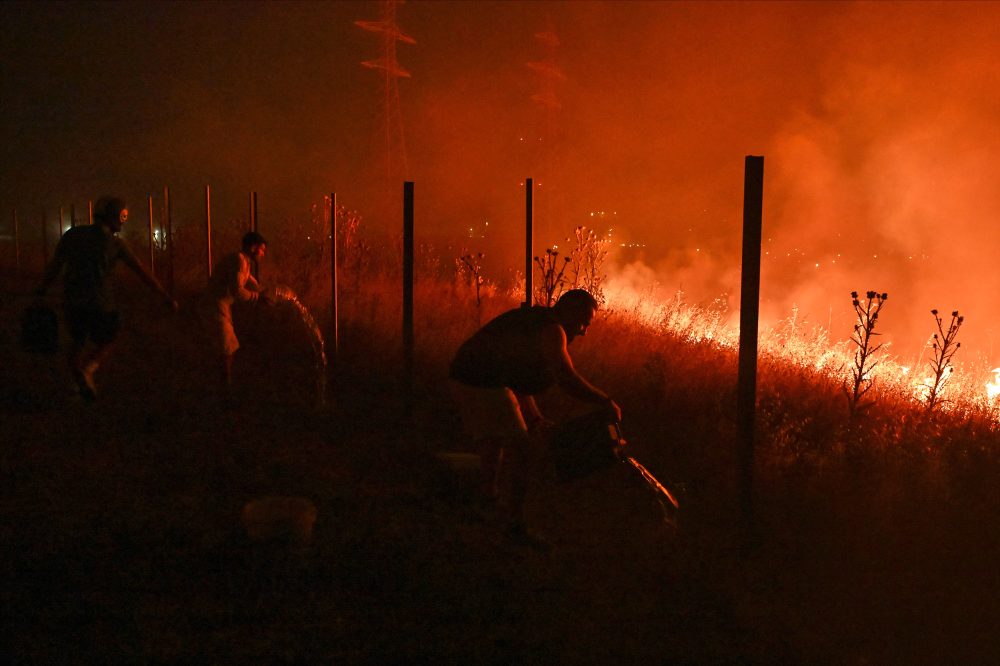
In Greece, government spokesman Pavlos Marinakis announced Monday that 96 wildfires had ignited across the country within the previous 48 hours. He noted that the overwhelming majority were contained before they could grow larger.
Climate scientists continue to warn that rising global temperatures are making heat and dry conditions more frequent and more severe — particularly in southeastern Europe — increasing the region’s exposure to health risks and wildfire dangers.
The most serious Greek fire broke out Sunday afternoon near the town of Mandra, west of the capital Athens. Authorities rushed 29 aircraft and more than 200 firefighters to the scene to get the fire under control before nightfall, when aerial firefighting operations must cease. By Monday, the fire had largely died down, though it had not been completely put out.
Several areas of Greece remained under high or very high wildfire risk Monday because of strong winds. On the southern island of Crete, a wildfire near the town of Ierapetra triggered evacuation orders for a nearby village. Fanned by strong winds, that blaze was moving primarily through agricultural land, fire officials said.
Across the Iberian Peninsula, Spain and Portugal were also enduring another surge of dangerous heat, with hundreds of firefighters working to hold back wildfires in both countries.
Spain’s weather agency AEMET cautioned that a heatwave which began Sunday would continue at least through Thursday, pushing daytime and nighttime temperatures well above normal. Much of Spain, including the capital Madrid, was expected to see afternoon highs ranging from 37 C to 42 C (99 F to 108 F) on Monday and Tuesday.
Overnight temperatures were also forecast to stay oppressively warm, with readings expected to remain above 20 C (68 F) — a threshold scientists describe as “tropical nights.” Such conditions prevent people from adequately cooling down and recovering from the heat of the day.
In Portugal, temperatures soared at inland locations Monday, while even the coastal capital Lisbon sweltered under readings reaching 33 C (91 F). Forecasters said temperatures should ease later in the week.