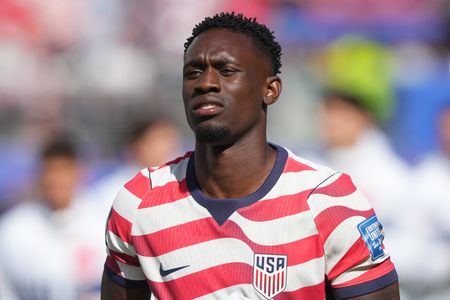

Folarin Balogun steps onto the field Monday for the biggest match of his career, carrying with him a story that has become far more than just soccer — it touches on questions of identity, immigration, and American politics at the highest level.
Balogun was not supposed to be on the field at all for the United States’ round of 16 showdown against Belgium. He had been handed a red card during the Americans’ previous match against Bosnia and Herzegovina, which would have automatically kept him out. But FIFA stunned the soccer world on Sunday by announcing it would lift that suspension.
The circumstances surrounding that decision are hard to miss. President Donald Trump — who has repeatedly pushed to end birthright citizenship — publicly called on FIFA President Gianni Infantino to take another look at Balogun’s case. Infantino confirmed the conversation took place, though he denied that Trump’s involvement had any bearing on the final outcome.
The irony runs deep. Balogun holds U.S. citizenship because his Nigerian mother was visiting New York when her pregnancy advanced too far for her to fly home. She gave birth in the United States, then brought her newborn son back to England when he was just one month old. Balogun grew up in Britain and came through the Arsenal youth academy before eventually deciding to represent the United States on the international stage.
He had previously played for England at the youth level before formally joining the U.S. Soccer program in 2023. England, Nigeria, and the United States had all been possibilities for the talented forward.
“It feels like I’m at home here,” Balogun said when U.S. Soccer announced he would wear the Stars and Stripes.
He noted that the decision was made alongside his family, and that a vacation to Orlando played a role in winning him over. “I think that’s when I really saw the full force of the U.S. fans,” he said. “It’s just something I’m really happy that I’ve decided to do.”
At the World Cup, Balogun has emerged as the tournament’s breakout American star, scoring three goals and sparking dreams of a deep run. While Christian Pulisic — long the face of U.S. men’s soccer — remains the team’s most recognized name among sponsors, it is Balogun who has captured the imagination of fans. He even drew a shoutout from LeBron James after mimicking the NBA star’s “Silencer” celebration on the pitch.
The red card that threatened to sideline him came Wednesday, when a Video Assistant Referee review caught him planting his boot on the ankle of Bosnia defender Tarik Muharemovic — a contact that appeared unintentional. Pulisic put his arm around Balogun as the 25-year-old took the moment in stride, later vowing to support his teammates from the sidelines if the ban held.
It did not hold. And the timing of the reversal — coming less than a week after the Supreme Court handed Trump a significant defeat in his effort to end birthright citizenship — made the story impossible to ignore.
“The timing and the development of the story has been extraordinary to witness,” said Jorge Loweree, the managing director of programs at the American Immigration Council.
Loweree also weighed in on what Balogun’s story represents in the broader debate. “Mr. Balogun’s case is an extraordinary example of the good that is made available to us by things like birthright citizenship, giving people an opportunity that they would not have otherwise, to be their best and to contribute to the United States in ways that benefit all of us,” he said.
A Miami Herald editorial declared that Balogun “prove(s) birthright citizenship isn’t a loophole — it’s America.”
The United States is among 33 countries — the majority located in the Western Hemisphere — that grant unconditional birthright citizenship, a right rooted in an 1898 Supreme Court ruling affirming the 14th Amendment. A Reuters/Ipsos poll conducted this year found that most Americans oppose eliminating that right.
Balogun’s rise has also taken on added significance for U.S. Soccer itself, as the program works to move beyond its long-standing reputation for drawing overwhelmingly from white, suburban talent pools. His success on sport’s grandest stage has become a symbol of a changing American soccer identity.