
Brazil’s World Cup heartbreak is fresh once more, and legendary right back Cafu says the solution goes deeper than tactics or finding someone to blame. Speaking in New York on Monday, the captain of Brazil’s 2002 World Cup championship team said the real fix might start with something much more fundamental — letting kids play freely without carrying the burden of a nation’s expectations.
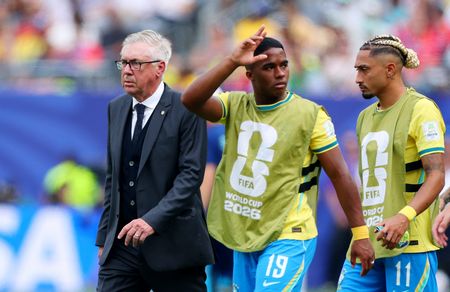
Just one day after Brazil suffered a gut-wrenching 2-1 defeat to Norway in the Round of 16 at the New York/New Jersey stadium — with Erling Haaland netting both goals to send the record five-time champions packing — Cafu called on Brazil to give coach Carlo Ancelotti the time and space for a full four-year rebuild.
Brazil’s quest for a sixth World Cup title will now stretch to at least 28 years without a championship, the longest drought in the nation’s storied football history. Cafu, who was part of the 1994 squad that snapped a 24-year title drought, understands exactly what that number means to those who wear the famous yellow jersey.
When asked about the pressure the next generation of Brazilian players will face, Cafu didn’t sugarcoat it. “Even greater,” he told Reuters. “If there was pressure in ’94 after 24 years, just imagine now in 2030, after 28 years.”
Cafu was in New York to help unveil a massive LEGO sculpture of the World Cup trophy at Rockefeller Plaza — an 8.47-metre-long creation made from more than 1.36 million LEGO bricks. Despite the occasion, he kept his remarks grounded and measured.
Brazil, he insisted, are still Brazil — a country measured by “the potential and the calibre of Brazilian football.” That standard, he noted, is exactly why patience will be both painful and essential in the years ahead.
“It’s not the end of the world,” he said. “It’s the start of a new cycle and a new generation, so we have to trust Carlo (Ancelotti) is the man to help Brazil win that title again.”
ANCELOTTI STEPPED INTO CHAOS
Ancelotti, who was once managed by Cafu at AC Milan, took over a Brazilian program in disarray. After three interim coaches and significant administrative turmoil, Cafu said the Italian manager wasn’t handed a team so much as a crisis.
“Ancelotti came into this World Cup to put out a fire, really,” Cafu said. “He took the reins of a ship that was already underway. He tried to right that ship mid-journey… but unfortunately he didn’t succeed.
“Now he’ll take the ship while it’s docked and will be able to set it on its exact course.”
Beyond the national team, Cafu’s concern runs deeper — into the academies and youth leagues where he believes Brazil’s trademark creativity and flair are being choked out by an adult-driven obsession with results. The country that once produced attacking full backs who could cover entire flanks with joy and freedom is, in his view, losing sight of what made those players great.
“Youth teams aren’t developing full-backs the way they should be,” he said. “A full-back has to be a full-back; he has to work on the flank.”
On a broader level, Cafu believes Brazil has confused nurturing talent with manufacturing winners.
“Today we’re not developing players, we’re developing competitors,” he said. “When you set up a youth programme where you’re obliged to win, you’ll develop competitors; you won’t develop proper athletes with creative freedom.”
The romance of street football — the barefoot games on asphalt that shaped his own generation — cannot be brought back simply by wishing for it, Cafu acknowledged. His memories belong to a different era of Brazilian life.
“That’s changed. It won’t come back,” he said. “Lucky were us who lived through that time, who lived through that era.”
The challenge now isn’t to recreate the past, but to preserve some of its spirit within the modern game’s structure.
“Let children be children,” Cafu said. “At eight, a child should be playing with a ball, laughing and having fun.”
And then he offered perhaps the simplest coaching philosophy imaginable — fitting, given the setting.
“It’s like building with Lego,” he said. “You put the pieces together one by one and enjoy yourself without even noticing you are developing a skill.”