
DETROIT (AP) — Long before it was ever called the United States, this nation was built not on centuries of shared tradition, but on something harder to pin down: a collection of stories it repeated to itself again and again — a mix of truths, myths, and outright fabrications — until it willed itself into being.
“A city upon a hill.” “All men are created equal.” “Life, liberty and the pursuit of happiness.” Tales of presidents splitting logs and owning up to chopping down cherry trees. A founding father flying a kite in a thunderstorm. And towering above them all, the “American Dream” — a story that traveled across states and entire oceans.
The United States grew into the nation that built the most powerful storytelling machines the world had ever seen — the American frontier, Hollywood, and Madison Avenue. It also sat at the heart of the internet and social media revolution — technologies that muddled and scrambled information even as they gave a voice to groups that had long been silenced, allowing them to offer their own perspectives on the American experience.
This past Saturday marked 250 years of what many call the Great Experiment. And even in this era of deep division, the American story still carries enormous weight. It shapes hearts and minds in a country where the national narrative — and the question of who controls it — has always been a source of power. And as is evident today, it is those who win who get to write and control the history.
Frontier historian Richard Slotkin once put it plainly. “There’s nothing organic about the United States. It’s an invented country,” he told The Associated Press. “And if we stop telling the American story, we’re just a bunch of folks. … You have to keep adding new chapters to the story and making the story make sense.”
In politics and entertainment, in classrooms and at tourist destinations, Americans do exactly that — at a relentless pace, and sometimes, perhaps, to a degree that isn’t healthy.
The country today holds countless versions of its own story, each reflecting what America has been, is, and might one day become. But in the 2020s, telling that story is a crowded and contentious endeavor, riddled with misinformation and deliberate falsehoods. The battle plays out in schools, political arenas, newsrooms, entertainment, and history books alike.
Is your anthem “This Land Is Your Land,” “God Bless America,” or “Courtesy of the Red, White and Blue”? Do you side with Sean Penn or James Woods? Tucker Carlson or Jimmy Kimmel? Do you wear a bald eagle on your shirt or a pride flag? Do you drive a pickup truck or an electric vehicle? These choices signal what kind of American you see yourself as.
Do you grab flag-themed souvenirs at Walmart, or do you express your love of country differently? Do you belt out the National Anthem at sporting events? Do you share memes celebrating America’s greatness — or lamenting its failures? Do you watch old World War II films with a sense of reverence? Every one of those choices is a small act of storytelling, a contribution to the ongoing national narrative.
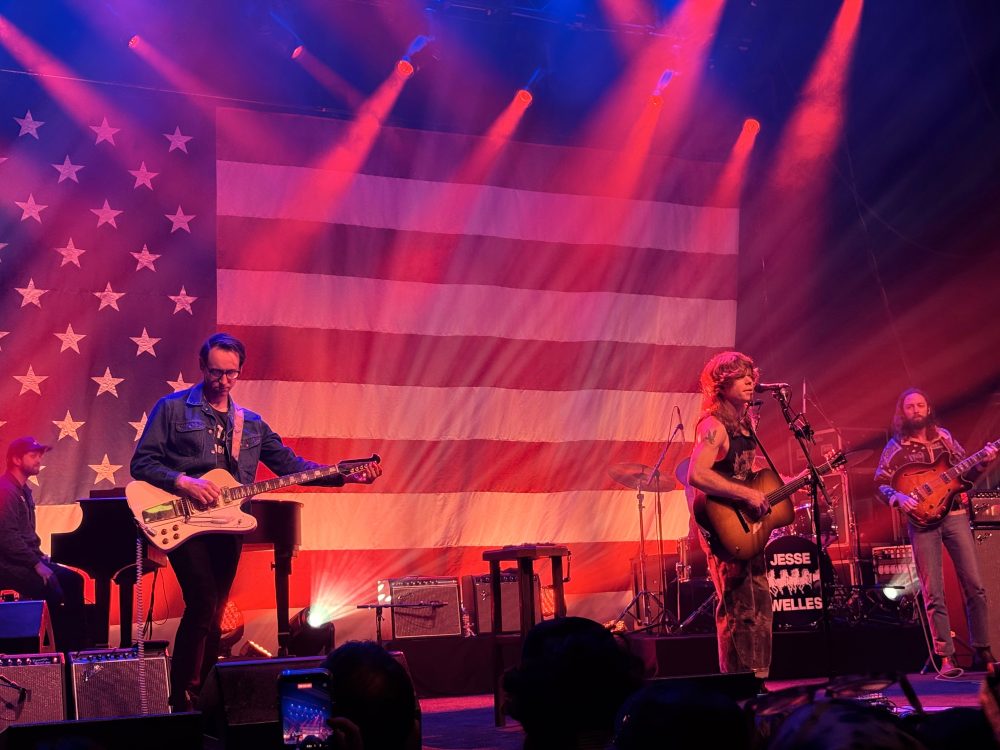
Consider singer-songwriter Jesse Welles — progressive and openly patriotic, carrying on the tradition of Woody Guthrie and Bruce Springsteen — who uses flag imagery and pointed lyrics at his concerts to assert that he and those who share his beliefs will not be written out of the American story. “Good morning, America. Good evening, America. I love ya,” he likes to sing.
Or consider Donald Trump, a master of brand-driven storytelling, who is actively reshaping the story America tells about itself. Regardless of how one feels about him, it’s difficult to argue that the American narrative — both at home and abroad — doesn’t bear his unmistakable mark. He is well aware of his influence over the tale.
“The left has warped, distorted, and defiled the American story with deceptions, falsehoods, and lies,” Trump said shortly before losing the 2020 election.
Yet the president’s version of the story frequently centers less on the nation itself and more on Donald Trump personally.
Through a torrent of superlatives and self-promotion, he has placed his own story front and center — both in a figurative and a literal sense. He has expressed interest in being added to Mount Rushmore. His face may appear on currency during his own lifetime. It will appear on this year’s anniversary edition of the U.S. passport. His image is displayed throughout Washington, D.C., alongside other visible marks of his presence — from a triumph arch to the disputed redesign of the reflecting pool to the equally controversial $400 million ballroom being added to the White House. Whatever else these projects represent, they are attempts to claim pieces of the American story as his own.
It is a pattern that has defined much of his life — presenting himself as the living symbol of American success. Even this month’s anniversary celebration became a contest over which story to tell, with Trump’s influence clearly in play.
There was America250, a bipartisan effort created by Congress. And there was Freedom 250, a version backed by the Trump administration that hewed much more closely to the MAGA interpretation of American history. The two events effectively represent a tug-of-war over which version of America gets the spotlight — a tension made more visible when several musical acts pulled out of Freedom 250 concerts, saying the events had become too politically charged.
The story shifted.
The American flag sits at the heart of the national narrative — a piece of cloth that contains contradictions and complexities (“gave proof through the night, that our flag was still there”). It always has, going back to the legend of Betsy Ross.
Its display — in ballparks, at solemn military ceremonies, in the aisles of big-box stores — invites people to think about their country and its purpose. Its deliberate destruction, protected under the principle of free speech and itself a significant chapter in the American story, is used by some as a form of passionate protest, and condemned by others as shameful and even treasonous.
That tension is no surprise, given that the flag is a physical representation of the American story — something Jesse Welles makes plain at his performances.
“It’s an extraordinarily potent symbol for anybody — left, right or center,” said Ken Burns, the celebrated documentary filmmaker. “It’s interesting when we have this assault on traditional democratic institutions that the people who are out in the streets protesting have sort of reclaimed — and they never should have relinquished — the American flag.”
But how the flag is used — and by whom — varies considerably. Republicans and older white Americans are more likely to fly it, wear it as clothing, or, as in the case of Pete Hegseth, use it as a pocket square. Democrats and Black Americans are less likely to do so. That was the finding of an AP-NORC poll conducted last month.
John Baick, a historian at Western New England University, has noticed less flag imagery during Trump’s second term than during his first, suggesting that the intense focus on Trump himself may have crowded it out. Baick argues that the use of storytelling in today’s political environment shapes the broader sense of what the United States is — and he sees that sense fragmenting, as reflected in how the flag is being used.
“I think it’s just become a muddled mess,” Baick said. “I think it’s just going to be almost the breakdown of a national system and states will figure it out, cities will figure it out, individuals will figure it out. They’ll put out their flags, but … they’ll tell their own stories.”
The national story is far from finished. Fox News business journalist Maria Bartiromo, when recently recounting her family’s history, referred to the United States as “this young nation” — a reminder of just how new this country really is. Nations like China and Russia have thousands of years of stories to draw upon. The United States has fewer than 400, even counting back to its earliest origins.
And so the American story presses on. Where it goes next — and whose voice will carry the farthest — remains to be seen.