Drivers in the Dover area should expect delays on southbound Frederica Road today due to ongoing construction work.
DelDOT reports that the right lane is currently closed between East David Street and Water Street while crews complete their work. The lane closure is expected to last until 4 PM this afternoon.
Motorists are advised to use caution when traveling through the construction zone and allow extra time for their commute. Traffic may be backed up during peak travel times as vehicles merge into the remaining open lane.
LAS VEGAS (AP) — Las Vegas betting markets suggest the real NBA championship battle may unfold in a potential Western Conference clash between defending titleholder Oklahoma City and San Antonio, a squad that dominated the Thunder during regular season play.
However, sportsbook numbers also suggest not overlooking Boston as NBA postseason action commences, given the Celtics captured their record 18th title just two seasons ago.
Oklahoma City stands as the +120 betting choice at BetMGM Sportsbook to become the first franchise since Golden State in 2018 to claim back-to-back championships. San Antonio, which beat the Thunder in four of their five regular season encounters, follows at +450 odds. Boston remains within striking distance at +550.
All remaining franchises carry betting lines of 10-1 or higher.
“The West team is going to be favored in the final unless there’s a real shocker,” said Bruce Marshall, handicapper for WagerTalk/Gold Sheet. “We’re assuming it’s Oklahoma or San Antonio. Either of those two would be favored. Boston would have the best chance, I think, in the East, followed by the Knicks and then Detroit.”
David Lieberman, pro basketball lead at Caesars Sportsbook, expressed caution about assuming favorites would wind up in the NBA Finals.
“It should be pretty wide open this year, and I can see any of the top 3-5 seeds making a run in each conference,” Lieberman said. “I expect several long, competitive series all the way through.”
Jayson Tatum’s earlier-than-expected return from an Achilles tendon tear sustained in last year’s playoffs has made bettors believers of the Celtics. Boston was listed at 10-1 before his comeback, and 8.7% of the bets and 8.2% of the money at BetMGM are on the Celtics. That’s behind only the Pistons in the Eastern Conference (10.2% of bets, 9.7% of the handle).
Detroit has generated significant optimism with Cade Cunningham returning after missing approximately three weeks due to a collapsed lung.
Despite the Western Conference’s superior depth and talent, numerous bettors are finding value in Eastern Conference wagering opportunities.
“The Detroit Pistons have been getting bet all year, and now with Cade Cunningham back and healthy, bets are coming in on them again,” Lieberman said. “The top five seeds in the East have been pretty popular bets of late, so I think there is some belief in those teams outside of the Celtics.”
Los Angeles Lakers generated considerable discussion as a potential dark horse contender in the West before Luka Doncic (hamstring) and Austin Reaves (oblique) suffered injuries this month.
BetMGM’s wagering figures demonstrate minimal confidence in the Lakers’ championship prospects. Los Angeles carries 125-1 odds to advance from the Western Conference and 250-1 to capture the title.
The fourth-seeded Lakers begin postseason play against fifth-ranked Houston. The Rockets are 8-1 series favorites despite lacking home-court advantage.
“The moment Luka got hurt, the chances of the Lakers making a deep run ended,” Marshall said. “Houston has been playing better, so I think that Lakers (have a) short stay. It’s too bad because it was looking like they might be menacing for a while when all the hands were on deck.”
Should betting predictions prove accurate, Tuesday and Wednesday’s four play-in tournament contests should remain competitive until the final moments.
Charlotte and Los Angeles Clippers, each favored by 5 1/2 points, represent BetMGM’s largest spreads.
The Hornets face Miami, with the victor meeting either Orlando or Philadelphia before potentially challenging top-seeded Detroit. Philadelphia holds a 1 1/2-point edge over Orlando, with that winner advancing to face Boston.
In Western Conference action, the Clippers battle Golden State for the opportunity to face Portland or Phoenix before potentially meeting Oklahoma City. Phoenix carries a 3 1/2-point advantage over Portland, with that victor set to challenge San Antonio.
Marshall concurred with NBA Commissioner Adam Silver regarding tanking as a significant league concern.
Teams potentially not providing maximum effort won’t influence playoff betting, unlike regular season wagering.
“Actually, I kind of enjoyed it when you got these teams that weren’t trying because you could try to go against them, although the oddsmakers were really making us pay with a lot of these numbers,” Marshall said. “It’s really a disease in the NBA and they’re trying to address, but it gets worse every year with the tanking stuff. As soon as a team sees they’re out of the playoff picture, they try not to win.”
PORT-AU-PRINCE, Haiti (AP) — Over 1,000 factory employees took to the streets Monday in Haiti’s capital city, calling for increased minimum wages as rising tensions in Iran continue to drive fuel costs higher worldwide.
Employees from the government-operated Metropolitan Industrial Park, commonly called Sonapi, assembled at the facility’s entrance in Port-au-Prince, chanting, “When we are hungry, we don’t mess around!”
The workers pointed out they haven’t received any pay increases since 2023, and basic necessities have become unaffordable after Haiti’s administration boosted diesel costs by 37% and gas prices by 29% this month.
“A gallon of gas is higher than our minimum daily wage,” said Marc Jean Jean-Pierre, a 47-year-old father of two children.
Jean-Pierre manufactures denim at a factory, making 685 Haitian gourdes ($5.23) daily, while gasoline now sells for 850 gourdes ($6.49) per gallon.
“You can see what we’re going through,” he said.
Jean-Pierre previously relied on public transit for his commute but now walks an hour each way to save money, as round-trip bus fare has jumped by 100 gourdes (76 cents).
“We will be in the street until the government hears our voice,” he said.
Also participating in Monday’s demonstration was Maxime Excellence, a 49-year-old custodian at the factory, who expressed concern about escalating transportation costs and other expenses.
“On top of it, I have to eat. I can’t spent the whole day not eating,” he said. “God knows what I’m going to have to eat when I get home.”
Excellence described the workers’ requests as reasonable.
“We can barely make ends meet with what we’re living on,” he said.
He vowed to continue demonstrating until their demands are addressed and indicated he would turn to violence if needed.
James Cardichon, a 37-year-old T-shirt manufacturer, shared similar views.
“We need a revolution for them to understand,” he said, noting that workplace conditions also require improvement. “We are leaving our sweat behind.”
Cardichon explained that employees want better compensation so their kids won’t face identical hardships.
“We are tired,” he said. “Our country is infested by gangs. The bus charges more because they have to pay the gangs to get through, and we end up paying for everything.”
Cardichon also expressed frustration with repeated government pledges to address the nation’s problems.
“We are tired of promises,” he said. “We want them to take action, and quickly.”
Several Haitians who joined the demonstration don’t work at the industrial complex but wanted to voice their anger over Haiti’s worsening crises, including escalating gang violence and increasing poverty.
Garry Jean Paul, 35, who sells mobile phones on the street, said climbing oil prices are making the country’s circumstances worse.
“Some days I make a couple hundred of gourdes, some days I have to go home with nothing,” he said. “Families are doing things they are not supposed to be doing. They are begging.”
NEW YORK — Law enforcement officers arrested approximately 90 demonstrators Monday during a protest targeting Senate Democratic Leader Chuck Schumer and Senator Kirsten Gillibrand over their stance on American weapons sales to Israel.
The antiwar organization Jewish Voice for Peace organized the demonstration, which drew hundreds of participants to the Manhattan offices of both Democratic senators. Activists accused the lawmakers of supporting Israel’s escalating military operations in Lebanon and the broader U.S.-Israeli conflict with Iran.
When building security prevented protesters from conducting their planned sit-in inside the offices, demonstrators moved to the street where they blocked vehicular traffic. Participants chanted “fund people, not bombs” as officers placed them under arrest and transported them on three separate buses.
Notable individuals among the 90 people detained included whistleblower Chelsea Manning, actress Hari Nef, and New York City Council Member Alexa Avilés, a spokesperson for Jewish Voice for Peace confirmed.
The protest centered around legislative measures introduced by Senator Bernie Sanders that would prevent the sale of over $600 million worth of bombs to Israel.
Previous attempts by Sanders, a Vermont independent, to advance similar legislation have been unsuccessful. However, his latest effort during the summer months gained backing from more than half of the Democratic senators in response to widespread humanitarian concerns in Gaza. Neither Schumer nor Gillibrand supported those measures.
Monday’s demonstrators emphasized that Israel’s military campaign in southern Lebanon, combined with the expanded U.S.-Israeli operations against Iran, made the upcoming vote more critical. The Senate is expected to consider the resolution later this week.
“This is the moment when Schumer and Gillibrand must listen to their constituents,” stated Sonya Meyerson-Knox, communications director for Jewish Voice for Peace. “The majority of Americans and New Yorkers want a resolution to what the Israeli government is doing.”
Representatives for both Senator Schumer and Senator Gillibrand did not respond to requests for comment.
AUSTIN, Texas (AP) — The leader of a Texas summer camp where flooding claimed the lives of 27 campers and staff members in 2025 testified Monday that he failed to receive advance weather alerts from federal and state agencies issued before the deadly storm struck, and no staff discussions occurred regarding the approaching threat.
Edward Eastland, who runs Camp Mystic, gave his testimony during court proceedings focused on maintaining damaged portions of the facility as evidence for multiple lawsuits brought by families affected by the July 4th tragedy along the Guadalupe River.
Last month, a judge mandated the camp preserve these areas, prompting an appeal from camp management. Monday’s court session continued testimony regarding the facility’s operations before and during the fatal flooding.
The current proceedings, potentially offering the most comprehensive public statements from leadership of the all-girls Christian facility, occur as operators seek state approval to reopen Camp Mystic this summer on grounds unaffected by flooding.
Edward Eastland spent several hours on the witness stand Monday before a courtroom filled with relatives of the deceased girls.
Eastland explained that he and fellow staff members had registered for emergency notifications on their mobile devices and utilized various weather applications. However, he stated he never saw flood watch announcements posted by the National Weather Service and Texas Department of Emergency Management on July 2nd and 3rd on social media platforms.
Eastland noted he wasn’t connected to those agencies through social media and believed the local “CodeRED” mobile alert system and staff weather applications “was enough.”
A July 3rd National Weather Service bulletin requested area media outlets inform the public that intense local rainfall might trigger flash flooding in rivers, creeks, streams and low-elevation areas – all characteristics present at Camp Mystic’s location.
Eastland explained that his father, camp co-owner Richard Eastland, usually handled weather monitoring duties. Edward Eastland stated he didn’t think camp personnel conducted any meetings regarding the alerts and warnings that day.
The storms struck during the night, taking the lives of 25 campers, two teenage staff members and Richard Eastland.
“We did not expect what was going to happen,” Edward Eastland said.
“You were warned,” said Brad Beckworth, an attorney representing families who have sued Camp Mystic.
Eastland faced questioning about the minimal information available to campers and cabin supervisors since mobile phones weren’t permitted in sleeping quarters, and only select staff possessed walkie-talkies for communication.
The courtroom listened to a portion of a “Taps” recording broadcast through speakers when campers retired at 10 p.m. on July 3rd. Those same speakers weren’t utilized to announce weather warnings, Eastland confirmed.
Eastland said he retired around 11 p.m. His father contacted him via walkie-talkie near 2 a.m. to report heavy rainfall and the necessity to relocate canoes and water gear from the riverbank.
Eastland testified he never received a National Weather Service flash flood alert at 1:14 a.m. and slept through a CodeRED text message at the same time targeting his specific location. The notification warned of flooding that could persist for several hours.
Family attorneys questioned Eastland about a written account from a counselor who awakened during the storm and reported seeing girls fleeing to safety.
“The water was rising faster than anything I have ever witnessed,” the counselor wrote.
Overall, the catastrophic flooding resulted in at least 136 deaths across several miles of the river, prompting questions about how the situation became so deadly.
Relatives of multiple deceased girls have filed lawsuits against camp management, claiming officials didn’t implement proper safety measures to protect campers as dangerous floodwaters advanced.
The camp’s reopening plans have angered victim families and Texas Lt. Gov. Dan Patrick, who believes the license should be rejected while state legislators and agencies conduct investigations. Camp leadership reports nearly 900 campers have registered to return.
Texas health officials announced last week they’re examining hundreds of complaints submitted against camp ownership. The Texas Rangers are also assisting with investigations into neglect allegations, according to the Texas Department of Safety, though the extent of the elite investigation unit’s involvement remains unclear.
The Trump family’s business empire has experienced unprecedented growth during Donald Trump’s second presidency, raising new questions about potential conflicts of interest and what precedent this might establish for future commanders-in-chief.
While the Trump Organization completed zero international agreements during Trump’s initial White House tenure, the family has closed eight overseas deals within the last twelve months alone.
The financial windfall has been remarkable. Revenue from Trump-branded digital “meme” coins over just four months has exceeded twice what the organization earned operating their prominent Washington D.C. hotel throughout Trump’s entire first presidency.
Additional ethical concerns arise from family investments in corporations that rely on federal contracts and pursue government-backed funding and loans.
Columbia University historian Timothy Naftali observed that any previous limitations seem to have vanished entirely. “Whatever constraints there were in the first term appear to have completely disappeared,” Naftali stated.
Princeton University historian Julian Zelizer expressed concern about the precedent being established for future presidents. “He has shown politically there is no price to be paid to making money,” Zelizer explained. “You know you can go there.”
White House officials maintain Trump faces no conflicts of interest, emphasizing his assets remain in a trust overseen by his children and asserting he maintains “no involvement” in family business transactions. The Trump Organization separately declared, “The implication that politics has enriched the Trump family is unfounded.”
However, the recent surge in family business activity presents a stark contrast to Trump’s first presidential term.
International projects include a Qatar golf club and villa development partially backed by a Qatari government-owned company. In Vietnam, where The New York Times documented government displacement of farmers to accommodate a Trump resort, the nation’s deputy prime minister formally approved the project during a signing ceremony. Saudi Arabia is developing a “Trump Plaza” resort along the Red Sea through a Saudi developer with close royal family connections.
While determining whether these deals influenced U.S. policy decisions remains virtually impossible, each country achieved significant policy objectives: Qatar gained access to cutting-edge American technology, Vietnam received tariff reductions, and Saudi Arabia secured fighter jet purchases.
The Trump Organization has earned tens of millions in fees from these arrangements.
Just before inauguration, the Trump family sold nearly half their World Liberty Financial crypto operation to a UAE government-connected firm managed by a UAE royal family member for $500 million.
A second UAE entity, a government investment fund, purchased $2 billion worth of stablecoin digital currency for the offshore cryptocurrency platform Binance through World Liberty. This arrangement allows the Trump company receiving those dollars to invest in secure options like bonds or money market accounts while retaining tens of millions in interest earnings.
Subsequently, the Trump administration lifted Biden-era restrictions, granting the UAE access to advanced American semiconductor technology. Binance founder Changpeng Zhao later received a presidential pardon despite pleading guilty to failing to prevent criminals from using his platform for money laundering connected to child exploitation, drug trafficking, and terrorism.
Regarding the pardon, White House officials characterized Zhao as a casualty of what they termed “The Biden Administration’s war on crypto.” Zhao’s legal representative stated via email, “Any claim of a quid pro quo by Binance or CZ, or preferential financial treatment by Binance, is a clear misstatement of the public record.”
World Liberty has created another revenue source for a new Trump limited liability company through “governance token” sales, which provide buyers voting rights without ownership stakes. These sales generated $2 billion last year, translating to hundreds of millions for the Trumps through their World Liberty ownership and a separate agreement providing them a percentage of sales.
Cryptocurrency billionaire Justin Sun emerged as a major token purchaser, spending $75 million between Trump’s election and inauguration. As a foreign national, Sun would be prohibited under U.S. law from making political contributions to American politicians.
A federal lawsuit accusing Sun of investor fraud was suspended in February before reaching a $10 million settlement last month.
Digital “meme” coins featuring Trump’s image launched just days before his second inauguration have proven extraordinarily profitable.
Within four months, these coins generated $320 million, with the majority flowing to Trump-affiliated entities according to blockchain analyst Chainalysis. Unlike lobbyists or campaign contributors seeking to influence Trump, coin purchasers can buy anonymously.
Forbes estimates place Trump’s current net worth at $6.3 billion, representing a 60% increase since returning to office.
The business expansion has continued into Trump’s second year back in the White House.
Last month, his eldest sons acquired stakes in an armed drone manufacturer pursuing Pentagon contracts and seeking business with Gulf nations under Iranian attack who depend on U.S. military protection led by their father.
Other government contractors where one or both sons have obtained ownership interests this year include a rocket motor producer, an artificial intelligence chip supplier, and a data analytics firm.
When questioned about potential conflicts following the drone deal announcement, Eric Trump stated, “I am incredibly proud to invest in companies I believe in.” A representative for Donald Trump Jr. said he doesn’t “interface” with government officials regarding his portfolio companies.
The president has largely dismissed conflict-of-interest concerns, telling The New York Times in January, “I found out that nobody cared.”
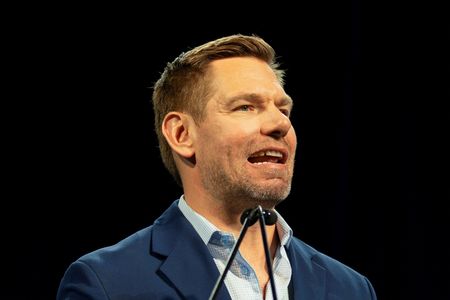
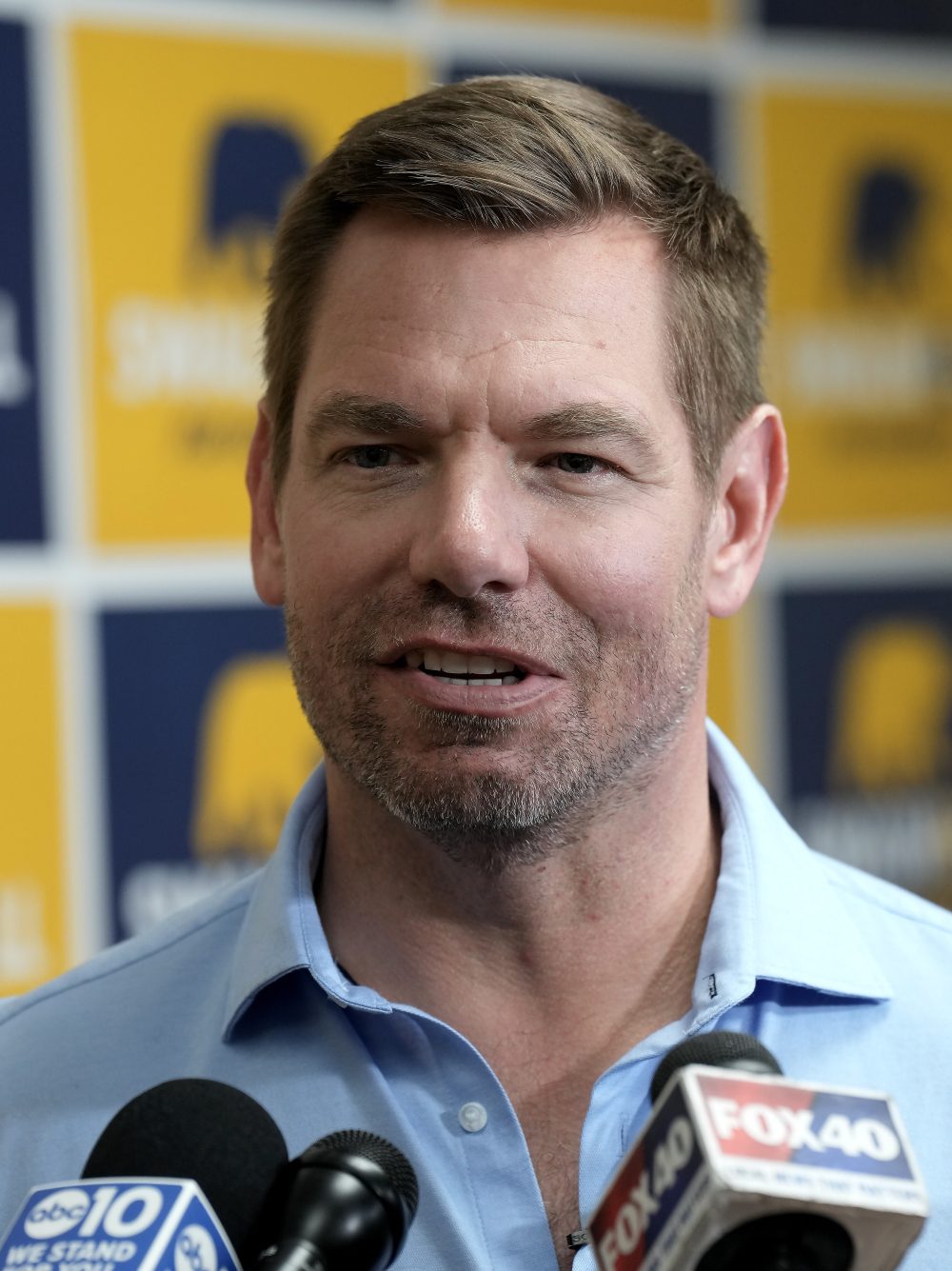
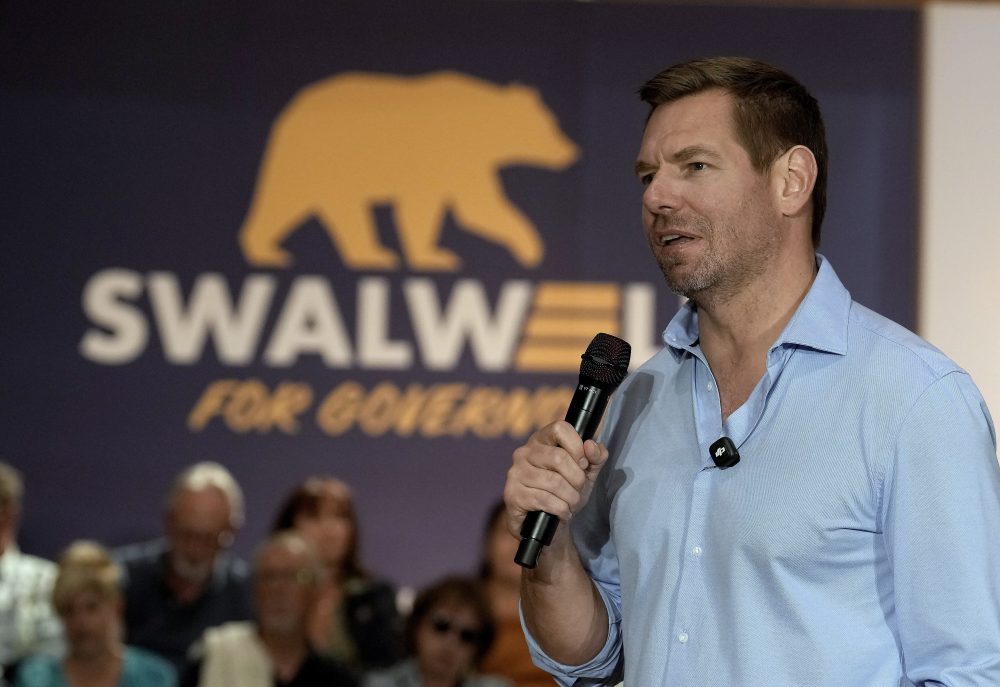
WASHINGTON – California Representative Eric Swalwell faces mounting pressure from his Democratic colleagues to step down from Congress as a House ethics committee begins investigating sexual misconduct allegations against him.
The congressional ethics panel announced Monday it is examining whether Swalwell broke House rules. Four women have come forward with sexual assault accusations against the California congressman.
Swalwell ended his gubernatorial campaign on Sunday, issuing an apology for “mistakes in judgment” while maintaining his innocence and calling the allegations serious but untrue.
Oregon Representative Andrea Salinas issued a statement Monday demanding Swalwell’s resignation. “The allegations against him are serious, credible, and demand accountability,” Salinas stated. “The halls of power must not be a place where predators are shielded by inaction.”
Swalwell joins three other House members currently facing mounting calls for resignation or expulsion from Congress – a bipartisan group of two Democrats and two Republicans.
Texas Republican Tony Gonzales withdrew from his reelection bid last month, abandoning a May 26 runoff against gun rights advocate Brandon Herrera. Gonzales allegedly engaged in an affair with a former staff member who later took their own life.
New Jersey Democratic Representative Nellie Pou condemned both lawmakers in strong terms. “At a minimum, it is clear that Reps. Swalwell and Gonzalez have betrayed their constituents, staff, and their oath of office,” Pou declared. “At worst, it appears they may have committed abhorrent, outrageous, and potentially criminal acts. They should resign immediately; if they refuse, the House should debate their removal through expulsion.”
House expulsion represents the chamber’s harshest disciplinary action and demands a two-thirds majority vote for approval. Throughout history, only six House members have faced expulsion – most recently former New York Republican George Santos in December 2023.
With Republicans maintaining a slim 217-214 advantage over Democrats, any successful expulsion effort would require support from both parties.
Florida Republican Anna Paulina Luna announced plans to introduce expulsion legislation targeting Swalwell. Meanwhile, New Mexico Democrat Teresa Leger Fernandez said she would file similar measures against Gonzalez, with Luna promising her support.
North Carolina Republican Addison McDowell emphasized the need for action. “It’s past time to get rid of predators in Congress who prey on women – especially their own staff,” McDowell stated. “Women working in the halls of Congress deserve to know that, as an institution, we have their backs and that we condemn this behavior at the highest level.”
Arizona Democratic Representative Yassamin Ansari indicated she would vote to remove both men if they refuse to resign voluntarily. Maryland Democrat April McClain Delaney characterized their alleged behavior as “beyond inexcusable” and potentially criminal. “Both should be expelled,” she declared, contingent on investigations confirming “the facts are true.”
A coalition of Democrats from competitive districts that could determine House control in November’s midterm elections urged leadership to accelerate misconduct investigations.
“Public confidence in Congress is at a historic low, but it can be earned back through public accountability,” the group wrote. “We must demonstrate that no one is above the law and that serious misconduct will result in serious consequences. We respectfully request that you work together in a bipartisan manner to ensure these investigations proceed swiftly, that findings are made public, and that action is brought to the floor for a vote.”
New York Representative Nydia Velazquez went beyond her Democratic colleagues by suggesting two additional Florida representatives should also face resignation or expulsion. She named Democrat Sheila Cherfilus-McCormick and Republican Cory Mills alongside Swalwell and Gonzales.
Federal prosecutors have charged Cherfilus-McCormick with misappropriating $5 million in federal disaster relief funds for her congressional campaign. Mills faces allegations of sexual misconduct and campaign finance violations.
“Congress should not tolerate representatives who abuse staff, betray public trust for personal gain, and generally violate their oath of office,” Velazquez stated. “Americans deserve better and Congress must hold our members accountable.”
WASHINGTON – President Donald Trump orchestrated a McDonald’s delivery to the Oval Office Monday as part of an effort to showcase his elimination of taxes on tips, giving the delivery driver what looked like a $100 bill when reporters questioned whether White House staff tip well.
Sharon Simmons, a DoorDash driver from Arkansas sporting a red “DoorDash Grandma” shirt, arrived at the door with two bags of fast food while cameras rolled. The President greeted her and subsequently fielded questions from the press with Simmons beside him, who mentioned she has kept significantly more money since tip taxes were eliminated in January.
As November’s midterm elections approach with Congressional control at stake, Trump’s team began this year planning to highlight the robust U.S. economy. However, the ongoing U.S.-Israeli conflict with Iran has complicated these plans, especially as climbing oil prices have increased fuel costs, diminishing the impact of tax reductions on tips, Social Security benefits, overtime wages, auto loan interest, and state and local taxes that were included in last year’s GOP-supported tax legislation.
In fact, DoorDash and similar companies relying on independent contractors recently implemented strategies to address rising gasoline costs.
When a reporter questioned Simmons about the White House’s tipping practices, she responded: “Ummm, potentially.”
Trump interrupted with “wait,” reaching into his pocket to pull out what appeared to be a $100 bill for her.
“Thank you, you reminded me,” he stated.
During a later Fox News appearance, Simmons commented on the tip: “He took good care of me.” However, she declined to reveal the amount: “I don’t talk money.”
Simmons also skillfully deflected Trump’s attempts to draw her into political discussions before the press.
When Trump inquired: “Do you think that men should play in women’s sports?” she responded: “I really don’t have an opinion on that … I’m here about tax on tips.”
He also questioned whether she had voted for him. Smiling, Simmons answered: “Ummm, maybe.”
WASHINGTON – While the world’s banking system has successfully weathered recent economic turbulence from ongoing conflicts, a top international financial official is raising concerns about mounting pressures that could create a perfect storm of financial instability.
Bank of England Governor Andrew Bailey, who leads the Financial Stability Board, issued a warning letter to finance ministers and central bank leaders from the world’s largest economies on Monday. Bailey cautioned about the possibility of a “double or triple whammy” scenario where tightening credit conditions could simultaneously trigger problems across multiple areas of the financial system.
The financial watchdog chief specifically highlighted concerns about inflated asset prices, excessive borrowing by non-bank institutions, and mounting pressure in private lending markets. Bailey’s warning came as global policymakers prepared for this week’s International Monetary Fund gathering in Washington.
According to Bailey’s assessment, the most significant risk would come if financial markets suddenly began factoring in much more severe damage to worldwide economic growth. Such a shift could lead to sharp drops in stock prices while investors are already scrutinizing private asset valuations more closely than before.
Despite these emerging concerns, Bailey noted that traditional banks have shown remarkable strength, largely due to regulatory improvements put in place following the 2008 financial crisis. He emphasized the continued importance of implementing stronger capital requirements known as Basel III rules.
The Financial Stability Board serves as an international body that monitors risks to the global financial system and coordinates responses among major economies.
The Atlantic Sun Conference has recognized University of Delaware women’s lacrosse sophomore defender Lena Stolarick as Co-Defensive Player of the Week, the league announced Monday from Jacksonville, Florida.
The honor comes after Stolarick’s exceptional defensive play helped propel the Blue Hens to a pair of victories last week. Those two wins were crucial in securing Delaware’s berth in the upcoming 2026 ASUN Championship tournament.
The sophomore defender’s stellar week on the field caught the attention of conference officials, earning her the prestigious weekly recognition alongside another standout player from the league.
With their championship tournament spot now locked up, the Blue Hens women’s lacrosse team continues to build momentum as they prepare for postseason competition under Stolarick’s defensive leadership.
Drivers in New Castle County should prepare for a temporary detour next month as state transportation officials plan overnight road work at a major highway interchange.
The Delaware Department of Transportation has scheduled the closure of the southbound Route 896 ramp leading to northbound Interstate 95 for the evening of Monday, April 20, 2026. The shutdown will allow crews to complete milling and paving operations on southbound Route 896 in the area where traffic enters the ramp.
Officials say the work is scheduled to take place during overnight hours to minimize disruption to commuter traffic. Alternative routes will be marked with temporary signage to guide motorists around the construction zone.
DelDOT notes that the scheduled road work depends on favorable weather conditions.
The NHL’s most prestigious individual honors remain up for grabs as the league enters playoff season, with Associated Press hockey experts weighing in on the top contenders across all major categories.
The Hart Memorial Trophy for Most Valuable Player presents another year without a runaway favorite, marking three consecutive seasons where the award race has remained competitive until the final weeks. Connor McDavid of Edmonton appears poised to capture the scoring title and Art Ross Trophy for most points, while Nathan MacKinnon from Colorado leads the goal-scoring race. Meanwhile, Tampa Bay’s Nikita Kucherov has separated himself from teammates by more than 40 points and could earn his second straight Hart Trophy nomination.
AP Hockey Writers John Wawrow and Stephen Whyno offered their expert analysis on award winners across six categories:
Hart Memorial Trophy (MVP) BetMGM Sportsbook favorite: Nathan MacKinnon, Colorado
Wawrow selected Nikita Kucherov, explaining: “As much as McDavid and MacKinnon deserve consideration, and maybe Montreal’s Nick Suzuki merits mention, Kucherov did more with less on a Tampa Bay team that proved immune to the shakeup that turned the Atlantic Division upside down.”
Whyno chose McDavid, stating: “There’s an argument to be made for Kucherov, given where the Lightning could be without him after a season full of injuries. But McDavid carried the Oilers down the stretch after Leon Draisaitl got injured, and he should add a fourth MVP honor to his impressive resume that is missing only the Stanley Cup.”
Vezina Trophy (Top Goaltender) BetMGM Sportsbook favorite: Andrei Vasilevskiy, Tampa Bay
Both writers agreed on Vasilevskiy for the goaltending award.
Wawrow noted: “The numbers simply speak for themselves. Leading the league with 38 wins entering the final week, no goalie had a better goals-against average and save percentage playing 50 or more games this season.”
Whyno added: “John and I are on the same wavelength here. With a nod to Utah’s Karel Vejmelka for making more than 60 starts, no one has mixed a heavy workload with quality of play like Vasilevskiy, who has made the Cup Final four times, won it twice, but only won the Vezina once (2019).”
James Norris Memorial Trophy (Top Defenseman) BetMGM Sportsbook favorite: Zach Werenski, Columbus
The writers split on this category, with Wawrow backing Cale Makar of Colorado: “If the Blue Jackets make the playoffs, a case could be made for Werenski over a ton of talent such as Buffalo’s Rasmus Dahlin and Minnesota’s Quinn Hughes. Makar, however, stands out for once again being the NHL’s most complete defenseman.”
Whyno supported Werenski: “The Blue Jackets leaned heavily on the 28-year-old, who skated over 26 minutes per night. Werenski produced at better than a point-a-game level and does everything well on the defensive end as well.”
Calder Memorial Trophy (Rookie of the Year) BetMGM Sportsbook favorite: Matthew Schaefer, New York Islanders
Both experts agreed on Schaefer for rookie honors.
Wawrow explained: “Montreal’s Ivan Demidov and Anaheim’s Beckett Sennecke might have more points, but no rookie played more valuable minutes than Schaefer, justifying his selection as a No. 1 pick.”
Whyno emphasized the unanimous nature of the choice: “Schaefer could be unanimous. Even some of the best defensemen of this generation needed years to adapt to the learning curve at the position, and Schaefer did it perfectly at 18.”
Frank J. Selke Trophy (Best Defensive Forward)
The writers disagreed on defensive forward honors, with Wawrow choosing Nick Suzuki of Montreal: “With Aleksander Barkov injured, the field was wide open and Suzuki may run away with the honor. Though he is a secondary figure on the Canadiens’ penalty kill, his 5-on-5 numbers and puck-possession metrics, while facing opposing top lines, are solid.”
Whyno selected Jordan Staal of Carolina: “The team captain has consistently drawn tough defensive matchups and dominated on faceoffs and has only once been a Selke finalist. This should be his year.”
Jack Adams Award (Coach of the Year) BetMGM Sportsbook favorite: Lindy Ruff, Buffalo
Another split decision saw Wawrow backing Ruff: “He found the elusive key to finally unlock the potential of a team that too often faltered under pressure, carrying over the lessons learned from his first season back in Buffalo. He did so with a game-at-a-time focus, a changing lineup and being Buffalo’s first coach during the team’s 14-season playoff drought to finally place an emphasis on improving locker room culture.”
Whyno chose Jon Cooper of Tampa Bay: “Injuries and extended absences to key players, including Victor Hedman, Brayden Point, Anthony Cirelli and Ryan McDonagh, led the Lightning to dress 33 skaters and three goalies and showcased why Cooper is considered among the best in the business.”
Motorists traveling on Kingsley Drive should plan for potential delays as construction crews continue work that requires periodic lane restrictions.
The affected area spans from Durso Drive to Tamara Circle, where workers are implementing intermittent lane closures throughout the day. These temporary traffic restrictions are expected to remain in place until 6 PM today.
Drivers are advised to allow extra travel time when using this route and to exercise caution when passing through the construction zone. Alternative routes may be advisable for those seeking to avoid potential delays.
The United States Department of Agriculture’s National Agricultural Statistics Service has issued its most recent evaluation of crop advancement and agricultural conditions nationwide.
The federal agency’s latest assessment tracks the development of various crops and provides insight into current growing conditions across American farmland.
These regular reports from NASS serve as important indicators for farmers, agricultural markets, and food industry professionals monitoring seasonal crop performance throughout the country.
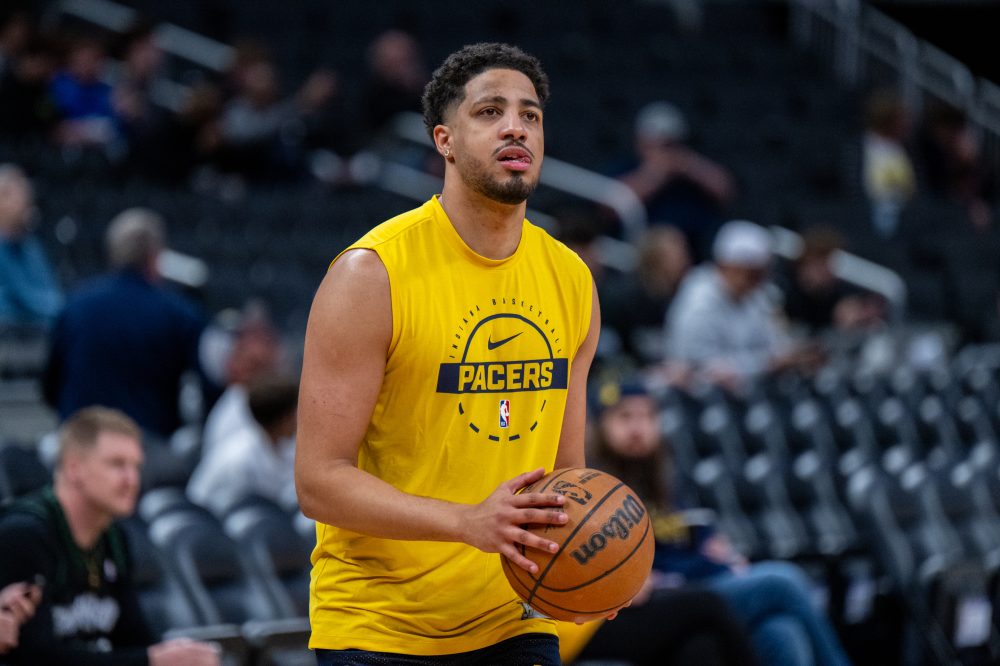
INDIANAPOLIS — Indiana Pacers All-Star Tyrese Haliburton expected to spend the entire NBA season working his way back from a ruptured right Achilles tendon that kept him off the court.
What the two-time All-Star didn’t see coming was how a severe case of shingles would complicate his comeback plans.
Speaking to media Monday, just one day after Indiana wrapped up a disappointing 19-win campaign without their star player, Haliburton revealed that while his Achilles has healed properly, the viral illness will be his main challenge heading into the offseason. The condition has led to weight gain, caused him to lose hair from his right eyebrow, and forced him to wear glasses to protect his irritated eye.
“First of all, I’d tell anybody over 50 years old to get the shot,” Haliburton said. “It’s been miserable. I have good days and bad days, but for the most part it’s been bad days. I’ve been taking unbelievable amounts of medication to try to get rid of it. It hasn’t worked. It’s not been fun and hopefully it goes away soon. It’s hard to really tell with nerve pain, but I’ve been dealing now with nerve pain for two months and in the world of nerve pain, that’s not very long. Hopefully, it goes away soon.”
The condition develops when the chickenpox virus, which remains dormant in nerve cells after childhood infection, reactivates due to stress, illness, or aging. This reactivation creates painful, blistering lesions that typically appear on one side of the body and can persist for weeks.
CDC data shows roughly one-third of Americans will experience shingles during their lifetime. While most patients recover completely, serious complications can occur. Eye involvement may result in permanent vision damage, and approximately 20% of patients endure severe nerve pain that can last months or years beyond the initial outbreak.
Team management quickly announced last July that the former Iowa State standout would miss the entire season, but Haliburton explained his rehabilitation had been progressing similarly to Boston Celtics star Jayson Tatum’s recovery timeline before the shingles diagnosis emerged. Haliburton suffered his injury during June’s Game 7 NBA Finals appearance, while Tatum tore his Achilles in May.
Tatum has since returned to competition and appears increasingly strong as Boston holds the Eastern Conference’s second seed.
Meanwhile, Haliburton and his Indiana teammates face a pivotal offseason that could determine whether the franchise remains competitive when their star returns next season.
The encouraging news is that Haliburton feels completely confident about his lower leg’s condition. His focus now centers on overcoming the illness that prevented him from participating in full-contact scrimmages until this past week.
“I’m out of shape like crazy, like I never have been before,” Haliburton said. “I’ve changed my medication a bunch of times. I’ve gotten a Botox injection I thought would help, it hasn’t really helped. I’ve done everything, it just hasn’t worked yet. But I’m confident it goes away soon.”
Many observers assumed losing Haliburton would end Indiana’s championship aspirations after reaching last year’s Eastern Conference finals. However, as training camp began, franchise officials rejected characterizing the season as simply waiting for their star’s return.
Early-season injuries to other key players, combined with a devastating 1-13 start, quickly shifted those expectations and left everyone frustrated.
“It was tough, just tough mentally going through that,” four-time All-Star Pascal Siakam said Sunday. “It was hard trying to get through it, find positive things, trying to continue to improve, trying to find ways to win games. It was pretty bad. It sucked.”
Despite his own struggles, Haliburton remained engaged with the team at coach Rick Carlisle’s suggestion, attending meetings, film study sessions, and practice. He served as a mentor to teammates dealing with their own injuries while encouraging younger players to develop their skills.
“Once I get off that (medication) and start running a little more, I have no worries,” Haliburton said. “I’ve got a long summer ahead of me — we’re only in April and the season doesn’t start till October. So I don’t really have any concerns. I can’t wait till I get out there and play and compete with my guys.”
Despite winning support from a majority of Catholic voters in his 2024 election victory, President Donald Trump now faces widespread criticism from religious leaders following his verbal attack on Pope Leo XIV, America’s first pontiff.
The controversy has united Catholics across political lines, with both conservative bishops and progressive leaders expressing outrage over what historians call an unprecedented assault on papal authority by a U.S. president.
Pope Leo XIV maintains he is simply delivering the Gospel message through his calls for peace and his criticism of attitudes that contribute to ongoing conflicts, without targeting Trump or any specific individual.
Archbishop Paul Coakley, who leads the U.S. Conference of Catholic Bishops, joined Minnesota’s Bishop Robert Barron in condemning the president’s comments. Bishop Barron, who recently praised Trump during his Easter White House visit, described the president’s statements as “entirely inappropriate and disrespectful” while calling for a public apology.
The backlash extended beyond Catholic leadership to include conservative evangelical Christians, many of whom were horrified when Trump posted a Truth Social image portraying himself in a Christ-like manner.
David Brody, a well-known Trump supporter from the Christian Broadcasting Network, responded forcefully: “TAKE THIS DOWN, MR. PRESIDENT. You’re not God. None of us are. This goes too far. It crosses the line.”
The controversial image disappeared from Truth Social by Monday afternoon. During a White House appearance, Trump denied any intention to compare himself to Jesus Christ.
“How did they come up with that?” Trump questioned. “It’s supposed to be me as a doctor, making people better. And I do make people better. I make people a lot better.”
Regarding his conflict with the pope, Trump remained unapologetic: “There’s nothing to apologize for. He’s wrong.”
This religious controversy emerges six months before midterm elections, as Trump deals with declining approval ratings and internal MAGA base disagreements over the Iran conflict. Religious right voters have historically formed one of Trump’s most dependable support groups.
Some Trump supporters believe the dispute will fade quickly. Ralph Reed, a member of the president’s faith advisory board, expressed optimism to The Associated Press.
“There is a deep reservoir of appreciation for the president and his faith-based policies that transcends and eclipses any disagreement over a social media post,” Reed stated.
While previous presidents have disagreed with papal policies, Vatican and religious historians cannot recall any similar exchange between a U.S. leader and a pope over America’s military involvement.
University of Notre Dame political science professor David Campbell emphasized the historic nature of these events in an email statement: “This is unprecedented criticism of a Pope from a US president.”
Campbell noted that many Catholic laypeople have recently supported Trump despite episcopal criticism. “If this attack on the pope does not shift that dynamic in a marked way it will truly be a watershed moment… with American Catholics choosing a Catholic-baiting president over their own pope,” he added.
Notre Dame professor Kathleen Sprows Cummings placed Trump’s actions in historical context, noting that powerful leaders have long attempted to intimidate popes.
“Emperors, monarchs, and despots have long threatened popes in an effort to force them to bend to their will,” she explained via email. “In an American context, however, Trump’s invective does represent a historic reversal.”
She observed how the traditional dynamic has shifted: “For most of this country’s history, Americans viewed the pope as war-mongering, money-grubbing, anti-democratic menace who had designs on the White House. Today, the menace is in the White House, and the pope is the one defending the ideals of liberty and human dignity.”
Vice President JD Vance, a Catholic convert who has previously clashed with church leaders over immigration policies, has not commented on the papal dispute.
Catholics Vote Common Good, a progressive nonprofit organization, urged Vance to take a public stance through national co-chair Denise Murphy McGraw.
“At a moment when the Holy Father is being attacked and the dignity of the Church is being undermined, silence is not neutrality. It is complicity,” McGraw declared.
Several prominent evangelical Trump supporters criticized the Christ-like imagery while maintaining their overall support for the president.
Willy Rice, a Southern Baptist Convention presidential candidate and Clearwater, Florida pastor, called the situation clear-cut.
“It isn’t hard to condemn this outright,” Rice wrote on X. “Many Christians appreciate the President’s administration and have supported him in meaningful ways, but this is wrong.”
Doug Wilson, who co-founded the Communion of Reformed Evangelical Churches, a conservative Calvinist denomination with administration ties including Defense Secretary Pete Hegseth, also weighed in.
“I was very grateful to see how many conservative Christians immediately denounced the blasphemous Jesus/Trump image,” Wilson posted on X.
Conservative evangelical commentator Megan Basham supported Trump’s criticism of Leo as “Weak on crime, and terrible for Foreign Policy” but condemned the imagery as “OUTRAGEOUS blasphemy,” urging Trump to “ask for forgiveness from the American people and then from God.”
Such public evangelical criticism of Trump remains unusual. White evangelical Protestants formed a crucial part of Trump’s 2024 victory, with AP VoteCast showing 34% of Trump voters identifying as white evangelical or born-again Christians, compared to just 8% of Harris supporters. White evangelicals represented about 20% of all voters, with 79% supporting Trump.
A February AP-NORC poll revealed that approximately two-thirds of white born-again Protestants approve of Trump’s presidential performance, while one-third disapprove.
Catholic approval ratings were significantly lower, with only about 40% approving of Trump’s presidency, similar to national averages.
The Catholic Association, a national advocacy group promoting “faithful Catholic voice in the public square,” joined calls for a papal apology.
Senior fellow Ashley McGuire criticized the approach: “Insulting the Pope, and all Catholics by extension, with the hope of making the Church bend to American political agendas, is discouraging and counterproductive.”
Catholic author and Marine Corps veteran Phil Klay suggested Pope Leo would maintain a long-term perspective during a Georgetown University panel Monday.
“The church’s role is not to win a news cycle or a social media slap fight, but to calmly articulate timeless truths,” Klay explained. “I think that’s what Pope Leo is doing and I think we should listen and pray.”
A Texas man who allegedly hurled a firebomb at the San Francisco residence of OpenAI CEO Sam Altman was carrying anti-artificial intelligence writings when arrested, federal court records show.
Daniel Moreno-Gama is accused of launching the incendiary attack around 4 a.m. Friday morning, igniting an entrance gate at Altman’s property before escaping on foot, according to law enforcement officials. Within the next hour, investigators say Moreno-Gama traveled to OpenAI’s corporate offices and made threats to destroy the building with fire.
Federal agents conducted an extensive search Monday morning at Moreno-Gama’s residence in Spring, Texas, located in the Houston metropolitan area, remaining on scene for multiple hours. He now faces federal charges including unlawful firearm possession and property destruction using explosive materials.
Court filings indicate that when authorities took Moreno-Gama into custody Friday, they discovered written materials expressing his opposition to artificial intelligence technology and naming multiple executives from AI companies.
The documentation allegedly contained Moreno-Gama’s thoughts about “the purported risk AI poses to humanity,” according to the federal criminal complaint.
Following the attack on his residence, Altman shared an image of his spouse and young child on his blog while addressing the threats he has received.
“Normally we try to be pretty private, but in this case I am sharing a photo in the hopes that it might dissuade the next person from throwing a Molotov cocktail at our house, no matter what they think about me,” Altman wrote.
He continued by stating that “fear and anxiety about AI is justified” while emphasizing the need to “de-escalate the rhetoric and tactics and try to have fewer explosions in fewer homes, figuratively and literally.”
Federal workplace safety officials have penalized three construction companies following the workplace death of an employee who was helping construct a massive immigration detention facility in Texas last year.
The U.S. Occupational Safety and Health Administration determined that serious safety violations occurred during its investigation of the July 21, 2025 fatal accident that killed Hector Gonzalez, 38. Gonzalez died when construction materials collapsed on him while crews worked to complete Camp East Montana in El Paso, Texas.
These safety violations were brought to public attention in a Monday report from Public Citizen, a watchdog organization that examined companies earning profits from work at the expensive and problematic U.S. Immigration and Customs Enforcement detention facility.
Gonzalez’s fatal accident occurred just days following the Army’s decision to award Acquisition Logistics a contract valued at up to $1.3 billion for constructing and managing the facility at Fort Bliss, located near the border with Mexico. The detention center began operations the following month and rapidly expanded to become ICE’s biggest facility for immigrants facing deportation proceedings or challenging removal orders, sometimes holding over 3,000 individuals.
The facility has faced numerous problems including accusations of cruel treatment conditions, disease outbreaks, and the deaths of three detainees between December and January. An ICE Office of Detention Oversight inspection conducted in February discovered dozens of violations of federal detention standards. Last month, ICE terminated its contract with Acquisition Logistics, a small Virginia-based company lacking previous detention facility management experience, and awarded a no-bid contract to Amentum Services instead.
“The Trump administration is doling out billions of dollars in taxpayer funds on contracts that have led to the deaths of four people in a six-month period. And things are not likely to improve,” said Public Citizen researcher Douglas Pasternak, who authored Monday’s report.
OSHA conducted its standard investigation into Gonzalez’s workplace death to evaluate compliance with safety regulations. The agency chose not to penalize Acquisition Logistics but pursued fines against three subcontractors involved in the camp’s construction. These companies — Base International, JMJ Production Services and Fulfillment Personnel Services — received citations in January for violations related to powered industrial truck safety standards, according to agency records.
Base International, which employed Gonzalez, is owned by Florida businessman Nathan Albers, who has contributed to Trump and other Republican candidates and organizations in recent years. OSHA determined the company violated safety regulations by exposing workers to “struck-by hazards” from an unstable, elevated stack of composite beams on a forklift during supply unloading operations.
The investigation also cited the remaining two companies for that same violation plus another for failing to verify that employees had proper certification to operate powered industrial trucks at the construction site.
Both JMJ Production Services and Fulfillment Personnel Services accepted reduced penalty payments of $15,000 each through February settlements with OSHA. However, Base International is challenging its citation, which carries a proposed $11,585 fine, according to the agency’s enforcement records. Without a settlement agreement, an administrative law judge will conduct a hearing to review the company’s appeal.
“Base International is appealing the ruling, because there was no wrongdoing by the company,” company spokesperson Tom McNicholas said.
Albers also serves as CEO of Disaster Management Group, a federal contractor operating from the same Jupiter, Florida address as Base International.
Public Citizen’s report characterized Albers as having close ties to the Trump family, noting he contributed over $150,000 to Republican campaigns in 2025. The report also mentioned that Albers’ wife recently co-chaired a pet fundraising event at Mar-A-Lago alongside Trump’s daughter-in-law, Lara Trump.
Juan Munoz, founder and president of Austin, Texas-based JMJ Production Services, told the AP by phone Friday, “I wish I could talk about that but you’d have to talk to my attorneys.” He did not respond to a follow-up email he requested.
Fulfillment Personnel Services, headquartered in Mobile, Alabama, did not respond to phone calls and email messages requesting comment.
SALISBURY, Md. – Salisbury University athletes dominated conference weekly honors, with five Sea Gulls capturing recognition across multiple sports from April 6-12, 2026.
The impressive haul came from three different conferences, showcasing the breadth of athletic excellence at the Maryland university. Krista Brosius from the women’s golf team claimed her second Colonial Women’s Golf Conference weekly award last Wednesday.
In lacrosse action, the Sea Gulls continued their recent dominance of Coast-to-Coast Athletic Conference honors. Women’s players Avery Dunbar and Abby Fleishell helped Salisbury achieve its third consecutive sweep of the C2C weekly recognition.
The men’s lacrosse program also earned double recognition from the Coastal Lacrosse Conference, with Riley Strub and Blake Malamphy both receiving weekly honors.
All five athletes earned their Jersey Mike’s A Sub Above Player of the Week distinctions through outstanding performances during the April 6-12 competition period.
Two Blue Hens lacrosse standouts have been recognized by the Atlantic 10 Conference for their outstanding play in a recent matchup against UMass.
The conference announced Monday that University of Delaware’s Colton Silverstein has earned the title of A-10 defensive player of the week. Meanwhile, teammate Scott Conte received recognition as the league’s top rookie performer of the week.
Both honors stem from the players’ contributions during Delaware’s game against the University of Massachusetts, highlighting the strong individual performances that helped drive the team’s effort.
The weekly awards mark continued success for the Blue Hens lacrosse program as the season progresses through Atlantic 10 competition.
Brazil’s highest-ranking labor inspection official has been terminated from his position after defying direct orders from his superior regarding the placement of Chinese electric vehicle manufacturer BYD on the country’s registry of companies accused of subjecting employees to slave-like working conditions, according to two individuals familiar with the situation who spoke to Reuters.
Luiz Felipe Brandao de Mello ignored instructions from Labor Minister Luiz Marinho to keep the automaker off Brazil’s labor violations registry, commonly referred to as the “dirty list,” the anonymous sources revealed.
The termination, which appeared in Monday’s official government publication, represents the most recent tension between President Luiz Inacio Lula da Silva’s administration and the historically autonomous labor inspectors responsible for investigating severe workplace violations. Minister Marinho has faced previous allegations of meddling in inspector activities to protect major corporations from being listed.
Neither Brazil’s Labor Ministry nor Mello responded immediately to requests for statements.
The country’s labor inspector association, Anafitra, condemned the firing and warned it compromises Brazil’s efforts to combat workplace exploitation while diminishing the effectiveness of the registry, which serves as an important enforcement mechanism.
“The dismissal of the secretary signals an escalation of political interference in labor inspections,” Anafitra declared in an official statement.
The controversy surrounding BYD stems from a 2024 incident involving 163 Chinese employees working for a subcontractor who were discovered constructing the company’s primary Brazilian manufacturing facility under conditions Brazilian authorities characterized as “slavery-like.”
This controversy damaged BYD’s public image and caused significant construction delays in Brazil, which represents the company’s second-largest market globally after China.
BYD has not responded to requests for comment but previously stated it was unaware of any violations until Brazilian news outlets reported on them in late 2024.
Government regulations require the labor violations registry to be refreshed every six months, with the most recent update deadline falling on April 6.
Sources indicated that Marinho instructed Mello to postpone adding BYD to the list without providing any technical reasoning for the delay.
Two days following this directive, a court issued an injunction removing BYD from the registry at the company’s request. A final court decision remains pending.
BYD has cultivated strong relationships with Brazil’s leftist administration, with President Lula participating in the factory’s opening ceremony in October, even as the labor abuse investigation was ongoing.
Companies placed on the registry face more than just public embarrassment, as they become ineligible for specific types of financing from Brazilian financial institutions.
In the previous year, Marinho conducted extraordinary final assessments of labor inspector findings to prevent certain companies from being listed, including a subsidiary of Brazilian meat processing giant JBS.
One source revealed that Mello had opposed Marinho’s previous interventions, noting that his refusal to comply with orders in the BYD situation was viewed as the breaking point.
Newark law enforcement officials are reaching out to the public for assistance in identifying two individuals connected to a credit card theft investigation that began earlier this month.
The case started on Tuesday, April 7, 2026, when police began looking into reports of a stolen payment card from the Kimberton area. Investigators discovered that the compromised card had been fraudulently used at two separate Newark establishments.
Police were able to secure security camera footage from the businesses, which captured images of both suspects as well as the vehicle they used to travel to the locations. The surveillance material has been released to help community members identify the individuals involved in the alleged fraud.
Authorities are encouraging anyone who recognizes the suspects or their vehicle from the released images to contact the police department with information that could assist in the ongoing investigation.
New federal agriculture statistics show turkey production displaying mixed trends as spring gets underway.
According to the latest report from the U.S. Department of Agriculture’s National Agricultural Statistics Service, the number of turkey eggs currently in incubation facilities has risen 2% compared to the same period last year as of April 1.
However, the data also shows that fewer young turkeys, known as poults, were successfully hatched during March compared to the same month in the previous year. The report indicates a slight decrease in both hatching numbers and the total number of poults delivered to turkey growing operations.
The statistics reflect ongoing fluctuations in the nation’s turkey industry as producers navigate seasonal breeding cycles and market conditions.
WASHINGTON — Federal lawmakers have launched a formal ethics investigation into California Democratic Representative Eric Swalwell following accusations of sexual misconduct involving a staff member who worked under him, officials announced Monday.
The congressional probe was revealed just 24 hours after Swalwell withdrew from the California governor’s race as allegations surfaced that he has consistently rejected.
Democratic Party members swiftly withdrew their backing of Swalwell following reports that he sexually assaulted a woman on two occasions, including during her employment in his office. These accusations, first detailed by the San Francisco Chronicle and subsequently reported by CNN, emerged just as Swalwell was gaining momentum as a top candidate in the competitive gubernatorial contest.
“I will fight the serious, false allegations that have been made — but that’s my fight, not a campaign’s,” Swalwell said in a social media post.
Committee officials emphasized that initiating this investigation and making it public does not suggest any wrongdoing has been established.
The investigation announcement follows mounting pressure from legislators across party lines demanding Swalwell’s resignation from Congress. Some discussions have even addressed the possibility of a House expulsion vote, though no such measure has been placed on the legislative calendar.
The Ethics Committee’s decision to begin its own investigation may temporarily halt other immediate congressional actions regarding the matter.
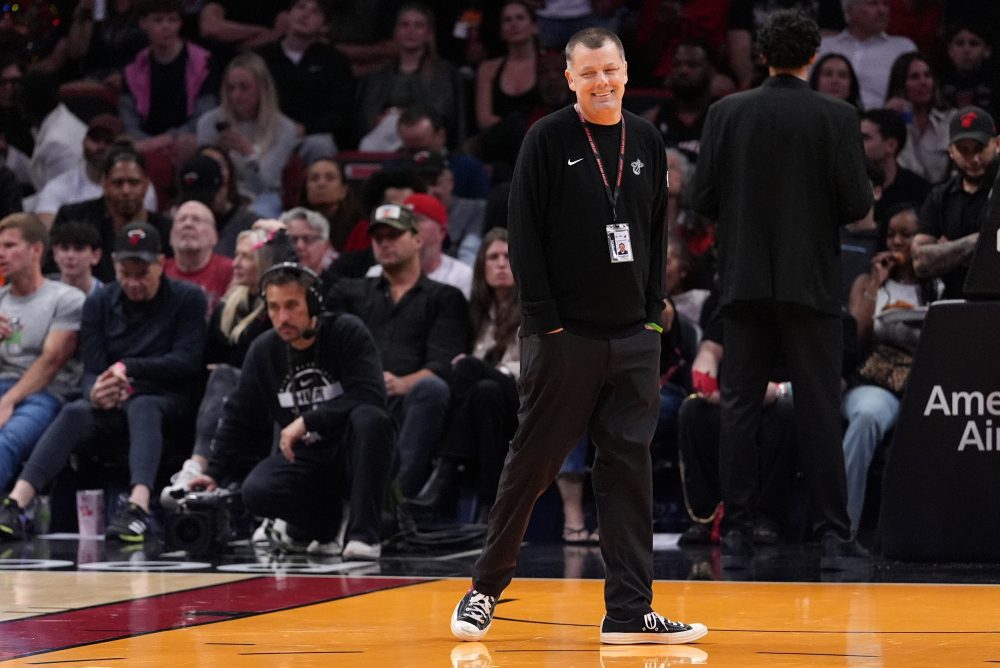
MIAMI — Inside his Miami Heat office, Rob Pimental stands at his workstation, navigating another lengthy 12-hour shift. The team’s director of operations focuses intently on his oversized monitor, crafting travel arrangements while a partially finished salad sits beside his keyboard.
Behind his chair sits a mobile IV pole. A transparent pouch containing dialysis solution rests on the floor nearby.
“Hey, don’t mind that,” he tells a guest, gesturing toward the medical equipment and tubing near his feet.
For almost twelve months, this setup has defined Pimental’s daily routine. After living with Type 1 diabetes for approximately three decades, his condition deteriorated significantly last spring when his kidneys started declining and his blood pressure began climbing dangerously. He has spent months on waiting lists, hoping for both kidney and pancreas donations.
The life-changing phone call could arrive within days or might not come for another year. The timeline remains completely uncertain.
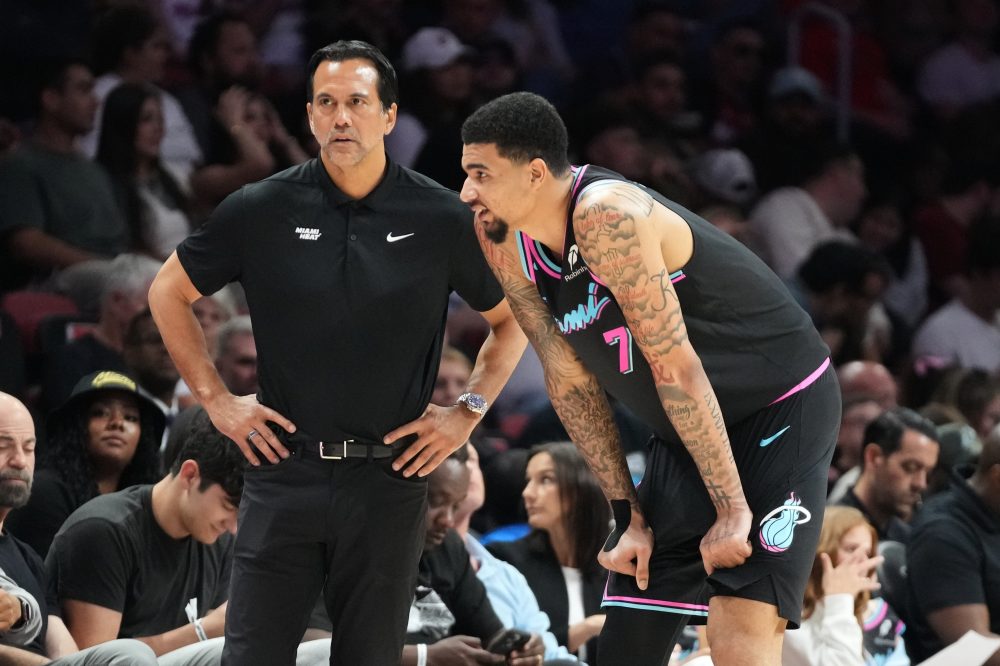
“We’ve all just kind of wanted to rally around him,” Heat coach Erik Spoelstra said. “We support him as much as possible, but also we let him know, one, we love him, and two, we really appreciate everything that he does and that he’s still able to do it, despite everything.”
April marks National Donate Life Month, making the cause especially meaningful for Miami’s organization. Alonzo Mourning, the franchise’s legendary Hall of Fame player and current vice president for player programs, received a life-saving kidney donation in 2003. His experience has provided crucial guidance for Pimental during this challenging period.
“That’s a big thing, having Zo around me all the time,” Pimental said. “He’s been through this and just to have him come in and walk me through some steps I didn’t understand and then just be there if I have a question, it means something. Sometimes he walks in and he’s like, ‘Man, you look good today. You good? You feeling good? You look good.’ That means a lot, because he knows what I’m going through.”
The veteran equipment manager, among the NBA’s most experienced in his position, was absent from Monday’s team flight to the play-in tournament. Air travel with the squad has become impossible this season, marking the most significant adjustment to his responsibilities during his 15-year tenure in Miami.
His routine now includes self-administered dialysis sessions twice daily, along with increased dependence on fellow Heat employees and his staff members. Former Heat players Kyle Lowry and Kevin Love provide regular encouragement and humor through frequent check-ins, helping him maintain his demanding schedule.
“It’s meant a lot because he’s meant so much to us, as a mentor, as someone we look up to, as someone who has put so many years into this league,” said locker room manager Marvin Ulysse, who reports directly to Pimental. “I felt like it was our duty to get him through this journey. He’s a big brother to us. We’re like his human dialysis in a way.”
Despite his inability to accompany the team on road trips, Pimental maintains his effectiveness. When issues arise during away games, he resolves them remotely from his residence. His workdays remain demanding, though he now enjoys increased time with his spouse and children compared to previous years.
Nevertheless, frightening moments occur regularly. He frequently awakens during the night, frantically checking his phone out of concern that he missed the crucial call announcing available organs. The uncertainty creates constant anxiety, particularly regarding his family’s future should his condition worsen.
Despite these challenges, he maintains optimism each morning.
“Dialysis is working, I’m still here,” Pimental said. “Just like somebody said to me awhile back, you’ve got to learn how to string as many good days together as you can so when that one bad day comes, you can handle it. And that, I think, is what we’re doing right now. The Heat have been very, very supportive throughout this whole thing. But to be honest, the only motivation I need is my wife and my kids. To be here for them, that’s the only motivation I ever needed.”
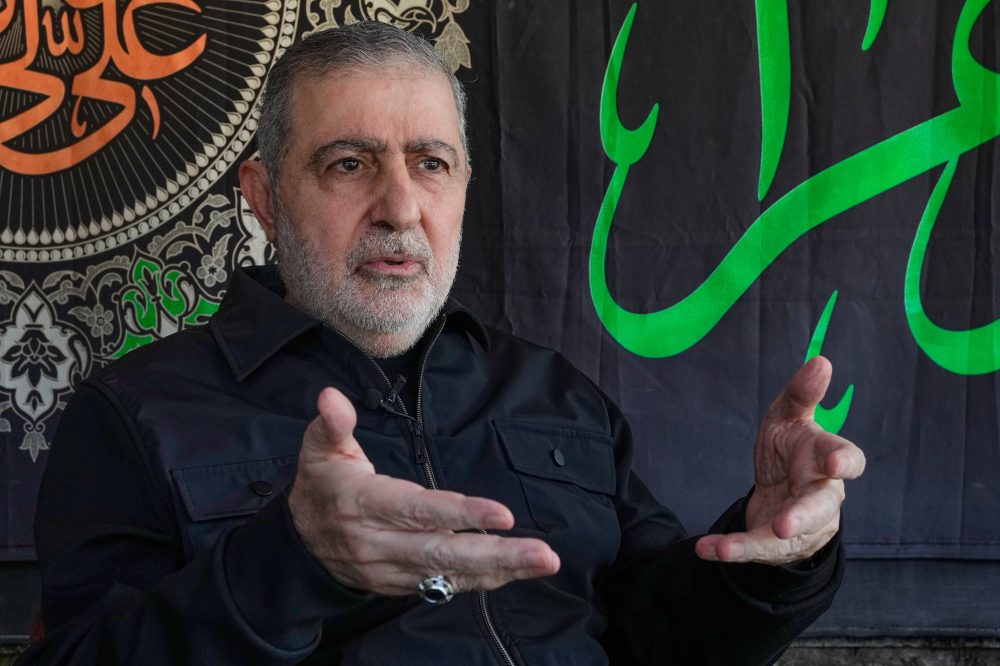
BEIRUT (AP) — A top Hezbollah leader announced Monday that the Iranian-backed militant organization will reject any deals emerging from direct diplomatic discussions between Lebanon and Israel scheduled to take place in Washington.
Wafiq Safa, a senior member of Hezbollah’s political council, made his declaration just one day before Lebanese and Israeli ambassadors to the United States are set to conduct their first face-to-face negotiations in decades. The two nations maintain no formal diplomatic ties.
“As for the outcomes of this negotiation between Lebanon and the Israeli enemy, we are not interested in or concerned with them at all,” Safa stated during an interview with The Associated Press.
“We are not bound by what they agree to,” he continued in the uncommon media appearance, speaking beside a graveyard while an Israeli surveillance drone flew above.
Lebanese government representatives hope to secure a ceasefire in the current Israel-Hezbollah conflict through these Washington negotiations.
Israeli Prime Minister Benjamin Netanyahu has outlined different objectives, seeking Hezbollah’s complete disarmament and potentially establishing a formal peace treaty between the two countries. Netanyahu’s spokesperson Shosh Bedrosian stated Monday that Israel will not agree to any ceasefire with Hezbollah.
In related diplomatic activity, Iran attempted to incorporate Lebanon into its own ceasefire negotiations with the United States during talks held in Pakistan over the weekend. Both Israel and the U.S. rejected including Lebanon in those discussions.
Following Tehran and Washington’s announcement of a temporary truce last Wednesday, Israel conducted over 100 bombing raids throughout Lebanon, targeting crowded residential and business districts in central Beirut.
Despite the collapse of U.S.-Iran negotiations without reaching an accord, Safa revealed that Hezbollah learned Iran “was able to obtain a cessation of attacks” across Beirut’s entire administrative zone, including the southern suburbs known as Dahiyeh where Hezbollah maintains strong influence.
Israeli bombardment of Beirut and surrounding areas has ceased since Wednesday, though fierce combat persists in southern Lebanon.
The Iran-supported Lebanese militant organization and Israel have engaged in numerous conflicts since Hezbollah’s establishment in the 1980s as a guerrilla force opposing Israel’s occupation of southern Lebanese territory.
The current warfare began March 2, just two days after Israel and the United States initiated military action against Iran. Hezbollah joined the conflict by launching rockets across the border into Israeli territory. Israel retaliated with air strikes and ground forces.
The war has forced more than one million Lebanese residents from their homes and resulted in over 2,000 deaths, including more than 500 women, children, and healthcare personnel. Many Lebanese citizens have criticized Hezbollah for dragging Lebanon into the conflict while serving Iranian interests.
Safa defended Hezbollah’s involvement as a preventive measure, claiming the organization’s leadership believed “Israel was preparing for a second battle with Lebanon” aimed at eliminating Hezbollah entirely.
He described it as “an appropriate moment for Hezbollah … to rebuild a new equation” and reestablish deterrence against Israel, while denying any prior agreements with Tehran requiring Hezbollah to join combat if Iran faced attack.
Following a U.S.-mediated ceasefire that ended the previous Israel-Hezbollah war in November 2024, Israel maintained almost daily strikes in Lebanon, claiming these operations prevented the group from rebuilding its capabilities. Safa indicated Hezbollah seeks to prevent returning to that situation.
Israel has asserted that its Wednesday strikes in Lebanon eliminated more than 250 Hezbollah fighters. However, Lebanon’s health ministry reported that over 100 women and children were among the more than 350 people killed that day.
Based on Israel’s claims, this would indicate every adult male killed was allegedly a Hezbollah member.
“None of our officials or cadres was killed in Beirut,” Safa countered. “Those who died in Beirut are 100% civilians.” He did not dispute that group members may have been killed in other areas outside the Lebanese capital.
Israel claimed to have eliminated Ali Yusuf Harshi, who served as both secretary and nephew to Hezbollah leader Naim Kassem, along with several high-ranking commanders.
Safa disputed this, saying Kassem’s secretary survived, though “maybe a relative of his was” killed.
He also revealed for the first time that he sustained injuries during the earlier 2024 Israel-Hezbollah war after being targeted in two Israeli strikes in Beirut, “but God granted me survival.”
Tensions have escalated between Lebanon’s government and Hezbollah, which operates both as a militant organization and a political party holding parliamentary seats.
The government approved legislation last year requiring removal of all weapons not belonging to state security forces or the military, later claiming substantial progress implementing this policy south of the Litani River, where Hezbollah militants currently battle Israeli forces.
After March 2, the government took additional action by declaring Hezbollah’s military wing an illegal organization.
Safa disclosed that Hezbollah currently maintains no direct communication with President Joseph Aoun or Prime Minister Nawaf Salam, instead channeling all dialogue through Parliament Speaker Nabih Berri, who leads the Hezbollah-aligned Amal party.
Safa indicated that following any ceasefire and Israeli troop withdrawal from Lebanon, Hezbollah — which characterizes itself as a “resistance” movement opposing Israel — would be willing to discuss its weapons with the Lebanese government.
“The issue of resistance weapons is a Lebanese matter that has nothing to do with Israel or the United States,” he concluded.
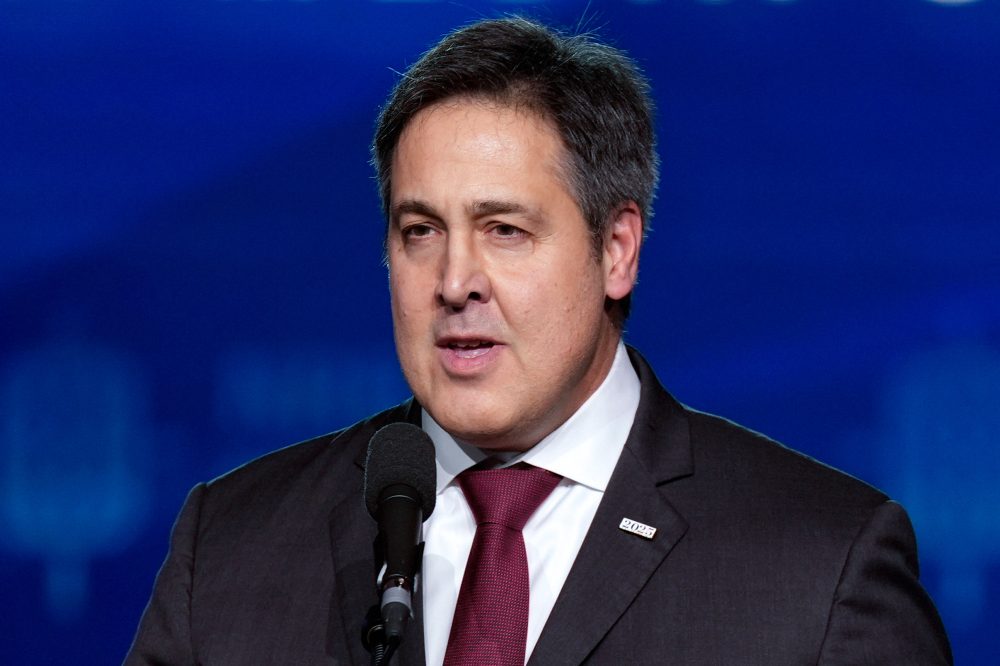
COLUMBIA, S.C. — Paul Dans, a leading figure behind the conservative Project 2025 initiative, has ended his Republican primary campaign against Senator Lindsey Graham in South Carolina, withdrawing from a race that was expected to highlight divisions within President Trump’s political base.
Dans withdrew his candidacy on Friday, which marked the final opportunity to have his name removed from ballots ahead of South Carolina’s June 9 primary election.
President Trump, who has long supported Graham as one of his key congressional supporters, responded to Dans’ withdrawal with a social media message claiming that Tucker Carlson’s backing of Dans had been the “KISS OF DEATH” for his campaign.
The former president and Carlson have been in a public dispute regarding the Iran conflict, which the ex-Fox News host described as “absolutely disgusting and evil.” Dans rejected claims that Carlson’s involvement influenced his decision to exit the race.
Following his withdrawal, Dans announced his support for Mark Lynch, a Republican candidate who owns an appliance business. Trump quickly criticized this endorsement in another social media message, stating that Lynch “would be a DISASTER for the Republican Party” if he wins.
Dans gained national recognition as a primary organizer of Project 2025, a comprehensive conservative policy framework designed for Trump’s potential return to office. While expressing satisfaction with certain Trump administration achievements — such as reducing federal employment and cutting government programs — Dans indicated that “more work to do” remains in the Senate.
“What we’ve done with Project 2025 is really change the game in terms of closing the door on the progressive era,” Dans shared with The Associated Press in a previous interview. “If you look at where the chokepoint is, it’s the United States Senate. That’s the headwaters of the swamp.”
Dans, who served as White House liaison to the Office of Personnel Management during Trump’s first presidency, frequently traveled to Washington while developing Project 2025 at the Heritage Foundation, a prominent conservative policy organization. The extensive policy document spans nearly 1,000 pages and features contributions from prominent conservative policy experts.
Taking on Graham, who has successfully defended his seat against multiple challengers throughout his tenure, represents a significant political challenge. Six other Republican candidates continue their campaigns, while Graham’s team reported having over $11.6 million available, after raising approximately $1.4 million during the year’s first quarter.
Trump provided early support for Graham, who serves as both a trusted advisor and frequent golf companion, despite their occasionally strained relationship. Graham, who is pursuing a fifth Senate term, has also secured endorsements from South Carolina’s top Republican leaders, including Senator Tim Scott and Governor Henry McMaster, who will lead his 2026 campaign effort.
MAMMOTH LAKES, Calif. — A powerful weekend storm brought more than 3.5 feet of fresh snow to California’s eastern Sierra Nevada mountains, temporarily shuttering a major highway and giving Mammoth Mountain an unexpected opportunity to keep its slopes open longer.
The late-season snowfall arrived just weeks following a March heat wave that melted significant portions of California’s snowpack, compelling numerous ski facilities to end their seasons early. Additional snow remained in the forecast for Monday.
By April 1st, the Sierra snowpack — which supplies one-third of California’s water resources — measured only 18% of normal levels based on readings taken in mountains near Lake Tahoe. This marked the second-lowest measurement recorded for that date in history.
Between Friday and Sunday, the UC Berkeley Central Sierra Snow Lab documented 42.5 inches of accumulation, noting it “has been great to create a late-season snowpack.”
“Unfortunately, record warm temps this winter means that we’re still well below average for the water year,” the laboratory posted on social media.
Blizzard conditions forced authorities to close Interstate 80 in Northern California on Sunday, while chain requirements remained in effect Monday morning for the vital corridor linking San Francisco and Lake Tahoe.
The weather system also delivered powerful winds, intense rainfall and hail throughout many regions. Near Sacramento, a tornado made contact with the ground Sunday, though the National Weather Service reported no resulting damage.
Mammoth Mountain operated 11 chairlifts on Monday as conditions improved. While skies were becoming clearer, the resort’s daily update indicated another few inches of snow could still fall.
“While fresh snow may look inviting, hazards like dirt, rocks, and bushes remain just below the surface. Ski and ride with caution and avoid venturing off trail,” the resort’s report cautioned.
Throughout much of the western United States, snow had been disappearing following an unusually warm winter that created poor skiing conditions before giving way to record-breaking spring temperatures. Colorado this month recorded its most severe snowpack deficit since comprehensive state tracking began in 1941.
Authorities cautioned that these measurements clearly indicate potential worsening of water shortages amid the current substantial drought, unless unexpected heavy precipitation occurs.
Regional municipalities are implementing water usage limitations, while ranchers face uncertainty about feeding and watering their livestock. The possibility of catastrophic wildfire activity continues to threaten the area.
WASHINGTON — Federal lawmakers have initiated a formal ethics investigation into California Representative Eric Swalwell following accusations of sexual misconduct involving a staff member who worked under his authority, according to an announcement made Monday by the House Ethics Committee.
The investigation was announced just one day after the Democratic congressman halted his bid for California’s governorship when serious allegations surfaced that he continues to refute.
Support from fellow Democrats evaporated rapidly after reports emerged claiming Swalwell sexually assaulted a woman on two separate occasions, including during her employment in his office. These accusations, first reported by the San Francisco Chronicle and subsequently covered by CNN, surfaced just as Swalwell was gaining momentum as a top candidate in the competitive gubernatorial race.
“I will fight the serious, false allegations that have been made — but that’s my fight, not a campaign’s,” Swalwell said in a social media post.
Committee officials emphasized that launching this investigation and making it public does not suggest any wrongdoing has been confirmed.
The investigation announcement follows mounting pressure from legislators across party lines demanding Swalwell’s resignation from Congress. Some discussions have even explored the possibility of a House vote to remove the congressman from office, though no such vote has been officially scheduled.
The Ethics Committee’s decision to begin its own investigation may temporarily halt any other immediate congressional actions regarding Swalwell’s future.
MIAMI (AP) — Federal prosecutors have filed murder and aggravated sexual abuse charges against a 16-year-old Florida boy in connection with his stepsister’s death aboard a Carnival cruise ship, the U.S. Justice Department announced Monday.
Timothy Hudson initially faced juvenile charges on February 2, but the proceedings remained under seal until U.S. District Judge Beth Bloom approved prosecutors’ request to try him as an adult. Defense attorneys did not oppose the transfer to adult court, according to court documents. Hudson’s legal team has not responded to requests for comment regarding the indictment.
The victim, 18-year-old Anna Kepner, was vacationing with family members on the Carnival Horizon in November when tragedy struck. Her body was discovered hidden beneath a bed in a cabin she shared with two other teenagers, including her younger stepbrother, before the vessel was set to return to Florida.
Medical examiners determined Kepner died on November 6 from mechanical asphyxia, a condition that occurs when breathing is prevented by an object or physical pressure.
“Our hearts go out to the victim’s family during this unimaginable loss,” U.S. Attorney Jason Reding Quiñones said in a written statement. “A federal grand jury has returned an indictment charging serious offenses that allegedly occurred aboard a vessel in international waters.”
Kepner was a cheerleader at Temple Christian School in Titusville, Florida, located approximately 40 miles east of Orlando. During her November memorial service, relatives asked attendees to wear vibrant colors rather than traditional black “in honor of Anna’s bright and beautiful soul.”
Federal prosecution of minors is exceptionally uncommon. Hudson appeared at the Miami federal courthouse in February wearing a baseball cap and hoodie pulled over his face. His status remained unclear at that time due to age-related restrictions on public disclosure by attorneys, prosecutors, and court officials.
On February 6, a judge ordered Hudson to wear electronic monitoring while residing with his uncle. Court records indicate the conditions were modified last week to permit him to spend several days working with his father at a landscaping company.
Legal experts suggest the case falls under federal jurisdiction, rather than typical state court proceedings for juvenile defendants, because Kepner’s death occurred in international waters.
Officials in Minnesota’s Ramsey County announced Monday they are examining whether federal immigration agents committed kidnapping, burglary and false imprisonment when they arrested a Hmong American citizen in an incident caught on camera.
County Attorney John Choi and Sheriff Bob Fletcher told reporters they plan to seek information from the Department of Homeland Security for their probe into the January detention of ChongLy “Scott” Thao. The county encompasses Minnesota’s capital city of St. Paul.
Federal Immigration and Customs Enforcement agents broke down Thao’s front door with weapons drawn, operating without a warrant, before forcing him outside wearing only undergarments and a blanket during bitter cold weather.
“There are many facts we don’t know yet, but there’s one that we do know. And that is that Mr. Thao is and has been an American citizen. There’s not a dispute over that,” Fletcher stated. “There’s no dispute that he was taken out of his house, forcibly taken out of his home and driven around.”
Fletcher added: “Is that good law enforcement, to take an American citizen out of their home and drive them around aimlessly, trying to determine what they can tell them?”
The Department of Homeland Security, which supervises ICE, has declined to assist with other state and local probes into fatal shootings of two American citizens by federal agents in Minneapolis during the previous administration’s immigration enforcement efforts.
Choi explained they are working to establish if any violations occurred that could warrant prosecution under state or federal statutes.
“This is not about, any type of predetermined agenda other than to seek the truth and to investigate the facts,” he stated.
Federal agents ultimately discovered Thao was a long-term American citizen without any criminal history, Thao revealed during a January interview with The Associated Press. Officials brought him back to his residence after several hours.
Homeland Security subsequently stated ICE personnel had been searching for two individuals convicted of sex crimes. However, Thao informed the AP he had never encountered these men and they were not residents of his home.
Recorded footage showed the incident, featuring community members using whistles and horns, while neighbors shouted at more than twelve armed agents to stop bothering Thao’s family.
Minnesota and the top prosecutor in Hennepin County, which contains Minneapolis, filed legal action against the former administration last month seeking access to evidence they claim is necessary for independent investigations of three federal officer shootings in Minneapolis, including the deaths of Renee Good and Alex Pretti.
The legal challenge alleges the federal government broke its commitment to assist state investigations following the deployment of approximately 3,000 federal law enforcement personnel to Minnesota.
Both Minnesota and Hennepin County have requested public assistance in gathering information about potentially unlawful federal officer conduct, citing federal authorities’ refusal to provide evidence.
The former administration argued Minnesota officials lack authority to investigate these incidents. State and county prosecutors maintain they must conduct independent reviews because they lack confidence in federal oversight.
The Justice Department announced in January it was launching a federal civil rights investigation into Pretti’s death, placing two officers on administrative leave, but determined a similar federal review was unnecessary for Good’s killing.
President Donald Trump took down a controversial artificial intelligence-created image from his Truth Social account on Monday after facing sharp criticism from religious supporters who typically back him.
The digitally-generated picture, shared on Sunday, showed Trump wearing white robes while placing his hand on a man’s head in a healing gesture reminiscent of biblical imagery. The image also featured a glowing sphere in Trump’s hand, with the Statue of Liberty, fireworks, military aircraft, and eagles visible in the background.
The controversial social media post emerged during Trump’s intensifying public conflict with Pope Leo, the first pontiff born in America. Leo has condemned the ongoing U.S.-Israeli military campaign against Iran as inhumane. Just before sharing the image, Trump had published a harsh attack on Pope Leo, labeling him “WEAK on crime and terrible for Foreign Policy.”
When confronted by reporters at the White House on Monday, Trump rejected suggestions that the image portrayed him in a Christ-like manner, dismissing such interpretations as “fake news.”
“It’s supposed to be me as a doctor making people better, and I do make people better,” Trump explained to journalists shortly after removing the post.
The incident has created tension between Trump and some of his religious conservative supporters, whose backing proved essential in his 2024 electoral victory. Several prominent Republican figures publicly criticized the image.
Brilyn Hollyhand, who previously served as co-chair of the Republican National Committee Youth Advisory Council, posted on X: “This is gross blasphemy. Faith is not a prop. You don’t need to portray yourself as a savior when your record should speak for itself.”
Riley Gaines, a former competitive swimmer and vocal opponent of transgender participation in women’s athletics who has joined Trump at campaign events, also expressed confusion about the post on X.
“Does he actually think this?” she questioned. “Either way, two things are true. 1) a little humility would serve him well 2) God shall not be mocked.”
Christian voters, including Catholics, represent a crucial segment of Trump’s political coalition. Despite his irregular church attendance, Trump secured overwhelming support from Christian voters in the 2024 election, including Catholics who had previously been more evenly divided politically.
Following Trump’s narrow survival of an assassination attempt in July 2024, some evangelical supporters interpreted the incident as divine intervention.
David Gibson, who directs the Center on Religion and Culture at Fordham University, a Catholic institution, characterized the situation as a critical test for American Catholics.
“Will this move cross a red line for them? Will they finally punish Trump and the GOP and at the ballot box?” Gibson questioned. “This is a watershed moment – will Catholics in America choose the pope or the president?”
Bishop Robert Barron, who sits on a religious liberty commission established by Trump, called the president’s social media statements about Leo “inappropriate” and suggested an apology was warranted, while simultaneously commending Trump’s Catholic outreach efforts.
When asked about apologizing to the pope, Trump told reporters Monday he had “nothing to apologize for.”
In recent weeks, Pope Leo has emerged as one of the most vocal opponents of the Iranian conflict, making an unprecedented direct appeal to Trump to seek an “off-ramp” from the military engagement.
Leo has also stated that Jesus cannot be invoked to justify warfare and that God rejects prayers from those who initiate conflicts. These comments were widely interpreted as criticism of Trump administration officials like Defense Secretary Pete Hegseth, who has referenced scripture to defend using “overwhelming violence” against adversaries and compared the rescue of an American airman in Iran to Christ’s resurrection.
This isn’t Trump’s first papal controversy. He previously clashed with Leo’s predecessor, Francis, who publicly criticized Trump’s deportation policies as un-Christian. After Francis’s death last year, Trump shared an AI-generated image depicting himself as pope, which also sparked outrage among Catholics.
However, Gibson noted that Trump’s confrontation with Leo has escalated beyond his previous disputes with Francis.
“American presidents and American Catholics have disagreed with popes in the past,” Gibson observed. “But this is disrespect. Disrespect is way different than disagreement, and that’s the danger for Trump here.”
Trump’s current cabinet includes at least eight Catholic members, among them Vice President JD Vance and Secretary of State Marco Rubio.
BEIRUT, April 13 – The leader of the militant organization Hezbollah has publicly demanded that Lebanon’s government abandon scheduled diplomatic discussions with Israeli officials set to take place in Washington on Tuesday, calling the planned negotiations futile.
During a broadcast address on Monday, Naim Qassem declared that his armed organization would maintain its resistance against Israeli military actions targeting Lebanon.
Meanwhile, Lebanon’s foreign minister has stated that Beirut plans to utilize Tuesday’s direct diplomatic discussions to advocate for an end to hostilities in the ongoing conflict.
The Toronto Blue Jays made a roster move Monday, bringing in infielder Lenyn Sosa from the Chicago White Sox through a trade deal.
Toronto sent minor league outfielder Jordan Rich plus either cash considerations or an additional player to be determined later to Chicago in the transaction.
The Blue Jays made room on their 40-man roster by moving right-handed pitcher Shane Bieber to the 60-day injured list due to his ongoing elbow injury.
The 26-year-old Sosa has struggled at the plate this season, posting a .212 batting average with three runs batted in across 12 appearances for Chicago. Throughout his five-year major league career, all spent with the White Sox, Sosa has maintained a .245 batting average while contributing 37 home runs and 128 RBIs over 315 total games. His most productive season came last year when he achieved personal bests with 22 home runs and 75 RBIs.
Meanwhile, Rich is an 18-year-old prospect who Toronto selected in the 17th round of the 2025 draft from a Florida high school. The left-handed batter had been playing in the Arizona Complex League before the trade.
Immigration and Customs Enforcement has taken into custody Alexandre Ramagem, who previously led Brazil’s intelligence operations, according to an agency announcement Monday. Ramagem had escaped from Brazil last September after being found guilty of participating in a coup attempt alongside former President Jair Bolsonaro.
The former Federal Police inspector received a prison term exceeding 16 years for his participation in efforts to prevent leftist politician Luiz Inacio Lula da Silva from assuming office following his electoral victory over Bolsonaro in 2022.
Legal representatives for Ramagem have not yet provided a statement regarding his detention. Throughout the legal proceedings, he has consistently denied any wrongdoing. Paulo Figueiredo, a supporter of Bolsonaro residing in the United States, claimed on social media platform X that Ramagem’s arrest stemmed from a minor traffic offense.
The specific circumstances of his detention remain unconfirmed, and it’s unclear whether his arrest connects to Brazil’s efforts to have him returned to face his sentence.
The legal proceedings against Bolsonaro, known for his far-right political stance, prompted criticism from U.S. President Donald Trump, who cited the case as justification for imposing significant trade penalties on Brazilian goods during the previous year.
Despite Trump’s response, the case proceeded to completion in September, resulting in guilty verdicts for 29 individuals, including Bolsonaro, who is currently serving a 27-year prison term. Trump subsequently removed many of the trade restrictions he had previously implemented.
During his tenure as Brazil’s intelligence agency director beginning in 2019 under the Bolsonaro government, Ramagem faced accusations of conducting surveillance on the former president’s political opponents and supplying information designed to undermine confidence in Brazil’s election procedures.
Pop superstar Britney Spears has made the decision to enter a treatment facility following her recent arrest for suspected impaired driving, according to a spokesperson who spoke with media outlets Monday.
The singer was taken into custody last month in Ventura County by California Highway Patrol officers who had received reports of a black BMW being driven recklessly at excessive speeds. Authorities stated that when they pulled over the vehicle, Spears was alone inside.
According to an official statement from the highway patrol, the performer “showed signs of impairment” that officers believed resulted from consuming both alcohol and controlled substances. Law enforcement administered standard field sobriety evaluations during the traffic stop.
Following her arrest, Spears was processed at the Ventura County Main Jail facility. She is scheduled to make her court appearance on May 4.
The entertainer, who rose to international stardom as a teenage pop sensation in the late 1990s, has faced ongoing challenges with substance abuse issues and mental health concerns that have been heavily scrutinized by the media for many years.
This is not Spears’ first encounter with traffic-related legal troubles. In 2007, she faced charges for leaving the scene of an accident that resulted in property damage and operating a vehicle without proper licensing, though both misdemeanor charges were eventually resolved.
That same year marked a difficult period for the singer, who experienced a very public mental health crisis that resulted in psychiatric hospitalization. During this time, her father was granted legal authority over her personal and financial decisions through a court-ordered conservatorship.
The restrictive legal arrangement, which controlled both her personal choices and her $60 million fortune, remained in place from 2008 until 2021. A judge finally terminated the conservatorship after it became a rallying point for supporters who believed Spears deserved her freedom back.
Authorities have released the identity of the man killed in a Saturday homicide in Milton, identifying him as Jerry Lee Hall, a 47-year-old Lincoln resident.
Investigators with the Delaware State Police Homicide Unit are continuing their work on the case and are seeking public assistance. Anyone who may have information about the incident is urged to reach out to Detective A. Bluto at 302-741-2859. Tips can also be submitted through a private message to the Delaware State Police Facebook page or by calling Delaware Crime Stoppers at 1-800-847-3333.
Support services are available for those affected by crime or sudden loss through the Delaware State Police Victim Services Unit and Delaware Victim Center. Help is accessible around the clock via their toll-free number at 1-800-VICTIM-1 (1-800-842-8461), or through email at [email protected].
LEWISBURG, Pa. – Several multi-event athletes from the University of Delaware track and field program traveled to Pennsylvania to participate in heptathlon competition during the Bucknell Invitational held April 12-13.
The Blue Hens sent their specialized group of multi-discipline competitors to Lewisburg, Pennsylvania, where they took part in the demanding seven-event heptathlon over the two-day meet at Bucknell University.
Israeli military forces intensified their ground campaign in southern Lebanon on Monday, according to military officials, with troops advancing toward the strategic Hezbollah stronghold of Bint Jbeil just hours before scheduled diplomatic meetings in Washington.
Military forces have surrounded the border town of Bint Jbeil and initiated ground operations focused on destroying Hezbollah infrastructure. According to the Israeli Defense Forces, over 100 Hezbollah fighters have been eliminated in the region, while dozens of facilities have been destroyed and hundreds of weapons seized.
Intense fighting at close range continues with air support, as military officials describe efforts to bolster their defensive positions around Bint Jbeil. Israeli forces also destroyed a Hezbollah underground tunnel network in southern Lebanon that had been used for coordinating and launching attacks against Israeli troops.
The town of Bint Jbeil serves as a key Hezbollah stronghold, and Israeli forces have been systematically surrounding the area over recent weeks as part of a larger campaign to establish control in southern Lebanon.
The location holds historical significance from the 2006 Second Lebanon War, when Israeli forces battled Hezbollah in the town but failed to achieve complete control.
Israeli military officials also announced that more than 250 Hezbollah fighters and leaders were killed across Beirut, the Beqaa Valley, and southern Lebanon in what they characterized as their most extensive strike in the region.
Among those killed were Hezbollah operatives allegedly involved in weapons smuggling and storage, intelligence operations, target identification, and missile launches against Israel, according to military reports.
These military actions precede Tuesday’s planned negotiations in Washington featuring Lebanese Ambassador Nada Hamadeh, Israeli Ambassador Yechiel Leiter, and US Ambassador to Beirut Michel Issa, who will head their respective teams. Intelligence reports suggest Washington and Lebanon plan to push Israel toward accepting a ceasefire agreement, though Israel has previously indicated that any negotiations will occur “under fire.”
Mental health professionals in Israel are working around the clock to prevent lasting psychological harm as families in northern border communities continue living under the constant threat of attack.
Clinical psychologist Shulamis Pollack emphasizes that helping individuals structure traumatic experiences into coherent stories, focusing on their logical decision-making and safety measures, represents one of the most powerful methods for preventing PTSD.
Despite a temporary pause in Iranian missile strikes toward Israel, Prime Minister Benjamin Netanyahu has indicated that military actions against Hezbollah will persist. While much of Israel experiences relative calm, northern communities remain under regular air raid warnings and persistent fear.
Ori Mogel and his wife Tom have called Misgav Am home for a decade. Their kibbutz represents Israel’s northernmost settlement, positioned even beyond Kiryat Shmona and Metula, sitting merely 5 kilometers from Lebanon’s border. “Our perimeter fence is literally the border, the border fence,” Mogel explained to The Media Line.
The father of three children all under seven years old watched his family endure evacuation after the conflict began following October 7. They relocated to a kibbutz near Kfar Saba in central Israel before finally returning home in March 2025. Now they face danger once again.
“On one hand, we are very strong. We’re a strong community, we take care of each other, and we want everyone to come back and be together,” Mogel stated. “On the other hand, the way we live here is not normal. I don’t want to use words I shouldn’t, but it’s not normal.”
Seeking respite from the continuous sounds of warfare, Mogel recently brought his family to the desert. Even when rockets aren’t striking their immediate area, northern regions remain filled with the relentless noise of combat.
“The army is here, Hezbollah is here,” he noted. “These are very difficult sounds, especially for children my kids’ age, and even older. You have to take breaks from that.”
Mogel expressed frustration with the Israeli government’s insufficient support, claiming that 70% of northern residents don’t have proper access to protected spaces. Experts have not verified this figure.
“I would expect the state to do everything possible to ensure I have a safe room in my house, especially now, so my children can be safe,” Mogel stated. “Officials can come here and see how we live. If you tell me I can stay here with my children, but a cleaning worker or technician is not allowed to come because it’s too dangerous, then something is wrong.”
Children’s trauma levels are already becoming apparent, though measuring long-term effects remains challenging. A State Comptroller report following the October 7 attack revealed that approximately 30% of the nation shows trauma symptoms or PTSD.
Mogel shared how his 6-year-old daughter recently mastered riding without training wheels. During a bike ride, she heard an alarm, immediately abandoned her bicycle, and rushed to safety. His 4-year-old son can now differentiate between Israeli explosions and Hezbollah attacks. His youngest child, only 18 months old, automatically runs to the safe room upon hearing sirens.
Regarding long-term effects on his children, Mogel stated: “They will need treatment.” Having experienced the Second Lebanon War in 2006 at age 13 and requiring help himself, he added: “I hope their lives won’t be damaged, but I expect I’ll need to give them the treatment they’ll need … We’ll all probably need treatment.”
Understanding his children require professional assistance, Mogel recognizes that specialists like Shulamis Pollack are already providing crucial intervention, responding to attack sites to stabilize emotional responses before trauma becomes entrenched.
Pollack, a clinical psychologist from Beit Shemesh, serves with United Hatzalah’s emergency psychological response team. Their mission involves supporting community members immediately following attacks.
“We go to an impact site, and we don’t know what we’re going to find, much like medical personnel don’t know what they will find,” Pollack described. “We’re trained to look for different levels of distress … In all cases, the first thing that we do is get a person’s nervous system regulated, and once they’re regulated, we can help them make well-thought-out decisions, effective decisions, safe decisions.”
At impact locations, individuals affected in non-medical ways also require attention because they can become susceptible to harm, she explained. She recalled arriving at one site early in the conflict where a woman’s house had been struck and was literally falling apart. Though the family had escaped, the woman kept returning inside to retrieve possessions.
The woman was in panic, declaring: “I need my head covering. I need my favorite bag. I had a birthday present I got from my mother-in-law, and I want it,” while the structure continued collapsing around her.
Pollack informed The Media Line that the mental health function at such moments involves preventing “second-line damage”—injuries from individuals who, emotionally unstable and driven by feelings rather than reason, make hazardous choices.
A secondary level of care exists for people no longer facing immediate danger but unable to organize their thinking. At another incident site, Pollack found homes still intact but with all windows blown out. In one residence, glass covered the floor while a mother of four young children attempted to sweep it up as her barefoot children stood nearby.
“The first thing I said to her was, ‘Let’s take a breath. Let’s survey the scene logically,’” Pollack described. She helped calm the woman and encouraged her to leave with her children. After calling her husband, who later arrived to clean the glass himself, Pollack continued: “We sat down after I stabilized her, and I was able to help her figure out the next steps. I’m engaging the logic part of her brain, and then I’m allowing her to make a regulated decision when she’s in a much calmer place.”
Following the initial attack on Beit Shemesh during Operation Rising Lion, which resulted in nine fatalities, Pollack and other psychotrauma responders conducted an evening session for emergency personnel who had worked at the impact site, including United Hatzalah ambulance operators and volunteer medics exposed to extremely challenging sights, sounds, and experiences.
Pollack observed that responders are impacted not only by death and destruction at scenes but also by their own critical decisions, such as prioritizing victims or deciding whether to enter burning structures. She stressed that immediate processing of these experiences is essential for preventing lasting trauma.
United Hatzalah’s psychological response unit combines professionals from various backgrounds nationwide. They maintain a WhatsApp communication network to rapidly share information about incidents requiring support. Generally, nearby responders arrive first. When events occur in a responder’s own community, their participation often proves beneficial due to their understanding of local culture and mindset.
According to Pollack, helping people structure events into coherent narratives with clear beginnings, middles, and endings, while emphasizing how they used reasoning to ensure safety and make challenging decisions, represents one of the most effective PTSD prevention methods.
“Then they feel good about those choices, which doesn’t mean that we whitewash things that were hard, but it means we make order out of things,” Pollack explained. “One of the greatest ways to prevent PTSD is to have an organized version of what happened, an organized narrative.”
With approximately 100 emergency responders attending the evening workshop in Beit Shemesh, Pollack said the team helped construct this narrative while providing psychological first aid. This included preparing participants for potential experiences in coming hours and days, helping them recognize when additional support might be needed, and sharing practical self-care tools including proper sleep, exercise, nutrition, and physical health support to enable emotional recovery.
“The medical field has become more aware of how important people’s emotional needs are for their long-term medical wellness,” Pollack stated. “I think that’s an enormous step that United Hatzalah has taken, in parallel with the broader medical field, by providing psychological first aid so people can remain well.”
Mogel acknowledged that he and his family are, in essence, defending the country by continuing to live in harm’s way. “We understand the responsibility,” he said, adding his willingness to bear that burden, even if it requires years of trauma therapy. However, he hopes the IDF will complete their mission rather than agreeing to an early ceasefire that leaves the area unsafe.
“Agreements won’t solve this. They need to finish what they started,” Mogel concluded. For his family’s situation, he explained, healing can only begin when safety and quiet return.
Tensions in the Middle East are escalating as Israeli military leaders have directed their forces to prepare for potential renewed conflict with Iran after diplomatic efforts collapsed, according to Israeli media reports.
According to Ynet, Israeli Defense Forces Chief of Staff Lt. Gen. Eyal Zamir has ordered the military to elevate to a “heightened state of readiness” and begin making preparations for possible renewed fighting with Iran. Kan News quoted a “senior defense official” who stated that “Israel is interested in renewing the war against Iran,” claiming the previous conflict concluded “too early, without sufficient pressure being applied on Iran regarding the nuclear issue and ballistic missiles.”
Speaking to reporters Monday at Joint Base Andrews in Maryland, President Trump expressed indifference about potential renewed diplomatic discussions. “I don’t care if they come back or not. If they don’t come back, I’m fine,” Trump stated.
These escalating tensions come after failed negotiations and Washington’s implementation of a naval blockade targeting Iran. U.S. Central Command announced it will enforce restrictions on all ship traffic moving in and out of Iranian ports, including facilities along the Arabian Gulf and Gulf of Oman, affecting vessels from all countries operating in Iranian coastal waters.
CENTCOM announced the blockade would commence Monday April 13 at 10 a.m. ET and stated it would not disrupt freedom of navigation for ships traveling through the Strait of Hormuz to and from ports outside Iran.
Iranian military leadership strongly denounced the blockade and issued warnings of retaliation if their maritime access faces threats. “The restrictions imposed by criminal America on maritime navigation and transit in international waters are illegal and constitute an example of piracy,” declared a statement from the Iranian military’s central command center, Khatam Al-Anbiya, broadcast on state television.
The statement added a warning: “If the security of the Islamic Republic of Iran’s ports in the waters of the Persian Gulf and the Arabian Sea is threatened, no port in the Persian Gulf and the Arabian Sea will be safe.”
International discussions about connecting Gaza’s reconstruction to Hamas giving up its weapons briefly gained momentum last week before quickly losing steam as escalating US-Iran tensions captured global diplomatic focus.
Sources from diplomatic and regional channels indicated that progress on rebuilding efforts was being connected to steps toward weapon surrender, though no official ultimatum was delivered. However, within just a few days, focus had returned to the Washington-Tehran crisis, once again leaving Gaza’s political future in limbo. No official or enforceable disarmament agreement has been established, leaving the matter caught between political messaging and actual execution.
The shift wasn’t merely political in nature. International engagement, security cooperation, and diplomatic efforts that were once focused on determining Gaza’s post-conflict arrangements became increasingly redirected toward preventing escalation with Iran. Gaza’s long-term leadership and security issues momentarily returned to diplomatic discussions, only to be overshadowed by broader regional tensions before any concrete mechanism or agreement could take shape.
This recent push was part of a wider US-led initiative, referred to in diplomatic circles as the “Board of Peace,” designed to influence post-conflict governance in Gaza. Under this approach, weapon surrender has been viewed as a key requirement for reconstruction funding, international participation, and the potential deployment of external administrative or security forces in the territory. However, the initiative continues to lack effective enforcement mechanisms or strong enough guarantees to force armed groups to comply. While political pressure exists, there remains no functional system to convert it into actual disarmament.
Michael Milshtein, who leads Palestinian Studies at the Moshe Dayan Center, informed The Media Line that Hamas has shown no indication it’s willing to give up its weapons, despite diplomatic pressure or broader regional escalation. According to his assessment, the organization might be open to discussing restrictions on specific weapons, but not complete demilitarization.
“We all heard Abu Obeida”—the nom de guerre used by the current anonymous spokesman for Hamas’ Izz al-Din al-Qassam Brigades—”on Sunday when he said in a very clear manner that Hamas is not ready even to consider any disarmament. And he actually said that all the reports about progress in the negotiations about disarmament—it’s all nonsense, because it’s very clear that Hamas is not ready to be flexible on this point.”
“They can negotiate about the weapons, what kind of weapons they can keep, but they will never negotiate total disarmament.”
Milshtein contended that even a US-supported post-conflict arrangement would more likely rebrand Hamas rather than eliminate it. He believes the organization could accept a new governing appearance while maintaining armed capabilities and political control, similar to Hezbollah’s structure in Lebanon.
“All the Palestinians talk a lot today about what will happen on the day after the war with Iran. Many of them really wish that on the day after, Trump will promote a kind of political settlement in Gaza, based on the arrival of a bureaucratic government to Gaza, and even the arrival of international forces and their deployment in Gaza.”
“It’s quite clear that Hamas is ready right now to accept all these demands, and actually to establish a kind of local model of Hezbollah in Gaza—means that they will keep their weapons, they will keep their influence in Gaza, but they will not really be ready for this total disarmament.”
He connected this argument to a wider lesson regarding Israel’s military objectives, stating that complete victory over Hamas, Hezbollah, and Iran-supported groups is not realistically possible in the manner some leaders have presented it.
“Right now, on all the fronts Israel deals with—I mean Lebanon and Iran and Hamas, Gaza—Netanyahu didn’t achieve any total victory and erasing the enemy. The enemy still exists—very, very weak, but dominant.”
“We need to understand and realize that the warfare today, or the nature of our enemies, you cannot really achieve a kind of total eradication of these enemies from the map. You will need to repeat fighting them again and again and again.”
This evaluation also aligns with a broader change in diplomatic conversations, where complete disarmament is increasingly being compared with more limited or gradual arrangements. Some proposals have examined restricting heavy weapons, long-range capabilities, or offensive systems while permitting other forms of armament to stay, though none of these concepts has been formalized into a binding agreement.
Amjad Salfiti, a Palestinian British attorney who specializes in human rights and international law, examined the issue from a different angle. He contended that connecting reconstruction to disarmament risks pressuring civilians instead of armed groups and may violate fundamental humanitarian principles.
“A key feature of the proposal is the conditioning of reconstruction assistance on the disarmament of Palestinian armed groups,” he told The Media Line. “Under international humanitarian law, humanitarian relief must be guided by necessity and impartiality and should not be made conditional on political or military concessions.”
Salfiti explained that such proposals could establish coercive situations by making access to housing, healthcare, and infrastructure dependent on meeting security requirements.
“Linking reconstruction to disarmament risks creating coercive conditions in which civilians are indirectly pressured to accept security demands in order to access essential services such as housing, healthcare, and infrastructure.”
“This may be inconsistent with the prohibition on collective punishment and the principle of impartial humanitarian assistance.”
He also challenged the framework’s legitimacy, arguing that it has been developed mainly through external mediation without clear mechanisms for local approval, while missing reciprocal obligations such as binding guarantees on hostilities or humanitarian access.
“The reported framework appears to have been developed primarily through external mediation, without clear mechanisms for local consent or representation. This raises questions about legitimacy and compliance with the requirement that arrangements in affected territories act in the interests of the local population.”
“The absence of clear reciprocal obligations—such as binding guarantees on cessation of hostilities or unimpeded humanitarian access—creates an asymmetrical structure that may undermine established norms governing armed conflict and occupation.”
Salfiti additionally cautioned that staged reconstruction tied to compliance could generate legal and ethical issues if assistance is distributed selectively rather than based on need.
“The proposed suggestion that reconstruction could be delivered in phases based on compliance introduces further legal and ethical concerns. Selective aid distribution risks violating the principle of non-discrimination in humanitarian assistance, which requires that relief be provided based solely on need.”
Combined, these concerns indicate that even if disarmament were politically achievable, the mechanisms currently being discussed could still encounter serious legal obstacles.
This has resulted in a divided international response. While the United States has led much of the current initiative, European nations and multilateral organizations have expressed caution, particularly regarding the legal implications of conditional reconstruction and the absence of a clearly authorized international framework.
For Gaza’s civilian population, estimated at approximately two million people and already experiencing severe humanitarian conditions, the impact is immediate. Reconstruction, governance, and security affect daily life, access to vital services, and any hope of long-term stability.
Currently, Hamas disarmament remains a diplomatic goal without a practical implementation pathway. No definitive framework has developed for disarmament, reconstruction, or governance, leaving Gaza’s civilians still awaiting solutions while broader regional issues draw global attention elsewhere.
BOGOTA, Colombia — Colombian authorities gave the green light Monday to a controversial plan that will result in the killing of dozens of wild hippos wandering through the nation’s central region, where the massive animals have been endangering local residents and pushing out indigenous wildlife.
Environment Minister Irene Vélez announced the decision came after alternative population control measures proved both costly and ineffective, such as sterilization procedures and relocating the animals to zoological facilities. Vélez indicated that as many as 80 hippos could be targeted under this new approach, though she provided no timeline for when the culling would commence.
“If we don’t do this we will not be able to control the population,” Vélez said. “We have to take this action to preserve our ecosystems.”
Colombia stands as the sole nation beyond Africa’s borders harboring a free-roaming hippo population. These Colombian hippos trace their lineage to four specimens imported during the 1980s by infamous narcotics trafficker Pablo Escobar, who assembled a personal menagerie at Hacienda Nápoles, his sprawling estate in the Magdalena River valley complete with an airstrip that functioned as his countryside retreat.
Research conducted by Colombia’s National University calculated that approximately 170 hippos were living wild throughout the nation as of 2022.
In recent times, these massive mammals have been documented in locations extending more than 100 kilometers (60 miles) beyond the original ranch where Escobar first released the aquatic giants.
Colombian environmental officials warn that these large creatures present dangers to rural inhabitants who have come across them on agricultural properties and waterways. The hippos also create competition for resources with indigenous animals like river manatees.
While presenting ecological concerns, the hippos have simultaneously developed into a tourism draw, with local communities around Hacienda Nápoles now providing hippo observation excursions and marketing hippo-related merchandise.
The animals have become a primary feature at the Nápoles estate, which the Colombian government seized along with other Escobar assets. The property currently operates as an entertainment complex, complete with pools, water attractions and a zoo housing various other African animals.
Animal rights advocates throughout Colombia have consistently fought against proposals to eliminate the hippos, contending the animals have a right to exist and arguing that using lethal force creates a negative precedent for a nation that has endured decades of violent internal strife.
During the previous 12 years, spanning three separate presidential terms, Colombia has attempted sterilization of some hippos to reduce their numbers. However, these efforts have achieved limited results due to the substantial expenses involved in capturing these dangerous creatures and conducting medical procedures on them.
Since Colombia’s hippos originate from a restricted genetic background and may harbor diseases, returning them to their African homeland is also not a viable option.
NEW YORK (AP) — Federal officials have reversed their decision to remove the rainbow Pride flag from New York’s Stonewall National Monument, announcing Monday they will restore the banner following legal pressure from advocacy groups.
The decision comes as the government works to resolve a lawsuit brought by LGBTQ+ organizations and historic preservation advocates who challenged the flag’s removal in February. The settlement still requires judicial approval.
Court documents show the Interior Department and National Park Service “have confirmed their intention to maintain a Pride flag at Stonewall.” The flag will remain in place permanently, only coming down for “maintenance or other practical purposes.”
The settlement requires the Park Service to install three flags within one week on the monument’s flagpole, each measuring three by five feet. The Pride banner will be positioned between the American flag and the Park Service flag.
The rainbow flag had become a source of controversy regarding President Donald Trump’s handling of the Stonewall site — the nation’s first national monument dedicated to LGBTQ+ history — along with other historic properties.
Following years of activist campaigns pushing for daily display of the LGBTQ+ pride symbol at the park service location, officials formally installed the flag in 2022 under Democratic President Joe Biden’s administration.
Park service officials in New York described the display at that time as demonstrating the government’s dedication to “telling the complex and diverse histories of all Americans.”
However, the agency took down the flag in February, citing adherence to federal guidelines governing flag displays. A January 21 park service directive primarily limits the agency to showing U.S., Department of the Interior and POW/MIA flags, though exceptions exist for providing “historical context.”
The park service maintained that the monument “remains committed to preserving and interpreting the history and significance of this site” through various displays and educational programs. LGBTQ+ advocates, however, viewed the flag’s removal as a deliberate insult designed to undermine a location central to their struggle for rights and recognition.
Supporters and several New York Democratic officials quickly appeared with another rainbow flag and — following tense moments when the politicians initially seemed willing to place it on a separate, lower pole — hoisted it alongside the U.S. flag that park service had erected.
Democratic President Barack Obama established the Stonewall monument in 2016. The memorial focuses on a small park situated across from the Stonewall Inn, the gay establishment where a 1969 police raid triggered an uprising that helped launch the contemporary LGBTQ+ rights movement.
Following Trump’s return to office as a Republican last year, he has targeted diversity, equity and inclusion programs and protections for transgender individuals. As one result of his policies, numerous references to transgender people were eliminated from the monument’s website and educational materials.
Trump’s administration has similarly scrutinized national parks, museums and landmarks for messaging, working to remove or modify materials the government considers “divisive or partisan” or that “inappropriately disparage Americans.”
Maryland State Police are looking into a deadly two-vehicle collision that happened Sunday evening in Cecil County, leaving one man dead and a Delaware resident injured.
Chablaoui Khalid, 42, of Rising Sun, Maryland, died in the crash and was declared dead at the scene by emergency responders. Khalid was behind the wheel of a 2016 Toyota Corolla at the time of the accident.
The other driver involved was Gavin Dehaven, 23, of Newark, Delaware, who was operating a 2019 Acura CL. Dehaven was taken to a nearby hospital to receive medical care for his injuries.
Maryland State Police troopers from the North East Barrack were called to the intersection of US Route 1 and Mount Street around 9:30 p.m. on April 12 following reports of the two-vehicle accident. According to initial findings from investigators, Khalid’s Toyota was turning left from Mount Street onto southbound Route 1 during a steady green traffic light when Dehaven’s Acura, heading north on Route 1, ran through a red light and collided with the Corolla’s left side.
Authorities suspect that impairment could have played a role in causing the collision. Criminal charges may be filed depending on what the investigation reveals and after discussions with Cecil County’s State’s Attorney Office.
The Maryland State Police Crash Team has taken over the investigation, which continues to be active. The Maryland Department of Transportation State Highway Administration helped with closing the roadway for about three hours.
Drivers in Mt. Pleasant will need to find alternate routes as Delaware transportation officials prepare to shut down a stretch of Ratledge Road for extensive reconstruction work.
The Delaware Department of Transportation has notified the public that Ratledge Road will be completely closed between Boyds Corner Road and Lorewood Grove Road beginning Thursday, April 23rd. The closure is expected to last approximately six weeks.
According to DelDOT, crews will tear up the current road surface and rebuild the street with an entirely new configuration. The project represents a complete overhaul of this section of roadway rather than simple repairs.
Motorists who regularly travel this route should plan alternative paths during the construction period, which will extend into early June.
International financial leaders are convening in Washington this week for the Spring Meetings of the International Monetary Fund and World Bank Group as a new wave of economic uncertainty emerges from the ongoing Iran conflict.
This latest financial turbulence, characterized by rising borrowing costs, climbing energy prices, and growing inflation concerns, is creating additional strain on several developing nations including Sri Lanka, Egypt, and Pakistan that were just beginning to recover from previous economic crises.
Several countries are expected to receive particular attention during the meetings:
UKRAINE
Ukraine’s financial stability depends heavily on IMF support, having secured a two-year $8.1 billion agreement with the organization in February.
A significant external barrier to maintaining IMF assistance may have been eliminated following Sunday’s electoral defeat of Hungarian Prime Minister Viktor Orban, which is anticipated to clear the path for 90 billion euros in European Union aid to Kyiv—a requirement for the IMF program.
Nevertheless, Ukraine must still implement an extensive domestic reform agenda that includes increasing revenue generation, addressing corruption issues, and allowing greater currency exchange flexibility.
“The key question domestically is if we see more, and we do need to see more, efforts by the Ukrainians to pass these pieces of reform, and they seem like they’re going there,” said Roger Mark from investment firm Ninety One.
SENEGAL
The West African country’s economic future remains uncertain following the revelation of billions in previously undisclosed debt, which led the IMF to suspend a $1.8 billion lending program in 2024.
Discussions about a new program continue, but addressing the debt problem would likely require difficult and extended budget tightening measures that may prove challenging for government officials.
JPMorgan analysts noted in a research report: “Without the large fiscal effort, the Fund may ask Senegal for some sort of debt treatment, which has been firmly rejected by the authorities.” They added their expectation that negotiations between Dakar and the IMF would persist, stating: “Our base case of a new IMF arrangement remains tricky, with a muddle-through scenario as another option.”
MOZAMBIQUE
Mozambique has been negotiating with the IMF since mid-2025 regarding a new lending arrangement. The nation has expressed interest in restructuring its debt obligations, though specific details have not been provided. In an unexpected development, the country made early repayment of its IMF obligations in March, which was viewed as an indication of its desire to obtain new funding in the future.
Oxford Economics analyst Christian Franken commented: “Mozambique’s recent payment is a bold attempt to acquire further credit from the IMF. Indeed, we expect such a loan agreement to be finalised in Q2 2026.”
GABON
Gabon’s government officially requested IMF program assistance in March to support their reform initiatives. Extended periods of political uncertainty have placed Gabon, the second-largest economy in the CEMAC region, in financial difficulty with declining reserves.
Discussions about program details are expected to continue throughout the Spring meetings.
EGYPT
Over the past two years, Egypt has secured billions in IMF financing and foreign investment from Gulf nations. However, the country’s significant dependence on energy imports, Gulf remittances, and tourism revenue makes it susceptible to economic disruption from the Iran conflict.
Some observers anticipate Egypt will request an increase to its current IMF program, which consists of an $8 billion Extended Fund Facility and a $1.3 billion Resilience and Sustainability Facility. The Fund is scheduled to conduct a program review for the next funding installment in June, though analysts predict potential delays could postpone this until later in the year.
VENEZUELA
Venezuela’s $5 billion allocation of special drawing rights—the IMF’s reserve currency—has remained frozen since 2021 because the government was not recognized by most IMF Board member nations, a situation that continues under President Delcy Rodriguez’s administration.
However, with the Fund currently reviewing this matter, changes may be forthcoming. A data embargo that has hindered engagement with international lenders is also being gradually lifted, with Caracas publishing economic data in recent weeks. Some experts suggest this could signal preparation for an official IMF delegation visit to Caracas in the coming months.
Following their 9-6 defeat to the Los Angeles Angels on Sunday, the Cincinnati Reds sent right fielder Noelvi Marte down to their Triple-A Louisville affiliate due to his poor performance at the plate.
The 24-year-old went hitless in four at-bats during Sunday’s loss and has managed only a .138 batting average (4 hits in 29 at-bats) through 11 games this season. Marte has yet to record an extra-base hit or drive in a run while striking out 10 times.
Since his major league debut on August 19, 2023, Marte has compiled a .249 batting average across 202 games, hitting 21 home runs and driving in 84 runs while stealing 26 bases.
While the Reds have not officially announced a replacement move, several media reports indicate the team plans to bring up outfielder Rece Hinds from Louisville.
The 25-year-old Hinds has been performing exceptionally well in Triple-A this season, posting a .354 batting average with a 1.246 OPS while launching five home runs and collecting 16 RBIs across 13 games.
Hinds first appeared in the majors on July 8, 2024, and has struggled in limited big league action, hitting .191 with seven homers, 14 RBIs and 37 strikeouts over 39 games spanning the 2024 and 2025 seasons.
Delaware State Police have taken a Maryland man into custody in connection with an early morning break-in at a Bear area retail store this past Saturday.
Officers were dispatched to the Dollar General on Pulaski Highway at 1815 around 4:45 a.m. on April 11, 2026, after receiving reports of a burglar alarm activation. Upon arrival, authorities discovered that someone had broken through the store’s front entrance. According to police, the intruder, described as wearing distinctive clothing including a cowboy hat, lengthy black overcoat, and black and white footwear, attempted unsuccessfully to break into the store’s tobacco display before fleeing the scene.
Law enforcement officers conducted a search of the surrounding area and soon located an individual matching the suspect’s description at the Wawa store situated at 1605 Pulaski Highway. The man was identified as Anthony Ferguson, age 32, from Hyattsville, Maryland. Ferguson was taken into custody without any complications, and investigators confirmed he was responsible for the Dollar General incident.
Following his arrest, Ferguson was transported to Troop 2 headquarters where he faced multiple charges. He appeared before Justice of the Peace Court 11 for arraignment and was subsequently released after posting a $3,000 unsecured bond.
The Miami Heat find themselves in a familiar position this season – back in the NBA’s play-in tournament for the fourth year running.
While this scenario presents challenges, it also offers opportunities for a franchise that has successfully navigated these waters before, advancing to the playoffs through the play-in format in each of the previous three seasons. To continue that trend, Miami must secure victories in two away games this week.
“It’s harrowing. It’s nuts,” Heat coach Erik Spoelstra said. “You have to absolutely embrace it. It makes you feel alive, that’s for sure, if you’re a competitor. … Once you’re in it, it’s exhilarating. And you have to embrace the competition, embrace how every single possession really does matter. It’s a Game 7. And so, I just want our guys to take on that challenge.”
The tournament field includes Charlotte, Orlando and Philadelphia from the Eastern Conference, alongside Golden State, the Los Angeles Clippers, Portland and Phoenix from the Western Conference.
The Clippers have an opportunity to reach the playoffs despite starting the season with a disappointing 6-21 record.
“It’s a great achievement,” Clippers coach Tyronn Lue said.
The opening matchups are scheduled as follows:
Tuesday’s games feature East No. 10 Miami visiting East No. 9 Charlotte at 7:30 p.m., followed by West No. 8 Portland traveling to West No. 7 Phoenix at 10 p.m.
Wednesday’s slate includes East No. 8 Orlando at East No. 7 Philadelphia at 7:30 p.m., and West No. 10 Golden State facing West No. 9 Los Angeles Clippers at 10 p.m.
Each contest will result in teams either securing playoff positions or facing elimination from postseason consideration.
Teams losing the Miami-Charlotte and Golden State-LA Clippers matchups will be eliminated immediately. Victorious teams from the Portland-Phoenix and Orlando-Philadelphia games will earn No. 7 seeds in their respective conferences, with the Eastern winner facing Boston and the Western winner meeting San Antonio in the first round.
Friday’s elimination games will determine the final playoff spots. The Orlando-Philadelphia loser will host the Miami-Charlotte winner at 7:30 p.m. to decide the East’s No. 8 seed and Detroit’s first-round opponent. Similarly, the Portland-Phoenix loser will host the Golden State-LA Clippers winner at 10 p.m. to determine the West’s No. 8 seed and Oklahoma City’s opening opponent.
Phoenix enters the play-in tournament for the first time, while the remaining seven franchises have previous experience in this format.
Both Miami and Golden State are making their fourth play-in appearances. Charlotte participates for the third time, while Orlando, Philadelphia, Portland and the Clippers are making their second trips.
Miami holds a 4-2 record in play-in contests. Orlando, Philadelphia and Portland each stand at 1-0, Golden State is 1-3, and both Charlotte and the Clippers are 0-2.
Portland captured the inaugural play-in victory against Memphis during the 2020 bubble season. The current eight-team format began in 2021.
For the Miami-Charlotte matchup, the season series favored Miami 3-1, with BetMGM listing Charlotte as 5.5-point favorites. The winner advances to Friday’s elimination game while the loser’s season ends. High-scoring affairs are expected, as the teams averaged 126-120 in Miami’s favor during regular season meetings. Miami outscored Charlotte by 23 points overall while committing 23 fewer turnovers. Charlotte has only two players (LaMelo Ball and Miles Bridges) with play-in experience, compared to Miami’s 11, including Tyler Herro and Bam Adebayo, who have participated in four play-in victories.
The Phoenix-Portland game features Phoenix as 4.5-point favorites despite Portland winning the season series 2-1. The victor claims the No. 7 seed and faces San Antonio on Sunday, while the loser hosts Friday’s elimination game. Phoenix outscored Portland by seven points across their three meetings, with both teams shooting approximately 46%. However, their last encounter occurred two months ago. Portland exceeded expectations after losing coach Chauncey Billups early in the season, while Phoenix also performed better than many predicted.
Philadelphia holds slight 1.5-point odds over Orlando, having won the season series 2-1. The winner earns the No. 7 seed to face Boston on Sunday. Philadelphia defeated Orlando by exactly 12 points twice this season, while Orlando’s lone victory came by 41 points. The 76ers are managing without Joel Embiid, who underwent an appendectomy last week, adding to an unpredictable season. Orlando must overcome disappointment from losing to a depleted Boston team in their regular season finale.
The Golden State-LA Clippers elimination game has the Clippers favored by 4.5 points despite splitting their season series 3-1. This Western Conference elimination contest will end either Kawhi Leonard’s or Stephen Curry’s season. The combined scoring from their four meetings was exactly even at 411-411. Leonard will experience his first play-in game, while Curry has gone 1-3 in four previous play-in appearances, averaging 33.8 points in those contests.
SAN FRANCISCO — Stephen Curry’s face lit up with fierce joy as he converted a layup while drawing a foul in his return to the court after being sidelined for more than two months with a knee injury. The Warriors superstar brought back his signature shimmy celebration, dancing after getting knocked to the floor on the drive past his former teammate Kevin Durant.
Fans arrived early at Chase Center during the regular season’s final stretch just to witness Curry’s pre-game warm-up routine, with phones raised high — including by injured teammate Jimmy Butler — to record the special moments as everyone suddenly recognizes that No. 30 isn’t invincible, despite how it once appeared.
However, this season’s window may be closing quickly. The injury-riddled Golden State Warriors face steep odds, even with Curry attempting to rescue their campaign on his problematic right knee.
The two-time MVP and his squad confront a challenging path just to reach the playoffs: sitting as the tenth seed in the Western Conference, they must win two consecutive elimination games away from home to secure the eighth seed and earn a matchup with defending champion and top-seeded Oklahoma City.
Golden State faces the Clippers in Los Angeles on Wednesday night.
“Until we get bounced from whatever this is, we’re going to approach it the same way: dignity, competitiveness and confidence that you can win any game,” Curry said. “That’s just the mentality we have.”
Curry never contemplated shutting things down and resting for the remainder of the season, despite enduring difficult moments alone during rehabilitation.
He was determined to return and compete. The veteran understands these chances won’t continue indefinitely, having celebrated his 38th birthday last month while wrapping up a 17th NBA campaign that has fallen far short of expectations.
However, Curry’s presence brings renewed optimism.
“There’s a momentum and a confidence,” coach Steve Kerr said. “He’s Steph Curry for a reason.”
Guard Gary Payton II described the Warriors’ prospects this way: “Whatever we put our mind to — now that Superman’s back.”
Teammate Butler suffered a torn ACL in his right knee during January’s game against his former Heat squad, requiring surgical repair. A lengthy roster of other injured players has also plagued the team. This meant chemistry was missing throughout much of the campaign. The Warriors sent Jonathan Kuminga and Buddy Hield to Atlanta in exchange for Kristaps Porzingis at the trade deadline, but the center also battled health issues that restricted his playing time.
“There’s a level of dignity and a level of competition that we can’t run from, the way that we approach things,” Curry said. “The fact that I have a chance to play and the fact that I’m out there, that comes with expectations. Whether you achieve them or not, the energy you put into it makes you who you are — whether you win or you lose. You’re chasing championships or not.”
Draymond Green has offered some stability to Kerr’s lineup, participating in 68 games. Green and Curry have won four titles together under Kerr, but they all understand their window is narrowing.
Before Curry’s 29-point showing against Durant and the Rockets in a narrow defeat last weekend during his comeback, Kerr praised his star as “the greatest face of a franchise in any sport I’ve ever seen.”
“He’s one of the most beloved players in league history, Bay Area history, any sport,” Kerr added, “so tonight’s a special night because we’re reminded how lucky we’ve been and how lucky we still are.”
Curry entered as a substitute to thunderous standing ovations during his first two home appearances before rejoining the starting lineup for Friday night’s defeat at Sacramento. Prior to the Houston matchup, he hadn’t competed since Jan. 30, sitting out 27 contests.
The Warriors posted a 9-18 record during his absence due to patellofemoral pain syndrome.
Simply having Curry back and physically ready means everything regardless of his role — for the on-court product, certainly, but also for the atmosphere and spirit in the locker room.
“He makes the game a lot easier for everybody,” Green said. “Things just kind of fit into their normal spots. The familiarity looked more like the team I’m accustomed to seeing. The spacing is different, he obviously draws two or three people, so just having different reads to make, different things opening up because he’s on the floor I think is probably the biggest difference. And also the confidence level of our group is probably the biggest difference. He comes on the court you just think you can win.”
Curry’s explanation for wanting to compete remains straightforward.
“I love playing basketball,” he said, “it’s what I get paid to do.
“… Our season’s been different than we expected, but the fact that there is something to still play for gives all of us a lot of confidence down the stretch to make something out it, and I want to be a part of that.”
HENDERSON, Nev. — As the Las Vegas Raiders prepare to potentially select Fernando Mendoza with the top pick in the upcoming NFL draft, franchise hopes are high for finally landing a quarterback capable of delivering long-sought playoff success.
However, historical data paints a sobering picture for teams banking on first-overall quarterbacks to deliver championship glory. The path to hoisting the Lombardi Trophy proves challenging even for signal-callers chosen at the draft’s pinnacle.
Among the 19 quarterbacks selected with the initial pick since 2000, just Eli Manning captured a Super Bowl championship while playing for his original franchise — though his journey included a draft-day trade from San Diego to New York. Only three additional first-overall quarterbacks have reached the championship game with their drafting team, each suffering defeat in their lone appearance.
The recent trend shows even greater instability, as Kyler Murray’s release from Arizona last month marked the fifth consecutive top-pick quarterback who failed to remain with his original team through age 30.
NFL Network draft expert Daniel Jeremiah explained the underlying challenges facing these highly-touted prospects. “It’s hard to identify and evaluate quarterbacks, but probably the bigger picture, these teams all earn the No. 1 pick, so you’re going into a rough situation,” Jeremiah noted. “If you go back and look at a lot of those, there’s been a lot of upheaval and turnover with the coaching staffs as well. So if you don’t get a chance to have continuity to settle in, to be with a talented team, then it’s a major, major stress on your physical and mental toughness.”
Despite the championship struggles, the overall picture shows some positive outcomes for first-overall quarterbacks.
Among those 19 players drafted in the 2000s, 14 successfully guided their original franchises to postseason appearances, accumulating 33 total playoff berths. Ten of these quarterbacks combined for 28 playoff victories during their tenures.
Championship success remains elusive, with just four quarterbacks reaching the Super Bowl alongside their drafting teams. Manning achieved the ultimate goal twice, despite originally being selected by San Diego before orchestrating his trade to the Giants.
Several quarterbacks have found greater success after changing teams, with six starting playoff contests for new franchises and all but one capturing at least one postseason victory. Matthew Stafford exemplifies this trend, elevating his performance after departing Detroit for Los Angeles in 2021 following 12 seasons with the Lions. He immediately delivered a Super Bowl championship to the Rams and earned league MVP honors this past season.
ESPN draft expert Matt Miller suggests the championship statistics may be misleading due to recent quarterback dominance. “Obviously, the Super Bowl is the ultimate goal, but it does make it more difficult the two dynasties that just ran concurrently. If that’s what we’re judging quarterbacks by, almost every quarterback in the NFL is a failure because Brady and Mahomes have dominated it for so long,” Miller explained.
The Raiders have largely watched from the sidelines during this championship era. Their most recent Super Bowl appearance came during the 2002 season, with only two playoff appearances since then — both ending in first-round eliminations.
This marks just the second time in franchise history that Las Vegas holds the top draft selection. To ease the transition for Mendoza, the organization has pursued an aggressive free agency approach, including the acquisition of Kirk Cousins, who likely enters next season as the starting quarterback.
Las Vegas general manager John Spytek emphasized the importance of managing rookie expectations. “I think you want to limit the amount of pressure you have on (a rookie QB) from the start,” Spytek stated prior to the Cousins signing.
Regardless of his initial role, Mendoza will face intense evaluation beginning with his first offseason practice throws.
The Raiders understand the risks associated with top quarterback selections, having experienced disappointment with JaMarcus Russell in 2007. Russell lasted merely three seasons while compiling a 7-18 record.
Russell represents one of many first-overall quarterbacks who failed to meet expectations, possibly due to unrealistic pressure accompanying the position. Given the quarterback’s significant impact in today’s offense-oriented league, teams frequently reach for signal-callers earlier than warranted.
Miller described conversations with NFL personnel about reassessing their approach. “Talking to scouts and general managers the last couple of years, it’s this idea of, ‘OK, what are we doing wrong?’” Miller said. “It’s too easy to sit back and say these quarterbacks all suck. That doesn’t really matter. You have to have one. There’s only 32 of these jobs in the world, and surely there’s 32 guys that can do it.
“I think there was an adjustment over post-Mahomes where everyone wanted traits over a developed product. That’s not a slight to Pat, who I think is fantastic, but he is an enigma, not a rule. I think a lot of people tried to make him the rule of scouting, and now we’re looking at teams that say, ‘We do want to go back to more traditional quarterback metrics and measurables and values and, say, 25 starts minimum, and you have to be able to perform from within the pocket.’”
While evaluation methods may return to traditional approaches, the pressure on quarterback-needy organizations to select signal-callers early will persist.
Jeremiah noted teams remain willing to gamble when available quarterbacks appear superior to current roster options. Rookie quarterback contracts also provide salary cap flexibility, allowing organizations to surround young players with talent while accepting position risks.
“The risk that used to be there in the previous salary structure, it’s not there anymore,” Jeremiah observed. “So there’s no harm, no foul. You end up right back in the top three or five the next year and you feel somebody that’s much better, there’s nothing to stop you from just pulling the trigger on another one.”
The new Automated Ball-Strike challenge system has become a standout feature in Major League Baseball’s opening weeks, generating its own drama with clear winners and losers emerging from contested calls.
However, this technological advancement appears to come with a small cost in terms of game duration.
The electronic umpire system may be contributing to slightly extended game times this spring, with nine-inning contests now averaging 2 hours and 42 minutes through Saturday, based on data from baseball-reference.com. This represents an increase from 2:38 during last season and 2:36 in 2024.
The marginal increase in game length is logical. While each ABS challenge typically requires fewer than 15 seconds to resolve, these brief interruptions accumulate when multiple pitches face disputes during a single game.
Baseball achieved a significant victory in recent years with rule modifications introduced in 2023, particularly the pitch clock that cut game times by approximately 25 minutes. Despite some initial criticism, these changes have earned widespread approval.
The ABS technology may be slightly reversing some of that progress, though current game durations remain substantially shorter than before the pitch clock implementation. Nine-inning games averaged a record 3:10 in 2021.
Arizona’s two-time All-Star Corbin Carroll has started strong again this season with a .327 batting average and 1.067 OPS, while showcasing a distinctive skill that’s becoming increasingly uncommon in modern baseball.
The triple.
The 25-year-old speedster tops the majors with three triples across just 14 games. Carroll has dominated triple production league-wide for two consecutive seasons, recording 17 in 2025 and 14 in 2024.
Chase Field, the Diamondbacks’ home venue, suits Carroll perfectly with its expansive right-center field gap that challenges outfielders while he races around the basepaths.
Carroll currently ranks sixth among active MLB players with 46 career triples.
Philadelphia Phillies manager Rob Thomson acknowledges his team’s good fortune in having their relief corps performing so effectively this early in April, with strong depth, favorable matchups, and dominant pitching.
This includes dependable closer Jhoan Duran managing ninth-inning responsibilities. He’s already recorded five saves with a 1.35 ERA.
Philadelphia’s relief pitchers allowed just one earned run during the team’s recent six-game road trip, covering 18 innings with a 0.50 ERA and limiting opponents to a .129 batting average (8 for 62).
Rookie prospect Andrew Painter values having such reliable relievers supporting him. When Painter allowed four runs across four innings in a recent matchup against the Giants, the bullpen delivered five shutout innings that enabled the Phillies to mount a comeback for a 6-4 victory.
“They stepped up, to go out there and throw up five more zeros after that,” Painter said. “Offense stepped up, I’m super happy that everyone could pick me up.”
Following a disappointing 2025 campaign, St. Louis Cardinals outfielder Jordan Walker is demonstrating why he’s regarded as one of baseball’s premier young talents. The 23-year-old has already launched seven home runs this season, including six during his past eight contests.
Walker is hitting .327 with a 1.138 OPS through 15 games, leading a Cardinals squad that’s achieved a respectable 8-7 record to start the season.
The top five active MLB players in triples ahead of Carroll are: Mike Trout with 55, Starling Marte with 55, Andrew McCutchen with 50, Trea Turner with 48, and Amed Rosario with 47.
DAKAR, Senegal — A judicial court in Senegal has delivered the nation’s initial conviction under recently enacted legislation that strengthens penalties for homosexual conduct.
On Friday, a court located in the Dakar suburb of Pikine-Guédiawaye handed down a six-year prison sentence to a 24-year-old worker, along with a fine of 2 million CFA francs (approximately $3,300) for “acts against nature and public indecency.” The individual had been taken into custody earlier this month.
The West African nation, where Islam is the predominant religion, joins other African countries implementing stricter measures against LGBTQ+ individuals. Under the new legislation, prison terms now range from five to 10 years.
The statute additionally targets what it describes as the “promotion” or “financing” of homosexuality, which appears designed to target organizations that advocate for sexual and gender minorities.
Speaking to The Associated Press on Monday, Human Rights Watch researcher Larissa Kojoué said the legislation has fostered an atmosphere of “constant fear” and noted that arrests have become more aggressive “because now there is backing from the state apparatus.”
Across Africa’s 54 nations, more than 30 have laws criminalizing homosexual conduct. Countries including Somalia, Uganda, and Mauritania impose capital punishment for such offenses.
Delaware Department of Transportation officials have temporarily shut down the shoulder lane on northbound Route 1 for ongoing construction work.
The affected stretch runs from Seaside Outlet Drive to Sea Blossom Boulevard, with the closure expected to last until 4 PM today.
Drivers traveling north on the Coastal Highway should expect potential delays and are advised to exercise caution while passing through the construction zone.
JUBA, South Sudan (AP) — United Nations officials are voicing alarm following the capture of Akobo, a strategically important town in South Sudan’s Jonglei State, by opposition forces who drove out government soldiers.
Clashes erupted over the weekend, and by Monday, Sudan People’s Liberation Army-in-Opposition spokesman Lam Paul Gabriel confirmed that rebel fighters had successfully taken control of the town, seizing military equipment and weaponry in the process. Government forces, who had controlled Akobo since capturing it in March, retreated from their positions.
Public service minister Ezekiel Lol Gatkuoth condemned the assault as “senseless and unjustified,” accusing opposition forces of endangering civilian lives. While Gatkuoth promised that military officials would release additional information about the incident, army representatives declined to provide any statements.
The conflict between South Sudan’s government and rebel groups has intensified since the collapse of a 2018 peace agreement approximately one year ago. Akobo represents a crucial remaining stronghold for opposition forces under the leadership of Riek Machar, the country’s imprisoned vice president.
Military officials had issued evacuation orders for Akobo residents last month in preparation for operations targeting opposition fighters. The directive prompted thousands of people to flee the town, which sits along the border with Ethiopia.
Social media footage revealed opposition fighters positioned at critical locations throughout the town, including the airfield and government buildings, indicating their control over key administrative zones.
The U.N. Mission in South Sudan, known as UNMISS, issued a warning Monday about deteriorating humanitarian circumstances and urged all parties to cease fighting.
“We are engaging intensively with all parties at all levels to help prevent further escalation and restore calm,” stated UNMISS spokesperson Priyanka Chowdhury.
UNMISS plans to shut down its Akobo facility as part of budget reductions affecting humanitarian operations.
LONDON (AP) — A devastating attack that claimed the lives of three young girls at a Taylor Swift-themed dance class in England during 2024 was entirely preventable, according to a comprehensive investigation released Monday that details years of ignored warning signs.
Retired judge Adrian Fulford conducted a nine-week examination that resulted in a 763-page document outlining countless instances where intervention could have stopped Axel Rudakubana from carrying out what officials describe as an attack of extraordinary brutality never before seen in Britain.
“One of the most striking conclusions from this inquiry’s extensive investigation is the sheer number of missed opportunities over many years to intervene meaningfully, which directly contributed to the failure to avert this disaster,” Fulford stated. “The consequences were catastrophic.”
The perpetrator, age 17 during the northwestern England assault, received a life sentence without possibility of release for 52 years after taking the lives of 9-year-old Alice da Silva Aguiar, 7-year-old Elsie Dot Stancombe, and 6-year-old Bebe King, while injuring eight children and two adults.
The Southport incident sparked widespread civil unrest when far-right groups spread false information claiming the attacker was a recently-arrived Muslim immigrant. In reality, Rudakubana was born in Wales to Christian parents from Rwanda.
Fulford’s investigation produced 67 specific recommendations for preventing similar tragedies, prompting British Prime Minister Keir Starmer to pledge significant reforms addressing the “systematic failures that led to this terrible event.”
“The report today is truly harrowing and profoundly disturbing,” Starmer commented. “While nothing will ever bring these three little girls back, I’m determined to make the fundamental changes needed to keep the public safe.”
Law enforcement, social services, and school officials had extensive knowledge of Rudakubana’s troubling patterns.
At age 13 in 2019, he received a conviction for attacking a classmate with a hockey stick and was placed under youth offender supervision. Between 2019 and 2021, authorities referred him three separate times to Prevent, Britain’s counter-extremism initiative, due to his fascination with school shootings, the 2017 London Bridge terrorist incident, the Irish Republican Army, and Middle Eastern conflicts. Each referral was dismissed because officials determined he was unlikely to become a terrorist.
Throughout this timeframe, local officers responded to his residence five times regarding behavioral concerns. Despite receiving mental health services and educational assistance, he eventually stopped cooperating with social workers. School officials expelled him for bringing a blade to campus, and he rarely attended his next educational placement.
“Far too often, AR’s ‘case’ was passed from one public sector agency to another in an inappropriate merry-go-round of referrals, assessments, case-closures and ‘hand-offs,’” Fulford wrote, using only the attacker’s initials.
The judge emphasized a critical March 2022 incident when authorities discovered Rudakubana carrying a knife on public transportation, during which he expressed desires to stab someone and confessed to attempting poison creation.
These combined incidents should have resulted in his arrest and a home search that would have revealed his purchase of materials for creating ricin, a deadly biological toxin, plus downloaded terrorist content on his computer, Fulford determined.
Instead of arresting him, authorities released Rudakubana to his parents, who lived in fear of their son and repeatedly failed to report his knife purchases, disturbing actions, and threatening statements.
While Fulford documented multiple parental failures that could have prevented the tragedy, he cautioned against condemning them for an increasingly impossible situation.
“Their life at home must have become little short of a nightmare given, to use the words of his own father, AR had turned into a ‘monster,’” Fulford observed.
Post-attack searches of Rudakubana’s residence uncovered ricin concealed beneath his bed and a downloaded al-Qaida training manual.
Investigators determined his crimes did not qualify as terrorism because they found no clear political or religious motivation behind his actions.
Starmer previously indicated this case demonstrates how “terrorism has changed” and suggested legal modifications may be necessary to address threats from “extreme violence carried out by loners, misfits, young men in their bedrooms.”
WASHINGTON — A fresh White House economic analysis released Monday reveals America faces a deficit of 10 million homes, with economists proposing regulatory reductions as the key to spurring more construction, stabilizing costs, boosting homeownership, and accelerating economic expansion.
The findings, included in the Economic Report of the President, present both political challenges and messaging opportunities for President Donald Trump, whose approval ratings have declined amid concerns over tariff policies, the Iran conflict, and unmet promises to reduce inflation and strengthen economic growth.
While Trump issued two executive orders in March instructing federal departments to ease housing regulatory barriers and simplify mortgage lending for smaller banks, he has moved slowly on additional measures that would demonstrate housing affordability as an administration priority.
For months, the White House has attempted to emphasize housing and affordability concerns in preparation for what many anticipate will be a difficult midterm election cycle for Republicans, though international crises have repeatedly disrupted this focus. A January World Economic Forum speech in Davos, Switzerland, originally planned to highlight housing policy, instead became dominated by Trump’s Greenland acquisition dispute.
Additionally, the Iran conflict has increased homebuying costs, with 30-year mortgage rates climbing from below 6% to 6.37%.
Trump has also expressed support for maintaining elevated home values to protect current homeowners’ investments. “I don’t want to drive housing prices down,” Trump told his Cabinet earlier this year. “I want to drive housing prices up for people that own their homes, and they can be assured that’s what’s going to happen.”
The housing section of the annual economic assessment, acquired by The Associated Press prior to publication, establishes a framework showing how increased home construction would benefit middle-class families and the broader economy, providing Trump with potential voter messaging.
Compiled by White House Council of Economic Advisers personnel, the report determines the nation would have 10 million additional homes if “homebuilding and the growth of the single-family housing stock had continued at their historical pace instead of falling dramatically” following the 2008 global financial crisis. That crisis stemmed primarily from widespread housing market defaults, where prices had been inflated by questionable lending practices.
The study highlights that home values have increased 82% since 2000, while wages have grown only 12% — a disparity previously hidden by historically low mortgage rates. However, when rates surged with post-pandemic inflation, monthly mortgage payments also increased for buyers, making homeownership — a traditional middle-class milestone — a primary concern for voters under 40.
The White House contends that March’s executive orders, combined with plans to acquire mortgage-backed securities, demonstrate the president’s commitment to housing issues.
The report identifies various home construction regulations, termed “the bureaucrat tax,” as adding over $100,000 to building expenses. These costs encompass recent building code modifications, compliance requirements, and zoning approval charges, among other expenditures.
According to the report’s calculations, reducing these regulatory expenses could stimulate construction of up to 13.2 million homes. This development could contribute an average of 1.3 percentage points to annual economic growth over the coming decade and support 2 million manufacturing and construction positions.
Trump might consider making federal funding to state and local governments dependent on regulatory reduction, according to an administration official who requested anonymity to discuss the unreleased report.
The analysis also criticizes green energy housing requirements implemented during the Biden administration as contributing to increased construction expenses. Those measures favored more efficient air conditioning systems and water heaters, along with enhanced ductwork standards.
However, eliminating some requirements could raise other long-term homeowner expenses, including utility costs.
The report references a 2021 National Association of Home Builders study indicating the standards could increase new home prices by up to $31,000, while homebuyers might need as long as 90 years “to realize a payback on the added cost of the home.”
The potential savings from reversing Biden-era housing standards remains uncertain due to ongoing legal challenges regarding enforcement and varying state practices. In March, a Texas federal judge sided with 15 Republican-led states arguing that federally backed housing standards were unlawful.
WASHINGTON — A newly released White House economic analysis reveals America faces a deficit of 10 million homes, with economists proposing regulatory reductions as a pathway to increase construction and address affordability concerns affecting families nationwide.
Released Monday as part of the Economic Report of the President, the study presents both challenges and opportunities for President Donald Trump’s administration as it grapples with public concerns over economic policies and housing costs.
In March, Trump issued two executive directives aimed at reducing federal housing regulations and expanding mortgage access through smaller financial institutions, though critics say additional action is needed to demonstrate the administration’s commitment to tackling housing affordability.
The administration has attempted to prioritize housing and cost-of-living issues in preparation for upcoming midterm elections, but international crises have repeatedly diverted attention. A January housing-focused address at the World Economic Forum in Switzerland was overshadowed by Trump’s Greenland acquisition discussions.
Additionally, ongoing conflict with Iran has pushed mortgage rates higher, with 30-year loan rates climbing from below 6% to 6.37%, further straining homebuyers.
Trump has previously expressed reluctance to lower home values, stating to his Cabinet: “I don’t want to drive housing prices down. I want to drive housing prices up for people that own their homes, and they can be assured that’s what’s going to happen.”
The housing analysis, compiled by White House Council of Economic Advisers staff and obtained by The Associated Press, establishes a framework for how increased construction could benefit middle-class Americans and strengthen economic growth.
Researchers determined the housing shortage exists because “homebuilding and the growth of the single-family housing stock had continued at their historical pace instead of falling dramatically” following the 2008 financial crisis. That economic collapse stemmed largely from housing market failures and risky lending practices.
The report highlights a stark economic reality: home values have surged 82% since 2000 while household incomes grew only 12%. This disparity was temporarily offset by record-low interest rates, but post-pandemic inflation drove borrowing costs higher, making homeownership increasingly difficult for Americans under 40.
According to the White House, March’s executive orders and plans to purchase mortgage-backed securities demonstrate presidential focus on housing challenges.
The analysis identifies what it terms “the bureaucrat tax” — regulatory expenses adding over $100,000 to construction costs through updated building codes, compliance requirements, and zoning approval processes.
Reducing these regulatory barriers could potentially generate 13.2 million new homes, boost annual economic growth by 1.3 percentage points over ten years, and create 2 million manufacturing and construction positions, according to administration projections.
One administration official, speaking anonymously about the unreleased report, suggested Trump might tie federal funding for state and local governments to regulatory reform requirements.
The document also criticizes energy efficiency standards implemented under the Biden administration, arguing these requirements for improved air conditioning, water heating systems, and related infrastructure increase building expenses.
However, eliminating such standards could raise long-term homeowner costs through higher utility expenses.
Citing a 2021 National Association of Home Builders study, the report claims these efficiency standards add up to $31,000 to new home prices, requiring up to 90 years for buyers “to realize a payback on the added cost of the home.”
The potential savings from reversing Biden-era housing standards remains uncertain due to ongoing legal disputes and varying state implementation practices. In March, a Texas federal judge sided with 15 Republican-led states challenging the legality of federally-backed housing standards.
Beyond rising fuel costs, the Middle East conflict is creating unexpected challenges for American water systems, with several utilities reporting difficulties maintaining proper fluoride concentrations in public drinking water supplies.
Recent weeks have brought supply chain disruptions affecting water treatment facilities nationwide, reports the Association of Metropolitan Water Agencies. Water systems add fluoride as a dental health measure to combat tooth decay in communities.
The supply issue stems from Israel’s position as a leading global producer of fluorosilicic acid, the chemical compound used in water fluoridation, according to Environmental Protection Agency records. The United States ranks among the world’s top five nations importing this product.
Production capacity has declined at Israeli manufacturing facilities as workers receive military deployment orders, explained Dan Hartnett, who serves as chief policy officer for the Association of Metropolitan Water Agencies.
“That has led to decreased production, and supply shortages for the U.S. market,” he said.
While currently affecting a limited number of utilities, the shortage impacts several hundred thousand residents. Hartnett warned that continued fighting means “there will likely be additional stressors placed on the supply chain, leading to shortages in additional communities.”
Maryland’s WSSC Water, ranking as the nation’s eighth-largest water and wastewater provider, announced fluoride reductions on April 7. The utility decreased fluoride concentrations to 0.4 milligrams per liter from the standard 0.7 milligrams per liter recommendation.
Chuck Brown, representing the utility that serves 1.9 million customers, acknowledged uncertainty about the shortage duration, “but we feel confident that we’ll be able to stretch that out for a couple more months.”
Pennsylvania’s Lititz borough temporarily suspended water fluoridation for several weeks in recent months due to similar supply constraints.
Since fluoride addition remains voluntary for public health benefits, reduced concentrations don’t compromise water safety standards.
Dr. Scott Tomar, a community water fluoridation specialist with the American Dental Association, believes temporary fluoride reductions shouldn’t alarm most residents.
Studies examining communities that discontinued fluoridation programs in Calgary, Canada; Juneau, Alaska; and Israel demonstrate that impacts typically emerge over multiple years rather than months.
“Based on the best available information we have, below about 0.5 milligrams per liter, you’re probably not going to see effective preventive exposure,” he said.
Children face the greatest risk from prolonged fluoride deficiency, Tomar noted, since the mineral reinforces tooth enamel during development and after permanent teeth emerge.
He advises residents in affected areas to maintain twice-daily brushing with fluoride toothpaste and continue regular dental checkups. Anyone concerned about fluoride intake should consult their dentist before considering supplements or alternative treatments.
Studies confirm water fluoridation provides benefits even when fluoride appears in toothpaste and other products. Centers for Disease Control data shows nearly two-thirds of Americans receive fluoridated tap water.
Public health officials historically celebrated water fluoridation as among the most significant health advances of the previous century. The American Dental Association attributes the practice with cutting tooth decay rates by over 25% across age groups.
Despite this track record, fluoride safety misinformation has spread widely. Utah became the first state to prohibit public water fluoridation last year. Health Secretary Robert F. Kennedy Jr. has frequently questioned fluoride safety and opposed its dental health applications.
“The levels we use in the United States is perfectly safe,” Tomar said. “Despite a lot of the misinformation, there are no adverse health effects associated with the levels we use in our drinking water.”
A former NFL defensive back who played for several professional teams lost his life in a tragic highway accident in Florida over the weekend, authorities confirmed.
Chris Payton-Jones, age 30, was killed Saturday evening when his car crashed head-on with a pickup truck in Alachua County, according to Florida Highway Patrol officials cited by News 4 Jacksonville. The collision occurred when Payton-Jones was traveling in the wrong direction on State Road 24 near Gainesville.
The vehicle Payton-Jones was driving flipped over and caught fire following the impact. Emergency responders declared him deceased at the crash site, News 4 Jacksonville reported. The pickup truck’s three occupants suffered only minor injuries in the accident.
Originally from the Jacksonville region, Payton-Jones competed under the name Chris Jones during his college years at the University of Nebraska between 2014 and 2017. Though he wasn’t chosen in the 2018 NFL Draft, he successfully earned roster spots with multiple professional teams over the following years.
His NFL career spanned from 2018 through 2021, during which he participated in 29 regular season contests across four franchises: the Arizona Cardinals, Detroit Lions, Minnesota Vikings, and Tennessee Titans.
Following his NFL tenure, Payton-Jones continued his football career in alternative leagues, joining the Seattle Sea Dragons in the XFL during 2023 before spending his final two playing seasons with the St. Louis Battlehawks in the UFL.
The United Football League released an official statement honoring the fallen player’s memory. “Chris was a beloved teammate and leader in the locker room, who demonstrated the importance of hard work, determination, and resilience throughout his career,” the organization stated. “As importantly, Chris was always a bright soul who everyone throughout the league enjoyed spending time with off-the-field.”
Payton-Jones had stepped away from professional football this past January to focus entirely on his digital media venture. His sports-focused video content through his YouTube channel Flashflix had attracted over one million total views.
The French luxury powerhouse LVMH announced Monday that ongoing Middle Eastern warfare has significantly damaged its business performance, with decreased spending in Gulf nations and reduced tourist purchases from that region across Europe.
The conglomerate behind Louis Vuitton, Dior, Bulgari jewelry, and Hennessy reported quarterly revenue growth of just 1% after currency adjustments, falling short of analyst predictions of 1.5% growth based on Visible Alpha consensus data.
Company officials stated the warfare created approximately 1% drag on overall group revenue, not including secondary effects like reduced tourism in other markets.
Dubai shopping center sales have plummeted up to 50% since hostilities began, Reuters previously reported. LVMH confirmed mall visitor numbers dropped dramatically, noting that while the Middle East accounts for 6% of company revenue, profit margin impacts will likely be more severe given the region’s exceptionally high profitability.
European sales also suffered, declining 3% primarily due to the conflict and a strengthened euro, according to company statements.
LVMH’s U.S.-traded stock price fell nearly 3% after the earnings announcement, pulling down competitor shares as well. Gucci parent company Kering saw its U.S. shares drop 4%.
This earnings report from the luxury sector leader highlights potential challenges facing the $400 billion global luxury market and may increase investor concerns about the Gulf conflict disrupting the industry’s emerging recovery.
LVMH became the first major luxury firm to release first-quarter sales figures. Kering and Hermes, maker of Birkin handbags, will report later this week.
“The luxury sector has endured two or three years of crisis already,” commented Laurent Chaudeurge, investment committee member at Paris-based BDL asset management. “Just when we thought we might escape the crisis, the Middle East situation strikes back.”
Despite current challenges, most industry experts still predict 2026 will bring luxury growth, including for LVMH, following more than two years of market stagnation. The company noted improvements across most product categories and geographic regions, including China, excluding war impacts that started with U.S.-Israeli strikes on Iran February 28.
Stock prices for the conglomerate, led and owned by billionaire Bernard Arnault, have fallen 26% year-to-date, ranking among Europe’s poorest large-cap stock performances.
The company’s primary fashion and leather goods segment, which generated roughly 80% of profits last year, posted 2% organic sales decline, about 1% better than the previous quarter but slightly worse than analyst expectations of 1% drop.
This marked the seventh consecutive quarter of revenue decreases for the division.
Flagship brands Louis Vuitton and Dior, currently undergoing redesign under new creative director Jonathan Anderson, performed similarly to the overall division, company representatives said.
United States demand provided the primary positive development. American sales grew 3% organically, with company officials noting the war hasn’t yet affected U.S. consumer spending patterns.
Credit card information referenced by Citi analysts showed consistent U.S. luxury spending increases during the first quarter, with consumers making larger individual purchases.
However, American consumer confidence reached record lows in early April, and shoppers expect significant inflation over the next year, according to a prominent survey released Friday.
Facebook’s parent company Meta Platforms is on track to become the world’s largest digital advertising revenue generator, overtaking Google for the first time by 2026, according to new research from Emarketer.
The market analysis firm forecasts that Meta’s worldwide net advertising revenues will climb to $243.46 billion in 2026, slightly ahead of Google’s anticipated $239.54 billion during the same period.
A key factor driving Meta’s success has been the strong adoption of its Advantage+ automated advertising platform, which helps businesses simplify their marketing campaigns while improving their return on investment.
“In surpassing Google, Meta has essentially had many of its core strategies validated,” said Max Willens, principal analyst at Emarketer.
Although Google has additional revenue streams like YouTube Premium subscriptions, its more diversified business model may make it challenging to keep pace with Meta’s advertising growth.
Industry experts note that smaller social media companies such as Snap and Pinterest face the greatest risk from advertising budget reductions during periods of global uncertainty, as marketing dollars tend to flow toward established giants like Meta and Google.
The shift stems from Meta’s accelerating expansion rate, which Emarketer expects to jump to 24.1% this year from 22.1% in 2025. Meanwhile, Google’s growth is projected to hold steady at 11.9% for the current year.
Meta has ramped up competition in the advertising space by introducing ads on WhatsApp and Threads, putting it in direct competition with platforms such as Elon Musk’s X. At the same time, Instagram’s Reels feature continues to compete with TikTok and YouTube Shorts in the profitable short-form video advertising market.
Together, Google, Meta and Amazon are expected to control 62.3% of worldwide digital advertising spending in 2026, according to Emarketer’s projections.
The research company noted that recent court decisions involving Meta and YouTube are unlikely to significantly affect these forecasts, as the analysis was completed prior to those legal rulings.
BUDAPEST, April 13 – Following his party’s decisive electoral triumph on Sunday, Hungary’s incoming leader Peter Magyar announced Monday his commitment to constitutional reforms aimed at rebuilding democratic institutions after more than a decade and a half of nationalist leadership.
Magyar’s center-right Tisza party defeated longtime Prime Minister Viktor Orban and his nationalist Fidesz party in what he described as a clear signal that Hungarians want their nation firmly positioned within Europe following 16 years under nationalist governance.
The electoral outcome represents a significant blow to Orban’s international supporters, including allies in Russia and U.S. President Donald Trump’s administration.
During a Budapest press conference, Magyar detailed his administration’s priorities and timeline for assuming control.
Regarding the transition of power, Magyar stated: “According to the rules, the result of the election becomes final by May 4 the latest, but this could happen earlier and the President… must convene the first session of the new parliament 30 days after the election at the latest.”
He directly addressed President Tamas Sulyok, saying: “I call on President Tamas Sulyok to convene the inaugural session as soon as possible, and not wait until May 12.”
On Hungary’s relationship with the European Union, Magyar emphasized the historical significance of the timing, declaring: “The Hungarian people yesterday, exactly 23 years after the referendum on our EU membership, confirmed Hungary’s place in Europe.”
He added: “I would like to see a strong Central Europe within a strong EU.”
Outlining his reform agenda, Magyar detailed several immediate priorities: “We will have a lot of tasks… the first, to adopt the functional measures, to start Hungary’s accession to the European Public Prosecutor’s Office… to amend the fundamental law (constitution), and to write into it that in the future in Hungary anyone can only serve as prime minister for two terms, which is eight years.”
Addressing concerns about democratic governance, Magyar pledged: “We will fundamentally restore, we will do everything to restore the rule of law, plural democracy, and the system of checks and balances.”
He emphasized his commitment to democratic methods, stating: “I would like to underline that we will not use anti-democratic measures to restore the rule of law, but luckily our two-thirds mandate allows us to do a lot.”
Magyar outlined his vision for government’s role in judicial independence: “A government’s job is to ensure the independence of the judiciary, the independence of the investigative authorities, to provide all possible financial and other resources to carry out their tasks.”
Regarding the current president, Magyar took a firm stance against Sulyok, who assumed the ceremonial position with Fidesz party support. “We don’t need this president,” Magyar declared, criticizing him for merely approving all proposals without scrutiny.
“I call on him to leave, if he doesn’t, we will find a solution,” Magyar added.
On economic matters and the central bank, Magyar acknowledged the nation’s financial challenges while expressing willingness to collaborate with current leadership under certain conditions.
“Hungary is in a difficult financial and economic situation. The National Bank is primarily responsible for ensuring exchange rate stability. I myself believe… Governor Mihaly Varga is doing his job in line with the central bank law and I think that in a country which is in a difficult economic situation, cooperation with the national bank is important… of course while respecting the independence of the central bank,” he explained.
Magyar outlined his approach to working with the central bank: “So I will try to work this way, and if we see that the central bank governor and the bank itself work in line with their legal mandate and are not, for example, trying to obstruct the financial policy of the new government… then we will be able to work together. We do not need yet more chaos… to harm investors’ confidence in Hungary.”
On social issues including LGBTQ+ rights and public demonstrations, Magyar reaffirmed his party’s inclusive stance.
“I have clearly stated several times already last year that everyone has the right to assemble in Hungary,” he said.
He continued: “We have clearly stated that, according to Tisza and the many millions of Hungarians who support Tisza, everyone can live with, and love, whomever they want, as long as they do not violate the laws and do not harm others.”
ROME – Italian politicians and religious officials came to Pope Leo’s defense Monday following harsh criticism from Donald Trump, creating a diplomatic challenge for Prime Minister Giorgia Meloni as she navigates between Italy’s Vatican relationship and her Trump alliance.
The controversy began when Trump labeled the pope as “terrible,” prompting an unusual direct reply from Leo, who declared he held “no fear” of the American administration and would persist in condemning the U.S.-led conflict with Iran while advocating for immigrant rights.
Meloni, who has built strong connections with Trump over recent years, released a statement supporting Leo as he departed for an extensive four-country African tour, though she avoided directly addressing Trump’s harsh words.
“May the Holy Father’s ministry help foster the resolution of conflicts and the return of peace, both within nations and among them,” Meloni stated, showing papal support while steering clear of criticizing the American president.
Political rivals quickly seized on Meloni’s careful response, arguing her Trump relationship has become a political liability in Italy, where polling shows 66% of citizens view the U.S. leader unfavorably due to his confrontational international approach.
“As a Catholic, I am outraged by a prime minister who invokes Christian values but cannot find the strength and courage to condemn Trump’s unacceptable blasphemy against the pope and the Catholic world,” declared Angelo Bonelli from the left-wing AVS party, also referencing Trump’s later social media post featuring an AI-created image of himself as Jesus.
Deputy Prime Minister Matteo Salvini, despite his own past Trump associations, offered more direct criticism of the American leader, reflecting how European far-right politicians are distancing themselves from Trump’s movement.
“Pope Leo is a spiritual leader for billions of Catholics, but beyond that, if there is one person striving for peace, it is Pope Leo, and so attacking him does not seem either wise or helpful,” Salvini stated.
The pope serves as Rome’s bishop and guides millions of Italian Catholics, making politicians across the political spectrum extremely cautious about confronting him.
“It has been centuries since such a blatant act of aggression against the Roman Pontiff was seen,” commented former center-left Prime Minister Matteo Renzi, emphasizing the importance for both Catholics and non-believers to support Leo.
“He is, after all, a ‘builder of bridges,’ unlike Trump, a destroyer of relationships and of civilisation. The only advantage is this: Trumps come and go, popes remain,” Renzi added.
His remarks reflected the traditional Italian expression “chi mangia papa crepa,” roughly translating to “whoever tries to devour the pope dies” – a saying rooted in centuries of conflict between papal authority and political rulers.
“Trump has made the mistake of the century, because ‘chi mangia papa crepa’ has been borne out repeatedly,” observed church historian Alberto Melloni, citing Italy’s royal House of Savoy, which repeatedly clashed with Vatican authority only to eventually fall while the papacy endured.
Vatican official Antonio Spadaro, a Roman Catholic priest and undersecretary of the Vatican’s Dicastery for Culture and Education, suggested Trump’s attack actually demonstrated his own vulnerability.
“If Leo were irrelevant, he would not merit any comment. Instead, he is invoked, named, opposed — a sign that his words matter,” Spadaro posted on social media. “This is where the Church’s moral force emerges. Not as a counter-power, but as a space in which power is judged by a standard it does not control.”
A groundbreaking piece of federal legislation that transformed how America protects its ocean fisheries is marking a major milestone this year. The Magnuson-Stevens Act reached its 50th anniversary on April 13, prompting reflection from marine conservation leaders about its enduring significance.
NOAA Fisheries Assistant Administrator Eugenio Piñeiro Soler shared his personal connection to the historic law, recalling his college days in Virginia’s Blue Ridge Mountains back in 1976. Though far from his native Puerto Rican waters at the time, Soler said the ocean remained central to his thoughts and future plans.
“I had dreams of going to law school and eventually merging that expertise with my first love: fishing. Even then, I understood the critical need for innovative legislation to protect our marine resources,” Soler explained.
The federal law, originally crafted by U.S. Senators Warren Magnuson of Washington and Ted Stevens of Alaska, was signed into effect on April 13, 1976. According to Soler, the legislation represented forward-thinking policy that continues to guide marine conservation efforts today.
“When the Magnuson-Stevens Act, or MSA, was signed into law 50 years ago on April 13, 1976, it was nothing short of visionary. And it remains so today,” he stated.
The Act established the framework for managing and conserving fisheries in federal waters, helping to rebuild fish populations and regulate commercial and recreational fishing activities along America’s coastlines.
Picture yourself balanced against the back rail of a large fishing boat, bracing for stability as waves rock the vessel while you watch the churning water behind it. Suddenly, a fishing reel begins spinning wildly as a crew member shouts “Fish on!” Your pulse quickens as you seize the rod and begin reeling. The struggle might last just 20 minutes or stretch into an exhausting 5-hour marathon before revealing a streamlined predator packed with over 80 pounds of pure muscle. This experience captures what adventures with the Bacon brothers are truly like.
Brothers Brian and Peter Bacon have become exceptional contributors to marine science through their participation in NOAA’s bluefin tuna tagging initiative. During their involvement in the research program, the duo has successfully tagged 273 bluefin tuna, providing scientists with invaluable information about these magnificent ocean dwellers.
Their recreational fishing expeditions have transformed into meaningful scientific missions, demonstrating how passionate anglers can make significant contributions to marine research and conservation efforts.
A federal judge has thrown out former President Donald Trump’s massive $10 billion legal action against the Wall Street Journal regarding the publication’s coverage of Jeffrey Epstein matters.
The court ruling, handed down on Monday, determined that Trump’s legal team could not successfully demonstrate that the Wall Street Journal published their report with malicious intentions. The disputed article focused on correspondence to Epstein that the publication claimed contained Trump’s signature.
According to the judge’s written decision, the former president’s attorneys were unable to establish that the newspaper’s story about the letter was created or distributed with deliberate harmful intent, which is a crucial legal standard required for such defamation cases.
The lawsuit represented one of Trump’s efforts to challenge media coverage through the court system, seeking substantial financial damages from the prominent business publication owned by News Corp.
A comprehensive study released Monday by Tel Aviv University reveals that deadly attacks targeting Jewish communities reached their most severe levels in decades throughout 2025, with researchers documenting 20 fatalities across four separate incidents spanning three continents. The findings show incident numbers fluctuated inconsistently from nation to nation.
The extensive 152-page research, published jointly by Tel Aviv University’s Center for the Study of Contemporary European Jewry and the Irwin Cotler Institute, documented increases in physical attacks across multiple regions. Anti-Jewish incidents in Western nations continued to register at levels dozens of percentage points above 2022 figures, prior to the Gaza conflict’s start.
Researchers noted that the downward trend observed following the initial spike after October 7 failed to persist throughout 2025. Prof. Uriya Shavit, who served as the study’s editor-in-chief, expressed alarm about the implications. “The data raise concern that a high level of antisemitic incidents is becoming a normalized reality,” Shavit stated. He connected the increase in serious violence to enforcement patterns, explaining: “When law-enforcement authorities are indifferent to small crimes, the result is big crimes.”
The research highlighted particularly troubling statistics from Australia and Canada. Australian authorities documented 1,750 incidents during 2025, representing an increase from 1,727 cases in 2024 and a dramatic jump from just 472 incidents in 2022. The study specifically highlighted the devastating Bondi Beach Hanukkah attack, which claimed 15 lives. Canadian figures showed an escalation from 6,219 incidents in 2024 to 6,800 in 2025, more than tripling the 2022 total.
British incidents climbed from 3,556 to 3,700, with researchers noting increased activity during the final quarter of 2025 following the Gaza war’s conclusion. French authorities reported fewer overall incidents compared to 2024, though physical attacks increased. Belgian data showed rises in both total incident counts and assault numbers. German statistics reflected an overall decrease in incidents, although the reduction in violent cases was more modest. New York City experienced a slight decline in anti-Jewish hate crime reports overall, but saw increases during the October-December period compared to the previous year.
The study included harsh criticism of Israeli government efforts, stating officials had “not contributed in any meaningful way” to combating antisemitism and had actually undermined these efforts by expanding the term’s definition for political purposes. Report authors recommended eliminating the Israeli Ministry for Diaspora Affairs and Combating Antisemitism, suggesting its resources be redirected to overseas diplomatic missions.
Additional research within the report analyzed prosecuted perpetrators across the United States, France, Canada, and Britain from 2020 through 2025, revealing many were individual actors representing opposing ideological positions, including white supremacists and anti-Zionist Muslims. Former Canadian Justice Minister Prof. Irwin Cotler characterized the situation as “an unprecedented global explosion in incidents of antisemitism.” The study also examined antisemitism within healthcare settings and the increasing acceptance of anti-Jewish language in American political discussions.
MILWAUKEE — For the first time in ten years, the Milwaukee Bucks won’t be participating in the NBA playoffs.
Milwaukee’s path back to postseason play may hinge on what could be one of the most pivotal offseasons in team history, with superstar Giannis Antetokounmpo’s future hanging in the balance.
Could the two-time Most Valuable Player have suited up for Milwaukee for the final time?
“I don’t know,” Antetokounmpo stated on Sunday following a 126-106 defeat in Philadelphia that concluded the Bucks’ disappointing 32-50 campaign. “It’s not up to me. We’ll see.”
The 31-year-old Antetokounmpo has played his complete 13-season NBA career with Milwaukee after being chosen 15th overall by the franchise in the 2013 draft. The 6-foot-11 star guided the Bucks to their first championship in 50 years during 2021 and holds virtually every significant franchise scoring record.
Unless he agrees to a four-year, $275 million extension this October, Antetokounmpo can enter free agency following next season. Alternatively, Milwaukee might deal him earlier if they doubt his willingness to commit long-term. This situation made Antetokounmpo a focal point of trade speculation at this year’s deadline, though the Bucks retained him.
When questioned Sunday about potentially signing the extension, Antetokounmpo responded with caution.
“It’s something I have to sit down with my family and see what’s best for me, what’s best for my family,” he said.
Doc Rivers, who revealed Monday his decision to resign as Milwaukee’s head coach, expressed hope for a mutually beneficial outcome.
“Giannis and this franchise won a title together, and to me, that should never be lost, no matter how this ends up,” Rivers commented. “As I said, Giannis is a fantastic person. I’ve been lucky to coach a lot of stars, and he’s right at the top as far as just good people. I want good people to be taken care of.”
This critical juncture comes during a period of strained relations between Antetokounmpo and Milwaukee’s management.
Antetokounmpo’s season ended March 15 following an awkward landing during a dunk attempt against Indiana that forced his exit. He posted averages of 27.6 points, 9.8 rebounds, and 5.4 assists across a career-low 36 appearances.
Despite feeling ready to return, team officials kept him sidelined during the final weeks, citing a left knee hyperextension and bone bruise. The NBA has opened an investigation into the matter.
Should Milwaukee part ways with Antetokounmpo, they would likely face an extended rebuilding process due to limited draft capital.
Milwaukee will receive a lottery selection this year from either their own position or New Orleans’ spot, whichever is worse. However, they lack first-round picks in 2027 and 2029, with agreed-upon swaps potentially hurting their draft positioning in 2028 and 2030.
Following their 2021 championship, the Bucks have made only two first-round selections: MarJon Beauchamp in 2022 and AJ Johnson in 2024. Both players are no longer with the organization.
While Antetokounmpo has consistently expressed his fondness for Milwaukee, he desires to compete for championships. The Bucks haven’t advanced past the first playoff round since 2022 and just completed their first losing season since 2015-16.
“We’re the furthest away we’ve been,” Antetokounmpo observed. “I didn’t think we were going to be in this position last year, so I don’t know what position we will be in next year.”
Injuries have significantly contributed to Milwaukee’s decline.
Khris Middleton’s knee problems prevented the three-time All-Star from participating in Milwaukee’s 2022 Eastern Conference semifinal defeat to Boston. Despite posting the league’s best regular season record in 2022-23, Antetokounmpo’s back injury forced him to miss 2½ playoff games as Miami eliminated Milwaukee in round one.
A calf injury kept Antetokounmpo out of the entire 2024 first-round series loss to Indiana. Damian Lillard suffered an Achilles tear during Game 4 of last year’s opening-round elimination by Indiana.
This season’s injury problems extended beyond Antetokounmpo. Kevin Porter Jr., Milwaukee’s second-highest scorer, appeared in just 36 contests.
The Bucks frequently struggled to remain competitive throughout the season, missing the playoffs for the first time since 2016.
Milwaukee suffered 20 defeats by 20 or more points. According to Sportradar, they had never previously endured more than 14 such losses in any single season.
The team recorded 14 losses of 25+ points — double their previous single-season high. They also absorbed eight defeats of 30+ points, another franchise record that doubled the previous mark.
“Obviously when you have injuries to two of your top ball handlers like Giannis and KPJ, it kind of hurt us a lot,” forward Bobby Portis explained. “And then all the outside noise as well kind of just took away from the team. Years before, things that were said or things we had internally that were about the team didn’t really get out to the media. There were a lot more dark clouds than in previous years.”
General Manager Jon Horst has previously made bold moves that helped persuade Antetokounmpo to remain in Milwaukee.
Antetokounmpo agreed to an extension in 2021 after Horst acquired Jrue Holiday. He signed another deal following the 2023 trade for Lillard.
After Lillard’s Achilles injury, Milwaukee made another bold decision by releasing him and spreading his remaining $113 million contract across five years. This created enough salary cap space to sign former Indiana center Myles Turner.
Horst now confronts his most significant challenge: assembling a roster capable of convincing Antetokounmpo that championship contention is possible without switching teams.
“Money doesn’t mean nothing to me,” Antetokounmpo declared. “Zero. Absolutely zero. What means something to me, it’s winning.”
Remote U.S. territories in the Pacific are bracing for impact as Super Typhoon Sinlaku, Earth’s most powerful storm this year, approaches with devastating force.
The National Weather Service announced Monday that Sinlaku is projected to strike the Northern Mariana Islands on Tuesday, delivering catastrophic winds, torrential rainfall, and severe flooding to the region.
Guam, home to critical U.S. military bases, faces the threat of damaging winds starting Monday and remains under a tropical storm warning. Weekend advisories from the U.S. Coast Guard alerted residents to prepare for flooding and dangerous wind conditions.
As of Monday, this record-breaking typhoon was generating continuous winds of 173 mph as it moved toward Rota, Tinian, and Saipan, data from the Joint Typhoon Warning Center shows.
Though forecasters predict some weakening in coming days, Sinlaku is still anticipated to pass through the island chain as either a Category 4 or 5 storm.
Military leadership in Guam has instructed service members to make storm preparations and remain in secure locations. The territory is still recovering from Typhoon Mawar, which left residents without electricity for extended periods in 2023.
On Saturday, President Donald Trump granted emergency disaster status to both Guam and the Northern Mariana Islands, unlocking federal resources for emergency response efforts.
Super typhoons represent the most formidable tropical weather systems that develop in the northwestern Pacific, Earth’s breeding ground for the planet’s most violent storms.
These massive weather events, tracked by the Joint Typhoon Warning Center based in Guam, match the intensity of Atlantic Category 4 or 5 hurricanes, featuring winds that exceed 150 mph. Since the warning center began using this classification in 1947, more than 300 super typhoons have been documented.
BEIJING, April 13 – China’s Foreign Minister Wang Yi expressed deep concern Monday about the stability of the existing US-Iran ceasefire, describing the situation as “very fragile” during diplomatic discussions.
Speaking with Pakistani Foreign Minister Mohammad Ishaq Dar in a telephone conversation, Wang called on nations worldwide to “unequivocally oppose any actions that undermine the ceasefire or escalate the confrontation,” according to statements from Wang’s ministry.
The Chinese diplomat emphasized that preventing renewed fighting should be the top priority, stressing the need “to preserve the hard-won momentum of ceasefire.”
Wang indicated China’s interest in seeing Pakistan take on a more significant role in diplomatic efforts to resolve the ongoing tensions, while also affirming that Beijing remains prepared to contribute to peaceful solutions.
Ukrainian officials are breathing a sigh of relief following Monday’s electoral defeat of Hungarian Prime Minister Viktor Orban, whose opposition had been blocking a critical 90 billion euro ($105 billion) aid package that Ukraine desperately needs to continue its fight against Russia.
Peter Magyar’s center-right Tisza party secured a decisive victory on Sunday, bringing an end to Orban’s 16-year leadership and gaining the supermajority needed to implement constitutional changes.
For years, Orban had been Ukraine’s most vocal opponent within the European Union. The nationalist leader, who cultivated close relationships with Russian President Vladimir Putin, consistently blocked Brussels’ initiatives to assist Ukraine. Most recently, he prevented approval of the two-year EU loan package, claiming Ukraine had intentionally stopped Russian oil shipments through the Druzhba pipeline that crosses Ukrainian territory.
Ukrainian President Volodymyr Zelenskyy maintains that Russian military strikes damaged the Druzhba pipeline in January, with repairs expected to finish this spring. However, he has also encouraged European nations to cease purchasing Russian oil altogether.
Ukrainian lawmaker Oleksiy Honcharenko from the European Solidarity Party offered a measured assessment of the change in leadership. “One should not call Magyar pro-Ukrainian – he isn’t – but he is not anti-Ukrainian, unlike Orban, and that’s already great,” Honcharenko stated. “Putin has lost his main ally in Europe.”
During his inaugural press conference following the election results, Magyar acknowledged Ukraine as the victim in its conflict with Russia and committed to reducing Hungary’s energy dependence on Russia. However, he also indicated that Budapest would continue “pragmatic” relationships with Moscow and tied improved Ukraine relations to addressing concerns about Hungarian minorities living in western Ukraine.
European Union officials and policy experts anticipate that Magyar will eliminate Hungary’s blockade of the aid package and lift opposition to a 20th round of Russian sanctions once he assumes office, likely in mid-May. Magyar appears eager to restore EU funding for Hungary that was frozen due to concerns about democratic deterioration under Orban’s administration.
The timeline remains critical for Ukraine’s financial stability. After four years of warfare, Ukraine depends heavily on Western financial assistance and requires $52 billion this year. Economic analysts warn the country could face a funding crisis as early as next month.
“Hungary’s vetoes on EU financial support for Ukraine will likely cease, improving EU decision-making capacity,” explained Zsuzsanna Vegh, an analyst with the German Marshall Fund think tank. She noted that while Hungary would stop blocking aid, the country itself would not contribute funding, and “Tisza is unlikely to embrace expansive military support.”
In Kyiv, residents responded to Hungary’s election results with measured hope. Yehor Vasylchencko, a 33-year-old technology worker, called the outcome “very positive because it gives us a chance to improve relations with Hungary.” However, noting Magyar’s previous membership in Orban’s nationalist Fidesz party, he added, “I have some doubts about whether Magyar will be an improvement. Time will tell.”
Ukrainian Foreign Minister Andrii Sybiha emphasized that “meticulous, pragmatic, and calm work” would be necessary to establish common ground with Hungary’s incoming leadership.
Volodymyr Fesenko, who directs the Penta think tank, suggested that restarting oil flows through the Druzhba pipeline could serve as a goodwill gesture as Ukraine seeks to rebuild its relationship with Hungary.
Despite the political shift, years of anti-Ukrainian messaging in Hungarian media have left much of the Hungarian population skeptical about closer ties with Kyiv. During Monday’s press conference, Magyar reiterated his opposition to fast-tracking Ukraine’s EU membership application.
Other Central and Eastern European leaders remain Ukraine-skeptical as well. Slovak Prime Minister Robert Fico, who opposes EU sanctions on Russia, and Czech Prime Minister Andrej Babis both publicly supported Orban before Sunday’s vote. In Bulgaria, former President Rumen Radev, who favors improved Moscow relations, leads polling ahead of next Sunday’s parliamentary elections.
Oleksandr Merezhko, who chairs Ukraine’s parliamentary foreign affairs committee, believes Slovakia’s Fico may become more cautious without Orban’s political backing.
However, Yehor Cherniev, a lawmaker from Ukraine’s governing Servant of the People party and deputy chair of the national security committee, cautioned against expecting dramatic changes in European support. “A miracle isn’t going to happen,” Cherniev said.
Policy analysts expect Orban’s departure will reduce the confrontational tone in EU discussions about Ukraine and eliminate Hungary’s obstructionist stance. Budapest will likely stop blocking technical discussions about Ukraine’s EU membership process.
Nevertheless, significant reservations persist in several EU capitals, including Paris and Berlin, that accelerating Ukraine’s membership path might eliminate incentives for implementing promised reforms, particularly anti-corruption measures.
“Magyar will be obviously less hostile than Orban was,” said Orsolya Raczova, an analyst with Eurasia Group. “But, with Magyar as prime minister, Hungary will basically join the mainstream opposition to speedy EU accession for Ukraine.”
WASHINGTON – President Donald Trump issued a stark warning Monday that Iranian naval vessels attempting to approach the United States’ new maritime blockade would face immediate destruction.
The president’s threat came as the American naval blockade against Iranian shipping was scheduled to begin at 1400 GMT Monday.
In a post on Truth Social, Trump referenced Iran’s naval capabilities following what he described as a six-week military conflict that left Iran’s navy “completely obliterated.” He wrote: “What we have not hit are their small number of, what they call, ‘fast attack ships,’ because we did not consider them much of a threat.”
The president’s warning continued with explicit language about potential consequences. “Warning: If any of these ships come anywhere close to our BLOCKADE, they will be immediately ELIMINATED, using the same system of kill that we use against the drug dealers on boats at Sea. It is quick and brutal,” Trump wrote.
The president’s reference points to numerous American military operations targeting suspected narcotics vessels in Caribbean and Pacific waters since September, which have resulted in at least 110 deaths according to reports.
The maritime tensions have escalated as Iran has effectively shut down the Strait of Hormuz, blocking a crucial shipping route that typically handles approximately 20 percent of the world’s oil and liquefied natural gas transportation. This action represents Iran’s response to combined U.S.-Israeli military operations.
While Iran’s traditional naval forces have suffered significant damage, military experts note that the Islamic Revolutionary Guard Corps maintains various tactical options. According to retired Royal Navy commander Tom Sharpe, these include rapid-attack vessels, small submarines, naval mines, and explosive-laden watercraft including jet skis.
NEW YORK – The European Union’s foreign policy leader called for building an international maritime security alliance during a United Nations Security Council session on Monday, citing ongoing tensions in the Strait of Hormuz as justification for coordinated action.
Kaja Kallas, the EU’s foreign policy chief, advocated for a “strong international coalition on maritime security” while addressing the Security Council in New York, though she did not outline specific actions such a partnership would take.
Kallas emphasized that the European Union opposes any measures that would restrict “the free and safe passage through the straits in accordance with the international law.”
The Strait of Hormuz serves as a critical shipping route for global oil supplies, making maritime security in the region a key international concern.
Delaware Department of Transportation crews are conducting traffic signal repairs that have forced the closure of the right lane on northbound Route 113 at Handy Road.
The lane restriction is currently in effect as workers address signal maintenance issues in the area. Drivers using this stretch of Route 113 should anticipate potential delays and consider using alternate routes if possible.
DelDOT has not provided an estimated timeline for when the repair work will be completed and the lane fully reopened to traffic.
Drivers traveling on northbound US Route 13 should expect lane restrictions near Interstate 495 this afternoon due to ongoing drone operations in the area.
The Delaware Department of Transportation reports that the right shoulder of Governor Printz Boulevard heading north at the I-495 interchange has been temporarily closed to accommodate the aerial activity.
Officials indicate the shoulder closure will remain in effect until 1:00 PM today, though drivers should continue to exercise caution and expect possible delays in the area.
Motorists are advised to allow extra travel time and merge safely when approaching the affected section of roadway.
MILWAUKEE — The Milwaukee Bucks announced Monday that head coach Doc Rivers has resigned from his position, concluding a challenging season that saw the franchise miss the playoffs for the first time in nearly a decade.
Rivers, who was honored with a Hall of Fame induction this year, expressed his gratitude for his time with the organization despite the team’s struggles with injuries and underperformance.
“I have truly loved my time in Milwaukee,” Rivers said Monday in a statement released by the team. “Coming back to where I got my start, to a city that has always embraced me, has been a privilege. I am disappointed that things did not turn out the way any of us hoped, but I am deeply grateful for this experience, the relationships built, and unwavering support from our fans and the community. Milwaukee will always mean a lot to me, and this chapter will hold a special place in my heart.”
The resignation follows the conclusion of Milwaukee’s 32-50 campaign, which brought an end to their impressive nine consecutive playoff appearances. Team officials have not disclosed whether Rivers might continue with the organization in another capacity.
Bucks ownership praised Rivers’ contributions both on and off the court in their own statement.
“It has been an honor to have Doc as our coach and as a leader in our organization and community,” Bucks owners Wes Edens, Jimmy Haslam, Dee Haslam and Jamie Dinan said in a statement. “In addition to his impact on the court, we’re thankful for Doc’s class and professionalism during his tenure in Milwaukee.”
During his tenure with Milwaukee spanning two and a half seasons, Rivers compiled a 97-103 record. His career coaching achievements include 1,194 total victories and 866 losses, placing him sixth all-time among NBA coaches after surpassing George Karl this season.
The 64-year-old mentor had hinted at his future intentions as the disappointing season neared its conclusion, revealing his desire to prioritize family time.
“I have seven grandkids now and they’re all 8 years and under,” Rivers had said about his future before an April 7 loss at Brooklyn. “And it kills me every time I miss grandparents’ day with each one of them in school. And it’s probably time to go see them more. So, I’ll let you figure out the rest.”
NEW YORK — A coalition of more than 1,000 entertainment industry professionals has publicly declared their complete opposition to the massive proposed merger between Paramount and Warner Bros. Discovery, releasing an open letter on Monday.
The entertainment industry coalition includes notable figures such as Denis Villeneuve, Kristen Stewart, J.J. Abrams, and Joaquin Phoenix, all speaking out against the $111 billion transaction that would combine two historic studios. Industry professionals argue this consolidation would further eliminate positions and reduce film production in an already shrinking Hollywood landscape.
“The result will be fewer opportunities for creators, fewer jobs across the production ecosystem, higher costs, and less choice for audiences in the United States and around the world,” the letter states, which was published on BlocktheMerger.com. “Alarmingly, this merger would reduce the number of major U.S. film studios to just four.”
The acquisition agreement between David Ellison’s Paramount Skydance and Warner Bros. Discovery was finalized in late February, creating one of the entertainment industry’s largest mergers in history. The transaction still requires shareholder approval later this month and must pass government regulatory review. Paramount Skydance secured the deal after extended negotiations and successfully competing against a rival offer from Netflix.
This merger follows other significant Hollywood consolidations, including Disney’s $71.3 billion purchase of 20th Century Fox in 2019.
David Ellison, who serves as Paramount Skydance’s chief executive, has committed to maintaining Paramount and Warner Bros. as independent movie studio divisions and promised to distribute 30 theatrical releases annually. While the merger will inevitably lead to significant workforce reductions due to overlapping positions, Paramount maintains that combining Paramount and Warner Bros. Discovery will “strengthen the overall job market.”
However, numerous film industry professionals fear the merger will trigger widespread layoffs and concentrate too much industry control in fewer hands.
“We are deeply concerned by indications of support for this merger that prioritize the interests of a small group of powerful stakeholders over the broader public good,” the letter continues. “The integrity, independence, and diversity of our industry would be grievously compromised.”
Several advocacy organizations coordinated the letter’s publication, including the Committee for the First Amendment — a free speech organization headed by Jane Fonda — along with the Democracy Defenders Fund and the Future Film Coalition. Additional notable signers include Ben Stiller, Don Cheadle, Javier Bardem, Lily Gladstone, Lin-Manuel Miranda, Tiffany Haddish, and Ted Danson.
On Monday, signatory Damon Lindelof explained his participation through an Instagram post. Lindelof, who created “Watchmen” and co-created “Lost,” currently has a production agreement with Warner Bros. Discovery.
“Hollywood mergers mean fewer movies and fewer TV shows and that means fewer jobs,” Lindelof posted. “When two storied backlots are owned by the same company, the outcome is intuitive — one becomes a Ghost Town. I’m scared. But I’m not a ghost. And a fight is already lost if it’s never fought.”
Neither Paramount nor Warner Bros. representatives provided immediate responses to requests for comment regarding the letter.
The movie theater industry finds itself at a pivotal crossroads as cinema attendance slowly recovers but remains fragile compared to pre-COVID levels.
While more moviegoers have returned to theaters this year compared to 2023, domestic ticket sales continue trailing pre-pandemic numbers by roughly 20%. The rise of streaming platforms has created fierce competition, and industry insiders express concern about potential consolidation effects on film releases as Warner Bros. faces possible new ownership under Paramount.
Against this uncertain backdrop, film industry executives and cinema operators are meeting this week in Las Vegas for CinemaCon, the yearly trade conference that gained wider recognition through Seth Rogen’s series “The Studio” and its portrayal of “old school Hollywood buffet” culture. However, real entertainment industry leaders face more pressing matters than party planning.
Producer Jerry Bruckheimer, known for “F1” and “Top Gun: Maverick,” recently stated: “We are at a defining point in the future of this industry.”
Bruckheimer has joined forces with “Oppenheimer” producer Emma Thomas and “Sinners” director Ryan Coogler to tackle these challenges head-on. Cinema United, representing approximately 60,000 movie screens across the United States and internationally, announced last week that Bruckheimer will lead their new filmmaker leadership council, with Thomas serving as deputy chair and Coogler among the founding participants.
The council also includes Brad Bird, Celine Song and Jason Reitman, who will provide guidance on key industry challenges such as theatrical release windows – the exclusive period films play in cinemas before becoming available for home purchase or rental – and market consolidation.
“Our industry is strongest when it works together to promote the singular experience of seeing a movie on the big screen,” Cinema United president and CEO Michael O’Leary said in a statement. “The importance of having Jerry and Emma at the helm of this initiative, at such a critical time for our industry, cannot be overstated.”
Much discussion will center on Paramount’s proposed acquisition of Warner Bros. Both companies plan separate presentations to theater owners – Warner Bros. on Tuesday and Paramount on Thursday. Industry observers wonder whether executives will directly address the merger concerns from the stage, similar to former 20th Century Fox Chair and CEO Stacey Snider’s approach during the 2018 Disney acquisition discussions.
Although Paramount Skydance chairman and CEO David Ellison has expressed intentions to expand the combined studio’s annual film output to over 30 movies, organizations like Cinema United remain apprehensive.
Historically, studio consolidation has resulted in fewer theatrical releases. The pandemic, industry strikes, streaming service expansion, and financial uncertainty have already impacted release schedules. In 2019, theaters showed 112 wide releases – films opening in more than 2,000 venues. This year marks the first time since the pandemic that number has increased, reaching 115 according to Comscore data.
Despite challenges, CinemaCon typically maintains an upbeat atmosphere. Studios invest significantly in bringing stars and exclusive footage, indicating genuine optimism about upcoming projects.
Universal’s domestic distribution president Jim Orr described the conference mood as “very optimistic.”
“The first part of the year we’ve seen some extraordinary titles and great business, including our own ‘Super Mario Galaxy Movie,’” Orr said. “I think it should be quite the celebration in Vegas this year.”
This summer’s lineup includes Christopher Nolan’s “The Odyssey,” a Steven Spielberg science fiction film, a Star Wars installment, live-action “Moana,” a fifth Toy Story movie, and a new “Spider-Man” film. Later this year brings another Marvel release, “Avengers: Doomsday” and the third “Dune” film, both scheduled for December 18. Some wonder if this “Dunesday” could replicate the “Barbenheimer” phenomenon.
Recent positive developments include growing audience interest in premium large-format experiences like IMAX and 70mm screenings, plus a surge in PG-rated film success indicating families and younger viewers haven’t completely abandoned theaters for home viewing.
Recent hits like “Project Hail Mary,” “Hoppers” and “Wuthering Heights” demonstrate that non-franchise films can still draw audiences, though tentpole releases like “The Super Mario Galaxy Movie” remain crucial.
“At least from the box-office perspective, we are going in on a very positive note,” said Paul Dergarabedian, who heads marketplace trends for Comscore.
Industry veterans frequently note that the business has weathered previous existential threats, including streaming, piracy, VHS, and television.
Thomas, who is producing “The Odyssey,” highlighted the “profound cultural value in gathering together with a group of strangers and connecting while experiencing something special on the big screen” in her statement about partnering with the theater trade organization.
“That is what this is about: making sure that cinemas of all sizes, around the world, can continue to present our stories in the best possible setting, so movie fans of all ages can enjoy them as they were intended to be seen,” Thomas said.
The U.S. housing market experienced a disappointing March as sales of previously owned homes dropped to their weakest level in nine months, despite mortgage rate improvements that failed to entice buyers during the traditionally active spring season.
According to Monday’s report from the National Association of Realtors, previously owned home transactions declined 3.6% from February, reaching a seasonally adjusted annual rate of 3.98 million units.
The March figures also showed a 1% decrease compared to the same month last year, with the Northeast and Midwest regions experiencing the steepest declines. Economists had anticipated sales would reach approximately 4.06 million units, according to FactSet data.
“Lower consumer confidence and softer job growth continue to hold back buyers,” Lawrence Yun, NAR’s chief economist, said in a statement.
Consumer sentiment data supports Yun’s assessment, with Americans’ short-term outlook for income, business conditions, and employment dropping 1.7 points to 70.9. This measurement has remained below the 80-point threshold that economists consider a potential recession indicator for 14 straight months.
Current sales activity has remained near the 4-million annual rate since 2023, significantly below the historical average of 5.2 million units annually.
While transaction volume decreased, property values continued their upward trajectory in March. The nationwide median selling price climbed 1.4% year-over-year to $408,800, establishing a new record for March based on data extending back to 1999. Home values have now increased annually for 33 consecutive months.
The housing sector has struggled since 2022, when borrowing costs started climbing from their pandemic-era lows. Last year saw previously owned home sales remain at three-decade lows, with sluggish performance continuing through the early months of this year as January and February sales lagged behind 2023 levels.
Many metropolitan markets have experienced slower price appreciation or declines, while housing inventory has expanded compared to last year.
Mortgage rates had been declining recently, reducing financing costs for potential buyers. Properties sold in March typically entered contracts during January and February, when 30-year mortgage rates ranged from 5.98% — the lowest in three and a half years — to 6.16%, based on Freddie Mac data.
However, borrowing costs have primarily increased since conflicts with Iran began, driving energy prices higher and raising inflation concerns. This has elevated yields on 10-year Treasury bonds, which mortgage lenders use to determine home loan pricing. Last week, the average 30-year mortgage rate reached 6.37%, according to Freddie Mac.
Rising mortgage rates prompted Yun to revise his 2026 existing home sales projection downward. He now anticipates a 4% increase this year, substantially lower than his previous 14% growth forecast.
A former Nigerian petroleum minister took the witness stand in a London courtroom Monday, firmly rejecting accusations that she accepted millions in bribes in exchange for awarding government oil contracts.
Diezani Alison-Madueke, 65, faces allegations that energy companies seeking Nigerian government deals provided her with free access to expensive UK residences worth millions of pounds, complete with renovations and furnishings.
According to prosecutors, the benefits extended far beyond housing. They claim she received private jet transportation, chauffeur services, and extravagant shopping excursions, including a staggering 2 million pounds ($2.7 million) shopping spree at the prestigious Harrods department store in London. Authorities also allege she pocketed 100,000 pounds in direct cash payments during her tenure leading Nigeria’s petroleum ministry from April 2010 through May 2015.
Speaking at Southwark Crown Court, Alison-Madueke firmly stated, “I did not abuse my office during that period.” She faces five separate bribery charges plus one conspiracy count.
Two other defendants are also standing trial. Olatimbo Ayinde, 54, who owns Nigerian oil enterprises, contests two bribery charges. Alison-Madueke’s brother, former archbishop Doye Agama, 69, denies conspiracy charges.
“I can state categorically at no time did I ask for, take, or seek a bribe or bribes of any sort from any of these persons,” Alison-Madueke declared during her testimony.
During her ministerial role, Alison-Madueke supervised Nigeria’s state oil corporation and its affiliated companies, including the Nigerian Petroleum Development Co. and Pipelines Product Marketing Co.
Prosecutors detail additional alleged spending sprees throughout London, claiming she used company funds for purchases totaling hundreds of thousands of pounds at high-end antique dealers and luxury home goods stores in the upscale Mayfair district.
In her defense, Alison-Madueke explained that Nigeria’s National Petroleum Company managed all travel logistics and financial arrangements for her official trips. She maintained that any services provided to her were properly reimbursed through official channels.
A Florida federal court has thrown out President Donald Trump’s massive $10 billion defamation case against the Wall Street Journal and media mogul Rupert Murdoch over the newspaper’s coverage of his connection to Jeffrey Epstein.
In his Monday ruling, U.S. District Judge Darrin P. Gayles determined that Trump’s legal team had not successfully demonstrated that the publication acted with malicious intent when reporting the story. However, the judge has allowed Trump the opportunity to submit a revised complaint.
The legal action was initiated by Trump in July, stemming from a Wall Street Journal piece that highlighted his documented association with Epstein. The article featured details about a provocative letter allegedly bearing Trump’s signature that was part of a commemorative album created for Epstein’s 50th birthday celebration in 2003.
Congressional investigators later made the letter public after obtaining it through a subpoena of Epstein’s estate records. Trump has firmly rejected claims he authored the correspondence, describing the newspaper’s reporting as “false, malicious, and defamatory.”
Legal representatives for the publication and Murdoch had requested that Judge Gayles declare the article’s claims factually accurate, which would eliminate any basis for defamation. The judge declined this approach, stating that “whether President Trump was the author of the Letter or Epstein’s friend are questions of fact that cannot be determined at this stage of the litigation.”
This court decision represents another setback for the Trump administration as it continues dealing with consequences from the public release of Epstein-related documents and the president’s pattern of pursuing legal action against news organizations whose coverage he considers unfavorable.
Representatives from both the White House and Dow Jones, the Wall Street Journal’s parent company, have not yet provided responses to requests for comment on the ruling.
Salisbury University marked a significant achievement on April 9 as officials held a ribbon-cutting ceremony to formally christen the Thomas Family Tennis Pavilion. The enhanced facility represents a major investment in the future of Sea Gull tennis programs.
The substantial six-figure donation from the Thomas family will benefit student-athletes in multiple ways. Beyond the improved physical infrastructure of the pavilion itself, the generous contribution also establishes an endowment fund that will provide ongoing support for both the men’s and women’s tennis teams in the years ahead.
The newly named facility represents Salisbury University’s commitment to providing top-tier amenities for their athletic programs and ensuring Sea Gull tennis players have access to quality training and competition venues.
A shocking drug discovery unfolded Sunday evening when two individuals walking through a wooded area in the Radnor Green neighborhood came across a massive stash of illegal narcotics.
The incident occurred around 5:30 p.m. on April 12, 2026, as a young adult and juvenile were hiking through the forest area located off Miles Road. During their walk, they encountered two grocery bags containing what appeared to be suspicious substances.
After examining the bags’ contents and suspecting they contained illegal drugs, the pair made the decision to head home and contact law enforcement about their discovery. Authorities later confirmed the bags contained over 14,000 individual packages of fentanyl.
The significant drug find highlights ongoing concerns about narcotics distribution in residential areas and the dangers posed by fentanyl, a powerful synthetic opioid responsible for numerous overdose deaths across the country.
Delaware Department of Transportation crews are conducting construction work that has resulted in a southbound shoulder closure on Lockmeath Way today.
The affected stretch runs between Peach Tree Run and Voshells Mill Star Hill Road, with the shoulder remaining off-limits to traffic through 6:30 PM this evening.
Motorists traveling through the area should expect potential delays and are advised to exercise caution while construction activities continue.
Motorists traveling on Route 1 should expect delays near Deep Branch Road as construction crews continue work that has shut down left lanes in both directions.
According to DelDOT traffic reports, the lane restrictions on Coastal Highway are scheduled to remain in place until 3:00 PM today. Both northbound and southbound traffic is being impacted by the ongoing construction activity.
Drivers are advised to allow extra travel time and use caution when passing through the work zone. Alternative routes may help avoid potential backups during the construction period.
WASHINGTON – The American housing market took another hit in March as home sales plummeted to their lowest level in nine months, according to new data released Monday by the National Association of Realtors.
Sales of previously-owned homes declined 3.6% last month, reaching a seasonally adjusted annual pace of 3.980 million units – the weakest performance since June 2025. The figure fell short of economists’ predictions, who had anticipated sales would slow to 4.06 million units.
The March decline represents sales that closed last month but likely originated from contracts signed during January and February when borrowing costs were decreasing. Every region of the country experienced decreased activity, with overall sales down 1.0% compared to the same period last year.
Lawrence Yun, the NAR’s Chief Economist, pointed to supply shortages as a primary factor limiting market activity. “Inventory remains a major constraint on the market,” Yun stated. “An additional 300,000 to 500,000 homes for sale would help bring the market closer to normal conditions and allow consumers to make purchase decisions without feeling rushed.”
The housing sector continues to face headwinds from an unstable job market, with employment declining in six of the past 15 months. Additionally, borrowing costs have climbed as the ongoing U.S.-Israeli conflict with Iran has driven up oil prices and Treasury yields amid inflation concerns.
Federal data released last week showed consumer prices jumped by the largest margin in nearly four years during March. Since mortgage rates follow Treasury yields, the popular 30-year fixed-rate loan averaged 6.37% last week, climbing from 5.98% before the conflict began, according to Freddie Mac data.
Rates had previously fallen after President Donald Trump directed Freddie Mac and Fannie Mae to increase their mortgage-backed securities purchases. The affordability crisis has emerged as a significant political topic before November’s midterm elections, as homeownership becomes increasingly difficult for many Americans to achieve.
The National Association of Realtors has revised its 2026 home sales growth projection downward to 4% from an earlier estimate of 14%. The organization’s affordability index dropped to 113.7 in March from February’s 117.5, though it remained above last year’s 104.2 reading.
“Mortgage rates have been rising, and that has led us to trim our home sales outlook for the year,” Yun explained. “Even with a more modest pace of sales growth, home prices continue to steadily increase due to minimal inventory growth.”
The typical existing home price climbed 1.4% year-over-year to $408,800 last month, marking the highest March figure on record. Available inventory grew 3.0% to 1.36 million units, though this remains significantly below pre-pandemic levels. Supply increased 2.3% from the previous year.
Based on March’s sales rate, clearing the current inventory would require 4.1 months, up from 4.0 months a year earlier. Properties remained on the market for a median of 41 days, compared to 36 days in March of last year.
First-time purchasers represented 32% of all sales, matching last year’s percentage. Industry experts believe a 40% share in this category is necessary for a healthy housing market. Cash purchases accounted for 27% of transactions, rising from 26% the previous year.
Distressed properties, including foreclosures, comprised 2% of all sales, down from 3% in the prior year.
The International Committee of the Red Cross has voiced serious alarm over two consecutive attacks targeting medical personnel in Lebanon, following a deadly assault on a Red Cross facility Monday and the killing of a volunteer the previous day.
According to Lebanon’s state news agency, Monday’s attack, which the agency attributed to Israeli forces, resulted in one fatality and caused damage to Lebanese Red Cross vehicles.
The ICRC confirmed that the Lebanese Red Cross facility located in the Tyre district, situated along Lebanon’s coastline, was struck during the attack. The organization refrained from identifying who carried out the strike or providing additional details about the casualty.
Israeli military officials have not yet provided a response to requests for comment regarding Monday’s incident.
The day before, the Lebanese Red Cross announced that volunteer Hassan Badawi had succumbed to injuries sustained during a drone strike in the Bint Jbeil district of southern Lebanon.
Israel’s military acknowledged conducting a strike against what it described as a “Hezbollah terrorist” in that region and stated the matter was being investigated following reports of Red Cross personnel being injured.
Agnes Dhur, who leads the ICRC delegation in Lebanon, released a statement Monday expressing deep concern. “The loss of those who dedicate their lives to saving others is gravely concerning, given the impact on the civilians who depend on their help,” Dhur stated.
She continued, “Humanitarian and medical personnel must be protected. They must be allowed to reach and help the wounded, and return unharmed.”
The current conflict in Lebanon commenced on March 2, when the Lebanese militant organization Hezbollah launched attacks against Israeli positions in solidarity with Iran.
Since then, Israel has intensified its aerial bombardment and ground operations throughout the nation, with these military actions resulting in over 2,000 deaths, displacing more than one million residents, and prompting warnings that medical facilities may exhaust critical supplies.
Mental health professionals are encouraging people to recognize warning signs earlier, including feelings of being overwhelmed, not feeling like themselves, and changes in sleeping patterns, behavior, and mood.
Data from the U.S. Centers for Disease Control and Prevention reveals America faces significant mental health challenges. Young people, particularly girls, are increasingly reporting poor mental health conditions. Although the national suicide rate decreased slightly in 2024, it dropped from historically high levels.
Mental health emergencies can develop suddenly or gradually escalate over time. They may stem from unexpected loss, traumatic experiences, personal or social disruption, underlying medical conditions, or multiple contributing factors.
Regardless of the trigger, professionals emphasize starting conversations early and establishing connections to broader support networks.
EDITOR’S NOTE: This story discusses suicide. Anyone needing assistance can contact the national suicide and crisis lifeline by calling or texting 988.
Mental health specialists explain that crisis definitions differ among individuals, but certain warning indicators suggest someone may be struggling, often beginning subtly.
“My crisis might not be your crisis, but what we do know is that — however people define crisis — there is a change in how they’re feeling, a change in how they’re behaving,” stated Dr. Theresa Miskimen Rivera, president of the American Psychiatric Association.
Emergencies may begin with depression or anxiety feelings without clear causes, Miskimen Rivera explained.
Additional warning signs include:
— Losing interest in previously enjoyed activities
— Withdrawing from social interactions
— Experiencing sleep disturbances
— Neglecting personal hygiene
— Increasing alcohol or drug consumption
— Displaying severe mood fluctuations
— Expressing feelings of being burdensome
— Feeling hopeless, expressing death wishes or suicidal thoughts, lacking purpose
When these changes appear, professionals recommend initiating conversations.
Crisis intervention specialists suggest researching and preparing before approaching someone experiencing difficulties.
Resources and guidance are available through organizations like the National Alliance on Mental Illness, The Trevor Project, the American Psychological Association, and 988, the national mental health crisis hotline. People can contact 988 through calls, texts, or chat for conversation guidance.
“We get more than 10 million calls, chats and texts a year, and a lot those are actually people just looking for resources for someone in their life that’s struggling,” said Tia Dole, who oversees the lifeline.
Alex Boyd, director of crisis intervention at The Trevor Project, which operates a suicide prevention hotline for LGBTQ+ youth, suggests structuring initial conversations into four components:
— Begin with open-ended questions acknowledging behavioral changes. Example: “I noticed you haven’t been showing up to (the space we share) recently. I want to check in. What’s going on?”
— Communicate care and concern
— Inquire about their crisis experience: “What’s been going on for you that has led you to (name the change in behavior)? What’s changed for you? What are you concerned about?”
— Recognize difficult circumstances and ask directly about suicide or self-harm thoughts. Consider additional support resources, remembering your role is supportive, not therapeutic. Ask: “What would feel helpful right now?”
Professionals dispel the misconception that asking about suicide contemplation plants the idea in someone’s mind.
Though potentially uncomfortable, directly asking about self-harm or suicide plans and intentions remains crucial.
When someone has a plan, Boyd suggests responding: “What would lead you to actually take that step? Because that sounds scary. I don’t want that to happen. What would lead you to feel more escalated to act on the plan?”
If immediate danger exists, seek professional assistance immediately. Ideally, collaborate with the person in crisis to maintain their autonomy and build confidence in seeking help, Boyd advised.
Contacting 988 or similar helplines connects callers to crisis intervention teams and specialized resources.
Emergency services through 911 or hospital emergency rooms remain options, though not all emergency personnel receive mental health intervention training.
Mental health crises involve complexity, requiring understanding of cultural stigmas and potential conversation barriers.
Some individuals may withdraw when hearing diagnostic terms like “depression” and “anxiety,” Dole noted. Others might remain silent initially but return for discussions days or weeks later.
Dole recommends “parallel activities” to reduce conversation pressure. Creating mental health discussion opportunities during walks or car rides allows people to open up without forced eye contact or formality.
Validating and normalizing experiences without minimizing them is essential, experts emphasized. Avoid dismissing concerns as temporary phases. Sharing personal experiences can help, but avoid making conversations self-centered.
Loved ones may require ongoing support navigating extended care and mental health system complexities. Options may be restricted by insurance coverage, location, or personal identity. Finding suitable therapists may require multiple attempts.
“Getting help — the traditional, clinical help — is really hard,” Dole said. “It takes perseverance to find a clinician.”
She encouraged exploring non-medical resources, including faith communities, community centers, and educational institutions.
Most importantly, don’t allow a loved one’s struggles to change your perception of them.
“Being suicidal or having a mental health crisis does not diminish who they are as your loved one,” Dole said. “They’re still them.”
BEIRUT (AP) — Sixteen-day-old Shiman has only experienced life inside a makeshift tent on Beirut’s coastline — surrounded by the odor of damp, moldy bedding, constant bug bites, and the terrifying sounds of Israeli fighter jets bombing Lebanon’s capital city.
Her mother, Haifa Kenjo, says the infant was delivered in the muddy camp conditions on March 28.
The 34-year-old Kenjo was in her final month of pregnancy when Israeli bombardments targeting Dahiyeh, Beirut’s southern neighborhoods, forced her family to flee their home immediately. She, her husband, and their toddler son Khalid escaped wearing only sleepwear and flip-flops as explosions rocked their residence, leaving behind all possessions including clothing and money.
The family found shelter in a donated tent structure near central Beirut, using stones to anchor the tarp against strong winds that constantly threaten to tear it away.
Among Lebanon’s more than one million displaced residents affected by the ongoing conflict between Israel and Iran-supported Hezbollah, 13,500 women are currently pregnant, with over 1,500 expected to give birth within the coming month, according to this week’s report from the UN’s sexual and reproductive health agency. The organization warns that many mothers cannot obtain proper prenatal and delivery care.
During peacetime, Kenjo had planned to deliver at Beirut’s primary public medical facility, the same hospital where she had given birth to Khalid. Originally from Syria, despite living nearly half her lifetime in Lebanon’s capital and marrying a Lebanese citizen, she must pay hospital fees that Lebanese women receive at no cost.
When labor began and her water broke on March 28, she contacted emergency services while her husband gathered the required $40 entrance fee. However, the $500 needed for the actual delivery remained trapped under the rubble of their destroyed home, which had been leveled by an Israeli air attack the previous week.
The couple returned to their tent shelter, contacted a midwife, and hoped for the best.
The midwife, known as Umm Ali, explained she provided the best care possible under the circumstances, but the tent environment was unsanitary. Rainwater leaked through the structure, and they could only clean newborn Shiman using bottled water.
Kenjo’s body failed to produce breast milk for her daughter. Baby formula costs exceed her husband’s daily wages from his water tank installation work.
She recognizes her infant is malnourished. Food distribution volunteers at the displacement site provided only enough formula to last several days.
Rather than typical newborn crying, Shiman produces coughing sounds. Her skin feels cold and damp, covered with bite marks from insects.
“She is so precious,” Kenjo said, stroking her baby girl. “But for her we have nothing. We have less than zero.”
BEIRUT (AP) — Intense combat erupted Monday in the Lebanese border town of Bint Jbeil, where Israeli forces moved to surround the strategically important location as Hezbollah fighters responded with rocket and artillery attacks.
The mountainous community, positioned just over 2 miles from the U.N.-established Blue Line separating Lebanon and Israel, has seen escalating violence during the past week following an Iran-U.S. agreement on a temporary ceasefire. The timing is significant as Lebanese and Israeli ambassadors to the United States are scheduled to conduct face-to-face discussions in Washington on Tuesday, marking the beginning of what could be historic direct peace negotiations.
Israeli military operations in Lebanon have shifted focus recently, with reduced bombardments in Beirut following a series of unannounced deadly attacks that struck busy residential and commercial districts in the capital, resulting in more than 350 deaths.
Simultaneously, Israel has intensified its ground operations and airstrikes in southern Lebanon, working to establish a security buffer zone extending to the Litani River, located approximately 20 miles from the international border. Bint Jbeil sits among numerous communities south of this river that Israel ordered evacuated when the current conflict began. The violence was triggered when Hezbollah launched rockets into northern Israel on March 2 as a show of support for Iran.
Lebanese Health Ministry statistics show that Israeli attacks have claimed at least 2,055 lives throughout Lebanon, including 252 women, 165 children, and 87 healthcare personnel, with an additional 6,588 people injured.
Reports from Lebanon’s government-operated National News Agency indicate Israeli ground troops have advanced into the town while blocking most escape routes. Regional media outlets suggest that numerous Hezbollah militants have become trapped in the encirclement.
Israeli military officials confirmed their forces have surrounded Hezbollah installations and initiated ground combat in Bint Jbeil and nearby areas, claiming to have eliminated more than 100 Hezbollah combatants. Hezbollah has not disclosed any losses from its fighters, while Israel has remained silent about its own military casualties.
On Sunday, Hezbollah reported conducting at least five separate attacks against Israeli troops in and around the town using rockets, artillery, and unmanned aircraft. The organization’s communications indicated Israeli forces had taken positions near educational facilities, medical centers, and key intersections in Bint Jbeil’s center. That same day, Israeli forces said they engaged Hezbollah personnel conducting surveillance from Bint Jbeil Government Hospital and discovered stored machine guns and rockets.
During Israel’s previous occupation of southern Lebanon, which lasted until 2000, the country used Bint Jbeil and other high-elevation sites as crucial observation posts. Hezbollah’s recapture of this hilltop community became a significant milestone, culminating in a victory address by former Secretary General Hassan Nasrallah at a local stadium. Israeli military sources released satellite imagery Monday showing the apparent destruction of that same stadium in a recent strike.
In other developments, funeral services were held in Choueifat, south of Beirut, for a Lebanese Red Cross volunteer who died in an Israeli attack Sunday while conducting a rescue operation in the southern village of Beit Yahoun.
Monday brought another incident when an Israeli strike near Red Cross headquarters in the coastal city of Tyre killed an injured person during transport, while also damaging multiple Red Cross vehicles. A source with knowledge of the situation said the attack targeted an individual on a motorcycle who was transporting the wounded person. The identities of both victims remain unclear. The source requested anonymity as they were not authorized to share this information.
Red Cross officials have not yet issued a statement regarding the incident. Israeli military representatives did not provide an immediate response when contacted by The Associated Press for comment.
Delaware’s Department of Natural Resources and Environmental Control is calling on community members to join efforts protecting the state’s coastal bird populations.
The agency’s Division of Fish and Wildlife will conduct a volunteer training workshop this Saturday, May 2, from 10 a.m. until noon. The session will take place at the Officers Club within Cape Henlopen State Park on Queens Road in Lewes.
Those who participate in the program will learn how to serve as beach-nesting bird monitors, helping to safeguard vulnerable species that nest along Delaware’s shoreline during breeding season.
Motorists traveling on southbound Route 13 should expect delays this morning due to lane restrictions at the Interstate 295 interchange.
The Delaware Department of Transportation has shut down the right shoulder and right intermittent lane in the area, creating potential traffic backups during the morning commute.
Officials indicate the closure will remain active until approximately 11:30 AM today. Drivers are advised to allow extra travel time and use caution when passing through the work zone.
The specific reason for the lane closure was not immediately provided by DelDOT.
BERLIN – The Berlin Zoo’s most distinguished resident marked a major milestone Monday as Fatou, the oldest gorilla in captivity worldwide, turned 69 years old with a special vegetable celebration.
The western lowland gorilla enjoyed a birthday spread featuring cherry tomatoes, beets, leeks, and lettuce – though zoo staff skipped the traditional birthday cake since sugar poses health risks for the elderly primate.
Fatou first came to what was then West Berlin back in 1959, estimated to be around 2 years old upon her arrival. Since her exact birth date remains unknown, zoo officials designated April 13 as her official birthday. While gorillas typically survive 35-40 years in their natural habitat, those in captivity often live considerably longer.
The distinguished gorilla claimed the title of the zoo’s senior-most resident in 2024 after the passing of Ingo the flamingo. The bird had reached at least 75 years old and called the zoo home since 1955.
According to Guinness World Records, Fatou’s journey began in the wilds of western Africa before a French sailor reportedly removed her from the continent and traded her to settle his bar bill in Marseille, France. A French animal dealer subsequently purchased and sold her to the Berlin Zoo.
Now in her golden years, Fatou occupies her own private living space and maintains distance from the zoo’s other gorillas. Age has taken its toll – she’s lost her teeth and deals with mild arthritis and hearing difficulties.
However, Christian Aust, the Berlin Zoo’s primate supervisor, notes she maintains friendly relationships with her caretakers, though she retains some of her stubborn nature.
At 69 years old, she’s certainly earned the right to be set in her ways. Alles Gute zum Geburtstag, Fatou.
Thailand’s annual Songkran water festival marks the beginning of the Thai new year with traditional water ceremonies. Participants splash and spray water as part of the celebration, with the ritual symbolizing spiritual purification and bringing good luck.
The festival showcases the cultural significance of water in Thai traditions, where the act of dousing represents washing away negativity and welcoming prosperity for the year ahead.
The celebration has been captured in a series of photographs compiled by Associated Press photo editors, documenting the vibrant festivities and community participation in this important Thai cultural event.
HONG KONG (AP) — At a major technology exhibition in Hong Kong, a child-sized humanoid robot captivated visitors by performing songs and engaging in conversations using both Mandarin and English, responding to any inquiries from fascinated onlookers.
The Hong Kong Convention and Exhibition Center hosted displays of over 100 robotic units beginning Monday across two separate exhibitions. Among the featured machines was the X2 Ultra model created by AGIBOT Innovation (Shanghai) Technology Co., one of China’s leading humanoid robotics companies.
The robot enthusiastically discussed its interests, ranging from athletics and dance to technology research and music appreciation. It also demonstrated impressive observational capabilities, accurately identifying individuals in its vicinity by stating: “a woman holding a phone, a woman holding a bag and a phone, a man holding a camera.”
Calvin Chiu, chief operating officer of Novautek Autonomous Driving, which represents AGIBOT in Hong Kong, explained that these machines can offer emotional companionship through dialogue while functioning as educational aids for seniors and young people. Each unit can be configured with distinct personality traits.
“It would be like a friend,” Chiu said.
Within China, technological advancement has become a competitive arena against the United States, carrying national security significance. Beijing’s most recent five-year strategy pledges to “target the frontiers of science and technology.” Accelerating humanoid robot development and applications forms a key component of the 2026-2030 blueprint for the globe’s second-largest economy.
Government statistics revealed China housed over 140 humanoid robot producers and more than 330 different models during 2025.
Technology research firm Omdia, headquartered in London, recently identified three Chinese companies — AGIBOT, Unitree Robotics and UBTech Robotics Corp. — as the sole first-tier suppliers in its worldwide evaluation based on delivery volumes. Each company shipped over 1,000 general-purpose intelligent robots in the previous year, with the leading two firms delivering more than 5,000 units, according to the analysis.
During February’s CCTV Spring Festival celebration in China, a television program honoring the Lunar New Year, humanoid robots featured prominently. A martial arts demonstration combining children and robotic performers became the evening’s standout attraction.
Chinese exhibitors demonstrated their technological progress at the Hong Kong Convention and Exhibition Center Monday, presenting robotic functions spanning human conversation, combat techniques, artistic sand painting, acrobatic backflips, and security patrol operations using nets to apprehend mock suspects.
Robert Chan, global strategy officer at Shenzhen-based EngineAI, presented his company’s PM01 robot to highlight its movement abilities, including executing a forward flip. His organization intends to establish two Chinese manufacturing facilities for large-scale production this year.
Chan noted China’s competitive advantages in specific sectors, particularly cost-effective engineering. He also highlighted the collaborative approach to knowledge sharing among Chinese firms, contrasting with American and European companies that typically protect their proprietary technologies.
Chan predicted the robotics industry’s next phase would emphasize human-like physical appearances, enhanced emotional interactions, facial expressions, and even simulated breathing patterns. This development aims to bridge communication gaps between robots and humans, he explained.
“The warmth and emotion exchange with the human being. Besides, helping humans to make the decision and helping humans to complete their task,” he said.
One exhibition participant appears to be advancing toward that vision.
From afar, three women seemed to be welcoming visitors at an exhibition display in one section. Upon closer inspection, they revealed themselves as humanoid robots representing the potential future of customer service and museum guidance.
Wang Zuhua, business director at Shenzhen DX Intech Technology Co., reported his company has sold over 400 robots featuring feminine characteristics and flexible synthetic facial features. Several units currently operate in mainland museums and government facilities, where they direct visitors to restrooms and offices or conduct facility tours, he noted.
Malaysian attendee Russel Lupang expressed fascination with their appearance and mobility.
CANFIELD, Ohio — From his combine’s cab, Wayne Greier observes his teenage son Blake maneuvering a tractor across barren fields, preparing plowing equipment for another unpredictable growing season.
Financial stress would be significantly reduced if the solar installation planned for his property had moved forward. However, county commissioners prevented the project in 2023 using Ohio legislation, forcing Greier to liquidate portions of his farm to manage overwhelming medical bills. The blocked agreement would have generated approximately $540,000 annually in rental income.
“It was our saving grace,” he said. “It wasn’t a scary picture that everybody likes to paint about solar and the loss of farmland.”
Community resistance to solar installations has consistently challenged renewable energy developers. However, certain regions are attempting to overturn local prohibitions, emphasizing tax revenue benefits, employment opportunities, and rental payments from energy corporations that offer steady income for agricultural producers in an unstable sector.
When solar developers contacted the 42-year-old sixth-generation farmer about constructing panels on his property, Greier initially remained cautious. However, confronting $1 million in medical expenses from an extended COVID battle and related health issues, he recognized an opportunity to preserve his agricultural operation.
Community members held opposing views.
Greier described how his family faced social isolation as public discussions about the proposal unfolded during town meetings. His psychological well-being deteriorated. The initiative was ultimately prevented under state legislation permitting counties to halt wind and solar construction on designated “restricted” properties.
“I was the one that was going to lose the sixth-generation farm. I was the one that couldn’t provide for my family,” he said.
President Donald Trump’s opposition to renewable energy has damaged the sector by eliminating subsidies, financing options and tax benefits. Even prior to his White House return, municipal prohibitions on clean energy projects were expanding. Research from Columbia University in 2025 revealed a 16% growth in restrictive legislation across 44 states between 2023 and 2024.
“Many communities want to decarbonize and probably theoretically support renewable energy,” said Juniper Katz, an assistant professor at the University of Massachusetts who focuses on environmental policy. But, she added, “When it’s your community and your backyard, balancing these processes so people feel like they’ve had a say without creating so many veto points that nothing can get done, I think is the trick. And it’s not easy to do.”
During February, Dearborn County, Indiana, administrators suspended solar development for twelve months following resident concerns about panel placement near residential areas and possible environmental effects from panel components.
Bobby Rauen, residing adjacent to a proposed 1,200-acre solar installation in that county, joined residents petitioning for the moratorium. He expressed hope that officials would utilize this period to establish stronger protections for neighbors of potential solar developments. He also worried that agricultural land might not return to farming if solar equipment is eventually dismantled.
Following Mahoning County, Ohio, officials’ decision to stop Greier’s planned 675-acre, 150-megawatt installation, he chose to assist others seeking solar development on their properties, stating he “didn’t want to be a victim.” As a Renewable Energy Farmers of America member, Greier, who primarily cultivates corn and soybeans, has discussed his situation with legislators, advocacy organizations and communities considering green energy development.
He recently addressed government representatives at a public forum in Richland County, Ohio, approximately 100 miles from his residence. Supporters there secured a referendum for this May’s ballot to eliminate the county’s prohibition on wind and solar developments.
Morgan Carroll, a lifelong county resident, has worked since last summer to build support for removing the ban. Although not a farmer or property owner, Carroll advocates for the employment and tax income these projects generate and believes the prohibition removes decision-making power from residents — potentially affecting her two young children’s future.
“I want them to be in a county that can provide jobs, can provide a good school for them,” she said. “I don’t want to have to move.”
Congressional Republicans and the Trump administration accelerated deadlines for utility-scale solar developments to qualify for tax incentives following passage of significant tax reduction and spending cut legislation last July. Currently, utility-scale solar installations must become operational by late 2027 to qualify.
Last year, Lita Leavell and her husband Joe, who manage a 1,000-acre cattle operation in Lancaster, Kentucky, planned to accommodate a utility-scale solar development on roughly half their property that would have generated an estimated $60,000 annually. Similar to Greier, the lease income would have guaranteed the land remained within their family.
However, after Garrard County enacted an ordinance in 2023 limiting solar development, the energy company working with Leavell chose to terminate the project.
County officials justified the ordinance partly based on federal government opposition to solar energy and the Trump administration’s goal to prevent utility-scale projects on farmland, according to statements made during an August 2025 meeting. Leavell, who identifies as Republican, questioned why insufficient federal support for green energy should impact her ability to pursue such projects on her own property. She and six other landowners are pursuing legal action to challenge the ordinance.
“The thing I guess that perplexed me so much is that there’s so many more worse things that could be next to you,” she said.
Carroll, who collected signatures for the Richland County, Ohio referendum, discovered that framing solar project discussions as property rights issues made community members more receptive.
Greier also emphasizes property rights when discussing the topic. His farm represents his retirement security, and he should maintain the right to utilize it for family support, he explained.
“There’s families that are relying on this and looking for this,” he said. “And it’s been taken away, this opportunity.”
PHILADELPHIA — Recovery teams located the remains of two construction workers early Monday morning, days after they became trapped when a stairwell roof caved in at a Philadelphia parking garage construction site, city officials confirmed.
The roof section at the Children’s Hospital of Philadelphia parking structure gave way last Wednesday, causing a devastating collapse that affected all seven floors of the building, according to Mayor Cherelle Parker’s statements to the media last week. Emergency responders initially pulled three injured workers from the debris and transported them to area hospitals, where one later died from their injuries, authorities reported. The remaining two workers received medical treatment and were discharged. By Thursday, search and rescue teams with specially trained dogs detected no survivors in the wreckage.
Throughout the weekend, construction crews carefully dismantled the dangerous structure to allow safe access for search operations, with recovery efforts beginning Sunday evening, officials reported. The two workers were located and removed from the site in the early morning hours Monday.
“They have recovered both individuals with the utmost dignity and compassion and respect for their families and loved ones,” Parker stated. The city’s Department of Public Health and Medical Examiner’s office will handle the formal identification process.
Parker also revealed plans to direct the city solicitor and legal department to launch a comprehensive investigation into what caused the deadly collapse.
LAGOS – Nigerian military forces conducting an airstrike against a village marketplace have reportedly killed more than 200 civilians in what marks another tragic incident where non-combatants became casualties during operations targeting militant organizations.
This devastating attack represents just one example in a troubling pattern of civilian deaths resulting from military air operations across Nigeria. The following timeline shows recent incidents where innocent people lost their lives during military strikes:
In April 2026, Nigerian fighter jets bombed a village marketplace while chasing Islamic extremists in the country’s northeastern region, resulting in at least 200 feared casualties according to local officials and community members who spoke on Sunday following Saturday evening’s attack.
During January 2025, Nigeria’s Air Force launched an investigation into reports of non-combatant deaths during bombing operations that targeted criminal gangs in the nation’s northwest region. Local residents reported to Reuters that no fewer than 15 innocent people died, including community security personnel.
The military admitted in December 2024 that bombing raids aimed at a Lakurawa terrorist cell’s compound in northwestern Sokoto state resulted in 10 civilian deaths due to secondary explosions that followed the initial strike.
September 2024 saw at least 24 people lose their lives when military aircraft bombed a community in Kaduna state while conducting operations against criminal organizations and their strongholds.
An April 2024 military operation targeting kidnapping syndicates and their bases in northwestern Zamfara state killed at least 33 villagers during the Eid holiday celebration.
In December 2023, military drone attacks in northern Kaduna state claimed the lives of at least 85 individuals, including women and children. President Bola Tinubu ordered a full investigation, leading to court-martial proceedings against two military personnel.
January 2023 witnessed the deaths of numerous ethnic Fulani cattle herders during aerial bombardment in central Nasarawa state as they were retrieving livestock from government authorities in an adjacent state. The Nigerian Air Force later accepted responsibility for this incident, which became the focus of a Reuters investigative report.