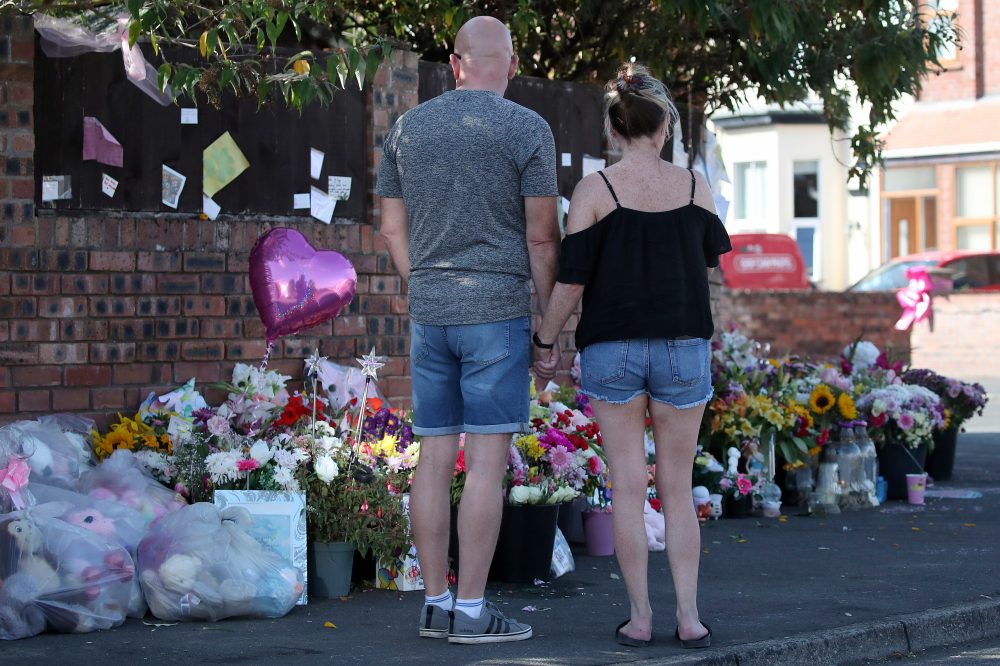

LONDON (AP) — A devastating attack that claimed the lives of three young girls at a Taylor Swift-themed dance class in England during 2024 was entirely preventable, according to a comprehensive investigation released Monday that details years of ignored warning signs.
Retired judge Adrian Fulford conducted a nine-week examination that resulted in a 763-page document outlining countless instances where intervention could have stopped Axel Rudakubana from carrying out what officials describe as an attack of extraordinary brutality never before seen in Britain.
“One of the most striking conclusions from this inquiry’s extensive investigation is the sheer number of missed opportunities over many years to intervene meaningfully, which directly contributed to the failure to avert this disaster,” Fulford stated. “The consequences were catastrophic.”
The perpetrator, age 17 during the northwestern England assault, received a life sentence without possibility of release for 52 years after taking the lives of 9-year-old Alice da Silva Aguiar, 7-year-old Elsie Dot Stancombe, and 6-year-old Bebe King, while injuring eight children and two adults.
The Southport incident sparked widespread civil unrest when far-right groups spread false information claiming the attacker was a recently-arrived Muslim immigrant. In reality, Rudakubana was born in Wales to Christian parents from Rwanda.
Fulford’s investigation produced 67 specific recommendations for preventing similar tragedies, prompting British Prime Minister Keir Starmer to pledge significant reforms addressing the “systematic failures that led to this terrible event.”
“The report today is truly harrowing and profoundly disturbing,” Starmer commented. “While nothing will ever bring these three little girls back, I’m determined to make the fundamental changes needed to keep the public safe.”
Law enforcement, social services, and school officials had extensive knowledge of Rudakubana’s troubling patterns.
At age 13 in 2019, he received a conviction for attacking a classmate with a hockey stick and was placed under youth offender supervision. Between 2019 and 2021, authorities referred him three separate times to Prevent, Britain’s counter-extremism initiative, due to his fascination with school shootings, the 2017 London Bridge terrorist incident, the Irish Republican Army, and Middle Eastern conflicts. Each referral was dismissed because officials determined he was unlikely to become a terrorist.
Throughout this timeframe, local officers responded to his residence five times regarding behavioral concerns. Despite receiving mental health services and educational assistance, he eventually stopped cooperating with social workers. School officials expelled him for bringing a blade to campus, and he rarely attended his next educational placement.
“Far too often, AR’s ‘case’ was passed from one public sector agency to another in an inappropriate merry-go-round of referrals, assessments, case-closures and ‘hand-offs,’” Fulford wrote, using only the attacker’s initials.
The judge emphasized a critical March 2022 incident when authorities discovered Rudakubana carrying a knife on public transportation, during which he expressed desires to stab someone and confessed to attempting poison creation.
These combined incidents should have resulted in his arrest and a home search that would have revealed his purchase of materials for creating ricin, a deadly biological toxin, plus downloaded terrorist content on his computer, Fulford determined.
Instead of arresting him, authorities released Rudakubana to his parents, who lived in fear of their son and repeatedly failed to report his knife purchases, disturbing actions, and threatening statements.
While Fulford documented multiple parental failures that could have prevented the tragedy, he cautioned against condemning them for an increasingly impossible situation.
“Their life at home must have become little short of a nightmare given, to use the words of his own father, AR had turned into a ‘monster,’” Fulford observed.
Post-attack searches of Rudakubana’s residence uncovered ricin concealed beneath his bed and a downloaded al-Qaida training manual.
Investigators determined his crimes did not qualify as terrorism because they found no clear political or religious motivation behind his actions.
Starmer previously indicated this case demonstrates how “terrorism has changed” and suggested legal modifications may be necessary to address threats from “extreme violence carried out by loners, misfits, young men in their bedrooms.”