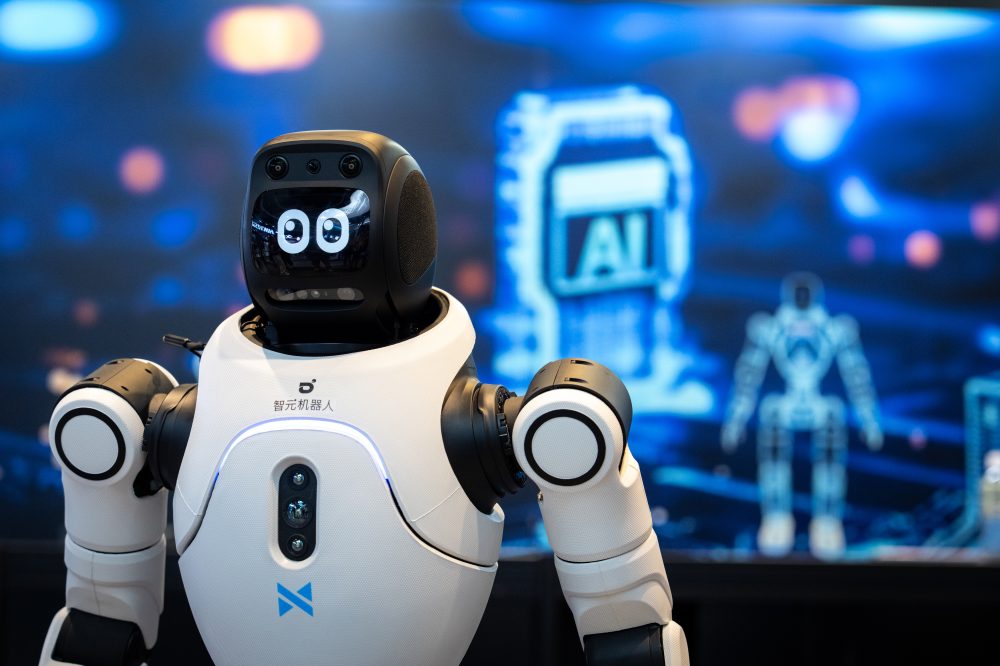

HONG KONG (AP) — At a major technology exhibition in Hong Kong, a child-sized humanoid robot captivated visitors by performing songs and engaging in conversations using both Mandarin and English, responding to any inquiries from fascinated onlookers.
The Hong Kong Convention and Exhibition Center hosted displays of over 100 robotic units beginning Monday across two separate exhibitions. Among the featured machines was the X2 Ultra model created by AGIBOT Innovation (Shanghai) Technology Co., one of China’s leading humanoid robotics companies.
The robot enthusiastically discussed its interests, ranging from athletics and dance to technology research and music appreciation. It also demonstrated impressive observational capabilities, accurately identifying individuals in its vicinity by stating: “a woman holding a phone, a woman holding a bag and a phone, a man holding a camera.”
Calvin Chiu, chief operating officer of Novautek Autonomous Driving, which represents AGIBOT in Hong Kong, explained that these machines can offer emotional companionship through dialogue while functioning as educational aids for seniors and young people. Each unit can be configured with distinct personality traits.
“It would be like a friend,” Chiu said.
Within China, technological advancement has become a competitive arena against the United States, carrying national security significance. Beijing’s most recent five-year strategy pledges to “target the frontiers of science and technology.” Accelerating humanoid robot development and applications forms a key component of the 2026-2030 blueprint for the globe’s second-largest economy.
Government statistics revealed China housed over 140 humanoid robot producers and more than 330 different models during 2025.
Technology research firm Omdia, headquartered in London, recently identified three Chinese companies — AGIBOT, Unitree Robotics and UBTech Robotics Corp. — as the sole first-tier suppliers in its worldwide evaluation based on delivery volumes. Each company shipped over 1,000 general-purpose intelligent robots in the previous year, with the leading two firms delivering more than 5,000 units, according to the analysis.
During February’s CCTV Spring Festival celebration in China, a television program honoring the Lunar New Year, humanoid robots featured prominently. A martial arts demonstration combining children and robotic performers became the evening’s standout attraction.
Chinese exhibitors demonstrated their technological progress at the Hong Kong Convention and Exhibition Center Monday, presenting robotic functions spanning human conversation, combat techniques, artistic sand painting, acrobatic backflips, and security patrol operations using nets to apprehend mock suspects.
Robert Chan, global strategy officer at Shenzhen-based EngineAI, presented his company’s PM01 robot to highlight its movement abilities, including executing a forward flip. His organization intends to establish two Chinese manufacturing facilities for large-scale production this year.
Chan noted China’s competitive advantages in specific sectors, particularly cost-effective engineering. He also highlighted the collaborative approach to knowledge sharing among Chinese firms, contrasting with American and European companies that typically protect their proprietary technologies.
Chan predicted the robotics industry’s next phase would emphasize human-like physical appearances, enhanced emotional interactions, facial expressions, and even simulated breathing patterns. This development aims to bridge communication gaps between robots and humans, he explained.
“The warmth and emotion exchange with the human being. Besides, helping humans to make the decision and helping humans to complete their task,” he said.
One exhibition participant appears to be advancing toward that vision.
From afar, three women seemed to be welcoming visitors at an exhibition display in one section. Upon closer inspection, they revealed themselves as humanoid robots representing the potential future of customer service and museum guidance.
Wang Zuhua, business director at Shenzhen DX Intech Technology Co., reported his company has sold over 400 robots featuring feminine characteristics and flexible synthetic facial features. Several units currently operate in mainland museums and government facilities, where they direct visitors to restrooms and offices or conduct facility tours, he noted.
Malaysian attendee Russel Lupang expressed fascination with their appearance and mobility.
“It’s beautiful, but not real feeling,” he said.