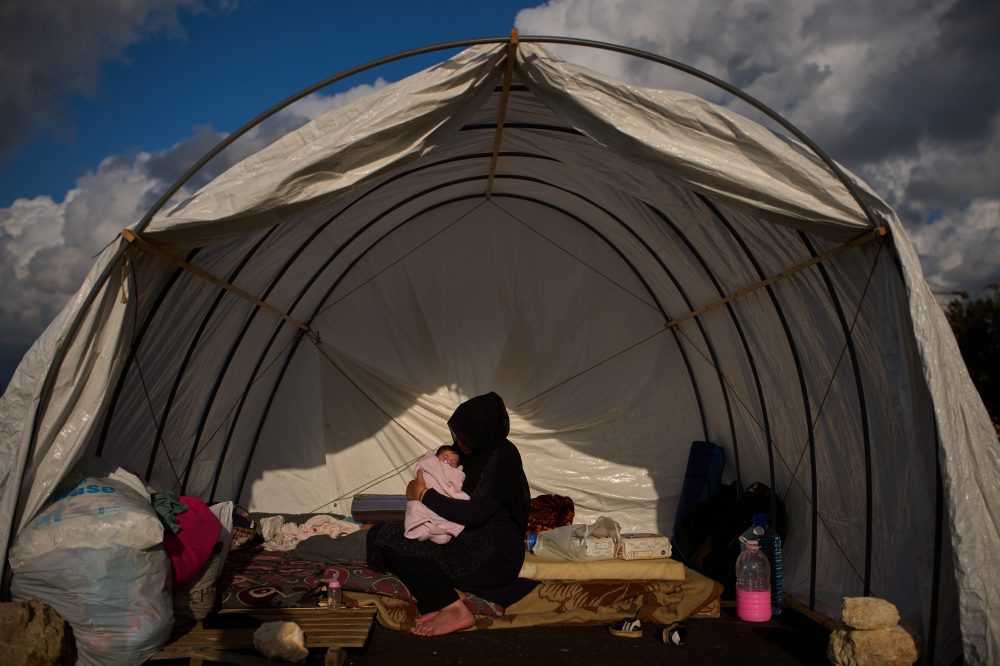

BEIRUT (AP) — Sixteen-day-old Shiman has only experienced life inside a makeshift tent on Beirut’s coastline — surrounded by the odor of damp, moldy bedding, constant bug bites, and the terrifying sounds of Israeli fighter jets bombing Lebanon’s capital city.
Her mother, Haifa Kenjo, says the infant was delivered in the muddy camp conditions on March 28.
The 34-year-old Kenjo was in her final month of pregnancy when Israeli bombardments targeting Dahiyeh, Beirut’s southern neighborhoods, forced her family to flee their home immediately. She, her husband, and their toddler son Khalid escaped wearing only sleepwear and flip-flops as explosions rocked their residence, leaving behind all possessions including clothing and money.
The family found shelter in a donated tent structure near central Beirut, using stones to anchor the tarp against strong winds that constantly threaten to tear it away.
Among Lebanon’s more than one million displaced residents affected by the ongoing conflict between Israel and Iran-supported Hezbollah, 13,500 women are currently pregnant, with over 1,500 expected to give birth within the coming month, according to this week’s report from the UN’s sexual and reproductive health agency. The organization warns that many mothers cannot obtain proper prenatal and delivery care.
During peacetime, Kenjo had planned to deliver at Beirut’s primary public medical facility, the same hospital where she had given birth to Khalid. Originally from Syria, despite living nearly half her lifetime in Lebanon’s capital and marrying a Lebanese citizen, she must pay hospital fees that Lebanese women receive at no cost.
When labor began and her water broke on March 28, she contacted emergency services while her husband gathered the required $40 entrance fee. However, the $500 needed for the actual delivery remained trapped under the rubble of their destroyed home, which had been leveled by an Israeli air attack the previous week.
The couple returned to their tent shelter, contacted a midwife, and hoped for the best.
The midwife, known as Umm Ali, explained she provided the best care possible under the circumstances, but the tent environment was unsanitary. Rainwater leaked through the structure, and they could only clean newborn Shiman using bottled water.
Kenjo’s body failed to produce breast milk for her daughter. Baby formula costs exceed her husband’s daily wages from his water tank installation work.
She recognizes her infant is malnourished. Food distribution volunteers at the displacement site provided only enough formula to last several days.
Rather than typical newborn crying, Shiman produces coughing sounds. Her skin feels cold and damp, covered with bite marks from insects.
“She is so precious,” Kenjo said, stroking her baby girl. “But for her we have nothing. We have less than zero.”