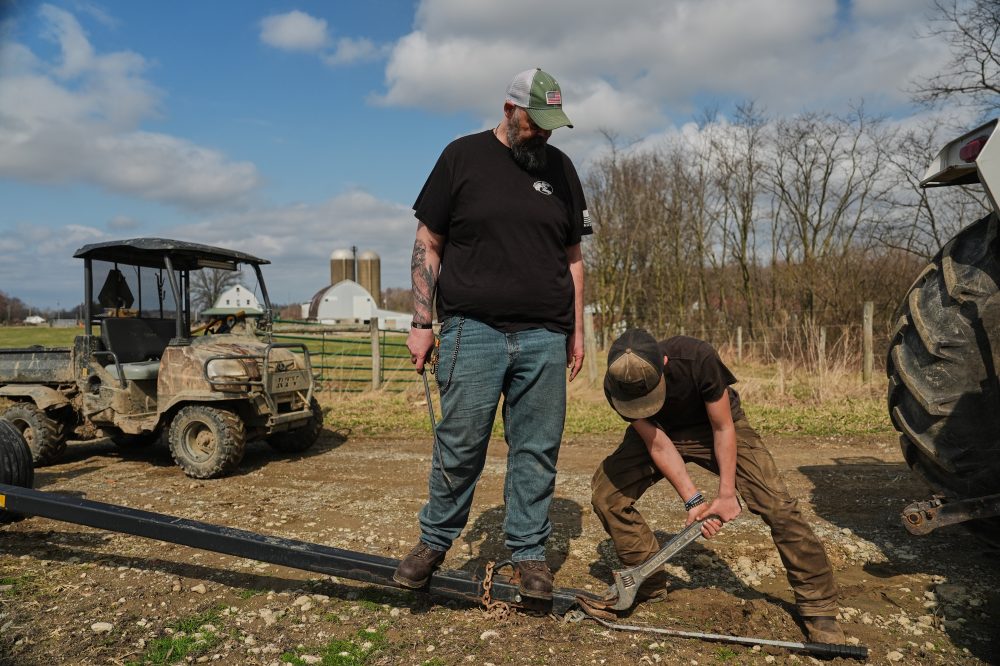

CANFIELD, Ohio — From his combine’s cab, Wayne Greier observes his teenage son Blake maneuvering a tractor across barren fields, preparing plowing equipment for another unpredictable growing season.
Financial stress would be significantly reduced if the solar installation planned for his property had moved forward. However, county commissioners prevented the project in 2023 using Ohio legislation, forcing Greier to liquidate portions of his farm to manage overwhelming medical bills. The blocked agreement would have generated approximately $540,000 annually in rental income.
“It was our saving grace,” he said. “It wasn’t a scary picture that everybody likes to paint about solar and the loss of farmland.”
Community resistance to solar installations has consistently challenged renewable energy developers. However, certain regions are attempting to overturn local prohibitions, emphasizing tax revenue benefits, employment opportunities, and rental payments from energy corporations that offer steady income for agricultural producers in an unstable sector.
When solar developers contacted the 42-year-old sixth-generation farmer about constructing panels on his property, Greier initially remained cautious. However, confronting $1 million in medical expenses from an extended COVID battle and related health issues, he recognized an opportunity to preserve his agricultural operation.
Community members held opposing views.
Greier described how his family faced social isolation as public discussions about the proposal unfolded during town meetings. His psychological well-being deteriorated. The initiative was ultimately prevented under state legislation permitting counties to halt wind and solar construction on designated “restricted” properties.
“I was the one that was going to lose the sixth-generation farm. I was the one that couldn’t provide for my family,” he said.
President Donald Trump’s opposition to renewable energy has damaged the sector by eliminating subsidies, financing options and tax benefits. Even prior to his White House return, municipal prohibitions on clean energy projects were expanding. Research from Columbia University in 2025 revealed a 16% growth in restrictive legislation across 44 states between 2023 and 2024.
“Many communities want to decarbonize and probably theoretically support renewable energy,” said Juniper Katz, an assistant professor at the University of Massachusetts who focuses on environmental policy. But, she added, “When it’s your community and your backyard, balancing these processes so people feel like they’ve had a say without creating so many veto points that nothing can get done, I think is the trick. And it’s not easy to do.”
During February, Dearborn County, Indiana, administrators suspended solar development for twelve months following resident concerns about panel placement near residential areas and possible environmental effects from panel components.
Bobby Rauen, residing adjacent to a proposed 1,200-acre solar installation in that county, joined residents petitioning for the moratorium. He expressed hope that officials would utilize this period to establish stronger protections for neighbors of potential solar developments. He also worried that agricultural land might not return to farming if solar equipment is eventually dismantled.
Following Mahoning County, Ohio, officials’ decision to stop Greier’s planned 675-acre, 150-megawatt installation, he chose to assist others seeking solar development on their properties, stating he “didn’t want to be a victim.” As a Renewable Energy Farmers of America member, Greier, who primarily cultivates corn and soybeans, has discussed his situation with legislators, advocacy organizations and communities considering green energy development.
He recently addressed government representatives at a public forum in Richland County, Ohio, approximately 100 miles from his residence. Supporters there secured a referendum for this May’s ballot to eliminate the county’s prohibition on wind and solar developments.
Morgan Carroll, a lifelong county resident, has worked since last summer to build support for removing the ban. Although not a farmer or property owner, Carroll advocates for the employment and tax income these projects generate and believes the prohibition removes decision-making power from residents — potentially affecting her two young children’s future.
“I want them to be in a county that can provide jobs, can provide a good school for them,” she said. “I don’t want to have to move.”
Congressional Republicans and the Trump administration accelerated deadlines for utility-scale solar developments to qualify for tax incentives following passage of significant tax reduction and spending cut legislation last July. Currently, utility-scale solar installations must become operational by late 2027 to qualify.
Last year, Lita Leavell and her husband Joe, who manage a 1,000-acre cattle operation in Lancaster, Kentucky, planned to accommodate a utility-scale solar development on roughly half their property that would have generated an estimated $60,000 annually. Similar to Greier, the lease income would have guaranteed the land remained within their family.
However, after Garrard County enacted an ordinance in 2023 limiting solar development, the energy company working with Leavell chose to terminate the project.
County officials justified the ordinance partly based on federal government opposition to solar energy and the Trump administration’s goal to prevent utility-scale projects on farmland, according to statements made during an August 2025 meeting. Leavell, who identifies as Republican, questioned why insufficient federal support for green energy should impact her ability to pursue such projects on her own property. She and six other landowners are pursuing legal action to challenge the ordinance.
“The thing I guess that perplexed me so much is that there’s so many more worse things that could be next to you,” she said.
Carroll, who collected signatures for the Richland County, Ohio referendum, discovered that framing solar project discussions as property rights issues made community members more receptive.
Greier also emphasizes property rights when discussing the topic. His farm represents his retirement security, and he should maintain the right to utilize it for family support, he explained.
“There’s families that are relying on this and looking for this,” he said. “And it’s been taken away, this opportunity.”