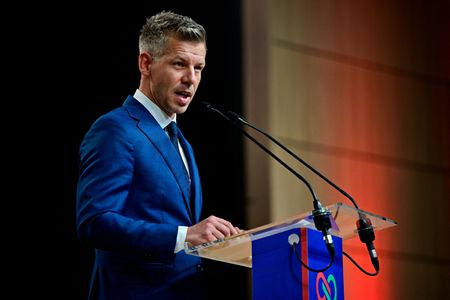

BUDAPEST, April 13 – Following his party’s decisive electoral triumph on Sunday, Hungary’s incoming leader Peter Magyar announced Monday his commitment to constitutional reforms aimed at rebuilding democratic institutions after more than a decade and a half of nationalist leadership.
Magyar’s center-right Tisza party defeated longtime Prime Minister Viktor Orban and his nationalist Fidesz party in what he described as a clear signal that Hungarians want their nation firmly positioned within Europe following 16 years under nationalist governance.
The electoral outcome represents a significant blow to Orban’s international supporters, including allies in Russia and U.S. President Donald Trump’s administration.
During a Budapest press conference, Magyar detailed his administration’s priorities and timeline for assuming control.
Regarding the transition of power, Magyar stated: “According to the rules, the result of the election becomes final by May 4 the latest, but this could happen earlier and the President… must convene the first session of the new parliament 30 days after the election at the latest.”
He directly addressed President Tamas Sulyok, saying: “I call on President Tamas Sulyok to convene the inaugural session as soon as possible, and not wait until May 12.”
On Hungary’s relationship with the European Union, Magyar emphasized the historical significance of the timing, declaring: “The Hungarian people yesterday, exactly 23 years after the referendum on our EU membership, confirmed Hungary’s place in Europe.”
He added: “I would like to see a strong Central Europe within a strong EU.”
Outlining his reform agenda, Magyar detailed several immediate priorities: “We will have a lot of tasks… the first, to adopt the functional measures, to start Hungary’s accession to the European Public Prosecutor’s Office… to amend the fundamental law (constitution), and to write into it that in the future in Hungary anyone can only serve as prime minister for two terms, which is eight years.”
Addressing concerns about democratic governance, Magyar pledged: “We will fundamentally restore, we will do everything to restore the rule of law, plural democracy, and the system of checks and balances.”
He emphasized his commitment to democratic methods, stating: “I would like to underline that we will not use anti-democratic measures to restore the rule of law, but luckily our two-thirds mandate allows us to do a lot.”
Magyar outlined his vision for government’s role in judicial independence: “A government’s job is to ensure the independence of the judiciary, the independence of the investigative authorities, to provide all possible financial and other resources to carry out their tasks.”
Regarding the current president, Magyar took a firm stance against Sulyok, who assumed the ceremonial position with Fidesz party support. “We don’t need this president,” Magyar declared, criticizing him for merely approving all proposals without scrutiny.
“I call on him to leave, if he doesn’t, we will find a solution,” Magyar added.
On economic matters and the central bank, Magyar acknowledged the nation’s financial challenges while expressing willingness to collaborate with current leadership under certain conditions.
“Hungary is in a difficult financial and economic situation. The National Bank is primarily responsible for ensuring exchange rate stability. I myself believe… Governor Mihaly Varga is doing his job in line with the central bank law and I think that in a country which is in a difficult economic situation, cooperation with the national bank is important… of course while respecting the independence of the central bank,” he explained.
Magyar outlined his approach to working with the central bank: “So I will try to work this way, and if we see that the central bank governor and the bank itself work in line with their legal mandate and are not, for example, trying to obstruct the financial policy of the new government… then we will be able to work together. We do not need yet more chaos… to harm investors’ confidence in Hungary.”
On social issues including LGBTQ+ rights and public demonstrations, Magyar reaffirmed his party’s inclusive stance.
“I have clearly stated several times already last year that everyone has the right to assemble in Hungary,” he said.
He continued: “We have clearly stated that, according to Tisza and the many millions of Hungarians who support Tisza, everyone can live with, and love, whomever they want, as long as they do not violate the laws and do not harm others.”