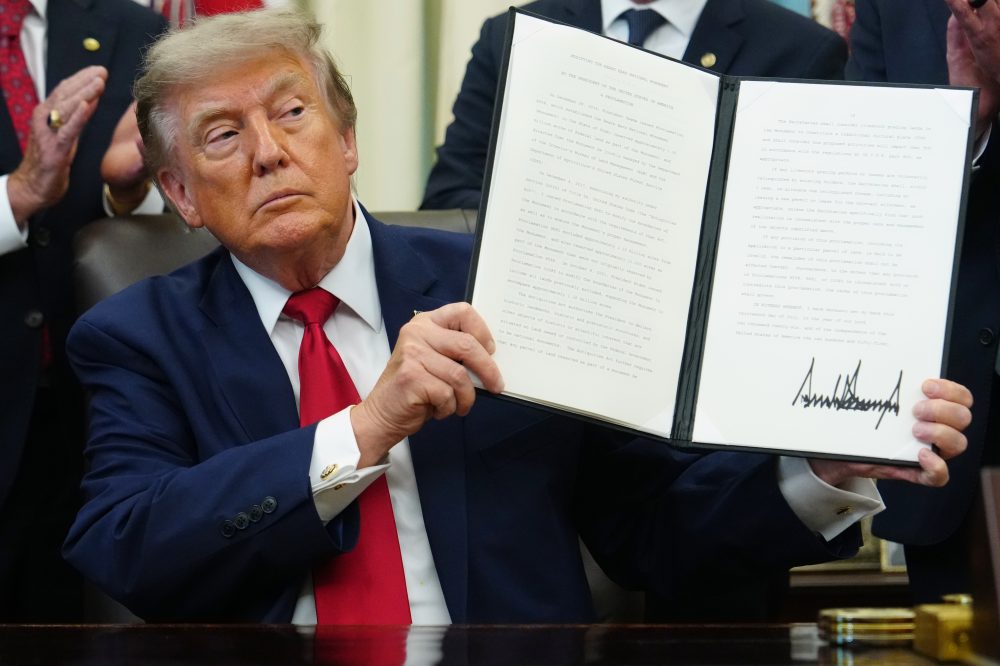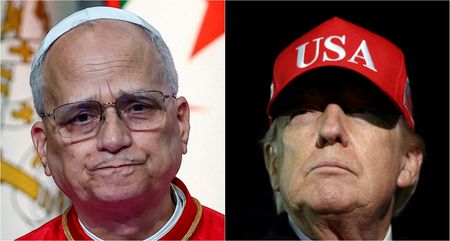

ROME – Italian politicians and religious officials came to Pope Leo’s defense Monday following harsh criticism from Donald Trump, creating a diplomatic challenge for Prime Minister Giorgia Meloni as she navigates between Italy’s Vatican relationship and her Trump alliance.
The controversy began when Trump labeled the pope as “terrible,” prompting an unusual direct reply from Leo, who declared he held “no fear” of the American administration and would persist in condemning the U.S.-led conflict with Iran while advocating for immigrant rights.
Meloni, who has built strong connections with Trump over recent years, released a statement supporting Leo as he departed for an extensive four-country African tour, though she avoided directly addressing Trump’s harsh words.
“May the Holy Father’s ministry help foster the resolution of conflicts and the return of peace, both within nations and among them,” Meloni stated, showing papal support while steering clear of criticizing the American president.
Political rivals quickly seized on Meloni’s careful response, arguing her Trump relationship has become a political liability in Italy, where polling shows 66% of citizens view the U.S. leader unfavorably due to his confrontational international approach.
“As a Catholic, I am outraged by a prime minister who invokes Christian values but cannot find the strength and courage to condemn Trump’s unacceptable blasphemy against the pope and the Catholic world,” declared Angelo Bonelli from the left-wing AVS party, also referencing Trump’s later social media post featuring an AI-created image of himself as Jesus.
Deputy Prime Minister Matteo Salvini, despite his own past Trump associations, offered more direct criticism of the American leader, reflecting how European far-right politicians are distancing themselves from Trump’s movement.
“Pope Leo is a spiritual leader for billions of Catholics, but beyond that, if there is one person striving for peace, it is Pope Leo, and so attacking him does not seem either wise or helpful,” Salvini stated.
The pope serves as Rome’s bishop and guides millions of Italian Catholics, making politicians across the political spectrum extremely cautious about confronting him.
“It has been centuries since such a blatant act of aggression against the Roman Pontiff was seen,” commented former center-left Prime Minister Matteo Renzi, emphasizing the importance for both Catholics and non-believers to support Leo.
“He is, after all, a ‘builder of bridges,’ unlike Trump, a destroyer of relationships and of civilisation. The only advantage is this: Trumps come and go, popes remain,” Renzi added.
His remarks reflected the traditional Italian expression “chi mangia papa crepa,” roughly translating to “whoever tries to devour the pope dies” – a saying rooted in centuries of conflict between papal authority and political rulers.
“Trump has made the mistake of the century, because ‘chi mangia papa crepa’ has been borne out repeatedly,” observed church historian Alberto Melloni, citing Italy’s royal House of Savoy, which repeatedly clashed with Vatican authority only to eventually fall while the papacy endured.
Vatican official Antonio Spadaro, a Roman Catholic priest and undersecretary of the Vatican’s Dicastery for Culture and Education, suggested Trump’s attack actually demonstrated his own vulnerability.
“If Leo were irrelevant, he would not merit any comment. Instead, he is invoked, named, opposed — a sign that his words matter,” Spadaro posted on social media. “This is where the Church’s moral force emerges. Not as a counter-power, but as a space in which power is judged by a standard it does not control.”