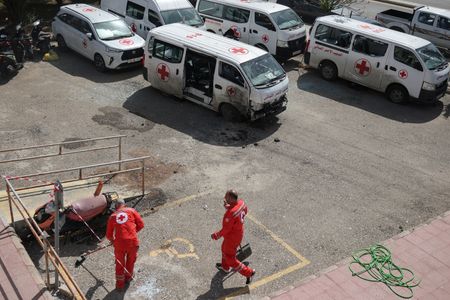

The International Committee of the Red Cross has voiced serious alarm over two consecutive attacks targeting medical personnel in Lebanon, following a deadly assault on a Red Cross facility Monday and the killing of a volunteer the previous day.
According to Lebanon’s state news agency, Monday’s attack, which the agency attributed to Israeli forces, resulted in one fatality and caused damage to Lebanese Red Cross vehicles.
The ICRC confirmed that the Lebanese Red Cross facility located in the Tyre district, situated along Lebanon’s coastline, was struck during the attack. The organization refrained from identifying who carried out the strike or providing additional details about the casualty.
Israeli military officials have not yet provided a response to requests for comment regarding Monday’s incident.
The day before, the Lebanese Red Cross announced that volunteer Hassan Badawi had succumbed to injuries sustained during a drone strike in the Bint Jbeil district of southern Lebanon.
Israel’s military acknowledged conducting a strike against what it described as a “Hezbollah terrorist” in that region and stated the matter was being investigated following reports of Red Cross personnel being injured.
Agnes Dhur, who leads the ICRC delegation in Lebanon, released a statement Monday expressing deep concern. “The loss of those who dedicate their lives to saving others is gravely concerning, given the impact on the civilians who depend on their help,” Dhur stated.
She continued, “Humanitarian and medical personnel must be protected. They must be allowed to reach and help the wounded, and return unharmed.”
The current conflict in Lebanon commenced on March 2, when the Lebanese militant organization Hezbollah launched attacks against Israeli positions in solidarity with Iran.
Since then, Israel has intensified its aerial bombardment and ground operations throughout the nation, with these military actions resulting in over 2,000 deaths, displacing more than one million residents, and prompting warnings that medical facilities may exhaust critical supplies.