The Edmonton Oilers made their move on Sunday, signing restricted free agent forward Colton Dach to a two-year contract worth $2.4 million.
Before joining Edmonton, the 23-year-old spent the majority of last season with the Chicago Blackhawks, putting up nine points — three goals and six assists — along with a minus-15 rating, 47 penalty minutes, 27 blocked shots, and 189 hits across 53 games. His time in Chicago came to an end on March 4, when he and forward Jason Dickinson were dealt to the Oilers in exchange for forward Andrew Mangiapane and a conditional first-round draft pick in 2027.
Once in Edmonton, Dach appeared in eight regular-season games and contributed four points — two goals and two assists — with a zero rating, five penalty minutes, two blocked shots, and 30 hits.
When the playoffs arrived, the 6-foot-4, 218-pound forward added one assist, four penalty minutes, one blocked shot, and 23 hits over five postseason games with the Oilers.
Combining his totals from both teams, Dach’s 219 hits on the season placed him 14th in the entire league — a notable achievement considering he played just 61 games, the fewest among any player ranked in the top 17 on that list.
Chicago originally selected Dach in the second round of the 2021 NHL Draft. Over his career, spanning time with the Blackhawks from 2024 to 2026 and the Oilers in 2026, he has accumulated 20 points — seven goals and 13 assists — along with a minus-18 rating, 69 penalty minutes, 41 blocked shots, and 305 hits in 86 regular-season games.
The federal watchdog agency overseeing the U.S. health department announced Monday that it generated $5.56 billion in expected recoveries and projected savings during a six-month stretch, while also removing 1,212 individuals and organizations from federal health programs. Despite those figures, total enforcement activity dropped to its lowest level in at least two years.
The Department of Health and Human Services Office of Inspector General released a semiannual report to Congress covering October through March, stating that for every dollar it spent, it returned $12.70.
Several high-profile cases drove the headline dollar figure, including a 15-year prison sentence handed down to a telemedicine software executive tied to a $1 billion fraud scheme, along with $674 million in settlements involving Kaiser Permanente affiliates and CVS Health’s Aetna related to inflated Medicare Advantage billing.
Despite the large dollar amounts, the number of actual cases declined significantly. Combined criminal and civil actions totaled 604 — down from 833 in the previous reporting period and the lowest figure recorded in at least two years. Criminal referrals also dropped, falling from 1,451 to 1,168. The number of individuals and entities barred from Medicare continued a two-year downward trend, slipping from a high of 1,795 to the current 1,212.
Compared to the same time frame under the prior administration, casework was essentially unchanged before declining. No data in the report indicated a surge in enforcement activity.
The way the office calculates its headline figure also changed. A new measurement called “total monetary impact” — which combines projected savings with money actually ordered to be repaid — was introduced in early 2025. That figure has fluctuated widely, ranging from $16.61 billion to $2.43 billion before landing at the current $5.56 billion. The report itself notes in its glossary that these figures represent amounts ordered or agreed to be repaid, not money that has actually been collected.
The report comes as Vice President JD Vance, HHS Secretary Robert F. Kennedy Jr., and Medicare chief Mehmet Oz have publicly promoted what the White House has described as an “unrelenting” effort to combat fraud. The OIG noted it now works alongside a new White House fraud task force led by Vance.
Oz has previously stated that the government identified roughly $2 billion in improper spending linked to people in the country illegally — a figure that does not appear anywhere in the report.
The report’s geographic findings crossed political boundaries, with improper payments made on behalf of deceased enrollees found across 35 states, Puerto Rico, and Washington, D.C.
Autism-related services also drew scrutiny in the report. Vance and Oz have pointed to autism-linked Medicaid spending as a sign of widespread fraud, but the OIG’s audits tell a more limited story. In four states — Indiana, Wisconsin, Maine, and Colorado — the office found hundreds of millions of dollars in improper or potentially improper payments connected to applied behavior analysis therapy.
In each instance, the problems identified were administrative in nature: missing paperwork, unsigned evaluations, copied session notes, staff without proper credentials, and insufficient state-level oversight. None of the audits accused anyone of criminal wrongdoing, though they did not rule out the possibility that other agencies could pursue criminal charges.
This report marks the first full accounting signed by Inspector General T. March Bell, a longtime Republican attorney who was confirmed by the Senate in December. Bell previously led a House investigation of Planned Parenthood and served as chief of staff in the HHS Office for Civil Rights during the first Trump administration.
Whether you’re settling in for a movie night or looking for something new to listen to, this week has no shortage of fresh content hitting your screens and speakers. Here’s a look at what’s worth your time, as highlighted by Associated Press entertainment journalists.
Television & Film
Netflix’s fan-favorite series “Heartstopper” wraps up its story with a feature-length finale titled “Heartstopper Forever,” arriving on the platform July 17. Written by series creator and graphic novelist Alice Oseman, the film picks up after the Season 3 ending, in which Nick Nelson (played by Kit Connor) and Charlie Spring (played by Joe Locke) deepen their relationship. The story moves forward with new hurdles, including Nick weighing his university options.
Filmmaker Sofia Coppola — known for “Lost in Translation” and “The Bling Ring” — steps into documentary territory for the first time with “Marc by Sofia,” a profile of fashion designer Marc Jacobs. Much of the film was captured as Jacobs prepares to debut a ready-to-wear collection. It lands on HBO Max on July 16.
Christian Petzold’s film “Miroirs No. 3” arrives on Mubi on July 17. Described by AP Film Writer Jake Coyle as “beguiling and restorative,” the film follows a piano student (Paula Beer) who recovers from a car accident at the rural home of an older woman (Barbara Auer) who lives near the crash site. It was considered one of the standout films of the first half of 2026.
Anya Taylor-Joy stars as Lucky, a con artist sitting on a winning lottery ticket she can’t legally cash, in a new Apple TV+ series simply called “Lucky.” While the jackpot could be her ticket to a fresh start, both law enforcement and her crime boss are closing in. Reese Witherspoon, who selected the source novel for her book club back in 2021, serves as an executive producer. The first two episodes drop Wednesday.
Will Ferrell takes on the role of Lonnie Hawkins in “The Hawk” — a golfer who was ranked No. 1 in the world back in 2004. Now, years of wear on the course are catching up with him, and both his ex-wife and his son — golf’s newest rising star — are pushing him toward retirement. Lonnie isn’t ready to walk away, though. He’s determined to win one more major and complete a career Grand Slam. The supporting cast includes Molly Shannon, Jimmy Tatro, Fortune Feimster, Luke Wilson, and Chris Parnell. “The Hawk” premieres July 16 on Netflix.
Robert Irwin, winner of Season 34 of “Dancing with the Stars,” now steps into the host’s role for “The Next Pro,” a new Hulu series in which 12 dancers compete for a spot as a professional on the show’s next season. Judging the competition is Mark Ballas — a three-time Mirrorball champion — alongside his mother Shirley Ballas, a celebrated Latin dance competitor, instructor, and British television personality. Rotating guest judges will include Derek Hough, Witney Carson, and Jenna Johnson. The show debuts on Hulu Tuesday.
“Marc by Sofia” also arrives July 16, while Sofia Coppola marks her first foray into documentary filmmaking with an intimate look at designer Marc Jacobs preparing to launch a new collection.
Music
Steve Lacy, the alt-R&B artist formerly of the group the Internet, is releasing a new album this Friday called “Oh yeah?” Lacy broke through in a big way in 2022 with the hit “Bad Habit” and its memorable, self-deprecating hook: “I wish I knew you wanted me.” The new project marks a pop-leaning evolution, featuring a dreamy collaboration with SZA titled “Is It Cool?” and the ambitious track “The Feeling.”
Also dropping Friday is “Caribenya” from Colombian Canadian artist Lido Pimienta. The album’s title blends the words “Caribe” and the name of elusive Irish singer Enya — a fitting framework for an album that sits at the crossroads of cumbia, DIY roots, and Pimienta’s ongoing anti-colonial sonic experimentation. She is frequently compared to both Björk and Natalia Lafourcade.
Gaming
“Culdcept Begins” brings back a cult-classic game that has been missing from consoles for years. It combines elements of a board game — think rolling dice and claiming property like in Monopoly — with a collectible card game mechanic similar to Magic: The Gathering, where players summon creatures, cast spells, and deploy weapons. Landing on a space already claimed by an opponent triggers a battle. With more than 400 cards and boards that change with every session, the game offers both a solo campaign and online multiplayer. It launches Thursday, July 16, on Switch.
“D-topia” presents a world where artificial intelligence curates daily life to maximize human happiness — but not everything runs smoothly. Players take on the role of a facilitator tasked with repairing the cracks in the system, encountering residents who aren’t quite as content as they’re supposed to be. Dig deeper and you’ll uncover the hidden “Block Side” — and the unsettling secrets it holds. Publisher Annapurna Interactive calls it “a calm, yet thought-provoking journey” where player choices can lead to very different outcomes. “D-topia” is available starting July 14 on PlayStation 5, Xbox X/S, Switch, and PC.
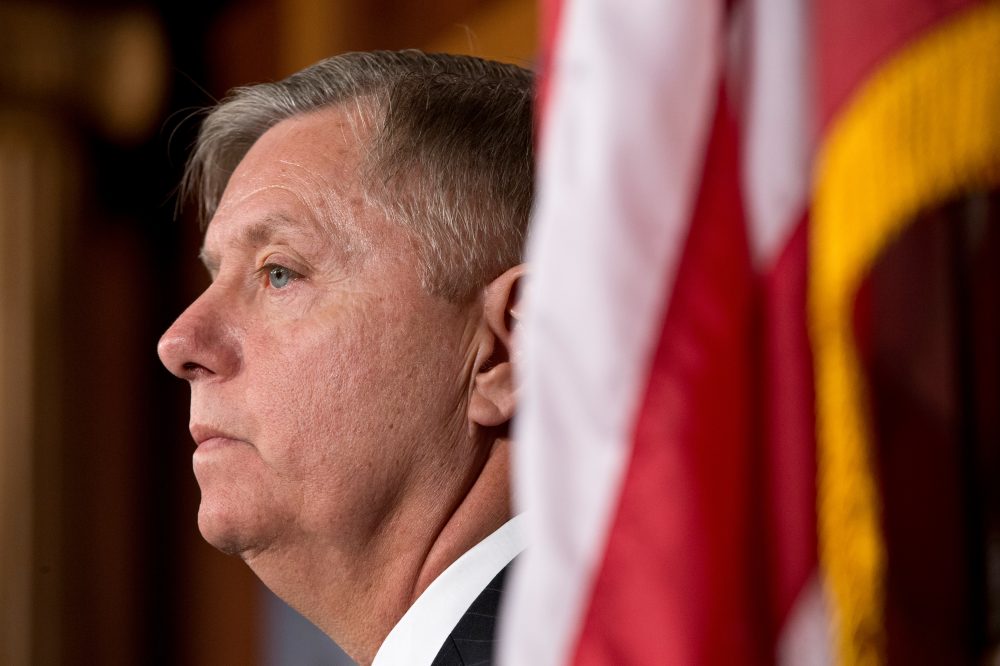
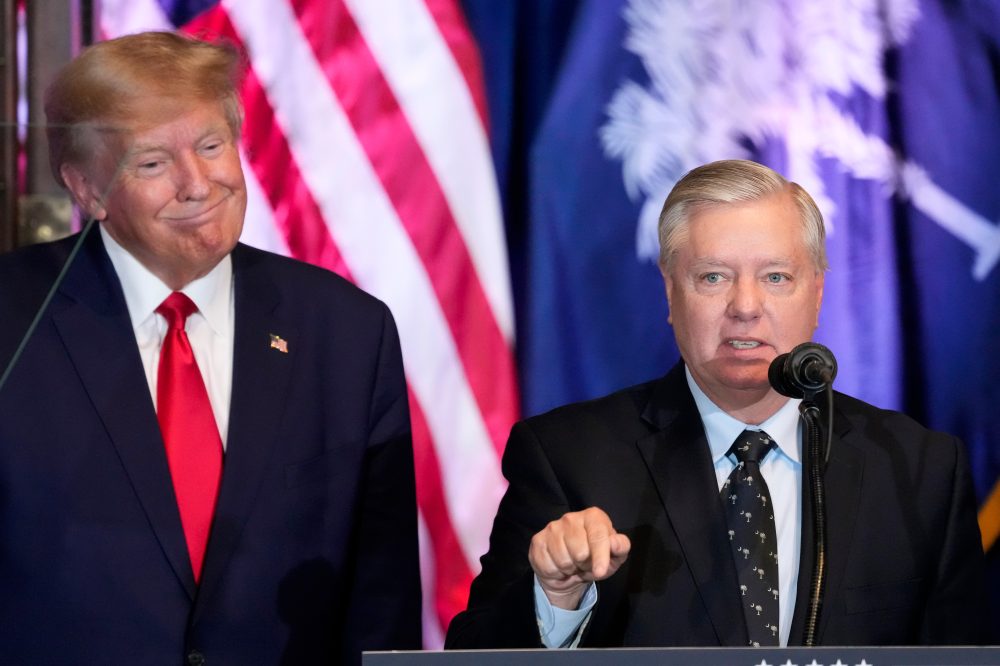
CHARLESTON, S.C. — The passing of Sen. Lindsey Graham over the weekend has thrown South Carolina politics into uncharted territory, coming in a year that has already seen significant political turbulence. Graham had been seeking a fifth Senate term at the time of his death.
As one of the state’s most senior and influential conservative voices and a close ally of President Donald Trump, Graham had been widely expected to cruise to another victory in November.
Now, Gov. Henry McMaster faces the task of naming a temporary replacement to fill the seat through January, while the state simultaneously gears up for a special primary election to let voters choose a new Republican nominee for the general election.
The sudden availability of the Senate seat has sparked intense interest among South Carolina’s ambitious conservatives, many of whom have been looking for an opportunity to advance their political careers.
The state’s Republicans had just wrapped up a hard-fought primary battle to determine who would succeed McMaster, who is finishing his second term as governor. State Attorney General Alan Wilson emerged victorious, defeating a field that included Lt. Gov. Pamela Evette, Rep. Nancy Mace, and Ralph Norman — all of whom are now reportedly considering a run for Graham’s seat.
Under South Carolina law, a one-week filing window for the special primary opens on the second Tuesday following a candidate’s death — in this case, July 21. The special primary itself would then be held on the second Tuesday after that filing period ends, landing on Aug. 11. If a runoff is needed, it would take place two weeks later on Aug. 25.
That would leave the eventual Republican nominee just over two months to campaign before the general election on Nov. 3.
The compressed timeline raises concerns under federal law, which mandates that military and overseas ballots be sent out at least 45 days before any federal election. For the general election primary, that deadline would have fallen on June 27. Officials at the Federal Election Commission had not responded to requests for clarification about how the process would proceed.
Graham died Saturday night. A preliminary report from the medical examiner indicated he suffered an aortic dissection — a tear in the body’s main artery.
Within hours of the announcement of his death, speculation was already swirling within South Carolina Republican circles about who might step into the role. Given how close the November election is, political observers believe McMaster’s appointee could have a significant advantage in the special primary, though it’s also possible the governor may opt to name someone who serves only as a short-term placeholder.
Evette, who spent nearly eight years serving alongside McMaster and had his backing in the governor’s race before losing the June 23 runoff to Wilson, is considered a leading candidate for the appointment. A source familiar with her thinking, who was not authorized to speak publicly, said she has been receiving encouragement from across the state and believes she would be competitive in the special primary.
It is considered unlikely that McMaster would appoint a sitting House member to complete Graham’s current term, given how narrow the Republican majority in the chamber currently is.
U.S. Rep. Joe Wilson, who had been mentioned as a potential replacement, said he told Trump on Sunday that “my goal is to remain in the House to keep his two-vote majority for the American people!!!”
That said, House members may still enter the race for the next full Senate term. A source familiar with Rep. Nancy Mace’s thinking, speaking anonymously, said she is weighing a run. Mace is not seeking reelection to her current House seat.
Another House Republican, Rep. Russell Fry, is also seen as a potential contender. The two-term congressman represents the fast-growing area around Myrtle Beach and has been a strong supporter of Trump.
A spokesman for businessman Mark Lynch, who was defeated by Graham in the primary, did not respond to a message left Sunday.
Treasury Secretary Scott Bessent, who previously lived in South Carolina before joining the Trump administration, has received calls about potentially taking Graham’s seat. However, a source who requested anonymity to discuss private conversations said Bessent has no interest in the position and is content in his current role serving the president.
No Democrat has captured a Senate seat in South Carolina in several decades, and Republican candidates have typically won statewide races by wide margins. When Graham last ran in 2020, he defeated Democratic challenger Jaime Harrison by 10 percentage points.
Despite that history, Republican leaders are keeping a close eye on the political landscape. Charleston pediatrician Annie Andrews, who secured the Democratic nomination last month, has raised more than $8 million in the race and had just under $3 million in cash on hand as of the end of May, according to federal filings. Graham had raised $6 million, with just over $4 million available.
In a statement Sunday, Andrews called on South Carolinians to join her “in setting partisanship aside and offering gratitude” to Graham for his years of service.
Harrison, Graham’s 2020 opponent, reflected on their relationship in a social media post, writing that even though he and Graham “had our share of political disagreements,” he “always appreciated that even in our fiercest political battles, we could still share a conversation, a laugh, and a mutual respect for South Carolina and the institutions we were both privileged to serve.”
Graham’s death leaves a significant gap in the Senate, where seniority carries real weight in terms of influence and committee leadership. He spent more than two decades in the chamber, building up enough standing to chair committees and help shape the legislative agenda.
South Carolina’s junior senator, Sen. Tim Scott, has served since 2012 — a relatively short tenure by the state’s historical standards. Former Sen. Fritz Hollings served 38 years, and Sen. Strom Thurmond held his seat for 47.
Scott, who had co-chaired Graham’s reelection campaign, said his former colleague was “irreplaceable.”
“America lost a statesman, but I lost a friend,” Scott said in an appearance on ABC’s “This Week.”
Oil prices surged and stock markets across Asia fell broadly Monday following a series of military exchanges between the United States and Iran that have reignited concerns about global energy supplies.
Brent crude, the international benchmark for oil pricing, climbed 3.9% to $78.96 per barrel. U.S. benchmark crude rose 4% to reach $74.26 per barrel.
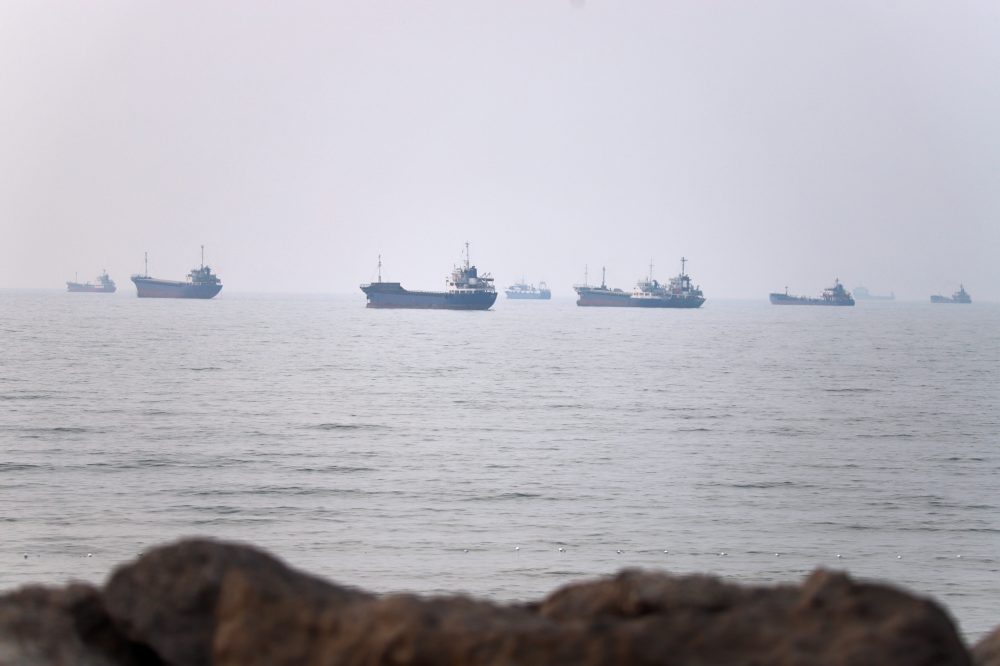
Both oil benchmarks had recently returned to pre-war levels after the two nations reached a temporary agreement to pause hostilities and oil tankers resumed passage through the Strait of Hormuz. That progress was reversed over the weekend when Iran attacked a container ship in the strait, setting it on fire and leaving one crew member unaccounted for. In response, the U.S. launched multiple waves of airstrikes on Iran that continued into Monday morning. Iran then struck back by targeting multiple countries throughout the Middle East.
U.S. stock futures retreated in response to the escalation. The contract tied to the S&P 500 dropped 0.4%, the Dow futures fell 0.3%, and the Nasdaq composite futures slid 1%.
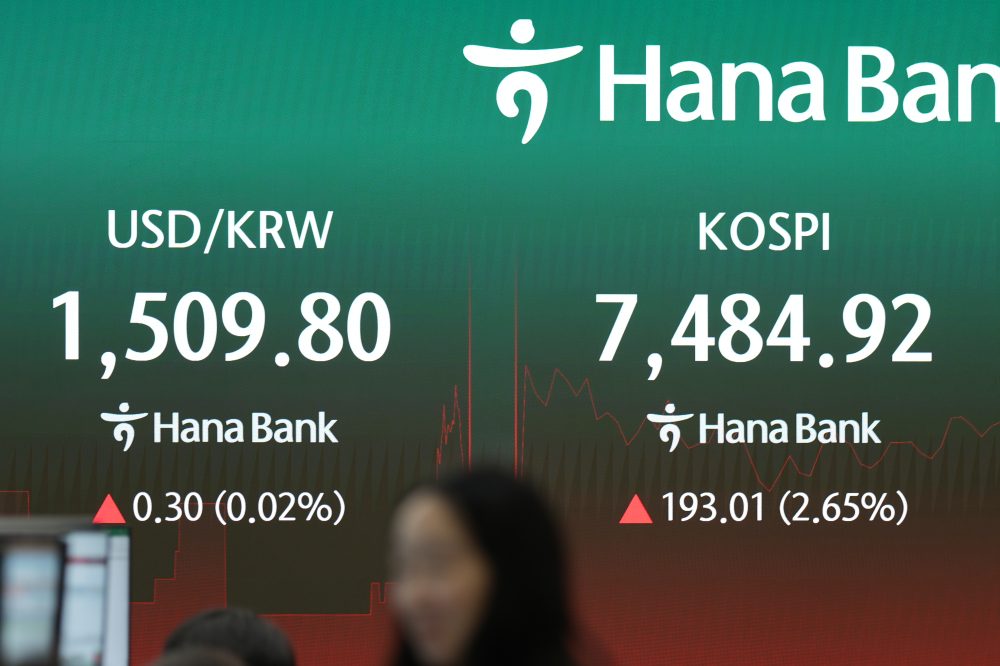
Across Asia, Tokyo’s Nikkei 225 dropped 1.1% to 67,786.86. South Korea’s Kospi fell sharply, declining 5.6% to 7,060.69. South Korean memory chipmaker SK Hynix, which had surged 13% in its Wall Street debut on Friday, tumbled 10.6% in Seoul trading. Its larger competitor Samsung Electronics also fell, dropping 6.7%.
Hong Kong’s Hang Seng bucked the regional trend, edging up 0.1% to 24,202.41. China’s Shanghai Composite index fell 1.2% to 3,947.34, and Australia’s S&P/ASX 200 dipped 0.3% to 8,777.00.
On Friday, U.S. stocks had finished higher, driven by continued investor enthusiasm for companies benefiting from the artificial intelligence boom. The S&P 500 gained 0.4%, the Dow Jones Industrial Average rose 0.3%, and the Nasdaq composite added 0.3%. Nvidia was the biggest single contributor to Friday’s S&P 500 gains, rising 4%.
SK Hynix made its Wall Street debut Friday afternoon after raising approximately $26.5 billion by selling American depositary shares at $149 each. The company’s stock in Seoul had already surged more than 600% over the past year, fueled by surging demand for computer memory tied to the AI boom. However, concerns have grown that AI-related stock valuations may have risen too far and that massive global spending on chips and data centers may not generate enough productivity and profit growth to justify the investment.
Those concerns have caused significant volatility among AI-related stocks, which have become some of Wall Street’s most influential due to their enormous market sizes.
Investors are also turning their attention to the upcoming corporate earnings season, when companies will report their spring profits. Firms across multiple sectors will need to show strong profit growth to support their current stock prices, which remain near record highs. Next Tuesday alone, major banks including Bank of America, Citigroup, JPMorgan Chase, Goldman Sachs, and Wells Fargo are all scheduled to release earnings.
The ongoing conflict with Iran is adding uncertainty to the economic outlook by threatening to push energy prices higher, which could fuel broader inflation. Elevated bond yields have already been pressuring financial markets globally, as rising oil costs and persistent inflation could prompt the Federal Reserve and other central banks to raise interest rates. While higher rates can help bring inflation under control, they also slow economic growth and weigh on investment values across the board.
WASHINGTON — Senate Republicans are heading back to the nation’s capital this Monday facing a deeply uncertain road ahead, following the unexpected death of South Carolina Republican Sen. Lindsey Graham — a committee chairman and one of President Donald Trump’s closest allies in the chamber.
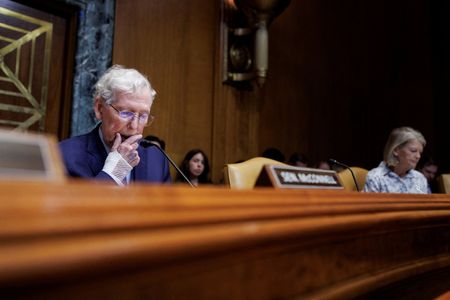
Graham, 71, passed away Saturday evening after suffering a tear in his aorta, his office confirmed in a statement released Sunday. The news sent shockwaves through Washington, coming at a time when another high-profile Republican senator, former Republican leader Mitch McConnell, has been hospitalized for nearly a month. McConnell broke his extended public silence on Sunday evening, revealing that he had been recovering from pneumonia and a fall at his home.
The combination of McConnell’s ongoing absence and Graham’s sudden passing has rattled Republican ranks at an already turbulent moment. Senators are returning from a two-week recess already divided internally and behind on several key priorities. With Republicans holding a 53-47 majority, the loss of even one or two members adds significant complications to what was already expected to be a chaotic stretch leading into the November midterm elections.
Even with control of the Senate, House, and White House, Republicans have struggled to advance their agenda. Disagreements between the chambers and the administration have caused repeated stalls, and Trump has publicly criticized Senate Republicans — particularly for their failure to pass legislation requiring proof of citizenship for voters. Graham had frequently served as a go-between, helping smooth tensions between Trump and his Senate colleagues.
Trump spoke about Graham on NBC’s “Meet the Press” Sunday morning, saying he had spoken with him just the day before. “He was a great — like a gauge, a temperature gauge of the Senate,” Trump said. “He could go in and get something approved. He would just get people on his side.”
The Senate had already departed Washington after a difficult stretch. Trump blocked confirmation of one of his own nominees, pushed senators to fund portions of a White House ballroom renovation despite opposition, and put them in the uncomfortable position of defending military action against Iran while many privately questioned the strategy.
Trump also declined to sign a bipartisan housing bill that had strong support in both chambers, insisting Congress should instead pass his voter citizenship bill — known as the SAVE America Act. That bill became law at midnight Friday after Trump neither signed nor vetoed it.
Tensions between Trump and Senate Republicans have also been strained after the president endorsed primary challengers against two sitting Republican senators who had been reliable supporters — Texas Sen. John Cornyn and Louisiana Sen. Bill Cassidy. Cassidy had directly confronted Trump over the Iran conflict during a Capitol meeting shortly before the recess, which sources described as going poorly.
Senators are returning to a packed agenda, including the confirmation of Trump’s attorney general pick, Todd Blanche, and the nomination of Jay Clayton to serve as director of national intelligence — a pick Trump had temporarily blocked himself. They must also navigate Democratic opposition and Trump’s frustration to avoid yet another government shutdown. Graham held a senior seat on the Senate Appropriations Committee, as does McConnell, making both absences particularly significant for spending negotiations.
Graham also served on the Judiciary Committee, which will take up Blanche’s nomination, and chaired the Senate Budget Committee, which has been under pressure to advance a defense spending package tied to the Iran situation.
Additionally, a bipartisan Russia sanctions bill that Graham and Democratic Sen. Richard Blumenthal of Connecticut had unveiled on Friday now faces an uncertain future. The two senators had announced the package after months of negotiations with the Trump administration.
Blumenthal told The Associated Press on Sunday that Graham had been “absolutely focused on this moment” when they made the announcement. He expressed hope that Graham’s legacy would push the Senate to move the legislation forward.
“We’ve really reached this moment where all of the stars are aligned and we will be lacking Lindsey’s spectacular advocacy,” Blumenthal said.
Senate leadership has not yet announced plans to formally honor Graham, who died from what his office described as an aortic dissection — a tear in the inner wall of the aorta — connected to hardening of his arteries. A final cause of death will be released pending toxicological and microscopic testing, according to his office.
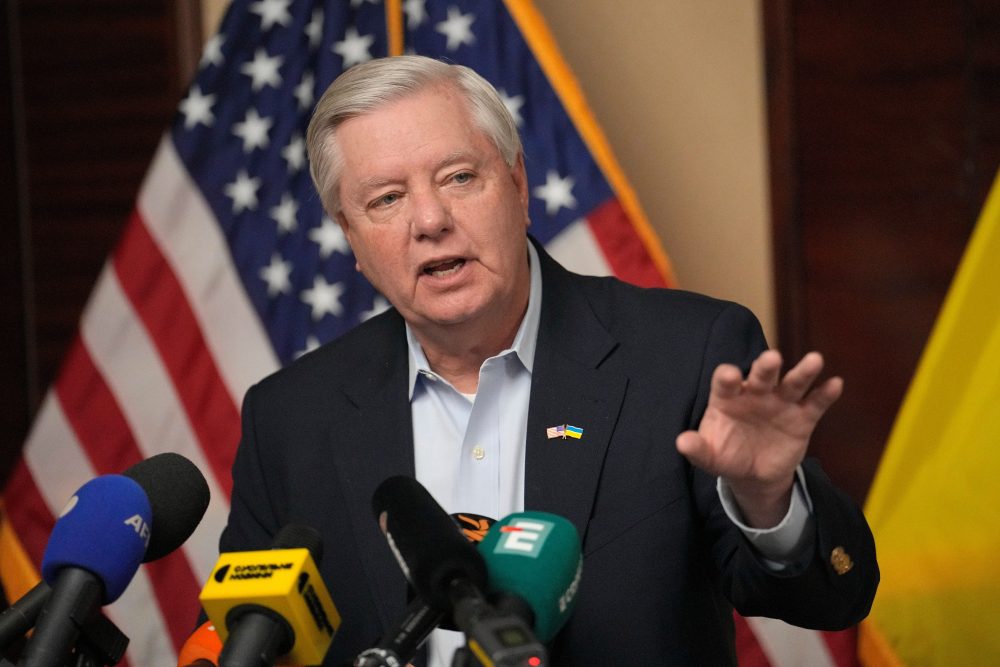
Graham had served in Congress for more than three decades and was a former Air Force lawyer. He had just returned from a trip to Ukraine before his death.
Several Republican names have already surfaced as potential replacements to serve out the remainder of Graham’s term, including Rep. Nancy Mace, Rep. Ralph Norman, and Lt. Gov. Pamela Evette — all of whom fell short in this year’s gubernatorial primary. Rep. Russell Fry, elected to the House in 2022, has also been mentioned as a possible contender.
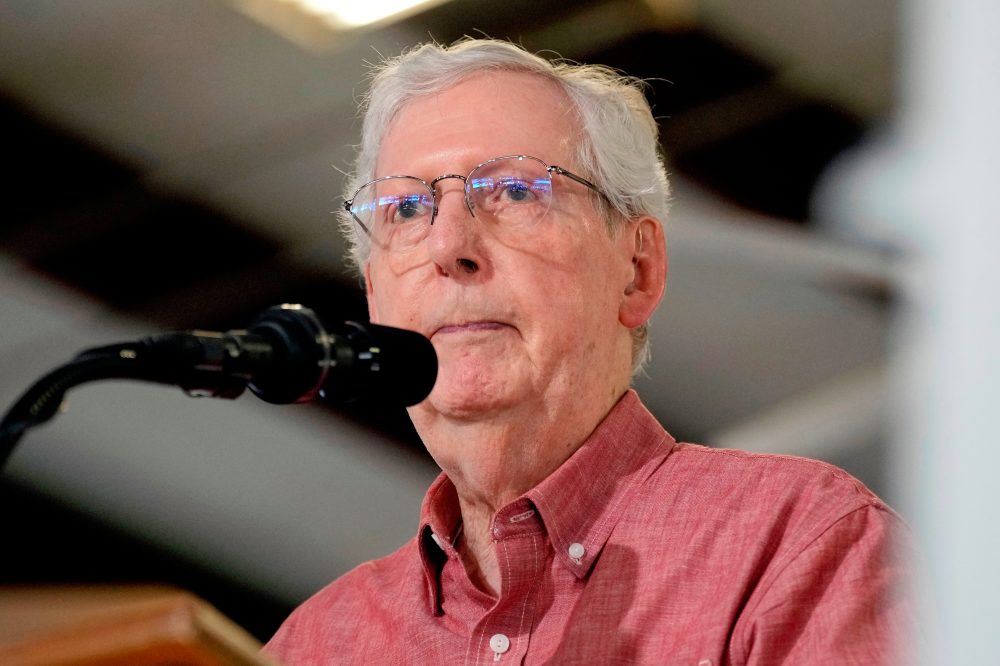
As for McConnell, his Sunday statement was the first public acknowledgment of the circumstances surrounding his hospitalization. The Kentucky Republican, who is set to retire in January, said he was “briefly unconscious” around the time he was first admitted to the hospital in June. He has since undergone numerous tests to determine the cause of his fall and has been treated for mild pneumonia before being moved to a rehabilitation facility.
“My doctors have confirmed that I didn’t break any bones or suffer a concussion. I didn’t have a heart attack or a stroke. I don’t have any tumors or hemorrhages,” McConnell said, adding that he is now “regaining my strength.”
He acknowledged he cannot return to the Senate “quite yet” and explained his four weeks of silence by noting that “folks of my generation often hesitate to share the vulnerability that comes with growing older.” “Even in the public eye, I feel that same instinct — I can’t help it,” he said.
Western allies are convening in Paris on Monday with the goal of securing additional air defense pledges for Ukraine, as ammunition shortages have left the country increasingly exposed to Russian ballistic missile attacks — even as momentum on the ground has shown some signs of shifting.
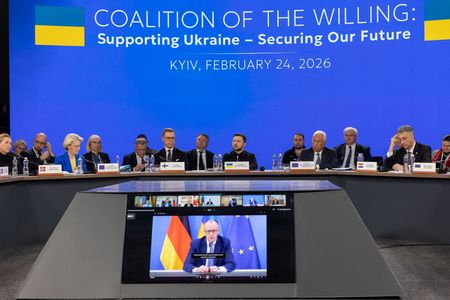
Ukrainian President Volodymyr Zelenskiy is attending the Coalition of the Willing meeting alongside at least 25 other world leaders. The gathering is part of a broader effort that includes developing a unified position that could be presented to Russia, as well as working out security guarantees to support any future peace agreement.
The Paris summit follows closely on the heels of a NATO meeting that sought to demonstrate transatlantic unity and lasting support for Ukraine.
Over the weekend, Russia carried out missile and drone strikes on Ukraine, killing eight people and wounding dozens more, according to officials. Zelenskiy responded by urging allies to speed up weapons deliveries to Kyiv.
French Foreign Minister Jean-Noel Barrot addressed the urgency of the situation in an interview with Ouest-France newspaper on Sunday. “The ballistic missiles launched by Vladimir Putin are deliberately targeting civilian zones and June was one of the most murderous months since the start of the war,” he said.
Russia maintains that it only strikes targets with military significance and denies deliberately attacking civilians.
A French presidency official, speaking to reporters, said the summit’s primary focus would be anti-ballistic missile cooperation. That includes efforts to obtain more U.S. Patriot interceptors, advance the deployment of the Franco-Italian SAMP-T air defense system, and explore how European and Ukrainian defense industries might develop alternative solutions.
One possibility being considered involves multiple European countries working together on a system that would work alongside SAMP-T and/or Patriot, with Ukraine playing a meaningful role in its production.
Ukraine’s stockpiles of munitions for its air defense systems are critically low, and the country has been largely unable to intercept ballistic missiles — which travel at several times the speed of sound — over the past month. Ukraine has been pressing allies for more supplies and has also urged Europe to collaborate with it on developing its own anti-ballistic missile defense system.
As Russian strikes have intensified, Ukraine has also stepped up drone attacks deep inside Russian territory, focusing on oil infrastructure and weapons manufacturing in an effort to weaken Moscow’s economic capacity to sustain the war.
Leaders at the summit will also discuss ways to cut into Russia’s revenue streams, particularly targeting the so-called “shadow fleet” — tankers with murky ownership structures used to ship Russian oil while evading international oversight.
The European Union is also expected to adopt a 21st package of sanctions against Russia in the coming week.
French President Emmanuel Macron has indicated there will be announcements on Monday, some of them bilateral, potentially involving joint arms production agreements.
Macron also said the coalition could announce joint military exercises as part of broader efforts to make the concept of a future multinational force in Ukraine a practical reality rather than just an idea.
“What must be remembered is that the MNFU consists of land, air, sea and training. All of these pillars are intended to be tested continuously, to varying degrees, with all participants in order to guarantee their credibility,” the French presidency official said, adding: “It’s not a question of conducting exercises in Ukraine.”
Baltimore Orioles utility player Blaze Alexander is dealing with a fractured left hand after being struck by a pitch during Sunday’s game against the Kansas City Royals, according to Orioles manager Craig Albernaz.
The incident took place in the seventh inning when Alexander was hit by a 95-mph fastball thrown by Royals right-hander Lucas Erceg. The pitch — the seventh of the at-bat — prompted both teams’ benches to clear. Erceg said after the game that hitting Alexander was not intentional.
Medical imaging confirmed a non-displaced fracture in Alexander’s hand. The 27-year-old is scheduled to meet with a doctor during the All-Star break this week, Albernaz said.
“You know it hurts, but he has a good attitude about it,” Albernaz said. “Blaze will be around and see where he’s at rehab-wise and go from there.”
No timeline has been established for Alexander’s return. Albernaz described the loss of the player as “definitely a gut punch.” Alexander was not available to speak with reporters following the game.
Before the injury, Alexander had a strong afternoon at the plate, going 2-for-2 with two runs scored and a walk while playing third base. The performance pushed his batting average to a team-best .312, with a .368 on-base percentage and a .439 slugging percentage. He has tallied four home runs and 29 RBIs across 82 games this season.
Originally drafted by the Arizona Diamondbacks in the 11th round of the 2018 MLB Draft, Alexander was acquired by Baltimore in February in exchange for rookie right-hander Kade Strowd and two minor league players.
Alexander has proven to be one of the team’s most versatile players this season, starting at third base 34 times, second base 11 times, shortstop seven times, center field six times, left field four times, and right field twice.
Taiwan Semiconductor Manufacturing Co, known as TSMC, is set to build two more advanced chip packaging facilities at the Chiayi Science Park in southern Taiwan, according to the island’s science and technology minister.
The Chiayi Science Park is already being developed as a major hub for TSMC’s advanced chip packaging operations. The company’s first packaging plant at the site has already reached full-scale production, and a second facility is expected to follow suit in the near future.
National Science and Technology Council Minister Wu Cheng-wen made the announcement Sunday during a groundbreaking ceremony for the next phase of development. “Today’s groundbreaking marks the start of the second phase, which will include a third and fourth plant,” Wu said.
The minister added that once all four plants are fully operational, the park is projected to produce more than 300 billion Taiwan dollars — roughly $9.35 billion — in annual output and support more than 9,000 jobs.
TSMC has been aggressively scaling up its advanced chip packaging capacity, including its chip-on-wafer-on-substrate technology. The push is being driven by surging demand from artificial intelligence chip designers such as Nvidia, where current supply has struggled to keep pace with what customers need.
When France and Spain square off Tuesday for a spot in the World Cup final, one notable chapter will come to a close — the life of the Dallas Stadium pitch.
The playing surface, which took five years of research to develop and perfect, will be torn apart once the match concludes and one of the two teams heads to New York to prepare for the championship game.
“What we’re doing here is hosting the biggest football tournament in the world, these are the best players in the world so we want to provide the best surfaces for them,” said Ian Craig, FIFA’s pitch manager for Dallas Stadium.
Creating a consistent playing experience across all 16 World Cup venues — plus training sites for the first-ever 48-team tournament — required turf scientists and groundskeepers to collaborate with the University of Tennessee, Michigan State University, and FIFA’s pitch management team. Their goal was to standardize how the ball rolls and bounces on every surface.
“It’s not just about having green grass. We have to make sure that these pitches play the way that these elite-level players are used to, which is obviously where years of research and hard work have gone into,” Craig explained.
Dallas presented a particularly tough challenge as one of three indoor venues in the tournament. The lack of natural sunlight and the constant use of air conditioning meant that grass native to Texas simply wouldn’t survive. Instead, a variety capable of tolerating cooler temperatures was brought in from Colorado.
To keep the grass alive on non-match days, grow lamps have been hung from the stadium’s roof and repositioned as needed. The entire pitch sits four-and-a-half feet above the artificial turf the Dallas Cowboys normally play on.
“We’re standing four-and-a-half feet above where the NFL field is, just in order to fit this within the stadium, but we have a full soil profile in there,” Craig said. “This is a full football pitch. This isn’t just a temporary installation. This is typical of what would be underneath a standard playing surface. We also have the hybrid elements, so it’s typical of what you would see at the elite level in Europe.”
After hosting nine matches over the course of more than four weeks, the pitch has served its purpose. Craig and his crew will begin tearing it down as soon as the semifinal wraps up.
“This is a very, very busy stadium,” Craig noted. “It has a lot of events, so this pitch has done what it was here to do, and it’s then on to concerts and the NFL again.”
BEIJING — China’s export sector is expected to have posted another solid month of growth in June, though at a slightly slower pace than May, as companies raced to get goods to the United States before potential new tariffs kicked in, capitalized on surging global demand for artificial intelligence technology, and slashed prices to attract budget-conscious buyers around the world.
A Reuters survey of 20 economists projects that Chinese exports rose 18.2% compared to the same month last year when measured in U.S. dollars — a step down from the 19.4% growth recorded in May, but still a strong figure by most standards.
The worldwide boom in AI investment has become a crucial support for China’s $20 trillion economy, giving manufacturers a cushion against growing headwinds including disruptions tied to conflict in the Middle East and an ongoing slump in the country’s property market.
On the import side, economists expect a 24% year-on-year increase, slowing from the 27.4% pace seen the month before. Export data from South Korea — often used as an indicator of Chinese import activity — suggests that most of that demand came from purchases of semiconductors and other components used in tech products, rather than a broader rebound in consumer spending inside China.
Manufacturing data released at the end of last month showed overseas demand beginning to pick up, but factory prices kept falling as Chinese companies continued cutting costs to win contracts from international customers already feeling the pinch from higher energy prices connected to the Iran conflict.
Chinese exporters also received a lift from U.S. retailers, who moved their orders up by four to six weeks to build up inventory for Black Friday and Christmas shopping seasons before anticipated tariff increases later this year. Still, uncertainty lingers following U.S. President Donald Trump’s May trip to Beijing, which did not produce the major agreements many observers had anticipated.
Economists were divided in their predictions for June. BNP Paribas and Mizuho Securities each projected a 20% jump in exports, in line with the robust growth seen throughout the first half of the year. On the more cautious end, China Industrial Securities and Shanghai Securities both projected growth of just 12%.
While exports helped China beat expectations during the first quarter, the economy has lost momentum since then. That slowdown has deepened worries that weak domestic spending leaves China’s growth heavily dependent on foreign markets — and has strengthened calls for additional government policy support.
China is set to release its second-quarter GDP figure on Wednesday. The government has established a growth target in the range of 4.5% to 5%.
Trade figures from last month underscored a notable imbalance: demand for semiconductors stayed robust, while most other categories of Chinese exports saw minimal growth. Furniture exports, for instance, increased just 1.9% in value terms year-on-year through May, while shipments of automated data processing equipment surged 60% over the same period.
China’s trade surplus for June is forecast to reach $120.60 billion, up from $105.43 billion in May.
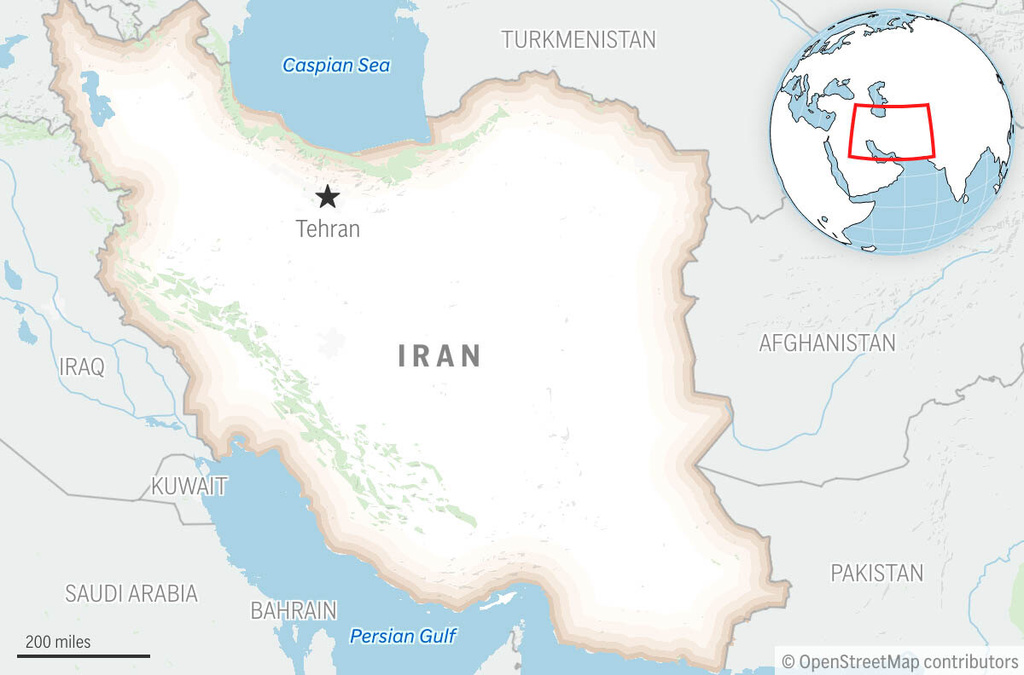
DUBAI, United Arab Emirates — Missile alert sirens blared across Bahrain for the second time Monday as Iran struck back against the United States following a new wave of American airstrikes targeting Iranian territory.
Residents of the island nation, which serves as home base for the U.S. Navy’s 5th Fleet, were warned to seek shelter immediately. No immediate reports of casualties or damage were available following Monday morning’s attacks.
The U.S. military announced it had concluded its most recent round of strikes against Iran after hitting dozens of targets. Iran’s paramilitary Revolutionary Guard confirmed it had begun launching retaliatory strikes in response.
The conflict escalated after the United States launched multiple waves of strikes on Iran stretching into Monday morning. The military action followed an Iranian attack on a container ship in the Strait of Hormuz over the weekend, which set the vessel on fire and left one crew member missing.
Iran’s state media confirmed the latest strikes on Iranian soil early Monday, reporting explosions at several locations and acknowledging at least one death.
The U.S. military’s Central Command said its forces struck dozens of sites, including air defense systems, radar installations, missile and drone equipment, and small boats. The command also addressed the central issue now threatening to reignite the broader conflict — control of the Strait of Hormuz, through which a fifth of the world’s traded oil and natural gas once flowed.
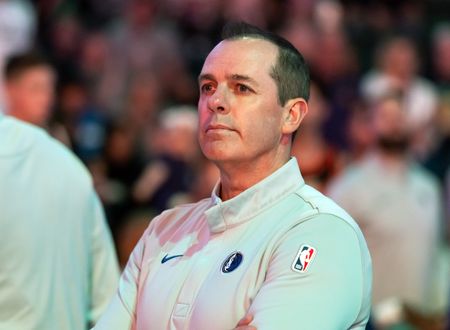
The Golden State Warriors are bolstering their coaching staff by bringing in Frank Vogel as associate head coach alongside head coach Steve Kerr, ESPN reported Sunday.
Vogel steps into the role previously held by Terry Stotts, who departed Golden State’s staff along with Jerry Stackhouse following the 2025-26 season.
The 53-year-old Vogel is best known for guiding the Los Angeles Lakers to the NBA championship in 2020. Most recently, he served as an assistant coach with the Dallas Mavericks last season — his first time on the bench in a non-head coaching capacity after a lengthy run leading teams at the top level.
His head coaching career included stops with the Indiana Pacers from 2011 to 2016, the Orlando Magic from 2016 to 2018, the Lakers from 2019 to 2022, and the Phoenix Suns from 2023 to 2024. He compiled an overall head coaching record of 480 wins and 422 losses, guiding his teams to the playoffs eight times. Among his highlights were back-to-back Eastern Conference Finals appearances with Indiana in 2013 and 2014, before his Lakers squad captured the title during the NBA’s COVID bubble season.
That Lakers championship was the only title the franchise won during LeBron James’ tenure there. James is currently reported to be weighing the Warriors as one of several potential destinations for his next team.
Golden State is coming off one of its most difficult seasons in recent memory, finishing 37-45 — their worst record since 2019-20. The Warriors did earn a spot in the Western Conference play-in tournament, where they defeated the Clippers in their first game before falling to the Suns and being eliminated.
The Boston Red Sox are heading into the All-Star break on a roll, winning their ninth consecutive game Sunday by edging the New York Mets 3-2 in extra innings to close out a three-game interleague series in New York.
Anthony Siegler delivered the go-ahead sacrifice fly in the 10th inning to seal the victory for Boston. The Red Sox had rallied in the ninth, with Andrew Monasterio drawing a bases-loaded walk and Jarren Duran adding an RBI single to force extra innings. Aroldis Chapman earned the win after getting through a ninth-inning threat, and Garrett Whitlock recorded his second save by retiring all three batters he faced in the 10th. Boston’s current streak is its longest since the club won 10 straight last July.
Francisco Lindor was responsible for all of New York’s offense, hitting a run-scoring double in the first inning and a solo home run in the sixth. However, a one-out error by Lindor in the ninth kept Boston’s comeback alive. Rookie Zach Thornton put together a solid outing for the Mets, surrendering just two hits and two walks while striking out five across seven innings in his first appearance since June 26. Brooks Raley took the loss after giving up Siegler’s decisive fly ball.
Pirates 14, Brewers 5
Pittsburgh put up 10 runs in the fourth inning alone to blow past Milwaukee and complete a three-game sweep at home. The Pirates sent 14 batters to the plate in that massive inning, chasing two Brewers pitchers in the process. Starter Paul Skenes allowed two runs on three hits with seven strikeouts over 5 1/3 innings to improve to 8-8. Jared Triolo collected three of Pittsburgh’s 15 hits on the day. Milwaukee starter Robert Gasser fell to 2-4 after giving up seven runs on eight hits in just over three innings. He was filling in for Jacob Misiorowski, who was sidelined with arm fatigue. Jackson Chourio led the Brewers with two hits, including a double.
Orioles 8, Royals 2
Baltimore swept visiting Kansas City in three games, heading into the break riding a season-best four-game winning streak. Leody Taveras homered and later drove in the tiebreaking run, finishing with three RBIs on the day. Samuel Basallo also went deep, Gunnar Henderson had three hits, and Blaze Alexander scored twice. Grant Wolfram picked up the win to move to 2-2. The Royals, now on a five-game skid, collected nine hits from players like Lane Thomas and Bobby Witt Jr. but stranded nine runners on base.
Yankees 5, Nationals 3
New York completed a three-game sweep in Washington, using yet another late-inning rally — this time an eighth-inning comeback — to close out the first half. Ben Rice’s two-run triple in the eighth was the key blow. Ryan Yarbrough improved to 2-0 with the victory, and Paul Blackburn pitched two innings for his first career save. Cody Bellinger had two hits for New York, which has won four straight and enters the break second in the American League East and leading the AL wild-card standings. James Wood homered for the second consecutive day and Curtis Mead also went deep for Washington, which sits fourth in the National League East and remains in wild-card contention.
Phillies 5, Tigers 0
Zach Wheeler was dominant for Philadelphia, striking out 10 over six innings as the Phillies blanked Detroit to head into the break with two straight wins. Wheeler improved to 10-1 on the season. Jose Alvarado, Orion Kerkering, and Jonathan Bowlan each threw a perfect inning of relief to complete the two-hit shutout. J.T. Realmuto paced the offense with two hits, two runs, and three RBIs, while Bryson Stott and Kyle Schwarber each added two hits and an RBI. Detroit starter Tarik Skubal dropped to 5-5 after allowing two runs and four hits over five-plus innings. Riley Greene and Zack McKinstry each had a single for the Tigers’ only hits.
Cubs 8, Reds 4
Alex Bregman went 3-for-4 with a three-run homer in the seventh inning to power Chicago past Cincinnati in the deciding game of their three-game series. Michael Busch added two hits and an RBI, and Kevin Alcantara drove in two for the Cubs, who have won five of their last seven entering the break. Left-hander Matthew Boyd won his third straight start to improve to 5-1, though he allowed four hits and six runs in 6 1/3 innings. Eugenio Suarez homered for Cincinnati, which has dropped three of four. Chase Petty took the loss for the Reds after two-plus innings of work.
Guardians 5, Marlins 2
Cleveland swept Miami at home, with Brayan Rocchio and Chase DeLauter each hitting home runs and Joey Cantillo striking out nine batters over five innings. Rocchio went 2-for-5 with two RBIs and two runs scored, while right fielder Kahlil Watson contributed two hits, an RBI, a stolen base, and an outfield assist. Cantillo improved to 8-4 as the Guardians extended their winning streak to four games entering the break. Miami had entered the series on a six-game winning streak but was swept, scoring just five total runs in three games. Griffin Conine homered and Xavier Edwards had an RBI single for the Marlins. Opener Tyler Phillips dropped to 2-4 after giving up two runs in one inning.
Mariners 8, Rays 2
Seattle salvaged one win from its six-game Florida road trip by beating Tampa Bay in St. Petersburg. Weston Wilson and Randy Arozarena both homered during a four-run fourth inning. J.P. Crawford went 3-for-4 with two doubles, three RBIs, a run, and a walk, while Josh Naylor reached base three times. Starter Emerson Hancock exited in the second inning after fielding a comebacker barehanded, and Jose A. Ferrer stepped in to escape the jam with a key strikeout. Ferrer improved to 2-1 with the win. Jonathan Aranda homered to reach 64 RBIs for Tampa Bay, and Yandy Diaz went 2-for-4. Starter Ian Seymour fell to 6-2 after surrendering six runs — five earned — on six hits in 3 1/3 innings.
White Sox 9, Athletics 1
Rookie Braden Montgomery delivered a career-high four RBIs, including a three-run homer in a six-run first inning, as host Chicago routed Oakland. Sam Antonacci also went deep for the White Sox. Rookie left-hander Noah Schultz picked up his first win since May 1, improving to 3-6 by allowing just one run and four hits over five innings. The Chicago bullpen — Jordan Hicks, Seranthony Dominguez, and Tyler Schweitzer — combined for four hitless innings without issuing a single walk. Shea Langeliers hit a solo shot early to give Oakland a brief lead — the first time the club had led since July 1. Starter J.T. Ginn dropped to 7-6 after allowing eight runs in 4 1/3 innings. The Athletics have now dropped nine straight and 13 of their last 14 games.
Twins 4, Angels 2
Taj Bradley threw seven strong innings and Ryan Jeffers hit a go-ahead two-run double in the third inning as Minnesota beat Los Angeles at home. Bradley improved to 9-3, allowing two runs on six hits with six strikeouts — going 4-0 over his last five starts. Trevor Larnach added an RBI single and a solo homer for the Twins, who have now won five straight series. Josh Lowe and rookie Denzer Guzman each hit solo homers for the Angels, but Los Angeles couldn’t generate more. Starter Jose Soriano fell to 8-6, dropping to 0-2 over his last five outings. The Angels have lost 10 of their last 12 to fall to a season-worst 21 games below .500 at 38-59.
Braves 4, Cardinals 3
A ninth-inning throwing error by St. Louis shortstop Masyn Winn — a Gold Glove winner — allowed the go-ahead run to score, lifting visiting Atlanta to a series-salvaging win after dropping the first two games. JoJo Romero pitched the ninth for the Cardinals, allowing Ozzie Albies’ one-out double. Matt Olson’s groundout moved Albies to third. Romero then hit Michael Harris II with a pitch, a call that prompted St. Louis manager Oliver Marmol to argue and get ejected. Mauricio Dubon followed with a grounder, and Albies scored when Winn’s throw went astray. Raisel Iglesias closed it out with a perfect ninth for his 19th save in 20 attempts. Tyler Kinley earned the win at 5-3 by striking out Winn in the eighth.
Diamondbacks 5, Dodgers 3
Arizona completed a three-game sweep of Los Angeles on the road, with Ildemaro Vargas delivering a go-ahead single in the sixth inning and Tim Tawa adding a home run. Nolan Arenado and Ryan Waldschmidt also drove in runs for the Diamondbacks, who enter the break on a four-game winning streak — their best run since a five-game stretch in May. Mitch Bratt filled in for injured Zac Gallen and allowed three runs in three innings before the bullpen shut down the Dodgers with six hitless frames. Ryan Thompson earned the win at 4-2, and Paul Sewald notched his 22nd save. Shohei Ohtani homered and Tommy Edman had a two-run single for Los Angeles. The Dodgers head into the break at a major-league-best 61-34 despite losing three straight for the first time since a four-game skid in early May.
Rangers 6, Astros 5
Brandon Nimmo capped a 3-for-5 performance with a walk-off single in the bottom of the ninth to give Texas a victory over Houston in the rubber match of their in-state series in Arlington. Nimmo also had an RBI triple earlier in the game. Kyle Higashioka homered for the Rangers, who blew a 4-1 lead but still won. Starter MacKenzie Gore was effective on short rest, allowing just one run over four innings. Jacob Latz improved to 2-1 by escaping a ninth-inning jam with a double play. Cam Smith hit his 12th homer and Jose Altuve blasted his 11th for Houston. Josh Hader dropped to 3-1 after allowing hits to all three batters he faced in the ninth, capped by Nimmo’s walk-off.
Giants 3, Rockies 1
Willy Adames had three hits, including an RBI single in a two-run eighth inning, as San Francisco edged visiting Colorado. Trevor McDonald allowed three hits and one run over seven innings, combining with two relievers on a four-hit complete effort. The Giants scored the decisive runs off Colorado reliever Antonio Senzatela, who fell to 9-2. Erik Miller improved to 1-1 by striking out Mickey Moniak to escape an eighth-inning jam before finishing with a scoreless ninth. Colorado’s Jake McCarthy hit an inside-the-park home run on just the second pitch of the game for the Rockies’ only run. Michael Lorenzen lasted five innings for Colorado, giving up one run and five hits.
Padres 5, Blue Jays 4
Ty France’s sacrifice fly in the bottom of the eighth inning broke a tie and lifted San Diego past visiting Toronto. Manny Machado had three hits on the day, including an RBI single earlier in the eighth that knotted the score. Starter German Marquez went four innings before Adrian Morejon picked up the win at 7-2, and Mason Miller earned his 25th save in as many chances. Toronto’s four runs all came via home runs — solo shots from Nathan Lukes, Ernie Clement, and Jonatan Clase. Clase’s blast in the eighth gave the Blue Jays a 4-3 lead before San Diego responded. Kevin Gausman worked six innings for Toronto, allowing four hits and three runs. Jeff Hoffman dropped to 5-6 with the loss.
A Boston-based drug discovery firm has announced a major new financial agreement with a Chinese pharmaceutical company aimed at tackling diseases of the central nervous system.
Insilico Medicine said that China Medical System will provide up to roughly 1.2 billion yuan — equivalent to approximately $177 million — in milestone payments as part of a joint research and development program in the central nervous system disease field.
According to a statement from Insilico, the collaboration is focused on a “mass-market indication in central nervous system” conditions. The company added that both parties will “jointly advance the co-development of the R&D programme.”
This is not the first time the two companies have worked together. Insilico has previously announced partnerships with China Medical System covering disease areas that include both central nervous system and autoimmune conditions.
When asked about the specific disease targeted by this latest collaboration, China Medical System did not immediately provide a response.
Motorists in the area should be aware that Glenda Road is closed at its intersection with Case Ridge Road due to a tree that has fallen across the roadway.
The closure is expected to remain in place until July 13, 2026, while crews work to address the situation.
Drivers are advised to seek alternate routes and allow extra travel time until the road is reopened.
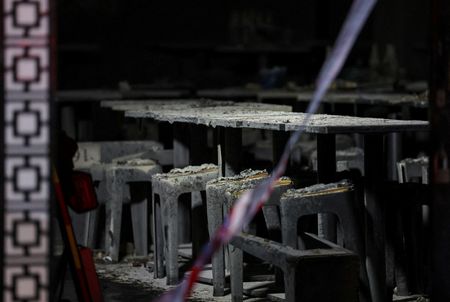
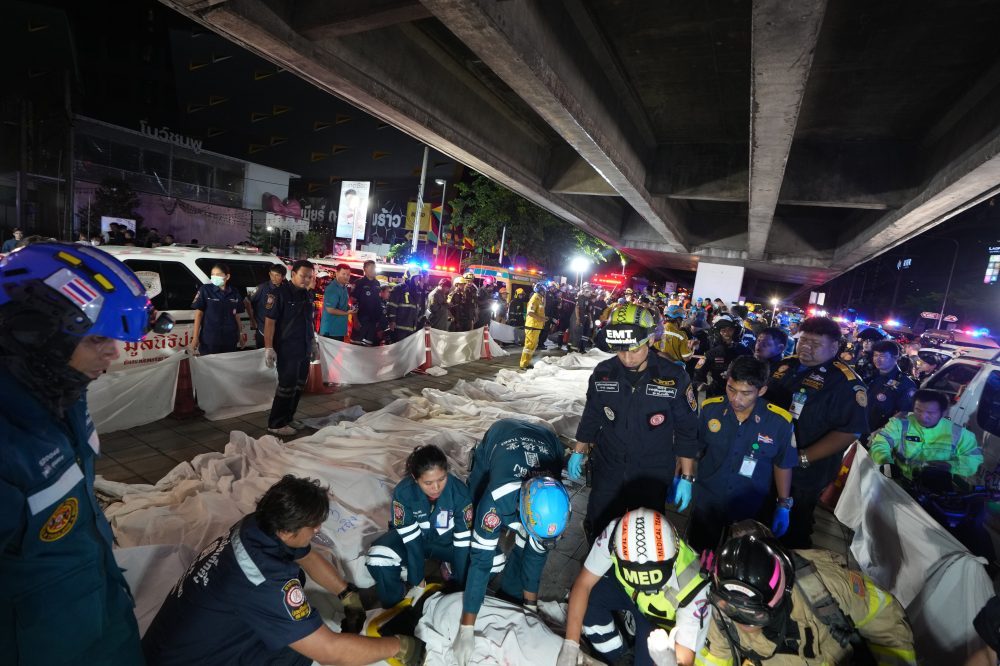
A devastating fire tore through a popular pub in Bangkok, Thailand’s capital city, killing 27 people and leaving 22 others in critical condition, according to officials speaking on Monday.
The tragedy is far from an isolated incident. Thailand has experienced numerous deadly fires over the years, with some of the most notable incidents listed below:
December 29, 2024: A hotel fire near Bangkok’s well-known backpacker district claimed the lives of three foreign nationals — one each from the United States, Brazil, and Ukraine.
October 1, 2024: A school bus transporting more than 40 students and teachers on a field trip burst into flames on the outskirts of Bangkok, killing at least 23 people.
July 30, 2023: An explosion involving firecrackers inside a warehouse in the southern province of Narathiwat, which shares a border with Malaysia, left 12 people dead and more than 100 injured.
August 5, 2022: Fire engulfed the Mountain B night club in the Sattahip district of Chonburi, located roughly 180 kilometers (about 110 miles) southeast of Bangkok. At least 13 people were killed and 35 others were hurt.
July 5, 2021: An explosion at a factory in Samut Prakan province resulted in the death of one firefighter, injuries to 29 people, and the evacuation of thousands of nearby residents.
January 1, 2009: A fire broke out at a Bangkok nightclub packed with New Year’s revelers, killing at least 65 people and injuring more than 200 others.
July 11, 1997: At least 90 lives were lost when fire ripped through a 16-story beachfront hotel in Pattaya, approximately 200 kilometers (about 125 miles) southeast of Bangkok. Authorities determined that a cooking gas explosion in the hotel’s ground-floor cafeteria ignited the blaze, which spread with alarming speed.
May 10, 1993: One of Thailand’s deadliest industrial disasters unfolded at toy manufacturer Kader Industrial in Nakhon Pathom, where a fire killed 188 workers and injured nearly 500 more.
Motorists traveling eastbound on US-40 at Porter Road are facing a temporary lane restriction due to ongoing construction work.
The right turning lane at that intersection is currently shut down, and drivers should plan accordingly when passing through the area.
The closure is scheduled to remain in effect until 6 a.m., at which point the lane is expected to reopen. Drivers are encouraged to allow extra travel time or seek alternate routes until construction activity wraps up.
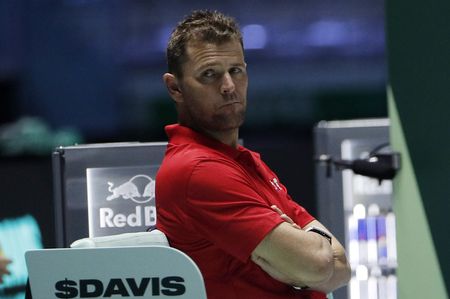
Retired tennis star Mardy Fish may have found his second calling on the golf course.
The 44-year-old Fish captured his third American Century Championship title on Sunday, pulling away from the field with a final score of 72 points at Edgewood Tahoe Golf Course in Stateline, Nevada.
Fish, who reached a career-high ranking of No. 7 in the world during a 15-year tennis career that included six singles titles and eight doubles championships, now has three celebrity golf victories to his name. He finished six points ahead of runner-up Joe Pavelski in the tournament’s modified Stableford scoring format.
Speaking with NBC after the win, Fish reflected on his love for the game. “I think I played the right sport, but I am obsessed with this game,” he said. “I do love playing. This is the best week of the year. It’s the best email of the year when you get the invite.”
Pavelski, a retired hockey player who was attempting to defend his title from the previous year, saw his chances slip away on Hole 17 with a bogey. Needing an eagle on the final hole to catch Fish, Pavelski instead sent his shot into the water, ending his bid for back-to-back titles.
Golden State Warriors star Steph Curry finished third with 59 points. LPGA legend Annika Sorenstam came in fourth with 58 points, and former MLB pitcher John Smoltz rounded out the top five with 55 points.
Here is the full American Century Championship Top 10:
1. Mardy Fish – 72 2. Joe Pavelski – 66 3. Steph Curry – 59 4. Annika Sorenstam – 58 5. John Smoltz – 55 6. Tony Romo – 52 7. Derek Lowe – 50 8. Taylor Twellman – 47 9. Matt Boldy – 43 10. Dwight Freeney – 42
Zack Wheeler isn’t interested in a consolation prize.
The ace pitcher for the Philadelphia Phillies announced he has turned down a late invitation to the MLB All-Star Game, saying the selection committee “disrespected” him through a series of oversights.
Wheeler was left off the All-Star roster when it was officially announced last weekend. To make matters worse, he wasn’t included when replacement players were added on Tuesday either. It wasn’t until Friday that he finally received an invite — as an injury replacement — but by then, the damage was done.
“They disrespected me, so I’m just not going to participate in that thing,” Wheeler told NBC Sports Philadelphia on Saturday.
The veteran pitcher said he didn’t want to be treated as a last resort. “Maybe I didn’t earn it from the get-go, but maybe just second choice,” he said. “Once I feel like they kind of messed that up, I’m out.”
Wheeler, 36, has put together an impressive season despite missing the first month of the year while recovering from thoracic outlet surgery. He has logged 93 innings across 15 starts and has been pitching at an elite level.
His last two outings made a strong case that MLB made a serious error. He matched a career best with 14 strikeouts against the Cincinnati Reds on Tuesday, then followed that up Sunday with six scoreless innings and 10 strikeouts against the Detroit Tigers, outdueling that team’s ace Tarik Skubal.
Sunday’s victory pushed Wheeler’s record to 10-1, and his 2.13 ERA ranks second in the National League, trailing only Jacob Misiorowski.
The three-time All-Star called the midsummer classic a “privilege” and said this particular year would have carried extra meaning given his comeback from surgery.
“It’s personal to me, and I really tried hard to get back to where I was,” Wheeler said. “This is hard work, appreciation of everybody who kind of helped me get back to where I am now.”
Adding another layer to the story, this year’s All-Star Game is scheduled for Tuesday at Citizens Bank Park in Philadelphia — Wheeler’s home ballpark. Despite his absence, six of his Phillies teammates will be on hand to represent the club: Kyle Schwarber, Bryce Harper, Cristopher Sanchez, Jhoan Duran, Brandon Marsh, and late addition Jesus Luzardo.
Minnesota Governor Tim Walz activated state National Guard troops this past Sunday to help fight a series of wildfires burning along the northern edge of the state near the Canadian border.
According to the Minnesota state website, the fires have burned through more than 800 acres over the course of five days and have not yet been brought under control. These blazes are part of a broader wave of wildfires spreading across the United States, fueled by hot and dry weather conditions tied to an El Niño weather pattern affecting the entire continent.
Governor Walz, a Democrat, announced the emergency measure in a statement: “I’ve declared a peacetime emergency and mobilized the National Guard to assist with wildfire response in northern Minnesota. Minnesotans extend our deepest gratitude to all of the first responders working around the clock to keep their neighbors safe.”
Sixteen individual fires are currently burning within the Superior National Forest in northern Minnesota — a popular destination that typically sees around 150,000 visitors during the summer months. The Minnesota Natural Resources Department reported that park rangers spent the weekend escorting visitors safely out of the area.
The National Weather Service noted that elevated temperatures over the weekend added to the already dangerous fire conditions.
Samsung Electronics is working to open its new chip manufacturing facility in Yongin, a city located south of Seoul, South Korea, a full one to two years ahead of schedule, according to a source who spoke with Reuters on Monday.
The chipmaker originally planned to begin operations at the Yongin site between 2030 and 2031, but is now targeting 2029 as the new launch date. The accelerated timeline reflects the company’s effort to meet rapidly growing demand for memory chips that power artificial intelligence infrastructure.
Samsung did not respond to a request for comment from Reuters. South Korean outlet Yonhap News Agency was the first to report on the change in plans, publishing the story on Sunday.
KUBUQI DESERT, China — For the past 50 years, millions of laborers across northern China have performed the same painstaking task: pushing forearm-length sticks into shifting sands, first in one direction, then crossing them to form a grid pattern. Once the grid is in place, young trees are planted at the center of each small square.
This method, called “straw checkerboards,” is a straightforward but highly effective approach to anchoring sand dunes against wind erosion. Combined with irrigation systems that deliver water to the plants, the technique has become central to China’s massive anti-desertification campaign known as the Three-North Protective Forest Program — or more popularly, the Green Great Wall.
Generations of effort have produced real, measurable results, though scientists are quick to point out that protecting those gains will require many more decades of sustained work.
Over a long period, drought, overgrazing, and farming stripped the land of vegetation, damaged the soil, and left vast areas exposed to fierce winds and sandstorms — a process known as desertification. That spread of desert conditions in northern China reached its worst point in 2000, but since then, the amount of desertified land has been reduced by more than 1,000 square kilometers, or about 400 square miles, every year, according to figures released by Chinese state media.
The Chinese government says the program, which got its start in 1978, has been central to transforming enormous stretches of land covering nearly half the country — shifting from a reality of “desertification advancing and people retreating” to one of “greenery advancing and the desertification retreating.” Forests planted under the program now span a total of 500,000 square kilometers, or roughly 200,000 square miles.
“The broad significance of the Three-North Program is not only the scale of restoration, but the long-term political commitment behind it,” said Barron Joseph Orr, chief scientist for the U.N. Convention to Combat Desertification. In written comments to The Associated Press, he noted that turning back desertification is achievable when it becomes embedded in long-term development strategies.
Similar efforts are underway elsewhere in the world. A project launched in Africa in 2007 aims to plant trees across multiple countries to help hold back the expanding Sahara Desert.
According to Zhu Jiaojun, a scientist at the Institute of Applied Ecology within the Chinese Academy of Sciences who has spent years working on the program, the results stem from the dedication of frontline workers combined with strong national planning and significant government funding. He also noted that some regions have seen increased rainfall in recent years, which has made it easier to restore plant life.
“The achievement of desertification combat is due to people’s hard work and a bit of luck with climate,” Zhu said.
Long-term monitoring data collected by Zhu’s research team shows that China’s total desertified land area has shrunk by roughly 10% since 2000, while land classified as severely or extremely desertified has fallen by more than 40%. Forest coverage within the program’s zone has climbed from approximately 5% in 1978 to 14% as of 2022.
During a recent media tour organized by the government to the Kubuqi Desert — located about 800 kilometers, or 500 miles, west of Beijing — a 60-year-old sand-control worker named Yin Yuzhen described her early years on the job as “very lonely.” Working with her husband near her hometown in the adjacent Mu Us desert, she said even the smallest signs of life were a source of joy.
“Even the passing of a bird across the sky made me happy,” she recalled.
She described conditions four decades ago when blowing sand was so dense it was difficult to see even a short distance ahead.
“But now we can see the sun. We can see the green in the distance. We can see the road,” Yin said.
Today, she and her husband work each morning from sunrise until noon, tending to trees and repairing or replacing checkerboard grids. Their children pitch in as well, along with local volunteers from time to time.
Zhu estimated that more than 300 million rural workers have taken part in the program over the years, most of them on a paid, part-time basis.
Orr noted that ecosystems restored in dry regions can gradually become more self-sufficient over time, but they still need careful management and ongoing monitoring. He said success hinges on factors like water availability and soil health.
The environmental group Green Camel Bell, based in Gansu province, works with farmers and herders to raise awareness about desertification and its dangers, plants trees alongside community members in dry areas, and helps sustain vegetation over the long term.
“Efforts to combat desertification and restore forests should be linked to local livelihoods, so communities do not see economic development and ecological protection as an either-or choice,” said the group’s founder, Zhao Zhong.
Orr echoed that view, saying restoration projects are far more likely to succeed when local communities can also benefit economically from the work.
Zhu identified a central question facing the program going forward: how can conservation be maintained if the level of human effort and government investment eventually decreases?
“This is what we are very concerned with and this is also the biggest challenge,” he said.
For Yin, her greatest hope is that younger people will carry on the mission she has devoted her life to.
“We need to teach young people to love this Earth. If we love it with all our hearts, nature will love us in return,” she said.
Shares of SK Hynix tumbled as much as 4.4% during early Monday trading in Seoul, pulling back after the world’s top AI memory chipmaker enjoyed a remarkable first appearance on the Nasdaq exchange last Friday.
The South Korean memory chip company brought in more than $26 billion through the sale of American Depositary Receipts, which were initially priced at $149 apiece. When trading began, the stock opened at $170 — roughly 14% above the offer price — and ultimately closed its debut session with a gain of 12.8%.
South Korea’s benchmark KOSPI index was also in negative territory, down 0.4% as of 0021 GMT on Monday.
The U.S. dollar gained ground against most major world currencies Monday as renewed conflict in the Middle East raised fresh concerns about inflation and pushed traders to anticipate additional interest rate hikes from central banks.
Against the Japanese yen, the dollar edged up 0.1% to 161.92 yen. The euro dipped 0.1% to $1.1403, while the British pound fell 0.1% to $1.3383. The Australian dollar slipped 0.1% to $0.6942, and the New Zealand dollar dropped 0.1% to $0.5757.
The latest market turbulence followed a weekend of heavy military exchanges between U.S. and Iranian forces. Tehran struck U.S. facilities in Gulf states on Sunday and announced it had once again shut down the strategically critical Strait of Hormuz.
When Asian markets opened for the week, oil prices surged — Brent crude futures climbed 3.3% to $78.49 per barrel.
Tony Sycamore, a market analyst at IG in Sydney, explained the connection between the conflict and currency markets. “After the flare-up into the end of last week which continued over the weekend, the dollar has responded, and the crude oil price has been the driver,” he said. “This reinflames concerns that if the energy prices rise from here, we could start to see rate hikes pulled forward.”
Markets are now leaning toward the possibility of two rate increases from the Federal Reserve before the end of the year. According to the CME Group’s FedWatch tool, Fed funds futures are now pricing in a 52.1% chance of two or more rate hikes by the Fed’s December meeting — up from a 47.6% probability as of Friday.
The U.S. dollar index, which tracks the greenback’s performance against a basket of six major currencies, held at 101.07 after climbing as much as 0.2% from Friday’s closing level — reaching its strongest point since July 8.
Analysts at Westpac noted that inflation risks are expected to remain a central focus in the days ahead, with U.S. consumer price index data due Tuesday, producer price figures the following day, and Fed Chair Kevin Warsh scheduled to testify before both chambers of Congress.
Meanwhile, three sources familiar with the Bank of Japan’s internal thinking told Reuters that the central bank may raise its economic growth forecast for fiscal 2026, keeping its attention on the risk that inflation could overshoot expectations. Rising costs tied to a weak yen and strong demand for artificial intelligence are helping to offset some of the decline in oil prices.
In the cryptocurrency markets, bitcoin fell 0.6% to $63,770.42, while ether dropped 1.1% to $1,801.28.
Stock markets across Asia retreated Monday as conflict escalated in the Gulf region and Iran announced it had shut down the critical Strait of Hormuz, causing oil prices to spike and raising fresh concerns about inflation around the world.
The U.S. dollar strengthened alongside bond yields as investors increased the likelihood of the Federal Reserve raising interest rates — just one day before Chair Kevin Warsh is scheduled to appear before Congress for the first time since taking the role.
An inflation report for June, due out Tuesday, may show some easing in the headline rate of 4.2%, partly due to lower gasoline prices — though that relief could be short-lived now that oil is climbing again.
Brent crude surged 3.3% in early trading, reaching $78.50 per barrel and climbing well above its recent low of $70.14. U.S. crude rose 3.4% to $73.83 per barrel.
American officials reported that roughly 20 ships had been guided through the strait over the previous 24 hours, although vessel tracking services showed minimal movement in the waterway.
Stock investors are hopeful that the upcoming earnings season will live up to optimistic projections, with major banks set to begin reporting results on Tuesday. Netflix and General Electric are also expected to release their figures soon.
Analysts at Citi wrote in a research note that “tech continues to screen highly in our models, supported by stand out earnings growth/momentum and attractive valuations.”
The same analysts added, “While AI volatility may remain elevated over the coming quarter, we maintain our Overweight stance on global IT and the U.S. We pair these growth exposures with over weights in cyclical regions/sectors, including Japan, financials and materials.”
Early market moves showed S&P 500 futures slipping 0.3% and Nasdaq futures dropping 0.5%. Japan’s Nikkei index fell 1.0%, following a 1.7% decline last week. The MSCI index tracking Asia-Pacific shares outside Japan dipped 0.2%.
South Korea’s market, which had been on a hot streak, pulled back 0.4% and remained under scrutiny after losing nearly 8% last week as heavily leveraged bets on semiconductor stocks came under strain. The South Korean market has become a closely watched indicator for the global chip industry, meaning further declines there could have wider ripple effects.
South Korean chipmaker SK Hynix saw its U.S.-listed shares jump nearly 14% during their Nasdaq debut on Friday. Separately, news broke after markets closed that Apple had filed a lawsuit against OpenAI and two former employees, alleging theft of trade secrets.
The oil-driven jump pushed 10-year U.S. Treasury yields up 2 basis points to 4.59%. Fed fund futures slipped slightly, pointing to about 34 basis points of policy tightening expected before year’s end.
The dollar index held firm at 101.12. The euro slipped slightly to $1.1403, reflecting Europe’s heavier dependence on imported oil compared to the United States.
Against the Japanese yen, the dollar edged up 0.1% to 161.96, recovering some of the ground it lost Friday after Japanese Finance Minister Satsuki Katayama floated the idea of encouraging the $1.8 trillion Government Pension Investment Fund and other retirement funds to repatriate some of their overseas holdings.
Taylor Nugent, a senior economist at NAB, noted that “the GPIF currently allocates 50/50 between domestic and offshore and a move back even to the pre-pandemic norm closer to 60/40 would come with a large JPY buying flow.”
He cautioned, however, that “while allocations can theoretically be reviewed any time, they tend to be slow moving, and the FY26 investment plan is already in place.”
In commodity markets, the rise in yields weighed on gold, which does not pay interest, sending it down 1.1% to $4,076 per ounce.
Conor McGregor’s highly anticipated comeback to the UFC came to a painful and abrupt end Saturday night when his knee gave out on the very first kick he threw against Max Holloway, with the bout being stopped after just 69 seconds.
McGregor’s coach, John Kavanagh, took to Facebook to address speculation that the fighter may have entered the match already dealing with an injury. Kavanagh firmly rejected that idea.
“Devastated,” Kavanagh wrote. “That opening jump switch kick was drilled daily for months, multiple times in warmup. Never an issue. Knee went when he (threw) the very first kick. Doesn’t get any worse than this.”
After McGregor landed from the kick, his right leg buckled beneath him. He tried to push forward and continue fighting, but was unable to stay on his feet, prompting the referee to step in and stop the contest.
UFC president and CEO Dana White said the organization’s medical team believes McGregor suffered a torn ACL. White also pushed back against social media chatter suggesting the fighter was already hurt before the match started.
“If there was a preexisting injury, somebody would have noticed,” White said. “I don’t think there was. Anything is possible, but he sure didn’t look like it. And for 80 million people (to watch him) on my account alone, that overall number has to be massive. Nobody noticed anything, so, there you go.”
The ending drew painful comparisons to McGregor’s last UFC appearance in July 2021, when he broke his right tibia against Dustin Poirier, also resulting in a doctor’s stoppage at the end of the first round.
McGregor, who turns 38 on Tuesday, addressed his fans directly through his X account in the early hours of Sunday morning, insisting he was fully prepared going into the fight and promising he will be back.
“I was so sharp and so ready for this fight I cannot believe what has happened. The talk of me being off while walking in to the fight is nonsense,” McGregor posted. “I was calm, ready and confident. I am in shock what has taken place. The devil is literally staring at me right in front of my face here. I am not engaging. I will be at church tomorrow.”
He closed his message with a defiant pledge: “I will overcome this. I will not be deterred. I will return.”
Alexander Zverev came agonizingly close to Wimbledon glory on Sunday, but the German star says the aggressive game plan that got him to the final is the key to eventually catching up with men’s tennis powerhouses Jannik Sinner and Carlos Alcaraz.
Zverev, 29, will move up to second in the ATP world rankings on Monday after pushing world number one Sinner hard before falling 6-7(7) 7-6(2) 6-3 6-4 in the Centre Court final. It was his 10th consecutive loss to the Italian, but this one was a genuine battle from start to finish.
A pivotal moment came in the third set when Zverev stumbled and fell at 3-3 during his only break point opportunity of the match. Had he converted, he might have become the first German man to claim the Wimbledon singles title since Michael Stich did it in 1991.
The Wimbledon final came just weeks after Zverev broke through for his first Grand Slam championship at the French Open — his 41st major attempt. Some observers have noted that Sinner was eliminated in the second round at Roland Garros and that Alcaraz missed the tournament entirely due to an ongoing wrist injury.
The confidence Zverev gained from his Roland Garros victory was on full display at Wimbledon, where a noticeably more aggressive style — particularly with his forehand — carried him to his deepest run ever at the grasscourt major.
“I’ve said it at the beginning of the year, and I’ve stuck to it. That’s the tennis I want to play. That’s the game style I want to play,” Zverev told reporters. “There were matches in the beginning of the year where I was struggling a bit more with this style, but I was consistently doing it. The more I do it, the better I’ll become.”
“I won a Grand Slam for the first time in my career in Paris. I made it to the finals here for the first time in my career. Of course, something has to be working.”
During the final, Zverev’s first serve landed in at roughly 80% throughout much of the match, while his forehand — once considered too cautious — was deployed with real force against Sinner.
“When I have the opportunity, I hit it. Whether I make it or miss it, that depends on the day. But I definitely go for it,” he said. “That’s my goal, that’s my aim for this year, that’s my aim for hopefully the rest of my career.”
With Sinner and Alcaraz combining for 12 Grand Slam titles between them, Zverev is confident he belongs in that conversation.
“I think I’ve been pushing those guys. I haven’t beaten them this year, but I’ve pushed them to the limits, I would say,” Zverev said. “Alcaraz in Australia, Jannik maybe here. Even though it was four sets, I think it was a very close four sets, which could have gone five as well.”
“There was always this conversation who will be the third guy, the search for the third guy. Kind of the last couple years, I’ve always been the third guy, but I was just far away from those two. If I get closer to them, if I can be in the mix, competing and winning the big tournaments, it would be great.”
Zverev also addressed the fall that disrupted his momentum in the third set, revealing it affected his ability to serve effectively.
“I over-extended my knee again, similar to two years ago. I was struggling to push off on the serve a little bit. So my serve speed went down,” he said. “But everything else went fine. I think the fall didn’t help me in the third set. My level dropped a little bit. But then I picked it up in the fourth again. Overall I thought it was quite high level throughout.”
Route 1 northbound is closed at Exit 104 following a crash, according to Delaware’s Department of Transportation.
Motorists traveling in the area are urged to avoid the roadway and plan for alternate routes until the closure is lifted. No additional details about the crash or a timeline for reopening have been provided at this time.
Drivers should stay alert for updates from DelDOT as conditions change.
Delaware Route 1 northbound has been closed just north of Exit 104 following a crash, according to Delaware transportation officials.
Motorists traveling in the area are advised to plan for delays and consider using alternate routes until the roadway is cleared and reopened.
No further details regarding the crash, including the number of vehicles involved or any injuries, have been made available at this time. Updates are expected as the situation develops.
If you’ve ever dreamed of owning a real Tyrannosaurus rex, Tuesday’s auction could make that happen — if you have about $30 million to spare.
A T. rex fossil going by the name “Gus” is scheduled to go up for bidding at Sotheby’s in New York City. A press preview of the skeleton was held on July 1, giving the public a glimpse of the massive prehistoric specimen before it goes to the highest bidder.
The sale of “Gus” is far from the first time dinosaur remains have been put on the auction block. The practice of selling fossil bones to private collectors has become an increasingly familiar event in the world of high-end auctions.
BRUSSELS — European Union foreign ministers are gathering Monday to assess how much backing exists among member nations for new steps to restrict trade with Israeli settlements in the occupied West Bank, according to diplomats and officials familiar with the discussions.
The talks will center on a confidential document prepared by the European Commission that outlines three possible approaches: an import licensing system, steep tariffs designed to discourage trade, or an outright ban. A senior EU diplomat and a European official confirmed the existence and general contents of the paper.
The EU has historically found it difficult to make sweeping decisions on Middle East policy, largely due to deep and longstanding disagreements among its 27 member nations — especially when it comes to the Israeli-Palestinian conflict.
However, pressure within the bloc to act on the settlement issue has intensified in recent months, driven by growing violence from Israeli settlers and mounting frustration with Israeli Prime Minister Benjamin Netanyahu’s government, which has continued to expand settlements in the region.
The EU took action in May, imposing sanctions on four organizations and three individuals over what it characterized as serious and systematic human rights violations against Palestinians in the West Bank.
In July 2024, the International Court of Justice issued an advisory opinion stating that Israel’s occupation of Palestinian territories and its settlement activity in the West Bank are illegal. The court also said that other nations should take steps to avoid trade or investment relationships that help sustain that situation.
Israeli Foreign Minister Gideon Saar previously called efforts by some European governments to act on that advisory opinion “shameful.”
United Nations bodies and the majority of countries around the world consider Israel’s West Bank settlements to be illegal. Israel disputes this position, viewing the land as contested territory and pointing to a Jewish historical presence in the region spanning thousands of years.
One diplomat, speaking anonymously to discuss the confidential internal process, described what to expect from Monday’s session: “I think what you will see on Monday is a discussion on the options, and we will get a bit of a picture of where everybody is.”
Diplomats noted that no formal vote or binding decision on any specific measure is anticipated from Monday’s meeting.
The divisions among EU members also touch on the procedural question of how any decision would be reached. Some diplomats argue that a trade ban could be approved with a qualified majority — meaning at least 15 EU member states representing 65% of the bloc’s population. However, the Commission’s paper appears to suggest that a ban might require unanimous agreement among all members, a threshold that would make approval far less likely.
European Commission spokesperson Paula Pinho confirmed that the paper was shared with member countries but declined to discuss its specific contents.
A familiar last name could soon be returning to the New York Yankees organization.
During the conclusion of the 2026 MLB Draft held Sunday in Philadelphia, the Yankees used their eighth-round selection on Luke Pettitte, a 21-year-old two-way player from Dallas Baptist University — and the son of longtime Yankees pitching great Andy Pettitte.
Andy Pettitte himself was drafted by New York in the 22nd round back in 1990, going on to become one of the franchise’s most celebrated pitchers over 15 seasons. He earned three All-Star selections and five World Series rings during his time with the Yankees (1995-2003, 2007-13) and the Houston Astros (2004-06).
Now his son Luke has the opportunity to carve out a path of his own. This past spring, Luke Pettitte hit .337 with 16 home runs for Dallas Baptist. He served as the team’s designated hitter throughout the season because Tommy John surgery on his right arm kept him off the mound in 2026.
Yankees skipper Aaron Boone learned the news from reporters after a game in Washington on Sunday, and his reaction was enthusiastic. Andy Pettitte was once his teammate, and Boone said the connection runs deep.
“Heck yeah. Andy’s become a real good friend now, and obviously he’s not here right now but they know he’s around a lot and a big part of our staff and our culture,” Boone said. “And getting to know Luke and his journey and his story. Having Tommy John and going out raking in college this year. … Looking forward to seeing his journey unfold. He’s a great kid. That’s great news.”
Sunday’s action covered rounds 5 through 20 of the draft. The Colorado Rockies kicked things off by selecting high school right-hander Tyler Putnam with the first pick of the fifth round.
Among the most talked-about selections of the day was first baseman Rintaro Sasaki, taken in the eighth round by the Miami Marlins. Sasaki made a name for himself by breaking Japan’s all-time high school home run record with 140 long balls. He relocated to the United States in 2024 and went on to play two seasons of college baseball at Stanford.
Whether Sasaki will actually sign with Miami remains uncertain. He was also selected in the first round of the Nippon Professional Baseball draft last fall by the Fukuoka Hawks, giving him options on both sides of the Pacific.
The Los Angeles Angels grabbed Oklahoma shortstop Jaxon Willits in the fifth round. Willits is the older brother of Eli Willits, the No. 1 overall pick in the 2025 draft by the Washington Nationals, and the son of former Angels outfielder Reggie Willits, who played for the club from 2006 to 2011. Jaxon Willits was named Most Outstanding Player of the College World Series last month.
One of his Oklahoma teammates, catcher Deiten Lachance, was taken in the sixth round by the Cleveland Guardians.
Rounding out the notable picks, Carsten Sabathia III — son of another former Yankees ace — was chosen in the 20th round, though not by New York. The Milwaukee Brewers drafted the younger Sabathia, who plays first base.
Arizona Diamondbacks right-handed pitcher Zac Gallen has been shut down and placed on the 15-day injured list after developing inflammation in his throwing elbow, the team announced Sunday.
Gallen first told team staff about the discomfort on Saturday, which led to him being scratched from his scheduled Sunday start against the Los Angeles Dodgers at their home stadium. The 30-year-old was sent back to Phoenix on Saturday to undergo imaging, which confirmed the issue.
Arizona manager Torey Lovullo spoke with reporters but said no timetable has been established for when Gallen might return to action.
The injury arrives at a difficult point for Gallen, who carries a 3-9 record and a 6.34 ERA on the season. His recent performances have been especially rough — he has not picked up a win in eight straight starts, going 0-5 with an 8.24 ERA during that span.
Lovullo offered some perspective on Gallen’s situation, saying the pitcher had been pushing through discomfort without saying much. “Zac will be able to give you a little bit more detail as to exactly how he was feeling outing to outing,” Lovullo said. “But he was taking the baseball, and I don’t think he was throwing the ball terribly. I know that there were some moments where it was touch-and-go for him, but he’s a warrior.”
The manager continued: “He just wanted the ball, and then I think he felt something, he spoke up and that’s why we decided to get him examined.”
Gallen’s most recent appearance came last Tuesday in a 4-1 defeat to the San Diego Padres, where he surrendered four runs on six hits across six innings, suffering his fourth loss in a row.
The setback is a stark contrast to where Gallen was just two years ago. In 2023, he earned an All-Star selection and posted a career-high 17 wins. Over his career — which includes time with the Miami Marlins in 2019 and the Diamondbacks from 2019 through 2026 — he holds a 69-61 record with a 3.83 ERA across 195 starts.
To fill Gallen’s spot in the rotation, Arizona recalled left-hander Mitch Bratt from Triple-A Reno. The 23-year-old started Sunday’s game against the Dodgers, allowing three runs and three hits over three innings. He walked three batters and recorded no strikeouts in what was his second appearance in the major leagues.
Six relievers followed Bratt to the mound and collectively threw six hitless innings, helping Arizona secure a 5-3 victory that completed a three-game sweep at Dodger Stadium.
It was a short night for Conor McGregor inside the octagon, but the UFC 329 main event still shattered records at the betting window. Max Holloway finished McGregor in just over a minute, yet the fight generated more MMA wagering than any other event in BetMGM’s history.
BetMGM trading manager Alex Rella confirmed the milestone, saying, “Conor McGregor-Max Holloway was the most-bet MMA event in BetMGM history. There was heavy action on McGregor as an underdog in his return fight. Holloway winning was a good outcome for the sportsbook.”
McGregor was returning to the UFC for the first time in more than five years, and bettors rallied behind him despite his underdog status. He opened at +250 and entered fight night at +240, yet still attracted 88% of all fight bets and 81% of the total money wagered. Holloway, the -300 favorite who had opened at -345, drew only 12% of bets and 19% of the money.
The fight came to an end at the 1:09 mark of the opening round when Holloway (28-9 MMA) stopped McGregor (22-7 MMA) via TKO. McGregor suffered an injury to the same right leg that had sidelined him following his trilogy bout with Dustin Poirier at UFC 264 back in July 2021.
While Holloway winning by KO, TKO, or disqualification was available at -145, the single most popular prop bet across the entire main card was actually McGregor winning by KO, TKO, or DQ — offered at +275.
The event also ranked as the second-most wagered combat sports event in BetMGM’s history, surpassed only by the Jake Paul versus Mike Tyson matchup.
The full card featured 14 bouts, capped by a five-fight main card. In the co-main event, Paddy Pimblett (24-4 MMA) strengthened his lightweight title credentials by submitting Benoit Saint-Denis (17-4, 1 NC MMA) with a D’arce choke just 52 seconds into round one.
Pimblett’s win turned out to be the most bettor-friendly result of the evening. He pulled in 87% of bets and 77% of the money as the +110 underdog. The prop bet for Pimblett to win by submission — offered at +500 — was the most popular wager on that fight.
Life is imitating art for Cristo Fernandez, the actor who spent years pretending to be a professional soccer player on television — because he just became one for real.
Fernandez, widely recognized for his recurring role as Danny Rojas on the popular streaming series “Ted Lasso,” stepped onto the field for El Paso in a USL Cup match against New Mexico United this past Saturday. He entered the game as a substitute in the 79th minute, picked up a yellow card, and ended the night on the losing side of a 2-0 final score.
Before fame found him through acting, the 35-year-old had already put in serious time on the pitch as a young player, competing with Tecos FC in Liga MX. Injuries, however, cut that career short and sent him down a different path — one that eventually led to Hollywood.
His road back to professional soccer began earlier this year when he tried out for the Chicago Fire’s reserve squad. That opportunity opened the door to a second tryout with El Paso, which ultimately resulted in a contract.
Fans of “Ted Lasso” will instantly recognize the phrase that defined his character: “Football is life!” Fernandez reflected on those words in a May interview with ESPN.
“Football has given me both the best moments, the sad moments,” he said. “I guess that’s why, for me, football is life.”
A deadly highway crash in the Mexican state of Jalisco claimed nine lives and left approximately ten people injured on Sunday, according to Civil Protection authorities. The collision was caused by a tractor-trailer and involved multiple vehicles.
Two of the victims who lost their lives were minors. Among the injured, two members of the National Guard sustained serious injuries and were rushed to Magdalena Hospital in Guadalajara for treatment.
Video footage shared on social media by local news outlets captured the aftermath of the wreck, showing multiple vehicles engulfed in flames along a highway that connects the cities of Guadalajara and Tepic.
All four of the injured American citizens were reported to be in minor condition. “Four patients in minor condition, all U.S. citizens, were transferred to the Arboledas Hospital in Guadalajara by a private ambulance from the highway,” Jalisco Civil Protection said in a statement.
The release of a jailed pastor by Chinese authorities this month has brought renewed attention to how Beijing treats Christians. The pastor leads one of China’s largest unregistered, or underground, house churches — congregations that refuse to comply with the government’s requirement that Christians worship only in officially approved, state-registered churches. China’s ruling Communist Party, which holds atheism as its official position, considers organized religion a potential challenge to its authority. Under President Xi Jinping, the government has pushed a campaign to “Sinicize” religion, demanding that faith communities demonstrate loyalty to the party. Despite ongoing crackdowns, underground churches continue to grow rapidly.
Egypt’s government has announced a major archaeological find — a well-preserved city from the Byzantine era, discovered in the country’s western desert. The Tourism and Antiquities Ministry says the settlement contains numerous buildings and inscriptions that reflect the strong presence of Christianity in the region during the fourth and fifth centuries A.D. A basilica church dating to the 300s stands at the entrance of the site, overlooking the main streets, with the ruins of two watchtowers that once guarded the city’s edges. Researchers have identified one home as belonging to a man named Tisous (pronounced TISS-oos), who served as a church deacon during that period.
A new survey from AP-NORC is shedding light on the divisions within American Jewish communities when it comes to Israel. The poll found that Jews who are religiously affiliated tend to view support for Israel as a core part of their identity, while those who are not religiously affiliated are more likely to be critical of Israel’s actions. The wide-ranging survey covered topics including views on Israel, anti-Semitism, and tensions in personal relationships. While supporting Israel remains important to many Jewish adults, how central it is compared to other aspects of Jewish identity varies widely — and disagreements over Israel are clearly creating rifts within Jewish communities across the country.
Christian missionaries from the evangelical organization Cru — which rhymes with “true” — are now spreading their message in VRChat, a widely used social platform where millions of people worldwide connect through digital avatars. As virtual spaces become an increasingly significant part of people’s social lives, Cru’s missionaries are adapting traditional outreach methods to meet people where they spend their time. Through VRChat, users can visit thousands of virtual worlds to talk, play games, and — in the missionaries’ case — hear about the Christian faith. Cru was founded in 1951 under the name Campus Crusade for Christ and has long focused on evangelism and faith development among younger generations.
WASHINGTON — After weeks of mounting public curiosity and speculation, Sen. Mitch McConnell has come forward to explain that a fall was behind his recent hospitalization. The 84-year-old Kentucky Republican broke his silence Sunday in a written statement, saying he was “briefly unconscious” around the time he was first admitted to the hospital.
McConnell said he underwent extensive testing to determine what caused the fall and disclosed that he was also treated for mild pneumonia during his hospital stay. He has since been transferred to a rehabilitation facility to continue his recovery.
“My doctors have confirmed that I didn’t break any bones or suffer a concussion. I didn’t have a heart attack or a stroke. I don’t have any tumors or hemorrhages,” McConnell said, noting that he is now “regaining my strength.”
When asked why he waited nearly four weeks to share details about his condition, McConnell offered a personal explanation: “Folks of my generation often hesitate to share the vulnerability that comes with growing older.” He added, “Even in the public eye, I feel that same instinct — I can’t help it.”
The senator said he has not yet returned to the Senate chamber but is continuing to work with his staff on legislative matters. His statement was accompanied by a photo showing him smiling alongside his wife, Elaine Chao — an apparent response to online rumors suggesting he had died or was severely incapacitated.
Disclosure Came Under Growing Pressure
Since McConnell was first hospitalized on June 14, his office had offered little beyond saying he was “receiving excellent care” and getting better. As weeks passed without further detail, public pressure intensified. Kentucky’s Democratic Gov. Andy Beshear took the unusual step last week of sending an open letter urging McConnell to update the public in a “transparent manner.”
McConnell is set to retire at the end of January, capping one of the most significant careers in modern American politics. Republicans have nominated U.S. Rep. Andy Barr to succeed him, while Democrats have put forward former state lawmaker Charles Booker. Despite his health struggles, McConnell made clear he plans to see out the remainder of his term.
“I still have unfinished business to complete on your behalf,” McConnell wrote, addressing Kentuckians directly, “and I have every intention of finishing the job you elected me to do.”
A Long History of Health Challenges
McConnell contracted polio as a young child and has long acknowledged that it has made walking and climbing stairs more difficult as an adult. The physician’s office for Congress confirmed Sunday that McConnell has “experienced several falls through the year” as a result of his “post-polio condition” and said his physical therapy is focused on lowering the risk of future falls.
“A comprehensive evaluation by a multidisciplinary team determined that he had no fractures, cardiac abnormalities, stroke, tumor, or hemorrhage,” the congressional physician’s office stated.
McConnell was first elected to the Senate in 1984 and served as the Republican leader from 2007 until last year, holding both the majority and minority leader roles during that stretch. He has continued showing up for Senate sessions as a rank-and-file member, frequently using a wheelchair to move around the chamber.
His physical health has noticeably deteriorated in recent years. In March 2023, he suffered a concussion after falling at a Washington hotel and missed several weeks of work. After returning, he twice appeared to freeze during press conferences, staring blankly while colleagues and staff looked on. A year after that, he fell and sprained his wrist while leaving a Republican luncheon.
DUBAI, United Arab Emirates (AP) — American forces launched multiple rounds of strikes against Iran on Sunday, responding to an Iranian assault on a container ship in the Strait of Hormuz that ignited the vessel and left one crew member unaccounted for. Iran struck back by targeting Bahrain, Kuwait, Qatar, Jordan, and Oman — the nation sharing the other side of the strait that Tehran has been pushing to partner with in controlling ship traffic through the waterway.
The U.S. military released a statement saying its goal was to reduce Iran’s capability to freely attack commercial vessels passing through the vital strait. That statement followed a third wave of strikes that extended from late Sunday night into early Monday morning inside Iran.
Iranian state media acknowledged the latest round of attacks early Monday but reported no deaths or harm to civilian infrastructure in the regions near the strait. Whether any military targets were successfully hit remained unclear at that time.
The initial strikes Sunday morning came in direct response to Iran’s attack on a container ship in the waterway the previous day. Iran then launched retaliatory strikes against Gulf Arab nations, setting off a cycle of escalating violence that pushed ongoing peace negotiations between Tehran and Washington dangerously close to falling apart.
A second round of U.S. strikes followed later Sunday. The governor of Qeshm Island, located near the strait, told Iran’s state-run IRNA news agency that projectiles had been fired at military targets without causing any casualties. Residents also reported hearing explosions in the coastal city of Bandar Abbas and in Hajiabad, a city to the north.
A U.S. official, speaking without authorization to comment publicly on military activities, said a limited number of strikes were aimed at missile and air defense systems as well as paramilitary Revolutionary Guard watercraft.
The conflict comes as Iran and the U.S. are roughly halfway through a 60-day interim agreement designed to lead to a permanent end to the war. The Strait of Hormuz — long regarded as an international waterway and a critical corridor for the world’s oil and natural gas supply — has become a major point of contention in negotiations that now appear at serious risk of breaking down.
United Nations Secretary-General António Guterres warned that “a return to full-scale hostilities would have catastrophic consequences,” according to an official statement.
Earlier Sunday, the U.S. military reported hitting approximately 140 targets, which included missile and drone launch sites, weapons storage depots, communications equipment, and other facilities. The intensity of the attacks surpassed those seen in recent days. Over the past week, the U.S. has conducted three rounds of airstrikes on Iran in response to attacks on ships traveling through the strait via a route along Oman’s coast, which ships have been using to avoid Iranian territorial waters.
“We bombed the hell out of them last night,” President Donald Trump said in an interview on NBC’s “Meet the Press.”
Semiofficial Iranian news outlets reported that a navy officer was killed in the strikes. Iran retaliated by attacking regional nations that host U.S. military personnel, while maintaining its position that it alone must control the strait and may require ships to pay fees to pass through it.
“The era of one-sided deals is OVER,” wrote Mohammad Bagher Qalibaf, the speaker of Iran’s parliament and a key negotiator. “We told you: keep your word or pay the price. Reality is knocking.”
Iran declared the strait closed until the situation stabilizes and warned it could strike “additional enemy bases in the region” if attacks continued. The U.S. military and President Trump both maintained that the strait remained open for navigation.
The U.S. military reported that more than 140 ships had passed through the strait over the previous week. A multinational organization under U.S. Navy oversight said vessel traffic was continuing “at reduced levels” along routes near both Oman and Iran, noting that nearly 140 ships had been transiting daily before the war began.
Prior to the war, roughly one-fifth of all globally traded oil and natural gas moved through the strait. Iran’s control over the waterway triggered a worldwide energy crisis, though oil prices have fallen sharply from wartime peaks of $120 per barrel.
Qatar’s military announced it had intercepted incoming Iranian fire, with explosions also reported in the neighboring United Arab Emirates. Three individuals, including a child, sustained injuries from shrapnel during the interception, according to Qatar’s Interior Ministry.
Missile alerts were triggered in Bahrain, which is home to the U.S. Navy’s 5th Fleet.
Kuwait’s Defense Ministry reported that three northern land border posts and an offshore drilling platform operated by the Kuwait Oil Company were damaged, with one worker injured.
Three Iranian missiles struck locations across Jordan, causing minor damage but no reported injuries, according to Jordan’s state news agency.
Oman’s state news agency reported that drones hit sites along the waterway — just one day after Oman and Iran had held talks about the strait and agreed to keep talking. The strait runs through the territorial waters of both Iran and Oman. Oman called in the Iranian ambassador to formally protest the strikes, the first such diplomatic action since the war began, and labeled Iran’s actions “irresponsible.”
The Cyprus-flagged container ship struck by Iran sustained “significant engine room damage,” according to the U.S. military. Oman’s maritime authority said it rescued 23 crew members, but one remained missing. India’s foreign ministry identified the missing individual as an Indian national.
The United Kingdom Maritime Trade Operations center, which operates under British military oversight, confirmed the ship had been traveling along Oman’s coastline at the time of the attack.
Iran’s Revolutionary Guard claimed that multiple vessels “disregarded our warnings” and failed to follow what it described as an approved route, saying one ship “was struck by a warning shot and brought to a stop.”
Iranian state media subsequently reported U.S. strikes across the country, including in southern Iran in the province nearest the strait and at military installations in a province close to Tehran.
President Trump suggested last week that the interim ceasefire deal was “over,” but mediating nations including Pakistan, Qatar, and Egypt have continued working toward a resolution. A regional official involved in the mediation effort, speaking anonymously to discuss the sensitive talks, said efforts to preserve the ceasefire continued on Sunday. Pakistan confirmed that its foreign minister spoke by phone with Iran’s top diplomat and called for “de-escalation” from both sides.
Iran’s new supreme leader, Ayatollah Mojtaba Khamenei, who had not been seen publicly since the war began, issued his first statement Saturday since the funeral of his father, Ayatollah Ali Khamenei. He vowed that Iranians would seek revenge for his father’s death, which occurred in the war’s opening strikes on February 28.
Some buildings quietly hold history within their walls. At Berggasse 6 in Vienna, Austria, that history is anything but quiet.
The structure, built in the mid-1850s, is owned by the Catholic Schottenstift Abbey. Its ground floor is home to a pizzeria run by a Palestinian owner. And from 1896 to 1898, the building served as the residence of Theodor Herzl, one of the founding figures of modern Zionism. Adding yet another layer to its complex past, several Jewish residents connected to the building were later deported and killed during the Holocaust.
A commemorative plaque honoring Herzl stands near the building — unveiled by Israeli President Isaac Herzog just one month before the October 7 massacre. The plaque has since been vandalized with red markings.
Where Zionism Became a Movement
On January 6, 1897, Herzl wrote in his diary: “The road from Palestine to Paris is beginning to pass through my room.” Though he lived at the address for only two years, his apartment in Vienna’s 9th District became a critical hub for the push to establish a Jewish state.
Dr. Daniel Polisar, executive vice president and co-founder of Shalem College in Jerusalem, described the apartment’s significance to The Media Line: “In a very real sense, his home was also the central office of the Zionist movement. But you could also say that from his home, he built the Jewish state. A large number of the most important meetings took place there. A lot of the most important work took place there. A lot of his writing took place there.”
Polisar, who served as the founding chairman of the National Council for the Commemoration of the Legacy of Theodor Herzl, called the period Herzl spent at the building “the peak of his activity.” During those years, Herzl launched the newspaper Die Welt, organized the First Zionist Congress in Basel in 1897, and later coordinated activities for the newly established World Zionist Organization — including hosting its executive meetings — all from that address.
Herzl also received diplomatic figures there. A diary entry dated December 13, 1896, included a letter in which he offered to welcome Prussian Minister of War Julius von Verdy du Vernois to his home to argue the case for a Jewish state. He also met with Jewish community leaders including Dr. Joseph Samuel Bloch, an Austrian parliamentarian and rabbi; Rabbi Sigmund Gelbhaus, a Galicia-born scholar then active in Vienna; Sigmund Mayer, a Viennese Jewish merchant and communal leader from Pressburg; and J. K. Poznanski of Łódź, a wealthy Russian Polish Jewish industrialist.
The Residents Who Never Escaped
Decades after Herzl moved out, the building became linked to a far darker chapter. At least three Jewish residents were deported from Berggasse 6 and murdered during the Holocaust.
Hugo and Irene Roden were deported on July 14, 1942, to Terezín — the ghetto and concentration camp located in what is now Czechia. Of the 1,009 people on their transport, 950 perished, including Hugo. Irene was among 59 survivors of Terezín, but she was later sent to Auschwitz, where she was killed. The exact dates of their deaths remain unknown.
Three days after the Rodens were deported, Camilla Tandler was also removed from the building. She died at Auschwitz, her date of death also unknown.
Heinrich and Adele Kurtz, who had lived in the building in 1919, applied in 1939 for permission to emigrate to Mandatory Palestine, where Jewish immigration was controlled by British authorities at the time. They never made it to safety. Heinrich was transported from Terezín to Treblinka in September 1942, where he was killed. Adele died on February 23, 1942 — four months before her husband was deported from a different Vienna address. The cause of her death is not known.
A Palestinian Owner Beneath It All
Today, the closest most visitors can get to Herzl’s former apartment is Pizzeria Valentino, the restaurant occupying the building’s ground floor.
The irony of the address is hard to miss. The work Herzl did in the floors above, nearly 130 years ago, helped shape the life of the restaurant’s current owner — Hakim Hadid, a Palestinian.
In the very building where Zionism evolved from an idea into an organized political movement, Hadid keeps a framed photograph of himself with Yasser Arafat, the longtime leader of the Palestine Liberation Organization and later president of the Palestinian Authority. Hadid said he had known Arafat since the age of 12, through an uncle who had a close relationship with the former leader.
When asked how he felt about the building’s history, Hadid told The Media Line simply: “Not good.”
Born in Nablus, the 67-year-old Hadid moved to Libya as an infant. He later came to Vienna to pursue a master’s degree at the Technical University of Vienna, but left the program after two years. He has now worked at the pizzeria for 43 years, spending the last 18 as its sole owner.
Hadid said visitors — including Israelis — frequently stop in to ask about the building’s past. He said he simply wants to be left in peace, adding that he sometimes gets the sense that people want him gone, and that Israelis “have already taken my house” in the West Bank. He also questioned why so much attention was paid to Herzl’s brief stay, given that he himself had been at the location for roughly four decades longer.
In his back office, taped near a printer, hangs a newspaper photo of Israeli Prime Minister Benjamin Netanyahu beneath the German headline “Haftbefehl gegen Netanjahu” — which translates to “Arrest Warrant for Netanyahu.”
Despite the weight of his personal history, Hadid said he believes peace between Israelis and Palestinians is possible — a Palestinian state existing alongside a Jewish one. He views Israel as an “illegal” state, but acknowledges the reality that it is not going away.
He summed up his view of coexistence not as something warm, but as something unavoidable.
“We cannot kill all the Israelis,” Hadid said.
Interview translation provided by Prabhu Guptara and Clemens Öllinger.
French counterterrorism prosecutors launched a formal investigation on Sunday after police uncovered a military-style rifle, a loaded handgun, and ammunition inside an abandoned car parked near a synagogue in Sarcelles, a suburb north of Paris with a well-known Jewish population. The discovery triggered the evacuation of roughly 300 people on Saturday night.
Domestic intelligence officials tipped off police to the suspicious vehicle on Rue Henri Dunant at approximately 9:30 p.m., citing concerns it could be connected to a potential attack targeting the Jewish community. Officers set up a security perimeter and cleared out patrons from nearby restaurants and a movie theater while bomb-disposal experts examined the car.
No explosives were found inside the vehicle. According to French reports, investigators recovered a rifle loaded with seven rounds and a handgun containing 10 rounds. The operation wrapped up just before midnight. As of the latest reports, no arrests had been announced, and authorities were working to identify anyone linked to the vehicle and determine why the weapons were left there.
French Interior Minister Laurent Nuñez confirmed that investigators had recovered “a long firearm, a military-grade weapon.” When asked whether authorities believed an attack had been imminent, he responded, “We simply don’t know.”
Nuñez clarified that the vehicle was found in the general area of the Great Synagogue of Sarcelles, not directly outside it. The surrounding neighborhood also includes restaurants and entertainment venues, leaving investigators uncertain whether the synagogue, another nearby location, or no specific site had been chosen as a potential target.
Sarcelles has historically been home to one of France’s most prominent Jewish communities and has faced antisemitic incidents in the past, including attacks on Jewish-owned businesses during protests in 2014.
The investigation comes amid an ongoing struggle with antisemitism in France. The Interior Ministry recorded 1,320 antisemitic incidents in 2025 — a 16% drop from 2024 — but that figure remains significantly higher than levels seen before the October 7, 2023, Hamas attack on Israel and the subsequent war in Gaza.
Authorities have not established a motive and have not confirmed that any attack was actually being planned.
Motorists traveling along Route 2 should be aware of an overnight lane restriction currently in effect.
The right lane on DE-2 in both the eastbound and westbound directions is closed between Pike Creek Road and Milltown Road. The closure is expected to remain in place until 6 a.m.
Drivers are encouraged to allow extra travel time or consider alternate routes until the lane reopens.
VINA DEL MAR, Chile — A member of the Chilean navy who was off duty drove his personal vehicle into a crowded open-air market in the coastal city of Vina del Mar on Sunday, leaving several people dead, according to an official statement from the navy.
Video footage shared on social media, captured by a residential security camera, appears to show the moment the vehicle slammed into the market stalls. Additional videos show the driver being hurried into a nearby police car as furious bystanders chased after him.
“The accident resulted in the deaths of several people and left others with injuries of varying severity,” the navy said in its statement, noting that the branch is working alongside authorities to determine exactly what led to the crash.
While the navy did not specify the exact number of fatalities, local media in Chile reported at least six people had died. Hospital officials at Gustavo Fricke Hospital confirmed five injured individuals — among them two babies — were admitted with various traumatic injuries that were not considered life-threatening. Two additional injured people were treated and released.
“At this stage of the evaluation, they are stable and out of life-threatening danger, but of course they are still awaiting the completion of all the examinations required in these cases,” said Denise Cataldo, the hospital’s deputy director.
Interior Undersecretary Máximo Pavez confirmed that the navy member — the sole person detained in connection with the incident — tested negative on a breathalyzer.
Col. Jorge Guaita, the police prefect for Vina del Mar, told reporters that the driver claims to have no recollection of what happened, and that investigators have not yet determined the cause of the crash.
“Witness statements from people who saw the crash indicate that the vehicle was traveling in the correct direction of traffic, at high speed,” Guaita said. He added that the car jumped onto the sidewalk and spun around before coming to a stop. “Fortunately, the bus stop brought it to a halt. Otherwise, it might have continued forward and caused even more damage,” he said.
Some witnesses told local media they believe the driver may have lost control after a collision with another vehicle.
Chilean President José Antonio Kast addressed the tragedy on X, writing that the incident had plunged “the entire country in mourning.” He added: “All state institutions are working to assist those affected and to establish with complete clarity the responsibilities for this painful event.”
The Caupolican market, where the crash occurred, is a large open-air market held every Thursday and Sunday in the upper section of Vina del Mar. It features more than 1,000 vendor stalls along with informal sellers in the surrounding streets, and typically draws large crowds of shoppers.
WASHINGTON — After weeks of mounting public speculation, Sen. Mitch McConnell has finally opened up about his health, disclosing Sunday that a fall was responsible for sending him to the hospital.
The 84-year-old Kentucky Republican said in a written statement that in addition to the fall, he also came down with a mild case of pneumonia. Doctors have put him through an extensive round of tests to figure out what triggered the fall in the first place.
McConnell addressed why he had stayed quiet about his condition for nearly a month, saying that people of his generation tend to guard their vulnerabilities when it comes to aging. “Even in the public eye, I feel that same instinct — I can’t help it,” he said.
The senator confirmed he is currently recovering at a rehabilitation facility and is not ready to return to the Senate floor just yet. He said he has continued to stay engaged with his staff on Senate matters during his absence.
Alongside his statement, McConnell’s office released a photo showing him smiling alongside his wife, Elaine Chao — widely seen as a direct response to online rumors that he had died or was severely incapacitated.
McConnell had been hospitalized on June 14, with his office offering only minimal updates, saying he was “receiving excellent care” and getting better. Concern grew so widespread that Kentucky’s Democratic Gov. Andy Beshear took the rare step of writing a public letter urging McConnell to update the public in a “transparent manner.”
McConnell is set to retire when his current term ends in January, closing out one of the most influential careers in modern American politics. Republicans have tapped U.S. Rep. Andy Barr to run for his seat, while Democrats have nominated former state lawmaker Charles Booker.
The senator contracted polio as a young child and has long acknowledged that walking and climbing stairs has been a challenge for him as an adult.
The congressional physician’s office stated Sunday that McConnell has “experienced several falls through the year” connected to his “post-polio condition.” The physical therapy he is undergoing is designed to lower his risk of falling again.
“A comprehensive evaluation by a multidisciplinary team determined that he had no fractures, cardiac abnormalities, stroke, tumor, or hemorrhage,” the physician’s office said.
McConnell first won his Senate seat in 1984 and led Senate Republicans from 2007 until last year, serving at various times as both majority and minority leader. Since stepping down from leadership, he has continued showing up for Senate sessions, frequently using a wheelchair to get around.
His physical health has noticeably deteriorated over recent years. In March 2023, he suffered a concussion after falling at a Washington hotel and missed several weeks of work. After returning, he twice froze during public news conferences, staring blankly ahead while colleagues and staff looked on. A year after that episode, he fell again and sprained his wrist while walking out of a Republican luncheon.
A woman named Melissa arrived in South Africa a decade ago, taking whatever jobs she could find and sending money back to her family in Zimbabwe. This month, she began packing her bags.
“I am planning to go back home, because I’m no longer safe in this country,” she told The Media Line. She noted that many of those departing had been living there legally. “Some of us have papers, but now we are forced to go.”
Melissa is one of tens of thousands of foreign nationals who have departed South Africa as anti-immigrant demonstrations, scattered violence, and fears of further unrest have rippled across the country. What started as a domestic dispute over immigration has grown into a full-blown diplomatic crisis for a nation whose post-apartheid foreign policy has long championed Pan-African unity.
Several neighboring countries — including Ghana, Mozambique, Malawi, Zimbabwe, and Nigeria — have assisted their citizens in returning home while voicing alarm over their safety. By early July, Malawi reported bringing back more than 38,000 of its nationals, while Zimbabwean officials said more than 60,000 citizens had returned during the unrest and stepped-up immigration enforcement.
Anti-immigrant groups set June 30 as a deadline for undocumented foreigners to leave, following weeks of confrontations and attacks. Mozambique reported that five of its citizens were killed in Mossel Bay in late May. Ghana and Nigeria each raised concerns about the deaths of their nationals, while thousands of migrants lined up at consulates, temporary camps, and repatriation centers.
March and March, the most prominent group within a coalition of more than 20 anti-immigrant organizations, organized demonstrations across South Africa on June 30. Its leader, Jacinta Ngobese-Zuma, has consistently pushed back against characterizations of the movement as xenophobic.
“We don’t care if it’s white people, Chinese or anyone else,” Ngobese-Zuma said at a June 24 press briefing in Midrand. “We just want people to be in the country legally.”
President Cyril Ramaphosa met with protest organizers ahead of June 30 and urged them to pursue their grievances through lawful means. In a weekly letter released by the Presidency on June 29, Ramaphosa acknowledged that South Africa’s immigration system needed “substantial reform” and said the government was working to strengthen border security and crack down on undocumented immigration. He also cautioned that private citizens and groups cannot take on powers that belong to the state.
Police and military personnel were deployed across the country on June 30.
Deputy National Police Commissioner Tebello Mosikili told reporters at a July 1 press conference that officers recorded 120 marches that day. Of those, 108 remained peaceful while 12 required police intervention.
In Johannesburg’s Alexandra township, one person was shot and killed late on June 30 as residents looted shops owned by foreigners. A separate shooting in Hillbrow, in the heart of Johannesburg, left two people wounded. Police arrested more than 900 individuals on charges that ranged from public violence and robbery to immigration violations and harboring undocumented migrants.
On July 3, Ramaphosa informed Parliament that 3,405 members of the South African National Defense Force had been deployed beginning June 28 to assist police.
The unrest has also sparked questions about how South Africa’s internal tensions square with its long-held Pan-African foreign policy commitments.
Chrispin Phiri, spokesperson for the Department of International Relations and Cooperation (DIRCO), told The Media Line that the government does not believe the unrest signals an abandonment of those principles.
“Our commitment to the continent remains foundational to our foreign policy identity,” Phiri said. “We do not see our historical role as a champion of Pan-African solidarity as diminished by localized tensions, but rather as being tested.”
DIRCO views the unrest, he said, “not as an ideological failure of Pan-Africanism, but as an urgent domestic governance issue that requires a human-rights-centric response.”
Since the end of apartheid, South Africa has sought influence through the African Union and the Southern African Development Community, while holding up human rights and international law as cornerstones of its foreign policy.
Loren Landau, a migration scholar at the University of Oxford and the University of the Witwatersrand, told The Media Line that the protests reveal something deeper than frustration over immigration policy.
“My greatest takeaway from the marches and the lead-up to them is that they are less about immigration and more about the nature of South African politics,” Landau said, “and the degree to which it has become captured by people willing to use the language of hate, threats of violence, and actual violence to shape the country’s political future.”
“Politicians who lack genuine or practical solutions to economic inequality, poverty and unemployment are using immigration to advance their political careers,” he argued.
Phiri said the government is working to resist populist pressures while defending its regional standing.
“As Minister Lamola has recently articulated, we reject populist or xenophobic narratives that seek to turn Africans against each other,” he said. “Our standing relies on our ability to openly confront these internal social challenges while remaining steadfast in the AU and SADC agendas.”
Ronald Lamola, the minister of international relations and cooperation, expressed that position in a May 8 statement after Ghana requested a debate at an African Union summit on what Accra described as xenophobic attacks against African nationals in South Africa.
XenoWatch, a research project at the University of the Witwatersrand, has documented 1,321 xenophobic incidents since 1994, including 698 deaths and the displacement of nearly 129,000 people.
John J. Stremlau, an honorary professor of international relations at the University of the Witwatersrand, told The Media Line that political calls for tougher immigration enforcement cannot simply be brushed aside.
“We live in a world of nation-states,” he said. “South Africa has experienced an inflow of people who are desperate for work. South Africa remains one of the most unequal societies in the world, so political pressure to restrict illegal immigration is understandable.”
“Personally, I wish South Africa could afford to receive more refugees, but it can’t,” he added.
Even so, Stremlau made clear that economic and political pressures do not justify attacks on migrants.
“The violence itself is not understandable,” he said, connecting part of the political climate to Zulu nationalism and figures including former President Jacob Zuma and his MK party.
The diplomatic friction has been intensified by conflicting accounts of deaths involving foreign nationals.
Nigeria raised concerns over the deaths of two of its citizens in separate incidents involving South African security personnel in April. In early May, Nigerian Foreign Affairs Minister Bianca Odumegwu-Ojukwu called the deaths “utterly condemnable and unacceptable” and demanded that justice be served.
South African police said on July 7 that one of the men, Nnaemeka Matthew Andrew Ekpeyong, collapsed after being arrested by officers during a drug-related operation at his apartment in Pretoria. Police said the death had no connection to anti-migrant violence. The Independent Police Investigative Directorate is looking into the matter, and South Africa has asked Nigeria to submit evidence regarding allegations against its security forces through official diplomatic channels.
Ghana has also disputed South Africa’s account of the death of one of its citizens. Ghanaian authorities identified the man as Bashiru Isak, 40, and said he was killed in Cape Town during the period of the June 30 protests, calling for an independent investigation.
South African police said they had no record of a murder in Khayelitsha matching Ghana’s description and asked for more details. Police said the Ghanaian death they were investigating involved Kwabena Boagen, 35, who was shot on June 29 in Nyanga, outside Cape Town. They characterized that case as suspected extortion-related violence rather than a xenophobic attack.
Justice Minister Mmamoloko Kubayi has said police records showed no deaths during the June 30 demonstrations.
Phiri confirmed that DIRCO had received formal communications from several African governments regarding the safety of their citizens.
“Receiving these concerns is standard diplomatic practice during periods of social friction,” Phiri said. “We welcome this direct engagement, as it allows us to counter disinformation with verifiable facts about our domestic stabilization efforts.”
On July 7, Ghana postponed high-level bilateral meetings with South Africa that had been set for August.
Ghana’s minister of state for government communications, Felix Kwakye Ofosu, told Reuters that anti-migrant violence risked overshadowing the meetings, which Ghana was scheduled to host and which Presidents John Dramani Mahama and Cyril Ramaphosa were expected to co-chair.
Phiri pushed back against reports framing the postponement as a diplomatic snub directed at Ramaphosa.
“We want to explicitly correct the record here. There was no ‘snub.’ Neither the Presidency nor DIRCO requested a formal state visit that was subsequently declined by Accra,” he said. “We recognize that relations have experienced some strain due to broader concerns over anti-immigrant rhetoric on the continent.”
He added that Minister Lamola remained in “continuous, constructive communication with his Ghanaian counterpart to strengthen our historical bilateral bonds.”
The diplomatic strain actually began before the June 30 demonstrations. In May, African ambassadors and high commissioners did not attend South Africa’s Africa Day celebration.
The protests have not stopped since June 30. Ngobese-Zuma had promised weekly demonstrations for six months, and protesters returned to the streets in Johannesburg, Soweto, and Durban on July 9.
Reuters journalists in Alexandra reported that protesters entered or tried to force open homes and businesses while searching for suspected undocumented migrants, removing some individuals and handing them over to police.
Among those taken was a Malawian woman carrying a child. A Zimbabwean man told Reuters he held legal status under the Zimbabwe Exemption Permit.
Some flyers promoting the July 9 demonstrations advertised a “peaceful march” followed by “door to door.”
The government has repeatedly stated that only official state authorities have the legal power to arrest, deport, or determine a person’s immigration status.
South Africa’s migrant population is deeply woven into the construction, agriculture, retail, and transportation sectors. United Nations data from 2024 estimated that 2.6 million international migrants live in South Africa, making up roughly 5% of the population. A 2018 study by the Organisation for Economic Co-operation and Development and the International Labor Organization estimated that immigrants contribute about 9% of the country’s gross domestic product.
Landau warned that the reputational damage from the unrest could hurt South African companies doing business elsewhere on the continent.
“South African businesses will find it harder to operate because their brand has been damaged,” he said. “Many countries now have alternatives, and I think they will increasingly choose non-South African options where possible.”
Landau described the June 30 security deployment as “unfortunately necessary” but said authorities had allowed tensions to fester through an extended period of inaction.
“It came after a long period of non-response,” he said.
The long-term solution, he argued, requires broader negotiations “about how migration can strengthen the regional economy for everyone.”
Meanwhile, South Africa is ramping up immigration enforcement. Justice Minister Kubayi said at a July 12 briefing that 53,449 foreign nationals had been processed for deportation or repatriation as of the previous day. Authorities deported 4,898 people in June alone.
As for Melissa, her mind is made up. After a decade in South Africa, she is heading back to Zimbabwe.
“My family calls me every day and tells me to come home as soon as I can,” she said. “So now I’m going back to Zimbabwe and starting over. I know it won’t be easy. Even finding work there is difficult.”
Sheikh Hamad bin Khalifa Al Thani, the former Qatari emir who steered his nation from a regional player to a major international force across 18 years of rule, passed away at the age of 74, according to state media reports released Sunday. Qatar’s government-run news agency confirmed the death but offered no information regarding the cause.
Sheikh Hamad came to power in 1995 by ousting his father, Sheikh Khalifa, in a peaceful palace coup. He governed the country until June 2013, when he voluntarily stepped aside and transferred authority to his son, Sheikh Tamim bin Hamad Al Thani — a relatively rare act of voluntary abdication in the region.
Throughout his tenure, the energy-wealthy nation grew its global footprint considerably. Among his most notable achievements was the founding of the Al Jazeera satellite news network. Qatar also made significant overseas investments, including a stake in London’s Harrods department store, and won the bid to host the 2022 FIFA World Cup.
Sheikh Hamad charted an independent course in foreign affairs, cultivating relationships with Iran, Hamas, and Egypt’s outlawed Muslim Brotherhood — moves that created friction with certain regional neighbors and Western partners. At the same time, Qatar became home to a critical Pentagon logistics hub following the September 11, 2001 attacks and the subsequent U.S.-led military campaigns in Afghanistan and Iraq.
Qatar also carved out a role as a neutral mediator in several international disputes, including conflicts involving Sudan’s Darfur region, rival Lebanese political factions, and the competing Palestinian groups Hamas and Fatah.
In October 2012, Sheikh Hamad made history by becoming the first head of state to set foot in the Gaza Strip since Hamas had taken control five years prior. During the visit, he pledged $400 million in development projects and investments. Earlier, in 2007, he had met with Israel’s then-Foreign Minister Tzipi Livni at the United Nations General Assembly. Qatar had permitted Israel to maintain a trade office in its capital, Doha, until closing it in response to Israeli military operations in Gaza in late 2008.
When the Arab Spring swept the region, Qatar dispatched warplanes to support NATO-led operations against forces loyal to Muammar Gaddafi in Libya and provided both military assistance and financial backing to Libyan rebel groups. The country also emerged as a leading political supporter of opposition forces fighting then-President Bashar Assad in Syria.
In the period just before his abdication, Sheikh Hamad oversaw the formal opening of an official office for Afghanistan’s Taliban in Qatar, a move that eventually paved the way for negotiations between the Taliban and the United States.
When Sheikh Hamad announced he was stepping down, he addressed the Qatari people with a message of optimism: “The future lies ahead of you, the children of this homeland, as you usher into a new era where young leadership hoists the banner.”
New York City Mayor Zohran Mamdani has committed to updating the city’s official “Immigrant Enclaves” map — including adding Little Italy — after a wave of criticism from ethnic communities who say the map fails to honor their place in the city’s history.
The map currently highlights 30 neighborhood enclaves and is being featured as part of the city’s Neighborhood Passport campaign, a promotional effort connected to the 2026 FIFA World Cup.
Mayor Mamdani explained that the map was originally created in 2023 by the previous administration and was never designed to represent all of New York City’s more than 200 ethnic communities. He noted that his administration had already added several neighborhoods to the map and intended to keep making updates.
“When we inherited it, we added a few additional neighborhoods. It’s clearly not an exhaustive list of the more than 200 ethnic communities that call our city home. We are going to be making additional changes in the future to reflect that,” Mamdani said. He added that those future changes would include Little Italy.
The mayor’s announcement came one day after the City Council’s Italian Caucus — whose members are all Republicans — accused the Democratic mayor’s administration of “erasing” Italian Americans. The caucus called the map “incomplete at best and insulting at worst,” according to the New York Post.
Staten Island Borough President Vito Fossella broadened the criticism, pointing out that the map also failed to include Jewish American communities in Brooklyn and Sri Lankan communities on Staten Island, among other groups.
“Ignorance is not a good ingredient for highlighting the sacrifices of so many who built this City and gave so much,” Fossella said in a written statement.
A spokesperson for former Mayor Eric Adams pushed back on Mamdani’s claim that the prior administration was to blame for the omissions, according to ABC New York.
The New York Post also reported that the Adams administration had previously recognized 27 immigrant communities through separate illustrated projects that spotlighted neighborhood businesses, religious sites, and cultural landmarks. The newspaper reported that the Mamdani administration replaced those detailed projects with a simplified citywide map that added three communities but stripped away much of the neighborhood-specific content. The new map was also reported to contain errors in its public transit information.
Jordan and Bahrain found themselves increasingly entangled in the widening fallout from renewed US-Iran hostilities this weekend, as Iran unleashed another round of missiles and drone strikes targeting American military facilities and countries where US forces are stationed — a response to sweeping US military strikes carried out inside Iran.
The latest round of fighting represents a major escalation of clashes that first reignited on July 8 and 9, and has effectively gutted the memorandum of understanding that Washington and Tehran had signed on June 17. Iran once again announced that the Strait of Hormuz was closed to traffic, though the United States disputed that claim, stating that commercial shipping continued to move through the waterway.
US forces conducted strikes targeting Iranian missile installations, naval assets, communications infrastructure, and a range of other military targets. The conflict is placing mounting pressure on Gulf governments, which are struggling to maintain a careful balance between their own security needs and the demands of regional diplomacy.
U.S. Senator Mitch McConnell issued a statement on Sunday indicating that he is not yet ready to resume his duties in the Senate chamber.
The senator has been away from the Senate following a hospitalization, and his Sunday statement makes clear that his return remains on hold for the time being.
Northbound travelers on South State Street at South DuPont Highway, also known as Route 13, are facing a right lane closure due to ongoing construction activity.
The lane restriction is expected to remain in effect until 2 PM. Drivers in the area should anticipate possible delays and consider alternate routes if available.
Motorists are encouraged to slow down, stay alert, and follow any posted signs or instructions from traffic control personnel in the construction zone.
Drivers traveling along Summit Bridge Road (Route 896) should be aware of an active trash operation taking place in the shoulder and median of the roadway.
The work is affecting both northbound and southbound lanes between Pulaski Highway (Route 40) and Route 71, and is expected to continue until 3:00 PM.
Motorists passing through the area are urged to remain alert and watch for workers and equipment along the roadside.
The United States carried out its third round of military strikes against Iran early Sunday morning, aiming to weaken Tehran’s capacity to threaten sailors and commercial ships in the region. The action came after Iran’s Islamic Revolutionary Guards Corps attacked a container ship traveling through the Strait of Hormuz, according to the US military.
In response to the American strikes, Iran reported multiple explosions across several locations in its southern territory, while the IRGC announced it had targeted US military and logistics facilities in Qatar, Kuwait, Jordan, and Oman using missiles and drones.
US Central Command stated that the latest round of American strikes was a direct response to the Iranian attack on the GFS Galaxy, a Cypriot-flagged container ship passing through the Strait of Hormuz. The crew was forced to abandon ship and take to a lifeboat following the attack.
“A civilian crew member is missing, and a fire broke out on the ship, causing significant damage to the engine room, preventing it from continuing its voyage,” US Central Command said in a statement.
The Revolutionary Guards later announced they had also struck a second vessel they claimed had violated their border in the strait.
The US military accused Iran of violating a memorandum of understanding between the two countries, stating that “the strikes are intended to continue degrading its ability to attack sailors and commercial vessels.”
US Defense Secretary Pete Hegseth took to X to respond, writing, “Iran made a poor choice, and now it is paying the price.”
Iranian media outlets reported explosions in Bandar Abbas, Sirik, Qeshm Island, and Chabahar. Three blasts were recorded in Bandar Abbas and two in Sirik, both located in southern Iran near the Strait of Hormuz. Iran’s PRESSTV also reported explosions in Bushehr and Asaluyeh. The IRGC said US forces struck multiple military bases, communication towers, and infrastructure along Iran’s southern coastline.
The IRGC claimed to have hit Al Udeid Air Base in Qatar, saying it destroyed a “fighter jet maintenance center and command and control center.” The group also said it attacked a US military radar installation in Kuwait as part of its retaliatory operation.
In Jordan, the IRGC claimed it destroyed a command and control center along with hangars housing MQ-9 drones at Prince Hassan Air Base. The group further announced it had “destroyed American-owned logistics centers supporting ships and refueling docks for aircraft carriers at the port of al-Duqm in Oman.”
Qatar confirmed it had intercepted a missile attack after explosions were reported in its capital, Doha. The country’s Defense Ministry said it was continuing to manage the ongoing missile threat, while the Interior Ministry elevated the security alert level and instructed residents to stay inside, avoid going outdoors, and keep away from windows and open areas.
Qatar’s Interior Ministry reported that three people, including a child, suffered injuries from falling shrapnel during the interception of Iranian attacks.
The United Arab Emirates announced that its air defense systems were “currently operating against a missile and drone threat from Iran.” Bahrain’s Interior Ministry also reported attacks and air raid sirens, with Arab media outlets confirming additional explosions in the country.
Jordan’s military reported that three missiles fired from Iran landed within its borders, resulting in no deaths and only minor property damage. The Jordanian military issued a firm statement: “Jordan’s forces will not allow the kingdom’s airspace or territory to be turned into a conflict zone and will deal firmly with any threat to the state’s sovereignty, territorial integrity and the security of its citizens.”
Adding to the regional tension, the Revolutionary Guards Navy declared the Strait of Hormuz closed until further notice after firing a warning shot at a vessel it said was attempting to pass through an unauthorized route. The IRGC stated the closure would remain in place “until American interference in the region ceases,” warning that any “wrong move by the enemy will be met with a severe response.”
Iranian Parliament Speaker Mohammad Bagher Ghalibaf shared a photo on X showing Article 5 of the memorandum of understanding between Iran and the United States, along with a pointed message: “The era of one-sided deals is over. We told you: keep your word or pay the price. Reality is knocking on the door.”
Article 5 of the agreement reads: “Iran will act and make every effort to ensure safe passage of commercial vessels free of charge for 60 days only from the Persian Gulf to the Sea of Oman and vice versa. Iran will conduct dialogue with the Sultanate of Oman to define the future administrator and maritime services in the Strait of Hormuz.”
Good Sunday, Delmarva! We’re wrapping up the weekend with a comfortable night ahead. Expect partly cloudy skies this evening with a low around 66°F — a pleasant break before the heat builds back in. A light southeast breeze of up to 10 mph will keep things feeling fairly nice outdoors.
Heading into Monday, sunshine takes over and temperatures climb to a warm 83°F. It’s a great day to get outside, but don’t forget the sunscreen! Monday night stays mostly clear with a refreshing low of 64°F — perfect sleeping weather with the windows open.
Looking ahead to Tuesday, we’re cranking things up a notch. Sunny skies return, but so does the heat, with highs pushing up to 89°F. Stay hydrated, seek shade during peak afternoon hours, and check on neighbors and pets as we head deeper into this summer warmth.
Stay cool out there, Delmarva — I’ll have updates throughout the day right here on TV Delmarva!
U.S. Senator Lindsey Graham, the South Carolina Republican who spent 30 years in Congress becoming one of the nation’s most prominent voices on national security, judicial matters, and foreign policy — and a fierce advocate for Israel — passed away Saturday following what his office described as a brief and sudden illness. He was 71 years old. His family has asked for privacy and said details about funeral arrangements would be shared at a later time.
Graham had a distinguished background before entering politics, having served as a lawyer and Air Force officer. He retired from the Air Force Reserve at the rank of colonel after 33 years of service. He was first elected to the U.S. House of Representatives in 1994 and then won a Senate seat in 2002. Over the following two decades, he rose to become a top Republican voice on defense and intelligence issues, serving on the Senate Judiciary, Appropriations, and Budget committees. He led the Senate Judiciary Committee from 2019 to 2021 and, more recently, chaired the Senate Budget Committee.
Throughout his career, Graham was known for his sharp wit, his occasional willingness to reach across the aisle, and his later close partnership with President Donald Trump. He played a central role in major national debates over Supreme Court nominations, military policy, immigration, and U.S. foreign relations. Earlier in his congressional tenure, he served as one of the House managers during President Bill Clinton’s impeachment trial. As Judiciary Committee chairman, he oversaw the confirmation of Justice Amy Coney Barrett and was heavily involved in other Supreme Court nomination fights. He also made an unsuccessful bid for the Republican presidential nomination in 2016.
Graham’s impact was perhaps most visible in the Middle East. He approached the region through a national security perspective, consistently arguing that the United States had a strategic duty to support its allies, push back against Iran, and fight extremist groups. He became one of the most frequent congressional visitors to Israel over the course of his career, holding repeated meetings with Israeli prime ministers, military commanders, and security officials.
In the wake of Hamas’s October 7, 2023 attack on Israel, Graham became one of the Senate’s loudest advocates for expanding U.S. military support, imposing tougher sanctions on Iran, and taking stronger action against Tehran’s regional allies. He repeatedly made the case that Israel’s security and America’s own strategic interests were fundamentally linked.
His backing of Israel went beyond military assistance. Graham championed the Abraham Accords and pushed for normalization between Israel and Saudi Arabia, believing that broader Arab-Israeli cooperation could transform the region and undercut Iranian influence. He also cultivated strong ties with Gulf leaders, making frequent trips to the region and calling for deeper U.S. partnerships with Arab allies.
Graham’s aggressive foreign policy stance earned him both admirers and critics. He supported U.S. military involvement in Afghanistan and Iraq, backed ongoing American efforts against the Islamic State, and repeatedly contended that diplomacy on its own could not stop Iran from developing nuclear weapons. Supporters credited him with consistency and a willingness to confront threats head-on, while detractors saw him as one of Washington’s leading proponents of military intervention.
On the domestic front, Graham was seen as a skilled lawmaker who could sometimes bridge divides within his own party. Though firmly conservative, he occasionally broke from Republican positions on issues like immigration reform and criminal justice, especially earlier in his Senate career. His political journey — from close ally of Sen. John McCain to one of Trump’s most dependable congressional supporters — made him one of the defining Republican figures of his era.
Even in the final year of his life, Graham remained actively engaged in Middle East diplomacy, describing the region as standing “on the verge of previously unimaginable change” and calling for sustained U.S. leadership.
Whether viewed as a principled defender of American allies or criticized as an unapologetic champion of military intervention, Lindsey Graham left a lasting imprint on the U.S. Senate and on American foreign policy. Few members of Congress shaped the national conversation about the Middle East as persistently — or as powerfully — as he did.
LONDON — World No. 1 Jannik Sinner secured his second consecutive Wimbledon championship Sunday, defeating Alexander Zverev 6-7 (7), 7-6 (2), 6-3, 6-4. The victory marks Sinner’s fifth Grand Slam title overall and his 10th consecutive win over Zverev. Zverev appeared to struggle with a knee problem after slipping on the grass during a critical moment in the third set. The win was especially meaningful for Sinner, as it came in his first tournament following a difficult exit at the French Open. Zverev, who had just claimed his first Grand Slam crown at the French Open, fell short in his bid to add Wimbledon to that achievement. In the women’s final on Saturday, Linda Noskova defeated fellow Czech player Karolina Muchova to capture her first Grand Slam title.
Zverev Looks Ahead After Wimbledon Runner-Up Finish
LONDON — Despite the loss to Sinner on Centre Court Sunday, Alexander Zverev says he believes he is closer than ever to breaking through at the top of the sport. Zverev has long been considered a step behind Sinner and Carlos Alcaraz in the Grand Slam conversation. “I think I’ve been pushing those guys,” Zverev said, adding that this is the first time in his career he genuinely believes he could win Wimbledon.
World Cup Semifinals Feature Four Former Champions
ATLANTA — The World Cup semifinal stage is shaping up to be one of the most memorable in recent history. France, Spain, England, and Argentina — all previous champions and the four highest-ranked teams in the world — are each two wins away from lifting the trophy again. It marks the first time since 1990 that all four remaining teams in a World Cup have previously won the tournament. England and Argentina, both of whom were in that 1990 semifinal, will face each other on Wednesday. France and Spain meet in the other semifinal on Tuesday, featuring a matchup between Kylian Mbappé and Lamine Yamal.
Sánchez, Cease Named All-Star Starters
Cristopher Sánchez of the Philadelphia Phillies will take the mound for the National League in Tuesday night’s MLB All-Star Game, which is being played at his home ballpark. He will face American League starter Dylan Cease of the Toronto Blue Jays, who was announced as the AL’s pick on Sunday. National League manager Dave Roberts of the Los Angeles Dodgers confirmed Sánchez as his choice. In a separate development, New York Yankees manager Aaron Boone initially said pitcher Cam Schlittler would not participate in the All-Star Game, but later in the day both Boone and Schlittler indicated the right-hander might be available after all.
Flewelling Named MVP in All-Star Futures Game
PHILADELPHIA — Tampa Bay Rays prospect Nathan Flewelling slugged a two-run home run and was named MVP as the American League topped the National League 6-1 in the All-Star Futures Game. The 19-year-old catcher is considered the second-best prospect in the Tampa Bay organization. He and fellow Tampa Bay prospect Theo Gillen combined to drive in three runs. Philadelphia Phillies minor leaguer Gage Wood started the game for the National League, giving up one run in one inning. Former Phillies outfielder Shane Victorino managed the NL squad, while Larry Bowa managed the AL. Historically, 86.8% of Futures Game participants have gone on to appear in at least one major league game.
Royal Birkdale Offers New Challenges at British Open
SOUTHPORT, England — Royal Birkdale is hosting the British Open for the first time in several years, and players arriving for practice Sunday found a noticeably different course than in the past. Golfer Peter Uihlein was puzzled by the 241-yard 15th hole before discovering it was an entirely new addition. Fairways have been repositioned, and the fifth hole has been redesigned. Beyond the course changes, the conditions themselves stand out — hot, dry weather has left the links turf yellowed and parched from the sun.
Ryu Wins Evian Championship for Second Straight Major Title
EVIAN-LES-BAINS, France — South Korean golfer Haeran Ryu won the Evian Championship in a playoff over Brooke Henderson, claiming her second major title in just three weeks. Ryu had previously won the Women’s PGA Championship at Hazeltine National Golf Club on June 29. Both players finished the week at 19-under par at Evian Golf Resort — Ryu shooting a level-par 71 and Henderson firing a 7-under 64 on Sunday. Henderson’s final-round charge included three eagles, one of which was a hole-in-one at No. 8, and another eagle at No. 18 that forced the playoff. In the extra hole, Henderson was forced to lay up after a wayward drive and made par, while Ryu drained a three-foot birdie putt to seal the win. Ryu had set the tone with a 60 on Saturday, the lowest single round ever recorded at a major championship.
Prince William and Kate Attend Wimbledon Men’s Final
LONDON — Prince William and his wife Kate were among the notable attendees at Sunday’s Wimbledon men’s final, joined by two of their children in a Royal Box that also included actors Dustin Hoffman, Nicole Kidman, and Ben Stiller. Kate, who serves as patron of the All England Club, presented the championship trophy to Jannik Sinner following his win over Alexander Zverev. She had also handed out the women’s trophy to Linda Noskova on Saturday, though family members were not with her that day. The couple’s two oldest children, Prince George and Princess Charlotte, were present for Sunday’s final.
Brothers Who Ran 33 Marathons for Dementia Awareness Visit Wimbledon’s Royal Box
LONDON — British brothers Jordan and Cian Adams completed 33 marathons in 33 days to raise awareness of frontotemporal dementia, known as FTD — a brain disease that claimed their mother’s life at age 52, six years after her diagnosis. Both brothers carry the same genetic mutation linked to the disease: Jordan is 31 and Cian is 25, and both expect to begin experiencing symptoms in their mid-40s. Their campaign earned them an invitation to spend a day in the Royal Box at Wimbledon, and Prince William personally wrote to commend them on their “inspiring journey.” Working with Alzheimer’s organizations in Britain and Ireland, the brothers have raised nearly $2.7 million. There is currently no cure for FTD.
McGregor Suffers Knee Injury in UFC 329 Return
LAS VEGAS — Conor McGregor’s highly anticipated comeback fight at UFC 329 came to an abrupt end just 1 minute and 9 seconds into the first round Saturday night due to a knee injury. McGregor, who had not fought in more than five years, launched a flying left roundhouse kick at the opening of the match and landed awkwardly on his right knee. After attempting two more strikes on Max Holloway, it was apparent McGregor could not continue the scheduled five-round welterweight bout. Holloway improved to 28-9-0, while McGregor’s record stands at 22-7-0.
A podcast is shedding new light on Georgia’s one-of-a-kind role in America’s revolutionary history — and it’s doing so one roadside marker at a time.
NPR’s Don Gonyea recently spoke with Andrew Iden, the Executive Producer of Marked!: The Podcast, a series that explores Georgia’s involvement in the American Revolution through the lens of the state’s roughly 2,000 roadside historical markers.
The conversation delved into how those markers — the kind drivers often pass without a second glance — actually hold the key to understanding what made Georgia’s experience during the revolutionary period stand apart from the other colonies.
Houston Astros center fielder Brice Matthews was removed from Sunday’s contest against the Texas Rangers in the second inning after sustaining a left knee injury when he collided with the outfield wall.
The incident occurred in the bottom of the first inning as Matthews sprinted toward the wall in an attempt to haul in a fly ball off the bat of Josh Jung. He crashed hard into the barrier, and the ball fell loose from his glove on impact, allowing Jung to advance all the way to third base for a triple.
Matthews was able to stay in the game through the end of the inning after receiving attention from a Houston trainer on the field. However, when his spot in the batting order arrived with two outs in the second inning, manager Joe Espada chose to send Taylor Trammell to the plate as a pinch-hitter rather than let Matthews continue.
The 24-year-old outfielder has appeared in 81 games this season, putting up a .197 batting average along with seven home runs and four stolen bases.
Drivers traveling northbound on Route 1 in Smyrna should expect a delay of approximately 10 to 15 minutes due to congestion in the area.
Authorities are reporting a slowdown along this stretch of roadway. The cause of the backup is congestion, and no additional details about the source of the delay have been provided at this time.
Motorists in the area are encouraged to allow extra travel time or seek an alternate route until conditions improve.
A devastating fire broke out at a pub in Bangkok in the early hours of Monday morning, claiming the lives of at least 27 people before emergency crews were able to extinguish the flames, according to officials.
Video footage posted online by first responders captured the massive blaze shooting out of the front entrance of the Na Ladprao pub, located in the northern section of the Thai capital. Thick black smoke could be seen rising into the night sky as people scrambled to escape. Emergency crews reported receiving the call about the fire near midnight.
Thailand Prime Minister Anutin Charnvirakul spoke to reporters at the scene, confirming the death toll of 27 and noting that multiple injured victims had been transported to area hospitals. He stated that authorities are actively working to determine what caused the fire.
Anutin relayed an account from a musician who had been performing at the venue that night. According to the prime minister, the performer told him he noticed smoke coming from a circuit breaker close to the stage just before the power cut out, followed by an explosion and a rapid buildup of thick smoke throughout the building.
Anutin also noted that many of the victims were discovered near the restrooms at the rear of the pub.
It took firefighters roughly 30 minutes to bring the fire under control. Images taken after the blaze show the pub’s interior left in ruin, with charred furniture and extensive damage throughout.
This is not the first time Thailand has experienced a tragedy of this kind. In 2022, a fire at a music pub in the eastern region of the country took 14 lives. And going back more than a decade, 66 people were killed and over 200 others were injured during a New Year’s Eve celebration on January 1, 2009, at the Santika nightclub in the Thai capital — a fire believed to have been ignited by an indoor fireworks display.
Residents across Philadelphia neighborhoods and surrounding counties spent Sunday cleaning up after a string of intense, fast-moving thunderstorms swept through the region the day before, leaving behind a wide swath of destruction.
The storms, classified as microbursts, struck Saturday afternoon and brought down trees and power lines, flooded several streets, and caused structural damage to buildings. In one West Philadelphia neighborhood, a building collapse sent bricks tumbling into the street, crushing parked vehicles and blocking trolley tracks.
The National Weather Service reported that at least four of the microbursts produced straight-line wind gusts ranging from 60 to 70 mph — between 97 and 113 kilometers per hour — across Montgomery and Philadelphia counties. The worst of the storms hit between approximately 2:30 and 3:15 p.m. Saturday. Although some had speculated that a tornado was responsible for the damage — which included part of a roof being ripped from a Philadelphia Housing Authority apartment building — National Weather Service officials confirmed the destruction was caused by straight-line winds, not a tornado.
The Philadelphia-area storms were part of a broader pattern of extreme weather across the United States this weekend, which also included heat waves, flooding, and wildfires in other parts of the country.
Philadelphia Mayor Cherelle Parker said in an early Sunday news release that she personally visited damaged areas across multiple city neighborhoods throughout Saturday afternoon and evening. The city formally issued a Declaration of Disaster Emergency in response to the storms.
“Every level of government is working together today, tonight, and for as long as it takes to respond to this storm, restore services, and help our residents recover. That is our commitment,” Mayor Parker stated.
Philadelphia Housing Authority officials confirmed that 11 residential units were impacted by roof and water damage at the affected apartment building. All residents were safely evacuated and moved to temporary shelter before eventually being transferred to a nearby hotel.
The Philadelphia Office of Emergency Management also assisted with the evacuation of at least one private residence due to storm-related damage, according to city officials.
A Coastal Flood Advisory is in effect for parts of Delmarva this evening, with minor tidal flooding expected to impact low-lying areas across Kent County, Inland Sussex County, and the Delaware Beaches until 11 o’clock tonight.
The National Weather Service out of Mount Holly is warning residents that up to one foot of water above ground level is possible near shorelines and tidal waterways. That’s enough to trigger flooding on the most vulnerable roads in coastal and bayside communities, and some partial or full road closures are possible.
If you live or plan to travel through flood-prone areas tonight, officials urge you to take precautions now. Do not leave your vehicle parked in areas known to flood during high tide events, and never attempt to drive through standing water — it may be deeper than it appears and could put your life at risk.
The advisory remains in effect until 11 PM this evening. Conditions are expected to improve after that, but residents should continue to monitor their local roadways carefully as water levels rise.
For real-time water level information and local tide gauge data, visit water.noaa.gov. TV Delmarva will keep you updated as conditions develop throughout the evening.
The National Weather Service out of Mount Holly, New Jersey has put a Coastal Flood Advisory into effect for the evening of July 12, running until 11:00 PM EDT.
The advisory was issued at 4:06 PM EDT, giving coastal residents several hours of notice to prepare for potential minor flooding conditions along low-lying shoreline areas.
During a Coastal Flood Advisory, water levels may rise enough to cause minor flooding in vulnerable spots, particularly near bays, inlets, and low-elevation coastal roads. Residents are encouraged to use caution if traveling near the water and to avoid parking vehicles in areas prone to flooding.
Forecasters with the NWS Mount Holly office are monitoring conditions. Residents should check for updates as the evening progresses and follow any additional guidance from local emergency management officials.
Seattle Mariners right-handed pitcher Emerson Hancock was pulled from Sunday’s game against the Tampa Bay Rays during the second inning after sustaining an injury to his pitching hand.
The trouble began in the bottom of the first inning when leadoff batter Yandy Diaz hit a hard ball directly back toward Hancock, who caught it with his bare hand. Despite the contact, Hancock finished the play and continued on the mound, retiring the first five batters he faced without issue.
However, in the second inning, after issuing a walk to Victor Mesa Jr. with two outs, Hancock gestured toward the dugout to indicate he could not keep pitching. Relief pitcher Jose A. Ferrer was brought in to finish out the inning.
Hancock, 27, had been one of the more reliable arms in the Seattle rotation this year, compiling a 6-4 record and a 3.17 earned run average across 18 starts. Over 99 and one-third innings pitched, he has recorded 94 strikeouts while walking just 25 batters.
The National Weather Service office in Mount Holly, New Jersey has issued a Coastal Flood Advisory for the local area, effective from 4:06 PM Eastern Time on Saturday, July 12, through midnight on Sunday, July 13.
A Coastal Flood Advisory means that minor flooding is possible in low-lying areas near the coast during times of high tide. Residents are advised to use caution near shorelines and avoid parking vehicles in areas prone to flooding.
Additional details on specific zones and impacts were not provided in the advisory text. TV Delmarva will continue to monitor this situation and provide updates as more information becomes available from the National Weather Service.
CARACAS — The number of lives lost following two devastating earthquakes that hit Venezuela on June 24 has climbed to 4,490, according to an announcement made Sunday by National Assembly President Jorge Rodriguez via his Telegram account.
The official injury count remains at 16,740, unchanged from previous reports. Rescue teams have pulled 6,462 people to safety since the twin disasters struck.
According to the latest figures, 17,907 people have been displaced from their homes as a result of the earthquakes.
A fire that swept through a Bangkok pub in the early hours of Monday morning claimed the lives of at least 27 people, according to the Associated Press, which cited officials familiar with the situation.
Thailand’s Prime Minister Anutin Charnvirakul stated that the cause of the fire has not yet been determined and remains under active investigation, the AP reported.
While full details were not immediately available, reports from Sky News indicate the fire is believed to have originated at a pub located in Bangkok’s Chatuchak district.
Local media in Thailand identified the establishment as Rong Beer Na Lat Phrao, a venue that Sky News described as a popular gathering spot in the area.
LONDON — Italian tennis sensation Jannik Sinner has captured his second Wimbledon men’s singles crown, taking down second seed and French Open champion Alexander Zverev 6-7(7) 7-6(2) 6-3 6-4 in Sunday’s final at the All England Club.
Here is a look at the key facts surrounding the defending champion’s latest triumph:
Sinner grew up in Innichen, a small town in northern Italy, and first picked up a tennis racket at age 7. Before fully dedicating himself to the sport at age 13, he had a greater passion for skiing and soccer.
Career Highlights
Sinner launched his professional journey on the ITF Circuit in 2018. The following year, he captured the 2019 Next Gen ATP Finals with a victory over Alex de Minaur and closed out the season ranked 78th in the world, earning the ATP Newcomer of the Year award.
In 2020, he took home the Sofia Open — his first ATP-level title — becoming the youngest Italian to win a tour event in the Open Era and finishing the year ranked 37th.
During 2021, he added four more titles: the Great Ocean Road Open, the Washington Open, the Sofia Open, and the European Open, wrapping up the year inside the top 10.
At Wimbledon 2023, Sinner reached his first Grand Slam semifinal and also claimed his first Masters 1000 crown at the Canadian Open. His ranking climbed to a then-career-best of world number four, making him only the second Italian ever to crack the top five. Later that November, he was part of the Italian squad that won the Davis Cup for the first time in 47 years.
Sinner then defeated Daniil Medvedev to capture his first Grand Slam title at the 2024 Australian Open. However, his year was complicated when two samples taken in March 2024 tested positive for the steroid clostebol. He avoided suspension after the International Tennis Integrity Agency concluded the positive results stemmed from contamination caused by his physiotherapist.
He ascended to the world number one ranking after reaching the French Open semifinals in June 2024, then beat Taylor Fritz to claim the 2024 U.S. Open. He capped that year by winning the Shanghai Masters and the ATP Finals.
In 2025, Sinner successfully defended his Australian Open title. That February, he accepted a three-month ban following an agreement with the World Anti-Doping Agency, which had contested the earlier decision not to suspend him over the 2024 positive tests.
He went on to avenge a 2025 French Open final defeat against Alcaraz by beating him in the 2025 Wimbledon final, securing his first title at the All England Club. In May 2026, he became the first man in history to win five consecutive Masters 1000 titles after claiming the Madrid Open.
On Sunday, Sinner completed back-to-back Wimbledon championships by defeating Alexander Zverev in the 2026 final.
Philadelphia Phillies left-hander Cristopher Sánchez will have the honor of starting Tuesday night’s MLB All-Star Game on his home field, pitching for the National League against American League starter Dylan Cease of the Toronto Blue Jays.
Toronto’s club announced Sunday that Cease would carry the AL flag into the game. Meanwhile, Los Angeles Dodgers manager Dave Roberts, who is leading the NL squad, confirmed that Sánchez is his choice to open on the mound.
“I think he deserves it. He’s the hometown ballplayer and I think the city of Philly will enjoy watching him and supporting him,” Roberts said. “I had a conversation with him this morning. … He was very grateful. In a time when guys are not wanting to participate, this guy in the Midsummer Classic for fans, I think this is a good thing. He’s very excited about pitching.”
In other All-Star news Sunday, Yankees manager Aaron Boone revealed that New York right-hander Cam Schlittler has decided not to pitch in the game. Schlittler will still attend the event, and no replacement is being added to the AL roster.
Sánchez has put together an impressive season, going 11-4 with a 2.62 ERA. He ranks third across the major leagues with 144 strikeouts, and his remarkable streak of 50 and two-thirds consecutive scoreless innings has been one of the standout stories of the season.
Milwaukee’s Jacob Misiorowski, who tops the majors in ERA (1.62), WHIP (0.76), and strikeouts (167), had been removed from the All-Star roster earlier in the week. He had been expected to start for the Brewers on Sunday, but Milwaukee pulled him from that outing due to arm fatigue.
Cease has posted a 6-4 record with a 2.56 ERA for Toronto this season. He came within one out of throwing his second career no-hitter last Wednesday against San Francisco before the bid was broken up in the ninth inning.
With this selection, Cease becomes the first Blue Jays pitcher to start an All-Star Game since Roy Halladay did so in 2009.
Schlittler had been considered a strong candidate to start the All-Star Game, carrying an AL-best 2.05 ERA, but he took the mound for the Yankees on Saturday, making the quick turnaround a concern.
“Just feels like on his recovery day to go back out there throwing 100 mph is something that I think he felt a little apprehensive about,” Boone told reporters ahead of New York’s game at Washington. “Certainly support that decision and obviously I think he understands what’s at stake here in the second half too for us and for him.”
Schlittler could potentially be tabbed to start the Yankees’ first game of the second half against the Dodgers on Friday at Yankee Stadium.
Lindsey Graham, the talkative son of South Carolina pool hall owners, climbed his way to the center of global affairs and became one of the U.S. Senate’s most outspoken champions of American military strength.
A former military attorney who achieved the rank of colonel in the Air Force, Graham was recognized for his Southern drawl, his willingness to shift political positions, and his consistently hawkish approach to foreign affairs. He challenged Donald Trump for the Republican presidential nomination in 2016 as a firm opponent, only to later emerge as one of the new president’s most loyal supporters.
In keeping with his high-energy style, Graham had just come back to Washington after a trip to Ukraine, where he announced a new sanctions package against Russia worked out with the Trump administration. He had been scheduled to appear on NBC’s “Meet the Press” on Sunday to talk about it. Trump appeared in his place instead.
“I just can’t believe it,” Trump said. “He was like a member of the family.”
Graham passed away Saturday night following what his office described as “a brief and sudden illness.” He was 71 years old.
His death drew praise from leaders around the world and, at home, from both Republicans and Democrats — a testament to his influence and his talent for building friendships across political lines. In an outpouring of tributes, fellow lawmakers expressed disbelief and remembered his humor, warmth, and passion for public life.
“He is the quintessential boy makes good story,” said Bob McAlister, a communications consultant who worked with Graham for many years. “I don’t know of anybody who, or know very few people who, started out with less and gained as much from life as he did. I guess that may be my epitaph for him.”
Graham was part of the “Never Trump” movement during the 2016 race and clashed sharply with his reality television rival throughout the campaign. He was particularly angered by Trump’s attacks on his close friend and political ally, Sen. John McCain of Arizona. “You know, run for president, but don’t be the world’s biggest jackass,” Graham said at the time.
Trump responded by reading Graham’s personal cellphone number aloud at a campaign rally, prompting Graham to joke publicly about whether he should replace it with an Android or an iPhone.
After eventually coming around to Trump — particularly in the years following McCain’s death in 2018 — Graham built considerable influence as a go-between with the White House. The two became close and were frequent golf partners, though their bond fractured for a period following the January 6, 2021, attack on the U.S. Capitol.
Even so, just a year later Graham was urging fellow Republicans to get back behind Trump rather than join those calling for his political removal.
“Can I just say to my Republican colleagues — can we move forward without President Trump?” Graham said on Fox News in 2022. “The answer is no,” he continued, adding “we can’t grow without him.”
Graham was born to Millie and Florence James Graham in Central, South Carolina, on July 19, 1955. His parents ran a restaurant, bar, and pool hall in town. Graham, his parents, and his younger sister all shared a single room at the back of the building.
“It was one room, where we all slept, we all ate, we watched TV, the sofa, everything was in one room,” his sister Darline recalled in 2015.
Growing up, Graham had the run of the family’s Sanitary Cafe, where he occasionally sneaked a sip of beer or a puff from a customer’s cigarette, according to his autobiography. The regulars, who took him hunting and fishing as though he were their own child, gave him the nickname “Stinkball.”
“It was a good life,” Graham once told The Post and Courier of Charleston, South Carolina. “I could go grab a Coke any time I wanted to. In my world, I was as rich as I could be.”
Like many establishments of that era, the Sanitary Cafe was racially segregated, Graham wrote. Black customers were required to take their drinks outside until the 1970s. However, Graham said his father — known to everyone as “Dude” — would not allow white customers to use racial slurs against Black people.
Only a C student in high school, Graham nonetheless became the first person in his family to go to college, enrolling at the University of South Carolina. While he was there, his mother died of Hodgkin lymphoma. Months later, his father was diagnosed with prostate cancer and died of a heart attack just as Graham began his first semester of law school.
Graham, who never married and had no children, took on guardianship of his younger sister after his parents died. Later in life, he frequently spoke about how Social Security benefits helped keep the two of them financially stable during those years.
After finishing law school, Graham served as a judge advocate general in the Air Force, beginning as a defense attorney for service members and eventually rising to serve as the Air Force’s chief prosecutor in Europe, stationed in Germany. He returned to South Carolina in 1989 but continued serving in the reserves or National Guard for decades.
Even while serving in the Senate, Graham briefly returned to active duty to help advise the Air Force during the Iraq War. He received the Bronze Star medal for his service in 2014 and formally retired as a colonel in 2015.
Back in South Carolina, Graham quickly turned to politics. He won a seat in the state legislature in 1992, followed by a U.S. House seat in 1994. He became part of a group of aggressive young Republican lawmakers who pushed to remove then-House Speaker Newt Gingrich, accusing him of making too many concessions to Democratic President Bill Clinton.
Graham played a visible role in Clinton’s impeachment over an affair with a White House intern. “Is this Watergate or Peyton Place?” he asked during one House hearing. After the Republican-controlled House voted to impeach Clinton, Graham served as one of the managers presenting the case to the Senate, which ultimately voted to acquit the president.
In 2002, when South Carolina’s senior senator, Strom Thurmond, opted to retire at the age of 99, Graham ran for his seat and won. He took naturally to the Senate’s emphasis on personal relationships, sometimes starting his mornings eating alone in the Senate dining room before diving into the day’s political battles.
Vice President JD Vance recalled getting a firsthand look at Graham’s approach to politics when Vance was a newly elected senator.
“I remember getting into a shouting match with Lindsey about a Ukraine funding bill at lunch and then learning the very next day that he was pushing rail legislation I really cared about behind the scenes,” Vance said. “That was Lindsey Graham. He fought like hell for the things he believed in, and he was just as willing to go to bat for you when it counted.”
A significant portion of Graham’s career was shaped by his deep friendship with McCain and Joe Lieberman, a Connecticut Democrat who later became an independent. Calling themselves “The Three Amigos,” the three senators traveled the world together and pushed for U.S. involvement in several international conflicts, particularly in the Middle East following the September 11 attacks.
When McCain died in 2018, Graham wept on the Senate floor as he paid tribute to his friend.
“He failed a lot, but he never quit,” Graham said. “And the reason we’re talking about him today and the reason I’m crying is because he was successful in spite of his failures.”
In the later years of his career, Graham drew on his legal background to play a central role in judicial confirmations, especially to the U.S. Supreme Court. In 2018, when Trump’s nominee Brett Kavanaugh faced allegations of sexual misconduct, Graham helped shift the momentum with a passionate defense of the federal judge.
“Boy, y’all want power. Boy, I hope you never get it,” Graham said, accusing Democrats of orchestrating a smear campaign against Kavanaugh and undermining the nomination process. “I hope the American people can see through this sham.”
Despite those fiery moments, Graham typically kept his partisan instincts in check as he cultivated his image as a dealmaker. He was a fixture in nearly every bipartisan Senate coalition.
“He was a fierce Republican partisan one day and a key bipartisan ally the next,” said Democratic Sen. Dick Durbin of Illinois, who collaborated with Graham on immigration legislation.
Kevin Bishop, who worked for Graham for 27 years before running for Congress himself, said the senator commanded deep loyalty from his staff.
“He was incredibly fun to be around,” Bishop said. People would walk into Graham’s office with “pitchforks” and leave with a different outlook, he noted.
“He was willing to accept a lot of criticism to move the ball forward,” Bishop said.
A proposed legal settlement filed in federal court would require the operator of the Keystone Pipeline system to pay $26.9 million in civil penalties connected to a significant oil spill that occurred in Kansas back in December 2022.
The agreement, reached with both the U.S. Environmental Protection Agency and the state of Kansas, targets South Bow, a Canada-based company, for alleged violations of federal and state clean water laws. The pipeline rupture released close to 13,000 barrels of heavy crude oil into a creek flowing through a rural pasture in Washington County, Kansas — roughly 150 miles northwest of Kansas City.
That spill was the largest onshore crude oil pipeline accident in the United States in nine years, and it exceeded the combined total of all 22 previous spills recorded on the same pipeline system, according to a 2021 report from the U.S. Government Accountability Office. The volume of oil released would have nearly filled an Olympic-sized swimming pool.
Under the proposed decree filed Friday in U.S. District Court in Kansas, South Bow would also pay Kansas more than $3 million toward environmental restoration efforts. In addition to the civil penalty, the company would be required to invest approximately $40 million in measures aimed at preventing future accidents. A judge must sign off on the agreement after a mandatory 30-day public comment window.
Jeffrey Hall, the EPA’s assistant administrator for enforcement, described the environmental damage in stark terms. “The oil spill blanketed land and water, rendering the waterway lifeless and useless and requiring extensive cleanup and remediation,” he said in a statement. “The substantial penalty reflects the seriousness of the environmental harm.”
South Bow officials did not immediately respond to requests for comment Sunday, but the company told The Canadian Press that it began cleanup efforts “proactively” — before receiving any directives from U.S. regulators. That cleanup process was completed in early 2024.
The pipeline was originally built by TC Energy, which later spun off South Bow as an independent company in 2024, after the Kansas cleanup had already been finished.
No pipeline workers or nearby residents were hurt in the incident, and officials confirmed that public drinking water supplies were not impacted. However, a complaint filed Friday alongside the proposed settlement stated that more than 2,700 animals were either harmed or killed. The affected region is also habitat for the long-eared bat, a species listed as endangered.
An engineering consulting firm, in a May 2023 report prepared for the U.S. government, found that the section of pipeline where the rupture occurred had been “overstressed” ever since it was installed in December 2010. Investigators believe construction activity at the time likely disturbed the surrounding soil. The court complaint filed Friday also noted that soil beneath the pipe had been “improperly compacted,” and that although the company dug up the site again in 2013, it never replaced that particular section of pipe.
The Keystone system stretches 2,689 miles and transports thick Canadian tar sands oil to refineries located in Illinois, Oklahoma, and Texas.
In April, President Donald Trump authorized South Bow and another company to proceed with construction of a second pipeline running from Canada to Wyoming — a scaled-down version of the much larger $8 billion Keystone XL project that former President Joe Biden’s administration halted in 2021 due to environmental concerns.
When Mauricio Pochettino put together his U.S. roster for the World Cup, one organization stood out above all others in shaping the players who would represent the tournament’s co-hosts — FC Dallas.
The Frisco-based club developed four players who earned spots on the national team: Weston McKennie, Chris Richards, Ricardo Pepi, and Alejandro Zendejas. That quartet cemented FC Dallas’s standing as the top talent-producing club in Major League Soccer.
“We’re a big believer in domestic talent,” FC Dallas president Dan Hunt told Reuters. “And we want to try to help not only FC Dallas win, but the national teams win. Because without a strong national team, I really think it hurts the domestic league too. So we stay true to who we are.”
All four players saw action during the U.S. team’s run to the round of 16. But FC Dallas’s connection to this World Cup goes beyond player development — the Dallas venue hosted more World Cup matches than any of the tournament’s other 16 sites.
Dallas Stadium will wrap up its World Cup run on Tuesday when France takes on Spain in the first semifinal, capping more than four weeks of matches and festivities.
“We’re so thankful that we had nine games and we’ve had unbelievable matches here,” said Hunt, who also served as co-chair of the North Texas World Cup organizing committee. “I mean, that England-Croatia game. Japan twice was amazing here. Argentina twice. Even having Cristiano Ronaldo’s last World Cup game. I mean, these are just amazing things.”
The Hunt family’s ties to soccer in the region run deep. Dan’s father, Lamar, founded the Dallas Tornado back in 1967. A year later, the club became one of the founding members of the North American Soccer League, competing until that league shut down in 1981.
Hunt believes those deep roots — combined with the club’s continued investment in youth development — are a major reason the Dallas area keeps producing elite players.
“Sports are a big deal in Texas,” he said. “Families are willing to invest, spend the time and effort to do it. We have the climate for it too, even though it gets hot. The reason why this is such a great youth soccer market goes all the way back to the Dallas Tornado, because a bunch of those players stayed after their days were done, started youth clubs. There are both boys and girls who coached at the local high schools or did camps and clinics. And so you have this huge ecosystem of teams where the games are so competitive all the time and they’re always fighting and they push each other to be so much better.”
Hunt is confident that hosting the World Cup has given that development system an additional boost. FC Dallas saw youth enrollment grow by roughly 10% in 2025, and the club expects at least another 7% increase this year as World Cup excitement continues to draw new players to the sport.
The tournament also triggered the start of a redevelopment project at the club’s Toyota Stadium, which Sweden used as a training base during the competition.
“You hope that this inspires the American Messi,” Hunt said. “You hope this inspires a kid that might not have picked soccer, who’s this special athlete and has a special brain for the game to come play and hopefully play here at FC Dallas or at MLS teams, and we develop players like this. We keep developing more and more top talent here. I’m so excited about our next generation of young players. Really, the only thing that limits us is fields. We have, one way or another, between 40 and 55 fields under management. I could build another 100 and I could fill every single ground.”
Jannik Sinner is a Wimbledon champion once again. The Italian star held off Alexander Zverev in a hard-fought four-set final on Sunday, winning 6-7(7) 7-6(2) 6-3 6-4 to claim his fifth Grand Slam title and successfully defend last year’s championship at the All England Club in London.
With the victory, Sinner joined an exclusive group as just the 10th man in the professional era to successfully defend the Wimbledon title. The win also strengthens his case as one of the premier players of his generation as he continues to chase rival Carlos Alcaraz, who holds seven major titles.
The match opened with both players trading blows through 12 games in a tense, high-energy first set played on a warm and windy afternoon. Zverev ultimately seized the moment, firing a sharp forehand winner to close out the tiebreak and taking the opener. He dropped to the ground in celebration, pumping his fist in excitement.
The quality of play remained high into the second set, but Zverev’s composure began to crack late in the set. Sinner, visibly fired up, took control of the tiebreak to even the match at one set each.
A dramatic moment unfolded midway through the third set, more than two and a half hours into the match. Zverev had just earned his first break point opportunity when a Sinner drop shot caught him off guard. He slipped trying to recover and crashed to the ground, rolling onto his back and grabbing his right knee in pain. The crowd at Centre Court fell silent in shock.
Zverev shook it off and returned to play, but his frustration boiled over moments later when Sinner broke serve to go up 5-3, prompting Zverev to slam his racket against the court. Sinner closed out the third set to take a two-sets-to-one lead after nearly three hours of play.
In the fourth set, Sinner broke again to take a 4-3 lead as Zverev’s level briefly dropped. The 24-year-old Sinner held on through an entertaining stretch of tennis to seal the championship, then collapsed onto the grass at Centre Court in a moment of pure joy.
New York Mets second baseman Marcus Semien moved closer to a return from injury Sunday, starting a rehab assignment in the minor leagues as he recovers from a left hip flexor strain.
Semien suited up for Double-A Binghamton in its series finale against the Hartford Yard Goats, marking his first game action since June 24 — one day before the Mets placed him on the 10-day injured list.
Hitting second in the Rumble Ponies’ lineup, directly behind Luis Robert Jr., Semien struck out in his opening at-bat but followed that up with a sharp single to left field in his next plate appearance.
Through 80 games in his first season with New York, the 35-year-old is batting .214 with nine home runs, 29 RBIs, and six stolen bases. The Mets brought him to New York from the Texas Rangers last November in a trade that sent outfielder Brandon Nimmo to Texas.
Sunday’s outing is expected to give the Mets a clearer picture of how ready Semien is to rejoin their active roster. The club has not announced a specific number of rehab appearances he will need before being activated.
Now in his 14th major league season, Semien carries a .252 career batting average with 262 home runs and 830 RBIs across 1,709 games with the Athletics, Toronto Blue Jays, Rangers, and Mets. He has earned three All-Star selections, along with two Gold Glove and two Silver Slugger awards. He also played a key role in Texas’s 2023 World Series championship, recording at least one hit in each of the five games against the Arizona Diamondbacks.
The starting pitchers for Tuesday’s MLB All-Star Game in Philadelphia have been announced — and the hometown crowd will get to cheer on one of their own. Philadelphia Phillies left-hander Cristopher Sanchez has been chosen to start for the National League, while Dylan Cease of the Toronto Blue Jays will take the ball for the American League.
Sanchez, 29, is no stranger to the All-Star stage — this marks his second appearance in the game. He enters with an impressive 11-4 record and a 2.62 ERA over 20 starts this season. Among all major league pitchers, only Milwaukee Brewers reliever Aaron Ashby, who has 12 wins, has more victories than Sanchez.
When All-Star rosters were revealed on July 4, Sanchez held the second-best ERA in all of baseball at 2.00. However, he ran into trouble two days later, surrendering nine runs in just 3 1/3 innings.
Earlier this season, Sanchez put together one of the most remarkable stretches in recent memory. From April 30 through June 3, he threw 50 2/3 consecutive innings without giving up a single earned run — breaking the all-time major league record for the longest such streak by a left-handed pitcher and ranking fifth in history overall.
While Citizens Bank Park is generally known as a hitter-friendly ballpark, Sanchez has been virtually untouchable there. In his 11 home starts, he carries a 7-1 record with a microscopic 0.86 ERA, allowing just two home runs across 73 innings. On the road, the numbers look quite different — a 4-3 record and a 4.97 ERA with 10 homers allowed in 54 1/3 innings over nine outings.
Cease, 30, will be making his All-Star Game debut. The right-hander holds a 6-4 record and a 2.56 ERA through 17 starts. He leads the entire American League with 148 strikeouts, and his rate of 13.5 punchouts per nine innings ties Milwaukee’s Jacob Misiorowski for the top spot in all of baseball.
Cease’s most recent outing came Wednesday in San Francisco, where he nearly made history. He carried a no-hitter all the way into the ninth inning before Heliot Ramos broke it up with a leadoff single on Cease’s 118th and final pitch of the game.
ATLANTA — FIFA president Gianni Infantino has signaled that a potential expansion of the World Cup to 64 participating teams could be on the agenda, though he said those conversations won’t happen until after the current tournament wraps up.
The 2026 World Cup, being held across Canada, Mexico, and the United States, is the first edition to feature 48 teams — an increase that drew significant criticism when it was announced but has generated little controversy since play began on June 11.
Speaking to Swiss television outlet Blue Sport, Infantino — who championed the move from 32 to 48 teams — said, “These are all issues that we will be examining after the World Cup.”
He kept his comments brief on the subject but offered a broader vision for the tournament’s future: “I think it is important that when you want to organise a World Cup, you do it for the whole world — not just Europe and South America, but effectively the entire world.”
Infantino continued: “Every nation should be allowed to dream of participating in the World Cup. You can see that the quality of the teams is extremely high and it’s getting higher and higher, all over the world.”
He also made the case for giving smaller nations a seat at the table: “If you don’t give smaller countries a chance to participate in the World Cup, they’ll lack the incentive to keep improving.”
The FIFA president called the expanded 48-team format a success, pointing to strong performances from teams across all continents. “Every team played at a high level. Teams from every continent scored goals and earned at least one point,” he said.
Infantino highlighted Africa’s strong showing in particular: “Nine out of 10 African teams reached the knockout stage. At the last World Cup, there were only five teams from Africa. That just goes to show how important it is to include all teams, to give them this opportunity to participate.”
The World Cup field was last expanded in 1998, when it grew to 32 teams. Looking ahead, the 2030 tournament is set to be co-hosted by Morocco, Portugal, and Spain, while Saudi Arabia will host the 2034 edition.
Infantino, who rarely sits down with journalists and has held few formal press conferences during the tournament, also addressed two other hot-button issues: hydration breaks and ticket pricing.
On the subject of mid-half hydration breaks — which critics have suggested are designed to give television partners additional advertising time — Infantino acknowledged the backlash while referencing last year’s Club World Cup in the United States as a testing ground.
“This is a topic that sparks a lot of debate. After all, we don’t want to get everything perfect; we like to give everyone something to disagree with… no, joking aside. Last year, during the Club World Cup in the USA, there were cooling breaks whenever it was very hot,” he said.
He noted that those breaks occurred in roughly 60% of matches but not in the remaining 40% where temperatures were lower, which itself drew complaints about uneven conditions between teams.
As for ticket prices drawing criticism for being too expensive, Infantino pointed to near-full stadiums as evidence the market supported the cost. “The stadiums are full; capacity utilisation is at 99.7% and it will likely reach 99.9% by the end,” he said.
“Experts determined the ticket prices before the tournament. Our experts worked on that and told us: ‘These are the prices you can go with’. We see the proof now: prices that some people claimed were too high are being resold on the secondary market — which is perfectly legal here — for four or five times the original cost,” Infantino added.
The FIFA president projected that the organization would bring in between 13 and 14 billion Swiss francs — roughly $16.08 billion to $17.32 billion — from the 39-day event. “That is quite satisfactory,” he said.
The United States military has carried out a sweeping series of strikes against Iranian military installations near the Strait of Hormuz, following a missile attack by Iran’s Revolutionary Guard that severely damaged a commercial cargo vessel.
U.S. Central Command reported that the Cyprus-flagged container ship sustained a fire and major damage to its engine room as a result of the Iranian missile strike, leaving the vessel unable to continue its journey. One civilian crew member is still unaccounted for.
In response to the attack, American forces hit approximately 140 Iranian targets using precision-guided weapons launched from aircraft, drones, and naval ships. Among the sites targeted were radar installations, facilities used to store missiles and drones, launch sites, and air-defense systems.
CENTCOM stated that the goal of the operation was to diminish Iran’s capacity to pose a threat to commercial vessels passing through one of the globe’s most vital maritime corridors.
The military exchange follows demands from the Trump administration that Iran ensure safe passage through the Strait of Hormuz. Rather than comply, Iran’s Revolutionary Guard declared the waterway closed in the wake of the cargo ship incident, alleging the vessel had disregarded warnings to change course.
Iran has additionally fired drones and missiles toward Qatar, the United Arab Emirates, and Jordan as part of its retaliatory actions.
Despite Iran’s claims that the strait is closed, President Trump and U.S. military officials maintain that the Strait of Hormuz remains open to international shipping traffic.
A crash on Delaware Route 1 southbound in the vicinity of Exit 119 has prompted intermittent lane closures, according to transportation officials.
Motorists traveling through the affected stretch should anticipate potential slowdowns and are advised to proceed with caution. Drivers may want to consider alternate routes until the situation is cleared.
No additional details regarding the crash or an estimated time for the lanes to fully reopen have been provided at this time. TV Delmarva will update this story as more information becomes available.
The Boston Red Sox have brought right-hander Brayan Bello back up from Triple-A Worcester, adding a fresh pitcher to their roster on Sunday before their last game prior to the All-Star break.
Bello is expected to potentially pitch behind rookie Payton Tolle in the series finale against the New York Mets, as the Red Sox look to avoid putting too much strain on a bullpen that has already been heavily used. Boston also faces a doubleheader against the Tampa Bay Rays on Friday — the first day back from the break — making pitching depth even more critical.
Interim manager Chad Tracy said how Bello is used will depend on how the game plays out Sunday, whether the team needs him to eat multiple innings early or provide relief later in the contest.
“The big thing is you guys know over the last handful of days how short we are bullpen-wise,” Tracy said. “So just want to make sure that we have enough (pitchers) down there and have enough coverage to get through the game.”
Bello was sent down to the minors on June 5 following a rough stretch in which he posted a 2-6 record and a 6.34 ERA across 61 innings in 12 appearances, including eight starts. During his time with Worcester, the 27-year-old turned things around, putting up a 4.34 ERA with 22 strikeouts over 18 2/3 innings in four starts.
Over his five-year major league career with Boston, Bello holds a 41-42 record and a 4.32 ERA across 112 appearances, 105 of which were starts.
JERUSALEM — Israel’s national election is set to take place on October 27, the country’s ruling coalition confirmed Sunday, marking the first time voters will head to the polls since Hamas carried out its devastating 2023 attack and the military conflicts that followed in Gaza, Lebanon, and Iran.
There had been some uncertainty about the exact election date after the Israeli parliament voted in May to dissolve itself, which opened the door to the possibility of an earlier vote. But coalition head Ofir Katz put that speculation to rest, telling a parliamentary committee Sunday that the election would proceed on the October 27 date already established under Israeli law.
A string of opinion polls indicates that Netanyahu’s coalition — made up of nationalist and religious parties — is likely to lose the upcoming vote. Even so, his political opponents have yet to establish a clear route to forming a government, and the political situation could still change before ballots are cast.
Netanyahu made a political comeback in 2022, leading what was described as Israel’s most right-wing government in the country’s history. But his reputation on national security took a serious blow when Hamas launched its surprise assault on October 7, 2023. More recent polling shows widespread public dissatisfaction with Netanyahu over the outcome of the conflict with Iran.
Completing a full four-year term is uncommon in Israeli politics. Netanyahu holds the distinction of being the country’s longest-serving leader and has repeatedly demonstrated a remarkable ability to survive political setbacks.
The Los Angeles Sparks announced Sunday that they have cut ties with general manager Raegan Pebley.
Pebley, who is 50 years old, joined the Sparks on January 5, 2024, bringing with her more than two decades of head coaching experience at Utah State, Fresno State, and TCU. Under her tenure as GM, the team went 8-32 in 2024, improved to 21-23 in 2025, and currently holds a 10-11 record this season.
Despite the front office change, the Sparks have won their last two games after struggling through a 1-5 stretch that ran from June 15 through July 6.
Eric Holoman, the Sparks managing partner and governor, released a statement expressing appreciation for Pebley’s time with the organization. “We are grateful to Raegan for her leadership and commitment to the Los Angeles Sparks and women’s basketball,” Holoman said. “Her work on the Sparks roster and player experience will have a lasting positive impact on our organization. We sincerely thank her for all she has invested in the Sparks and wish her success in her next chapter.”
In the meantime, assistant general managers Zach Knowlton and Nate Nielsen will divide GM responsibilities between them while the team searches for a permanent replacement, according to the Sparks.
New York Yankees pitcher Cam Schlittler will not take the mound in Tuesday’s All-Star Game, manager Aaron Boone confirmed on Sunday.
Boone shared with reporters that the right-hander — who is not dealing with any injury — expressed concern about throwing on what would be his scheduled rest day, and that his focus is on being fresh for the second half of the baseball season.
Schlittler’s most recent outing came just a day earlier on Saturday, when he delivered 6 2/3 strong innings in New York’s 4-2 win against the Washington Nationals.
The 25-year-old has put together an impressive 2025 campaign, going 9-5 with a 2.05 ERA across 20 starts — the best earned run average among American League pitchers. His 137 strikeouts rank second in the AL, just behind Toronto Blue Jays right-hander Dylan Cease.
Through 118 2/3 innings pitched this season, Schlittler is on track to surpass his personal best of 149 2/3 innings, which he accumulated last year split between the Yankees, Triple-A Scranton/Wilkes-Barre, and Double-A Somerset.
New Castle County Division of Police has activated a Gold Alert for a missing 14-year-old girl identified as Diamond Brown.
Diamond was last seen around 11:00 p.m. on Saturday, July 11, 2026, in the area of the 200 block of Highland Boulevard in New Castle.
Despite extensive efforts to find her, officers have been unable to locate Diamond or make contact with her. Authorities say there is concern for her well-being.
Anyone with information on Diamond Brown’s whereabouts is urged to contact the New Castle County Division of Police immediately.
Northbound Route 1 is currently closed at the Spring Creek Bridge following a crash, according to traffic officials.
Motorists traveling in the area are urged to avoid the roadway and plan for alternate routes until the scene is cleared. Delays in the area are expected.
No further details regarding the crash, including the number of vehicles involved or any injuries, have been made available at this time. Drivers should monitor traffic updates for the latest information on when the road may reopen.
Disney’s live-action remake of “Moana” claimed the top spot at the domestic box office this weekend, but the victory came with little to celebrate — the film’s opening numbers fell well short of what the studio was counting on.
The movie, which reportedly cost $250 million to make, brought in just $43 million from ticket sales across the U.S. and Canada during its opening weekend, based on studio estimates released Sunday. Overseas, the film added another $52 million across 50 markets, bringing its total global debut to $95 million.
Disney had high hopes for the project, given that “Moana” is one of its most beloved franchises. The original 2016 animated film holds the title of the most-watched movie on Disney+. Its follow-up, “Moana 2” — which was assembled from a planned streaming series — crossed the $1 billion mark and set a Thanksgiving opening record with $225 million when it debuted in 2024, just 19 months ago.
This new version, directed by Thomas Kail, brings Dwayne Johnson back in the role of the demigod Maui, while Catherine Lagaʻaia steps in as the adventurous Polynesian princess. Although Lagaʻaia received praise for her performance, the film sailed into a storm of negative reviews, with many critics calling it little more than a scene-by-scene retread of the original animated movie.
The film currently holds a 34% rating on Rotten Tomatoes. Audiences were more forgiving — 66% of opening weekend viewers were women, and according to PostTrak, 63% said they would “definitely” recommend it to others. Among parents, that number jumped to 78%. The film also earned an A- CinemaScore rating.
Disney’s track record with live-action remakes of its animated classics is a mixed bag. Some have crossed the $1 billion mark, including “Lilo & Stitch,” “The Lion King,” and “Beauty and the Beast.” Others have struggled, with last year’s “Snow White” standing out as a notable disappointment, finishing with just $205 million worldwide.
Paul Dergarabedian, who heads marketplace trends for Rentrak, suggested that the crowded family film landscape may have played a role in “Moana’s” underwhelming start. Universal’s “Minions & Monsters” came in second place with $20.5 million, and “Toy Story 5” was close behind in third with $18.5 million.
“Families love going to the movies, but right now there are three of them,” Dergarabedian said. “That’s a lot of competition.”
He noted that while PG-rated films outperformed others in both 2024 and 2025, “Moana’s” numbers may not signal family movie burnout — rather, they may simply reflect a natural ceiling when audiences are forced to choose. “Toy Story 5” continues to perform well after four weekends, with a running worldwide total of $879.1 million.
There are also indications that opening weekend numbers may not tell the whole story. “Minions & Monsters” opened below expectations over the Fourth of July holiday but saw only a modest 45% drop this weekend, pushing its domestic running total to $108.3 million.
The other major new release this weekend was a sharp departure from family fare. The R-rated horror film “Evil Dead Burn,” released by Warner Bros., opened to $13.7 million and landed in fourth place.
Rounding out the top five was Angel Studios’ “Young Washington,” a film about George Washington, which brought in $6.4 million in its second weekend in theaters.
According to a report from USA Today, two-time reigning American League Cy Young Award winner Tarik Skubal has told friends he wants to continue his career with the Detroit Tigers.
Skubal has spent all seven years of his professional career with Detroit and is currently playing out the final season of his contract. Many around the league believe he could land the largest free-agent pitching contract in baseball history when he hits the open market.
USA Today reports that Skubal believes the Tigers have a genuine chance to capture the World Series this season. The publication quoted the pitcher as saying, “I’ve never lost faith.”
Detroit has been playing some of its best baseball recently, going 9-2 over its last 11 games. That run has brought the Tigers to within 5 and a half games of both the Chicago White Sox and the Cleveland Guardians, who share first place in the American League Central division.
The 29-year-old Skubal carries a 5-4 record and a 3.06 ERA through 12 starts this season. In 70 and two-thirds innings pitched, he has struck out 84 batters while issuing just 10 walks heading into his scheduled start against the Philadelphia Phillies.
Over the course of his entire career with Detroit dating back to 2020, Skubal has compiled a 59-41 record with a 3.07 ERA in 149 games, including 146 starts. He has racked up 973 strikeouts against only 182 walks across 837 and a third innings of work.
The United States carried out a series of military strikes against Iranian missile and air defense systems in the region surrounding the Strait of Hormuz, according to a report published Sunday by Axios.
A senior U.S. official told Axios that the strikes hit multiple locations in the area. In addition to the missile and air defense systems, American forces also targeted small speedboats operated by Iran’s Islamic Revolutionary Guard Corps, known as the IRGC.
Iran’s official state news outlet, IRNA, reported Sunday that missiles were fired in the direction of Qeshm Island, according to the agency’s account of the incident.
The news agency described the attack as being carried out by the “enemy,” though it did not identify a specific party responsible. IRNA also stated that no injuries or deaths were reported as a result of the missile launches.
LONDON (AP) — British brothers Jordan and Cian Adams walked away from their day at Wimbledon with more than just memories — they brought home a program, their personalized seating chart from the Royal Box, and a hat each, small tokens they plan to treasure for years to come.
The reason those keepsakes matter so much is heartbreaking. Both brothers carry a rare genetic mutation that makes it nearly certain they will develop frontotemporal dementia, known as FTD. Their mother, Geraldine, lost her life to the same disease in 2016 at just 52 years old, passing away at the family home in Redditch, just south of Birmingham, roughly six years after her diagnosis.
The brothers expect their own symptoms to begin in their mid-40s — a reality they live with every day. In response, they set out to do something extraordinary: run 33 marathons over 33 consecutive days to shine a light on FTD and bring the dementia community together.
“We have been able to turn adversity into something quite hopeful by advocating for other people and trying to bring the dementia community together and hopefully that will be evidence to them that they can live positive lives too,” Jordan, 31, told the Associated Press.
The campaign kicked off at the London Marathon, where Jordan tackled all 26.2 miles with a refrigerator strapped to his back — a deliberate symbol of the heavy burden that family caregivers carry when a loved one has FTD.
The following day, the brothers launched what they called the “Irish Challenge,” completing one marathon per day in each of the island of Ireland’s 32 counties. The connection was personal — their mother’s family has Irish roots, and 12 relatives on that side of the family have died from the disease.
The response across Ireland was extraordinary. Crowds of supporters turned out to run alongside them and cheer them on, they made appearances on national television, and Ireland’s deputy prime minister extended an invitation for them to address government officials about improving support for people living with dementia.
Recognition also came from Britain. Prince William sent a personal letter commending their “inspiring journey,” and the All England Club followed up with an invitation to the Royal Box, where Jordan, Cian, and their partners watched the men’s semifinal matches on Friday. The brothers were also set to be honored guests of the Gaelic Athletic Association on Sunday at the national Gaelic football semifinals at Croke Park in Dublin.
The UK’s National Health Service describes FTD as an uncommon form of dementia that is “highly heritable” and marked by “changes in behavior, personality, language and motor function.” The specific mutation the brothers carry — known as a MAPT mutation — makes the disease “fully penetrant,” according to the NHS, meaning it is essentially guaranteed to develop, with an average age of onset around 49 that closely tracks with the age a parent first showed symptoms.
Both Jordan and Cian, 25, have undergone genetic testing that confirmed they carry the mutation. Their older sister, Kennedy, was tested and came back negative. There is currently no cure for FTD.
“It’s more of a guarantee that we’re going to get it,” Jordan said, noting a 99.9% likelihood. “Rather than an if, it’s a matter of when.”
Jordan was candid about his outlook on a cure arriving in time to help him and his brother. “If I’m totally honest, and I’m quite brazen about this, I don’t believe that a cure will come in time for me and my brother,” he said. “I’ve got the best part of 10 to 15 years before symptoms likely arise. … We just want to move things forward in all different areas including vital research but welfare support and services is just as important and something that we get echoed a lot to us by the families and the people who we’re advocating for.”
Through their work alongside Alzheimer’s organizations in Britain and Ireland, the brothers have raised nearly 2 million pounds — approximately $2.7 million — and continue pushing for greater government investment in services so that, as Jordan put it, “people living with dementia and their families don’t feel alone, don’t feel isolated and that’s just as important as finding the treatment and the cure.”
Looking ahead, the brothers plan to run the Chicago Marathon in October and lead a group climb of Mount Kilimanjaro through their nonprofit, the FTD Brothers Foundation.
Inside the Royal Box, the brothers found themselves among notable company, including actors Benedict Cumberbatch and Hugh Laurie. They also had a chance to speak with West Indies cricket legend Brian Lara and journalist and podcaster Louis Theroux.
“I’ve watched his stuff over the years,” Jordan said of Theroux. “He asked what our connection was to the event. We opened up to him about that. He found that very interesting. Very humble man.”
Jordan said the family was “very grateful” for the All England Club’s invitation, describing the day as a bucket-list experience — one their partners “can hold on to in those difficult times in the future when sadly we won’t remember them ourselves.”
“It seems silly, but we’ve collected artifacts and come away with a program and our little name placards and the seating plan for the day in the Royal Box and took away a hat each and things like that,” Jordan said. “It’s things like that hopefully if we have families of our own, and we have children of our own, our partners will be able to show them that along with photographs of the day and show them what we were able to do in the face of adversity.”
DAMASCUS, Syria — Syria’s newly formed legislature convened for the first time on Sunday since the removal of former President Bashar Assad, as the country takes steps to rebuild its political institutions after years of conflict and one-family rule.
The 210-seat People’s Assembly is made up of two distinct groups: two-thirds of the members were chosen through electoral colleges, while the remaining one-third were directly appointed by interim President Ahmed al-Sharaa. The body is expected to serve for 30 months as the nation prepares for future democratic elections.
The opening of parliament signals that Syria is pressing forward with creating new legislation as it works to recover from decades of harsh rule under the Assad family dynasty and a catastrophic war that claimed the lives of roughly half a million people.
Addressing the assembled lawmakers, al-Sharaa declared, “After liberating our homeland and regaining our freedom, we are all moving toward consolidating the state.”
Following an oath-taking ceremony, the legislators chose Abdul Hamid al-Awak to serve as speaker of the assembly. According to Syria’s state-run SANA news agency, al-Awak hails from the northeastern Hassakeh province and spent a decade working as a judge within the Justice Ministry. Reports indicate he was among a number of Syrian officials who broke away from the Assad government during the early stages of the uprising and subsequently relocated to Turkey.
PARIS — French President Emmanuel Macron issued a stark warning Sunday about the return of what he called the “demons of antisemitism” — a dark force he said has long haunted France and continues to threaten it today.
The French leader joined others in unveiling a statue dedicated to Capt. Alfred Dreyfus, a Jewish military officer whose false conviction for treason in the 1800s laid bare deep-seated anti-Jewish prejudice within France. Sunday’s ceremony marked 120 years to the day since France’s highest court cleared Dreyfus of all wrongdoing — and that same court is now where his statue stands.
The day’s events were shadowed by a serious security incident just hours before the ceremony. Police evacuated approximately 300 residents from the Paris suburb of Sarcelles after intelligence officials discovered a suspicious vehicle near a synagogue. The vehicle was found to contain a military-grade weapon. Sarcelles is home to a large Jewish community, and prosecutors launched a terrorism investigation into the matter.
French Interior Minister Laurent Nunez confirmed the vehicle held what he described as a “long military weapon,” while noting that investigators have not yet determined whether the Jewish community was the intended target.
France has the largest Jewish population in Europe and experienced a sharp increase in antisemitic incidents — including threats, property destruction, and physical attacks — in the wake of the Hamas assault on Israel on October 7, 2023, and the conflict in Gaza that followed.
Israeli Prime Minister Benjamin Netanyahu and U.S. Ambassador to France Charles Kushner both criticized Macron, claiming his decision to recognize Palestine last year has contributed to rising antisemitism.
Speaking at Sunday’s ceremony, Macron said, “We know that the old demons of antisemitism have never completely disappeared from our country,” and called for constant vigilance to stop acts that “target people because of who they are.”
Dreyfus was a Jewish French army captain who was convicted of treason in 1894 on fabricated charges that he had leaked military secrets to Germany. He was sentenced to life in prison. Prominent voices of the era, including celebrated novelist Emile Zola, publicly argued that Dreyfus had been used as a scapegoat by the French military establishment.
On July 12, 1906, France’s Court of Cassation — the country’s highest court — overturned his conviction and exonerated him completely. Macron announced that July 12 will now be observed as a national day of commemoration honoring Dreyfus’ innocence, beginning this year.
Following his exoneration, Dreyfus returned to military service and went on to serve in World War I. He passed away in 1935.
Among those attending Sunday’s ceremony was Dreyfus’ 99-year-old grandson, Charles. “I must sadly admit that I would not have imagined, at my age, seeing antisemitism resurface with such virulence in our country,” he said.
Despite his grief, Charles Dreyfus said he felt what he described as “the deep joy” of witnessing his grandfather’s statue placed outside the Palace of Justice — a sculpture depicting Dreyfus standing tall, holding a broken sword.
KANSAS CITY, Missouri — England’s tenacious run through the World Cup has earned them a semi-final showdown with Argentina, a matchup steeped in decades of rivalry and drama. For Thomas Tuchel’s squad, the reward for outlasting Norway 2-1 in extra time is a date with the reigning world champions — and a shot at reaching the final for the first time in 60 years.
The day after their hard-fought victory over Norway, England turned their attention to a familiar foe. The two nations have clashed five times at previous World Cups, producing some of the tournament’s most memorable and controversial moments.
This marks England’s second semi-final appearance in the last three World Cups. They were eliminated by Croatia in extra time at the 2018 tournament in Russia. Their sole trip to a World Cup final dates back to 1966, when they claimed the trophy on home turf.
Throughout this tournament, England have shown a knack for survival, coming from behind twice during the knockout stage to keep their campaign alive. Tuchel says that fighting spirit has become a hallmark of his side.
“They just refuse to give in. They just refuse to accept a defeat,” Tuchel said. “They overcome setbacks. They put a shift in. There is not one 1% complaint about that.”
Still, the coach was quick to note that the team has not yet reached its ceiling.
“To overcome adversity and find ways to win is on the absolutely highest level,” he said. “We found a way, we’re in the last four, which is the most important thing. But I still think we can and have to play better football.”
Much of England’s success has been fueled by captain Harry Kane and midfielder Jude Bellingham, who have each scored six of the team’s 13 goals — making them the first pair of teammates to each reach that total at a single World Cup. Bellingham heads into the semi-final in Atlanta on a torrid run, having found the net four times in his last two matches.
“World-class performance from a world-class player in big, big moments,” Tuchel said. “Absolute top class.”
Forward Noni Madueke suggested Bellingham’s brilliance is simply business as usual for the Real Madrid star.
“It’s unbelievable what he’s doing,” Madueke said. “It’s very normal though for him.”
The match against Norway pushed England to their physical limits, with players battling cramps and illness in brutal heat. Tuchel disclosed that midfielder Declan Rice, who was absent for the second half Saturday, had spent most of the three days prior to the game sick in bed. Despite the rough conditions, Madueke said the only thing that matters is the result.
“Listen, if we play like this and win the next two games, I don’t mind. I’m not bothered,” he said.
The history between these two nations at the World Cup is rich and complicated. England defeated Argentina in both 1962 and 1966, but the 1986 tournament in Mexico saw Diego Maradona’s infamous “Hand of God” goal — along with a breathtaking solo effort — lead Argentina to victory. In 1998, Argentina edged England on penalties in the round of 16, a match remembered for Michael Owen’s stunning goal and David Beckham’s red card. Beckham had the last laugh in 2002 in Japan, converting a penalty to give England a 1-0 group-stage win.
England’s most recent major tournament semi-final had a happier ending — a 2-1 win over the Netherlands at Euro 2024, secured by a late goal from Ollie Watkins, which sent them to the final. Now they face Lionel Scaloni’s world champions with a berth in the 2026 World Cup final on the line.
Tuchel acknowledged that the emotional weight of international tournament football is unlike anything he has encountered managing club teams, but said he wouldn’t trade the experience for anything.
“I feel very alive in these moments,” he said. “This is where I want to be. I don’t want to be anywhere else in the world.”
Powered by the brilliance of Kane and Bellingham and a growing conviction that they can weather any storm, England will be hoping that feeling carries them at least one match further.
DEIR AL-BALAH, Gaza Strip — At least five Palestinians, including a 9-year-old child, lost their lives Sunday due to Israeli military fire in Gaza, with several others wounded, according to local health officials.
A drone strike targeted a blacksmith shop in the Sabra neighborhood of Gaza City, claiming the lives of at least four people and injuring one more, according to officials at Shifa hospital, where the victims were transported.
The Israeli military confirmed it carried out a strike in that area, stating it had hit what it described as “terrorist infrastructure,” though it offered no further details.
Following the initial strikes, Palestinian residents received evacuation orders from the military. Approximately one hour later, a second round of heavy airstrikes hit the same blacksmith shop location.
In a separate incident that same day, 9-year-old Tala Abu Matar was killed by Israeli gunfire at a displacement camp in central Gaza, according to Gaza’s Health Ministry. The Israeli military stated it had no knowledge of that incident.
While Israeli strikes have dropped off significantly since a ceasefire went into effect on October 10, they have continued on a near-daily basis. Israel’s military maintains that its strikes target Hamas and other armed groups, frequently claiming those individuals were planning attacks. However, many civilians have also died as a result.
Since the ceasefire began, at least 1,098 Palestinians have been killed — including at least 260 children — according to Gaza’s Health Ministry. Five Israeli soldiers have also died during that same period.
The conflict traces back to the October 7, 2023 attack carried out by Hamas-led militants, which killed approximately 1,200 people in Israel and resulted in 251 individuals being taken hostage. Israel’s military response has since killed 73,221 Palestinians, according to the Health Ministry, which operates under the Hamas-led government but is staffed by medical professionals. United Nations agencies and independent experts generally consider its records to be reliable. The ministry does not separate civilian from militant deaths, but notes that women and children account for roughly half of all fatalities.
Talks between Israel and Hamas over moving into the second phase of the ceasefire remain largely at an impasse. Key sticking points include the disarmament of Hamas and plans for rebuilding Gaza. More than 2 million residents remain displaced, with large numbers living in overcrowded tent camps that lack basic services or sheltering in the ruins of destroyed buildings.
WASHINGTON — Sen. Lindsey Graham had what seemed like a defining moment of separation from President Donald Trump on the night of January 6, 2021, after a mob of rioters stormed the U.S. Capitol. Standing in the Senate chamber once order had been restored, a visibly shaken Graham delivered what sounded like a farewell to their political partnership.
“Trump and I, we’ve had a hell of a journey. I hate it to end this way. Oh my God, I hate it. From my point of view, he’s been a consequential president,” Graham said that evening. “All I can say is count me out. Enough is enough.”
But it was not the end — not even close.
Graham, the South Carolina Republican who passed away unexpectedly Saturday night at the age of 71, quickly concluded that the future of his party was bound up with Trump, and he pivoted back to being one of the president’s most reliable defenders. That reversal transformed what had looked like a permanent falling-out into just one more unpredictable chapter in a relationship that defined much of his later career.
By May 2021, only four months after the Capitol attack, Graham had made his position clear: “Can we move forward without President Trump? The answer is no. I’ve determined we can’t grow without him.”
Trump, who referred to Graham as a “true American Patriot” in a social media post the day after his death, said he was stunned by the sudden loss.
“I just can’t believe it,” Trump told NBC’s ‘Meet the Press.’ “He was like a member of the family.”
Graham had been a trusted voice in Trump’s ear on foreign policy, especially regarding Israel, Ukraine, and Iran, and was a regular presence at the White House. Trump recalled their last conversation fondly, saying he told Graham, “We’ll see you soon, come over anytime you want.”
The two men’s relationship had a rocky start. They first collided during the race for the 2016 Republican presidential nomination, when Graham called Trump “unfit for office” and grew furious after Trump mocked the military service of Graham’s close friend, Sen. John McCain of Arizona. Trump’s comment — “I like people that weren’t captured” — referred to McCain’s years as a prisoner of war in Vietnam.
Trump retaliated by publicly releasing Graham’s personal cell phone number. Graham responded with a now-famous video in which he destroyed a string of flip phones in increasingly dramatic fashion — using a meat cleaver, a golf club, lighter fluid, a blender, and a toaster oven, before throwing one off a rooftop.
Graham ultimately compared Trump winning the nomination to “being shot in the head” and declined to vote for him in November 2016. Yet the two men later found common ground over golf outings and what Graham described as a shared, irreverent sense of humor.
Their time on the golf course became frequent enough that Graham leaned into it as a political strategy, lavishing Trump with the kind of praise the president openly enjoyed. In 2017, Graham joked that Trump had beaten him “like a drum” on the course — an even bigger defeat, he said, than losing to him in the primary.
Sen. Tim Scott of South Carolina reflected on the bond between the two men on ABC’s ‘This Week,’ saying, “Their true friendship could only be seen behind the curtain.” Scott noted the relationship began as one between political rivals but deepened through more than 100 hours spent golfing together.
Throughout Trump’s first term, Graham played a significant role in shepherding Trump’s Supreme Court nominees through the confirmation process, lent his credibility to the administration’s legislative goals, and at times operated as part of the president’s inner circle. He frequently described Trump as someone who was maturing and growing in the role.
Graham’s divergence from his longtime friend McCain became most apparent in 2017, when McCain cast the decisive vote against a Trump-backed effort to repeal the health care law signed by former President Barack Obama — a bill that Graham himself had co-sponsored.
In the aftermath of January 6, Graham said he had “never been so humiliated and embarrassed for the country.” But the rupture with Trump did not last. Within weeks, Trump extended an invitation to Graham for golf and dinner at his Mar-a-Lago estate in Florida, and their alliance was back on track. During the 2024 campaign, Graham frequently appeared on television as a Trump surrogate, promoting a vision of American military strength tied to “America First” priorities.
Graham never abandoned his more traditional Republican positions on foreign policy. He was a vocal supporter of Ukraine following Russia’s invasion and consistently pushed the White House to stand firmly behind Israeli Prime Minister Benjamin Netanyahu while taking a harder stance toward Iran.
After the U.S. and Israel launched strikes against Iran in February, Graham defended the action forcefully, pushing back against voices within the “Make America Great Again” movement who believed “America First” meant staying out of such conflicts.
“To those who say Iran is stronger now than before, that is an insult to the American military and it is delusional thinking because the Iranian economy is in shambles,” Graham wrote on social media on June 19.
His admiration for Trump extended well beyond policy. When Graham secured victory in the South Carolina Republican primary last month, he offered remarks that drew laughter from the crowd — placing Trump just below the Almighty in his personal rankings.
“I want to start with a bunch of thank yous. I want to thank the big guy, God. Trump comes later,” Graham said with a laugh. “Mr. President, you’re not far behind God, but we’re gonna start with him.”
With the 2026 World Cup nearing its conclusion, FIFA’s top official is already looking ahead — and potentially bigger — for 2030.
FIFA president Gianni Infantino revealed in an interview with Swiss media outlet Bluewin that the organization may consider adding another 16 teams to the World Cup field, bumping participation from 48 to 64 nations for the 2030 edition.
“That’s definitely an issue that will be examined and discussed in the relevant committees after this World Cup,” Infantino told Bluewin.
He went on to explain his reasoning, saying, “When organizing a World Cup, it’s important to organize it for the whole world — not just Europe and South America — but effectively the entire world. Every nation should be allowed to dream of participating in the World Cup. You can see that the quality of the teams is extremely high — and it’s getting higher and higher, all over the world. If you don’t give smaller countries a chance to participate in the World Cup, they’ll lack the incentive to keep improving.”
The World Cup featured 32 teams from 1998 through 2022. This year’s 2026 tournament marked the first time the field was expanded to 48 countries.
Only four nations remain in contention — Argentina, England, France, and Spain. Two semifinal matches and the championship game are all that stand between now and the end of a 104-game tournament that was held across Canada, Mexico, and the United States.
Infantino described the expanded 48-team format as a “huge success.”
“Every team played at a high level. Teams from every continent scored goals and earned at least one point,” he said. “Nine out of 10 African teams reached the knockout stage. At the last World Cup, there were only five teams from Africa. That just goes to show how important it is to include all teams — to give them this opportunity to participate.”
The 2030 World Cup is already shaping up to be a sprawling, multi-continent event. The opening three matches are set to take place in Uruguay, Argentina, and Paraguay — one game per country — while the bulk of the tournament will be hosted by Morocco, Portugal, and Spain. If the field grows to 64 teams, those three South American host nations could each take on a full four-team group rather than just a single match.
Four people lost their lives and four more were wounded after Ukrainian drones struck the Russian-controlled city of Enerhodar, according to Alexei Likhachev, the head of Russia’s state nuclear corporation Rosatom, who made the announcement on Sunday.
Enerhodar is the home of the Zaporizhzhia nuclear power plant and came under Russian control within just a few weeks of Russia launching its full-scale invasion of Ukraine back in February 2022.
A traffic crash has forced the closure of southbound S. DuPont Highway between Tower Hill Road and School Street, according to transportation officials.
Motorists traveling through the affected stretch should anticipate delays and are encouraged to seek alternate routes until the roadway is cleared and reopened.
No further details regarding the crash, including the number of vehicles involved or any injuries, have been made available at this time. Drivers should use caution in the surrounding area.
KYIV, Ukraine — Ukrainian Prime Minister Yulia Svyrydenko announced her resignation Sunday, as President Volodymyr Zelenskyy revealed sweeping changes to the country’s government.
Taking to social media, Svyrydenko expressed pride in her service, writing that she was “proud to have had the honor of leading the government during one of the most difficult periods in Ukraine’s modern history.” She noted that she and Zelenskyy had spoken about her “next steps,” though she offered no specifics on what comes next.
“I remain ready to serve the Ukrainian state and carry out every task aimed at strengthening Ukraine’s position, defending our national interests and bringing a just peace closer,” Svyrydenko wrote.
Svyrydenko, who previously served as Ukraine’s economy minister, was appointed prime minister in July 2025 at age 39. She had been credited with playing a central role in securing a minerals agreement between Ukraine and the United States — a deal viewed as a key mechanism for aligning American interests with Ukraine’s security needs.
In announcing her departure, Zelenskyy said Ukraine was “changing its political strategy.” He also indicated he had extended an offer to Svyrydenko to take charge of “a new, important area” in Ukraine’s relationship with a major international partner.
Zelenskyy described the broader restructuring, saying, “Each priority area of foreign policy will be assigned to a specific person with substantial experience who is capable of implementing what we agree on at the leaders’ level and what the Ukrainian people expect.” He added that changes would also be coming to the upper ranks of Ukraine’s law enforcement agencies.
On the battlefield, a Ukrainian military strike in southwestern Russia left one person dead and three others wounded, including a child, according to local Russian officials on Sunday. The governor of Russia’s Samara region said residential homes, apartment buildings, and an unidentified “industrial site” were damaged in the attack.
Russian media reported that the strike targeted the Syzran Oil Refinery in the Samara region — a facility owned by energy giant Rosneft located roughly 800 kilometers, or about 500 miles, east of the Ukrainian border. Photographs circulating in Russian media appeared to show thick black smoke rising from the site. The refinery has been struck by Ukrainian forces on multiple previous occasions.
Separately, the governor of Russia’s Rostov region reported that a drone attack damaged a tanker in the Azov-Black Sea maritime canal. Officials said the vessel was empty and that there is no risk of an oil spill.
Ukraine’s ongoing campaign of drone strikes against Russian oil facilities and other infrastructure has contributed to a significant fuel shortage across multiple Russian regions, with motorists reportedly waiting hours to fill their tanks and rationing measures in place. Russia has responded by stepping up missile and drone attacks on Kyiv and other Ukrainian cities, highlighting Ukraine’s continued vulnerability to ballistic missile strikes.
Zelenskyy has framed the strikes on Russian energy infrastructure as part of what he calls a campaign of “long-range sanctions” — a direct response to Moscow’s refusal to end its four-year invasion of Ukraine.
In a separate development, Russia’s Ministry of Defense claimed Sunday that it had struck the Ukrainian ports of Odesa and Chornomorsk in the Odesa region. Ukrainian officials had not yet responded to those claims.
A Georgia judge has scheduled a combined plea and sentencing hearing later this month for a teenager facing charges in connection with a deadly shooting at Apalachee High School that left four people dead.
Colt Gray, now 16, had previously entered a not guilty plea to charges that include murder, stemming from the September 2024 attack at the high school located northeast of Atlanta. The shooting claimed the lives of two students and two teachers and left several others injured.
According to a court filing made Friday, the judge handling the case set a “Non-Negotiated Plea and Sentencing Hearing” to get underway on July 24. The judge had previously indicated that if Gray intended to change his plea to guilty before trial, he would need to notify both the state and the court by this coming Wednesday.
A non-negotiated plea differs from a traditional plea deal in an important way: rather than the defense and prosecution agreeing on a sentence in advance, the judge retains full authority over sentencing. Both sides are given the opportunity to present a summary of the case and offer a sentencing recommendation before the judge makes a final decision.
An email sent Sunday to Gray’s attorney seeking comment was not returned.
Gray’s trial had originally been scheduled to begin in mid-October in Columbia County, roughly 100 miles from Barrow County where the shooting took place. The judge approved a defense request to move the trial to a different venue.
Gray’s father, Colin Gray, was found guilty by a jury in March on charges that included second-degree murder and involuntary manslaughter. Prosecutors argued that he provided his teenage son with the assault-style rifle used in the school attack. The elder Gray is also awaiting sentencing later this month.
The shooting on September 4, 2024, took the lives of teachers Richard “Ricky” Aspinwall, 39, and Cristina Irimie, 53, along with students Mason Schermerhorn and Christian Angulo, both 14 years old. An additional teacher and eight students were wounded, with seven of those struck by gunfire. Colt Gray was 14 at the time of the shooting and was charged as an adult, facing a total of 55 counts including murder, cruelty to children, and 25 counts of aggravated assault.
Investigators testified that Gray brought the rifle onto the school bus with the barrel concealed inside a rolled-up piece of poster board. He reportedly slipped out of his second-period class and came out of a bathroom armed with the weapon, firing on people in both a classroom and a hallway.
Authorities described the attack as carefully premeditated. A Georgia Bureau of Investigation agent testified that Gray left behind a notebook in his classroom containing step-by-step instructions and a diagram outlining his plan, including an estimate that he could kill up to 26 people and wound as many as 13 others. The school had an enrollment of approximately 1,900 students.
Both Colt and Colin Gray had been interviewed by sheriff’s deputies in May 2023 regarding an online threat connected to Colt Gray, who denied making the threat at that time. Colt Gray skipped eighth grade, enrolled as a freshman at Apalachee after the school year had already started, and subsequently missed multiple days of school.
Family members had reportedly been trying to get psychological help for Colt Gray prior to the shooting, though it appears he never actually met with a counselor.
Colt’s mother, Marcee Gray, who was separated from Colin Gray at the time, told investigators she had confronted Colin Gray weeks before the shooting, urging him to lock up his firearms and limit Colt’s access to them. Records show that instead, Colin Gray purchased ammunition, a gun sight, and other shooting accessories for the boy over time.
Prosecutors also said that Colt Gray had created a shrine in his bedroom dedicated to Nikolas Cruz, the gunman responsible for the 2018 massacre at Marjory Stoneman Douglas High School in Florida.
LONDON — A Chinese and French partnership made history at Wimbledon on Sunday, as Guo Hanyu and Kristina Mladenovic defeated second seeds Gabriela Dabrowski and Luisa Stefani 6-3, 7-5 to claim the women’s doubles championship — their first major title as a team.
Seeded tenth heading into the final, Guo and Mladenovic came out firing, quickly picking apart Dabrowski’s early lob attempts and storming to a commanding 5-0 lead in the opening set. The Canadian-Brazilian duo of Dabrowski and Stefani rallied to take three straight games, but the deficit proved too steep to overcome, and the first set went to the underdogs.
The second set was a tighter affair. Dabrowski and Stefani looked far more comfortable and pressed hard for a service break, but Guo and Mladenovic held firm, with Mladenovic’s sharp cross-court forehands keeping the match level at 5-5.
The decisive moment came in the 11th game, when Guo’s backhand returns at the net created a break point opportunity. The 28-year-old, playing in her first Grand Slam final, converted it with a precisely angled cross-court backhand to put her side one game away from the title.
With Mladenovic serving for the championship, she closed things out in clinical fashion — a forehand winner that her opponents could only send back into the net, sealing the victory and the Wimbledon crown.