
PARIS — French President Emmanuel Macron issued a stark warning Sunday about the return of what he called the “demons of antisemitism” — a dark force he said has long haunted France and continues to threaten it today.
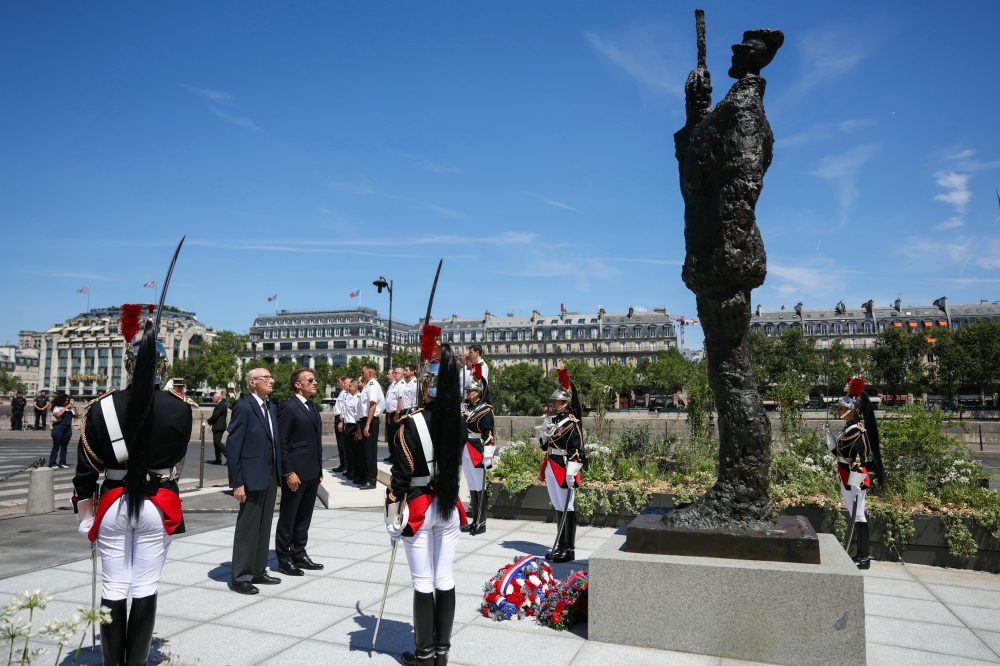
The French leader joined others in unveiling a statue dedicated to Capt. Alfred Dreyfus, a Jewish military officer whose false conviction for treason in the 1800s laid bare deep-seated anti-Jewish prejudice within France. Sunday’s ceremony marked 120 years to the day since France’s highest court cleared Dreyfus of all wrongdoing — and that same court is now where his statue stands.
The day’s events were shadowed by a serious security incident just hours before the ceremony. Police evacuated approximately 300 residents from the Paris suburb of Sarcelles after intelligence officials discovered a suspicious vehicle near a synagogue. The vehicle was found to contain a military-grade weapon. Sarcelles is home to a large Jewish community, and prosecutors launched a terrorism investigation into the matter.
French Interior Minister Laurent Nunez confirmed the vehicle held what he described as a “long military weapon,” while noting that investigators have not yet determined whether the Jewish community was the intended target.
France has the largest Jewish population in Europe and experienced a sharp increase in antisemitic incidents — including threats, property destruction, and physical attacks — in the wake of the Hamas assault on Israel on October 7, 2023, and the conflict in Gaza that followed.
Israeli Prime Minister Benjamin Netanyahu and U.S. Ambassador to France Charles Kushner both criticized Macron, claiming his decision to recognize Palestine last year has contributed to rising antisemitism.
Speaking at Sunday’s ceremony, Macron said, “We know that the old demons of antisemitism have never completely disappeared from our country,” and called for constant vigilance to stop acts that “target people because of who they are.”
Dreyfus was a Jewish French army captain who was convicted of treason in 1894 on fabricated charges that he had leaked military secrets to Germany. He was sentenced to life in prison. Prominent voices of the era, including celebrated novelist Emile Zola, publicly argued that Dreyfus had been used as a scapegoat by the French military establishment.
On July 12, 1906, France’s Court of Cassation — the country’s highest court — overturned his conviction and exonerated him completely. Macron announced that July 12 will now be observed as a national day of commemoration honoring Dreyfus’ innocence, beginning this year.
Following his exoneration, Dreyfus returned to military service and went on to serve in World War I. He passed away in 1935.
Among those attending Sunday’s ceremony was Dreyfus’ 99-year-old grandson, Charles. “I must sadly admit that I would not have imagined, at my age, seeing antisemitism resurface with such virulence in our country,” he said.
Despite his grief, Charles Dreyfus said he felt what he described as “the deep joy” of witnessing his grandfather’s statue placed outside the Palace of Justice — a sculpture depicting Dreyfus standing tall, holding a broken sword.