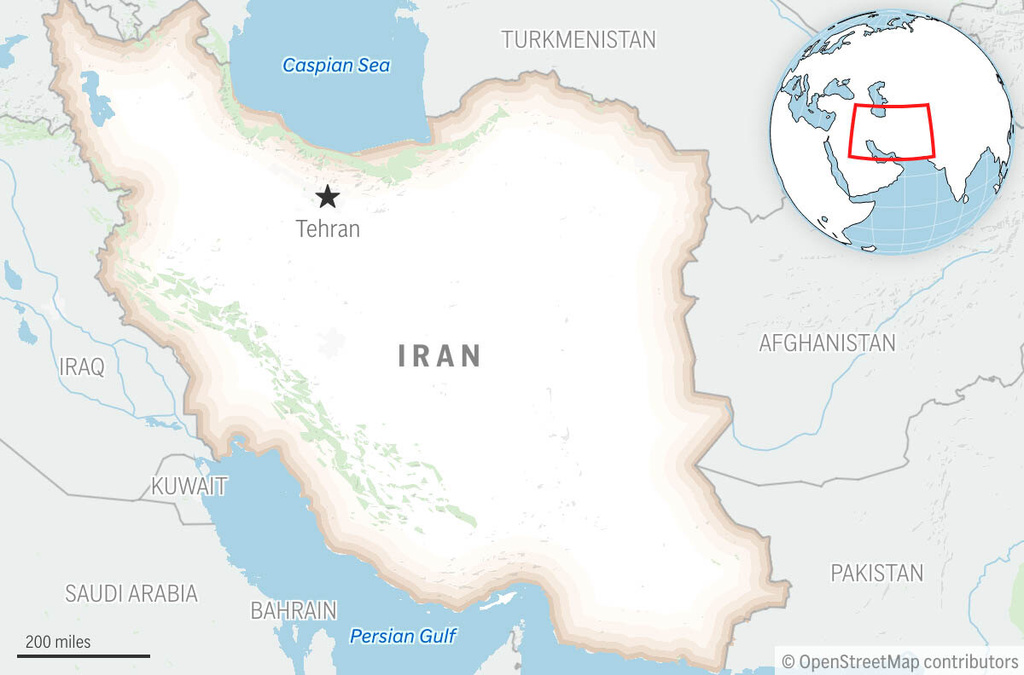

DUBAI, United Arab Emirates (AP) — American forces launched multiple rounds of strikes against Iran on Sunday, responding to an Iranian assault on a container ship in the Strait of Hormuz that ignited the vessel and left one crew member unaccounted for. Iran struck back by targeting Bahrain, Kuwait, Qatar, Jordan, and Oman — the nation sharing the other side of the strait that Tehran has been pushing to partner with in controlling ship traffic through the waterway.
The U.S. military released a statement saying its goal was to reduce Iran’s capability to freely attack commercial vessels passing through the vital strait. That statement followed a third wave of strikes that extended from late Sunday night into early Monday morning inside Iran.
Iranian state media acknowledged the latest round of attacks early Monday but reported no deaths or harm to civilian infrastructure in the regions near the strait. Whether any military targets were successfully hit remained unclear at that time.
The initial strikes Sunday morning came in direct response to Iran’s attack on a container ship in the waterway the previous day. Iran then launched retaliatory strikes against Gulf Arab nations, setting off a cycle of escalating violence that pushed ongoing peace negotiations between Tehran and Washington dangerously close to falling apart.
A second round of U.S. strikes followed later Sunday. The governor of Qeshm Island, located near the strait, told Iran’s state-run IRNA news agency that projectiles had been fired at military targets without causing any casualties. Residents also reported hearing explosions in the coastal city of Bandar Abbas and in Hajiabad, a city to the north.
A U.S. official, speaking without authorization to comment publicly on military activities, said a limited number of strikes were aimed at missile and air defense systems as well as paramilitary Revolutionary Guard watercraft.
The conflict comes as Iran and the U.S. are roughly halfway through a 60-day interim agreement designed to lead to a permanent end to the war. The Strait of Hormuz — long regarded as an international waterway and a critical corridor for the world’s oil and natural gas supply — has become a major point of contention in negotiations that now appear at serious risk of breaking down.
United Nations Secretary-General António Guterres warned that “a return to full-scale hostilities would have catastrophic consequences,” according to an official statement.
Earlier Sunday, the U.S. military reported hitting approximately 140 targets, which included missile and drone launch sites, weapons storage depots, communications equipment, and other facilities. The intensity of the attacks surpassed those seen in recent days. Over the past week, the U.S. has conducted three rounds of airstrikes on Iran in response to attacks on ships traveling through the strait via a route along Oman’s coast, which ships have been using to avoid Iranian territorial waters.
“We bombed the hell out of them last night,” President Donald Trump said in an interview on NBC’s “Meet the Press.”
Semiofficial Iranian news outlets reported that a navy officer was killed in the strikes. Iran retaliated by attacking regional nations that host U.S. military personnel, while maintaining its position that it alone must control the strait and may require ships to pay fees to pass through it.
“The era of one-sided deals is OVER,” wrote Mohammad Bagher Qalibaf, the speaker of Iran’s parliament and a key negotiator. “We told you: keep your word or pay the price. Reality is knocking.”
Iran declared the strait closed until the situation stabilizes and warned it could strike “additional enemy bases in the region” if attacks continued. The U.S. military and President Trump both maintained that the strait remained open for navigation.
The U.S. military reported that more than 140 ships had passed through the strait over the previous week. A multinational organization under U.S. Navy oversight said vessel traffic was continuing “at reduced levels” along routes near both Oman and Iran, noting that nearly 140 ships had been transiting daily before the war began.
Prior to the war, roughly one-fifth of all globally traded oil and natural gas moved through the strait. Iran’s control over the waterway triggered a worldwide energy crisis, though oil prices have fallen sharply from wartime peaks of $120 per barrel.
Qatar’s military announced it had intercepted incoming Iranian fire, with explosions also reported in the neighboring United Arab Emirates. Three individuals, including a child, sustained injuries from shrapnel during the interception, according to Qatar’s Interior Ministry.
Missile alerts were triggered in Bahrain, which is home to the U.S. Navy’s 5th Fleet.
Kuwait’s Defense Ministry reported that three northern land border posts and an offshore drilling platform operated by the Kuwait Oil Company were damaged, with one worker injured.
Three Iranian missiles struck locations across Jordan, causing minor damage but no reported injuries, according to Jordan’s state news agency.
Oman’s state news agency reported that drones hit sites along the waterway — just one day after Oman and Iran had held talks about the strait and agreed to keep talking. The strait runs through the territorial waters of both Iran and Oman. Oman called in the Iranian ambassador to formally protest the strikes, the first such diplomatic action since the war began, and labeled Iran’s actions “irresponsible.”
The Cyprus-flagged container ship struck by Iran sustained “significant engine room damage,” according to the U.S. military. Oman’s maritime authority said it rescued 23 crew members, but one remained missing. India’s foreign ministry identified the missing individual as an Indian national.
The United Kingdom Maritime Trade Operations center, which operates under British military oversight, confirmed the ship had been traveling along Oman’s coastline at the time of the attack.
Iran’s Revolutionary Guard claimed that multiple vessels “disregarded our warnings” and failed to follow what it described as an approved route, saying one ship “was struck by a warning shot and brought to a stop.”
Iranian state media subsequently reported U.S. strikes across the country, including in southern Iran in the province nearest the strait and at military installations in a province close to Tehran.
President Trump suggested last week that the interim ceasefire deal was “over,” but mediating nations including Pakistan, Qatar, and Egypt have continued working toward a resolution. A regional official involved in the mediation effort, speaking anonymously to discuss the sensitive talks, said efforts to preserve the ceasefire continued on Sunday. Pakistan confirmed that its foreign minister spoke by phone with Iran’s top diplomat and called for “de-escalation” from both sides.
Iran’s new supreme leader, Ayatollah Mojtaba Khamenei, who had not been seen publicly since the war began, issued his first statement Saturday since the funeral of his father, Ayatollah Ali Khamenei. He vowed that Iranians would seek revenge for his father’s death, which occurred in the war’s opening strikes on February 28.