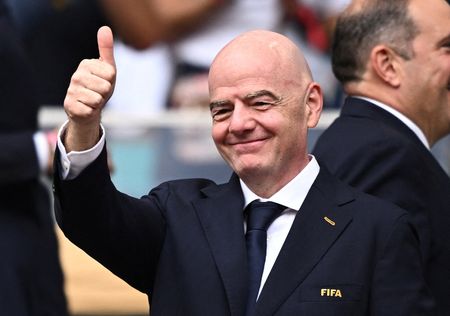

ATLANTA — FIFA president Gianni Infantino has signaled that a potential expansion of the World Cup to 64 participating teams could be on the agenda, though he said those conversations won’t happen until after the current tournament wraps up.
The 2026 World Cup, being held across Canada, Mexico, and the United States, is the first edition to feature 48 teams — an increase that drew significant criticism when it was announced but has generated little controversy since play began on June 11.
Speaking to Swiss television outlet Blue Sport, Infantino — who championed the move from 32 to 48 teams — said, “These are all issues that we will be examining after the World Cup.”
He kept his comments brief on the subject but offered a broader vision for the tournament’s future: “I think it is important that when you want to organise a World Cup, you do it for the whole world — not just Europe and South America, but effectively the entire world.”
Infantino continued: “Every nation should be allowed to dream of participating in the World Cup. You can see that the quality of the teams is extremely high and it’s getting higher and higher, all over the world.”
He also made the case for giving smaller nations a seat at the table: “If you don’t give smaller countries a chance to participate in the World Cup, they’ll lack the incentive to keep improving.”
The FIFA president called the expanded 48-team format a success, pointing to strong performances from teams across all continents. “Every team played at a high level. Teams from every continent scored goals and earned at least one point,” he said.
Infantino highlighted Africa’s strong showing in particular: “Nine out of 10 African teams reached the knockout stage. At the last World Cup, there were only five teams from Africa. That just goes to show how important it is to include all teams, to give them this opportunity to participate.”
The World Cup field was last expanded in 1998, when it grew to 32 teams. Looking ahead, the 2030 tournament is set to be co-hosted by Morocco, Portugal, and Spain, while Saudi Arabia will host the 2034 edition.
Infantino, who rarely sits down with journalists and has held few formal press conferences during the tournament, also addressed two other hot-button issues: hydration breaks and ticket pricing.
On the subject of mid-half hydration breaks — which critics have suggested are designed to give television partners additional advertising time — Infantino acknowledged the backlash while referencing last year’s Club World Cup in the United States as a testing ground.
“This is a topic that sparks a lot of debate. After all, we don’t want to get everything perfect; we like to give everyone something to disagree with… no, joking aside. Last year, during the Club World Cup in the USA, there were cooling breaks whenever it was very hot,” he said.
He noted that those breaks occurred in roughly 60% of matches but not in the remaining 40% where temperatures were lower, which itself drew complaints about uneven conditions between teams.
As for ticket prices drawing criticism for being too expensive, Infantino pointed to near-full stadiums as evidence the market supported the cost. “The stadiums are full; capacity utilisation is at 99.7% and it will likely reach 99.9% by the end,” he said.
“Experts determined the ticket prices before the tournament. Our experts worked on that and told us: ‘These are the prices you can go with’. We see the proof now: prices that some people claimed were too high are being resold on the secondary market — which is perfectly legal here — for four or five times the original cost,” Infantino added.
The FIFA president projected that the organization would bring in between 13 and 14 billion Swiss francs — roughly $16.08 billion to $17.32 billion — from the 39-day event. “That is quite satisfactory,” he said.